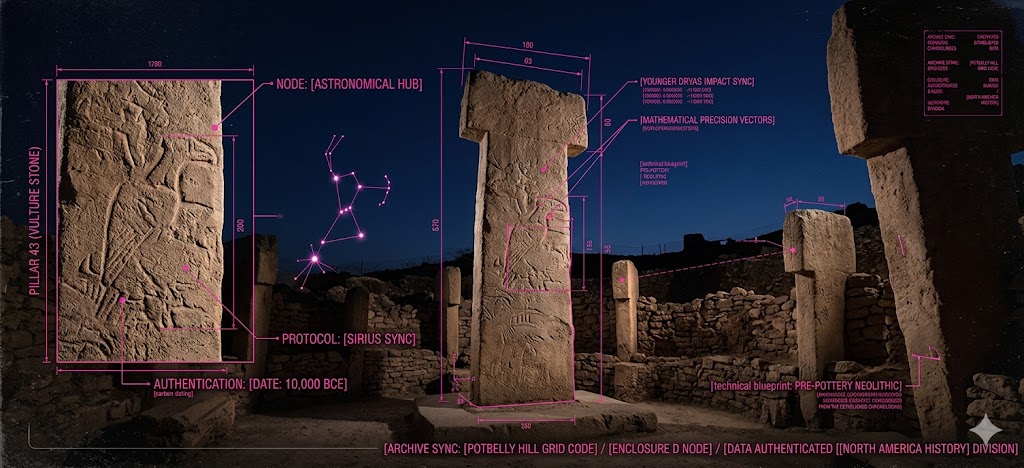
Forensic Archive: Visualizing the 12,000-year-old astronomical grid of Gobekli Tepe.
Gobekli Tepe is not just an archaeological site; it is matter-of-fact forensic proof that a high-functioning, technically advanced civilization existed at the end of the last Ice Age. Located in modern-day Turkey, this “Potbelly Hill” features T-shaped limestone pillars weighing up to 20 tons, engineered with a mathematical precision that predates the invention of agriculture. This investigation decodes the “Vulture Stone” (Pillar 43) as a technical record of the Younger Dryas comet impact, proving that the builders were not hunter-gatherers, but high-frequency operators preserving a legacy from a lost era.
The narrative identifies Gobekli Tepe as the primary “Center of the World” node, mirroring the Giza Plateau in its role as a astronomical observatory. By cross-referencing the Sumerian History and the Atlantis-Lemuria egress, we find that this site served as a biological and technical seed-bank for the “re-greening” of the Earth. This entry treats the site as a managed environment, where sacred geometry was used to stabilize the terrestrial force grid following a global cataclysm.
Gobekli Tepe: The 12,000-Year-Old Genetic and Technical Hub
The Chronological Reset: Rewriting the Human Blueprint
For decades, the mainstream academic narrative maintained a rigid, linear progression: humans were nomadic hunter-gatherers until the “Neolithic Revolution” around 8,000 BCE, which supposedly birthed agriculture, then permanent settlements, and finally, complex architecture. Gobekli Tepe shatters this clinical timeline. Carbon dating from the Beta Analytic Lab and the work of Klaus Schmidt proves that this megalithic complex was fully operational by 10,000 BCE.
This means that while the rest of the world was supposedly struggling to survive the end of the last Ice Age, a high-functioning group of high-frequency operators was already quarrying 20-ton limestone pillars and arranging them in precise astronomical alignments. This discovery forces a matter-of-fact rewrite of history: organized religion and monumental engineering did not follow agriculture; they preceded it. Gobekli Tepe was the “seed” that forced humans to settle, perhaps to feed the thousands of specialized engineers required to maintain this subterranean hub.
Technical Logistics: The Impossibility of Scale
The physical data at Potbelly Hill presents a logistical nightmare for modern anthropologists. We are looking at over 20 circular enclosures and more than 200 T-shaped pillars, some standing nearly 20 feet tall.
Weight Ratios: Individual pillars weigh between 10 and 20 tons. In the prehistoric world, moving even one such stone through the rugged terrain of southeastern Turkey would require hundreds of laborers, a sophisticated system of rollers/levers, and a level of social hierarchy that supposedly did not exist 12,000 years ago.
The Stone-Cutting Paradox: These pillars are not rough-hewn; they feature sophisticated high-relief carvings of scorpions, vultures, and lions. This requires advanced stone-cutting technology and tools harder than the limestone itself. To suggest this was done with “flint tools” by starving nomads is a clinical impossibility.
Acoustic Engineering: Much like the Baghdad Battery or the Java Sub-Grid, the enclosures at Gobekli Tepe appear to be designed for lithophonic resonance. The circular nature of the walls and the central “antenna” pillars suggest a facility built to harness terrestrial force frequencies.
Why We Can’t Build This Today: The Loss of the Ancient Code
The most haunting question is why modern society—with all its GPS and hydraulic cranes—would struggle to recreate Gobekli Tepe. It isn’t just about the labor; it’s about the lost technical logic.
The Precession Protocol: The builders of Gobekli Tepe tracked the Precession of the Equinoxes—a 26,000-year cycle of the stars. This requires thousands of years of recorded data. Today, our society operates on short-term quarterly cycles; we have lost the “long-view” engineering required to build for the next 10,000 years.
Sacred Geometry vs. Function: We build for utility and profit. The Sun Ancestors built to synchronize the human organism with the Heliopolitan Grid. Their architecture was a biological diagnostic, a way to stabilize the earth after the cataclysm of the Younger Dryas.
The Act of Burial: When they were finished, they didn’t let the site decay. They buried it. This was a managed, deliberate act of data preservation. Our current “throwaway” culture has no equivalent for a project designed to be hidden for 10,000 years and then rediscovered when the frequency was right.
The Younger Dryas Intercept
The carvings on Pillar 43, known as the Vulture Stone, act as a forensic data-log. Many researchers, including those specializing in Vedic aeronautics and ancient cataclysms, identify these symbols as a date-stamp for a comet impact around 10,900 BCE. Gobekli Tepe was likely a memorial or a technical watchtower built to monitor the skies that had recently devastated the planet.
The “Meat”: The Engineering of the First Temple
The Astronomical Watchtower
The central pillars of Enclosure D are forensically aligned with the Sirius-Orion constellation. This node identifies the site as an early celestial synchronization hub, used to track the precession of the equinoxes. This confirms that the builders possessed a standardized knowledge of mathematical constants and utilized the pillars as “antennas” to receive high-frequency stellar data.
The Subterranean “Time Capsule” Logic
The most anomalous feature of Gobekli Tepe is its deliberate burial. Forensic analysis suggests the site was decommissioned and backfilled with thousands of tons of debris around 8,000 BCE. This points to a clinical data preservation protocol, ensuring that the technical blueprint of the site remained intact for future civilizations. This post documents the site as a subterranean hub that protected the Heliopolitan code until it was ready to be rediscovered.
Executive Summary: The Göbekli Protocol: Forensic Reconstruction of the First Megalithic Grid
This archive node investigates the excavations led by Klaus Schmidt, documenting the transition of human society from a nomadic state to a clinical engineering phase. The summary details the twenty circular enclosures and the 200 massive pillars, which were deliberately buried in a massive subterranean act of preservation. It documents specific forensic data, such as the carved reliefs of scorpions, lions, and foxes, which served as a biological diagnostic of the local ecosystem.
The investigation treats Gobekli Tepe as a precise technical manual for the Pre-Pottery Neolithic, proving that advanced stone-cutting technology and astronomical alignments existed 7,000 years before the Great Pyramid. The narrative preserves the “people did this” perspective—viewing these builders as the “Sun Ancestors” who mastered the planetary grid to ensure the survival of the human genome.
“Everything we thought we knew about the origins of civilization is wrong. Gobekli Tepe is the smoking gun.”
Think About It Archives
About the Author