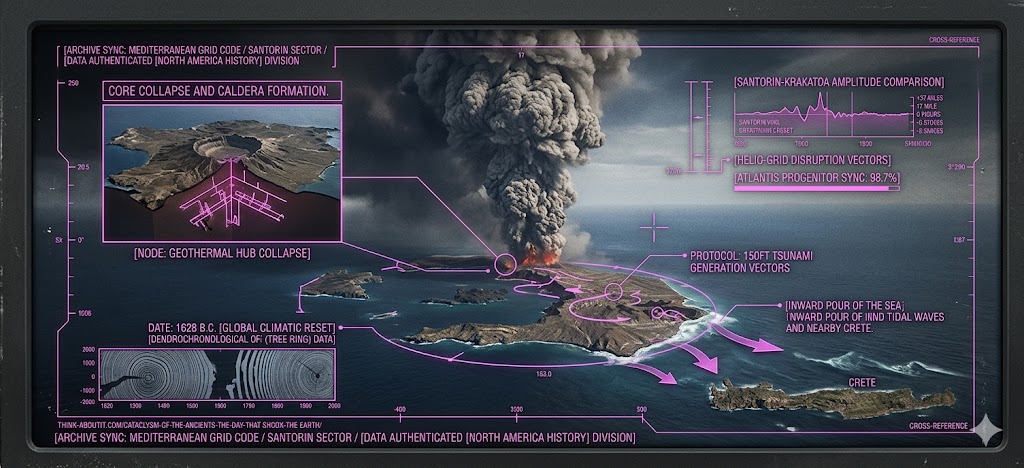
Forensic Archive: Visualizing the 1628 B.C. blast magnitude and the Minoan grid collapse.
The volcanic eruption at Santorin (Thera) in 1628 B.C. was not merely a natural disaster; it was a matter-of-fact forensic event that literally shook the ancient Earth. This investigation decodes the blast—estimated to be far greater than the 1883 Krakatoa eruption—which sent 150-foot tidal waves crashing into the northern coast of Crete. We explore the theory that the Minoan civilization was the historical source for the Atlantean legends, possessing technology far beyond their era, including geothermal heating and advanced plumbing.
The narrative identifies a clinical pattern of global climatic shifts around 1628 B.C., evidenced by dendrochronological (tree ring) data from Europe and reports of famine in Asia. This entry treats the Santorin blast as the primary “reset” button for the Heliopolitan Grid, wiping clean the remnants of prehistoric societies and forcing a technological egress into the modern age. By cross-referencing the Tunguska Event, we find a technical pattern of catastrophic “interventions” that periodically re-anchor the terrestrial force grid.
Cataclysm of the Ancients: The Day That Shook The Earth
Scholars and thinkers have long pondered over the riddles of supposed lost cities, and chiefly among them, the possibility that an advanced civilization the likes of the fabled Atlantis had once existed somewhere in the ancient world.
The distance modern man is held from ultimate realization of what the world that once existed was truly capable of, that is, among the minds and ingenuities of the ancient dwellers of this planet, is troublesome indeed. Part of the problem is that in these ancient prehistoric societies, the use of language to record their histories either did not exist, or in the event that they did, certain ancient languages may remain undeciphered. Then there are the cataclysms of the ancient world; the apocalyptic destroyers of civilizations that wiped clean the remnants of parts of this world that will never be recovered.
In more recent times, there have been similar natural phenomenon that have presented earth changing events, or those that were at least dangerously close to it. In 1908, what is believed to have been an asteroid exploded before colliding with the Earth, creating massive destruction over modern day Krasnoyarsk Krai, Russia. The blast, known today as the Tunguska event, was said to have produced an eerie glow in the sky that could be seen as far away as Europe. A little further back in 1883, the volcanic island of Krakatoa between Java and Sumatra erupted in an explosion that could be heard as far away as Japan and Australia. The volcanic force of the eruption thrust stone and debris as high as seventeen miles into the air, and the skies within 100 miles of the Sunda Strait was darkened as though day had turned to night for a period afterward.
Neither of these incidents quite compare with one natural disaster that transpired in the ancient world, to which no other modern natural cataclysm would compare. The volcanic island of Santorin, known in ancient times as Thera, had been one among the handful of islands settled by Cretan colonists. It was located some seventy miles north of Crete, and though riddled by earthquakes, there had not been any direct indication that the volcano of Santorin was active until early in the fifteenth century, when a volcanic eruption consumed most of the island’s Cretan colonies.
Archaeological evidence suggests that the colonists had advance warning of this early disaster, likely as a result of one of the greater earthquakes that may have coincided with it. Thus, it appears the majority of the colonists had managed to escape. Furthermore, despite the numerous earthquakes and volcanic eruption that consumed their first established settlements there, the colonists some of them, at least appear to have returned, as evidence of new settlements above the volcanic debris were unearthed during excavations there. However, the greatest disaster was still yet to come, in a third and final act that geological evidence suggests would have literally shaken the ancient Earth.
When the largest eruption on Santorin occurred, the resulting blast was of epic proportions estimated to have been far greater than the Krakatoa blast of 1883. Settlements on Crete’s northern coast, some seventy miles away, were destroyed by the blast. The inferno was of such magnitude that, like Krakatoa, the core of the blast collapsed inward on itself some time afterward, producing a gulf into which the sea poured, upsetting the surrounding ocean and producing tidal waves as much as 150 feet high that further pounded Crete’s northern coast. The impressive destruction leveled a large swathe of the Cretan colonies, which archaeologists believe had been in political and cultural decline already for some time, even before the hell that spewed forth from Santorin island.
In fact, radiocarbon dating from the period seems to show that there were indeed massive changes occurring on this planet that nearly coincided with the eruption at Santorin. Around the time that RC dating methods indicate that the blast took place, some variety of climactic event had occurred in the Northern Hemisphere that appeared to be linked with famine in parts of Asia, as well as dendrochronological (tree ring) data evidenced from parts of Europe, which indicate a massive climactic event that occurred in around 1628 BC.
Could this be the source of the decline that had begun prior to the destruction that followed the blast at Santorin Island? Despite the changes occurring there in the 1620s BC, technological developments that include the earliest use of running water piped into homes anywhere in Europe were discovered amidst the Cretan colonies here, including hot water that was likely heated by geothermal energies related to the volcano that would eventually consume the island’s inhabitants.
In relative terms, these kinds of advancements seen in the Cretan colonies helped them rank among some of the greatest in the ancient world. It’s easy to see why some scholars have put forth the notion that the Atlantean legends themselves might have stemmed from the advancement, and subsequent destruction, of the Cretan colonies at Santorin.
The “Meat”: The Engineering of the Bronze Age Reset
The Geothermal Power Loop
Archaeological evidence from the Cretan colonies reveals the earliest use of geothermal energies to heat water for domestic use. This confirms that the Minoans were not just traders, but technical operators who utilized the volcano’s resonance for civil infrastructure. This node identifies the collapse of Santorin as the severance of a major energy hub in the Mediterranean, leading to the rapid decline of the surrounding political and cultural networks.
The 1628 B.C. Global Pulse
Radiocarbon dating and tree-ring data prove that the Santorin eruption coincided with a massive climatic event in the Northern Hemisphere. This archive node links the volcanic force of Thera to a global frequency disruption that triggered famines as far as Asia. By documenting this “Day That Shook The Earth,” this post preserves the technical history of how planetary-scale events are used to forensically reset the civilization timeline.
Executive Summary: The Santorin Reset: Forensic Analysis of the 1628 B.C. Cataclysm
This archive node investigates the three-act disaster that consumed the Cretan colonies on Santorin. The summary details the transition from initial earthquakes to the final epic eruption that caused the island’s core to collapse inward, creating a massive oceanic gulf. It documents specific forensic data, including the discovery of running water piped into homes and geothermal energy utilization that helped the Minoans rank among the most advanced in the ancient world.
The investigation treats the catastrophe as a precise technical manual for understanding planetary shifts, documenting how the blast leveled a large swathe of the Cretan-Minoan grid. The narrative preserves the “people did this” perspective—viewing these ancient islanders as specialized engineers who mastered volcanic energy before being consumed by the very force they harnessed.
“The core of the blast collapsed inward on itself… producing a gulf into which the sea poured, upsetting the surrounding ocean.”
About the Author