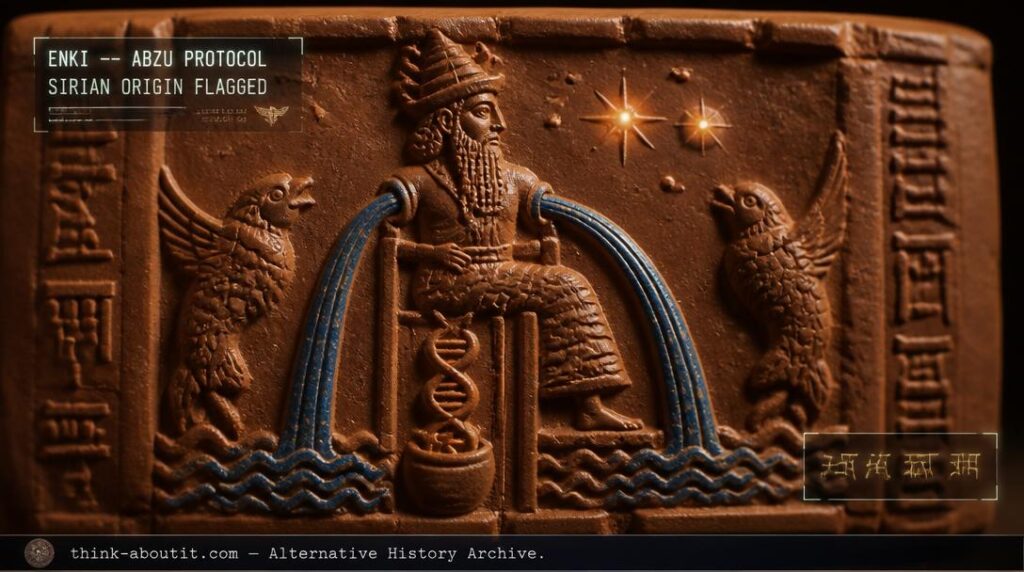
Ea — Lord of the Abzu, chief genetic engineer of the Anunnaki, and the entity who gave humanity the knowledge its creators wanted suppressed — remains the most consequential figure in the Sumerian pantheon.
Before Yahweh, before Zeus, before any god the Western world remembers by name, there was Ea — the Sumerian Enki, Lord of the Abzu, god of wisdom, fresh water, and the genetic engineering of the human species. In the Mesopotamian creation epics, Ea is the deity who designed Homo sapiens as a labor force for the Anunnaki, and then — in a move that put him permanently at odds with his own pantheon — turned around and championed the survival of his creation against every attempt by his half-brother Enlil to exterminate it. When the flood came, it was Ea who warned Atrahasis. When the other gods voted for genocide, it was Ea who dissented. The serpent in the Garden of Eden? According to Dr. Arthur David Horn and channeled material from “The Prism of Lyra,” that was Ea too — a Sirian entity encouraging humanity to eat from the Tree of Knowledge against the explicit orders of the Lyran faction that wanted its slave species kept ignorant.
The article traces Ea’s identity through multiple cultural lenses: the Sumerian water god of Eridu, the Babylonian architect of the Enuma Elish, the Sirian genetic interventionist of Sitchin’s Anunnaki framework, and — in a detail that belongs in a novel but apparently comes from a field trip — the co-deity embedded in the name “California” itself. According to local tradition near a 30,000-year-old site in the Malibu area, the word California derives from “Kali-form-Ea” — Kali and Ea formed the land. Whether you read Ea as mythology, ancient astronaut history, or encoded Sirian contact protocol, his fingerprints are on everything.
Who is Ea?
Throughout my life it seems that the subject of Ea has cropped up from time to time. When I was a child I was taught about the serpent in the garden of Eden. Next I was told that Ea was the same person as Enki, who was a space person from Sirius and he helped out mankind. Last of of I made a trip down into the Malibu area of Calif. to see a 30,000 year old city and was told that the word California comes from the name of two deities. The first was called Kali and the second was called Ea. Kali was changed into the word Cali and the last part of California was changed from Ea to Ia. They put a word in the middle which is the word Form which was changed to forn. We then have the name Kali form Ea or California which means Kali and Ea formed the land. Here is some information that will make it make a little more sense.
We have seen that the entity Enki (or Ea) is portrayed in the Mesopotamian historical epics as having played a crucial role in the genetic engineering of modern humans, and he consistently championed the cause of humans, usually in the face of considerable opposition from other “gods”, the Anunnaki. Enki, who is identified as the chief genetic engineer of the Anunnaki and half-brother of Enlil in the Mesopotamian creation epics, is identified as a Sirian, “who protects humanity”, in The Prism of Lyra by Royal and Priest. This channeled information certainly fits in well with the historical information we have reviewed. The reader will recall that we have evidence of entities from the vicinity of the double star Sirius being involved in the ancient affairs of humans from the oral traditions of the Dogan tribe of west Africa. This, plus historical data indicating that ancient Egypt was involved with entities from near Sirius leaves little doubt of a Sirian connection with ancient mankind.
Enki’s frequent compassionate behavior he displayed towards the human slaves of the Anunnaki bespeaks of an entity that was much more spiritually evolved than the Anunnaki. The Anunnaki would not want their slaves to know of an entity who had their best interests in mind and was actually trying to help them. On the other hand, the Anunnaki apparently needed the skills of Enki, especially in the genetic engineering of their slave species. It seems probable, therfore, that the Anunnaki would try to distort accounts of Enki, the Sirian, even to the point of making Enki one of their own.
In The Prism of Lyra the Sirians are depicted as interfering with the plans of a Lyran group that were trying to create a species that was to have no knowledge of good and evil. How “the Lyran group” was related to the Anunnaki of the Sumerian texts is not made clear. Perhaps, the Lyrans of The Prism of Lyra and the Anannaki of the Sumerians are one. Or, perhaps we are looking at different levels, where the Anunnaki of the “twelfth planet” in our solar system are actually carrying out the wishes of a “Lyran group” unknowingly.
In any case, The Prism of Lyra states that the Lyrans and Sirians, who had worked together in the creation of humans, the primitive workers, disagreed philosophically concerning their creation. While the Lyrans wanted to create a species devoid of the knowledge of polarity – or of “good” and “evil” – the Sirians saw that humans could not evolve spiritually without this knowledge. Royal and Priest point out that Enki in the Sumerian texts is sometimes portrayed as a serpent – an evil serpent – and that perhaps this was a ploy by Lyrans to keep humanity from following the instructions of the Sirians who were attempting to help humankind. Royal and Priest imply that it was the Sirian group that encouraged Adam and Eve to eat of the Tree of Knowledge in the story of the Garden of Eden, as contained in the Bible.
The Sirians may have been at least temporarily thwarted by the Lyrans (the Anunnaki?) (JW They spell this word two ways in this information—- Anunnaki and Anunnaki), in the Garden of Eden, but it seems that the Sirians had the last laugh. According to The Prism of Lyra, the Sirian group inserted a latent DNA code in humans:
The code is triggered by an accelerating vibration that occurs when a civilization begins to evolve spiritually. As Earth accelerates toward self-awareness and fourth density (which is occurring presently), the code is activated. Once activated, the human race unwinds its limited vision like a coil until the expanse of All That Is becomes visible. It was their way of allowing humanity to eat from the tree of life after all.
Perhaps your latent DNA code implanted by Enki or other members of the “Sirian group” is becoming active as you read this book. In any case, it is safe to say that entities from a planet near Sirius were very much involved in our biological, cultural and spiritual evolution/creation.
Source of Information: Humanity’s Extraterrestrial Origins, by Dr. Arthur David Horn.
Executive Summary:
The God Who Made Us and Then Saved Us — Ea, the Sirian Connection, and the Latent DNA Code
This article assembles the identity of Ea/Enki from Sumerian creation epics, Babylonian liturgy, Zecharia Sitchin’s Anunnaki framework, and channeled material from Royal and Priest’s “The Prism of Lyra,” cross-referenced with Dr. Arthur David Horn’s research in “Humanity’s Extraterrestrial Origins.” The composite portrait depicts Ea as a Sirian entity who served as chief genetic engineer for the Anunnaki, created the human species, and then consistently intervened on humanity’s behalf — warning of the flood, dissenting from Enlil’s extermination orders, and covertly encouraging the acquisition of knowledge that the ruling faction wanted suppressed.
The article’s most provocative claim comes from “The Prism of Lyra”: that the Sirian group inserted a latent DNA code in humanity — a code triggered by accelerating planetary vibration as a civilization approaches fourth-density awareness. This code, once activated, “unwinds limited vision like a coil until the expanse of All That Is becomes visible.” The article also draws on the Dogon tribe’s oral traditions and ancient Egyptian stellar alignments as independent evidence of a Sirian connection with early humanity. As the source material frames the Garden of Eden: the serpent was not the villain — the serpent was Ea, and the fruit was the knowledge the slave-masters didn’t want you to have.
FAQ for “Who is Ea?”
Q: Are Ea and Enki the same god?
A: Yes. Enki is the original Sumerian name (meaning “Lord of the Earth”), while Ea is the Akkadian and Babylonian name. While their names changed over time, their attributes—wisdom, water, and creation—remained consistent throughout Mesopotamian history.
Q: What is the “Abzu” (Apsu)?
A: The Abzu was believed to be a vast, subterranean freshwater ocean located deep beneath the earth. It was the source of all life-giving water (rivers and springs) and served as the mystical home and laboratory of the god Ea.
Q: How did Ea save humanity from the Great Flood?
A: In the Atrahasis and the Epic of Gilgamesh, the god Enlil decides to wipe out humanity with a flood because they are too noisy. Ea thwarts this plan by whispering through the wall of a reed hut to the hero Utnapishtim (or Atrahasis), instructing him to build a boat to save his family and the seeds of all living things.
Q: What are the symbols of Ea?
A: Ea is most commonly associated with flowing water, often depicted with two streams (the Tigris and Euphrates) erupting from his shoulders. His animal symbols include the Goat-Fish (the precursor to the Capricorn zodiac sign) and the Turtle.
Q: Why is Ea called a “Trickster” god?
A: Ea is often called a trickster because he rarely uses brute force to solve problems. Instead, he uses magic, cleverness, and subversion. His “tricks” are almost always performed to benefit humanity or to maintain the balance of the universe against more impulsive deities.
About the Author