
The Antikythera Mechanism — a 37-gear analog computer from the 2nd century BC — predicted eclipses, tracked planets, and calculated Olympic dates using Babylonian mathematics. Nothing comparable would be built for another 1,500 years.
The mechanism was discovered in 1901 in an ancient shipwreck near Crete. Its origins still remain a mystery, but it is believed that it could serve as an astronomical calculator. The complex clock-like mechanism consisting of 37 bronze gears was most likely used to track planetary positions and accurately predict lunar and solar eclipses. It also tracked the dates of the Olympic Games.
What is the most amazing about this ancient device is that it was centuries ahead of its time. The complexity and the unbelievable accuracy of the mechanism make it more advanced than any known similar device of the time when it was created and for centuries afterwards.
When, where and by whom was it built? Science does not give a solid answer, but some experts suggest that it might have been inspired by one of the legendary scientists of the Greek antiquity – Archimedes, Hipparchus or Posidonius. This is also consistent with a study conducted in 2008 which examined the language inscribed on the mechanism and concluded that it must have been manufactured in Corinth or in Syracuse, where Archimedes lived. As for the date of manufacture, the engravings on the box the device was housed in were estimated to date between 80 and 90 B.C. But more recent estimations of the age of the letters in the inscriptions suggest a date of 100 to 150 B.C.
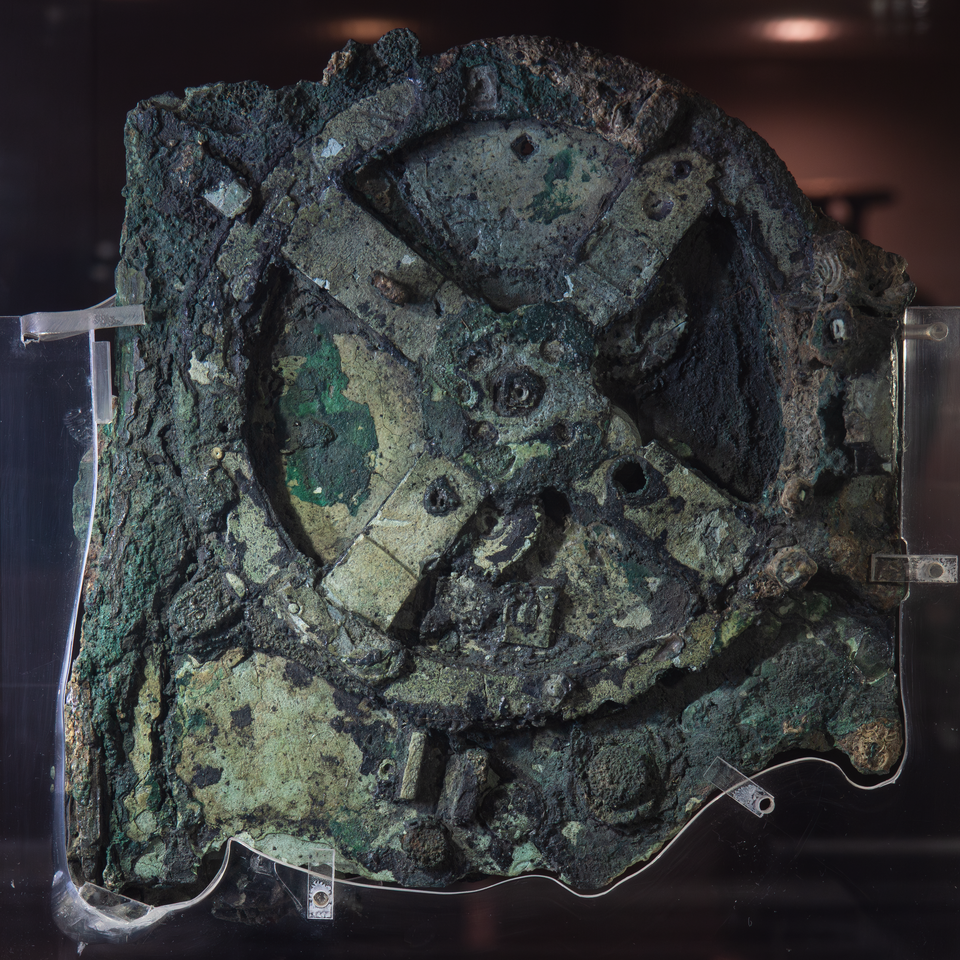
Now, Dr. Christian Carman of National University of Quilmes in Argentina and Dr. James Evans of the University of Puget Sound in Washington suggest that the Antikythera mechanism’s calendar started in 205 B.C., just seven years after Archimedes’ death.
The new finding also makes the connection of the Antikythera mechanism to Archimedes seem even less likely, as the Antikythera wreck, which involved the ship that was carrying the device, took place between 85 and 60 B.C., and Archimedes was killed in 212 B.C. Of course, the device could have been built with a starting date set many years before its manufacture, but it does not make sense because in this case its accuracy would have been significantly reduced.
Earlier this fall, an international expedition travelled to the site of the shipwreck and made a number of remarkable finds. They plan to return in the spring. Who knows, maybe the findings from that trip will disclose more about this mysterious ancient device.
ABOUT THE AUTHOR
Anna LeMind is the owner and lead editor of the website Learning-mind.com, and a staff writer for The Mind Unleashed.
Executive Summary:
The Machine That Shouldn’t Exist — New Findings on the Antikythera Mechanism’s Lunar Calendar and Babylonian Roots
Anna LeMind’s report covers the latest research on the Antikythera Mechanism — the 2nd-century BC analog computer recovered from a Roman shipwreck in 1901. New statistical analysis by Dr. Christian Carman and Dr. James Evans, using gravitational wave modeling techniques, has revealed that the Calendar Ring was calibrated to a 354-day lunar year and that the eclipse prediction scheme was based on Babylonian arithmetic rather than Greek trigonometry. The device’s operational start date has been pushed back to 205 BC, weakening its previously assumed connection to Archimedes and suggesting it drew on a much older mathematical tradition.
The article positions the mechanism as evidence for a 1,500-year gap in the technological record — a period during which no known civilization produced anything approaching its precision, despite the engineering clearly having existed. As the site’s editorial framing notes, the finding reinforces the “Living Thread” theory: that computational capabilities existed in ancient civilizations and were lost or suppressed, creating blank spots in human technological history that remain unexplained. The mechanism tracked planetary positions, predicted eclipses, and calculated Olympic dates — with 37 bronze gears — centuries before anything similar would be built again.
About the Author