Aerial Extraction: Mapping the forensic evidence of sky-bound vanishings through the thread of truth.
Dismantle the linear narrative of travel and face the material reality of tracks that end in nothing. This dossier scrutinizes “Voices from the Sky“—exposing how Oliver Lerch vanished while crossing a farmyard in South Bend, Indiana. By cross-referencing Ambrose Bierce’s 1893 fiction with M.K. Jessup’s UFO analysis, we reveal how a literary ghost story may have camouflaged actual anomalous events occurring throughout 1889, 1890, and 1900.
In a landscape of managed historical records and identity-shifting enigmas, reclaiming the sovereign record of these fading screams is a vital step. We are in a fight to distinguish between mercurial urban legends and the predatory dimensional gates that snatch individuals from the safety of their homes.
Voices from the Sky: The strange case of Oliver Lerch.
The story of poor young Oliver varies quite a bit. For starters he has a couple of different names – that being Oliver Lerch, Oliver Larch and Oliver Thomas.
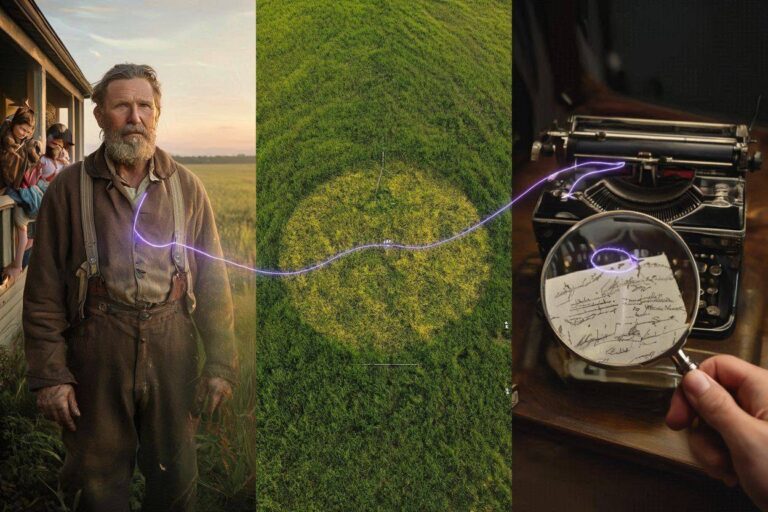
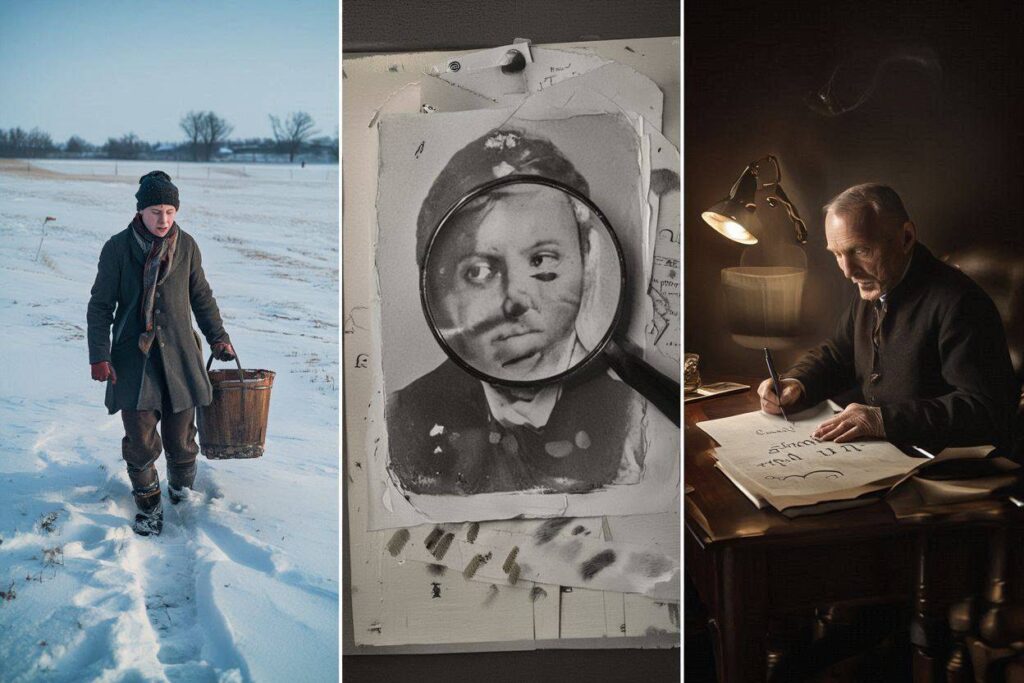
The story tells of a young man either eleven or twenty years old who lived on a farm outside South Bend, Indiana. On Christmas Eve 1889, 1980 or 1900 Oliver, some friends and family were having a Christmas party. Oliver went to fetch water from the well outside. A few minutes later screams were heard from outside. Everyone rushed outside to see a mysterious sight. Oliver’s tracks suddenly disappeared halfway to the well. His voice was heard screaming from the sky “It’s got me! Help! Help!” The screams faded away and Oliver was never seen or heard from again.
Another version of the story features one Oliver Thomas, an eleven year old, who lives in Rhayader, Wales. This version is believed to have appeared as recently as the 1960’s when first published in “true mystery” paperbacks. Further investigations into this character have proved that Oliver Thomas of Rhayader never existed at all and the story had it’s origins from the original Oliver Lerch/Larch story.
The Larch/Lerch story is the much older and much more original version. The story was featured in M. K. Jessups’ The Case for the UFO (1955) and in Frank Edward’s Strangest of All (1956), it also appeared in the 1950 issue of Fate Magazine.
The story is believed to have come from and early science-fiction story “Charles Ashmore’s Trail,” published in an 1893 collection by Ambrose Bierce, Can Such Things Be? The main character is Charles Ashmore not Oliver Lerch however, but the story is the same……. it’s still a mystery how a science fiction story became an unsolved mystery and how the title character suddenly became Oliver Lerch/Larch.
Executive Summary: Strategic Analysis of the Indiana Extraction
This investigative report analyzes the vanishing of Oliver Lerch, identifying the sudden cessation of footprints in the snow as a signature of vertical lift technology. Our investigation has mapped the global sub-grid of disappearances, identifying the voices heard in the air as proof of a non-terrestrial or dimensional capture. We highlight that Fate Magazine and Frank Edwards were among the first to catalog these anomalies.
The logistical data reveals that Oliver Thomas of Rhayader was likely a fictional fabrication from the 1960s, illustrating how disinformation agents muddy the forensic trail. It warns that fictional works by authors like Ambrose Bierce are often weaponized to dismiss actual events as “just a story.” This investigation proves that humanity must remain alert to the unseen forces that can reach down from the firmament.
The report concludes with the sovereign imperative: the sovereign ear must learn to hear the frequency of truth beneath the echoes of the sky. Reclaiming the knowing of Oliver’s fate allows us to recognize that reality is more plastic than secular science admits. Align with the sovereign record and witness the clarity of the unexplained.
His voice was heard screaming from the sky: ‘It’s got me! Help! Help!’
About the Author