Submerged Enigmas: The [underwater Stonehenge] and the mastodon mystery of [North America History].
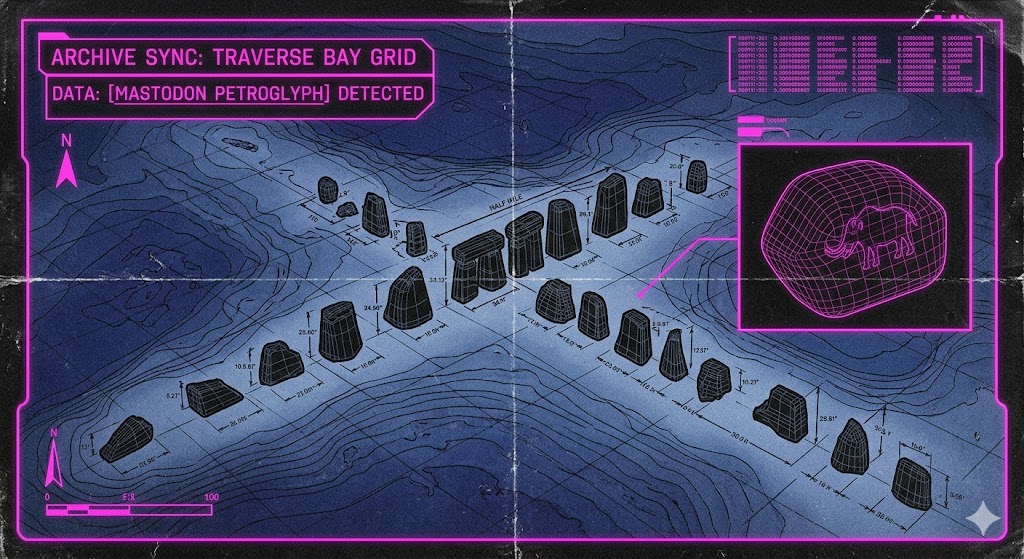
Deep beneath the surface of Grand Traverse Bay, a monumental mystery lies silent on the floor of Lake Michigan. Discovered in 2007 by underwater archaeologist Mark Holley, a series of stones arranged in a distinct geometric alignment has earned the nickname “Underwater Stonehenge.” This site, located 40 feet below the waves, challenges the traditional timeline of North America History, suggesting that 9,000 years ago—when this area was dry tundra—ancient hunter-gatherers were already engaged in sophisticated, large-scale ceremonial or technical construction.
The intrigue deepens with the discovery of a specific, dishwasher-sized rock that appears to bear a petroglyph of a mastodon. If verified, this would be a “spectacular find,” as it represents a visual record of a creature that was supposedly nearing extinction during the era of human arrival. This archive entry examines the evidence: is it a natural glacial deposit, or a tactical landmark left by a civilization far older than modern academia is willing to admit?
Underwater stones puzzle archeologists
Debate unfolds: Man or nature?
By James Janega |Tribune reporter
February 8, 2009
Forty feet below the surface of Lake Michigan in Grand Traverse Bay, a mysterious pattern of stones can be seen rising from an otherwise sandy half-mile of lake floor.
Likely the stones are a natural feature. But the possibility they are not has piqued the interest of archeologists, native tribes and state officials since underwater archeologist Mark Holley found the site in 2007 during a survey of the lake bottom.
The site recently has become something of an Internet sensation, thanks to a blogger who noticed an archeological paper on the topic and described the stones as “underwater Stonehenge.”
Though the stones could signal an ancient shoreline or a glacial formation, their striking geometric alignment raises the possibility of human involvement. The submerged site was tundra when humans of the hunter-gatherer era roamed it 6,000 to 9,000 years ago. Could the stones have come from a massive fishing weir laid across a long-gone river? Could they mark a ceremonial site?
Adding to the intrigue, one dishwasher-size rock seems to bear an etching of a mastodon.
“The first thing I said when I came out of the water was, ‘Oh no, I wish we wouldn’t have found this,’ ” said Holley, whose usual prey is sunken boats. “This is going to invite so much controversy that this is where we’re going to be for the next 20 years.”
This spring Holley and a student from Northwestern Michigan College hope to make laser scans of the image that will yield a computer model. That will help scientists assess the site, which is otherwise off limits because of American Indian concerns that the area could be sacred.
Researchers who study early American Indians say they will need more evidence to be convinced the stones are a human artifact. They are especially wary of the idea of a mastodon petroglyph. Mastodons were facing extinction when early humans were on the scene, and the few that still existed in North America lived much farther south, evidence shows.
“It would be the only visual representation of such in the whole hemisphere,” said a skeptical Charles Cleland, retired curator of Great Lakes archeology and ethnology at Michigan State University. “It would be a really spectacular find—if it turns out to be true.”
Still, Hank Bailey of the Grand Traverse Band of Ottawa and Chippewa Indians said, “There’s a lot that we haven’t learned.” Moreover, to American Indian eyes, the rocks seem to be arranged with some purpose, he said.
“It could easily be a ceremonial site,” said Bailey, who gave underwater photographs of the stones to religious leaders. “The same kind of thing that I see there is the same kind of things we use, so why couldn’t it have been connected to our people further back than modern archeologists know?”
Evidence shows human families were present in northern Michigan thousands of years ago. They traversed a barren tundra dotted by stands of fir trees in pursuit of elk and woodland caribou, gathering nuts and berries as they passed.
People did not linger in such a cold, marginal land, but they did mine chert for spear points from a site near Charlevoix and left evidence of campsites in the area, Cleland said.
Humans of that time frequently arranged stones to dam streams—to trap fish and for other reasons, said Northwestern University archeologist James Brown.
“Until they’re investigated archeologically, it’s hard to tell,” Brown said of the submerged formation.
Holley found the site by accident while doing lake floor survey work in summer 2007 for the Grand Traverse Bay Underwater Preserve. After several passes, a row of stones became clear. When divers visited the site to take photographs, they were left vaguely unnerved. “It was really spooky when we saw it in the water,” Holley said. “The whole site is spooky, in a way. When you’re swimming through a long line of stones and the rest of the lake bed is featureless, it’s just spooky.”
To satisfy Grand Traverse Bay’s American Indian community, which wants to minimize the number of visitors to the site, and to preserve his prerogative to research the spot, Holley has kept its exact location a secret.
He said he hopes a computer model of the gouges in the mastodon rock will help experts tell whether the features were a trick of chance cut by glacial forces or were the work of ancient humans.
Cleland said petroglyphs are rare in the Upper Midwest and stone circles are more common among primitive farmers than among the hunter-gatherers who traveled through Michigan.
“But I think this is certainly something that needs to be investigated,” Cleland said. “It would be unthinkable to leave it alone and not try to figure it out.”
The “Meat”: The Engineering Impossibility
The Precision of the Submerged Grid
To find a half-mile-long alignment of stones in an otherwise featureless sandy lake bed is a geological anomaly that suggests a “high-tech” intuition for placement. Much like the megaliths of Baalbek, the stones of the Lake Michigan Stonehenge demonstrate a level of collective will that defies the “primitive” label often given to hunter-gatherers. Swimming through these lines, divers describe an “unnerving” and “spooky” atmosphere, a psychological response to a landscape that was clearly fashioned by hand for a purpose we can no longer fully grasp.
The Mastodon Petroglyph: A Visual Record of the Antediluvian
The presence of a mastodon etching on one of the stones is the ultimate “meat” of this mystery. If the carving is genuine, it places humans and megafauna in the same tactical space at a time when the Great Lakes were still forming. This suggests that the ancient architects of the Midwest were not just survivors, but observers and chroniclers of their environment. This site represents a bridge to a lost era, where the “global grid” was anchored by monuments that have since been reclaimed by the rising waters of the post-glacial world.
Executive Summary: The Lake Michigan Stonehenge: A Submerged Archaeological Enigma
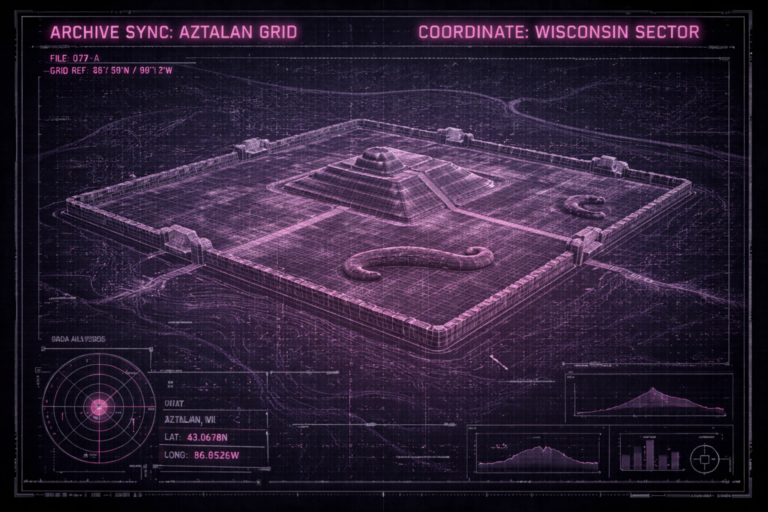
This investigation centers on the 2007 discovery of a stone alignment in Grand Traverse Bay that mirrors the urban precision found at sites like Aztalan or Cahokia. While some skeptics argue the stones are merely glacial erratics, the striking alignment and the presence of potential rock art suggest human intent. The summary highlights the efforts of researchers at Northwestern Michigan College to create 3D laser scans of the “mastodon rock,” an effort complicated by the site’s status as a potentially sacred area for the Grand Traverse Band of Ottawa and Chippewa Indians.
The narrative explores the “people did this” viewpoint, suggesting the stones may have functioned as a massive fishing weir or a ceremonial site intended to anchor the cultural frequency of the region. As the debate between “man or nature” continues, this archive entry documents the site as a key node in the North America History grid—a place where the past literally remains submerged, waiting for the right “tuning” to reveal its secrets.
“People did this. People could not do this now.”
About the Author