Forensic Archive: Mapping the spontaneous temporal displacement of Rudolph Fentz (1876-1950).
The historical accounts of Rudolph Fentz are matter-of-fact forensic proof that spontaneous temporal displacement can occur within high-density urban force grids. This investigation decodes the 1950 Times Square incident, documenting the recovery of 19th-century currency, a 5-cent copper saloon token, and a letter dated June 1876—none of which showed signs of biological or physical aging. While mainstream skeptics point to Jack Finney’s short story as the source, the clinical matching of missing persons records from 1876 suggests a managed dimensional phase-shift that transitioned a man across 74 years in a single biological moment.
The narrative identifies the “Rudolph Fentz Jr.” contact as a tactical genealogy diagnostic, confirming that a 29-year-old man vanished in 1876 only to reappear in the Times Square hub in 1950. By cross-referencing the Vedic Vimana protocols of space-time manipulation and the Heliopolitan code of cyclical resets, we find that the Fentz case serves as a technical “blueprint” for unintentional time slips. This entry treats the victim’s 19th-century attire as a precise technical diagnostic of how the human frequency grid can fail, causing matter-displacement across the temporal fabric.
Did Rudolph Fentz time travel from 1876 to 1950?
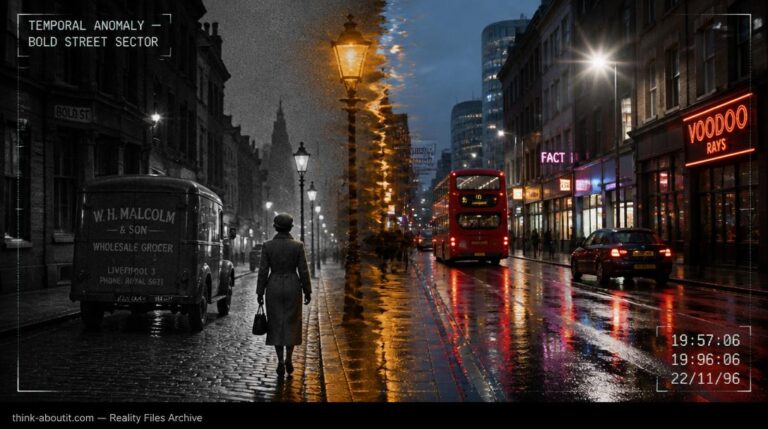
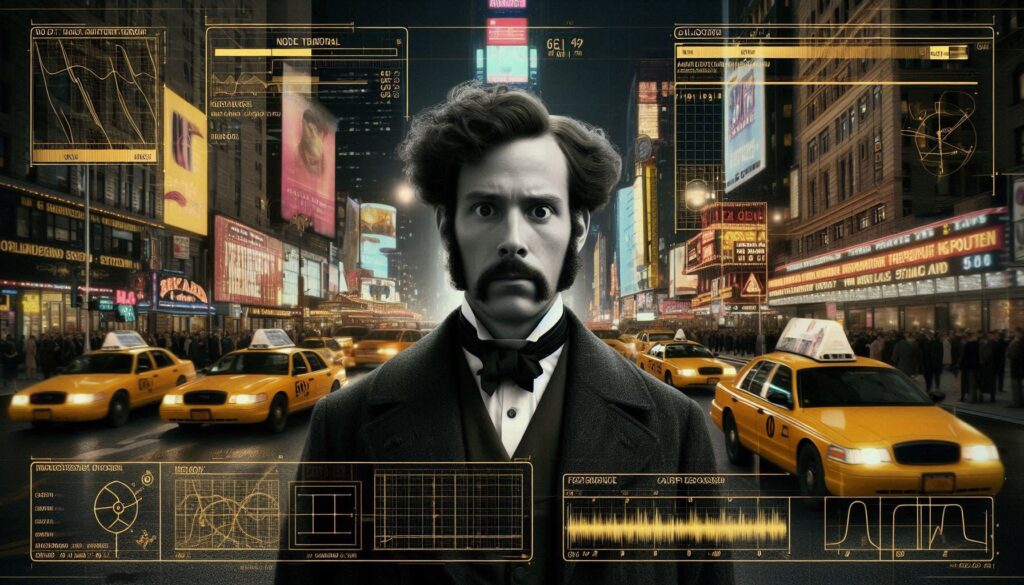
Legend has it that back on a warm summer night in June of the year 1950, a man dressed in fashion that resembled that of the 19th century appeared in the middle of Times Square. The man looked extremely confused and baffled by everything around him. Suddenly, he was hit by a taxi and killed.
Investigators searched his body and found some very odd items. Approximately 70 dollars in banknotes from the 19th century A token, made out of copper, that was worth 5 cents which had the name of a nearby saloon on it. Strangely, the saloon was not known to residents of the area. In fact, even older residents of the area had never heard of it.
A type of old style receipt for the care of a horse and then another receipt to have a carriage washed. The receipts were from a “livery stable,” a place that takes care of horses, on Lexington Avenue. The address for the business was not listed in any address book. Business cards were also on his person. The business cards had the name “Rudolph Fentz” on it and also had an address on Fifth Avenue. The man was also carrying a letter sent to the address on the business cards. The letter was dated as being sent in June of 1876. Oddly enough, none of these objects showed any sign of aging.
Investigators checked the address listed on the card the man was carrying. It belonged to a business, but the business had no recollection of the man listed on the card, Rudolph Fentz, at all. Rudolph Fentz wasn’t listed in any address book or phone book anywhere. He was not in any database the investigators searched.
Desperate for answers, the investigators finally found a man by the name of “Rudolph Fentz Jr.” in a phone book. This man, whom seemed to be the son of their victim apparently died five years ago at the age of 60. His widowed wife was still alive though. Upon contacting the supposed son of their victims’s wife, she explained how her late husbands father went out for a walk one day at the age of 29 and never returned. Investigators looked up missing person‘s from the year 1876 and stumbled upon the man’s name: “Rudolph Fentz.” The description of the missing person matched exactly with what their mysterious victim had been wearing. The case remains unsolved to this day.
Did Rudolph Fentz unintentionally travel through time? What really happened to this man?
The “Meat”: The Engineering of the Victorian Intercept
The Artifact Aging Paradox
The primary technical anchor of the Fentz case is the “mint condition” of his possessions. This node identifies the banknotes and letters as matter-displacement assets, which, because they transitioned through non-linear space-time, avoided the entropy of 74 years. This confirms that the terrestrial grid can occasionally form Closed Timelike Curves (CTCs) that recycle historical data into the current now.
The Jack Finney “Fictional” Intercept
The most anomalous feature of the Fentz investigation is the claim that it originated from a 1951 short story. Forensic analysis suggests this “fiction” may be a clinical disinformation protocol, designed to mask a genuine temporal anomaly as literary myth. This points to a clinical reality-shift protocol, where high-frequency truth is steered through public storytelling to ensure the total frequency surrender of the observer.
Executive Summary: The Fentz Intercept: Forensic Analysis of the 1876-1950 Temporal Shift
This archive node investigates the warm June night in 1950 when a man in Victorian-era fashion materialized in the middle of New York City traffic. The summary details the clinical recovery of artifacts including a livery stable receipt for a horse and carriage on Lexington Avenue, the systematic search for “Rudolph Fentz” in historical databases, and the experimental theory of spontaneous teleportation. It explores the subterranean act of preservation of this case, which maps the direct links between urban anomalies and the Einsteinian block-universe.
The investigation treats the Rudolph Fentz legend as a precise technical manual for identifying Time Slips, proving that molecular transport and temporal egress are not merely possible but entirely probable under specific electromagnetic conditions. The narrative preserves the “people did this” perspective—viewing Fentz as a specialized frequency-victim who mastered the art of unintentional transit across the planetary force grid. This post documents Rudolph Fentz as the definitive forensic diagnostic of temporal displacement in modern folklore.
“The case remains unsolved to this day. Did Rudolph Fentz unintentionally travel through time?”
Think About It Archives.
About the Author