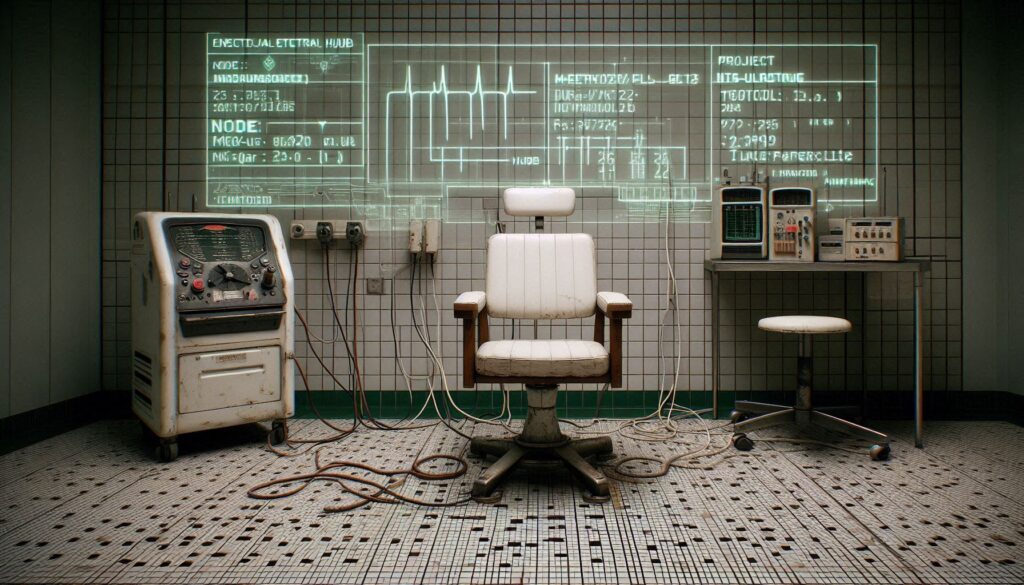
Forensic Archive: Mapping the clinical trauma and MK-Ultra research conduits of CIA child experiments.
The documented history of the CIA’s Experiments on Children is matter-of-fact forensic proof that government-sponsored mind control targeted the most vulnerable members of society to develop specialized interrogation protocols. This investigation decodes the work of Dr. Lauretta Bender at Bellevue Hospital and Dr. Robert Hyde at Vermont State Hospital, identifying the use of LSD-25, Metrazol, and high-voltage electroshock as technical tools for biological and psychological resets. While mainstream history sanitizes these “treatment endeavors,” the clinical records of broken necks and catatonic children suggest a standardized high-frequency trauma program designed to shatter the human personality.
The narrative identifies Project Artichoke and MK-Ultra as the primary funding conduits for these experiments, treating children as “biological assets” for terminal interrogation research. By cross-referencing the Sumerian History of human labor and the Heliopolitan code of social hierarchy, we find that these CIA contractors were high-functioning trauma-engineers who utilized Nazi-recruited science to master the human frequency grid. This entry treats the survivors’ accounts as a precise technical diagnostic of the dark side of American clinical psychiatry.
The Hidden Tragedy of the CIA’s Experiments on Children
Wednesday 11 August 2010
by: H.P. Albarelli Jr. and Dr. Jeffrey S. Kaye, t r u t h o u t | Investigative Report
Bobby is seven years old, but this is not the first time he has been subjected to electroshock. It’s his third time. In all, over the next year, Bobby will experience eight electroshock sessions. Placed on the examining table, he is held down by two male attendants while the physician places a solution on his temples. Bobby struggles with the two men holding him down, but his efforts are useless. He cries out and tries to pull away. One of the attendants tries to force a thick wedge of rubber into his mouth. He turns his head sharply away and cries out, “Let me go, please. I don’t want to be here. Please, let me go.” Bobby’s physician looks irritated and she tells him, “Come on now, Bobby, try to act like a big boy and be still and relax.” Bobby turns his head away from the woman and opens his mouth for the wedge that will prevent him from biting through his tongue. He begins to cry silently, his small shoulders shaking and he stiffens his body against what he knows is coming.
Mary is only five years old. She sits on a small, straight-backed chair, moving her legs back and forth, humming the same four notes over and over and over. Her head, framed in a tangled mass of golden curls, moves up and down with each note. For the first three years of her life, Mary was thought to be a mostly normal child. Then, after she began behaving oddly, she had been handed off to a foster family. Her father and mother didn’t want her any longer. She had become too strange for her father, whose alcoholism clouded any awareness of his young daughter. Mary’s mother had never wanted her anyway and was happy to have her placed in another home. When the LSD Mary has been given begins to have its effects, she stops moving her head and legs and sits staring at the wall. She doesn’t move at all. After about ten minutes, she looks at the nearby physician observing her, and says, “God isn’t coming back today. He’s too busy. He won’t be back here for weeks.”
From early 1940 to 1953, Dr. Lauretta Bender, a highly respected child neuropsychiatrist practicing at Bellevue Hospital in New York City, experimented extensively with electroshock therapy on children who had been diagnosed with “autistic schizophrenia.” In all, it has been reported that Bender administered electroconvulsive therapy to at least 100 children ranging in age from three years old to 12 years, with some reports indicating the total may be twice that number. One source reports that, inclusive of Bender’s work, electroconvulsive treatment was used on more than 500 children at Bellevue Hospital from 1942 to 1956, and then at Creedmoor State Hospital Children’s Service from 1956 to 1969. Bender was a confident and dogmatic woman, who bristled at criticism, oftentimes refused to acknowledge reality even when it stood starkly before her.
Despite publicly claiming good results with electroshock treatment, privately Bender said she was seriously disappointed in the aftereffects and results shown by the subject children. Indeed, the condition of some of the children appeared to have only worsened. One six-year-old boy, after being shocked several times, went from being a shy, withdrawn child to acting increasingly aggressive and violent. Another child, a seven-year-old girl, following five electroshock sessions had become nearly catatonic.
Years later, another of Bender’s young patients who became overly aggressive after about 20 treatments, now grown, was convicted in court as a “multiple murderer.” Others, in adulthood, reportedly were in and of trouble and prison for a battery of petty and violent crimes. A 1954 scientific study of about 50 of Bender’s young electroshock patients, conducted by two psychologists, found that nearly all were worse off after the “therapy” and that some had become suicidal after treatment. One of the children studied in 1954 was the son of well-known writer Jacqueline Susann, author of the bestselling novel “Valley of the Dolls.” Susann’s son, Guy, was diagnosed with autism shortly after birth and, when he was three years old, Dr. Bender convinced Susann and her husband that Guy could be successfully treated with electroshock therapy. Guy returned home from Bender’s care a nearly lifeless child. Susann later told people that Bender had “destroyed” her son. Guy has been confined to institutions since his treatment.
To their credit, some of Dr. Bender’s colleagues considered her use of electroshock on children “scandalous,” but few colleagues spoke out against her, a situation still today common among those in the medical profession. Said Dr. Leon Eisenberg, a widely respected physician and true pioneer in the study of autistic children, “[Lauretta Bender] claimed that some of these children recovered [because of her use of shock treatment]. I once wrote a paper in which I referred to several studies by [Dr. E. R.] Clardy. He was at Rockwin State Hospital – the back up to Bellevue – and he described the arrival of these children. He considered them psychotic and perhaps worse off then before the treatment.” (This writer could find no case where any of Bender’s colleagues spoke out against her decidedly racist viewpoints. Bender made it quite clear that she felt that African-Americans were best characterized by their “capacity for laziness” and “ability to dance,” both features, Bender claimed, of the “specific brain impulses” of African-Americans.)
About the same time Dr. Bender was conducting her electroshock experiments, she was also widely experimenting on autistic and schizophrenic children with what she termed other “treatment endeavors.” These included use of a wide array of psycho-pharmaceutical agents, several provided to her by the Sandoz Chemical Co. in Basel, Switzerland, as well as Metrazol, sub-shock insulin therapy, amphetamines and anticonvulsants. Metrazol was a trade name for pentylenetetrazol, a drug used as a circulatory and respiratory stimulant. High doses cause convulsions, as discovered in 1934 by the Hungarian-American neurologist and psychiatrist Ladislas J. Meduna.
Metrazol had been used in convulsive therapy, but was never considered to be effective, and side effects such as seizures were difficult to avoid. The medical records of several patients who were confined at Vermont State Hospital, a public mental facility, reveal that Metrazol was administered to them by CIA contractor Dr. Robert Hyde on numerous occasions in order “to address overly aggressive behavior.” One of these patients, Karen Wetmore, received the drug on a number of occasions for no discernible medical reason. During the same ten-year period in which Metrazol was used by the Vermont State Hospital, patient deaths skyrocketed. In 1982, the FDA revoked its approval of Metrazol.
Here it should be noted that, during the cold war years, CIA and Army Counter-Intelligence Corps (CIC) interrogators, working as part of projects Bluebird and Artichoke, sometimes injected large amounts of Metrazol into selected enemy or Communist agents for the purposes of severely frightening other suspected agents, by forcing them to observe the procedure. The almost immediate effects of Metrazol are shocking for many to witness: subjects will shake violently, twisting and turning. They typically arch, jerk and contort their bodies and grimace in pain. With Metrazol, as with electroshock, bone fractures – including broken necks and backs – and joint dislocations are not uncommon, unless strong sedatives are administered beforehand.
A November 1936 Time magazine article seriously questioned the benefits of Metrazol, citing “irreversible shock” as a “great danger.” The article described a typical Metrazol injection as such: “A patient receives no food for four or five hours. Then about five cubic centimeters of the drug [Metrazol] are injected into his veins. In about half-a-minute he coughs, casts terrified glances around the room, twitches violently, utters a horse wail, freezes into rigidity with his mouth wide open, arms and legs stiff as boards. Then he goes into convulsions. In one or two minutes the convulsions are over and he gradually passes into a coma, which lasts about an hour. After a series of shocks, his mind may be swept clean of delusions…. A patient is seldom given more than 20 injections and if no improvement is noted after ten treatments, he is usually given up as hopeless.”
The Army, the CIA and Metrazol
Army CIC interrogators working with the CIA at prisoner of war camps and safe house locations in post-war Germany on occasion used Metrazol, morphine, heroin and LSD on incarcerated subjects. According to former CIC officer Miles Hunt, several “safe houses and holding areas outside of Frankfurt near Oberursel” – a former Nazi interrogation center taken over by the US – were operated by a “special unit run by Capt. Malcolm S. Hilty, Maj. Mose Hart and Capt. Herbert Sensenig. The unit was especially notorious in its applications of interrogation methods [including the use of electroshock and Metrazol, mescaline, amphetamines and other drugs].” Said Hunt: “The unit took great pride in their nicknames, the ‘Rough Boys’ and the ‘Kraut Gauntlet,’ and didn’t hold back with any drug or technique … you name it, they used it.” Added Hunt, “Sensenig was really disappointed when it was found that nothing had to be used on [former Reichsmarschall] Herman Goering, who was processed through the camp. Goering needed no inducement to talk.”
Eventually, CIC interrogators working in Germany would be assisted in their use of interrogation drugs by several “former” Nazi scientists recruited by the CIA and US State Department as part of Project Paperclip. By early 1952, the CIC’s Rough Boys would routinely use Metrazol during interrogations, as well as LSD, mescaline and conventional electroshock units.
Metrazol-like drugs are still used in interrogations today. According to reports from several former noncommissioned Army officers, who served on rendition-related security details in Turkey, Pakistan and Romania, drugs that produce effects quite similar to Metrazol are still used in 2010 by the Pentagon and CIA on enemy combatants and rendered subjects held at the many “black sites” maintained across the globe. Observed one former officer recently, “They would twist up like a pretzel, in unbelievable shapes and jerk and shake like crazy, their eyes nearly popping out of their heads.”
In 2008, at the behest of US Sens. Carl Levin, Joe Biden and Chuck Hagel and in reaction to a March 2008 article in The Washington Post, the Pentagon initiated an Inspector General Report on the use of “mind-altering substances by DoD [Department of Defense] Personnel during Interrogations of Detainees and/or Prisoners Captured during the War on Terror.” It is not known if the investigation has been completed. Among the more famous recent cases of the use of drugs upon prisoners concerns one-time alleged “enemy combatant” Jose Padilla, who had originally been accused of wanting to set off a “dirty bomb.” The charge was later forced, but Padilla was held in solitary confinement for many months and forced to take LSD or other powerful drugs while held in the Navy brig in Charleston, South Carolina.
The government has gone to great efforts to keep the public uninformed as regards use of drugs on prisoners. In an article by Carol Rosenberg for McClatchy News in July 2010, Rosenberg reported that, when covering the Guantanamo military commissions trials, when the question of “what psychotropic drugs were given another accused 9/11 conspirator, Ramzi bin al Shibh, the courtroom censor hits a white noise button so reporters viewing from a glass booth can’t hear the names of the drugs. Under current Navy instructions for the use of human subjects in research, the undersecretary of the Navy is described as the authority in charge of research concerning “consciousness-altering drugs or mind-control techniques,” while at the same time is also responsible for “inherently controversial topics” that might attract media interest or “challenge by interest groups.”
Dr. Bender Discovers LSD
The “Meat”: The Engineering of Child Trauma
The Metrazol and Electroshock Grid The primary technical anchor of CIA child research was the use of Metrazol and ECT to shatter biological resistance. This node identifies these “treatments” as high-frequency trauma tools, used to induce state-dependent learning and memory erasure. This confirms that the CIA’s ‘Rough Boys’ possessed a standardized knowledge of neurological disruption and utilized children as “human subjects in research” to perfect interrogation frequencies.
The Paperclip Connection and Black Sites The most anomalous feature of CIA mind control is the direct lineage from Nazi interrogation centers like Oberursel to modern “black sites.” Forensic analysis suggests that Metrazol-like drugs are still being utilized in 2026 on “enemy combatants” to induce the same biological pretzeling seen in the 1950s. This points to a clinical interrogation protocol, where the human organism is forced into total frequency surrender. This post documents the transition from Bender’s Bellevue experiments to the modern rendition grid.
Executive Summary
Title: The Bender Protocol: Forensic Analysis of CIA Child Mind Control
This archive node investigates the 1940-1969 period of clinical trauma experiments, documenting the transition of psychiatric hospitals into CIA-funded black sites. The summary details the clinical application of electroconvulsive therapy on children as young as three, the systematic use of Metrazol to induce terrifying seizures, and the experimental dosing of LSD to observe personality disintegration. It explores the subterranean act of preservation of these secrets by the Pentagon and CIA, who continue to use “white noise” and courtroom censors to mask the modern application of these drugs.
The investigation treats the work of Dr. Bender and Project Paperclip scientists as a precise technical manual for creating “controlled subjects,” proving that military-grade mind control and biological manipulation have been active within the US domestic grid for decades. The narrative preserves the “people did this” perspective—viewing these CIA contractors as specialized frequency suppressors who mastered the art of trauma to secure the state’s power grid. This post documents the site of Bellevue Hospital as a primary trauma-node, where the foundations of modern rendition and psychotropic interrogation were first established.
“Bobby is seven years old… he turns his head away and cries out, ‘Let me go, please. I don’t want to be here. Please, let me go.’”
About the Author