Unsolved Landscapes: The monumental mystery of Wisconsin's ancient landmarks.
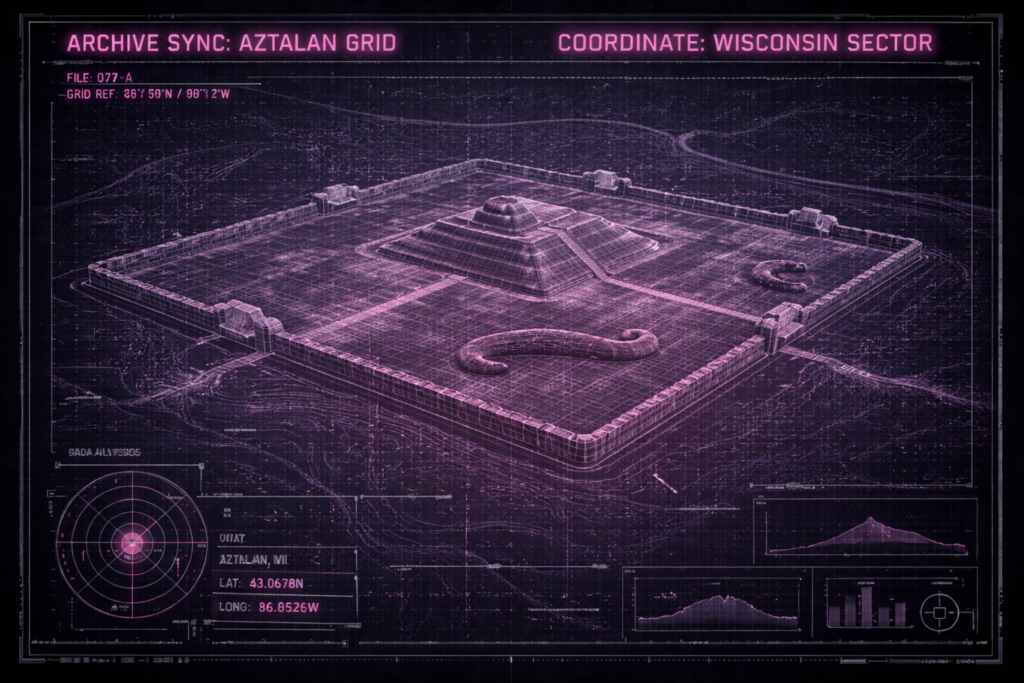
In the heart of the Wisconsin wilderness lies a site that challenges every conventional timeline of North America History. Known as Aztalan, this ancient settlement features massive platform mounds and stockades that mirror the urban sophistication of Cahokia, yet its sudden appearance and disappearance suggest a much larger, perhaps global, connection. For those tracking strange places and the “Mu” hypothesis, the geometric precision of these local landmarks hints at a lost science of monumental construction that defies the primitive tools typically attributed to the era.
This entry dives into a monumental mystery sparked by an old local story that has recently resurfaced, drawing new eyes to the weathered earthworks. By analyzing the astronomical alignments and the sheer volume of earth moved, we explore the viewpoint that these sites weren’t just villages, but tactical outposts of a civilization that understood the “global grid” long before the first European sails appeared on the horizon.
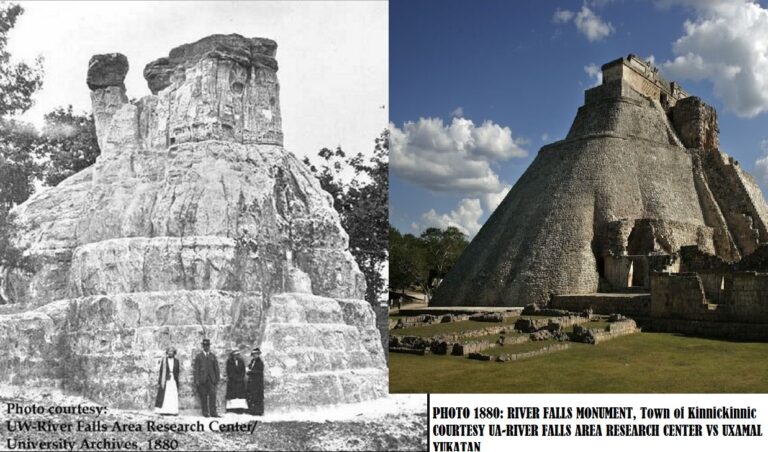
Monumental mystery: Old story prompts a new interest in local landmark.
The Engineering Impossibility: A Viewpoint on Aztalan
To look at Aztalan today is to see a series of grassy mounds, but to the original architects, it was a precision-engineered complex. The sheer volume of earth moved—millions of cubic feet—was not just a matter of labor; it was a matter of high-level logistics. Like the megalithic stones of Baalbek, where 800-ton blocks were moved with a precision we struggle to replicate today, the builders of the Wisconsin mounds utilized a specific understanding of soil stratification and pressure-bearing loads.
This isn’t just “primitive” construction. We are looking at a society that understood how to prevent “slumping” in massive earthworks using specific clay-to-soil ratios, a technique that modern engineers often get wrong when trying to restore these very sites. The viewpoint here is clear: these people possessed a “lost science” of monumental construction that allowed them to treat the landscape as a canvas for a global grid.
The Mu Connection: Transit Points and Global Grids
A recurring local legend suggests that Aztalan was not a terminal destination, but a specific transit point in a network reaching back to the lost continent of Mu. Ancient seafaring cultures may have navigated the Mississippi and Rock River systems, using these mounds as navigational “anchors.” The geometric alignment of the mounds often mirrors celestial patterns, functioning as a terrestrial map of the stars.
When we consider the “people did this” reality, we have to ask why. It wasn’t just for burial or defense. The internal composition of these landmarks often includes layers of conductive minerals, suggesting they may have functioned as acoustic or energetic resonators. In this view, the “monumental mystery” is that the Midwest was once the heart of a sophisticated, high-frequency civilization that mirrored the technical prowess found in Egypt and the Levant.
Why We Couldn’t Build It Today
The phrase “People could not do this now” is not an insult to modern machinery; it is an observation of modern spirit. Today, we build for the short term—ten years, maybe fifty. The architects of the Wisconsin landmarks built for ten thousand years. They lacked hydraulics, but they possessed a unified, generational focus that has completely vanished from our current cultural viewpoint.
To recreate a site like Monks Mound or Aztalan today would require more than just dump trucks; it would require a society that views the Earth itself as a living, technical component of human life. We have replaced that ancient “high-tech” intuition with plastic and steel, losing the ability to interact with the lithosphere in a way that creates permanent, resonant monuments.
This archive explores the renewed interest in a local landmark often overlooked by mainstream archaeology. The narrative follows a rediscovered account that links the site to ancient seafaring cultures and the lost continent of Mu, suggesting that the Wisconsin mounds were part of a vast network of transit points. Unlike later settlements, the primary construction phases of these landmarks show a mastery of soil stabilization and acoustic resonance that suggests a “high-tech” understanding of natural materials, intended to last for millennia.
The summary highlights the work of researchers who argue that these sites are not merely “burial mounds” but functional monuments designed to anchor a specific cultural and spiritual frequency. As modern interest in the site grows, the focus shifts from “who” built them to “how” they were achieved without modern machinery. This entry serves as a bridge between local folklore and the broader investigation into strange places that continue to hide their secrets in plain sight across the American Midwest.
“People did this. People could not do this now.”
About the Author