Tag: Khufu

  • The Age of the Pyramids

    The Age of the Pyramids


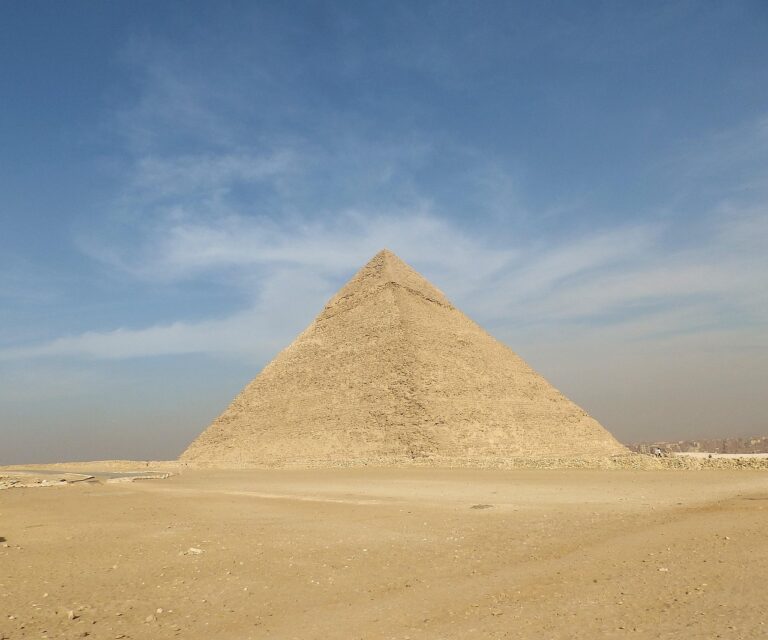
    The Great Pyramid of Giza, among the seven wonders of the ancient world, points towards the celestial north pole with a margin of error of only a tiny fraction of one degree.

    Dr. Kate Spence, a British Egyptologist, believes she may have solved two of the great mysteries of archaeology – how the ancient Egyptians aligned the pyramid with such remarkable geographical accuracy and when the vast royal tomb was built.

    Pointing north

    The Great Pyramid is a master of precision. Comprised of an estimated 2.5 million limestone blocks, archaeologists have known for over a century that the Great Pyramid was pointed almost exactly north, but nobody has been able to explain how the ancient Egyptians managed to align it with such unprecedented accuracy.


    The deviation in accuracy is minute as Dr. Spence explains:

    ‘The Great Pyramid is extremely accurately aligned towards north. The sides deviate from true north by less than three ark minutes, that’s less than a twentieth of a degree, which is extremely accurate in terms of orientation.’

    Modern astronomers would have little difficulty in finding north because the Pole Star, Polaris, is almost directly above the North Pole. But astronomers know that the Earth regularly wobbles very slowly on its axis over a period of 26,000 years and so in ancient Egyptian times there would have been no star overhead marking true north.

    The Spence theory

    Using computer simulations of the night sky as it would have been seen at the time of the Egyptians, Dr Spence, from Cambridge University, suggests that the ancient Egyptians carefully monitored two stars which revolve in the northern region of the night sky.

    The north-finding stars were Kochab, in the bowl of the Little Dipper (Ursa Minor), and Mizar, in the middle of the handle of The Plough or Big Dipper (Ursa Major). Dr Spence says that the ancient Egyptians realised that when one was directly above the other then the line between the two-marked true north.

    Dr Spence speculates that these astronomical calculations were made at special ceremonies early in a pharaoh’s reign and that construction work would then begin on the pyramids to house their tombs. She explains:

    ‘What would probably have happened is that the king would have dressed in his ceremonial gear, and there would probably have been priests dressed as gods who would begin stretching chords and marking out the base. It would have been a highly charged religious atmosphere, taking place in the dark, at night, with torches everywhere. It would have been a spectacular ceremony.’

    The ancient Egyptians fascination with the night sky is well known. Believing that the Gods lived in the Duat, an afterworld in the sky, the pharoahs who were responsible for the construction of the pyramid at Giza, would have associated the stars with eternity and afterlife.

    Dating the pyramids

    In the past the date of the ancient Egyptian pyramids has been a source of much debate among historians, who have put it at around the middle of the third millennium BC, by tracing the chronology of Kings. However, publishing her research in the scientific journal Nature, Dr Spence says her theory gives a more precise date for the beginning of construction work on the Great Pyramid.

    The celestial north pole was only aligned exactly with Kochab and Mizar in 2, 467 BC, which would put the beginning of building work about 70 years later than many archaeologists, have previously thought.

    Dr Owen Gingerich, Senior Astronomer, at the Harvard-Smithsonian Centre for Astrophysics said Dr Spence’s theory is an ingenious and convincing astronomical solution to a long-standing mystery. He comments:

    ‘I was rather tickled to see the solution that she had put forward and wondered why nobody else had thought of it before, because I think it makes a lot of sense and it has an internal coherence.’

    Source:
    BBC World Service, Science and Technology,
     The Stargazers of Ancient Egypt


    How Old are the Pyramids?

    by JOSEPH JOCHMANS

    The controversy raised by John Anthony West and Robert Schoch concerning the true age of the Great Sphinx is now beginning to overcast the other famous monuments which share space on the Giza plateau—namely, the three pyramids that were supposedly built by Pharaohs Khufu, Khafre and Menkhare in the Fourth Dynasty. Were these Pyramids constructed only 4,300 years ago, or—like the Sphinx—is there evidence they could be far older, dating instead to perhaps 12,000 years ago?

    Let’s begin first with looking at the age of the Great Pyramid. The conservative historians’ entire case for dating the Great Pyramid to the Fourth Dynasty rests upon two major pieces of evidence. The first is the story of Herodotus, who in 443 B.C. visited Egypt and recounted how Pharaoh Cheops (the Greek name for Khufu) built the Great Pyramid during his reign with 100,000 men in 20 years. However, we now know this story is highly questionable. Even his contemporaries called Herodotus the “Father of Lies.” Not only do the construction estimates he gave not work, but Herodotus, as an Initiate in the Egyptian Mystery Schools, was sworn to secrecy regarding the true nature of the Pyramid, and he more than likely copied a fictitious tale about the monument that was then in circulation among the common masses. The Greek historian’s account stands in sharp contrast to most other Egyptian, Hebrew, Greek, Roman, Hermetic, Coptic and medieval Arabic scholarly sources which agree that the Great Pyramid was not constructed during the time frame of Pharaoh Khufu or Dynastic Egypt, but was the product of the “Age of the Gods” thousands of years earlier.

    The second piece of evidence is the existence of painted hieroglyphic inscriptions found in the air space chambers above the King’s Chamber, which include the name of Pharaoh Khufu. They were supposedly discovered by Col. Richard Howard-Vyse in 1837, when he forced his way up to these chambers using gunpowder. But there are certain facts showing these inscriptions were in actuality forgeries.

    Actually, we have the testament of Pharaoh Khufu himself that he only did repair work on the Great Pyramid. The Inventory Stele, found in 1857 by Auguste Mariette just to the east of the Pyramid, dates to about 1500 B.C., but according to Maspero and other experts, shows evidence of having been copied from a far older stele contemporaneous with the Fourth Dynasty. In the Stele, Khufu himself tells of his discoveries made while clearing away the sands from the Pyramid and Sphinx. He dedicated the account to Isis, who he called the “Mistress of the Western Mountain,” “Mistress of the Pyramid,” and identified the Pyramid itself as the “House of Isis.”

    The Stele describes how Pharaoh Khufu, “gave to her (Isis) an offering anew, and he built again (to restore, renovate, reconstruct) her temple of stone.” From there, the Pharaoh inspected the Sphinx, according to the text, and related the story of how in his time both the monument and a nearby sycamore tree had been struck by lightning. The bolt had knocked off part of the headdress of the Sphinx, which Khufu carefully restored. Egyptologist Selim Hassan, who dug out the Sphinx from the surrounding sands in the 1930’s, observed there is indeed evidence that portions of the Sphinx were damaged by lightning, and the mark of ancient repairs is very apparent. Also, he noted, sycamore trees once grew to the south of the monument, which had been dated to a great age.

    The Stele then ends with the story of how Khufu built small pyramids for himself and his daughters, wife and family, next to the Great Pyramid. Today, the ruins of three small pyramids are indeed situated on the east side of the monument. Archaeologists have found independent evidence that the southernmost of the three small pyramids flanking the Great Pyramid was in fact dedicated to Henutsen, a wife of Khufu. Everything in the inscription thus matches the known facts. If these facts can be believed as true, then the additional information that Khufu was only a restorer of the Great Pyramid and not its builder, must also be treated as historically true.


    ANCIENT LEGENDS AND MODERN RESEARCH CONFIRM EACH OTHER

    When we look at mythic history for the story of the origins of the Great Pyramid, we discover that the monument was not attributed to any Pharaoh, but was the product of the genius and higher learning of the Gods of Old. Time and time again, from the Roman Marcellinus to the Coptic Al Masudi and the Arab Ibn Abd Alhokim, the recounters of the ancient legends tell how the Pyramid was built to preserve the knowledge of a magnificent civilization from destruction by a Flood, and that it was this Flood which brought the Age of the Gods to its tragic end. The various Chronologies of Legendary Rulers place a minimum date for the Age of the Gods as circa 10,000 B.C. This is the time frame Plato, in his Timaeus and Critias, ascribed the destruction of Atlantis. And it is also this date, as can be proven in modern scientific studies, which was highlighted by major climatic, geologic and geomagnetic disturbances, accompanied by massive paleo-biological extinctions in the planet, marking the division point between the Ice Age and the Present Era.

    In Egypt, geologists examining the fossil record have found that the combined effect of melting glaciers in the Mountains of the Moon, plus a sharp rise in precipitation levels in Central Africa, caused the Nile river circa 10,000 B.C. to swell in size a thousandfold, eroding away cliff walls miles from its present banks, and washing out its entire valley throughout the length of Egypt. At the same time, as the Mediterranean Sea began to fill and rise due to higher ocean levels from melting northern glaciers, its waters for a brief period also flooded the lower Nile valley.

    mpl_2fl

    These, geologists are certain, are the last major flood events in Egypt’s fossil history, before the sea retreated and the Nile settled down to today’s relatively peaceful, winding flow. Yet, knowing this, geologists are hard pressed to explain why there existed a fourteen-foot layer of silt sediment around the base of the Pyramid, a layer which also contained many seashells, and the fossil of a sea cow, all of which were dated by radiocarbon methods to 11,600 B.P. (Before Present) plus or minus 300 years.

    Legends and records likewise speak of the fact that, before the Arabs removed the Pyramid’s outer casing stones, one could see water marks on the stones halfway up the Pyramid’s height, in about the 240-foot level, which would be 400 feet above the present Nile level. The medieval Arab historian Al Biruni, writing in his treatise The Chronology of Ancient Nations, noted: “The Persians and the great mass of Magians relate that the inhabitants of the west, when they were warned by their sages, constructed buildings of the King and the Giza Pyramids. The traces of the water of the Deluge and the effects of the waves are still visible on these pyramids halfway up, above which the water did not rise.” Add to this the observation made when the Pyramid was first opened, that incrustations of salt an inch thick were found inside. Most of this salt is natural exudation from the chambered rock wall, but chemical analysis also shows some of the salt has a mineral content consistent with salt from the sea. Thus, during the prehistoric Flood, when waters surrounded the Great Pyramid, the known and unknown entrances leaked, allowing seawater into the interior, which later evaporated and left the salts behind. The locations where the salts are found are consistent with the monument having been submerged half-way up its height.

    If the floodings of 10,000 B.C. were the last major catastrophic water events in Egypt, and the Pyramid exhibits signs of having been subjected to them, it means the Pyramid must date from a period before the flooding occurred.

    Though most Egyptologists today have yet to accept such a necessary “radical” revision of their dating of the Pyramid, there have been other discoveries that have forced them to at least realize that their preconceived theories of any early Dynastic age for the structure is no longer tenable.

    In 1983 and 1984, prehistorian Robert J. Wenke from the University of Washington, and president of the American Research Center in Egypt, was given permission to collect mortar samples from various ancient construction sites, including the Great Pyramid and the Sphinx Temple. The mortar contained particles of charcoal, insect matter, pollen, and other organic materials which could be subjected for carbon-14 dating analysis. Using two different radiocarbon dating laboratories—the Institute for the Study of Man at Southern Methodist University, and the Institute of Medium Energy Physics in Zurich—the samples revealed a number of curiosities. For the Great Pyramid samples, the tests performed at the two labs initially gave very different clusterings of dates, off by several thousands of years. When certain “adjustments” in the data were applied, the resulting time frame narrowed to 3100 B.C. to 2850 B.C.—which is still 400 years earlier than when most Egyptologists believe the Great Pyramid was built. Even more anomalous, the dates obtained from mortar used near the top of the Pyramid were a thousand years older than those obtained from mortar nearer the Pyramid base. The researchers, if they were to fully believe these findings, would have to propose that the Pyramid had somehow been built from the top down.

    What makes the datings further unacceptable is that all of them were taken from areas of previously exposed surfaces. We know from such sources as the Inventory Stele that the Giza monuments were time and time again subjected to many reconstructions and repair work, inside and out. Therefore the radiocarbon dates can only give us clues as to when the time frame was for the repair work, not the actual construction of the Great Pyramid. If the dates are to be believed at all, they at least tell us that reconstruction work was done on the monument in a time period long before the “accepted” building was done, which means the Pyramid itself must be from an even earlier period, farther distant in the past.


    WERE THE THREE GIZA PYRAMIDS MODELS FOR EGYPT’S “PYRAMID AGE”?

    Expanding our sphere of inquiry to now include all three of the Giza Pyramids, we find that an interesting historical conundrum arises regarding their “accepted” construction. If, as conservative scholars surmise, the three Giza Pyramids were built in the Fourth Dynasty by the succession of three Pharaohs—Khufu, Khafre and Menkhare— what we find regarding the sizes of the three pyramids in association with the three reigns is inconsistent with what we would have expected to have happened.

    First, Khufu ruled and supposedly constructed the Great Pyramid. Khafre followed Khufu, and in order to be politically and religiously “correct,” we would have expected him to have erected a pyramid larger than Khufu’s. To do otherwise would have seriously reflected on his being inferior to his predecessor. Generally speaking, a ruler could not afford for his people to think that their Pharaoh was weaker in power and less blessed by the gods and goddesses than the ruler before him.

    After Khafre, Menkhare next took the throne of Egypt, and in order to be in continued good political and religious form, we would have expected him to build the largest pyramid of all, dwarfing those of Khufu and Khafre in order to make sure he was not to be outshone by either of his predecessors.

    Yet what we find at Giza is exactly opposite the expected scenario: Supposedly Khufu constructed the largest pyramid, Khafre built his slightly smaller than Khufu’s, and Menkhare erected a pyramid only a third the size of the other two.

    If what actually happened contradicts what should have happened if the three Giza pyramids were built in the Fourth Dynasty, then this can only mean that something is fundamentally wrong with the accepted scenario.

    Instead of the three Pharaohs building the three Giza pyramids, what if the pyramids were already present, old with age, and in the Fourth Dynasty the three succeeding rulers simply claimed possession of the structures, doing repair work on them, and building only the minor subsidiary pyramids around them for themselves and their families—just as the Inventory Stele describes Khufu did. What would we expect would have happened?

    Khufu, first on the scene, would naturally have laid claim to the largest pyramid for himself, or the Great Pyramid. His successor, Khafre, now left with only two pyramids to choose from, would have taken possession of the second largest. Menkhare, the last to reign, would have had to be content with the last pyramid available, the smallest of the three.

    Such a scenario best fits the actual facts, for this is exactly the succession of pyramids the Pharaoh had jurisdiction over, each in their turn. Clearly, what this suggests is the Giza pyramids came first, then the Pharaohs ruled, not the other way around.

    According to conservative scholars, the Giza Three were supposed to represent the “height of accomplishment” in the Egyptian age of pyramid building, from the Third to the Thirteenth Dynasties, 2700 to 1800 B.C. But if the Giza Pyramids are in reality 12,000 years old, then they instead must have served as the models the Dynastic Egyptians repeatedly tried to copy and emulate. If we recognize this greater antiquity for the Giza Three, then many mysteries surrounding the design and construction of Egypt’s other pyramids find their solutions.

    The conservative view purports that the early pyramids along the Nile developed by stages of “evolution.” Initially, in the First and Second Dynasties, from circa 3200 to 2800 B.C., the Pharaohs were buried in mastabas, which were rectangular-shaped structures with walls sloping inward, built over underground vaults. What has baffled archaeologists is that each of the first kings of Egypt had not one but two such mastabas, at Abydos, and at Saqqara. One of these served as a cenotaph, or an empty tomb in honor of the royal person. The reason for this early practice is still a puzzle to scholars, not yet solved.

    However, we know from ancient records that the peoples of the ancient world at one time had knowledge of the existence of the known entrance to the Great Pyramid, and they left evidence, in the form of torch soot and graffiti on the walls, that they penetrated as far as the Descending Passage and Pit Chamber. The Second and Third Pyramids also possess passages and empty chambers deep beneath their foundations. Did the early Pharaohs, in studying the design of the Giza Pyramids standing silently before them on the Nile, imitate the empty Pyramid chambers in the building of their second royal tombs, believing the empty chambers had a special spiritual significance they wished to emulate?

    In the Third Dynasty, beginning about 2780 B.C., Pharaoh Zoser undertook to build a mastaba for himself as had his predecessors, but then decided to go several steps further. Two more mastaba structures were constructed on top of the first in step fashion, and finally, these in turn were incorporated as one side of a six-tiered pyramid. The development of this curious structure—today called the Step Pyramid, and located at Saqqara—indicates that Zoser was attempting to copy or duplicate a particular image. The pyramid does resemble a Sumerian ziggurat, or “holy mountain,” except that unlike the ziggurat Zoser’s structure possessed no sanctuary at its apex, and had a system of internal tunnels and chambers. The only structures which come close to being models for Zoser’s work are the Giza Pyramids.

    Significantly—and again in imitation of the Giza monuments—Zoser was not buried in his Step Pyramid. The foot of a mummy thought to have belonged to Zoser was found in one chamber, but the wrappings proved to be from a period much later than the Third Dynasty. All in all, a total of sixty mummies were found in and around the Step Pyramid, but these have been dated to the Saitic or Late Period, in the first millennium B.C. Zoser’s tomb has been identified as located at Bet Khalaif, and no pyramid structure was found associated with it.

    Following Zoser, his successor, Pharaoh Sekhemket, attempted to build a pyramid, but it appears never to have been completed, and today is only a mass of rubble. However, archaeologists did find at the bottom of a shaft below the structure a sealed alabaster sarcophagus. When the sarcophagus was opened, it was found to be completely empty, mirroring the state the Stone Box was found in, in the Great Pyramid.

    The one ruler who by far was the most ambitious pyramid builder of the Third Dynasty was Pharaoh Senefru. He constructed three monuments, and there is every reason to believe he attempted to duplicate the feat of the three Giza Pyramids. He came close, for his pyramids contained two-thirds as much stone, covered 90 percent as much area, and were built with comparable speed as the Giza structures. The one obvious difference is their building design and masonry were very crude, when examined alongside the work done in the Giza area.

    It is in the period immediately following Senefru, at the beginning of the Fourth Dynasty, that we are supposed to believe that Egyptian architects somehow miraculously overcame all their construction shortcomings, and developed the quantum leap of techniques for advanced building that went into the making of the Giza Pyramids. But the Giza monuments, however, stand out above all the rest of the pyramids in Egypt in many unique ways, clearly showing they were not related to the other Egyptian pyramids in time or construction.

    First, only the Great Pyramid and (from what is known from legend and esoteric literature) the other two Giza Pyramids have chambers in their upper interior—all the rest possess only a lower chamber or chambers near the foundation. These are copies of the pit chambers in the Giza Pyramids. The Dynastic Egyptians, not knowing of the secret chambers higher up, had no precedent for including these in their own pyramids.

    Second, only the Giza Three are accurately aligned to true north, which is indicative of a very sophisticated science of Earth measurement and construction—elements exhibited in no other pyramid.

    Third, only the Giza monuments were built with a high degree of accuracy—this precision, coupled with the apparent mastery of large, multi-ton stone construction, is what allowed the Giza Pyramids to reach their gigantic size, the largest in Egypt. In the Second and Third Pyramids the construction blocks are often not as massive or as finely positioned as they are seen in the Great Pyramid, but they are precise enough to place them in an entirely different category from all other structures along the Nile.

    Fourth, the Giza monuments were built using construction designs totally alien to any other pyramid form. As William R. Fix, in Pyramid Odyssey observed: “Because the other pyramids consist of much smaller blocks, they were built as a series of shells with multiple internal retaining walls to give cohesiveness. The three large Giza Pyramids do not have these internal casings. The very size of the blocks produces the necessary stability. This characteristic reveals a general excellence of workmanship and also imply a much higher technological capability than that employed anywhere else..

    And fifth, unlike any pyramid supposedly built either before or after the Giza Three, none of the Giza monuments contain religious symbols or pictures in any of their inner chambers.

    According to conservative scholars, the Giza Pyramids were built by the Fourth Dynasty Pharaohs Khufu, Khafre and Menkhare, as tombs. Yet not one of their bodies was found in any of them. The King’s Chamber in the Great Pyramid was discovered to be completely empty upon its opening, its Stone Box sealed but vacant. In the Belzoni Chamber, beneath the Second Pyramid, a stone box was found like the one in the Great Pyramid, but it too contained no corpse. In 1878, a sarcophagus with a mummy inside was brought to light in the Third Pyramid. Though both the sarcophagus and mummy were lost at sea during their transport to the British Museum, samples had been taken from them, and when later analyzed by radiocarbon dating techniques, they were found to be from a fairly late date, only 2,000 to 2,500 years ago.

    It is becoming increasingly apparent that the three Pharaohs who are thought to have built the Giza Pyramids instead simply claimed the monuments as their own, having given up on the idea of attempting to duplicate the structures, as Senefru had tried but failed to do before them. There are several subsidiary pyramids around the Giza Three which were probably built by the Pharaohs, and today are almost in total ruins because of their greatly inferior construction. According to ancient stelae and legends, the Pharaohs also made repairs on the Pyramids—but had nothing to do with their actual construction.

    With Menkhare came the end of the Fourth Dynasty, and at the beginning of the Fifth Dynasty we are supposed to believe, according to the historians, that the Egyptians suddenly reverted back to the same old methods of design and greatly inferior construction techniques as seen in the pyramids prior to the Fourth Dynasty. The first Pharaoh, Shepeskaf, actually built nothing more than a mastaba for his burial place. He was then followed by Userkaf, whose pyramid was so badly made it today is only a heap of debris. Sahure, Nieswerre and Neferirkare came next, and between them at Abu Sir they attempted to erect three pyramids (again duplicating Giza), but these in no way approached the size or grandeur of the Giza Three, and today are nothing more than broken piles. The same can be said for the monuments of the Sixth through the Thirteenth Dynasties, after which pyramid building for the most part came to an end. In all, 23 major pyramids were erected following the Fourth Dynasty and in each single case, the work on them was done hastily, with little care of precision, and using blocks that were no more than roughly squared boulders. We may well ask, if the Giza Pyramids, in all their excellence, were supposedly built in the Fourth Dynasty, what happened to the advanced knowledge seen in their design and construction—why was it never used again, in not a single later pyramid?

    Author William R. Fix concluded: “The many fundamental differences between the major Giza monuments and the rest of Egypt’s pyramids indicates that they do not fit into the contended chronology for dynastic Egypt. But if they do not belong to dynastic Egypt, there is only one direction in which they can be moved-not forward, but back into the past.”

    In truth, the Giza Pyramids were not an integral part of the evolutionary development of the Egyptian pyramids. Instead, they were there from the very beginning, the motivation and influence which spurred the building of the Dynastic pyramids along the Nile.

    The source of the above article by Joseph Robert Jochmans is available at
    http://www.atlantisrising.com/issue8/ar8pyramids.html


    Edgar Cayce – Great Pyramid and Sphinx Reading from 1932

    READING 5748-6. This Reading given by Edgar Cayce July 1st 1932.

    1. EC: Much has been written respecting that represented in the Great Pyramid, and the record that may be read by those who would seek to know more concerning the relationships that have existed, that may exist, that do exist, between those of the Creative Forces that are manifest in the material world. As indicated, there were periods when a much closer relationship existed, or rather should it be said, there was a much better understanding OF the relationship that EXISTS between the creature and the Creator.

    2. In those conditions that are signified in the way through the pyramid, as of periods through which the world has passed and is passing, as related to the religious or the spiritual experiences of man – the period of the present is represented by the low passage or depression showing a downward tendency, as indicated by the variations in the character of stone used. This might be termed in the present as the Cruciatarian Age, or that in which preparations are being made for the beginning of a new sub-race, or a change, which – as indicated from the astronomical or numerical conditions – dates from the latter portion or middle portion of the present fall [1932]. In October there will be a period in which the benevolent influences of Jupiter and Uranus will be stronger, which – from an astrological viewpoint – will bring a greater interest in occult or mystic influences.

    3. At the correct time accurate imaginary lines can be drawn from the opening of the great Pyramid to the second star in the Great Dipper, called Polaris or the North Star. This indicates it is the system toward which the soul takes it flight after having completed its sojourn through this solar system. In October there will be seen the first variation in the position of the polar star in relation to the lines from the Great Pyramid. The dipper is gradually changing, and when this change becomes noticeable – as might be calculated from the Pyramid – there will be the beginning of the change in the races. There will come a greater influx of souls from the Atlantean, Lemurian, La, Ur or Da civilizations. These conditions are indicated in this turn in the journey through the pyramid. 4. How was this begun? Who was given that this should be a record of man’s experiences in this root race? for that is the period covered by the prophecies in the pyramid. This was given to Ra and Hermes in that period during the reign of Araaraart when there were many who sought to bring to man a better understanding of the close relationship between the Creative Forces and that created, between man and man, and man and his Maker.

    5. Only those who have been called may truly understand. Who then has been called? Whosoever will make himself a channel may be raised to that of a blessing that is all that entity-body is able to comprehend. Who, having his whole measure full, would desire more does so to his own undoing.

    6. (Q) What are the correct interpretations of the indications in the Great Pyramid regarding the time when the present depression will end?
    (A) The changes as indicated and outlined are for the latter part of the present year [1932]. As far as depression is concerned, this is not – as in the minds of many – because fear has arisen, but rather that, when fear has arisen in the hearts of the created, SIN lieth at the door. Then, the change will occur – or that seeking will make the definite change – in the latter portion of the present year. Not that times financially will be better, but the minds of the people will be fitted to the conditions better.

    7. (Q) What was the date of the actual beginning and ending of the construction of the Great Pyramid?
    (A) Was one hundred years in construction. Begun and completed in the period of Araaraart’s time, with Hermes and Ra.

    8. (Q) What was the date B.C. of that period?
    (A) 10,490 to 10,390 before the Prince entered into Egypt.

    9. (Q) What definite details are indicated as to what will happen after we enter the period of the King’s Chamber?
    (A) When the bridegroom is at hand, all do rejoice. When we enter that understanding of being in the King’s presence, with that of the mental seeking, the joy, the buoyancy, the new understanding, the new life, through the period.

    10. (Q) What is the significance of the empty sarcophagus?
    (A) That there will be no more death. Don’t misunderstand or misinterpret! but the INTERPRETATION of death will be made plain.

    11. (Q) If the Armageddon is foretold in the Great Pyramid, please give a description of it and the date of its beginning and ending.
    (A) Not in what is left there. It will be as a thousand years, with the fighting in the air, and – as has been – between those returning to and those leaving the earth.

    12. (Q) What will be the type and extent of the upheaval in ’36?
    (A) The wars, the upheavals in the interior of the earth, and the shifting of same by the differentiation in the axis as respecting the positions from the Polaris center.

    13. (Q) Is there not a verse of scripture in Isaiah mentioning the rock on which the great pyramid is builded?
    (A) Not as we find; rather the rock on which John VIEWED the New Jerusalem – that is, as of the entering in the King’s Chamber in the Pyramid.

    14. (Q) What is the date, as recorded by the Pyramid, of entering in the King’s Chamber?
    (A) ’38 to ’58.

    15. (Q) If the Passion of Jesus is recorded in the Great Pyramid, please give the date according to our present system of recording time?
    (A) This has already been presented in a fair and equitable manner through those students of same, and these descriptions have been presented as to their authenticity.

    16. (Q) How was this particular Great Pyramid of Gizeh built?
    (A) By the use of those forces in nature as make for iron to swim. Stone floats in the air in the same manner. This will be discovered in ’58.

    17. (Q) What is the significance of the character of the figure of the Sphinx, mentioned above?
    (A) In this particular period of Araaraart and of the priest (that began those understandings – and passed through those of the hell in the misinterpretation of same), there was even then the seeking through those channels that are today called archaeological research.

    In those periods when the first change had come in the position of the land, there had been an egress of peoples – or THINGS, as would be called today – from the Atlantean land, when the Nile (of Nole, then) emptied into what is now the Atlantic Ocean, on the Congo end of the country. What is now as the Sahara was a fertile land, a city that was builded in the edge of the land, a city of those that worshipped the sun – for the use of its rays were used for supplying from the elements that which is required in the present to be grown through a season; or the abilities to use both those of introgression and retrogression – and mostly retrograded, as we are in the present.

    The beginnings of these mounds were as an interpretation of that which was crustating in the land. (See, most of the people had tails then!) In those beginnings these were left. When there was the entrance of Arart and Araaraart, they begin to build upon those mounds which were discovered through research. With the storehouse, or record house (where the records are still to be uncovered), there is a chamber or passage from the right forepaw to this entrance of the record chamber, or record tomb. This may not be entered without an understanding, for those that were left as guards may NOT be passed until after a period of their regeneration in the Mount, or the fifth root race begins. In the building of the pyramid, and that which is now called the Mystery of Mysteries [the Sphinx], this was intended to be a MEMORIAL – as would be termed today – to that counsellor who ruled or governed, or who acted in the capacity of the director in the MATERIAL things in the land.

    With the return of the priest (as it had been stopped), this was later – by Isis, the queen, or the daughter of Ra – turned so as to present to those peoples in that land the relationships of man and the animal or carnal world with those changes that fade or fall away in their various effect. These may be seen in a different manner presented in many of the various sphinxes, as called, in other portions of the land – as the lion with the man, the various forms of wing, or characterizations in their various developments. These were as presentations of those projections that had been handed down in their various developments of that which becomes man – as in the present.

    18. We are through.


  • 1995: THE HALL OF RECORDS

    1995: THE HALL OF RECORDS


    WILL THE LEGENDARY EGYPTIAN TREASURE TROVE BE REDISCOVERED IN 1999?


    By Dr. Joseph Robert Jochmans

    Recently, archaeologists announced an important find has been brought to light, a major series of tombs found in the Valley of the Kings, the burial vaults of the sons of Ramses II. What is amazing is that previously, the Valley had been thoroughly searched for almost a century, and was thought to be completely exhausted for any further investigation. That a find of such major proportions could have eluded so many Egyptologists, including Howard Carter, the discoverer of the tomb of Tutankhamen in the same Valley, goes to show that the land of the Nile still has many secrets. What else, we may well ask, lurks below the sands?

    For untold centuries both historical and esoteric sources have passed down stories of a forgotten time-capsule of Ancient Wisdom, far greater in importance than the golden treasures of Tutankhamen. The various accounts speak of chambers located beneath the Great Pyramid and the Sphinx at Giza, filled with a technological legacy left by lost advanced civilizations older than Egypt itself. Along with the stories are also preserved a number of prophecies foretelling who, when and how the vanished time-capsule will be opened.
    The Messages in Stone

    Our search begins with several stone stelae or tablets from the Middle and New Kingdom periods (between 4,000 and 3,000 years old), found in the vicinity of the Sphinx, which show the great animal reclining on top of a high pedestal surmounted by a cornice. One ancient artist, a Twelfth Dynasty scribe named Mentu-her, made sure his viewers knew his subject matter was the Great Sphinx and not other sphinxes found along the Nile, by drawing in the Pyramids in perspective in the background, a technique very rarely seen in Egyptian art.

    Seven other stelae go further, and show a door on the side of the pedestal. The famous Stele of Thutmose IV, located between the paws of the Sphinx, likewise depicts at its top the Sphinx Iying upon an understructure, with a doorway clearly seen. Finally, on yet another stele, made by an official named Nezem, and now kept in the Louvre, there is clearly depicted a flight of six steps leading to the door.

    Conservative scholars have attempted to explain the pedestal as simply a representation of the nearby Temple of the Sphinx, because from a front view perspective the Sphinx does look like it sits on its roof. But this illusion can only be seen from the front and on the surface. The ancient artists, on the other hand, depicted the pedestal from the side and from below.

    In the 1930’s, the sands around the Sphinx were finally completely cleared away, and we now know that the ancient monument rests firmly on bedrock. But the bedrock itself may have been the pedestal the Egyptian artists had in mind. And deep below somewhere along the southern side may yet be discovered the six steps and doorway, the entrance to secret hollowed out chambers undisturbed.

    An important early Egyptian source that tells us much about the Hall of Records is called the Building Texts, found among the hieroglyph inscriptions on the inner enclosure wall of the temple of Horus at Edfu, in the heart of southern Egypt. The Building Texts refer to a number of now lost documents, grouped together into what was called The Sacred Book of Temples, which gave a history and description of the major shrines along the Nile from a very remote period. These were first established by a group of creator-entities called the Shebtiw, who were associated with the god Divine Heart or Thoth, the Egyptian deity of Wisdom.

    According to the Building Texts, the sacred books and power objects were eventually placed back inside the bw-hmn or Hall, and the Shebtiw sealed the entrance, constructed a new enclosure about it, and erected power staffs and pillars outside to protect its secrets, hidden away again from all but its guardians. The site thereafter became known as bw-hmr, the Place of the Throne of the Soul, regarded as the location where only the highest Initiations were performed.

    In another Egyptian text, known today as the Westcar Papyrus, which bears evidence of dating to the Fourth Dynasty, is the story of an enigmatic sage named Djeda who could not only perform miraculous feats of magic, but who also possessed certain information concerning what he called the secret chambers of the books of Thoth. In the narrative, Djeda told Pharaoh Khufu the location of specific keys that will one day open the hidden place, which he described as follows: In the city of Ani (Heliopolis) is a temple called the House of Sapti, referring to Septi, the fifth Pharaoh of the First Dynasty, who reigned about 3000 B.C. Within the temple is a special library room where the scrolls of inventory are kept. The walls of this room are made of sandstone blocks, and either within or behind one of these blocks is a secret niche containing a small box made of flint or whetstone. It is within this box that the ipwt-seals or keys that will open the secret chambers of Thoth, the Hall of Records, may still be hidden.

    When Khufu asked Djeda to bring these keys to him, the sage replied he did not have the power to do so, but prophesied that he who some day would find the keys would be one of three sons born to Rad-dedet, the wife of the chief priest of Ra in Heliopolis, Lord of Sakhbu (the second Lower Egyptian nome or district in the Nile Delta), and that the three would be born on the 15th day of the month of Tybi (our October-November).

    Now it is generally interpreted that the three mentioned were the first three Pharaohs of the succeeding Fifth Dynasty. But because much of Egyptian literature is multi-leveled in its symbolism, there is reason to believe that a more hidden meaning may have been intended, that the three enigmatic brothers may also be those yet future individuals who will one day find and open the Hall of Records.

    Today, many portions of the old city of Heliopolis are still buried and unexcavated, silently resting underneath the expanding suburbs of Cairo. The secret of the House of Septi may yet await discovery.
    Ancient Tales

    Interpreter of ancient languages Zecharia Sitchin cites a hymn composed in the Eighteenth Dynasty which speaks of the god Amun taking on the functions of the heavenly Harakhty (the Sphinx) who attains perception in his heart, command on his lips as he enters the two caverns which are under his (the Sphinx’s) feet. The command of Amun is then placed into the writings of Thoth, the god of Hidden Knowledge and Initiation.

    The famed Greek historian Herodotus, in 443 B.C., recorded after his visit to Egypt that extending beneath and in all directions far beyond the pyramid whereon great figures are graven is a vast labyrinth, and a way into it underground.

    In the Corpus Hermeticum, a body of treatises compiled from older materials toward the beginning of the Christian era, we find in one of these works, the Virgin of the World, these words:

    The sacred symbols of the cosmic elements, the secrets of Osiris, were hidden carefully. Hermes (the Greek equivalent to Thoth), before his return to Heaven, invoked a spell on them, and said, O holy books which have been made by my immortal hands, by incorruption’s magic spell remain free from decay throughout eternity and incorrupt by time. Become unseeable, unfindable, from everyone whose foot shall tread the plains of this land, until old Heaven shall bring instruments for you, whom the Creator shall call His souls. Thus spake he, and laying the spells on them by means of his works, he shut them safe away in their rooms. And long has been the time since they were hid away.

    The Roman Marcellinus, in the 4th century, stated: There are certain subterranean galleries and passages full of windings beneath the pyramids which, it is said, the adepts in the ancient rites (knowing that the flood was coming, and fearing that the memory of the sacred ceremonies would be obliterated), constructed vaults in various places, mining them out of the ground with great labor. And upon leveled walls they engraved the hieroglyphic characters.

    Marcellinus contemporary, Iamblichus, wrote a treatise on the Mysteries of the Egyptians, and described the Initiation associated with the Sphinx. In a secret location between the paws of the feline monument, he said, is a bronze door, its opening triggered by a hidden spring. Beyond it, the neophytes went into a circular room. From this point on, they were subject to a series of trials to become full members among the Initiates, eventually reaching Masterhood.

    In similar fashion, the tenth century Coptic chronicler Al Masudi observed from earlier accounts that in the area of the Sphinx were subterranean doorways to the Giza monuments: One entered the pyramid through a vaulted underground passage 100 cubits or more long; each pyramid had such a door and entry.

    In later centuries, the medieval Arab chronicler Firouzabadi noted that the chambers of the Sphinx were constructed at the same time as the Great Pyramid: The Pyramid was erected by Esdris (Hermes or Thoth), to preserve there the sciences, to prevent their destruction. And also, the first priests, by observations of the stars, preserved records of medicine, magic and talismans elsewhere. Likewise, Ibn Abd Alhokim, who told the story of the antediluvian king Salhouk’s dream of the Flood and his building of the Pyramid to save wisdom, also recounted that Salhouk dug a vault nearby the Pyramid, filling it with all manners of works on mathematics, astronomy and physics: And they built gates (entrances) of it forty cubits underground, with foundations of massive stones from the Ethiopians, and fastened them together with lead and iron. When Salhouk was finished, he covered it with colored marble from top to bottom and he appointed a solemn festival, at which were present all the inhabitants of the kingdom.

    The Jewish historian Josephus recorded further that Enoch built an underground temple of nine vaults, one beneath the other, placing within tablets of gold. His son, Methuselah, also worked on the project, putting in the brick walls of the vaults according to his father’s plan. As Manly P. Hall noted, the Freemasons predict that someday a man will locate this buried vault, and that he will be an initiate after the order of Enoch.
    Prophetic Code

    Ever since two centuries ago when Sir Isaac Newton took a special interest in the sacred geometry of the Great Pyramid, and speculated that its inner labyrinth of tunnels and chambers was a prophecy calendar in stone, a host of scholars who have attempted to elaborate on this idea, and crack the Pyramid’s prophetic code.

    In correlation with the prophecy inside the Great Pyramid, the nearby Sphinx may hold its own symbology of past and future happenings. According to ancient Egyptian and Coptic traditions, one of the earlier forms of the Sphinx, before it was carved into its present configuration, is that it had the front paws of a lion, the back legs and tail of a bull, the face of a human, and along its sides where today one can see the remains of stone incendiary boxes, fires were lit at night to give the Sphinx the appearance of having the flaming wings of an eagle.

    Lion. Bull. Human. Eagle. We have here not only the Four Beings before the throne of the Divine as described in the Books of Ezekiel and the Revelations, but we also have here the four Fixed signs of the Zodiac, Leo, Taurus, Aquarius and Scorpio.

    Most significantly, in the Precession of the Equinoxes, the distant Age of Leo 12,000 years ago saw the burial of the Hall of Records beneath the Sphinx’s front paws. Recent archaeological and geologic surveys conducted by John Anthony West and Robert Schoch have demonstrated that the Sphinx does indeed date to such a remote time period.

    Today we have just entered the Age of Aquarius, and the face of the Sphinx symbolizes the face of global humanity joined in one mind and one heart, the goal of evolving Aquarian civilization.

    Another 6,000 years into the future will complete the Sphinx’s prophecy in the distant Age of Scorpio, when perhaps humanity’s spiritual evolution will be complete. The flaming wings of the Sphinx may be more than just that of an eagle; they may signify the fire of the Phoenix, the higher form of Scorpio that epitomizes its central themes of death and transfiguration. It is striking to note that the Pyramid’s time line ending in the 83rd century will also fall in the Age of Scorpio.

    Another theory sees the Sphinx embodying not only the four Fixed signs, but more specific astrological locations which Philip Sedgwick in his book Astrology of Deep Space identifies as the Four Points of Avatar, found at 14 degrees of Leo, Taurus, Aquarius and Scorpio. There are those students of the Egyptian Mysteries who believe that when all Four Points of Avatar will be triggered by planetary configurations, this may be a cosmic key for opening the doorway into the Sphinx’s forgotten secrets.

    Significantly, the next occurrence will take place on August 6, 1999. Will this presage the opening of the hidden Hall of Records? After that, the only other Four Points of Avatar hits to take place in the foreseeable future will be from May 4-14, 2003; November 6-11, 2005; and January 2-10, 2006.
    The Visionaries

    America’s most famous psychic, Edgar Cayce, who lived from 1877 to 1945, saw in vision that at the same time the Great Pyramid was being built over 12,000 years ago, other activities were underway to preserve books of knowledge. The hiding place for these books Cayce variously described as the hall of records yet to be uncovered, a storehouse of records, a time-capsule, a small tomb or pyramid, the pyramid of unknown origins as yet, the holy mount yet to be uncovered. As to which direction from the Sphinx the Hall lies, the seer specified in several trances that it is between that monument and the Nile river, toward the east, as the sun rises from the waters, the line of the shadow (or light) falls between the paws of the Sphinx.

    Renowned as France’s most famous seer, Nostradamus in 1558 published the completed edition of his book of prophecies, Les Vrayes Centuries, The True Centuries. The book was composed of 969 prophetic quatrains or four-lined poetic verses, all purposely written cryptically as a defense against the Inquisition of his day, who took a dim view of all forms of forecasting.

    Despite the obscuring of his words, many of Nostradamus prophetic verses have seen their fulfillment to a remarkable degree of accuracy, describing such twentieth century events as the World Wars, the landing of a man on the Moon, and even such modem happenings of the 1990s as the fall of Communism in Russia, the end of the Cold War, the Gulf War, the reunification of Germany, plus the rise of global pollution and the AIDS epidemic.

    Nostradamus also left behind a significant group of verses which, once we work out the seer’s puzzling cryptics, offers us invaluable information about the coming opening of the lost Hall of Records in Egypt.

    Here’s one example:
    They will come to discover the hidden topography of the land (at Giza),

    The urns holding wisdom within the monuments (the Pyramids) opened up,

    Their contents will cause the understanding of holy philosophy to expand greatly,

    White exchanged for black, falsehoods exposed, new wisdom replacing the established tradition that no longer work. VII,14.
    The Message From the Past to the Future

    When we look at the sum total of information from both historical and psychic sources regarding the Hall of Records, we find some remarkable correlations. These include: its location (below and around the Sphinx), age (at least twelve millennia old), identity of its builder (Thoth-Hermes), purposes (a storehouse and Initiation site), descriptions of its contents (advanced wisdom and science), the number of its future openers (three), the circumstances of its re-discovery (found by spiritual intuition), and the coming time-frame when it could possibly be brought to light (between 1999 and 2012).

    Most modern conservative Egyptologists believe that the Hall of Records is nothing more than a mere myth or fable, because its existence does not fit into currently acceptable views of ancient history. Yet the stubborn persistence of the story of the lost Hall through the millennia, plus the consistency of its description and the integrity of the many sources testifying to its reality, suggests there is something very substantial to the story, that it may be based on fact. Perhaps very soon, within the next fifteen years if the prophecies are right, we will be able to agree with Egyptologist Gerald Massey, who wrote: Someday what we thought was myth will be found to contain the true history of the past, while what we always regarded as history will be relegated to a myth of our own making.

    Finding of the Hall of Records will no doubt catalyze the transformation of everything we know about the past, and in so doing, will also revolutionize how we will enter the future ahead. The lost time-capsule from the past may be destined to change the very nature of time itself, as we know it.
    Copyright 1995. Joseph Robert Jochmans. All rights reserved. Excerpted from Joseph’s book, Time-Capsule: the Search for the Lost Hall of Records in Ancient Egypt.
    Atlantis Rising Copyright 1994-1996 – all rights reserved
    P.O. Box 441, Livingston, Montana 59047

  • Where is the Capstone of the Great Pyramid?

    Where is the Capstone of the Great Pyramid?


    The Great Pyramid of Giza is one of the most geometrically perfect structures ever built on planet Earth. You can find books, careers, even entire lives devoted to theories about how it was built and what its intended purpose was. However, even if you’re a first time onlooker, whether in person or in a photograph, one thing is blatantly obvious–the top seems to be missing.

    The top or capstone is traditionally thought to be the last piece added when constructing a pyramid. Some have speculated that the Great Pyramid’s capstone was made of solid gold, or in some theories, at least gold-plated. Of course presently undetermined, some have stated this was for an aesthetic purpose, boasting the wealth and power of the Pharaoh Cheops, for whom it was supposedly built. Others have offered a more functional explanation such as The Great Pyramid is actually a machine and its design, including a massive gold capstone, was intended for harnessing and transmitting energy, not just for showing-off.

    Since the capstone is absent, rumors abound as to why it’s missing or where it has gone. Egyptologists tend to stick by their guns–namely, that the pyramid was a tomb built for Cheops around 2500 BC and that the capstone is missing because it was looted, similar to other ancient Egyptian relics and tombs. Archaeologists, geologists, and researchers have been poking holes in this mainstream theory for decades. If you want the official version of The Great Pyramid and its missing capstone, go read the first paragraph of any encyclopedia entry. We will explore some of the “other” theories for those who find it hard to swim in the mainstream.

    The First Building?

    Readers familiar with the work of Edgar Cayce, Graham Hancock, or Erich von Daniken have undoubtedly heard of Atlantis or of the prehistoric civilizations whose technological advancement is claimed to rival or surpass our own. The location of this mysterious land has never been proven, though most tend to agree that Atlantis was somewhere in the Atlantic Ocean. Some researchers propose that our modern era of civilization began with the destruction of the old era, or Atlantis. Across the globe, nomadic peoples and primitive cultures seemed to experience advancements in sudden bursts. One theory is that these cultures were infiltrated by refugees from the Atlantean culture. They brought with them the knowledge for advancing technology and thus seeding a modern civilization.

    In this theory, many believe that The Great Pyramid (with its capstone) is much, much older than commonly suggested. In fact, some believe it was built to preserve the Atlantean legacy. Others suggest that it was built after the cataclysm, using the knowledge that the refugees had preserved. Either way, the precision and technology necessary to build this massive structure eludes even the cutting-edge of modern science.

    When examining why The Great Pyramid was built, we will further discuss two hypotheses.

    1. The design of the pyramid encodes mathematical information about the form and function of the universe. It was made so large with the hardest stone around in order to protect this vital information and to ensure that it would stand the test of time.
    2. The finished pyramid (with capstone) was a device or machine for harnessing and using energy.

    Who built The Great Pyramid, and when it was built remains a mystery, however, the mathematics that are so ubiquitous in its design are not. Contrary to popular belief, there are no inscriptions or hieroglyphs inside the pyramid.

    The only clues we have are measurements, ratios, and proportion. Some believe that the pyramid is a geometric representation of the Earth. The length of the bases, the height, and the slope of the sides correspond to the circumference of the Earth, its diameter, and its surface area. This data is essential to travel, astronomy, and cartography, among other things. The imaginary numbers Pi and Phi, though often attributed to Greek astronomers, are also prevalent in the much older Great Pyramid.

    Unlike the mathematical hypothesis above, the “machine” theory looks to the inner parts of the pyramid, such as its rooms and chambers. The inner-workings of the pyramid were designed in a very odd, but specific way. The Queen’s Chamber and The Grand Gallery, in particular, are designed in such an elaborate manner that it casts doubt onto their “official” functions as simply a tomb and a passageway.

    The peculiar nature of the inside of the pyramid has inspired a number of studies and speculations as to the acoustical properties of these rooms, the specific material chosen for their construction, the relationship of the rooms to one another, and the type of energy that The Great Pyramid was built to manipulate. Sub-theories and possible explanations are many, but the verdict is still out on what kind of machine this pyramid really was, or is.

    The common theme among these sub-theories is that the pyramid does not function without the capstone. The capstone completes the pyramid and is considered the most important part. Without it, we’re left with a 13-acre, six-million ton mystery. The golden capstone has been missing for as long as history seems to remember. Could it be the missing piece to the most advanced machine on our planet?

    The Egyptian Government had plans to put a gold-plated capstone on The Great Pyramid at the turn of the century to celebrate the beginning of its seventh millennium, but scrapped its plans at the last minute, with no real explanation. Whether this was to restore the energetic function of the pyramid, or simply a gesture to promote tourism and Egyptian history, we may never know. And so, tomb, puzzle, or machine, The Great Pyramid remains incomplete, like the symbol found on the back of every American one-dollar bill.

    Read more http://otherworldmystery.com/where-is-the-capstone-of-the-great-pyramid