Tag: Sphinx

  • 2013: Mankind’s Cradle of Civilisation Found in Java?

    2013: Mankind’s Cradle of Civilisation Found in Java?


    February 3, 2013 

    By FRANK JOSEPH

    Men fear time, the old saying used to go, ‘but time fears the Sphinx.’ That famous statue and Egypt’s Great Pyramid before which it has reclined for thousands of years have been long regarded as the most ancient monumental structures on Earth. Indeed, their late 20th century reappraisals indicated that they were even older than suspected.

    Beginning in 1974, a medical physicist and colleague of Albert Einstein, Kurt Mendelssohn, showed that the Great Pyramid was not the 2560 BCE tomb of some vainglorious king described by mainstream scholars.1 Instead, the ‘Mountain of Ra’ was raised nearly six centuries earlier, at the very outset of Pharaonic Civilisation, as a massive public works project to unify the numerous, divisive tribes of the Nile Delta in the common cause of its construction.

    So too, the Great Sphinx ‘ roughly contemporaneous, according to Egyptologists, with the Great Pyramid ‘ has been back-dated to at least 5000 BCE ‘ two millennia before the first Egyptian dynasty ‘ by an American geologist at Boston University. During the early 1990s, Robert M. Schoch found that erosion on the Sphinx was not caused by the effects of wind-driven sand, as consensus opinion held, but by moving water, when conditions at the Nile Valley were far more rainy, long prior to the 26th century BCE.2

    As recently as 2009, these extreme chronological disclosures were radically eclipsed by radiocarbon testing of a monumental ceremonial centre in southern Turkey. Its T-shaped pillars, arranged in concentric, stone circles emblazoned with anthropomorphic, zoomorphic and geometric bas-relief images, pushed the start of civilisation back to eleven thousand years ago. But now, even Gobekli Tepe’s primacy has been overtaken by the announcement last autumn of a much larger megalithic complex, half a world away from Anatolia, two thousand or more years older.

    The paradigm-shattering ruins were found in western Java, fifty kilometres southwest of Cianjur, a city with more than two million residents; Jakarta lies one hundred twenty kilometres to the northwest. A half-hour drive over asphalt and unpaved roads to the village of Karyamukti passes through mountainous landscape dotted with rice paddies and farms flourishing in the volcanic soil with chillies, peanuts, pineapple and corn, then skirts an immense tea plantation. At Mount Padang, hardy visitors need about twenty minutes to climb some 370 stone steps, rising at almost a forty-degree angle, ninety-five metres to the summit, which is crowned with the largest megalithic site in southeastern Asia. It encompasses more than twenty-five hectares, including nine hundred square metres of five, rectangular, stone courtyards ascending northwest to southeast, precisely laid out on a series of landscaped terraces, and neatly organised into low walls, inner partitions, and outward gateways, all of them connected by flights of stairs.

    Within and without the enclosures are dozens of standing monoliths, but many more lie scattered about. The entire complex comprises an estimated 3,703,700 black, andesite blocks ranging from one to two metres in length, and formed by geological processes into polygonal structures of five-, six- or eight-sided columns. (Andesite is an extrusive, igneous rock, a type of basalt formed by volcanic action.) Average dimensions for the columns are 0.3-by-0.3-by-1.5 metres. These smooth-sided blocks weigh from ninety to six hundred kilograms, with an average, individual weight of about three hundred kilograms. In other words, the site’s prehistoric workers transported approximately 1,111,110,000 kilograms (1,224,790 short tons) of building materials 885 metres above sea level, up the precipitous slopes of Mount Padang. Added to their burden was a non-local source for their andesite, which had to be brought in from some distant quarry unknown to academic scholars.

    Archaeologists were further surprised to find traces of a kind of adhesive, glue or perhaps cement that bound some of the top courses of the walls. Beneath, investigators were perplexed by the presence of several layers of sand that had been deliberately incorporated into the original stonework by the prehistoric engineers, perhaps allowing the blocks to move and slide against each other with the motion of seismic disturbances, instead of rigidly resisting such geologic upheavals and breaking under tension. Here was possible evidence for ancient earthquake-proof construction. Java is notorious for its tectonic violence, which claimed the lives of about eighty victims as recently as 2 September 2009. But it seemed utterly inconceivable that some pre-industrial people living in a remote, Indonesian backwater could have actually applied a form of technology our modern world has only recently begun to grasp.

    ‘Musical’ Rocks

    Contributing to the stones’ high strangeness, most of them possess an unusual quality that may have additionally warranted their distant importation by the ancient builders to the top of Mount Padang. Most of its andesite blocks and columns resonate with a bell-like tone when struck with another hard object. They belong to a rare, geological occurrence known as lithophony, the property of some rocks to emit musical sounds under percussive stress. Although only slightly more than one dozen lithophonic boulder fields have been identified in the world, most are found on private property, or have been obliterated by urban development.

    Two, separate sites identically named ‘Ringing Rocks Park’ may be visited in the United States at Upper Black Eddy and Lower Pottsgrove Township, or Stony Garden on the northern slope of Haycock Mountain, all in Pennsylvania. Yet another American ‘Ringing Rocks’ field is found in Montana’s Deerlodge National Forest, on the southwestern flank of Dry Mountain, in Jefferson County, southeast of Butte. Australia has its own ‘Ringing Rocks’ in northwest Queensland, and Mexico’s Cerro de las Campanas, or ‘Hill of the Bells,’ is located on a hill in the city of Querétaro. There are the Musical Stones of Skiddaw in Cumbria, England, but Scotland’s Clach a’ Choire is more cogent to our investigation, because this ‘Ringing Stone Of Tiree’ bears fifty-three circular ‘cup marks’ made by New Stone Age musicians, 4,500 years ago. They, like the builders at far-off Java’s Mount Padang, discovered something unusually mystical in the bell-like sounds. Remarkably, all these various sites produce very different tones from one another; no two locations sound exactly alike.3

    During laboratory testing of several lithophonic rocks in 1965, Pennsylvania geologist Richard Faas found that they created a series of tones at frequencies lower than the range of human hearing, and only became audible when they interacted with each other. Although lithophonic rocks sound metallic, their somewhat higher iron content is not responsible for such music, but rather a combination of the density of the stone and high degree of internal stress. Or so geologists speculate. In truth, beyond the cursory examinations undertaken by Faas, no actual studies to identify the source of lithophony have been made. Why some rocks produce ringing tones remains a scientific riddle.

    Their anomalous appearance among the ruins of Mount Padang is another dimension of their ancient mystery. No doubt, they were used by the prehistoric inhabitants as part of their ceremonial and spiritual activities. A concentration of lithophonic rocks on the site’s first terrace is referred to as ‘the gamelan stones’ for their suggestive arrangement and the variety of musical sounds they make. Notes they produce have been identified as F, G, D and A by Hokky Situngkir from the Bandung Fe Institute, an Indonesian research organisation.4

    Alignments at Gunung Padang

    Archaeo-astronomers have determined that at least several of Mount Padang’s larger standing stones point to very definite celestial phenomena, such as sunrise and sunset on the summer and winter solstices, together with those of the spring and vernal equinoxes. The ceremonial centre’s name may, in fact, have actually derived from these prehistoric solar orientations. For example, the word padang, in the language of the Sundanese people of West Java Province, translates as ‘bright.’ Gunung Padang, the archaeological zone itself, is commonly referred to by native residents as Sundapura, or ‘the Shrine of the Sun,’ while the hill on which the ruins are located (‘Mount Padang’) is traditionally called Parahyang Padang: ‘Where The Sun Ancestors Dwell,’ or ‘Place Of The Ancestors Of The Sun.’ These names or titles imply that the original inhabitants were astronomer-priests and/or priestesses, who aligned some of their monoliths with important solar positions. As such, these ‘Sun Ancestors’ were light-worshippers, not unlike the European megalith-builders, who often oriented their own standing stones in western France and the British Isles with identical solar coordinates. Today, Gunung Padang is still sought out as a holy place by the two hundred to seven hundred visitors, most of them religious pilgrims, who visit every month.

    Geomantic alignments are also in evidence. Terrace I is deliberately aligned with nearby Mount Gede, where Karuhun cemetery has been revered for untold generations as the country’s oldest ancestral burial ground. Five, crudely sculpted, andesite thrones stand in Terrace II; six more are found in Terrace V. Although overshadowed by their massive courtyards, Mount Padang’s hundreds of stone terraces are themselves engineering marvels, two metres in height and diameter, with an uncanny resemblance to their far better known agricultural counterparts at another mountainous location on the other side of the world, in the Inca citadel of Machu Picchu, among the Peruvian Andes.

    The Mysterious Nan Madol

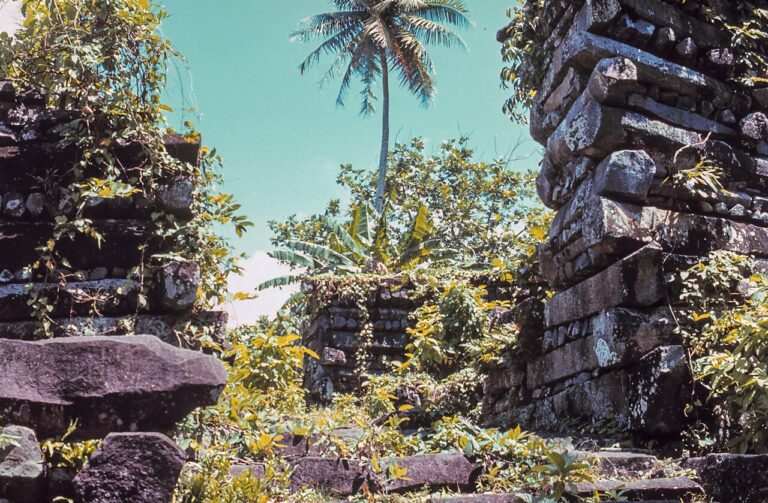
    But this South American parallel is not Gunung Padang’s only overseas’ comparison. No less great is an astounding, perhaps kindred mystery 4,345 kilometres northeast from Java, in a remote corner of the western Pacific Ocean. Off the coast of the Micronesian island of Pohnpei ‘ ‘Built Upon An Altar’ ‘ stand the massive ruins of a long-dead archaeological site. Incongruously built on a coral reef less than two metres above sea level, Nan Madol ‘ ‘Spaces In Between’ ‘ is a series of rectangular islands and colossal towers choked by draping vegetation. Ninety-two man-made islands are enclosed within the ‘downtown’ area’s 2.6 square kilometres. All are inter-connected by an extensive network of what appear to be massive canals, each nine metres across and more than one metre deep at high tide.

    An estimated two hundred fifty million tons of prismatic basalt ‘ related to Gunung Padang’s andesite ‘ went into the construction of Nan Madol. Its stone girders rise in a cribwork configuration to eight metres. Between four and five million stone columns went into the construction of this prehistoric megalopolis. These prismatic columns range in length from one to four metres, although many reach six metres. Their average weight is around five tons each, but the larger examples weigh twenty or twenty-five tons apiece. An estimated four to five million basalt pillars, girders and logs went into building Nan Madol. It is, in effect, a double-walled enclosure comprising thirteen thousand, five hundred cubic metres of coral, with an additional four thousand, five hundred cubic metres of basalt. Remove all concealing vegetation, and visitors would behold crudely worked masses of basalt contrasting with orderly courses of stone rising in massive towers and overpowering walls amid a complex of smaller, rectangular buildings and man-made lakes interconnected by dozens of canals and numerous steps, sometimes formed into grand staircases, and spread out over eighteen square kilometres.

    Construction migrated to the main island of Pohnpei, where a rectangular enclosure fifteen metres long by eleven metres wide, with bisecting, one-metre-high interior wall, was discovered in a remote, swampy meadow high in the mountains; its configuration and mountaintop setting are particularly reminiscent of Gunung Padang. Although the Micronesian island’s twin courtyards contain a five hundred square-metre area, a pair of inner platforms are only a third of a metre high. As at Nan Madol, roughly cut basalt boulders and basalt ‘logs’ were stacked to form the enclosure. Several others stand on Pohnpei’s southwest coast, with the largest example atop a two hundred forty-metre-high mountain. The summit is entirely surrounded by walls about two metres high connected via paved walkways to several terraced platforms.

    No one knows who raised them, when or why. Micronesian myth recounts only that exceptionally tall, twin-brother sorcerers, named Olisihpa and Olsohpa, arrived sometime during the ancient past in a ‘large canoe’ from their distant homeland. It was a great kingdom of glittering splendour, until falling stars and earthquakes eventually destroyed Kanamwayso, which sank to the bottom of the sea. This native oral tradition seems like a variation on the more famous story of Mu, or Lemuria, a deeply ancient and supposedly sophisticated, pan-Pacific civilisation that exerted lasting influence on both Asia and America prior to its destruction by a natural catastrophe similar to the tsunami that ravaged northern Japan, in 2010. Before the analogous loss of Kanamwayso, Olisihpa and Olsohpa allegedly built the basalt enclosures and staircases that continue to grace Nan Madol and Pohnpei. Despite more than one hundred years of scientific investigations, however, no known culture has been associated with these places. Meanwhile, the moist, tropical climate skewers accurate carbon-dating at both locations.

    Nor is their original purpose entirely clear. Nothing about either location suggests real urban centres, lacking as they do any provision for food production or storage. No human burials have been found there, save a few, individual skeletons of above-average stature ‘ calling to mind local myths of the founding-fathers, Olisihpa and Olsohpa ‘ unearthed by Japanese archaeologists during the 1930s. The rectangular arrangement of walls with regularly spaced openings and partitions suggest a ceremonial function. But for what people, and why in this extremely remote, obscure corner of the vast Pacific’ Nevertheless, Nan Madol’s and Pohnpei’s fundamental resemblances to Gunung Padang imply, at the very least, a relationship of some kind, however inconceivable.

    14,000 BCE’

    Yet more extraordinary than even these comparisons and the monumental greatness of the Indonesian site itself is its uniquely profound age. The first archaeological survey of Gunung Padang appears in a ‘Report, the Department of Antiquities’ (Rapporten van de Oudheidkundige Dienst) for Holland’s colonial office, whose anonymous author posited during 1914 that the ruins could not predate the official beginning of Java’s history in the early 5th century CE, although they appeared much older. For the rest of the 20th century, the site went unrecognised by the outside world, even after it was briefly mentioned by the prolific Dutch archaeological author, Dr. N.J. Krom, in 1946’s Under Palm And Banyan Trees.5 

    Thirty-three years later, a Canberra team from the Australian National University’s Centre for Archaeological Research ‘ ‘dedicated to investigating and learning with and about the people, languages, and land of Asia and the Pacific region’ ‘ returned for the site’s first, scientific examination.6In doing so, they determined that Gunung Padang was far older than previously imagined. Lichen growth alone covering many of the megaliths bespoke an antiquity going back millennia before Java’s earliest known culture. Not until February 2012, however, was a State-sponsored evaluation of the site carried out, when thorough radiocarbon testing revealed it was built and first occupied about 4,800 years ago. This surprisingly early Third Millennium BCE date placed Gunung Padang squarely within Western Europe’s Megalithic Age, with implications for transoceanic contact, however heretical such considerations struck conventional scholars.

    But as the researchers were carrying out their investigations, they noticed traces on Mount Padang’s surface of what might be other, underground structures. No less a supporter of science than the President of Indonesia himself, Susilo Bambang Yudhoyono, lavished the archaeologists with costly GSSI and Multi-Channel SuperSting R-8 ground-penetrating radar units, plus GEM-Ovenhausser geo-magnetometers. These state-of-the-art instruments readily found and accurately confirmed the existence of large and small chambers, walls, gates and staircases buried deep beneath the often-visited, open-air ruins in a virtual subterranean mirror image of Gunung Padang.

    According to team leader and geologist, Dr. Danny Hilman Natawidjaja, ‘3-D geo-electric and geo-radar [procedures] discovered two doors in the hallway’ of a chamber measuring ten-by-ten-by-ten metres at a depth of twenty-five metres.7 Throughout last summer and into early fall, he and his twenty colleagues ‘ leading seismologists, philologists, archaeologists, anthropologists, and petrographers ‘ carefully dredged up organic materials, which were sent for laboratory testing in the United States, because the Indonesians were determined to avoid any appearance of politically motivated results.

    ‘US lab validates Cianjur ‘ancient structure’ theory,’ The Jakarta Post announced on 5 November. ‘A recent analysis of carbon-dating by the Miami-based Beta Analytic Lab has apparently validated findings by a government-sanctioned team that a man-made structure lies buried under Mount Padang in Cianjur, West Java. The lab used samples of sand, soil and charcoal found at a depth of between three and twelve metres beneath the mountain’s surface. Based on geo-electric, geo-radar and geo-magnetic [surveys], a large chamber is buried at least up to fifteen metres from the surface’ Carbon-dating test results from the Miami lab show that the structure could date back to 14,000 B.C., or beyond.’8

    Since publication of The Jakarta Post report, repeated and additional analysis by Beta Analytic scientists confirmed their initial 14,000 BCE findings. The significance of this discovery cannot be over-stated, because it crosses the Ice Age event horizon. Even Turkey’s Gobekli Tepe, for all its Tenth Millennium BCE antiquity, came into being only after the close of the last glacial epoch, when environmental conditions were moderating sufficiently to allow for the development of proto-civilisation. Less distracted by the incessant challenges to their survival, our ancestors were afforded opportunities for broader, more complex social cooperation. But Gunung Padang proves that humans were already in possession of a relatively high culture two thousand years earlier, while the Ice Age was still in progress.

    This ‘Shrine of the Sun’ has radically pushed back the origins of civilisation to remoter levels of time and space, because mainstream palaeo-anthropologists, fixated on Europe and the Near East, are resistant to the very notion of mankind’s transition from ‘savagery’ in Indonesia. Yet, it is precisely here that Stephen Oppenheimer, a British geneticist, member of Green Templeton College, Oxford, and an honorary fellow of Liverpool School of Tropical Medicine, traced the beginnings of civilised mankind with his controversial Eden in the East, in 1999.9 It had been preceded during the previous century by The Lost Continent of Mu, written by another Englishman, James Churchward, an Imperial British Army colonel serving in India, where his translation of original Hindu monastery source materials likewise recorded how humans took that first step in the Western Pacific realm.10 My own The Lost Civilization of Lemuria (2006) and Before Atlantis (2013) similarly trace the rise of homo erectus in Java, his Pacific-wide dispersal and accelerated evolution after the eruption of history’s greatest volcanic event, and his descendants’ subsequent invention of civilisation.

    These conclusions are wonderfully brought to life by recognition of Gunung Padang as Man’s earliest-known megalithic complex. Its apparent sophistication declares that it was not the first, but must have been preceded by the construction of even earlier ceremonial centres. Civilisation is, therefore, older than we presently comprehend. If, however, the quest for its ultimate origins goes on, and deeper into the past than ever imagined, then at the very least, Gunung Padang is pointing us in their proper direction.

    You can read more about ancient civilisations, including articles on an ancient pan-Pacific civilisation and Turkey’s Gobekli Tepe, in New Dawn Special Issue Vol 7 No 1.

    If you appreciated this article, please consider a digital subscription to New Dawn.

    Footnotes

    1. Kurt Mendelssohn, The Riddle of the Pyramids, London: Thames & Hudson, 1974.

    2. Robert M. Schoch, Voices of the Rocks, NY: Harmony, 1999.

    3. Ringing Rocks Park, Upper Black Eddy, Pennsylvania, www.youtube.com/watch’v=V4VtjFhysgc;Ringing Rocks Park, Lower Pottsgrove Township, Pennsylvania, www.youtube.com/watch’v=NBfrLoBpsIQ; Ringing rocks, Queensland, Australia, www.youtube.com/watch’v=dl_zL4g2gvs;Musical Stones of Skiddaw, England, www.youtube.com/watch’v=inWKcmVEwvs; Ringing Rocks, Montana, www.youtube.com/watch’v=smiCS1Ixfts; Cerro de las Campanas, Querétaro, Mexico,www.youtube.com/watch’v=_dMRcnlZ2tk; The Ringing Stone, or Clach a’ Choire, Scotland,www.youtube.com/watch’v=eNn-4O_G-bU

    4. www.abovetopsecret.com/forum/thread880575/pg1

    5. Dr. N. J. Krom, Onder Palmen En Waringins, Holland: Uitgeverij in Den Toren, 1946.

    6. ANU Centre for Archaeological Research, http://chl.anu.edu.au/archaeology/car.php

    7. www.abovetopsecret.com/forum/thread880575/pg1

    8. ‘U.S. lab validates Cianjur ‘ancient structure’ theory,’ 5 November 2012, The Jakarta Post,www.thejakartapost.com/news/2012/11/05/us-lab-validates-cianjur-ancient-structure-theory.html.

    9. Stephen Oppenheimer, Eden in the East, London: George Weidenfeld & Nicholson, Ltd., 1999.

    10. Col. James Churchward, The Lost Continent of Mu, U.S.: Brotherhood of Life, 1987 reprinting of the 1924 original.

    11. Frank Joseph, The Lost Civilization of Lemuria, U.S.: Bear and Company, 2006; Before Atlantis, U.S.: Bear and Company, 2013.

    FRANK JOSEPH has published more books (eight) about the lost civilisation of Atlantis than any other writer in history. These and his twenty, other titles dealing with archaeology, military history and metaphysics have been released in thirty-seven foreign editions around the world. He was the editor-in-chief of Ancient American, a popular science magazine, from its inception in 1993 until his retirement fourteen years later. He lives today with his wife, Laura, in the Upper Mississippi Valley of the United States.

    The above article appeared in New Dawn No. 136 (Jan-Feb 2013).

    Read this article with its illustrations and much more by downloading
    your copy of New Dawn 136 (PDF version) for only US$5.95

    © Copyright New Dawn Magazine, http://www.newdawnmagazine.com. Permission granted to freely distribute this article for non-commercial purposes if unedited and copied in full, including this notice.


  • 1995: THE HALL OF RECORDS

    1995: THE HALL OF RECORDS


    WILL THE LEGENDARY EGYPTIAN TREASURE TROVE BE REDISCOVERED IN 1999?


    By Dr. Joseph Robert Jochmans

    Recently, archaeologists announced an important find has been brought to light, a major series of tombs found in the Valley of the Kings, the burial vaults of the sons of Ramses II. What is amazing is that previously, the Valley had been thoroughly searched for almost a century, and was thought to be completely exhausted for any further investigation. That a find of such major proportions could have eluded so many Egyptologists, including Howard Carter, the discoverer of the tomb of Tutankhamen in the same Valley, goes to show that the land of the Nile still has many secrets. What else, we may well ask, lurks below the sands?

    For untold centuries both historical and esoteric sources have passed down stories of a forgotten time-capsule of Ancient Wisdom, far greater in importance than the golden treasures of Tutankhamen. The various accounts speak of chambers located beneath the Great Pyramid and the Sphinx at Giza, filled with a technological legacy left by lost advanced civilizations older than Egypt itself. Along with the stories are also preserved a number of prophecies foretelling who, when and how the vanished time-capsule will be opened.
    The Messages in Stone

    Our search begins with several stone stelae or tablets from the Middle and New Kingdom periods (between 4,000 and 3,000 years old), found in the vicinity of the Sphinx, which show the great animal reclining on top of a high pedestal surmounted by a cornice. One ancient artist, a Twelfth Dynasty scribe named Mentu-her, made sure his viewers knew his subject matter was the Great Sphinx and not other sphinxes found along the Nile, by drawing in the Pyramids in perspective in the background, a technique very rarely seen in Egyptian art.

    Seven other stelae go further, and show a door on the side of the pedestal. The famous Stele of Thutmose IV, located between the paws of the Sphinx, likewise depicts at its top the Sphinx Iying upon an understructure, with a doorway clearly seen. Finally, on yet another stele, made by an official named Nezem, and now kept in the Louvre, there is clearly depicted a flight of six steps leading to the door.

    Conservative scholars have attempted to explain the pedestal as simply a representation of the nearby Temple of the Sphinx, because from a front view perspective the Sphinx does look like it sits on its roof. But this illusion can only be seen from the front and on the surface. The ancient artists, on the other hand, depicted the pedestal from the side and from below.

    In the 1930’s, the sands around the Sphinx were finally completely cleared away, and we now know that the ancient monument rests firmly on bedrock. But the bedrock itself may have been the pedestal the Egyptian artists had in mind. And deep below somewhere along the southern side may yet be discovered the six steps and doorway, the entrance to secret hollowed out chambers undisturbed.

    An important early Egyptian source that tells us much about the Hall of Records is called the Building Texts, found among the hieroglyph inscriptions on the inner enclosure wall of the temple of Horus at Edfu, in the heart of southern Egypt. The Building Texts refer to a number of now lost documents, grouped together into what was called The Sacred Book of Temples, which gave a history and description of the major shrines along the Nile from a very remote period. These were first established by a group of creator-entities called the Shebtiw, who were associated with the god Divine Heart or Thoth, the Egyptian deity of Wisdom.

    According to the Building Texts, the sacred books and power objects were eventually placed back inside the bw-hmn or Hall, and the Shebtiw sealed the entrance, constructed a new enclosure about it, and erected power staffs and pillars outside to protect its secrets, hidden away again from all but its guardians. The site thereafter became known as bw-hmr, the Place of the Throne of the Soul, regarded as the location where only the highest Initiations were performed.

    In another Egyptian text, known today as the Westcar Papyrus, which bears evidence of dating to the Fourth Dynasty, is the story of an enigmatic sage named Djeda who could not only perform miraculous feats of magic, but who also possessed certain information concerning what he called the secret chambers of the books of Thoth. In the narrative, Djeda told Pharaoh Khufu the location of specific keys that will one day open the hidden place, which he described as follows: In the city of Ani (Heliopolis) is a temple called the House of Sapti, referring to Septi, the fifth Pharaoh of the First Dynasty, who reigned about 3000 B.C. Within the temple is a special library room where the scrolls of inventory are kept. The walls of this room are made of sandstone blocks, and either within or behind one of these blocks is a secret niche containing a small box made of flint or whetstone. It is within this box that the ipwt-seals or keys that will open the secret chambers of Thoth, the Hall of Records, may still be hidden.

    When Khufu asked Djeda to bring these keys to him, the sage replied he did not have the power to do so, but prophesied that he who some day would find the keys would be one of three sons born to Rad-dedet, the wife of the chief priest of Ra in Heliopolis, Lord of Sakhbu (the second Lower Egyptian nome or district in the Nile Delta), and that the three would be born on the 15th day of the month of Tybi (our October-November).

    Now it is generally interpreted that the three mentioned were the first three Pharaohs of the succeeding Fifth Dynasty. But because much of Egyptian literature is multi-leveled in its symbolism, there is reason to believe that a more hidden meaning may have been intended, that the three enigmatic brothers may also be those yet future individuals who will one day find and open the Hall of Records.

    Today, many portions of the old city of Heliopolis are still buried and unexcavated, silently resting underneath the expanding suburbs of Cairo. The secret of the House of Septi may yet await discovery.
    Ancient Tales

    Interpreter of ancient languages Zecharia Sitchin cites a hymn composed in the Eighteenth Dynasty which speaks of the god Amun taking on the functions of the heavenly Harakhty (the Sphinx) who attains perception in his heart, command on his lips as he enters the two caverns which are under his (the Sphinx’s) feet. The command of Amun is then placed into the writings of Thoth, the god of Hidden Knowledge and Initiation.

    The famed Greek historian Herodotus, in 443 B.C., recorded after his visit to Egypt that extending beneath and in all directions far beyond the pyramid whereon great figures are graven is a vast labyrinth, and a way into it underground.

    In the Corpus Hermeticum, a body of treatises compiled from older materials toward the beginning of the Christian era, we find in one of these works, the Virgin of the World, these words:

    The sacred symbols of the cosmic elements, the secrets of Osiris, were hidden carefully. Hermes (the Greek equivalent to Thoth), before his return to Heaven, invoked a spell on them, and said, O holy books which have been made by my immortal hands, by incorruption’s magic spell remain free from decay throughout eternity and incorrupt by time. Become unseeable, unfindable, from everyone whose foot shall tread the plains of this land, until old Heaven shall bring instruments for you, whom the Creator shall call His souls. Thus spake he, and laying the spells on them by means of his works, he shut them safe away in their rooms. And long has been the time since they were hid away.

    The Roman Marcellinus, in the 4th century, stated: There are certain subterranean galleries and passages full of windings beneath the pyramids which, it is said, the adepts in the ancient rites (knowing that the flood was coming, and fearing that the memory of the sacred ceremonies would be obliterated), constructed vaults in various places, mining them out of the ground with great labor. And upon leveled walls they engraved the hieroglyphic characters.

    Marcellinus contemporary, Iamblichus, wrote a treatise on the Mysteries of the Egyptians, and described the Initiation associated with the Sphinx. In a secret location between the paws of the feline monument, he said, is a bronze door, its opening triggered by a hidden spring. Beyond it, the neophytes went into a circular room. From this point on, they were subject to a series of trials to become full members among the Initiates, eventually reaching Masterhood.

    In similar fashion, the tenth century Coptic chronicler Al Masudi observed from earlier accounts that in the area of the Sphinx were subterranean doorways to the Giza monuments: One entered the pyramid through a vaulted underground passage 100 cubits or more long; each pyramid had such a door and entry.

    In later centuries, the medieval Arab chronicler Firouzabadi noted that the chambers of the Sphinx were constructed at the same time as the Great Pyramid: The Pyramid was erected by Esdris (Hermes or Thoth), to preserve there the sciences, to prevent their destruction. And also, the first priests, by observations of the stars, preserved records of medicine, magic and talismans elsewhere. Likewise, Ibn Abd Alhokim, who told the story of the antediluvian king Salhouk’s dream of the Flood and his building of the Pyramid to save wisdom, also recounted that Salhouk dug a vault nearby the Pyramid, filling it with all manners of works on mathematics, astronomy and physics: And they built gates (entrances) of it forty cubits underground, with foundations of massive stones from the Ethiopians, and fastened them together with lead and iron. When Salhouk was finished, he covered it with colored marble from top to bottom and he appointed a solemn festival, at which were present all the inhabitants of the kingdom.

    The Jewish historian Josephus recorded further that Enoch built an underground temple of nine vaults, one beneath the other, placing within tablets of gold. His son, Methuselah, also worked on the project, putting in the brick walls of the vaults according to his father’s plan. As Manly P. Hall noted, the Freemasons predict that someday a man will locate this buried vault, and that he will be an initiate after the order of Enoch.
    Prophetic Code

    Ever since two centuries ago when Sir Isaac Newton took a special interest in the sacred geometry of the Great Pyramid, and speculated that its inner labyrinth of tunnels and chambers was a prophecy calendar in stone, a host of scholars who have attempted to elaborate on this idea, and crack the Pyramid’s prophetic code.

    In correlation with the prophecy inside the Great Pyramid, the nearby Sphinx may hold its own symbology of past and future happenings. According to ancient Egyptian and Coptic traditions, one of the earlier forms of the Sphinx, before it was carved into its present configuration, is that it had the front paws of a lion, the back legs and tail of a bull, the face of a human, and along its sides where today one can see the remains of stone incendiary boxes, fires were lit at night to give the Sphinx the appearance of having the flaming wings of an eagle.

    Lion. Bull. Human. Eagle. We have here not only the Four Beings before the throne of the Divine as described in the Books of Ezekiel and the Revelations, but we also have here the four Fixed signs of the Zodiac, Leo, Taurus, Aquarius and Scorpio.

    Most significantly, in the Precession of the Equinoxes, the distant Age of Leo 12,000 years ago saw the burial of the Hall of Records beneath the Sphinx’s front paws. Recent archaeological and geologic surveys conducted by John Anthony West and Robert Schoch have demonstrated that the Sphinx does indeed date to such a remote time period.

    Today we have just entered the Age of Aquarius, and the face of the Sphinx symbolizes the face of global humanity joined in one mind and one heart, the goal of evolving Aquarian civilization.

    Another 6,000 years into the future will complete the Sphinx’s prophecy in the distant Age of Scorpio, when perhaps humanity’s spiritual evolution will be complete. The flaming wings of the Sphinx may be more than just that of an eagle; they may signify the fire of the Phoenix, the higher form of Scorpio that epitomizes its central themes of death and transfiguration. It is striking to note that the Pyramid’s time line ending in the 83rd century will also fall in the Age of Scorpio.

    Another theory sees the Sphinx embodying not only the four Fixed signs, but more specific astrological locations which Philip Sedgwick in his book Astrology of Deep Space identifies as the Four Points of Avatar, found at 14 degrees of Leo, Taurus, Aquarius and Scorpio. There are those students of the Egyptian Mysteries who believe that when all Four Points of Avatar will be triggered by planetary configurations, this may be a cosmic key for opening the doorway into the Sphinx’s forgotten secrets.

    Significantly, the next occurrence will take place on August 6, 1999. Will this presage the opening of the hidden Hall of Records? After that, the only other Four Points of Avatar hits to take place in the foreseeable future will be from May 4-14, 2003; November 6-11, 2005; and January 2-10, 2006.
    The Visionaries

    America’s most famous psychic, Edgar Cayce, who lived from 1877 to 1945, saw in vision that at the same time the Great Pyramid was being built over 12,000 years ago, other activities were underway to preserve books of knowledge. The hiding place for these books Cayce variously described as the hall of records yet to be uncovered, a storehouse of records, a time-capsule, a small tomb or pyramid, the pyramid of unknown origins as yet, the holy mount yet to be uncovered. As to which direction from the Sphinx the Hall lies, the seer specified in several trances that it is between that monument and the Nile river, toward the east, as the sun rises from the waters, the line of the shadow (or light) falls between the paws of the Sphinx.

    Renowned as France’s most famous seer, Nostradamus in 1558 published the completed edition of his book of prophecies, Les Vrayes Centuries, The True Centuries. The book was composed of 969 prophetic quatrains or four-lined poetic verses, all purposely written cryptically as a defense against the Inquisition of his day, who took a dim view of all forms of forecasting.

    Despite the obscuring of his words, many of Nostradamus prophetic verses have seen their fulfillment to a remarkable degree of accuracy, describing such twentieth century events as the World Wars, the landing of a man on the Moon, and even such modem happenings of the 1990s as the fall of Communism in Russia, the end of the Cold War, the Gulf War, the reunification of Germany, plus the rise of global pollution and the AIDS epidemic.

    Nostradamus also left behind a significant group of verses which, once we work out the seer’s puzzling cryptics, offers us invaluable information about the coming opening of the lost Hall of Records in Egypt.

    Here’s one example:
    They will come to discover the hidden topography of the land (at Giza),

    The urns holding wisdom within the monuments (the Pyramids) opened up,

    Their contents will cause the understanding of holy philosophy to expand greatly,

    White exchanged for black, falsehoods exposed, new wisdom replacing the established tradition that no longer work. VII,14.
    The Message From the Past to the Future

    When we look at the sum total of information from both historical and psychic sources regarding the Hall of Records, we find some remarkable correlations. These include: its location (below and around the Sphinx), age (at least twelve millennia old), identity of its builder (Thoth-Hermes), purposes (a storehouse and Initiation site), descriptions of its contents (advanced wisdom and science), the number of its future openers (three), the circumstances of its re-discovery (found by spiritual intuition), and the coming time-frame when it could possibly be brought to light (between 1999 and 2012).

    Most modern conservative Egyptologists believe that the Hall of Records is nothing more than a mere myth or fable, because its existence does not fit into currently acceptable views of ancient history. Yet the stubborn persistence of the story of the lost Hall through the millennia, plus the consistency of its description and the integrity of the many sources testifying to its reality, suggests there is something very substantial to the story, that it may be based on fact. Perhaps very soon, within the next fifteen years if the prophecies are right, we will be able to agree with Egyptologist Gerald Massey, who wrote: Someday what we thought was myth will be found to contain the true history of the past, while what we always regarded as history will be relegated to a myth of our own making.

    Finding of the Hall of Records will no doubt catalyze the transformation of everything we know about the past, and in so doing, will also revolutionize how we will enter the future ahead. The lost time-capsule from the past may be destined to change the very nature of time itself, as we know it.
    Copyright 1995. Joseph Robert Jochmans. All rights reserved. Excerpted from Joseph’s book, Time-Capsule: the Search for the Lost Hall of Records in Ancient Egypt.
    Atlantis Rising Copyright 1994-1996 – all rights reserved
    P.O. Box 441, Livingston, Montana 59047

  • Secrets of the Sphinx

    Secrets of the Sphinx


    Mysteries of the Ages Revealed.


    Secrets of the Sphinx by Andrew Raymond is an amazing act of syntheses and one of the more informative books to be published in recent times. By reading this review and other pages linked from this site, you will discover that our scientists divide the 25,800-year cycle of our Earth into twelve ages instead of twelve months, and that the Great Sphinx in Egypt marks the “Happy New Year” of this cycle. The 25,800-year cycle of our planet with its four seasons is called the great year, the Platonic year (Plato’s year), or the precession of the equinoxes in a comprehensive dictionary.


    The four seasons of the great year are marked by Egypt’s four minor sphinxes, Ezekiel’s four heads of the beast, Revelation’s four cherubim, and astronomy’s Taurus, Leo, Aquarius, and Scorpio (Abraham’s Eagle) constellations.


    Our Current Position in the Great Year
    (Cross takes 25,800 years to make one turn through the twelve ages) .
    Our astrological birth signs no longer coincide with the sun’s location in the constellations of the Zodiac because of precession. Even the Tropic of Cancer and the Tropic of Capricorn are now the Tropic of Taurus and the Tropic of Scorpio when we observe the sun on the solstices? Our astrologers and map makers neglected to update our present position in the cosmos for over 2,000 years. We are not the astrological birth signs the newspapers and a majority of the astrologers proclaim we are!

    The North star (pole star) also changes with the precession of the equinoxes.
    The North star was Thuban (Alpha Draconis) when the Great Pyramid was constructed to align with true North. The descending passage of the Great Pyramid points to Thuban, the most accurately aligned pole star of all the North stars in the 25,800-year cycle of our Earth.


    25,800-Year Cycle of Earth

    Comprehend that the word sphinx means to bind or close a circle tightly, and that the Great Sphinx binds Virgo and Leo in the Zodiac on the ceiling of the Portico — at Esna’s Khnum Temple. The Great Sphinx marks the “Happy New Year” of our present Platonic year, and Leo was the first age in this great year. Listen when the Vatican informs us every Christmas Eve, when it reads the ancient Calens (calendar) from Rome, that it was the sixth age or the Piscean Age when Jesus, the fisherman, was born 2,000 years ago. Even the ancient Persians called Polaris the “turning point star” 5,000 years before it became our current pole star between the sixth and seventh ages.


    Precession of the Vernal Equinox.
    (Currently, we are at the end of the Sixth Age — halfway around one great year)

    When Moses threw out the golden calf, he knew it was the end of the Taurus Age or the fourth age in our present great year. He instructed his followers to get rid of the bull, put lambs’ blood on the doors, and place Rams’
    horns in the temples. By looking at the Master Calendar, the Mazzaroth, or the Zodiac in the heavens, anyone could see that it was the dawning of the Age of Aries the ram or lamb. It was the start of the fifth age in our current great year.

    It was the third age, or the Age of Gemini 6,000 to 8,000 years ago, when some people on the Earth believe Adam and Eve lived. Gemini is also known as the twins or Adam and Eve in the ancient Zodiacs.

    At one time in history, the Vernal Equinox used to indicate New Year’s Day in our annual calendar until Julius Caesar moved it to January 1 in 45 BC. The names of our months still reflect March as the first month of the year. In Latin, Septem is seven, Octo is eight, Novem is nine, and Decem is ten. This is why the name of an age is determined by where the sun is on the Vernal Equinox.
    The megalithic monuments like Stonehenge, Chichen Itza, and Casa Grande are all trying to find the Vernal Equinox or the first day of spring in the Northern Hemisphere.

    Understand how Nostradamus, Revelation writers, and the Mayans could have used this 25,800-year cycle of our planet to predict what can be expected as we approach what some call the millennium. The ancients refer to the coupled-ages of Pisces (Fish) and Aquarius (Man) in the great year as the time for the FisherMan (Jesus) or Merman (Fish-Man) to return from the sea. The old legends say that he will teach the people how to heal and govern themselves.

    Don’t be confused by the misinformed people on the planet. Our scientists inform us that, in the great year, we are dawning into the Age of Aquarius and leaving the Piscean Age. When someone says, its the dawning of the Age of Aquarius, that is no different then someone saying, it is the beginning of the month of July. Only, ages are around 2,150 years long, while months are made up of approximately 30 days. Many college books inform us that we are commencing a new age in the great year.

    Even Pat Robertson, who throws oranges across the media-air waves at the new age people, wrote a book called The End of the Age. He should realize — if we are eternal as he preaches and it is the end of an age, than it must be the beginning of a new age.

    Catch the “joke of the universe”. The Oneness, God, or the Whole says to
    Itself: I am everything! I am God! I am It! I am the point or a perfect circle!
    God I am bored! I am so tired of playing with Myself. This is ridiculous. I am tired of being all one or alone.

    “Boring”

    Notice that “all one” and “alone” are essentially the same word. If one is all one, then one must be alone. Are we sensing the predicament of the One Who Causes? Being absolutely bored, the Oneness comes up with a bright idea.
    Why! I’ll just split into two. This would be the same way we split into two teams to play football, chess, or checkers. The Perfect Circle, God, or the Whole gets imaginative, and It splits in two or in-to creation.


    In-Divided-Dual or Individual

    Once the Oneness or God splits into the two U’s (You & You, Us or We), what is a game the universe can play? “Hide and Seek” of course! God can hide from Itself, and spend Its Being trying to find Itself. Give me space to find myself! I have been found! I found it! Most of us know that lost and found departments are normally found together.


    A Double of You or A Double U

    The game of the universe is hide and seek. Dis-member to separate.
    Re-member is to put it back together again or to remember something we have forgotten. Every baby knows this intuitively, until we teach it to babble in words.

    The last 2,000 years has been the Piscean age. Two fish tied together trying to swim apart. We allowed them to swim so far apart, that we lost sight that the opposites are connected. This is the hide stage of the game of “Hide and Seek”
    in full manifestation. The more we separate them the more lost we become. At this juncture in the great year, we are using less than twelve percent of our brain’s potential, and we are only putting one fish on the car bumper. How lost we are!


    Piscean Symbol

    The coming of Aquarius, the man or water bearer, gives us two lines that fit back together. We are approaching a time of Atonement (at-one-ment). It is time for us to re-member or awaken. It is time to look down and observe that our right and left hands are connected. Notice that the electric light doesn’t work without the plus and minus. The end of the Piscean Age is a time of Revelations. It is time to reveal the truth. Catch the Joke! — It was necessary to get lost just to play.


    Aquarian Symbol

    Secrets of the Sphinx is a revealing book that is subtitled The Mysteries of the Ages Revealed. It will point out that it is not the end of the world, but we can expect some very big seasonal changes — the same as the frost comes and the leaves change colors shortly after the beginning of fall. It will teach you what types of foods will help you stay healthy, look younger, and handle the sun’s increasing light at this juncture in the great year.

    Secrets of the Sphinx is an uplifting experience and an easy book to read.
    You will be thinking about this publication long after you set it down!
    Copyright material-Secrets of the Sphinx©. You may use it for personal use only.