Category: Time

  • ON THE EDGE OF TIME: The Mystery of Time Slips


    ON THE EDGE OF TIME: The Mystery of Time Slips
    By Tim Swartz


    Time is a funny thing. There never seems to be enough — yet there is an infinite amount. Time slips through moment upon second into eternity past; yet present, to begin the future.

    Time is thought to be unstoppable in its relentless push towards the future. Humans perceive themselves as bound up in time as an insect in amber. Forever imprisoned and forced to reconcile with the regularity and inevitability of change. The past is gone — the present, fleeting — and the future is unknown.  Or is it?

    If a Merseyside policeman by the name of Frank was asked, he may have an entirely different opinion on the subject of time.

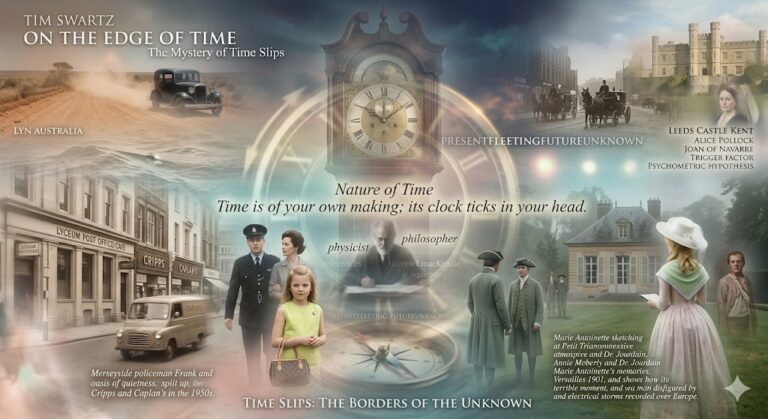
    On a sunny Saturday afternoon in July of 1996, Frank and his wife, Carol was visiting Liverpool’s Bold Street area for some shopping. At Central Station, the pair split up; Carol went to Dillons Bookshop and Frank went to HMV to look for a CD he wanted. As he walked up the incline near the Lyceum Post Office/Café building that lead onto Bold Street, Frank suddenly noticed he had entered a strange “oasis of quietness.”

    Suddenly, a small box van that looked like something out of the 1950s sped across his path, honking its horn as it narrowly missed him. Frank noticed the name on the van’s side: “Caplan’s.” When he looked down, the confused policeman saw that he was unexpectedly standing in the road. The off-duty policeman crossed the road and saw that Dillons Book Store now had “Cripps” over its entrances. More confused, he looked in to see not books, but women’s handbags and shoes.

    Looking around, Frank realized people were dressed in clothes that appeared to be from the 1940s. Suddenly, he spotted a young girl in her early 20’s dressed in a lime-colored sleeveless top. The handbag she was carrying had a popular brand name on it, which reassured the policeman that maybe he was still partly in 1996. It was a paradox, but he was relieved, and he followed the girl into Cripps.

    As the pair went inside, Frank watched in amazement as the interior of the building completely changed in a flash to that of Dillons Bookshop of 1996. The girl turned to leave and Frank lightly grasped the girl’s arm to attract attention and said, “Did you see that?”

    She replied, “Yeah! I thought it was a clothes shop. I was going to look around, but it’s a bookshop.”

    It was later determined that Cripps and Caplan’s were businesses based in Liverpool during the 1950s. Whether these businesses were based in the locations specified in the story has not been confirmed. 1

    Frank’s experience is not that unusual in the realm of strange phenomenon. There is even a name given to such events — time slips.

    A time slip is an event where it appears that some other era has briefly intruded on the present. A time slip seems to be spontaneous in nature and localization, but there are places on the planet that seem to be more prone than others to time slip events. As well, some people may be more inclined to experience time slips than others. If time then is the unmovable force that physicists say it is, why do some people have experiences that seem to flaunt this concept?

    THE NATURE OF TIME

    Much of ancient Greek philosophy was concerned with understanding the concept of eternity, and the subject of time is central to all the world’s religions and cultures. Can the flow of time be stopped or slowed? Certainly some mystics thought so. Angelus Silesius, a 17th-century philosopher and poet, thought the flow of time could be suspended by mental powers:

    Time is of your own making;
    its clock ticks in your head.
    The moment you stop thought
    time too stops dead.

    The line between science and mysticism sometimes grows thin. Today physicists would agree that time is one of the strangest properties of our universe. In fact, there is a story circulating among scientists of an immigrant to America who has lost his watch. He walks up to a man on a New York street and asks, “Please, Sir, what is time?” The scientist replies, “I’m sorry, you’ll have to ask a philosopher. I’m just a physicist.”

    Time travel, according to modern scientific theory, may still be beyond our grasp. Yet for a number of people who have had unusual time slip experiences, time may be easier to circumnavigate than expected.

    A classic example of a time slip can be seen in a note from Lyn in Australia. Lyn had read the book, Time Travel: A How-To Insiders Guide, (Global Communications, 1999) and thought her experience was similar to others featured in the book.

    In 1997 Lyn lived in a small outback town that was built in 1947 and had changed little since that time.

    “I was driving toward the main intersection of the town, when suddenly I felt a change in the air. It wasn’t the classic colder feeling, but a change, like a shift in atmosphere. The air felt denser somehow. As I slowed at the intersection, I seemed to be suddenly transported back in time to approximately 1950. The road was dirt, the trees were gone and coming toward me to cross the intersection was an old black car, something like a Vanguard or old FJ Holden. As the car passed through the intersection the driver was looking back at me in total astonishment before he accelerated. From what I could see he was dressed in similar 1950s fashion, complete with hat.

    “This whole episode lasted perhaps 20 seconds and was repeated at least 5 times during my time there, always at the exact spot. I tried to make out the registration plate number but the car was covered in dust.”

    Lyn wondered if there is someone out there still living who remembers seeing a strange sight at the intersection back in the 50s…of a weird car with a bug-eyed woman at the wheel. 2

    Derek E. tells another interesting time slip story.  When he was a child, his father was a taxi driver in Glasgow, Scotland. One day in the late 1960s, Derek’s father was driving in the north of the city along Maryhill Road near Queen’s Cross, one of the older parts of town and once its own separate community outside the city.

    “One minute it was now,” Derek wrote, “cars, buses, modern clothes, tarmac roads etc. – and the next thing my dad knew he was in some earlier time. It was certainly pre-Victorian given the clothes he described people wearing, horses, rough road, lower buildings, people in rough clothes and bonnets etc. It lasted as long as it took him to be aware of it and then it vanished and he was back in ‘now.’”

    Derek also reported that in the 1980’s, he and his wife were on a driving holiday in the North York Moors in England. They went to a tiny coastal village called Staithes, which had a steep winding and narrowing road down to the harbor, with the entrance to the houses and narrow footway at a higher level of three or four feet.

    “We parked at the top of the village, hamlet really, where the tourist buses and cars had to stop and made our way down on foot. What I remember is a brilliantly sunny day with lots of other people around, but as we made our way down, it just suddenly seemed as if no one else were there but my wife and me. An old woman appeared on the footway opposite us. It became cooler and duller. She asked, in what seemed to me an old-fashioned and very polite way, what year it was. Now lots of old people get confused and it could have been that, but what I remember vividly is her black clothes – handmade, rough and with hand-sewn buttons – really big compared with modern ones. Her shoes were very old fashioned with much higher and chunkier heels than you’d see an older person wearing nowadays. In the time it took me to turn to my wife and say, ‘Did you see that?’ she was gone. The sun was back and so were all the people. My wife had also seen the same old woman and felt the same chill.” 3

    Derek’s experience seems strikingly similar to traditional ghost stories. Many ghost sightings are readily explained as individuals who appear out of their normal location or time; but often the ghost also seems to change the surroundings of the witness, giving the impression of a time slip. What is open to question is whether these are glimpses into another time or does the witness or the ghost actually travel in time? Perhaps it is simply different sides of the same coin.

    Martin Jeffrey, co-editor with Louise Jeffrey of the website www.mysterymag.com, speculates that time slips can be recreated or induced using a “trigger factor,” which “…occurs when one is interested in his surroundings but is not concentrating on them; a slip occurs at a precise place and moment and the witness is thrust seemingly into another time.”

    Jeffrey cites the case of Alice Pollock, who at Leeds Castle in Kent “experienced what could be called a ‘classic’ time slip. Alice was experimenting in Henry VIII’s rooms by touching objects in an attempt to experience events from another time. After a period of receiving no impressions whatsoever, the room suddenly changed. It lost its modern, comfortable appearance to become cold and bare. The carpet had disappeared and there were now logs burning on the fire. A tall woman in a white dress was walking up and down the room; her face seemed to be in deep concentration. Not long after, the room returned to its original state.

    Later research found that the rooms had been the prison of Queen Joan of Navarre, Henry V’s stepmother, who had been accused of witchcraft by her husband. 4

    It could be that the witness triggers time slips, whether they blank their mind at a precise moment and the slip occurs, or the witness touches something that holds the memory of a previous time.

    “The simplest explanation is probably the psychometric hypothesis,” noted Colin Wilson and John Grant in The Directory of Possibilities. “In the mid-nineteenth century, Dr. Joseph Rodes Buchanan of the Covington Medical Institute performed experiments that convinced him that certain of his students could hold letters in their hands and accurately describe the character of the writer. He became convinced that all objects carry their ‘history’ photographed in them. Buchanan wrote: ‘The past is entombed in the present. The discoveries of psychometry will enable us to explore the history of Man as those of geology enable us to explore the history of Earth.’ Clearly, psychometry may be seen as a form of time slip.”

    CLASSIC TIME SLIPS

    The classic of time slip tales occurred in August 1901, when two Englishwoman on holiday, Annie Moberly, Principal of St. Hugh’s College in Oxford and Dr. Eleanor Frances Jourdain, visited Paris. After a short stay in the capital, they went on to Versailles.

    After visiting the palace they began searching for the Petit Trianon but became lost. As they wandered the grounds, both women began to feel strange, as if a heavy mood was oppressing their spirits. Two men dressed in “long greyish-green coats with small three-cornered hats” suddenly appeared and directed the women to the Petit Trianon. They strolled up to an isolated cottage where a woman and a 12- or 13-year-old girl were standing at the doorway, both wearing white kerchiefs fastened under their bodices.  The woman was standing at the top of the steps, holding a jug and leaning slightly forwards, while the girl stood beneath her, looking up at her and stretching out her empty hands.

    “She might have been just going to take the jug or have just given it up I remember that both seemed to pause for an instant, as in a motion picture,” Dr. Jourdain would later write.

    The two Oxford ladies went on their way and soon reached a pavilion that stood in the middle of an enclosure. The place had an unusual air about it and the atmosphere was depressing and unpleasant. A man was sitting outside the pavilion, his face repulsively disfigured by smallpox, wearing a coat and a straw hat. He seemed not to notice the two women; at any rate, he paid no attention to them.

    The Englishwomen walked on in silence and after a while reached a small country house with shuttered windows and terraces on either side. A lady was sitting on the lawn with her back to the house. She held a large sheet of paper or cardboard in her hand and seemed to be working at or looking at a drawing. She wore a summer dress with a long bodice and a very full, apparently short skirt, which was extremely unusual. She had a pale green fichu or kerchief draped around her shoulders, and a large white hat covered her fair hair.

    At the end of the terraces was a second house. As the two women drew near, a door suddenly flew open and slammed shut again. A young man with the demeanor of a servant, but not wearing livery, came out. As the two Englishwomen thought they had trespassed on private property, they followed the man toward the Petit Trianon. Quite unexpectedly, from one moment to the next, they found themselves in the middle of a crowd–apparently a wedding party–all dressed in the fashions of 1901.

    On their return to England, Annie Moberly and Eleanor Jourdain discussed their trip and began to wonder about their experiences at the Petit Trianon. The two began to wonder if they had somehow seen the ghost of Marie Antoinette, or rather, if they had somehow telepathically entered into one of the Queen’s memories left behind in that location. As if to confirm their suspicion, Moberly came across a picture of Marie Antoinette drawn by the artist Wertmüller. To her astonishment it depicted the same sketching woman she had seen near the Petit Trianon. Even the clothes were the same.

    Intrigued by the growing mystery, Jourdain returned to Versailles in January 1902 and discovered that she was unable to retrace their earlier steps. The grounds seemed mysteriously altered. She then learned that on October 5, 1789 Marie Antoinette had been sitting at the Petit Trianon when she first learned that a mob from Paris was marching towards the palace gates. Jourdain and Moberly decided that Marie Antoinette’s memory of this terrifying moment must have somehow lingered and persisted through the years, and it was into this memory that they had inadvertently stumbled. 5

    NATURES TIME MACHINE

    What can be concluded then from these anecdotal tales? Did these people actually travel, albeit briefly, into the past to glimpse scenes that once were? Or were they caught up in a form of haunting where, like an old movie, they saw a scene that had somehow been implanted in a location and allowed to “play back” again for those sensitive enough to pick up the lingering impressions?

    However, if time slips are a form of haunting, what explanation can be offered to the experience of a Mr. Squirrel, who in 1973 went into a stationer’s shop in Great Yarmouth to buy some envelopes. He was served by a woman in Edwardian dress and bought three dozen envelopes for a shilling. He noticed that the building was extremely silent — there was no traffic noise. On visiting the shop three weeks later, he found it completely changed and modernized; the assistant, an elderly lady, denied that there had been any other assistant in the shop the previous week. Even though the envelopes disintegrated quickly, Mr. Squirrel was able to track down the manufacturers, who said that such envelopes had ceased to be manufactured fifteen years before. 6

    How can a haunting produce such physical evidence?

    Time slips are “often accompanied by feelings of depression, eeriness and a marked sense of silence, deeper than normally experienced,” posits author Andrew MacKenzie in his book Adventures in Time: Encounters With the Past, drawing this conclusion based on the Versailles time slip accounts as well as his own interviews with people who have experienced the phenomenon.

    “It is interesting to note that on August 10, 1901, the day of Annie Moberly and Eleanor Jourdain’s experience, electrical storms were recorded over Europe and the atmosphere was heavy with electricity. Could this have led to an alteration in the local temporal field around Versailles?”

    Perhaps there is a natural phenomenon that under the right conditions and location can produce briefly a doorway to another time and place. Even though this may sound outrageous, this natural “time machine” could show that modern concepts and perceptions of time need to be seriously reconsidered. It may be that the past and even the future might be closer then thought with current scientific theories. With the right frame of mind and the right natural conditions, the barriers of time and space that have traditionally kept mankind locked into place may finally be broken, allowing the mysteries of the world and the universe to be finally revealed.

    ABOUT THE AUTHOR

    Tim Swartz is an Emmy-Award winning television producer and the author of such books as: The Lost Journals of Nikola Tesla, Time Travel: A How-To Insiders Guide, and Teleportation: From Star Trek to Tesla. Tim Swartz is also the editor of Conspiracy Journal, a popular e-mail newsletter of conspiracies, UFOs, the paranormal and anything else weird and strange.

    Endnotes:

    1 http://www.bbc.co.uk/dna/h2g2/alabaster/A684821

    2 E-mailed to author

    3  E-mailed to author

    4  www.mysterymag.com

    5 An adventure (London, 1911), The Ghosts of the Trianon, Edited by Michael H. Coleman, Published 1988 by Aquarian
    6 The Directory of Possibilities, edited by Colin Wilson and John Grant, published 1981 by Webb & Bower


  • Did Rudolph Fentz time travel from 1876 to 1950?

    Did Rudolph Fentz time travel from 1876 to 1950?


    Legend has it that back on a warm summer night in June of the year 1950, a man dressed in fashion that resembled that of the 19th century appeared in the middle of Times Square. The man looked extremely confused and baffled by everything around him. Suddenly, he was hit by a taxi and killed.

    Investigators searched his body and found some very odd items.
    Approximately 70 dollars in banknotes from the 19th century
    A token, made out of copper, that was worth 5 cents which had the name of a nearby saloon on it.

    Strangely, the saloon was not known to residents of the area. In fact, even older residents of the area had never heard of it.

    A type of old style receipt for the care of a horse and then another receipt to have a carriage washed. The receipts were from a “livery stable,” a place that takes care of horses, on Lexington Avenue. The address for the business was not listed in any address book.

    Business cards were also on his person. The business cards had the name “Rudolph Fentz” on it and also had an address on Fifth Avenue.

    The man was also carrying a letter sent to the address on the business cards. The letter was dated as being sent in June of 1876.

    Oddly enough, none of these objects showed any sign of aging.

    Investigators checked the address listed on the card the man was carrying. It belonged to a business, but the business had no recollection of the man listed on the card, Rudolph Fentz, at all.

    Rudolph Fentz wasn’t listed in any address book or phone book anywhere. He was not in any database the investigators searched.

    Desperate for answers, the investigators finally found a man by the name of “Rudolph Fentz Jr.” in a phone book. This man, whom seemed to be the son of their victim apparently died five years ago at the age of 60. His widowed wife was still alive though.

    Upon contacting the supposed son of their victims’s wife, she explained how her late husbands father went out for a walk one day at the age of 29 and never returned.

    Investigators looked up missing person‘s from the year 1876 and stumbled upon the man’s name: “Rudolph Fentz.”

    The description of the missing person matched exactly with what their mysterious victim had been wearing.

    The case remains unsolved to this day.

    Did Rudolph Fentz unintentionally travel through time? What really happened to this man?


  • Here’s why time doesn’t exist and its a product of humans

    Here’s why time doesn’t exist and its a product of humans


    In recent years, many scientific studies have gone unnoticed by the general public — studies proving that time doesn’t exist.

    One study shows that “time” is perceived differently by size.

    Smaller species including insects live in a slow-motion world where everything is slowed down – which explains how flying bugs are able to easily dodge an object coming at them such as a newspaper.

    The study was led by scientists from Ireland who found that size affected how one perceived time and it involved more than 30 different species, including lizards, cats, dogs, birds, and mice.

    The research is based off of animals’ ability to detect separate flashes of fast-flickering light.
    Scientists found that “Critical flicker fusion frequency” is the point where the flashes seem to merge together and that light appears constant. Then, comparing the phenomenon in different animals revealed size relates to the perception of how one experiences “time.”

    “The smaller an animal is and the faster its metabolic rate the slower time passes.”
    “The bigger an animal is and the slower its metabolic rate the faster time passes.”

    It’s very fascinating that small animals live in a slow motion world . Where the opposite – Big Animals living in a rapid fast motion world – is also true.

    So next time you play fetch with your dog (or your cat if your cat thinks its a dog), remember that smaller animals are seeing things move in slow motion and bigger animals are seeing things in hyper speed rapid mode.

    That’s not all though — scientists also believe that we ourselves are affected by this phenomenon. When we are younger, we experience time faster because we too are smaller in size, and when we grow up time seems to fly by.

    “It’s tempting to think that for children time moves more slowly than it does for grownups, and there is some evidence that it might,” said the study.

    “Our results lend support to the importance of time perception in animals where the ability to perceive time on very small scales may be the difference between life and death for fast-moving organisms.”

    Further following up with the research of size and time perception, earthquakes, can also influence and shorten our day by shifting and altering the Earth’s Axis.

    This happened when an Earthquake 8.8 hit Chile in 2010. Although not by a significant amount – 1.26 micro-seconds – the day got shorter, slowing the earth down.

    Dr. Michio Kaku explains “that the Earth shifted three inches off its axis, several hundreds miles of plate shifted 6 feet in the earth and that increased the earth’s rotational speed.
    It’s a very tiny effect but it builds up over time.”

    So time as we know it, seconds, minutes and hours do not exist – the only thing that exists is day, night and the current now.

    Human beings created time, with the invention of the clock. Time is an illusion that is experienced differently based off a person or animal’s size. So next “time” you are late for an appointment, tell the person time doesn’t exist and my perception is different then yours.

    On second thought, best to keep in mind that most people live in the matrix of time – for now.

    SOURCE


  • Time Travel: Merely Possible, or Entirely Probable?

    Time Travel: Merely Possible, or Entirely Probable?


    Doc Brown did it with a DeLorean, and The Doctor does it with a blue Police Box; and if it weren’t for the imagination, neither film, nor even the printed page would be useful enough in helping humans succeed with time travel.

    According to many, that’s where time travel is destined to remain: within the realms of science fiction, rather than anything remotely based in fact. One should ask, however, whether this is really the most fair assessment of time travel. Even Einstein had perspectives on the nature of time that seemed counter-intuitive; thinkers and philosophers who have come and gone have thus argued and disputed Einstein on the matter, particularly in the absence of an understanding of the mathematics needed to express any actual mechanics that might underly it.

    Hence, the notion of time and temporality as it might actually exist, rather than merely how we perceive it generally, often becomes discarded, especially when the analytical mind attempts to reconcile with the seeming impossibilities that our universe worthily tosses our way from time to time.

    Einstein’s primary beef with our perception of time had been the notion that it exists apart from space itself, and that much like an old carriage barreling down a dusty road, time plunders on in a linear fashion; ever onward, and forward, forever escaping humanity as every passing moment we strive to call “now” actually becomes then, and fades away into memory.

    However, contrary to this linear interpretation that had accompanied time since its emergence in human thought, Einstein considered time as being constant; and thus the past, present, and future, in addition to becoming illusory, are revealed to actually exist simultaneously:

    “Since there exists in this four dimensional structure [space-time] no longer any sections which represent “now” objectively, the concepts of happening and becoming are indeed not completely suspended, but yet complicated. It appears therefore more natural to think of physical reality as a four dimensional existence, instead of, as hitherto, the evolution of a three dimensional existence.”

    In other words, many of our intellectual struggles with the idea of stepping out-of-place with our conventional temporality are just that: perceptual hinderances that are fitted to the limitations of the human senses, through which all things perceivable must be filtered. Arguably, this manner of thinking in terms of what can be only defined by our senses (example: “I perceive this as being that, and thus, ‘it’ must be!”) may seem logical relative to the human way of seeing things. But it is also inherently biased; maybe one day, perhaps with the help of intelligent machines, those kinds of human biases favoring sensory views toward materiality will broaden… but I get ahead of myself.

    On a personal note, I too have  struggled with trying to express the seemingly non-logical or counter-intuitive aspects regarding time and temporality in the past, some of which were included in my book The UFO Singularity. Rather than being a UFO-centric work, this book actually dealt more with ideas pertaining to the speculative realm of “technological singularity” that some think may await us as a civilization; in addition to providing commentary on this juxtaposed against UFO belief over the last few decades, there is also a healthy peppering of time-travel talk that I get into as well.

    Some of the reviews (as we will soon see mirrored in thinking applied in opposition with Einstein’s theories of relativity and time travel) seemed to argue against what I had written based on a limited knowledge of the subjects themselves. For instance, one skeptical blogger who, in his defense, had apparently not actually read the book, nevertheless summarized it as being about “aliens coming to visit Earth from the future, and other made-up ideas”; a humorous statement, nonetheless, since it is actually contrary to the ideas I tried to outline. Of greater interest here, however, and one at the heart of the time travel debate, had been the views of one proponent of “high-strangeness”, John Harney, at the Magonia blog, who felt that any discussion of the possibility of time travel was tantamount to nonsense:

    “Mathematician and physicist John D. Barrow has remarked: “Time travel is the thinking man’s UFO”. However, Hanks’s ideas on the subject don’t show much coherent thinking, as his awareness of some of the time travel paradoxes should make him realise that the notion of UFOs as manifestations of of time travellers is nonsense.”

    Which brings us back around to the seemingly-logical illogic of expecting “paradoxes” to be the death-nail of time travel. In fairness, a more general opposition to the kinds of ideas expressed by Einstein in his theory of relativity were commonplace around the time it was first presented to the scientific community. Martin Gardner, a writer for Scientific American and author of the book The Relativity Explosion, once noted the criticisms Einstein had managed to entertain among his peers:

    “How did the world’s leading scientists and philosophers react when they caught their first glimpse of the strange new world of relativity? The reaction was mixed. Most physicists and astronomers, confused by the violations of common sense and the difficult mathematics of the general theory, maintained a discrete silence. But scientists and philosophers capable of understanding relativity were inclined to accept it with exhilaration… Here and there scientists were unable to shake themselves loose from old Newtonian habits of thought. In many ways they resembled the scientists back in the days of Galileo who could not bring themselves to admit that Aristotle might have been mistaken. [Albert] Mitchelson himself, a limited mathematician, never excepted relativity even though his great experiment smoothed the way for the special theory.”

    Gardner devoted an entire chapter in his book to Einstein’s discussion of the so-called “Twin Paradox,” which was used to illustrate the broader concept of time dilation. “Henri Bergson, the famous French philosopher,” Gardner wrote, “was the most imminent thinker to crosswords with Einstein over the twin paradox. He wrote about it at some length, po fun at what he thought were its logical absurdities. Unfortunately, what he wrote only proves that it is possible to be a great philosopher without knowing much about mathematics.” Sadly, these sorts of arguments against things that often include subjects like time travel are still based on a fundamental close-mindedness toward the deeper complexities underlying the principles being expressed.

    There are, however, more famous paradoxes associated with the concept of time travel that have aroused controversy. Most famous among these, perhaps, is the so-called “Grandfather paradox,” which entails a hypothetical situation where one would conceivably be incapable of traveling back in time to destroy an ancestor, since the act of killing this individual would negate the killer’s own future existence. In September, Scientific American featured this article which describes a new scientific model that was discussed previously in the journal Nature Communications, formulated by scientists who claim it can successfully resolve the long-questioned Grandfather paradox:

    “Instead of a human being traversing a CTC to kill her ancestor, imagine that a fundamental particle goes back in time to flip a switch on the particle-generating machine that created it… If the particle were a person, she would be born with a one-half probability of killing her grandfather, giving her grandfather a one-half probability of escaping death at her hands—good enough in probabilistic terms to close the causative loop and escape the paradox. Strange though it may be, this solution is in keeping with the known laws of quantum mechanics.”

    Though the scenario above is still hypothetical, it stands to reason that it could be achieved if consideration is given to such things as “dimensional splits” that may occur as a result of what we now recognize as a many-worlds hypothesis of space-time. Here, changes in one timeline involving you or I might not affect another, particularly if the process of traveling through time is done so in a manner that also affects these hypothetical “multiple timelines,” or perhaps even creates all-new “splinters” in the temporal fabric of reality, of which there might exist infinite numbers.

    More and more, we are finding with time that old ideas that seemed to limit the possibilities of such things as a time travel are having to be revised, and slowly we are learning that things once deemed “imaginary” are perhaps worthy of consideration, after all. Much more could be said of the subject, but in it’s finest essence, it would seem that if the notion of time travel can be conceived within the mind, it then may indeed be possible, so long as it is not irrevocably ousted by the imposition of more firmly-understood scientific laws: to date, the idea remains far from being disproven.

    A few final resources and thoughtful rumination worthy of any  prospective time traveler’s… well, time, are the following articles on the subject: Albert Einstein and the Fabric of Time, featured at the website of Gevin Giorbran, as well as Michio Kaku’s “The Physics of Time Travel“, featured at his website. Then again, some might argue, as seen below, that we’re already time travelers; maybe, in the end it all has more to do with simply changing the way we think about things: