Presence on the Path: The BlueBird found beauty through disciplined ritual, while the Coyote lost it through pride.
“Be careful where you look, or you may lose the very beauty you seek to show off.”
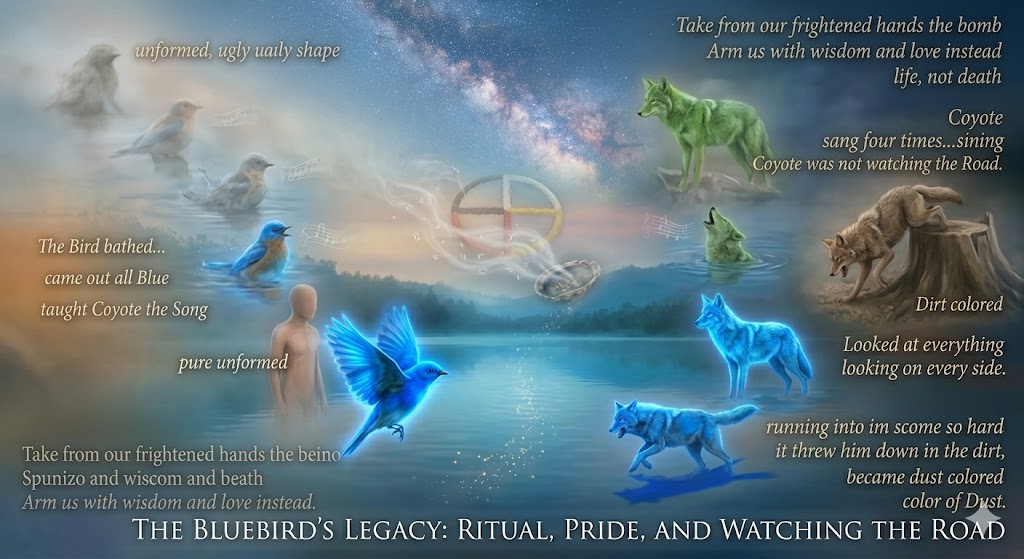
In this ancient teaching story, we learn how the BlueBird transitioned from an “ugly color” to the vibrant blue we see today through discipline and song. But when the ever-curious and prideful Coyote tried to mimic the transformation, his vanity became his undoing. This story is a beautiful metaphor for the spiritual journey: it is not enough to achieve “Blue” beauty; one must also watch the road ahead.
BlueBird
“…O wonderful spirit of gentleness…
touch, calm and embolden all men. Take from our frightened hands the bomb…
Arm us with wisdom and love instead. Let life, not death, enter no matter where we walk…”
The BlueBird was once a very, very ugly color. And, nearby where he lived, there was a lake. Now this lake was where where no river water flowed in or out. The Bird bathed in it four times every morning for four mornings.
And, on each of these times it sang.
” There is a blue water, it lies there. I went in, I am all blue.”
On the Fourth morning, the bird shed all of it’s feathers. He came out of the lake in his bare skin. But, on the fifth day, oh the fifth day, he came out all Blue. Now, all of this time Coyote had been watching the Bird. He wanted to jump in and get the Bird but he was afraid of the water.
On that fifth morning Coyote asked,
“How come your ugly color is all gone and you are now blue, pretty, and happy? You are more beautiful than anything that flies in the air. I want to be Blue too.”
Coyote at this time was green, a very bright green. “I went in four times,” said Bird and he taught Coyote the Song. So, four times Coyote went in singing. The fifth time he came out as Blue as the little Bird. This made him very proud.
Coyote began to walk around. And, as he walked along, he looked and looked on every side to see if anyone noticed how wonderfully fine and Blue he was.
He looked to see if his shadow was Blue also. Because he was looking at everything, Coyote was not watching the Road. Soon he ran into a stump so hard that it threw him down in the dirt and he became dust colored all over.
To this day all Coyotes are the color of Dirt.
Summary: Why the Coyote is the Color of Dust
This story highlights several key themes found in Indigenous storytelling:
-
The Power of Four: The bird bathes four times for four mornings—a recurring sacred number in Native traditions representing the four directions and cycles of completion.
-
The Song of Transformation: Change doesn’t just happen; it is invited through specific words and sounds (“There is a blue water, it lies there…”).
-
The Pitfall of Pride: Coyote achieves the beauty he desires, but because he is too busy looking for admirers (and checking his own blue shadow), he hits a stump and loses his gift to the dirt.
-
Etymology of Nature: Like many “Why” stories, this explains the physical characteristics of animals we see today—the brilliant BlueBird and the dust-colored Coyote.