Category: Legends & Stories

  • BlueBird

    “…O wonderful spirit of gentleness…touch, calm and embolden all men.
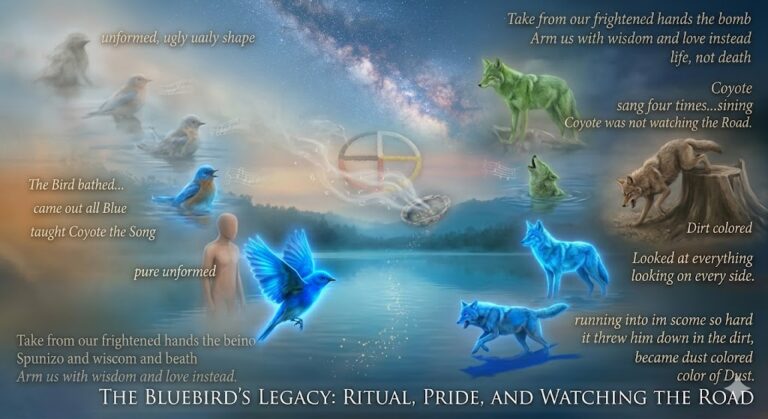
    Take from our frightened hands the bomb…Arm us with wisdom and love instead.
    Let life, not death,  enter no matter where we walk…”


    BlueBird


    The BlueBird was once a very, very ugly color.
    And, nearby where he lived, there was a lake.
    Now this lake was where
    where no river water flowed in or out.
    The Bird bathed in it four
    times every morning for four mornings.
    And, on each of these times it sang.
    ” There is a blue water,
    it lies there.
    I went in,
    I am all blue.”


     On the Fourth morning, the bird shed all of it’s feathers.  He came
    out of the lake in his bare skin.  But, on the fifth day, oh the fifth
    day, he came out all Blue.  Now, all of this time Coyote had been
    watching the Bird.   He wanted to jump in and get the Bird but he
    was afraid of the water.  On that fifth morning Coyote asked,
    “How come your ugly color is all gone and you are now blue,
    pretty, and happy?  You are more beautiful than
    anything that flies in the air.  I want to be Blue too.”


      Coyote at this time was green, a very bright green.  “I went in
    four times,” said Bird and he taught Coyote the Song.  So, four
    times Coyote went in singing.  The fifth time he came out as Blue
    as the little Bird. This made him very proud.


        Coyote began to walk around.  And, as he walked along, he
    looked and looked on every side to see if anyone noticed how
    wonderfully fine and Blue he was.  He looked to see if his shadow
    was Blue also.  Because he was looking at everything, Coyote was
    not watching the Road.  Soon he ran into a stump so hard that it
    threw him down in the dirt and he became dust colored all over.


              To this day all Coyotes are the color of Dirt.


  • Buffalo Calf Woman


    Buffalo Calf Woman


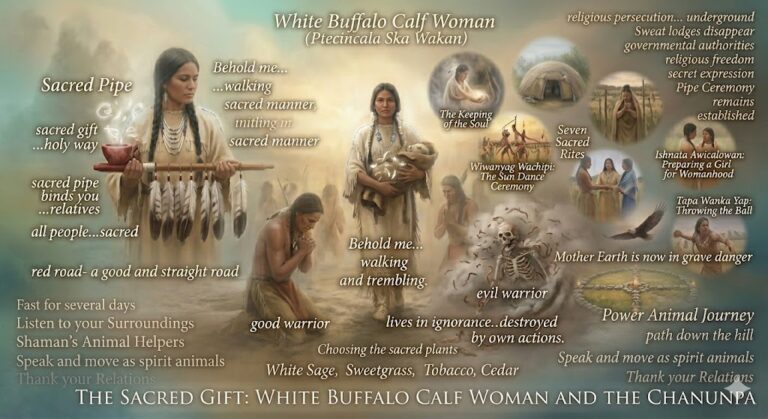
    White Buffalo Calf Woman

    (Ptecincala Ska Wakan)

    The Gift of the Sacred Pipe

    Before the appearance of the Buffalo Calf Woman, the Indian honored the Great Spirit. But for the Sioux, the coming of Buffalo Calf Woman brought a most important instrument, the pipe, which is now used in all ceremonies.

    The sacred pipe came into being many, many years ago. Two men of the Sioux tribe were hunting when they saw something approaching in the distance. As the figure grew close, they observed a maiden, attired in white buckskin, carrying a bundle wrapped in buffalo hide.

    As she walked slowly toward them she sang out and repeated;

    Behold me.
    Behold me,
    For in a sacred manner
    I am walking.

    One of the men had evil thoughts about this maiden and moved towards her. the other Sioux tried forcibly to restrain him, but the evil warrior pushed the good warrior away. A cloud descended and engulfed the evil one, and when it lifted, his body was a skeleton being devoured by worms. This symbol-ized that one who lives in ignorance and has evil in their hearts may be destroyed by their own actions.

    The good warrior knelt in fear, trembling as the buckskin-clad maiden approached. She spoke to him, telling him to fear not and to return to his people and prepare them for her coming. The warrior did so, and the maiden appeared, walking among them in a sunwise, (clockwise) direction. She held forth her bundle and said:

    This is a sacred gift
    And must always be treated in a holy way.
    In this bundle is a sacred pipe
    Which no impure man or woman should ever see.

    With this sacred pipe
    You will send your voices to Wakan Tanka.
    The Great Spirit, Creator of all.
    Your Father and Grandfather.

    With this sacred pipe
    You will walk upon the Earth
    Which is your Grandmother and Mother.
    All your steps should be holy.

    The bowl of the pipe is red stone
    Which represents the earth.
    A buffalo calf is carved in the stone facing the center
    And symbolizes the four-legged creatures
    Who live as brothers among you.
    The stem is wood and represents all growing things.
    Twelve feathers hang from where the stem fits the bowl
    And are from the Spotted Eagle.
    These represent all the winged brothers
    Who live among you.

    All these things are joined to you
    Who will smoke the pipe and send voices to Wakan Tanka.
    When you use this pipe to pray,
    You will pray for and with every thing.
    The sacred pipe binds you to all your relatives;
    Your Grandfather and Father,
    Your Grandmother and Mother.

    The red stone represents the Mother Earth
    On which you will live.
    The Earth is red
    And the two-leggeds who live upon it are also red.
    Wakan Tanka has given you a red road-
    A good and straight road to travel,
    And you must remember that all people
    Who stand on this earth are sacred.

    From this day,
    The sacred pipe will stand on the red earth,
    And you will send your voices to Wakan Tanka.

    There are seven circles on the stone
    Which represent the seven rites
    In which you will use the pipe.

    The Buffalo Calf Woman then instructed the people to send messengers to the different bands of the Sioux nation, to bring in the leaders, the medicine people, and the holy ones.

    When the people gathered, she instructed them in the sacred ceremonies. She told them of the first rite, the Keeping of the Soul. She told them that the remaining six rites would be revealed to them through visions. As she prepared to leave she said:

    Remember how sacred the pipe is
    And treat it in a sacred manner,
    For it will be with you always.
    Remember also that in me are four ages.
    I shall leave you now,
    But shall look upon you in every age
    And will return in the end.

    The Sioux begged the woman to stay among them. They promised to build a fine lodge and let her select a warrior to provide for her, but she declined their offer.

    No, the Creator above,
    The Great Spirit,
    Is happy with you
    You the grandchildren.
    You have listened well to my teachings.
    Now I must return to the spirit world.

    She walked some distance away from them and sat down. When she arose, she had become a white buffalo calf. She walked farther, bowed to the four quarters of the universe, then disappeared into the distance. Her sacred bundle was left with the people. To this day, A Sioux family, the “Keepers of the Sacred Bundle,” still guards the bundle and its contents on one of the Sioux reservations.

    Today, other ceremonies have supplanted some of the original seven ceremonies taught by the Buffalo Calf Woman. The Sun Dance, Sweat Lodge and Vision Quest are still major ceremonies that are widely practiced. The Pipe Ceremony itself is now used to open gatherings, meetings, and sweat lodges. The Pipe Ceremony is used in naming ceremonies, in which one is given an Earth or Indian name. It is also used in Indian marriage ceremonies.

    In times of religious persecution, the visible ceremonies had to go underground. Sweat lodges, which were common around most lodges and tipis in the early reservation days, started to disappear when Christian missionaries began to entrench their power with governmental authorities. The pipe was much easier to hide. Sioux spirituality thus came to depend for its secret expression upon the pipe. Now that Native Americans have won back their religious freedom, the Pipe Ceremony remains established.

    The Buffalo Calf Woman told the Sioux where to find the sacred red stone to make the peace pipe. In the pipestone quarries in southwestern Minnesota, near the town of Pipestone, the Sioux and all other Indian nations dug for their red stone in peace. They also traveled to and from the quarries in peace. No warfare was allowed. Peace councils were often held in this place.

    Mother Earth is now in grave danger. Why not turn to ceremony, at least to get the feeling, the message that Mother Earth must live? She is speaking to us quite strongly already. Let Her speak also in ceremony. We can gain a special resolve by communicating within the ceremonies. By listening to nature through nature-based ceremonies, we can be like the Sioux. Deforestation, the thinning ozone layer, global warming, overpopulation and the pollution of our streams, rivers and oceans present great odds. But we can adapt. We can live, and our planet can survive.

    The Seven Sacred Rites

    Seven traditional rituals use the sacred pipe in accordance with the Buffalo Calf Woman s teachings.

    The Seven Sacred Rites

    • The Keeping of the Soul
    • Inipi: The Sweat Lodge Ceremony or Rite of Purification
    • Hanblecheyapi: Vision Quest
    • Wiwanyag Wachipi: The Sun Dance Ceremony
    • Hunkapi: Making Relatives
    • Ishnata Awicalowan: Preparing a Girl for Womanhood
    • Tapa Wanka Yap: Throwing the Ball


  • AMERICAN INDIAN FAIRY TALES

    AMERICAN INDIAN FAIRY TALES


    AMERICAN

    INDIAN FAIRY

    TALES


    SNOW BIRD,
    THE WATER TIGER, etc.
    BY

    MARGARET COMPTON

    With numerous illustrations

    NEW YORK

    DODD, MEAD & COMPANY

    [1907]

    Scanned at sacred-texts.com, February 2007. This text is in the public domain in the United States because it was published prior to January 1st, 1923. These files may be used for any non-commercial purpose provided this notice of attribution is left intact in all copies.Front Cover and Spine

    “Once he found a water-lily with a leaf so broad that it made a petticoat for his wife”

    Title Page

    Verso


    COPYRIGHT, 1895
    BY
    DODD, MEAD & COMPANY
    ________
    All rights reserved

    TO
    MY SISTER,
    WHO STILL “LOVES FAIRY TALES,”
    THIS VOLUME IS
    AFFECTIONATELY DEDICATED.


    AUTHOR’S NOTE

    THROUGH the courtesy of the librarian of the Smithsonian Institute, the author has had access to government reports of Indian life. Upon these and the folk-lore contained in the standard works of Schoolcraft, Copway, and Catlin these stories are founded.


    CONTENTS

    PAGE.

    THE STORY-TELLER HIMSELF

    1

    SNOWBIRD AND THE WATER-TIGER

    3

    THE COYOTE OR PRAIRIE WOLF

    15

    HOW MAD BUFFALO FOUGHT THE THUNDER-BIRD

    27

    THE RED SWAN

    37

    THE BENDED ROCKS

    55

    WHITE HAWK, THE LAZY

    63

    THE MAGIC FEATHER

    75

    THE STAR MAIDEN

    93

    THE FIGHTING HARE

    101

    THE GREAT HEAD

    113

    THE ADVENTURES OF LIVING STATUE

    123

    TURTLE-DOVE, SAGE-COCK, AND THE WITCH

    133

    THE ISLAND OF SKELETONS

    141

    STONE-SHIRT AND THE ONE-TWO

    155

    THE GREAT WIZARD

    167

    WHITE CLOUD’S VISIT TO THE SUN-PRINCE

    185


    LIST OF ILLUSTRATIONS

    PAGE

    “Once he found a water-lily with a leaf so broad that it made a petticoat for his wife,”

    Frontispiece.

    “Then, all of a sudden it changed to a woman,”

    10

    “Pounced upon him, and lifted him into the air,”

    31

    “He flew swiftly toward the magician’s lodge,”

    53

    “Lo! Clouds of blue and white pigeons rushed from the smoke,”

    91

    “He went to the top of the cliff and saw the sun just rising,”

    111

    “Near the white, misty road of the dead,”

    132

    ” Whispered to the Swans, ‘Come, let us go home,’”

    148

    “Instead of one handsome young warrior, there were two,”

    161

    “It formed a small lake,”

    172

    “White Cloud and his friend at last gave a great leap,”

    197


    p. 1

    THE STORY-TELLER HIMSELF


    AGOO, the story-teller of the Indians, is a little, old man with a face as black as the shell of the butternut and a body like a twisted stick. His eyes are twice as large as other men’s, so that when a bird flies past him he sees twice as many feathers on it, and all the little colors underneath are bright to him. His ears are twice as large as other men’s, so that what seems to them but a tiny sound is to him like the roll of thunder. His legs are supple and his arms are strong, so that he can run faster and further, and can lift and carry twice as much as others.

    No one believes him, yet every one is eager to listen to him. He tells of things of which no one else ever saw the like; but the stories are pleasant to hear, and Iagoo says they are true. When the rivers and lakes are frozen so that the Indian cannot fish, and the snow has drifted many feet in thickness so that he cannot hunt, then he goes into his wigwam, cowers under his heaviest bear-skin wrapper or

    p. 2

    crouches by the fire, and longs for Iagoo to appear. When the Storm-fool dances about the wigwam and throws the snowflakes, hard and dry as sand, in at the doorway, then Iagoo is most likely to visit him.

    He vanishes for many moons and comes back with new and wonderful tales. He has met bears with eyes of fire and claws of steel, mosquitoes whose wings were large enough for a sail for his canoe and serpents with manes like horses.

    Once he found a water-lily with a leaf so broad that it made a petticoat for his wife. At another time he saw a bush so large that it took him half a day to walk round it.

    As he sat in his doorway one summer evening he shot an arrow without taking direct aim. It killed a swan and twenty brace of ducks that were swimming on the river, then passed on and mortally wounded two Mons on the bank, bounded back and, as it touched the water, killed an enormous fish.

    He remembers when the oldest oak was an acorn. He says that he will be alive long after the white man has disappeared from the land.

    These are his tales written down for the little Pale-faces. They are of the fairies, the giants, the dwarfs, the witches and the magicians of our own land, America.


    p. 3 p. 4 p. 5

    SNOWBIRD AND THE WATER-TIGER

    SNOWBIRD was the much-loved wife of Brown Bear, the brave hunter whose home was on the shore of the Great Lake. He kept the wigwam well supplied with food; and Snowbird’s moccasins were the finest in the tribe, save only those of the Chief’s daughters. Even those owed much of their beauty to the lovely feathers that Snowbird had given them. If you had asked her where she got them she would have answered proudly, “My husband brought them from the chase.”

    Besides Brown Bear and his wife, there lived in the wigwam their own, dear, little papoose whom they called “Pigeon,” because he was always saying, “Goo, goo;” but they hoped that he would win a nobler name some day, when he should fight the enemy, or kill some beast that was a terror to the tribe, and so take its name for his own.

    p. 6

    These three would have been a very happy family; nor would the little orphan boy whom they had adopted long before Pigeon was born, have made them any trouble; he was a great help to them. But there was still another inmate, Brown Bear’s mother, a wicked, old squaw, whom none of the other sons’ wives would have in their wigwams. Brown Bear was her youngest son, and had always been her favorite. She was kind to him when she was not to any one else; and he loved her and took good care of her, just as much after he brought Snowbird home to be his wife, as he had done before. But the old woman was jealous; and when Brown Bear brought in dainty bits, such as the moose’s lip and the bear’s kidney, and gave them to his wife, she hated her and grumbled and mumbled to herself in the corner by the fire.

    Day after day she sat thinking how she could get rid of the “intruder,” as she called her daughter-in-law. She forgot how she had married the only son of a brave Chief and had gone to be the mistress of his wigwam; and he had been as kind and good to her as her son was to Snowbird.

    One day when the work was all done,

    p. 7

    the old woman asked her daughter-in-law to go out to see a swing she had found near the Great Lake. It was a twisted grapevine, that hung over a high rock; but it was stout and strong, for it had been there many years and was securely fastened about the roots of two large trees. The old woman got in first and grasping the vine tightly, swung herself further and further until she was clear out over the water. “It is delightful,” said she; “just try it.”

    So Snowbird got into the swing. While she was enjoying the cool breeze that rose from the lake, the old woman crept behind the trees, and, as soon as the swing was in full motion, and Snowbird was far out over the water, she cut the vine and let her drop down, down, down, not stopping to see what became of her.

    She went home and putting on her daughter-in-law’s clothes sat in Snowbird’s place by the fire, hiding her face as much as possible, so that no one should see her wrinkles.

    When Brown Bear came home he gave her the dainties, supposing she was his wife; and she ate them greedily, paying no attention to the baby, who was crying as if its heart would break.

    p. 8

    “Why does little Pigeon cry so?” asked the father.

    I don’t know,” said the old woman, “I suppose he’s hungry.”

    Thereat, she picked up the baby, shook it soundly and made believe to nurse it. It cried louder than ever. She boxed its ears and stuffed something into its mouth to keep it quiet.

    Brown Bear thought his wife very cross, so he took his pipe and left the wigwam.

    The orphan boy had watched all these doings and had grown suspicious. Going to the fire he pretended to brush away the ashes; and, when he thought the old woman was not looking at him, he stirred the logs and made a bright flame leap up so that he could plainly see her face. He was sure there was something wrong.

    “Where is Snowbird?” asked he.

    “Sh—!” said the old woman; “she is by the lake, swinging.” The boy said no more, but went out of the wigwam and down to the lake. There he saw the broken swing, and guessing what had happened, he went in search of Brown Bear and told him what he had discovered.

    Brown Bear did not like to think any wrong of his mother, and therefore asked her no questions. Sadly he paced up and

    p. 9

    down outside the door of his wigwam. Then taking some black paint he smeared his face and body with it as a sign of mourning. When this was done he turned his long spear upside down, and pressing it into the earth, prayed for lightning, thunder and rain, so that his wife’s body might rise from the lake.

    Every day he went thither, but saw no sign of his dear Snowbird, though the thunder rolled heavily and the lightning had split a great oak near the wigwam from the top to the base. He watched in the rain, in the sunlight, and when the great, white moon shone over the lake, but he saw nothing.

    Meanwhile the orphan boy looked after little Pigeon, letting him suck the dantiest, juiciest bits of meat, and bringing him milk to drink. On bright afternoons he would take the baby to the lake shore and amuse him by throwing pebbles into the water. Little Pigeon would laugh and crow and stretch out his tiny hands, then taking a pebble would try to throw it into the water himself, and, though it always dropped at his feet, he was just as well pleased.

    One day as they were playing in this manner they saw a white gull rise from

    p. 10

    the center of the lake and fly towards the part of the shore where they were. When it reached them it circled above their heads, flying down close to them until little Pigeon could almost touch its great, white wings. Then, all of a sudden, it changed to a woman— Snowbird, little Pigeon’s mother!

    The baby crowed with delight and caught at two belts, one of leather and one of white metal, that his mother wore about her waist. She could not speak; but she took the baby in her arms, fondled it and nursed it. Then she made signs to the boy by which he understood that he was to bring the child there every day.

    When Brown Bear came home that night the boy told him all that had happened.

    The next afternoon when the baby cried for food the boy took him to the lake shore, Brown Bear following and hiding behind the bushes. The boy stood where he had before, close to the water’s edge, and, choosing a smooth, round pebble, raised his arm slowly and with careful aim threw it far out into the lake.

    Soon the gull, with a long, shining belt around its body, was seen rising from the


    “Then, all of a sudden it changed to a woman.”


    p. 11

    water. It came ashore, hovered above them a moment, and, as on the previous day, changed into a woman and took the child in her arms.

    While she was nursing it her husband appeared. The black paint was still on his body, but he held his spear in his hand.

    “Why have you not come home?” he cried, and sprang forward to embrace her.

    She could not speak, but pointed to the shining belt she wore.

    Brown Bear raised his spear carefully and struck a great blow at the links. They were shivered to fragments and dropped on the sands, where any one seeing them would have supposed they were pieces of a large shell.

    Then Snowbird’s speech returned and she told how when she fell into the lake, a water-tiger seized her and twisting his tail around her waist, drew her to the bottom.

    There she found a grand lodge whose walls were blue like the bluejay’s back when the sun shines upon it, green like the first leaves of the maize and golden like the bright sands on the island of the Caribs; and the floor was of sand, white as the snows of winter. This was the

    p. 12

    wigwam of the Chief of the water-tigers, whose mother was the Horned Serpent and lived with him.

    The Serpent lay on a great, white shell which had knobs of copper that shone like distant campfires. But these were nothing to the red stone that sparkled on her forehead. It was covered with a thin skin like a man’s eyelid, which was drawn down when she went to sleep. Her horns were very wonderful, for they were possessed of magic. When they touched a great rock the stone fell apart and there was a pathway made through it wherever the Serpent wanted to go.

    There were forests in the Water-Tiger’s country, trees with leaves like the willow, only longer, finer and broader, bushes and clumps of soft, dark grass.

    When night came and the sun no longer shone down into the lodge and the color went out of the walls, there were fireflies—green, blue, crimson, and orange—that lighted on the bushes outside the Water-Tiger’s wigwam; and the most beautiful s of them passed inside and fluttered about the throne of the Serpent, standing guard over her while the purple snails, the day sentinels, slept.

    Snowbird trembled when she saw these

    p. 13

    things and fell down in a faint before the great Horned Serpent. But the Water-Tiger soothed her, for he loved her and wanted her to become his wife. This she consented to do at last on condition that she should be allowed to go back sometimes to the lake shore to see her child.

    The Water-Tiger consulted his mother, who agreed to lend him a sea-gull’s wing which should cover his wife all over and enable her to fly to the shore. He was told, however, to fasten his tail securely about her waist, lest she should desert him when she found herself near her old home. He did so, taking care to put a leather belt around her, for fear the links of white metal might hurt her delicate skin.

    So she lived with the Water-Tiger, kept his lodge in order and made moccasins for the little water-tigers out of beaver skin and dried fish scales, and was as happy as she could have been anywhere away from her own Brown Bear and Little Pigeon.

    When the old woman, Brown Bear’s mother, saw them at the door of the wigwam, she leaped up and flew out of the lodge and was never seen again.


    p. 14 p. 15 p. 16 p. 17

    THE COYOTE OR PRAIRIE WOLF.

    N the beginning, when the Cahrocs lived on the shores of the Klamath River, beyond the desert of the sage-brush and far from the Rocky mountains, on towards the falling place of the sun, they had many good gifts. Their forests were noble and their deer were stately and fat. The bear was fierce, but his flesh was sweet and life-giving, and the Cahrocs grew strong by feeding upon it. But they longed for the gift of fire. In the evening when the beautiful red appeared in the sky they looked and looked upon it and wished that they might catch just one spark from the fagots in the heavens.

    All the fire in the world at that time was held by two old hags who lived at the mouth of the river and watched it with jealous care. They also held the key of the dam that kept back the shining salmon.

    The Cahrocs hated the old women and sought for some way to deceive them, so that they might loose the salmon, but

    p. 18

    most of all they wanted the precious fire. They lay and shivered under the thick bear-skin robes, for the nights were long and cold in their country, and the north wind blew in their faces and cut them sharply with his spears of ice and his arrows of snow.

    They tried many times to steal the fire. Those rich in wampum offered to buy it, while some who were cunning attempted to wheedle the old hags into giving it to them, but all to no purpose. At last they thought of asking the animals to help them. But who so cunning and so brave as to undertake the task? The bear was too clumsy and growled too much, the elk was too tall and his antlers would strike against the lodge pole of the wigwam; the dog was not wise, and the serpent was never known to do good to the Cahrocs or to any man.

    The council sat and smoked and thought about the matter and at last decided to ask the Coyote, for he was lean and hungry and might be glad to earn some food. Moreover, he would feel proud to have the Cahrocs ask a favor of him, for even the meanest beast despised him because he had such hard work to get a living.

    p. 19

    So they went to see the Coyote. His home was in the deserts half way to the mountains, where he cowered behind the sage-brush, from whence he kept a sharp lookout for blood spilled by the hunter, the flesh that he threw away, or animals small and weak enough for him to be able to capture. The Coyote must forever go hungry, for when the animals were let loose upon the earth and each sprang upon its prey, the mountain sheep which was given to the Coyote dodged him, and ever since all coyotes blunder in the chase.

    The Cahrocs found him sniffing at the ground for the hunter’s trail. He felt flattered when he knew that they had come to see him, but he was far too cunning to show it. They explained their errand, but he would not promise to do anything. He took the food that they offered him, some dog’s meat, buffalo steaks, and bear’s kidney, dainties that the Cahrocs gave to an honored guest. Then he could no longer conceal his pleasure, nor refuse to do what they asked of him.

    He did not need to hunt that night, so he curled himself up snugly, put his nose under his paws, whisked his tail about to keep his feet warm, and for the first time in his life was really comfortable. He

    p. 20

    soon fell asleep, but not before he had made up his mind that it would be well to do his best for the Cahrocs; it was much better than hunting in the desert.

    The next morning he set out early to secure help from other animals, for he could not do the thing alone. The smaller ones did not dare to refuse him, and the larger ones felt sorry for the poor creature, and were willing to be of use to him.

    The Coyote placed a frog nearest to the camp of the Cahrocs, then a squirrel, a bat, a bear, and a cougar at certain measured distances, arranged in proportion to their strength and to the roughness of the road. Last of all a Cahroc was told to hide in the bushes near the hut where the old hags lived.

    Then the Coyote walked slowly up to the door and scratched for admittance. One of the sisters went to see what was wanted and she let him in; they were surely not afraid of a miserable coyote. He walked wearily to the center of the lodge, where he dropped down as if tired out, and shivered so that he shook the very lodge pole.

    The two old hags who sat by the fire,  cooking salmon turned to look at him,

    p. 21

    and one of them said: “Come up near the fire if you are cold,” and she made room for him directly in front of the blaze.

    He dragged himself to it and lay with his head upon his paws. When he grew uncomfortably warm he gave two short barks as a signal to the man outside.

    The old hags thought he barked because he enjoyed the fire. “Ha! ha!” they said, “wouldn’t the Cahrocs like this?”

    Just then there was a fearful noise of hammering and of stones striking the lodge. The old women rushed out to drive the enemy away.

    Instantly the Coyote seized a half-burnt stick of wood and fled like a comet down the trail in the forest. The hags pursued him; but when he heard their shrieks he ran all the faster.

    Nearer and nearer they came, now they were almost upon him and his strength was fast giving out. By a great effort he flung the brand from him, just as they put out their hands to catch him.

    The Cougar seized it and ran with long bounds down the winding road. The hags followed, but were no match for him and he had no trouble in handing it over to the Bear.

    p. 22

    The Bear was very awkward and dropped it several times from his clumsy paws, so that the old women gained upon him rapidly; and had it not been that the Bat seized it and flew high in the air quite unexpectedly, the Cahrocs would never have got the fire. As for the old Bear, he rolled over against the tree exhausted.

    The Bat led the hags a roundabout chase over trees, now flying high, now close to their very heads, until he nearly tired them out.

    They took courage when they saw the Squirrel spring forward to catch the stick that the Bat let fall from a great height. “Surely we can catch him,” they said; and they gathered their skirts about them and pursued him with furious haste.

    All this time the brand was burning and it grew so hot that the Squirrel could hardly hold it. But he was a brave, little fellow and hopped and jumped steadily on through the woods, though his tail was burnt so badly that it curled up over his back and shoulders. He bears the marks of the singeing to this day.

    Just as he thought he would have to drop it, he caught sight of the Frog. It was such a little piece by this time that the Frog could hardly take it from him,

    p. 23

    but he caught hold of it and ran on. The smoke blinded him and made his eyes smart, besides choking him so that he lost ground, and soon heard the hags close to him. He was the last, and only a pond lay between him and the village of the Cahrocs. His heart thumped against his sides and he dropped the fire in order to take breath before jumping into the water, when the old women pounced upon him.

    But he was too quick for them. He dodged them, swallowed the brand and jumped into the lake. They leaped after him, but it was of no use, for they could not swim. So he got away, and they had to turn back and go to their hut at the mouth of the river.

    The Cahrocs were waiting on the edge of the pond, and when the Frog crossed they welcomed him with shouts of joy. But where was the fire? He lost no time in showing them, for he spat out the sparks upon some fagots and they quickly caught alight. But the Frog lost his tail and it never grew again. Tadpoles still wear tails, but when they become full-grown frogs they cast them off, out of respect to their brave ancestor, who is king of all the animals that inhabit the bogs and marshes of the Klamath country.

    p. 24

    After his success in getting the fire, the Coyote was a great favorite with the Cahrocs and dined off the choicest bits that were brought into the camp.

    They were not satisfied even now that they had roasted meat and corn, but must needs coax the Coyote to go and get the salmon. They explained to him that the big, shining fish were all in a great dam at the mouth of the river and that the old hags from whom he had stolen the fire kept the key.

    The Coyote was willing, but he said: “Wait a little till my coat changes so that the hags will not know me.”

    So they waited till his coat grew thin and light in color, and then when he was ready, accompanied him, with song and shouting, to the edge of the village.

    He went down the Klamath many days’ journey, until he reached the mouth of the river, where he saw the old hags’ lodge. He rapped at the door. They were asleep by the fire, but one of them being roused by the noise, growled, “Come in.”

    Instead of hanging his head, drooping his tail, and looking weary, as he had done when he went to steal the fire, the Coyote held up his head, frisked his tail

    p. 25

    and grinned at them. He was of much greater importance now, and he was sleek and round from being well fed, so the hags did not know him.

    They cooked salmon, but offered him none. He said nothing, for he was not hungry, having dined off food that the Cahrocs had prepared for him. “Ha!” he thought, “I shall soon have all the salmon I want from the Cahrocs.”

    The next morning he pretended to be asleep when the elder sister arose and went to the cupboard to get the key of the dam. She was going for salmon for breakfast. When she had left the lodge he stretched himself lazily and walked slowly towards the door. Once outside he ran after the old woman and flung himself between her feet, so that she fell down and in doing so dropped the key. He seized it, went to the dam and unlocked it.

    The green water shining with silvery salmon rushed through it so fast that it broke not only the lock, but the dam itself, and thereafter the Cahrocs had all the salmon that they wanted.

    The Coyote grew proud over his success and was not satisfied with the kindness and honor shown to him by the Cahrocs.

    p. 26

    [paragraph continues]He wanted to dance through heaven. He chose a bright blue Star for a partner and called out to her night after night to dance with him. At last she grew tired of his howling; so one night she told him to go to the highest point of the cliff and she would reach down far enough for him to dance with her.

    He had fine sport for a while; but as she lifted him higher and higher he began to feel cold, until his paws became numb and slipped from his partner’s wrist, and he fell into the great chasm that is between the sky and the earth at the edge of the world. He went down, down, until every bit of him was lost; for Coyotes could not be permitted to dance with Stars.


    p. 27 p. 28 p. 29

    HOW MAD BUFFALO FOUGHT THE THUNDER-BIRD.

    NCE upon a time the Indians owned all the land around the Big Sea Water. The Good Spirit had smoked the pipe of peace at the Red-stone quarry and called all the nations to him. At his command they washed the war-paint from their faces, buried their clubs and tomahawks and made themselves pipes of red sand-stone like the one that he had fashioned. They, too, smoked the peace-pipe, and there was no longer war among the nations, but each dwelt by its own river and hunted only the deer, the beaver, the bear, or the bison.

    In those happy days there lived on that shore of the Big Sea Water, which is directly under the hunter’s star, an Indian whom all his nation trusted, for there were none like him in courage, wisdom, and prudence. From his early childhood they had looked to him to do some great deed.

    He had often mastered the grizzly bear

    p. 30

    and the strong buffalo. Once he captured a buffalo ox, so large and so strong that a dozen arrows did not kill it, and from that day he was known as Mad Buffalo.

    When the magic horns were needed for medicine for the people, Mad. Buffalo went forth in the Moon of Flowers and by cunning, not by magic, cut them from the head of the Great Horned Serpent. For this the people loved him and he sat with the oldest and the wisest of the tribe.

    Their greatest trouble in those days was the mysterious thunder-bird, which was often seen flying through the air. It had black and ragged wings, and as it moved swiftly overhead they darkened all the earth. On moonlight nights no harm came; but when it passed in the daytime, or when the Moon-princess was journeying to see her brother, the Sun-prince, and her shining lodge was hidden by the beautiful red, the thunder-bird did evil to all who fell under its shadow.

    Great curiosity existed as to its nest, but no one had dared to follow it, nor had any hunter discovered a place where it seemed likely that it could hide. Some thought it lived in a hollow tree, others that its home was in the sandstone caverns, but it had never been seen to alight.

    p. 31

    “Pounced upon him, and lifted him into the air.”

    One day in the winter, Mad Buffalo set out in search of food for his family. He had to travel to the lodge of the beavers across the Big Sea Water and far up the river. He trapped a fat beaver, slung it over his shoulder and started for home just as the full moon showed through the tree-tops.

    While crossing the lake, when he was in sight of his own wigwam, a great shadow passed before him, shutting out all light. After it had gone he looked about him for the cause. The night was clear and the moon so bright that the hunter’s star could be seen but faintly, but objects about him were as plain as in the day.

    At first he saw nothing, for the thunderbird was directly over his head; but as it circled he caught sight of it. It made a swift movement downwards, pounced upon him and lifted him with all he had into the air.

    He felt himself rising slowly till he was far above the earth, yet not so far as to prevent him seeing what was going on in the village. He could even see his own wigwam and his children in the doorway. They saw him and were terribly frightened. Their mother failed to comfort them, for they knew by heart all the

    p. 32

    dreadful tales that were told of the thunder-bird. They themselves had seen the beautiful birch tree which they had often climbed, torn up by the roots and lie black and dead in the forest. And the oak tree where the warriors assembled was split to its base by this terrible creature. The yellow cedar whose boughs were used for the canoe that sailed on the Big Sea Water was scorched and blighted by the thunder-bird.

    Mad Buffalo’s heart did not fail him. He grasped his spear firmly and waited his chance to do battle with the monster. Faster and faster they went towards the north, straight across the Big Sea Water, rising higher and higher in the air.

    At last they came to a great mountain where no trees grew. The top was a solid, bare, rugged rock, while the sides were formed of sharp boulders, with here and there a small patch of coarse grass and a few stunted furze bushes. In a cleft of the highest rock overhanging the water was the nest of the thunder-bird. It was made of the tendons of human beings, woven with their scalp locks and the feathers they had worn when living.

    Still Mad Buffalo was not afraid. As the bird neared its home it croaked and

    p. 33

    muttered, and the sound was echoed and re-echoed till the noise was deafening. Worse than this, the creature tried to dash him against the rock, driving him towards it with its wings; and when these struck him his flesh stung and smarted as if touched by coals of fire.

    By violently wrenching himself and balancing his spear, he managed to escape uninjured. At length with one powerful blow the bird drove him into its nest. It then flew away.

    Mad Buffalo was stunned, but only for a moment. On coming to himself he heard a low crackling noise of thunder and found that he was left to the mercy of a brood of wild, hungry young thunders, for whose food he had probably been brought. They began at once to pick at his head, uttering croaks like the old bird, only not so loud; but as they were many the sound was, if possible, more dreadful.

    Seeing that they were young birds, Mad Buffalo supposed they would be helpless; and when the old bird was out of sight he ventured to fight them. Raising himself as well as he could, he struck at one with his spear. Thereupon they all set upon him, beating him with their wings and blinking at him with their long, narrow,

    p. 34

    blood-red eyes, from which darted flashes of lightning that scorched his hands and face. In spite of the pain he fought bravely; though, when they struck him with their sharp wings, it was like the prick of a poisoned arrow or the sting of a serpent.

    One by one their strength failed them and they were beaten down into the nest. Mad Buffalo took hold of the largest and strongest, wrung its neck and threw it over the precipice. On seeing this the others crept close together and did not offer to touch him again.

    He seized another, pulled out its heart, threw the body away and spread the skin over the edge of the nest to dry. Then filling his pipe from a pouch of wolf skin suspended from his belt, he sat down to smoke. While resting he wrung the necks of the other birds and threw them into the Big Sea Water, saving only their hearts and claws.

    When he had killed them all he took four short whiffs at his pipe, pointing as he did so to the kingdoms of the four winds, and asking them for assistance. Then he got inside the dry skin, fastened it round him with the claws he had saved, put the hearts of the young thunders on

    p. 35

    his spear and started to roll down the side of the mountain.

    As he tumbled from rock to rock the feathers of the skin flashed like fire-insects. When he was about half way down he straightened himself out and, lifting the wings with his arms, found that he could fly. He moved slowly at first, but was soon used to the motion and went as fast as the great bird could have done.

    He crossed the Big Sea Water and winged his way over the forest until he came to the place from which he had been taken ten days before. There he alighted, tore off the bird’s skin and started homewards.

    His wife and children could hardly believe that it was he; for they supposed the young thunders had long ago picked his bones. He broiled the hearts of the birds, which crackled and hissed so that they could be heard a mile from the wigwam, but the meat was juicy and tender.

    The old bird was never seen again in that part of the country. Hunters who came from the Rocky Mountains say that it built a nest on the highest peak, where it raised another brood that sometimes

    p. 36

    came down towards the earth, despoiling the forests and the grain fields. But they flew higher than formerly, and from the day that Mad Buffalo fought them they never interfered with men. Their nest henceforth was made of the bones of the, mountain goat and the hair of his beard.

    Now when Indian children hear the fire crackling they say it is the hearts of the young thunders; for all their nations know of the brave deed of Mad Buffalo.


    p. 37 p. 38 p. 39

    THE RED SWAN.

    GREAT chief, Red Thunder, was traveling with his wife and three children to a council of the nations. When they were near the place appointed for the meeting, one of the children saw a beautiful white bird winging its way high in the air. He pointed upwards, clapping his hands with delight, for it was flying swiftly towards the earth and the sun was shining on its broad back and wings.

    While the smile was on their faces the bird suddenly appeared above them, and in a moment struck their mother to the earth, driving her into the ground so that no portion of her body remained. The force of the blow was so great that the bird itself was broken in pieces and its plumes were scattered far and wide. The Indians assembled at the council, rushed forth eagerly to secure them; for a white feather is not easily procured and is highly prized in time of war.

    Red Thunder stood speechless in his

    p. 40

    great agony. Then taking his little ones with him he tied into the forest, and no man ever saw him again. He built himself a lodge and never passed far from its doorway. When Winter shook his white locks and covered the land with snow, Red Thunder fell, shot by an unseen arrow.

    Thus the three boys were left alone. Even the eldest was not large enough or strong enough to bring home much food, and all that they could do was to set snares for rabbits. The animals were sorry for them and took them in charge. The squirrels dropped nuts at their doorway, and a great brown bear kept guard over them at night. They were too young to remember much of their parents, and they were brave boys, who tried their best to learn how to hunt and fish. The eldest soon became skillful and he taught his brothers.

    When they were all able to take care of themselves, the eldest wanted to leave them and go to see the world, to find other lodges and bring home wives for each of them. The younger ones would not hear of this, and said that they had gone along so far well without strangers, and they could still do without them. So

    p. 41

    they continued to live together and no more was said about any of them leaving.

    One day they wanted new quivers for their arrows. One made his of otter, another chose sheep, and a third took wolf skin. Then they thought it well to make new arrows. They made many, some being of oak and a few, very precious, of the thigh-bone of the buck. It took them much longer to fashion the heads of flint and sandstone; but at last all were finished, and they were ready for a grand hunt. They laid wagers with one another as to who should come in first with game, each one agreeing to kill only the animal he was in the habit of taking, and not to meddle with what he knew belonged to his brother.

    The youngest, named Deep Voice, had not gone far when he met a black bear, which according to the agreement he was not to kill. But the animal was so close to him that he could not refrain from taking aim. The bear fell dead at his feet. His scruples were gone then, so he began skinning it.

    Soon his eyes troubled him and he rubbed them with his bloody hands, when, on looking up, everything appeared red. He went to the brook and washed

    p. 42

    his hands and face, but the same red hue was still on the trees, the ground, and even on the skin of the black bear. He heard a strange noise, and leaving the animal partly skinned, went to see whence it came.

    By following the sound he came to the shore of a great lake, where he saw a beautiful swan swimming. Its feathers were not like those of any other swan he had ever seen, for they were a brilliant scarlet and glistened in the sun.

    He drew one of his arrows and fired at it, but the arrow fell short of its mark. He shot again and again until his quiver was empty. Still the swan remained dipping its long neck into the water, seemingly ignorant of the hunter’s presence.

    Then he remembered that three magic arrows which had belonged to his father were in the wigwam. At any other time he would not have thought of meddling with them; but he was determined to secure this beautiful bird. He ran quickly to the lodge, brought the arrows and fired them. The first went very near the bird, but did not strike it. The second also fell harmless in the water. The third struck the swan in the neck; but she rose immediately and flew towards the setting sun.

    p. 43

    Deep Voice was disappointed, and knowing that his brothers would be angry about the loss of the arrows, he rushed into the water and secured the first two, but found that the third had been carried off by the red swan.

    He thought that as the bird was wounded it could not fly far, so, placing the magic arrows in his quiver, he ran on to overtake it. Over hills and prairies, through the forests and out on the plain he went, till at last it grew dark and he lost sight of the swan.

    On coming out of the forest he heard voices in the distance, and knew that people could not be far off. He looked about and saw a large town on a distant hill and heard the watchman, an old owl, call out, “We are visited,” to which the people answered with a loud “Hallo!”

    Deep Voice approached the watchman and told him that he came for no evil purpose, but merely to ask for shelter. The owl said nothing, but led him to the lodge of the Chief, and told him to enter.

    “Come in, come in,” said the Chief; “sit there,” he added, as the young man appeared.

    He was given food to eat and but few questions were asked him.

    p. 44

    By and by the Chief, who had been watching him closely, said, “Daughter, take our son-in-law’s moccasins, and if they need mending, do it for him.”

    Deep Voice was much astonished to find himself married at such short notice, but made up his mind to let one of his brothers have her for his wife. She was not good-looking and she proved herself bad-tempered by snatching the moccasins in such a surly manner that Deep Voice ran after her, took them from her and hung them up himself.

    Being very tired he soon fell asleep. Early next morning he said to the girl: “Which way did the red swan go?”

    “Do you think you can catch it?” she said, and turned angrily away.

    Yes,” he answered.

    “Foolishness!” said the girl; but as he persisted, she went to the door and showed him the direction in which the bird had flown.

    It was still dark, and as the road was strange to him he traveled slowly. When daylight came he started to run and ran all day as fast as lie could. Towards night he was almost exhausted and was glad to find himself near another village, where he might be able to rest.

    p. 45

    This village also had an owl for a watchman, a large, gray bird, who saw him at a distance and called to those in the camp, “Tu-who! we are visited.”

    Deep Voice was shown to the lodge of the Chief and treated exactly as on the first night. This time the Chief’s daughter was beautiful and gentle in her ways. “She shall be for my elder brother,” thought the boy, “for he has always been kind to me.”

    He slept soundly all night and it was nearly dawn when he awoke; but he lost no time, for the Chief’s daughter was ready to answer his questions at once. She told him the red swan had passed about the middle of the previous afternoon, showed him the exact course it took and pointed out the shortest road to the prairie.

    He went slowly until sunrise and then ran as before. He was a swift runner, for he could shoot an arrow and then pass it in its flight so that it would fall behind him. He did this many times on the second day, for it helped him to travel faster. Towards evening, not seeing any town, he went more leisurely, thinking that he would have to travel all night.

    Soon after dark he saw a glow of light

    p. 46

    in the woods, and found when he went nearer that it came from a small, low lodge. He went cautiously on and looked in at the doorway. An old man was sitting by the fire, his head bent forward on his breast.

    Although Deep Voice had not made the slightest noise the old man called out, “Come in, my grandson.”

    The boy entered.

    “Take a seat there,” said the old man, pointing to a corner opposite him by the fire. “Now dry your things, for you must be tired, and I will cook supper for you. My kettle of water stands near the fire.”

    Deep Voice had been looking about the fireplace, but had seen no kettle. Now there appeared a small earthen pot filled with water. The old man took one grain of corn and one whortleberry, dropped them into the pot and set it where it would boil. Deep Voice was hungry and thought to himself that there was small chance of a good supper.

    When the water boiled the old man took the kettle off, handed him a dish and spoon made of the same material as the pot and told him to help himself.

    Deep Voice found the soup so good that

    p. 47

    he helped himself again and again until he had taken all there was. He felt ashamed, but he was still hungry.

    Before he could speak, the old man said, “Eat, eat, my grandchild, help yourself,” and motioned to the pot, which was immediately refilled.

    Deep Voice again helped himself to all the soup and again the kettle was filled, and his hunger was satisfied. Then the pot vanished.

    “My grandchild,” said the old man, when Deep Voice had finished, “you have set out on a difficult journey, but you will succeed. Only be determined, and be prepared for whatever may happen. Tomorrow you will go on your way until the sun sets, when you will find one of my fellow-magicians. He will give you food and shelter and will tell you more than I am permitted to do. Only be firm. On the day beyond to-morrow you will meet still another who will tell you all you wish to know and how you are to gain your wish.”

    Deep Voice lay down on the buffalo skins, which were white and soft, and slept soundly; for the old man’s words made him very happy.

    The magician prepared his breakfast as

    p. 48

    he had done the supper, after which the boy went on his way. He found the second magician as he had been told, and was given a supper from a magic kettle, and a couch upon white buffalo robes.

    The second magician did not seem so sure of the young man’s success. “Many have gone this way before you,” said he, “and none have ever come back. We shall see, we shall see.”

    This was said to try the courage of Deep Voice; but he remembered what the first magician had told him and was firm in his resolution.

    After breakfast next day he ran forward quickly, for he was anxious to meet the third magician who should tell him all about the red swan. But though he ran all day he did not get to the third lodge any earlier than he had reached the others.

    After a supper prepared as on the previous nights, the magician said to him: “My grandchild, to-morrow night you will come to the lodge of the Red Swan. She is not a bird, but a beautiful girl, the most beautiful that ever lived. Her father is a magician and rich in wampum. This wampum is of much value, for many of the shells were brought from the Great

    p. 49

    [paragraph continues]Salt Lake; but he prizes his daughter far more than all. The Red Swan loves her father, and all her life is spent in making him comfortable. The old man has met with a misfortune, having lost his cap of wampum which used to be fastened to his scalp and was never removed, night or day. A tribe of Indians, who had heard of it, one day sent to him, saying that their Chief’s daughter was very ill and that but one thing could cure her—a sight of this magic cap of wampum. The magician did not suspect the messengers, though he tried to persuade them to bring the maiden to him. They declared that she could not be moved; whereupon the old man tore off his cap, though it gave him much pain to do so, and sent it to the Chief. The story was all a pretense; and when they got the cap they made fun of it and placed it on a pole for the birds to peck at, and the stranger to ridicule. The old man is not strong enough to get the cap back; but he has been told that a young warrior shall some day procure it for him. The Red Swan goes forth in the Moon of Falling Leaves to seek for this Brave, and she has promised to be the wife of him who is successful. My grandchild, many have followed her and have

    p. 50

    failed, but I think you will be more favored. When you are seated in the lodge of the Red Swan, the magician will ask you many things. Tell him your dreams and what your guardian spirits have done for you. Then he will ask you to recover his cap of wampum and will show you what you are to do to find and punish the wicked possessors of it.”

    Deep Voice was greatly pleased to hear that he might win such a beautiful wife. He leaped and ran gaily through the forest the next day, and the idea that he might fail never entered his mind. Towards evening he heard deep groans, which he believed came from the lodge of the Red Swan.

    It was not long before he reached a fine wigwam, and on entering saw the magician seated in the center, holding his head with both hands and moaning with pain.

    The old man prepared supper, for no one was allowed to see the Red Swan, or even to know that she was in the wigwam. But Deep Voice saw a curtain dividing the lodge, and thought that he heard a rustle of wings.

    His heart did not fail him, and he answered the old man’s questions patiently

    p. 51

    and truthfully. When he told his dreams, the magician shook his head, saying, “No, that is not the one, that is not it,” to each, until Deep Voice thought he would not tell him any more. He was not willing, however, to give up the Red Swan, so at last he remembered a dream wholly different from the others, which he straightway told.

    The magician became quite excited before he had finished his story, and exclaimed: “That’s it, that’s it! You will cause me to live! That is what I have been waiting for a young man to say. Will you go and get my cap for me?”

    “Yes,” said Deep Voice, “and on the day beyond to-morrow when you hear the voice of the night-hawk, you must put your head out of the door of the lodge. You will see me coming with the cap, which I will fasten on your head before I enter. The magic food that I have eaten has given me the power to change my form, so I shall come as a night-hawk, and will give the cry to let you know that I am successful. Have ready your war-club that I may seize it to strike with when I come.”

    Deep Voice had not known when he began speaking what he would say, but

    p. 52

    as the magician looked at him the words came. In spite of all the tales that he had heard about the young men who had gone before him, and the magician told him many that night, Deep Voice was anxious to begin his task. He rose early and went in the direction pointed out to him.

    When he saw the cap at a distance he thought that no one was near it; but as he went nearer he found that those about it were as the hanging leaves for number. Knowing that he could not pass unharmed through so great a crowd, he changed himself into a humming-bird and flew close enough to the cap to examine it, but did not touch it, for fear an arrow might be aimed at him.

    The cap was tied securely to a tall pole and no bird could unfasten it without his actions being noticed. Deep Voice, therefore, changed himself into the down of a dandelion and lighted on the cap itself. He thrust his silver fingers under and between the cords, untied them, and lifted the cap slowly, for it was a great weight for so small a thing to carry.

    When the crowd below saw the cap moving, and that it was being carried away, they raised a great shout and ran after it,

    p. 53

    “He flew swiftly toward the magician’s lodge.”


    shooting clouds of arrows as they went. The wind which blew the arrows blew the down out of their reach; so it was soon far enough from them to be safe for Deep Voice to take the form of a bird. As a night-hawk he flew swiftly towards the magician’s lodge, giving the call he had named as a signal.

    The old man heard him and looked out. Deep Voice flew close to him and dropped the cap upon his head; then changing himself into a man, he seized the war-club which the magician had placed just outside the lodge, and with one powerful blow fastened the cap securely, but knocked the old man senseless. When he recovered, what was the surprise of Deep Voice to see, not the old magician who had entertained him, but a handsome young warrior who said to him, “Thank you, my friend, for the bravery and kindness by which you have restored my youth and strength.”

    He urged Deep Voice to remain in his lodge as his guest. They hunted together many days and became fast friends. At last Deep Voice wished to return to his brothers. The young magician then brought out gifts—buffalo robes and deer skin white as snow, strings and belts of

    p. 54

    wampum, as much as he could carry, enough to make him a great man in any country.

    During all his stay nothing had been said about the Red Swan. This day, as they were smoking their farewell pipe, the young magician said to Deep Voice: “My brother, you know the reward that was to be for him who restored my cap of wampum. I have given you riches that will be all that you will want as long as you live. I now give you the best gift of all.”

    At this the Red Swan appeared.

    “Take her,” said the magician; “she is my sister, let her be your wife.”

    So Deep Voice and the Red Swan went home by the way he came, stopping at the lodges of the old magicians to take with them the wives for his brothers. The Red Swan far surpassed them in beauty and loveliness, and her daughters and their daughters have ever been known as the handsomest women of the tribe.


    p. 55 p. 56 p. 57

    THE BENDED ROCKS.

    A STORY OF NIAGARA.


    ENDING WILLOW was the most beautiful girl in a tribe noted for its handsome women. She had many suitors, but she refused them all; for her love was given to a young warrior of a distant nation, who, she felt sure, would some day return to throw a red deer at her feet in token that he wished to marry her.

    Among her suitors was a hideous old Indian, a chief who was very rich. He was scarred and wrinkled and his hair was as gray as the badger that burrows in the forest. He was cruel also, for when the young men were put to the torture to prove themselves worthy to be warriors, he devised tests more dreadful than any that the tribe had ever known. But the chief, who was rightly named No Heart, declared that he would marry Bending Willow, and, as he was powerful, her parents did not dare to refuse him. Bending Willow begged and pleaded in vain.

    p. 58

    On the night before the day set for the marriage, she went into the woods, and throwing herself on the ground, sobbed as if her heart would break. All night she lay there, listening to the thunder of the great cataract of Niagara, which was but a woman’s journey from the village. At last it suggested to her a sure means of escape.

    Early in the morning before any one was stirring, she went back to her father’s wigwam, took his canoe and dragged it to the edge of the river. Then stepping into it she set it adrift and it headed quickly towards the Falls. It soon reached the rapids and was tossed like a withered branch on the white-crested billows, but went on, on, swiftly and surely to the edge of the great fall.

    For a moment only, she saw the bright, green water, and then she felt herself lifted and was borne on great, white wings which held her above the rocks. The water divided and she passed into a dark cave behind the rainbow.

    The spirit of Cloud and Rain had gone to her rescue and had taken her into his lodge. He was a little, old man, with a white face and hair and beard of soft, white mist, like that which rises day and

    p. 59

    night from the base of the Falls. The door of his lodge was the green wave of Niagara, and the walls were of gray rock studded with white stone flowers.

    Cloud and Rain gave her a warm wrapper and seated her on a heap of ermine skins in a far corner of the lodge where the dampness was shut out by a magic fire. This is the fire that runs beneath the Falls, and throws its yellow-and-green flames across the water, forming the rainbow.

    He brought her dainty fish to eat and delicate jelly made from mosses which only the water spirits can find or prepare.

    When she was rested he told her that he knew her story, and if she would stay with him he would keep her until her ugly old suitor was dead. “A great serpent,” added he, “lies beneath the village, and is even now poisoning the spring from which No Heart draws all the water that he uses, and he will soon die.”

    Bending Willow was grateful, and said that she would gladly remain all her life in such a beautiful home and with such a kind spirit.

    Cloud and Rain smiled; but he knew the heart of a young girl would turn towards her own home when it was safe

    p. 60

    for her to return. He needed no better proof of this than the questions she asked about the serpent which caused so much sickness among her people.

    He told her that this serpent had lain there many years. When he once tasted human blood he could never be satisfied. He crept beneath a village and cast a black poison into the springs from which people drew water. When any one died the serpent stole out at night and drank his blood. That made him ravenous for more. So when one death occurred more followed until the serpent was gorged and went to sleep for a time.

    “When you return,” said Cloud and Rain, “persuade your people to move their camp. Let them come near me, and should the serpent dare to follow I will defend them.”

    Bending Willow stayed four months with Cloud and Rain, and he taught her much magic, and showed her the herbs which would cure sickness.

    One day when he came in from fishing he said to her: “No Heart is dead. This night I will throw a bridge from the foot of the waters across the Falls to the high hills. You must climb it without fear, for I will hold it firmly until you are on the land.”

    p. 61

    When the moon rose and lighted all the river, Cloud and Rain caused a gentle wind to raise the spray until it formed a great, white arch reaching from his cave to the distant hills. He led Bending Willow to the foot of this bridge of mist and helped her to climb until she was assured of her safety and could step steadily.

    All the tribe welcomed her, and none were sorry that she had not married No Heart. She told them of the good spirit, Cloud and Rain, of his wonderful lodge, of his kindness, and of the many things he had taught her.

    At first they would not entertain the idea of moving their village, for there were pleasant fishing-grounds where they lived, and by the Falls none but spirits could catch the fish. But when strong men sickened and some of the children of the Chief died, they took down their lodge poles and sought the protection of the good spirit.

    For a long time they lived in peace and health; but after many moons the serpent discovered their new camp and made his way thither.

    Cloud and Rain was soon aware of his arrival, and was very angry because the serpent dared to come so near his lodge.

    p. 62

    [paragraph continues]He took a handful of the magic fire and molded it into thunderbolts which he hurled at the monster. The first stunned him, the second wounded him severely, and the third killed him.

    Cloud and Rain told them to drag the body to the rapids and hurl it into the water. It took all the women of the tribe to move it, for it was longer than the flight of twenty arrows. As it tossed upon the water, it looked as though a mountain had fallen upon the waves, and it drifted but slowly to the edge of the Great Fall. There it was drawn between the rocks and became wedged so firmly that it could not be dislodged, but coiled itself as if it had lain down to sleep. Its weight was so great that it bent the rocks, and they remain curved like a drawn bow to this day. The serpent itself was gradually washed to pieces and disappeared.

    In the Moon of Flowers the young warrior whom Bending Willow loved came and cast a red deer at her feet, and they were happy ever after.


    p. 63 p. 64 p. 65

    WHITE HAWK, THE LAZY.

    HITE HAWK was known as the laziest boy in the tribe. When his father set his nets, even on the coldest days in winter, he had to do it alone; for White Hawk would never help him either to carry the net or to cut the ice. He neither hunted nor fished, he took no part in the games of the young men, and he refused to wait upon his parents, until his name became a reproach.

    His father and mother were deeply grieved by his conduct, for they themselves were industrious and frugal. They did not, like many of their tribe, return from the wintering grounds to feast and be idle; but built themselves a lodge in the forest, where they laid store for the future. At last they determined to try to shame White Hawk out of his laziness. So one night when he had refused to go to fetch water for them, the father said: “Ah, my son, one who is afraid to

    p. 66

    go to the river after dark will never kill the Red Head.”

    Now, it was the ambition of every Indian boy to kill the Red Head. Though his parents did not know it, White Hawk had always believed that he would accomplish it, and he often sat and thought of different ways in which it might be done, for he was strong, despite his laziness.

    He made no answer, but went at once to bed. The next morning he asked his mother to make him some new moccasins of deer skin while he cut some arrows. He made only four, which he put into a shabby quiver and laid beside his moccasins ready to take with him in the morning.

    He rose before daylight, and without waking either his father or his mother put on his moccasins, took his bow and quiver and set out, determined to kill the Red Head before he returned. He did not know which way to go, so as soon as it was light he shot an arrow into the air and followed the direction of its flight.

    He traveled all day. Towards night he was tired and hungry, for he had brought no food with him and had found but a few acorns in the forest. To his surprise he saw a fat deer with an arrow in its side lying across his path.

    p. 67

    It was the arrow he had shot that morning. He did not pull it out, but cut off as much meat as he wanted to eat and left the rest for the coyotes.

    He slept in a hollow tree all night. Early the next morning he shot another arrow into the air to find out in what direction to go that day, and at night he found another deer that had been pierced by this arrow.

    Thus it happened every day for four days; but as he had not withdrawn any of the arrows, on the fifth day he had none to use and so was without food. He was very hungry, for he had long since left the woods and there were no nuts or berries on the prairie.

    He lay down, thinking he might as well die there as elsewhere, for he was suffering great pain from hunger. It was not long before he heard a hollow, rumbling sound that seemed to be under ground.

    He stood up and looking around, saw a broad, beaten path leading across the prairie. An old woman was walking along this path, thumping the ground with a stick at every step.

    He went nearer and was terribly frightened, for he discovered that she was a

    p. 68

    witch, known throughout the country as “the little old woman who makes war.”

    She wore a mantle made entirely of women’s scalps. Her staff, which was a stout, hickory stick, was ornamented with a string of toes and bills of birds of all kinds. At every stroke of the staff they fluttered and sang, each in its own fashion, and the discord was horrible.

    White Hawk followed her, creeping along in the high grass so as to hide himself, until he saw her lodge, which was on the shore of the lake. She entered, took off her mantle and shook it several times. At every shake the scalps uttered loud shrieks of laughter, in which the old witch joined.

    Presently she came out, and without seeming to look, walked directly up to White Hawk. She told him that she knew all about his determination to kill the Red Head, and that she would help him. “Many young men have thought about killing him,” she said, “but you are the only one who has set out to do it.”

    She insisted upon his going to her lodge to spend the night, and he went, although he knew that he would not be able to sleep in such a place.

    She told him to lie down, and taking

    p. 69

    out a comb, began to comb his hair, which in a few moments became long and glossy, like a woman’s. She tied its with a magic hairstring, and gave him a woman’s dress of fine, soft skin, a necklace, and brooches of silver, and many strings of wampum. Then she painted his face red and yellow, not forgetting to put on some love-powder. Last of all she brought a silver bowl for him and slipped a blade of scented sword-grass into his girdle.

    She told him that the Red Head lived on an island in the center of the lake on the shore of which her lodge was built.

    On the morrow White Hawk should go down to the water and begin dipping they silver bowl into the lake and drinking from it. The Indians who were with the Red Head would see him, and, supposing him to be a woman, would come over in their canoes, and each would wish to make her his wife.

    He was to say, “No, I will only marry the Red Head, and he must bring his own canoe for me, for I have traveled a long way in order to be his wife.”

    When the Red Head should receive the news he would cross in his canoe and take White Hawk to the island. The witch

    p. 70

    loaded him with presents to give in the event of a marriage, in which case he was to be on the watch for an opportunity to kill the Red Head by cutting off his head with the spear of scented sword-grass.

    White Hawk rose next morning, put on the woman’s garments that had been given him, went down to the lake and began dipping water with the silver bowl.

    Presently many canoes were put out from the island. They were driven swiftly to the spot where he stood, and the men strove with one another in offers of marriage.

    White Hawk acted as the witch told him a woman would under the circumstances. To all their entreaties he replied: “I have come a great way to see the Red Head, whom I am resolved to marry. If he wants me let him come in his own canoe to take me to his wigwam.”

    The message was taken to the Red Head, who immediately crossed the lake in his canoe. As it neared the shore White Hawk saw that its framework was of live rattlesnakes, who thrust out their heads and hissed and rattled as he stepped into the boat. The Red Head spoke to them and they quieted down, as dogs at the word of their master.

    p. 71

    When they landed the Red Head went straight to his wigwam and the marriage was performed. Then a feast was spread, the presents were given and White Hawk waited his opportunity.

    By and by Red Head’s mother, who had been watching the bride closely, said to her husband, “That is no woman our son has married; no woman ever looked out of her eyes like that.”

    Her husband was very angry; and White Hawk, who had overheard the conversation, jumped up and said: “I have been insulted, and by my husband’s people. I cannot live here. I will return at once to my nation,” and he ran out of the wigwam, followed by the guests and by the Red Head, who motioned to them to leave him.

    White Hawk went down to the shore and made pretense of getting into a canoe, when the Red Head laid a hand upon him and sorrowfully begged him to wait at least a little time. He turned back and sat down, when the Red Head threw himself at his wife’s feet and put his head into her lap.

    White Hawk lost not a moment in drawing out the blade of sword-grass and cutting off his head at a single stroke. He

    p. 72

    then plunged into the water and swam across the lake with the head in his hand.

    He had scarcely reached the shore when he saw the Red Head’s followers come down with torches in search of him and his wife. He heard their shrieks when they found the headless body, and so lost no time in making his way to the witch’s lodge, whither they would not be likely to follow him.

    The witch received him with great joy. She told him that he must give her a little piece of the scalp for herself, but he might take the rest home.

    He was anxious to return, so she gave him a partridge to offer the spirit of the earth, in case he should meet him on the way.

    As White Hawk crossed the prairie, he heard a great rumbling and crackling sound, and the earth split and opened in front of him. He threw the partridge into the crack and it was closed immediately, so that he passed over it in safety.

    On reaching home he found that his parents had fasted and mourned for him as dead, for he had been gone a year. Many young men had come to them and had said, “See, I am your son,” until

    p. 73

    when White Hawk did return they would not even look at him.

    He threw himself at their feet and told them that he had killed the Red Head. They paid no attention to him, and the young men of the tribe to whom he repeated the story laughed in his face.

    He went outside the camp and brought back the head. Then indeed his parents rejoiced, for they knew that he would be admitted at once to the company of warriors for having rid them of so great an enemy. While they all wondered how one who was so lazy could have become so great a brave, he told them why he had acted as he did before he left the village. He was so strong that he had been afraid of breaking things, and so did not dare to touch them. He took hold of some fishing-nets, and as he turned them over in his fingers, they snapped in many places. But now that he was a man his strength would be useful to him and to the tribe. He could clear the forest of fallen trees, and carry some to the streams, where he could throw them so that his people might go from one side to the other in safety. Thereafter he was not known as White Hawk the Lazy, but as “The Strong Man.”


    p. 74 p. 75 p. 76 p. 77

    THE MAGIC FEATHER.

    N the depths of the forest in the land of the Dacotahs stood a wigwam many leagues distant from any other. The old man who had been known to live in it was supposed to have died; but he kept himself in hiding for the sake of his little grandson, whose mother had brought him there to escape the giants.

    The Dacotahs had once been a brave and mighty people. They were swift runners and proud of their fleetness. It had been told among the nations for many generations that a great chief should spring from this tribe, and that he should conquer all his enemies, even the giants who had made themselves strong by eating the flesh of those they took in battle and drinking their blood. This great chief should wear a white feather and should be known by its name.

    The giants believed the story and

    p. 78

    sought to prevent it coming true. So they said to the Dacotahs: “Let us run a race. If you win you shall have our sons and our daughters to do with them as you please, and if we win we will take yours.”

    Some of the wise Indians shook their heads and said: “Suppose the giants win; they will kill our children and will serve them as dainty food upon their tables.” But the young men answered: “Kaw: who can outrun the Dacotahs? We shall return from the race with the young giants bound hand and foot, to fetch and carry for us all our days.” So they agreed to the wager and ran with the giants.

    Now, it was not to be supposed that the giants would act fairly. They dug pitfalls on the prairie, covering them with leaves and grass, which caused the runners to stumble, and lose the race.

    The Dacotahs, therefore, had to bring out their children and give them to the giants. When they were counted one child was missing. The giants roared with anger and made the whole tribe search for him, but he could not be found. Then the giants killed the father instead and ate his flesh, grumbling and

    p. 79

    muttering vengeance with every mouthful.

    This was the child whose home was in the forest. When he was still a very little fellow his grandfather made him a tiny bow and some smooth, light arrows, and taught him how to use them.

    The first time he ventured from the lodge he brought home a rabbit, the second time a squirrel, and he shot a fine, large deer long before he was strong enough to drag it home.

    One day when he was about fourteen years old, he heard a voice calling to him as he went through the thick woods:

    Come hither, you wearer of the white feather. You do not yet wear it, but you are worthy of it.”

    He looked about, but at first saw no one. At last he caught sight of the head of a little old man among the trees. On going up to it he discovered that the body from the heart downwards was wood and fast in the earth. He thought some hunter must have leaped upon a rotten stump and, it giving way, had caught and held him fast; but he soon recognized the roots of an old oak that he well knew. Its top had been blighted by a stroke of lightning, and the lower branches

    p. 80

    were so dark that no birds built their nests on them, and few even lighted upon them.

    The boy knew nothing of the world except what his grandfather had taught him. He had once found some lodge poles on the edge of the forest and a heap of ashes like those about their own wigwam, by which he guessed that there were other people living. He had never been told why he was living with an old man so far away from others, or of his father, but the time had come for him to know these things.

    The head which had called him, said as he came near: “Go home, White Feather, and lie down to sleep. You will dream, and on waking will find a pipe, a pouch of smoking mixture, and a long white feather beside you. Put the feather on your head, and as you smoke you will see the cloud which rises from your pipe pass out of the doorway as a flock of pigeons.” The voice then told him who he was, and also that the giants had never given up looking for him. He was to wait for them no longer, but to go boldly to their lodge and offer to race with them. “Here,” said the voice, “is an enchanted vine which you are to

    p. 81

    throw over the head of every one who runs with you.”

    White Feather, as he was thenceforth called, picked up the vine, went quickly home and did as he had been told. He heard the voice, awoke and found the pouch of tobacco, the pipe, and the white feather. Placing the feather on his head, he filled the pipe and sat down to smoke.

    His grandfather, who was at work not far from the wigwam, was astonished to see flocks of pigeons flying over his head, and still more surprised to find that they came from his own doorway. When he went in and saw the boy wearing the white feather, he knew what it all meant and became very sad, for he loved the boy so much that he could not bear the thought of losing him.

    The next morning White Feather went in search of the giants. He passed through the forest, out upon the prairie and through other woods across another prairie, until at last he saw a tall lodge pole in the middle of the forest. He went boldly up to it, thinking to surprise the giants, but his coming was not unexpected, for the little spirits which carry the news had heard the voice speaking to

    p. 82

    him and had hastened to tell those whom it most concerned.

    The giants were six brothers who lived in a lodge that was ill-kept and dirty. When they saw the boy coming they made fun of him among themselves; but when he entered the lodge they pretended that they were glad to see him and flattered him, telling him that his fame as a brave had already reached them.

    White Feather knew well what they wanted. He proposed the race; and though this was just what they had intended doing, they laughed at his offer. At last they said that if he would have it so, he should try first with the smallest and weakest of their number.

    They were to run towards the east until they came to a certain tree which had been stripped of its bark, and then back to the starting point, where a war-club made of iron was driven into the ground. Whoever reached this first was to beat the other’s brains out with it.

    White Feather and the youngest giant ran nimbly on, and the giants, who were watching, were rejoiced to see their brother gain slowly but surely, and at last shoot ahead of White Feather. When his enemy was almost at the goal,

    p. 83

    the boy, who was only a few feet behind, threw the enchanted vine over the giant’s head, which caused him to fall back helpless. No one suspected anything more than an accident, for the vine could not be seen except by him who carried it.

    After White Feather had cut off the giant’s head, the brothers thought to get the better of him, and begged him to leave the head with them, for they thought that by magic they might bring it back to life, but he claimed his right to take it home to his grandfather.

    The next morning he returned to run with the second giant, whom he defeated in the same manner; the third morning the third, and so on until all but one were killed.

    As he went towards the giant’s lodge on the sixth morning he heard the voice of the old man of the oak tree who had first appeared to him. It came to warn him. It told him that the sixth giant was afraid to race with him, and would therefore try to deceive him and work enchantment on him. As he went through the wood he would meet a beautiful woman, the most beautiful in the world. To avoid danger he must wish himself an elk and he would be changed into that

    p. 84

    animal. Even then he must keep out of her way, for she meant to do him harm.

    White Feather had not gone far from the tree when he met her. He had never seen a woman before, and this one was so beautiful that he wished himself an elk at once for he was sure she would bewitch him. He could not tear himself away from the spot, however, but kept browsing near her, raising his eyes now and then to look at her.

    She went to him, laid her hand upon his neck and stroked his sides. Looking from him she sighed, and as he turned his head towards her, she reproached him for changing himself from a tall and handsome man to such an ugly creature. “For,” said she, “I heard of you in a distant land, and, though many sought me, I came hither to be your wife.”

    As White Feather looked at her he saw tears shining in her eyes, and almost before he knew it he wished himself a man again. In a moment he was restored to his natural shape, and the woman flung her arms about his neck and kissed him.

    By and by she coaxed him to lie down on the ground and put his head on her lap. Now, this beautiful woman was

    p. 85

    really the giant in disguise; and as White Feather lay with his head on her knee, she stroked his hair and forehead, and by her magic put him to sleep. Then she took an ax and broke his back. This done, she changed herself into the giant, turned White Feather into a dog, and bade him follow to the lodge.

    The giant took the white feather and placed it on his own head, for he knew there was magic in it; and he wished to make the tribes honor him as the great warrior they had long expected.

    p. 86

    II.

    N a little village but a woman’s journey from the home of the giants lived a chief named Red Wing. He had two daughters, White Weasel and Crystal Stone, each noted for her beauty and haughtiness, though Crystal Stone was kind to every one but her lovers, who came from far and near, and were a constant source of jealousy to White Weasel, the elder. The eldest of the giants was White Weasel’s suitor, but she was afraid of him, so both the sisters remained unmarried.

    When the news of White Feather’s race with the giants came to the village, each of the maidens determined that she would win the young brave for a husband. White Weasel wanted some one who would be a great chief and make all the tribes afraid of him. Crystal Stone loved him beforehand, for she knew he must be good as well as brave, else the white feather would not have been given to him. Each kept the wish to herself and went into the woods to fast, that it might come true.

    p. 87

    When they heard that White Feather was on his way through the forest, White Weasel set her lodge in order and dressed herself gaily, hoping thereby to attract his attention. Her sister made no such preparation, for she thought so brave and wise a chief would have too good sense to take notice of a woman’s finery.

    When the giant passed through the forest, White Weasel went out and invited him into her lodge. He entered and she did not guess that it was the giant of whom she had been in such fear.

    Crystal Stone invited the dog into her lodge—her sister had shut him out—and was kind to it, as she had always been to dumb creatures. Now, although the dog was enchanted and could not change his condition, he still had more than human sense and knew all the thoughts of his mistress. He grew to love her more and more every day and looked about for some way to show it.

    One day when the giant was hunting on the prairie, the dog went out to hunt also; but he ran down to the bank of the river. He stepped cautiously into the water and drew out a large stone, which was turned into a beaver as soon as it touched the ground. He took it home

    p. 88

    to his mistress, who showed it to her sister and offered to share it with her. White Weasel refused it, but told her husband he had better follow the dog and discover where such fine beavers could be had.

    The giant went, and hiding behind a tree, saw the dog draw out a stone, which turned into a beaver. After the animal had gone home he went down to the water and drew out a stone, which likewise turned into a beaver. He tied it to his belt and took it home, throwing it down at the door of the lodge.

    When he had been at home a little while, he told his wife to go and bring in his belt. She did so, but there was no beaver tied to it, only a large, smooth stone such as he had drawn out of the water.

    The dog, knowing that he had been watched, would not go for more beavers; but the next day went through the woods until he came to a charred tree. He broke off a small branch, which turned into a bear as soon as he took hold of it to carry it home. The giant, who had been watching him, also broke off a branch, and he, too, secured a bear; but when he took it home and told his wife to fetch it in, she found only a black stick.

    Then White Weasel became very angry

    p. 89

    and scoffed at her husband, asking him if this was the way he had done the wonderful things that had made his fame. “Ugh!” she said, “you are a coward, though you are so big and great.”

    The next day, after the giant had gone out, she went to the village to tell her father, Red Wing, how badly her husband treated her in not bringing home food. She also told him that her sister, who had taken the dog into her wigwam, always had plenty to eat, and that Crystal Stone pitied the wife of the wearer of the white feather, who often had to go hungry.

    Red Wing listened to her story and knew at once that there must be magic at work somewhere. He sent a company of young men and women to the lodge of Crystal Stone to see if White Weasel’s story were true, and if so to bring his younger daughter and the dog to his wigwam.

    Meanwhile the dog had asked his mistress to give him a bath such as the Indians take. They went down to the river, where he pointed out a spot on which she was to build him a lodge. She made it of grass and sticks, and after heating some large stones laid them on

    p. 90

    the floor, leaving only just enough room for the dog to crawl in and lie down. Then she poured water on the stones, which caused a thick steam that almost choked him. He lay in it for a long time, after which, raising himself, he rushed out and jumped into a pool of water formed by the river. He came out a tall, handsome man, but without the power of speech.

    The messengers from Red Wing were greatly astonished at finding a man instead of the dog that they had expected to see, but had no trouble in persuading him and Crystal Stone to go with them.

    Red Wing was as much astonished as his messengers had been, and called all the wise men of the tribe to witness what should take place, and to give counsel concerning his daughters.

    The whole tribe and many strangers soon assembled. The giant came also and brought with him the magic pipe that had been given to White Feather in his dream. He smoked it and passed it to the Indians to smoke, but nothing came of it. Then White Feather motioned to them that he wished to take it. He also asked for the white feather, which he placed on his head; when, at

    p. 91


    “Lo! Clouds of blue and white pigeons rushed from the smoke.”

    the first whiff from the pipe, lo! clouds of blue and white pigeons rushed from the smoke.

    The men sprang to their feet, astonished to see such magic. White Feather’s speech returned, and in answer to the questions put to him, he told his story to the chief.

    Red Wing and the council listened and smoked for a time in silence. Then the oldest and wisest brave ordered the giant to appear before White Feather, who should transform him into a dog. White Feather accomplished this by knocking upon him the ashes from the magic pipe. It was next decreed that the boys of the tribe should take the war-clubs of their fathers and, driving the animal into the forest, beat him to death.

    White Feather wished to reward his friends, so he invited them to a buffalo hunt, to take place in four days’ time, and he bade them prepare many arrows. To make ready for them, he cut a buffalo robe into strips, which he sowed upon the prairie.

    On the day appointed the warriors found that these shreds of skin had grown into a large herd of buffaloes. They killed as many as they pleased, for White Feather

    p. 92

    tipped each arrow with magic, so that none missed their aim.

    A grand feast followed in honor of White Feather’s triumph over the giants and of his marriage with Crystal Stone.


    p. 93 p. 94 p. 95

    THE STAR MAIDEN.

    HE Ojibways were a great nation whom the fairies loved. Their land was the home of many spirits, and as long as they lived on the shores of the great lakes the woods in that country were full of fairies. Some of them dwelt in the moss at the roots or on the trunks of trees. Others hid beneath the mushrooms and toadstools. Some changed themselves into bright-winged butterflies or tinier insects with shining wings. This they did that they might be near the children they loved and play with them where they could see and be seen.

    But there were also evil spirits in the land. These burrowed in the ground, gnawed at the roots of the loveliest flowers and destroyed them. They breathed upon the corn and blighted it. They listened whenever they heard men talking, and carried the news to those with whom it would make most mischief.

    It is because of these wicked fairies that the Indian must be silent in the

    p. 96

    woods and must not whisper confidences in the camp unless he is sure the spirits are fast asleep under the white blanket of the snow.

    The Ojibways looked well after the interests of the good spirits. They shielded the flowers and stepped carefully aside when moss or flower was in their path. They brushed no moss from the trees, and they never snared the sunbeams, for on them thousands of fairies came down from the sky. When the chase was over they sat in the doorways of their wigwams smoking, and as they watched the blue circles drift and fade into the darkness of the evening, they listened to the voices of the fairies and the insects’ hum and the thousand tiny noises that night always brings.

    One night as they were listening they saw a bright light shining in the top of the tallest trees. It was a star brighter than all the others, and it seemed very near the earth. When they went close to the tree they found that it was really caught in the topmost branches.

    The wise men of the tribe were summoned and for three nights they sat about the council fire, but they came to no conclusion about the beautiful star. At last

    p. 97

    one of the young warriors went to them and told them that the truth had come to him in a dream.

    While asleep the west wind had lifted the curtains of his wigwam and the light of the star fell full upon him. Suddenly a beautiful maiden stood at his side. She smiled upon him, and as he gazed speechless she told him that her home was in the star and that in wandering over all the earth she had seen no land so fair as the land of the Ojibways. Its flowers, its sweet-voiced birds, its rivers, its beautiful lakes, the mountains clothed in green, these had charmed her, and she wished to be no more a wanderer. If they would welcome her she would make her home among them, and she asked them to choose a place in which she might dwell.

    The council were greatly pleased; but they could not agree upon what was best to offer the Star Maiden, so they decided to ask her to choose for herself.

    She searched first among the flowers of the prairie. There she found the fairies’ ring, where the little spirits danced on moonlight nights. “Here,” thought she, “I will rest.” But as she swung herself backwards and forwards on the stem of a lovely blossom, she heard a terrible noise

    p. 98

    and fled in great fear. A vast herd of buffaloes came and took possession of the fairies’ ring, where they rolled over one another, and bellowed so they could be heard far on the trail. No gentle star maiden could choose such a resting-place.

    She next sought the mountain rose. It was cool and pleasant, the moss was soft to her dainty feet, and she could talk to the spirits she loved, whose homes were in the stars. But the mountain was steep, and huge rocks hid from her view the nation that she loved.

    She was almost in despair, when one day as she looked down from the edge of the wild rose leaf she saw a white flower with a heart of gold shining on the waters of the lake below her. As she looked a canoe steered by the young warrior who had told her wishes to his people, shot past, and his strong, brown hand brushed the edge of the flower.

    “That is the home for me,” she cried, and half-skipping, half-flying down the side of the mountain, she quickly made her way to the flower and hid herself in its bosom. There she could watch the stars as well as when she looked upward from the cup of the mountain rose; there she could talk to the star spirits, for they

    p. 99

    bathed in the clear lake; and best of all, there she could watch the people whom she loved, for their canoes were always upon the water.


    p. 100 p. 101 p. 102 p. 103

    THE FIGHTING HARE.

    T

    HE Prince of the Hares was playing with his children in front of his burrow, one day, when, growing tired, he threw back his ears, drew in his feet, and lay down to sleep.

    Meanwhile the sun came up and passed so close to the earth that it burnt his back full of holes. The Hare felt very sore; and as he rubbed himself, his fur came off in great patches, so that his beauty was spoiled. He was furiously angry, and starting up, cried out that he would fight the sun; and in spite of all that his friends could say, went at once in pursuit of him.

    The land where the Hare lived was a vast plain. When he had come to the end of it, he climbed a high hill in order to look over the country. He saw below him on the other side a field of green plumes nodding to the west wind. He had never seen corn growing before, and did not know what these plumes were.

    He ran eagerly to the place, broke off

    p. 104

    as many as he could carry, and hid them behind the rocks. Then he rubbed two dead branches together and made a fire, in which he roasted the corn.

    Presently the owner came along, and seeing the damage done, called his warriors to fight the thief.

    The Hare had burrowed a hole at the side of the rock, and when the arrows were hurled at him, he blew them back with his magic breath. The warriors ran to catch him, but so great was their haste that one rushed upon another, and each caught only the other’s fists. Then they thought of digging him out. They worked until the Sun Prince was half way home, but before they had caught sight of the Hare, he had escaped through a secret passage.

    He ran to a rock a little way off and higher than the one beneath which they were digging, and hurled his magic ball at the burrow, breaking away the floor and the sides, so that it fell in, burying the Chief and all his followers.

    The next morning the Hare saw two men making arrowheads of hot rocks. He watched them heating the rocks, and when they were red hot, he cried out: “Oho! hot rocks will not burn me!”

    p. 105

    The men looked up, and one of them said: “Are you a wizard?”

    “No,” said the Hare, “but I am a better man than you are, or the man who is working with you. I will lie on the hot rocks, if you will let me hold you on them in the same manner.”

    They agreed. So, when the rocks were glowing, the Hare laid himself on top of them, and the men pressed him down against them with their hands. But he breathed heavily, and his magic breath so cooled the part on which he was lying that not a particle of his fur was singed.

    The men having no such protection, soon begged for mercy, but the Hare held them to their promise and they both perished. “So much for making one’s self equal to a wizard,” said the Hare to himself as he continued his journey.

    The following day he passed by a high cliff round which the winds blew so hard that it was known by the men of that country as Hurricane Cliff. It overhung a deep ravine in which were sunflowers as tall as trees and the heads were heavy with seeds.

    The Hare took a handful of seeds and amused himself by throwing them into the air and catching them in his mouth.

    p. 106

    [paragraph continues]While doing this he heard voices, and looking up, saw a group of women who were plotting to kill him.

    “Oho!” they said, “let us call the hurricane to hurl a rock down on him.”

    The Hare said nothing, but went in full sight of them and began eating the seeds with great relish. The women looked at them longingly, and finally asked him to share his dainties with them, not knowing what he really had.

    He tossed a handful of seeds into the air, and they tried hard to catch them, but failed again and again, each time going nearer to the edge of the cliff till, in her eagerness, the one nearest the edge reached out too far and fell into the ravine. The others were so close that they fell over her; so all but two were dashed to pieces, and these vowed vengeance on the Hare.

    He met them soon afterwards gathering berries, and called out that he would give them the revenge they wished. “Come,” said he, “you may blow these blackberry thorns and leaves into my eyes. I will let you try first and if you do not blind me you must let me do the same to you.”

    They took him at his word and threw

    p. 107

    a handful of little else than thorns. But by breathing as he had done when on the hot rocks, he blew them all from him.

    The women trusted to their hands to protect them, but the Hare aimed well and the thorns passed between their fingers and put their eyes quite out.

    He had one more adventure with women. While passing through a lonely place he saw several women weaving jugs of willow which they made water-tight by smearing them inside with pitch. They, too, were planning to destroy him.

    He went boldly up to them and proposed that they should put him inside one of the jugs. As he could not get into those already made they put him into one that was not finished and wove the neck of the jug about him, making it very small, so that he should not escape.

    While they were laughing at the ease with which he had been caught he burst the jug open and stepped out unhurt.

    He then compelled them to get inside of the jugs and to let him weave the necks about them. He worked slowly at first to make them think that he did not know how to weave, but he made the necks strong and fastened them well.

    Then he rolled the jugs about till the

    p. 108

    women were shaken and badly bruised. They threatened to be revenged, but when he knocked them harder and their blood ran out over the ground, they begged him to let them out.

    He would not, but, after a time, thinking that they had suffered enough, he struck each jug with his magic ball and put them out of their misery.

    A tarantula who had watched the Hare resolved to punish him by his own methods. The spider had a magic club which poisoned everything it struck, but never injured him. He called to the Hare and asked to be struck with the club.

    The Hare raised it and beat him on the head and back, but the spider remained unhurt. He began to suspect something wrong, and just before it was his turn to be struck he changed the spider’s club for his magic ball and killed the insect with one blow.

    Thus he traveled on, conquering all who opposed him or plotted against him, till he came to the edge of the world. There he saw a high cliff covered with trees of all sizes and kinds. He went up to the maple and said: “What are you good for, pray?”

    The maple shook its leaves in great disdain

    p. 109

    and said: “I am the food of the Great Head. The blood of my children is sweet and nourishing, and they give it freely to the nations.”

    The Hare next went to the larch and asked: “What are you good for?”

    “I,” said the larch, “bind together the canoes of the people. If it were not for me they could not sail upon the lakes and rivers.”

    The cedar answered the question by saying: “I make the canoes strong, so that they will bear the weight of the great warriors. If it were not for me, none but women and children could sail on the waters.”

    The birch stood next in his way and said: “If it were not for me you could make no canoes at all. My bark is for the picture-writing of the people. How, but for me, could one Chief talk to his brother who lives by the distant river?”

    The fir-tree boasted of its balsam without which the canoe could not glide upon the water.

    “Ugh!” said the Hare. “You all say that no canoe could be made without you. You, Linden, you have no part in these canoes; what are you good for?”

    “I,” said the Linden, “am for the

    p. 110

    cradles of the children. Without me where could they be rocked and put to sleep when the beautiful red has gone from the sky and the night comes? From me you take the basswood for your bowls and your drinking-cups.”

    The Oak stood in his path, and before the question was put to it, touched his head with its lower branches and said in a deep voice: “I shelter the great warriors. I mark the spot for their councils. From my boughs are made the swift arrows that bring food to the feet of the hunter and carry death to his enemies.”

    The Ash sighed and whispered: “From me is taken the bow that speeds the arrow in its flight.”

    The Red Willow drooped its head as it said: “My bark is for the pipe of the Indian, my wands are to bid him to the feast. My osiers are for his baskets, his mats and his water-jugs.”

    Thus every tree claimed to be of so much use that men could not do without it. At last the Hare came to a little tree hardly more than a shrub, many of whose leaves were blighted. “Of what use are you?” asked he.

    “None,” said the tree, “unless you can use me.”

    p. 111


    “He went to the top of the cliff and saw the sun just rising.”


    “We shall see, we shall see,” said the Hare.

    He went to the top of the cliff and saw the sun just rising. It caught sight of him at the same moment, and knowing that he had come for vengeance, it retreated quickly into its cave.

    It stayed there three days and all the world suffered from cold and darkness. At last the noise of the people in their discontent reached the sun and he was obliged to come out.

    The Hare had his arrows ready and aimed many at him, but they fell short of their mark. When the sun was directly overhead he drew forth a magic arrow, which he dipped into a magic tear that escaped from his eye. With this he took good aim. It struck the sun and broke it into thousands of fragments.

    The flying pieces set the whole world on fire. It burned the forest, the prairie, the villages, the corn and the wild rice, the pumpkin vines and the gourds, the grapes and the nuts.

    The children of the Hare Prince ran into their burrow and the Great Elk led many of the other animals into a vast field in the Rocky Mountains, around which was drawn a sacred line that no fire could cross.

    p. 112

    The fire burnt the cliff at the edge of the world. The Hare sought refuge first in one tree and then in another; but they were all destroyed except the little one that had said it was of no use. It was so small that it could not wholly protect him. His tail, his back, his feet and the tips of his ears were burnt, every part of him except his head.

    He rolled over and over trying to get relief, but his pain was so great that his eyes burst, and the water gushing from them put out the fire.

    The sun had been conquered and was summoned to appear before the council. They found him guilty of cruelty and indifference to the welfare of men; so he was compelled to travel the same trail day after day for all time and at a fixed distance from the earth. Thus he can no longer burn trees or animals, nor can he leave them in cold and darkness.


    p. 113 p. 114 p. 115

    THE GREAT HEAD.

    ONE WOLF was an Indian, who with his wife and ten sons moved some distance from their tribe and built themselves a lodge in the forest. The man and his wife were both old, and when sickness came they had no strength to fight it, but died within a few moons of each other. The sons were too young to live by themselves, and therefore went to the wigwam of their uncle, Deep Lake, their mother’s brother. He gave them food and shelter until the elder ones were able to hunt and so provide for their brothers.

    One morning several of them started out, each going in a different direction. The eldest went towards the north, because he was better able to travel far and to fight the fierce animals which lived in that region.

    The night came, bright with many stars, but he did not return.

    The next morning the second brother

    p. 116

    set out in the same direction, thinking he might find the trail of the other. He did not return. Then the third brother went in search of those who had disappeared, and he, too, was seen no more.

    Thus they all followed one another, until only the youngest, Little Elk, was left with his uncle. He was too small and feeble to hope to succeed where his brothers had failed; and Deep Lake forbade him going out alone, for fear the witch or giant who had destroyed his brothers should do him harm.

    One day while Deep Lake and Little Elk were in the woods together they heard a deep groan which seemed to come from the ground. They searched and found a man covered with mold and lying under a great log.

    “Quick,” said Deep Lake to his nephew, “run to the lodge and get the bear’s oil.”

    Little Elk hurried to the wigwam and returned with a jar of bear’s oil, with which he rubbed the man until he became conscious and was able to speak. His words were very strange, considering that he had never seen either of them before.

    “You,” said he, looking at the boy, “are Little Elk. You had nine brothers

    p. 117

    who set out towards the barren place to hunt, and not one of them ever returned.”

    The old man began to suspect magic, and asked, tremblingly, “Who are you?”

    “I,” said the stranger, “am Rotten Foot, the brother of the Great Head.”

    Deep Lake knew well about the Great Head. It was an enormous head without any body. It had large eyes that rolled about fearfully, and long, coarse hair like that of the grizzly bear, and it streamed over the huge cleft rock that was his home. Seen or unseen, if it caught sight of any living thing it would shriek in a shrill voice, “I see thee, I see thee; thou shalt die!”

    Deep Lake had been a brave chief, and he thought perhaps he could conquer the Great Head, or that at least he could find out about his nephews, whom he felt sure the Head had destroyed, and the plan which occurred to him was to be kind to the Head’s brother, so that he might learn more about him.

    He therefore invited Rotten Foot to his wigwam, gave him the most comfortable seat by the fire, rubbed his stiff limbs with bear’s oil, and set dainty food before him.

    p. 118

    When he was warm and well fed, Deep Lake began to question him about the Head. “Could you bring him here?” he said at last.

    “He would not come merely for the asking, but I might lure him hither,” was the reply.

    The next day Rotten Foot set out in search of his brother. He promised to use all his skill and magic, if necessary, to bring him to the lodge. “Have ready some blocks of the maple tree for the Head’s food, in case he should return with me,” said he, as he set out on his journey.

    He pulled up a hickory tree and made arrows of its roots; then he crept cautiously along until he saw the cleft rock in the distance. Fearing that he might be seen, he used his magic and crawled inside a mole and told the animal to burrow in the ground, so as to hide him.

    It was not long before he heard the Head growl, “I see thee, I see thee; thou shalt die!”

    He looked out and saw that his brother was watching an owl, which immediately dropped from the tree, its flesh crumbled and its bones immediately lay bare.

    Rotten Foot drew out an arrow and aimed it at his brother. It was but a

    p. 119

    small arrow when it started, but it grew larger and larger as it neared the Head. It did not strike him, but flew back, growing smaller and smaller until it was its original size, and slipped itself into the quiver at Rotten Foot’s side.

    Feeling sure that the Head would follow him, he turned and ran towards Deep Lake’s wigwam. The ridge that the mole made as it passed along completely hid him from the view of the Head, who soon followed in a roaring tempest.

    Deep Lake heard him tearing through the forest, and provided himself and Little Elk with war-clubs in case he should attack the wigwam.

    Just as Rotten Foot reached the wigwam and was about to jump out of the mole’s skin, the Head recognized his brother. He was delighted to see him, for he had long since supposed him dead. He laughed so loudly that the clouds were broken and a rainbow appeared above the trees.

    On hearing the change in his voice, from fierce anger to laughter, Deep Lake and Little Elk dropped their clubs and brought out the blocks of the maple tree.

    The Head devoured them greedily, and when he had finished he told them that

    p. 120

    he had made up his mind to kill a witch who lived towards the north, and who destroyed twice as many animals and men as he did. “I never kill the brave or the innocent,” said he; “but she has no mercy, and draws men to their death by her sweet songs. They lull the unwary hunter as the snow lulls him when he staggers and falls in the forest.”

    Deep Lake then said, “Let me go with you, for the witch has slain my nephews, nine men, all brothers of this lad.”

    “No,” said the Head, “I will take the boy, and he shall help to avenge their death.”

    They traveled in the night, and early in the morning came in sight of the witch’s lodge. It was a cave filled with dead men’s bones. Their fingers hung from the roof, their scalps were heaped together for her couch, their skulls were her bowls and kettles.

    She sat rocking herself to and fro, singing a low, sweet song, the notes of which made all who heard it turn cold and shiver till all their flesh was shaken off them and they became nothing but dry bones.

    The Head had told Little Elk to put two clover blossoms into his ears so that he could not hear her. When they were

    p. 121

    near her lodge he said to the lad: “I will ask her the question, ‘How long have you been here?’ This will break the charm of her song upon me, but you will see the hair fall from my head. You must put it back as fast as it comes out and it will grow at once and very long; then I will jump upon her and bite her. You must take the pieces of flesh from my mouth and throw them from you, saying, ‘Be a fox, a bird,’ or anything you choose, so they will run off and never return.”

    As they crept up to the cave, the Head shouted, “How long have you been here?”

    His hair began to fall out in long, thick locks, which Little Elk at once replaced. The Head then jumped upon the witch, and she screamed and begged for mercy; but he answered, “You had no mercy on others; you must die!”

    He bit her and killed her, and all the plain was covered with animals and the river was filled with fish from the pieces of her body. To make sure of her never coming to life again, they burned her bones and scattered them on the river.

    Then the Head told Little Elk to search for the year-old bones, which would be whiter than the others, and lay them

    p. 122

    together. “Now,” said he, “I am going home, and as I go I will raise a tempest that will strike into the mouth of this cave. As it touches the bones, you must say, ‘All arise.’”

    Little Elk had just laid down the last bone when he heard the wind rising in the forest. As it blew into the cave he called loudly, “All arise!”

    The bones stood up and were immediately covered with flesh. The brothers recognized one another, and one and all praised Little Elk for his courage and his patience. Then they vanished down the trail in the forest.


    p. 123 p. 124 p. 125

    THE ADVENTURES OF LIVING STATUE.

    IVING STATUE was a great magician of the Ottawas, who lived on the shores of Lake Huron. His wigwam was of skin that had been scrubbed and bleached until it shone like snow when the sun falls upon it; and it could be seen at a great distance. From the lodge pole downwards it was covered with paintings, some done by the magician and others by his friends, each telling a wonderful tale of his magic.

    His couch was of white buffalo skins, which are very rare and precious. His pipes were the admiration of all who saw them, for they were ornamented with red feathers from the breast of the robin, blue from the jay, purple from the neck of the pigeon, and green from the throat of the drake. His moccasins of rabbit skin, dyed scarlet, were the softest that could be made. They were worked with

    p. 126

    beads brought by a messenger from a far-distant tribe, who had received them from the Pale-faces that came across the Big Salt Lake. But the most wonderful thing about these moccasins was that they were magic shoes; for every stride he took in them carried him over a mile of ground.

    His flute was a reed cut in the swamp forest. When he blew a loud note upon it the distant rocks answered him, and the little vanishing men who danced in the moonlight, took up the music and laughed it back to him. When he breathed softly upon it no Indian heard him; for the sound went straight into the heart of the flowers. The fairies hearing it crept forth and balanced themselves on the petals of the flowers that they might hear the better.

    The magician’s sister, Sweet Strawberry, whose fawn-skin robe may be seen in the moon on bright nights, sometimes rested on the topmost branches of the tall trees to listen. She had once lived with him, but the Moon Prince had taken her to be his bride, and all the tribe mourned for her as for one dead.

    Living Statue talked with the birds and the squirrels, who laid down and died

    p. 127

    and rolled out of their skins when he asked for them. He was the friend of all the rabbits, who were proud to have him eat them. When he had finished the meal, he read the story of the animal’s life in its bones, and if it had been good in its time he stroked its skin and it came to life again, and could nevermore be caught.

    One day, as Living Statue Was walking across the plain near the edge of the forest, he met a little man no higher than his knee. The dwarf was dressed all in green, and wore a green cap with a red plume in it.

    “Fight me, fight me,” said the dwarf, placing himself directly in front of the magician.

    Living Statue tried to kick him out of his path. Thereupon his foot began to swell so that he could hardly move.

    “Fight me, fight me,” said the dwarf, who again danced in front of him.

    Living Statue stooped and took hold of him, intending to throw him to one side, but he found the dwarf too strong for him. He strove in vain to lift him, so he wrestled with him till his arms were tired; but the dwarf was not overcome. At last, by a great effort he pushed him

    p. 128

    from him, then rushed at him with all his might and succeeded in throwing him to the ground. He sprang quickly upon him, and taking out his knife prepared to scalp him.

    “Hold, hold,” said the dwarf; “I see the Ottawa magician is a brave warrior, as well as a great wizard. He has fought and conquered me, though not by magic. I will show him greater magic than any he has ever known.”

    When he had done speaking he threw himself backwards and was changed into a crooked ear of corn, which rolled over and lay at the magician’s feet.

    “Take me,” said the ear; “tear off the wrapper that is drawn so tightly about me and leave nothing to hide my body from your eyes. Then pull my body to pieces, taking all the flesh from the bones and throw the flesh upon different parts of the plain. Cover me with earth that the ravens may not feast upon me. My spine you shall break in pieces no larger than your thumb and shall scatter them near the edge of the forest. Go back to your village when you have done this and return to this place after one moon.”

    Living Statue did exactly what the

    p. 129

    dwarf had told him to do, but he said nothing to the Ottawas about his adventure. It was not for them to understand magic; they might try to do what he alone understood and the spirits would be offended.

    When the hot moon had come Living Statue went back to the plain where he had wrestled with the dwarf, and there he saw a field of long, green plumes waving in the sunlight. They were smooth and glossy and dropped almost to the ground. In color they were like the robe of the dwarf, only bright and shining.

    While he was looking and wondering, the dwarf suddenly sprang out of the broadest stalk and said, “You have done well. Let one moon pass and another appear before you come again. Then you will find a new food for the Ottawas, better than the wild rice, sweet as the blood of the maple, and strength-giving as the flesh of the deer.”

    At the time appointed, Living Statue went again to the spot and there he found the gift of the corn. He brought his tribe to witness, and to gather it. Then he and three other magicians painted their bodies with white clay and danced round the kettle in which it was being prepared,

    p. 130

    which done, they took out the ears and burnt them as a sacrifice. They then put out the fire and lighted a fresh one, with which they cooked “the spirits’ berry” for themselves.

    One night when Living Statue lay asleep, he heard the curtain of his tent flap, and presently two dwarfs entered and crept up to his couch. One climbed upon his legs and sat astride them; the other mounted to his breast and began feeling his throat.

    “Choke him! choke him!” said the dwarf at his feet.

    “I can’t; my hands are too small and weak,” said the other.

    “Pull his heart out! Pull his heart out!” said the first.

    The second dwarf began pounding and tugging at the breast of the sleeper. At this the one astride his legs gave his companion a vicious kick, and said in a hoarse whisper, “You stupid! pull it out through his mouth.”

    So the dwarf forced open the teeth of Living Statue and thrust his fingers far down his throat. Now, this was just what the magician thought he would do; so when the fingers were inside his mouth, he shut his teeth together quickly and bit

    p. 131

    them off. Then, slowly raising himself, he threw the dwarf who was on his legs, clear to the door of the wigwam.

    “Oh! oh!” cried the one whose hand was bitten, and he howled like a dog.

    “Oh! oh!” cried the other, and he howled like a wolf as the two disappeared in the darkness.

    The magician kept very still, then crept to the door, raised the curtain and put his head outside to listen, so that he might know in what direction they went. He heard them hurrying through the forest towards the lake. There was a soft splash, as of water when a canoe bends to it beneath the weight of a man, and all was still.

    In the morning Living Statue found that the fingers he had bitten off were long wampum beads, greatly prized by the Indians, and so valuable that they made him very rich. He had no trouble in following the trail of the dwarfs, for it was marked by drops of blood that were changed into wampum beads. He had enough to make a coat, a cap and leggings, so that ever after he was known to all nations as the Prince of Wampum.

    When he reached the lake he saw a stone canoe which was four times the

    p. 132

    length of his prow and white as the waves when the strong wind races with them to the shore. Two men were seated in it, one at the bow and the other in the stern. They were bolt upright, with their hands upon their knees, and did not look towards him. On going closer he saw that they were the dwarfs turned into stone. The boat was filled with sacks of bear skin, in which was treasure such as the magician had never before seen or imagined.

    As he was about to take some of it away, the dwarf whose fingers he had bitten off, spoke to him and said: “In this manner the canoes of your people shall be loaded as they go past these shores, and no enemy shall be able to rob them.”

    The magician took the statues to his wigwam and afterwards they were set up in the sacred lodge of the tribe, the white canoe being placed between them.

    Many chiefs wished to give the Prince of Wampum their daughters in marriage, but he chose a star maiden, and they went to live in the fields of the sky, near the white, misty road of the dead.

    “Near the white, misty road of the dead.”


    p. 133 p. 134 p. 135

    TURTLE-DOVE, SAGE-COCK, AND THE WITCH.

    T

    URTLE-DOVE was a widow with two children—Yellow-bird, a girl eleven years of age, and Sage-cock, a baby boy. The girl was big, awkward and stupid; but the boy, though only a baby, gave signs of being a remarkably bright child.

    Turtle-dove was always anxious about him, for an old witch who lived in that part of the country stole every little boy that she could find.

    One day Turtle-dove went down to the valley to gather seeds and herbs. She carried her baby on her back, but he was heavy, and after a time she grew tired from the weight and constant stooping. So she took the baby and laid him under a sage-brush, telling his sister to watch him.

    Presently the old witch came that way, and going up to the bundle, felt it all over, and asked Yellow-bird what it contained.

    p. 136

    “It is my sister,” said she, for she thought the witch would not want to steal a girl.

    Then the old witch scolded her, growing more and more loud and angry in her speech and manner until her eyes stood out, glaring at the girl, and her grizzled locks rattled like the naked branches of the trees. Yellow-bird grew cold as ice and could not even scream, she was so frightened.

    The old witch, seeing that she was not likely to be attacked, seized the little pappoose and flew away with him on her bat-like wings to the distant mountain, which no man can climb by reason of the rattlesnake forest at its base.

    When she reached her den, which was a hollow place black with cinders and hidden from sight by a clump of hemlock trees, she laid the boy on the ground, broke the strips of deer skin that held his fur blanket over him and stretched his legs till he became a man.

    “Now,” said she, “I shall have a husband.”

    Although Sage-cock had suddenly grown to a man’s size, he had only a baby’s heart and knew no better than to marry an ugly old witch.

    p. 137

    When Turtle-dove returned and heard Yellow-bird’s story she was very angry and would not forgive the girl for not calling her. She spent day after day searching among the rocks and wherever a wild beast or a witch might have a hiding-place. She left no clump of bushes, however small, unexplored, but all to no purpose. At last she went to her brother, the Eagle, and told him her story.

    Eagle was keen of sight and a swift hunter. He put on his war feathers and his war paint and set out in search of the boy.

    One day he heard a baby crying, but he did not recognize its voice. He told his sister, and she begged him to take her to the place, for she felt sure that she would know the child’s voice and he would know hers.

    They went towards the witch’s mountain. Before they reached it they heard the child cry; but did not know how to get to him because of the rattlesnake forest.

    Eagle thought he would try his magic, for he was one of the wizards of the tribe. He took two feathers from his head dress and spread them out into

    p. 138

    wings, which he fastened upon his shoulders. He then placed Turtle Dove on his back and flew with her over the forest of rattlesnakes.

    He hid in some bushes while the mother called, “Sage-cock, Sage-cock.”

    The child cried and strove to get out of the den. He did struggle through the bushes, but the witch caught him. Then with one blow of her stick she killed a mountain sheep near by, and taking the boy in her arms, jumped into its stomach. She pulled the wool about them and lay very still.

    Meanwhile Eagle killed a rabbit and put it on the top of a tall pine tree, then peeled the bark so that it would be hard to climb. They watched for days but with no success.

    At last the old woman grew hungry, and Sage-cock cried for food. So she crept out, and seeing the rabbit, tried to get it.

    When Eagle saw her he knew that the baby could not be far off. He stretched himself full length on the ground and listened, with his ear to the earth.

    First he heard a faint cry which seemed to come from the sheep, then, as he went nearer, he heard the boy’s heart thumping

    p. 139

    and knew just whereto go. He found the baby, caught him up in his arms and ran quickly with him down to the edge of the rattlesnake forest.

    Knowing the old witch would follow him, he raised a great snow-storm, that covered all his tracks, so that she should not know in what direction he had gone.

    But in his haste he dropped two eagle’s feathers, and the witch knew at once who had stolen her husband. She went to her brother, one of the chiefs of the rattlesnakes, and asked him to take her part. He hated her, for she was always getting him into trouble; but she was his sister, and he could not refuse.

    Just then, Eagle’s war-whoop was heard; and, having no place in which to hide her, he opened his mouth, and let her jump down his throat. She would not be still and bothered him so much that after Eagle had passed he tried to throw her off. But he could not rid himself of her, and at last he wrenched himself so hard that he jumped out of his own skin.

    The witch still lives in it and rolls about among the rocks to this day, mocking all who pass, though no one can ever lay hold of her. The Pale-faces call her Echo.

    p. 140

    Sage-cock became a little boy again and grew to be a mighty chief, succeeding his uncle, the Eagle, as a warrior and magician.


    p. 141 p. 142 p. 143

    THE ISLAND OF SKELETONS.

    IG Wave and his little nephew, Red Shell, lived together in a deep forest. The boy was the only relative that the old man had, and he was very fond of him. He had brought Red Shell and his sister, Wild Sage, to his home some years before, just after the great plague had killed most of his tribe, among them the father and mother of the children. But they had not been many months in the forest before Wild Sage was stolen by a giant who lived on the Island of Skeletons.

    Big Wave warned the boy never to go towards the east; for, if by any chance, he should cross a certain magic line of sacred meal that Big Wave had drawn, he would be at the mercy of the giant.

    The boy obeyed for a time; but by and by he grew tired of playing in one place, so he went towards the east, not noticing when he crossed the magic line, till he came to the shore of a great lake.

    p. 144

    He amused himself for a while, throwing pebbles into the water, and shooting arrows. A man came up to him, and said, “Well, boy, where is your lodge?”

    Red Shell told him. Then the man proposed shooting arrows to see who could shoot the higher. Red Shell had had much practice, and though he was only a boy, his arm was strong, and he drew the bow far back and sent the arrow much higher than the man did.

    The man laughed and said, “You are a brave boy; now let us see whether you can swim as well as you can shoot.”

    They jumped into the water and tried holding their breath while swimming. Again the boy proved himself the victor.

    When they were again on land, the man said to him, “Will you go with me in my canoe? I am on my way to an island where there are pretty birds, and you can shoot as many as you please.”

    Red Shell said he would go, and looked about for a canoe. The man began singing, and presently there appeared a canoe drawn by six white swans, three on either side. The boy and his companion stepped in and the man guided the swans by singing.

    p. 145

    The island was so long that he could not see the end of it, but it was not very wide. It was thickly wooded and there was so much undergrowth that the ground could hardly be seen, but Red Shell noticed heaps of bones under the bushes, and asked what they were. He was told that the island had once been a famous hunting-ground and these were the bones of the animals that had been killed.

    After wandering about for some time, the man proposed another swim. They had been in the water but a few minutes when the boy heard singing, and looking around he saw the man going off in the canoe and taking his own and Red Shell’s clothes with him. He shouted, but neither the man nor the birds paid any attention to him.

    Thus he was left alone and naked, and it was fast growing dark. Then he remembered his uncle’s warnings, and was so miserable from cold, hunger and fear, that at last he sat down and cried.

    By-and-by he heard a voice calling to him, “Hist! keep still.”

    He looked round and saw a skeleton lying on the ground not far from him. It beckoned to him and said, “Poor boy, it was the same with me, but I will help

    p. 146

    you if you will do me a service. Go to that tree” (pointing to one close by) “dig on the west side of it, and you will find a pouch of smoking mixture and a pipe. Bring them to me. You can get a flint on the shore. Bring that also.”

    The boy was terribly frightened, but the skeleton spoke kindly, and not as though he meant to do harm. Red Shell therefore went to the tree, and brought the pipe and smoking mixture. Then he found a flint and on being asked to do so struck fire, lit the pipe and handed the same to the skeleton.

    It smoked quickly, drawing the smoke into the mouth and letting it escape between the ribs. Red Shell watched and saw mice run out from between the bones. When the skeleton was rid of them it said: “Now I feel better, and can tell you what to do to escape my fate. A giant is coming to-night with three dogs, to hunt you and kill you for his supper. You must lose the trail for them by jumping into the water many times on your way to a hollow tree, which you will find on the other side of the island. In the morning after they have gone, come to me.”

    Red Shell thanked the skeleton and

    p. 147

    started at once to find the tree. It was quite dark, so he could see nothing, but he ran from tree to tree, climbing hallway up each one, and running into the water many times before he found the place where he had been told to sleep.

    Towards morning he heard the splash of a canoe in the water, and soon a giant followed by three large dogs, strode into the forest.

    “You must hunt this animal,” the giant said to the dogs.

    They scented the trail and dashed through the bushes. They rushed up one tree and then another, and at last came back to the giant with their tails between their legs, for they had found nothing.

    He was so angry that he struck the foremost animal with his war-club and killed it on the spot. He skinned it and ate it raw. Then he drove the two others down to the canoe, jumped in and went away.

    When they were out of sight of the island, Red Shell crept from his hiding place and went back to the skeleton.

    “You are still alive?” it asked in surprise. “You are a brave boy. To-night the man who brought you here will come to drink your blood. You must go

    p. 148

    down to the shore before the darkness comes and dig a pit in the sand. Lie down in it and cover yourself with sand. When he leaves his canoe, get into it and say ‘Come swans, let us go home.’ If the man calls you, you must not turn round or look at him. When you are free, do not forget the skeleton.”

    Red Shell promised to come back to the island and to do all that he could for the poor bones. He went down to the shore and dug the pit deep enough so that when he stood in it his head was on a level with the water. When he heard the song in the distance he knew the swans were coming; so he covered his head with sand and waited till he heard a footstep on the dry leaves.

    Then he crept out stealthily, stepped into the canoe and whispered to the swans, “Come, let us go home.” He began the song that he had heard their master sing to them, and the canoe glided from the shore.

    The swans carried him down the lake to a large cleft rock in the center. They drew the canoe through the opening and through the cave till they came to a stone door. Red Shell tried to open it, but could not. Then he turned the canoe
    “Whispered to the Swans, ‘Come, let us go home.’”


    p. 149

    around and struck the door with the stern.

    The door flew open and Red Shell found himself in a fine lodge. He saw his own clothes and many others heaped in a corner near the fire which was burning brightly. A kettle of soup was steaming over it and there were some potatoes in the ashes on the hearth.

    Seeing no one, the boy ate supper and then lay down to sleep on a couch of wild-cat skins.

    In the morning he went out and stepping into the canoe, said, “Come, swans, let us go to the island.”

    He saw the two dogs lying asleep in the sun and, on landing, found that then had killed their master.

    The skeleton was delighted to see him and praised him for his courage and for being true to his word. But he said to him, “You must not go home yet. Travel toward the east three days and you will come to some huge rocks. There you will see a young girl drawing water from a spring. She is your sister, Wild Sage, whom the giant stole many moons since, and whom you believed dead. You will be able to get her away. When you have done so, come back to me.”

    p. 150

    Red Shell at once set out for the east and in three days he found the rocks of which he had been told. As he came near them he saw a lovely girl drawing water. “Sister,” he said, going up to her, “you must come home with me.”

    She was frightened and tried to run away. Looking back, she saw that it was really her brother, when she was even more afraid, though she turned and spoke to him. “Hist,” said she, “a giant keeps me here. Go before he sees you or he will kill you.”

    Red Shell did not move.

    “Go,” said Wild Sage.

    “No,” he answered, “not till you go with me. Take me to your lodge.”

    The giant had gone to a cranberry swamp, and Wild Sage knew that he would not return until the evening; so she ventured to take her brother home with her. She dug a pit in one corner of the lodge, told him to get into it, and then covered it with her bed of buffalo skins.

    Just before the darkness came the giant’s dogs rushed in, barking furiously. “Who?” said the giant, “is hidden here?”

    “No one,” said Wild Sage.

    p. 151

    “There is, there is,” said the giant, “or the dogs would not bark like that.”

    They did not discover Red Shell, however, so the giant sat down to his supper.

    “This boy is not tender, he is not cooked enough, get up and cook him more,” said the giant.

    “Cook it yourself, if it doesn’t suit you,” she answered.

    The giant took no notice of her answer, but called to her to come and take off his moccasins.

    “Take them off yourself,” she said.

    “Kaw,” thought the giant, “now I know she has some one hidden. I will kill him in the morning.”

    Early the next day the giant said he was going to the cranberry swamp to get some children for his dinner. He did not go far from the lodge, but hid himself in some bushes close to the shore.

    He saw Wild Sage and her brother get into a canoe, and threw a hook after them, which caught the boat and drew it towards the shore. But Red Shell took up a stone and broke the hook, and they floated off once more.

    The giant was in a terrible rage. He lay down flat on the ground, and, putting his mouth to the water, drank so fast

    p. 152

    that the canoe was drawn close to the shore He began to swell from drinking such a quantity, and could not move. Red Shell took another stone and threw it at him. It struck him and he snapped in two, and the water he had swallowed flowed back into the lake.

    Red Shell and his sister then sailed to the island, where the two dogs who had eaten their master rushed down to meet them. The boy raised his hand threateningly, and said: “Off to the woods as wolves. You no longer deserve to be dogs.”

    The animals slunk away growling, and as they disappeared were seen to change into lean and hungry wolves.

    Red Shell went to the skeleton, who commanded him to gather all the bones that he could find on the island and to lay them side by side in one place. Then he was to say to them, “Dead folk, arise!”

    It took him and his sister many days, for there were bones everywhere. When all had been arranged in one place, Red Shell stood off at a little distance and called loudly, “Dead folk, arise!” The bones raised themselves and took human form. All the men had bows and arrows,

    p. 153

    but some had only one arm, and others only one leg. The skeleton whom Red Shell had first met became a tall, handsome warrior, perfect in every limb. He saluted Red Shell as Chief, and the others did the same.

    Then the boy and his sister crossed the lake and traveled westward till they came to their uncles’ lodge. He was very old, his fire was out and he was still mourning for his nephew. But as he listened to the story of the lad’s adventures, and realized that he had come back unhurt, some of his years left him.

    They built a long lodge with many fireplaces; then Red Shell returned to the island and brought back those who had been skeletons. The handsome brave, who was known as White Eagle, married Wild Sage, and they all dwelt together in peace to the end of their lives.


    p. 154 p. 155 p. 156 p. 157

    STONE-SHIRT AND THE ONE-TWO.

    S

    TONE-SHIRT was a terrible giant who wore a shirt of shells so fastened that no arrow could pierce it. He lived with his three daughters on the shore of the Big Sea Water.

    His daughters were not bad or hardhearted, but they were forced to do all sorts of evil to protect their father. They had magic arrows which went wherever they wished and found their way straight to the hearts of their enemies, though shot’ without aim.

    Stone-shirt, while out hunting one day, saw a beautiful woman gathering flags. “Who are you?” said he to her.

    She was afraid of him, and said “I am Spear-mint.”

    “You are not,” roared the giant, “you are Mouse, the wife of the Crane. I will kill him and you shall live with me. Kill your child before I return or I will dash him to pieces before your eyes.”

    p. 158

    Mouse picked up the boy, and as soon as the giant was out of sight she ran quickly with it to its grandmother’s. Then she went back and smeared the stones with the blood of some fresh bear’s meat which she threw into the lake.

    She could not warn her husband, for he had gone hunting soon after sunrise, and she did not know which way he went or when he would be likely to return. Search as she might there was no escape.

    The giant was not long gone, and when he returned he carried the scalp of the Crane, whom he had met on the way back to his wigwam. Seizing Mouse by the hair, he shook the scalp in her face, and then dragged her through the forest.

    The deer had shed his horns many times when the baby boy, now grown to be a fine lad, went with his grandmother to dig flag-roots. They took a sharp flint knife with which to cut the ground, for the roots are hard to pull.

    When they had been some time in the swamp, they found that the roots came up easily and then more easily till at last they had only to take hold of a flag to have it at once loosened from the earth. The old woman said, “Surely something strange is going to happen. Let us go

    p. 159

    home, I do not care to dig any more to-day.”

    The boy took an armful of flags to the place where he had put the others, but the pile was gone. He called to his grandmother and asked her if she had moved the roots.

    “No, my child,” said she, “perhaps some giant has stolen them, let us go home.”

    The boy looked around and soon spied a man sitting under a tree not far off. He felt sure it was he who had stolen the flags, and taking up some small stones, threw them at him, calling him, ”Thief, coward.”

    The man did not move. At last a stone larger than the others struck his leg and broke it. He lifted up the leg, bound it tightly with a strip torn from his coat and again sat down under the tree. Then he beckoned to the boy, and pointing to some bones in front of him, asked: “What bones are these?”

    The boy answered promptly, “Elk or deer.”

    “No,” said the man,” these are the bones of your father. Has not the old woman told you how he was killed by Stone-shirt and his bones left to rot like those of the wolf?”

    p. 160

    “No,” said the boy.

    “Has she not told you of your mother whom Stone-shirt carried off?”

    “No,” said the lad again; but the man saw he would fight the giant, so he said no more, but disappeared as suddenly as he had come.

    The boy went back to his grandmother and told her what he had heard. She knew at once that he must have seen a spirit. When the boy blamed her for keeping the story of his father’s death a secret, she cried and said, “You are my only hope. If you go to fight Stone-shirt, he will kill you and I shall be alone.”

    The boy made no answer, but went and lay down on his couch of skins, for he felt a heavy sleep coming over him. He slept three days and three nights. When he awoke he refused food and said: “I am going to all nations to enlist warriors in my cause,” and passed out of the wigwam.

    The boy was tall and well-formed, and while he slept he had taken on the face of a young man. He traveled many moons, and wherever he went the chiefs listened to him, and the young men of the different tribes took up their bows and arrows and declared themselves ready

    p. 161

    “Instead of one handsome young warrior, there were two.”
    Click to enlarge

    “Instead of one handsome young warrior, there were two.”


    to follow him. Among them were two magicians, the Wolf and the Rattlesnake.

    These two went with him some distance, and the three entered his grandmother’s wigwam. After they had eaten a meal which the old woman gladly prepared for them, the young man took a stone axe and handing it to her asked her to cut him in two.

    She refused, but he persisted, and at last commanded her to do as he said, and in such a tone that she dared not disobey.

    She struck the blow tremblingly, hitting the red deer’s tail that he wore, when lo! each half of his body took form, and instead of one handsome young warrior, there were two who were so much alike that one could not be distinguished from the other.

    The One-Two, as they called themselves, went out to meet the people who were now advancing through the forest. The number of them was so great that it was a day’s march from the foremost men to those at the end of the trail.

    Their way lay through a barren place, and they traveled all day without seeing trees or water. The next morning they

    p. 162

    began to grumble, for they suffered from thirst. As the day wore on they grumbled more and more and began to threaten the One-Two, though no one had been compelled to follow.

    The Rattlesnake, who had much wisdom, said, “One-Two, now is the time to bring out your magic cup.”

    This cup was a large bowl of polished bass-wood. It could be held in the hand, and yet when one looked inside it one could not see the bottom. One-Two had received it from a magician when he first set out on his journey. He had sealed it as he had been told, with a water-lily leaf and the balsam of the fir, and kept it to use when in great distress.

    The brothers consulted together and decided to take the Rattlesnake’s advice. They handed the cup from one to another. As soon as one had taken all that he wanted, even to what might have been half that it held, the cup was full again. But before it could be passed to the Wolf he was dead.

    Then the people grumbled again, for the Wolf was brave and gave them courage. The brothers paid no attention to the complaints; but one held the cup while the other took some

    p. 163

    water from it and with it he sprinkled the Wolf.

    Wolf arose and cried: “Why did you disturb me? I was having such pleasant dreams.”

    They gave him the cup and he drank all that there was in it; but when he handed it to the brothers it did not refill.

    They had brought but little food with them, and no animals crossed their path in the barren place; so they were hungry, and on the third day began again to grumble and to accuse the brothers.

    The One-Two said nothing, but towards evening they said to the Wolf, who was keen of sight and of scent, “Is not that an antelope in the distance?”

    “Yes,” said the Wolf, “but it is the goat with many eyes, the watchman of Stone-shirt. Nevertheless I will go and kill it.”

    Then the Rattlesnake said, “Let me go, for the antelope will see you and will run away.”

    But the One-Two sent the Wolf, for they knew him to be the braver. He started at once, going in and out so as to hide in the bushes,

    After he had gone, the Rattlesnake said to the brothers, “Do you see me?”

    p. 164

    “No,” was the answer, and they began to search for him. They looked in vain till the Rattlesnake chose to show himself, although they were standing in an open space where there was no place for him to hide.

    The Rattlesnake again asked to be allowed to hunt the antelope. The brothers told him he might go, and in a few hours he returned with the game on his shoulders.

    The Wolf saw him as he passed, and at first was very angry, but afterwards he said to himself, “What does it matter, so long as the people get food?”

    Again they were without water; so the One-Two changed themselves into doves, took the magic cup and flew with it towards the lodge of Stone-shirt, which they knew was on the edge of a lake.

    The daughters of Stone-shirt bathed in the lake every morning; and having been annoyed by birds peeping at them from the bushes, they set a snare for them.

    The One-Two, knowing nothing of this, were caught, and the maidens carried them to a lodge. Stone-shirt looked at them with suspicion, for he knew no such birds lived thereabouts, and he feared they were spies. His daughters,

    p. 165

    however, persuaded him not to kill them. They stroked them and fed them and in the morning let them fly away.

    The brothers went back to the bushes where they had dropped the cup, filled it and flew with it to their camp.

    The next day they ventured near Stone-shirt’s lodge in their natural form. This time they saw their mother. She did not believe their story at first, for she had left only one child. But when they explained how everything had happened, she begged them not to fight Stone-shirt, and told them about his armor and his daughters’ arrows.

    But they could not be persuaded. They told her they would surely fight the giant the next day, and warned her not to go down to the lake for fear she might be hit by a stray arrow.

    That night the One-Two disguised themselves as mice and crept into the wigwam of Stone-shirt, where they nibbled the strings of all his bows. The Rattlesnake went with them and hid himself behind a rock on which Stone-shirt sat every morning.

    When the giant appeared as usual, the Rattlesnake bit him. He leaped high in the air and exclaimed, “We are betrayed!”

    p. 166

    His daughters seized their bows and arrows, but found them useless, as the strings had been gnawed.

    The cry of Stone-shirt had roused the warriors who, having advanced in the night, were lying in ambush near his lodge. They let fly a shower of arrows and then rushed from their hiding-place.

    Both the maidens were struck; and waving their hands to their enemies to fall back, they sang a death-song and fell dead across the path that led to the lodge.

    One-Two were very sorry, for the maidens had been kind to them. They buried them with great mourning; but the bones of Stone-shirt were left to rot as he had left those of their father, the Crane.


    p. 167 p. 168 p. 169

    THE GREAT WIZARD.

    ANGLED-HAIR, son of the West-wind, was a giant in size and his face was as black as the feathers of the crow. His hair was of twisted snakes, gray, black and spotted, with an adder raising its copper-colored head for his crown, while a rattlesnake spread itself across his shoulders. He was the greatest of all wizards, and could change himself into any bird or beast at will, could disguise his voice, and did both good and evil as he felt inclined.

    He lived with his grandmother, who had been thrown from the moon by a jealous rival. Their lodge was on the edge of the prairie not far from the Big Sea Water.

    He himself did not know his power until one day while playing with a beautiful snake, whose colors were brighter than any of those upon his head, he found that by means of it he could do magic. He had caught the snake and

    p. 170

    kept it in a bowl of water, feeding it every day on birds and insects. By chance he let fall some seeds, which were turned into birds as they touched the water, and the snake greedily devoured them. Then he discovered that everything he put into the water became alive.

    He went to the swamp where he had caught the snake, for others, which he put into the bowl. Happening to rub his eyes while his fingers were still wet he was surprised to find how much clearer things at a distance appeared.

    He gathered some roots, powdered them, and put them into the water. Then he took a little of the water into his mouth and blew it out in spray which made a bright light. When he put the water on his eyes he could see in the dark. By bathing his body with it he could pass through narrow or slippery places. A feather dipped into it would shoot any bird at which it was aimed, and would enter its body like an arrow.

    He was able to heal wounds and sicknesses and to conquer all his enemies, but for all this he was a bad spirit nearly all his life.

    His father, the West-wind, had intrusted Tangled Hair’s brothers with the

    p. 171

    care of three-fourths of the earth, the north, the south, and the east; but gave nothing to him, the youngest. When he was old enough to know how he had been slighted, he was very angry and sought to fight his father.

    He took his bearskin mittens and dipped them into the snake-water, thereby making them strong with magic, so that he could break off great boulders by merely striking them. He chased his father across the mountains, hurling boulder after boulder at him until he drove him to the very edge of the earth. He would have killed the West-wind if he had dared, but he was afraid of his brothers, who were friendly to one another, and he knew that he could not stand against the three. So he compelled his father to give him power over serpents, beasts and monsters of all kinds, and to promise him a place in his own kingdom after he should have rid the earth of them.

    Having thus secured his share, he returned to his lodge, where he was sick for a long time from the wounds that he had received.

    One of his first adventures after he had recovered was capturing a great fish, from which he took so much oil, that when he

    p. 172

    poured it into a hollow in the woods, it formed a small lake, to which he invited all the animals for a feast.

    As fast as they arrived he told them to jump in and drink. The bear went in first, followed by the deer and the oppossum. The moose and the buffalo were late and did not get as much as the others. The partridge looked on until nearly all the oil was gone, while the hare and the marten were so long in coming, that they did not get any. That is why animals differ so much in fatness.

    When they had done feasting, Tangled Hair took up his drum, beat upon it, and invited his guests to dance. He told them to pass round him in a circle, keeping their eyes shut all the time.

    When he saw a fat fowl pass by him he wrung its neck, beating loudly on his drum to drown its cries, and the noise of its fluttering. After killing each one, he would call out, “That’s the way, my brothers, that’s the way!”

    At last a small duck, being suspicious of him, opened one eye, and seeing what he was doing, called as loudly as she could, “Tangled Hair is killing us,” and jumped and flew towards the water.

    Tangled Hair followed her, and just as

    “It formed a small lake.”


    p. 173

    she was getting into the water, gave her a kick which flattened her back, and straightened her legs out backward, so that she can no longer walk on land, and her tail-feathers are few to this day.

    The other birds took advantage of the confusion to fly away, and the animals ran off in all directions.

    After this Tangled Hair set out to travel, to see if there were any wizards greater than himself. He saw all the nations of red men, and was returning quite satisfied, when he met a great magician in the form of an old wolf, who was journeying with six young ones.

    As soon as the wolf saw him, he told the whelps to keep out of the way, for Tangled Hair’s fame for cruelty and wickedness had been carried everywhere by the animals and birds he had tried to kill.

    As the young wolves were running off, Tangled Hair said to them, “My grandchildren, where are you going? Stop and I will go with you.”

    The old wolf was watching him and came up in time to answer, “We are going to a place where we can find most game, where we may pass the winter.”

    Tangled Hair said he would like to go

    p. 174

    with them and asked the old wolf to change him into a wolf. Now this was very foolish, for he thereby lost his power, whereas if he had changed himself into one he might still have kept it, but even the greatest wizard did not know everything.

    The old wolf was only too glad to grant his wish, and changed him into a wolf like himself. Tangled Hair was not satisfied and asked to be made a little larger. The wolf made him larger; and as he was still dissatisfied, he made him twice as large as the others.

    Tangled Hair was better pleased, but he still thought he might be improved, so he said to the old wolf, “Do, please make my tail a little larger and more bushy.”

    The wolf did this, and Tangled Hair found a large tail very heavy to drag about with him.

    Presently they came to the bottom of a ravine up which they rushed into the thick woods where they discovered the track of a moose. The young wolves followed it, while the old wolf and Tangled Hair walked on after them, taking their time.

    “Which do you think is the swiftest

    p. 175

    runner among my whelps?” said the wolf.

    “Why the foremost one, that takes such long leaps,” said Tangled Hair.

    The old wolf laughed sneeringly.

    “You are mistaken,” he said, “he will soon tire out. The one who seems to be slowest will capture the game.”

    Shortly afterward they reached a place where one of the young wolves had dropped a small bundle.

    “Pick it up,” said the wolf to Tangled Hair.

    “No,” replied he, “what do I want with a dirty dog-skin?”

    The wolf took it up and it was turned into a beautiful robe.

    “I will carry it now,” said Tangled Hair.

    “Oh, no,” said the wolf, “I cannot trust you with a robe of pearls,” and immediately the robe shone, for nothing could be seen but pearls.

    They had gone about six arrow-flights farther when they saw a broken tooth that one of the young wolves had dropped in biting at the moose as it passed.

    “Tangled Hair,” said the wolf, “one of the children has shot at the game, pick up his arrow.”

    p. 176

    “No,” he replied, “what do I want with a dirty dog’s tooth?”

    The old wolf took it up, and it became a beautiful silver arrow.

    They found that the young wolves had killed a very fat moose. Tangled Hair was hungry, but the wolf charmed him so that he saw nothing but the bones picked bare. After a time the wolf gave him a heap of fresh ruddy meat cut, so it seemed to Tangled Hair, from the skeleton.

    “How firm it is!” he exclaimed.

    “Yes,” answered the wolf, “our game always is. It is not a long tail that makes the best hunter.”

    Tangled Hair was a good hunter when he was not too lazy to undertake the chase. One day he went out and killed a large fat moose, but having lived well in the wolf’s lodge he was not very hungry, and so turned the carcass from side to side, uncertain where to begin. He had learned to dread the ridicule of the wolves, who were always showing him how little he knew as a wolf, yet he could not change himself into a man again.

    “If I begin at the head,” he said, “they will say I ate it backwards. If I cut the side first, they will say I ate it sideways.” He turned it round so that

    p. 177

    the hindquarter was in front of him. “If I begin here, they will say I ate it forwards.” But he began to be hungry, so he said, “I will begin here, let them say what they will.”

    He cut a piece off the flank and was just about to put it into his mouth when he heard the branches of a large tree creaking. “Stop, stop,” he said to the tree, for the sound annoyed him. The tree paid no attention to him, so he threw down his meat, exclaiming, “I cannot eat with such a noise about!”

    He climbed the tree and was pulling at the branch which by rubbing against another had caused the creaking, when it was suddenly blown towards him and his paw was caught so that he could not get it out. Pretty soon a pack of wolves came along and he called out to them,

    “Go away, go away!”

    The chief of the wolves knew Tangled Hair’s voice and said to the others, “Let us go on, for I am sure he has something there he does not want us to see.”

    They found the moose and began eating it. Tangled Hair could not get to them, so they finished the animal, leaving nothing but the bones. After they had gone a storm arose which blew the branches of

    p. 178

    the trees apart, and Tangled Hair was able to get out, but he had to go home hungry.

    The next day the old wolf said to him, “My brother, I am going to leave you, for we cannot live together always.”

    “Let me have one of your children for my grandson,” said Tangled Hair.

    The old wolf left the one who was the best hunter, and also the lodge.

    Tangled Hair was disenchanted after the wolves had gone, and when he assumed his natural shape, his power as a wizard came back. He was very fond of his grandson and took good care of him, giving much thought night and day to his welfare. One day he said to him, “My grandson, I dreamed of you last night, and I feel that trouble will come to you unless you will heed what I say. You must not cross the lake that lies in the thick woods. No matter what may the need or how tired you may be, go around it, even though the ice looks strong and safe.”

    In the early spring when the ice was breaking up on the lakes and rivers, the little wolf came to the edge of the water late in the evening. He was tired and it was such a long way round. He stood

    p. 179

    and thought to himself, “My grandfather is too cautious about this lake,” and he tried the ice with his foot, pressing his weight upon it. It seemed strong to him, so he ventured to cross. He had not gone half way, however, when it broke and he fell in, and was seized by the serpents whose lodge was under the water.

    Tangled Hair guessed what had happened to him when night came and again the day and he did not return. He mourned many days first in his lodge, and then by a small brook that ran into the lake.

    A bird that had been watching him said, “What are you doing here?”

    “Nothing,” said Tangled Hair, “but can you tell me who lives in this lake?”

    “Yes,” said the bird, “the Prince of Serpents lives here, and I am set by him to watch for the body of Tangled Hair’s grandson, whom they killed three moons since. You are Tangled Hair, are you not?”

    “No,” was the answer, “Why do you think he would wish to come here? Tell me about these serpents.”

    The bird pointed to a beautiful beach of white sand where he said the serpents

    p. 180

    came just after mid-day to bask in the sun. “You may know when they are coming,” said he, “because all the ripples will disappear and the water will be smooth and still before they rise.

    “Thank you,” said Tangled Hair, “I am the wizard Tangled Hair. Do not fear me. Come and I will give you a reward.”

    The bird went to him and Tangled Hair placed a white medal round his neck, which the Kingfisher wears to this day. While putting it on he tried to wring the bird’s neck. He did this for fear it might go to the serpents and tell them he was watching for them. It escaped him, however, with only the crown feathers ruffled.

    He went to the beach of white sand and changing himself into an oak stump waited for the serpents. Before long the water became smooth as the lake of oil he himself had once made. Soon hundreds of serpents came crawling up on the beach. The Prince was beautifully white, the others were red and yellow.

    The Prince spoke to the others and said, “I never saw that black stump there before; it may be the wizard, Tangled Hair.”

    p. 181

    Then one of the largest serpents went to the stump and coiled itself round the top, pressing it very hard. The greatest pressure was on Tangled Hair’s throat, and he was just ready to cry out when the serpent let go. Eight of the others did the same to him, but each let go just in time. They then coiled themselves up on the beach near their Prince, and after a long time fell asleep.

    Tangled Hair was watching them closely, and when he saw the last one breathing heavily in sleep, he took his bow and arrows and stepped cautiously about until he was near the Prince, whom he shot and wounded.

    The serpents were roused by his cry, and plunging into the water, they lashed the waves so that a great flood was raised and Tangled Hair was nearly drowned. He climbed into a tall tree, and when the water was up to his chin he looked about for some means of escape. He saw a loon and said to him, “Dive down, my brother, and bring up some earth so that I can make a new world.”

    The bird obeyed him, but came up lifeless. He next asked the muskrat to do him the service, and promised him if he succeeded, a chain of beautiful little lakes

    p. 182

    surrounded by rushes for his lodge in future. The muskrat dived down, but floated up senseless. Tangled Hair took the body and breathed into the nostrils, which restored the animal to life. It tried again and came up the second time senseless, but it had some earth in its paws.

    Tangled Hair charmed the earth till it spread out into an island, and then into a new world. As he was walking upon it, he met an old woman, the mother of the Prince of Serpents, looking for herbs to cure her son. She had a pack of cedar cords on her back. In answer to his questions she said she intended it for a snare for Tangled Hair.

    Having found out all he wished, Tangled Hair killed her, took off her skin, wrapped it about him, and placing the cedar cord on his back, went to her lodge.

    There he saw the skin of his beloved grandson hanging in the doorway. This made him so angry that he could hardly keep up the disguise. He sat down outside the door and began weaving a snare of the cedar cord, rocking himself to and fro and sobbing like an old woman. Some one called to him to make less noise and to come and attend to the Prince.

    p. 183

    He put down the snare, and wiping his eyes, went in, singing the songs the old woman had told him would cure her son.

    No one suspected him, and he pretended to make ready to pull out the arrow which he found was not deeply embedded in the Prince’s side. Instead of pulling it out he gave it a sudden thrust and killed the Prince; but he had used so much force that he burst the old woman’s skin. The serpents hissed and he fled quickly from the place.

    He took refuge with the badger, and with its help he threw a wall of earth against the opening of their lodge so that no one could get at him. They had another opening behind the rock, through which they could bring in food so that they could not be starved out by the serpents.

    Tangled Hair soon grew tired of living under ground, so he started to go out, and, as the badger stood in his way, and did not move quickly enough to please him, he kicked the poor animal and killed him.

    He then ran back towards the serpent’s lodge, and finding the dead body of the Prince, which the serpents in their haste to follow him had left unburied, he put

    p. 184

    the skin around him and went boldly up to the serpent tribe. They were so frightened that they fell into the lake and never again ventured forth.

    After many years of wickedness, Tangled Hair repented, and traveled to the end of the earth, where he built himself a lodge, and tried, by good deeds, to rid himself of remembrances. But even there he was a terror to men and beasts.

    Having shown, however, that he was really sorry for his misdeeds, his father, the West-wind gave him a part of his kingdom. He went to live beyond the Rocky mountains, and took the name of the North-west wind.


    p. 185 p. 186 p. 187

    WHITE CLOUD’S VISIT TO THE SUN-PRINCE.

    NCE upon a time, when there were no large cities in the western world, all the land being forest or prairie, five young men set out to hunt. They took with them a boy named White Cloud. He was only ten years old, but he was a swift runner and his sight was keen, so there were many ways in which he was useful to them.

    They started before daylight, and had traveled a long way when, on reaching the top of a high hill, the sun suddenly burst forth. The air was free from mist, and there being but few trees or tall bushes near, the brightness dazzled then as it had never done before, and they exclaimed, “How near it is!”

    Then one of them said, “Let us go to it,” and they all agreed. They did not wish to take White Cloud with them, but he insisted upon going. When they continued to refuse he threatened to tell

    p. 188

    their parents and the Chief, who would surely prevent them from undertaking such a journey. Finally they consented, and each went home to make preparations. They shot some birds and a red deer on the way so as not to arouse the suspicions of their friends.

    Before they parted they agreed to get all the moccasins they could and a new suit of leather apiece, in case they should be gone a long time and might not be able to procure clothes.

    White Cloud had most difficulty in getting these things, but after coaxing to no purpose, he burst out crying and said, “Don’t you see I am not dressed like my s companions, they all have new leggings?” This plea was successful, and he was provided with a new outfit.

    As the party went forth the next day they whispered mysteriously to one another, taking care that such phrases should be overheard as “a grand hunt,” and “we’ll see who brings home most game.” They did this to deceive their friends.

    Upon reaching the spot from which they had seen the sun so near on the previous day, they were surprised to find that it looked as far away as it did from their

    p. 189

    own village. They traveled day after day, but seemed to come no nearer. At last they encamped for a season and consulted with one another as to the direction in which they should go. White Cloud settled it by saying, “There is the place of light (pointing towards the east), if we keep on we must reach it some time.”

    So they journeyed toward the east. They crossed the prairie and entered a deep forest, where it was dark in the middle of the day. There the Prince of the rattlesnakes had his warriors gathered round him, but the eldest of the party wore a “medicine” of snake-skin, so he and his companions were allowed to go through the woods unharmed.

    They went on day after day and night after night through forests that seemed to have no end. When the Morning Star painted her face, and when the beautiful red glowed in the west, when the Storm-fool gathered his harvest, when the south wind blew silver from the dandelion, they kept on, but cane no nearer to their object.

    Once they rested a long time to make snowshoes and more arrows. They built a lodge and hunted daily until they had a good store of dried meat, as much as

    p. 190

    they could carry, and again they went on their way.

    After many moons they reached a river that was running swiftly towards the east. They kept close to it until it flowed between high hills. One of these they climbed and caught sight of something white between the trees. They hurried on and rested but little that night, for they thought surely the white line must be the path that leads to the splendid lodge of the sun.

    Next morning they came suddenly in view of a large lake. No land was on any side of it except where they stood. Some of them being thirsty, stooped to drink. As soon as they had tasted, they spat out the liquid, exclaiming, “Salt water!”

    When the sun arose he seemed to lead forth out of the farthest waves. They looked with wonder, then they grew sad, for they were as far away as ever.

    After smoking together in council, they resolved not to go back, but to walk around the great lake. They started towards the north, but had only gone a short distance when they came to a broad river flowing between mountains. Here they stayed the night. While seated

    p. 191

    round their fire, some one thought to ask whether any of them had dreamed of water.

    After a long silence the eldest said, “I dreamt last night that we had come wrong, that we should have gone towards the south. But a little way beyond the place where we encamped yesterday is a river. There we shall see an island not far out in the lake. It will come to us and we are to go upon it, for it will carry us to the lodge of the sun.”

    The travelers were well pleased with the dream and went back towards the south. A few hours’ journey from their old camp brought them to a river. At first they saw no island, but as they walked they came to a rise of ground and the island appeared to them in the distance. As they looked, it seemed to approach.

    Some were frightened and wanted to go away, but the courage of White Cloud shamed them, and they waited to see what would happen. They saw three bare trees on the island, such as pine trees that have been robbed of their leaves by fire. As they looked, lo! a canoe with wings that flapped like those of a loon when it flies low down to the lake, left the island.

    p. 192

    It came swiftly over the water, and when it touched the land, a man with a white face and a hat on, stepped upon the shore and spoke to them, but they could not understand what he said. He motioned to them to mount the bird canoe, which they did, and were carried to the island.

    There was a horrible noise and rattle like that made by the magician when he conjures the evil spirit from a sick man, then white wings sprang from the bare tree trunks, and they felt themselves moving over the water, as the deer bounds across the trail in the forest.

    The night came and they saw the familiar stars above them, so they lay down to sleep, fearing nothing.

    When the day dawned, they could see no shore anywhere, only the water of the lake. The Pale-faces were kind, and gave them food and drink, and taught them words, such as they said to one another.

    One moon had passed and another had come and nearly gone, when the Pale-face Chief said they would soon find the shore, and he would take them to his Prince, who would direct them to their journey’s end.

    p. 193

    The Prince lived in a beautiful lodge of white stone. The walls were of silver, hung with silver shields and arrows. His throne was of white horn carved with many figures. His robe was ermine, and he had many sparkling stones in his headdress.

    He talked to White Cloud and listened to the story of their wanderings, their dreams and their disappointments, and spoke gently, trying to persuade them to’ give up their purpose. “See,” said he, “here are hunting-grounds, and fat deer, and game and fish enough for you, and none shall make war or trouble you, why go farther?”

    But they would not stay. Whereupon, the Prince proved himself a magician, for he told them in what direction they should go, and what would befall them. At the last they would come to the wigwam of the great wizard, Tangled Hair. They would hear his dreadful rattle three days before they reached his lodge, and the wizard would do his best to destroy them.

    The Prince tried again to keep them, but as they would not stay, he gave them presents of food and clothing, and his warriors led them to the end of his country.

    p. 194

    They went through many forests, but the trees were strange to them. They saw flowers springing in their path and vines upon the rocks and about the trees, but none were those they knew. Even the birds were strange, and talked in voices which they could not understand. But all this made them believe they wire getting nearer to the Sun-Prince.

    After many moons the clothing which the Prince of the Pale-faces had given was worn out, so they put on their leather dresses again. Hardly had they done this, when they heard a fierce rattle and knew that they were near the wigwam of the wizard. The noise was dreadful and seemed to come from the centre of the earth.

    They had traveled far that day. The ground had been rough and stony and in many places covered with water through which they had been obliged to wade. They lighted a fire and sat down to dry their clothes and to rest. The noise of the rattle continued and increased so much that they broke up their camp and went toward the place which they knew must be Tangled Hair’s lodge.

    It was not a wigwam, but a lodge with many fireplaces, and it had eyes which

    p. 195

    glared like their camp fire. Two of the travelers wished to go back or to try to get around the lodge, but White Cloud said, “Let the wizard see we are no cowards.” So they went up to the door.

    There they were met by Tangled Hair himself, who said, “Welcome, my grandsons!”

    When they were seated in his lodge, he gave each some smoking mixture, and as they sat and smoked he said that he knew their history, and had seen them when they left their village. He took the trouble to do this so that they might believe what he was about to say.

    “I do not know that all of you will reach your journey’s end, though you have gone three-fourth’s of the way and are very near the edge of the earth. When you reach that place you will see a chasm below you and will be deafened by the noise of the sky descending upon the world. It keeps moving up and down. You must watch, and when it lifts you will see a little space. You must leap through this, fearing nothing, and you will find yourselves on a beautiful plain.”

    The wizard then told them who he was and that they had no need to fear him if

    p. 196

    they were brave men. He was not permitted to help weak men and cowards.

    When the first arrow of daylight came into the lodge, the young men started up and refused to rest longer, so Tangled Hair showed them the direction they were to take in going to the edge of the world. Before they left he pointed out a lodge in the shape of an egg standing upon its larger end and said, “Ask for what you want and he who lives in that lodge will give it to you.”

    The first two asked that they might live forever and never be in want. The third and fourth asked to live longer than many others and always to be successful in war. White Cloud spoke for his favorite companion and for himself. Their wish was to live as long as other braves and to have success in hunting that they might provide for their parents and relatives.

    The wizard smiled upon them and a voice from the pointed lodge said, “Your wishes shall be granted.”

    They were anxious to be gone, more especially when they found that they had been in Tangled Hair’s lodge not a day, as they had supposed, but a year.

    “Stop,” cried Tangled Hair, as they

    p. 197

    “White Cloud and his friend at last gave a great leap.”

    prepared to depart, “you who wished to live forever shall have that wish granted now.” Thereupon he turned one of them into a cedar tree and the other into a gray rock.

    “Now,” said he to the others, “you may go.”

    They went on their way trembling, and said to one another, “We were fortunate to get away at all, for the Prince told us he was an evil spirit.”

    They had not gone far when they heard the beating of the sky. As they went nearer and nearer to the edge it grew deafening, and strong gusts of wind blew them off their feet. When they reached the very edge everything was dark, for the sky had settled down, but it soon lifted and the sun passed but a short distance above their heads.

    It was some time before they could get courage enough to jump through the space. White Cloud and his friend at last gave a great leap and landed on the plain of which they had been told.

    “Leap, leap quickly,” called White Cloud to the others, “the sky is on its way down.”

    They reached out timidly with their hands, but just then the sky came down

    p. 198

    with terrific force and hurled them into the chasm. There they found themselves changed into monstrous serpents which no man could kill, so their wish was granted.

    Meanwhile, White Cloud and his companion found themselves in a beautiful country lighted by the moon. As they walked on all weariness left them and they felt as if they had wings. They saw a hill not far off and started to climb it, that they might look abroad over the country.

    When they reached it, a little old woman met them. She had a white face and white hair, but her eyes were soft and dark and bright in spite of her great age.

    She spoke kindly and told them that she was the Princess of the Moon, that they were now half way to the lodge of her brother, the Sun-prince. She led them up a steep hill which sloped on the other side directly to the lodge of the Sun.

    The Moon-princess introduced them to her brother, who wore a robe of a rich, golden color, and shining as if it had points of silver all over it. He took down from the wall a splendid pipe and a pouch

    p. 199

    of smoking mixture, which he handed to them.

    He put many questions to them about their country and their people, and asked them why they had undertaken this journey. They told him all he wished to know, and in return asked him to favor their nation, to shine upon their corn and make it grow and to light their way in the forest.

    The Prince promised to do all these things, and was much pleased because they had asked for favors for their friends rather than for themselves.

    “Come with me,” he said, “and I will show you much that you could not see elsewhere.”

    Before starting he took down from his walls arrows tipped with silver and with gold, and placed them in a golden quiver. Then they set out on their journey through the sky.

    Their path lay across a broad plain covered with many brilliant flowers. These were half hidden many times by the long grass, the scent of which was as fragrant as the flowers it hid. They passed tall trees with wide spreading branches and thick foliage. The most luxuriant were on the banks of a river as

    p. 200

    clear as crystal stone, or on the edge of little lakes which in their stony trails looked like bowls of water set there for the use of a mighty giant. Tribes of water-fowl flew about, and birds of bright plumage darted through the forest like a shower of arrows. They saw some long, low lodges with cages filled with singing birds hanging on the walls, but the people were away.

    When they had traveled half across the sky, they came to a place where there were fine, soft mats, which the young men discovered were white clouds. There they sat down, and the Sun-prince began making preparations for dinner.

    At this place there was a hole in the sky, and they could look down upon the earth. They could see all its hills, plains, rivers, lakes and trees, and the big salt lake they had crossed.

    While they were looking at a tribe of Indians dancing, something bright flew past them, downwards through the hole in the sky and struck the merriest dancer of them all, a young boy, son of a great chief.

    The warriors of his tribe ran to him and raised him with great cries and sounds of sorrow. A wizard spoke and

    p. 201

    told them to offer a white dog to the Sun-prince.

    The animal was brought, and the master of the feast held the choicest portion above his head, saying: “We send this to thee, Great Spirit,” and immediately the roasted animal was drawn upwards and passed through the sky. Then the boy recovered and went on dancing.

    After White Cloud and his companion had feasted with the Sun-prince, they walked on till they saw before them a long slope that was like a river of gold, flowing across silver sands.

    “Keep close to me,” said the Sun-prince, “and have no fear. You will reach your home in safety.”

    So they took hold of his belt, one on either side of him, and felt themselves lowered as if by ropes. Then they fell asleep.

    When they awoke they found themselves in their own country, and their friends and relatives were standing near them, rejoicing over their return. They related all their adventures, and lived many years in honor and in plenty, the Sun-prince smiling upon them in all their undertakings.


  • Old Indian Legends

    Old Indian Legends


    Old Indian Legends

    Zitkala-Sa

    Published: 1901
    OLD INDIAN LEGENDS


    PREFACE

    THESE legends are relics of our country’s once virgin soil. These and many others are the tales the little black-haired aborigine loved so much to hear beside the night fire.

    For him the personified elements and other spirits played in a vast world right around the center fire of the wigwam.

    Iktomi, the snare weaver, Iya, the Eater, and Old Double-Face are not wholly fanciful creatures.

    There were other worlds of legendary folk for the young aborigine, such as “The Star- Men of the Sky,” “The Thunder Birds Blinking Zigzag Lightning,” and “The Mysterious Spirits of Trees and Flowers.”

    Under an open sky, nestling close to the earth, the old Dakota story-tellers have told me these legends. In both Dakotas, North and South, I have often listened to the same story told over again by a new story-teller.

    While I recognized such a legend without the least difficulty, I found the renderings varying much in little incidents. Generally one helped the other in restoring some lost link in the original character of the tale. And now I have tried to transplant the native spirit of these tales — root and all — into the English language, since America in the last few centuries has acquired a second tongue.

    The old legends of America belong quite as much to the blue-eyed little patriot as to the black-haired aborigine. And when they are grown tall like the wise grown-ups may they not lack interest in a further study of Indian folklore, a study which so strongly suggests our near kinship with the rest of humanity and points a steady finger toward the great brotherhood of mankind, and by which one is so forcibly impressed with the possible earnestness of life as seen through the teepee door! If it be true that much lies “in the eye of the beholder,” then in the American aborigine as in any other race, sincerity of belief, though it were based upon mere optical illusion, demands a little respect.

    After all he seems at heart much like other peoples.

    ZITKALA-SA.

    CONTENTS

    IKTOMI AND THE DUCKS
    IKTOMI’S BLANKET
    IKTOMI AND THE MUSKRAT
    IKTOMI AND THE COYOTE
    IKTOMI AND THE FAWN
    THE BADGER AND THE BEAR
    THE TREE-BOUND
    SHOOTING OF THE RED EAGLE
    IKTOMI AND THE TURTLE
    DANCE IN A BUFFALO SKULL
    THE TOAD AND THE BOY
    IYA, THE CAMP-EATER
    MANSTIN, THE RABBIT
    THE WARLIKE SEVEN

    IKTOMI AND THE DUCKS

    IKTOMI is a spider fairy. He wears brown deerskin leggins with long soft fringes on either side, and tiny beaded moccasins on his feet. His long black hair is parted in the middle and wrapped with red, red bands. Each round braid hangs over a small brown ear and falls forward over his shoulders.

    He even paints his funny face with red and yellow, and draws big black rings around his eyes. He wears a deerskin jacket, with bright colored beads sewed tightly on it. Iktomi dresses like a real Dakota brave. In truth, his paint and deerskins are the best part of him — if ever dress is part of man or fairy.

    Iktomi is a wily fellow. His hands are always kept in mischief. He prefers to spread a snare rather than to earn the smallest thing with honest hunting. Why! he laughs outright with wide open mouth when some simple folk are caught in a trap, sure and fast.

    He never dreams another lives so bright as he. Often his own conceit leads him hard against the common sense of simpler people.

    Poor Iktomi cannot help being a little imp. And so long as he is a naughty fairy, he cannot find a single friend. No one helps him when he is in trouble. No one really loves him. Those who come to admire his handsome beaded jacket and long fringed leggins soon go away sick and tired of his vain, vain words and heartless laughter.

    Thus Iktomi lives alone in a cone-shaped wigwam upon the plain. One day he sat hungry within his teepee. Suddenly he rushed out, dragging after him his blanket. Quickly spreading it on the ground, he tore up dry tall grass with both his hands and tossed it fast into the blanket.

    Tying all the four corners together in a knot, he threw the light bundle of grass over his shoulder.

    Snatching up a slender willow stick with his free left hand, he started off with a hop and a leap. From side to side bounced the bundle on his back, as he ran light- footed over the uneven ground. Soon he came to the edge of the great level land. On the hilltop he paused for breath. With wicked smacks of his dry parched lips, as if tasting some tender meat, he looked straight into space toward the marshy river bottom. With a thin palm shading his eyes from the western sun, he peered far away into the lowlands, munching his own cheeks all the while. “Ah-ha!” grunted he, satisfied with what he saw.

    A group of wild ducks were dancing and feasting in the marshes. With wings out- spread, tip to tip, they moved up and down in a large circle. Within the ring, around a small drum, sat the chosen singers, nodding their heads and blinking their eyes.

    They sang in unison a merry dance-song, and beat a lively tattoo on the drum.

    Following a winding footpath near by, came a bent figure of a Dakota brave. He bore on his back a very large bundle. With a willow cane he propped himself up as he staggered along beneath his burden.

    “Ho! who is there?” called out a curious old duck, still bobbing up and down in the circular dance.

    Hereupon the drummers stretched their necks till they strangled their song for a look at the stranger passing by.

    “Ho, Iktomi! Old fellow, pray tell us what you carry in your blanket. Do not hurry off! Stop! halt!” urged one of the singers.

    “Stop! stay! Show us what is in your blanket!” cried out other voices.

    “My friends, I must not spoil your dance. Oh, you would not care to see if you only knew what is in my blanket. Sing on! dance on! I must not show you what I carry on my back,” answered Iktomi, nudging his own sides with his elbows. This reply broke up the ring entirely. Now all the ducks crowded about Iktomi.

    “We must see what you carry! We must know what is in your blanket!” they shouted in both his ears. Some even brushed their wings against the mysterious bundle. Nudging himself again, wily Iktomi said, “My friends, ‘t is only a pack of songs I carry in my blanket.”

    “Oh, then let us hear your songs!” cried the curious ducks.

    At length Iktomi consented to sing his songs. With delight all the ducks flapped their wings and cried together, “Hoye! hoye!”

    Iktomi, with great care, laid down his bundle on the ground.

    “I will build first a round straw house, for I never sing my songs in the open air,” said he.

    Quickly he bent green willow sticks, planting both ends of each pole into the earth. These he covered thick with reeds and grasses. Soon the straw hut was ready. One by one the fat ducks waddled in through a small opening, which was the only entrance way. Beside the door Iktomi stood smiling, as the ducks, eyeing his bundle of songs, strutted into the hut.

    In a strange low voice Iktomi began his queer old tunes. All the ducks sat round-eyed in a circle about the mysterious singer. It was dim in that straw hut, for Iktomi had not forgot to cover up the small entrance way. All of a sudden his song burst into full voice. As the startled ducks sat uneasily on the ground, Iktomi changed his tune into a minor strain. These were the words he sang:

    “Istokmus wacipo, tuwayatunwanpi kinhan ista nisasapi kta,” which is, “With eyes closed you must dance. He who dares to open his eyes, forever red eyes shall have.”

    Up rose the circle of seated ducks and holding their wings close against their sides began to dance to the rhythm of Iktomi’s song and drum.

    With eyes closed they did dance! Iktomi ceased to beat his drum. He began to sing louder and faster. He seemed to be moving about in the center of the ring. No duck dared blink a wink. Each one shut his eyes very tight and danced even harder.

    Up and down! Shifting to the right of them they hopped round and round in that blind dance. It was a difficult dance for the curious folk.

    At length one of the dancers could close his eyes no longer! It was a Skiska who peeped the least tiny blink at Iktomi within the center of the circle. “Oh! oh!” squawked he in awful terror! “Run! fly! Iktomi is twisting your heads and breaking your necks! Run out and fly! fly!” he cried. Hereupon the ducks opened their eyes. There beside Iktomi’s bundle of songs lay half of their crowd — flat on their backs.

    Out they flew through the opening Skiska had made as he rushed forth with his alarm.

    But as they soared high into the blue sky they cried to one another: “Oh! your eyes are red-red!” “And yours are red-red!” For the warning words of the magic minor strain had proven true. “Ah-ha!” laughed Iktomi, untying the four corners of his blanket, “I shall sit no more hungry within my dwelling.” Homeward he trudged along with nice fat ducks in his blanket. He left the little straw hut for the rains and winds to pull down.

    Having reached his own teepee on the high level lands, Iktomi kindled a large fire out of doors. He planted sharp-pointed sticks around the leaping flames. On each stake he fastened a duck to roast. A few he buried under the ashes to bake. Disappearing within his teepee, he came out again with some huge seashells. These were his dishes. Placing one under each roasting duck, he muttered, “The sweet fat oozing out will taste well with the hard-cooked breasts.”

    Heaping more willows upon the fire, Iktomi sat down on the ground with crossed shins. A long chin between his knees pointed toward the red flames, while his eyes were on the browning ducks.

    Just above his ankles he clasped and unclasped his long bony fingers. Now and then he sniffed impatiently the savory odor.

    The brisk wind which stirred the fire also played with a squeaky old tree beside Iktomi’s wigwam.

    From side to side the tree was swaying and crying in an old man’s voice, “Help! I’ll break! I’ll fall!” Iktomi shrugged his great shoulders, but did not once take his eyes from the ducks. The dripping of amber oil into pearly dishes, drop by drop, pleased his hungry eyes. Still the old tree man called for help. “He! What sound is it that makes my ear ache!” exclaimed Iktomi, holding a hand on his ear.

    He rose and looked around. The squeaking came from the tree. Then he began climbing the tree to find the disagreeable sound. He placed his foot right on a cracked limb without seeing it. Just then a whiff of wind came rushing by and pressed together the broken edges. There in a strong wooden hand Iktomi’s foot was caught.

    “Oh! my foot is crushed!” he howled like a coward. In vain he pulled and puffed to free himself.

    While sitting a prisoner on the tree he spied, through his tears, a pack of gray wolves roaming over the level lands. Waving his hands toward them, he called in his loudest voice, “He! Gray wolves! Don’t you come here! I’m caught fast in the tree so that my duck feast is getting cold. Don’t you come to eat up my meal.”

    The leader of the pack upon hearing Iktomi’s words turned to his comrades and said:

    “Ah! hear the foolish fellow! He says he has a duck feast to be eaten! Let us hurry there for our share!” Away bounded the wolves toward Iktomi’s lodge.

    From the tree Iktomi watched the hungry wolves eat up his nicely browned fat ducks. His foot pained him more and more. He heard them crack the small round bones with their strong long teeth and eat out the oily marrow. Now severe pains shot up from his foot through his whole body. “Hin-hin-hin!” sobbed Iktomi. Real tears washed brown streaks across his red-painted cheeks. Smacking their lips, the wolves began to leave the place, when Iktomi cried out like a pouting child, “At least you have left my baking under the ashes!”

    “Ho! Po!” shouted the mischievous wolves; “he says more ducks are to be found under the ashes! Come! Let us have our fill this once!”

    Running back to the dead fire, they pawed out the ducks with such rude haste that a cloud of ashes rose like gray smoke over them.

    “Hin-hin-hin!” moaned Iktomi, when the wolves had scampered off. All too late, the sturdy breeze returned, and, passing by, pulled apart the broken edges of the tree. Iktomi was released. But alas! he had no duck feast.

    IKTOMI’S BLANKET

    ALONE within his teepee sat Iktomi. The sun was but a handsbreadth from the western edge of land.

    “Those, bad, bad gray wolves! They ate up all my nice fat ducks!” muttered he, rocking his body to and fro.

    He was cuddling the evil memory he bore those hungry wolves. At last he ceased to sway his body backward and forward, but sat still and stiff as a stone image.

    “Oh! I’ll go to Inyan, the great-grand- father, and pray for food!” he exclaimed.

    At once he hurried forth from his teepee and, with his blanket over one shoulder, drew nigh to a huge rock on a hillside.

    With half-crouching, half-running strides, he fell upon Inyan with outspread hands.

    “Grandfather! pity me. I am hungry. I am starving. Give me food. Great-grand- father, give me meat to eat!” he cried. All the while he stroked and caressed the face of the great stone god.

    The all-powerful Great Spirit, who makes the trees and grass, can hear the voice of those who pray in many varied ways. The hearing of Inyan, the large hard stone, was the one most sought after. He was the great-grandfather, for he had sat upon the hillside many, many seasons. He had seen the prairie put on a snow-white blanket and then change it for a bright green robe more than a thousand times.

    Still unaffected by the myriad moons he rested on the everlasting hill, listening to the prayers of Indian warriors. Before the finding of the magic arrow he had sat there.

    Now, as Iktomi prayed and wept before the great-grandfather, the sky in the west was red like a glowing face. The sunset poured a soft mellow light upon the huge gray stone and the solitary figure beside it. It was the smile of the Great Spirit upon the grandfather and the wayward child.

    The prayer was heard. Iktomi knew it. “Now, grandfather, accept my offering; ’tis all I have,” said Iktomi as he spread his half-worn blanket upon Inyan’s cold shoulders. Then Iktomi, happy with the smile of the sunset sky, followed a foot- path leading toward a thicketed ravine. He had not gone many paces into the shrubbery when before him lay a freshly wounded deer!

    “This is the answer from the red western sky!” cried Iktomi with hands uplifted.

    Slipping a long thin blade from out his belt, he cut large chunks of choice meat. Sharpening some willow sticks, he planted them around a wood-pile he had ready to kindle. On these stakes he meant to roast the venison.

    While he was rubbing briskly two long sticks to start a fire, the sun in the west fell out of the sky below the edge of land. Twilight was over all. Iktomi felt the cold night air upon his bare neck and shoulders. “Ough!” he shivered as he wiped his knife on the grass. Tucking it in a beaded case hanging from his belt, Iktomi stood erect, looking about. He shivered again. “Ough! Ah! I am cold. I wish I had my blanket!” whispered he, hovering over the pile of dry sticks and the sharp stakes round about it. Suddenly he paused and dropped his hands at his sides.

    “The old great-grandfather does not feel the cold as I do. He does not need my old blanket as I do. I wish I had not given it to him. Oh! I think I’ll run up there and take it back!” said he, pointing his long chin toward the large gray stone.

    Iktomi, in the warm sunshine, had no need of his blanket, and it had been very easy to part with a thing which he could not miss. But the chilly night wind quite froze his ardent thank-offering.

    Thus running up the hillside, his teeth chattering all the way, he drew near to Inyan, the sacred symbol. Seizing one corner of the half-worn blanket, Iktomi pulled it off with a jerk.

    “Give my blanket back, old grandfather! You do not need it. I do!” This was very wrong, yet Iktomi did it, for his wit was not wisdom. Drawing the blanket tight over his shoulders, he descended the hill with hurrying feet.

    He was soon upon the edge of the ravine. A young moon, like a bright bent bow, climbed up from the southwest horizon a little way into the sky.

    In this pale light Iktomi stood motionless as a ghost amid the thicket. His wood- pile was not yet kindled. His pointed stakes were still bare as he had left them. But where was the deer — the venison he had felt warm in his hands a moment ago? It was gone. Only the dry rib bones lay on the ground like giant fingers from an open grave. Iktomi was troubled. At length, stooping over the white dried bones, he took hold of one and shook it. The bones, loose in their sockets, rattled together at his touch. Iktomi let go his hold. He sprang back amazed. And though he wore a blanket his teeth chattered more than ever. Then his blunted sense will surprise you, little reader; for instead of being grieved that he had taken back his blanket, he cried aloud, “Hin-hin-hin! If only I had eaten the venison before going for my blanket!”

    Those tears no longer moved the hand of the Generous Giver. They were selfish tears. The Great Spirit does not heed them ever.

    IKTOMI AND THE MUSKRAT

    BESIDE a white lake, beneath a large grown willow tree, sat Iktomi on the bare ground. The heap of smouldering ashes told of a recent open fire. With ankles crossed together around a pot of soup, Iktomi bent over some delicious boiled fish.

    Fast he dipped his black horn spoon into the soup, for he was ravenous. Iktomi had no regular meal times. Often when he was hungry he went without food.

    Well hid between the lake and the wild rice, he looked nowhere save into the pot of fish. Not knowing when the next meal would be, he meant to eat enough now to last some time.

    “How, how, my friend!” said a voice out of the wild rice. Iktomi started. He almost choked with his soup. He peered through the long reeds from where he sat with his long horn spoon in mid-air.

    “How, my friend!” said the voice again, this time close at his side. Iktomi turned and there stood a dripping muskrat who had just come out of the lake.

    “Oh, it is my friend who startled me. I wondered if among the wild rice some spirit voice was talking. How, how, my friend!” said Iktomi. The muskrat stood smiling. On his lips hung a ready “Yes, my friend,” when Iktomi would ask, “My friend, will you sit down beside me and share my food?”

    That was the custom of the plains people. Yet Iktomi sat silent. He hummed an old dance-song and beat gently on the edge of the pot with his buffalo-horn spoon. The muskrat began to feel awkward before such lack of hospitality and wished himself under water.

    After many heart throbs Iktomi stopped drumming with his horn ladle, and looking upward into the muskrat’s face, he said:

    “My friend, let us run a race to see who shall win this pot of fish. If I win, I shall not need to share it with you. If you win, you shall have half of it.” Springing to his feet, Iktomi began at once to tighten the belt about his waist.

    “My friend Ikto, I cannot run a race with you! I am not a swift runner, and you are nimble as a deer. We shall not run any race together,” answered the hungry muskrat.

    For a moment Iktomi stood with a hand on his long protruding chin. His eyes were fixed upon something in the air. The muskrat looked out of the corners of his eyes without moving his head. He watched the wily Iktomi concocting a plot.

    “Yes, yes,” said Iktomi, suddenly turning his gaze upon the unwelcome visitor;

    “I shall carry a large stone on my back. That will slacken my usual speed; and the race will be a fair one.”

    Saying this he laid a firm hand upon the muskrat’s shoulder and started off along the edge of the lake. When they reached the opposite side Iktomi pried about in search of a heavy stone.

    He found one half-buried in the shallow water. Pulling it out upon dry land, he wrapped it in his blanket.

    “Now, my friend, you shall run on the left side of the lake, I on the other. The race is for the boiled fish in yonder kettle!” said Iktomi.

    The muskrat helped to lift the heavy stone upon Iktomi’s back. Then they parted. Each took a narrow path through the tall reeds fringing the shore. Iktomi found his load a heavy one. Perspiration hung like beads on his brow. His chest heaved hard and fast.

    He looked across the lake to see how far the muskrat had gone, but nowhere did he see any sign of him. “Well, he is running low under the wild rice!” said he. Yet as he scanned the tall grasses on the lake shore, he saw not one stir as if to make way for the runner. “Ah, has he gone so fast ahead that the disturbed grasses in his trail have quieted again?” exclaimed Iktomi. With that thought he quickly dropped the heavy stone. “No more of this!” said he, patting his chest with both hands.

    Off with a springing bound, he ran swiftly toward the goal. Tufts of reeds and grass fell flat under his feet. Hardly had they raised their heads when Iktomi was many paces gone.

    Soon he reached the heap of cold ashes. Iktomi halted stiff as if he had struck an invisible cliff. His black eyes showed a ring of white about them as he stared at the empty ground. There was no pot of boiled fish! There was no water-man in sight! “Oh, if only I had shared my food like a real Dakota, I would not have lost it all! Why did I not know the muskrat would run through the water? He swims faster than I could ever run! That is what he has done. He has laughed at me for carrying a weight on my back while he shot hither like an arrow!”

    Crying thus to himself, Iktomi stepped to the water’s brink. He stooped forward with a hand on each bent knee and peeped far into the deep water.

    “There!” he exclaimed, “I see you, my friend, sitting with your ankles wound around my little pot of fish! My friend, I am hungry. Give me a bone!”

    “Ha! ha! ha!” laughed the water-man, the muskrat. The sound did not rise up out of the lake, for it came down from overhead. With his hands still on his knees, Iktomi turned his face upward into the great willow tree. Opening wide his mouth he begged, “My friend, my friend, give me a bone to gnaw!”

    “Ha! ha!” laughed the muskrat, and leaning over the limb he sat upon, he let fall a small sharp bone which dropped right into Iktomi’s throat. Iktomi almost choked to death before he could get it out. In the tree the muskrat sat laughing loud. “Next time, say to a visiting friend, ‘Be seated beside me, my friend. Let me share with you my food.’”

    IKTOMI AND THE COYOTE

    AFAR off upon a large level land, a summer sun was shining bright. Here and there over the rolling green were tall bunches of coarse gray weeds. Iktomi in his fringed buckskins walked alone across the prairie with a black bare head glossy in the sunlight. He walked through the grass without following any well-worn footpath.

    From one large bunch of coarse weeds to another he wound his way about the great plain. He lifted his foot lightly and placed it gently forward like a wildcat prowling noiselessly through the thick grass. He stopped a few steps away from a very large bunch of wild sage. From shoulder to shoulder he tilted his head. Still farther he bent from side to side, first low over one hip and then over the other. Far forward he stooped, stretching his long thin neck like a duck, to see what lay under a fur coat beyond the bunch of coarse grass.

    A sleek gray-faced prairie wolf! his pointed black nose tucked in between his four feet drawn snugly together; his handsome bushy tail wound over his nose and feet; a coyote fast asleep in the shadow of a bunch of grass! — this is what Iktomi spied. Carefully he raised one foot and cautiously reached out with his toes. Gently, gently he lifted the foot behind and placed it before the other. Thus he came nearer and nearer to the round fur ball lying motionless under the sage grass.

    Now Iktomi stood beside it, looking at the closed eyelids that did not quiver the least bit. Pressing his lips into straight lines and nodding his head slowly, he bent over the wolf. He held his ear close to the coyote’s nose, but not a breath of air stirred from it.

    “Dead!” said he at last. “Dead, but not long since he ran over these plains! See! there in his paw is caught a fresh feather. He is nice fat meat!” Taking hold of the paw with the bird feather fast on it, he exclaimed, “Why, he is still warm! I’ll carry him to my dwelling and have a roast for my evening meal. Ah-ha!” he laughed, as he seized the coyote by its two fore paws and its two hind feet and swung him over head across his shoulders. The wolf was large and the teepee was far across the prairie. Iktomi trudged along with his burden, smacking his hungry lips together. He blinked his eyes hard to keep out the salty perspiration streaming down his face.

    All the while the coyote on his back lay gazing into the sky with wide open eyes. His long white teeth fairly gleamed as he smiled and smiled.

    “To ride on one’s own feet is tiresome, but to be carried like a warrior from a brave fight is great fun!” said the coyote in his heart. He had never been borne on any one’s back before and the new experience delighted him. He lay there lazily on Iktomi’s shoulders, now and then blinking blue winks. Did you never see a birdie blink a blue wink? This is how it first became a saying among the plains people. When a bird stands aloof watching your strange ways, a thin bluish white tissue slips quickly over his eyes and as quickly off again; so quick that you think it was only a mysterious blue wink. Sometimes when children grow drowsy they blink blue winks, while others who are too proud to look with friendly eyes upon people blink in this cold bird-manner.

    The coyote was affected by both sleepiness and pride. His winks were almost as blue as the sky. In the midst of his new pleasure the swaying motion ceased. Iktomi had reached his dwelling place. The coyote felt drowsy no longer, for in the next instant he was slipping out of Iktomi’s hands. He was falling, falling through space, and then he struck the ground with such a bump he did not wish to breathe for a while. He wondered what Iktomi would do, thus he lay still where he fell. Humming a dance-song, one from his bundle of mystery songs, Iktomi hopped and darted about at an imaginary dance and feast. He gathered dry willow sticks and broke them in two against his knee. He built a large fire out of doors. The flames leaped up high in red and yellow streaks. Now Iktomi returned to the coyote who had been looking on through his eyelashes.

    Taking him again by his paws and hind feet, he swung him to and fro. Then as the wolf swung toward the red flames, Iktomi let him go. Once again the coyote fell through space. Hot air smote his nostrils. He saw red dancing fire, and now he struck a bed of cracking embers. With a quick turn he leaped out of the flames. From his heels were scattered a shower of red coals upon Iktomi’s bare arms and shoulders. Dumfounded, Iktomi thought he saw a spirit walk out of his fire. His jaws fell apart. He thrust a palm to his face, hard over his mouth! He could scarce keep from shrieking.

    Rolling over and over on the grass and rubbing the sides of his head against the ground, the coyote soon put out the fire on his fur. Iktomi’s eyes were almost ready to jump out of his head as he stood cooling a burn on his brown arm with his breath.

    Sitting on his haunches, on the opposite side of the fire from where Iktomi stood, the coyote began to laugh at him.

    “Another day, my friend, do not take too much for granted. Make sure the enemy is stone dead before you make a fire!”

    Then off he ran so swiftly that his long bushy tail hung out in a straight line with his back.

    IKTOMI AND THE FAWN

    IN one of his wanderings through the wooded lands, Iktomi saw a rare bird sitting high in a tree-top. Its long fan-like tail feathers had caught all the beautiful colors of the rainbow. Handsome in the glistening summer sun sat the bird of rainbow plumage. Iktomi hurried hither with his eyes fast on the bird.

    He stood beneath the tree looking long and wistfully at the peacock’s bright feathers. At length he heaved a sigh and began: “Oh, I wish I had such pretty feathers! How I wish I were not I! If only I were a handsome feathered creature how happy I would be! I’d be so glad to sit upon a very high tree and bask in the summer sun like you!” said he suddenly, pointing his bony finger up toward the peacock, who was eyeing the stranger below, turning his head from side to side.

    “I beg of you make me into a bird with green and purple feathers like yours!” implored Iktomi, tired now of playing the brave in beaded buckskins. The peacock then spoke to Iktomi: “I have a magic power. My touch will change you in a moment into the most beautiful peacock if you can keep one condition.”

    “Yes! yes!” shouted Iktomi, jumping up and down, patting his lips with his palm, which caused his voice to vibrate in a peculiar fashion. “Yes! yes! I could keep ten conditions if only you would change me into a bird with long, bright tail feathers. Oh, I am so ugly! I am so tired of being myself! Change me! Do!”

    Hereupon the peacock spread out both his wings, and scarce moving them, he sailed slowly down upon the ground. Right beside Iktomi he alighted. Very low in Iktomi’s ear the peacock whispered, “Are you willing to keep one condition, though hard it be?”

    “Yes! yes! I’ve told you ten of them if need be!” exclaimed Iktomi, with some impatience.

    “Then I pronounce you a handsome feathered bird. No longer are you Iktomi the mischief-maker.” Saying this the peacock touched Iktomi with the tips of his wings.

    Iktomi vanished at the touch. There stood beneath the tree two handsome peacocks. While one of the pair strutted about with a head turned aside as if dazzled by his own bright-tinted tail feathers, the other bird soared slowly upward. He sat quiet and unconscious of his gay plumage. He seemed content to perch there on a large limb in the warm sunshine.

    After a little while the vain peacock, dizzy with his bright colors, spread out his wings and lit on the same branch with the elder bird.

    “Oh!” he exclaimed, “how hard to fly! Brightly tinted feathers are handsome, but I wish they were light enough to fly!” Just there the elder bird interrupted him. “That is the one condition. Never try to fly like other birds. Upon the day you try to fly you shall be changed into your former self.”

    “Oh, what a shame that bright feathers cannot fly into the sky!” cried the peacock. Already he grew restless. He longed to soar through space. He yearned to fly above the trees high upward to the sun.

    “Oh, there I see a flock of birds flying thither! Oh! oh!” said he, flapping his wings, “I must try my wings! I am tired of bright tail feathers. I want to try my wings.”

    “No, no!” clucked the elder bird. The flock of chattering birds flew by with whirring wings. “Oop! oop!” called some to their mates.

    Possessed by an irrepressible impulse the Iktomi peacock called out, “He! I want to come! Wait for me!” and with that he gave a lunge into the air. The flock of flying feathers wheeled about and lowered over the tree whence came the peacock’s cry. Only one rare bird sat on the tree, and beneath, on the ground, stood a brave in brown buckskins.

    “I am my old self again!” groaned Iktomi in a sad voice. “Make me over, pretty bird. Try me this once again!” he pleaded in vain.

    “Old Iktomi wants to fly! Ah! We cannot wait for him!” sang the birds as they flew away.

    Muttering unhappy vows to himself, Iktomi had not gone far when he chanced upon a bunch of long slender arrows. One by one they rose in the air and shot a straight line over the prairie. Others shot up into the blue sky and were soon lost to sight. Only one was left. He was making ready for his flight when Iktomi rushed upon him and wailed, “I want to be an arrow! Make me into an arrow! I want to pierce the blue Blue overhead. I want to strike yonder summer sun in its center. Make me into an arrow!”

    “Can you keep a condition? One condition, though hard it be?” the arrow turned to ask.

    “Yes! Yes!” shouted Iktomi, delighted.

    Hereupon the slender arrow tapped him gently with his sharp flint beak. There was no Iktomi, but two arrows stood ready to fly. “Now, young arrow, this is the one condition. Your flight must always be in a straight line. Never turn a curve nor jump about like a young fawn,” said the arrow magician. He spoke slowly and sternly.

    At once he set about to teach the new arrow how to shoot in a long straight line.

    “This is the way to pierce the Blue over- head,” said he; and off he spun high into the sky.

    While he was gone a herd of deer came trotting by. Behind them played the young fawns together. They frolicked about like kittens. They bounced on all fours like balls. Then they pitched forward, kicking their heels in the air. The Iktomi arrow watched them so happy on the ground. Looking quickly up into the sky, he said in his heart, “The magician is out of sight. I’ll just romp and frolic with these fawns until he returns. Fawns! Friends, do not fear me. I want to jump and leap with you. I long to be happy as you are,” said he. The young fawns stopped with stiff legs and stared at the speaking arrow with large brown wondering eyes. “See!

    I can jump as well as you!” went on Iktomi. He gave one tiny leap like a fawn. All of a sudden the fawns snorted with extended nostrils at what they beheld. There among them stood Iktomi in brown buckskins, and the strange talking arrow was gone.

    “Oh! I am myself. My old self!” cried Iktomi, pinching himself and plucking imaginary pieces out of his jacket.

    “Hin-hin-hin! I wanted to fly!”

    The real arrow now returned to the earth. He alighted very near Iktomi. From the high sky he had seen the fawns playing on the green. He had seen Iktomi make his one leap, and the charm was broken. Iktomi became his former self.

    “Arrow, my friend, change me once more!” begged Iktomi.

    “No, no more,” replied the arrow. Then away he shot through the air in the direction his comrades had flown.

    By this time the fawns gathered close around Iktomi. They poked their noses at him trying to know who he was.

    Iktomi’s tears were like a spring shower. A new desire dried them quickly away. Stepping boldly to the largest fawn, he looked closely at the little brown spots all over the furry face.

    “Oh, fawn! What beautiful brown spots on your face! Fawn, dear little fawn, can you tell me how those brown spots were made on your face?”

    “Yes,” said the fawn. “When I was very, very small, my mother marked them on my face with a red hot fire. She dug a large hole in the ground and made a soft bed of grass and twigs in it. Then she placed me gently there. She covered me over with dry sweet grass and piled dry cedars on top. From a neighbor’s fire she brought hither a red, red ember. This she tucked carefully in at my head. This is how the brown spots were made on my face.”

    “Now, fawn, my friend, will you do the same for me? Won’t you mark my face with brown, brown spots just like yours?” asked Iktomi, always eager to be like other people.

    “Yes. I can dig the ground and fill it with dry grass and sticks. If you will jump into the pit, I’ll cover you with sweet smelling grass and cedar wood,” answered the fawn.

    “Say,” interrupted Ikto, “will you be sure to cover me with a great deal of dry grass and twigs? You will make sure that the spots will be as brown as those you wear.”

    “Oh, yes. I’ll pile up grass and willows once oftener than my mother did.”

    “Now let us dig the hole, pull the grass, and gather sticks,” cried Iktomi in glee.

    Thus with his own hands he aids in making his grave. After the hole was dug and cushioned with grass, Iktomi, muttering something about brown spots, leaped down into it. Lengthwise, flat on his back, he lay. While the fawn covered him over with cedars, a far-away voice came up through them, “Brown, brown spots to wear forever!” A red ember was tucked under the dry grass. Off scampered the fawns after their mothers; and when a great distance away they looked backward. They saw a blue smoke rising, writhing upward till it vanished in the blue ether.

    “Is that Iktomi’s spirit?” asked one fawn of another.

    “No! I think he would jump out before he could burn into smoke and cinders,” answered his comrade.

    THE BADGER AND THE BEAR

    ON the edge of a forest there lived a large family of badgers. In the ground their dwelling was made. Its walls and roof were covered with rocks and straw.

    Old father badger was a great hunter. He knew well how to track the deer and buffalo. Every day he came home carrying on his back some wild game. This kept mother badger very busy, and the baby badgers very chubby. While the well- fed children played about, digging little make-believe dwellings, their mother hung thin sliced meats upon long willow racks. As fast as the meats were dried and seasoned by sun and wind, she packed them carefully away in a large thick bag.

    This bag was like a huge stiff envelope, but far more beautiful to see, for it was painted all over with many bright colors. These firmly tied bags of dried meat were laid upon the rocks in the walls of the dwelling. In this way they were both useful and decorative.

    One day father badger did not go off for a hunt. He stayed at home, making new arrows. His children sat about him on the ground floor. Their small black eyes danced with delight as they watched the gay colors painted upon the arrows.

    All of a sudden there was heard a heavy footfall near the entrance way. The oval- shaped door-frame was pushed aside. In stepped a large black foot with great big claws. Then the other clumsy foot came next. All the while the baby badgers stared hard at the unexpected comer. After the second foot, in peeped the head of a big black bear! His black nose was dry and parched. Silently he entered the dwelling and sat down on the ground by the doorway.

    His black eyes never left the painted bags on the rocky walls. He guessed what was in them. He was a very hungry bear. Seeing the racks of red meat hanging in the yard, he had come to visit the badger family.

    Though he was a stranger and his strong paws and jaws frightened the small badgers, the father said, “How, how, friend! Your lips and nose look feverish and hungry. Will you eat with us?”

    “Yes, my friend,” said the bear. “I am starved. I saw your racks of red fresh meat, and knowing your heart is kind, I came hither. Give me meat to eat, my friend.”

    Hereupon the mother badger took long strides across the room, and as she had to pass in front of the strange visitor, she said: “Ah han! Allow me to pass!” which was an apology.

    “How, how!” replied the bear, drawing himself closer to the wall and crossing his shins together.

    Mother badger chose the most tender red meat, and soon over a bed of coals she broiled the venison.

    That day the bear had all he could eat. At nightfall he rose, and smacking his lips together, — that is the noisy way of saying “the food was very good!” — he left the badger dwelling. The baby badgers, peeping through the door-flap after the shaggy bear, saw him disappear into the woods near by.

    Day after day the crackling of twigs in the forest told of heavy footsteps. Out would come the same black bear. He never lifted the door-flap, but thrusting it aside entered slowly in. Always in the same place by the entrance way he sat down with crossed shins.

    His daily visits were so regular that mother badger placed a fur rug in his place. She did not wish a guest in her dwelling to sit upon the bare hard ground.

    At last one time when the bear returned, his nose was bright and black. His coat was glossy. He had grown fat upon the badger’s hospitality.

    As he entered the dwelling a pair of wicked gleams shot out of his shaggy head. Surprised by the strange behavior of the guest who remained standing upon the rug, leaning his round back against the wall, father badger queried: “How, my friend! What?”

    The bear took one stride forward and shook his paw in the badger’s face. He said: “I am strong, very strong!”

    “Yes, yes, so you are,” replied the badger. From the farther end of the room mother badger muttered over her bead work: “Yes, you grew strong from our well-filled bowls.”

    The bear smiled, showing a row of large sharp teeth.

    “I have no dwelling. I have no bags of dried meat. I have no arrows. All these I have found here on this spot,” said he, stamping his heavy foot. “I want them! See! I am strong!” repeated he, lifting both his terrible paws.

    Quietly the father badger spoke: “I fed you. I called you friend, though you came here a stranger and a beggar. For the sake of my little ones leave us in peace.”

    Mother badger, in her excited way, had pierced hard through the buckskin and stuck her fingers repeatedly with her sharp awl until she had laid aside her work. Now, while her husband was talking to the bear, she motioned with her hands to the children. On tiptoe they hastened to her side.

    For reply came a low growl. It grew louder and more fierce. “Wa-ough!” he roared, and by force hurled the badgers out. First the father badger; then the mother. The little badgers he tossed by pairs. He threw them hard upon the ground. Standing in the entrance way and showing his ugly teeth, he snarled, “Be gone!”

    The father and mother badger, having gained their feet, picked up their kicking little babes, and, wailing aloud, drew the air into their flattened lungs till they could stand alone upon their feet. No sooner had the baby badgers caught their breath than they howled and shrieked with pain and fright. Ah! what a dismal cry was theirs as the whole badger family went forth wailing from out their own dwelling! A little distance away from their stolen house the father badger built a small round hut. He made it of bent willows and covered it with dry grass and twigs.

    This was shelter for the night; but alas! it was empty of food and arrows. All day father badger prowled through the forest, but without his arrows he could not get food for his children. Upon his return, the cry of the little ones for meat, the sad quiet of the mother with bowed head, hurt him like a poisoned arrow wound.

    “I’ll beg meat for you!” said he in an unsteady voice. Covering his head and entire body in a long loose robe he halted beside the big black bear. The bear was slicing red meat to hang upon the rack. He did not pause for a look at the comer. As the badger stood there unrecognized, he saw that the bear had brought with him his whole family. Little cubs played under the high-hanging new meats. They laughed and pointed with their wee noses upward at the thin sliced meats upon the poles.

    “Have you no heart, Black Bear? My children are starving. Give me a small piece of meat for them,” begged the badger.

    “Wa-ough!” growled the angry bear, and pounced upon the badger. “Be gone!” said he, and with his big hind foot he sent father badger sprawling on the ground.

    All the little ruffian bears hooted and shouted “ha-ha!” to see the beggar fall upon his face. There was one, however, who did not even smile. He was the youngest cub. His fur coat was not as black and glossy as those his elders wore. The hair was dry and dingy. It looked much more like kinky wool. He was the ugly cub. Poor little baby bear! he had always been laughed at by his older brothers. He could not help being himself. He could not change the differences between himself and his brothers. Thus again, though the rest laughed aloud at the badger’s fall, he did not see the joke. His face was long and earnest. In his heart he was sad to see the badgers crying and starving. In his breast spread a burning desire to share his food with them.

    “I shall not ask my father for meat to give away. He would say ‘No!’ Then my brothers would laugh at me,” said the ugly baby bear to himself.

    In an instant, as if his good intention had passed from him, he was singing happily and skipping around his father at work. Singing in his small high voice and dragging his feet in long strides after him, as if a prankish spirit oozed out from his heels, he strayed off through the tall grass. He was ambling toward the small round hut. When directly in front of the entrance way, he made a quick side kick with his left hind leg. Lo! there fell into the badger’s hut a piece of fresh meat. It was tough meat, full of sinews, yet it was the only piece he could take without his father’s notice.

    Thus having given meat to the hungry badgers, the ugly baby bear ran quickly away to his father again.

    On the following day the father badger came back once more. He stood watching the big bear cutting thin slices of meat.

    ” Give — ” he began, when the bear turning upon him with a growl, thrust him cruelly aside. The badger fell on his hands. He fell where the grass was wet with the blood of the newly carved buffalo. His keen starving eyes caught sight of a little red clot lying bright upon the green. Looking fearfully toward the bear and seeing his head was turned away, he snatched up the small thick blood. Underneath his girdled blanket he hid it in his hand.

    On his return to his family, he said within himself : “I’ll pray the Great Spirit to bless it.” Thus he built a small round lodge. Sprinkling water upon the heated heap of sacred stones within, he made ready to purge his body. “The buffalo blood, too, must be purified before I ask a blessing upon it,” thought the badger. He carried it into the sacred vapor lodge. After placing it near the sacred stones, he sat down beside it. After a long silence, he muttered: “Great Spirit, bless this little buffalo blood.” Then he arose, and with a quiet dignity stepped out of the lodge. Close behind him some one followed. The badger turned to look over his shoulder and to his great joy he beheld a Dakota brave in handsome buckskins. In his hand he carried a magic arrow. Across his back dangled a long fringed quiver. In answer to the badger’s prayer, the avenger had sprung from out the red globules.

    “My son!” exclaimed the badger with extended right hand.

    “How, father,” replied the brave; “I am your avenger!”

    Immediately the badger told the sad story of his hungry little ones and the stingy bear.

    Listening closely the young man stood looking steadily upon the ground.

    At length the father badger moved away.

    “Where?” queried the avenger.

    “My son, we have no food. I am going again to beg for meat,” answered the badger.

    “Then I go with you,” replied the young brave. This made the old badger happy. He was proud of his son. He was delighted to be called “father” by the first human creature.

    The bear saw the badger coming in the distance. He narrowed his eyes at the tall stranger walking beside him. He spied the arrow. At once he guessed it was the avenger of whom he had heard long, long ago. As they approached, the bear stood erect with a hand on his thigh. He smiled upon them.

    “How, badger, my friend! Here is my knife. Cut your favorite pieces from the deer,” said he, holding out a long thin blade.

    “How!” said the badger eagerly. He wondered what had inspired the big bear to such a generous deed. The young avenger waited till the badger took the long knife in his hand.

    Gazing full into the black bear’s face, he said: “I come to do justice. You have returned only a knife to my poor father. Now return to him his dwelling.” His voice was deep and powerful. In his black eyes burned a steady fire.

    The long strong teeth of the bear rattled against each other, and his shaggy body shook with fear. “Ahow!” cried he, as if he had been shot. Running into the dwelling he gasped, breathless and trembling, “Come out, all of you! This is the badger’s dwelling. We must flee to the forest for fear of the avenger who carries the magic arrow.”

    Out they hurried, all the bears, and disappeared into the woods.

    Singing and laughing, the badgers returned to their own dwelling.

    Then the avenger left them.

    “I go,” said he in parting, “over the earth.”

    THE TREE-BOUND

    IT was a clear summer day. The blue, blue sky dropped low over the edge of the green level land. A large yellow sun hung directly overhead.

    The singing of birds filled the summer space between earth and sky with sweet music. Again and again sang a yellow- breasted birdie — “Koda Ni Dakota!” He insisted upon it. “Koda Ni Dakota!” which was “Friend, you’re a Dakota! Friend, you’re a Dakota!” Perchance the birdie meant the avenger with the magic arrow, for there across the plain he strode. He was handsome in his paint and feathers, proud with his great buckskin quiver on his back and a long bow in his hand. Afar to an eastern camp of cone-shaped teepees he was going. There over the Indian village hovered a large red eagle threatening the safety of the people. Every morning rose this terrible red bird out of a high chalk bluff and spreading out his gigantic wings soared slowly over the round camp ground. Then it was that the people, terror-stricken, ran screaming into their lodges. Covering their heads with their blankets, they sat trembling with fear. No one dared to venture out till the red eagle had disappeared beyond the west, where meet the blue and green.

    In vain tried the chieftain of the tribe to find among his warriors a powerful marks- man who could send a death arrow to the man-hungry bird. At last to urge his men to their utmost skill he bade his crier proclaim a new reward.

    Of the chieftain’s two beautiful daughters he would have his choice who brought the dreaded red eagle with an arrow in its breast.

    Upon hearing these words, the men of the village, both young and old, both heroes and cowards, trimmed new arrows for the contest. At gray dawn there stood indistinct under the shadow of the bluff many human figures; silent as ghosts and wrapped in robes girdled tight about their waists, they waited with chosen bow and arrow.

    Some cunning old warriors stayed not with the group. They crouched low upon the open ground. But all eyes alike were fixed upon the top of the high bluff. Breathless they watched for the soaring of the red eagle.

    From within the dwellings many eyes peeped through the small holes in the front lapels of the teepee. With shaking knees and hard-set teeth, the women peered out upon the Dakota men prowling about with bows and arrows.

    At length when the morning sun also peeped over the eastern horizon at the armed Dakotas, the red eagle walked out upon the edge of the cliff. Pluming his gorgeous feathers, he ruffled his neck and flapped his strong wings together. Then he dived into the air. Slowly he winged his way over the round camp ground; over the men with their strong bows and arrows! In an instant the long bows were bent. Strong straight arrows with red feathered tips sped upward to the blue sky. Ah! slowly moved those indifferent wings, untouched by the poison-beaked arrows. Off to the west beyond the reach of arrow, beyond the reach of eye, the red eagle flew away.

    A sudden clamor of high-pitched voices broke the deadly stillness of the dawn. The women talked excitedly about the invulnerable red of the eagle’s feathers, while the would-be heroes sulked within their wigwams. “He-he-he!” groaned the chieftain.

    On the evening of the same day sat a group of hunters around a bright burning fire. They were talking of a strange young man whom they spied while out upon a hunt for deer beyond the bluffs. They saw the stranger taking aim. Following the point of his arrow with their eyes, they beheld a herd of buffalo. The arrow sprang from the bow! It darted into the skull of the foremost buffalo. But unlike other arrows it pierced through the head of the creature and spinning in the air lit into the next buffalo head. One by one the buffalo fell upon the sweet grass they were grazing. With straight quivering limbs they lay on their sides. The young man stood calmly by, counting on his fingers the buffalo as they dropped dead to the ground. When the last one fell, he ran thither and picking up his magic arrow wiped it carefully on the soft grass. He slipped it into his long fringed quiver.

    “He is going to make a feast for some hungry tribe of men or beasts!” cried the hunters among themselves as they hastened away.

    They were afraid of the stranger with the sacred arrow. When the hunter’s tale of the stranger’s arrow reached the ears of the chieftain, his face brightened with a smile. He sent forth fleet horsemen, to learn of him his birth, his name, and his deeds.

    “If he is the avenger with the magic arrow, sprung up from the earth out of a clot of buffalo blood, bid him come hither. Let him kill the red eagle with his magic arrow. Let him win for himself one of my beautiful daughters,” he had said to his messengers, for the old story of the badger’s man-son was known all over the level lands.

    After four days and nights the braves returned. “He is coming,” they said. “We The Tree-Bound have seen him. He is straight and tall; handsome in face, with large black eyes. He paints his round cheeks with bright red, and wears the penciled lines of red over his temples like our men of honored rank. He carries on his back a long fringed quiver in which he keeps his magic arrow. His bow is long and strong. He is coming now to kill the big red eagle.” All around the camp ground from mouth to ear passed those words of the returned messengers.

    Now it chanced that immortal Iktomi, fully recovered from the brown burnt spots, overheard the people talking. At once he was filled with a new desire. “If only I had the magic arrow, I would kill the red eagle and win the chieftain’s daughter for a wife,” said he in his heart.

    Back to his lonely wigwam he hastened. Beneath the tree in front of his teepee he sat upon the ground with chin between his drawn-up knees. His keen eyes scanned the wide plain. He was watching for the avenger.

    “‘He is coming!’ said the people,” muttered old Iktomi. All of a sudden he raised an open palm to his brow and peered afar into the west. The summer sun hung bright in the middle of a cloudless sky. There across the green prairie was a man walking bareheaded toward the east.

    “Ha! ha! ’tis he! the man with the magic arrow!” laughed Iktomi. And when the bird with the yellow breast sang loud again — “Koda Ni Dakota! Friend, you’re a Dakota!” Iktomi put his hand over his mouth as he threw his head far backward, laughing at both the bird and man.

    “He is your friend, but his arrow will kill one of your kind! He is a Dakota, but soon he’ll grow into the bark on this tree! Ha! ha! ha!” he laughed again.

    The young avenger walked with swaying strides nearer and nearer toward the lonely wigwam and tree. Iktomi heard the swish! swish! of the stranger’s feet through the tall grass. He was passing now beyond the tree, when Iktomi, springing to his feet, called out: “How, how, my friend! I see you are dressed in handsome deerskins and have red paint on your cheeks. You are going to some feast or dance, may I ask?” Seeing the young man only smiled Iktomi went on: “I have not had a mouthful of food this day. Have pity on me, young brave, and shoot yonder bird for me!” With these words Iktomi pointed toward the tree-top, where sat a bird on the highest branch. The young avenger, always ready to help those in distress, sent an arrow upward and the bird fell. In the next branch it was caught between the forked prongs.

    “My friend, climb the tree and get the bird. I cannot climb so high. I would get dizzy and fall,” pleaded Iktomi. The avenger began to scale the tree, when Iktomi cried to him: “My friend, your beaded buckskins may be torn by the branches. Leave them safe upon the grass till you are down again.”

    “You are right,” replied the young man, quickly slipping off his long fringed quiver. Together with his dangling pouches and tinkling ornaments, he placed it on the ground. Now he climbed the tree unhindered. Soon from the top he took the bird. “My friend, toss to me your arrow that I may have the honor of wiping it clean on soft deerskin!” exclaimed Iktomi.

    “How!” said the brave, and threw the bird and arrow to the ground.

    At once Iktomi seized the arrow. Rubbing it first on the grass and then on a piece of deerskin, he muttered indistinct words all the while. The young man, stepping downward from limb to limb, hearing the low muttering, said: “Iktomi, I cannot hear what you say!”

    “Oh, my friend, I was only talking of your big heart.”

    Again stooping over the arrow Iktomi continued his repetition of charm words. “Grow fast, grow fast to the bark of the tree,” he whispered. Still the young man moved slowly downward. Suddenly dropping the arrow and standing erect, Iktomi said aloud: “Grow fast to the bark of the tree!” Before the brave could leap from the tree he became tight-grown to the bark.

    “Ah! ha!” laughed the bad Iktomi. “I have the magic arrow! I have the beaded buckskins of the great avenger!” Hooting and dancing beneath the tree, he said: “I shall kill the red eagle; I shall wed the chieftain’s beautiful daughter!”

    “Oh, Iktomi, set me free!” begged the tree-bound Dakota brave. But Iktomi’s ears were like the fungus on a tree. He did not hear with them.

    Wearing the handsome buckskins and carrying proudly the magic arrow in his right hand, he started off eastward. Imitating the swaying strides of the avenger, he walked away with a face turned slightly skyward.

    “Oh, set me free! I am glued to the tree like its own bark! Cut me loose!” moaned the prisoner.

    A young woman, carrying on her strong back a bundle of tightly bound willow sticks, passed near by the lonely teepee. She heard the wailing man’s voice. She paused to listen to the sad words. Looking around she saw nowhere a human creature. “It may be a spirit,” thought she.

    “Oh! cut me loose! set me free! Iktomi has played me false! He has made me bark of his tree!” cried the voice again.

    The young woman dropped her pack of firewood to the ground. With her stone axe she hurried to the tree. There before her astonished eyes clung a young brave close to the tree.

    Too shy for words, yet too kind-hearted to leave the stranger tree-bound, she cut loose the whole bark. Like an open jacket she drew it to the ground. With it came the young man also. Free once more, he started away. Looking backward, a few paces from the young woman, he waved his hand, upward and downward, before her face. This was a sign of gratitude used when words failed to interpret strong emotion.

    When the bewildered woman reached her dwelling, she mounted a pony and rode swiftly across the rolling land. To the camp ground in the east, to the chieftain troubled by the red eagle, she carried her story.

    SHOOTING OF THE RED EAGLE

    A MAN in buckskins sat upon the top of a little hillock. The setting sun shone bright upon a strong bow in his hand. His face was turned toward the round camp ground at the foot of the hill. He had walked a long journey hither. He was waiting for the chieftain’s men to spy him.

    Soon four strong men ran forth from the center wigwam toward the hillock, where sat the man with the long bow.

    “He is the avenger come to shoot the red eagle,” cried the runners to each other as they bent forward swinging their elbows together.

    They reached the side of the stranger, but he did not heed them. Proud and silent he gazed upon the cone-shaped wigwams beneath him. Spreading a handsomely decorated buffalo robe before the man, two of the warriors lifted him by each shoulder and placed him gently on it. Then the four men took, each, a corner of the blanket and carried the stranger, with long proud steps, toward the chieftain’s teepee.

    Ready to greet the stranger, the tall chieftain stood at the entrance way. “How, you are the avenger with the magic arrow!” said he, extending to him a smooth soft hand.

    “How, great chieftain!” replied the man, holding long the chieftain’s hand. Entering the teepee, the chieftain motioned the young man to the right side of the doorway, while he sat down opposite him with a center fire burning between them. Wordless, like a bashful Indian maid, the avenger ate in silence the food set before him on the ground in front of his crossed shins. When he had finished his meal he handed the empty bowl to the chieftain’s wife, saying, “Mother-in-law, here is your dish!”

    “Han, my son!” answered the woman, taking the bowl.

    With the magic arrow in his quiver the stranger felt not in the least too presuming in addressing the woman as his mother- in-law.

    Complaining of fatigue, he covered his face with his blanket and soon within the chieftain’s teepee he lay fast asleep.

    “The young man is not handsome after all!” whispered the woman in her husband’s ear.

    “Ah, but after he has killed the red eagle he will seem handsome enough!” answered the chieftain.

    That night the star men in their burial procession in the sky reached the low northern horizon, before the center fires within the teepees had flickered out. The ringing laughter which had floated up through the smoke lapels was now hushed, and only the distant howling of wolves broke the quiet of the village. But the lull between midnight and dawn was short indeed. Very early the oval-shaped door- flaps were thrust aside and many brown faces peered out of the wigwams toward the top of the highest bluff.

    Now the sun rose up out of the east. The red painted avenger stood ready within the camp ground for the flying of the red eagle. He appeared, that terrible bird! He hovered over the round village as if he could pounce down upon it and devour the whole tribe.

    When the first arrow shot up into the sky the anxious watchers thrust a hand quickly over their half-uttered “hinnu!” The second and the third arrows flew upward but missed by a wide space the red eagle soaring with lazy indifference over the little man with the long bow. All his arrows he spent in vain. “Ah! my blanket brushed my elbow and shifted the course of my arrow!” said the stranger as the people gathered around him.

    During this happening, a woman on horseback halted her pony at the chieftain’s teepee. It was no other than the young woman who cut loose the tree- bound captive!

    While she told the story the chieftain listened with downcast face. “I passed him on my way. He is near!” she ended.

    Indignant at the bold impostor, the wrathful eyes of the chieftain snapped fire like red cinders in the night time. His lips were closed. At length to the woman he said: “How, you have done me a good deed.” Then with quick decision he gave command to a fleet horseman to meet the avenger. “Clothe him in these my best buckskins,” said he, pointing to a bundle within the wigwam.

    In the meanwhile strong men seized Iktomi and dragged him by his long hair to the hilltop. There upon a mock-pillared grave they bound him hand and feet. Grown-ups and children sneered and hooted at Iktomi’s disgrace. For a half-day he lay there, the laughing-stock of the people. Upon the arrival of the real avenger, Iktomi was released and chased away beyond the outer limits of the camp ground.

    On the following morning at daybreak, peeped the people out of half-open door- flaps.

    There again in the midst of the large camp ground was a man in beaded buckskins. In his hand was a strong bow and red-tipped arrow. Again the big red eagle appeared on the edge of the bluff. He plumed his feathers and flapped his huge wings.

    The young man crouched low to the ground. He placed the arrow on the bow, drawing a poisoned flint for the eagle.

    The bird rose into the air. He moved his outspread wings one, two, three times and lo! the eagle tumbled from the great height and fell heavily to the earth. An arrow stuck in his breast! He was dead!

    So quick was the hand of the avenger, so sure his sight, that no one had seen the arrow fly from his long bent bow.

    In awe and amazement the village was dumb. And when the avenger, plucking a red eagle feather, placed it in his black hair, a loud shout of the people went up to the sky. Then hither and thither ran singing men and women making a great feast for the avenger.

    Thus he won the beautiful Indian princess who never tired of telling to her children the story of the big red eagle.

    IKTOMI AND THE TURTLE

    THE huntsman Patkasa (turtle) stood bent over a newly slain deer.

    The red-tipped arrow he drew from the wounded deer was unlike the arrows in his own quiver. Another’s stray shot had killed the deer. Patkasa had hunted all the morning without so much as spying an ordinary blackbird.

    At last returning homeward, tired and heavy-hearted that he had no meat for the hungry mouths in his wigwam, he walked slowly with downcast eyes. Kind ghosts pitied the unhappy hunter and led him to the newly slain deer, that his children should not cry for food.

    When Patkasa stumbled upon the deer in his path, he exclaimed: “Good spirits have pushed me hither!”

    Thus he leaned long over the gift of the friendly ghosts.

    “How, my friend!” said a voice behind his ear, and a hand fell on his shoulder. It was not a spirit this time. It was old Iktomi.

    “How, Iktomi!” answered Patkasa, still stooping over the deer.

    “My friend, you are a skilled hunter,” began Iktomi, smiling a thin smile which spread from one ear to the other.

    Suddenly raising up his head Patkasa’s black eyes twinkled as he asked: “Oh, you really say so?”

    “Yes, my friend, you are a skillful fellow. Now let us have a little contest. Let us see who can jump over the deer without touching a hair on his hide,” suggested Iktomi.

    “Oh, I fear I cannot do it!” cried Patkasa, rubbing his funny, thick palms together.

    “Have no coward’s doubt, Patkasa. I say you are a skillful fellow who finds nothing hard to do.” With these words Iktomi led Patkasa a short distance away. In little puffs Patkasa laughed uneasily.

    “Now, you may jump first,” said Iktomi.

    Patkasa, with doubled fists, swung his fat arms to and fro, all the while biting hard his under lip.

    Just before the run and leap Iktomi put in: “Let the winner have the deer to eat!”

    It was too late now to say no. Patkasa was more afraid of being called a coward than of losing the deer. “Ho-wo,” he replied, still working his short arms. At length he started off on the run. So quick and small were his steps that he seemed to be kicking the ground only. Then the leap! But Patkasa tripped upon a stick and fell hard against the side of the deer.

    “He-he-he!” exclaimed Iktomi, pretending disappointment that his friend had fallen.

    Lifting him to his feet, he said: “Now it is my turn to try the high jump!” Hardly was the last word spoken than Iktomi gave a leap high above the deer.

    “The game is mine!” laughed he, patting the sullen Patkasa on the back. “My friend, watch the deer while I go to bring my children,” said Iktomi, darting lightly through the tall grass.

    Patkasa was always ready to believe the words of scheming people and to do the little favors any one asked of him. However, on this occasion, he did not answer “Yes, my friend.” He realized that Iktomi’s flattering tongue had made him foolish.

    He turned up his nose at Iktomi, now almost out of sight, as much as to say: “Oh, no, Ikto; I do not hear your words!”

    Soon there came a murmur of voices. The sound of laughter grew louder and louder. All of a sudden it became hushed. Old Iktomi led his young Iktomi brood to the place where he had left the turtle, but it was vacant. Nowhere was there any sign of Patkasa or the deer. Then the babes did howl!

    “Be still!” said father Iktomi to his children. “I know where Patkasa lives. Follow me. I shall take you to the turtle’s dwelling.” He ran along a narrow footpath toward the creek near by. Close upon his heels came his children with tear-streaked faces.

    “There!” said Iktomi in a loud whisper as he gathered his little ones on the bank. “There is Patkasa broiling venison! There is his teepee, and the savory fire is in his front yard!”

    The young Iktomis stretched their necks and rolled their round black eyes like newly hatched birds. They peered into the water.

    “Now, I will cool Patkasa’s fire. I shall bring you the broiled venison. Watch closely. When you see the black coals rise to the surface of the water, clap your hands and shout aloud, for soon after that sign I shall return to you with some tender meat.”

    Thus saying Iktomi plunged into the creek. Splash! splash! the water leaped upward into spray. Scarcely had it become leveled and smooth than there bubbled up many black spots. The creek was seething with the dancing of round black things.

    “The cooled fire! The coals!” laughed the brood of Iktomis. Clapping together their little hands, they chased one another along the edge of the creek. They shouted and hooted with great glee.

    “Ahas!” said a gruff voice across the water. It was Patkasa. In a large willow tree leaning far over the water he sat upon a large limb. On the very same branch was a bright burning fire over which Patkasa broiled the venison. By this time the water was calm again. No more danced those black spots on its surface, for they were the toes of old Iktomi. He was drowned.

    The Iktomi children hurried away from the creek, crying and calling for their water-dead father.

    DANCE IN A BUFFALO SKULL

    IT was night upon the prairie. Overhead the stars were twinkling bright their red and yellow lights. The moon was young. A silvery thread among the stars, it soon drifted low beneath the horizon.

    Upon the ground the land was pitchy black. There are night people on the plain who love the dark. Amid the black level land they meet to frolic under the stars. Then when their sharp ears hear any strange footfalls nigh they scamper away into the deep shadows of night. There they are safely hid from all dangers, they think.

    Thus it was that one very black night, afar off from the edge of the level land, out of the wooded river bottom glided forth two balls of fire. They came farther and farther into the level land. They grew larger and brighter. The dark hid the body of the creature with those fiery eyes. They came on and on, just over the tops of the prairie grass. It might have been a wildcat prowling low on soft, stealthy feet. Slowly but surely the terrible eyes drew nearer and nearer to the heart of the level land.

    There in a huge old buffalo skull was a gay feast and dance! Tiny little field mice were singing and dancing in a circle to the boom-boom of a wee, wee drum. They were laughing and talking among themselves while their chosen singers sang loud a merry tune.

    They built a small open fire within the center of their queer dance house. The light streamed out of the buffalo skull through all the curious sockets and holes.

    A light on the plain in the middle of the night was an unusual thing. But so merry were the mice they did not hear the “king, king” of sleepy birds, disturbed by the unaccustomed fire.

    A pack of wolves, fearing to come nigh this night fire, stood together a little distance away, and, turning their pointed noses to the stars, howled and yelped most dismally. Even the cry of the wolves was unheeded by the mice within the lighted buffalo skull.

    They were feasting and dancing; they were singing and laughing — those funny little furry fellows.

    All the while across the dark from out the low river bottom came that pair of fiery eyes.

    Now closer and more swift, now fiercer and glaring, the eyes moved toward the buffalo skull. All unconscious of those fearful eyes, the happy mice nibbled dried roots and venison. The singers had started another song. The drummers beat the time, turning their heads from side to side in rhythm. In a ring around the fire hopped the mice, each bouncing hard on his two hind feet. Some carried their tails over their arms, while others trailed them proudly along.

    Ah, very near are those round yellow eyes! Very low to the ground they seem to creep — creep toward the buffalo skull. All of a sudden they slide into the eye- sockets of the old skull.

    “Spirit of the buffalo!” squeaked a frightened mouse as he jumped out from a hole in the back part of the skull.

    “A cat! a cat!” cried other mice as they scrambled out of holes both large and snug. Noiseless they ran away into the dark.

    THE TOAD AND THE BOY

    THE water-fowls were flying over the marshy lakes. It was now the hunting season. Indian men, with bows and arrows, were wading waist deep amid the wild rice. Near by, within their wigwams, the wives were roasting wild duck and making down pillows.

    In the largest teepee sat a young mother wrapping red porcupine quills about the long fringes of a buckskin cushion. Beside her lay a black-eyed baby boy cooing and laughing. Reaching and kicking upward with his tiny hands and feet, he played with the dangling strings of his heavy-beaded bonnet hanging empty on a tent pole above him.

    At length the mother laid aside her red quills and white sinew-threads. The babe fell fast asleep. Leaning on one hand and softly whispering a little lullaby, she threw a light cover over her baby. It was almost time for the return of her husband.

    Remembering there were no willow sticks for the fire, she quickly girdled her blanket tight about her waist, and with a short-handled ax slipped through her belt, she hurried away toward the wooded ravine. She was strong and swung an ax as skillfully as any man. Her loose buckskin dress was made for such freedom. Soon carrying easily a bundle of long willows on her back, with a loop of rope over both her shoulders, she came striding homeward.

    Near the entrance way she stooped low, at once shifting the bundle to the right and with both hands lifting the noose from over her head. Having thus dropped the wood to the ground, she disappeared into her teepee. In a moment she came running out again, crying, “My son! My little son is gone!” Her keen eyes swept east and west and all around her. There was nowhere any sign of the child.

    Running with clinched fists to the nearest teepees, she called: “Has any one seen my baby? He is gone! My little son is gone!”

    “Hinnu! Hinnu!” exclaimed the women, rising to their feet and rushing out of their wigwams.

    “We have not seen your child! What has happened?” queried the women.

    With great tears in her eyes the mother told her story.

    “We will search with you,” they said to her as she started off.

    They met the returning husbands, who turned about and joined in the hunt for the missing child. Along the shore of the lakes, among the high-grown reeds, they looked in vain. He was nowhere to be found. After many days and nights the search was given up. It was sad, indeed, to hear the mother wailing aloud for her little son.

    It was growing late in the autumn. The birds were flying high toward the south. The teepees around the lakes were gone, save one lonely dwelling.

    Till the winter snow covered the ground and ice covered the lakes, the wailing woman’s voice was heard from that solitary wigwam. From some far distance was also the sound of the father’s voice singing a sad song.

    Thus ten summers and as many winters have come and gone since the strange disappearance of the little child. Every autumn with the hunters came the unhappy parents of the lost baby to search again for him.

    Toward the latter part of the tenth season when, one by one, the teepees were folded and the families went away from the lake region, the mother walked again along the lake shore weeping. One evening, across the lake from where the crying woman stood, a pair of bright black eyes peered at her through the tall reeds and wild rice. A little wild boy stopped his play among the tall grasses. His long, loose hair hanging down his brown back and shoulders was carelessly tossed from his round face. He wore a loin cloth of woven sweet grass. Crouching low to the marshy ground, he listened to the wailing voice. As the voice grew hoarse and only sobs shook the slender figure of the woman, the eyes of the wild boy grew dim and wet.

    At length, when the moaning ceased, he sprang to his feet and ran like a nymph with swift outstretched toes. He rushed into a small hut of reeds and grasses.

    “Mother! Mother! Tell me what voice it was I heard which pleased my ears, but made my eyes grow wet!” said he, breathless.

    “Han, my son,” grunted a big, ugly toad. “It was the voice of a weeping woman you heard. My son, do not say you like it. Do not tell me it brought tears to your eyes. You have never heard me weep. I can please your ear and break your heart. Listen!” replied the great old toad.

    Stepping outside, she stood by the entrance way. She was old and badly puffed out. She had reared a large family of little toads, but none of them had aroused her love, nor ever grieved her. She had heard the wailing human voice and marveled at the throat which produced the strange sound. Now, in her great desire to keep the stolen boy awhile longer, she ventured to cry as the Dakota woman does. In a gruff, coarse voice she broke forth:

    “Hin-hin, doe-skin! Hin-hin, Ermine, Ermine! Hin-hin, red blanket, with white border!”

    Not knowing that the syllables of a Dakota’s cry are the names of loved ones gone, the ugly toad mother sought to please the boy’s ear with the names of valuable articles. Having shrieked in a torturing voice and mouthed extravagant names, the old toad rolled her tearless eyes with great satisfaction. Hopping back into her dwelling, she asked:

    “My son, did my voice bring tears to your eyes? Did my words bring gladness to your ears? Do you not like my wailing better?”

    “No, no!” pouted the boy with some impatience. “I want to hear the woman’s voice! Tell me, mother, why the human voice stirs all my feelings!”

    The toad mother said within her breast, “The human child has heard and seen his real mother. I cannot keep him longer, I fear. Oh, no, I cannot give away the pretty creature I have taught to call me ‘mother’ all these many winters.”

    “Mother,” went on the child voice, “tell me one thing. Tell me why my little brothers and sisters are all unlike me.”

    The big, ugly toad, looking at her pudgy children, said: “The eldest is always best.”

    This reply quieted the boy for a while. Very closely watched the old toad mother her stolen human son. When by chance he started off alone, she shoved out one of her own children after him, saying: “Do not come back without your big brother.”

    Thus the wild boy with the long, loose hair sits every day on a marshy island hid among the tall reeds. But he is not alone. Always at his feet hops a little toad brother. One day an Indian hunter, wading in the deep waters, spied the boy. He had heard of the baby stolen long ago.

    “This is he!” murmured the hunter to himself as he ran to his wigwam. “I saw among the tall reeds a black-haired boy at play!” shouted he to the people.

    At once the unhappy father and mother cried out, “‘Tis he, our boy!” Quickly he led them to the lake. Peeping through the wild rice, he pointed with unsteady finger toward the boy playing all unawares.

    “‘Tis he! ’tis he!” cried the mother, for she knew him.

    In silence the hunter stood aside, while the happy father and mother caressed their baby boy grown tall.

    IYA, THE CAMP-EATER

    FROM the tall grass came the voice of a crying babe. The huntsmen who were passing nigh heard and halted.

    The tallest one among them hastened toward the high grass with long, cautious strides. He waded through the growth of green with just a head above it all. Suddenly exclaiming “Hunhe!” he dropped out of sight. In another instant he held up in both his hands a tiny little baby, wrapped in soft brown buckskins.

    “Oh ho, a wood-child!” cried the men, for they were hunting along the wooded river bottom where this babe was found.

    While the hunters were questioning whether or no they should carry it home, the wee Indian baby kept up his little howl.

    “His voice is strong!” said one.

    “At times it sounds like an old man’s voice!” whispered a superstitious fellow, who feared some bad spirit hid in the small child to cheat them by and by.

    “Let us take it to our wise chieftain,” at length they said; and the moment they started toward the camp ground the strange wood-child ceased to cry.

    Beside the chieftain’s teepee waited the hunters while the tall man entered with the child.

    “How! how!” nodded the kind-faced chieftain, listening to the queer story. Then rising, he took the infant in his strong arms; gently he laid the black-eyed babe in his daughter’s lap. “This is to be your little son!” said he, smiling.

    “Yes, father,” she replied. Pleased with the child, she smoothed the long black hair fringing his round brown face.

    “Tell the people that I give a feast and dance this day for the naming of my daughter’s little son,” bade the chieftain.

    In the meanwhile among the men waiting by the entrance way, one said in a low voice: “I have heard that bad spirits come as little children into a camp which they mean to destroy.”

    “No! no! Let us not be overcautious. It would be cowardly to leave a baby in the wild wood where prowl the hungry wolves!” answered an elderly man.

    The tall man now came out of the chieftain’s teepee. With a word he sent them to their dwellings half running with joy.

    “A feast! a dance for the naming of the chieftain’s grandchild!” cried he in a loud voice to the village people.

    “What? what?” asked they in great surprise, holding a hand to the ear to catch the words of the crier.

    There was a momentary silence among the people while they listened to the ringing voice of the man walking in the center ground. Then broke forth a rippling, laughing babble among the cone-shaped teepees. All were glad to hear of the chieftain’s grandson. They were happy to attend the feast and dance for its naming. With excited fingers they twisted their hair into glossy braids and painted their cheeks with bright red paint. To and fro hurried the women, handsome in their gala-day dress. Men in loose deerskins, with long tinkling metal fringes, strode in small numbers toward the center of the round camp ground.

    Here underneath a temporary shade-house of green leaves they were to dance and feast. The children in deerskins and paints, just like their elders, were jolly little men and women. Beside their eager parents they skipped along toward the green dance house.

    Here seated in a large circle, the people were assembled, the proud chieftain rose with the little baby in his arms. The noisy hum of voices was hushed. Not a tinkling of a metal fringe broke the silence. The crier came forward to greet the chieftain, then bent attentively over the small babe, listening to the words of the chieftain. When he paused the crier spoke aloud to the people:

    “This woodland child is adopted by the chieftain’s eldest daughter. His name is Chaske. He wears the title of the eldest son. In honor of Chaske the chieftain gives this feast and dance! These are the words of him you see holding a baby in his arms.”

    “Yes! Yes! Hinnu! How!” came from the circle. At once the drummers beat softly and slowly their drum while the chosen singers hummed together to find the common pitch. The beat of the drum grew louder and faster. The singers burst forth in a lively tune. Then the drum- beats subsided and faintly marked the rhythm of the singing. Here and there bounced up men and women, both young and old. They danced and sang with merry light hearts. Then came the hour of feasting.

    Late into the night the air of the camp ground was alive with the laughing voices of women and the singing in unison of young men. Within her father’s teepee sat the chieftain’s daughter. Proud of her little one, she watched over him asleep in her lap.

    Gradually a deep quiet stole over the camp ground, as one by one the people fell into pleasant dreams. Now all the village was still. Alone sat the beautiful young mother watching the babe in her lap, asleep with a gaping little mouth. Amid the quiet of the night, her ear heard the far-off hum of many voices. The faint sound of murmuring people was in the air. Upward she glanced at the smoke hole of the wigwam and saw a bright star peeping down upon her. “Spirits in the air above?” she wondered. Yet there was no sign to tell her of their nearness. The fine small sound of voices grew larger and nearer.

    “Father! rise! I hear the coming of some tribe. Hostile or friendly — I cannot tell. Rise and see!” whispered the young woman.

    “Yes, my daughter!” answered the chieftain, springing to his feet.

    Though asleep, his ear was ever alert. Thus rushing out into the open, he listened for strange sounds. With an eagle eye he scanned the camp ground for some sign.

    Returning he said: “My daughter, I hear nothing and see no sign of evil nigh.”

    “Oh! the sound of many voices comes up from the earth about me!” exclaimed the young mother.

    Bending low over her babe she gave ear to the ground. Horrified was she to find the mysterious sound came out of the open mouth of her sleeping child!

    “Why so unlike other babes!” she cried within her heart as she slipped him gently from her lap to the ground. “Mother, listen and tell me if this child is an evil spirit come to destroy our camp!” she whispered loud.

    Placing an ear close to the open baby mouth, the chieftain and his wife, each in turn heard the voices of a great camp. The singing of men and women, the beating of the drum, the rattling of deer-hoofs strung like bells on a string, these were the sounds they heard.

    “We must go away,” said the chieftain, leading them into the night. Out in the open he whispered to the frightened young woman: “Iya, the camp-eater, has come in the guise of a babe. Had you gone to sleep, he would have jumped out into his own shape and would have devoured our camp. He is a giant with spindling legs. He cannot fight, for he cannot run. He is powerful only in the night with his tricks. We are safe as soon as day breaks.” Then moving closer to the woman, he whispered: “If he wakes now, he will swallow the whole tribe with one hideous gulp! Come, we must flee with our people.”

    Thus creeping from teepee to teepee a secret alarm signal was given. At midnight the teepees were gone and there was left no sign of the village save heaps of dead ashes. So quietly had the people folded their wigwams and bundled their tent poles that they slipped away unheard by the sleeping Iya babe.

    When the morning sun arose, the babe awoke. Seeing himself deserted, he threw off his baby form in a hot rage.

    Wearing his own ugly shape, his huge body toppled to and fro, from side to side, on a pair of thin legs far too small for their burden. Though with every move he came dangerously nigh to falling, he followed in the trail of the fleeing people.

    “I shall eat you in the sight of a noon- day sun!” cried Iya in his vain rage, when he spied them encamped beyond a river.

    By some unknown cunning he swam the river and sought his way toward the teepees.

    “Hin! hin!” he grunted and growled. With perspiration beading his brow he strove to wiggle his slender legs beneath his giant form.

    “Ha! ha!” laughed all the village people to see Iya made foolish with anger. “Such spindle legs cannot stand to fight by daylight!” shouted the brave ones who were terror-struck the night before by the name “Iya.”

    Warriors with long knives rushed forth and slew the camp-eater.

    Lo! there rose out of the giant a whole Indian tribe: their camp ground, their teepees in a large circle, and the people laughing and dancing.

    “We are glad to be free!” said these strange people.

    Thus Iya was killed; and no more are the camp grounds in danger of being swallowed up in a single night time.

    MANSTIN, THE RABBIT

    MANSTIN was an adventurous brave, but very kind-hearted. Stamping a moccasined foot as he drew on his buckskin leggins, he said: “Grandmother, beware of Iktomi! Do not let him lure you into some cunning trap. I am going to the North country on a long hunt.”

    With these words of caution to the bent old rabbit grandmother with whom he had lived since he was a tiny babe, Manstin started off toward the north. He was scarce over the great high hills when he heard the shrieking of a human child.

    “Wan!” he ejaculated, pointing his long ears toward the direction of the sound; “Wan! that is the work of cruel Double-Face. Shameless coward! he delights in torturing helpless creatures!”

    Muttering indistinct words, Manstin ran up the last hill and lo! in the ravine beyond stood the terrible monster with a face in front and one in the back of his head!

    This brown giant was without clothes save for a wild-cat-skin about his loins. With a wicked gleaming eye, he watched the little black-haired baby he held in his strong arm. In a laughing voice he hummed an Indian mother’s lullaby, “A-boo! Aboo!” and at the same time he switched the naked baby with a thorny wild-rose bush.

    Quickly Manstin jumped behind a large sage bush on the brow of the hill. He bent his bow and the sinewy string twanged. Now an arrow stuck above the ear of Double-Face. It was a poisoned arrow, and the giant fell dead. Then Manstin took the little brown baby and hurried away from the ravine. Soon he came to a teepee from whence loud wailing voices broke. It was the teepee of the stolen baby and the mourners were its heart- broken parents.

    When gallant Manstin returned the child to the eager arms of the mother there came a sudden terror into the eyes of both the Dakotas. They feared lest it was Double- Face come in a new guise to torture them. The rabbit understood their fear and said: “I am Manstin, the kind-hearted, — Manstin, the noted huntsman. I am your friend. Do not fear.”

    That night a strange thing happened. While the father and mother slept, Manstin took the wee baby. With his feet placed gently yet firmly upon the tiny toes of the little child, he drew upward by each small hand the sleeping child till he was a full- grown man. With a forefinger he traced a slit in the upper lip; and when on the morrow the man and woman awoke they could not distinguish their own son from Manstin, so much alike were the braves.

    “Henceforth we are friends, to help each other,” said Manstin, shaking a right hand in farewell. “The earth is our common ear, to carry from its uttermost extremes one’s slightest wish for the other!”

    “Ho! Be it so!” answered the newly made man.

    Upon leaving his friend, Manstin hurried away toward the North country whither he was bound for a long hunt. Suddenly he came upon the edge of a wide brook. His alert eye caught sight of a rawhide rope staked to the water’s brink, which led away toward a small round hut in the distance. The ground was trodden into a deep groove beneath the loosely drawn rawhide rope.

    “Hun-he!” exclaimed Manstin, bending over the freshly made footprints in the moist bank of the brook. “A man’s footprints!” he said to himself. “A blind man lives in yonder hut! This rope is his guide by which he comes for his daily water!” surmised Manstin, who knew all the peculiar contrivances of the people. At once his eyes became fixed upon the solitary dwelling and hither he followed his curiosity, — a real blind man’s rope.

    Quietly he lifted the door-flap and entered in. An old toothless grandfather, blind and shaky with age, sat upon the ground. He was not deaf however. He heard the entrance and felt the presence of some stranger.

    “How, grandchild,” he mumbled, for he was old enough to be grandparent to every living thing, “how! I cannot see you. Pray, speak your name!”

    “Grandfather, I am Manstin,” answered the rabbit, all the while looking with curious eyes about the wigwam.

    “Grandfather, what is it so tightly packed in all these buckskin bags placed against the tent poles?” he asked.

    “My grandchild, those are dried buffalo meat and venison. These are magic bags which never grow empty. I am blind and cannot go on a hunt. Hence a kind Maker has given me these magic bags of choicest foods.”

    Then the old, bent man pulled at a rope which lay by his right hand. “This leads me to the brook where I drink! and this,” said he, turning to the one on his left, “and this takes me into the forest, where I feel about for dry sticks for my fire.”

    “Grandfather, I wish I lived in such sure luxury! I would lean back against a tent pole, and with crossed feet I would smoke sweet willow bark the rest of my days,” sighed Manstin.

    “My grandchild, your eyes are your luxury! you would be unhappy without them!” the old man replied.

    “Grandfather, I would give you my two eyes for your place!” cried Manstin.

    “How! you have said it. Arise. Take out your eyes and give them to me. Henceforth you are at home here in my stead.”

    At once Manstin took out both his eyes and the old man put them on! Rejoicing, the old grandfather started away with his young eyes while the blind rabbit filled his dream pipe, leaning lazily against the tent pole. For a short time it was a most pleasant pastime to smoke willow bark and to eat from the magic bags.

    Manstin grew thirsty, but there was no water in the small dwelling. Taking one of the rawhide ropes he started toward the brook to quench his thirst. He was young and unwilling to trudge slowly in the old man’s footpath. He was full of glee, for it had been many long moons since he had tasted such good food. Thus he skipped confidently along jerking the old weather-eaten rawhide spasmodically till all of a sudden it gave way and Manstin fell headlong into the water.

    “En! En!” he grunted kicking frantically amid stream. All along the slippery bank he vainly tried to climb, till at last he chanced upon the old stake and the deeply worn footpath. Exhausted and inwardly disgusted with his mishaps, he crawled more cautiously on all fours to his wigwam door. Dripping with his recent plunge he sat with chattering teeth within his unfired wigwam.

    The sun had set and the night air was chilly, but there was no fire-wood in the dwelling. “Hin!” murmured Manstin and bravely tried the other rope. “I go for some fire-wood!” he said, following the rawhide rope which led into the forest. Soon he stumbled upon thickly strewn dry willow sticks. Eagerly with both hands he gathered the wood into his out-spread blanket. Manstin was naturally an energetic fellow.

    When he had a large heap, he tied two opposite ends of blanket together and lifted the bundle of wood upon his back, but alas! he had unconsciously dropped the end of the rope and now he was lost in the wood!

    “Hin! hin!” he groaned. Then pausing a moment, he set his fan-like ears to catch any sound of approaching footsteps. There was none. Not even a night bird twittered to help him out of his predicament.

    With a bold face, he made a start at random.

    He fell into some tangled wood where he was held fast. Manstin let go his bundle and began to lament having given away his two eyes.

    “Friend, my friend, I have need of you! The old oak tree grandfather has gone off with my eyes and I am lost in the woods!” he cried with his lips close to the earth.

    Scarcely had he spoken when the sound of voices was audible on the outer edge of the forest. Nearer and louder grew the voices — one was the clear flute tones of a young brave and the other the tremulous squeaks of an old grandfather.

    It was Manstin’s friend with the Earth Ear and the old grandfather. “Here Manstin, take back your eyes,” said the old man, “I knew you would not be content in my stead, but I wanted you to learn your lesson. I have had pleasure seeing with your eyes and trying your bow and arrows, but since I am old and feeble I much prefer my own teepee and my magic bags!”

    Thus talking the three returned to the hut. The old grandfather crept into his wigwam, which is often mistaken for a mere oak tree by little Indian girls and boys.

    Manstin, with his own bright eyes fitted into his head again, went on happily to hunt in the North country.

    THE WARLIKE SEVEN

    ONCE seven people went out to make war, — the Ashes, the Fire, the Bladder, the Grasshopper, the Dragon Fly, the Fish, and the Turtle. As they were talking excitedly, waving their fists in violent gestures, a wind came and blew the Ashes away. “Ho!” cried the others, “he could not fight, this one!”

    The six went on running to make war more quickly. They descended a deep valley, the Fire going foremost until they came to a river. The Fire said “Hsss — tchu!” and was gone. “Ho!” hooted the others, “he could not fight, this one!”

    Therefore the five went on the more quickly to make war. They came to a great wood. While they were going through it, the Bladder was heard to sneer and to say, “He! you should rise above these, brothers.” With these words he went upward among the tree-tops; and the thorn apple pricked him. He fell through the branches and was nothing! “You see this!” said the four, “this one could not fight.”

    Still the remaining warriors would not turn back. The four went boldly on to make war. The Grasshopper with his cousin, the Dragon Fly, went foremost. They reached a marshy place, and the mire was very deep. As they waded through the mud, the Grasshopper’s legs stuck, and he pulled them off! He crawled upon a log and wept, “You see me, brothers, I cannot go!”

    The Dragon Fly went on, weeping for his cousin. He would not be comforted, for he loved his cousin dearly. The more he grieved, the louder he cried, till his body shook with great violence. He blew his red swollen nose with a loud noise so that his head came off his slender neck, and he was fallen upon the grass.

    “You see how it is, said the Fish, lashing his tail impatiently, “these people were not warriors!” “Come!” he said, “let us go on to make war.”

    Thus the Fish and the Turtle came to a large camp ground.

    “Ho!” exclaimed the people of this round village of teepees, “Who are these little ones? What do they seek?”

    Neither of the warriors carried weapons with them, and their unimposing stature misled the curious people.

    The Fish was spokesman. With a peculiar omission of syllables, he said: “Shu . . . hi pi!”

    “Wan! what? what?” clamored eager voices of men and women.

    Again the Fish said: “Shu . . . hi pi!” Everywhere stood young and old with a palm to an ear. Still no one guessed what the Fish had mumbled!

    From the bewildered crowd witty old Iktomi came forward. “He, listen!” he shouted, rubbing his mischievous palms together, for where there was any trouble brewing, he was always in the midst of it.

    “This little strange man says, ‘Zuya unhipi! We come to make war!’”

    “Uun!” resented the people, suddenly stricken glum. “Let us kill the silly pair! They can do nothing! They do not know the meaning of the phrase. Let us build a fire and boil them both!”

    “If you put us on to boil,” said the Fish, “there will be trouble.”

    “Ho ho!” laughed the village folk. “We shall see.”

    And so they made a fire.

    “I have never been so angered!” said the Fish. The Turtle in a whispered reply said: “We shall die!”

    When a pair of strong hands lifted the Fish over the sputtering water, he put his mouth downward. “Whssh!” he said. He blew the water all over the people, so that many were burned and could not see. Screaming with pain, they ran away.

    “Oh, what shall we do with these dreadful ones?” they said.

    Others exclaimed: “Let us carry them to the lake of muddy water and drown them!”

    Instantly they ran with them. They threw the Fish and the Turtle into the lake. Toward the center of the large lake the Turtle dived. There he peeped up out of the water and, waving a hand at the crowd, sang out, “This is where I live!”

    The Fish swam hither and thither with such frolicsome darts that his back fin made the water fly. “E han!” whooped the Fish, “this is where I live!”

    “Oh, what have we done!” said the frightened people, “this will be our undoing.”

    Then a wise chief said: “Iya, the Eater, shall come and swallow the lake!”

    So one went running. He brought Iya, the Eater; and Iya drank all day at the lake till his belly was like the earth. Then the Fish and the Turtle dived into the mud; and Iya said: “They are not in me.” Hearing this the people cried greatly.

    Iktomi wading in the lake had been swallowed like a gnat in the water. Within the great Iya he was looking skyward. So deep was the water in the Eater’s stomach that the surface of the swallowed lake almost touched the sky.

    “I will go that way,” said Iktomi, looking at the concave within arm’s reach.

    He struck his knife upward in the Eater’s stomach, and the water falling out drowned those people of the village.

    Now when the great water fell into its own bed, the Fish and the Turtle came to the shore. They went home painted victors and loud-voiced singers.


  • SPARKS FROM WAR EAGLE’S LODGE-FIRE

    SPARKS FROM WAR EAGLE’S LODGE-FIRE


    Indian Why Stories

    SPARKS FROM WAR EAGLE’S LODGE-FIRE

    Frank B.Linderman

    [CO SKEE SEE CO COT]
    Published: 1915


    I DEDICATE THIS LITTLE BOOK TO MY FRIEND
    CHARLES M. RUSSELL
    THE COWBOY ARTIST
    GEORGE BIRD GRINNELL
    THE INDIAN’S FRIEND
    AND TO ALL OTHERS WHO HAVE KNOWN AND LOVED OLD MONTANA
    FOR I HOLD THEM ALL AS KIN
    WHO HAVE BUILDED FIRES WHERE NATURE
    WEARS NO MAKE-UP ON HER SKIN


    PREFACE

    THE great Northwest — that wonderful frontier that called to itself a world’s hardiest spirits — is rapidly becoming a settled country; and before the light of civilizing influences, the blanket-Indian has trailed the buffalo over the divide that time has set between the pioneer and the crowd. With his passing we have lost much of the aboriginal folk-lore, rich in its fairy-like characters, and its relation to the lives of a most warlike people.

    There is a wide difference between folk-lore of the so-called Old World and that of America. Transmitted orally through countless generations, the folk-stories of our ancestors show many evidences of distortion and of change in material particulars; but the Indian seems to have been too fond of nature and too proud of tradition to have forgotten or changed the teachings of his forefathers. Childlike in simplicity, beginning with creation itself, and reaching to the whys and wherefores of nature’s moods and eccentricities, these tales impress me as being well worth saving.

    The Indian has always been a lover of nature and a close observer of her many moods. The habits of the birds and animals, the voices of the winds and waters, the flickering of the shadows, and the mystic radiance of the moonlight — all appealed to him. Gradually, he formulated within himself fanciful reasons for the myriad manifestations of the Mighty Mother and her many children; and a poet by instinct, he framed odd stories with which to convey his explanations to others. And these stories were handed down from father to son, with little variation, through countless generations, until the white man slaughtered the buffalo, took to himself the open country, and left the red man little better than a beggar. But the tribal story-teller has passed, and only here and there is to be found a patriarch who loves the legends of other days.

    Old-man, or Napa, as he is called by the tribes of Blackfeet, is the strangest character in Indian folk-lore. Sometimes he appears as a god or creator, and again as a fool, a thief, or a clown. But to the Indian, Napa is not the Deity; he occupies a somewhat subordinate position, possessing many attributes which have sometimes caused him to be confounded with Manitou, himself. In all of this there is a curious echo of the teachings of the ancient Aryans, whose belief it was that this earth was not the direct handiwork of the Almighty, but of a mere member of a hierarchy of subordinate gods. The Indian possesses the highest veneration for the Great God, who has become familiar to the readers of Indian literature as Manitou. No idle tales are told of Him, nor would any Indian mention Him irreverently. But with Napa it is entirely different; he appears entitled to no reverence; he is a strange mixture of the fallible human and the powerful under-god. He made many mistakes; was seldom to be trusted; and his works and pranks run from the sublime to the ridiculous. In fact, there are many stories in which Napa figures that will not bear telling at all.

    I propose to tell what I know of these legends, keeping as near as possible to the Indian’s style of story-telling, and using only tales told me by the older men of the Blackfeet, Chippewa, and Cree tribes.


    CONTENTS

    WHY THE CHIPMUNK’S BACK IS STRIPED

    HOW THE DUCKS GOT THEIR FINE FEATHERS

    WHY THE KINGFISHER ALWAYS WEARS A WAR-BONNET

    WHY THE CURLEW S BILL IS LONG AND CROOKED

    OLD-MAN REMARKS THE WORLD

    WHY BLACKFEET NEVER KILL MICE

    HOW THE OTTER SKIN BECAME GREAT “MEDICINE”

    OLD-MAN STEALS THE SUN’S LEGGINGS

    OLD-MAN AND HIS CONSCIENCE

    OLD-MAN’S TREACHERY

    WHY THE NIGHT-HAWK’S WINGS ARE BEAUTIFUL

    WHY THE MOUNTAIN-LION IS LONG AND LEAN

    THE FIRE-LEGGINGS

    THE MOON AND THE GREAT SNAKE

    WHY THE DEER HAS NO GALL

    WHY INDIANS WHIP THE BUFFALO-BERRIES FROM THE BUSHES

    OLD-MAN AND THE FOX

    WHY THE BIRCH-TREE WEARS THE SLASHES IN ITS BARK

    MISTAKES OF OLD-MAN

    HOW THE MAN FOUND HIS MATE

    DREAMS

    RETROSPECTION


    INTRODUCTION

    IT was the moon when leaves were falling, for Napa had finished painting them for their dance with the North wind. Just over the ragged mountain range the big moon hung in an almost starless sky, and in shadowy outline every peak lay upon the plain like a giant pattern. Slowly the light spread and as slowly the shadows stole away until the October moon looked down on the great Indian camp — a hundred lodges, each as perfect in design as the tusks of a young silver-tip, and all looking ghostly white in the still of the autumn night.

    Back from the camp, keeping within the ever-moving shadows, a buffalo-wolf skulked to a hill overlooking the scene, where he stopped to look and listen, his body silhouetted against the sky. A dog howled occasionally, and the weird sound of a tom-tom accompanying the voice of a singer in the Indian village reached the wolf’s ears, but caused him no alarm; for not until a great herd of ponies, under the eyes of the night-herder, drifted too close, did he steal away.

    Near the centre of the camp was the big painted lodge of War Eagle, the medicine-man, and inside had gathered his grandchildren, to whom he was telling the stories of the creation and of the strange doings of Napa, the creator. Being a friend of the old historian, I entered unhindered, and with the children listened until the hour grew late, and on the lodge-wall the dying fire made warning shadows dance.


    WHY THE CHIPMUNK’S BACK IS STRIPED

    WHAT a splendid lodge it was, and how grand War Eagle looked leaning against his back-rest in the firelight! From the tripod that supported the back-rest were suspended his weapons and his medicine-bundle, each showing the wonderful skill of the maker. The quiver that held the arrows was combined with a case for the bow, and colored quills of the porcupine had been deftly used to make it a thing of beauty. All about the lodge hung the strangely painted linings, and the firelight added richness to both color and design. War Eagle’s hair was white, for he had known many snows; but his eyes were keen and bright as a boy’s, as he gazed in pride at his grandchildren across the lodge-fire. He was wise, and had been in many battles, for his was a warlike tribe. He knew all about the world and the people in it. He was deeply religious, and every Indian child loved him for his goodness and brave deeds.

    About the fire were Little Buffalo Calf, a boy of eleven years; Eyes-in-the-Water, his sister, a girl of nine; Fine Bow, a cousin of these, aged ten, and Bluebird, his sister, who was but eight years old.

    Not a sound did the children make while the old warrior filled his great pipe, and only the snapping of the lodge-fire broke the stillness. Solemnly War Eagle lit the tobacco that had been mixed with the dried inner bark of the red willow, and for several minutes smoked in silence, while the children’s eyes grew large with expectancy. Finally he spoke:

    “Napa, Old-man, is very old indeed. He made this world, and all that is on it. He came out of the south, and travelled toward the north, making the birds and animals as he passed. He made the perfumes for the winds to carry about, and he even made the war-paint for the people to use. He was a busy worker, but a great liar and thief, as I shall show you after I have told you more about him. It was Old-man who taught the beaver all his cunning. It was Old-man who told the bear to go to sleep when the snow grew deep in winter, and it was he who made the curlew’s bill so long and crooked, although it was not that way at first. Old-man used to live on this world with the animals and birds. There was no other man or woman then, and he was chief over all the animal-people and the bird-people. He could speak the language of the robin, knew the words of the bear, and understood the sign-talk of the beaver, too. He lived with the wolves, for they are the great hunters. Even to-day we make the same sign for a smart man as we make for the wolf; so you see he taught them much while he lived with them. Old-man made a great many mistakes in making things, as I shall show you after a while; yet he worked until he had everything good. But he often made great mischief and taught many wicked things. These I shall tell you about some day. Everybody was afraid of Old-man and his tricks and lies — even the animal-people, before he made men and women. He used to visit the lodges of our people and make trouble long ago, but he got so wicked that Manitou grew angry at him, and one day in the month of roses, he built a lodge for Old-man and told him that he must stay in it forever. Of course he had to do that, and nobody knows where the lodge was built, nor in what country, but that is why we never see him as our grandfathers did,long, long ago.

    “What I shall tell you now happened when the world was young. It was a fine summer day, and Old-man was travelling in the forest. He was going north and straight as an arrow — looking at nothing, hearing nothing. No one knows what he was after, to this day. The birds and forest-people spoke politely to him as he passed but he answered none of them. The Pine-squirrel, who is always trying to find out other people’s business, asked him where he was going, but Old-man wouldn’t tell him. The woodpecker hammered on a dead tree to make him look that way, but he wouldn’t. The Elk-people and the Deer-people saw him pass, and all said that he must be up to some mischief or he would stop and talk a while. The pine-trees murmured, and the bushes whispered their greeting, but he kept his eyes straight ahead and went on travelling.

    “The sun was low when Old-man heard a groan” (here War Eagle groaned to show the children how it sounded), “and turning about he saw a warrior lying bruised and bleeding near a spring of cold water. Old-man knelt beside the man and asked: ‘Is there war in this country? ‘

    “‘Yes,’ answered the man. ‘This whole day long we have fought to kill a Person, but we have all been killed, I am afraid.’

    “‘That is strange,’ said Old-man; ‘how can one Person kill so many men? Who is this Person, tell me his name!’ but the man didn’t answer — he was dead. When Old-man saw that life had left the wounded man, he drank from the spring, and went on toward the north, but before long he heard a noise as of men fighting, and he stopped to look and listen. Finally he saw the bushes bend and sway near a creek that flowed through the forest. He crawled toward the spot, and peering through the brush saw a great Person near a pile of dead men, with his back against a pine-tree. The Person was full of arrows, and he was pulling them from his ugly body. Calmly the Person broke the shafts of the arrows, tossed them aside, and stopped the blood flow with a brush of his hairy hand. His head was large and fierce-looking, and his eyes were small and wicked. His great body was larger than that of a buffalo-bull and covered with scars of many battles.

    “Old-man went to the creek, and with his buffalo-horn cup brought some water to the Person, asking as he approached:

    “‘Who are you, Person? Tell me, so I can make you a fine present, for you are great in war.’

    “‘I am Bad Sickness,’ replied the Person. ‘Tribes I have met remember me and always will, for their bravest warriors are afraid when I make war upon them. I come in the night or I visit their camps in daylight. It is always the same; they are frightened and I kill them easily.’

    ” ‘Ho!’ said Old-man, ‘tell me how to make Bad Sickness, for I often go to war myself.’ He lied; for he was never in a battle in his life. The Person shook his ugly head and then Old-man said:

    ” ‘If you will tell me how to make Bad Sickness I will make you small and handsome. When you are big, as you now are, it is very hard to make a living; but when you are small, little food will make you fat. Your living will be easy because I will make your food grow everywhere.’

    “‘Good,’ said the Person, ‘I will do it; you must kill the fawns of the deer and the calves of the elk when they first begin to live. When you have killed enough of them you must make a robe of their skins. Whenever you wear that robe and sing — “now you sicken, now you sicken,” the sickness will come — that is all there is to it. ‘

    “‘Good,’ said Old-man, ‘now lie down to sleep and I will do as I promised.’

    “The Person went to sleep and Old-man breathed upon him until he grew so tiny that he laughed to see how small he had made him. Then he took out his paint sack and striped the Person’s back with black and yellow. It looked bright and handsome and he waked the Person, who was now a tiny animal with a bushy tail to make him pretty.

    “‘Now,’ said Old-man, ‘you are the Chipmunk, and must always wear those striped clothes. All of your children and their children, must wear them, too.’

    “After the Chipmunk had looked at himself, and thanked Old-man for his new clothes, he wanted to know how he could make his living, and Old-man told him what to eat, and said he must cache the pine-nuts when the leaves turned yellow, so he would not have to work in the winter time.

    “‘You are a cousin to the Pine-squirrel,’ said Old-man, ‘and you will hunt and hide as he does. You will be spry and your living will be easy to make if you do as I have told you.’

    “He taught the Chipmunk his language and his signs, showed him where to live, and then left him, going on toward the north again. He kept looking for the cow-elk and doe-deer, and it was not long before he had killed enough of their young to make the robe as the Person told him, for they were plentiful before the white man came to live on the world. He found a shady place near a creek, and there made the robe that would make Bad Sickness whenever he sang the queer song, but the robe was plain, and brown in color. He didn’t like the looks of it. Suddenly he thought how nice the back of the Chipmunk looked after he had striped it with his paints. He got out his old paint sack and with the same colors made the robe look very much like the clothes of the Chipmunk. He was proud of the work, and liked the new robe better; but being lazy, he wanted to save himself work, so he sent the South-wind to tell all the doe-deer and the cow-elk to come to him. They came as soon as they received the message, for they were afraid of Old-man and always tried to please him. When they had all reached the place where Old-man was he said to them:

    “‘Do you see this robe?’

    “‘Yes, we see it,’ they replied.

    “‘Well, I have made it from the skins of your children, and then painted it to look like the Chipmunk’s back, for I like the looks of that Person’s clothes. I shall need many more of these robes during my life; and every time I make one, I don’t want to have to spend my time painting it; so from now on and forever your children shall be born in spotted clothes. I want it to be that way to save me work. On all the fawns there must be spots of white like this (here he pointed to the spots on Bad Sickness’s robe) and on all of the elk-calves the spots shall not be so white and shall be in rows and look rather yellow.’ Again he showed them his robe, that they might see just what he wanted.

    “‘Remember,’ he said, ‘after this I don’t want to see any of your children running about wearing plain clothing, because that would mean more painting for me. Now go away, and remember what I have said, lest I make you sick. ‘

    “The cow-elk and the doe-deer were glad to know that their children’s clothes would be beautiful, and they went away to their little ones who were hidden in the tall grass, where the wolves and mountain-lions would have a hard time finding them; for you know that in the tracks of the fawn there is no scent, and the wolf cannot trail him when he is alone. That is the way Manitou takes care of the weak, and all of the forest-people know about it, too.

    “Now you know why the Chipmunk’s back is striped, and why the fawn and elk-calf wear their pretty clothes.

    “I hear the owls, and it is time for all young men who will some day be great warriors to go to bed, and for all young women to seek rest, lest beauty go away forever. Ho!”


    HOW THE DUCKS GOT THEIR FINE FEATHERS

    ANOTHER night had come, and I made my way toward War Eagle’s lodge. In the bright moonlight the dead leaves of the quaking-aspen fluttered down whenever the wind shook the trees; and over the village great flocks of ducks and geese and swan passed in a never-ending procession, calling to each other in strange tones as they sped away toward the waters that never freeze.

    In the lodge War Eagle waited for his grandchildren, and when they had entered, happily, he laid aside his pipe and said:

    “The Duck-people are travelling to-night just as they have done since the world was young. They are going away from winter because they cannot make a living when ice covers the rivers.

    “You have seen the Duck-people often. You have noticed that they wear fine clothes but you do not know how they got them; so I will tell you to-night.

    “It was in the fall when leaves are yellow that it happened, and long, long ago. The Duck-people had gathered to go away, just as they are doing now. The buck-deer was coming down from the high ridges to visit friends in the lowlands along the streams as they have always done. On a lake Old-man saw the Duck-people getting ready to go away, and at that time they all looked alike; that is, they all wore the same colored clothes. The loons and the geese and the ducks were there and playing in the sunlight. The loons were laughing loudly and the diving was fast and merry to see. On the hill where Old-man stood there was a great deal of moss, and he began to tear it from the ground and roll it into a great ball. When he had gathered all he needed he shouldered the load and started for the shore of the lake, staggering under the weight of the great burden. Finally the Duck-people saw him coming with his load of moss and began to swim away from the shore.

    “‘Wait, my brothers!’ he called, ‘I have a big load here, and I am going to give you people a dance. Come and help me get things ready. ‘

    “‘Don’t you do it,’ said the gray goose to the others; ‘that’s Old-man and he is up to something bad, I am sure.’

    “So the loon called to Old-man and said they wouldn’t help him at all.

    “Right near the water Old-man dropped his ball of moss and then cut twenty long poles. With the poles he built a lodge which he covered with the moss, leaving a doorway facing the lake. Inside the lodge he built a fire and when it grew bright he cried:

    “‘Say, brothers, why should you treat me this way when I am here to give you a big dance? Come into the lodge,’ but they wouldn’t do that. Finally Old-man began to sing a song in the duck-talk, and keep time with his drum. The Duck-people liked the music, and swam a little nearer to the shore, watching for trouble all the time, but Old-man sang so sweetly that pretty soon they waddled up to the lodge and went inside. The loon stopped near the door, for he believed that what the gray goose had said was true, and that Old-man was up to some mischief. The gray goose, too, was careful to stay close to the door but the ducks reached all about the fire. Politely, Old-man passed the pipe, and they all smoked with him because it is wrong not to smoke in a person’s lodge if the pipe is offered, and the Duck-people knew that.

    “‘Well,’ said Old-man, ‘this is going to be the Blind-dance, but you will have to be painted first.

    “‘Brother Mallard, name the colors — tell how you want me to paint you.’

    “‘Well,’ replied the mallard drake, ‘paint my head green, and put a white circle around my throat, like a necklace. Besides that, I want a brown breast and yellow legs: but I don’t want my wife painted that way.’

    “Old-man painted him just as he asked, and his wife, too. Then the teal and the wood-duck (it took a long time to paint the wood-duck) and the spoonbill and the blue-bill and the canvasback and the goose and the brant and the loon — all chose their paint. Old-man painted them all just as they wanted him to, and kept singing all the time. They looked very pretty in the firelight, for it was night before the painting was done.

    “‘Now,’ said Old-man, ‘as this is the Blind-dance, when I beat upon my drum you must all shut your eyes tight and circle around the fire as I sing. Every one that peeks will have sore eyes forever.’

    “Then the Duck-people shut their eyes and Old-man began to sing: ‘Now you come, ducks, now you come — tum-tum, tum; tum-tum, tum.’

    “Around the fire they came with their eyes still shut, and as fast as they reached Old-man, the rascal would seize them, and wring their necks. Ho! things were going fine for Old-man, but the loon peeked a little, and saw what was going on; several others heard the fluttering and opened their eyes, too. The loon cried out, ‘He’s killing us — let us fly,’ and they did that. There was a great squawking and quacking and fluttering as the Duck-people escaped from the lodge. Ho! but Old-man was angry, and he kicked the back of the loon-duck, and that is why his feet turn from his body when he walks or tries to stand. Yes, that is why he is a cripple to-day.

    “And all of the Duck-people that peeked that night at the dance still have sore eyes — just as Old-man told them they would have. Of course they hurt and smart no more but they stay red to pay for peeking, and always will. You have seen the mallard and the rest of the Duck-people. You can see that the colors Old-man painted so long ago are still bright and handsome, and they will stay that way forever and forever. Ho!”


    WHY THE KINGFISHER ALWAYS WEARS A WAR-BONNET

    AUTUMN nights on the upper Missouri river in Montana are indescribably beautiful, and under their spell imagination is a constant companion to him who lives in wilderness, lending strange, weird echoes to the voice of man or wolf, and unnatural shapes in shadow to commonplace forms.

    The moon had not yet climbed the distant mountain range to look down on the humbler lands when I started for War Eagle’s lodge; and dimming the stars in its course, the milky-way stretched across the jewelled sky. “The wolf’s trail,” the Indians call this filmy streak that foretells fair weather, and to-night it promised much, for it seemed plainer and brighter than ever before.

    “How — how!” greeted War Eagle, making the sign for me to be seated near him, as I entered his lodge. Then he passed me his pipe and together we smoked until the children came.

    Entering quietly, they seated themselves in exactly the same positions they had occupied on the previous evenings, and patiently waited in silence. Finally War Eagle laid the pipe away and said: “Ho! Little Buffalo Calf, throw a big stick on the fire and I will tell you why the Kingfisher wears a war-bonnet.”

    The boy did as he was bidden. The sparks jumped toward the smoke-hole and the blaze lighted up the lodge until it was bright as daytime, when War Eagle continued:

    “You have often seen Kingfisher at his fishing along the rivers, I know; and you have heard him laugh in his queer way, for he laughs a good deal when he flies. That same laugh nearly cost him his life once, as you will see. I am sure none could see the Kingfisher without noticing his great head-dress, but not many know how he came by it because it happened so long ago that most men have forgotten.

    “It was one day in the winter-time when Old-man and the Wolf were hunting. The snow covered the land and ice was on all of the rivers. It was so cold that Old-man wrapped his robe close about himself and his breath showed white in the air. Of course the Wolf was not cold; wolves never get cold as men do. Both Old-man and the Wolf were hungry for they had travelled far and had killed no meat. Old-man was complaining and grumbling, for his heart is not very good. It is never well to grumble when we are doing our best, because it will do no good and makes us weak in our hearts. When our hearts are weak our heads sicken and our strength goes away. Yes, it is bad to grumble.

    “When the sun was getting low Old-man and the Wolf came to a great river. On the ice that covered the water, they saw four fat Otters playing.

    “‘There is meat,’ said the Wolf; ‘wait here and I will try to catch one of those fellows.’

    “‘No! — No!’ cried Old-man, ‘do not run after the Otter on the ice, because there are air-holes in all ice that covers rivers, and you may fall in the water and die.’ Old-man didn’t care much if the Wolf did drown. He was afraid to be left alone and hungry in the snow — that was all.

    “‘Ho!’ said the Wolf, ‘I am swift of foot and my teeth are white and sharp. What chance has an Otter against me? Yes, I will go,’ and he did.

    “Away ran the Otters with the Wolf after them, while Old-man stood on the bank and shivered with fright and cold. Of course the Wolf was faster than the Otter, but he was running on the ice, remember, and slipping a good deal. Nearer and nearer ran the Wolf. In fact he was just about to seize an Otter, when SPLASH! — into an air-hole all the Otters went. Ho ! the Wolf was going so fast he couldn’t stop, and SWOW! into the airhole he went like a badger after mice, and the current carried him under the ice. The Otters knew that hole was there. That was their country and they were running to reach that same hole all the time, but the Wolf didn’t know that.

    “Old-man saw it all and began to cry and wail as women do. Ho! but he made a great fuss. He ran along the bank of the river, stumbling in the snowdrifts, and crying like a woman whose child is dead; but it was because he didn’t want to be left in that country alone that he cried — not because he loved his brother, the Wolf. On and on he ran until he came to a place where the water was too swift to freeze, and there he waited and watched for the Wolf to come out from under the ice, crying and wailing and making an awful noise, for a man.

    “Well — right there is where the thing happened. You see, Kingfisher can’t fish through the ice and he knows it, too; so he always finds places like the one Old-man found. He was there that day, sitting on the limb of a birch-tree, watching for fishes, and when Old-man came near to Kingfisher’s tree, crying like an old woman, it tickled the Fisher so much that he laughed that queer, chattering laugh.

    “Old-man heard him and — Ho! but he was angry. He looked about to see who was laughing at him and that made Kingfisher laugh again, longer and louder than before. This time Old-man saw him and SWOW! he threw his war-club at Kingfisher; tried to kill the bird for laughing. Kingfisher ducked so quickly that Old-man’s club just grazed the feathers on his head, making them stand up straight.

    “‘There,’ said Old-man, ‘I’ll teach you to laugh at me when I’m sad. Your feathers are standing up on the top of your head now and they will stay that way, too. As long as you live you must wear a head-dress, to pay for your laughing, and all your children must do the same.

    “This was long, long ago, but the Kingfishers have not forgotten, and they all wear war-bonnets, and always will as long as there are Kingfishers.

    “Now I will say good night, and when the sun sleeps again I will tell you why the curlew’s bill is so long and crooked. Ho!”


    WHY THE CURLEW’S BILL IS LONG AND CROOKED

    WHEN we reached War Eagle’s lodge we stopped near the door, for the old fellow was singing — singing some old, sad song of younger days and keeping time with his tom-tom. Somehow the music made me sad and not until it had ceased, did we enter.

    “How! How!” — he greeted us, with no trace of the sadness in his voice that I detected in his song.

    “You have come here to-night to learn why the Curlew’s bill is so long and crooked. I will tell you, as I promised, but first I must smoke.”

    In silence we waited until the pipe was laid aside, then War Eagle began:

    “By this time you know that Old-man was not always wise, even if he did make the world, and all that is on it. He often got into trouble but something always happened to get him out of it. What I shall tell you now will show you that it is not well to try to do things just because others do them. They may be right for others, and wrong for us, but Old-man didn’t understand that, you see.

    “One day he saw some mice playing and went near to watch them. It was springtime, and the frost was just coming out of the ground. A big flat rock was sticking out of a bank near a creek, and the sun had melted the frost from the earth about it, loosening it, so that it was about to fall. The Chief-Mouse would sing a song, while all the other mice danced, and then the chief would cry ‘now!’ and all the mice would run past the big rock. On the other side, the Chief-Mouse would sing again, and then say ‘now!’ — back they would come — right under the dangerous rock. Sometimes little bits of dirt would crumble and fall near the rock. as though warning the mice that the rock was going to fall, but they paid no attention to the warning, and kept at their playing. Finally Oldman said:

    “‘Say, Chief-Mouse, I want to try that. I want to play that game. I am a good runner.’

    “He wasn’t, you know, but he thought he could run. That is often where we make great mistakes — when we try to do things we were not intended to do.

    “‘No — no!’ cried the Chief-Mouse, as Old-man prepared to make the race past the rock. ‘No! — No! — you will shake the ground. You are too heavy, and the rock may fall and kill you. My people are light of foot and fast. We are having a good time, but if you should try to do as we are doing you might get hurt, and that would spoil our fun.’

    “‘Ho!’ said Old-man, ‘stand back! I’ll show you what a runner I am.’

    “He ran like a grizzly bear, and shook the ground with his weight. Swow! — came the great rock on top of Old-man and held him fast in the mud. My! how he screamed and called for aid. All the Mice-people ran away to find help. It was a long time before the Mice-people found anybody, but they finally found the Coyote, and told him what had happened. Coyote didn’t like Old-man very much, but he said he would go and see what he could do, and he did. The Mice-people showed him the way, and when they all reached the spot — there was Old-man deep in the mud, with the big rock on his back. He was angry and was saying things people should not say, for they do no good and make the mind wicked.

    “Coyote said: ‘Keep still, you big baby. Quit kicking about so. You are splashing mud in my eyes. How can I see with my eyes full of mud? Tell me that. I am going to try to help you out of your trouble.’ He tried but Old-man insulted Coyote. and called him a name that is not good, so the Coyote said, ‘Well, stay there,’ and went away.

    “Again Old-man began to call for helpers, and the Curlew, who was flying over, saw the trouble, and came down to the ground to help. In those days Curlew had a short, stubby bill, and he thought that he could break the rock by pecking it. He pecked and pecked away without making any headway, till Old-man grew angry at him, as he did at the Coyote. The harder the Curlew worked, the worse Old-man scolded him. Old-man lost his temper altogether, you see, which is a bad thing to do, for we lose our friends with it, often. Temper is like a bad dog about a lodge — no friends will come to see us when he is about.

    “Curlew did his best but finally said: ‘I’ll go and try to find somebody else to help you. I guess I am too small and weak. I shall come back to you.’ He was standing close to Old-man when he spoke, and Old-man reached out and grabbed the Curlew by the bill. Curlew began to scream — oh, my — oh, my — oh, my — as you still hear them in the air when it is morning. Old-man hung onto the bill and finally pulled it out long and slim, and bent it downward, as it is to-day. Then he let go and laughed at the Curlew.

    “‘You are a queer-looking bird now. That is a homely bill, but you shall always wear it and so shall all of your children, as long as there are Curlews in the world.’

    “I have forgotten who it was that got Old-man out of his trouble, but it seems to me it was the bear. Anyhow he did get out some-how, and lived to make trouble, until Manitou grew tired of him.

    “There are good things that Old-man did and to-morrow night, if you will come early, I will tell you how Old-man made the world over after the water made its war on the land, scaring all the animal-people and the bird-people. I will also tell you how he made the first man and the first woman and who they were. But now the grouse is fast asleep; nobody is stirring but those who were made to see in the dark, like the owl and the wolf. — Ho! “


    OLD-MAN REMAKES THE WORLD

    THE sun was just sinking behind the hills when we started for War Eagle’s lodge.

    “To-morrow will be a fine day,” said Other-person, “for grandfather says that a red sky is always the sun’s promise of fine weather, and the sun cannot lie.”

    “Yes,” said Bluebird, “and he said that when this moon was new it travelled well south for this time of year and its points were up. That means fine, warm weather.”

    “I wish I knew as much as grandfather,” said Fine-bow with pride.

    The pipe was laid aside at once upon our entering the lodge and the old warrior said:

    “I have told you that Old-man taught the animals and the birds all they know. He made them and therefore knew just what each would have to understand in order to make his living. They have never forgotten anything he told them — even to this day. Their grandfathers told the young ones what they had been told, just as I am telling you the things you should know. Be like the birds and animals — tell your children and grandchildren what I have told you, that our people may always know how things were made, and why strange things are true.

    “Yes — Old-man taught the Beaver how to build his dams to make the water deeper; taught the Squirrel to plant the pine-nut so that another tree might grow and have nuts for his children; told the Bear to go to sleep in the winter, when the snow made hard travel-ling for his short legs — told him to sleep, and promised him that he would need no meat while he slept. All winter long the Bear sleeps and eats nothing, because Old-man told him that he could. He sleeps so much in the winter that he spends most of his time in summer hunting.

    “It was Old-man who showed the Owl how to hunt at night and it was Old-man that taught the Weasel all his wonderful ways — his bloodthirsty ways — for the Weasel is the bravest of the animal-people, considering his size. He taught the Beaver one strange thing that you have noticed, and that is to lay sticks on the creek-bottoms, so that they will stay there as long as he wants them to.

    “Whenever the animal-people got into trouble they always sought Old-man and told him about it. All were busy working and making a living, when one day it commenced to rain. That was nothing, of course, but it didn’t stop as it had always done before. No, it kept right on raining until the rivers overran their banks, and the water chased the Weasel out of his hole in the ground. Yes, and it found the Rabbit’s hiding-place and made him leave it. It crept into the lodge of the Wolf at night and frightened his wife and children. It poured into the den of the Bear among the rocks and he had to move. It crawled under the logs in the forest and found the Mice-people. Out it went to the plains and chased them out of their homes in the buffalo skulls. At last the Beavers’ dams broke under the strain and that made everything worse. It was bad — very bad, indeed. Everybody except the fish-people were frightened and all went to find Old-man that they might tell him what had happened. Finally they found his fire, far up on a timbered bench, and they said that they wanted a council right away.

    “It was a strange sight to see the Eagle sitting next to the Grouse; the Rabbit sitting close to the Lynx; the Mouse right under the very nose of the Bobcat, and the tiny Humming-bird talking to the Hawk in a whisper, as though they had always been great friends. All about Old-man’s fire they sat and whispered or talked in signs. Even the Deer spoke to the Mountain-lion, and the Antelope told the Wolf that he was glad to see him, because fear had made them all friends.

    “The whispering and the sign-making stopped when Old-man raised his hand-like that” (here War Eagle raised his hand with the palm outward) — “and asked them what was troubling them.

    “The Bear spoke first, of course, and told how the water had made him move his camp. He said all the animal-people were moving their homes, and he was afraid they would be unable to find good camping-places, because of the water. Then the Beaver spoke, because he is wise and all the forest-people know it. He said his dams would not hold back the water that came against them; that the whole world was a lake, and that he thought they were on an island. He said he could live in the water longer than most people, but that as far as he could see they would all die except, perhaps, the fish-people, who stayed in the water all the time, anyhow. He said he couldn’t think of a thing to do — then he sat down and the sign-talking and whispering commenced again.

    “Old-man smoked a long time — smoked and thought hard. Finally he grabbed his magic stone axe, and began to sing his warsong. Then the rest knew he had made up his mind and knew what he would do. Swow! he struck a mighty pine-tree a blow, and it fell down. Swow! down went another and another, until he had ten times ten of the longest, straightest, and largest trees in all the world lying side by side before him. Then Old-man chopped off the limbs, and with the aid of magic rolled the great logs tight together. With withes of willow that he told the Beaver to cut for him, he bound the logs fast together until they were all as one. It was a monstrous raft that Old-man had built, as he sang his song in the darkness. At last he cried, ‘Ho! everybody hurry and sit on this raft I have made’; and they did hurry.

    “It was not long till the water had reached the logs; then it crept in between them, and finally it went on past the raft and off into the forest, looking for more trouble.

    “By and by the raft began to groan, and the willow withes squeaked and cried out as though ghost-people were crying in the night. That was when the great logs began to tremble as the water lifted them from the ground. Rain was falling — night was there, and fear made cowards of the bravest on the raft. All through the forest there were bad noises — noises that make the heart cold — as the raft bumped against great trees rising from the earth that they were leaving forever.

    “Higher and higher went the raft; higher than the bushes; higher than the limbs on the trees; higher than the Woodpecker’s nest; higher than the tree tops, and even higher than the mountains. Then the world was no more, for the water had whipped the land in the war it made against it.

    “Day came, and still the rain was falling. Night returned, and yet the rain came down. For many days and nights they drifted in the falling rain; whirling and twisting about while the water played with the great raft, as a Bear would play with a Mouse. It was bad, and they were all afraid — even Old-man himself was scared.

    “At last the sun came but there was no land. All was water. The water was the world. It reached even to the sky and touched it all about the edges. All were hungry, and some of them were grumbling, too. There are always grumblers when there is great trouble, but they are not the ones who become great chiefs — ever.

    “Old-man sat in the middle of the raft and thought. He knew that something must be done, but he didn’t know what. Finally he said: ‘Ho! Chipmunk, bring me the Spotted Loon. Tell him I want him.’

    “The Chipmunk found the Spotted Loon and told him that Old-man wanted him, so the Loon went to where Old-man sat. When he got there, Old-man said:

    “‘Spotted Loon you are a great diver. Nobody can dive as you can. I made you that way and I know. If you will dive and swim down to the world I think you might bring me some of the dirt that it is made of — then I am sure I can make another world.’

    “‘It is too deep, this water,’ replied the Loon, ‘I am afraid I shall drown.’

    “‘Well, what if you do?’ said Old-man. ‘I gave you life, and if you lose it this way I will return it to you. You shall live again!’

    “‘All right, Old-man,’ he answered, ‘I am willing to try’; so he waddled to the edge of the raft. He is a poor walker — the Loon, and you know I told you why. It was all because Old-man kicked him in the back the night he painted all the Duck-people.

    “Down went the Spotted Loon, and long he stayed beneath the water. All waited and watched, and longed for good luck, but when he came to the top he was dead. Everybody groaned — all felt badly, I can tell you, as Old-man laid the dead Loon on the logs. The Loon’s wife was crying, but Old-man told her to shut up and she did.

    “Then Old-man blew his own breath into the Loon’s bill, and he came back to life.

    “‘What did you see, Brother Loon?’ asked Old-man, while everybody crowded as close as he could.

    “‘Nothing but water,’ answered the Loon, ‘we shall all die here, I cannot reach the world by swimming. My heart stops working.’

    “There were many brave ones on the raft, and the Otter tried to reach the world by diving; and the Beaver, and the Gray Goose, and the Gray Goose’s wife; but all died in trying, and all were given a new life by Old-man. Things were bad and getting worse. Everybody was cross, and all wondered what Old-man would do next, when somebody laughed.

    “All turned to see what there could be to laugh at, at such a time, and Old-man turned about just in time to see the Muskrat bid good-by to his wife — that was what they were laughing at. But he paid no attention to Old-man or the rest, and slipped from the raft to the water. Flip! — his tail cut the water like a knife, and he was gone. Some laughed again, but all wondered at his daring, and waited with little hope in their hearts; for the Muskrat wasn’t very great, they thought.

    “He was gone longer than the Loon, longer than the Beaver, longer than the Otter or the Gray Goose or his wife, but when he came to the surface of the water he was dead.

    “Old-man brought Muskrat back to life, and asked him what he had seen on his journey. Muskrat said: ‘I saw trees, Old-man, but I died before I got to them.’

    “Old-man told him he was brave. He said his people should forever be great if he succeeded in bringing some dirt to the raft; so just as soon as the Muskrat was rested he dove again.

    “When he came up he was dead, but clinched in his tiny hand Old-man found some dirt — not much, but a little. A second time Old-man gave the Muskrat his breath, and told him that he must go once more, and bring dirt. He said there was not quite enough in the first lot, so after resting a while the Muskrat tried a third time and a third time he died, but brought up a little more dirt.

    “Everybody on the raft was anxious now, and they were all crowding about Old-man; but he told them to stand back, and they did. Then he blew his breath in Muskrat’s mouth a third time, and a third time he lived and joined his wife.

    “Old-man then dried the dirt in his hands, rubbing it slowly and singing a queer song. Finally it was dry; then he settled the hand that held the dirt in the water slowly, until the water touched the dirt. The dry dirt began to whirl about and then Old-man blew upon it. Hard he blew and waved his hands, and the dirt began to grow in size right before their eyes. Old-man kept blowing and waving his hands until the dirt became real land, and the trees began to grow. So large it grew that none could see across it. Then he stopped his blowing and sang some more. Everybody wanted to get off the raft, but Old-man said ‘no.’

    “‘Come here, Wolf,’ he said, and the Wolf came to him.

    “‘You are swift of foot and brave. Run around this land I have made, that I may know how large it is.’

    “The Wolf started, and it took him half a year to get back to the raft. He was very poor from much running, too, but Old-man said the world wasn’t big enough yet so he blew some more, and again sent the Wolf out to run around the land. He never came back — no, the Old-man had made it so big that the Wolf died of old age before he got back to the raft. Then all the people went out upon the land to make their living, and they were happy, there, too.

    “After they had been on the land for a long time Old-man said: ‘Now I shall make a man and a woman, for I am lonesome living with you people. He took two or three handfuls of mud from the world he had made, and moulded both a man and a woman. Then he set them side by side and breathed upon them. They lived! — and he made them very strong and healthy — very beautiful to look upon. Chippewas, he called these people, and they lived happily on that world until a white man saw an Eagle sailing over the land and came to look about. He stole the woman — that white man did; and that is where all the tribes came from that we know to-day. None are pure of blood but the two humans he made of clay, and their own children. And they are the Chippewas!

    “That is a long story and now you must hurry to bed. To-morrow night I will tell you another story — Ho!”


    WHY BLACKFEET NEVER KILL MICE

    MUSKRAT and his grandmother were gathering wood for the camp the next morning, when they came to an old buffalo skull. The plains were dotted with these relics of the chase, for already the hide-hunting white man had played havoc with the great herds of buffalo. This skull was in a grove of cottonwood-trees near the river, and as they approached two Mice scampered into it to hide. Muskrat, in great glee, secured a stick and was about to turn the skull over and kill the Mice, when his grandmother said: “No, our people never kill Mice. Your grandfather will tell you why if you ask him. The Mice-people are our friends and we treat them as such. Even small people can be good friends, you know — remember that.”

    All the day the boy wondered why the Mice-people should not be harmed; and just at dark he came for me to accompany him to War Eagle’s lodge. On the way he told me what his grandmother had said, and that he intended to ask for the reason, as soon as we arrived. We found the other children already there, and almost before we had seated ourselves, Muskrat asked:

    “Grandfather, why must we never kill the Mice-people? Grandmother said that you knew.”

    “Yes,” replied War Eagle, “I do know and you must know. Therefore I shall tell you all to-night why the Mice-people must be let alone and allowed to do as they please, for we owe them much; much more than we can ever pay. Yes — they are great people, as you will see.

    ” It happened long, long ago, when there were few men and women on the world. Old-man was chief of all then, and the animal-people and the bird-people were greater than our people, because we had not been on earth long and were not wise.

    “There was much quarrelling among the animals and the birds. You see the Bear wanted to be chief, under Old-man, and so did the Beaver. Almost every night they would have a council and quarrel over it. Beside the Bear and Beaver, there were other animals, and also birds, that thought they had the right to be chief. They couldn’t agree and the quarrelling grew worse as time went on. Some said the greatest thief should be chosen. Others thought the wisest one should be the leader; while some said the swiftest traveller was the one they wanted. So it went on and on until they were most all enemies instead of friends, and you could hear them quarrelling almost every night, until Old-man came along that way.

    “He heard about the trouble. I forget who told him, but I think it was the Rabbit. Anyhow he visited the council where the quarrelling was going on and listened to what each one had to say. It took until almost daylight, too. He listened to it all — every bit. When they had finished talking and the quarrelling commenced as usual, he said, ‘stop!’ and they did stop.

    “Then he said to them: ‘I will settle this thing right here and right now, so that there will be no more rows over it, forever.’

    “He opened his paint sack and took from it a small, polished bone. This he held up in the firelight, so that they might all see it, and he said:

    “‘This will settle the quarrel. You all see this bone in my right hand, don’t you?’

    “‘Yes,’ they replied.

    “‘Well, now you watch the bone and my hands, too, for they are quick and cunning.’

    “Old-man began to sing the gambling song and to slip the bone from one hand to the other so rapidly and smoothly that they were all puzzled. Finally he stopped singing and held out his hands — both shut tight, and both with their backs up.

    “‘Which of my hands holds the bone now?’ he asked them.

    “Some said it was in the right hand and others claimed that it was the left hand that held it. Old-man asked the Bear to name the hand that held the bone, and the Bear did; but when Old-man opened that hand it was empty — the bone was not there. Then everybody laughed at the Bear. Old-man smiled a little and began to sing and again pass the bone.

    “‘Beaver, you are smart; name the hand that holds the bone this time.’

    “The Beaver said: ‘It’s in your right hand. I saw you put it there.’

    “Old-man opened that hand right before the Beaver’s eyes, but the bone wasn’t there, and again everybody laughed — especially the Bear.

    “‘Now, you see,’ said Old-man, ‘that this is not so easy as it looks, but I am going to teach you all to play the game; and when you have all learned it, you must play it until you find out who is the cleverest at the playing. Whoever that is, he shall be chief under me, forever.’

    “Some were awkward and said they didn’t care much who was chief, but most all of them learned to play pretty well. First the Bear and the Beaver tried it, but the Beaver beat the Bear easily and held the bone for ever so long. Finally the Buffalo beat the Beaver and started to play with the Mouse. Of course the Mouse had small hands and was quicker than the Buffalo — quicker to see the bone. The Buffalo tried hard for he didn’t want the Mouse to be chief but it didn’t do him any good; for the Mouse won in the end.

    “It was a fair game and the Mouse was chief under the agreement. He looked quite small among the rest but he walked right out to the centre of the council and said:

    “‘Listen, brothers — what is mine to keep is mine to give away. I am too small to be your chief and I know it. I am not warlike. I want to live in peace with my wife and family. I know nothing of war. I get my living easily. I don’t like to have enemies. I am going to give my right to be chief to the man that Old-man has made like himself.’

    “That settled it. That made the man chief forever, and that is why he is greater than the animals and the birds. That is why we never kill the Mice-people.

    “You saw the Mice run into the buffalo skull, of course. There is where they have lived and brought up their families ever since the night the Mouse beat the Buffalo playing the bone game. Yes — the Mice-people always make their nests in the heads of the dead Buffalo-people, ever since that night.

    “Our people play the same game, even to-day. See,” and War Eagle took from his paint sack a small, polished bone. Then he sang just as Old-man did so long ago. He let the children try to guess the hand that held the bone, as the animal-people did that fateful night; but, like the animals, they always guessed wrong. Laughingly War Eagle said:

    “Now go to your beds and come to see me to-morrow night. Ho!”


    HOW THE OTTER SKIN BECAME GREAT “MEDICINE”

    IT was rather late when we left War Eagle’s lodge after having learned why the Indians never kill the Mice-people; and the milky way was white and plain, dimming the stars with its mist. The children all stopped to say good night to little Sees-in-the-dark, a brand-new baby sister of Bluebird’s; then they all went to bed.

    The next day the boys played at war, just as white boys do; and the girls played with dolls dressed in buckskin clothes, until it grew tiresome, when they visited relatives until it came time for us all to go to their grandfather’s lodge. He was smoking when we entered, but soon laid aside the pipe and said:

    “You know that the otter skin is big medicine, no doubt. You have noticed that our warriors wear it sometimes and you know that we all think it very lucky to wear the skin of the Otter. But you don’t know how it came to be great; so I shall tell you.

    “One time, long before my grandfather was born, a young-man of our tribe was unlucky in everything. No woman wanted to marry him, because he couldn’t kill enough meat to keep her in food and clothes. Whenever he went hunting, his bow always broke or he would lose his lance. If these things didn’t happen, his horse would fall and hurt him. Everybody talked about him and his bad luck, and although he was fine-looking, he had no close friends, because of his ill fortune. He tried to dream and get his medicine but no dream would come. He grew sour and people were sorry for him all the time. Finally his name was changed to ‘The Unlucky-one,’ which sounds bad to the ear. He used to wander about alone a good deal, and one morning he saw an old woman gathering wood by the side of a River. The Unlucky-one was about to pass the old woman when she stopped him and asked:

    “‘Why are you so sad in your handsome face? Why is that sorry look in your fine eyes?’

    “‘Because,’ replied the young-man, ‘I am the Unlucky-one. Everything goes wrong with me, always. I don’t want to live any longer, for my heart is growing wicked.’

    “‘Come with me,’ said the old woman, and he followed her until she told him to sit down. Then she said: ‘Listen to me. First you must learn a song to sing, and this is it.’ Then she sang a queer song over and over again until the young-man had learned it well.

    “‘Now do what I tell you, and your heart shall be glad some day.’ She drew from her robe a pair of moccasins and a small sack of dried meat. ‘Here,’ she said, ‘put these moccasins on your feet and take this sack of meat for food, for you must travel far. Go on down this river until you come to a great beaver village. Their lodges will be large and fine-looking and you will know the village by the great size of the lodges. When you get to the place, you must stand still for a long time, and then sing the song I taught you. When you have finished the singing, a great white Beaver, chief of all the Beavers in the world, will come to you. He is wise and can tell you what to do to change your luck. After that I cannot help you; but do what the white Beaver tells you, without asking why. Now go, and be brave!’

    “The young-man started at once. Long his steps were, for he was young and strong. Far he travelled down the river — saw many beaver villages, too, but he did not stop, because the lodges were not big, as the old woman told him they would be in the right village. His feet grew tired for he travelled day and night without resting, but his heart was brave and he believed what the old woman had told him.

    “It was late on the third day when he came to a mighty beaver village and here the lodges were greater than any he had ever seen before. In the centre of the camp was a monstrous lodge built of great sticks and towering above the rest. All about, the ground was neat and clean and bare as your hand. The Unlucky-one knew this was the white Beaver’s lodge — knew that at last he had found the chief of all the Beavers in the world; so he stood still for a long time, and then sang that song.

    “Soon a great white Beaver — white as the snows of winter — came to him and asked: ‘Why do you sing that song, my brother? What do you want of me? I have never heard a man sing that song before. You must be in trouble.’

    “‘I am the Unlucky-one, ‘ the young-man replied. ‘I can do nothing well. I can find no woman who will marry me. In the hunt my bow will often break or my lance is poor. My medicine is bad and I cannot dream. The people do not love me, and they pity me as they do a sick child.’

    “‘I am sorry for you, ‘ said the white Beaver — chief of all the Beavers in the world — ‘but you must find my brother the Coyote, who knows where Old-man’s lodge is. The Coyote will do your bidding if you sing that song when you see him. Take this stick with you, because you will have a long journey, and with the stick you may cross any river and not drown, if you keep it always in your hand. That is all I can do for you, myself.’

    “On down the river the Unlucky-one travelled and the sun was low in the west on the fourth day, when he saw the Coyote on a hillside near by. After looking at Coyote for a long time, the young-man commenced to sing the song the old woman had taught him. When he had finished the singing, the Coyote came up close and asked:

    “‘What is the matter? Why do you sing that song? I never heard a man sing it before. What is it you want of me?’

    “Then the Unlucky-one told the Coyote what he had told the white Beaver, and showed the stick the Beaver-chief had given him, to prove it.

    “‘I am hungry, too,’ said the Unlucky-one, ‘for I have eaten all the dried meat the old woman gave me.’

    “‘Wait here,’ said the Coyote, ‘my brother the Wolf has just killed a fat Doe, and perhaps he will give me a little of the meat when I tell him about you and your troubles.’

    “Away went the Coyote to beg for meat, and while he was gone the young-man bathed his tired feet in a cool creek. Soon the Coyote came back with meat, and young-man built a fire and ate some of it, even before it was warm, for he was starving. When he had finished the Coyote said:

    “‘Now I shall take you to Old-man’s lodge, come.’

    “They started, even though it was getting dark. Long they travelled without stopping — over plains and mountains — through great forests and across rivers, until they came to a cave in the rough rocks on the side of a mighty mountain.

    “‘In there,’ said the Coyote, ‘you will find Old-man and he can tell you what you want to know.’

    “The Unlucky-one stood before the black hole in the rocks for a long time, because he was afraid; but when he turned to speak to the Coyote he found himself to be alone. The Coyote had gone about his own business — had silently slipped away in the night.

    “Slowly and carefully the young-man began to creep into the cave, feeling his way in the darkness. His heart was beating like a tom-tom at a dance. Finally he saw a fire away back in the cave.

    “The shadows danced about the stone sides of the cave as men say the ghosts do; and they frightened him. But looking, he saw a man sitting on the far side of the fire. The man’s hair was like the snow and very long. His face was wrinkled with the seams left by many years of life and he was naked in the firelight that played about him.

    “Slowly the young-man stood upon his feet and began to walk toward the fire with great fear in his heart. When he had reached the place where the firelight fell upon him, the Old-man looked up and said:

    “‘How, young-man, I am Old-man. Why did you come here? What is it you want?’

    “Then the Unlucky-one told Old-man just what he had told the old woman and the white Beaver and the Coyote, and showed the stick the Beaver had given him, to prove it.

    “‘Smoke,’ said Old-man, and passed the pipe to his visitor. After they had smoked Old-man said:

    “‘I will tell you what to do. On the top of this great mountain there live many ghost-people and their chief is a great Owl. This Owl is the only one who knows how you can change your luck, and he will tell you if you are not afraid. Take this arrow and go among those people, without fear. Show them you are unarmed as soon as they see you. Now go!’

    “Out into the night went the Unlucky-one and on up the mountain. The way was rough and the wind blew from the north, chilling his limbs and stinging his face, but on he went toward the mountain-top, where the stormclouds sleep and the winter always stays. Drifts of snow were piled all about, and the wind gathered it up and hurled it at the young-man as though it were angry at him. The clouds waked and gathered around him, making the night darker and the world lonelier than before, but on the very top of the mountain he stopped and tried to look through the clouds. Then he heard strange singing all about him; but for a long time there was no singer in sight. Finally the clouds parted and he saw a great circle of ghost-people with large and ugly heads. They were seated on the icy ground and on the drifts of snow and on the rocks, singing a warlike song that made the heart of the young-man stand still, in dread. In the centre of the circle there sat a mighty Owl — their chief. Ho! — when the ghost-people saw the Unlucky-one they rushed at him with many lances and would have killed him but the Owl-chief cried, ‘Stop!’

    “The young-man folded his arms and said: ‘I am unarmed — come and see how a Blackfoot dies. I am not afraid of you.’

    “‘Ho!’ said the Owl-chief, ‘we kill no unarmed man. Sit down, my son, and tell me what you want. Why do you come here? You must be in trouble. You must smoke with me.’

    “The Unlucky-one told the Owl-chief just what he had told the old woman and the Beaver and the Coyote and Old-man, and showed the stick that the white Beaver had given him and the arrow that Old-man had given to him to prove it.

    “‘Good,’ said the Owl-chief, ‘I can help you, but first you must help yourself. Take this bow. It is a medicine-bow; then you will have a bow that will not break and an arrow that is good and straight. Now go down this mountain until you come to a river. It will be dark when you reach this river, but you will know the way. There will be a great cottonwood-tree on the bank of the stream where you first come to the water. At this tree, you must turn down the stream and keep on travelling without rest, until you hear a splashing in the water near you. When you hear the splashing, you must shoot this arrow at the sound. Shoot quickly, for if you do not you can never have any good luck. If you do as I have told you the splasher will be killed and you must then take his hide and wear it always. The skin that the splasher wears will make you a lucky man. It will make anybody lucky and you may tell your people that it is so.

    “‘Now go, for it is nearly day and we must sleep.’

    “The young-man took his bow and arrow and the stick the white Beaver had given him and started on his journey. All the day he travelled, and far into the night. At last he came to a river and on the bank he saw the great cottonwood-tree, just as the ghost Owl had told him. At the tree the young-man turned down the stream and in the dark easily found his way along the bank. Very soon he heard a great splashing in the water near him, and — zipp — he let the arrow go at the sound — then all was still again. He stood and looked and listened, but for a long time could see nothing — hear nothing.

    “Then the moon came out from under a cloud and just where her light struck the river, he saw some animal floating — dead.

    With the magic stick the young-man walked out on the water, seized the animal by the legs and drew it ashore. It was an Otter, and the young-man took his hide, right there.

    “A Wolf waited in the brush for the body of the Otter, and the young-man gave it to him willingly, because he remembered the meat the Wolf had given the Coyote. As soon as the young-man had skinned the Otter he threw the hide over his shoulder and started for his own country with a light heart, but at the first good place he made a camp, and slept. That night he dreamed and all was well with him.

    “After days of travel he found his tribe again, and told what had happened. He became a great hunter and a great chief among us. He married the most beautiful woman in the tribe and was good to her always. They had many children, and we remember his name as one that was great in war. That is all — Ho!”


    OLD-MAN STEALS THE SUN’S LEGGINGS

    FIRELIGHT — what a charm it adds to story-telling. How its moods seem to keep pace with situations pictured by the oracle, offering shadows when dread is abroad, and light when a pleasing climax is reached; for interest undoubtedly tends the blaze, while sympathy contributes or withholds fuel, according to its dictates.

    The lodge was alight when I approached and I could hear the children singing in a happy mood, but upon entering, the singing ceased and embarrassed smiles on the young faces greeted me; nor could I coax a continuation of the song.

    Seated beside War Eagle was a very old Indian whose name was Red Robe, and as soon as I was seated. the host explained that he was an honored guest; that he was a Sioux and a friend of long standing. Then War Eagle lighted the pipe, passing it to the distinguished friend, who in turn passed it to me, after first offering it to the Sun, the father, and the Earth, the mother of all that is.

    In a lodge of the Blackfeet the pipe must never be passed across the doorway. To do so would insult the host and bring bad luck to all who assembled. Therefore if there be a large number of guests ranged about the lodge, the pipe is passed first to the left from guest to guest until it reaches the door, when it goes back, unsmoked, to the host, to be refilled ere it is passed to those on his right hand.

    Briefly War Eagle explained my presence to Red Robe and said:

    “Once the Moon made the Sun a pair of leggings. Such beautiful work had never been seen before. They were worked with the colored quills of the Porcupine and were covered with strange signs, which none but the Sun and the Moon could read. No man ever saw such leggings as they were, and it took the Moon many snows to make them. Yes, they were wonderful leggings and the Sun always wore them on fine days, for they were bright to look upon.

    “Every night when the Sun went to sleep in his lodge away in the west, he used the leggings for a pillow, because there was a thief in the world, even then. That thief and rascal was Old-man, and of course the Sun knew all about him. That is why he always put his fine leggings under his head when he slept. When he worked he almost always wore them, as I have told you, so that there was no danger of losing them in the daytime; but the Sun was careful of his leggings when night came and he slept.

    “You wouldn’t think that a person would be so foolish as to steal from the Sun, but one night Old-man — who is the only person who ever knew just where the Sun’s lodge was — crept near enough to look in, and saw the leggings under the Sun’s head.

    “We have all travelled a great deal but no man ever found the Sun’s lodge. No man knows in what country it is. Of course we know it is located somewhere west of here, for we see him going that way every afternoon, but Old-man knew everything — except that he could not fool the Sun.

    “Yes — Old-man looked into the lodge of the Sun and saw the leggings there — saw the Sun, too, and the Sun was asleep. He made up his mind that he would steal the leggings so he crept through the door of the lodge. There was no one at home but the Sun, for the Moon has work to do at night just as the children, the Stars, do, so he thought he could slip the leggings from under the sleeper’s head and get away.

    “He got down on his hands and knees to walk like the Bear-people and crept into the lodge, but in the black darkness he put his knee upon a dry stick near the Sun’s bed. The stick snapped under his weight with so great a noise that the Sun turned over and snorted, scaring Old-man so badly that he couldn’t move for a minute. His heart was not strong — wickedness makes every heart weaker — and after making sure that the Sun had not seen him, he crept silently out of the lodge and ran away.

    “On the top of a hill Old-man stopped to look and listen, but all was still; so he sat down and thought.

    “‘I’ll get them to-morrow night when he sleeps again’; he said to himself. ‘I need those leggings myself, and I’m going to get them, because they will make me handsome as the Sun.’

    “He watched the Moon come home to camp and saw the Sun go to work, but he did not go very far away because he wanted to be near the lodge when night came again.

    “It was not long to wait, for all the Old-man had to do was to make mischief, and only those who have work to do measure time. He was close to the lodge when the Moon came out, and there he waited until the Sun went inside. From the bushes Old-man saw the Sun take off his leggings and his eyes glittered with greed as he saw their owner fold them and put them under his head as he had always done. Then he waited a while before creeping closer. Little by little the old rascal crawled toward the lodge, till finally his head was inside the door. Then he waited a long, long time, even after the Sun was snoring.

    “The strange noises of the night bothered him, for he knew he was doing wrong, and when a Loon cried on a lake near by, he shivered as with cold, but finally crept to the sleeper’s side. Cautiously his fingers felt about the precious leggings until he knew just how they could best be removed without waking the Sun. His breath was short and his heart was beating as a war-drum beats, in the black dark of the lodge. Sweat — cold sweat, that great fear always brings to the weak-hearted — was dripping from his body, and once he thought that he would wait for another night, but greed whispered again, and listening to its voice, he stole the leggings from under the Sun’s head.

    “Carefully he crept out of the lodge, looking over his shoulder as he went through the door. Then he ran away as fast as he could go. Over hills and valleys, across rivers and creeks, toward the east. He wasted much breath laughing at his smartness as he ran, and soon he grew tired.

    “‘Ho!’ he said to himself, ‘I am far enough now and I shall sleep. It’s easy to steal from the Sun — just as easy as stealing from the Bear or the Beaver.’

    “He folded the leggings and put them under his head as the Sun had done, and went to sleep. He had a dream and it waked him with a start. Bad deeds bring bad dreams to us all. Old-man sat up and there was the Sun looking right in his face and laughing. He was frightened and ran away, leaving the leggings behind him.

    “Laughingly the Sun put on the leggings and went on toward the west, for he is al-ways busy. He thought he would see Old-man no more, but it takes more than one lesson to teach a fool to be wise, and Old-man hid in the timber until the Sun had travelled out of sight. Then he ran westward and hid himself near the Sun’s lodge again, intending to wait for the night and steal the leggings a second time.

    “He was much afraid this time, but as soon as the Sun was asleep he crept to the lodge and peeked inside. Here he stopped and looked about, for he was afraid the Sun would hear his heart beating. Finally he started toward the Sun’s bed and just then a great white

    Owl flew from off the lodge poles, and this scared him more, for that is very bad luck and he knew it; but he kept on creeping until he could almost touch the Sun.

    “All about the lodge were beautiful linings, tanned and painted by the Moon, and the queer signs on them made the old coward tremble. He heard a night-bird call outside and he thought it would surely wake the Sun; so he hastened to the bed and with cunning fingers stole the leggings, as he had done the night before, without waking the great sleeper. Then he crept out of the lodge, talking bravely to himself as cowards do when they are afraid.

    “‘Now,’ he said to himself, ‘I shall run faster and farther than before. I shall not stop running while the night lasts, and I shall stay in the mountains all the time when the Sun is at work in the daytime!’

    “Away he went — running as the Buffalo runs — straight ahead, looking at nothing, hearing nothing, stopping at nothing. When day began to break Old-man was far from the Sun’s lodge and he hid himself in a deep gulch among some bushes that grew there. He listened a long time before he dared to go to sleep, but finally he did. He was tired from his great run and slept soundly and for a long time, but when he opened his eyes — there was the Sun looking straight at him, and this time he was scowling. Old-man started to run away but the Sun grabbed him and threw him down upon his back. My! but the Sun was angry, and he said:

    “‘Old-man, you are a clever thief but a mighty fool as well, for you steal from me and expect to hide away. Twice you have stolen the leggings my wife made for me, and twice I have found you easily. Don’t you know that the whole world is my lodge and that you can never get outside of it, if you run your foolish legs off? Don’t you know that I light all of my lodge every day and search it carefully? Don’t you know that nothing can hide from me and live? I shall not harm you this time, but I warn you now, that if you ever steal from me again, I will hurt you badly. Now go, and don’t let me catch you stealing again!’

    “Away went Old-man, and on toward the west went the busy Sun. That is all.

    “Now go to bed; for I would talk of other things with my friend, who knows of war as I do. Ho! “


    OLD-MAN AND HIS CONSCIENCE

    NOT so many miles away from the village, the great mountain range so divides the streams that are born there, that their waters are offered as tribute to the Atlantic, Pacific, and Arctic Oceans. In this wonderful range the Indians believe the winds are made, and that they battle for supremacy over Gunsight Pass. I have heard an old story, too, that is said to have been generally believed by the Blackfeet, in which a monster bull-elk that lives in Gunsight Pass lords it over the winds. This elk creates the North wind by “flapping” one of his ears, and the South wind by the same use of his other. I am inclined to believe that the winds are made in that Pass, myself, for there they are seldom at rest, especially at this season of the year.

    To-night the wind was blowing from the north, and filmy white clouds were driven across the face of the nearly full moon, momentarily veiling her light. Lodge poles creaked and strained at every heavy gust, and sparks from the fires inside the lodges sped down the wind, to fade and die.

    In his lodge War Eagle waited for us, and when we entered he greeted us warmly, but failed to mention the gale. “I have been waiting,” he said. “You are late and the story I shall tell you is longer than many of the others.” Without further delay the story-telling commenced.

    “Once Old-man came upon a lodge in the forest. It was a fine one, and painted with strange signs. Smoke was curling from the top, and thus he knew that the person who lived there was at home. Without calling or speaking, he entered the lodge and saw a man sitting by the fire smoking his pipe. The man didn’t speak, nor did he offer his pipe to Old-man, as our people do when they are glad to see visitors. He didn’t even look at his guest, but Old-man has no good manners at all. He couldn’t see that he wasn’t wanted, as he looked about the man’s lodge and made himself at home. The linings were beautiful and were painted with fine skill. The lodge was clean and the fire was bright, but there was no woman about.

    “Leaning against a fine back-rest, Old-man filled his own pipe and lighted it with a coal from the man’s fire. Then he began to smoke and look around, wondering why the man acted so queerly. He saw a star that shone down through the smoke-hole, and the tops of several trees that were near the lodge. Then he saw a woman — way up in a tree top and right over the lodge. She looked young and beautiful and tall.

    “‘Whose woman is that up there in the tree top?’ asked Old-man.

    “‘She’s your woman if you can catch her and will marry her,’ growled the man; ‘but you will have to live here and help me make a living.’

    “‘I’ll try to catch her, and if I do I will marry her and stay here, for I am a great hunter and can easily kill what meat we want,’ said Old-man.

    “He went out of the lodge and climbed the tree after the woman. She screamed, but he caught her and held her, although she scratched him badly. He carried her into the lodge and there renewed his promise to stay there always. The man married them, and they were happy for four days, but on the fifth morning Old-man was gone — gone with all the dried meat in the lodge — the thief.

    “When they were sure that the rascal had run away the woman began to cry, but not so the man. He got his bow and arrows and left the lodge in anger. There was snow on the ground and the man took the track of Old-man, intending to catch and kill him.

    “The track was fresh and the man started on a run, for he was a good hunter and as fast as a Deer. Of course he gained on Old-man, who was a much slower traveller; and the Sun was not very high when the old thief stopped on a hilltop to look back. He saw the man coming fast.

    “‘This will never do,’ he said to himself. ‘That queer person will catch me. I know what I shall do; I shall turn myself into a dead Bull-Elk and lie down. Then he will pass me and I can go where I please.’

    “He took off his moccasins and said to them: ‘Moccasins, go on toward the west. Keep going and making plain tracks in the snow toward the big-water where the Sun sleeps. The queer-one will follow you, and when you pass out of the snowy country, you can lose him. Go quickly for he is close upon us.’

    “The moccasins ran away as Old-man wanted them to, and they made plain tracks in the snow leading away toward the big-water. Old-man turned into a dead Bull-Elk and stretched himself near the tracks the moccasins had made.

    “Up the hill came the man, his breath short from running. He saw the dead Elk, and thought it might be Old-man playing a trick. He was about to shoot an arrow into the dead Elk to make sure; but just as he was about to let the arrow go, he saw the tracks the moccasins had made. Of course he thought the moccasins were on Old-man’s feet, and that the carcass was really that of a dead Elk. He was badly fooled and took the tracks again. On and on he went, following the moccasins over hills and rivers. Faster than before went the man, and still faster travelled the empty moccasins, the trail growing dimmer and dimmer as the daylight faded. All day long, and all of the night the man followed the tracks without rest or food, and just at daybreak he came to the shore of the big-water.

    There, right by the water’s edge, stood the empty moccasins, side by side.

    “The man turned and looked back. His eyes were red and his legs were trembling. ‘Caw — caw, caw,’ he heard a Crow say. Right over his head he saw the black bird and knew him, too.

    “‘Ho! Old-man, you were in that dead Bull-Elk. You fooled me, and now you are a Crow. You think you will escape me, do you? Well, you will not; for I, too, know magic, and am wise.’

    “With a stick the man drew a cricle in the sand. Then he stood within the ring and sang a song. Old-man was worried and watched the strange doings from the air overhead. Inside the circle the man began to whirl about so rapidly that he faded from sight, and from the centre of the circle there came an Eagle. Straight at the Crow flew the Eagle, and away toward the mountains sped the Crow, in fright.

    “The Crow knew that the Eagle would catch him, so that as soon as he reached the trees on the mountains he turned himself into a Wren and sought the small bushes under the tall trees. The Eagle saw the change, and at once began turning over and over in the air. When he had reached the ground, instead of an Eagle a Sparrow-hawk chased the Wren. Now the chase was fast indeed, for no place could the Wren find in which to hide from the Sparrow-hawk. Through the brush, into trees, among the weeds and grass, flew the Wren with the Hawk close behind. Once the Sparrow-hawk picked a feather from the Wren’s tail — so close was he to his victim. It was nearly over with the Wren, when he suddenly came to a park along a river’s side. In this park were a hundred lodges of our people, and before a fine lodge there sat the daughter of the chief. It was growing dark and chilly, but still she sat there looking at the river. The Sparrow-hawk was striking at

    the Wren with his beak and talons, when the Wren saw the young-woman and flew straight to her. So swift he flew that the young-woman didn’t see him at all, but she felt something strike her hand, and when she looked she saw a bone ring on her finger. This frightened her, and she ran inside the lodge, where the fire kept the shadows from coming. Old-man had changed into the ring, of course, and the Sparrow-hawk didn’t dare to go into the lodge; so he stopped outside and listened. This is what he heard Old-man say:

    “‘Don’t be frightened, young-woman, I am neither a Wren nor a ring. I am Old-man and that Sparrow-hawk has chased me all the day and for nothing. I have never done him harm, and he bothers me without reason.’

    “‘Liar — forked-tongue,’ cried the Sparrow-hawk. ‘Believe him not, young-woman. He has done wrong. He is wicked and I am not a Sparrow-hawk, but conscience. Like an arrow I travel, straight and fast. When he lies or steals from his friends I follow him. I talk all the time and he hears me, but lies to himself, and says he does not hear. You know who I am, young-woman, I am what talks inside a person.’

    “Old-man heard what the Sparrow-hawk said, and he was ashamed for once in his life. He crawled out of the lodge. Into the shadows he ran away — away into the night, and the darkness — away from himself!

    “You see,” said War Eagle, as he reached for his pipe,” Old-man knew that he had done wrong, and his heart troubled him, just as yours will bother you if you do not listen to the voice that speaks within yourselves. Whenever that voice says a thing is wicked, its wicked — no matter who says it is not. Yes — it is very hard for a man to hide from himself. Ho!”


    OLD-MAN’S TREACHERY

    THE next afternoon Muskrat and Fine Bow went hunting. They hid themselves in some brush which grew beside an old game trail that followed the river, and there waited for a chance deer.

    Chickadees hopped and called, “chick-a-de-de-de” in the willows and wild-rose bushes that grew near their hiding-place; and the gentle little birds with their pretty coats were often within a few inches of the hands of the young hunters. In perfect silence they watched and admired these little friends, while glance or smile conveyed their appreciation of the bird-visits to each other.

    The wind was coming down the stream, and therefore the eyes of the boys seldom left the trail in that direction; for from that quarter an approaching deer would be unwarned by the ever-busy breeze. A rabbit came hopping down the game trail in believed perfect security, passing so close to Fine Bow that he could not resist the desire to strike at him with an arrow. Both boys were obliged to cover their mouths with their open hands to keep from laughing aloud at the surprise and speed shown by the frightened bunny, as he scurried around a bend in the trail, with his white, pudgy tail bobbing rapidly.

    They had scarcely regained their composure and silence when, “snap!” went a dry stick. The sharp sound sent a thrill through the hearts of the boys, and instantly they became rigidly watchful. Not a leaf could move on the ground now — not a bush might bend or a bird pass and escape being seen by the four sharp eyes that peered from the brush in the direction indicated by the sound of the breaking stick. Two hearts beat loudly as Fine Bow fitted his arrow to the bowstring. Tense and expectant they waited — yes, it was a deer — a buck, too, and he was coming down the trail, alert and watchful — down the trail that he had often travelled and knew so well. Yes, he had followed his mother along that trail when he was but a spotted fawn — now he wore antlers, and was master of his own ways. On he came — nearly to the brush that hid the hunters, when, throwing his beautiful head high in the air, he stopped, turning his side a trifle.

    Zipp — went the arrow and, kicking out behind, away went the buck, crashing through willows and alders that grew in his way, until he was out of sight. Then all was still, save the chick-a-de-de-de, chick-a-de-de-de, that came constantly from the bushes about them.

    Out from the cover came the hunters, and with ready bow they followed along the trail. Yes — there was blood on a log, and more on the dead leaves. The arrow had found its mark and they must go slowly in their trailing, lest they lose the meat. For two hours they followed the wounded animal, and at last came upon him in a willow thicket — sick unto death, for the arrow was deep in his paunch. His sufferings were ended by another arrow, and the chase was done.

    With their knives the boys dressed the buck, and then went back to the camp to tell the women where the meat could be found — just as the men do. It was their first deer; and pride shone in their faces as they told their grandfather that night in the lodge.

    “That is good,” War Eagle replied, as the boys finished telling of their success. “That is good, if your mother needed the meat, but it is wrong to kill when you have plenty, lest Manitou be angry. There is always enough, but none to waste, and the hunter who kills more than he needs is wicked. To-night I shall tell you what happened to Old-man when he did that. Yes, and he got into trouble over it.

    “One day in the fall when the leaves were yellow, and the Deer-people were dressed in their blue robes — when the Geese and Duck-people were travelling to the country where water does not freeze, and where flowers never die, Old-man was travelling on the plains.

    “Near sundown he saw two Buffalo-Bulls feeding on a steep hillside; but he had no bow and arrow with him. He was hungry, and began to think of some way to kill one of the Bulls for meat. Very soon he thought out a plan, for he is cunning always.

    “He ran around the hill out of sight of the Bulls, and there made two men out of grass and sage-brush. They were dummies, of course, but he made them to look just like real men, and then armed each with a wooden knife of great length. Then he set them in the position of fighting; made them look as though they were about to fight each other with the knives. When he had them both fixed to suit, he ran back to the place where the Buffalo were calling:

    “‘Ho! brothers, wait for me — do not run away. There are two fine men on the other side of this hill, and they are quarrelling. They will surely fight unless we stop them. It all started over you two Bulls, too. One of the men says you are fat and fine, and the other claims you are poor and skinny. Don’t let our brothers fight over such a foolish thing as that. It would be wicked. Now I can decide it, if you will let me feel all over you to see if you are fat or poor. Then I will go back to the men and settle the trouble by telling them the truth. Stand still and let me feel your sides — quick, lest the fight begin while I am away.’

    “‘All right,’ said the Bulls, ‘but don’t you tickle us.’ Then Old-man walked up close and commenced to feel about the Bulls’ sides; but his heart was bad. From his robe he slipped his great knife, and slyly felt about till he found the spot where the heart beats, and then stabbed the knife into the place, clear up to the hilt.

    “Both of the Bulls died right away, and Old-man laughed at the trick he had played upon them. Then he gave a knife to both of his hands, and said:

    “‘Get to work, both of you! Skin these Bulls while I sit here and boss you.’

    “Both hands commenced to skin the Buffalo, but the right hand was much the swifter worker. It gained upon the left hand rapidly, and this made the left hand angry. Finally the left hand called the right hand ‘dog-face.’ That is the very worst thing you can call a person in our language, you know, and of course it made the right hand angry. So crazy and angry was the right hand that it stabbed the left hand, and then they began to fight in earnest.

    “Both cut and slashed till blood covered the animals they were skinning. All this fighting hurt Old-man badly, of course, and he commenced to cry, as women do sometimes. This stopped the fight; but still Old-man cried, till, drying his tears, he saw a Red Fox sitting near the Bulls, watching him. ‘Hi, there, you — go away from there ! If you want meat you go and kill it, as I did.’

    “Red Fox laughed — ‘Ha! — Ha! — Ha! — foolish Old-man — Ha! — ha!’ Then he ran away and told the other Foxes and the Wolves and the Coyotes about Old-man’s meat. Told them that his own hands couldn’t get along with themselves and that it would be easy to steal it from him.

    “They all followed the Red Fox back to the place where Old-man was, and there they ate all of the meat — every bit, and polished the bones.

    “Old-man couldn’t stop them, because he was hurt, you see; but it all came about through lying and killing more meat than he needed. Yes — he lied and that is bad, but his hands got to quarrelling between themselves, and family quarrels are always bad. Do not lie; do not quarrel. It is bad. Ho!”


    WHY THE NIGHT-HAWK’S WINGS ARE BEAUTIFUL

    I WAS awakened by the voice of the camp crier, and although it was yet dark I listened to his message.

    The camp was to move. All were to go to the mouth of the Maria’s — “The River That Scolds at the Other” — the Indians call this stream, that disturbs the waters of the Missouri with its swifter flood.

    On through the camp the crier rode, and behind him the lodge-fires glowed in answer to his call. The village was awake, and soon the thunder of hundreds of hoofs told me that the pony-bands were being driven into camp, where the faithful were being roped for the journey. Fires flickered in the now fading darkness, and down came the lodges as though wizard hands had touched them. Before the sun had come to light the world, we were on our way to “The River That Scolds at the Other.”

    Not a cloud was in the sky, and the wind was still. The sun came and touched the plains and hilltops with the light that makes all wild things glad. Here and there a jackrabbit scurried away, often followed by a pack of dogs, and sometimes, though not often, they were overtaken and devoured on the spot. Bands of graceful antelope bounded out of our way, stopping on a knoll to watch the strange procession with wondering eyes, and once we saw a dust-cloud raised by a moving herd of buffalo, in the distance.

    So the day wore on, the scene constantly changing as we travelled. Wolves and coyotes looked at us from almost every knoll and hilltop; and sage-hens sneaked to cover among the patches of sage-brush, scarcely ten feet away from our ponies. Toward sundown we reached a grove of cottonwoods near the mouth of the Maria’s, and in an incredibly short space of time the lodges took form. Soon, from out the tops of a hundred camps, smoke was curling just as though the lodges had been there always, and would forever remain.

    As soon as supper was over I found the children, and together we sought War Eagle’s lodge. He was in a happy mood and insisted upon smoking two pipes before commencing his story-telling. At last he said:

    “To-night I shall tell you why the Night-hawk wears fine clothes. My grandfather told me about it when I was young. I am sure you have seen the Night-hawk sailing over you, dipping and making that strange noise. Of course there is a reason for it.

    “Old-man was travelling one day in the springtime; but the weather was fine for that time of year. He stopped often and spoke to the bird-people and to the animal-people, for he was in good humor that day. He talked pleasantly with the trees, and his heart grew tender. That is, he had good thoughts; and of course they made him happy. Finally he felt tired and sat down to rest on a big, round stone — the kind of stone our white friend there calls a bowlder. Here he rested for a while, but the stone was cold, and he felt it through his robe; so he said:

    “‘Stone, you seem cold to-day. You may have my robe. I have hundreds of robes in my camp, and I don’t need this one at all.’ That was a lie he told about having so many robes. All he had was the one he wore.

    “He spread his robe over the stone, and then started down the hill, naked, for it was really a fine day. But storms hide in the mountains, and are never far away when it is springtime. Soon it began to snow — then the wind blew from the north with a good strength behind it. Old-man said:

    “‘Well, I guess I do need that robe myself, after all. That stone never did anything for me anyhow. Nobody is ever good to a stone. I’ll just go back and get my robe.’

    “Back he went and found the stone. Then he pulled the robe away, and wrapped it about himself. Ho! but that made the stone angry — Ho! Old-man started to run down the hill, and the stone ran after him. Ho! it was a funny race they made, over the grass, over smaller stones, and over logs that lay in the way, but Old-man managed to keep ahead until he stubbed his toe on a big sage-brush, and fell — swow!

    “‘Now I have you!’ cried the stone — ‘now I’ll kill you, too! Now I will teach you to give presents and then take them away,’ and the stone rolled right on top of Old-man, and sat on his back.

    “It was a big stone, you see, and Old-man couldn’t move it at all. He tried to throw off the stone but failed. He squirmed and twisted — no use — the stone held him fast. He called the stone some names that are not good; but that never helps any. At last he began to call:

    “‘Help! — Help! — Help!’ but nobody heard him except the Night-hawk, and he told the Old-man that he would help him all he could; so he flew away up in the air — so far that he looked like a black speck. Then he came down straight and struck that rock an awful blow — ‘swow!’ — and broke it in two pieces. Indeed he did. The blow was so great that it spoiled the Night-hawk’s bill, forever — made it queer in shape, and jammed his head, so that it is queer, too. But he broke the rock, and Old-man stood upon his feet.

    “‘Thank you, Brother Night-hawk, ‘ said Old-man, ‘now I will do something for you. I am going to make you different from other birds — make you so people will always notice you.’

    “You know that when you break a rock the powdered stone is white, like snow; and there is always some of the white powder whenever you break a rock, by pounding it. Well, Old-man took some of the fine powdered stone and shook it on the Night-hawk’s wings in spots and stripes — made the great white stripes you have seen on his wings, and told him that no other bird could have such marks on his clothes.

    “All the Night-hawk’s children dress the same way now; and they always will as long as there are Night-hawks. Of course their clothes make them proud; and that is why they keep at flying over people’s heads — soaring and dipping and turning all the time, to show off their pretty wings.

    “That is all for to-night. Muskrat, tell your father I would run Buffalo with him tomorrow — Ho!”


    WHY THE MOUNTAIN-LION IS LONG AND LEAN

    HAVE you ever seen the plains in the morning — a June morning, when the spurred lark soars and sings — when the plover calls, and the curlew pipes his shriller notes to the rising sun? Then is there music, indeed, for no bird outsings the spurred lark; and thanks to Old-man he is not wanting in numbers, either. The plains are wonderful then — more wonderful than they are at this season of the year; but at all times they beckon and hold one as in a spell, especially when they are backed or bordered by a snow-capped mountain range. Looking toward the east they are boundless, but on their western edge superb mountains rear themselves.

    All over this vast country the Indians roamed, following the great buffalo herds as did the wolves, and making their living with the bow and lance, since the horse came to them. In the very old days the “piskun” was used, and buffalo were enticed to follow a fantastically dressed man toward a cliff, far enough to get the herd moving in that direction, when the “buffalo-man” gained cover, and hidden Indians raised from their hiding places behind the animals, and drove them over the cliff, where they were killed in large numbers.

    Not until Cortez came with his cavalry from Spain, were there horses on this continent, and then generations passed ere the plains tribes possessed this valuable animal, that so materially changed their lives. Dogs dragged the Indian’s travois or packed his household goods in the days before the horse came, and for hundreds — perhaps thousands of years, these people had no other means of trans-porting their goods and chattels. As the Indian is slow to forget or change the ways of his father, we should pause before we brand him as wholly improvident, I think.

    He has always been a family-man, has the Indian, and small children had to be carried, as well as his camp equipage. Wolf-dogs had to be fed, too, in some way, thus adding to his burden; for it took a great many to make it possible for him to travel at all.

    When the night came and we visited War Eagle, we found he had other company — so we waited until their visit was ended before settling ourselves to hear the story that he might tell us.

    “The Crows have stolen some of our best horses,” said War Eagle, as soon as the other guests had gone. “That is all right — we shall get them back, and more, too. The Crows have only borrowed those horses and will pay for their use with others of their own. To-night I shall tell you why the Mountain lion is so long and thin and why he wears hair that looks singed. I shall also tell you why that person’s nose is black, because it is part of the story.

    “A long time ago the Mountain-lion was a short, thick-set person. I am sure you didn’t guess that. He was always a great thief like Old-man, but once he went too far, as you shall see.

    “One day Old-man was on a hilltop, and saw smoke curling up through the trees, away off on the far side of a gulch. ‘Ho!’ he said, ‘I wonder who builds fires except me. I guess I will go and find out.’

    “He crossed the gulch and crept carefully toward the smoke. When he got quite near where the fire was, he stopped and listened. He heard some loud laughing but could not see who it was that felt so glad and gay. Finally he crawled closer and peeked through the brush toward the fire. Then he saw some Squirrel-people, and they were playing some sort of game. They were running and laughing, and having a big time, too. What do you think they were doing? They were running about the fire — all chasing one Squirrel. As soon as the Squirrel was caught, they would bury him in the ashes near the fire until he cried; then they would dig him out in a hurry. Then another Squirrel would take the lead and run until he was caught, as the other had been. In turn the captive would submit to being buried, and so on — while the racing and laughing continued. They never left the buried one in the ashes after he cried, but always kept their promise and dug him out, right away.

    “‘Say, let me play, won’t you?’ asked Old-man. But the Squirrel-people all ran away, and he had a hard time getting them to return to the fire.

    “‘You can’t play this game,’ replied the Chief-Squirrel, after they had returned to the fire.

    “‘Yes, I can,’ declared Old-man, ‘and you may bury me first, but be sure to dig me out when I cry, and not let me burn, for those ashes are hot near the fire.’

    “‘All right,’ said the Chief-Squirrel, ‘we will let you play. Lie down,’ — and Old-Man did lie down near the fire. Then the Squirrels began to laugh and bury Old-man in the ashes, as they did their own kind. In no time at all Old-man cried: ‘Ouch! — you are burning me — quick! — dig me out.’

    “True to their promise, the Squirrel-people dug Old-man out of the ashes, and laughed at him because he cried so quickly.

    “‘Now, it is my turn to cover the captive,’ said Old-man, ‘and as there are so many of you, I have a scheme that will make the game funnier and shorter. All of you lie down at once in a row. Then I will cover you all at one time. When you cry — I will dig you out right away and the game will be over.’

    “They didn’t know Old-man very well; so they said, ‘all right,’ and then they all laid down in a row about the fire.

    “Old-man buried them all in the ashes — then he threw some more wood on the fire and went away and left them. Every Squirrel there was in the world was buried in the ashes except one woman Squirrel, and she told Old-man she couldn’t play and had to go home. If she hadn’t gone, there might not be any Squirrels in this world right now. Yes, it is lucky that she went home.

    “For a minute or so Old-man watched the fire as it grew hotter, and then went down to a creek where willows grew and made himself a great plate by weaving them together. When he had finished making the plate, he returned to the fire, and it had burned low again. He laughed at his wicked work, and a Raven, flying over just then, called him ‘forked-tongue,’ or liar, but he didn’t mind that at all. Old-man cut a long stick and began to dig out the Squirrel-people. One by one he fished them out of the hot ashes; and they were roasted fine and were ready to eat. As he fished them out he counted them, and laid them on the willow plate he had made. When he had dug out the last one, he took the plate to the creek and there sat down to eat the Squirrels, for he was hungry, as usual. Old-man is a big eater, but he couldn’t eat all of the Squirrels at once, and while eating he fell asleep with the great plate in his lap.

    “Nobody knows how long it was that he slept, but when he waked his plate of Squirrels was gone — gone completely. He looked behind him; he looked about him; but the plate was surely gone. Ho! But he was angry. He stamped about in the brush and called aloud to those who might hear him; but nobody answered, and then he started to look for the thief. Old-man has sharp eyes, and he found the trail in the grass where somebody had passed while he slept. ‘Ho!’ he said, ‘the Mountain-lion has stolen my Squirrels. I see his footprints; see where he has mashed the grass as he walked with those soft feet of his; but I shall find him, for I made him and know all his ways.’

    “Old-man got down on his hands and knees to walk as the Bear-people do, just as he did that night in the Sun’s lodge, and followed the trail of the Mountain-lion over the hills and through the swamps. At last he came to a place where the grass was all bent down, and there he found his willow plate, but it was empty. That was the place where the Mountain-lion had stopped to eat the rest of the Squirrels, you know; but he didn’t stay there long because he expected that Old-man would try to follow him.

    “The Mountain-lion had eaten so much that he was sleepy and, after travelling a while after he had eaten the Squirrels, he thought he would rest. He hadn’t intended to go to sleep; but he crawled upon a big stone near the foot of a hill and sat down where he could see a long way. Here his eyes began to wink, and his head began to nod, and finally he slept.

    “Without stopping once, Old-man kept on the trail. That is what counts — sticking right to the thing you are doing — and just before sundown Old-man saw the sleeping Lion. Carefully, lest he wake the sleeper, Old-man crept close, being particular not to move a stone or break a twig; for the Mountain-lion is much faster than men are, you see; and if Old-man had wakened the Lion, he would never have caught him again, perhaps. Little by little he crept to the stone where the Mountain-lion was dreaming, and at last grabbed him by the tail. It wasn’t much of a tail then, but enough for Old-man to hold to. Ho! The Lion was scared and begged hard, saying:

    “‘Spare me, Old-man. You were full and I was hungry. I had to have something to eat; had to get my living. Please let me go and do not hurt me.’ Ho! Old-man was angry — more angry than he was when he waked and found that he had been robbed, because he had travelled so far on his hands and knees.

    “‘I’ll show you. I’ll teach you. I’ll fix you, right now. Steal from me, will you? Steal from the man that made you, you night-prowling rascal!’

    “Old-man put his foot behind the Mountain-lion’s head, and, still holding the tail, pulled hard and long, stretching the Lion out to great length. He squalled and cried, but Old-man kept pulling until he nearly broke the Mountain-lion in two pieces — until he couldn’t stretch him any more. Then Old-man put his foot on the Mountain-lion’s back, and, still holding the tail, stretched that out until the tail was nearly as long as the body.

    “‘There, you thief — now you are too long and lean to get fat, and you shall always look just like that. Your children shall all grow to look the same way, just to pay you for your stealing from the man that made you. Come on with me’; and he dragged the poor Lion back to the place where the fire was, and there rolled him in the hot ashes, singeing his robe till it looked a great deal like burnt hair. Then Old-man stuck the Lion’s nose against the burnt logs and blackened it some — that is why his face looks as it does to-day.

    “The Mountain-lion was lame and sore, but Old-man scolded him some more and told him that it would take lots more food to keep him after that, and that he would have to work harder to get his living, to pay for what he had done. Then he said, ‘go now, and remember all the Mountain-lions that ever live shall look just as you do.’ And they do, too!

    “That is the story — that is why the Mountain-lion is so long and lean, but he is no bigger thief than Old-man, nor does he tell any more lies. Ho!”


    THE FIRE-LEGGINGS

    THERE had been a sudden change in the weather. A cold rain was falling, and the night comes early when the clouds hang low. The children loved a bright fire, and to-night War Eagle’s lodge was light as day. Away off on the plains a wolf was howling, and the rain pattered upon the lodge as though it never intended to quit. It was a splendid night for story-telling, and War Eagle filled and lighted the great stone pipe, while the children made themselves comfortable about the fire.

    A spark sprang from the burning sticks, and fell upon Fine Bow’s bare leg. They all laughed heartily at the boy’s antics to rid himself of the burning coal; and as soon as the laughing ceased War Eagle laid aside the pipe. An Indian’s pipe is large to look at, but holds little tobacco.

    “See your shadows on the lodge wall?” asked the old warrior. The children said they saw them, and he continued:

    “Some day I will tell you a story about them, and how they drew the arrows of our enemies, but to-night I am going to tell you of the great fire-leggings.

    “It was long before there were men and women on the world, but my grandfather told me what I shall now tell you.

    “The gray light that hides the night-stars was creeping through the forests, and the wind the Sun sends to warn the people of his coming was among the fir tops. Flowers, on slender stems, bent their heads out of respect for the herald-wind’s Master, and from the dead top of a pine-tree the Yellowhammer beat upon his drum and called ‘the Sun is awake — all hail the Sun!’

    “Then the bush-birds began to sing the song of the morning, and from alders the Robins joined, until all live things were awakened by the great music. Where the tall ferns grew, the Doe waked her Fawns, and taught them to do homage to the Great Light. In the creeks, where the water was still and clear, and where throughout the day, like a delicate damaskeen, the shadows of leaves that overhang would lie, the Speckled Trout broke the surface of the pool in his gladness of the coming day. Pine-squirrels chattered gayly, and loudly proclaimed what the wind had told; and all the shadows were preparing for a great journey to the Sand Hills, where the ghost-people dwell.

    “Under a great spruce-tree — where the ground was soft and dry, Old-man slept. The joy that thrilled creation disturbed him not, although the Sun was near. The bird-people looked at the sleeper in wonder, but the Pine squirrel climbed the great spruce-tree with a pine-cone in his mouth. Quickly he ran out on the limb that spread over Old-man, and dropped the cone on the sleeper’s face. Then he scolded Old-man, saying: ‘Get up — get up — lazy one — lazy one — get up — get up.’

    “Rubbing his eyes in anger, Old-man sat up and saw the Sun coming — his hunting leggings slipping through the thickets — setting them afire, till all the Deer and Elk ran out and sought new places to hide.

    “‘Ho, Sun!’ called Old-man, ‘those are mighty leggings you wear. No wonder you are a great hunter. Your leggings set fire to all the thickets, and by the light you can easily see the Deer and Elk; they cannot hide. Ho! Give them to me and I shall then be the great hunter and never be hungry.’

    “‘Good,’ said the Sun, ‘take them, and let me see you wear my leggings.’

    “Old-man was glad in his heart, for he was lazy, and now he thought he could kill the game without much work, and that he could be a great hunter — as great as the Sun. He put on the leggings and at once began to hunt the thickets, for he was hungry. Very soon the leggings began to burn his legs. The faster he travelled the hotter they grew, until in pain he cried out to the Sun to come and take back his leggings; but the Sun would not hear him. On and on Old-man ran. Faster and faster he flew through the country, setting fire to the brush and grass as he passed. Finally he came to a great river, and jumped in. Sizzzzzzz — the water said, when Old-man’s legs touched it. It cried out, as it does when it is sprinkled upon hot stones in the sweat-lodge, for the leggings were very hot. But standing in the cool water Old-man took off the leggings and threw them out upon the shore, where the Sun found them later in the day.

    “The Sun’s clothes were too big for Old-man, and his work too great.

    “We should never ask to do the things which Manitou did not intend us to do. If we keep this always in mind we shall never get into trouble.

    “Be yourselves always. That is what Manitou intended. Never blame the Wolf for what he does. He was made to do such things. Now I want you to go to your fathers’ lodges and sleep. To-morrow night I will tell you why there are so many snakes in the world. Ho!”


    THE MOON AND THE GREAT SNAKE

    THE rain had passed; the moon looked down from a clear sky, and the bushes and dead grass smelled wet, after the heavy storm. A cottontail ran into a clump of wild-rose bushes near War Eagle’s lodge, and some dogs were close behind the frightened animal, as he gained cover. Little Buffalo Calf threw a stone into the bushes, scaring the rabbit from his hiding-place, and away went bunny, followed by the yelping pack. We stood and listened until the noise of the chase died away, and then went into the lodge, where we were greeted, as usual, by War Eagle. To-night he smoked; but with greater ceremony, and I suspected that it had something to do with the forthcoming story. Finally he said:

    “You have seen many Snakes, I suppose?”

    “Yes,” replied the children, “we have seen a great many. In the summer we see them every day.”

    “Well,” continued the story-teller, “once there was only one Snake on the whole world, and he was a big one, I tell you. He was pretty to look at, and was painted with all the colors we know. This snake was proud of his clothes and had a wicked heart. Most Snakes are wicked, because they are his relations.

    “Now, I have not told you all about it yet, nor will I tell you to-night, but the Moon is the Sun’s wife, and some day I shall tell you that story, but to-night I am telling you about the Snakes.

    “You know that the Sun goes early to bed, and that the Moon most always leaves before he gets to the lodge. Sometimes this is not so, but that is part of another story.

    “This big Snake used to crawl up a high hill and watch the Moon in the sky. He was in love with her, and she knew it; but she paid no attention to him. She liked his looks, for his clothes were fine, and he was always slick and smooth. This went on for a long time, but she never talked to him at all. The Snake thought maybe the hill wasn’t high enough, so he found a higher one, and watched the Moon pass, from the top. Every night he climbed this high hill and motioned to her. She began to pay more attention to the big Snake, and one morning early, she loafed at her work a little, and spoke to him. He was flattered, and so was she, because he said many nice things to her, but she went on to the Sun’s lodge, and left the Snake.

    “The next morning very early she saw the Snake again, and this time she stopped a long time — so long that the Sun had started out from the lodge before she reached home. He wondered what kept her so long, and became suspicious of the Snake. He made up his mind to watch, and try to catch them together. So every morning the Sun left the lodge a little earlier than before; and one morning, just as he climbed a mountain, he saw the big Snake talking to the Moon. That made him angry, and you can’t blame him, because his wife was spending her time loafing with a Snake.

    “She ran away; ran to the Sun’s lodge and left the Snake on the hill. In no time the Sun had grabbed him. My, the Sun was angry! The big Snake begged, and promised never to speak to the Moon again, but the Sun had him; and he smashed him into thousands of little pieces, all of different colors from the different parts of his painted body. The little pieces each turned into a little snake, just as you see them now, but they were all too small for the Moon to notice after that. That is how so many Snakes came into the world; and that is why they are all small, nowadays.

    “Our people do not like the Snake-people very well, but we know that they were made to do something on this world, and that they do it, or they wouldn’t live here.

    “That was a short story, but to-morrow night I will tell you why the Deer-people have no gall on their livers; and why the Antelope-people do not wear dew-claws, for you should know that there are no other animals with cloven hoofs that are like them in this.

    “I am tired to-night, and I will ask that you go to your lodges, that I may sleep, for I am getting old. Ho!”


    WHY THE DEER HAS NO GALL

    BRIGHT and early the next morning the children were playing on the bank of “The River That Scolds the Other,” when Fine Bow said:

    “Let us find a Deer’s foot, and the foot of an Antelope and look at them, for to-night grandfather will tell us why the Deer has the dew-claws, and why the Antelope has none.”

    “Yes, and let us ask mother if the Deer has no gall on its liver. Maybe she can show both the liver of a Deer and that of an Antelope; then we can see for ourselves,” said Blue-bird.

    So they began to look about where the hides had been grained for tanning; and sure enough, there were the feet of both the antelope and the deer. On the deer’s feet, or legs, they found the dew-claws, but on the antelope there were none. This made them all anxious to know why these animals, so nearly alike, should differ in this way.

    Bluebird’s mother passed the children on her way to the river for water, and the little girl asked: “Say, mother, does the Deer have gall on his liver?”

    “No, my child, but the Antelope does; and your grandfather will tell you why if you ask him.”

    That night in the lodge War Eagle placed before his grandchildren the leg of a deer and the leg of an antelope, as well as the liver of a deer and the liver of an antelope.

    “See for yourselves that this thing is true, before I tell you why it is so, and how it happened.”

    “We see,” they replied, “and to-day we found that these strange things are true, but we don’t know why, grandfather.”

    “Of course you don’t know why. Nobody knows that until he is told, and now I shall tell you, so you will always know, and tell your children, that they, too, may know.

    “It was long, long ago, of course. All these things happened long ago when the world was young, as you are now. It was on a summer morning, and the Deer was travelling across the plains country to reach the mountains on the far-off side, where he had relatives. He grew thirsty, for it was very warm, and stopped to drink from a water-hole on the plains. When he had finished drinking he looked up, and there was his own cousin, the Antelope, drinking near him.

    “‘Good morning, cousin,’ said the Deer. ‘It is a warm morning and water tastes good, doesn’t it?’

    “‘Yes,’ replied the Antelope, ‘it is warm to-day, but I can beat you running, just the same.’

    “‘Ha-ha!’ laughed the Deer — ‘you beat me running? Why, you can’t run half as fast as I can, but if you want to run a race let us bet something. What shall it be?’

    “‘I will bet you my gall-sack,’ replied the Antelope.

    “‘Good,’ said the Deer, ‘but let us run toward that range of mountains, for I am going that way, anyhow, to see my relations.’

    “‘All right,’ said the Antelope. ‘All ready, and here we go.’

    “Away they ran toward the far-off range. All the way the Antelope was far ahead of the Deer; and just at the foot of the mountains he stopped to wait for him to catch up.

    “Both were out of breath from running, but both declared they had done their best, and the Deer, being beaten, gave the Antelope his sack of gall.

    “‘This ground is too flat for me,’ said the Deer. ‘Come up the hillside where the gulches cut the country, and rocks are in our way, and I will show you how to run. I can’t run on flat ground. It’s too easy for me.’

    “‘All right,’ replied the Antelope, ‘I will run another race with you on your own ground, and I think I can beat you there, too.’

    “Together they climbed the hill until they reached a rough country, when the Deer said:

    “‘This is my kind of country. Let us run a race here. Whoever gets ahead and stays there, must keep on running until the other calls on him to stop.’

    “‘That suits me,’ replied the Antelope, ‘but what shall we bet this time? I don’t want to waste my breath for nothing. I’ll tell you — let us bet our dew-claws.’

    “‘Good. I’ll bet you my dew-claws against your own, that I can beat you again. Are you all ready? — Go!’

    “Away they went over logs, over stones and across great gulches that cut the hills in two. On and on they ran, with the Deer far ahead of the Antelope. Both were getting tired, when the Antelope called:

    “‘Hi, there — you! Stop, you can beat me. I give up.’

    “So the Deer stopped and waited until the Antelope came up to him, and they both laughed over the fun, but the Antelope had to give the Deer his dew-claws, and now he goes without himself. The Deer wears dew-claws and always will, because of that race, but on his liver there is no gall, while the Antelope carries a gallsack like the other animals with cloven hoofs.

    “That is all of that story, but it is too late to tell you another to-night. If you will come to-morrow evening, I will tell you of some trouble that Old-man got into once. He deserved it, for he was wicked, as you shall see. Ho!”


    WHY THE INDIANS WHIP THE BUFFALO-BERRIES FROM THE BUSHES

    THE Indian believes that all things live again; that all were created by one and the same power; that nothing was created in vain; and that in the life beyond the grave he will know all things that he knew here. In that other world he expects to make his living easier, and not suffer from hunger or cold; therefore, all things that die must go to his heaven, in order that he may be supplied with the necessities of life.

    The sun is not the Indian’s God, but a personification of the Deity; His greatest manifestation; His light.

    The Indian believes that to each of His creations God gave some peculiar power, and that the possessors of these special favors are His lieutenants and keepers of the several special attributes; such as wisdom, cunning, speed, and the knowledge of healing wounds. These wonderful gifts, he knew, were bestowed as favors by a common God, and therefore he revered these powers, and, without jealousy, paid tribute thereto.

    The bear was great in war, because before the horse came, he would sometimes charge the camps and kill or wound many people. Although many arrows were sent into his huge carcass, he seldom died. Hence the Indian was sure that the bear could heal his wounds. That the bear possessed a great knowledge of roots and berries, the Indian knew, for he often saw him digging the one and stripping the others from the bushes. The buffalo, the beaver, the wolf, and the eagle — each possessed strange powers that commanded the Indian’s admiration and respect, as did many other things in creation.

    If about to go to war, the Indian did not ask his God for aid — oh, no. He realized that God made his enemy, too; and that if He desired that enemy’s destruction, it would be accomplished without man’s aid. So the Indian sang his song to the bear, prayed to the bear, and thus invoked aid from a brute, and not his God, when he sought to destroy his fellows.

    Whenever the Indian addressed the Great God, his prayer was for life, and life alone. He is the most religious man I have ever known, as well as the most superstitious; and there are stories dealing with his religious faith that are startling, indeed.

    “It is the wrong time of year to talk about berries,” said War Eagle, that night in the lodge, “but I shall tell you why your mothers whip the buffalo-berries from the bushes. Old-man was the one who started it, and our people have followed his example ever since. Ho! Old-man made a fool of himself that day.

    “It was the time when buffalo-berries are red and ripe. All of the bushes along the rivers were loaded with them, and our people were about to gather what they needed, when Old-man changed things, as far as the gathering was concerned.

    “He was travelling along a river, and hungry, as he always was. Standing on the bank of that river, he saw great clusters of red, ripe buffalo-berries in the water. They were larger than any berries he had ever seen, and he said:

    “‘I guess I will get those berries. They look fine, and I need them. Besides, some of the people will see them and get them, if I don’t.’

    “He jumped into the water; looked for the berries; but they were not there. For a time Old-man stood in the river and looked for the berries, but they were gone.

    “After a while he climbed out on the bank again, and when the water got smooth once more there were the berries — the same berries, in the same spot in the water.

    “‘Ho! — that is a funny thing. I wonder where they hid that time. I must have those berries!’ he said to himself.

    “In he went again — splashing the water like a Grizzly Bear. He looked about him and the berries were gone again. The water was rippling about him, but there were no berries at all. He felt on the bottom of the river but they were not there.

    “‘Well,’ he said, ‘I will climb out and watch to see where they come from; then I shall grab them when I hit the water next time.’

    “He did that; but he couldn’t tell where the berries came from. As soon as the water settled and became smooth — there were the berries — the same as before. Ho! — Old-man was wild; he was angry, I tell you. And in he went flat on his stomach! He made an awful splash and mussed the water greatly; but there were no berries.

    “‘I know what I shall do. I will stay right here and wait for those berries; that is what I shall do’; and he did.

    “He thought maybe somebody was looking at him and would laugh, so he glanced along the bank. And there, right over the water, he saw the same bunch of berries on some tall bushes. Don’t you see? Old-man saw the shadow of the berry-bunch; not the berries. He saw the red shadow-berries on the water; that was all, and he was such a fool he didn’t know they were not real.

    “Well, now he was angry in truth. Now he was ready for war. He climbed out on the bank again and cut a club. Then he went at the buffalo-berry bushes and pounded them till all of the red berries fell upon the ground — till the branches were bare of berries.

    “‘There,’ he said, ‘that’s what you get for making a fool of the man who made you. You shall be beaten every year as long as you live, to pay for what you have done; you and your children, too.’

    “That is how it all came about, and that is why your mothers whip the buffalo-berry bushes and then pick the berries from the ground. Ho!”


    OLD-MAN AND THE FOX

    I AM sure that the plains Indian never made nor used the stone arrow-head. I have heard white men say that they had seen Indians use them; but I have never found an Indian that ever used them himself, or knew of their having been used by his people. Thirty years ago I knew Indians, intimately, who were nearly a hundred years old, who told me that the stone arrow-head had never been in use in their day, nor had their fathers used them in their own time. Indians find these arrow-points just as they find the stone mauls and hammers, which I have seen them use thousands of times, but they do not make them any more than they make the stone mauls and hammers. In the old days, both the head of the lance and the point of the arrow were of bone; even knives were of bone, but some other people surely made the arrow-points that are scattered throughout the United States and Europe, I am told.

    One night I asked War Eagle if he had ever known the use, by Indians, of the stone arrow-head, and he said he had not. He told me that just across the Canadian line there was a small lake, surrounded by trees, wherein there was an island covered with long reeds and grass. All about the edge of this island were willows that grew nearly to the water, but intervening there was a narrow beach of stones. Here, he said, the stone arrow-heads had been made by little ghost-people who lived there, and he assured me that he had often seen these strange little beings when he was a small boy. Whenever his people were camped by this lake the old folks waked the children at daybreak to see the inhabitants of this strange island; and always when a noise was made, or the sun came up, the little people hid away. Often he had seen their heads above the grass and tiny willows, and his grandfather had told him that all the stone arrow-heads had been made on that island, and in war had been shot all over the world, by magic bows.

    “No,” he said, “I shall not lie to you, my friend. I never saw those little people shoot an arrow, but there are so many arrows there, and so many pieces of broken ones, that it proves that my grandfather was right in what he told me. Besides, nobody could ever sleep on that island.”

    I have heard a legend wherein Old-man, in the beginning, killed an animal for the people to eat, and then instructed them to use the ribs of the dead brute to make knives and arrow-points. I have seen lance-heads, made from shank bones, that were so highly polished that they resembled pearl, and I have in my possession bone arrow-points such as were used long ago. Indians do not readily forget their tribal history, and I have photographed a war-bonnet, made of twisted buffalo hair, that was manufactured before the present owner’s people had, or ever saw, the horse. The owner of this bonnet has told me that the stone arrow-head was never used by Indians, and that he knew that ghost-people made and used them when the world was young.

    The bow of the plains Indian was from thirty-six to forty-four inches long, and made from the wood of the choke-cherry tree. Sometimes bows were made from the service (or sarvice) berry bush, and this bush furnished the best material for arrows. I have seen hickory bows among the plains Indians, too, and these were longer and always straight, instead of being fashioned like Cupid’s weapon. These hickory bows came from the East, of course, and through trading, reached the plains country. I have also seen bows covered with the skins of the bull-snake, or wound with sinew, and bows have been made from the horns of the elk, in the early days, after a long course of preparation.

    Before Lewis and Clark crossed this vast country, the Blackfeet had traded with the Hudson Bay Company, and steel knives and lance-heads, bearing the names of English makers, still remain to testify to the relations existing, in those days, between those famous traders and men of the Piegan, Blood, and Blackfoot tribes, although it took many years for traders on our own side of the line to gain their friendship. Indeed, trappers and traders blamed the Hudson Bay Company for the feeling of hatred held by the three tribes of Black-feet for the “Americans”; and there is no doubt that they were right to some extent, although the killing of the Blackfoot warrior by Captain Lewis in 1805 may have been largely to blame for the trouble. Certain it is that for many years after the killing, the Blackfeet kept traders and trappers on the dodge unless they were Hudson Bay men, and in 1810 drove the “American” trappers and traders from their fort at Three-Forks.

    It was early when we gathered in War Eagle’s lodge, the children and I, but the story-telling began at once.

    “Now I shall tell you a story that will show you how little Old-man cared for the welfare of others,” said War Eagle.

    “It happened in the fall, this thing I shall tell you, and the day was warm and bright. Old-man and his brother the Red Fox were travelling together for company. They were on a hillside when Old-Man said: ‘I am hungry. Can you not kill a Rabbit or something for us to eat? The way is long, and I am getting old, you know. You are swift of foot and cunning, and there are Rabbits among these rocks.’

    “‘Ever since morning came I have watched for food, but the moon must be wrong or something, for I see nothing that is good to eat,’ replied the Fox. ‘Besides that, my medicine is bad and my heart is weak. You are great, and I have heard you can do most anything. Many snows have known your footprints, and the snows make us all wise. I think you are the one to help, not I.’

    “‘Listen, brother,’ said Old-man, ‘I have neither bow nor lance — nothing to use in hunting. Your weapons are ever with you — your great nose and your sharp teeth. Just as we came up this hill I saw two great Buffalo-Bulls. You were not looking, but I saw them, and if you will do as I want you to we shall have plenty of meat. This is my scheme; I shall pull out all of your hair, leaving your body white and smooth, like that of the fish. I shall leave only the white hair that grows on the tip of your tail, and that will make you funny to look at. Then you are to go before the Bulls and commence to dance and act foolish. Of course the Bulls will laugh at you, and as soon as they get to laughing you must act sillier than ever. That will make them laugh so hard that they will fall down and laugh on the ground. When they fall, I shall come upon them with my knife and kill them. Will you do as I suggest, brother, or will you starve?’

    “‘What! Pull out my hair? I shall freeze with no hair on my body, Old-man. No — I will not suffer you to pull my hair out when the winter is so near,’ cried the Fox.

    “‘Ho! It is vanity, my brother, not fear of freezing. If you will do this we shall have meat for the winter, and a fire to keep us warm. See, the wind is in the south and warm. There is no danger of freezing. Come, let me do it,’ replied Old-man.

    “‘Well — if you are sure that I won’t freeze, all right,’ said the Fox, ‘but I’ll bet I’ll be sorry.’

    “So Old-man pulled out all of the Fox’s hair, leaving only the white tip that grew near the end of his tail. Poor little Red Fox shivered in the warm breeze that Old-man told about, and kept telling Old-man that the hair-pulling hurt badly. Finally Old-man finished the job and laughed at the Fox, saying: ‘Why, you make me laugh, too. Now go and dance before the Bulls, and I shall watch and be ready for my part of the scheme.’

    “Around the hill went the poor Red Fox and found the Bulls. Then he began to dance before them as Old-man had told him. The Bulls took one look at the hairless Fox and began to laugh. My! How they did laugh, and then the Red Fox stood upon his hind legs and danced some more; acted sillier, as Old-man had told him. Louder and louder laughed the Bulls, until they fell to the ground with their breath short from the laughing. The Red Fox kept at his antics lest the Bulls get up before Old-man reached them; but soon he saw him coming, with a knife in his hand.

    “Running up to the Bulls, Old-man plunged his knife into their hearts, and they died. Into the ground ran their blood, and then Old-man laughed and said: ‘Ho, I am the smart one. I am the real hunter. I depend on my head for meat — ha! — ha!-ha!’

    “Then Old-man began to dress and skin the Bulls, and he worked hard and long. In fact it was nearly night when he got the work all done.

    “Poor little Red Fox had stood there all the time, and Old-man never noticed that the wind had changed and was coming from the north. Yes, poor Red Fox stood there and spoke no word; said nothing at all, even when Old-man had finished.

    “‘Hi, there, you! what’s the matter with you? Are you sorry that we have meat? Say, answer me!’

    “But the Red Fox was frozen stiff — was dead. Yes, the north wind had killed him while Old-man worked at the skinning. The Fox had been caught by the north wind naked, and was dead. Old-man built a fire and warmed his hands; that was all he cared for the Red Fox, and that is all he cared for anybody. He might have known that no person could stand the north wind without a robe; but as long as he was warm himself — that was all he wanted.

    “That is all of that story. To-morrow night I shall tell you why the birch-tree wears those slashes in its bark. That was some of Old-man’s work, too. Ho!”


    WHY THE BIRCH-TREE WEARS THE SLASHES IN ITS BARK

    THE white man has never understood the Indian, and the example set the Western tribes of the plains by our white brethren has not been such as to inspire the red man with either confidence or respect for our laws or our religion. The fighting trapper, the border bandit, the horse-thief and rustler, in whose stomach legitimately acquired beef would cause colic — were the Indians’ first acquaintances who wore a white skin, and he did not know that they were not of the best type. Being outlaws in every sense, these men sought shelter from the Indian in the wilderness; and he learned of their ways about his lodge-fire, or in battle, often provoked by the white ruffian in the hope of gain. They lied to the Indian — these first white acquaintances, and in after-years, the great Government of the United States lied and lied again, until he has come to believe that there is no truth in the white man’s heart. And I don’t blame him.

    The Indian is a charitable man. I don’t believe he ever refused food and shelter or abused a visitor. He has never been a bigot, and concedes to every other man the right to his own beliefs. Further than that, the Indian believes that every man’s religion and belief is right and proper for that man’s self.

    It was blowing a gale and snow was being driven in fine flakes across the plains when we went to the lodge for a story. Every minute the weather was growing colder, and an early fall storm of severity was upon us. The wind seemed to add to the good nature of our host as he filled and passed me the pipe.

    “This is the night I was to tell you about the Birch-Tree, and the wind will help to make you understand,” said War Eagle after we had finished smoking.

    “Of course,” he continued, ” this all happened in the summer-time when the weather was warm, very warm. Sometimes, you know, there are great winds in the summer, too.

    “It was a hot day, and Old-man was trying to sleep, but the heat made him sick. He wan-dered to a hilltop for air; but there was no air. Then he went down to the river and found no relief. He travelled to the timberlands, and there the heat was great, although he found plenty of shade. The travelling made him warmer, of course, but he wouldn’t stay still.

    “By and by he called to the winds to blow, and they commenced. First they didn’t blow very hard, because they were afraid they might make Old-man angry, but he kept crying:

    “‘Blow harder — harder — harder! Blow worse than ever you blew before, and send this heat away from the world.’

    “So, of course, the winds did blow harder — harder than they ever had blown before.

    “‘Bend and break, Fir-Tree!’ cried Old-man, and the Fir-Tree did bend and break. ‘Bend and break, Pine-Tree!’ and the Pine-Tree did bend and break. ‘Bend and break, Spruce-Tree!’ and the Spruce-Tree did bend and break. ‘Bend and break, O Birch-Tree!’ and the Birch-Tree did bend, but it wouldn’t break — no, sir! — it wouldn’t break!

    “‘Ho! Birch-Tree, won’t you mind me? Bend and break! I tell you,’ but all the Birch-Tree would do was to bend.

    “It bent to the ground; it bent double to please Old-man, but it would not break.

    “‘Blow harder, wind!’ cried Old-man, ‘blow harder and break the Birch-Tree.’ The wind tried to blow harder, but it couldn’t, and that made the thing worse, because Old-man was so angry he went crazy. ‘Break! I tell you — break!’ screamed Old-man to the Birch-Tree.

    “‘I won’t break,’ replied the Birch; ‘I shall never break for any wind. I will bend, but I shall never, never break.’

    “‘You won’t, hey?’ cried Old-man, and he rushed at the Birch-Tree with his hunting-knife. He grabbed the top of the Birch because it was touching the ground, and began slashing the bark of the Birch-Tree with the knife. All up and down the trunk of the tree Old-man slashed, until the Birch was covered with the knife slashes.

    “‘There! that is for not minding me. That will do you good! As long as time lasts you shall always look like that, Birch-Tree; always be marked as one who will not mind its maker. Yes, and all the Birch-Trees in the world shall have the same marks forever.’ They do, too. You have seen them and have wondered why the Birch-Tree is so queerly marked. Now you know.

    “That is all — Ho!”


    MISTAKES OF OLD-MAN

    ALL night the storm raged, and in the morning the plains were white with snow. The sun came and the light was blinding, but the hunters were abroad early, as usual.

    That day the children came to my camp, and I told them several stories that appeal to white children. They were deeply interested, and asked many questions. Not until the hunters returned did my visitors leave.

    That night War Eagle told us of the mistakes of Old-man. He said:

    “Old-man made a great many mistakes in making things in the world, but he worked until he had everything good. I told you at the beginning that Old-man made mistakes, but I didn’t tell you what they were, so now I shall tell you.

    “One of the things he did that was wrong, was to make the Big-Horn to live on the plains. Yes, he made him on the plains and turned him loose, to make his living there. Of course the Big-Horn couldn’t run on the plains, and Old-man wondered what was wrong. Finally, he said: ‘Come here, Big-Horn!’ and the Big-Horn came to him. Old-man stuck his arm through the circle his horns made, and dragged the Big-Horn far up into the mountains. There he set him free again, and sat down to watch him. Ho! It made Old-man dizzy to watch the Big-Horn run about on the ragged cliffs. He saw at once that this was the country the Big-Horn liked, and he left him there. Yes, he left him there forever, and there he stays, seldom coming down to the lower country.

    “While Old-man was waiting to see what the Big-Horn would do in the high mountains, he made an Antelope and set him free with the Big-Horn. Ho! But the Antelope stumbled and fell down among the rocks. He couldn’t run at all; could hardly stand up. So Old-man called to the Antelope to come back to him, and the Antelope did come to him. Then he called to the Big-Horn, and said:

    “‘You are all right, I guess, but this one isn’t, and I’ll have to take him somewhere else.’

    “He dragged the Antelope down to the prairie country, and set him free there. Then he watched him a minute; that was as long as the Antelope was in sight, for he was afraid Old-man might take him back to the mountains.

    “He said: ‘I guess that fellow was made for the plains, all right, so I’ll leave him there’; and he did. That is why the Antelope always stays on the plains, even to-day. He likes it better.

    “That wasn’t a very long story; sometime when you get older I will tell you some different stories, but that will be all for this time, I guess. Ho!”


    HOW THE MAN FOUND HIS MATE

    EACH tribe has its own stories. Most of them deal with the same subjects, differing only in immaterial particulars.

    Instead of squirrels in the timber, the Black-feet are sure they were prairie-dogs that Old-man roasted that time when he made the mountain-lion long and lean. The Chippewas and Crees insist that they were squirrels that were cooked and eaten, but one tribe is essentially a forest-people and the other lives on the plains — hence the difference.

    Some tribes will not wear the feathers of the owl, nor will they have anything to do with that bird, while others use his feathers freely.

    The forest Indian wears the soft-soled moccasin, while his brother of the plains covers the bottoms of his footwear with rawhide, because of the cactus and prickly-pear, most likely.

    The door of the lodge of the forest Indian reaches to the ground, but the plains Indian makes his lodge skin to reach all about the circle at the bottom, because of the wind.

    One night in War Eagle’s lodge, Other-person asked: “Why don’t the Bear have a tail, grandfather?”

    War Eagle laughed and said: “Our people do not know why, but we believe he was made that way at the beginning, although I have heard men of other tribes say that the Bear lost his tail while fishing.

    “I don’t know how true it is, but I have been told that a long time ago the Bear was fishing in the winter, and the Fox asked him if he had any luck.

    “‘No,’ replied the Bear, ‘I can’t catch a fish.’

    “‘Well,’ said the Fox, ‘if you will stick your long tail down through this hole in the ice, and sit very still, I am sure you will catch a fish.’

    “So the Bear stuck his tail through the hole in the ice, and the Fox told him to sit still, till he called him; then the Fox went off, pretending to hunt along the bank. It was mighty cold weather, and the water froze all about the Bear’s tail, yet he sat still, waiting for the Fox to call him. Yes, the Bear sat so still and so long that his tail was frozen in the ice, but he didn’t know it. When the Fox thought it was time, he called:

    “‘Hey, Bear, come here quick — quick! I have a Rabbit in this hole, and I want you to help me dig him out.’ Ho! The Bear tried to get up, but he couldn’t.

    “‘Hey, Bear, come here — there are two Rabbits in this hole,’ called the Fox.

    “The Bear pulled so hard to get away from the ice, that he broke his tail off short to his body. Then the Fox ran away laughing at the Bear.

    “I hardly believe that story, but once I heard an old man who visited my father from the country far east of here, tell it. I remembered it. But I can’t say that I know it is true, as I can the others.

    “When I told you the story of how Old-man made the world over, after the water had made its war upon it, I told you how the first man and woman were made. There is another story of how the first man found his wife, and I will tell you that.

    “After Old-man had made a man to look like himself, he left him to live with the Wolves, and went away. The man had a hard time of it, with no clothes to keep him warm, and no wife to help him, so he went out looking for Old-man.

    “It took the man a long time to find Old-man’s lodge, but as soon as he got there he went right in and said:

    “‘Old-man, you have made me and left me to live with the Wolf-people. I don’t like them at all. They give me scraps of meat to eat and won’t build a fire. They have wives,

    but I don’t want a Wolf-woman. I think you should take better care of me.’

    “‘Well,’ replied Old-man, ‘I was just waiting for you to come to see me. I have things fixed for you. You go down this river until you come to a steep hillside. There you will see a lodge. Then I will leave you to do the rest. Go!’

    “The man started and travelled all that day. When night came he camped and ate some berries that grew near the river. The next morning he started down the river again, looking for the steep hillside and the lodge. Just before sundown, the man saw a fine lodge near a steep hillside, and he knew that was the lodge he was looking for; so he crossed the river and went into the lodge.

    “Sitting by the fire inside, was a woman. She was dressed in buckskin clothes, and was cooking some meat that smelled good to the man, but when she saw him without any clothes, she pushed him out of the lodge, and dropped the door.

    “Things didn’t look very good to that man, I tell you, but to get even with the woman, he went up on the steep hillside and commenced to roll big rocks down upon her lodge. He kept this up until one of the largest rocks knocked down the lodge, and the woman ran out, crying.

    “When the man heard the woman crying, it made him sorry and he ran down the hill to her. She sat down on the ground, and the man ran to where she was and said:

    “‘I am sorry I made you cry, woman. I will help you fix your lodge. I will stay with you, if you will only let me.’

    “That pleased the woman, and she showed the man how to fix up the lodge and gather some wood for the fire. Then she let him come inside and eat. Finally, she made him some clothes, and they got along very well, after that.

    “That is how the man found his wife — Ho!”


    DREAMS

    As soon as manhood is attained, the young Indian must secure his “charm,” or “medicine.” After a sweat-bath, he retires to some lonely spot, and there, for four days and nights, if necessary, he remains in solitude. During this time he eats nothing; drinks nothing; but spends his time invoking the Great Mystery for the boon of a long life. In this state of mind, he at last sleeps, perhaps dreams. If a dream does not come to him, he abandons the task for a time, and later on will take another sweatbath and try again. Sometimes dangerous cliffs, or other equally uncomfortable places, are selected for dreaming, because the surrounding terrors impress themselves upon the mind, and even in slumber add to the vividness of dreams.

    At last the dream comes, and in it some bird or animal appears as a helper to the dreamer, in trouble. Then he seeks that bird or animal; kills a specimen; and if a bird, he stuffs its skin with moss and forever keeps it near him. If an animal, instead of a bird, appears in the dream, the Indian takes his hide, claws, or teeth; and throughout his life never leaves it behind him, unless in another dream a greater charm is offered. If this happens, he discards the old “medicine” for the new; but such cases are rare.

    Sometimes the Indian will deck his “medicine-bundle” with fanciful trinkets and quill-work At other times the “bundle” is kept forever out of the sight of all uninterested persons, and is altogether unadorned. But “medicine” is necessary; without it, the Indian is afraid of his shadow.

    An old chief, who had been in many battles, once told me his great dream, withholding the name of the animal or bird that appeared therein and became his “medicine.”

    He said that when he was a boy of twelve years, his father, who was chief of his tribe, told him that it was time that he tried to dream. After his sweat-bath, the boy followed his father without speaking, because the postulant must not converse or associate with other humans between the taking of the bath and the finished attempt to dream. On and on into the dark forest the father led, followed by the naked boy, till at last the father stopped on a high hill, at the foot of a giant pine-tree.

    By signs the father told the boy to climb the tree and to get into an eagle’s nest that was on the topmost boughs. Then the old man went away, in order that the boy might reach the nest without coming too close to his human conductor.

    Obediently the boy climbed the tree and sat upon the eagle’s nest on the top. “I could see very far from that nest,” he told me. “The day was warm and I hoped to dream that night, but the wind rocked the tree top, and the darkness made me so much afraid that I did not sleep.

    “On the fourth night there came a terrible thunder-storm, with lightning and much wind. The great pine groaned and shook until I was sure it must fall. All about it, equally strong trees went down with loud crashings, and in the dark there were many awful sounds — sounds that I sometimes hear yet. Rain came, and I grew cold and more afraid. I had eaten nothing, of course, and I was weak — so weak and tired, that at last I slept, in the nest. I dreamed; yes, it was a wonderful dream that came to me, and it has most all come to pass. Part is yet to come. But come it surely will.

    “First I saw my own people in three wars. Then I saw the Buffalo disappear in a hole in the ground, followed by many of my people. Then I saw the whole world at war, and many flags of white men were in this land of ours. It was a terrible war, and the fighting and the blood made me sick in my dream. Then, last of all, I saw a ‘person’ coming — coming across what seemed the plains. There were deep shadows all about him as he approached. This ‘person’ kept beckoning me to come to him, and at last I did go to him.

    “‘Do you know who I am,’ he asked me.

    “‘No, “person,” I do not know you. Who are you, and where is your country?’

    “‘If you will listen to me, boy, you shall be a great chief and your people shall love you. If you do not listen, then I shall turn against you. My name is “Reason.”‘

    “As the ‘person’ spoke this last, he struck the ground with a stick he carried, and the blow set the grass afire. I have always tried to know that ‘person.’ I think I know him wherever he may be, and in any camp. He has helped me all my life, and I shall never turn against him — never.”

    That was the old chief’s dream and now a word about the sweat-bath. A small lodge is made of willows, by bending them and sticking the ends in the ground. A completed sweatlodge is shaped like an inverted bowl, and in the centre is a small hole in the ground. The lodge is covered with robes, bark, and dirt, or anything that will make it reasonably tight. Then a fire is built outside and near the sweatlodge in which stones are heated. When the stones are ready, the bather crawls inside the sweat-lodge, and an assistant rolls the hot stones from the fire, and into the lodge. They are then rolled into the hole in the lodge and sprinkled with water. One cannot imagine a hotter vapor bath than this system produces, and when the bather has satisfied himself inside, he darts from the sweat-lodge into the river, winter or summer. This treatment killed thousands of Indians when the smallpox was brought to them from Saint Louis, in the early days.

    That night in the lodge War Eagle told a queer yarn. I shall modify it somewhat, but in our own sacred history there is a similar tale, well known to all. He said:

    “Once, a long time ago, two ‘thunders’ were travelling in the air. They came over a village of our people, and there stopped to look about.

    “In this village there was one fine, painted lodge, and in it there was an old man, an aged woman, and a beautiful young woman with wonderful hair. Of course the ‘thunders’ could look through the lodge skin and see all that was inside. One of them said to the other: ‘Let us marry that young woman, and never tell her about it.’

    “‘All right,’ replied the other ‘thunder.’ ‘I am willing, for she is the finest young woman in all the village. She is good in her heart, and she is honest.’

    “So they married her, without telling her about it, and she became the mother of twin boys. When these boys were born, they sat up and told their mother and the other people that they were not people, but were ‘thunders,’ and that they would grow up quickly.

    “‘When we shall have been on earth a while, we shall marry, and stay until we each have four sons of our own, then we shall go away and again become “thunders,”‘ they said.

    “It all came to pass, just as they said it would. When they had married good women and each had four sons, they told the people one day that it was time for them to go away forever.

    “There was much sorrow among the people, for the twins were good men and taught many good things which we have never forgotten, but everybody knew it had to be as they said. While they lived with us, these twins could heal the sick and tell just what was going to happen on earth.

    “One day at noon the twins dressed themselves in their finest clothes and went out to a park in the forest. All the people followed them and saw them lie down on the ground in the park. The people stayed in the timber that grew about the edge of the park, and watched them until clouds and mists gathered about and hid them from view.

    “It thundered loudly and the winds blew; trees fell down; and when the mists and clouds cleared away, they were gone — gone forever. But the people have never forgotten them, and my grandfather, who is in the ground near Rocker, was a descendant from one of the sons of the ‘thunders.’ Ho!”


    RETROSPECTION

    IT was evening in the bad-lands, and the red sun had slipped behind the far-off hills. The sundown breeze bent the grasses in the coulées and curled tiny dust-clouds on the barren knolls. Down in a gulch a clear, cool creek dallied its way toward the Missouri, where its water, bitter as gall, would be lost in the great stream. Here, where Nature forbids man to work his will, and where the she wolf dens and kills to feed her litter, an aged Indian stood near the scattered bones of two great buffalo-bulls. Time had bleached the skulls and whitened the old warrior’s hair, but in the solitude he spoke to the bones as to a boyhood friend:

    “Ho! Buffalo, the years are long since you died, and your tribe, like mine, was even then shrinking fast, but you did not know it; would not believe it; though the signs did not lie. My father and his father knew your people, and when one night you went away, we thought you did but hide and would soon come back. The snows have come and gone many times since then, and still your people stay away. The young-men say that the great herds have gone to the Sand Hills, and that my father still has meat. They have told me that the white man, in his greed, has killed — and not for meat — all the Buffalo that our people knew. They have said that the great herds that made the ground tremble as they ran were slain in a few short years by those who needed not. Can this be true, when ever since there was a world, our people killed your kind, and still left herds that grew in numbers until they often blocked the rivers when they passed? Our people killed your kind that they themselves might live, but never did they go to war against you. Tell me, do your people hide. or are the young-men speaking truth, and have your people gone with mine to Sand Hill shadows to come back no more?”

    “Ho! red man — my people all have gone. The young-men tell the truth and all my tribe have gone to feed among the shadow-hills, and your father still has meat. My people suffer from his arrows and his lance, yet there the herds increase as they did here, until the white man came and made his war upon us without cause or need. I was one of the last to die, and with my brother here fled to this forbidding country that I might hide; but one day when the snow was on the world, a white murderer followed on our trail, and with his noisy weapon sent our spirits to join the great shadow-herds. Meat? No, he took no meat, but from our quivering flesh he tore away the robes that Napa gave to make us warm, and left us for the Wolves. That night they came, and quarrelling, fighting, snapping ‘mong themselves, left but our bones to greet the morning sun.

    These bones the Coyotes and the weaker ones did drag and scrape, and scrape again, until the last of flesh or muscle disappeared. Then the winds came and sang — and all was done.”


  • The Soul of the Indian

    The Soul of the Indian


    The Soul of the Indian


    Eastman, Charles Alexander (1911)

    TO MY WIFE
    ELAINE GOODALE EASTMAN
    IN GRATEFUL RECOGNITION OF HER
    EVER-INSPIRING COMPANIONSHIP
    IN THOUGHT AND WORK
    AND IN LOVE OF HER MOST
    INDIAN-LIKE VIRTUES
    I DEDICATE THIS BOOK

    I speak for each no-tongued tree
    That, spring by spring, doth nobler be,
    And dumbly and most wistfully
    His mighty prayerful arms outspreads,
    And his big blessing downward sheds.

    SIDNEY LANIER.

    But there’s a dome of nobler span,
    A temple given
    Thy faith, that bigots dare not ban —
    Its space is heaven!
    It’s roof star-pictured Nature’s ceiling,
    Where, trancing the rapt spirit’s feeling,
    And God Himself to man revealing,
    Th’ harmonious spheres
    Make music, though unheard their pealing
    By mortal ears!

    THOMAS CAMPBELL.

    God! sing ye meadow streams with gladsome voice!
    Ye pine-groves, with your soft and soul-like sounds!
    Ye eagles, playmates of the mountain storm!
    Ye lightnings, the dread arrows of the clouds!
    Ye signs and wonders of the elements,
    Utter forth God, and fill the hills with praise! . . .
    Earth, with her thousand voices, praises GOD!

    COLERIDGE.

    FOREWORD

    “WE also have a religion which was given to our forefathers, and has been handed down to us their children. It teaches us to be thankful, to be united, and to love one another! We never quarrel about religion.”

    Thus spoke the great Seneca orator, Red Jacket, in his superb reply to Missionary Cram more than a century ago, and I have often heard the same thought expressed by my countrymen.

    I have attempted to paint the religious life of the typical American Indian as it was before he knew the white man. I have long wished to do this, because I cannot find that it has ever been seriously, adequately, and sincerely done. The religion of the Indian is the last thing about him that the man of another race will ever understand.

    First, the Indian does not speak of these deep matters so long as he believes in them, and when he has ceased to believe he speaks incaccurately and slightingly.

    Second, even if he can be induced to speak, the racial and religious prejudice of the other stands in the way of his sympathetic comprehension.

    Third, practically all existing studies on this subject have been made during the transition period, when the original beliefs and philosophy of the native American were already undergoing rapid disintegration.

    There are to be found here and there superficial accounts of strange customs and ceremonies, of which the symbolism or inner meaning was largely hidden from the observer; and there has been a great deal of material collected in recent years which is without value because it is modern and hybrid, inextricably mixed with Biblical legend and Cau-casian philosophy. Some of it has even been invented for commercial purposes. Give a reservation Indian a present, and he will possibly provide you with sacred songs, a mythology, and folk-lore to order!

    My little book does not pretend to be a scientific treatise. It is as true as I can make it to my childhood teaching and ancestral ideals, but from the human, not the ethnological standpoint. I have not cared to pile up more dry bones, but to clothe them with flesh and blood. So much as has been written by strangers of our ancient faith and worship treats it chiefly as mat-ter of curiosity. I should like to emphasize its universal quality, its personal appeal!

    The first missionaries, good men imbued with the narrowness of their age, branded us as pagans and devil-worshipers, and demanded of us that we abjure our false gods before bowing the knee at their sacred altar. They even told us that we were eternally lost, unless we adopted a tangible symbol and professed a particular form of their hydra-headed faith.

    We of the twentieth century know better! We know that all religious aspiration, all sincere worship, can have but one source and one goal. We know that the God of the lettered and the unlettered, of the Greek and the barbarian, is after all the same God; and, like Peter, we perceive that He is no respecter of persons, but that in every nation he that feareth Him and worketh righteousness is acceptable to Him.

    CHARLES A. EASTMAN (OHIYESA)

    CONTENTS

    I. THE GREAT MYSTERY

    II. THE FAMILY ALTAR

    III. CEREMONIAL AND SYMBOLIC WORSHIP

    IV. BARBARISM AND THE MORAL CODE

    V. THE UNWRITTEN SCRIPTURES

    VI. THE UNWRITTEN SCRIPTURES


    I. THE GREAT MYSTERY

    Solitary Worship. The Savage Philosopher. The Dual Mind. Spiritual Gifts versus Material Progress. The Paradox of “Christian Civilization.”

    THE original attitude of the American Indian toward the Eternal, the “Great Mystery” that surrounds and embraces us, was as simple as it was exalted. To him it was the supreme conception, bringing with it the fullest measure of joy and satisfaction possible in this life.

    The worship of the “Great Mystery” was silent, solitary, free from all self-seeking. It was silent, because all speech is of necessity feeble and imperfect; therefore the souls of my ancestors ascended to God in wordless adoration. It was solitary, because they believed that He is nearer to us in solitude, and there were no priests authorized to come between a man and his Maker. None might exhort or confess or in any way meddle with the religious experience of another. Among us all men were created sons of God and stood erect, as conscious of their divinity. Our faith might not be formulated in creeds, nor forced upon any who were unwilling to receive it; hence there was no preaching, proselyting, nor persecution, neither were there any scoffers or atheists.

    There were no temples or shrines among us save those of nature. Being a natural man, the Indian was intensely poetical. He would deem it sacrilege to build a house for Him who may be met face to face in the mysterious, shadowy aisles of the primeval forest, or on the sunlit bosom of virgin prairies, upon dizzy spires and pinnacles of naked rock, and yonder in the jeweled vault of the night sky! He who enrobes Himself in filmy veils of cloud, there on the rim of the visible world where our Great-Grandfather Sun kindles his evening camp-fire, He who rides upon the rigorous wind of the north, or breathes forth His spirit upon aromatic southern airs, whose war-canoe is launched upon majestic rivers and inland seas — He needs no lesser cathedral!

    That solitary communion with the Unseen which was the highest expression of our religious life is partly described in the word bambeday, literally “mysterious feeling,” which has been variously translated “fasting” and “dreaming.” It may better be interpreted as “consciousness of the divine.”

    The first bambeday, or religious retreat, marked an epoch in the life of the youth, which may be compared to that of confirmation or conversion in Christian experience. Having first prepared himself by means of the purifying vapor-bath, and cast off as far as possible all human fleshly influences, the young man sought out the noblest height, the most commanding summit in all the surrounding region. Knowing that God sets no value upon material things, he took with him no offerings or sacrifices other than symbolic objects, such as paints and tobacco. Wishing to appear before Him in all humility, he wore no clothing save his moccasins and breech-clout. At the solemn hour of sunrise or sunset took up his position, overlooking the glories of earth and facing the “Great Mystery,” and there he remained, naked, erect, silent, and motionless, exposed to the elements and forces of His arming, for a night and a day to two days and nights, but rarely longer. Sometimes he would chant a hymn without words, or offer the ceremonial “filled pipe.” In this holy trance or ecstasy the Indian mystic found his highest happiness and the motive power of his existence.

    When he returned to the camp, he must remain at a distance until he had again entered the vapor-bath and prepared himself for intercourse with his fellows. Of the vision or sign vouchsafed to him he did not speak, unless it had included some commission which must be publicly fulfilled. Sometimes an old man, standing upon the brink of eternity, might reveal to a chosen few the oracle of his long-past youth.

    The native American has been generally despised by his white conquerors for his poverty and simplicity. They forget, perhaps, that his religion forbade the accumulation of wealth and the enjoyment of luxury. To him, as to other single-minded men in every age and race, from Diogenes to the brothers of SaintFrancis, from the Montanists to the Shakers, the love of possessions has appeared a snare, and the burdens of a complex society a source of needless peril and temptation. Furthermore, it was the rule of his life to share the fruits of his skill and success his less fortunate brothers. Thus he kept his spirit free from the clog of pride, cupidity, or envy, and carried out, as he believed, the divine decree — a matter profoundly important to him.

    It was not, then, wholly from ignorance or improvidence that he failed to establish permanent towns and to develop a material civilization. To the untutored sage, the concentration of population was the prolific mother of all evils, moral no less than physical. He argued that food is good, while surfeit kills; that love is good, but lust destroys; and not less dreaded than the pestilence following upon crowded and unsanitary dwellings was the loss of spiritual power inseparable from too close contact with one’s fellow-men. All who have lived much out of doors know that there is a magnetic and nervous force that accumulates in solitude and that is quickly dissipated life in a crowd; and even his enemies have recognized the fact that for a certain innate power and self-poise, wholly independent of circumstances, the American Indian is unsurpassed among men.

    The red man divided mind into two parts, — the spiritual mind and the physical mind. The first is pure spirit, concerned only with the essence of things, and it was this he sought to strengthen by spiritual prayer, during which the body is subdued by fasting and hardship. In this type of prayer there was no beseeching favor or help. All matters of personal or selfish concern, as success in hunting or warfare, relief from sickness, or the sparing of a beloved life, were definitely relegated to the plane of the lower or material mind, and all ceremonies, charms, or incantations designed to secure a benefit or to avert a danger, were recognized as emanating from the physical self

    The rites of this physical worship, again, were wholly symbolic, and the Indian no more worshiped the Sun than the Christian adores the Cross. The Sun and the Earth, by an obvious parable, holding scarcely more of poetic metaphor than of scientific truth, were in his view the parents of all organic life. From the Sun, as the universal father, proceeds the quickening principle in nature, and in the patient and fruitful womb of our mother, the Earth, are hidden embryos of plants and men. Therefore our reverence and love for them was really an imaginative extension of our love for our immediate parents, and with this sentiment of filial piety was joined a willingness to appeal to them, as to a father, for such good gifts as we may desire. This is the material or physical prayer.

    The elements and majestic forces in nature, Lightning, Wind, Water, Fire, and Frost, were regarded with awe as spiritual powers, but always secondary and intermediate in character. We believed that the spirit pervades all creation and that every creature possesses a soul in some degree, though not necessarily a soul conscious of itself. The tree, the waterfall, the grizzly bear, each is an embodied Force, and as such an object of reverence.

    The Indian loved to come into sympathy and spiritual communion with his brothers of the animal kingdom, whose inarticulate souls had for him something of the sinless purity that we attribute to the innocent and irresponsible child. He had faith in their instincts, as in a mysterious wisdom given from above; and while he humbly accepted the supposedly voluntary sacrifice of their bodies to preserve his own, he paid homage to their spirits in prescribed prayers and offerings.

    In every religion there is an element of the supernatural, varying with the influence of pure reason over its devotees. The Indian was a logical and clear thinker upon matters within the scope of his understanding, but he had not yet charted the vast field of nature or expressed her wonders in terms of science. With his limited knowledge of cause and effect, he saw miracles on every hand, — the miracle of life in seed and egg, the miracle of death in lightning flash and in the swelling deep! Nothing of the marvelous could astonish him; as that a beast should speak, or the sun stand still. The virgin birth would appear scarcely more miraculous than is the birth of every child that comes into the world, or the miracle of the loaves and fishes excite more wonder than the harvest that springs from a single ear of corn.

    Who may condemn his superstition? Surely not the devout Catholic even Protestant missionary, who teaches Bible miracles as literal fact! The logical man must either deny all miracles or none, and our American Indian myths and hero stories are perhaps, in themselves, quite as credible as those of the Hebrews of old. If we are of the modern type of mind, that sees in natural law a majesty and grandeur far more impressive than any solitary infraction of it could possibly be, let us not forget that, after all, science has not explained everything. We have still to face the ultimate miracle, — the origin and principle of life! Here is the supreme mystery that is the essence of worship, without which there can be no religion, and in the presence of this mystery our attitude cannot be very unlike that of the natural philosopher, who beholds with awe the Divine in all creation.

    It is simple truth that the Indian did not, so long as his native philosophy held sway over his mind, either envy or desire to imitate the splendid achievements of the white man. In his own thought he rose superior to them! He scorned them, even as a lofty spirit absorbed in its stern task rejects the soft beds, the luxurious food, the pleasure-worshiping dalliance of a rich neighbor was clear to him that virtue and happiness are independent of these things, if not incompatible with them.

    There was undoubtedly much in primitive Christianity to appeal to this man, and Jesus’ hard sayings to the rich and about the rich would have been entirely comprehensible to him. Yet the religion that is preached in our churches and practiced by our congregations, with its element of display and self-aggrandizement, its active proselytism, and its open contempt of all religions but its own, was for a long time extremely repellent. To his simple mind, the professionalism of the pulpit, the paid exhorter, the moneyed church, was an unspiritual and unedifying, and it was not until his spirit was broken and his moral and physical constitution undermined by trade, conquest, and strong drink, that Christian missionaries obtained any real hold upon him. Strange as it may seem, it is true that the proud pagan in his secret soul despised the good men who came to convert and to enlighten him!

    Nor were its publicity and its Phariseeism the only elements in the alien religion that offended the red man. To him, it appeared shocking and almost incredible that there were among this people who claimed superiority many irreligious, who did not even pretend to profess the national. Not only did they not profess it, but they stooped so low as to insult their God with profane and sacrilegious speech! In our own tongue His name was not spoken aloud, even with utmost reverence, much less lightly or irreverently.

    More than this, even in those white men who professed religion we found much inconsistency of conduct. They spoke much of spiritual things, while seeking only the material. They bought and sold everything, labor, personal independence, the love of woman, and even the ministrations of their holy faith! The lust for money, power, and conquest so characteristic of the Anglo-Saxon race did not escape moral condemnation at the hands of his untutored judge, nor did he fail to contrast this conspicuous trait of the dominant race with the spirit of the meek and lowly Jesus.

    He might in time come to recognize that the drunkards and licentious among white men, with whom he too frequently came in contact, were condemned by the white man’s religion as well, and must not be held to discredit it. But it was not so easy to overlook or to excuse national bad faith. When distinguished emissaries from the Father at Washington, some of them ministers of the gospel and even bishops, came to the Indian nations, and pledged to them in solemn treaty the national honor, with prayer and mention of their God; and when such treaties, so made, were promptly and shamelessly broken, is it strange that the action should arouse not only anger, but contempt? The historians of the white race admit that the Indian was never the first to repudiate his oath.

    It is my personal belief, after thirty-five years’ experience of it, that there is no such thing as “Christian Civilization.” I believe that Christianity and modern civilization are opposed and irreconcilable, and that the spirit of Christianity and of our ancient religion is essentially the same.


    II. THE FAMILY ALTAR

    Pre-natal Influence. Early Religious Teaching. The Function of the Aged. Woman, Marriage and the Family. Loyalty, Hospitality, Friendship.

    THE American Indian was an individualist in religion as in war. He had neither a national army nor an organized church. There was no priest to assume responsibility for another’s soul. That is, we believed, the supreme duty of the parent, who only was permitted to claim in some degree the priestly office and function, since it is his creative and protecting power which alone approaches the solemn function of Deity.

    The Indian was a religious man from his mother’s womb. From the moment of her recognition of the fact of conception to the end of the second year of life, which was the ordinary duration of lactation, it was supposed by us that the mother’s spiritual influence counted for most. Her attitude and secret meditations must be such as to instill into the receptive soul of the unborn child the love of the “Great Mystery” and a sense of brotherhood with all creation. Silence and isolation are the rule of life for the expectant mother. She wanders prayerful in the stillness of great woods, or on the bosom of the untrodden prairie, and to her poetic mind the immanent birth of her child prefigures the advent of a master-man — a hero, or the mother of heroes — a thought conceived in the virgin breast of primeval nature, and dreamed out in a hush that is only broken by the sighing of the pine tree or the thrilling orchestra of a distant waterfall.

    And when the day of days in her life dawns — the day in which there is to be a new life, the miracle of whose making has been intrusted to her, she seeks no human aid. She has been trained and prepared in body and mind for this her holiest duty, ever since she can remember. The ordeal is best met alone, where no curious or pitying eyes embarrass her; where all nature says to her spirit: “‘Tis love! ’tis love! the fulfilling of life!” When a sacred voice comes to her out of the silence, and a pair of eyes open upon her in the wilderness, she knows with joy that she has borne well her part in the great song of creation!

    Presently she returns to the camp, carrying the mysterious, the holy, the dearest bundle! She feels the endearing warmth of it and hears its soft breathing. It is still a part of herself, since both are nourished by the same mouthful, and no look of a lover could be sweeter than its deep, trusting gaze.

    She continues her spiritual teaching, at first silently — a mere pointing of the index finger to nature; then in whispered songs, bird-like, at morning and evening. To her and to the child the birds are real people, who live very close to the “Great Mystery”; the murmuring trees breathe His presence; the falling waters chant His praise.

    If the child should chance to be fretful, the mother raises her hand. “Hush! hush!” she cautions it tenderly, “the spirits may be disturbed!” She bids it be still and listen to the silver voice of the aspen, or the clashing cymbals of the birch; and at night she points to the heavenly, blazed trail, through nature’s galaxy of splendor to nature’s God. Silence, love, reverence, — this is the trinity of first lessons; and to these she later adds generosity, courage, and chastity.

    In the old days, our mothers were single-eyed to the trust imposed upon them; and as a noted chief of our people was wont to say: “Men may slay one another, but they can never overcome the woman, for in the quietude of her lap lies the child! You may destroy him once and again, but he issues as often from that same gentle lap — a gift of the Great Good to the race, in which man is only an accomplice!”

    This wild mother has not only the experience of her mother and grandmother, and the accepted rules of her people for a guide, but she humbly seeks to learn a lesson from ants, bees, spiders, beavers, and badgers. She studies the family life of the birds, so exquisite in its emotional intensity and its patient devotion, until she seems to feel the universal mother-heart beating in her own breast. In due time the child takes of his own accord the attitude of prayer, and speaks reverently of the Powers. He thinks that he is a blood brother to all living creatures, and the storm wind is to him a messenger of the “Great Mystery.”

    At the age of about eight years, if he is a boy, she turns him over to his father for more Spartan training. If a girl, she is from this time much under the guardianship of her grandmother, who is considered the most dignified protector for the maiden. Indeed, the distinctive work of both grandparents is that of acquainting the youth with the national traditions and beliefs. It is reserved for them to repeat the time-hallowed tales with dignity and authority, so as to lead him into his inheritance in the stored-up wisdom and experience the race. The old are dedicated to the service of the young, as their teachers and advisers, and the young in turn regard them with love and reverence.

    Our old age was in some respects the happiest period of life. Advancing years brought with them much freedom, not only from the burden of laborious and dangerous tasks, but from those restrictions of custom and etiquette which were religiously observed by all others. No one who is at all acquainted with the Indian in his home can deny that we are a polite people. As a rule, the warrior who inspired the greatest terror in the hearts of his enemies was a man of the most exemplary gentleness, and almost feminine refinement, among his family and friends. A soft, low voice was considered an excellent thing in man, as well as in woman! Indeed, the enforced intimacy of tent life would soon become intolerable, were it not for these instinctive reserves and delicacies, this unfailing respect for the established place and possessions of every other member of the family circle, this habitual quiet, order, and decorum.

    Our people, though capable of strong and durable feeling, were not demonstrative in their affection at any time, least of all in the presence of guests or strangers. Only to the aged, who have journeyed far, and are in a manner exempt from ordinary rules, are permitted some playful familiarities with children and grandchildren, some plain speaking, even to harshness and objurgation, from which the others must rigidly refrain. In short, the old men and women are privileged to say what they please and how they please, without contradiction, while the hardships and bodily infirmities that of necessity fall to their lot are softened so far as may be by universal consideration and attention.

    There was no religious ceremony connected with marriage among us, while on the other hand the relation between man and woman was regarded as in itself mysterious and holy. It appears that where marriage is solemnized by the church and blessed by the priest, it may at the same time be surrounded with customs and ideas of a frivolous, superficial, and even prurient character. We believed that two who love should be united in secret, before the public acknowledgment of their union, and should taste their apotheosis with nature. The betrothal might or might not be discussed and approved by the parents, but in either case it was customary for the young pair to disappear into the wilderness, there to pass some days or weeks in perfect seclusion and dual solitude, afterward returning to the village as man and wife. An exchange of presents and entertainments betweens the two families usually followed, but the nuptial blessing was given by the High Priest of God, the most reverend and holy Nature.

    The family was not only the social unit, but also the unit of government clan is nothing more than a larger family, with its patriarchal chief as the natural head, and the union of several clans by inter-marriage and voluntary connection constitutes the tribe. The very name of our tribe, Dakota, means Allied People. The remoter degrees of kinship were fully recognized, and that not as a matter of form only: first cousins were known as brothers and sisters; the name of “cousin” constituted binding claim, and our rigid morality forbade marriage between cousins in any known degree, or in other words within the clan.

    The household proper consisted of a man with one or more wives and their children, all of whom dwelt amicably together, often under one roof, although some men of rank and position provided a separate lodge for each wife. There were, indeed, few plural marriages except among the older and leading men, and plural wives were usually, though not necessarily, sisters. A marriage might honorably be dissolved for cause, but there was very little infidelity or immorality, either open or secret.

    It has been said that the position of woman is the test of civilization, and that of our women was secure. In them was vested our standard of morals and the purity of our blood. The wife did not take the name of her husband nor enter his clan, and the children belonged to the clan of the mother. All of the family property was held by her, descent was traced in the maternal line, and the honor of the house was in her hands. Modesty was her chief adornment; hence the younger women were usually silent and retiring: but a woman who had attained to ripeness of years and wisdom, or who had displayed notable courage in some emergency, was sometimes invited to a seat in the council.

    Thus she ruled undisputed within her own domain, and was to us a tower of moral and spiritual strength, until the coming of the border white man, the soldier and trader, who with strong drink overthrew the honor of the man, and through his power over a worthless husband purchased the virtue of his wife or his daughter. When she fell, the whole race fell with her.

    Before this calamity came upon us, you could not find anywhere a happier home than that created by the Indian woman. There was nothing of the artificial about her person, and very little disingenuousness in her character. Her early and consistent training, the definiteness of her vocation, and, above all, her profoundly religious attitude gave her a strength and poise that could not be overcome by any ordinary misfortune.

    Indian names were either characteristic nicknames given in a playful spirit, deed names, birth names, or such as have a religious and symbolic meaning . It has been said that when a child is born, some accident or unusual appearance determines his name. This is sometimes the case, but is not the rule. A man of forcible character, with a fine war record, usually bears the name of the buffalo or bear, lightning or some dread natural force. Another of more peaceful nature may be called Swift Bird or Blue Sky. A woman’s name usually suggested something about the home, often with the adjective “pretty” or “good,” and a feminine termination. Names of any dignity or importance must be conferred by the old men, and especially so if they have any spiritual significance; as Sacred Cloud, Mysterious Night, Spirit Woman, and the like. Such a name was sometimes borne by three generations, but each individual must prove that he is worthy of it.

    In the life of the Indian there was only one inevitable duty, — the duty of prayer — the daily recognition of the Unseen and Eternal. His daily devotions were more necessary to him than daily food. He wakes at daybreak, puts on his moccasins and steps down to the water’s edge. Here he throws handfuls of clear, cold water into his face, or plunges in bodily. After the bath, he stands erect before the advancing dawn, facing the sun as it dances upon the horizon, and offers his unspoken orison. His mate may precede or follow him in his devotions, but never accompanies him. Each soul must meet the morning sun, the new, sweet earth, and the Great Silence alone!

    Whenever, in the course of the daily hunt, the red hunter comes upon a scene that is strikingly beautiful and sublime — a black thunder-cloud with the rainbow’s glowing arch above the mountain; a white waterfall in the heart of a green gorge; a vast prairie tinged with the blood-red of sunset — he pauses for an instant in the attitude of worship. He sees no need for setting apart one day in seven as a holy day, since to him all days are God’s.

    Every act of his life is, in a very real sense, a religious act. He recognizes the spirit in all creation, and believes that he draws from it spiritual power. His respect for the immortal part of the animal, his brother, often leads him so far as to lay out the body of his game in state and decorate the head with symbolic paint or feathers. Then he stands before it in the prayer attitude, holding up the filled pipe, in token that he has freed with honor the spirit of his brother, whose body his need compelled him to take to sustain his own life.

    When food is taken, the woman murmurs a “grace” as she lowers the kettle; an act so softly and unobtrusively performed that one who does not know the custom usually fails to catch the whisper: “Spirit, partake!” As her husband receives the bowl or plate, he likewise murmurs his invocation to the spirit. When he becomes an old man, he loves to make a notable effort to prove his gratitude. He cuts off the choicest morsel of the meat and casts it into the fire — the purest and most ethereal element.

    The hospitality of the wigwam is only limited by the institution of war. Yet, if an enemy should honor us with a call, his trust will not be misplaced, and he will go away convinced that he has met with a royal host! Our honor is the guarantee for his safety, so long as he is within the camp.

    Friendship is held to be the severest test of character. It is easy, we think, to be loyal to family and clan, whose blood is in our own veins. Love between man and woman is founded on the mating instinct and is not free from desire and self-seeking. But to have a friend, and to be true under any and all trials, is the mark of a man!

    The highest type of friendship is the relation of “brother-friend” or “life-and-death friend.” This bond is between man and man, is usually formed in early youth, and can only be broken by death. It is the essence of comradeship and fraternal love, without thought of pleasure or gain, but rather for moral support and inspiration. Each is vowed to die for the other, if need be, and nothing denied the brother-friend, but neither is anything required that is not in accord with the highest conceptions of the Indian mind.


    III. CEREMONIAL AND SYMBOLIC WORSHIP

    Modern Perversions of Early Religious Rites. The Sun Dance. The Great Medicine Lodge. Totems and Charms. The Vapor-Bath and the Ceremonial of the Pipe.

    THE public religious rites of the Plains Indians are few, and in large part of modern origin, belonging properly to the so-called “transition period.” That period must be held to begin with the first insidious effect upon their manners and customs of contact with the dominant race, and many of the tribes were so in influenced long before they ceased to lead the nomadic life.

    The fur-traders, the “Black Robe” priests, the military, and finally the Protestant missionaries, were the men who began the disintegration of the Indian nations and the overthrow of their religion, seventy-five to a hundred years before they were forced to enter upon reservation life. We have no authentic study of them until well along in the transition period, when whiskey and trade had already debauched their native ideals.

    During the era of reconstruction they modified their customs and beliefs continually, creating a singular admixture of Christian with pagan superstitions, and an addition to the old folk-lore of disguised Bible stories under an Indian aspect. Even their music shows the influence of the Catholic chants. Most of the material collected by modern observers is necessarily of this promiscuous character.

    It is noteworthy that the first effect of contact with the whites was an increase of cruelty and barbarity, an intensifying of the dark shadows in the picture! In this manner the “Sun Dance” of the Plains Indians, the most important of their public ceremonials, was abused and perverted until it became a horrible exhibition of barbarism, and was eventually prohibited by the Government.

    In the old days, when a Sioux warrior found himself in the very jaws of destruction, he might offer a prayer to his father, the Sun, to prolong his life. If rescued from imminent danger, he must acknowledge the divine favor by making a Sun Dance, according to the vow embraced in his prayer, in which he declared that he did not fear torture or death, but asked life only for the sake of those who loved him. Thus the physical ordeal was the fulfillment of a vow, and a sort of atonement for what might otherwise appear to be reprehensible weakness in the face of death. It was in the nature of confession and thank-offering to the “Great Mystery,” through the physical parent, the Sun, and did not embrace a prayer for future favors.

    The ceremonies usually took place from six months to a year after the making of the vow, in order to admit of suitable preparation; always in midsummer and before a large and imposing gathering. They naturally included the making of a feast, and the giving away of much savage wealth in honor of the occasion, although these were no essential part of the religious rite.

    When the day came to procure the pole, it was brought in by a party of warriors, headed by some man of distinction. The tree selected was six to eight inches in diameter at the base, and twenty to twenty-five feet high. It was chosen and felled with some solemnity, including the ceremony of the “filled pipe,” and was carried in the fashion of a litter, symbolizing the body of the man who made the dance. A solitary teepee was pitched on a level spot at some distance from the village the pole raised near at hand with the same ceremony, in the centre a circular enclosure of fresh-cut.

    Meanwhile, one of the most noted of our old men had carved out of rawhide, or later of wood, two figures, usually those of a man and a buffalo. Sometimes the figure of a bird, supposed to represent the Thunder, was substituted for the buffalo. It was customary to paint the man red and the animal black, and each was suspended from one end of the cross-bar which was securely tied some two feet from the top of the pole. I have never been able to determine that this cross had any significance; it was probably nothing more than a dramatic coincidence that surmounted the Sun-Dance pole with the symbol of Christianity.

    The paint indicated that the man who was about to give thanks publicly had been potentially dead, but was allowed to live by the mysterious favor and interference of the Giver of Life. The buffalo hung opposite the image of his own body in death, because it was the support of his physical self, and a leading figure in legendary lore. Following the same line of thought, when he emerged from the solitary lodge of preparation, and approached the pole to dance, nude save for his breech-clout and moccasins, his hair loosened daubed with clay, he must drag after him a buffalo skull, representing the grave from which he had escaped.

    The dancer was cut or scarified on the chest, sufficient to draw blood and cause pain, the natural accompaniments of his figurative death. He took his position opposite the singers, facing the pole, and dragging the skull by leather thongs which were merely fastened about his shoulders. During a later period, incisions were made in the breast or back, sometimes both, through which wooden skewers were drawn, and secured by lariats to the pole or to the skulls. Thus he danced without intermission for a day and a night, or even longer, ever gazing at the sun in the daytime, and blowing from time to time a sacred whistle made from the bone of a goose’s wing.

    In recent times, this rite was exaggerated and distorted into a mere ghastly display of physical strength and endurance under torture, almost on a level with the Caucasian institution of the bull-fight, or the yet more modern prize-ring. Moreover, instead of an atonement or thank-offering, it became the accompaniment of a prayer for success in war, or in a raid upon the horses of the enemy. The number of dancers was increased, and they were made to hang suspended from the pole by their own flesh, which they must break loose before being released. I well remember the comments in our own home upon the passing of this simple but impressive ceremony, and its loss of all meaning and propriety under the demoralizing additions which were some of the fruits of early contact with the white man.

    Perhaps the most remarkable organization ever known among American Indians, that of the “Grand Medicine Lodge,” was apparently an indirect result of the labors of the early Jesuit missionaries. In it Caucasian ideas are easily recognizable, and it seems reasonable to suppose that its founders desired to establish an order that would successfully resist the encroachments of the “Black Robes.” However that may be, it is an unquestionable fact that the only religious leaders of any note who have arisen among the native tribes since the advent of the white man, the “Shawnee Prophet” in 1762, and the half-breed prophet of the “Ghost Dance” in 1890, both founded their claims or prophecies upon the Gospel story. Thus in each case an Indian religious revival or craze, though more or less threatening to the invader, was of distinctively alien origin.

    The Medicine Lodge originated among the Algonquin tribe, and extended gradually throughout its branches, finally affecting the Sioux of the Mississippi Valley, and forming a strong bulwark against the work of the pioneer missionaries, who secured, indeed, scarcely any converts until after the outbreak of 1862, when subjection, starvation, and imprisonment turned our broken-hearted people to accept Christianity seemed to offer them the only gleam of kindness or hope.

    The order was a secret one, and in some respects not unlike the Free Masons, being a union or affiliation of a number of lodges, each with its distinctive songs and medicines. Leadership was in order of seniority in degrees, which could only be obtained by merit, and women were admitted to membership upon equal terms, with the possibility of attaining to the highest honors. No person might become a member unless his moral standing was excellent, all candidates remained on probation for one or two years, and murderers and adulterers were expelled. The commandments promulgated by this order were essentially the same as the Mosaic Ten, so that it exerted a distinct moral influence, in addition to its ostensible object, which was instruction in the secrets of legitimate medicine.

    In this society the uses of all curative and herbs known to us were taught exhaustively and practiced mainly by the old, the younger members being in training to fill the places of those who passed away. My grandmother was a well-known and successful practitioner, and both my mother and father were members, but did not practice.

    A medicine or “mystery feast” was not a public affair, as members only were eligible, and upon these occasions all the “medicine bags” and totems of the various lodges were displayed and their peculiar “medicine songs” were sung. The food was only partaken of by invited guests, and not by the hosts, or lodge making the feast. The “Grand Medicine Dance” was given on the occasion of initiating those candidates who had finished their probation, a sufficient number of whom were designated to take the places of those who had died since the last meeting. Invitations were sent out in the form of small bundles of tobacco. Two very large teepees were pitched facing one another, a hundred feet apart, half open, and connected by a roofless hall or colonnade of fresh-cut boughs. One of these lodges was for the society giving the dance and the novices, the other was occupied by the “soldiers,” whose duty it was to distribute the refreshments, and to keep order among the spectators. They were selected from among the best and bravest warriors of the tribe.

    The preparations being complete, and the members of each lodge garbed and painted according to their rituals, they entered the hall separately, in single file, led by their oldest man or “Great Chief.” Standing before the “Soldiers’ Lodge,” facing the setting sun, their chief addressed the “Great Mystery” directly in a few words, after which all extending the right arm horizontally from the shoulder with open palm, sang a short invocation in unison, ending with a deep: “E-ho-ho-ho!” This performance, which was really impressive, was repeated in front of the headquarters lodge, facing the rising sun, after which each lodge took its assigned place, and the songs and dances followed in regular order.

    The closing ceremony, which was intensely dramatic in its character, was the initiation of the novices, who had received their final preparation on the night before. They were now led out in front of the headquarters lodge and placed in a kneeling position upon a carpet of rich robes and furs, the men upon the right hand, stripped and painted black, with a round spot of red just over the heart, while the women, dressed in their best, were arranged upon the left. Both sexes wore the hair loose, as if in mourning or expectation of death. An equal number of grand medicine-men, each of whom was especially appointed to one of the novices, faced them at a distance of half the length of the hall, or perhaps fifty feet.

    After silent prayer, each medicine-man in turn addressed himself to his charge, exhorting him to observe all the rules of the order under the eye of the Mysterious One, and instructing him in his duty toward his fellow-man and toward the Ruler of Life. All then assumed an attitude of superb power and dignity, crouching slightly as if about to spring forward in a foot-race, and grasping their medicine bags firmly in both hands. Swinging their arms forward at the same moment, they uttered their guttural “Yo-ho-ho-ho!” in perfect unison and with startling effect. In the midst of a breathless silence, they took a step forward, then another and another, ending a rod or so from the row of kneeling victims, with a mighty swing of the sacred bags that would seem to project all their mystic power into the bodies of the initiates. Instantly they all fell forward, apparently lifeless.

    With this thrilling climax, the drums were vigorously pounded and the dance began again with energy. After a few turns had been taken about the prostrate bodies of the new members, covering them with fine robes and other garments which were later to be distributed as gifts, they were permitted to come to life and to join in the final dance. The whole performance was clearly symbolic of death and resurrection.

    While I cannot suppose that this elaborate ritual, with its use of public and audible prayer, of public exhortation or sermon, and other Caucasian features, was practiced before comparatively modern times, there is no doubt that it was conscientiously believed in by its members, and for a time regarded with reverence by the people. But at a later period it became still further demoralized and fell under suspicion of witchcraft.

    There is no doubt that the Indian held medicine close to spiritual things, but in this also he has been much misunderstood; in fact everything that he held sacred is indiscriminately called “medicine,” in the sense of mystery or magic. As a doctor he was originally very adroit and often successful. He employed only healing bark, roots, and leaves with whose properties he was familiar, using them in the form of a distillation or tea and always singly. The stomach or internal bath was a valuable discovery of his, and the vapor or Turkish bath was in general use. He could set a broken bone with fair success, but never practiced surgery in any form. In addition to all this, the medicine-man possessed much personal magnetism and authority, and in his treatment often sought to reestablish the equilibrium of the patient through mental or spiritual influences — a sort of primitive psychotherapy.

    The Sioux word for the healing art is “wah-pee-yah,” which literally means readjusting or making anew. “Pay-jee-hoo-tah,” literally root, means medicine, and “wakan” signifies spirit or mystery. Thus the three ideas, while sometimes associated, were carefully distinguished.

    It is important to remember that in the old days the “medicine-man” received no payment for his services, which were of the nature of an honorable functionn or office. When the idea of payment and barter was introduced among us, and valuable presents or fees began to be demanded for treating the sick, the ensuing greed and rivalry led to many demoralizing practices, and in time to the rise of the modern “conjurer,” who is generally a fraud and trickster of the grossest kind. It is fortunate that his day is practically over.

    Ever seeking to establish spiritual comradeship with the animal creation, the Indian adopted this or that animal as his “totem,” the emblematic device of his society, family, or clan. It is probable that the creature chosen was the traditional ancestress, as we are told that the First Man had many wives among the animal people. The sacred beast, bird, or reptile, represented by its stuffed skin, or by a rude painting, was treated with reverence and carried into battle to insure the guardianship of the spirits. The symbolic attribute of beaver, bear, or tortoise, such as wisdom, cunning, courage, and the like, was supposed to be mysteriously conferred upon the wearer of the badge. The totem or charm used in medicine was ordinarily that of the medicine lodge to which the practitioner belonged, though there were some great men who boasted a special revelation.

    There are two ceremonial usages which, so far as I have been able to ascertain, were universal among American Indians, and apparently fundamental. These have already been referred to as the “eneepee,” or vapor-bath, and the “chan-du-hupah-za-pee,” or ceremonial of the pipe. In our Siouan legends and traditions these two are preeminent, as handed down from the most ancient time and persisting to the last.

    In our Creation myth or story of the First Man, the vapor-bath was the magic used by The-one-who-was-First-Created, to give life to the dead bones of his younger brother, who had been slain by the monsters of the deep. Upon the shore of the Great Water he dug two round holes, over one of which he built a low enclosure of fragrant cedar boughs, and here he gathered together the bones of his brother. In the other pit he made a fire and heated four round stones, which he rolled one by one into the lodge of boughs. Having closed every aperture save one, he sang a mystic chant while he thrust in his arm and sprinkled water upon the stones with a bunch of sage. Immediately steam arose, and as the legend says, “there was an appearance of life.” A second time he sprinkled water, and the dry bones rattled together. The third time he seemed to hear soft singing from within the lodge; and the fourth time a voice exclaimed: “Brother, let me out!” (It should be noted that the number four is the magic or sacred number of the Indian.)

    This story gives the traditional origin of the “eneepee,” which has ever since been deemed essential to the Indian’s effort to purify and recreate his spirit. It is used both by the doctor and by his patient. Every man must enter the cleansing bath and take the cold plunge which follows, when preparing for any spiritual crisis, for possible death, or imminent danger.

    Not only the “eneepee” itself, but everything used in connection with the mysterious event, the aromatic cedar and sage, the water, and especially the water-worn boulders, are regarded as sacred, or at the least adapted to a spiritual use. For the rock we have a special reverent name — “Tunkan,” a contraction of the Sioux word for Grandfather.

    The natural boulder enters into many of our solemn ceremonials, such as the “Rain Dance,” and the “Feast of Virgins.” The lone hunter and warrior reverently holds up his filled pipe to “Tunkan,” in solitary commemoration of a miracle which to him is as authentic and holy as the raising of Lazarus to the devout Christian.

    There is a legend that the First Man fell sick, and was taught by his Elder Brother the ceremonial use of the pipe, in a prayer to the spirits for ease and relief. This simple ceremony is the commonest daily expression of thanks or “grace,” as well as an oath of loyalty and good faith when the warrior goes forth upon some perilous enterprise, and it enters even into his “hambeday,” or solitary prayer, ascending as a rising vapor or incense to the Father of Spirits.

    In all the war ceremonies and in medicine a special pipe is used, but at home or on the hunt the warrior employs his own. The pulverized weed is mixed with aromatic bark of the red willow, and pressed lightly into the bowl of the long stone pipe. The worshiper lights it gravely and takes a whiff or two; then, standing erect, he holds it silently toward the Sun, our father, and toward the earth, our mother. There are modern variations, as holding the pipe to the Four Winds, the Fire, Water, Rock, and other elements or objects of reverence.

    There are many religious festivals which are local and special in character, embodying a prayer for success in hunting or warfare, or for rain and bountiful harvests, but these two are the sacraments of our religion. For baptism we substitute the “eneepee,” the purification by vapor, and in our holy communion we partake of the soothing incense of tobacco in the stead of bread and wine.


    IV. BARBARISM AND THE MORAL CODE

    Silence the Corner-Stone of Character. Basic Ideas of Morality. “Give All or Nothing!” Rules of Honorable Warfare. An Indian Conception of Courage.

    LONG before I ever heard of Christ, or saw a white man, I had learned from an untutored woman the essence of morality. With the help of dear Nature herself, she taught me things simple but of mighty import. I knew God. I perceived what goodness is. I saw and loved what is really beautiful. Civilization has not taught me anything better!

    As a child, I understood how to give; I have forgotten that grace since I became civilized. I lived the natural life, whereas I now live the artificial. Any pretty pebble was valuable to me then; every growing tree an object of reverence. Now I worship with the white man before a painted landscape whose value is estimated in dollars! Thus the Indian is reconstructed, as the natural rocks are ground to powder, and made into artificial blocks which may be built into the walls of modern society.

    The first American mingled with his pride a singular humility. Spiritual arrogance was foreign to his nature and teaching. He never claimed that the power of articulate speech was proof of superiority over the dumb creation; on the other hand, it is to him a perilous gift. He believes profoundly in silence — the sign of a perfect equilibrium. Silence is the absolute poise or balance of body, mind, and spirit. The man who preserves his selfhood ever calm and unshaken by the storms of existence — not a leaf, as it were, astir on the tree; not a ripple upon the surface of shining pool — his, in the mind of the unlettered sage, is the ideal attitude and conduct of life.

    If you ask him: “What is silence?” he will answer: “It is the Great Mystery!” “The holy silence is His voice!” If you ask: “What are the fruits of silence?” he will say: “They are self-control, true courage or endurance, patience, dignity, and reverence. Silence is the cornerstone of character.”

    “Guard your tongue in youth,” said the old chief, Wabashaw, “and in age you may mature a thought that will be of service to your people!”

    The moment that man conceived of a perfect body, supple, symmetrical, graceful, and enduring — in that moment he had laid the foundation of a moral life! No man can hope to maintain such a temple of the spirit beyond the period of adolescence, unless he is able to curb his indulgence in the pleasures of the senses. Upon this truth the Indian built a rigid system of physical training, a social and moral code that was the law of his life.

    There was aroused in him as a child a high ideal of manly strength and beauty, the attainment of which must depend upon strict temperance in eating and in the sexual relation, together with severe and persistent exercise. He desired to be a worthy link in the generations, and that he might not destroy by his weakness that vigor and purity of blood which had been achieved at the cost of much self-denial by a long line of ancestors.

    He was required to fast from time to time for short periods, and to work off his superfluous energy by means of hard running, swimming, and the vapor-bath. The bodily fatigue thus induced, especially when coupled with a reduced diet, is a reliable cure for undue sexual desires.

    Personal modesty was early cultivated as a safeguard, together with a strong self-respect and pride of family and race. This was accomplished in part by keeping the child ever before the public eye, from his birth onward. His entrance into the world, especially in the case of the first-born, was often publicly announced by the herald, accompanied by a distribution of presents to the old and needy. The same thing occurred when he took his first step, when his ears were pierced, and when he shot his first game, so that his childish exploits and progress were known to the whole clan as to a larger family, and he grew into manhood with the saving sense of a reputation to sustain.

    The youth was encouraged to enlist early in the public service, and to develop a wholesome ambition for the honors of a leader and feastmaker, which can never be his unless he is truthful and generous, as well as brave, and ever mindful of his personal chastity and honor. There were many ceremonial customs which had a distinct moral influence; the woman was rigidly secluded at certain periods, and the young husband was forbidden to approach his own wife when preparing for war or for any religious event. The public or tribal position of the Indian is entirely dependent his private virtue, and he is never permitted to forget that he does not live to himself alone, but to his tribe and his clan. Thus habits of perfect self-control were early established, and there were no unnatural conditions or complex temptations to beset him until he was met and overthrown by a stronger race.

    To keep the young men and young women strictly to their honor, there were observed among us, within my own recollection, certain annual ceremonies of a semi-religious nature. One of the most impressive of these was the sacred “Feast of Virgins,” which, when given for the first time, was equivalent to the public announcement of a young girl’s arrival at a marriageable age. The herald, making the rounds of the teepee village, would publish the feast something after this fashion:

    “Pretty Weasel-woman, the daughter Brave Bear, will kindle her first maidens’ fire to-morrow! All ye who have never yielded to the pleading man, who have not destroyed your innocency, you alone are invited to proclaim anew before the Sun and the Earth, before your companions and in the sight of the Great Mystery, the chastity and purity of your maidenhood. Come ye, all who have not known man!”

    The whole village was at once aroused to the interest of the coming event, which was considered next to the Sun Dance and the Grand Medicine Dance in public importance. It always took place in midsummer, when a number of different clans were gathered together for the summer festivities, and was held in the centre of the great circular encampment.

    Here two circles were described, one within the other, about a rudely heart-shaped rock which was touched with red paint, and upon either side of the rock there were thrust into the ground a knife and two arrows. The inner circle was for the maidens, and the outer one for their grandmothers or chaperones, who were supposed to have passed the climacteric. Upon the outskirts of the feast there was a great public gathering, in which order was kept by certain warriors of highest reputation. Any man among the spectators might approach and challenge any young woman whom he knew to be unworthy; if the accuser failed to prove his charge, the warriors were accustomed to punish him severely.

    Each girl in turn approached the sacred rock and laid her hand upon it with all solemnity. This was her religious declaration of her virginity, her vow to remain pure until her marriage. If she should ever violate the maidens’ oath, then welcome that keen knife and those sharp arrows!

    Our maidens were ambitious to attend a number of these feasts before marriage, and it sometimes happened that a girl was compelled to give one, on account of gossip about her conduct. Then it was in the nature of a challenge to the scandal-mongers to prove their words! A similar feast was sometimes made by the young men, for whom the rules were even more strict, since no young man might attend this feast who had so much as spoken of love to a maiden. It was considered a high honor among us to have won some distinction in war and the chase, and above all to have been invited to a seat in the council, before one had spoken to any girl save his own sister.

    It was our belief that the love of possessions is a weakness to be overcome. Its appeal is to the material part, and if allowed its way it will in time disturb the spiritual balance of the man. Therefore the child must early learn the beauty of generosity. He is taught to give what he prizes most, and that he may taste the happiness of giving, he is made at an early age the family almoner. If a child is inclined to be grasping, or to cling to any of his little possessions, legends are related to him, telling of the contempt and disgrace falling upon the ungenerous and mean man.

    Public giving is a part of every important ceremony. It properly belongs to the celebration of birth, marriage, and death, and is observed whenever it is desired to do special honor to any person or event. Upon such occasions it is common to give to the point of utter impoverishment. The Indian in his simplicity literally gives away all that he has, to relatives, to guests of another tribe or clan, but above all to the poor and the aged, from whom he can hope for no return. Finally, the gift to the “Great Mystery,” the religious offering, may be of little value in itself, but to the giver’s own thought it should carry the meaning and reward of true sacrifice.

    Orphans and the aged are invariably cared for, not only by their next of kin, but by the whole clan. It is the loving parent’s pride to have his daughters visit the unfortunate and the helpless, carry them food, comb their hair, and mend their garments. The name “Wenonah,” bestowed upon the eldest daughter, distinctly implies all this, and a girl who failed in her charitable duties was held to be unworthy of the name.

    The man who is a skillful hunter, and whose wife is alive to her opportunities makes many feasts, to which he is careful to invite the older men of his clan, recognizing that they have outlived their period of greatest activity, and now love nothing so well as to eat in good company, and to live over the past. The old men, for their part, do their best to requite his liberality with a little speech, in which they are apt to relate the brave and generous deeds of their host’s ancestors, finally congratulating him upon being a worthy successor of an honorable line. Thus his reputation is won as a hunter and a feast-maker, and almost as famous in his way as the great warrior is he who has a recognized name and standing as a “man of peace.”

    The true Indian sets no price upon either his property or his labor. His generosity is only limited by his strength and ability. He regards it as an honor to be selected for a difficult or dangerous service, and would think it shame to ask for any reward, saying rather: “Let him whom I serve express his thanks according to his own bringing up and his sense of honor!”

    Nevertheless, he recognizes rights in property. To steal from one of his own tribe would be indeed disgrace if discovered, the name of “Wamanon,” or Thief, is fixed upon him forever as an unalterable. The only exception to the rule is in the case of food, which is always free to the hungry if there is none by to offer it. Other protection than the moral law there could not be in an Indian community, where there were neither locks nor doors, and everything was open and easy of access to all comers.

    The property of the enemy is spoil of war, and it is always allowable to confiscate it if possible. However, in the old days there was not much plunder. Before the coming of the white man, there was in fact little temptation or opportunity to despoil the enemy; but in modern times the practice of “stealing horses” from hostile tribes has become common, and is thought far from dishonorable.

    Warfare we regarded as an institution the “Great Mystery” — an organized tournament or trial of courage and skill, with elaborate rules and “counts” for the coveted honor of the eagle feather. It was held to develop the quality of manliness and its motive was chivalric or patriotic, but never the desire for territorial aggrandizement or the overthrow of a brother nation. It was common, in early times, for a battle or skirmish to last all day, with great display of daring and horsemanship with scarcely more killed and wounded than may be carried from the field during a university game of football.

    The slayer of a man in battle was expected to mourn for thirty days, blackening his face and loosening his hair according to the custom. He of course considered it no sin to take the life of an enemy, and this ceremonial mourning was a sign of reverence for the departed spirit. The killing in war of non-combatants, such as women and children, is partly explained by the fact that in savage life the woman without husband or protector is in pitiable case, and it was supposed that the spirit of the warrior would be better content if no widow and orphans were left to suffer want, as well as to weep.

    A scalp might originally be taken by the leader of the war party only, and at that period no other mutilation was practiced. It was a small lock not more than three inches square, which was carried only during the thirty days’ celebration of a victory, and afterward given religious burial. Wanton cruelties and the more barbarous customs of war were greatly intensified with the coming of the white man, who brought with him fiery liquor and deadly weapons, aroused the Indian’s worst passions, provoking in him revenge and cupidity, and even offered bounties for the scalps of innocent men, women, and children.

    Murder within the tribe was a grave offense, to be atoned for as the council might decree, and it often happened that the slayer was called upon to pay the penalty with his own life. He made no attempt to escape or to evade justice. That the crime was committed in the depths of the forest or at dead of night, witnessed by no human eye, made no difference to his mind. He was thoroughly convinced that all is known to the “Great Mystery,” and hence did not hesitate to give himself up, to stand his trial by the old and wise men of the victim’s clan. His own family and clan might by no means attempt to excuse or to defend him, but his judges took all the known circumstances into consideration, and if it appeared that he slew in self-defense, or that the provocation was severe, he might be set free after a thirty days’ period of mourning in solitude. Otherwise the murdered man’s next of kin were authorized to take his life; and if they refrained from doing so, as often happened, he remained an outcast from the clan. A willful murder was a rare occurrence before the days of whiskey and drunken rows, for we were not a violent or a quarrelsome people.

    It is well remembered that Crow Dog, who killed the Sioux chief, Spotted Tail, in 1881, calmly surrendered himself and was tried and convicted by the courts in South Dakota. After his conviction, he was permitted remarkable liberty in prison, such as perhaps no white man has ever enjoyed when under sentence of death.

    The cause of his act was a solemn commission received from his people, nearly thirty years earlier, at the time that Spotted Tail usurped the chieftainship by the aid of the military, whom he had aided. Crow Dog was under a vow to slay the chief, in case he ever betrayed or disgraced the name of the Brule Sioux. There is no doubt that he had committed crimes both public and private, having been guilty of misuse of office as well as of gross offenses against morality; therefore his death was not a matter of personal vengeance but of just retribution

    A few days before Crow Dog was to be executed, he asked permission to visit his home and say farewell to his wife and twin boys, then nine or ten years old. Strange to say, the request was granted, and the condemned man sent home under escort of the deputy sheriff, who remained at the Indian agency, merely telling his prisoner to report there on the following day. When he did not appear the time set, the sheriff dispatched Indian police after him.

    They did not find him, and his wife simply said that Crow Dog had desired to ride alone to the prison, and would reach there on the day appointed. All doubt was removed next day by a telegram from Rapid City, two hundred miles distant, saying Crow Dog has just reported here.”

    The incident drew public attention to the Indian murderer, with the unexpected result that the case was reopened, and Crow Dog acquitted. He still lives, a well-preserved man of about seventy-five years, and is much respected among his own people.

    It is said that, in the very early days, lying was a capital offense among us. Believing that the deliberate liar is capable of committing any crime behind the screen of cowardly untruth and double-dealing, the destroyer of mutual confidence was summarily put to death, that the evil might go no further.

    Even the worst enemies of the Indian, those who accuse him of treachery, blood-thirstiness, cruelty, and lust, have not denied his courage but in their minds it is a courage is ignorant, brutal, and fantastic. His own conception of bravery makes of it a high moral virtue, for to him it consists not so much in aggressive self-assertion as in absolute self-control. The truly brave man, we contend, yields neither to fear nor anger, desire nor agony; he is at all times master of himself; his courage rises to the heights of chivalry, patriotism, and real heroism.

    “Let neither cold, hunger, nor pain, nor the fear of them, neither the bristling teeth of danger nor the very jaws of death itself, prevent you from doing a good deed,” said an old chief to a scout who was about to seek the buffalo in midwinter for the relief of a starving people. This was his childlike conception of courage.


    V. THE UNWRITTEN SCRIPTURES

    A Living Book. The Sioux Story of Creation. The First Battle. Another Version of the Flood. Our Animal Ancestry.

    A MISSIONARY once undertook to instruct a group of Indians in the truths of his holy religion. He told them of the creation of the earth in six days, and of the fall of our first parents by eating an apple.

    The courteous savages listened attentively, and after thanking him, one related in his turn a very ancient tradition concerning the origin of the maize. But the missionary plainly showed his disgust and disbelief, indignantly saying: — “What I delivered to you were sacred truths, but this that you tell me is mere fable and falsehood!”

    “My brother,” gravely replied the offended Indian, “it seems that you have not been well grounded in the rules of civility. You saw that we, who practice these rules, believed your stories; why, then, do you refuse to credit ours?”

    Every religion has its Holy Book, and ours was a mingling of history, poetry, and prophecy, of precept and folk-lore, even such as the modern reader finds within the covers of his Bible. This Bible of ours was our whole literature, a living Book, sowed as precious seed by our wisest sages, and springing anew in the wondering eyes and upon the innocent lips of little children. Upon its hoary wisdom of proverb and fable, its mystic and legendary lore thus sacredly preserved and transmitted from father to son, was based in large part our customs and philosophy.

    Naturally magnanimous and open-minded, the red man prefers to believe that the Spirit of God is not breathed into man alone, but that the whole created universe is a sharer in the immortal perfection of its Maker. His imaginative and poetic mind, like that of the Greek, assigns to every mountain, tree, and spring its spirit, nymph, or divinity either beneficent or mischievous. The heroes and demigods of Indian tradition reflect the characteristic trend of his thought, and his attribution of personality and will to the elements, the sun and stars, and all animate or inanimate nature.

    In the Sioux story of creation, the great Mysterious One is not brought directly upon the scene or conceived in anthropomorphic fashion, but remains sublimely in the background. The Sun and the Earth, representing the male and female principles, are the main elements in his creation, the other planets being subsidiary.

    The enkindling warmth of the Sun entered into the bosom of our mother, the Earth, and forthwith she conceived and brought forth life, both vegetable and animal.

    Finally there appeared mysteriously Ish-na-e-cha-ge, the “First-Born,” a being in the likeness of man, yet more than man, who roamed solitary among the animal people and understood their ways and their language. They beheld him with wonder and awe, for they could do nothing without his knowledge. He had pitched his tent in the centre of the land, and there was no spot impossible for him to penetrate.

    At last, like Adam, the “First-Born” of the Sioux became weary of living alone, and formed for himself a companion — not a mate, but a brother — not out of a rib from his side, but from a splinter which he drew from his great toe! This was the Little Boy Man, who was not created full-grown, but as an innocent child, trusting and helpless. His Elder Brother was his teacher throughout every stage of human progress from infancy to manhood, and it is to the rules which he laid down, and his counsels to the Little Boy Man, that we trace many of our most deep-rooted beliefs and most sacred customs.

    Foremost among the animal people was Unk-to-mee, the Spider, the original trouble-maker, who noted keenly the growth of the boy in wit and ingenuity, and presently advised the animals to make an end of him; “for,” said he, “if you do not, some day he will be the master of us all!” But they all loved the Little Boy Man because he was so friendly and so playful. Only the monsters of the deep sea listened, and presently took his life, hiding his body in the bottom of the sea. Nevertheless, by the magic power of the First-Born, the body was recovered and was given life again in the sacred vapor-bath, as described in a former chapter.

    Once more our first ancestor roamed happily among the animal people, who were in those days a powerful nation. He learned their ways and their language — for they had a common tongue in those days; learned to sing like the birds, to swim like the fishes, and to climb sure-footed over rocks like the mountain sheep. Notwithstanding that he was their good comrade and did them no harm, Unk-to-mee once more sowed dissension among the animals, and messages were sent into all quarters of the earth, sea, and air, that all the tribes might unite to declare war upon the solitary man who was destined to become their master.

    After a time the young man discovered the plot, and came home very sorrowful. He loved his animal friends, and was grieved that they should combine against him. Besides, he was naked and unarmed. But his Elder Brother armed him with a bow and flint-headed arrows, a stone war-club and a spear. He likewise tossed a pebble four times into the air, and each time it became a cliff or wall of rock about the teepee.

    “Now,” said he, “it is time to fight and to assert your supremacy, for it is they who have brought the trouble upon you, and not you upon them!”

    Night and day the Little Boy Man remained upon the watch for his enemies from the top of the wall, and at last he beheld the prairies black with buffalo herds, and the elk gathering upon the edges of the forest. Bears and wolves were closing in from all directions, and now from the sky the Thunder gave his fearful war-whoop, answered by the wolf’s long howl.

    The badgers and other burrowers began at once to undermine his rocky fortress, while the climbers undertook to scale its perpendicular walls.

    Then for the first time on earth the bow was strung, and hundreds of flint-headed arrows found their mark in the bodies of the animals, while each time that the Boy Man swung his stone war-club, his enemies fell in countless numbers.

    Finally the insects, the little people of the air, attacked him in a body, filling his eyes and ears, and tormenting him with their poisoned spears, so that he was in despair. He called for help upon his Elder Brother, who ordered him to strike the rocks with his stone war-club. As soon as he had done so, sparks of fire flew upon the dry grass of the prairie and it burst into flame. A mighty smoke ascended, which drove away the teasing swarms of the insect people, while the flames terrified and scattered the others.

    This was the first dividing of the trail between man and the animal people, and when the animals had sued for peace, the treaty provided that they must ever after furnish man with flesh for his food and skins for clothing, though not without effort and danger on his part. The little insects refused to make any concession, and have ever since been the tormentors of man; however, the birds of the air declared that they would punish them for their obstinacy, and this they continue to do unto this day.

    Our people have always claimed that the stone arrows which are found so generally throughout the country are the ones that the first man used in his battle with the animals. It is not recorded in our traditions, much less is it within the memory of our old men, that we have ever made or used similar arrow-heads. Some have tried to make use of them for shooting fish under water, but with little success, and they are absolutely useless with the Indian bow which was in use when America was discovered. It is possible that they were made by some pre-historic race who used much longer and stronger bows, and who were workers in stone, which our people were not. Their stone implements were merely natural boulders or flint chips, fitted with handles of raw-hide or wood, except the pipes, which were carved from a species of stone which is soft when first quarried, and therefore easily worked with the most primitive tools. Practically all the flint arrowheads that we see in museums and elsewhere were picked up or ploughed up, while some have been dishonestly sold by trafficking Indians and others, embedded in trees and bones.

    We had neither devil nor hell in our religion until the white man brought them to us, yet Unk-to-mee, the Spider, was doubtless akin to that old Serpent who tempted mother Eve. He is always characterized as tricky, treacherous, and at the same time affable and charming, being not without the gifts of wit, prophecy, and eloquence. He is an adroit magician, able to assume almost any form at will, and impervious to any amount of ridicule and insult. Here we have, it appears, the elements of the story in Genesis; the primal Eden, the tempter in animal form, and the bringing of sorrow and death upon earth through the elemental sins of envy and jealousy.

    The warning conveyed in the story of Unk-to-mee was ever used with success by Indian parents, and especially grandparents, in the instruction of their children. Ish-na-e-cha-ge, on the other hand, was a demigod and mysterious teacher, whose function it was to initiate the first man into his tasks and pleasures here on earth.

    After the battle with the animals, there followed a battle with the elements, which in some measure parallels the Old Testament story of the flood. In this case, the purpose seems to have been to destroy the wicked animal people, who were too many and too strong for the lone man.

    The legend tells us that when fall came, the First-Born advised his younger brother to make for himself a warm tent of buffalo skins, and to store up much food. No sooner had he done this than it began to snow, and the snow fell steadily during many moons. The Little Boy Man made for himself snow-shoes, and was thus enabled to hunt easily, while the animals fled from him with difficulty. Finally wolves, foxes, and ravens came to his door to beg for food, and he helped them, but many of the fiercer wild animals died of cold and starvation.

    One day, when the hungry ones appeared, the snow was higher than the tops of the teepee poles, but the Little Boy Man’s fire kept a hole open and clear. Down this hole they peered, and lo! the man had rubbed ashes on his face by the advice of his Elder Brother, and they both lay silent and motionless on either side of the fire.

    Then the fox barked and the raven cawed his signal to the wandering tribes, and they all rejoiced and said: “Now they are both dying or dead, and we shall have no more trouble!” But the sun appeared, and a warm wind melted the snow-banks, so that the land was full of water. The young man and his Teacher made a birch-bark canoe, which floated upon the surface of the flood, while of the animals there were saved only a few, who had found a foothold upon the highest peaks.

    The youth had now passed triumphantly through the various ordeals of his manhood. One day his Elder Brother spoke to him and said: “You have now conquered the animal people, and withstood the force of the elements. You have subdued the earth to your will, and still you are alone! It is time to go forth and find a woman whom you can love, and by whose help you may reproduce your kind.”

    “But how am I to do this?” replied the first man, who was only an inexperienced boy. “I am here alone, as you say, and I know not where to find a woman or a mate!”

    “Go forth and seek her,” replied the Great Teacher; and forthwith the youth set out on his wanderings in search of a wife. He had no idea how to make love, so that the first courtship was done by the pretty and coquettish maidens of the Bird, Beaver, and Bear tribes. There are some touching and whimsical love stories which the rich imagination of the Indian has woven into this old legend.

    It is said, for example, that at his first camp he had built for himself a lodge of green boughs in the midst of the forest, and that there his reverie was interrupted by a voice from the wilderness — a voice that was irresistibly and profoundly sweet. In some mysterious way, the soul of the young man was touched as it had never been before, for this call of exquisite tenderness and allurement was the voice of the eternal woman!

    Presently a charming little girl stood timidly at the door of his pine-bough wigwam. She was modestly dressed in gray, with a touch of jet about her pretty face, and she carried a basket of wild cherries which she shyly offered to the young man. So the rover was subdued, and love turned loose upon the world to upbuild and to destroy! When at last she left him, he peeped through the door after her, but saw only a robin, with head turned archly to one side, fluttering away among the trees.

    His next camp was beside a clear, running stream, where a plump and industrious maid was busily at work chopping wood. He fell promptly in love with her also, and for some time they lived together in her cosy house by the waterside. After their boy was born, the wanderer wished very much to go back to his Elder Brother and to show him his wife and child. But the beaver-woman refused to go, so at last he went alone for a short visit. When he returned, there was only a trickle of water beside the broken dam, the beautiful home was left desolate, and wife and child were gone forever!

    The deserted husband sat alone upon the bank, sleepless and faint with grief, until he was consoled by a comely young woman in glossy black, who took compassion upon his distress and soothed him with food and loving attentions. This was the bear-woman, from whom again he was afterward separated by some mishap. The story goes that he had children by each of his many wives, some of whom resembled their father, and these became the ancestors of the human race, while those who bore the characteristics of their mother returned to her clan. It is also said that such as were abnormal or monstrous in form were forbidden to reproduce their kind, and all love and mating between man and the animal creation was from that time forth strictly prohibited. There are some curious traditions of young men and maidens who transgressed this law unknowingly, being seduced and deceived by a magnificent buck deer, perhaps, or a graceful doe, and whose fall was punished with death.

    The animal totems so general among the tribes were said to have descended to them from their great-grandmother’s clan, and the legend was often quoted in support of our close friendship with the animal people. I have sometimes wondered why the scientific doctrine of man’s descent has not in the same way apparently increased the white man’s respect for these our humbler kin.

    Of the many later heroes or Hiawathas who appear in this voluminous unwritten book of ours, each introduced an epoch in the long story of man and his environment. There is, for example, the Avenger of the Innocent, who sprang from a clot of blood; the ragged little boy who won fame and a wife by shooting the Red Eagle of fateful omen; and the Star Boy, who was the off-spring of a mortal maiden and a Star.

    It was this last who fought for man against his strongest enemies, such as Wazeeyah, the Cold or North-Wind. There was a desperate battle between these two, in which first one had the advantage and then the other, until both were exhausted and declared a truce. While he rested, Star Boy continued to fan himself with his great fan of eagle feathers, and the snow melted so fast that North-Wind was forced to arrange a treaty of peace, by which he was only to control one half the year. So it was that the orderly march of the seasons was established, and every year Star Boy with his fan of eagle feathers sets in motion the warm winds that usher in the spring.


    VI. ON THE BORDER-LAND OF SPIRITS

    Death and Funeral Customs. The Sacred Lock of Hair. Reincarnation and the Converse of Spirits. Occult and Psychic Powers. The Gift of Prophecy.

    THE attitude of the Indian toward death, the test and background of life, is entirely consistent with his character and philosophy. Death has no terrors for him; he meets it with simplicity and perfect calm, seeking only an honorable end as his last gift to his family and descendants. Therefore, he courts death in battle; on the other hand, he would regard it as disgraceful to be killed in a private quarrel. If one be dying at home, it is customary to carry his bed out of doors as the end approaches, that his spirit may pass under the open sky.

    Next to this, the matter that concerns him most is the parting with his dear ones, especially if he have any little children who must be left behind to suffer want. His family affections are strong, and he grieves intensely for the lost, even though he has unbounded faith in a spiritual companionship.

    The outward signs of mourning for the dead are far more spontaneous and convincing than is the correct and well-ordered black of civilization men and women among us loosen their hair and cut it according to the degree of relationship or of devotion. Consistent with the idea of sacrificing all personal beauty and adornment, they trim off likewise from the dress its fringes and ornaments, perhaps cut it short, or cut the robe or blanket in two. The men blacken their faces, and widows or bereaved parents sometimes gash their arms and legs till they are covered with blood. Giving themselves up wholly to their grief, they are no longer concerned about any earthly possession, and often give away all that they have to the first comers, even to their beds and their home. Finally, the wailing for the dead is continued night and day to the point of utter voicelessness; a musical, weird, and heart-piercing sound, which has been compared to the, “keening” of the Celtic mourner.

    The old-time burial of the Plains Indians was upon a scaffold of poles, or a platform among the boughs of a tree — their only means of placing the body out of reach of wild beasts, as they had no implements with which to dig a suitable grave. It was prepared by dressing in the finest clothes, together with some personal possessions and ornaments, wrapped in several robes, and finally in a secure covering of raw-hide. As a special mark of respect, the body of a young woman or a warrior was sometimes laid out in state in a new teepee, with the usual household articles and even with a dish of food left beside it, not that they supposed the spirit could use the implements or eat the food but merely as a last tribute. Then the whole people would break camp and depart to a distance, leaving the dead alone in an honorable solitude.

    There was no prescribed ceremony of burial, though the body was carried out with more or less solemnity by selected young men, and sometimes noted warriors were the pall-bearers of a man of distinction. It was usual to choose a prominent with a commanding outlook for the last resting-place of our dead. If a man were slain in battle, it was an old custom to place his body against a tree or rock in a sitting position, always facing the enemy, to indicate his undaunted defiance and bravery, even in death.

    I recall a touching custom among us, which was designed to keep the memory of the departed near and warm in the bereaved household. A lock of hair of the beloved dead was wrapped in pretty clothing, such as it was supposed that he or she would like to wear if living. This “spirit bundle,” as it was called, was suspended from a tripod, and occupied a certain place in the lodge which was the place of honor. At every meal time, a dish of food was placed under it, and some person of the same sex and age as the one who was gone must afterward be invited in to partake of the food. At the end of a year from the time of death, the relatives made a public feast and gave away the clothing and other gifts, while the lock of hair was interred with appropriate ceremonies.

    Certainly the Indian never doubted the immortal nature of the spirit or soul of man, but neither did he care to speculate upon its probable state or condition in a future life. The idea of a “happy hunting-ground” is modern and probably borrowed, or invented by the white man. The primitive Indian was content to believe that the spirit which the “Great Mystery” breathed into man returns to Him who gave it, and that after it is freed from the body, it is everywhere and pervades all nature, yet often lingers near the grave or “spirit bundle” for the consolation of friends, and is able to hear prayers. So much of reverence was due the disembodied spirit, that it was not customary with us even to name the dead aloud.

    It is well known that the American Indian had somehow developed occult power, and although in the latter days there have been many impostors, and, allowing for the vanity and weakness of human nature, it is fair to assume that there must have been some even in the old days, yet there are well-attested instances of remarkable prophecies and other mystic practice.

    A Sioux prophet predicted the coming of the white man fully fifty years before the event, and even described accurately his garments and weapons. Before the steamboat was invented, another prophet of our race described the “Fire Boat” that would swim upon their mighty river, the Mississippi, and the date of this prophecy is attested by the term used, which is long since obsolete. No doubt, many predictions have been colored to suit the new age, and unquestionably false prophets, fakirs, and conjurers have become the pest of the tribes during the transition period. Nevertheless, even during this period there was here and there a man of the old type who was implicitly believed in to the last.

    Notable among these was Ta-chank-pee Ho-tank-a, or His War Club Speaks Loud, who foretold a year in advance the details of a great war-party against the Ojibways. There were to be seven battles, all successful except the last, in which the Sioux were to be taken at a disadvantage and suffer crushing defeat. This was carried out to the letter. Our people surprised and slew many of the Ojibways in their villages, but in turn were followed and cunningly led into an ambush whence but few came out alive. This was only one of his remarkable prophecies.

    Another famous “medicine-man” was born on the Rum River about one hundred and fifty years ago, and lived to be over a century old. He was born during a desperate battle with the Ojibways, at a moment when, as it seemed, the band of Sioux engaged were to be annihilated. Therefore the child’s grandmother exclaimed: “Since we are all to perish, let him die a warrior’s death in the field!” and she placed his cradle under fire, near the spot where his uncle and grandfathers were fighting, for he had no father. But when an old man discovered the new-born child, he commanded the women to take care of him, “for,” said he, “we know not how precious the strength of even one warrior may some day become to his nation!”

    This child lived to become great among us, as was intimated to the superstitious by the circumstances of his birth. At the age of about seventy-five years, he saved his band from utter destruction at the hands of their ancestral enemies, by suddenly giving warning received in a dream of the approach of a large war-party. The men immediately sent out scouts, and felled trees for a stockade, barely in time to meet and repel the predicted attack. Five years later, he repeated the service, and again saved his people from awful slaughter. There was no confusion of figures or omens, as with lesser medicine-men, but in every incident that is told of him his interpretation of the sign, whatever it was, proved singularly correct.

    The father of Little Crow, the chief who led the “Minnesota massacre” of 1862, was another prophet of some note. One of his characteristic prophecies was made only a few years before he died, when he had declared that, although already an old man, he would go once more upon the war-path. At the final war-feast, he declared that three of the enemy would be slain, but he showed great distress and reluctance in foretelling that he would lose two of his own men. Three of the Ojibways were indeed slain as he had said, but in the battle the old war prophet lost both of his two sons.

    There are many trustworthy men, and men of Christian faith, to vouch for these and similar events occurring foretold. I cannot pretend to explain them, but I know that our people possessed remarkable powers of concentration and abstraction. I sometimes fancy that such nearness to nature as I have described keeps the spirit sensitive to impressions not commonly felt, and in touch with the unseen powers. Some of us seemed to have a peculiar intuition for the locality of a grave, which they explained by saying they had received a communication from the spirit of the departed. My own grandmother was one of these, and as far back as I can remember, when camping in a strange country, my brother and I would search for and find human bones at the spot she had indicated to us as an ancient burial-place or the spot where a lone warrior had fallen. Of course, the outward signs of burial had been long since obliterated.

    The Scotch would certainly have declared that she had the “second sight,” for she had other remarkable premonitions or intuitions within my own recollection. I have heard her speak of a peculiar sensation in the breast, by which, as she said, she was advised of anything of importance concerning her absent children. Other native women have claimed a similar monitor, but I never heard of one who could interpret with such accuracy. We were once camping on Lake Manitoba we received news that my uncle and his family had been murdered several weeks before, at a fort some two hundred miles distant. While all our clan were wailing mourning their loss, my grandmother calmly bade them cease, saying that her son was approaching that they would see him shortly. Although we had no other reason to doubt the ill tidings, it is a fact that my uncle came into camp two days after his reported death.

    At another time, when I was fourteen years old, we had just left Fort Ellis on the Assiniboine River, and my youngest uncle had selected a fine spot for our night camp. It was already after sundown, but my grandmother became unaccountably nervous, and positively refused to pitch her tent. So we reluctantly went on down the river, and camped after dark at a secluded place. The next day we learned that a family who were following close behind had stopped at the place first selected by my uncle, but were surprised in the night by a roving war-party, and massacred to a man. This incident made a great impression upon our people.

    Many of the Indians believed that one may be born more than once, and there were some who claimed to have full knowledge of a former incarnation. There were also those who held converse with a “twin spirit,” who had been born into another tribe or race. There was a well-known Sioux war-prophet who lived in the middle of the last century, so that he is still remembered by the old men of his band. After he had reached middle age, he declared that he had a spirit brother among the Ojibways, the ancestral enemies of the Sioux. He even named the band to which his brother belonged, and said that he also was a war-prophet among his people.

    Upon one of their hunts along the border between the two tribes, the Sioux leader one evening called his warriors together, and solemnly declared to them that they were about to meet a like band of Ojibway hunters, led by his spirit twin. Since this was to be their first meeting since they were born as strangers, he earnestly begged the young men to resist the temptation to join battle with their tribal foes.

    “You will know him at once,” the prophet said to them, “for he will not only look like me in face and form, but he will display the same totem, and even sing my war songs!”

    They sent out scouts, who soon returned with news of the approaching party. Then the leading men started with their peace-pipe for the Ojibway camp, and when they were near at hand they fired three distinct volleys, a signal of their desire for a peaceful meeting.

    The response came in like manner, and they entered the camp, with the peace-pipe in the hands of the prophet.

    Lo, the stranger prophet advanced to meet them, and the people were greatly struck with the resemblance between the two men, who met and embraced one another with unusual fervor.

    It was quickly agreed by both parties that they should camp together for several days, and one evening the Sioux made a “warriors’ feast” to which they invited many of the Ojibways. The prophet asked his twin brother to sing one of his sacred songs, and behold! it was the very song that he himself was wont to sing. This proved to the warriors beyond doubt or cavil the claims of their seer.

    Such are the beliefs in which I was reared — the secret ideals which have nourished in the American Indian a unique character among the peoples of the earth. Its simplicity, its reverence, its bravery and uprightness must be left to make their own appeal to the American of to-day, who is the inheritor of our homes, our names, and our traditions. Since there is nothing left us but remembrance, at least let that remembrance be just!


  • The Path on the Rainbow

    The Path on the Rainbow


    The Path on the Rainbow:

    An Anthology of Songs and Chants from the Indians of North America

    Edited by George W. Cronyn

    New York: Boni and Liveright, Inc.

    [1918]


    This anthology of Native American poetry, song and ritual, presents texts from a wide range of culture areas. The translations are largely based on work by anthropologists, and all reflect genuine Native American lore. These poems come from a place in which magic, art and ritual are indistinguishable. They reflect an archaic consciousness which comes close to the Homeric or Indian epics in which gods walk the earth, magic is alive, and animals are just as human as you or me. To read these texts is to be absorbed back into that consciousness.–J.B. Hare


    p. vii

    CONTENTS

    Early Moon Translated by Carl Sandburg xi
    Introduction Mary Austin xiii

    SONGS FROM THE EASTERN WOODLANDS

     
    Abanaki Songs Translated by John Reade 3
    Vengeance Song (Micmac) Translated by Silas T. Rand 5
    Iroquois Ritual Translated by Harriet Maxwell Converse 6
    Fire-Fly Song (Ojibwa) Translated by H. H. Schoolcraft 10
    Calling-One’s-Own (Ojibwa) Translated by Charles Fenno Hoffman 10
    Ojibwa War Songs Translated by H. H. Schoolcraft 11
    Two Winnebago Songs Translated by Natalie Curtis Burlin 12
    Sacred Midé Songs (Ojibwa) Translated by W. J. Hoffman 13
    Songs of the Chippewa Translated by Frances Densmore 13
    Memorial Ode (Iroquois) Translated by Mary Austin 26

    SONGS FROM THE SOUTHEAST

     
    The Wallum Olum (Delaware) Translated by Prof. D. G. Brinton 31
    Sacred Formulas of the Cherokees Translated by James Mooney 33

    SONGS FROM THE GREAT PLAINS

     
    Hunting Songs (Dakota) Translated by Stephen Return Riggs 41
    The Fashioning of the Children (Osage) Translated by J. Owen Dorsey 41
    p. viii    
    Ritual Chants of the Omaha Translated by Alice Fletcher 46
    Songs of the Ghost-Dance Religion (Arapaho-Cheyenne-Comanche-Paiute-Sioux-Kiowa-Caddo) Translated by James Mooney 51

    SONGS FROM THE SOUTHWEST

     
    Viracocha (Ancient Inca) Translated by Garcilasso de la Vega 61
    War Songs (Zuñi) Translated by Matilda Coxe Stevenson 61
    Invocations for Rain (Sia) Translated by Matilda Coxe Stevenson 62
    Magpie Song (Navajo)   66
    Songs in the Garden of the House God (Navajo) Translated by Washington Matthews 66
    The Mountain Chant of the Navajo Translated by Washington Matthews 67
    The Town Crier Calls at Dawn (Pueblo) Translated by J. W. Fewkes 81
    Song of the Horse (Navajo) Translated by Natalie Curtis Burlin 82
    Song of the Blue-Corn Dance (Zuñi) Translated by Natalie Curtis Burlin 82
    Songs of the Pima Translated by Frank Russell 83
    Song of the Earth (Navajo) Translated by Natalie Curtis Burlin 118
    Hunting Song (Navajo) Translated by Natalie Curtis Burlin 120
    Song of the Rain Chant (Navajo) Translated by Natalie Curtis Burlin 121
    Song from the Mountain Chant (Navajo) Translated by Natalie Curtis Burlin 122
    Corn-Grinding Song (Zuni) Translated by Natalie Curtis Burlin 123
    Korosta Katzina Song (Hopi) Translated by Natalie Curtis Burlin 124
    He-Hea Katzina Song (Hopi) Translated by Natalie Curtis Burlin 125
    p. ix    

    SONGS FROM CALIFORNIA

     
    Songs of Spirits (Wintu) Translated by Jeremiah Curtin 129
    Songs of Kumastamxo (Yuma) Translated by John Peabody Harrington 130

    SONGS FROM THE NORTHWEST COAST

     
    Prayers of the Tsimshian Translated by Prof. Franz Boas 135
    Three Songs from the Haida Translated by Constance Lindsay Skinner 136
    Bear Song (Haida) Translated by John R. Swanton 137
    Haida Cradle Songs Translated by John R. Swanton 138
    Bilqula Death Song Translated by Constance Lindsay Skinner 143
    Songs of the Tlingit Translated by John R. Swanton 143
    Spell Song (Kwakiutl) Translated by Prof. Franz Boas 154
    Chinook Songs Translated by Prof. Franz Boas 154

    SONGS FROM THE FAR NORTH

     
    Songs for the Great Feast to the Dead Translated by Edward W. Nelson 159
    Eskimo Songs Translated by Prof. Franz Boas 161
    Sednor and The Fulmar (Eskimo Ballad) Translated by Prof. Franz Boas 162

    INTERPRETATIONS
    CONSTANCE LINDSAY SKINNER

     
    Summer Dawn   167
    Song of the Search   170
    Song of Whip-Plaiting   171
    Song of the Young Mother   172
    Song of Basket-Weaving   175
    The Change-Song   176
    Song of the Full Catch   178
    Spring to the Earth-Witch   178
    Chief Capilano Greets His Namesake at Dawn   180
    The Wild Woman’s Lullaby   182
    Indian Lover’s Hymn   183
    p. x    

    MARY AUSTIN

     
    The Song of the Hills (Yokut)   184
    Neither Spirit nor Bird (Shoshone)   185
    Prayer to the Mountain Spirit (Navajo)   186
    Song for the Passing of Beautiful Women (Paiute)   187
    Song of a Passionate Lover (Yokut)   188
    The Heart’s Friend (Shoshone)   188
    A Song in Time of Depression (Paiute)   189

    FRANK GORDON

     
    Along the South Star Trail   190
    Sa-a Naraï   193
    Earth-Mother   196
    Feast of Wolves   198
    Lone-Dog Unto the Delawares   199

    ALICE CORBIN HENDERSON

     
    Listening   200
    Buffalo Dance   200
    Where the Fight Was   201
    The Wind   201
    Courtship   202
    Parting   202

    PAULINE JOHNSON

     
    The Lost Lagoon (Tekashionweke)   202
    The Song my Paddle Sings (Tekashionweke)   203

    CONSTANCE LINDSAY SKINNER

     
    Plem-Salia-Kwi (Autumn Dawn)   205

    SONGS FROM THE HAKO

     
    (A Pawnee Ceremony) Translated by Alice Fletcher

    p. xi

    EARLY MOON

    The baby moon, a canoe, a silver papoose canoe, sails and sails in the Indian West.

    A ring of silver foxes, a mist of silver foxes, sit and sit around the Indian moon.

    One yellow star for a runner, and rows of blue stars for more runners, keep a line of watchers.

    O foxes, baby moon, runners, you are the panel of memory fire-white writing tonight of the Red Man’s dreams.

    Who squats, legs crossed, and arms folded, matching its look against the moon-face, the star-faces, of the West?

    Who are the Mississippi Valley ghosts, of copper foreheads, riding wiry ponies in the night?—no bridles, love arms on the pony necks, riding in the night, a long old trail?

    Why do they always come back when the silver foxes sit around the early moon, a silver papoose, in the Indian West?


    p. xiii

    INTRODUCTION

    The poetic faculty is, of all man’s modes, the most responsive to natural environment, the most sensitive and the truest record of his reactions to its skyey influences, its floods, forests, morning colors. It is the first to register the rise of his spirits to the stimulus of new national ideals. If this were not so there would be no such thing as nationality in art, and it is only by establishing some continuity with the earliest instances of such reaction that we can be at all sure that American poetic genius has struck its native note. Therefore it becomes appropriate and important that this collection of American Indian verse should be brought to public notice at a time when the whole instinctive movement of the American people is for a deeper footing in their native soil. It is the certificate of our adoption, that the young genius of our time should strike all unconsciously on this ancient track to the High Places.

    Poetic art in America, at the time it began to be overlaid by European culture, had reached a mark close to that of the Greeks at the beginning of the Homeric era. The lyric was well developed, the epic was nascent, and the drama was still in the Satyris stage of development, a rude dance ritual about an altar or a sacrificial fire. Neither poetry nor drama were yet divorced from singing, and all art was but half-born out of the Great Mystery. Magic was sung, and songs had magic power. Both were accompanied by appropriate bodily movement, so that an Indian will say indifferently, I cannot sing that dance, or I cannot dance that song. Words, melody and movement were as much mixed as the water of a river with its own ripples and its rate of flowing. Hum a few bars of a plainsman’s familiar song, and he will

    p. xiv

    say, puzzled, “It ought to be a war song,” but without the words he will scarcely identify it. Words may become obsolete so that the song is untranslatable, but so long as enough of it remains to hold together the primary emotional impulse out of which it sprang, the Indian finds it worthy to be sung. He is, indeed, of the opinion that “White man’s songs, they talk too much.”

    This partly explains why most Indian songs are songs for occasions. The rest of the explanation lies in the fact that songs have magic power. Tiráwa, Wokonda, The Friend of the Soul of Man, is in everything; in the field we plant, the stone we grind with, the bear we kill. By singing, the soul of the singer is put in harmony with the essential Essence of Things. There are songs for every possible adventure of tribal life; songs for setting out on a journey, a song for the first sight of your destination, and a song to be sung by your wife for your safe return. Many of these songs occur detached from everything but the occasion from which they sprang, such as the women’s grinding song, measured to the plump, plump! of the mealing stone, or the Paddle Song which follows the swift rhythm of the stroke. Others, less descriptive and retaining always something of a sacred character, occur originally as numbers in the song sequences by which are celebrated the tribal Mysteries.

    Back of every Indian ceremony lies a story, the high moments of which are caught up in song, while the burden of the narrative is carried by symbolic rite and dance. The unequal social development of contemporaneous tribes affords examples from every phase of structural development from the elemental dance punctuated by singing exclamations to the Mountain Chant of the Zuñi in which the weight of the story has broken down the verse variants into strong simple forms capable of being carried in a single memory. Halfway between them is the ritual sequence of the Midéwan.

    The practical necessity of being preserved and handed on by word of mouth only, must be constantly borne in mind in considering the development of Indian verse forms.

    It operated to keep the poetry tied to its twin-born melody,

    p. xv

    which assisted memory, and was constantly at work modifying the native tendency to adjust the rhythm to every changing movement of the story. Ancient Chippeway singers kept ideographic birch bark memoranda of their songs, and wampum belts commemorated the events that gave use to them, but the songs themselves came down from their ancient sources hundreds of years in the stream of human memory shaped by its limitations.

    From the Zuñi Creation Cycle with its sustained narrative style to the Homeric Epic is but one poetic bound, the space between them, represented in old world literature by the Norse Sagas and the Kalevala, indicated but not filled, in America, by prose relations. It is probable that if we had anything like adequate records of the literature of vanished tribes, this pre-Homeric period would show notable examples of epic stuff. Nobody really knows how the Walam Olum or the Creek Migration Myths were recited. They embodied whole epochs of tribal history, to which the known literary remains were merely the mnemonic key, a tally of significant items. In every tribe are floating songs which appear to be fragments from a story sequence the key of which has been lost, and it is not unlikely that records like the Red Score would have owned complete, if detached, narratives of the historic events so slightly indicated, some of which may yet yield themselves to the patient researcher.

    For the casual reader more interest attaches to the personal songs, the lullabies, love songs, most of all the man’s own song which he makes of his great moment. This is a peculiar personal possession. No one may sing it without his permission. He may bestow it on a friend, or bequeath it to the tribe on his death, but it is also possible that he may die without having sung it to anyone but his god.

    On one occasion in the high Sierras I observed my Indian packer going apart at a certain hour each day to shuffle rhythmically with his feet and croon to himself. To my inquiry he said it was a song which he had made, to be sung by himself and his wife when they were apart from one another.

    p. xvi

    It had no words; it was just a song. Wherever they were they turned each in the direction he supposed the other to be, when the sun was a bow-shot above the edge of the heavens, and sang together. This is the sort of incident which gives the true value of song in aboriginal life. It is not the words which are potent, but the states of mind evoked by singing, states which the simple savage conceived as being supernally good for him. He evoked them therefore on all his most personal occasions. Poetry is the Path on the Rainbow by which the soul climbs; it lays hold on the Friend of the Soul of Man. Such exalted states are held to be protective and curative. Medicine men sing for their patients, and, in times of war, wives gather around the Chief’s woman and sing for the success of their warriors.

    “Calling on Zeus by the names of Victory” as Euripides puts it.

    It is this inherent power of poetry to raise the psychic plane above the accidents of being, which gives meaning to the custom of the Death Song. As he sees his moment approaching, the Indian throws himself, by some profound instinct of self-preservation, into the highest frame of mind attainable. When men in battle broke into the death song, they had committed themselves to the last desperate adventure. Dying of enfeebling sickness, their friends came and sang around them. One such I heard, the death song of a Yokut Song Maker. It was very simple:


    “All my life
    I have been seeking,
    Seeking!”


    [paragraph continues]What more than this have the schools taught us!

    Of Indian meters there has been no competent study made. The whole problem of form is inextricably complicated with melody and movement. The necessity of making his verse conform to a dance, probably accounts for the liberal use of meaningless syllables. To our ear no specific forms seem indicated, yet that the Indians recognize a certain correspondence between

    p. xvii

    form and meaning is certain. They will readily classify songs of other tribes in unknown tongues into songs of love or war or magic. The genius of the tribal language is a determining factor. No clumsiness of translation can quite disguise the—from our point of view—superior singableness of Chippeway verse. In general, poetry of forest dwellers is more lyric than the songs of mountain and mesa. An inquiry which I once made into the psychology of the Indian sign language with a view to discovering a possible relation between it and Greek manual gesture as displayed in ancient graphic art, led to the conclusion that Indian rhythms arise rather in the centre of self-preservation than of self-consciousness. Which is only another way of saying that poetry is valued primarily by the aboriginal for the reaction it produces within himself rather than for any effect he is able to produce on others by means of it. This is true even of that class of songs which originates wholly in the desire to affect the fortunes or well being of others, songs of healing and magic formulae.

    The first stage of Indian magic is the rise of the singer on his own song to a plane of power; only while he is in this plane is he able to bring the wish of his client to pass. It is a natural process of deterioration which leads to the song being thought of as having potency in itself.

    Magic songs can generally be recognized by the form of affirmation in which they are cast, as in the Winnebago Love Song, which is not really a song of love, but a song to secure success in love,

    Whosoe’r I look upon
    He becomes love crazed.

    or the Cherokee formula to insure the constancy of the beloved, and the Micmac vengeance song

    Death I make,
    Singing

    p. xviii

    Among the Navajo the magic effect is made certain by the fourfold repetition of the affirming phrase, four being a sacred number.

    These are all items which have to be taken into account in interpreting American Indian poetry. It is in the very nature of primitive verse that it should require interpretation, even among the audiences for whom it is originally intended. For verse is to the Red singer but a shorthand note to his emotions, a sentence or two, a phrase out of the heart of the situation. It is the “inside song” alone which is important. Says the Medicine Man, explaining these matters, “You see Injun man singin’ an’ cryin’ while he sing. It ain’t what he singin’ make him cry; iss what the song make him think, thass what he cryin’ about.”

    This inside song may be a fleeting instant of revelation, or a very long story… as if one should try in the Zuñi fashion to compress the whole Christian myth into one bitter cry,


    My God! My God!
    Why hast Thou deserted me?


    Hi-ihiya, naiho-o,
    It is finished,
    In beauty it is finished
    Nai-ho-o!


    Whole cycles of tribal or personal experience can lie behind some such simple but absolute phrasing. It is this hidden beauty for which the interpreter must dig deep into aboriginal life.

    The Ghost Dance songs included in this collection are scarcely intelligible until the reader realizes that they are supposed to be the flashes of revelation brought from the dead in dreams, foretelling the approach of a spiritual revival.

    Thus it came to the Cheyenne:


    I bring the whirlwind
    That you may know one another


    We shall live again!


    p. xix

    To the Piaute also


    Fog, fog,
    Lightning, lightning,
    Whirlwind, whirlwind.


    and then


    The cottonwoods are growing tall
    They are growing tall and green.


    [paragraph continues]For to the Piaute from his flat Reservation on Walker River, the faint young green of the cottonwoods is the first sign of that new growth which follows after seasonal storms. Any adequate rendering of these songs would have to convey in native figures all this sense of immanent world-overturning and spiritual reëstablishment in the Oneness of God and the Brotherhood of man.


    (It is I who wear the Morning Star on my forehead…
    All that grows upon the earth is mine
    Says the Father.)


    [paragraph continues]Thus interpreted they would rank with the prophetic utterances of the herdsman of Tekoa. It is quite possible, indeed, that in time all these ghostly songs would have been detached from their obscure authors and ascribed to the Messiah of the Ghost Dance, who would have been reckoned among the major prophets.

    For such illuminating gleams that Indian poetry can throw on the genesis of inspired literature, its study would be worthwhile, even if without the renewal of our native stock of poetic forms and figures.

    It is probable that the best Indian poetry has been lost to us in the stamping out of superior tribes.

    This would be particularly the case in the south, where

    p. xx

    social development had reached a stage which only the pueblos and the Five Nations of western New York approached.

    Miss Convers has shown us in the fragments of Iroquois ritual something of what might still be recovered from the remnants of that race, but this single example from the forgotten tribe of Tenasa, on the shore of the Missi-sippu seems to me to overleap all time and space and touch the hidden source of Greek inspiration. It is a marriage song, the faithful translation of an unliterary explorer, Greek in its mode, and in a certain tender irony of mood, but with touches to which only a full knowledge of Indian thought can give their full value, for all of which I venture to give it the isolation of its native quality.


    Tiakens, thou buildest a house,
    Thou bringest a wife to live in it.


    Thou art married, Tiakens, thou art married,
    Thou wilt become famous, thy children wilt name thee among
    the elders.
    Think of Tiakens as an old man!


    By what name is thy bride known,
    Is she beautiful?
    Are her eyes soft as the light of the moon?
    Is she a strong woman?
    Didst thou understand her signs as she danced
    to thee?
    I know not whether thou lovest her,
    Tiakens,
    What saidst the old man, her father, when you asked for his
    pretty daughter?
    What betrothal gifts didst thou give her?


    Rejoice, Tiakens, be glad, be happy,
    Build thyself a happy home.
    This is the song of its building.


    p. xxi

    [paragraph continues]The single line which identifies the song of Tiakens as intrinsically American is that one which inquires:

    Didst thou understand her signs when she danced to thee? embodying as it does a very widespread aboriginal belief that in the dance and song, more than in any other medium, a maiden revealed the physical capacity and the power of sustained emotion which fitted her for marriage. Since when, and with what unhappy results, have we forgotten that creative emotion is a qualification for marriage! We do shallowly indeed when we dismiss the dance and song as mere millinery of courtship. They are the speech of the spirit identifying itself with cosmic forces. I do not know whether or not the Tenasa had the custom known on the Pacific Coast as the Dance of Marriageable Maidens, but I know that if you cut deeply into any Indian poem it yields that profound and palpitant humanism without which no literary art can endure.

    Failure to realize the living background of Indian art has led to singular misinterpretation, in a class of songs common to every tribe, and almost invariably translated as love songs by the novice. These are the songs of the Mystics, Songs of Seeking. They record the unavailing search of the soul for the Absolute, for touch of that Great Mystery which is the object of the Indian’s profoundest aspiration. Two such songs may be found in Frederick Burton’s collection of Ojibway music, done into rather sentimental love ditties, the “Lake’s Sheen” and the “Birch Bark Canoe,” though their character as religious songs was so plainly marked that Mr. Burton himself commented on the singularity of Indian sweethearts forever getting themselves lost and requiring to be sought. It is well to remember before attempting the interpretation of an Indian love song, that the great Mystics have always appropriated the intimate language of the heart for the soul’s quest. As will be seen from the examples which Mr. Cronyn has included in his collection, the work of interpreting our treasure of Indian verse has been but lightly begun. While some of these, notably Miss Corbin’s “Across the River” leave nothing to be desired of the spirit, form and content

    p. xxii

    of the original, many others have had frankly to sacrifice one of them.

    In my own interpretations I have been feeling rather for a full expression of Indian thought, than for lyrical quality.

    And in any case, mine is not a singing gift. All Indian verse is either sung or chanted, but the difficulty of fitting Indian rhythms to European music is only surpassed by the difficulty of getting Indian music arranged in European notation.

    The long divided Muses of poetry, music and dance must come together again for the absolute rendering. Enough cannot be said in praise of the work of Miss Fletcher, Natalie Curtis, Frank Cushing and Washington Mathews, to mention no others, for the clarity and sincerity of their literal translations. The interpreter’s work is all before him. I know of no task so salutory to the poet who would, first of all, put himself in touch with the resident genius of his own land.

    MARY AUSTIN


    p. 1 p. 2 p. 3

    SONGS FROM THE EASTERN WOODLANDS

    THE PARTED LOVERS

    ABANAKI

    I

    THE MAN SINGS


    My parents think they can separate me from the girl I love;
    We have vowed to love each other while we live.
    Their commands are vain: we shall see each other while the world lasts.
    Yes! let them say or do what they like; we shall see each other while the rocks stand.


    THE WOMAN SINGS


    Here I sit on this point, whence I can see the man that I love.
    Our people think that they can sever us; but I shall see him while the world lasts.
    Here shall I remain, in sight of the one I love.


    II

    THE GIRL DESERTED BY HER JEALOUS COMPANIONS SINGS


    Now I am left on this lonely island to die—
    No one to hear the sound of my voice.
    Who will bury me when I die?
    Who will sing my death-song?


    p. 4


    My false friends leave me here to die alone;
    Like a wild beast, I am left on this island to die.
    I wish the wind spirit would carry my cry to my love!
    My love is swift as the deer; he would speed through the
    forest to find me.
    Now I am left on this lonely island to die.
    I wish the wind spirit would carry my cry to my love!
    My love is as swift as the deer; he would speed through the
    forest to find me;
    Now I am left on this lonely island to die.
    I wish the spirit of air would carry my breath to my love.
    My love’s canoe, like sunlight, would shoot through the water
    to my side;
    But I am left on this lonely island to die, with no one to pity
    me but the little birds.
    My love is brave and strong; but, when he hears my fate, his
    heart will break.
    And I am on this lonely island to die.
    Now the night comes on, and all is silent but the owl.
    He sings a mournful song to his mate, in pity for me.
    I will try to sleep.
    I wish the night spirit to hear my song; he will tell my love of
    my fate; and when I awake, I shall see the one I love.
    I am on this lonely island to die.


    III

    HER LOVER SEES HER IN A DREAM AND, GOING TO SEARCH FOR HER, SINGS


    Come, my beloved, let us go up that shining mountain, and
    sit together on that shining mountain; there we will watch
    the Sun go down in beauty from that shining place.
    There we will sit, till the Night Traveler arises in beauty
    about the shining mountain; we will watch him as he
    climbs to the beautiful skies.


    p. 5


    We will also watch the little Stars following their chief.
    We will also watch the Northern Lights playing their game of
    ball in their cold, glistening country.
    There we will sit, on the beautiful mountain, and listen to the
    Thunder beating his drum.
    We will see the flashes from the lit pipe of the Lightning.
    We will see the great Whirlwind race with Squall.
    There we will sit, until all creatures drowse.
    There we will hear the great Owl sing his usual song: “Go-to-
    sleep-all,” and see all animals obey his call.
    There we will sit in beauty on the mountain, and watch the
    small Stars in their sleepless flight.
    They do not mind the song, “go-to-sleep-all”; neither will we
    mind it, but sit more closely together, and think of
    nothing but ourselves, on the beautiful mountain.
    Again, the “go-to-sleep-all” will be heard, and the Night
    Traveler will come closer to warn us that all are sleeping,
    except ourselves and the little Stars.
    They and their chief are coursing along, and our minds go
    with them.
    Then the Owl sleeps; no more is heard “go-to-sleep-all”;
    the Lightnings flash afar; the great pipe is going out; the
    Thunder ceases beating his drum; and though our bodies
    urge us to be sleeping, we sit in beauty still upon the
    shining mountain.


    VENGEANCE SONG

    MICMAC


    Death I make, singing
    Heh-yeh! heh-yeh! heh-yeh! heh-yeh!
    Bones I hack, singing
    Heh-yeh! heh-yeh! heh-yeh! heh-yeh!
    Death I make, singing!
    Heh-yeh! heh-yeh! heh-yeh! heh-yeh!


    p. 6

    IROQUOIS RITUAL OF FIRE AND DARKNESS

    The members of the Ho-no-tci-no-ga Society assemble. Now the Medicine Doctor or Shaman casts the sacred tobacco on the medicine-blaze, and in a low voice he chants:


    Great Spirit who puts us to sleep in darkness,
    We thank thee for the silences of darkness.
    (Singer)
    Now I ask blessing and make prayers.
    (He sprinkles sacred tobacco on the fire.
    Then he speaks to the Invisible)
    Now I give you tobacco,
    You, the great Darkness!
    (To the Thunder Spirit)
    Now we act as we offer you tobacco!
    You love it most of all offerings.
    With it you will hear us better
    And not tire of our talking
    But love us with all power
    Beyond all treasures
    Or spreading of words through the air!
    All men traveling under great heaven
    You have invited, your grandchildren and all nations;
    Oh you, maker of noise,
    You, the great Thunderer!
    Your grandchildren wish to thank you!
    All your grandchildren have asked me
    To offer this tobacco upon the mountain to you!
    (Speaking to the Great Spirit)
    You the All-maker,
    Above-all-high
    Best Friend of people!
    We ask you to help us!
    We implore your favor!
    I have spoken.


    p. 7

    The lights are extinguished, leaving the assembly in total darkness. The Watcher of the Medicine uncovers the bundles, exposing it to the air, and as he does so a faint luminous cloud hovers over the table and disappears. Now the Chanter gives the signal and the members sing:

    THE CHANT OF DARKNESS


    Wait here in the darkness!
    Come, all you who listen,
    Go the magic journey:
    Now the sky is empty
    Of all sun-and-star-shine;
    Come, we lose our footing.
    Night no friend of ours is;
    She has shut her eyelids.
    Moon who has forgotten
    Lets us wait in darkness!


    Now the chiefs take their rattles, shaking them softly as the Chanter sings and members of the clan give the whip-poor-will cry.

    THE CHANT OF INVITATION TO THE WHIP-POOR-WILL TOTEM


    (Chorus)
    Thus sings the Whip-poor-will,
    Follow me, follow me!
    Thus speaks the Chief to him,
    Yes, I will follow you!
    Lo! the night darkening
    Stalks through the shadow-land;
    No light to beckon us
    Murmurs the waterfall,
    Thus sings the river-voice!
    Someone is nearing us,


    p. 8


    Creeping upon us close,
    Two fires of eyes are close
    Lighting the forest path—
    Hear how his breath blows by!
    Fol-low me, fol-low me,—
    So sings the whip-poor-will!
    Yes, I am following—
    Thus the Chief answers him.


    Cries announce that the Wolf and his mate have entered the room.


    Hark the trees whispering
    Bend their old bodies low,
    Not the strong North Wind’s hand
    Nay, but One great and swift
    Parts them with whistling breath!
    Hark! how the thickets snap!
    Fearless the footfalls pass
    Pushing the trees apart!
    Great horns dividing them.
    (Again the Whip-poor-will chorus)


    Now Buck and Doe, with cries, enter. The song continues:


    How I go shivering!
    No snow is falling now,
    Where hides the sun his fire?
    Something swift-footed comes
    Roaring and warning me!
    Eyes of the night it blinds,
    Falling like heavy mist!
    Now it creeps close to me,
    Warning and beckoning
    Where the black forest looms.
    (Whip-poor-will chorus)


    The Bear and his mate have come and the song goes on:


    How the wind whistles now!
    No one dares race with it.
    Great trees bend low to it,
    Rivers fight back to it,


    p. 9


    Roaring and splashing it!
    Hear how its strong wings beat
    Deep in the gusty sky!
    High through the night it flies
    Whistling and screaming, still
    Hunting the prey that runs!
    (Whip-poor-will chorus)


    The Hawk and its mate are announced. Then rites symbolizing the dangers of the forest tangles and swampy horrors are performed. According to the legend Eagle must dismiss the meeting. His coming, which is imitated on the small flute, announces the day. As the dawn-light penetrates the ceremonial place the last chorus is chanted of

    THE EAGLE


    Deep the dew-water falls
    No one comes close to me!
    Where are you, Whip-poor-will?
    Why am I waiting now
    Calling you, calling you?
    Screaming the night away
    With his great feathers spread
    Catching the darkness up
    I hear the Eagle-bird
    Pulling the blanket back
    From the east, sleeping still.
    How swift he flies, bearing the sun to the morning;
    See how he perches there on the trail of the east-sky.
    Whip-poor-will, Whip-poor-will,
    No more I follow thee!
    When night springs up again
    Will you cry, “Follow me?”


    The singing ends and the matrons bring in food and distribute it to all.


    p. 10

    FIRE-FLY SONG

    OJIBWA

    Flitting white-fire insects!
    Wandering small-fire beasts!
    Wave little stars about my bed!
    Weave little stars into my sleep!
    Come, little dancing white-fire bug,
    Come, little flitting white-fire beast!
    Light me with your white-flame magic,
    Your little star-torch.


    CALLING-ONE’S-OWN

    OJIBWA


    Awake! flower of the forest, sky-treading bird of the prairie.
    Awake! awake! wonderful fawn-eyed One.
    When you look upon me I am satisfied; as flowers that drink dew.
    The breath of your mouth is the fragrance of flowers in the morning,
    Your breath is their fragrance at evening in the moon-of-fading-leaf.
    Do not the red streams of my veins run toward you
    As forest-streams to the sun in the moon of bright nights?
    When you are beside me my heart sings; a branch it is, dancing,
    Dancing before the Wind-spirit in the moon of strawberries.
    When you frown upon me, beloved, my heart grows dark—
    A shining river the shadows of clouds darken,
    Then with your smiles comes the sun and makes to look like gold
    Furrows the cold wind drew in the water’s face.
    Myself! behold me! blood of my beating heart.


    p. 11


    Earth smiles—the waters smile—even the sky-of-clouds smiles—but I,
    I lose the way of smiling when you are not near,
    Awake! awake! my beloved.


    OJIBWA WAR SONGS

    I


    Hear my voice, Birds of War!
    I prepare a feast for you to feed on;
    I see you cross the enemy’s lines;
    Like you I shall go.
    I wish the swiftness of your wings;
    I wish the vengeance of your claws;
    I muster my friends;
    I follow your flight.
    Ho, you young men warriors,
    Bear your angers to the place of fighting!


    II


    From the south they came, Birds of War—
    Hark! to their passing scream.
    I wish the body of the fiercest,
    As swift, as cruel, as strong.
    I cast my body to the chance of fighting.
    Happy I shall be to lie in that place,
    In that place where the fight was,
    Beyond the enemy’s line.


    III


    Here on my breast have I bled!
    See—see! these are fighting-scars!
    Mountains tremble at my yell!
    I strike for life.


    p. 12

    LOVE-SONG

    WINNEBAGO

    Whomsoe’er look I upon
    He becomes love-crazed;
    Whomsoe’er speak I unto,
    He becomes love-crazed;
    Whomsoe’er whisper I to,
    He becomes love-crazed;
    All men who love women,
    Them I rule, them I rule,
    My friend;
    Whom I touch, whom I touch,
    He becomes love-crazed.

    HOLY SONG

    WINNEBAGO


    (Saith the Spirit,
    “Dream, oh, dream again,
    And tell of me,
    Dream thou!”)


    Into solitude went I
    And wisdom was revealed to me.
    (Saith the Spirit,
    “Dream, oh, dream again,
    And tell of me,
    Dream thou!”)


    Let the whole world hear me,
    Wise am I!
    (Now saith the Spirit,
    “Tell of me,
    Dream thou!”)


    p. 13


    All was revealed to me;
    From the beginning
    Know I all, hear me!
    All was revealed to me!
    (Now saith the Spirit,
    “Tell of me,
    Dream thou!”)


    SACRED MIDÉ SONGS

    OJIBWA


    Drifting snow,
    why do I sing?


    The Sun and Moon,
    Their bodies
    shine over the world
    unto me as unto you, my Midé
    friend.


    SONGS OF THE CHIPPEWA

    HEALING SONG


    They are in close consultation
    with their heads together
    Wenabojo
    and his grandmother.


    LOVE-CHARM


    What are you saying to me?
    I am arrayed like the roses
    and beautiful as they.


    p. 14

    I AM WALKING


    Toward calm and shady places
    I am walking
    on the earth.


    THEY THINK ME UNWORTHY


    They think me unworthy
    my Midé brethren
    but look and see
    the length of my wigwam.


    THE SOUND IS FADING AWAY


    The sound is fading away
    It is of five sounds
    freedom
    The sound is fading away
    It is of five sounds.


    DOCTOR’S SONG


    I am singing and dreaming in my poor way
    over the earth
    I who will again disembark
    upon earth.


    SONG OF THE TREES


    The wind
    only
    I am afraid of.


    p. 15

    SONG OF THE THUNDERS


    Sometimes
    I go about pitying
    myself
    while I am carried by the wind
    across the sky.


    THE APPROACH OF THE STORM


    From the half
    of the sky
    that which lives there
    is coming, and makes a noise.


    I AM AFRAID OF THE OWL


    Very much
    also
    I
    of the owl
    am afraid
    whenever I am sitting alone
    in the wigwam.


    I AM AS BRAVE AS OTHER MEN

    Men who are brave and heroic
    as you esteem them to be
    Like them
    I also
    consider myself to be.

    p. 16

    MY MUSIC REACHES TO THE SKY


    My music
    reaches
    to the sky.


    FAREWELL TO THE WARRIORS


    Come
    it is time for you to depart
    We are going on a long journey.


    SONG OF THE MAN WHO WAS TO BE HUNG


    The thunders will take me home,
    whenever I mind to go home,
    my friends,
    and the wind
    it will take me home, too.


    FRIENDLY SONG

    I


    Over there
    in the sky
    they have taken pity on me.


    II


    The sky
    loves to hear me.


    GAMING SONG


    I will go home
    if I am beaten
    after more articles
    to wager.


    p. 17

    WAR SONGS

    At Co’goben’s
    village
    they are weeping
    the men

    At Co’goben’s
    village
    they are wailing
    the women.

    I feel no fear
    when the Great River man
    death
    speaks of.

    THE MAN WHO STAYED HOME


    Although
    Jinwábe
    considers himself
    a man
    his wife
    certainly
    takes all his attention.


    ARROW SONG

    Scarlet
    is its head

    SONG OF THE BUFFALO

    Strike ye
    our land
    with curved horns

    p. 18

    SONG OF THE MINISINOWUCK


    It is uncertain what will happen
    to the one from whom I fly
    It is uncertain what will happen
    to the one from whom I rise.


    DRUM SONG


    I make them dance
    those brave men
    those brave men
    every one of them


    SONG OF WOMAN-OF-THE-RED-SKY, WHO WENT WITH HER HUSBAND, SINGING INTO BATTLE


    At that time
    if I had been a man
    truly
    a man
    I would have seized.


    DEATH SONG OF NAMEBINES


    The odor of death
    I discern the odor of death
    in the front of my body


    THE SIOUX WOMEN GATHER UP THEIR WOUNDED


    The Sioux women
    pass to and fro wailing
    as they gather up
    their wounded men
    The voice of their weeping comes back
    to us.


    p. 19

    THEY ARE PLAYING A GAME


    The noise of passing feet
    on the prairie
    They are playing a game as they come
    those men.


    SCALP SONG


    I wonder
    if she is humiliated
    the Sioux woman
    that I cut off her head.


    SONG OF REJOICING


    It shall be
    that I rejoice
    O, my son
    your elder brother
    you have brought back
    O, my son
    it shall be
    that I rejoice
    O, my son.


    DEATH SONG


    Is there anyone who
    would weep for me?
    My wife
    would weep for me.


    SONG OF THE BUTTERFLY


    In the coming heat
    of the day
    I stood there.


    p. 20

    MAPLE SUGAR


    Maple sugar
    is the only thing
    that satisfies me.


    A SONG OF SPRING


    As my eyes
    search
    the prairie
    I feel the summer in the spring.


    CARRIED AROUND THE SKY


    As the wind is carrying me
    around the sky.


    THE SKY WILL RESOUND


    It will resound finely
    the sky
    when I come making a noise.


    AN OVERHANGING CLOUD


    An overhanging
    cloud
    repeats my words with pleasing sound.


    HEAPS OF CLOUDS


    Great heaps
    of clouds
    in the direction I am looking.


    p. 21

    THE NOISE OF THE VILLAGE


    Whenever I pause
    the noise
    of the village.


    MIDÉ BURIAL SONG


    Neniwá
    let us stand
    and you shall see
    my body
    as I desire.


    LOVE SONGS

    MY LOVE HAS DEPARTED

    I


    A loon
    I thought it was
    but it was
    my love’s
    splashing oar.


    II


    To Sault Ste. Marie
    he has departed
    My love has gone on before me,
    Never again
    can I see him.


    THE GENEROUS ONE


    Why should
    I, even I


    p. 22


    be jealous
    because of that bad boy?


    RECOVERY


    Do not weep
    I am not going to die.


    LOVE-HURT


    Although he said it
    still
    I am filled with longing
    when I think of him.


    GLAD-PARTING


    Come
    I am going away
    I pray you
    let me go
    I will soon return
    Do not
    weep for me
    Behold
    we will be very glad
    to meet each other
    when I return
    Do not
    weep for me.


    INVITATION


    My sweetheart
    a long time
    I have been waiting for you


    p. 23


    to come over
    where I am.


    YOU DESIRE VAINLY


    You desire vainly
    that I seek you
    the reason is
    I come
    to see your younger sister.


    HE IS GONE


    I might grieve
    I am sad
    that he has gone
    my lover.


    SONG OF AN AMBITIOUS MOTHER


    I am asking for
    Bugac’s
    daughter
    My big
    brass kettle
    he is giving.


    NONSENSE SONG OF THE GAME OF SILENCE


    (If you speak or laugh you are defeated)
    It is hanging
    in the edge of the sunshine
    It is a pig I see
    with its double (cloven) hoofs
    It is a very fat pig.
    The people who live in a hollow tree
    are fighting


    p. 24


    They are fighting bloodily
    He is rich
    He will carry a pack toward the great water.
    (The rabbit speaks)
    At the end of the point of land
    I eat the bark off the tree
    I see the track of a lynx
    I don’t care, I can get away from him
    It is a jumping trail
    sep!


    WORK STEADILY


    Be very careful
    to work steadily
    I am afraid they will take you away from me.


    I HAVE FOUND MY LOVER


    Oh
    I am thinking
    Oh
    I am thinking
    I have found .
    my lover
    Oh
    I think it is so.


    MIDÉ SONGS

    THESE REPRESENT THE EXPRESSION OF RELIGIOUS IDEAS

    I


    Is it that
    which my voice resembles?


    p. 25


    Even metal
    the sounding of my voice?


    II


    From beneath the high hill
    my voice echoes forth.


    III


    The strength of metal
    has entered into my arrow point.
    A spirit
    I could kill.
    The strength of iron
    has entered into my arrow point.


    IV


    Beautiful as a star hanging in the sky
    is our Midé lodge.


    V


    I have gained such spirit-power
    that I can tame it in my hand
    It is true
    even our white shell
    I can tame it in my hand.


    VI


    Do not speak ill of the Midé
    my Midé brethren.
    Wherever you may be
    do not speak ill of a woman
    my Midé brethren.


    VII


    We may live by it always
    my Midé brethren
    It is spiritual
    the inspiration we receive.


    p. 26

    VIII


    In the middle of the sea
    in the lengthy room of the sea
    there I am standing.


    IX


    I that hasten around
    I shoot at a man and he falls in a trance
    Then I feel with my hand
    to see if he is still alive.


    X

    My Midé brother
    is searched
    In his heart is found
    that which I seek to remove
    a white shell.

    XI


    Into thy body
    I shoot
    the spirit


    XII


    What is this
    I promise you?
    The skies shall be bright and clear for you
    This is what I promise you.


    MEMORIAL ODE

    Chief John Buck, hereditary Keeper of the Wampum, made and sung his ode in 1884 on the occasion of the removal of the bones of Chief Red Jacket from their original burying place to Forest

    p. 27

    Lawn Cemetery. The Great League is the League of the five Iroquois nations in Western New York.

    CHANT


    Now, listen, Ye who established the Great
    League,
    Now it has become old,
    Now there is nothing but wilderness.


    Ye are in your graves who established it.
    Ye have taken it with you and have placed it under you,
    And there is nothing left but desert.
    There you have taken your great minds.
    That which you established, you have taken with you
    Ye have placed under your heads what ye have established,
    The Great League.


    REFRAIN


    Woe, Woe! Hearken ye!
    We are diminished
    Woe, woe!
    The land has become a thicket.
    Woe, woe!
    The clear places are deserted
    They are in their graves who established it.
    Woe, the Great League!
    Yet they declared it should endure.
    The Great League, Woe!
    Their work has grown old
    We are become wretched. Woe!


    p. 28 p. 29 p. 30 p. 31

    SONGS FROM THE SOUTHEAST

    FRAGMENT FROM THE WALLUM-OLUM OR CHRONICLE OF THE LENI-LENÂPÉ *

    DELAWARE

    After the rushing waters had subsided
    The Lenâpé of the Turtle were close together,
    In hollow houses, living together there.
    It freezes where they abode:
    It snows where they abode:
    It storms where they abode:
    It is cold where they abode.
    At this northern place they speak favorably
    Of mild, cool lands
    With many deer and buffaloes.
    As they journeyed, some being strong,
    Some being rich, they separated
    Into house-builders and hunters:
    The hunters showed themselves at the north:
    The hunters showed themselves at the east:
    The hunters showed themselves at the south:
    The hunters showed themselves at the west.
    In that ancient country, in that northern country,
    In that Turtle country
    The best of Lenâpé were the Turtle-men.
    All the cabin fires of that land were disquieted
    And all said, “Let us go.”


    p. 32

    To the Snake land, to the east, they went
    Going away, earnestly grieving.
    Split asunder, weak, trembling, their land burned
    They went, torn and broken, to Snake Island.
    Those from the north being free, without care
    Went forth from the land of snow in different directions.
    The fathers of the Bald Eagle and the White Wolf remain
    Along the sea, rich in fish and strength.
    Floating up stream in their canoes
    Our fathers were rich, they were in the light
    When they were at those islands.
    Head Beaver and Big Bird said:
    “Let us go to Snake Island,” they said.
    All say they will go along
    To destroy all the land.
    Those of the north agreed,
    Those of the east agreed,
    Over the sea, the frozen sea,
    They went to enjoy it.
    On the wonderful slippery water,
    On the stone-hard water all went,
    On the great tidal sea, the muscle-bearing sea.
    Ten thousand at night,
    All in one night,
    To the Snake Island, to the east, at night,
    They walk and walk, all of them.
    The men from the north, the east, the south:
    The Eagle clan, the Beaver clan, the Wolf clan,
    The best men, the rich men, the head men,
    Those with wives, those with daughters, those with dogs.
    They all come, they tarry at the land of the spruce-pines:
    Those from the west come without hesitation,
    Esteeming highly their old home at the Turtle land.
    There was no rain and no corn
    So they moved further seaward.
    At the place of caves, in the Buffalo land,
    They at last had food on a pleasant plain.


    Footnotes

    31:* This famous fragment, the only written (pictograph) historical record extant among the Eastern tribes, is included as an example of the Saga element in Indian literature.


    p. 33

    SACRED FORMULAS OF THE CHEROKEES

    I

    CONCERNING LIVING HUMANITY

    LOVE CHARM

    Hû! Listen! In Alahí yi you repose, O Terrible Woman,
    O you have drawn near to hearken.
    There in Elahiyi you are at rest, a White Woman. *
    No one, is ever lonely when with you.
    You are most beautiful.
    Instantly and at once you have rendered me a white man.
    No one is ever lonely when with me.
    Now you have made the path white for me.
    It shall never be dreary.
    Now you have put me into it.
    It shall never become blue.
    You have brought down to me from above the white road.
    There in mid-earth you have placed me.
    I shall stand erect upon the earth.
    No one is ever lonely when with me.
    I am very handsome.
    You have put me into the white house.
    I shall be in it as it moves about and no one with me shall ever be lonely.
    Verily, I shall never become blue.
    Instantly you have caused it to be so with me.

    And now there in Elahiyi you have rendered the woman blue.
    Now you have made the path blue for her.
    Let her be completely veiled in loneliness.
    Put her into the blue road.
    And now bring her down.


    p. 34

    Place her standing upon the earth.
    Where her feet are now and wherever she may go, let loneliness leave its mark upon her.
    Let her be marked out for loneliness where she stands.

    Ha! I belong to the Wolf clan, that one alone which was allotted into for you.
    No one is ever lonely with me.
    I am handsome.
    Let her put her soul in the very center of my soul, never to turn away.
    Grant that, in the midst of men she shall never think of them.
    I belong to the one clan alone which was allotted for you when the seven clans were established.

    Where other men live it is lonely.
    They are very loathsome.
    The common polecat has made them so like himself that they are fit only for his company.
    They have become mere refuse.
    They are very loathsome.
    The common opossum has made them so like himself that they are fit only to be with him.
    They are very loathsome.
    Even the crow has made them so like himself that they are fit only for his company.
    They are very loathsome.
    The miserable rain-crow has made them so like himself that they are fit only for his company.

    The seven clans all alike make one feel very lonely in their company.
    They are not even good looking.
    They go about clothed with mere refuse.
    They even go about covered with dung.
    But I—I was ordained to be a white man.

    p. 35

    I stand with my face toward the Sun Land.
    No one is ever lonely with me.
    I am very handsome.
    I shall certainly never become blue.
    I am covered by the everlasting white house wherever I go.
    No one is ever lonely with me.
    Your soul has come into the center of my soul, never to turn away.
    I, Gatigwan asti—I take your soul.
    Sge!

    II

    TO INSURE CONSTANCY

    Listen! O, now you have drawn near to harken, O, Ancient One.
    This woman’s soul has come to rest at the edge of your body.
    You are never to let go your hold upon it.
    It is ordained that you shall do just as you are requested to do.
    Let her never think upon any other place.
    Her soul has faded within her.
    She is bound by the black threads.

    III

    Listen! “Ha! Now the souls have met, never to part,” you have said, O Ancient One above.
    O Black Spider, you have brought down from on high.
    You have let down your web.
    She is of the Deer clan; her name is Ayâsta.
    Her soul you have wrapped up in your web.
    Listen! Ha! But now you have covered her with loneliness.

    Her eyes have faded.
    Whither can her soul escape?
    Let her be sorrowing as she goes along, and not for one night alone.

    p. 36

    Let her become an aimless wanderer, whose trail may never be followed.
    O Black Spider, may you hold her soul in your web so that it shall never get through the meshes.
    What is the name of the soul?
    They two have come together.
    It is mine!

    Listen! Ha! And now you have harkened,
    O Ancient Red.
    Your grandchildren have come to the edge of your body.
    You hold them yet more firmly in your grasp, never to let go your hold.
    O Ancient One, we have become as one.
    The woman has put her soul into our hands.
    We shall never let it go!
    Yu!

    IV

    TO DESTROY LIFE

    Listen! Now I have come to step over your soul
    You are of the Wolf clan.
    Your name is A’yû’nini.
    Your spittle I have put at rest under the earth.
    I have come to cover you over with the black rock.
    I have come to cover you over with the black cloth.
    I have come to cover you over with the black slabs, never to reappear.
    Toward the black coffin of the upland in the Darkening Land your paths shall stretch out.
    So shall it be for you.
    The clay of the upland has come to cover you.
    Instantly the black clay has lodged there where it is at rest at the black houses in the Darkening Land.
    With the black coffin and with the black slabs I have come to cover you.

    p. 37

    Now your soul has faded away.
    It has become blue.
    When darkness comes your spirit shall grow less and dwindle away, never to reappear.
    Listen!

    V

    THOSE ABOUT TO BE SLAIN

    Ha yi! Yû! Listen!
    Now instantly we have lifted up the red war club.
    Quickly his soul shall be without motion.
    There under the earth, where the black war clubs shall be moving about like ball sticks in the game, there his soul shall be, never to reappear.
    We cause it to be so.
    He shall never go and lift up the war club.
    We cause it to be so.
    There under the earth the black war club and the black fog have come together as one for their covering.
    The black fog shall never be lifted from them.
    We cause it to be so.


    Footnotes

    33:* White—happy; blue—despondent. “To make lonely” or to be “lonely” was, to the Cherokees, the depth of degradation.


    p. 38 p. 39 p. 40 p. 41

    SONGS FROM THE GREAT PLAINS

    HUNTING SONGS

    DAKOTA

    I


    Something I’ve killed, and I lift up my voice;
    Something I’ve killed, and I lift up my voice;
    The northern buffalo I’ve killed, and I lift up my voice;
    Something I’ve killed, and I lift up my voice.


    II


    The saddle bind:
    Children dear.
    For half a day,
    I will kill.


    THE FASHIONING OF THE CHILDREN

    OSAGE

    CHANT OF THE RED EAGLE CLAN

    The First of the Race
    Was saying, “Ho, younger brother! the children have no bodies.
    “We shall seek bodies for our children.
    “Ho, younger brother! you shall attend to it.”
    They reached one upper world and stood.
    There they were not human beings.

    p. 42

    “Ho, younger brother! the children have no bodies,” he was saying.
    “We must seek bodies for our children.”
    They reached the second upper world and stood.
    There they were not human beings.
    “Ho, younger brother! the children have no bodies,” he was saying.
    “We must seek bodies for our children.”
    They reached the third upper world and stood.
    There they were not human beings.
    “Ho, younger brother! the children have no bodies,” he was saying.
    “We must seek bodies for our children.”
    They reached the fourth upper world and stood.
    There they became human beings.
    Still, the children were without (human) bodies.
    “We must continue to seek bodies for our children.”
    They returned to the third upper world and stood.
    The children were really without bodies.
    “Ho, younger brother! the children have no bodies,” he was saying.
    “We must continue to seek bodies for our children.”
    They returned to the second upper world and stood.
    The children did not find bodies for themselves.
    “Ho, younger brother! the children have no bodies,” he was saying.
    “We must make an examination awhile longer.”
    They returned to the first upper world and stood.
    They came to red oak and were standing on it.
    On a very fine day they came hither and stood.
    Kaxe-wahü-sa (the Black Bear), who was then moving,
    Came directly to them and stood.
    “Ho, elder brother!” (said the Black Bear.)
    “You shall continue to burn my feet for me.”
    “Ho, Kaxe-wahü-sa!” was he (the Tsicu) saying.
    Kaxe-wahü-sa went to the star Watse-tuka.
    “Ho, grandfather!” he was saying.

    p. 43

    “The children have no bodies.”
    Watse-tuka replied, “Can I give the children bodies?
    “I have an everlasting road in which I must keep.
    “I am not the only mysterious one;
    “You shall attend to it awhile longer.”
    Then Kaxe-wahü-sa went to the star Watse-mika.
    “Ho, grandmother!” he said;
    “The children have no bodies.”
    She replied, “Can I give bodies to the children?
    “I have an everlasting road in which I must keep.
    “I am not the only mysterious one!
    “You shall attend to it awhile longer.”
    Then he went to the mysterious one of day.
    “Ho, grandfather!” said he;
    “The children have no bodies.”
    Said he, “Can I give the children bodies?
    “I have an everlasting road in which I must keep.
    “I am not the only mysterious one;
    “You shall attend to it awhile longer.”
    Then he went to the mysterious one of night.
    “Ho, grandfather!” said he;
    “The children have no bodies, grandfather!”
    The Moon replied, “Can I give bodies to the children?
    “I have an everlasting road in which I must keep.
    “I am not the only mysterious one;
    “You shall attend to it awhile longer.”
    Then he went to the Pleiades, saying,
    “Ho, grandfathers!
    “The children have no bodies.”
    One of these replied, “Can I give bodies to the children!
    “I have an everlasting road in which I must keep.
    “I am not the only mysterious one;
    “You shall attend to it awhile longer.”
    Then he went to the constellation called Three Deer.
    “Ho, grandfather,” said he;
    “The children have no bodies.”
    The latter replied, “Can I give the children bodies?

    p. 44

    “I have an everlasting road in which I must keep.
    “I am not the only mysterious one;
    “You shall attend to it awhile longer.”
    Then he went to the Morning Star, saying,
    “Ho, grandfather!
    “The children have no bodies.”
    The star replied, “Can I give bodies to the children?
    “I have an everlasting road in which I must keep.
    “I am not the only mysterious one;
    “You shall attend to it awhile longer.”
    Then he went to the Small Star, saying,
    “Ho, grandfather!
    “The children have no bodies.”
    The star replied, “Can I give bodies to the children?
    “I have an everlasting road in which I must keep.
    ‘I am not the only mysterious one;
    “You shall attend to it awhile longer.”
    The female Red Bird, who had been moving, was sitting on her nest.
    To her he came, saying,
    “Ho, grandmother!
    “The children have no bodies.”
    She replied, “I can cause your children to have (human) bodies from my own.
    “My left wing shall be a left arm for the children.
    “My right wing shall be a right arm for them.
    “My head shall be a head for them.
    “My mouth shall be a mouth for them.
    “My forehead shall be a forehead for them.
    “My neck shall be a neck for them.
    “My throat shall be a throat for them.
    “My chest shall be a chest for them.
    “My thighs shall be thighs for them.
    “My knees shall be knees for them.
    “My heels shall be their heels.
    “My toes shall be their toes.
    “My claws shall be their toenails.

    p. 45

    “You shall live forever without destruction.
    “Your children shall live as human beings.
    “The speech of children I will bestow on your children.”

    THE CHILD IS INTRODUCED TO THE COSMOS AT BIRTH

    OMAHA

    Ho! Ye Sun, Moon, Stars, all ye that move in the heavens,
    I bid you hear me!
    Into your midst has come a new life.
    Consent ye, I implore!
    Make its path smooth, that it may reach the brow of the first hill!
    Ho! Ye Winds, Clouds, Rain, Mist, all ye that move in the air,
    I bid you hear me!
    Into your midst has come a new life.
    Consent ye, I implore!
    Make its path smooth, that it may reach the brow of the second hill!
    Ho! Ye Hills, Valleys, Rivers, Lakes, Trees, Grasses, all ye of the earth,
    I bid you hear me!
    Into your midst has come a new life.
    Consent ye, I implore!
    Make its path smooth, that it may reach the brow of the third hill!
    Ho! Ye Birds, great and small, that fly in the air,
    Ho! Ye Animals, great and small, that dwell in the forest,
    Ho! Ye insects that creep among the grasses and burrow in the ground—
    I bid you hear me!
    Into your midst has come a new life.
    Consent ye, I implore!

    p. 46

    Make its path smooth, that it may reach the brow of the fourth hill!
    Ho! All ye of the heavens, all ye of the air, all ye of the earth:
    I bid you all to hear me!
    Into your midst has come a new life.
    Consent ye, consent ye all, I implore!
    Make its path smooth—then shall it travel beyond the four hills!


    RITUAL CHANT AT THE PREPARATION OF THE SWEAT LODGE FOR THE SICK

    OMAHA

    The Stone, with the curative powers of its heat, becomes a symbol of permanency and strength.

    Ho! Aged One, eçka, *
    At a time when there were gathered together seven persons,
    You sat in the seventh place, it is said,
    And of the Seven you alone possessed knowledge of all things,
    Aged One, eçka.
    When in their longing for protection and guidance,
    The people sought in their minds for a way,
    They beheld you sitting with assured permanency and endurance
    In the center where converged the paths,
    There, exposed to the violence of the four winds, you sat,
    Possessed with power to receive supplications,
    Aged One, eçka.
    Where is his mouth, by which there may be utterance of speech?
    Where is his heart, to which there may come knowledge and understanding?


    p. 47

    Where are his feet, whereby he may move from place to place?
    We question in wonder,
    Yet verily it is said you alone have power to receive supplications,
    Aged One, eçka.
    I have desired to go yet farther in the path of life with my little ones,
    Without pain, without sickness,
    Beyond the second, third, and fourth period of life’s pathway,
    Aged One, eçka.
    O hear! This is my prayer,
    Although uttered in words poorly put together,
    Aged One, eçka.

    RITUAL CHANT FOR THE SICK

    OMAHA

    He! Aged One, eçka
    Thou Rock, eçka
    Aged One, eçka
    He! I have taught these little ones
    They obey, eçka
    Aged One, eçka
    He!
    He! Unmoved from time without end, verily
    Thou sittest, eçka
    In the midst of the various paths of the coming winds
    In the midst of the winds thou sittest, eçka
    Aged One, eçka
    He! The small grasses grow about thee, eçka
    Thou sittest as though making of them thy dwelling place, eçka
    He! Verily thou sittest covered with the droppings of birds, eçka
    Thy head decked with the downy feathers of the birds, eçka

    p. 48

    Aged One, eçka
    Thou who standest next in power, eçka
    He! thou water, eçka.
    Water that hast been flowing
    From time unknown, eçka
    He! Of you the little ones have taken
    Though thy mysteries remain unrevealed
    These little ones crave thy touch, eçka
    He! Thou that standest as one dwelling place, eçka
    Even as one dwelling place, eçka
    Ye great animals, eçka
    He! Who make for us the covering, eçka
    These little ones, thou hast said, let their thoughts reverently dwell on me, eçka
    He! Thou tent frame, eçka
    Thou standest with bent back o’er us
    With stooping shoulders, bending over us
    Verily, thou standest
    Thus my little ones shall speak of me, thou hast said
    Brushing back the hair from thy forehead, eçka
    The hair of thy head
    The grass that grows about thee
    Thy hairs are whitened, eçka
    The hairs that grow upon thy head, eçka
    O, the paths that the little ones shall take, eçka
    Whichever way they may flee from danger, eçka
    They shall escape. Their shoulders shall be bent with age as they walk
    As they walk on the well-beaten path
    Shading their brows now and again with their hands
    As they walk in their old age, eçka
    That of thy strength they shall partake, eçka
    Therefore thy little ones desire to walk closely by thy side, eçka
    Venerable One, eçka.

    p. 49

    RITUAL OF THE COSMIC FORCES

    OMAHA

    Toward the coming of the sun
    There the people of every kind gathered,
    And great animals of every kind.
    Verily all gathered together, as well as people.
    Insects also of every description,
    Verily all gathered there together,
    By what means or manner we know not.
    Verily, one alone of all these was the greatest,
    Inspiring to all minds,
    The great white rock,
    Standing and reaching as high as the heavens, enwrapped in mist,
    Verily as high as the heavens.
    Thus my little ones shall speak of me,
    As long as they shall travel in life’s path, thus they shall speak of me.
    Such was the words, it has been said.
    Then next in rank
    Thou, male of the crane, stoodst with thy long beak
    And thy neck, none like to it in length,
    There with thy beak didst thou strike the earth.

    This shall be the legend
    Of the people of yore, the red people,
    Thus my little ones shall speak of me.
    Then next in rank stood the male gray wolf, whose cry,
    Though uttered without effort, verily made the earth to tremble,
    Even the stable earth to tremble.
    Such shall be the legend of the people.
    Then next in rank stood Hega, the buzzard, with his red neck.
    Calmly he stood, his great wings spread, letting the heat of the sun straighten his feathers.
    Slowly he flapped his wings,

    p. 50

    Then floated away, as though without effort,
    Thus displaying a power (a gift of Wakonda) often to be spoken of by the old men in their teachings.

    SONG OF SCORN

    OMAHA

    Ena! The one I wish to marry has gone to war.
    Ena! The one I hate has not gone forth but remains here.

    THE GHOST-DANCE RELIGION

    In 1892 the last serious Indian outbreak occurred. This was occasioned by the government’s efforts to suppress the practices of a new religion which, during the two years preceding, had spread over a large part of, the west, among the Indian tribes from the Plains to the Coast, and from the Columbia to the Rio Grande. The Prophet of this new cult claimed to be the Messiah, and professed to exercise divine powers. He instituted certain dances, which his followers, in a vain attempt to overthrow the world-order magically, perverted into frenzied rites, wherein entranced, they saw visions and spoke with the dead. The Messiah concept is an ancient one in Indian mythology, antedating all Christian influence, and so desperate had become the straits of the Vanishing Race that these doctrines received wide acceptance. At length the government intervened and brought the strange worship to an end.

    Mr. James Mooney investigated this interesting phenomenon and actually discovered the Seer, who proved to be an inoffensive visionary dwelling in a remote valley of the Southwest. This young man’s life and theories (a full-blood, apparently untouched by Christian influence), curiously resembled those of Christ, and like the latter, he preached the doctrines of Nonresistance and the Brotherhood of Man. In this case our government played the part of Rome.

    p. 51

    These songs were sung during the dancing, and express in the image of the Whirlwind, a mystic and exalted contemplation of the approaching Great Change. Unessential repetitions have been omitted for brevity’s sake.


    Footnotes

    46:* Eçka—I implore.


    SONGS OF THE GHOST-DANCE RELIGION

    ARAPAHO

    DISILLUSION

    I


    My children, when at first I liked the Whites,
    My children, when at first I liked the Whites,
    I gave them fruits,
    I gave them fruits.


    ECSTASY

    II


    My children, my children,
    The wind makes the head-feathers sing—
    The wind makes the head-feathers sing.
    My children, my children.


    LABORS OF THE SPIRIT

    III


    My children, my children,
    I take pity on those who have been taught,
    Because they push on hard,
    Says our Father.


    p. 52

    WONDER

    IV


    How bright is the moonlight!
    Tonight as I ride with my load of buffalo beef.


    THE WHIRLWIND (POWER OF CHANGE) SPEAKS

    V


    I circle around
    The boundaries of earth,
    Wearing the long wing feathers as I fly.


    VISION

    VI


    My children, my children,
    Look! the earth is about to move.
    My Father tells me so.


    SPIRIT-JOY

    VII


    I fly around yellow,
    I fly with the wild rose on my head,
    On high—He’e’e’!


    REVELATION

    VIII


    My children, my children,
    It is I who wear the morning star on my head;
    I show it to my children,
    Says the Father.


    p. 53

    TRAVAIL, OF SPIRIT

    IX


    Father, have pity on me,
    Father, have pity on me;
    I am crying for thirst;
    All is gone—I have nothing to eat.


    INVOCATION

    X


    Father, the Morning Star!
    Father, the Morning Star!
    Look on us, we have danced until daylight,
    Take pity on us—Hi’i’i!


    THE MESSIAH SPEAKS

    CHEYENNE


    I am coming in sight—
    I bring the Whirlwind with me—
    That you may know one another.


    REINCARNATION

    COMANCHE


    We shall live again,
    We shall live again.
    The sun’s beams are spreading out—He’e’yo’!
    The sun’s yellow rays are spreading out—Ahi’ni’yo’!


    SONGS OF LIFE RETURNING

    PAIUTE

    I


    The wind stirs the willows.
    The wind stirs the grasses.


    p. 54

    II


    The cottonwoods are growing tall,
    They are growing tall and verdant.


    III


    A slender antelope,
    A slender antelope
    He is wallowing upon the ground.


    IV


    Fog! Fog!
    Lightning! Lightning!
    Whirlwind! Whirlwind!


    V


    Whirlwind! Whirlwind!
    The snowy earth comes gliding, the snowy earth comes
    gliding.


    VI


    There is dust from the whirlwind,
    There is dust from the whirlwind,
    The whirlwind on the mountain.


    VII


    The rocks are ringing.
    The rocks are ringing,
    They are ringing in the mountains.


    SONG OF THE PATH OF SOULS

    VIII


    The snow lies there—ro’rani!
    The snow lies there—ro’rani!
    The milky way lies there!


    p. 55

    CREATION

    SIOUX

    I


    This is my work—Yo’yoyo’!
    All that grows upon the earth is mine—Yo’yoyo’!
    Says the Father—Yo’yoyo’!
    E’ya Yo’yoyo’!


    LAMENT

    II


    Mother, come home; mother, come home.
    My little brother goes about always crying,
    My little brother goes about always crying.
    Mother, come home; mother come home.


    COURIER CHANT

    III


    He! They have come back racing,
    Why, they say there is to be a buffalo hunt over here,
    Why, they say there is to be a buffalo hunt over here,
    Make arrows! Make arrows!
    Says the Father, says the Father.


    THE MILLENIUM

    IV


    The whole world is coming,
    A nation is coming, a nation is coming,
    The Eagle has brought the message to the tribe.
    Over the whole earth they are coming;
    The buffalo are coming, the buffalo are coming,
    The Crow has brought the message to the tribe.


    p. 56

    JUDGMENT

    KIOWA


    The Father will descend.
    Everybody will arise.
    Stretch out your hands.
    The earth will tremble.


    VISITATION

    II


    The spirit army is approaching,
    The whole world is moving onward.
    See! Everybody is standing watching.
    Let us all pray.


    THE SECRET OF HUMANITY

    III


    Because I am poor,
    I pray for every living creature.


    THE GOD-MAN

    IV


    My Father has had pity on me.
    I have eyes like my Father’s,
    I have hands like my Father’s,
    I have legs like my Father’s,
    I have a form like my Father’s.


    p. 57

    THE SPIRIT HUNTERS

    V


    The spirit host is advancing, they say.
    They are coming with the buffalo, they say.
    They are coming with the new earth, they say.


    MYSTIC

    VI


    That wind, that wind
    Shakes my tipi, shakes my tipi,
    And sings a song for me,
    And sings a song for me.


    EXHORTATION

    CADDO


    Come on, Caddo, we are all going up,
    Come on, Caddo, we are all going up
    To the great village—He’e’ye’!
    To the great village—He’e’ye’!
    With our Father above,
    With our Father above when he dwells on high—He’e’ye’!
    Where our Mother dwells—Hhe’e’ye’!
    Where our Mother dwells—Hhe’e’ye’!


    p. 58 p. 59 p. 60 p. 61

    SONGS FROM THE SOUTHWEST

    VIRACOCHA

    ANCIENT INCA


    Beautiful Princess
    Lo, thy brother
    Breaks thy vessel
    Now in fragments.
    From the blow comes
    Thunder, lightning,
    Strokes of lightning.
    And thou, princess,
    Take the water;
    As the rain, fall;
    As the hail, fall;
    As the snow, fall;
    Viracocha
    World-dispenser.


    WAR SONGS

    ZUNI


    To you of the six regions
    Whose homes cover the earth
    I give shells..
    Yellow ant, blue ant, red ant, all color ant
    U—hu—we—u—hu—we-
    U—hu—we—u—hu—we.
    To you whose homes
    Are covered with mountain tops


    p. 62


    I give shells
    Yellow, blue, red, white, all color, black.
    When we meet the enemy
    A little arrow storm will arise.
    When we meet him on the road nearby
    He will never more inhale the sacred breath of day.
    I inhale the sacred breath of day.
    All come quickly,
    The enemy comes from ambush.
    A Navajo is killed,
    We inhale the sacred breath of day.


    You have met the enemy.
    He will never more inhale the sacred breath of day.
    The enemy is destroyed.
    Who will be our great Bow priest?
    Who is to become a Bow priest?
    Well! who will kick the scalp?
    His younger mother, his elder sister.
    Who will wash the scalp?
    His younger father, his elder brother.
    Well!
    Good!


    PRAYER FOR RAIN

    SIA


    White floating clouds,
    Clouds like the plains
    Come and water the earth.
    Sun embrace the earth
    That she may be fruitful.
    Moon, lion of the north,
    Bear of the west,
    Badger of the south,
    Wolf of the east,


    p. 63


    Eagle of the heavens,
    Shrew of the earth,
    Elder war hero,
    Warriors of the six mountains of the world,
    Intercede with the cloud people for us,
    That they may water the earth.
    Medicine bowl, cloud bowl, and water vase
    Give us your hearts,
    That the earth may be watered.
    I make the ancient road of meal,
    That my song may pass over it—
    The ancient road.
    White shell bead woman
    Who lives where the sun goes down,
    Mother Whirlwind,
    Father Sus’sistinnako,
    Mother Ya’ya, creator of good thoughts.
    Yellow woman of the north,
    Blue woman of the west,
    Red woman of the south,
    White woman of the east,
    Slightly yellow woman of the zenith,
    And dark woman of the nadir,
    I ask your intercession with the cloud people.


    RAIN SONG OF THE GIANT SOCIETY

    SIA


    We, the Ancient Ones,
    Who ascended from the middle of the world below,
    Our medicine is precious,
    It is as our hearts precious to us,
    Arrow of lightning
    Come to us
    Echo.
    Spruce of the north


    p. 64


    And all your people;
    Your thoughts come to us.
    Who is it?
    White floating clouds.
    May your thoughts come to us
    And all your people,
    May their thoughts come to us.
    Who is it?
    Clouds like the plains,
    May your thoughts come to us.
    Who is it?
    Arrow of lightning,
    May your thoughts come to us.
    Who is it?
    Earth horizon
    And all your people,
    May your thoughts come to us.


    INVOCATION TO THE U’WANNAMI

    SIA

    I


    Come you, ascend the ladder; all come in; all sit down.
    We were poor, poor, poor, poor, poor, poor,
    When we came to this world through the poor place,
    Where the body of water dried for our passing.
    Banked up clouds cover the earth.
    All come four times with your showers,
    Descend to the base of the ladder and stand still;
    Bring your showers and great rains.
    All, all come, all ascend, all come in, all sit down.


    II


    I throw out to you my sacred meal that you may all. come.
    Hold your gaming-stick; throw it forward; all come.


    p. 65


    All come out and give us your showers and great rains; all come,
    That the seeds may be strong and come up, that all seed plants may come up and be. strong.
    Come you that all trees and seeds may come up and be strong.
    Come you hither; all come.


    III


    Cover my earth mother four times with many flowers.
    Let the heavens be covered with the banked up clouds.
    Let the earth be covered with fog; cover the earth with rains.
    Great waters, rains, cover the earth. Lightning cover the earth.
    Let thunder be heard over the earth; let thunder be heard;
    Let thunder be heard over the six regions of the earth.


    IV


    Rain-makers, come out from all roads that great rivers may cover the earth;
    That stones may be moved by the torrents;
    That trees may be uprooted and moved by the torrents.
    Great rain-makers, come out from all roads, carry the sands of our earth mother of the place.
    Cover the earth with her heart, that all seeds may develop,
    That my children may have all things to eat and be happy;
    That the people of the outlying villages may all laugh and be happy;
    That the growing children may all have things to eat and be happy.
    This way our great father wishes you to come.
    This way our great mother wishes you to come.
    That we may have all kinds of seeds and all things good;
    That we may inhale the sacred breath of life;
    That our fathers and our mothers may bring us happy days.
    Let our children live and be happy.
    Send us the good south winds.
    Send us your breath over the lakes that our great world may be made beautiful and our people may live.


    p. 66

    V


    There, far off, my Sun Father arises, ascends the ladder, comes forth from his place.
    May all complete the road of life, may all grow old.
    May the children inhale more of the sacred breath of life.
    May all my children have corn that they may complete the road of life.
    Here sit down; here remain; we give you our best thoughts.
    Hasten over the meal road; we are jealous of you.
    We inhale the sacred breath through our prayer plumes.


    MAGPIE SONG

    NAVAJO


    The Magpie! The Magpie! Here underneath
    In the white of his wings are the footsteps of morning.
    It dawns! It dawns!


    SONGS IN THE GARDEN OF THE HOUSE GOD

    NAVAJO

    I


    Truly in the East
    The white bean
    And the great corn-plant
    Are tied with the white lightning.
    Listen! rain approaches!
    The voice of the bluebird is heard.
    Truly in the East
    The white bean
    And the great squash
    Are tied with the rainbow,


    p. 67


    Listen! rain approaches!
    The voice of the bluebird is heard.


    II


    From the top of the great corn-plant the water gurgles, I hear it;
    Around the roots the water foams, I hear it;
    Around the roots of the plants it foams, I hear it;
    From their tops the water foams, I hear it.


    III


    The corn grows up. The waters of the dark clouds drop, drop.
    The rain descends. The waters from the corn leaves drop, drop.
    The rain descends. The waters from the plants drop, drop.
    The corn grows up. The waters of the dark mists drop, drop.


    IV


    Shall I cull this fruit of the great corn-plant?
    Shall you break it? Shall I break it?
    Shall I break it? Shall you break it?
    Shall I? Shall you?
    Shall I cull this fruit of the great squash vine?
    Shall you pick it up? Shall I pick it up?
    Shall I pick it up? Shall you pick it up?
    Shall I? Shall you?

    THE MOUNTAIN CHANT OF THE NAVAJO

    CHARACTER OF THE SONGS

    Some songs are self-explanatory or readily understood, but the greater number cannot be comprehended without a full knowledge of the mythology and of the symbolism to which they refer; they merely hint at mythic conceptions. Many contain archaic expressions, for which the shaman can assign a meaning,

    p. 68

    but whose etymology cannot now be learned; and some embody obsolete words whose meaning is lost even to the priesthood. There are many vocables known to be meaningless and recited merely to fill out the rhythm or to give a dignified length to the song. For the same reasons a meaningless syllable. is often added or a significant syllable duplicated. Other poetical licenses are taken, such as the omission of a syllable, the change of accent, the substitution of one vowel for another. The most familiar words are often distorted beyond recognition. For these various reasons the task of noting and translating these songs is one of considerable difficulty. In order to simplify the meaning of certain chants repetitive phrases are set as refrains.

    PRELUDE

    INVOCATION TO DSILYI N’EYANI


    Reared Within the Mountains!
    Lord of the Mountains!
    Young Man!
    Chieftain!
    I have made your sacrifice.
    I have prepared a smoke for you.
    My feet restore thou for me.
    My legs restore thou for me.
    My body restore thou for me.
    My mind restore thou for me.
    My voice restore thou for me.
    Restore all for me in beauty.
    Make beautiful all that is before me.
    Make beautiful all that is behind me.
    It is done in beauty.
    It is done in beauty.
    It is done in beauty.
    It is done in beauty.


    p. 69

    FIRST SONG OF THE THUNDER


    Thonah! Thonah!
    There is a voice above,
    The voice of the thunder.
    Within the dark cloud,
    Again and again it sounds,
    Thonah! Thonah!
    Thonah! Thonah!
    There is a voice below,
    The voice of the grasshopper.
    Among the plants,
    Again and again it sounds,
    Thonah! Thonah!


    II

    TWELFTH SONG OF THE THUNDER


    The voice that beautifies the land!
    The voice above,
    The voice of the thunder
    Within the dark cloud
    Again and again it sounds,
    The voice that beautifies the land!
    The voice that beautifies the land!
    The voice below;
    The voice of the grasshopper
    Among the plants
    Again and again it sounds,
    The voice that beautifies the land!


    III

    FIRST SONG OF THE EXPLODING STICK


    Young Woman Who Becomes a Bear set fire in the mountains


    p. 70


    In many places; as she journeyed on
    There was a line of burning mountains.
    The Otter set fire in the waters.
    In many places; as he journeyed on
    There was a line of burning waters.


    IV

    LAST SONG OF THE EXPLODING STICK


    Maid Who Becomes a Bear sought the gods and found them;
    On the high mountain peaks she sought the gods and found them;
    Truly with my sacrifice she sought the gods and found them.
    Somebody doubts it, so I have heard.


    V

    FIRST DAYLIGHT SONG


    The curtain of daybreak is hanging,
    The Daylight Boy (it is hanging),
    From the land of day it is hanging;
    Before him, as it dawns, it is hanging;
    Behind him, as it dawns, it is hanging.
    Before him, in beauty, it is hanging;
    Behind him, in beauty, it is hanging;
    From his voice, in beauty, it is hanging.


    VI

    LAST DAYLIGHT SONG


    Lullaby, lullaby.
    It is daybreak. Lullaby.
    Now comes the Daylight Boy. Lullaby.


    p. 71


    Now it is day. Lullaby.
    Now comes the Daylight Girl. Lullaby./ 

    VII

    SONG OF THE PROPHET


    That flowing water! That flowing water!
    My mind wanders across it.
    That broad water! That flowing water!
    My mind wanders across it.
    That old age water! That flowing water!
    My mind wanders across it.


    VIII

    SONG OF THE RISING SUN DANCE


    Where the sun rises
    The Holy Young Man
    The great plumed arrow
    Has swallowed
    And withdrawn it.
    The sun
    Is satisfied.
    Where the sun sets,
    The Holy Young Woman
    The cliff rose arrow
    Has swallowed
    And withdrawn it.
    The moon
    Is satisfied.


    p. 72

    IX

    LAST WORDS OF THE PROPHET


    Farewell, my younger brother!
    From the holy places the gods come for me.
    You will never see me again; but when the showers pass and
    the thunders peal,
    “There,” you will say, “is the voice of my elder brother.”
    And when the harvest comes, of the beautiful birds and
    grasshoppers you will say,
    “There is the ordering of my elder brother!”


    SONG OF BÉKOTSIDI WHEN HE MADE THINGS

    Both of the gods sang while they were at work, and this was the song that Békotsidi sang to bless all that he was making. It was the first song which he sang at this work.

    Now Békotsidi, that am I.
        For them I make.
    Now child of Day Bearer am I.
        For them I make.
    Now Day Bearer’s beam of blue.
        For them I make.
    Shines on my feet and your feet too.
        For them I make.
    Horses of all kinds now increase.
        For them I make.
    At my fingers’ tips and yours.
        For them I make.
    Beasts of all kinds now increase.
        For them I make.
    The bluebirds now increase.
        For them I make.
    Soft goods of all kinds now increase.

    p. 73

    For them I make.
    Now with the pollen they increase.
        For them I make.
    Increasing now, they will last forever.
        For them I make.
    In old age wandering on the trail of beauty.
        For them I make.
    To form them fair, for them I labor.
        For them I make.

    SONGS OF DAWN BOY

    I

    Where my kindred dwell,
        There I wander.
    The Red Rock House,
        There I wander.
    Where dark kethawns are at the doorway,
        There I wander.
    With the pollen of dawn upon my trail,
        There I wander.
    At the yuni, the striped cotton hangs with pollen.
        There I wander.
    Going around with it.
        There I wander.
    Taking another, I depart with it.
        With it I wander.
    In the house of long life,
        There I wander.
    In the house of happiness,
        There I wander.
    Beauty before me,
        With it I wander.
    Beauty behind me,
        With it I wander.

    p. 74

    Beauty below me,
        With it I wander.
    Beauty above me,
        With it I wander.
    Beauty all around me,
        With it I wander.
    In old age traveling,
        With it I wander.
    On the beautiful trail I am,
        With it I wander.

    II

    In Kininaéki.
    In the house made of dawn.
    In the story made of dawn.
    On the trail of dawn.
    O, Talking God!
    His feet, my feet, restore
    His limbs, my limbs, restore.
    His body, my body, restore.
    His mind, my mind, restore.
    His voice, my voice, restore.
    His plumes, my plumes, restore.
    With beauty before him, with beauty before me.
    With beauty behind him, with beauty behind me.
    With beauty above him, with beauty below me.
    With beauty below him, with beauty below me.
    With beauty around him, with beauty around me.
    With pollen beautiful in his voice, with pollen beautiful in my voice.
    It is finished in beauty.
    It is finished in beauty.
    In the house of evening light.
    From the story made of evening light.
    On the trail of evening light.
    O, House God!
    (The rest as in I, except that lines 12 and 13 are transposed.)

    p. 75

    III

    To the house of my kindred,
        There I return.
    Child of the yellow corn am I.
    To the Red Rock House,
        There I return.
    Where the blue kethawns are by the doorway,
        There I return.
    The pollen of evening light on my trail,
        There I return.
    At the yuni the haliotis shell hangs with the pollen,
    Going around,
        With it I return.
    Taking another, I walk out with it.
        With it I return.
    To the house of old age,
        Up there I return.
    To the house of happiness,
        Up there I return.
    Beauty behind me,
        With it I return.
    Beauty before me,
        With it I return.
    Beauty above me,
        With it I return.
    Beauty below me,
        With it I return.
    Beauty all around me,
        With it I return.
    Now in old age wandering,
        I return.
    Now on the trail of beauty, I am.
        There I return.

    p. 76

    A PRAYER

    FOR SECOND DAY OF THE NIGHT CHANT

    From the base of the east.
    From the base of the Pelado Peak.
    From the house made of mirage,
    From the story made of mirage,
    From the doorway of rainbow,
    The path out of which is the rainbow,
    The rainbow passed out with me.
    The rainbow raised up with me.
    Through the middle of broad fields,
    The rainbow returned with me.
    To where my house is visible,
    The rainbow returned with me.
    To the roof of my house,
    The rainbow returned with me.
    To the entrance of my house.
    The rainbow returned with me.
    To just within my house,
    The rainbow returned with me.
    To my fireside,
    The rainbow returned with me.
    To the center of my house,
    The rainbow returned with me.
    At the fore part of my house with the dawn,
    The Talking God sits with me.
    The House God sits with me.
    Pollen Boy sits with me.
    Grasshopper Girl sits with me.
    In beauty Estsánatlehi, my mother, for her I return.
    Beautifully my fire to me is restored.
    Beautifully my possessions are to me restored.
    Beautifully my soft goods to me are restored.
    Beautifully my hard goods to me are restored.
    Beautifully my horses to me are restored.

    p. 77

    Beautifully my sheep to me are restored.
    Beautifully my old men to me are restored.
    Beautifully my old women to me are restored.
    Beautifully my young men to me are restored.
    Beautifully my women to me are restored.
    Beautifully my children to me are restored.
    Beautifully my wife to me is restored.
    Beautifully my chiefs to me are restored.
    Beautifully my country to me is restored.
    Beautifully my fields to me are restored.
    Beautifully my house to me is restored.
    Talking God sits with me.
    House God sits with me.
    Pollen Boy sits with me.
    Grasshopper Girl sits with me.
    Beautifully white corn to me is restored.
    Beautifully yellow corn to me is restored.
    Beautifully blue corn to me is restored.
    Beautifully corn of all kinds to me is restored.
    In beauty may I walk.
    All day long may I walk.
    Through the returning seasons may I walk.
    On the trail marked with pollen may I walk.
    With grasshoppers about my feet may I walk.
    With dew about my feet may I walk.
    With beauty may I walk.
    With beauty before me, may I walk.
    With beauty behind me, may I walk.
    With beauty above me, may I walk.
    With beauty below me, may I walk.
    With beauty all around me, may I walk.
    In old age wandering on a trail of beauty, lively, may I walk.
    In old age wandering on a trail of beauty, living again, may I walk.
    It is finished in beauty.
    It is finished in beauty.

    p. 78

    NIGHT CHANT

    FOR THE NINTH SONG

    In Tsegihi,
    In the house made of dawn,
    In the house made of evening twilight,
    In the house made of dark cloud,
    In the house made of rain and mist, of pollen, of grasshoppers,
    Where the dark mist curtains the doorway,
    The path to which is on the rainbow,
    Where the zig-zag lightning stands high on top,
    Where the he-rain stands high on top,
    Oh, male divinity!
    With your moccasins of dark clouds, come to us,
    With your mind enveloped in dark cloud, come to us,
    With the dark thunder above you, come to us soaring,
    With the shapen cloud at your feet, come to us soaring.
    With the far darkness made of the dark cloud over your head, come to us soaring.
    With the far darkness made of the rain and the mist over your head, come to us soaring,
    With the far darkness made of the rain and the mist over your head, come to us soaring.
    With the zig-zag lightning flung out high over your head,
    With the rainbow hanging high over your head, come to us soaring.
    With the far darkness made of the dark cloud on the ends of your wings,
    With the far darkness made of the rain and the mist on the ends of your wings, come to us soaring,
    With the zig-zag lightning, with the rainbow hanging high on the ends of your wings, come to us soaring.
    With the near darkness made of dark cloud of the rain and the mist, come to us,
    With the darkness on the earth, come to us.

    p. 79

    With these I wish the foam floating on the flowing water over the roots of the great corn,
    I have made your sacrifice,
    I have prepared a smoke for you,
    My feet restore for me.
    My limbs restore, my body restore, my mind restore, my voice restore for me.
    Today, take out your spell for me,
    Today, take away your spell for me.
    Away from me you have taken it,
    Far off from me it is taken,
    Far off you have done it.

    Happily I recover,
    Happily I become cool,
    My eyes regain their power, my head cools, my limbs regain their strength, I hear again.
    Happily for me the spell is taken off,
    Happily I walk; impervious to pain, I walk; light within, I walk; joyous, I walk.
    Abundant dark clouds I desire,
    An abundance of vegetation I desire,
    An abundance of pollen, abundant dew, I desire.
    Happily may fair white corn, to the ends of the earth, come with you,
    Happily may fair yellow corn, fair blue corn, fair corn of all
    kinds, plants of all kinds, goods of all kinds, jewels of all
    kinds, to the ends of the earth, come with you.
    With these before you, happily may they come with you,
    With these behind, below, above, around you, happily may they come with you,
    Thus you accomplish your tasks.

    Happily the old men will regard you,
    Happily the old women will regard you,
    The young men and the young women will regard you,
    The children will regard you,

    p. 80

    The chiefs will regard you,
    Happily, as they scatter in different directions, they will regard you,
    Happily, as they approach their homes, they will regard you.

    May their roads home be on the trail of peace,
    Happily may they all return.
    In beauty I walk,
    With beauty before me, I walk,
    With beauty behind me, I walk,
    With beauty above and about me, I walk,
    It is finished in beauty,
    It is finished in beauty.

    PROTECTION SONG

    NAVAJO

    TO BE SUNG ON GOING INTO BATTLE

    I

    Now, Slayer of the Alien Gods, among men am I.
    Now among the alien gods with weapons of magic am I.
    Rubbed with the summits of the mountains,
    Now among the alien gods with weapons of magic am I.
    Now upon the beautiful trail of old age,
    Now among the alien gods with weapons of magic am I.

    II

    Now, Offspring of the Water, among men am I.
    Now among the alien gods with weapons of magic am I.
    Rubbed with the water of the summits,
    Now among the alien gods with weapons of magic am I.
    Now upon the beautiful trail of old age,
    Now among the alien gods with weapons of magic am I.

    p. 81

    III

    Now, Lightning of the Thunder, among men am I.
    Now among the alien gods with weapons of magic am I.
    Rubbed with the summit of the sky,
    Now among the alien gods with weapons of magic am I.
    Now upon the beautiful trail of old age,
    Now among the alien gods with weapons of magic am I.

    IV

    Now, Altsodoniglehi, among men am I.
    Now among the alien gods with weapons of magic am I.
    Rubbed with the summits of the earth,
    Now among the alien gods with weapons of magic am I.
    Now upon the beautiful trail of old age,
    Now among the alien gods with weapons of magic am I.


    THE TOWN CRIER CALLS AT DAWN TO ANNOUNCE THE FEAST

    PUEBLO

    All people awake, open your eyes, arise,
    Become children of light, vigorous, active, sprightly.
    Hasten clouds from the four world quarters;
    Come snow in plenty, that water may be abundant when summer comes;
    Come ice, cover the fields, that the planting may yield abundance,
    Let all hearts be glad!
    The knowing ones will assemble in four days;
    They will encircle the village dancing and singing songs…
    That moisture may come in abundance.


    p. 82

    SONG OF THE HORSE

    NAVAJO

    How joyous his neigh!
    Lo, the Turquoise Horse of Johano-ai,
    How joyous his neigh,
    There on precious hides outspread standeth he;
    How joyous his neigh,
    There on tips of fair fresh flowers feedeth he;
    How joyous his neigh,
    There of mingled waters holy drinketh he;
    How joyous his neigh,
    There he spurneth dust of glittering grains;
    How joyous his neigh,
    There in mist of sacred pollen hidden, all hidden he;
    How joyous his neigh,
    There his offspring many grow and thrive for evermore;
    How joyous his neigh!


    SONG OF THE BLUE-CORN DANCE

    ZUÑI


    Beautiful, lo, the summer clouds,
    Beautiful, lo, the summer clouds!
    Blossoming clouds in the sky,
    Like unto shimmering flowers,
    Blossoming clouds in the sky,
    Onward, lo, they come,
    Hither, hither bound!


    p. 83

    PIMA RITUAL SONG CYCLE

    THE FLOOD

    I

    ELDER BROTHER, SON OF EARTH


    (Chanted by the People)
    Dazzling power has Elder Brother,
    Mastering the winds with song.
    Swiftly now we come together,
    Singing to gain control.


    II

    EARTH DOCTOR PROPHESIED THE FLOOD, CAUSED BY ELDER BROTHER:


    Weep, my unfortunate people!
    All this you will see take place.
    Weep, my unfortunate people!
    For the waters will overwhelm the land.
    Weep, my unhappy relatives!
    You will learn all.
    Weep, my unfortunate relatives!
    You will learn all.
    The waters will overwhelm the mountains.


    III

    ELDER BROTHER FROM HIS OLLA SONG:


    Black house! Black house! Hold me safely in;
    Black house! Black house! Hold me safely in,
    As I journey to and fro, to and fro.


    p. 84

    AS HE WAS BORNE ALONG BY THE FLOOD HE SANG:


    Running water, running water, herein resounding,
    As on the clouds I am carried to the sky,
    Running water, running water, herein roaring,
    As on the clouds I am carried to the sky.


    EMERGING SAFELY FROM THE OLLA HE SANG:


    Here I come forth! Here I come forth!
    With magic powers I emerge.
    Here I come forth! Here I come forth!
    With magic powers I emerge.
    I stand alone! Alone!
    Who will accompany me?
    My staff and my crystal
    They shall bide with me.


    IV

    HOW SOUTH DOCTOR FORETOLD THE DESTRUCTION OF EARTH AND ALL ITS CREATURES:


    The waters dissolve the land.
    The waters dissolve the land.
    The mighty magician tests his strength.
    The waters dissolve the mountain.
    The waters dissolve the mountain.
    Nasi foresees what is coming.


    V

    EARTH DOCTOR BEHELD THE RISING WATERS:


    Haiya! Haiya! Flood! Flood! Hai-iya!
    See the doom awaiting them!


    p. 85


    Haiya! Haiya! Flood! Flood! Hai-iya!
    Here are my doomed people before me.


    VI

    SOUTH DOCTOR RAISED THE MOUNTAINS:


    On the Crooked mountain I am standing,
    Trying to disperse the waters.
    On the Crooked mountain I am standing,
    Trying to disperse the waters.


    AND MARKED THE LIMITS OF THE FLOOD:


    On the Crooked mountain top I’m standing,
    Trying to disperse the waters.
    On the Crooked mountain top I’m standing, –
    Trying to disperse the waters.


    BUT HE COULD DO NO MORE:

    Powerless! Powerless!
    Powerless is my magic crystal!
    Powerless! Powerless!
    I shall become as stone.

    Earth Doctor escaped destruction by shutting himself in his reed staff
    Elder Brother was saved in his olla.
    After the waters rolled back
    Elder Brother was first to appear and so became ruler of the world.
    Now Earth Doctor created all things anew.

    p. 86

    CREATION SONGS BY EARTH DOCTOR

    I


    Earth Magician shapes this world.
    Behold what he can do!
    Round and smooth he molds it.
    Behold what he can do!


    II


    Earth Magician makes the mountains.
    Heed what he has to say!
    He it is that makes the mesas.
    Heed what he has to say.
    Earth Magician shapes this world;
    Earth Magician makes its mountains;
    Makes all larger, larger, larger.


    III


    Into the earth the Magician glances;
    Into its mountains he may see.


    IV


    I have made the Sun!
    I have made the Sun!
    Hurling it high
    In the four directions.
    To the East I threw it
    To run its appointed course.


    V


    I have made the Moon!
    I have made the Moon!
    Hurling it high
    In the four directions.
    To the East I threw it
    To run its appointed course.


    p. 87

    VI


    I have made the Stars!
    I have made the Stars!
    Above the earth I threw them.
    All things above I’ve made
    And placed them to illumine.


    WARS OF THE PEOPLE

    I

    AFTER A TIME ELDER BROTHER WENT WITH THE PEOPLE TO SLAY HÂ-ÂK, THE FEMALE MONSTER


    Dazzling power has Elder Brother,
    Mastering the winds with song.
    Swiftly now we come together,
    Singing to secure control.
    Kovakova, kovakova,
    Kovakova, kovakova.
    Singing on the summit
    Of great Mo-hatûk mountain,
    Anayokuna, anayokuna, hayokuna.
    Sacred pipe of Tcu-unarsat,
    Sleep-inducing sacred pipe,
    Anayokuna, anayokuna, hayokuna.
    Hâ-âk flees from her pursuers,
    But her spring and mortar stay.
    Throw a great stone!
    Throw a great stone!
    The blue owl is brightest,
    Throw a great stone!
    The blue owl is brightest,
    Throw a great stone.


    p. 88

    II

    WHEN THEY HAD SLAIN HÂ-ÂK THEY WENT AGAINST THEIR ENEMIES, SINGING:


    We go; we go; we go; we go.
    Happy, we leave our homes.
    We go; happily we go.
    We run; we run; we run; we run.
    Happy, we leave our land.
    With pleasure hence we hasten.


    III

    THUS SANG THE PEOPLE AS THEY CAME UP OUT OF THE EARTH, WHITHER THEY FLED DURING THE FLOOD:


    Together we emerge with our rattles;
    Together we emerge with our rattles,
    Bright-hued feathers in our headdresses.


    With our nyñnyirsa we went down,
    With our nyñnyirsa we went down;
    Wearing Yoku feathers in our headdresses.


    This is the White Land, we arrive singing,
    Headdresses waving in the breeze.
    We have come! We have come!
    The land trembles with our dancing and singing.


        We run, we run, we run, we run,
    Happy we leave our land;
    With pleasure hence we hasten.


    On these Black mountains all are singing,
    Headdresses waving, headdresses waving.


    p. 89


    We all rejoice! We all rejoice!
    Singing, dancing, the mountains trembling.


    IV

    WHEN THEY ATTACKED THE MEN OF MORNING-BLUE THEY SANG:


    Yonder stands the doomed habitation.
    About the pueblo runs its frightened chieftain
    In yellow garment with hand-print decoration.


    V

    AT GILA CROSSING ELDER BROTHER SANG:


    I am the magician who with the sacred pipe
    Of Tcu-unarsat increase my magic power.
    I am the magician of the downy feathers.
    With the soothing sacred pipe.
    I bring sleep upon my enemy.


    VI

    THEY WENT AGAINST THE ENEMY NEAR TEMPE, SINGING:


    Look for him! Look for him!
    Poor distracted enemy; take him!
    Poor fear-stricken enemy; take him!


    p. 90

    VII

    WHEN HE CLIMBED THE CLIFF TO ATTACK EAGLE, ELDER BROTHER SANG:


    Up the cliff, steep and smooth,
    Up the cliff, steep and smooth,
    Up the cliff, steep and smooth,
    Climbs Elder Brother
    With his shining power.
    Up the cliff, steep and smooth,
    Up the cliff, steep and smooth,
    He climbs step by step.


    VIII

    THERE HE CONCEALED HIMSELF AS A FLY, SINGING:


    Himovali! Die fly! Himovali! Die fly!
    I shall sleep! I shall sleep!
    Himovali! Let die! I am drowsy.
    I will sleep! Buzz-z.


    IX

    WHEN EAGLE RETURNED HIS WIFE PUT HIM TO SLEEP WITH THIS SONG:


    Haya yakahai yahai mo! Haya yakahai mo!
    I am sleepy, I am sleepy.
    Haya yakahai yahai mo! I am sleepy.


    p. 91

    X

    THEN THE ELDER BROTHER SLEW THE EAGLE AND RETURNING IN TRIUMPH, ELDER BROTHER CELEBRATED HIS PROWESS:


    Child of the Raven! Child of the Raven!
    You of the dazzling power.
    See my magic power shining like the mirage.


    HUNTING SONGS

    I


    At the time of the White Dawn;
    At the time of the White Dawn,
    I arose and went away.
    At Blue Nightfall I went away.


    I ate the thornapple leaves
    And the leaves made me dizzy.
    I drank thornapple flowers
    And the drink made me stagger.
    The hunter, Bow-remaining,
    He overtook and killed me,
    Cut and threw my horns away.
    The hunter, Reed-remaining,
    He overtook and killed me,
    Cut and threw my feet away.


    Now the flies become crazy
    And they drop with flapping wings.
    The drunken butterflies sit
    With opening and shutting wings.


    p. 92

    II


    Young Hare Magician running
    Brings black-tailed deer venison.
    And young Badger Magician
    Brings the feet of black-tailed deer.


    Had I neither winds or clouds?
    In the east the Yellow Ikol,
    In the west the Yellow Ikol
    Called me. I had no winds or clouds.


    BASKET-BEATING SONGS

    I


    As the Sun sinks to the westward
    We begin singing the Eagle songs.
    The home of the Magician rises,
    Standing before me in the land.
    We begin singing the Eagle songs.


    Earth Magician now comes hither;
    Earth Magician now comes hither.
    From the depths the songs are rising,
    And by him are here established.
    As now the land is prosperous;
    As now the land is prosperous
    Elder Brother comes from the East;
    He comes here as a child might,
    The land prospers with his coming.


    It was in the western mountains
    That White-Eater Woman dwelt.
    It was in the western mountains
    That White-Eater Woman dwelt.


    p. 93


    The evening glows red in the West,
    And the birds here gather about me.
    Now I hear the screams of the Eagle.
    Haiya ha aiya haya haya ha-a!
    Now I meet and see you. Haiya ha!


    II


    Roll from cliff end to cliff end,
    Roll, Winds, from the steep house walls.
    Thus the growing excitement
    Gathers like the winds that blow
    From the house of Wind Magician.


    In the East, my younger brothers,
    We are preceded by the bearers
    Of the sacred eagle feathers.
    In the East, my younger brothers,
    We are preceded by the bearers
    Of the sacred eagle feathers


    In the distant land of Eagle,
    In the distant land of Eagle
    Sounds the harmonious rolling
    Of reverberating thunder.


    Now the Swallow begins his singing;
    Now the Swallow begins his singing.
    And the women who are with me,
    The poor women begin to sing.


    The Swallows meet in the standing cliffs;
    The Swallows meet in the standing cliffs.
    And the rainbows arched above me,
    There the blue rainbow arches meet.


    The Black Swallows running hither;
    The Black Swallows running hither,


    p. 94


    Running hither come to lead me,
    Lead me there, lead me there.


    Haiya! Far in the distant east
    Lie the clouds hidden under the mountain.
    Far in the east direction
    To the hidden clouds I come running.


    We are beating the basket drums:
    We are beating the basket drums.
    I am singing, I am listening;
    From my feathers clouds are shaking.


    I am circling like the Vulture,
    Staying, flying near the blue.
    I am circling like the Vulture,
    Breathing, flying near the blue.


    Now the Reddish Bat rejoices
    In the songs which we are singing;
    He rejoices in the eagle down
    With which we ornament our headdress.


    I ran into the swamp confused;
    There I heard the Tadpoles singing.
    I ran into the swamp confused,
    Where the bark-clothed Tadpoles sang.


    In the West the Dragonfly wanders,
    Skimming the surface of the pools,
    Touching only with his tail. He skims
    With flapping and rustling wings.


    Thence I run as the darkness gathers,
    Wearing cactus flowers in my hair.
    Thence I run as the darkness gathers,
    In fluttering darkness to the singing place.


    p. 95

    SONG OF THE RACE


    Many people have gathered together,
    I am ready to start in the race,
    And the Swallow with beating wings
    Cools me in readiness for the word.


    Far in the west stands the Black mountain
    Around which our racers ran at noon.
    Who is this man running with me,
    The shadow of whose hands I see?


    SONG OF STRANGENESS


    Singing to the gods in supplication;
    Singing to the gods in supplication,
    Thus my magic power is uplifted.
    My power is uplifted as I sing.


    Harlots hither running come;
    Harlots hither running come,
    Holding blue flowers as they run.
    Talking in whispers they file along.


    Along the crooked trail I’m going,
    Along the crooked trail going west.
    To the land of rainbows I’m going,
    Swinging my arms as I journey on.


    NAME-SONG


    The ceremonial reeds are lifted;
    The ceremonial reeds are lifted.
    Ma-akahi has killed an Apache,
    And we meet together here in war paint


    p. 96


    To collect hair trophies with their power.
    Hivayomi has taken a captive,
    And the magic of his bow dies with him.


    PUBERTY SONG


    Come, hurry forth, hurry forth.
    Already the echoing sounds
    Of darkness are heard around.


    The Virgin is not sleepy,
    She is wakeful through the night.


    The Saguaro lies there broken;
    And my fallen feathers rise
    O’er the top of Table Mountain.


    The boy stirred the rumbling stones;
    The woman heard and could not sleep.
    And my toe nails are broken.


    The branches of darkness fell,
    Cutting my feathers as I passed.


    SONG OF THE MAGIC OF DAWN


    On the top of Móhatûk
    There are many clouds standing.
    On the top of Móhatûk
    Many fog clouds are rising.
    The bitter wind blows on us;
    The bitter wind blows on us,
    As we sing with many bows.


    p. 97


    Though I am a Navitco,
    I hear you talk about me.
    I thrust my head through the sky
    And with it I run away.


    Cut sticks, cut sticks, cut sticks straight.


    FETISH SONG


    We commence the fetish song;
    We commence the fetish song.
    It is difficult but I try;
    The night grows very noisy.


    The fetish song arises;
    The fetish song arises.
    To it the crazed women run;
    To it the crazed women run.


    Pity me! Oh, pity me!
    And strip away my disease;
    Now strip away my disease;
    Clear it away by singing.
    I’m going to the singing;
    I’m going to the singing.
    It is leading to the mountain,
    Running to Sievat mountain.


    LIGHTNING SONG


    See the destructive lightning
    Going to kill the distant tree.
    It is going, my younger brother,
    To split the distant tree.


    p. 98


    Around the mountain I carry
    My poor younger brother:
    Carry him around the mountain
    And then stand before it.


    The lightning like reddish snakes
    Tries to lash and shiver the trees.
    The lightning tries to strike them,
    But it fails and they still stand.


    Through the roaring darkness I run,
    Carrying my poor younger brother;
    From the top of the sky the lightning
    Shoots, and strikes nearby.


    HORNED TOAD SONG


    The East Land seems very pleasant.
    I go toward it and I see
    How pleasant it seems to be.
    I go toward the Pleasant Land.


    West Land is most terrible.
    I go toward it and I see
    How terrible the Land is.
    I go toward the fearful Land.


    GILA MONSTER SONG


    Pitiable harlot though I am,
    My heart glows with the singing
    While the evening yet is young.
    My heart glows with the singing.


    p. 99


    Where the two stones were standing,
    Black Wind roared in fearful blasts,
    Driving the birds before him
    Fluttering back and forth.


    On the summit of white Ngiwolik
    There the green frogs are singing.
    Lying near the blue storm clouds
    There many frogs are singing.


    BLACK LIZARD SONG


    We first sing at the Magician’s;
    We first sing at the Magician’s,
    The round disk of the Sun arose,
    Accompanied with its rays.


    Harlots came running in a group;
    Harlots came running in a group.
    Harlots came with hikimoli,
    Flower crowns upon their heads.


    Black Lizard found the trail where
    Elder Brother had been running,
    And he came out from the clouds
    With water upon his arms.


    Darkness settles on the summit
    Of the great Stony Mountain.
    There circling round it settles
    On the great Stony Mountain.


    The ruddy beams like spider threads
    Across the sky came streaming.
    The reddish snakes like spider’s web
    To the opposite side came flaming.


    p. 100

    BLACK-TAILED DEER SONG


    Down from the houses of magic;
    Down from the houses of magic,
    Blow the winds and from my antlers,
    And my ears they stronger gather.


    Over there I ran trembling;
    Over there I ran trembling,
    For bows and arrows pursued me.
    Many bows were on my trail.


    What horse is trying to catch me?
    What horse is trying to catch me?
    The horse with the star forehead
    Now slowly gains upon me.


    We are sitting here together;
    We are sitting here together,.
    Singing the song of the east,
    Singing the song of the west.


    RATTLESNAKE SONG


    In the early evening,
    In the early evening
    We begin to sing many songs;
    And I join in singing many.


    It was near Kâ-matûk mountain
    That this Rattlesnake came forth;
    And he saw the low clouds lying
    Near the summit of the mountain.


    Who is this, who is this?
    Is it not Horned Rattlesnake?


    p. 101


    Is it not Horned Rattlesnake
    Who now appears before us?


    The Butterflies are singing;
    The Butterflies are singing,
    As I go past the foundations
    Below, of the ancient house.


    BEAVER SONG


    You talk about and fear me;
    You talk about and fear me.
    As like the sinuous snake
    I go upon the water.


    I see that you go slowly;
    I see that you go slowly.
    Strong as the Sun among the trees,
    You leave your mark upon them.


    Younger brother, I am Beaver,
    I am the quick-eared Beaver
    That gnaws the trees of the forest,
    ’Tis I who overthrow them.


    OWL SONG


    Toward great Kâ-matûk mountain
    I go to join the singing,
    During the glow of evening.
    I meet all the singers there.


    Owl is singing in the distance,
    I hear him moving back and forth.


    p. 102


    Many harlots came here running;
    Here came running and came laughing.


    Small Owl resembles Tcokot;
    The winds rise from Owl’s feathers.
    With their ashy tips he starts them.
    Small Owl is like the Large Owl.


    Owl makes me drink the reddish water;
    Rapidly intoxicated
    I try to walk straight toward the east,
    And find my footsteps staggering.


    QUAIL SONG


    The Gray quails were bunched together
    Coyote ran to look upon them.
    The Blue quails were bunched together;
    Coyote looked sidewise at them.


    MOUSE SONG


    Wings of birds invisible
    Are now fluttering above you.
    You stand with face uplifted
    And quietly listen there.


    Our land was unfortunate;
    The floods came rolling westward,
    Then they came flowing westward,
    And I cried out much afraid.


    p. 103

    BEAR SONG


    I am the Black Bear. Around me
    You see the light clouds extending.
    I am the Black Bear. Around me
    You see the light dew falling.


    I drink the reddish liquor
    Which kills the spirit in me.
    I drink the reddish liquor
    Which kills the spirit in me.


    Now the singing has commenced,
    Now the singing has commenced.
    I go with my younger brother;
    I know the songs we’re singing.


    ROADRUNNER SONG


    Roadrunner with the bushy head
    Is always crying, poi! poi!
    As he runs around the house.
    Poi! poi! around the house.


    Here is the lonely Roadrunner;
    Here is the lonely Roadrunner.
    He eats lizards in the morning;
    He eats solitary lizards.


    Here is the red-eyed Roadrunner;
    Here is the red-eyed Roadrunner,
    Who runs about the mistletoe.
    This is the red-eyed Roadrunner.


    I run and hide! I run and hide!
    Now I kill the Gray Lizard


    p. 104


    And I eat his fat body.
    I run and hide! I run and hide.


    Over yonder in the mesquite
    Stands the Hawk’s nest with its branches
    Which rise like kiâhâ frame sticks,
    Over yonder in the mesquite.


    DOG SONG


    The songs commence at nightfall,
    And the winds blow toward the north.
    The winds are blowing strongly,
    Blowing my tail toward the north.


    Butterfly wings are falling;
    Butterfly wings are falling,
    Falling upon and harming;
    My suffering is greater.


    See the small dogs come running;
    See the poor dogs come running.
    See the horsemen coming after;
    See the horsemen come laughing.


    HARE SONG


    Hare is jumping and singing;
    Hare is jumping and singing,
    While the wind is roaring.
    While the wind is roaring.


    Hare is dancing and singing;
    Hare is dancing and singing,


    p. 105


    While the clouds are roaring,
    While the clouds are roaring.


    With headdress of owl feathers;
    With headdress of owl feathers,
    He comes to my far country;
    He comes bringing hence his bow.


    The Gray Mouse came at nightfall;
    The Gray Mouse came at nightfall,
    Came running in the darkness;
    Came breathing in the darkness.


    I am shut in at day dawn;
    I am shut in at day dawn,
    All night I am free to run
    But am shut in at day dawn.


    GOPHER SONG


    In the reddish glow of nightfall,
    In the reddish glow of nightfall
    I return to my burrow,
    About which the flowers bloom.


    With the four eagle feathers,
    With the four eagle feathers
    I stir the air. When I turn
    My magic power is crossed.


    And I make hills of soft earth;
    And I make hills of soft earth.
    My breath withers all before it;
    My breath withers all before it.


    p. 106

    COYOTE SONG


    Coyote commences singing;
    Coyote commences singing.
    The young woman hurries forth
    To hear the Coyote songs.


    A hat of eagle feathers;
    A hat of eagle feathers,
    A headdress was made for me
    That made my heart grow stronger.


    Coyote ran around it;
    Coyote ran around it,
    Ran into the blue water,
    Changed the color of his hair.


    BADGER SONG


    Here am I unfortunate;
    Here am I unfortunate,
    Not to know the songs to sing;
    The songs we sing at sunset.


    There came a Gray Owl at sunset
    There came a Gray Owl at sunset
    Hooting softly around me,
    He brought terror to my heart.


    The land lay quietly sleeping;
    The land lay quietly sleeping.
    My young stretch, crying, haya!
    Pity them digging in the dust.


    You Sun out there in the west;
    You Sun out there in the west,


    p. 107


    You are now talking to me.
    You are sounding your gourd rattle.


    The land is parched and burning,
    The land is parched and burning.
    Going and looking about me
    I see a narrow strip of green.


    Yet I do not know surely,
    Yet I do not know surely.
    The harlot is here among us.
    I go away toward the west.


    The shadow of Crooked mountain,
    The curved and pointed shadow.
    ’Twas there that I heard the singing;
    Heard the songs that harmed my heart.


    The light glow of evening;
    The light glow of evening
    Comes as the quails fly slowly,
    And it settles on the young.


    BUTTERFLY SONG


    The Butterfly song we now commence;
    The Butterfly song we now commence,
    Dancing on sides to and fro
    Until the dust arises.


    The Butterfly Bird, the Butterfly Bird
    Commences to sing his many songs.
    I run to where the dust arises,
    Close to the walls of the house.


    p. 108


    I commence the song, I commence the song.
    I heard the singing as I ran;
    I heard the singing as I ran.
    I join with the singing.


    The Cat-tail Woman commences singing;
    The Cat-tail Woman commences singing.
    I join the circling dancers,
    Striking my breast and singing.


    I sail in the clouds to Table mountain;
    I sail in the clouds to Table mountain,
    And I sing with Kâ-matûk mountain
    Upon which there are no clouds.


    Hurry to the Dead Standing mountain;
    Hurry to the Dead Standing mountain.
    See there, my Younger Brother,
    How the winds there run their course.


    At the clearing of Ma-ayal mountain;
    At the clearing of Ma-ayal mountain,
    Before the house of the Magician,
    There stands the woman laughing.


    Here on the slopes of Crooked mountain;
    Here on the slopes of Crooked mountain,
    Around whose crest the foam remains,
    We have run for blue water.


    DEMON SONG


    Singing at Kâ-matûk mountain;
    Singing at Kâ-matûk mountain,
    I listen to their singing;
    I come running to sing with them.


    p. 109


    Evening now is falling;
    Evening now is falling,
    And demons appeared running
    To strip and expose my soul.


    In a Santa Rita cave;
    In a Santa Rita cave,
    As I entered in the cave,
    I saw the breath of demons.


    Here demon boys came running;
    Here demon boys came running,
    Grasping my hair they carried me,
    Brought me to a distant land.


    RAIN SONGS

    I

    Hi-ihiya naiho-o! Let us begin our song,
    Let us begin, rejoicing. Hitciya yahina-a.
    Let us begin our song, let us begin rejoicing,
    Singing of the large corn. Hitciya yahina-a.
    Singing of the small corn. Hitciya yahina-a.

    II

    Hi-ihiya naiho-o! The darkness of evening
    Falls as we sing before the sacred âmina.
    About us on all sides corn tassels are waving.
    Hitciya yahina! The white light of day dawn
    Yet finds us singing, while corn tassels are waving.
    Hitciya yahina-a! The darkness of evening
    Falls as we sing before the sacred âmina.
    About us on all sides corn tassels are waving.
    Hitciya yahina! The white light of day dawn
    Yet finds us singing, while the squash leaves are waving.

    p. 110

    Hi-iya naiho-o! The earth is rumbling
    From the beating of our basket drums.
    The earth is rumbling from the beating
    Of our basket drums, everywhere humming.
    Earth is rumbling, everywhere raining.

    III

    Hi-ihiya naiho-o! Pluck out the feathers
    From the wing of the Eagle and turn them
    Toward the east where lie the large clouds.
    Hitciya yahina-a! Pluck out the soft down
    From the breast of the Eagle and turn it
    Toward the west where sail the small clouds.
    Hitciya yahina! Beneath the abode
    Of the rain gods it is thundering;
    Large corn is there. Hitciya yahina!
    Beneath the abode of the rain gods
    It is raining; small corn is there.

    WAR SONGS

    I


    Over that black sandy land,
    Over the top came running,
    Over the top came running.
    The Apache slave was killed
    And his hide tanned for leather.


    II


    Here the warrior, Shining-row,
    Came and saw the night around me.
    Young Coyote made a shield house
    And he sat in it shouting,
    And that was pleasing to me.
    Young Coyote tied the darkness;


    p. 111


    The cigarettes were passed around,
    Four times when he led me there.
    The Hawk on Mahyal mountain
    Stood with me beating his wings.


    III


    There arose in the East Land
    One whom I met there smoking
    Flowerlike cigarettes.


    Running dazed and falsely speaking
    Pitiable and faint-hearted
    I feel at Crooked mountain.


    There I’m going, there I’m going.
    I have to drink the liquor
    That makes me stagger as I run.


    Vulture arose from Sandy hill
    Shining upon the land around.


    IV


    The Gray Spider magician
    He made a square kiâhâ.
    He is indeed a magician.


    They are shouting, they are shouting,
    Around the hill of Atci.
    The poor people there are shouting
    As the news of battle comes.


    V


    Now where is he, where is he,
    That he has not already come?
    Yes, I fear that he has been killed.


    p. 112


    You hung the Raven trophies
    On a pole and danced around them.


    Amid the rocks of the mountain
    The women tried to hide themselves;
    But the men ran and killed them.


    CORN SONG

    Hi-ilo-o ya-a-a! He who sees everything
    Sees two stalks of corn standing;
    He’s my younger brother. Hi-ilo-o ya-a-a!
    He who sees everything, sees the two squashes;
    He’s my younger brother. Hi-ilo-o ya-a-a!
    On the summit of Ta-atûkah sees the corn standing;
    He’s my younger brother. Hi-ilo-o ya-a-a!
    On the summit of Ta-atûkah sees the squash standing;
    He’s my younger brother. Hi-ilo-o woiha!

    Hi-ilo-o ya-a-a! Over Ta-atûkam
    Rise the clouds with their loud thundering.
    Hi-ilo-o ya-a-a! Over Ta-atûkam
    Rise the clouds with their loud raining.
    Hi-ilo-o ya-a-a! The Bluebird is holding
    In his talons the clouds that are thundering.
    Hi-ilo-o ya-a-a! Yellowbird is holding
    In his talons the clouds that are raining.

    Hi-ilo-o ya-a-a! See Elder Brother
    Breathe out the winds that over Ta-atûkam
    Drive the clouds with their loud thundering.
    Hi-ilo-o ya-a-a! See Elder Brother
    Breathe out the winds that over Ta-atûkam
    The welcome storm clouds are suspending.
    Hi-ilo-o ya-a-a! In the great rain clouds
    Let me sing my song of rejoicing.

    p. 113

    MAGICIAN SONG


    At early dawn I entered,
    Entered in the white light of day
    And my heart flamed with power
    As I entered the magic house.


    In the lofty feather house
    His magic is increasing,
    And he moves very slowly
    With the power in his heart.


    Elder Brother first came forth;
    Elder Brother first came forth,
    And with his shining power
    Governed over all the land.


    Earth Magician became angry;
    Earth Magician became angry,
    And with his magic power
    He destroyed all the houses.


    With a Black Snake I tie them;
    With a Black Snake I tie them,
    The houses with a Black Snake,
    The houses with a Black Snake.


    With a White Snake I tie them;
    With a White Snake I tie them,
    The houses with a White Snake,
    The houses with a White Snake.


    NAVITCO SONG


    The chicken beans are rattling,
    They are rattling as they fall.


    p. 114


    The chicken beans are rattling,
    They are rattling as they fall.


    And the stone wall arose there,
    And the stone wall arose there.
    When the gourd seed was planted
    It made its way through to grow.


    WIND SONG


    Wind now commences to sing;
    Wind now commences to sing.
    The land stretches before me,
    Before me stretches away.


    Wind’s house now is thundering;
    Wind’s house now is thundering.
    I go roaring o’er the land,
    The land covered with thunder.


    Over the windy mountains;
    Over the windy mountains,
    Came the myriad-legged wind;
    The wind came running hither.


    The Black Snake Wind came to me;
    The Black Snake Wind came to me,
    Came and wrapped itself about,
    Came here running with its song.


    Swiftly with a cup of water
    I came running to make you drink.
    I make you drink the water
    And turn dizzily around.


    p. 115


    Among the white cactus leaves;
    Among the white cactus leaves,
    I came running to that place;
    I came running to that place.


    SONG OF THE VISION-MAKER


    The evening glow yet lingers;
    The evening glow yet lingers,
    And I sit with my gourd rattle
    Engaged in the sacred chant.
    As I wave the eagle feathers
    We hear the magic sounding.


    Puissant Night is shaking me
    Just as he did at the time
    When I was taken up in spirit
    To the great Magician’s house.


    Yellow Bird placed his feathers
    Where they fell on the head of the woman;
    Making of her a harlot who ran about
    With her hands clasped before her.


    Bluebird drifted at the edge of the world,
    Drifted along upon the blue wind.
    White Wind went down from his dwelling
    And raised dust upon the earth.


    The moonshine abides in me;
    And soon you men and women will see
    The reed that I now am blowing
    Bring the Moon down to meet me.


    Haiya! The gourd is rattling;
    Haiya! The gourd is rattling.


    p. 116


    When I go to see it there
    I surely find it rattling.


    It is evening, it is evening.
    And four times at evening
    Calls the white-headed Swallow
    As he plucks out his feathers.


    Elder Brother cuts his reed,
    Yonder before me now he throws it,
    Stepping upon it so that the
    Clouds repeat the sound.


    Gray Coyote is a dirty meddler,
    He wears a belt of snake skin.
    Gray Coyote is a dirty meddler,
    He wears a belt of snake skin.


    Blue Frog-women met and carried me
    To the cloud land in the East.
    Blue Frog-women met and carried me
    To where the clouds are standing.


    Gray Coyote stood in the forest,
    From his shoulders he plucked feathers
    That gave me shining power,
    Plucked wing feathers bearing power.


    I entered Yâinupanu mountain
    And saw Elder Brother’s land
    Marked off with its square corners,
    Marked as in a rectangle.


    Yellow Bird carries me to the caves,
    To the distant caves of the mountain,
    And we hear the sound of his footsteps
    As he moves upon his way.


    p. 117


    Gray Road-runner, the magician,
    As his young cried out with hunger,
    Ran about engaged in killing
    Millipeds that he carried home.


    The Black Turtle now approaches us,
    Wearing and shaking his belt of night.
    The Black Turtle now approaches us,
    Wearing and shaking his belt of night.


    The harlot arose and ran about,
    Beating her breast and the air.
    The harlot arose and ran about,
    Beating her breast and the air.


    Understand, my younger brothers,
    That it is the Sun that gives me
    The trance vision that I see.
    The Sun gives magic power.


    NOTE

    “Tell me,” I asked an Indian song-poet who had just taught me a song of his composing, “when you made your song, which came first, words or music?”

    The Indian stared at me in puzzled surprise: “I made a song,” he answered, “a song is words and music—all comes together.”

    Because Indian poems are therefore really songs, conceived as a very part of the iteration and intonation of music, I have endeavored in my translations to hold in minutest detail to the original rhythm and accent, believing that only thus can the Indian verse sing, through an alien tongue, in its true form.

    NATALIE CURTIS
    Santa Fe, New Mexico, September, 1917


    p. 118

    SONG OF THE EARTH

    NAVAJO


    All is beautiful,
    All is beautiful,
    All is beautiful, indeed.


    Now the Mother Earth
    And the Father Sky,
    Meeting, joining one another,
    Helpmates ever, they.
    All is beautiful,
    All is beautiful,
    All is beautiful, indeed.


    Sisnajinni,
    Tsodsichl,
    Meeting, joining one another,
    Helpmates ever, they.
    All is beautiful,
    All is beautiful,
    All is beautiful, indeed.


    Now Doko-oslid
    And Depenitsa,
    Meeting, joining one another,
    Helpmates ever, they.
    All is beautiful,
    All is beautiful,
    All is beautiful, indeed.


    And the night of darkness
    And the dawn of light,
    Meeting, joining one another,
    Helpmates ever, they.
    All is beautiful,
    All is beautiful,


    p. 119


    All is beautiful, indeed.


    Now Hastyeyalli
    And Hastyehogan,
    Meeting, joining one another,
    Helpmates ever, they.
    All is beautiful,
    All is beautiful,
    All is beautiful, indeed.


    And the white corn
    And the yellow corn,
    Meeting, joining one another,
    Helpmates ever, they.
    All is beautiful,
    All is beautiful,
    All is beautiful, indeed.


    And the corn-pollen
    And the Ripener,
    Meeting, joining one another,
    Helpmates ever, they.
    All is beautiful,
    All is beautiful,
    All is beautiful, indeed.


    Life-that-never-passeth,
    Happiness-of-all-things,
    Meeting, joining one another,
    Helpmates ever, they.
    All is beautiful,
    All is beautiful,
    All is beautiful, indeed.


    Now all is beautiful,
    All is beautiful,
    All is beautiful, indeed.


    p. 120

    HUNTING SONG

    NAVAJO


    Comes the deer to my singing,
    Comes the deer to my song,
    Comes the deer to my singing.


    He, the blackbird, he am I,
    Bird beloved of the wild deer,
    Comes the deer to my singing.


    From the Mountain Black,
    From the summit,
    Down the trail, coming, coming now,
    Comes the deer to my singing.


    Through the blossoms,
    Through the flowers, coming, coming now,
    Comes the deer to my singing.


    Through the flower dew-drops,.
    Coming, coming now,
    Comes the deer to my singing.


    Through the pollen, flower pollen,
    Coming, coming now,
    Comes the deer to my singing.


    Starting with his left fore-foot,
    Stamping, turns the frightened deer,
    Comes the deer to my singing.


    Quarry mine, blessed am I
    In the luck of the chase.
    Comes the deer to my singing.


    Comes the deer to my singing,
    Comes the deer to my song,
    Comes the deer to my singing.


    p. 121

    SONG OF THE RAIN CHANT

    NAVAJO


    Far as man can see,
    Comes the rain,
    Comes the rain with me.


    From the Rain-Mount,
    Rain-Mount far away,
    Comes the rain,
    Comes the rain with me.


    O’er the corn,
    O’er the corn, tall corn,
    Comes the rain,
    Comes the rain with me.


    ’Mid the lightnings,
    ’Mid the lightnings zigzag,
    ’Mid the lightnings flashing,
    Comes the rain,
    Comes the rain with me.


    ’Mid the swallows,
    ’Mid the swallows blue,
    Chirping glad together,
    Comes the rain,
    Comes the rain with me.


    Through the pollen,
    Through the pollen blest,
    All in pollen hidden,
    Comes the rain,
    Comes the rain with me.


    Far as man can see,
    Comes the rain,
    Comes the rain with me.


    SONG FROM THE MOUNTAIN CHANT

    NAVAJO


    Thereof he telleth.


    Now of the Holy Youth,
    Thereof he telleth.


    Moccasins decked with black,
    Thereof he telleth.


    And richly broidered dress,
    Thereof he telleth.


    Arm-bands of eagle feathers,
    Thereof he telleth.


    And now the rain-plumes,
    Thereof he telleth.


    Now of the Male-Rain,
    Thereof he telleth.


    Now of the rain-drops fallen,
    Thereof he telleth.


    Now of Unending Life,
    Thereof he telleth.


    Now of Unchanging Joy,
    Thereof he telleth.


    Thereof he telleth.


    p. 123

    CORN-GRINDING SONG

    ZUÑI

    I


    O, my lovely mountain,
    To’ yallanne!
    O, my lovely mountain,
    To’ yallanne!
    To’ yallanne!
    High up in the sky,
    See Rain-makers seated,
    Hither come the rain-clouds now,
    He-ya, ha-ya, he-ya!


    Behold, yonder
    All will soon be abloom
    Where the flowers spring
    Tall shall grow the youthful corn-plants.


    II


    Lovely! See the cloud, the cloud appear!
    Lovely! See the rain, the rain draw near!
    Who spoke?
    ’Twas the little corn-ear
    High on the tip of the stalk
    Singing while it looked at me
    Talking aloft there
    “Ah, perchance the floods
    Hither moving
    Ah, may the floods come this way!”


    III


    Yonder, yonder the fair rainbow,
    See the rainbow brightly decked and painted!
    Now the swallow bringeth glad news to your corn,


    p. 124


    Singing, “Hitherward, hitherward, hitherward, rain,
    “Hither come!
    “Hither come!”
    Now hear the corn-plants murmur,
    “We are growing, everywhere!
    “Hi, yai! The world, how fair!”


    KOROSTA KATZINA SONG

    HOPI


        Yellow butterflies,
    Over the blossoming virgin corn,
    With pollen-painted faces
    Chase one another in brilliant throng. 

    Blue butterflies,
    Over the blossoming virgin beans,
    With pollen-painted faces
    Chase one another in brilliant streams.

    Over the blossoming corn,
    Over the virgin corn
    Wild bees hum!

    Over the blossoming beans,
    Over the virgin beans
    Wild bees hum!

    Over your field of growing-corn
    All day shall hang the thunder-cloud;
    Over your field of growing corn
    All day shall come the rushing rain.


    p. 125

    HE-HEA KATZINA SONG

    HOPI


    Corn-blossom maidens
    Here in the fields,
    Patches of beans in flower,
    Fields all abloom,
    Water shining after rain,
    Blue clouds looming above.


    Now behold!
    Through bright clusters of flowers
    Yellow butterflies
    Are chasing at play,
    And through the blossoming beans
    Blue butterflies
    Are chasing at play.


    p. 126 p. 127 p. 128


    p. 129

    SONGS FROM CALIFORNIA

    SONGS OF SPIRITS

    WINTU

    I

    LIGHTNING


    I bear the sucker-torch to the western tree-ridge.
    Behold me! first born and greatest.


    II

    OLELBIS (THE CREATOR)


        I am great above.
    I tan the black cloud.


    III

    HAU (RED FOX)


    On the stone ridge east I go.
    On the white road I, Hau, crouching go.
    I, Hau, whistle on the road of stars.


    IV

    POLAR STAR


    The circuit of earth which you see,
    The scattering of stars in the sky which you see,
    All that is the place for my hair.


    p. 130

    SONGS OF KUMASTAMXO

    YUMA

    I

    WHEN THE SPIRIT-WIND APPROACHED


    “The Wind is wandering, is wandering;
    The Wind is wandering, is wandering.”


    II

    WHEN HE BURNT THE UNCLEAN HOUSE


    “The house will burn, will burn.
    The house will be crackling, will be crackling.
    It will blaze.
    We are going to dance.
    It is going to be lighted.
    It is going to be lighted.
    It will blaze.
    We are going to dance.
    Something bird-like is coming. * 

    Bird-like tracks will be about the place.
    We are going to light this unclean house.
    It will blaze, blaze.”


    III

    WHEN HE MADE THE RIVER


        “This is my water, my water.
    This is my river, my river.
    We love its water.


    p. 131


    We love its foamwood.
    It shall flow forever.
    It shall flow forever.
    When the weather grows hot, it shall rise and overflow its banks.
    It shall flow forever.”


    IV

    AFTER HE HAD FINISHED HIS CREATING


    “Into the earth I go down, go down.
    Nothing but earth will I be seeing, will I be seeing.
    I sink down into the old river-bed,
    Down into the interior.”


    V

    WHEN HE BECAME THE EAGLE


        “I am springing, springing.
    Wing-feathers!
    Body-feathers!
    On my hands wing-feathers.
    On my body body-feathers.”


    p. 132 p. 133 p. 134 p. 135


    Footnotes

    130:* Where a house had been burnt seeds were scattered, for the birds to devour.


    SONGS FROM THE NORTHWEST COAST

    PRAYERS OF THE TSIMSHIAN TO NEXNÓA


    Nexnóx, Nexnóx!
    Chief, Chief!
    have pity upon us!
    else there will be nobody
    to smoke under you!
    Nexnóx, have pity upon us!


    FOR FAIR WEATHER


    Nexnóx, Nexnóx!
    Chief, Chief!
    have pity upon us!
    Look down and see
    what those under you
    whom you made are doing!
    Pull up your foot
    and sweep off your face! *


    FOR CALM WEATHER


    Hold in your breath, Chief,
    that it may be calm.


    Footnotes

    135:* “pull up your foot” means “stop the rain”; “sweep off your face” means “take away the clouds.”


    p. 136

    THREE SONGS FROM THE HAIDA:
    QUEEN CHARLOTTE’S ISLAND, B.C.

    LOVE SONG


    Beautiful is she, this woman,
    As the mountain flower;
    But cold, cold, is she,
    Like the snowbank
    Behind which it blooms.


    THE BEAR’S SONG


    (Whoever can sing this song is admitted forever to the friendship of the bears)
    I have taken the woman of beauty
    For my wife;
    I have taken her from her friends.
    I hope her kinsmen will not come
    And take her away from me.
    I will be kind to her.
    Berries, berries I will give her from the hill
    And roots from the ground.
    I will do everything to please her.
    For her I made this song and for her I sing it.


    SONG FOR FINE WEATHER


    O good Sun,
    Look thou down upon us:
    Shine, shine on us, O Sun,
    Gather up the clouds, wet, black, under thy arms—
    That the rains may cease to fall.
    Because thy friends are all here on the beach


    p. 137


    Ready to go fishing
    Ready for the hunt.
    Therefore look kindly on us, O Good Sun!
    Give us peace within our tribe
    And with all our enemies.
    Again, again, we call
    Hear us, hear us, O Good Sun!


    BEAR SONG

    HAIDA


    Chief, chief, that I am,
    Be careful how you pull your grandfather around.
    Be careful how you pull around your grandfather
    As you sit beside him.
    I am too much of a boy for you.
    Chief, chief that I am, 

    Chief, chief that I am,
    I am already far away.
    At the cliff, coming from my passage through the mountains,
    I, hold up my head grandly.
    Chief, chief that I am,
    I am already far away from it.
    From my blue mountain I am now far away.
    On the Island I travel, led about proudly.
    From it I am far away.
    Chief, chief that I am.

    Chief, chief that I am,
    They say that I have green mountains.
    They say that I went into the creek I own which stretches its length afar.
    Chief, chief that I am.


    p. 138


    Chief, chief that I am,
    When the sun rises I start traveling about.
    Now I am lying under a deadfall.
    Chief, chief that I am. 

    Chief, chief that I am,
    My power is all taken away,
    My power is all taken away.
    Chief, chief that I am,
    My power is all taken away,
    Chief, chief that I am.

    Chief, chief, whither did my great brother wander proudly?
    My mind shakes as I go about.
    Chief, chief.

    Chief, chief,
    Tell me where he fell.
    I do not know the place.
    Chief, chief, chief.


    HAIDA CRADLE SONGS

    I


    Again perhaps you expect to sit up high in your father’s canoe *
    chief-woman, and look around upon all things
    in front of Upset-Canoe.
    Be careful, be careful, chief-woman!


    p. 139


    Again perhaps you expect to sit up high in your father’s canoe,
    chief-woman, and look around the place
    whence abalones come.
    Be careful, be careful, chief-woman.


    II


    Perhaps you are crying and crawling
    to get your grandmother’s hand
    which was hurt on a wooden tray with square sides, I hear;
    for that you are crying and crawling
    chief-woman, chief-woman,
    crying and crawling.


    III


    Whence have you fallen, have you fallen?
    Whence have you fallen, have you fallen?
    Did you fall, fall, fall, fall,
    from the top of a salmonberry bush?


    IV


    Stop crying, chief’s child! Stop crying, chief’s child!
    I do not expect that drums will sound again for you, chief’s
    child, if it is for that you are crying and wriggling.
    Stop crying, great chief’s child, a child of noble family sits
    quietly.
    Now, now, great chief’s child; a child of noble family sits
    quietly.
    Stop crying, chief’s child! Stop crying, chief’s child!
    I do not expect that they are going to lay heavy planks for
    you again, chief’s child; if it is for that you are crying and
    wriggling.
    Stop crying, great chief’s child, a child of noble family sits
    quietly.
    Now, now, great chief’s child; a child of noble family sits
    quietly.


    p. 140

    V


    One sits here like a common person facing the woods
    Say, stop telling lies!
    Your mouth will be crooked
    you mosquito-people-trash!


    VI


    In your father’s house, your father’s house
    Cape Qóna seagulls eating things
    are making cries.
    In the midst of all these things
    you are going to move
    proudly as you sit.


    VII


    Come, let us take it on our knees!
    Come, let us take it on our knees!
    Hand it to one another inside of its father’s house,
    hand it to one another!
    Come, let us take it on our knees!
    Come, let us take it on our knees!


    VIII


    At that time when my child
    goes about as a youth
    vainly alone
    I shall sit around.
    His son
    making a great noise
    went by on the water.
    I wonder where he is going!
    His son
    making a great noise
    went by on the water.
    It must be to the North islands.


    p. 141

    IX


    Did you make up your mind
    to fall into the cradle
    to fall into the cradle
    to fall in from the top of a spruce-tree?
    to fall in from the top of a salmonberry bush?


    X


    Be careful, my noble sons!
    you will grow to one another like leaves.
    Be careful, my own chief!
    Be careful, my own chief!


    XI


    Are you crying for this, chief?
    Are you crying for this, chief?
    Are you crying to have your sisters
    put you up higher, chief?
    Crying for your cousins to make the people
    as numerous in front of you
    as when people make seagulls cry,
    being obliged to step on them,
    For these things are you crying, chief?


    XII


    You came to me, you came to me, ye he  he!
    You came to me, you came to me.
    You came walking to me, calling me “mother,”
    instead of to someone else.
    To me my child, who is a chief’s child,
    came walking, calling me “mother,”
    Mother of noble family,
    Mother of noble family, mother of noble family,
    mother of noble family, mother of noble family.


    p. 142

    XIII


    Why does he cry softly?
    Why does he wriggle as he sits?
    He wriggles and cries for grandfather’s house.


    XIV


    It is not now as it was in olden times.
    Even slaves are beginning to own good abalone-shells!


    XV


    Dogs, even,
    when they have pups
    to them give their love.
    That is why
    mine I love.


    XVI


    Still stands
    Skîlsîs town.
    Do not cry
    upon my knees!


    XVII


    Why is it
    your slave close by
    (even I, your mother!)
    you want something you cannot get, you say?
    You are very foolish,
    uncle reborn,
    I bore.


    XVIII


    My child says:
    Look around at the waves,—
    Then she fools me
    with unripe salmonberries.


    p. 143

    XIX


    Behind Sea-Lion Town
    I was looking around a while;
    the future chief I found,
    just big enough to walk.
    Take care, take care, my own chief!
    Take care, my own master!


    XX


    Women are better than men,
    women are better than men.
    Women have more property.
    Chiefs of my family,
    where are you?


    XXI


    Upon his grandmother’s land
    my child walks proudly.
    For that his foot is dear.
    Do not cry!


    Footnotes

    138:* Chiefs’ children used to be placed high up on blankets in the center of trading canoes so that they could look about. Here the baby is reminded of what she used to do in a former existence.


    BILQULA DEATH SONG


    He makes me pure
    O making pure, making pure!
    I destroy not life
    I am the life maker.


    SONG OF QAQATCGUK

    TLINGIT


    The man who thought he had perished
    dreams thus about himself:
    I keep feeling
    as if I had gotten home.


    p. 144

    SONG OF WOMAN’S PREMONITION


    Already I am going,
    I am going to die.
    I have dreamed of my son.


    SONG OF RAVEN


    That Raven must have been a great fellow.
    He went down under the sea.
    Then they pulled up his nose.
    He went through the town for his nose.
    When it was given him he started to fly out of doors.
    He flew out with it.
    Why! instead of looking like himself, he looks as if he ought
    to have a drink.
    After you have done as he has done you can wander about the
    entire world-beach.


    CRADLE SONG FOR A GIRL


    If I do not take anything to the party
    I shall be ashamed,
    I shall be ashamed.
    Little girls, listen.
    Little girls, listen.


    CRADLE SONG


    Let me shoot a small bird
    for my younger brother.
    Let me spear a small trout
    for my younger sister.


    p. 145

    SONG OF LITTLE-LAKE-UP-ABOVE

    (When his people expected others to come with food to give them a feast)


    It is before my face every day.
    And when I sleep I always think of you.
    I long much for you.
    Thinking about you comes to me
    like a sudden sickness.


    SONG OF SORROW

    (By a woman whose brothers were drowned and their bodies not recovered)


    Your reef has beaten me,
    Kágwantan’s children.
    But take pity on me.
    I wonder what I always attend to
    when I wake up in the morning.
    Sometime I might see my brothers.


    COMPOSED BY SMALL-LAKE-UNDERNEATH

    (About a drifting log found full of nails, out of which a house was built. Sung when a feast is about to be given for a dead man)


    I always compare you to a drifting log
    with iron nails in it.
    Let my brother float in,
    in that way.
    Let him float ashore
    on a good sandy beach.
    I always compare you, my mother,
    to the sun passing behind the clouds.
    That is what makes the world dark.


    p. 146

    KAGWANTAN SONG FOR THE FEAST


    (When a slave is to be killed)
    The words of people
    now snow me under,
    the words of worthless people.


    SUNG BY THE WOLF FAMILIES


    (Coming to a feast)
    A rich man is coming.
    Your feelings you keep silent.
    When it is ended,
    thus they always say:
    “It is all gone.”


    AT A GREAT FEAST


    We are also going to be invited
    to Killisnoo.
    High-cast people
    are going to eat.


    BY NAQUALI


    I wonder what my future life
    will do to me.


    p. 147

    SONG OF FOR-A-TOWN SPIRIT


    (About the Táqdentan, because when the latter came to Juneau to drink they did not pay any attention to the Auk people.)
    I observe how people are treated
    after they are dead,
    and therefore I drink
    before I die.
    What you did was very selfish,
    Táqdentan’s children.
    But I do not blame you
    for your words.
    It is this Raven’s fault.


    BY NIGOT


    What do you think I live for?
    I live to drink whiskey.
    Have pity on me,
    foam children.


    BY TSAKAK


    It is only crying about myself
    that comes to me in song.


    BY ONE OF THE LENÉDI


    (About Juneau when gold was first found there)
    Do not talk any more,
    Lenédi’s children.
    You are ahead
    of all the people in the world.


    p. 148

    AN ANGRY SONG COMPOSED BY SEXDAGWET


    (Against Little Raven, a blind man of Tongas)
    Just as if a man chased him
    out on the beach
    because of someone’s talking,
    Little Raven threw himself
    before my words.
    I do not feel even a little numb.
    That fellow, Little Raven,
    whose words
    they are always reporting to me,
    can not see anything. 

    (On the same subject)
    Little Raven,
    I hate what you keep saying,
    because you are a slave’s son
    and can see nothing.
    I hate to have you talk to me
    because you have spots all over your face
    like a big sea cucumber
    and look like a slave.
    Don’t you know that,
    because you can not see anything,
    you big slave’s son,
    you keep picking up sand
    instead of dipping into the dish?


    BY DEAD-SLAVE

    (About a woman named Poor-orphan, who was a very poor girl, but afterward became the richest woman in Wrangell)

    I used to make fun
    of this poor little girl at Wrangell
    when she was very small.


    p. 149

    BY A SHAMAN OF THE KÁGWANTAN NAMED KAGANK


    It is only on account of Strong Drink
    that you pity me.
    Why don’t you also love me?


    BY UNDER-A-BLANKET

    (About the son of Luknaxádi, whose brother was killed in compensation for the killing of her brother)


    His mind is just like mine,
    Lubnaxádi’s children.
    So that I am beginning to love him.
    I wonder what I always look for
    when I wake up in the morning.
    Sometime I might see my brothers.


    BY MAN-THAT-IS-NOT-ALL-RIGHT


    (About Princess Thom)
    Even from a house of Strong Drink
    men get away,
    but not from you,
    Raven woman.


    BY AMONG-THE-BRANT


    (When his wife had been taken from him)
    Like one who desires Strong Drink,
    I never sleep,
    Toqyédi’s children.


    p. 150


    (On the same subject)
    My own mind is very hard to me.
    It is just as if
    I were carrying my mind around.
    What is the matter with you?


    BY OTHER-WATER


    (Over a dead man)
    My younger brother has brought me
    great joy of laughter.
    If I knew the way they go,
    I would go right to him.


    BY JOINED-TOGETHER

    (When all his friends went down the rapids at Gonaxó and were drowned)


    I always look expectantly
    to see some one
    stand up in front of the town
    and in the bay.
    I always compare my brothers
    to the people the duck tribe saved.
    They went right down under the earth
    like those high-cast people.


    BY HERE-IS-A-FEATHER


    (When his brother died)
    It is as if my grandfather’s house
    were turning over with me.
    Where is the person who will save me?


    p. 151

    BY MAN-FOR-HIMSELF


    I love you from my heart,
    Tsaguédi’s children.
    You are the only one
    I will die with.


    BY CGWATC


    (About an uncle who had died)
    I always think within myself
    that there is no place
    where people do not die.


    MOURNING SONG OF SAKWET


    (About her brother who was drowned)
    I am like the people
    who were killed
    by the south wind.


    (On the same subject)
    Perhaps my brother went
    into the sun’s trail
    so that I can never see him again.


    PEACE-SONG AFTER A GREAT WAR


    If you had died,
    Kágwantan’s children,
    I would have cut off my hair for you
    I love you so much
    I would have blackened my face for you,
    Kágwantan’s children.


    p. 152

    SONG OF A HUMMING-BIRD DEER


    I am feeling very lonely away.
    I am going to my uncle’s town.
    I am singing inside, my masters.
    I am crying about myself.


    BY LQENA

    (When he was the only one of his people saved and his enemies wanted to make peace with him. He danced as a deer, singing this song and at the end of it cut in two the man standing next to him)


    I did this way regarding myself.
    I would not let what my conscience
    said to me, pass.
    Before his death I saw his ghost.
    At once he stabbed
    and killed Cadasíktc.


    BY QAUCTE


    (Who married a Téqoedi woman)
    After you have been drinking
    you had better stop talking
    about how well you were brought up,
    Téqoedi’s children.
    What one of you thinks about it.
    when he is sober?


    p. 153

    LOVE SONG OF A TAGISH WOMAN


    Why have I come to you
    to Dyea from far inland
    only to find
    that you have gone away?
    Here I am,
    crying for you.


    LOVE-SONG OF SIQUET, THE DANCER


    I wonder what this coming July morning
    will be like.
    My mind is very weak
    thinking that I shall be unable
    to see my sweetheart.


    BY RAVEN-SKIN


    (When his sweetheart abandoned him)
    If one had control of death
    it would be very easy
    to die with a Wolf woman.
    It would be very pleasant.


    MOURNING-SONG OF THE KÁGWANTAN


    It is his own fault
    that this man of the Wolf people died.
    Do not lay the blame on anyone else.


    p. 154

    SPELL SONG

    KWAKIUTL


    What of olden times,
    shall I tell you of olden times
    what of olden times
    my grandchildren?
    You of olden times,
    you of olden times,
    a cloud,
    lay on the mountains.


    CHINOOK SONGS

    SONGS OF THE MAN

    I


    Ya, that is good!
    Ya, that is good!
    That worthless woman
    does not like me.


    II


    Very unhappy I was
    with my wife,
    in Victoria.
    Nobody
    said good-day to us
    in Victoria.


    III


    Aya, aya!
    I have seen
    Sitka your country.
    Never mind, if I die
    now soon.


    p. 155

    SONGS OF THE WOMAN

    I


    I don’t care
    if you desert me.
    Many pretty boys are in the town.
    Soon I shall take another one.
    That is not hard for me!


    II


    Nothing shall bother my mind now.
    Don’t speak to me. I wish I were dead with my sister.


    III


    Ya  ya,
    When you take a wife,
    Ya  ya,
    Don’t become angry with me.
    I do not care.


    IV


    I am very glad
    when the steamboat comes here.
    I think I shall cry
    when the steamboat leaves.


    V


    I broke down! my dear!
    Say good-bye!
    to me now.
    Always I cry
    for I live far away.


    p. 156 p. 157 p. 158 p. 159


    SONGS FROM THE FAR NORTH

    SONGS FOR THE GREAT FEAST TO THE DEAD

    I


    For our children are gone,
    While those of our friends remain.
          Ai-ya-ya-yai.
    Come back, nephew, come back, we miss you;
          Ai-ya-ya-yai.
    Come back to us, our lost ones,
    We have presents for you.
          Ai-ya-ya-yai.
    Oh, my brother, come back to me,
          Ai-ya-ya-yai.
    Come back, my brother, I am lonely,
          Ai-ya-ya-yai.
    My brother come back and we
    Will give you a small present,
          Ai-ya-ya-yai-yae-yai, etc.
    My children, where are you?
          Ai-ya-ya-yai.
    Come back to us, our children.
    We are lonely and sad.
          Ai-ya-ya-yai.


    II


    Come, my brother,
    Return to us again;
    We wait for you;


    p. 160


    Come, brother, come.
          Ai-ya-ya-yai.
    Return once more.
    Our mother, come back to us.
          Ai-ya-ya-yai.
    Return, our father;
    We wait for you;
    Come back to us,
    And we, who are lonely,
    Will give you food.
          Ai-ya-ya-yai.


    III


    Dead ones, come here;
          A-la’-ai-ya’
    Come here, do.
    sealskins for a tent you will get,
          A-la’-ai-ya’
    Come here, do.
    reindeer skins for a bed you will get,
          A-la’-ai-ya’


    IV


    We will sing a song.
    We will go down the current.
    The waves will rise;
    The waves will fall.
    The dogs will growl at us.


    p. 161

    ESKIMO SONGS

    OXAITOQ’S SONG


    I walk so long thus
    inland, inland.
    I walk so long thus
    inland, inland, and inland.
    I am not loved
    inland, inland.
    I am not loved
    she is the greatest of all
    inland and inland.
    They love best
    inland, inland.
    They love best
    what I obtain
    inland and inland.
    They love best
    inland, inland.
    They love best
    the food that I bring
    inland and inland.


    SUMMER SONG


    Ajaja, it is pleasant,
    it is pleasant at last
    the great world
    when it is summer at last.
    Ajaja, it is pleasant,
    it is pleasant at last
    the great world
    when our caribous begin to come.
    Ajaja, they make great noise,


    p. 162


        they make great noise,
    the brooks there in our country
    when it is summer.
    Ajaja, this great water
    has spread over the ice;
    I cannot walk
    to the rock across there.
    Ajaja, I feel sorry for them,
    I feel sorry for them,
    not being able to speak,
    these gulls.
    Ajaja, I feel sorry for them,
    I feel sorry for them,
    not being able to speak,
    these ravens.
    A great animal comes now;
    no one observes it;
    I keep it secret;
    the ravens do not tell.
    Food like that I cannot obtain.
    but quickly I got
    little sculpins.
    Ajaja, he has found a smooth slope,
    he has found a smooth slope,
    to burrow into,
    the bad old fox.


    SEDNOR AND THE FULMAR

    AN ESKIMO BALLAD


    (Recitative)
    Where is she
    who would never marry?
    In a kayok to the mainland
    going away.


    p. 163


    Dost thou see, my eyes,
    dost thou see them?
    Ia, ha, ha, ha, ha!
    To a tent of ragged skins,
    he has brought her, crying;
        (the Fulmar, her husband)
    Her father with her elder brother
    in a boat coming;
        (he, seeking his daughter)
    In a boat his daughter embarked.
    Her husband, the Fulmar, cried:
        (thus the Magician!)
    The Fulmar says: “My means for transforming
    let me see them as they are;
    let me see them once more.”
    Now they are taking the woman back;
    to the tent going home;
    the Fulmar followed,
        (thus the Magician!)
    Wind very strong to come near them;
        (he made, the Magician!)
        they were shipwrecked, nearly.
        (Her father fears death!)
    His daughter he pushes
    into the sea.
    To the boat on both sides—
    to the boat she clings.
        (Still followed, the Fulmar!)
    With a knife he struck her;
    whales emerged.
    Again he struck her;
    a thong seal emerged.
    Again he struck her;
    a fiord seal emerged.
        (thus the Magician!)
    Her whole body she leaned.
        (Sednor, fearing death!)


    p. 164


    With a knife into the eyes
    he stabbed her;
    He killed her.
        (Thus the Fulmar, the Magician!)
    On the shore
    her father lifted her.
    A quilt he took;
    on the beach laid her down.
    With a dog skin she was covered,
        (Sednor, the Beautiful)
    The flood-tide took her. 

    (Based on a literal translation.)


    p. 165 p. 166 p. 167


    INTERPRETATIONS

    SUMMER DAWN

    TEM-EYOS-KYI


        She comes—Tem-Eyos-Kwi—
    The maiden who has known love!
    Last Night Love touched her in the house of waiting.
    Love hid the seeds of life in her garments.
    In the wind of her walking they are scattered;
    All the sod will bloom with them!
    None shall be lost: because of her gladness, the gladness of love known. 

    Ah—hi-i! She sees the earth not as we see it—
    We who were not overtaken by Love in the house of waiting.

    Wake, women, maidens and wives!
    Greet Tem-Eyos-Kwi!
    Greet her with feet dancing,
    With songs of the heart and lips trembling to silence,
    Hands that lift their wonder to the breast
    Yet touch not the flesh.

    Wake, sons, lovers, young chiefs, hunters with arrows!
    Sharpen the darts, make strong, bend the bow;
    Keen, keen as light, and clear as the wind be your eyes!
    The women await you in secret places,
    They have hidden themselves in the leafy shelters:
    All the green leagues of the forest are ashake with invitation.


    p. 168


    The quick beating of their hearts is the whisper along the bending grass.
    The sod grows warm—O men, Summer-dawn is the spirit of the women! 

    They have washed their hearts with prayer,
    And their bodies with juices of cedar:
    Perfumed and dried by the wind they have come up from the shore—
    The great hosts of the women—
    Unwrapping themselves from the mists of the morning.
    They have entered the forest with the footfalls of muted music,
    With light tossing steps like the spray on long beaches.
    The swinging trees drip dew:
    With lines of sparkling rain they point the way the women
    have gone,
    Leaving all the paths to them open.

    Harken! They follow Tem-Eyos-Kwi, singing:

    “Come, come, O swift and strong!
    We are the women: seek us!
    Our hearts, like little swallows, nest above the secret pools.
    Oh, say, shall not the winged dart pierce,
    And the shadow of the bended bow
    Stir the still, deep pools?
    Oh, the waters shall sparkle and leap and mingle,
    And brim at your lips, O men!
    They shall be poured out and drip upon a chief’s feet;
    They shall fill the hollows of his house with children!
    Flowing in laughter and whispers and little cries
    As smoke through the smoke-hole at evening!
    Ai! ah! ai! Women! Waken the soil with freshets;
    Bear joy upward as a canoe with sails, swifter than paddles.
    O men, hunters of life,


    p. 169


    We are the harborers, the fosterers—the women:
    Seek us!” 

    It was the women, the harborers, the fosterers, who rose first,
    And followed Tem-Eyos-Kwi:
    They called to the men.

    The men go forth like one!
    Lightning and heat are their weapons, hurled crashing before them.
    Their hairs, spreading wide, give black wings to the sun,
    As a cloud filled with eagles blown up from the sea.
    They enter the forest with the tramp of thunder and the darkness of storm;
    And the song of the women is stilled.
    The cry of offering ascends, it passes the swooping shadows;
    There is a sigh through the forest of winds sinking—
    Then the hush.

    On the leaves is a sweet whisper of rain,
    Whispered sweetness of pangs past.
    The warm soil drinks the coolness of tears—
    Tears that are dropping melodies
    Because cunning hands and strong have shaken the living cords.
    The skies part, the black wings fold;
    The Sun-chief’s canoe rides on the upper blue with furled sails:
    Tem-Eyos-Kwi, laughing, is at the paddle.
    Our village is drenched with light.
    (Ei-i! Tem-Eyos-Kwi is glad because Love has overtaken us;
    Because now we see the earth as she sees it.)
    Two by two, they come up from the forest—the men and the women.
    The women’s smiles are the little sun-tipped clouds
    Floating across the face of the mountain:
    The look in their eyes is deeper than seas.


    p. 170


    High in the light the men lift their heads.
    On their clear brows is the mystic mark
    Of those from whom a great dream has gone forth.
    Firmly they hold the hands of the women,
    Who have given peace to their strength, and a meaning.
    Together, together, the race-makers enter the lodges.


    SONG OF THE SEARCH


        I descend through the forest alone.
    Rose-flushed are the willows, stark and a-quiver,
    In the warm sudden grasp of Spring;
    Like a woman when her lover has suddenly, swiftly taken her.
    I hear the secret rustle of the little leaves,
    Waiting to be born.
    The air is a wind of love
    From the wings of eagles mating—
    O eagles, my sky is dark with your wings!
    The hills and the waters pity me,
    The pine-trees reproach me.
    The little moss whispers under my feet,
    “Son of Earth, Brother,
    Why comest thou hither alone?” 

    Oh, the wolf has his mate on the mountain—
    Where art thou, Spring-daughter?
    I tremble with love as the reeds by the river,
    I burn as the dusk in the red-tented west,
    I call thee aloud as the deer calls the doe,
    I await thee as hills wait the morning,
    I desire thee as eagles the storm;
    I yearn to thy breast as night to the sea,
    I claim thee as the silence claims the stars.
    O Earth, Earth, great Earth,
    Mate of God and mother of me,


    p. 171


    Say, where is she, the Bearer of Morning,
    My Bringer of Song?
    Love in me waits to be born,
    Where is She, the woman?


    SONG OF WHIP-PLAITING


        In the dawn I gathered cedar-boughs
    For the plaiting of thy whip.
    They were wet with sweet drops;
    They still thought of the night.
    All alone I shredded cedar-boughs,
    Green boughs in the pale light,
    Where the morning meets the sea,
    And the great mountain stops.
    Earth was very still. 

    I heard no sound but the whisper of my knife,
    My black flint knife.
    It whispered among the white strands of the cedar,
    Whispered in parting the sweet cords for thy whip.
    O sweet-smelling juice of cedar—
    Life-ooze of love!
    My knife drips:
    Its whisper is the only sound in all the world!

    Finer than young sea-lions’ hairs
    Are my cedar-strands:
    They are fine as little roots deep down.
    (O little roots of cedar
    Far, far under the bosom of Tsa-Kumts!—
    They have plaited her through with love.)
    Now, into my love-gift
    Closely, strongly, I will weave them—
    Little strands of pain!


    p. 172


    Since I saw thee
    Standing with thy torch in my doorway,
    Their little roots are deep in me. 

    In the dawn I gathered cedar-boughs:
    Sweet, sweet was their odor,
    They were wet with tears.
    The sweetness will not leave my hands,
    No, not in salt sea-washings:
    Tears will not wash away sweetness.
    I shall have sweet hands for thy service.

    (Ah—sometimes—thou wilt be gentle?
    Little roots of pain are deep, deep in me
    Since I saw thee standing in my doorway.)

    I have quenched thy torch—
    I have plaited thy whip.
    I am thy Woman!


    SONG OF THE YOUNG MOTHER


        M’-m’-m’-m’-n! N’-n’-n’-n’-m!
    Ai-i-he-i—ah-o-he-a-i-ne—
    Swing my chiefling fragrantly
    On the cedar-branch.
    Cedar, Cedar, tenderly
    Sway to the singing wind.
    Bright flying Wind with song in thy white throat,
    And light in thy wide sea-eyes,
    The sky’s blue feathers on thy wing—
    Oh blow, blow, gently, softly, Wind,
    Rock my chiefling, Wind,
    In his little woven cradle.
    In the dusk my fingers still threaded,
    Needing no light.


    p. 173


    I remember my mother sat near me often, watching;
    Sometimes weeping. Yes, she wept;
    Yet answered not when I asked wherefor.
    In the night thou hast waked me at his side—
    Dancing, in thy dark house, to the doors that soon must open
    On thy white shining dawn-shores of life:
    And I have seen the Moon-Woman’s round face
    Laughing through the smoke-hole, mocking,
    Pointing to thy empty cradle hanging.
    Ai! but her smile grew kind! She said,
    “Wait a little longer, impatient one;
    When next my round face peeps through the smoke-hole,
    I will seek him at your breast.”
    Ai-i-hi! Very precious is the man-child!
    Ere it is born a woman loves it.
    How cam’st thou here, little Chiefling?
    A woman gave thee life! 

    Yes—my mother wept, watching me weave for thee…
    And I have wept, too, a little.

    Strange, that pain came with love;
    I knew it not until thy father sought me.
    Yet—what woman would cast love out?

    Gladly in the dusk I waited him—
    None told me, not my mother even, of the pang.
    So my heart, joyous, sounded a song of drums,
    Beating the loud wild march for his swift-trampling feet.
    The breasts of love were as the eaves of a house,
    Jutting through the red mists and the dusk of ending day,
    Calling the hunter to enter to his rest.
    The door trembled with strange winds—
    He circled my house with the arms of strength,
    And took me with weapons…Joy?
    Ay. Yet I cried from the depths with a sudden deep cry,


    p. 174


    And in grieving earth was the torch quenched.
    …Darkness…and his, his utterly, in that dark…
    None had told me…
    Nor that his strength would leap, rejoicing at my cry. 

    At dawn—it is our custom—I went forth alone
    Into the mists that wrap the sleeping cedars
    And droop to the pale unwakened sea.
    Alone on the dawn’s white rim I gathered cedar-boughs.
    My tears fell, shining among the earth’s bright drops;
    For now I knew
    Why the maiden plaits a whip of cedar-fibre,
    To give into her husband’s hand on her marriage-day.
    Once I asked my father—it seemed so strange
    A maid should weave and weave a rod for her own sorrow.
    He laughed and said: “It is our custom; ay, an old custom—
    I know not if it means aught now,
    Or ever did have meaning.”
    My mother sat near. Ay, I have remembered that she spoke not;
    But, silently, in the shadow of his body, drooped her head.

    Ay, ’tis old, the custom,
    Old as earth is old;
    Ancient as passion,
    Pitiless as passion—
    Ay, pitiless, pitiless, the earth-way for women!
    Bitter it is, as the taste of bright sea-water,
    That he, who takes the gift, and wields our weaving of desire,
    Knows not the meaning of the gift—nor can know ever!
    Into the heedless hand of passion
    We yield our power-of-pain…
    It is the law of the earth-way.

    So it is with birth-giving.
    Aii-he! the mightier pang,
    The mightier loving!


    p. 175


    And thou and thy father, the two Strong Ones,
    Glad, glad of the woman’s pain-cry! 

        M’-m’-m’-m’-n—Ai-i-he-i—
    Sleepest thou, little Fatling?
    Ay, thou didst long drink at my breast—
    (But hast not drained it of love.)
    Cedar, Cedar, carefully
    Guard my little brown cone
    On thy earth-bending branch.
    M’-m’-m’-m’-n—Ai-i-he-i—
    Little life-bud on the bough!
    Sleep, sleep, thou drowsy one—
    Thou art guarded well.
    Ay, rock, rock, safely, safely, little Man-Child—
    A woman watches thee.


    SONG OF BASKET-WEAVING


    Kulasgh, Kulasgh, my mother, *
    I sit at thy knee
    Weaving my basket of grasses,
    Weaving for my harvest of berries when the Ripe Days come.
    Thy fingers gently touch my hair with fragrance,
    Thy mouth drips a song, for the wind has kissed it—
    (Love sings in thy mouth!)
    The soil listens and answers;
    I feel a stirring beneath me and hear buds opening,
    The river chants thy song and the clouds dance to it.
    Tonight the stars will float upon thy singing breath,
    Gleaming like slanting flocks above the sea.
    All the earth sings: and its voices are one song!


    p. 176


    I alone am silent: I alone, a maid waiting him, the Fate,
    The Stirring One, the Planter of the Harvest,
    The Basket-Filler.
    Kulasgh, Kulasgh, Mother!
    See how beautiful, how liberal, is my basket,
    How tightly woven for the waters of Love,
    How soft for the treading of children’s feet,
    How strong to bear them up!
    Kulasgh, Kulasgh, Mother, remember me—
    Ere the Sunset and the Dropping Leaf!


    Footnotes

    175:* Kulasgh, Cedar tree, considered the source of life by the British Columbian Coast tribes, as it supplies all their necessities, even food in fish famine.


    THE CHANGE-SONG


        Death’s first snows are drifting on my cheek,
    Pale are my lips
    As the kiss of Cin-Uza;
    I lie low and still.
    Near me crouch my silent kinsmen,
    They hold the breath and wait the hour of wailing;
    They have wrapped the scarlet mourning blanket
    Round the shoulders of the oldest man;
    He has taken their sorrow.
    He droops at my door
    Like a bleeding hawk where the eagles have battled.
    He is so old he feels not any grief,
    His heart is cold,
    In his ears no sound is,
    And in his eyes no light.
    Therefore have my kinsmen given him their griefs—
    Because the dawn leaps clear into their eyes,
    Because the sound of women’s feet
    Rustling on the cedar mats when the torch is blown
    Calls sweetly to their ears,
    And their hearts are beating for the hunt.
    They may not bear the sorrow of my passing,
    We have known strong joys together!


    p. 177


        I take your loves, my kinsmen,
    I leave; with you no griefs!
    Sing, my kinsmen, when ye swing me
    To the topmost branches of the cedar.
    Sweet-smelling arms of cedar, reach for me,
    Tenderly receive me,
    Hold me in the Last Caress under open sky!
    Sing, my kinsmen, when the oldest man
    Takes his lone trail through the forest.
    He will wear no mourning-blanket when he comes again tomorrow!
    He will say, “Rejoice—
    I have borne your grief afar,
    I have buried it deep,
    The place is not known.”
    The wind of your singing shall rock me
    In the arms of my mother, the cedar.
    Yet there is a sweeter song, my kinsmen;
    It is the Change-Song of Supreme One.
    I hear it now,
    He chants it to my heart;
    Because pale death has crossed my threshold, and has clasped my hand.
    “Fear not,” sings Supreme One;
    “I am making pure, making pure,
    I destroy not life,
    I am Life-maker!”


        The oldest man has entered the forest,
    Ah! Ah! my kinsmen are wailing;
    They saw me depart with Death
    Into the White Change.
    But I go on—and on!
    And I sing the Change-Song of Supreme One:
    Ha-eohos la no-ya ai-a me la-la
    Q’ oalahag’ i-h-e-e la-wo!


    p. 178

    SONG OF THE FULL CATCH

    Here’s good wind, here’s sweet wind,
    Here’s good wind and my woman calls me!
    Straight she stands there by the pine-tree,
    Faithful waits she by the cedar,
    She will smile and reach her hands
    When she sees my thousand salmon!
    Here’s good wind and my woman calls me.

    Here’s clear water, here’s swift water,
    Here’s bright water and my woman waits me!
    She will call me from the sea’s mouth—
    Sweet her pine-bed when the morning
    Lights my canoe and the river ends!
    Here’s good wind, here’s swift water,
    Strong as love when my woman calls me!


    SPRING TO THE EARTH-WITCH

    PAI-IYA TO SWI-YA KWENEWESALS


        My eyes I will not cover!
    I am Pai-iya, stepping free on the goathills behind thy village.
    Blue shadows and white mists, like flowers,
    Lie deep in thy green forests.
    Night lingers in thy hair;
    Pools of starred dusk are thine eyes.
    Thy speech is gray fog, impenetrable,
    Shrouding the port of the crimson lure—
    (The ships of the trusting one are broken.)
    Oh, flower-red is thy girdle at morning and evening!
    If it were loosened there would be a race of men,
    And thou the harbor of a thousand wondering ships.
    I have lifted dawn before me as a shield,
    Swi-ya Kwen-e-we-sals!


    p. 179


        The Raven pecks beside thy door;
    On thy roof the Thunder-Bird claps his wings;
    Thy smile darkles across the skies.
    Thy smile is death—
    My heart is the riven sea beneath.
    If thy scarlet girdle were unknotted would it stem the sea of my wound?
    Nay! Call not me with the wind blowing through thy garments!
    I have bound the mountains to my feet,
    Swi-ya Kwen-e-we-sals! 

    Last night I saw winged stars in flight
    Circling o’er thy dwelling.
    They swung at rest on the points of the shore pine—
    Torches red-spanning the bay.
    My wolves, at my call,
    In long gray troops fled up from the forest.
    They sphered in guard about me—sleeping on my shield
    poised on the four world-crags—
    As darkened silver cloud-mists wind about the moon.
    I have shepherded them into the canyon between us—
    (But my eyes I will not cover!)
    Wilt thou come, daring, among my fanged flocks,
    Swi-ya Kwen-e-we-sals?

    What is this warmth stealing to my height
    Like footsteps of a strange desire?
    Wave on wave of pink and gold breaks over the white;
    The petals open, chirring,
    As if they were feathers on the Song-bird’s swelling throat.
    My wolves, with heads hanging and fangs covered, slowly moving, moving,
    Huddle in the valley like sky-shadows before rain.
    Whose steps flow and ripple over the dark moss,
    Parting the green walls of cedars,


    p. 180


    Blossoming among my mating flocks?
    Whence this unraveling of flame blown loose across the air? 

    My eyes I will not cover!
    I have woven thongs of the mountain mists
    And bound me to the morning star.
    Between the cliffs of Night and Day, thou emergest!—
    Thy sod-brown bosom, the mystical craving eyes above;
    The yearning fragrance of thy closed hands,
    The wild winds between thy feet,
    And the rivers under thy girdle!
    I have cast down the great shield of the dawn!
    Come, redden its rim with me,
    Swi-ya Kwen-e-we-sals!


    CHIEF CAPILANO GREETS HIS NAMESAKE AT DAWN


        White Head of Waters, White Head of Light—
    Capilano; Cla’h’ya.
    White head of the Chief to thee lifts greeting.
    I am hoar with years as thou, great Father;
    My hair hangs like the dropping ice
    Of thy highest hushed waters.
    I have lived a hundred years at thy foot,
    Singing the prayer of thanks for life:
    “O Kia-Kunaë, Great Spirit One, Great Kind One,
    I praise thee for life, I serve thee with living,
    I bless thee that in kindness thou hast made the earth
    And with love covered it.
    Yea, by thy kindness, men and trees stand forth;
    Silently, to me, speak they the speech of brothers.
    For delights the little rivers come among the hills,
    Shining with the smiles of women;
    Ay, as the merry murmuring of many maidens


    p. 181


    Are the rivers; swift and tender in their coming.
    (Because thou art kind, Kunaë, thou madest women.)
    It is the morn, Kunaë, I pray, I praise thee.”
    Ah!—how many hundred years hast thou prayed thus, Capilano?
    With thee this day, Mountain-Father, I thank Kunaë for another dawn.
    I am girt with blanket and rope of cedar-fibre;
    In my ear is a ring of fine bark.
    Thou art belted with innumerable pine-trees;
    To thee they are smaller than feathers.
    The sun is the cedar-ring in thine ear,
    The long sea asleep is the spear in thy hand.
    It is still, with pale lights on the distant blade,
    Pointing at rest to islands beyond the dropping sky.
    Thou art come forth, as a hunter, to the dawn,
    Herding the antlered shadows down the forest slope.
    Their swift fleeing hoofs strike fire from the beaten sandshores of morning,
    And the black wraiths swoon upon the bright opening sea.
    With blood of his proud throat crimsoning the eastern sky
    The great Stag of the Dark in the van falls dying. 

    Here was I chief ere the coming of the white man;
    Now is his village spread from this sea beyond my sight.
    His canoes are floating villages;
    They go by with a great noise and a black smoke.
    His deeds are mighty; they leap with roaring clouds and thunder-fires
    Into the blue quiet morning and the white moon-sky.

    Yet have I heard no sound mightier
    Than the sun shattering the night
    On thy stone shoulder, Capilano.
    Yet have I seen no sight more wonderful and fair


    p. 182


    Than the coming of the light,
    When Day, the silver-winged gull, down-swooping finds the sea.
    Yet have I known no thing sweeter, stronger,
    Than the smell of piney winds and blue rippling sea-water,
    And the kindness of Kunaë-Kia, the living One,
    Waking the heart of the old chief
    To another dawn of life.


    THE WILD WOMAN’S LULLABY


    What shall I sing to thee, Babe on my back?
    Song of the Eagle that mates with the storm!
    Hi-i-ri-i-ki! Ri-eek!
    The wild gale is weeping, driven before him
    To his nest on the black lone mast of the night;
    Swinging, swinging, far out, high out, over the sea!
    Hi-i-ri-i-ki! Ri-eek!
    Thy father is Eagle-Go-High, chief of thy tribe:
    Fiercest in war, wisest in council, swiftest in hunting,
    Harshest and fondest in the tent of his woman;
    He is my mate! 

    What shall I sing to thee, Babe on my back!
    Song of the wind that is wanton forever!
    Fleeing forever, luring and weeping, laughing and leaping forever;
    Calling forever—calling—for the chase of swift wings,
    For the drive and the smite of wild wings,
    For the fold of strong wings,
    For the sleep in warm wings.
    OO-o-roo-o-rrr-ufffff-oo! Thy mother is Storm-Dancer, daughter of Winds.
    What art thou, Little Chiefling, babe of my heart?


    p. 183


    The star that I plucked from the mast of the night,
    When the wings of thy father outstrove me.
    Hi-i-ri-i-ki! Ri-eek!
    Eagle-Go-High, this is thy son,—
    He falls asleep, smiling,
    To the scream of thy nesting-call.
    Hi-i-ri-i-ki! Ri-i-ki! Ri-eek!


    INDIAN LOVER’S HYMN


    Sea-Song and Storm-Song
    And drums of the night,
    Drums of love’s footfall beating through the dark;
    Wind of my pulse and a breaking tide,
    And my cry the one note, the one note,
    Piercing the sky like a star over thee
    O See-Gooltha maq-ha-ten-tle,
    See-Gooltha with the two high breasts! 

    I am come as a river between hills,
    Meeting the sea among cliffs—
    O Waters surging to Waters in the monotoned might of the war-chant,
    With the sod sounding back,
    And thy voice—! sweet to the hunter’s ear
    Is the shrill arrowed hawk before the wind!
    O See-Gooltha maq-ha-ten-tle,
    Thy kiss opens the dark
    And the moon unfolds in thine eyes.

    Thunders of breaking day
    Long foaming surf-lines of light
    Sweep the morning beaches,
    Blown by winds that march and sing:
    Tall winds, with hunters’ feet, swift and trackless,


    p. 184


    Scattering the light from Kunaë’s * eyes
    And the laughter from his mouth—
    Red is love’s glory on the forest
    As a slain moose.
    O See-Gooltha maq-ha-ten-tle
    I arise from thy heart,
    My lips lift, from thy kiss,
    Flame-bright wings of new desire spreading to the Sun.
    Give thy hand and leap with me o’er thy threshold to the Good Ground!
    Run with cool palm to palm pressed, breasts beating,
    Thighs by fleet thighs flashing, down the white swaying shore.
    Brown feet and crags and trampling pines,
    Tread to the sound,
    Of Sea-Song and Storm-Song
    And Drums of the Dawn!


    THE SONG OF THE HILLS

    FROM THE YOKUT

    BEING THE SONG OF A MAN AND A WOMAN WHO MIGHT HAVE LOVED


    This is the song of the Hills
    In the hour when they talk together,
    When the alpen glow dies down in the west and leaves the heavens tender;
    In the pure and shadowless hour
    When the Mountains talk together; 

    “Fir tree leaneth to fir,
    The wind-blown willows mingle;


    p. 185


    Clouds draw each to each, dissolve, depart, and renew one another;
    But the strong Hills hold asunder. 

    “Had we been less we had loved;
    We had stooped and been tender;

    “But our hands are under the earth
    For the travail of her harvests,
    Upholding the rain-sleeked fields
    And the long, brown, fruitful furrow.
    Terror taketh the earth
    When the Mountains move together.

    “But ever as winds of Spring
    Set the meadow grasses caressing,
    And the coo-dove’s call.
    To the coo-dove’s mate
    Resounds in the oak-wood valleys,
    We shall thrill with the brooding earth,
    We shall turn, touch hands, and remember,
    Had we been less, how much we had loved
    How nobly we might have been tender.”


    Footnotes

    184:* Kunaë: Supreme One.


    NEITHER SPIRIT NOR BIRD

    SHOSHONE LOVE SONG


    Neither spirit nor bird;
    That was my flute you heard
    Last night by the River.
    When you came with your wicker jar
    Where the river drags the willows,
    That was my flute you heard,
    Wacoba, Wacoba,
    Calling, Come to the willows!


    p. 186


    Neither the wind nor a bird
    Rustled the lupin blooms,
    That was my blood you heard
    Answer your garment’s hem
    Whispering through the grasses;
    That was my blood you heard
    By the wild rose under the willows. 

    That was no beast that stirred,
    That was my heart you heard
    Pacing to and fro
    In the ambush of my desire,
    To the music my flute let fall.
    Wacoba, Wacoba,
    That was my heart you heard
    Leaping under the willows.


    RAYER TO THE MOUNTAIN SPIRIT

    FROM THE NAVAJO


    Lord of the Mountain,
    Reared within the Mountain
    Young Man, Chieftain,
    Hear a young man’s prayer!
    Hear a prayer for cleanness.
    Keeper of the strong rain,
    Drumming on the mountain;
    Lord of the small rain
    That restores the earth in newness;
    Keeper of the clean rain,
    Hear a prayer for wholeness, 

    Young Man, Chieftain,
    Hear a prayer for fleetness.


    p. 187


    Keeper of the deer’s way,
    Reared among the eagles,
    Clear my feet of slothness.
    Keeper of the paths of men,
    Hear a prayer for straightness. 

    Hear a prayer for courage.
    Lord of the thin peaks,
    Reared amid the thunders;
    Keeper of the headlands
    Holding up the harvest,
    Keeper of the strong rocks
    Hear a prayer for staunchness.

    Young Man, Chieftain,
    Spirit of the Mountain!


    ONG FOR THE PASSING OF BEAUTIFUL WOMEN

    FROM THE PAIUTE


    Go thy way in comeliness!
    Strong sun across the sod doth make
    Such quickening as thy countenance. 

    Pursue thy unguessed errand and pass by;
    I am more worth for what thy passing wakes,
    Great races in my loins to thee that cry!
    My blood is redder for thy loveliness.
    Prosper; be fair; pass by!


    p. 188

    SONG OF A PASSIONATE LOVER

    FROM THE YOKUT


    Come not near my songs,
    You who are not my lover,
    Lest from out that ambush
    Leaps my heart upon you! 

    When my songs are glowing
    As an almond thicket
    With the bloom upon it,
    Lies my heart in ambush
    All amid my singing;
    Come not near my songs,
    You who are not my lover!

    Do not hear my songs,
    You who are not my lover,
    Over-sweet the heart is
    Where my love has bruised it,
    Breathe you not that fragrance,
    You who are not my lover!
    Do not stoop above my heart
    With its languor on you,
    Lest I should not know you
    From my own belovèd,
    Lest from out my singing
    Leaps my heart upon you!


    THE HEART’S FRIEND

    SHOSHONE LOVE SONG


    Fair is the white star of twilight,
    And the sky clearer


    p. 189


    At the day’s end;
    But she is fairer, and she is dearer
    She, my heart’s friend! 

    Fair is the white star of twilight,
    And the moon roving
    To the sky’s end;
    But she is fairer, better worth loving,
    She, my heart’s friend.


    A SONG IN TIME OF DEPRESSION

    FROM THE PAIUTE


    Now all my singing Dreams are gone
    But none knows where they are fled
    Nor by what trail they have left me. 

    Return, O Dreams of my heart,
    And sing in the summer twilight,
    By the creek and the almond thicket
    And the field that is bordered with lupins!

    Now is my refuge to seek
    In the hollow of friendly shoulders,
    Since the singing is stopped in my pulse
    And the earth and the sky refuse me;
    Now must I hold by the eyes of a friend
    When the high white stars are unfriendly.

    Over sweet is the refuge of trusting;
    Return and sing, O my Dreams,
    In the dewy and palpitant pastures,
    Till the love of living awakes
    And the strength of the hills to uphold me.


    p. 190

    ALONG THE SOUTH STAR TRAIL: TRIBAL SONGS FROM THE SOUTHWEST

    THE TOM-TOM


        Drum-beat, beat of drums,
    Pebble-rattle in the gourd,
    Pebble feet on drifting sand…
    Drum-beat, beat of drums
    I have lost the wife-made robe of bearskin…
    Take the prize—mine the loss.
    Have I lost too the courage of the black bear—
    His power, his thunder?
    Lul-la-by,
    Games’ queer lullaby…
    O robe of mine!—
    O luck of mine! 

    Drum-beat, beat of drums,
    Pebble-rattle in the gourd,
    Coyote feet upon the plain…
    Drum-beat, beat of drums—
    Coyotes crushed the tender ham-string and the bone…
    A bull-calf bawls, dies alone.
    Where are the herds of buffalo and the hides,
    The meat, the tepees?
    Lul-la-by,
    Man’s dread lullaby…
    O home of mine!
    O life of mine!

    Drum-beat, beat of drums,
    Pebble-rattle in the gourd,
    Horse-hoof beat upon the ground…
    Drum-beat, beat of drums
    By Wounded Knee ye buried them, buried them—
    Red men’s flesh, their bones…


    p. 191


    By Wounded Knee we buried them, buried them.
    The songs we sung, the dreams…
    Lul-la-by,
    The white man’s lullaby…
    O race of mine!
    O brothers mine! 

    Drum-beat, beat of drums,
    Pebble-rattle in the gourd,
    Pulse-beat in the fever…
    Drum-beat, beat of drums—
    Famine drank from the gourd bottle, ate the gourd;
    Left the skin, the bone.
    She walked the pathway from the east, of the departed—
    Left me forsaken, alone…
    Lul-la-by,
    Tiráwa’s long lullaby…
    O blood of mine!
    O child of mine!

    Drum-beat, beat of drums,
    Pebble-rattle in the gourd.
    Still feet in the grave-mound…
    Drum-beat, beat of drums—
    The gourd-rattle handle leads to the sun and life;
    Leaves clay, leaves cold.
    A purple smoke arises from bowl to float on winds;
    Leaves ashes—my ash…
    Lul-la-by,
    Death’s sweet lullaby…
    O flesh of mine!
    O hands of mine!

    Drum-beat, beat of drums,
    Pebble-rattle in the gourd,
    Dream-feet in the yellow line…
    Drum-beat, beat of drums—


    p. 192


    One half the feather of Tiráwa’s bird is white;
    The other black—’tis night;
    Tiráwa’s song at night is morning star of dawn
    Where dance dreams, in light…
    Lul-la-by,
    The spirit’s lullaby…
    O soul of mine!
    O breath of mine! 

    Drum-beat, beat of drums,
    Pebble-rattle in the gourd,
    Calves’ feet in starry plains…
    Drum-beat, beat of drums—
    A sacred herd graze on tips of fair fresh flowers
    In garden—Star of Evening’s.
    A bison drinks mixed all-waters, pure
    From Spring; ’tis hers…
    Lul-la-by,
    All-Life’s lullaby…
    O land of mine!
    O plains of mine!

    Drum-beat, beat of drums,
    Pebble-rattle in the gourd,
    Dance-feet ’round the sun…
    Drum-beat, beat of drums—
    By the sun see the dancing white men with the red—
    By Wounded Knee, a post!
    There they blend their songs together, brother-wise;
    Here the post, the paint…
    Lul-la-by,
    The Nation’s lullaby…
    O race of mine!
    O brothers mine!

    Drum-beat, beat of drums,
    Pebble-rattle in the gourd,


    p. 193


    Child feet in the hogan…
    Drum-beat, beat of drums—
    A child has taught her little spider pet to weave
    Bead-work at my door;
    A child has taught these dimming eyes to see
    Thread-work, star-lit lodge…
    Lul-la-by,
    Love’s own lullaby…
    O hogan mine!
    O hogan thine! 

    Drum-beat, beat of drums,
    Pebble-rattle in the gourd,
    Soul-feet in trail of wind…
    Drum-beat, beat of drums—
    Hear the great sea-feet, beating on the flint-rock!
    Drum-beat, beat of drum—
    Hear the beat of distant feet on South Star Trail!
    Drum-beat, beat of drum—
    Ti-rá-wa!
    Earth’s great Ti-rá-wa.
    O heart-beat thine!
    O drum-beat thine!


    SA-A NARAÏ


    So I heard it commanded,
    On the edge of the mesa,
    By the sitter on the mesa,
    In the season of falling leaves: 

    Count thou, my son, the lights on South Star Trail;
          Sa-a Naraï
    Trust not time nor strength—they are twin liars;
          Sa-a Naraï
    On track of birth-dance the mourners wail—


    p. 194

    Sa-a Naraï
    The Tribe moves on—count thou the fires.
          Sa-a Naraï
    Beads, a few in falling rain; grains in desert sand;
          Sa-a Naraï
    The door of night swings wide—it will not close.
          Sa-a Naraï
    Still room for beads, dying hills for land;
         Sa-a Naraï
    The door is open—the Soul Trail glows.
          Sa-a Naraï
    I counted my sheep but not the bones;
          Sa-a Naraï
    A woman vows and goes her way;
          Sa-a Naraï
    Dust-wedded wealth—the desert owns—
          Sa-a Naraï
    Tomorrow smiles, while sad is yesterday.
          Sa-a Naraï
    Feast on wit and beauty—pendants of bone—
          Sa-a Naraï
    The eye-strings tie two souls today.
          Sa-a Naraï
    Fill the earthen bowl—fill jar of stone—
          Sa-a Naraï
    Youth blooms fresh—spring has not gone;
          Sa-a Naraï
    Winter gathers, gathers fruit of spring shower;
          Sa-a Naraï
    The frost-chain shakes—a soul moves on.
          Sa-a Naraï
    I saw a cripple, I saw a thief.
          Sa-a Naraï
    Go, hoe your corn with shoulder-blade of deer.
          Sa-a Naraï
    Where blows a wind, there stirs a leaf;

    p. 195


          Sa-a Naraï
    A bone enghosts a hoe—greed your spear.
          Sa-a Naraï
    If Red Moccasin moans, who knows the way?
          Sa-a Naraï
    I am ashamed before that standing within me—
          Sa-a Naraï
    The spirit upward flies—it will not stay;
          Sa-a Naraï
    Follow soon, thou must, the Voice within thee.
          Sa-a Narai
    Shagwakwa laughs—in black night sings—
          Sa-a Naraï
    Give me my mother’s bones—unto me, dreams!
          Sa-a Naraï
    A puff to the gods whither blue smoke wings—
          Sa-a Naraï
    Smoke now with me—soon the yellow line gleams.
          Sa-a Naraï
    Eat thy mother’s flesh—she is the corn:
          Sa-a Naraï
    Is there a stranger who is not thy brother?
          Sa-a Naraï
    The One Above sung life—lo, love was born!
          Sa-a Naraï
    Hast shared the gift of thy first mother?
          Sa-a Naraï
    A little puff—a little kernel—
          Sa-a Naraï
    The Tribe moves on—it will not stay.
          Sa-a Naraï
    A little play by the trail eternal—
          Sa-a Naraï
    A little puff—lo, the South Star Way…
    So I heard it chanted.


    p. 196

    ON THE WAR-PATH


        Hey—ye!
    Hey!
    Hey—now go, gather, gather living arrows, gather!
    Stand ye in the white dawn—
    Crouch, spring, run!
    Hey now, plume feather, feather—eagle flying feather—
    Strike ye in the red dawn!
    Crouch, spring, run!
    Hey, now pray power of storm!
    Hey, now pray lightning’s bolt!
    Hey, now pray power of flint!
    Hey, now pray weather, weather—war-like stormy weather!
    Slay ye in the yellow dawn—
    Crouch, spring, run!
    Hey, now go, gather, gather, bleeding bonnets gather—huh!


    EARTH-MOTHER


    O, ho, yo,
    O, ho, yo,
    To thee, my life,
    To thee, my wife,
    To thee, my mother— 

    Who are these the many-feeding?
    Heaps of horns,
    Hills of fur—
    To thee, I come to partake of food,
    My mother,
    O, ho—

    So say’th the spring,
    So say’th the wing,
    So say’th my mother—


    p. 197


    Thus, it was I heard the feet beat—
    My ear down,
    On the ground—
    Yea, I put my lips to thee and drank song,
    My mother,
    O, ho— 

    So cries the tree,
    So cries the sea,
    So cries my mother—

    There, the word was overheard,
    By the cactus
    Standing lone—
    Yea, by the cypress thou wilt teach me,
    My mother,
    O, ho—

    So walks the light,
    So walks the night,
    So walks my mother—

    Even unto the long black shadows,
    Goeth the frail thing,
    Evening star—
    Whither thou goeth and thy smile go I,
    My mother.
    O, ho—

    So broods the dark,
    So broods the bark,
    So broods my mother—

    Beneath the bark-blanket were the little men—
    The six-legged,
    Painted black and red—


    p. 198


    Unto thee will I hide me to sleep,
    My mother,
    O, ho— 

    To thee, O breath,
    To thee, O death,
    To thee, my mother—

    I saw it, yea in a dream, I saw it—
    My soul
    Arise from sleep—
    In the morning, thou wilt call me,
    My mother.

    O, ho, yo,
    O, ho, yo,
    To thee, O—
    Yo.


    FEAST OF WOLVES


    Ho, oh-o-o
    Come ye shades, shadows come
    Ho, oh-o-o
    Come ye shades, shadows come
    Come ye shades, oh-o-o, ho, oh-o-o
    Ye night ghosts and dance ye
    What—dark!
    Ho, oh-o-o
    Come ye wolves, wolf-howls come
    Ho, oh-o-o
    Come ye wolves, wolf-howls come
    Come ye wolves, oh-o-o, ho, oh-o-o
    Ye singers merry feast ye
    What—bark!
    Ho, oh-o-o


    p. 199


    Come ye crows, crow-bills come
    Ho, oh-o-o
    Come ye crows, crow-bills come
    Come ye crows, oh-o-o, ho, oh-o-o
    Ye black robes and flap ye
    What—hark!
    Ho, oh-o-o
    Come ye bones, bone-grins come
    Come ye bones, oh-o-o, ho, oh-o-o
    What—stark!


    LONE-DOG UNTO THE DELAWARES


    Brothers—Lennapi,
    Hear ye, come ye, all ye—
    By south-way, east-way, shore-land place,
    Men come,
    Boats come,
    Float fast,
    Handsome.
    Man-who-Paints, much-talker, he much-walked
    Easterly, south also,
    All-time stalked—
    Friends they, he says,
    Sun-rise men, sun-born men, east-coming;
    Great things have, wonderful, thundering
    Yea, great things, hear we, from clam-clam-sea—
    Hear ye—
    White-bird boat, great eagle, floats up streams,
    Man-carrying, house-bearing, much-fire gleams.
    Friends they,
    Say they,
    Come ye, hear ye, all ye,
    Brothers there, cousins there, Lennapi,
    Turtle men, turkey men, wolf clan,


    p. 200


    Let us running-friendly be,
    Let us brother-hearted be,
    Giver-brothers standing we,
    Men with meat, men with hides, everyman,
    Come ye, run ye, all ye.
    From Branchy-river-place,
    From Straightened-river-place,
    From Great-falls-at,
    From Shore-land-at,
    Sassafras-land.
    Many caves men,
    Riding waves men,
    All ye Wolves, Turtles, Lennapi—
    Bring your gifts, laying them
    At Clam-clam-sea.


    LISTENING *


        The noise of passing feet
    On the prairie—
    Is it men or gods
    Who come out of the silence?


    BUFFALO DANCE


        Strike ye our land
    With curved horns!
    Now with cries
    Bending our bodies,


    p. 201


    Breathe fire upon us;
    Now with feet
    Trampling the earth,
    Let your hoofs
    Thunder over us!
    Strike ye our land
    With curved horns!


    Footnotes

    200:* Miss Frances Densmore’s literal translations from the Chippewa furnished the keynotes of this and the following five songs.       A. C. H.


    WHERE THE FIGHT WAS


        In the place where the fight was
    Across the river,
    In the place where the fight was
    Across the river:
    A heavy load for a woman
    To lift in her blanket,
    A heavy load for a woman
    To carry on her shoulder.
    In the place where the fight was
    Across the river,
    In the place where the fight was
    Across the river:
    The women go wailing
    To gather the wounded,
    The women go wailing
    To pick up the dead.


    THE WIND


        The wind is carrying me round the sky;
    The wind is carrying me round the sky.
    My body is here in the valley—
    The wind is carrying me round the sky.


    p. 202

    COURTSHIP


        When I go I will give you surely
    What you will wear if you go with me;
    A blanket of red and a bright girdle,
    Two new moccasins and a silver necklace.
    When I go I will give you surely
    What you will wear if you go with me!


    PARTING


        Now I go, do not weep, woman—
    Woman, do not weep;
    Though I go from you to die,
    We shall both lie down
    At the foot of the hill, and sleep. 

    Now I go, do not weep, woman—
    Woman, do not weep;
    Earth is our mother and our tent the sky.
    Though I go from you to die,
    We shall both lie down
    At the foot of the hill, and sleep.


    THE LOST LAGOON


    It is dusk on the Lost Lagoon,
    And we two dreaming the dusk away,
    Beneath the drift of a twilight gray—
    Beneath the drowse of an ending day
    And the curve of a golden moon. 

    It is dark on the Lost Lagoon,
    And gone are the depths of haunting blue,


    p. 203


    The grouping gulls, and the old canoe,
    The singing firs, and the dusk and—you,
    And gone is the golden moon. 

    O lure of the Lost Lagoon—
    I dream tonight that my paddle blurs
    The purple shade where the seaweed stirs—
    I hear the call of the singing firs
    In the hush of the golden moon.


    THE SONG MY PADDLE SINGS


    West wind, blow from your prairie nest,
    Blow from the mountains, blow from the west.
    The sail is idle, the sailor too;
    O! wind of the west, we wait for you.
    Blow, blow!
    I have wooed you so,
    But never a favor you bestow.
    You rock your cradle the hills between,
    But scorn to notice my white lateen. 

    I stow the sail, unship the mast:
    I wooed you long but my wooing’s past;
    My paddle will lull you into rest.
    O! drowsy wind of the drowsy west,
    Sleep, sleep,
    By your mountain steep,
    Or down where the prairie grasses sweep!
    Now fold in slumber your laggard wings,
    For soft is the song my paddle sings.

    August is laughing across the sky,
    Laughing while paddle, canoe and I,
    Drift, drift,


    p. 204


    Where the hills uplift
    On either side of the current swift.
    The river rolls in its rocky bed;
    My paddle is plying its way ahead;
    Dip, dip,
    While the waters flip
    In foam as over their breast we slip. 

    And oh, the river runs swifter now;
    The eddies circle about my bow.
    Swirl, swirl!
    How the ripples curl
    In many a dangerous pool awhirl!

    And forward far the rapids roar,
    Fretting their margin for evermore.
    Dash, dash,
    With a mighty crash,
    They seethe, and boil, and bound, and splash.

    Be strong, O paddle! be brave, canoe!
    The reckless waves you must plunge into.
    Reel, reel.
    On your trembling keel,
    But never a fear my craft will feel.

    We’ve raced the rapid, we’re far ahead!
    The river slips through its silent bed.
    Sway, sway,
    As bubbles spray
    And fall in tinkling tunes away.
    And up on the hills against the sky,
    A fir tree rocking its lullaby,
    Swings, swings,
    Its emerald wings,
    Swelling the song that my paddle sings.


    p. 205

    PLEM-SALIA-KWI

    AUTUMN DAWN


    Plem-Salia-Kwi is the Hunter returning with plenty,
    And the Fisher from the green sea.
    His shoulders are heavy with deer’s meat;
    His great canoe is slow with salmon.
    We listen to the nudge of its tall ghost-prow
    In all our landing coves.
    We hear the ground-wind of his moccasins
    Rustling the forest-floors:
    Swifter than joy they speed on the purple paths of the Fall—
    Paths stained with fruitage, oozing odors.
    He comes to us, his little brown blood-brothers by the sea:—
    Through the dark silver-blue spruces, and the massed sea-green cedars,
    Through the brown and crimson maples,
    And the cottonwoods’ dropping gold;
    Through the pearl shimmer of the naked birches.
    Plem-Salia-Kwi’s blanket is the white, broidered, mist;
    Its fringes are dew-bells
    That tinkle little whispers down the mountain.
    While he still slept,
    Lake-Woman, Mother of Waters, wove him his blanket:
    Wove it of the wool of the mist-herds
    Drifting down from the cloud-ranges.
    She patterned it in bead-drops, sun-colored—
    A rainbow starts in the heart of each—
    With blue ravelings from sky-patches,
    With pink shells from the beaches of morning.
    He bears the strong bent bow of the hills,
    And the swift wind-arrows scarlet-shafted with dawn:
    And the tall spear of falling light,
    October light, the mystical weapon.
    (Ah-h! Ahi! Ah-h! We sing to Kunaë
    For the beauty and harvest of Plem-Salia-Kwi.)


    p. 206


    The little children,
    In laughing, leaping, running, stumbling,
    Pattering and creeping down to the beaches,
    Give thanks for the harvest of sweet, dried berries
    And the plenty of the breast.
    They go down to converse with the swallows,
    Who bathe in the small leaf-locked pools.
    Ak-hi! the shrill joy of the children,
    At the twirring and flashing of brown wings in bright water,
    And the twittering of news from all the nests of the sea-coast! 

    The pine-logs make a good smoke, blue, clear, sweet-smelling,
    The cooking baskets bubble with water:
    The women chant, while they heat stones for the baking,
    Concerning the large baskets of food they have cooked,
    And the racks of crimson, smoked salmon,
    And the many trays of dried berries,
    Sun-baked and jellied in long strips, packed in cool leaves.
    They behold their men coming up from the caves
    With hammers and copper, with silver and cunning shells;
    And they clatter at their ears, saying:—
    “Is not thy roof fragrant with cedar-trays of berries?
    Have I not stored thy house full?
    Hast thou not a little wayward son of thee at each of thy hands?
    Is the cradle on my back—the cradle of thy despised little daughter—empty?
    Where is another such wife?
    Speak, O thou Hunter of Life,
    That caughtest me unknowing in the pine shadows—
    Ak-hi-i! Il-ak-il-ak!—
    When I danced after Tem-Eyos-Kwi!”

    The men answer not:
    But in their eyes, behind their lashes, is a little smile,
    Like light in the depths of a reedy pool.


    p. 207


    Early, ere their clattering women woke,
    They went down to the caves with their axes.
    They have digged copper and silver and brilliant shells
    From a secret store.
    Tink-tonk, tink-tonk, tink-tonk!
    Through the forest rings the song of their hammers.
    The silent men are hammering rings for their women:
    Rings, bracelets, anklets, for their women,
    Glad gifts for their women, their mates. 

    For the silent men have seen
    That Plem-Salia-Kwi walks not alone.
    Through all his paths She follows him—his Woman, his Mate—
    Sharing his blanket.
    She has no other garment, her breast is bare,
    She has given all to him she follows;
    So comes he with plenty!
    He tires not forever on his leagues of march,
    Because her feet are set to his foot-prints,
    And the gleam of her bare hand slants across his shoulder.
    Therefore the silent men, the Hunters and Providers of Life,
    Greet Plem-Salia-Kwi, the Harvest-Bringer, their Blood-Brother the Mated One,
    With the tink-tonk, tink-tonk, tink-tonk of bright hammers,
    Shaping gifts for their women:
    Ringing their thanksgiving song for full joys—
    Full baskets, full cradles, the full arms of sleep.


    p. 208 p. 209 p. 210


    SONGS FROM THE HAKO: A PAWNEE CEREMONY

    RENDERED IN THE RHYTHMS OF THE ORIGINALS, BY ALICE FLETCHER
    WITH INTERPRETATIONS BY TAHIRUSSAWICHI, A PAWNEE

    p. 211

    PREFATORY NOTE

    The position of Tahirussawichi in the Pawnee tribe is that of a man worthy of respect—one versed in a knowledge of serious things, whose life has been devoted to the acquisition and maintenance of certain sacred rites. He is esteemed as a man of truth— one who has the favor of Tiráwa. He possesses a knowledge of curative roots, and often attends the sick, using herbs as medicine. He is the keeper of certain old and sacred objects, and leads in their attendant ceremonies. His great care in observing all the details of the intricate ceremony of the Hako is well known in the tribe, and much good fortune is believed to follow his leadership in this ceremony. His title is Kúrahus. This term is applied to a man of years who has been instructed in the meaning and use of sacred objects as well as their ceremonies. The word is sometimes employed as a synonym for a venerable man, one who commands respect, but throughout this paper it is used in its official sense—the leader of the ceremony.

    NATURE OF THE CEREMONY

    The teachings of the public ceremony were general in character. They emphasized, on the one hand, man’s dependence on the supernatural for all the gifts of life, and on the other hand, his dependence on the family tie for the gifts of peace and happiness. The specific teachings were reserved for the Son. These began in the ritual to the Dawn (tenth ritual) on the morning of the second and third days, which prefigured the secret ceremonies

    p. 212

    of the fifth morning, when the bond .of the family relation was extended beyond blood kinship through the symbolic rites which recognized the common source of life in Tiráwa atius.

    Looking over the entire ceremony, it is interesting to note how older rites have had their share in the development of the Hako, and how the trend of thought among the native seers has borne them toward a conception of the brotherhood of man, a conception recognized as the noblest known to the human family.

    This impressive ritual-drama may be compared to a medieval Miracle Play, and has exercised an influence no less profound on the tribes which have performed it. The chief persons in the drama are, the Father, the Son, the Children, and attendant Deities (the associates and representatives of Tiráwa atius, the Master of Life). Mother Corn, Kawas, the Eagle, the Morning Star, the Dawn, the Day and Father Sun. The Father is chosen from the tribe which presents the great spectacle; the Son is selected by the priests from another tribe by the curious psychic process described in the Second Ritual. Unusual blessings are supposed to accrue to those who take the leading parts.

    p. 213

    THE HAKO: A PAWNEE CEREMONY

    FIRST RITUAL

    INVOKING THE POWERS

    EXPLANATION BY THE KÚRAHUS, OR CHIEF PRIEST

    At the creation of the world it was arranged that there should be lesser powers. Tiráwa atius, the mighty power, could not come near to man, could not be seen or felt by him, therefore lesser powers were permitted. They were to mediate between man and Tiráwa. The first song mentions some of these lesser powers in the order in which they come near to man, in the order of their creation.

    INVOCATION TO THE GREAT SPIRITS

    I


    We heed as unto thee we call;
    Oh, send to us thy potent aid!
    Help us, Oh, holy place above!
    We heed as unto thee we call.


    II


    We heed as unto thee we call;
    Oh, send to us thy potent aid!
    Help us, Hotoru, giver of breath!
    We heed as unto thee we call.


    p. 214

    III


    We heed as unto thee we call;
    Oh, send to us thy potent aid!
    Help us, Shakuru, father of strength!
    We heed as unto thee we call.


    IV


    We heed as unto thee we call;
    Oh, send to us thy potent aid!
    Help us, h’Uraru, mother of all!
    We heed as unto thee we call.


    PREPARING THE FEATHERED STEM

    Blue is the color of the sky, the dwelling place of Tirawahut, that great circle of the powers which watch over man. As the man paints the stick blue we sing. We ask as we sing that life be given to this symbol of the dwelling place of Tiráwa. We paint the groove red because the passageway is red through which man’s breath comes and goes to give him life. The sun, too, is red, and the groove represents the straight path whereon the sun shines, the path which man must travel if he would live in peace and prosper. The teachings of this ceremony make a straight path along which if a man walks he will receive help from the powers.

    I


    Take we now the blue paint,
    Touch with it the stem, putting on the sacred symbol,
    Emblem of the clear sky,
    Where dwell the gods, who, descending, bring us good gifts,
    Gifts of life and plenty.


    II


    When the man begins to paint the stick green this song is sung.


    p. 215


    Take we now the green paint,
    Touch with it the stem, the mated stem,
    Putting on the emblem, the sacred and living symbol.
    Mother earth.
    From above descending, bountiful blessings on thee,
    Mother earth. 

    Oh, Kawas, come, with wings outspread in sunny skies!
    Oh, Kawas, come, and bring us peace, thy gentle peace!
    Oh, Kawas, come, and give new life to us who pray!


    In this ceremony the brown eagle is called Kawas. This eagle has been made holy by being sacrificed to Tiráwa. Its feathers are tied upon the stem that has been painted blue to represent the sky.

    This stem was the first one painted and decorated, because it is female and the leader. It represents the night, the moon, the north, and stands for kindness and helpfulness. It will take care of the people. It is the mother.

    Throughout the ceremony the Kúrahus carries this feathered stem.

    SONG TO MOTHER CORN

    Mother Corn knows all places and all that happens among men; therefore the corn which comes from her must lead, must direct us where to go.

    I


    Tiráwa, harken! Mighty one,
    Above us in blue, silent sky!
    We standing wait thy bidding here.
    The Mother Corn standing waits,
    Waits to serve thee here;
    The Mother Corn stands waiting here.


    p. 216

    II


    Tiráwa, harken! Mighty one,
    Above us in blue, silent sky!
    We flying seek thy dwelling there.
    The Mother Corn flying goes
    Up to seek thee there;
    The Mother Corn goes flying up.


    III


    Tiráwa, harken! Mighty one,
    Above us in blue, silent sky!
    Behold! We in thy dwelling stand.
    The Mother Corn, standing there.
    Leader she is made;
    The Mother Corn is leader made.


    IV


    Tiráwa, harken! Mighty one,
    Above us in blue, silent sky!
    The downward path we take again.
    The Mother Corn, leading us,
    Doth thy symbol bear;
    The Mother Corn with power leads.


    Mother Corn having reached the blue dome where dwells the great circle of powers, Tirawahut, and having gained what she went for, tawitshpa, authority to lead in the ceremony, she descends to earth by the four paths.

    SECOND RITUAL

    PREFIGURING THE JOURNEY TO THE SON

    The spirit of Mother Corn leads our spirits in the search for the Son. We draw near, in the spirit, to the village where the Son

    p. 217

    dwells. The Son does not see us as we stand there; he is sleeping. We fix our minds upon Mother Corn and upon him; we think of the gifts we are to bring him when we come to him with the Hako, the gifts that the birds and the animals that attend these sacred objects will surely bestow upon him—long life, children, and plenty. Now the spirit of Mother Corn touches him. We fix our minds upon Mother Corn and upon the Son; if we are in earnest he will respond to her touch. He will not waken, he will not see her, but he will see in a dream that which her touch will bring to him, one of the birds that attend the Hako, for all the spirits of those birds are with Mother Corn and they do her bidding, and he may hear the bird call to him. Then, when he awakens, he will remember his dream, and as he thinks upon it, he will know that he has been chosen to be a Son, and that all the good things that come with the ceremony which will make him a Son are now promised to him.

    CHANT OF THE MYSTIC JOURNEY

    I


    Mother Corn, Oh hear! Open our way!
    Lo! As we draw near, let our souls touch thine
    While we pray thee:
    Children give to us. Mother Corn, hear!


    II


    Mother Corn, Oh hear! Open our way!
    Lo! Our heads we bow, while our souls touch thine;
    Then as one mind
    Make the choice of Son. Mother Corn, hear!


    III


    Mother Corn, Oh hear! Open our way!
    Lo! With head erect Mother stands, and then
    Moves she through air
    On her mission bent. Mother Corn, hear!


    p. 218

    IV


    Mother Corn, Oh hear! Open our way!
    Lo! Now over hills, over streams, we go
    Taking our way
    Toward the Children’s land. Mother Corn, hear!


    V


    Mother Corn, Oh hear! Open our way!
    Lo! Our journey’s end now is near, we look
    O’er the strange land,
    Seeking Children there! Mother Corn, hear!


    VI


    Mother Corn, Oh hear! Open our way!
    Lo! Our eyes behold where they dwell. In their
    Village we walk,
    Seeking there the Son. Mother Corn, hear!


    VII


    Mother Corn, Oh hear! Open our way!
    Lo! His lodge we find, through the door we pass.
    Sleeping he lies,
    Knows not we are there. Mother Corn, hear!


    VIII


    Mother Corn, Oh hear! Open our way!
    Lo! Now at her touch comes a dream; then a
    Bird calls, “My son!”
    While his soul responds. Mother Corn, hear!


    p. 219

    THIRD RITUAL

    SENDING THE MESSENGERS

    The four messengers are selected informally by the Father from among his near relatives. They are generally young men, lithe and strong of limb, and able to make a long journey quickly. The distance to be traveled varies from a few miles to a hundred or more, and as they must carry all their provisions, it becomes necessary for them to get over the ground as rapidly as possible.

    The formal appointment of these messengers takes place in the lodge of the Father, in the presence of the sacred objects spread at ceremonial rest.

    When the messengers arrive at the lodge of the Son, he sends for his kindred and consults with them. Only a recent death in his family or some catastrophe which has deprived him of his property will be accepted as sufficient excuse for his not receiving the Hako party. If he accepts the tobacco he will bid the messengers return to the Father and say, “I am ready.” In either case he must make gifts to the messengers in recognition of the proffered honor.

    THE FATHER’S MESSAGE TO THE SON

    I


    I bid you travel o’er the land to the Son,
    And with you take these words of mine unto him:
    “Behold! Your Father comes to you speedily.”


    II


    We wait their journey o’er the land to the Son,
    When they will give these words of mine unto him:
    “Behold! Your Father comes to you speedily.”


    p. 220

    FOURTH RITUAL

    VIVIFYING THE SACRED OBJECTS

    On the morning of the day the journey is to begin the Kúrahus rises from his place in the lodge behind the Hako and goes outside. There he ties the sacred objects on the selected tent pole.

    The rope of buffalo hair is used to tie these sacred objects to the pole, which is then set up at the entrance of the lodge. Here it stands where the wind of the dawn may breathe upon the Hako and the first rays of the sun strike the sacred objects and give them life.

    SONG OF PRAISE TO MOTHER CORN

    As we sing we think that Mother breathing forth life, who has come out of the past, has now started to lead us on the journey we are to take and to the fulfilment of our desire that children may be given us, that generations may not fail in the future, and that the tie may be made strong between the Father and the Son.

    I


    Mother with the life-giving power now comes,
    Stepping out of far distant days she comes,
    Days wherein to our fathers gave she food;
    As to them, so now unto us she gives,
    Thus she will to our children faithful be.
    Mother with the life-giving power now comes!


    II


    Mother with the life-giving power is here.
    Stepping out of far distant days she comes.
    Now she forward moves, leading as we walk
    Toward the future, where blessings she will give,
    Gifts for which we have prayed granting to us.
    Mother with the life-giving power is here!


    p. 221

    THE HAKO PARTY PRESENTED TO THE POWERS

    INVOCATION TO TIRÁWA

    This song is addressed to Tiráwa atius. He is the father of all and all things come from him. We pray in our hearts as we sing. We ask Tiráwa to watch over the Kúrahus, to guide his acts and to guard his words so that he may make no mistake and the ceremony may be complete. From the east the flashes of the eyes of Tiráwa come darting through the air upon us and upon the sacred objects.


    Look on us as here we are standing, raising our voices!
    Look on us as here we, presenting, lift now these emblems that are so holy up to thy gaze!
    Swift, a flash from out of the heavens
    Falls on us as here we are standing, looking at thee.


    INVOCATION TO THE GODS

    The people are now looking toward the north, the moon, the night, the mother of the day.

    We ask the powers of the north, they who can see the path of life, to lead us and make us able to walk, us and our children.

    To all the powers of the east, west, south, and north we have sung and have presented ourselves. As we walked, we have traced upon the earth the figure of a man. This image that we have traced is from Tiráwa. It has gone around with us, and its feet are where we now stand; its feet are with our feet and will move with them as we now take four steps, bearing the sacred objects, in the presence of all the powers and begin our journey to the land of the Son.

    I


    Look down, West gods, look upon us! We gaze afar on your dwelling.
    Look down while here we are standing, look down upon us, ye mighty!
    Ye thunder gods, now behold us!
    Ye lightning gods, now behold us!


    p. 222


    Ye that bring life, now behold us!
    Ye that bring death, now behold us!


    II


    Look down, South gods, look upon us! We gaze afar on your dwelling.
    Look down while here we are standing, look down upon us, ye mighty!
    Ye daylight gods, now behold us!
    Ye sunshine gods, now behold us!
    Ye increase gods, now behold us!
    Ye plenty gods, now behold us.


    III


    Look down, North gods, look upon us! We gaze afar on your
    dwelling, look down upon us, ye mighty!
    Ye darkness gods, now behold us!
    Ye moonlight gods, now behold us!
    Ye that direct, now behold us!
    Ye that discern, now behold us!


    FIFTH RITUAL

    MOTHER CORN ASSERTS AUTHORITY

    THE JOURNEY BEGINS

    I


    The mother leads and we follow on,
    Her devious pathway before us lies.
    She leads us as were our fathers led
    Down through the ages.


    II


    The mother leads us and we follow on,
    Her pathway straight, where a stage each day.


    p. 223


    We forward walk, as our fathers walked
    Down through the ages.


    [paragraph continues]Mother Corn, who led our spirits over the path we are now to travel, leads us again as we walk, in our bodies, over the land.

    We speak of this path as devious, not merely because we must go over hills and through valleys and wind around gulches to reach the land of the Son, but because we are thinking of the way by which, through the Hako, we can make a man who is not of our blood a Son; a way which has come down to us from our far-away ancestors like a winding path.

    CROSSING THE PRAIRIE

    I


    Looking o’er the prairie, naught our eyes discern there,
    Wide the land stretches out before us;
    Then we cry aloud to Mother Corn: “Doth thy pathway lie here?”


    II


    Heeding now our crying, while our eyes she opens,
    Mother Corn moveth out before us
    On the lonely prairie, where we see straight the pathway lies there!


    SONG OF OBEDIENCE

    Mother Corn speaks to us and we are assured in our spirits. The next song is to enforce obedience to Mother Corn.

    I


    Hark! She speaks, and quickly we turn to her,
    Looking toward the west to the spot where we
    Passed ’neath the eyes of gods; and now do we heed her words:
    “Yonder is the place in the distant west
    Whence I have come out of the past to you.”


    p. 224

    II


    “Born of the earth and touched by the deep blue sky,
    Have I been chosen by the gods to lead.
    You are to hear my voice and follow my strict commands,
    As your fathers did in the days gone by.
    Thence come I to open your pathway here.”


    SONGS AND CEREMONIES OF THE WAY

    The journey we are taking is for a sacred purpose, and as we are led by the supernatural power in Mother Corn we must address with song every object we meet, because Tiráwa is in all things. Everything we come to as we travel can give us help, and send help by us to the Children.

    Trees are among the lesser powers, and they are represented on the Hako which we carry, so when we see trees we must sing to them.

    Trees grow along the banks of the streams; we can see them at a distance, like a long line, and we can see the river glistening in the sunlight in its length. We sing to the river, and when we come nearer and see the water and hear it rippling, then we sing to the water, the water that ripples as it runs.

    SONG TO THE TREES AND STREAMS

    I


    Dark against the sky yonder distant line
    Lies before us. Trees we see, long the line of trees,
    Bending, swaying in the breeze.


    II


    Bright with flashing light yonder distant line
    Runs before us, swiftly runs, swift the river runs,
    Winding, flowing o’er the land.


    p. 225

    III


    Hark. Oh, hark. A sound, yonder distant sound
    Comes to greet us, singing comes, soft the river’s song,
    Rippling gently ’neath the trees.


    SONG WHEN CROSSING THE STREAMS

    I


    Behold, upon the river’s brink we stand!
    River we must cross;
    Oh, Kawas, come! To thee we call. Oh, come, and thy permission give
    Into the stream to wade and forward go.


    II


    Behold, the water covers now our feet!
    River we must cross;
    Oh, Kawas, hear! To thee we call. Oh, come, and thy permission give
    On through the stream to pass and forward go.


    SONG TO THE WIND

    I


    Hither, Winds, come to us, touch where water
    O’er us flowed when we waded;
    Come, oh, Winds, come!


    II


    Lo! The Winds round us sweep where water
    O’er us flowed. Safe now are we,
    By the Winds safe.


    p. 226

    SONG TO THE MOUNTAINS

    I


    Mountains loom upon the path we take;
    Yonder peak now rises sharp and clear;
    Behold! It stands with its head uplifted,
    Thither go we, since our way lies there.


    II


    Mountains loom upon the path we take;
    Yonder peak now rises sharp and clear;
    Behold! We climb, drawing near its summit;
    Steeper grows the way and slow our steps.


    III


    Mountains loom upon the path we take;
    Yonder peak that rises sharp and clear,
    Behold us now on its head uplifted;
    Planting there our feet, we stand secure.


    IV


    Mountains loom upon the path we take;
    Yonder peak that rose so sharp and clear,
    Behold us now on its head uplifted;
    Resting there at last, we sing our song.


    SONG TO THE MESA

    I


    The mesa see; its flat top like a straight line cuts across the sky;
    It blocks our path, and we must climb, the mesa climb.


    II


    More mesas see; their flat tops rise against the sky, they bar our path;
    We reach their base, and we must climb, the mesas climb.


    p. 227

    III


    The mesas’ side we now ascend, the sharp ridge pass, its flat top reach;
    There lies their base that we must take, and forward go.


    IV


    The mesas rise around us still, their flat tops cut across the sky:
    They block our way, yet still we climb, the mesas climb.


    MOTHER CORN REASSERTS LEADERSHIP

    THE SEARCH FOR THE CHILDREN

    I


    Here we give our thanks, led by Mother Corn,
    As our eyes dwell upon the borders of the land
    Where dwell the Children we are seeking.


    II


    Now our eyes look on people walking to.
    Soon our eyes catch the print of footsteps on the ground,
    Made by the Children we are seeking.


    III


    Still we travel on, led by Mother Corn.
    Now our eyes look on people walking to and fro;
    They the Children are, we are seeking.


    As we move on and enter the land of the Children we sing, in the second stanza, about their footprints, the marks of their moccasins where they have walked to and fro on the ground. We may not actually see these marks, but the song represents us as seeing them; Mother Corn has seen them, and she is leading us.

    When the village of the Children is in sight the following

    p. 228

    song is sung. Mother Corn speaks in the first stanza and tells us she has come again to this place. Her spirit had been here before when she came seeking the Son. To-day we have arrived with her at this her destination, and we give thanks to Mother Corn.

    SONG OF THE JOURNEY’S END

    I


    Here is the place where I came, seeking to find the Son;
    Here have I led you again, here is our journey’s end.
    Thanks we give unto the Mother Corn!
    Here is the place where she came, seeking to find the Son;
    Here she has led us again, here is our journey’s end.


    II


    Here to this place have we come, bringing the Son our gifts,
    All of the gifts that go forth bearing the promised help.
    Thanks he’ll give as he sees, Mother Corn,
    All of the gifts that we bring, bring to his village here;
    Here, where you led, Mother Corn; here, where our journey ends.


    SIXTH RITUAL

    THE SON’S MESSAGES RECEIVED

    I


    Now our eyes look on him who is here;
    He is as the Son we have sought;
    He brings again tidings from the Son:
    “Father, come to me, here I sit,
    Waiting here for thee.”


    II


    Now our eyes look on him who is clad
    As befits the Son we have sought;


    p. 229


    He, arising, walks; follow we his steps,
    Moving slowly on toward the Son,
    Where he waiting sits.


    [paragraph continues]The pack containing the clothing provided for this representative of the Son is now opened. After the messenger has finished eating he is dressed in the new clothing.

    We clothe him because that is an act which marks the care of a father for his child. The garments we put upon him are fine and embroidered; these fine and carefully made garments show that we have been thinking of him, that we regard him highly and wish to do him honor.

    Just before we reach the village we halt and sing the next song.

    SEEKING THE SON

    I


    Where is he, the Son?
    Where his dwelling place that I seek?
    Which can be his lodge, where he sits
    Silent, waiting, waiting there for me?


    II


    Here is he, the Son,
    Here is his dwelling place that I seek;
    This is here his lodge, where he sits
    Silent, waiting, waiting here for me.


    SEVENTH RITUAL

    THE CONSECRATION OF THE LODGE

    When the Son has dispatched his messenger to the Hako party, he with a few of his near relatives, enters the lodge set apart for

    p. 230

    the ceremony, there to await the return of his messenger and the coming of the Fathers.

    He seats himself at the south side of the lodge near the door. This is the humblest place, and he takes it to show that he is not seeking his own honor. By the choice of him as the Son a very high honor has been bestowed upon him, and his appreciation of this is shown by his taking the seat of the lowliest and not assuming prominence before the people.

    The Kúrahus directs the chief of the Hako party to advance one step and to stand upon the threshold while the first stanza of the next song is sung.

    TOUCHING AND CROSSING THE THRESHOLD

    I


    Sent down by powers on high,
    She bears a promise most sure;
    The Mother Corn breathes forth life,
    On threshold She stands
    Of my Son’s dwelling. All’s well!


    II


    Sent down by powers on high,
    She bears a promise most sure—
    Now Kawas, bringing new life,
    The threshold crosses
    Of my Son’s dwelling. All’s well!


    MOTHER CORN BREATHING LIFE IS NOW WALKING IN THE LODGE

    I


    The Mother Corn, with breath of life,
    Now enters into my Son’s lodge;
    There she walks within:
    With breath of life walks Mother Corn.
    The Mother Corn, with breath of life,


    p. 231


    Now circles she within the lodge,
    Walking round within;
    With breath of life walks Mother Corn.


    KAWAS HOVERS OVERHEAD IN THE LODGE

    I


    Kawas, bearing new life, entereth this dwelling,
    Comes as to her own nest, on her spread pinions;
    There so gently she hovers over these her Children.


    II


    Kawas, bearing new life, flieth through this dwelling,
    All the lodge she cleanses, with her wings sweeping,
    Making clear the place, sweeping out the harm and danger.


    CLOTHING THE SON AND OFFERING THE SMOKE

    The lodge having been made ready as a nest within which life might be given and made secure, the Father performs his first act of recognition and responsibility. He puts upon the Son the garments he has previously prepared for the purpose. When clad in the finely embroidered clothing, the Son is told to make the offering of smoke to Tiráwa atius, as a prayer for the consecration of the new-born relationship.

    THE SON PRAYS TO THE GODS

    I


    Oh, speak to the gods list’ning above us!
    Oh, let your prayers ascend to the mighty ones on high!


    II


    My son obeys. His voice is now trav’ling far, speeding on;
    It goes to the list’ning gods above us;
    There will his prayer be heard by the mighty ones on high.


    p. 232

    SONG OF THE PRAYER SMOKE

    I


    See the smoke pass by!
    Rising high above, follows where his voice
    Sped, intent to reach
    Where the gods abide in the deep blue sky.
    See the smoke pass by!


    II


    See the smoke ascend!
    Now the odor mounts, follows where his voice
    Sped, intent to reach
    Where the gods abide. There the odor pleads,
    Pleads to gain us help.


    EIGHTH RITUAL (FIRST DAY)

    THE FATHERS FEED THE CHILDREN

    Now the heralds summon the people to the lodge and they come, dressed in their best attire and bringing gifts.

    IN PRAISE OF TIRÁWA

    Father, unto thee we cry!
    Father thou of gods and men;
    Father thou of all we hear;
    Father thou of all we see—
    Father, unto thee we cry!


    INVOCATION TO THE ALL-FATHER

    When the Kúrahus begins to sing this song he must think what this ceremony is for and be mindful that all the powers that the heavens contain and all the powers that are felt over the earth are now coming near and bending over the Hako.

    p. 233

    All the powers that are in the heavens and all those that are upon the earth are derived from the mighty power, Tiráwa atius. He is the father of all things visible and invisible. He is the father of all the people, and perpetuates the life of the tribe through the gift of children. So we sing, your father, meaning the father of all people everywhere, the father of all things that we see and hear and feel.


    Father, thou above, father of the gods,
    They who can come near and touch us,
    Do thou bid them bring us help.
    Help we need. Father, hear us!


    SONGS FOR LAYING DOWN THE FEATHERED STEMS

    FIRST SONG

    The feathered stems represent the eagle; the holy place, where the stems are laid to rest, represents the eagle’s nest. A nest is made for the young; the making of a nest in the lodge of the Son by Kawas presages the fulfillment of the promise of children to the Son, as well as the establishment of a close bond, like that of father and son, between the members of two unrelated clans or tribes.

    I


    See where she comes to her little one lying so snugly and safely the nest in!
    Hark! She is calling; hear her,
    List as her nestlings make answer;
    See how she gently hovers.
    Happy our hearts as we look on her hovering over her nestlings so gently.


    II


    See where she comes to her little ones lying so snugly and safely the nest in!
    Hark! She is calling; hear her,


    p. 234


    List as her nestlings answer;
    See her alighting gently.
    Happy our hearts as we see her alighting there over her nestlings so gently.


    SECOND SONG

    I


    Loud, loud the young eagles cry, cry, seeing their mother come;
    Flies she to them slantwise, flies;
    Then over the nest she hangs, there hovering, stays her flight;
    Thanks, thanks as we look we give.


    II


    Thanks, thanks, from our hearts we give, thanks give as we watch the bird
    As she to them slantwise flies:
    Then over her nest she drops; there, folding her wings, she rests,
    Rests safely within her nest.


    NINTH RITUAL (FIRST NIGHT)

    THE VISIONS ARE INVOKED

    When the sun has set and it is dark and the stars are shining, then the Children gather in the lodge. Some, as they come in, will advance to the holy place and there drop a stick; this means the gift of a pony. For every such gift the Kúrahus returns thanks to the giver.

    After all are seated, wood is piled upon the fire, and when the flames leap high the Kúrahus rises, then his assistant and the chief rise and the Hako are taken up.

    The singers carrying the drum follow the Hako bearers as they move slowly around the lodge, singing the following song.

    p. 235

    I

        Holy visions!
    Hither come, we pray you, come unto us,
    Bringing with you joy;
    Come, oh, come to us, holy visions,
    Bringing with you joy.

    [paragraph continues]We sing about the visions which the birds on the feathered stems are to bring to the Children.

    Visions come from above, they are sent by Tiráwa atius. The lesser powers come to us in visions. We receive help through the visions. All the promises which attend the Hako will be made good to us in this way.

    Visions can come most readily at night; spirits travel better at that time. Now when we are met together we, the Fathers, call upon the visions to come to the Children.

    II


    Holy visions!
    Near are they approaching, near to us here,
    Bringing with them joy;
    Nearer still they come—holy visions—
    Bringing with them joy.


    [paragraph continues]The visions have heard the call of the spirits of the birds upon the feathered stems, joined to the call of our spirits, and they are descending by the east from their dwelling place above, and are coming toward the lodge.

    We sing, “They are coming,” and the Children join in the song, as we pass around and wave the feathered stems.

    III


    Holy visions!
    Lo! Before the doorway pause they, waiting,
    Bearing gifts of joy;


    p. 236


    Pausing there they wait—holy visions—
    Bearing gifts of joy.


    [paragraph continues]As we sing the visions touch and cross the threshold and then pass down the long passageway leading into the lodge. As we reach the west they have entered the lodge.

    Kawas and all the birds have called these visions to bless the Children. The visions have heard, they have traveled far, they have reached the lodge, and now they have entered and are in the presence of the Children.

    IV


    Holy visions!
    Now they cross the threshold, gliding softly
    Toward the space within;
    Softly gliding on—holy visions—
    Toward the space within.


    V


    Holy visions!
    They the lodge are filling with their presence,
    Fraught with hope and peace;
    Filling all the lodge—holy visions
    Fraught with hope and peace.


    [paragraph continues]The visions which attend the Hako are now touching the Children, touching them here and there and by their touch giving them dreams, which will bring them health, strength, happiness, and all good things.

    VI


    Holy visions!
    Now they touch the children, gently touch them,
    Giving dreams of joy;
    Gently touch each one—holy visions—
    Giving dreams of joy.


    p. 237

    [paragraph continues]As we sing, the visions are walking away; they have done what they came to do; they are now leaving the lodge, and when we reach the west the space they had filled is empty.

    We pause and we think of the visions going away over the silent earth to ascend to their dwelling place.

    VII


    Holy visions!
    Ended now their mission, pass they outward,
    Yet they leave us joy;
    Pass they all from us—holy visions—
    Yet they leave us joy.


    VIII


    Holy visions!
    They, the sky ascending, reach their dwelling;
    There they rest above;
    They their dwelling reach—holy visions—
    There they rest above.


    TENTH RITUAL

    THE BIRTH OF DAWN

    As the night draws to a close, the Kúrahus orders the server to lift the skins which hang at the outer and inner doors of the long passageway of the lodge, and to go outside and watch for the first glimmer of light.

    At the first indication of a change, when the air begins to stir, the server comes in with the tidings, and we rise, take up the Hako, and stand at the west, behind the holy place; there, looking toward the east, we sing this song. We sing it slowly and with reverent feeling, for it speaks of the mysterious and powerful act of Tiráwa atius in the birth of Dawn.

    p. 238

    THE SUMMONS TO MOTHER CORN

    I


    Awake, Oh, Mother, from sleep!
    Awake! The night is far spent;
    The signs of dawn are now seen
    In east, whence cometh new life.


    [paragraph continues]We call to Mother Earth, who is represented by the ear of corn. She has been asleep and resting during the night. We ask her to awake, to move, to arise, for the signs of the dawn are seen in the east and the breath of the new life is here.

    Mother Earth hears the call; she moves, she awakes, she arises, she feels the breath of the new-born Dawn. The leaves and the grass stir; all things move with the breath of the new day; everywhere life is renewed.

    This is very mysterious; we are speaking of something very sacred, although it happens every day.

    THE AWAKENING OF MOTHER CORN

    II


    The Mother wakens from sleep;
    She wakes, for night is far spent;
    The signs of dawn are now seen
    In east, whence cometh new life.


    [paragraph continues]The eagle soars where these powers dwell and can communicate with them. The new life of the new day is felt by these powers above as well as by Mother Earth below.

    THE SUMMONS TO KAWAS, THE EAGLE

    III


    Awake, oh, Kawas, from sleep!
    Awake! The night is far spent;
    The signs of dawn are now seen
    In east, whence cometh new life.


    p. 239

    THE AWAKENING OF KAWAS

    IV


    Now Kawas wakens from sleep,
    Awakes, for night is far spent;
    The signs of dawn are now seen
    In east, whence cometh new life.


    [paragraph continues]H’Kawas hears the call and awakes. Now all the powers above wake and stir, and all things below wake and stir; the breath of new life is everywhere. With the signs in the east has come this new life.

    Kawas, the brown eagle, the messenger of the powers above, now stands within the lodge and speaks. The Kúrahus hears his voice as she tells him what the signs in the east mean.

    She tells him that Tiráwa atius there moves upon Darkness, the Night, and causes her to bring forth the Dawn. It is the breath of the new-born Dawn, the child of Night and Tiráwa atius, which is felt by all the powers and all things above and below and which gives them new life for the new day.

    V


    Then Kawas stands and speaks forth:
    “A child from Night is now born;
    Tiráwa, father on high,
    On Darkness moving, brings Dawn.”


    VI


    “I understand now, I know
    A child from Night has been born;
    Tiráwa, father on high,
    On Darkness moving, brings Dawn.”


    THE MORNING STAR AND THE NEW-BORN DAY

    We sing this song slowly with reverent feeling, for we are singing of very sacred things.

    p. 240

    The Morning Star is like a man; he is painted red all over; that is the color of life. He is clad in leggins and a robe is wrapped about him. On his head is a soft downy eagle’s feather, painted red. This feather represents the soft, light cloud that is high in the heavens, and the red is the touch of a ray of the coming sun. The soft, downy feather is the symbol of breath and life.

    The star comes from a great distance, too far away for us to see the place where it starts. At first we can hardly see it; we lose sight of it, it is so far off; then we see it again, for it is coming steadily toward us all the time. We watch it approach; it comes nearer and nearer; its light grows brighter and brighter.

    INVOCATION TO THE MORNING STAR

    I


    Oh, Morning Star, for thee we watch!
    Dimly comes thy light from distant skies;
    We see thee, then lost thou art.
    Morning Star, thou bringest life to us.


    II


    Oh, Morning Star, thy form we see!
    Clad in shining garments dost thou come,
    Thy plume touched with rosy light.
    Morning Star, thou now art vanishing.


    INVOCATION TO DAWN

    III


    Oh, youthful Dawn, for thee we watch!
    Dimly comes thy light from distant skies;
    We see thee, then lost art thou.
    Youthful Dawn, thou bringest life to us.


    p. 241

    IV


    Oh, youthful Dawn, we see thee come!
    Brighter grows thy glowing light
    As near, nearer thou dost come.
    Youthful Dawn, thou now art vanishing.


    As we sing this song the Morning Star comes still nearer and now we see him standing there in the heavens, a strong man shining brighter and brighter. The soft plume in his hair moves with the breath of the new day, and the ray of the sun touches it with color. As he stands there so bright, he is bringing us strength and new life.

    As we look upon him he grows less bright, he is receding, going back to his dwelling. place whence he came. We watch him vanishing, passing out of our sight. He has left with us the gift of life which Tiráwa atius sent him to bestow.

    As we stand, looking through the long passageway of the lodge, watching and singing, we see the Dawn come nearer and nearer; its brightness fills the sky, the shadowy forms on the earth are becoming visible. As we watch, the Dawn, like the Morning Star, recedes. It is following the Star, going back to the place whence it came, to its birthplace.

    The Day is close behind, advancing along the path of the Morning Star and, as we watch, the Dawn vanishes from our sight.

    DAYLIGHT

    We sing this song with loud voices, we are glad. We shout, “Daylight has come! Day is here!” The light is over the earth. As we look out through the door of the lodge we can see the trees, and all things stand out clearly in the light.

    We call to the Children, we bid them awake and throw off the robes that covered their heads as they slept and let their eyes look out and behold the light of day, the day that has come, that is here.

    p. 242

    SONG OF THE JOY OF DAY

    I


    Day is here! Day is here, is here!
    Arise, my son, lift thine eyes. Day is here! Day is here, is here!
    Day is here! Day is here, is here!
    Look up, my son, and see the day. Day is here! Day is here, is here!
    Day is here! Day is here, is here!


    II


    Lo, the deer! Lo, the deer, the deer
    Comes from her covert of the night! Day is here! Day is here, is here!
    Lo, the deer! Lo, the deer, the deer!
    All creatures wake and see the light. Day is here! Day is here, is here!
    Day is here! Day is here, is here!


    ELEVENTH RITUAL

    CHANT TO THE SUN

    On this, the second day of the ceremony, we remember our father the Sun. The sun comes directly from Tiráwa atius, and whoever is touched by the first rays of the sun in the morning receives new life and strength which have been brought straight from the power above. The first rays of the sun are like a young man, they have not yet spent their force or grown old, so, to be touched by them is to receive an accession of strength.

    All the time I am singing this song I remember the Sun, the Moon, the Stars, the Corn; all these were made by Tiráwa atius, and I ask them to give us success and plenty; success in hunting and in war; plenty of food, of children, and of health. The Sun, the Moon, the Stars, the Corn, are powerful.

    p. 243

    We speak of the sun as Father breathing forth life (h’Aars), causing the earth to bring forth, making all things to grow. We think of the sun, which comes direct from Tiráwa atius, the father of life, and his ray (hukawi) as the bearer of this life. (You have seen this ray as it comes through a little hole or crack.) While we sing, this ray enters the door of the lodge to bring strength and power to all within.

    The first four verses of this chant are sung in the morning; they follow the movements of the ray. When the spot has reached the floor we stop singing and do not begin again until the afternoon, so that our song can accompany the ray as it leaves the lodge, touches the hills, and finally returns to the sun.

    I


    Now behold; hither comes the ray of our father Sun; it cometh
    over all the land, passeth in the lodge, us to touch, and give
    us strength.


    II


    Now behold, where alights the ray of our father Sun; it touches
    lightly on the rim the place above the fire, whence the
    smoke ascends on high.


    III


    Now behold; softly creeps the ray of our father Sun; now o’er
    the rim it creeps to us, climbs down within the lodge;
    climbing down, it comes to us.


    IV

    Now behold; nearer comes the ray of our father Sun; it reaches
    now the floor and moves within the open space, walking
    there, the lodge about.

    [paragraph continues]Later, when the sun is sinking in the west, the land is in shadow, only on the top of the hills toward the east can the spot, the

    p. 244

    sign of the ray’s touch, be seen. Then we sing the stanza as we go around the lodge the third time.

    The ray of Father Sun, who breathes forth life, is standing on the edge of the hills. We remember that in the morning it had stood on the edge of the opening in the roof of the lodge over the fireplace; now it stands on the edge of the hills that, like the walls of a lodge, inclose the land where the people dwell.

    V


    Now behold where has passed the ray of our father Sun; around
    the lodge the ray has passed and left its blessing there,
    touching us, each one of us.


    VI


    Now behold; softly climbs the ray of our father Sun; it upward
    climbs, and o’er the rim it passes from the place whence
    the smoke ascends on high.


    VII


    Now behold on the hills the ray of our father Sun; it lingers
    there as loath to go, while all the plain is dark. Now has
    gone the ray from us.


    VIII


    Now behold; lost to us the ray of our father Sun; beyond our
    sight the ray has gone, returning to the place whence it
    came to bring us strength.


    CHANT OF THE EAGLES

    This song likens the bustle and stir of the Hako party as it comes into the village to the flapping of the wings of a flock of birds as they come to a place and alight. It refers also to the birds represented on the feathered stems—the eagle, the duck, the woodpecker, and the owl. The noise of the wings of these birds is what is meant, for they are moving with the Fathers toward the Children.

    p. 245

    THE WINGS OF THE MIGHTY

    I


    Hark, the sound of their wings! Mighty birds are here now
    alighting, bearing promised good.
    Hark, the, sound of their wings! Surely the Hako is coming.
    Children, forward bring your gifts.


    II


    Hark, the sound of their wings! Mighty birds are here now
    alighting, bearing promised good.
    Hark, the sound of their wings! See! The Hako has come. We
    children forward bring our gifts.


    TWELFTH RITUAL (SECOND NIGHT)

    THE RITES CAME BY A VISION

    FIRST SONG


    Was it, we ask, in dreams that the Fathers saw
    Clearly the Hako, wherewith I make you now
    As my son,
    My own begotten?
    Was it in dreams they learned how to make you thus
    My offspring? 

    Truly, in dreams it was that the Fathers saw
    Clearly the Hako, wherewith I make you now
    As my son,
    My own begotten.
    Truly, in dreams they learned how to make you thus
    My offspring.


    SECOND SONG


    This is the teaching, this is the word sent
    Down to us from our fathers:


    p. 246


    All of the wise words, all of the good gifts,
    Brought unto you as a Son,
    Verily, through a dream all of these things,
    All, by the east descended.
    This is the teaching, this is the word sent
    Down to us from our fathers:
    All of the wise words, all of the good gifts,
    Now brought to you as my Son,
    Verily, as of old, all of these things,
    All, by the east descended.


    THIRD SONG—TO THE PLEIADES


    Look as they rise, up rise
    Over the line where sky meets the earth;
    Pleiades!
    Lo! They ascending, come to guide us,
    Leading us safely, keeping us one;
    Pleiades,
    Us teach to be, like you, united.


    FOURTH SONG—OF KATASHA, THE DWELLING PLACE OF THE VISIONS

    I


    Give heed. We tell of Katasha holy,
    Whence the dreams come down, when draweth the night time near;
    Near the gods is their dwelling,
    They who watch o’er men; all silently come they down.


    II


    Give heed! The bird of whom we are telling
    Sends the dreams to us, when draweth the night time near;
    Kawas, she that is sending
    Holy visions, bringing, silently bringing peace.


    p. 247

    III


    Give heed! The birds of whom we are telling
    Climb with dreams to us, when draweth the night time near;
    Down the path they are climbing;
    Where the gods to men are traveling come they down.


    IV


    They climb, these birds; a dream each is bringing;
    Bear they dreams to us, when draweth the night time near;
    Kawas—she that is sending
    Down the birds with dreams; so faithful the Hako birds!


    V


    Then back they speed, the birds that were bringing
    Down the dreams that come when draweth the night time near;
    Birds and dreams are ascending
    Where the gods are dwelling, watching there over men.


    VI


    Now this we know in truth—where are resting
    Dreams that come to us when draweth the night time near;
    True it is that he did see them;
    In a vision saw he Katasha, where they dwell.


    FIFTH SONG

    I


    Mother Corn! Mother Corn! We pray thee,
    Be our leader, foes entrapping!
    Trusting in thee, we wander far, yet we see no foe;
    Food is gone, hope is dead within us.


    II


    Then in dreams Mother Corn spoke to me:
    “I will lead you, foes entrapping!


    p. 248


    “Testing your courage, far have I let you go astray;
    “Rise, my child, follow me to vict’ry!”


    SIXTH SONG

    I


    As I lay sleeping, as I lay dreaming,
    Out of the distance came one advancing
    One whom I ne’er had seen before, but when her voice
    addressed me, straightway I knew her—
    Lo! ’Twas our Mother, she whom we know.


    II


    I rose from sleeping, my dream rememb’ring
    Her words I pondered, words of our mother,
    Then I asked of each one I met, Tell me, how far may her
    shrine be? When I found it
    Sweet smoke I offered unto our Mother.


    PART II

    THE SACRED FEAST OF THE CORN TAKES PLACE

    FIRST SONG—TO OUR FATHER SUN


    Father, unto thee we cry;
    Father thou of gods and men;
    Father thou of all we hear;
    Father thou of all we see;
    Father, unto thee we cry.


    SECOND SONG


    Father! Thou above, father of the gods,
    They who can come near and touch us,
    Do thou bid them bring us help.
    Help we need. Father, hear us!


    p. 249

    THIRD SONG—TO OUR MOTHER EARTH

    I


    Behold! Our Mother Earth is lying here.
    Behold! She giveth of her fruitfulness.
    Truly, her power gives she us.
    Give thanks to Mother Earth who lieth here.


    II


    Behold on Mother Earth the growing fields!
    Behold the promise of her fruitfulness!
    Truly, her power gives she us.
    Give thanks to Mother Earth who lieth here.


    III


    Behold on Mother Earth the spreading trees!
    Behold the promise of her fruitfulness!
    Truly, her power gives she us.
    Give thanks to Mother Earth who lieth here.


    IV


    We see on Mother Earth the running streams;
    We see the promise of her fruitfulness.
    Truly, her power gives she us.
    Our thanks to Mother Earth who lieth here!


    FOURTEENTH RITUAL (THIRD NIGHT)

    INVOKING THE VISIONS OF THE ANCIENTS

    I


    Oh, come hither,
    Holy dreams—Our fathers knew them
    Hither come to us!
    Thanks we give unto them. They our message will hear,
    Calling them to come.


    p. 250

    II


    This way come they,
    Holy dreams—Our fathers knew them—
    Come they now this way.
    Thanks we give unto them. Coming now, they draw near,
    Coming now this way.


    III


    They come nearer,
    Holy dreams—Our fathers knew them—
    Come they now this way.
    Thanks we give unto them. On the threshold stand they,
    Holy visions stand.


    IV


    Now then enter,
    Holy dreams—Our fathers knew them—
    Enter now the lodge.
    Thanks we give unto them. Enter they the lodge now,
    Enter now the lodge.


    V


    The Son they see,
    Holy dreams—Our fathers knew them—
    See him now within.
    Thanks we give unto them. Entered now, they see him,
    See the Son within.


    VI


    Now they hover,
    Holy dreams—Our fathers knew them—
    Hover us above.
    Thanks we give unto them. Pausing here above us,
    Hover they above.


    p. 251

    VII


    Now depart they,
    Holy dreams—Our fathers knew them—
    Now they go away.
    Thanks we give unto them. They are passing from us,
    Going from the lodge.


    VIII


    Above rest they,
    Holy dreams—Our fathers knew them—
    Rest they now above.
    Thanks we give unto them. Where they rest we send thanks,
    Thanks send far above.


    THE FLOCKING OF THE BIRDS

    In the early spring the birds lay their eggs in their nests, in the summer they rear their young, in the fall all the young ones are grown, the nests are deserted and the birds fly in flocks over the country. One can hear the fluttering of a startled flock, the birds suddenly rise and their wings make a noise like distant thunder. Everywhere the flocks are flying. In the fall it seems as though new life were put into the people as well as into the birds; there is much activity in coming and going.

    When the eggs are hatched and the young are grown, the birds flock; the promise of young has been fulfilled. In this song, which we sing toward the close of the ceremony, we are thinking of the fulfilling of the promise given by the Hako, that children will be granted to the people, so that they may be many and strong, and we sing that the great flocks are coming.

    I


    All around the birds in flocks are flying;
    Dipping, rising, circling, see them coming.
    See, many birds are flocking here,
    All about us now together coming.


    p. 252

    II


    Yonder see the birds in flocks come flying;
    Dipping, rising, circling, see them gather.
    Loud is the sound their winging makes,
    Rushing come they on the trees alighting!


    III


    From the flock an eagle now comes flying;
    Dipping, rising, circling, comes she hither.
    Loud screams the eagle, flying swift.
    As an eagle flies, her nestlings seeking.


    IV


    It is Kawas coming, Kawas flying;
    Dipping rising, circling, she advances.
    See! Nearer comes she, nearer comes.
    Now, alighted, she her nest is making.


    V


    Yonder people like the birds are flocking,
    See them circling, this side, that side coming.
    Loud is the sound their moving makes,
    As together come they, onward come they.


    VI


    Toward the lodge where sits the Son they hasten,
    Bringing forward gifts with joyful shouting.
    Hark! Now they like the eagle scream,
    Glad of heart, as when her nest she seeth.


    p. 253

    FIFTEENTH RITUAL

    SONGS FOR THE SIXTEEN CIRCUITS OF THE LODGE

    The life of man depends upon the earth (h’Atira). Tiráwa atius works through it. The kernel is planted within Mother Earth as she brings forth the ear of corn, even as children are begotten and born of women.

    FIRST SONG

    I


    Look on her! She who sought far and near for a Son!
    Look on her! She who led from afar unto you!


    II


    Thanks we give unto her who came here for a Son.
    Thanks we give unto her who has led us to you.
    Thanks we give, Mother Corn, breathing life on us all.


    SECOND SONG

    I


    Rev’rent our hearts turn unto the one who brings to us
    Long life and children, peace, and the gifts of strength and food.
    Rev’rent our hearts turn unto our Mother Corn!


    II


    Rev’rent our hearts turn unto the source whence come to us
    Long life and children, peace, and the gifts of strength and. food,
    Gifts from Tiráwa, sent through our Mother Corn.


    THIRD SONG

    I


    O’er the prairie flits in ever widening circles the shadow of a
    bird about me as I walk;


    p. 254


    Upward turn my eyes, Kawas looks upon me, she turns with
    flapping wings and far away she flies.


    II


    Round about a tree in ever widening circles an eagle flies,
    alertly watching o’er his nest;
    Loudly whistles he, a challenge sending far, o’er the country
    wide it echoes there defying foes.


    FOURTH SONG

    I


    Kawas flying where her nestlings now are crying; loudly cry
    they when they hear her wings;
    Kawas flying, cry her children, as they hear her come.
    ’Tis Kawas who now homeward comes!
    ’Tis Kawas who now homeward comes!
    Quickly flying as she hears her young ones in the nest.


    II


    Kawas flying, o’er us flying, we her nestlings cry for joy as
    now we see her come
    Kawas flying! Glad our hearts as now we see her come.
    ’Tis Kawas brings us good gifts! ’Tis Kawas brings us good gifts!
    Kawas brings gifts to us; we, like her nestlings, cry.


    FIFTH SONG

    I


    Atira comes, she brings you life, she gives you joy; to her give
    thanks as she draws near.
    Now in the lodge before our eyes Atira moves;
    Look upon her who brings you life, who gives you joy. Oh,
    offer thanks to Mother Corn!


    p. 255

    II


    The Hako comes within the lodge, it walks within; let us give
    thanks as it draws near.
    Now in the lodge with Mother Corn the Hako moves;
    Thanks do we give for all the joy it brings to us, the children
    here, from realms above.


    SIXTH SONG

    I


    I know. not if the voice of man can reach to the sky;
    I know not if the mighty one will hear as I pray;
    I know not if the gifts I ask will all granted be;
    I know not if the word of old we truly can hear;
    I know not what will come to pass in our future days;
    I hope that only good will come, my children, to you.


    II


    I now know that the voice of man can reach to the sky;
    I now know that the mighty one has heard as I prayed;
    I now know that the gifts I asked have all granted been;
    I now know that the word of old we truly have heard;
    I now know that Tiráwa harkens unto man’s prayer;
    I know that only good has come, my children, to you.


    SIXTEENTH RITUAL

    (FIFTH DAY, DAWN)

    SEEKING THE CHILD

    The child referred to is usually a little son or daughter of the Son, the man who has received the Hako party. Upon this little child we are to put the signs of the promises which Mother Corn and Kawas bring, the promise of children, of increase, of long life, of plenty. The signs of these promises are put upon this little child, but they are not merely for that particular child

    p. 256

    but for its generation, that the children already born may live, grow in strength, and in their turn increase so that the family and the tribe may continue.

    FIRST SONG


    With the dawn will I seek, seek my child,
    Among the Children seek
    One the gods shall here make;
    My offspring, my own child.


    SECOND SONG

    I


    Where is he, the Son?
    Where his dwelling place that I seek?
    Which can be his lodge, where he sits
    Silent, waiting, waiting there for me?


    II


    Here is he, the Son,
    Here his dwelling place that I seek;
    This here is his lodge where he sits
    Silent, waiting, waiting here for me.


    SYMBOLIC INCEPTION

    FIRST SONG

    The ear of corn represents h’Uraru, Mother Earth who brings forth; the power which causes her to bring forth is from above, and the blue paint represents that power.

    We hold the painted ear of corn toward the little child that the powers from above and from below may come near it.


    Now our eyes look on him who is here;
    He is as the Son we have sought;
    He brings us again tidings of the Son:
    “Father, come to me, here I sit
    Waiting here for thee.”


    p. 257

    SIXTEENTH RITUAL—PART II

    SECOND SONG

    While we sing the third stanza, the Kúrahus touches the little child on the forehead with the ear of corn. The spirit of Mother Corn, with the power of Mother Earth, granted from above, has touched the child.

    The touch means the promise of fruitfulness to the child and its generation.

    I


    Tiráwa, harken! Mighty one
    Above us in blue, silent sky!
    We standing wait thy bidding here;
    The Mother Corn standing waits,
    Waits to serve thee here;
    The Mother Corn stands waiting here.


    II


    Tiráwa, harken! Mighty one
    Above us in blue, silent sky!
    We touch upon thy country fair;
    The Mother Corn touches there
    Upon the border land;
    The Mother Corn is touching there.


    III


    Tiráwa harken! Mighty one
    Above us in blue, silent sky!
    The path we reach leads up to thee;
    The Mother Corn enters there,
    Upward takes her way;
    The Mother Corn to thee ascends.


    IV


    Tiráwa, harken! Mighty one


    p. 258


    Above us in blue, silent sky!
    Behold! We in thy dwelling stand;
    The Mother Corn, standing there,
    Leader now is made;
    The Mother Corn is leader made.


    THIRD SONG

    This song means that it is accomplished, that the child has been encompassed by the powers represented by the united stems. It is a promise of procreation.

    I


    Here stand we while upon Tiráwa now we wait;
    Here Kawas stands, her mate with her is standing here;
    They both are standing, waiting, bringing gifts with them.


    II


    We finished are, as on Tiráwa now we wait;
    The task of Kawas with her mate accomplished is,
    And all the work they came to do is finished now.


    ACTION SYMBOLIZING LIFE

    The child, surrounded by the creative forces, is urged to move, to arise as the first song is sung.

    The four steps taken by the child represent the progress of life.

    FIRST SONG


    I am ready; come to me now, fearing nothing; come now to me here.
    Little one, come, come to me here; fearing nothing, come.


    SECOND SONG


    Stepping forward is my child, he forward steps, the four steps takes and enters into life;
    Forward stepping, four steps taking, enters into life.


    p. 259

    THIRD SONG


    Here we go singing, looking on the child Borne in his father’s arms, he leading us;
    Follow me singing, looking on the child.


    SEVENTEENTH RITUAL

    TOUCHING THE CHILD

    On the preceding night water was taken from a stream; this water is now put into a bowl. Every detail of this act is symbolic. The time when the water was obtained was night, the mother of day; running water symbolizes the continuity of life, one generation following another; the bowl which holds the water resembles in its shape the dome of the sky, the abode of the powers which bestow life.

    The child is touched with the water upon the head and face, an invisible outline being made, which afterward is to become distinct. The first touching with water, one of the lesser powers, is to cleanse and give strength.

    FIRST SONG

    I


    Give heed, my child, lift your eyes, behold the one who is standing here;
    Behold, my child; waiting here to bring the gift of strength to you.
    Give heed, my child. Look! Water waits to bring to you gift of strength.


    II


    Give heed, my child, lift your eyes, behold the one who has brought you strength
    Behold, my child! Strength you have and finished is the task.
    Give heed, my child. Look! Water now has brought to you gift of strength.


    p. 260


    Water is for sustenance and the maintenance of health; it is
    one of the great gifts of Tiráwa atius.
    The white man speaks of a heavenly Father; we say Tiráwa
    atius, the Father above, but we do not think of Tiráwa as
    a person. We think of Tiráwa as in everything, as the
    power which has arranged and thrown down from above
    everything the man needs. What the power above, Tiráwa
    atius, is like, no one knows, no one has been there.


    ANOINTING THE CHILD

    As we sing this song the old man makes the same lines upon the face of the child as he made with the water and the brush of grass. This is in recognition that the life which has been sustained and nourished is now consecrated to Tiráwa atius, the Father above, who gives life to all things.

    I


    Give heed, my child, lift your eyes, behold the one who is standing here,
    Behold, my child! waiting now to fit and set you here apart.
    Give heed, my child. Look! Sacred ointment now is here come to you.


    II


    Give heed, my child, lift your eyes, behold the one who has holy made.
    Behold, my child! You are set apart, and finished is the task.
    Give heed, my child. Look! Sacred ointment now has set you apart.


    SECOND SONG

    The grass of which the brush is made is gathered during a ceremony belonging to the Rain shrine. It represents Toharu, the living covering of Mother Earth. The power which is in Toharu gives food to man and the animals so that they can live and

    p. 261

    become strong and able to perform the duties of life. This power represented by the brush of grass is now standing before the little child.

    While we sing this song the old man touches the forehead of the child with the brush of grass. The power of Toharu has reached the child, has come in contact with it to impart the strength that comes from food.

    I


    Give heed, my child, lift your eyes, behold the one who is standing here;
    Behold, my child! waiting here to bring the gift of food to you.
    Give heed, my child. Look! Grass now waits to bring to you gift of food.


    II


    Give heed, my child, lift your eyes, behold the one who has brought you food.
    Behold, my child! Food you have received, and finished is the task.
    Give heed, my child. Look! Grass has now here brought you the gift of food.


    PAINTING THE CHILD

    FIRST SONG

    The paint symbolizes the red clouds of the dawn, the coming of the new day, the rising sun, the vigor of life. The power of the new day, the new life, is now standing before the child.

    As we sing this song the old man touches the forehead with the red paint. The vigor of life, the power of the touch of the sun, is now on the child.

    I


    Give heed, my child, lift your eyes, behold the one who is standing here,


    p. 262


    Behold, my child! waiting to bring the gift of life to you.
    Give heed, my child. Look! Red paint waits, the vigor of life to bring.


    II


    Give heed, my child, lift your eyes, behold the one who has brought you life.
    Behold, my child. Life you have received and finished is the task.
    Give heed, my child. Look. Red paint leaves the vigor of life with you.


    SECOND SONG

    Blue represents the sky, the place where Tiráwa atius dwells, and with this blue paint we are to make upon the child a picture of the face of Tiráwa atius. It is a mark of Tiráwa atius’ acceptance of the consecrated child and a sign of his presence. The symbol of the dwelling place of Tiráwa atius stands before the child.

    I


    Give heed, my child, lift your eyes, behold the one who is standing here,
    Behold, my child! waiting here to make the sign of him above.
    Give heed, my child. Look! Blue paint waits to bring to you sign of him.


    II


    Give heed, my child, lift your eyes, behold the one who has brought the sign,
    Behold, my child! brought to you the sign. Accomplished now the task.
    Give heed, my child. Look! Blue paint now has left with you sign of him.


    p. 263

    PUTTING ON THE SYMBOLS

    FIRST SONG

    The down represents the high, light clouds (cirrus) in the blue of the sky; they are near the abode of Tiráwa atius.

    The down is taken from under the wings of the white eagle. The white eagle is the mate of the brown eagle, and the child is the child of Kawas, the brown eagle. The down grew close to the heart of the eagle and moved as the eagle breathed. It represents the breath and life of the white eagle, the father of the child.

    While we sing this song the old man opens his hand and lets the down fall upon the hair. The soft, white clouds near the abode of Tiráwa atius have dropped and covered the head of the child.

    I


    Give heed, my child, lift your eyes, behold the one who is standing here,
    Behold, my child! waiting here to bring the sign of clouds above.
    Give heed, my child. Look! Down of eagle waits with the sign of clouds.


    II


    Give heed, my child, lift your eyes, behold the one who has laid on you,
    Behold, my child! sign of fleecy clouds that near Tiráwa float.
    Give heed, my child. Look! Rests on you sign of the clouds above.


    [paragraph continues]We sing in the fifth stanza that it is accomplished, the head of the consecrated child now rests in the soft, white clouds which float near the dwelling place of Tiráwa atius.

    p. 264

    SECOND SONG

    While we sing this song, the old man ties the downy feather on the child’s hair. Tiráwa atius is now with the little child as the double feather waves over its head.

    I


    Give heed, my child, lift your eyes, behold the one who is standing here,
    Behold, my child! waiting here to bring the last, great gift to you.
    Give heed, my child. Look! Waits to bring the emblem the Father sends.


    II


    Give heed, my child, lift your eyes, behold the one who has left on you,
    Behold, my child! left on you Tiráwa’s breathing sign.
    Give heed, my child. Look! On you rests the emblem the Father sent.


    [paragraph continues]Now we sing that all is accomplished. The child has been fully prepared, the sacred symbols put upon it, the powers from above have come, and Tiráwa atius breathes over it.

    The child is now told to look into the bowl of water and behold its face. The running water symbolizes the passing on of generations, one following another. The little child looks on the water and sees its own likeness, as it will see that likeness in its children and children’s children. The face of Tiráwa atius is there also, giving promise that the life of the child shall go on, as the waters flow over the land.

    p. 265

    EIGHTEENTH RITUAL

    FULFILLMENT PREFIGURED

    MAKING THE NEST

    The circle represents a nest, and is drawn by the toe because the eagle builds its nest with its claws. Although we are imitating the bird making its nest, there is another meaning to the action; we are thinking of Tiráwa making the world for the people to live in. If you go on a high hill and look around, you will see the sky touching the earth on every side, and within this circular inclosure the people live. So the circles we have made are not only nests, but they also represent the circle Tiráwa atius has made for the dwelling place of all the people. The circles also stand for the kinship group, the clan, and the tribe.

    The down represents the light clouds near the dwelling place of Tiráwa—the dome of the sky over the dwelling place of the people—and it stands for the protection of Tiráwa.

    SONG


    Behold where two eagles come forth!
    Now they soar high over head:
    See where one flies, watching, flies, guarding he
    His mate who has gone to her nest, dropping there;
    ’Tis Kawas who brings there new life.


    SYMBOLIC FULFILMENT

    The child represents the young generation, the continuation of life, and when it is put in the circle, it typifies the bird laying its eggs.

    SONG


    Within the nest the child rests its little feet,
    Awaiting there the gift sent by gods above;
    Descending there to him comes the promised life.


    p. 266

    THANK OFFERING

    An offering of sweet smoke is made to Tiráwa; then all traces of the nest are obliterated, and the lodge is once more thrown open to the people.

    NINETEENTH RITUAL

    THE CALL TO THE CHILDREN

    The purpose of the rite is recognized by the important place given to children in this part of the ceremony. The ponies presented to the Fathers are each led up by a little child; the acting out of a man’s war-like deeds is to honor his child, and the little child with the black covering upon its head and the picture of Tiráwa upon its face receives, with the chief, the gifts as they are presented.

    In every instance the child is the tie between the two groups, the Fathers and Children.

    FIRST SONG


    Harken! List! We are calling you. Come! Come! Children, come!
    Come! We’re ready and waiting, your Father’s waiting. Come! Children, come!
    Hear us calling, calling you! Children, come!
    Children, come! Come hither!
    Harken! List as we call you, call to the Children to come.


    SECOND SONG


    Ready and waiting, we call you, loud we call you, loudly call;
    “Come to us, Children,” call we loudly, call we long; Oh, come!
    Come! Come! Come!
    Hear us calling, calling, Children! Oh, come!
    Hear us calling, come to us here! Come!


    p. 267

    THIRD SONG


    Look, where they come, see them, see them, young ones and old ones!
    Look! Here they come, this way, that way flocking together.
    Hither they come, shouting like eagles,
    Shouting come.
    Joyous, happy, gladly come they, gaily coming, coming hither.
    See where they come, flocking like birds, shouting like eagles
    As they come to the Fathers.


    TWENTIETH RITUAL

    BLESSING THE CHILD

    When I sing this song I pray to Tiráwa to come down and touch with his breath the symbol of his face and all the other symbols on the little child. I pray with all my spirit that Tiráwa atius will let the child grow up and become strong and find favor in its life.

    This is a very solemn act, because we believe that Tiráwa atius, although not seen by us, sends down his breath as we pray, calling on him to come.

    As I sing this song here with you I can not help shedding tears. I have never sung it before except as I stood looking upon the little child and praying for it in my heart. There is no little child here, but you are here writing all these things down that they may not be lost and that our children may know what their fathers believed and practiced in this ceremony. So, as I sing, I am calling to Tiráwa atius to send down his breath upon you, to give you strength and long life. I am praying for you with all my spirit.

    The purport of this song is hidden from the people, but this is what it means: All that I have been doing to you, little child, has been a prayer to call down the breath of Tiráwa atius to give you long life and strength and to teach you that you belong to him—that you are his child and not mine.

    p. 268

    SONG


    Breathe on him!
    Breathe on him!
    Life thou alone canst give to him.
    Long life, we pray, Oh Father, give unto him!


    INCIDENTAL RITUALS

    I—COMFORTING THE CHILD

    Long ago there lived a holy man who knew all the songs and the rites of this ceremony, and to him came a vision wherein he was taught how to bring comfort to a little child when, during the ceremony, it cried and could not be pacified. In this vision he was shown what he must do to bring comfort to the little child, and he heard the songs that he must sing. The songs which he heard have been handed down through many generations.

    When during the ceremony a child cries and can not be comforted, the mother, or someone sent by her, can approach the Kúrahus who carries the brown-eagle stem and ask him to comfort and quiet the child. The Kúrahus must comply with this request, so he rises and stands before the holy place, takes up the feathered stem and sings this song, which tells the brown eagle, Kawas, that its baby is crying.

    FIRST SONG


    Kawas, harken; thy baby is crying!
    It grieveth, wailing and weeping and crying so sore.
    Ah! It cries, cryeth so sorely;
    Kawas, hasten, thy little one cryeth so sore.


    SECOND SONG


    Father cometh, now he cometh;
    See him, little one; hark! his footsteps!


    p. 269


    With him, see! coming are the eagles,
    All are coming now to thee.


    THIRD SONG

    I


    Look, my child, who is coming unto you;
    Look up, my little one, now your trouble goes away, away;
    Look! Above you flies one who guards you,
    Whose presence brings you joy. Now your sorrow has departed.


    II


    Ah, you look! See the eagles flying over you.
    From up above they come, from the clear blue sky where Father dwells;
    They to you this peace-bringing solace give.
    A happy little child now is smiling here light hearted.


    II—CHANGING A MAN’S NAME

    If any man of the Son’s party had achieved success in war, and his achievements had been acknowledged by the people, he could request the Son to have the ceremony of changing his name performed.

    This dramatic poem is in a rhythmic form impossible to reproduce in English; neither is a literal translation adequate to convey its meaning, since a single word sometimes represents a complex action, to the understanding of which a knowledge of the customs and beliefs of the tribe is essential. The terseness of expression was also intended to close the meaning to the uninitiated, keeping it sacred from the common people. Although the form of the following rhythmic rendition could not be determined as heretofore by musical phrases, the English version contains nothing which is not in the original text explained and amplified by the Kúrahus.

    The ritual is in three parts. The first gives a brief narration

    p. 270

    of the institution of the custom of changing the name in consequence of some new achievement. The second shows how the man was enabled to accomplish this act. It began with his lonely vigil and fast, when he cried to the powers for help. The scene then shifts to the circle of the lesser powers, who, in council, deliberate on the petition which makes its way to them and gains their consent. Then the Winds summon the messengers, and these, gathering at the lesser powers’ command, are sent to earth to the man crying in lonely places, to grant his desire. This part closes with a few vivid words which set forth that only by the favor and help of the powers had the man been able to do the deed. The third deals with the man’s names, the one to be discarded and the one now to be assumed.


    Harken! ’Twas thus it came to pass:
    In ancient days, a Leader and his men
    Walked this wide earth, man’s vast abode
    Roofed by the heavens, where dwell the gods.
    They reached a place, the spot no man can tell,
    Faced dangers dread, and vanquished them:
    Then, standing as if born anew to life
    Each warrior threw away the name
    That had been his ere yet these deeds were done. 

    Harken! The Leader and his men
    Made there the Vict’ry Song, and set the mark!
    Ye must o’ertake, if ye would be like them!

    Harken! The Leader and his men
    Turned then toward home. Their Vict’ry Song
    Proclaimed them near; the village rose,
    Looked toward the hill, where on the top
    Stood the brave men singing their Song,
    Heralding thus the favor of the gods
    By which they had surpassed all former deeds,
    Made new their claim to be accounted men.


    p. 271


    Harken! And whence, think ye, was borne
    Unto these men courage to dare,
    Strength to endure hardship and war?
    Mark well my words, as I reveal
    How the gods help man’s feebleness.
    The Leader of these warriors was a man
    Given to prayer. Oft he went forth
    Seeking a place no one could find,
    There would he stand, and lift his voice
    Fraught with desire, that he might be
    Invincible, a bulwark ’gainst all foes
    Threat’ning his tribe, causing them fear.
    Nighttime and day this cry sped on,
    Traveling far, seeking to reach
    Harken! Those places far above
    Harken! Within the circle vast
    Where sit the gods, watching o’er men. 

    Harken! This poor man’s prayer went on,
    Speeding afar into the blue
    Heavens above, reached there the place—
    Harken! Where dwell the lesser gods—
    Harken! And great Tiráwa, mightier than all!

    Harken! It was because a god
    Received this prayer, considered it,
    Favored its plea, and passed it on
    To him whose place was next, in that grand ring,
    Who, in his turn received the prayer,
    Considered it, and sent it on—
    Harken! Around that circle vast—
    Harken! Where sit the gods above.

    Harken! And thus it was the prayer
    Sent by this man won the consent
    Of all the gods. For each god in his place


    p. 272


        Speaks out his thought, grants or rejects
    Man’s suppliant cry, asking for help;
    But none can act until the Council grand
    Comes to accord, thinks as one mind,
    Has but one will, all must obey.
    Harken! The Council gave consent.
    Harken! And great Tiráwa, mightier than all. 

    Harken! To make their purpose known,
    Succor and aid freely to give,
    Heralds were called, called by the Winds;
    Then in the west uprose the Clouds
    Heavy and black, ladened with storm.
    Slowly they climbed, dark’ning the skies;
    While close on every side the Thunders marched
    On their dread way, ’till all were come
    To where the gods in stately Council sat
    Waiting for them. Then, bade them go
    Back to the earth, carrying aid
    To him whose prayers had reached their circle vast.
    This mandate given, the Thunders turned toward earth,
    Taking their course slantwise the sky.

    Harken! Another followed hard—
    Lightning broke forth out of the Cloud,
    Zig-zag and dart, cleaving their way
    Slantwise to earth, their goal to reach.

    Harken! For these two were not all
    That hastened to proclaim the gods’ behest;
    Swift on their wings, ranging the path,
    Black breasts and red, yellow, and white,
    Flying about, clearing the way
    For those who bore the message of the gods
    Granting the man courage to dare,


    p. 273


    Strength to endure, power to stand
    Invincible, a bulwark ’gainst all foes. 

    Harken! ’Twas thus it came to pass:
    The Leader grasped the help sent by the gods;
    Henceforth he walked steadfast and strong,
    Leading his men through dangers drear,
    Knowing that naught could strike at him
    To whom the gods had promised victory.

    Attend! Once more I change his name!

    Harken! Rirutskatit, it was
    We used to call him by, a name he won
    Long days ago, marking an act
    Well done by him, but now passed by.

    Harken! Today all men shall say—

    Harken! His act has lifted him
    Where all his tribe behold a man
    Clothed with new fame, strong in new strength,
    Gained by his deeds, blessed by the gods.
    Harken! Shakúru Wárukote shall he be called.


    CONCLUSION

    LAST WORDS OF TAHIRUSSAWICHI

    I have done what has never been done before. I have given you all the songs of this ceremony and explained them to you. I never thought that I, of all my people, should be the one to give this ancient ceremony to be preserved, and I wonder over it as I sit here.

    I think over my long life with its many experiences; of the

    p. 274

    great number of Pawnees who have been with me in war, nearly all of whom have been killed in battle. I have been severely wounded many times—see this scar over my eye. I was with those who went to the Rocky Mountains to the Cheyennes, when so many soldiers were slain that their dead bodies lying there looked like a great blue blanket spread over the ground. When I think of all the people of my own tribe who have died during my lifetime and then of those in other tribes that have fallen by our hands, they are so many they make a vast cover over Mother Earth. I once walked with these prostrate forms. I did not fall but I passed on, wounded sometimes but not to death, until I am here to-day doing this thing, singing these sacred songs and telling you of these ancient rites of my people. It must be that I have been preserved for this purpose, otherwise I should be lying back there among the dead.


  • Tales of the North American Indians, by Stith Thompson (1929)

    Tales of the North American Indians, by Stith Thompson (1929)


    Tales of the North American Indians, by Stith Thompson (1929).


    Preface, Table of Contents, Introduction 
    Chapter I: Mythological Stories
    Chapter II: Mythical Incidents 
    Chapter III: Trickster Tales 
    Chapter IV: Hero Tales 
    Chapter V: Journeys to the Other World 
    Chapter VI: Animal Wives and Husbands 
    Chapter VII: Miscellaneous Tales 
    Chapter VIII: Tales Borrowed From Europeans 
    Chapter IX: Bible Stories 


    Stith Thompson, a Distinguished Professor of English and Folklore at Indiana University, anthologized these Native American tales from the ethnographic literature. His chief contribution to the field was his ‘Motif-Index of Folk Literature’, which is a cross-cultural index of themes that occur in folktales.

    Reading through the traditional folk stories of Africa, Europe, and Native America, it becomes obvious that there are a broad set of motifs that are appear across geographic boundaries. Is this evidence of diffusion or something buried deeper in our cultural matrix that goes back to our common origins? This is still a mystery.

    Stories where virtue is rewarded, evil step-relations plot against the rightful heir, anthropomorphic animals play out very human dramas, and so on, soon blur together. There are also stories with violent, brutal, bawdy or transgressive sexual elements. Not all folklore is suitable for children!

    Westerners have been schooled by Shakespeare and TV sitcoms to expect that all stories will conclude in the final act with all of the loose ends tied up. This isn’t always the case in the dream-like landscape of the folktale.

    Some folklore stories seem to go nowhere, or end in a conclusion that seems unsatisfying, or have repetitive episodes that appear to be added just to fill out the story. In modern literature, a story must either be a tragedy or a comedy; most folklore has elements of both. Folklore often violates our modern expectations of how a story should be shaped, while keeping us riveted, wanting to hear more. In this way folklore is much closer to real life, where ‘stuff’ happens, at random and often without any apparent internal logic.

    Stith Thompson’s contribution was to attempt to make sense of this mass of material. This seminal book, which appears on the Internet for the first time at Sacred Texts, is his take on the Native American folklore corpus.

    -this page © jbh 4/2/2001.


    Note on the copyright status of this book.
    This text is believed to be in the public domain in the United States. The book was originally published in 1929, and was not renewed in a timely fashion (per the Catalog of Copyright Renewals). Hence it entered the public domain in 1957. This is reflected in the Midland paperback edition of 1966, which bears no copyright notice. The text was scanned from the Midland paperback edition.


    TALES OF THE NORTH AMERICAN INDIANS

    SELECTED AND ANNOTATED

    BY

    STITH THOMPSON

    Indiana University Press

    Bloomington

    [1929]

    Scanned at sacred-texts.com, 1998 and April 2001

    TO MY PARENTS
    JOHN WARDEN THOMPSON
    ELIZA McCLASKEY THOMPSON


    {p. vii}

    PREFACE

    DURING the past century the untiring labors of a score or two of field workers have gathered from the North American Indians by far the most extensive body of tales representative of any primitive people. These tales are available in government reports, folk-lore journals, and publications of learned societies. Unfortunately, the libraries in which more than a small portion of them can be examined are few, and even in the largest libraries the very wealth of material serves but to confuse the general reader who seeks without undue expenditure of time to acquaint himself with American Indian tales.

    To meet the obvious need presented by this situation, this collection has been prepared. The editor has sought to make available in the compass of a single volume typical examples of such of these tales as have gained any general currency. Some tales are common to the tribes of a single culture area, some to the whole East or the whole West, and some are known over practically the whole continent. Indeed, few tales worth telling are confined to a single tribe. The assiduous reader soon learns to recognize many recurrent patterns or types, which transcend geographical and linguistic boundaries, and which form the basis of most of the tales in the various collections. In recognition of the persistence of these types, the editor has endeavored to secure representative versions of each of the better-known tales then, by means of comparative notes, to show the extent of the distribution of each tale and each motif; and, finally, to present the material in such wise as to be obvious to the general reader.

    The unit of arrangement of the volume is thus the tale–not the tribe or the culture area. That each area has characteristics peculiar to itself the editor shows in the Introduction, but for the purpose of this volume the tale-type has been chosen as the most logical basis for classification. Only the first chapter, that on mythological tales, follows a geographical order. It is hoped that the geographical arrangement of the notes will give adequate recognition to the significance of tribe and culture area.

    {p. viii}


    In his choice of the texts of the tales the editor has striven to use a full, well-told example of each tale. With the following exceptions, he has given the texts as they appear in the original collections. (1) In stories about a single hero, the spelling of his name has been standardized. (2) Certain Indian names have been changed in spelling in order to be more easily pronounced by the general reader. Occasionally an Indian word has been omitted entirely when it did not add to the meaning of the story. (3) In several places irrelevant episodes have been omitted. These changes are always indicated.

    For valuable assistance in the preparation of the volume, the editor owes much to his graduate students of the past few years, especially for making his notes on various motifs fuller than they would otherwise be. To his wife he is grateful for much assistance in many indispensable parts of the undertaking. Particularly to his friend, Professor Archer Taylor of the University of Chicago, he desires at this time to give thanks for his encouragement and detailed advice at nearly every stage of the work.

    For courteous permission to reprint tales, acknowledgment is hereby made to the American Museum of Natural History, to the American Folk-Lore Society, to the Canadian Geological Survey, to Professor Franz Boas for the Jesup North Pacific Expedition Papers, to the Field Columbian Museum, to the University of California, to the Carnegie Institution, to G. P. Putnam’s Sons, and to Wellesley College.

    STITH THOMPSON

    BLOOMINGTON, INDIANA

    {p. ix}


    CONTENTS

    INTRODUCTION xv

    CHAPTER I

    MYTHOLOGICAL STORIES

    I. SEDNA, MISTRESS OF THE UNDERWORLD (Eskimo) 3

    II. SUN SISTER AND MOON BROTHER (Eskimo) 4

    III. GLOOSCAP (Micmac) 5

    IV. MANABOZHO 8

        A. MANABOZHO’S BIRTH (Menomini) 8

        B. MANABOZHO’S WOLF BROTHER (Menomini) 10

        C. MANABOZHO PLAYS LACROSSE (Menomini) 11

    V. THE WOMAN WHO FELL FROM THE SKY (Seneca) 14

    VI. THE BEGINNING OF NEWNESS (Zuñi) 17

    VII. RAVEN’S ADVENTURES 19

        A. RAVEN BECOMES VORACIOUS (Tsimshian) 19

        B. THE THEFT OF LIGHT (Tsimshian) 22

    VIII. THE CREATION (Maidu) 24

    IX. THE CREATION (Kato) 30

    CHAPTER II

    MYTHICAL INCIDENTS

    X. THE LIZARD-HAND (Yokuts) 38

    XI. DETERMINATION OF THE SEASONS (Tahltan) 38

    XII. MARRIAGE OF THE NORTH AND THE SOUTH (Cherokee) 39

    XIII. DETERMINATION OF NIGHT AND DAY (Iroquois) 39

    XIV. THE THEFT OF FIRE (Maidu) 40

    XV. THE SUN SNARER (Menomini) 42

    XVI. THE MAN WHO ACTED AS THE SUN (Bella Coola) 44

    XVII. THE MAN IN THE MOON (Lillooet) 45

    {p. x}

    XVIII. ORIGIN OF THE PLEIADES (Onondaga) 46

    XIX. THE BAG OF WINDS (Thompson) 47

    XX. THE BIRD WHOSE WINGS MADE THE WIND (Micmac) 48

    XXI. THE RELEASE OF THE WILD ANIMALS (Comanche) 49

    XXII. THE EMPOUNDED WATER (Malecite) 51

    XXIII. THE ORIGIN OF CORN (Abanaki) 51

    CHAPTER III

    TRICKSTER TALES

    XXIV. MANABOZHO’S ADVENTURES (Ojibwa and Menomini) 53

    XXV. THE TRICKSTER’S GREAT FALL AND HIS REVENGE (Menomini) 57

    XXVI. THE DECEIVED BLIND MEN (Menomini) 59

    XXVII. THE TRICKSTER’S RACE (Blackfoot) 61

    XXVIII. THE EYE-JUGGLER (Cheyenne) 63

    XXIX. THE SHARPENED LEG (Cheyenne) 64

    XXX. THE OFFENDED ROLLING STONE (Pawnee) 64

    XXXI. THE TRICKSTER KILLS THE CHILDREN (Arapaho) 66

    XXXII. WILDCAT GETS A NEW FACE (Uintah Ute) 68

    XXXIII. THE TRICKSTER BECOMES A DISH (Lillooet) 68

    XXXIV. COYOTE PROVES HIMSELF A CANNIBAL (Jicarilla Apache) 70

    XXXV. THE BUNGLING HOST (Thompson) 71

    XXXVI. COYOTE AND PORCUPINE (Nez Percé) 73

    XXXVII. BEAVER AND PORCUPINE (Tlingit) 75

    XXXVIII. THE BIG TURTLE’S WAR PARTY (Skidi Pawnee) 75

    CHAPTER IV

    HERO TALES

    XXXIX. THE SUN TESTS HIS SON-IN-LAW(Bella Coola) 78

    XL. THE JEALOUS UNCLE (Kodiak) 87

    XLI. BLUEJAY AND HIS COMPANIONS (Quinault) 93

    XLII. DUG-FROM-GROUND (Hupa) 97

    XLIII. THE ATTACK ON THE GIANT ELK(Jicarilla Apache) 101

    {p. xi}

    XLIV. LODGE-BOY AND THROWN-AWAY (Crow) 104

    XLV. BLOOD-CLOT-BOY (Blackfoot) 108

    XLVI. THE SON-IN-LAW TESTS (Timagami Ojibwa) 113

    XLVII. THE JEALOUS FATHER (Cree) 116

    XLVIII. DIRTY-BOY (Okanagon) 120

    XLIX. THE FALSE BRIDEGROOM (Gros Ventre) 124

    CHAPTER V

    JOURNEYS TO THE OTHER WORLD

    L. THE STAR HUSBAND–TYPE I: THE WISH TO MARRY A STAR (Timagami Ojibwa) 126

    LI. THE STAR HUSBAND–TYPE II: THE GIRL ENTICED TO THE SKY (Arapaho) 128

    LII. THE STRETCHING TREE (Chilcotin) 130

    LIII. THE ARROW CHAIN (Tlingit) 131

    LIV. MUDJIKIWIS (Plains Cree) 135

    LV. ORPHEUS (Cherokee) 148

    LVI. THE VISIT TO CHIEF ECHO (Tsimshian) 148

    CHAPTER VI

    ANIMAL WIVES AND HUSBANDS

    LVII. THE PIQUED BUFFALO-WIFE (Blackfoot) 150

    LVIII. BEAR-WOMAN AND DEER-WOMAN (Lassik) 153

    LIX. SPLINTER-FOOT-GIRL (Arapaho) 154

    LX. THE EAGLE AND WHALE HUSBANDS (Greenland Eskimo) 160

    LXI. THE FOX-WOMAN (Labrador Eskimo) 161

    LXII. THE WOMAN STOLEN By KILLER-WHALES (Tahltan) 162

    LXIII. THE ROLLING HEAD (Cheyenne) 163

    LXIV. THE BEAR-WOMAN (Blackfoot) 164

    LXV. THE DOG-HUSBAND (Quinault) 167

    LXVI. THE YOUTH WHO JOINED THE DEER (Thompson) 169

    {p. xii}

    CHAPTER VII

    MISCELLANEOUS TALES

    LXVII. THE DESERTED CHILDREN (Gros Ventre) 174

    LXVIII. THE PRINCESS WHO REJECTED HER COUSIN (Tsimshian) 178

    LXIX. THE FATAL SWING (Osage) 184

    LXX. THE SKIN-SHIFTING OLD WOMAN (Wichita) 186

    LXXI. THE CHILD AND THE CANNIBAL (Bella Coola) 190

    LXXII. THE CANNIBAL WHO WAS BURNED (Haida) 193

    LXXIII. THE CONQUERING GAMBLER (Chilcotin) 194

    LXXIV. THE DECEIVED BLIND MAN (Smith Sound Eskimo) 195

    LXXV. THE GIRL WHO MARRIED HER BROTHER (Shasta) 196

    LXXVI. THE SWAN-MAIDENS (Smith Sound Eskimo) 198

    LXXVII. THE DEATH OF PITCH (Tsimshian) 199

    CHAPTER VIII

    TALES BORROWED FROM EUROPEANS

    LXXVIII. THE SEVEN-HEADED DRAGON (Ojibwa) 201

    LXXIX. JOHN THE BEAR (Assiniboin) 205

    LXXX. THE ENCHANTED HORSE (Malecite) 208

    LXXXI. LITTLE POUCET (Thompson) 218

    LXXXII. THE WHITE CAT (Chilcotin) 222

    LXXXIII. CINDERELLA (Zuñi) 225

    LXXXIV. THE TRUE BRIDE (Thompson) 231

    LXXXV. THE MAGIC APPLES (Penobscot) 238

    LXXXVI. MAKING THE PRINCESS LAUGH (Micmac) 241

    LXXXVII. THE CLEVER NUMSKULL (Micmac) 248

    LXXXVIII. THE FOX AND THE WOLF (Menomini) 254

    LXXXIX. THE TAR-BABY (Cherokee) 258

    XC. THE TURTLE’S RELAY RACE (Arikara) 258

    XCI. THE PEACE FABLE (Wyandot) 259

    XCII. THE ANT AND THE GRASSHOPPER (Shuswap) 260

    {p. xiii}

    CHAPTER IX

    BIBLE STORIES

    XCIII. ADAM AND EVE (Thompson) 261

    XCIV. NOAH’S FLOOD (Thompson) 262

    XCV. THE TOWER OF BABEL (Choctaw) 263

    XCVI. CROSSING THE RED SEA (Cheyenne) 264

    NOTES

        ABBREVIATIONS USED IN NOTES AND BIBLIOGRAPHY 269

        COMPARATIVE NOTES 271

        LIST OF MOTIFS DISCUSSED IN THE NOTES 361

        SOURCES ARRANGED BY CULTURE AREAS AND TRIBES 368

        BIBLIOGRAPHY 371

        MAP OF TRIBES AND CULTURE AREAS


    {p. xiv}

    INTRODUCTION

    NEARLY three centuries have passed since the first American Indian tales were recorded by Europeans. The Jesuit Fathers in their Relations beginning with 1633 report tales current among the tribes with whom they had come into contact. From them we have at this early date rather good versions of the Iroquois creation myth (No. v of this collection), of “The Sun Snarer” (No. xv) and of “The Empounded Water” (No. xxii). These tales have the same form when collected in the twentieth century as they had in the early seventeenth.

    Though tales were reported sporadically during the next two centuries by travellers and explorers, it was not till the second quarter of the nineteenth century that any considerable body of this folk-lore became available. Through the labors of Henry Rowe Schoolcraft, the legends of the Ojibwa and their neighbors were reported at some length. Unfortunately, the scientific value of his work is marred by the manner in which he has reshaped the stories to suit his own literary taste. Several of his tales, indeed, are distorted almost beyond recognition. Nevertheless, he introduced to the civilized world a considerable body of Indian legend. Among these tales was the myth of Manabozho (No. iv), though he caused great confusion by adapting to his myth the name of the Iroquois hero, Hiawatha. Through the poem of Longfellow, the details of this myth have become a part of American literature. Another mythical tale known anew through the work of Schoolcraft was “The Sun Snarer” (No. xv), already mentioned as reported by the Jesuits. He also tells a number of trickster incidents (for example, Nos. xxiv, xxv, and xxvi). His work serves as a landmark in the history of the recording of American Indian tales.

    A result of Schoolcraft’s sentimentality has been the attitude of a large part of the general public toward Indian tradition. All sections of the country have acquired legends of “lovers’ leaps.” The courtship of Hiawatha and Minnehaha, the least “Indian” of any of the events in “Hiawatha,” has come for many readers to stand as the typical American Indian

    {p. xvi}

    tale. If a collection of authentic tales, like the present, can help correct so erroneous an impression, it will have been well worth preparing.

    Since Schoolcraft’s day collecting has continued. Most of it in the sixties, seventies, and eighties of the past century was done faithfully and well. Too little regard, indeed, was paid to the preservation of variants, or to reproducing carefully the style of the native narrator. But such embroidery as appears in the otherwise excellent volumes of Rink’s Eskimo or Rand’s Micmac tales seems to be in diction rather than in incident.

    Beginning about 1890, largely through the influence of Professor Franz Boas and others inspired by the desire to make their work of scientific value, collectors have been covering the entire continent in an increasingly efficient manner. A number of agencies have contributed to the very gratifying results thus attained. The Bureau of American Ethnology in its reports and bulletins, the University of Pennsylvania Museum, the American Museum of Natural History, the American Folk-Lore Society in its memoirs and in the Journal of American Folk-Lore have issued tales from every quarter of the continent. Several universities and societies have devoted themselves to the cultivation of particular areas. Thus the Field Museum has specialized in tales of the Pueblo and Plains tribes. the University of California has confined itself largely to the tribes of California; the Jesup North Pacific Expedition, to the tribes of the North Pacific Coast; Columbia University, to the North Pacific Coast and to Oregon; and the Canadian Geological Survey, to the Central and Eastern Woodland tribes. The American Ethnological Society has issued in text and close translation a series of studies covering the continent. These are of especial value to students of linguistics and of literary style. Aside from all these organized efforts, independent collectors such as Cushing for the Zuñi, Curtin for the Modoc, the Wintun, the Yana, and the Seneca, and Grinnell for the Blackfoot, the Cheyenne, and the Pawnee, have added to the store of available material. Some idea of the extent of recent collections and of the manner in which the whole territory north of Mexico has been covered will be gained by an examination of the list of sources on page 368. No other primitive people has such an extensive and accurate record of its myths, tales, and legends as the North American Indian.

    {p. xvii}

    After even a limited perusal of a few representative volumes of these tales the reader will begin to recognize certain general types of story that prevail in nearly all parts of the continent. Further reading but confirms the prevalence of these fundamental types.

    Prominent among these will be found mythological stories dealing with the world before it was in the present state. The primary purpose of such tales is to show the preparation for the present order of affairs. They often treat of demigods or culture heroes. They explain origins of animals, or tribes, or objects, or ceremonies, or the universe itself. The true creation myth, as Professor Boas points out, is almost wholly lacking, but origin myths of a sort are found over a large territory. The Zuñi myth (No. vi) and the California myths (Nos. viii and ix) are about as clear examples of the creation myth as are to be found. Stories of the “Glooscap” type (No. iii), in which the culture hero (in a world assumed as already existing) acts as an originator of various aspects of culture and is responsible for many changes in topography, are much more prevalent. In the Southwest and the Southeast, migration legends tell of the emergence of the tribe from lower worlds in mythological times.

    Aside from such rather well-developed mythological tales, there are a number of separate incidents or episodes that evidently belong to the same world of thought. The whole purpose of such tales is to explain by some happening in an earlier world the existence of some phenomenon in present-day life. Without the explanation the tale is pointless.

    Attempts at exact definition of “myth” as distinguished from “tale” seem futile. As Waterman has pointed out in his study of the explanatory element in North American mythology, it is quite certain that no satisfactory classification of tales can be made on the basis of whether some phenomenon is explained or not. By far the greater number of explanations he has studied are not organic: they are not necessary to the story, but are added as an ornament or for other reasons. The same explanations combine freely with a great number of different tales. Nor can more successful classification be made on the basis of ritualistic significance, or on that of personification. All these things appear and disappear–the tale remains as the only permanent element. In this volume, tales involving

    {p. xviii}

    an earlier world and primarily devoted to explaining present conditions have been classed as mythical. But no sharp line can be drawn. Certainly no real difference is found in published collections, whether the author calls his book “myths,” or “tales,” or “legends.”

    A second class of tale is that relating the deeds of a trickster. Sometimes the buffoon is a human being, but more often he is an animal endowed with human characteristics. Usually it is quite impossible to tell whether animal or person is in the mind of the narrator. The distinction is never very clear. In the most human of these tales , such as the Manabozho cycle (No. xxiv), the animal nature of the trickster seems always in the background of the narrative. Sometimes the trickster appears outside his proper cycle and confusion between the two natures is especially marked. Such is true, for example, in the version of the “Son-in-Law Tests” here given (No. xlvi).

    To the civilized reader, perhaps the most incongruous feature of the trickster tales is the frequent identification of the buffoon with the culture hero. Such identification is found over a large part of the continent. In one set of tales, for example, Manabozho is a beneficent being, bringing culture and light to his people (No. iv); in another (No. xxiv), he is the incarnation of greediness, lust, cruelty, and stupidity. As Professor Boas has shown, even the acts of benevolence of such trickster demigods are often mere accidental by-products of baser motives. Raven steals the sun that he may more easily satisfy his greed; incidentally, his people receive light. While it would be going too far to say that none of the trickster demigods is altruistic, one must always remember that most of the culture heroes are also tricksters and that even in their most dignified moments they are prone to show something of their dual nature.

    A third large division of American Indian tales concerns the life of human beings under conditions at least remotely resembling the present. To be sure, in all of these the marvelous occupies a large place. Transformation, magic, otherworld journeys, ogres, and beast marriages abound. But the characters are thought of as distinctly human. The general background is the tribal life and environment. The resemblance to the European tale in method and material is often striking. The characters and the setting are usually as vague as in a story

    {p. xix}

    from Grimm, the events as definitely established by convention. Motivation is usually weak, frequently quite absent. But to the average educated reader this type of tale is often more interesting than either the mythological story or the trickster cycle. We seem to have at least a partial expression of the life of the people from whom the tales come.

    A large group of these stories we may call “hero” tales, for they concern themselves with the exploits of a hero (or often of twin heroes). As will be seen from an examination of our fourth chapter, the tales usually relate attempts made to kill the hero and his successful escapes from death. He often deliberately seeks dangerous enemies and overcomes them. Frequently the hero is subjected to tests by his father-in-law–an incident bearing very interesting resemblances to the European Son-in-Law Test theme.

    From one area to another the hero differs in type. On the North Pacific Coast the heroes of even this kind of tale may be of the animal-human type (for example, No. xvi); in California and on the Plains his supernatural birth is stressed (Nos. xlii, xliv, xlv); the unpromising hero turned victor is common on the Plains (No. xlix), the Plateau (No. xlviii), and among the Iroquois. Twin heroes are frequent on the Plains and in the Southwest.

    On the North Pacific Coast the hero cycle merges with the next to be mentioned–tales of journeys to the other world. In these stories there is, from the point of view of the civilized reader, a confusion of worlds. Usually the “other world” is pictured as above; sometimes as below; sometimes as across a vast river or sea. The cosmological concepts of the particular tribe are always in the background of these tales, and a real understanding of what the narrator has in mind can often be gained only by a serious study of the religious ideas of the tribe. In spite, however, of tribal differences, such simple concepts as a star-world, a sky window, a rope to the sky, a rainbow-bridge to the upper world are to be found everywhere. For example, “The Star Husband” (Nos. l and li) is told over the entire width of the continent.

    In the discussion of the trickster cycle, mention has been made of the confusion between man and animal. This same confusion exists in the many stories of beast marriages. Animals carry off human girls or marry human husbands. They

    {p. xx}

    have offspring–sometimes human, sometimes animal, sometimes capable of becoming either at will. Sometimes the animal spouse is a transformed person. The tales regularly end with the transformation of the animal spouse to human form, or with an escape from the animal.

    All the classes of tales thus far discussed are sufficiently widespread to attract the attention of the casual reader. A number of stories of relatively wide distribution are much more difficult to classify. These have been grouped into a chapter to themselves (chapter VII).

    In the stories of certain tribes the recent influence of the Europeans is very apparent. The French in Canada, the Spanish in the Southwest, and the negroes in the Southeast have contributed many tales to the tribes in their respective territories. Usually the Indians recognize these definitely as borrowings. European phraseology, background, and ideas abound. Not fewer than fifty well-known European tales are current among the American Indians. Several good examples of such tales, as well as of Bible narratives, form chapters VIII and IX of this collection.

    As the discussion of types has several times implied, there is a difference in the tales of the American Indian as we pass from one culture area to another. The same themes may–usually do–appear, but there are differences, nevertheless. Certain kinds of tale or hero or setting may be favorites with one tribe and not with another. Explanatory stories may prevail here; hero myths there; trickster tales in a third tribe A few words will serve to characterize the various areas.

    The Eskimos are poor in explanatory myths and trickster tales. Insignificant animal stories and accounts of monsters and pursuits occupy a much larger proportion of their mythology than the selections here given would indicate. As a whole, their stories have a very low level of interest. (Nos. i, ii, xl, lx, lxi, lxxiv, lxxvi.)

    The tribes of the Mackenzie River district have little to distinguish their tales from those of their neighbors. As they approach the Eskimos to the north, the Coast tribes to the west, the Plains and Plateau tribes to the south, their stories show corresponding change.

    In contrast the Plateau area gives us collections of marked individuality. A wandering hero-trickster changes topography

    {p. xxi

    and gets into mischief. Journeys to the upper world, unpromising heroes and heroines, and animal marriages are frequent. These peoples have borrowed freely from the Europeans. Their trickster cycle contains both Plains and Pacific Coast elements. (Nos. xvii, xix, xxxiii, xxxv, xxxvi, xlviii, lxvi, lxxiii, lxxxi, lxxxii, xcii, xciii, xciv.)

    Tales of the North Pacific Coast are of a considerable variety. No more than the peoples already discussed do they possess a real creation myth. The trickster–Raven in the north, Mink, and Blue Jay farther south–is very active. Tales based on ritual or social rank are frequent. The sea is ever present, and in place of the animals of the Plateau, these tribes tell stories of whales and salmon. Tales involving the other world are prominent. (Nos. vii, xi, xvi, xxxvii, xxxix, xli, liii, lvi, lxii, lxv, lxviii, lxxi, lxxii, lxxvii.)

    The interest of the teller of tales in California seems to be two things only–the creation and the deeds of the trickster. A few other animal tales are present. One feels that, with the possible exception of the Eskimos, the range of interest is least among the California Indians of any tribes on the continent. (Nos. viii, ix, x, xiv, xlii, lviii.)

    In the Plains the range of interest is extraordinarily wide. Practically every class of tale current anywhere occurs here. If there are any favorite types they are the trickster and the hero tales. In certain parts of the area (for example, among the Caddoan tribes) the origin myth is important. (Nos. xxi, xxvii, xxviii, xxix, xxx, xxxi, xxxii, xxxviii, xliv, xlv, xlix, li, liv, lvii, lix, lxiii, lxiv, lxvii, lxix, lxx, lxxix, xc, xcvi.)

    In general spirit it is hard to distinguish between the tales of the Plains and those of the Central Woodland. The trickster cycle in almost all its parts is common to the two areas. The mythology of the Central Woodland tribes is nearly uniform, whereas the Plains tribes show great divergence. The Manabozho cycle prevails through most of this area. (Nos. iv, xxiv, xxv, xxvi, xlvi, xlvii, lxviii, lxxxviii.)

    The Northeast Woodland has been in such constant contact with Europeans that the native tales, except among such remote tribes as the Naskapi, have been almost crowded out. In the culture-hero cycle, myths explaining topography are prominent. Animal marriages and trickster tales are frequent.

    {p. xxii}

    The Glooscap cycle is notable as an account of a culture hero not combined (or certainly to a very small extent) with a trickster. (Nos. iii, xx, xxii, xxiii, lxxx, lxxxv, lxxxvi.)

    No other tribes show such thorough independence in their tales and detachment from other sections as do the Iroquois. Though their origin myth has much in common with that of the Central Woodland, the rest of their tales show little outside influence. The reader is impressed with a great monotony of motivation and treatment. Accounts of cruel uncles, wicked brothers, cannibalistic mothers, flying heads, and ravaging monsters are given but slight relief through an occasional trickster tale or a beautiful myth of otherworld journeying. (Nos. v, xiii, xviii, xci.)

    Animal tales and migration legends mark the collections from the Southeast. The animal cycle has become so greatly influenced by the “Uncle Remus” tales as to be at least as much negro, as Indian. (Nos. xii, lv, lxxix, xcv.)

    The tribes of the Southwest desert land have many interesting stories of the emergence of the tribe from lower worlds and its final establishment in its present habitat. Their hero tales are usually connected with their mythology. The trickster cycle of the Plains is also prevalent. Among some tribes (for example, the Navaho) there is a tendency to string many tales into a long and complicated myth. (Nos. vi, xxxiv, xliii, lxxxiii.)

    After due consideration is given to the differences in the various areas, however, these will not be found nearly so striking as the likenesses. Generally speaking, though proportion varies, the same classes of tales are found everywhere on the continent. The practised reader immediately recognizes a tale as characteristically American Indian, whether it comes from California or Labrador.

    In spite of the intrusion of stories from the whites during the past few centuries, the body of older American Indian tales is very clearly established. These tales have been here for a very long time–long enough for the incidents to travel over the entire continent. That they have some sort of relation to myths of the Old World seems in many cases most probable, but until the exact nature of parallels has been studied and a large number of them traced, speculation is perhaps unwise. Certain very clear instances of ancient migration of tales from Asia even

    {p. xxiii}

    now appear, but only very careful and detailed investigation will make any larger generalization safe.

    The American Indian tale offers ample material for much profitable study. The groping toward literary style, the attempt to narrate interestingly, the primitive conception of humor–such are only a few of the possibilities of their use for the student. To the general reader they hold out great attractions as a characteristic product of our native Americans. We may well be grateful to the faithful collectors who have gathered such a wealth of material for our profit and enjoyment.


    {p. 3}

    CHAPTER I

    MYTHOLOGICAL STORIES[1]


    I. SEDNA, MISTRESS OF THE UNDERWORLD[2]

    (Eskimo: Boas, Report of the Bureau of American Ethnology, vi, 583)

    Once upon a time there lived on a solitary shore an Inung with his daughter Sedna. His wife had been dead for some time and the two led a quiet life. Sedna grew up to be a handsome girl and the youths came from all around to sue for her hand, but none of them could touch her proud heart. Finally, at the breaking up of the ice in the spring a fulmar flew from over the ice and wooed Sedna with enticing song. “Come to me,” it said; “come into the land of the birds, where there is never hunger, where my tent is made of the most beautiful skins. You shall rest on soft bearskins. My fellows, the fulmars, shall bring you all your heart may desire; their feathers shall clothe you; your lamp shall always be filled with oil, your pot with meat.” Sedna could not long resist such wooing and they went together over the vast sea[3]. When at last they reached the country of the fulmar, after a long and hard journey, Sedna discovered that her spouse had shamefully deceived her. Her new home was not built of beautiful pelts, but was covered with wretched fishskins, full of holes, that gave free entrance to wind and snow. Instead of soft reindeer skins her bed was made of hard walrus hides and she had to live on miserable fish, which the birds brought her. Too soon she discovered that she had thrown away her opportunities when in her foolish pride she had rejected the Inuit youth. In her woe she sang: “Aja. O father, if you knew how wretched I am you would come to me and we would hurry away in your boat over the waters. The birds look unkindly upon me the stranger; cold winds roar about my bed; they give me but miserable food. O come and take me back home. Aja.”

    When a year had passed and the sea was again stirred by warmer winds, the father left his country to visit Sedna. His daughter greeted him joyfully and besought him to take her

    {p. 4}

    back home. The father, hearing of the outrages wrought upon his daughter, determined upon revenge. He killed the fulmar, took Sedna into his boat, and they quickly left the country which had brought so much sorrow to Sedna. When the other fulmars came home and found their companion dead and his wife gone, they all flew away in search of the fugitives. They were very sad over the death of their poor murdered comrade and continue to mourn and cry until this day.[4]

    Having flown a short distance they discerned the boat and stirred up a heavy storm. The sea rose in immense waves that threatened the pair with destruction. In this mortal peril the father determined to offer Sedna to the birds and flung her overboard. She clung to the edge of the boat with a death grip. The cruel father then took a knife and cut off the first joints of her fingers. Falling into the sea they were transformed into whales, the nails turning into whalebone. Sedna holding on to the boat more tightly, the second finger joints fell under the sharp knife and swam away as seals; when the father cut off the stumps of the fingers they became ground seals.

    Meantime the storm subsided, for the fulmars thought Sedna was drowned. The father then allowed her to come into the boat again. But from that time she cherished a deadly hatred against him and swore bitter revenge. After they got ashore, she called her dogs and let them gnaw off the feet and hands of her father while he was asleep. Upon this he cursed himself, his daughter, and the dogs which had maimed him; whereupon the earth opened and swallowed the hut, the father, the daughter, and the dogs. They have since lived in the land of Adlivun,[5] of which Sedna is the mistress.

    II. SUN SISTER AND MOON BROTHER[6]

    (ESKIMO: Boas, Report of the Bureau of American Ethnology, vi, 597)

    In olden times a brother and his sister lived in a large village in which there was a singing house, and every night the sister with her playfellows enjoyed themselves in this house. Once upon a time, when all the lamps in the singing house were extinguished, somebody came in and outraged her. She was unable to recognize him; but she blackened her hands with soot and when the same again happened besmeared the man’s back with it.[7] When the lamps were relighted she saw that the

    {p. 5}

    violator was her brother.[8] In great anger she sharpened a knife and cut off her breasts, which she offered to him, saying: “Since you seem to relish me, eat this.” Her brother fell into a passion and she fled from him, running about the room. She seized a piece of wood (with which the lamps are kept in order) which was burning brightly and rushed out of the house. The brother took another one, but in his pursuit he fell down and extinguished his light, which continued to glow only faintly. Gradually both were lifted up and continued their course in the sky, the sister being transformed into the sun, the brother into the moon.[9]Whenever the new moon first appears she sings:

    Aningaga tapika, takirn tapika qaumidjatedlirpoq; qaumatitaudle.
    Aningaga tapika, tikipoq tapika.
    (My brother up there, the moon up there begins to shine; he will be bright.
    My brother up there, he is coming up there.)


    III. GLOOSCAP[10]

    (MICMAC: Rand, Legends of the Micmacs, p. 232, No. 35)

    The tradition respecting Glooscap is that he came to this country from the east,–far across the great sea; that he was a divine being, though in the form of a man. He was not far from any of the Indians (this is the identical rendering of the Indian words used by my friend Stephen in relating the sketches of his history here given). When Glooscap went away, he went toward the west.[11] There he is still tented; and two important personages are near him, who are called Kuhkw and Coolpujot,–of whom more anon.

    Glooscap was the friend and teacher of the Indians; all they knew of the arts he taught them.[12] He taught them the names of the constellations and stars; he taught them how to hunt and fish, and cure what they took; how to cultivate the ground, as far as they were trained in husbandry. When he first came, he brought a woman with him, whom he ever addressed as Grandmother,[13]–a very general epithet for an old woman. She was not his wife, nor did he ever have a wife. He was always sober, grave, and good; all that the Indians knew of what was wise and good he taught them.

    {p. 6}

    His canoe was a granite rock.[14] On one occasion he put to sea in this craft, and took a young woman with him as a passenger. She proved to be a bad girl; and this was manifested by the troubles that ensued. A storm arose, and the waves dashed wildly over the canoe; he accused her of being the cause, through her evil deeds, and so he determined to rid himself of her. For this purpose he stood in for the land, leaped ashore, but would not allow her to follow; putting his foot against the heavy craft, he pushed it off to sea again with the girl on it, telling her to become whatever she desired to be. She was transformed into a large, ferocious fish, called by the Indians keeganibe, said to have a huge dorsal fin,–like the sail of a boat, it is so large and high out of the water.

    The Indians sometimes visit Glooscap at his present residence, so says tradition; this is in a beautiful land in the west. He taught them when he was with them that there was such a place, and led them to look forward to a residence there, and to call it their beautiful home in the far west,–where, if good, they would go at death.

    The journey to that fair region far away is long, difficult, and dangerous; the way back is short and easy. Some years ago, seven stout-hearted young men attempted the journey, and succeeded. Before reaching the place, they had to pass over a mountain, the ascent of which was up a perpendicular bluff, and the descent on the other side was still more difficult, for the top hung far over the base. The fearful and unbelieving could not pass at all; but the good and confident could travel it with ease and safety, as though it were a level path.

    Having crossed the mountain, the road ran between the heads of two huge serpents, which lay just opposite each other; and they darted out their tongues, so as to destroy whomsoever they hit. But the good and the firm of heart could dart past between the strokes of their tongues, so as to evade them.[113b] One more difficulty remained; it was a wall, as of a thick, heavy cloud, that separated the present world from that beautiful region beyond. This cloudy wall rose and fell at intervals, and struck the ground with such force that whatever was caught under it would be crushed to atoms; but the good could dart under when it rose, and come out on the other side unscathed.[15]

    This our seven young heroes succeeded in doing. There they found three wigwams,–one for Glooscap, one for Coolpujot,

    {p. 7}

    and one for Kuhkw. These are all mighty personages, but Glooscap is supreme; the other two are subordinates. Coolpujot has no bones. He cannot move himself, but is rolled over each spring and fall by Glooscap’s order, being turned with handspikes; hence the name Coolpujot (rolled over by handspikes). In the autumn he is turned towards the west, in the spring towards the east; and this is a figure of speech, denoting the revolving seasons of the year,[16]–his mighty breath and looks, by which he can sweep down whole armies and work wonders on a grand scale, indicating the weather: frost, snow, ice, and sunshine. (Such was Stephen’s very satisfactory explanation.)

    Kuhkw means Earthquake; this mighty personage can pass along under the surface of the ground, making all things shake and tremble by his power.

    All these seven visitors had requests to proffer, and each received what he asked for;[17] though the gift did not always correspond with the spirit of the request, it oftentimes agreed with the letter. For instance, one of these seven visitors was wonderfully enamoured of a fine country, and expressed a desire to remain there, and to live long; whereupon, at Glooscap’s direction, Earthquake took him and stood him up, and he became a cedar-tree.[18] When the wind blew through its boughs, they were bent and broken with great fracas,–making a thunder-storm that rolled far and wide over the country, accompanied by strong winds, which scattered the cedar-boughs and seeds in all directions, producing all the cedar-groves that exist in New Brunswick, Nova Scotia, and elsewhere.

    The other men started, and reached home in a short time.

    One of them had asked for a medicine that would be effectual in curing disease. This he obtained; but, neglecting to follow implicitly the directions given, he lost it before he reached home. It was carefully wrapped up in a piece of paper, and he was charged not to undo the parcel until he reached home. His curiosity got the better of his judgment; he could not see what difference it could make if he just looked at his prize as he was going along. So he undid the parcel, and presto! the medicine slipped out on the ground, spread and slid in all directions, covering up the face of the earth, and vanishing from sight.[19]

    {p. 8}

    On another occasion several young men went to see Glooscap in his present abode. One of them went to obtain the power of winning the heart of some fair one, which all his unaided skill had failed hitherto to do; an hundred times he had tried to get a wife, but the girls all shunned him. Many of the party who started on this perilous expedition failed to overcome the difficulties that lay in their way, and turned back, baffled and defeated; but several of them succeeded. They were all hospitably entertained; all presented their requests, and were favorably heard. The man who sought power to captivate some female heart was the last to proffer his petition. Glooscap and his two subordinates conferred together in a whisper, and then Earthquake informed him that his ugly looks and still more ugly manners were the chief hindrances to his success; but they must try to help him. So he was handed a small parcel, and directed not to open it until he reached his own village; this he took, and they all set off for home together. The night before they arrived, he could restrain his curiosity no longer; he opened the parcel, the foolish fellow! Out flew young women by the scores and hundreds, covering the face of the earth, piling themselves in towering heaps, and burying the poor fellow, crushing him to the earth under the accumulating weight of their bodies. His comrades had cautioned him against disobeying the mandate, and had begged him not to undo the parcel; but he had not heeded the caution. They now heard him calling for help, but he called in vain, they could not help him; and his cries became fainter and fainter, and finally ceased altogether. Morning came at last. The young women had all vanished, and the fragments of their comrade were scattered over the ground; he had been killed and ground to atoms as the result of his unbridled curiosity and disobedience.

    IV. MANABOZHO[20]

    A. MANABOZHO’S BIRTH

    (MENOMINI: Skinner and Satterlee, Anthropological Papers of the American Museum of Natural History, xiii, 239)

    In the beginning, there was a lone old woman living on this island. Nobody knows where she came from, nor how she got here, but it is true that she dwelt in a wigwam with her only daughter. Wild potatoes were the only food of the two women.

    {p. 9}

    Every day the old woman took her wooden hoe and went out to gather them. She packed them home and dried them in the sun, for in those days, there was no such thing as fire in that part of the world.

    One day her daughter begged to go with her. “Mother, let me go and help you; between us we can dig more potatoes than you can alone.” “No, my daughter, you stay here,” said the old woman; “I don’t want you to go. Your place is at home caring for the lodge.” “Oh dear! I don’t like to stay here alone all day,” teased the girl; “it’s so lonely when you are gone! I’d much rather go with you. There is another old hoe here that I can use. Please let me go too.”

    At last, the old woman consented to her daughter’s pleading; the two armed themselves with their tools and set out. After a little journey they came to a damp ravine. “Here is the place where I always come to gather the potatoes,” cried the mother; “you can dig here too. But there is one thing that I must warn you about, when you are digging these potatoes; I want you to face the south. Be sure not to forget this. It was because I was afraid that you could not be trusted to remember that I never brought you here before.” “Oh, that’s all right, I won’t forget,” cried the girl. “Very well then, you stay right here and work; I am going to dig over there.”

    The girl set to work with a will, and enjoyed her task very much. “Oh how nice it is to dig potatoes!” she said, and kept up a running stream of conversation with her mother as she labored. As the time passed by, the daughter gradually forgot her promise and at last turned round and faced in the opposite direction as she dug. All at once there came a great rushing, roaring noise from the heavens and the wind swept down where she stood and whirled her round and round. “Oh, mother! Help! Come quick!” she screamed. Her mother dropped everything and rushed to her aid. “Grab me by the back and hold me down!” cried the girl in terror. The old lady seized her with one hand and steadied herself, meanwhile, by catching hold of some bushes. “Hold me as tightly as you can!” she gasped. “Now you see why I told you to stay at home! You are being properly punished for your disobedience.”

    Suddenly the wind stopped. The air was as calm as though nothing had ever happened. The two women hastily gathered up their potatoes and hurried home. After that the old woman

    {p. 10}

    worked alone. Everything went well for a while, and then, one day the daughter complained. “I feel very strange and different, mother; there seems to be something within me.” The old woman scrutinized the girl narrowly, but made no answer, for she knew that her daughter was pregnant.” At last, she was brought to bed and gave birth to three children. The first of these was Manabozho, the second was a little wolf, Muh’wäse, and the last was a sharp flint stone. When the unfortunate mother gave issue to the rock, it cut her and she died. The old woman mourned her daughter greatly. In a paroxysm of rage and grief, she threw away the flint stone, but Manabozho[*] and Muh’wäse she cherished and cared for until they grew to be children.

    B. MANABOZHO’S WOLF BROTHER

    (MENOMINI: Hoffman, Report of the Bureau of American Ethnology, xiv, 115)

    When Manabozho had accomplished the works for which Kishä’ Ma’nido[22] sent him down to the earth, he went far away and built his wigwam on the northeastern shore of a large lake, where he took up his abode. As he was alone, the good manidos concluded to give him for a companion his twin brother, whom they brought to life and called Naq’pote (which signifies an expert marksman). He was formed like a human being, but, being a manido, could assume the shape of a wolf, in which form he hunted for food. Manabozho was aware of the anger of the bad manidos who dwelt beneath the earth, and warned his brother, the Wolf, never to return home by crossing the lake, but always to go around along the shore. Once after the Wolf had been hunting all day long he found himself directly opposite his wigwam, and being tired, concluded to cross the lake. He had not gone halfway across when the ice broke, so the Wolf was seized by the bad manidos, and destroyed.[23]

    Manabozho at once knew what had befallen his brother, and in his distress mourned for four days. Every time that Manabozho sighed the earth trembled, which caused the hills and ridges to form over its surface. Then the shade of Moquaio, the Wolf, appeared before Manabozho, and knowing that his brother could not be restored Manabozho told him to follow the path of the setting sun and become the chief of the shades in

    [*. The hero’s name appears in many forms. In this collection it is standardized.]

    {p. 11}

    the Hereafter where all would meet.[24] Manabozho then secreted himself in a large rock near Mackinaw. Here his uncles, the people, for many years visited Manabozho, and always built a long lodge, the mitä’wiko’mik, where they sang; so when Manabozho did not wish to see them in his human form he appeared to them in the form of a little white rabbit, with trembling ears, just as he had first appeared to Nokomis.

    C. MANABOZHO PLAYS LACROSSE[25]

    (MENOMINI: Skinner and Satterlee, Anthropological Papers of the American Museum of Natural History, xiii, 255)

    Now it happened that the beings above challenged the beings below to a mighty game of lacrosse. The beings below were not slow to accept the gage and the goals were chosen, one at Detroit and the other at Chicago. The center of the field was at a spot called Ke’sosasit (“where the sun is marked,” [on the rocks]) near Sturgeon Bay on Lake Michigan. The above beings called their servants, the thunderers, the eagles, the geese, the ducks, the pigeons, and all the fowls of the air to play for them, and the great white underground bear called upon the fishes, the snakes, the otters, the deer, and all the beasts of the field to take the part of the powers below.

    When everything was arranged, and the two sides were preparing, Manabozho happened along that way. As he strolled by he heard someone passing at a distance and whooping at the top of his voice. Curious to see who it was, Manabozho hastened over to the spot whence the noise emanated. Here he found a funny little fellow, like a tiny Indian, no other, however, than Nakuti, the sunfish. “What on earth is the matter with you?” queried Manabozho. “Why haven’t you heard?” asked sunfish, astonished; “to-morrow there is going to be a ball game, and fishes and the beasts of the field will take the part of the powers below against the thunderers and all the fowls, who are championing the powers above.” “Oh ho!” said Manabozho, and the simple Nakuti departed, whooping with delight. “Well, well,” thought Manabozho, “I must see this famous game, even if I was not invited.”

    The chiefs of the underworld left their homes in the waters and climbed high up on a great mountain where they could look over the whole field, and having chosen this spot they returned.

    {p. 12}

    Manabozho soon found their tracks and followed them to the place of vantage which they had selected. He judged by its appearance that they had decided to stay there, so he concluded that he would not be far away when the game commenced. Early next morning, before daybreak, he went to the place, and, through his magic power he changed himself into a tall pine tree, burnt on one side.[26]

    At dawn, he heard a great hubbub and whooping. From everywhere he heard derisive voices calling “Hau! Hau! Hau!” and “Hoo! hoo! hoo!” to urge on the enemy. Then appeared the deer, the mink, the otter, and all the land beings and the fishes in human form. They arrived at their side of the field and took their places and all became silent for a time. Suddenly the sky grew dark, and the rush of many wings made a thunderous rumbling, above which rose whoops, screams, screeches, cackling, calling, hooting, all in one terrific babel. Then the thunderers swooped down, and the golden eagles, and the bald eagles, and the buzzards, hawks, owls, pigeons, geese, ducks, and all manner of birds, and took the opposite end of the field. Then silence dropped down once more , and the sides lined up, the weakest near the goals, the strongest in the center. Someone tossed the ball high in the air and a pell mell mêlée followed, with deafening howling and whoopings. Back and forth surged the players, now one side gaining, now the other. At last one party wrested the ball through the other’s ranks and sped it toward the Chicago goal. Down the field it went, and Manabozho strained his eyes to follow its course. It was nearly at the goal, the keepers were rushing to guard it and in the midst of the brandished clubs, legs, arms, and clouds of dust something notable was happening that Manabozho could not see. In his excitement he forgot where he was and changed back into a man.

    Once in human shape he came to himself, and looking about, noted that the onlookers had not discovered him. Fired by his lust for revenge he promptly took his bow, which he had kept with him all the time, strung it, and fired twice at each of the underground gods as they sat on their mountain. His arrows sped true, and the gods rushed for the water, falling all over themselves as they scurried down hill. The impact of their diving caused great waves to roll down the lake towards the Chicago goal. Some of the players saw them coming, rolling

    {p. 13}

    high over the tree tops. “Manabozho, Manabozho!” they cried in breathless fright.

    At once all the players on both sides rushed back to the center field to look. “What is the matter?” said everyone to everyone else. “Why it must have been Manabozho; he’s done this; nobody else would dare to attack the underground gods.” When the excited players reached the center of the field they found the culprit had vanished. “Let’s all look for Manabozho,” cried someone. “We will use the power of the water for our guide.” So the players all waded into the water, and the water rose up and went ahead of them. It knew very well where Manabozho had gone.

    In the meantime Manabozho was skipping away as fast as he could, for he was frightened at what the consequences of his rashness might be. All at once he happened to look back and saw the water flowing after him. He ran faster and faster, but still it came. He strained himself to his utmost speed and it gained on him. On, on, led the chase, further, and further away.

    “Oh dear! I believed that water will get me yet!” worried Manabozho. As he scampered he saw a high mountain, on the top of which grew a lofty pine. “I guess I’ll go there and ask for help,” thought Manabozho. So up the mountain side he raced, with the water swiftly rising behind him. “Hee’ee! Nasee’! Oh my dear little brother,” gasped Manabozho to the pine tree, won’t you help me? Save me from the water! I am talking to you, pine tree.” “How can I help you?” asked the pine deliberately. “You can let me climb on you, and every time I reach your top, you can grow another length,” cried Manabozho anxiously, for the water was coming on.

    “But I haven’t so much power as all that; I can only grow four lengths.” Oh, that will do anyway, I’ll take that!” screamed Manabozho in terror, jumping into the branches just a few inches ahead of the water. With all his might and main Manabozho climbed, but the water wet his feet as it rose, rose, rose. He reached the top. “Oh, little brother, stretch yourself,” he begged. The pine tree shot up one length, and Manabozho climbed faster than ever, but still the water followed. “Oh, little brother, stretch yourself,” he entreated. Up shot the pine tree, and up climbed Manabozho, but the water followed inexorably. When he reached the top, the tree

    {p. 14}

    shot up again, but still the water rose. “Stretch yourself, only once more, little brother, give me just one more length,” prayed Manabozho, “maybe it will save me; if it doesn’t, why I’ll be drowned.” Up shot the pine tree for the fourth and last time. Manabozho climbed to the top, and the water followed. There it stopped. Manabozho clung to the tree with all his might, frightened half to death, but it rose no more.

    V. THE WOMAN WHO FELL FROM THE SKY[27]

    (SENECA: Curtin and Hewitt, Report of the Bureau of American Ethnology, xxxii, 460, No. 98)

    A long time ago human beings lived high up in what is now called heaven. They had a great and illustrious chief.

    It so happened that this chief’s daughter was taken very ill with a strange affection. All the people were very anxious as to the outcome of her illness. Every known remedy was tried in an attempt to cure her, but none had any effect.

    Near the lodge of this chief stood a great tree, which every year bore corn used for food. One of the friends of the chief had a dream, in which he was advised to tell the chief that in order to cure his daughter he must lay her beside this tree, and that he must have the tree dug up. This advice was carried out to the letter. While the people were at work and the young woman lay there, a young man came along. He was very angry and said: “It is not at all right to destroy this tree. Its fruit is all that we have to live on.” With this remark he gave the young woman who lay there ill a shove with his foot, causing her to fall into the hole that had been dug.

    Now, that hole opened into this world,[28] which was then all water,[29] on which floated waterfowl of many kinds. There was no land at that time. It came to pass that as these waterfowl saw this young woman falling they shouted, “Let us receive her,” whereupon they, at least some of them, joined their bodies together, and the young woman fell on this platform of bodies. When these were wearied they asked, “Who will volunteer to care for this woman?” The great Turtle then took her, and when he got tired of holding her, he in turn asked who would take his place. At last the question arose as to what they should do to provide her with a permanent resting place in this world. Finally it was decided to prepare the earth, on which

    {p. 15}

    she would live in the future. To do this it was determined that soil from the bottom of the primal sea should be brought up and placed on the broad, firm carapace of the Turtle, where it would increase in size to such an extent that it would accommodate all the creatures that should be produced thereafter. After much discussion the toad was finally persuaded to dive to the bottom of the waters in search of soil. Bravely making the attempt, he succeeded in bringing up soil from the depths of the sea.[30] This was carefully spread over the carapace of the Turtle,[31] and at once both began to grow in size and depth.

    After the young woman recovered from the illness from which she suffered when she was cast down from the upper world, she built herself a shelter, in which she lived quite contentedly. In the course of time she brought forth a girl baby, who grew rapidly in size and intelligence.

    When the daughter had grown to young womanhood, the mother and she were accustomed to go out to dig wild potatoes. Her mother had said to her that in doing this she must face the West at all times. Before long the young daughter gave signs that she was about to become a mother. Her mother reproved her, saying that she had violated the injunction not to face the east, as her condition showed that she had faced the wrong way while digging potatoes. It is said that the breath of the West Wind had entered her person, causing conceptions When the days of her delivery were at hand, she overheard twins within her body in a hot debate as to which should be born first and as to the proper place of exit, one declaring that he was going to emerge through the armpit of his mother, the other saying that he would emerge in the natural way.[33] The first one born, who was of a reddish color, was called Othagwenda; that is, Flint. The other, who was light in color, was called Djuskaha; that is, the Little Sprout.

    The grandmother of the twins liked Djuskaha and hated the other; so they cast Othagwenda into a hollow tree some distance from the lodge.[34]

    The boy that remained in the lodge grew very rapidly, and soon was able to make himself bows and arrows and to go out to hunt in the vicinity. Finally, for several days he returned home without his bow and arrows. At last he was asked why he had to have a new bow and arrows every morning. He replied

    {p. 16}

    that there was a young boy in a hollow tree in the neighborhood who used them. The grandmother inquired where the tree stood, and he told her; whereupon then they went there and brought the other boy home again.

    When the boys had grown to man’s estate, they decided that it was necessary for them to increase the size of their island, so they agreed to start out together, afterward separating to create forests and lakes and other things. They parted as agreed, Othagwenda going westward and Djuskaha eastward. In the course of time, on returning, they met in their shelter or lodge at night, then agreeing to go the next day to see what each had made. First they went west to see what Othagwenda had made. It was found that he had made the country all rocks and full of ledges, and also a mosquito which was very large. Djuskaha asked the mosquito to run, in order that he might see ‘whether the insect could fight. The mosquito ran, and sticking his bill through a sapling, thereby made it fall, at which Djuskaha said, “That will not be right, for you would kill the people who are about to come.” So, seizing him, he rubbed him down in his hands, causing him to become very small. then he blew on the mosquito, whereupon he flew away. He also modified some of the other animals which his brother had made. After returning to their lodge, they agreed to go the next day to see what Djuskaha had fashioned. On visiting the east the next day, they found that Djuskaha had made a large number of animals which were so fat that they could hardly move; that he had made the sugar-maple trees to drop syrup; that he had made the sycamore tree to bear fine fruit; that the rivers were so formed that half the water flowed upstream and the other half downstream. Then the reddish colored brother, Othagwenda, was greatly displeased with what his brother had made, saying that the people who were about to come would live too easily and be too happy. So he shook violently the various animals–the bears, deer, and turkeys–causing them to become small at once, a characteristic which attached itself to their descendants. He also caused the sugar maple to drop sweetened water only, and the fruit of the sycamore to become small and useless; and lastly he caused the water of the rivers to flow in only one direction, because the original plan would make it too easy for the human beings who were about to come to navigate the streams.

    {p. 17}

    The inspection of each other’s work resulted in a deadly disagreement between the brothers,[35] who finally came to grips and blows, and Othagwenda was killed in the fierce struggle.

    VI. THE BEGINNING OF NEWNESS[36]

    (Zuni: Cushing, Report of the Bureau of American Ethnology, xiii, 379)

    Before the beginning of the new-making, Awonawilona (the Maker and Container of All, the All-father Father), solely had being. There was nothing else whatsoever throughout the great space of the ages save everywhere black darkness in it, and everywhere void desolation.

    In the beginning of the new-made, Awonawilona conceived within himself and thought outward in space, whereby mists of increase, steams potent of growth, were evolved and uplifted. Thus, by means of his innate knowledge, the All-container made himself in person and form of the Sun whom we hold to be our father and who thus came to exist and appear. With his appearance came the brightening of the spaces with light, and with the brightening of the spaces the great mist-clouds were thickened together and fell, whereby was evolved water in water; yea, and the world-holding sea.

    With his substance of flesh outdrawn from the surface of his person, the Sun-father formed the seed-stuff of twain worlds, impregnating therewith the great waters, and lo! in the heat of his light these waters of the sea grew green and scums rose upon them, waxing wide and weighty until, behold! they became Awitelin Tsita, the “Four-fold Containing Mother-earth,” and Apoyan Tä’chu, the “All-covering Father-sky.”[37]

    From the lying together of these twain upon the great world-waters, so vitalizing, terrestrial life was conceived; whence began all beings of earth, men and the creatures, in the Fourfold womb of the World.

    Thereupon the Earth-mother repulsed the Sky-father, growing big and sinking deep into the embrace of the waters below, thus separating from the Sky-father in the embrace of the waters above. As a woman forebodes evil for her first-born ere born, even so did the Earth-mother forebode, long withholding from birth her myriad progeny and meantime seeking counsel with the Sky-father. “How,” said they to one another, “shall our children when brought forth, know one place from another, even by the white light of the Sun-father?”

    {p. 18}

    Now like all the surpassing beings the Earth-mother and the Sky-father were changeable, even as smoke in the wind; transmutable at thought, manifesting themselves in any form at will, like as dancers may by mask-making.

    Thus, as a man and woman, spake they, one to the other. “Behold!” said the Earth-mother as a great terraced bowl appeared at hand and within it water, “this is as upon me the homes of my tiny children shall be. On the rim of each world-country they wander in, terraced mountains shall stand, making in one region many, whereby country shall be known from country, and within each, place from place. Behold, again!” said she as she spat on the water and rapidly smote and stirred it with her fingers. Foam formed, gathering about the terraced rim, mounting higher and higher. “Yea,” said she, “and from my bosom they shall draw nourishment, for in such as this shall they find the substance of life whence we were ourselves sustained, for see!” Then with her warm breath she blew across the terraces; white flecks of the foam broke away, and, floating over above the water, were shattered by the cold breath of the Sky-father attending, and forthwith shed downward abundantly fine mist and spray! “Even so, shall white clouds float up from the great waters at the borders of the world, and clustering about the mountain terraces of the horizons be borne aloft and abroad by the breaths of the surpassing of soul-beings, and of the children, and shall hardened and broken be by thy cold, shedding downward, in rain-spray, the water of life, even into the hollow places of my lap! For therein chiefly shall nestle our children mankind and creature-kind, for warmth in thy coldness.”

    Lo! even the trees on high mountains near the clouds and the Sky-father crouch low toward the Earth-mother for warmth and protection! Warm is the Earth-mother, cold the Sky-father, even as woman is the warm, man the cold being!

    “Even so!” said the Sky-father; “Yet not alone shalt thou helpful be unto our children, for behold!” and he spread his hand abroad with the palm downward and into all the wrinkles and crevices thereof he set the semblance of shining yellow corn-grains; in the dark of the early world-dawn they gleamed like sparks of fire, and moved as his hand was moved over the bowl, shining up from and also moving in the depths of the water therein. “See!” said he, pointing to the seven grains

    {p. 19}

    clasped by his thumb and four fingers, “by such shall our children be guided; for behold, when the Sun-father is not nigh, and thy terraces are as the dark itself (being all hidden therein), then shall our children be guided by lights–like to these lights of all the six regions turning round the midmost one–as in and around the midmost place, where these our children shall abide, lie all the other regions of space! Yea! and even as these grains gleam up from the water, so shall seed-grains like to them, yet numberless, spring up from thy bosom when touched by my waters, to nourish our children.” Thus and in other ways many devised they for their offspring.

    VII. RAVEN’S ADVENTURES[38]

    A. RAVEN BECOMES VORACIOUS[39]

    (TSIMSHIAN: Boas, Report of the Bureau of American Ethnology, xxxi, 58)

    At one time the whole world was covered with darkness. At the southern point of Queen Charlotte Islands there was a town in which the animals lived. Its name was Kungalas. A chief and his wife were living there, and with them a boy, their only child, who was loved very much by his parents. Therefore his father tried to keep him out of danger. He built for his son a bed above his own, in the rear of his large house. He washed him regularly, and the boy grew up to be a youth.

    When he was quite large the youth became ill, and, being very sick, it was not long before he died. Therefore the hearts of his parents were very sad. They cried on account of their beloved child. The chief invited his tribe, and all the (animal) people went to the chief’s house and entered. Then the chief ordered the child’s body to be laid out; and he said, “Take out his intestines.” His attendants laid out the body of the chief’s child, took out the intestines, burned them at the rear of the chief’s house, and placed the body on the bed which his father had built for his son. The chief and the chieftainess wailed every morning under the corpse of their dead son, and his tribe cried with them. They did so every day after the young man’s death.

    One morning before daylight came, the chieftainess went again to wail. She arose, and looked up to where her son was lying. There she saw a youth, bright as fire, lying where the body of their son had been. Therefore she called her husband,

    {p. 20}

    and said to him, “Our beloved child has come back to life.” Therefore the chief arose and went to the foot of the ladder which reached to the place where the body had been. He went up to his son, and said, “Is it you, my beloved son? Is it you?” Then the shining youth said, “Yes, it is I.” Then suddenly gladness touched the hearts of the parents.

    The tribe entered again to console their chief and their chieftainess. When the people entered, they were much surprised to see the shining youth there. He spoke to them. “Heaven was much annoyed by your constant wailing,[41] so He sent me down to comfort your minds.” The great tribe of the chief were very glad because the prince lived again among them. His parents loved him more than ever.

    The shining youth ate very little. He staid there a long time, and he did not eat at all; he only chewed a little fat, but he did not eat any. The chief had two great slaves–a miserable man and his wife. The great slaves were called Mouth At Each End. Every morning they brought all kinds of food into the house. One day, when they came in from where they had been, they brought a large cut of whale meat. They threw it on the fire and ate it. They did this every time they came back from hunting. Then the chieftainess tried to give food to her son who had come back to life, but he declined it and lived without food. The chieftainess was very anxious to give her son something to eat. She was afraid that her son would die again. On the following day the shining youth took a walk to refresh himself. As soon as he had gone out, the chief went up the ladder to where he thought his son had his bed. Behold, there was the corpse of his own son! Nevertheless he loved his new child.

    One day the chief and chieftainess went out to visit the tribe, and the two great slaves entered, carrying a large piece of whale meat. They threw the whale fat into the fire and ate of it. Then the shining youth came toward them and questioned the two great slaves, asking them, “What makes you so hungry?” The two great slaves replied, “We are hungry because we have eaten scabs from our shin bones.” Therefore the shining youth said to them, “Do you like what you eat?” Then the slave-man said, “Yes, my dear!” Therefore the prince replied, “I will also try the scabs you speak about.” Then the slave-woman said, “No, my dear! Don’t desire to be as we

    {p. 21}

    are.” The prince repeated, “I will just taste it and spit it out again.” The male slave cut off a small piece of whale meat and put in a small scab. Then the female slave scolded her husband for what he was doing. “O bad man! what have you been doing to the poor prince?” The shining prince took up the piece of meat with the scab in it, put it into his mouth, tasted it, and spit it out again. Then he went back to his bed. When the chief and the chieftainess came back from their visit, the prince said to his mother, “Mother, I am very hungry.” The chieftainess said at once, “Oh, dear, is it true, is it true?” She ordered her slaves to feed her beloved son with rich food. The slaves prepared rich food, and the youth ate it all. Again he was very hungry and ate everything, and the slaves gave him more to eat than before.

    He did so for several days, and soon all the provisions in his father’s house were at an end. Then the prince went to every house of his father’s people and ate the provisions that were in the houses. This was because he had tasted the scabs of Mouth At Each End. Now the provisions were all used up. The chief knew that the provisions of his tribe were almost exhausted. Therefore the treat chief felt sad and ashamed on account of what his son had done, for he had devoured almost all the provisions of his tribe.

    Therefore the chief invited all the people in, and said, “I will send my child away before he eats all our provisions and we lack food.” Then all the people agreed to what the chief had said. As soon as they had all agreed, the chief called his son. He told him to sit down in the rear of the house. As soon as he had sat down there, the chief spoke to his son, and said, “My dear son, I shall send you away inland to the other side of the ocean.” He gave his son a small round stone and a raven blanket and a dried sea-lion bladder filled with all kinds of berries. The chief said to his son, “When you fly across the ocean and feel weary, drop this round stone on the sea, and you shall find rest on it; and when you reach the mainland, scatter the various kinds of fruit all over the land; and also scatter the salmon roe in all the rivers and brooks, and also the trout roe; so that you may not lack food as long as you live in this world.” Then he started. His father named him Giant.

    {p. 22}

    B. THE THEFT OF LIGHT[42]

    (TSIMSHIAN: Boas, Report of the Bureau of American Ethnology, xxxi, 60)

    Giant flew inland (toward the east). He went on for a long time, and finally he was very tired, so he dropped down on the sea the little round stone which his father had given to him. It became a large rock way out at sea. Giant rested on it and refreshed himself, and took off the raven skin.

    At that time there was always darkness. There was no daylight then. Again Giant put on the raven skin[132] and flew toward the east. Now, Giant reached the mainland and arrived at the mouth of Skeena River. There he stopped and scattered the salmon roe and trout roe. He said while he was scattering them, “Let every river and creek have all kinds of fish!” Then he took the dried sea-lion bladder and scattered the fruits all over the land, saying, “Let every mountain, hill, valley, plain, the whole land, be full of fruits!”

    The whole world was still covered with darkness. When the sky was clear, the people would have a little light from the stars; and when clouds were in the sky, it was very dark all over the land. The people were distressed by this. Then Giant thought that it would be hard for him[43] to obtain his food if it were always dark. He remembered that there was light in heaven, whence he had come. Then he made up his mind to bring down the light to our world. On the following day Giant put on his raven skin, which his father the chief had given to him, and flew upward. Finally he found the hole in the sky,[28] and he flew through it. Giant reached the inside of the sky. He took off the raven skin and put it down near the hole of the sky. He went on, and came to a spring near the house of the chief of heaven. There he sat down and waited.

    Then the chief’s daughter came out, carrying a small bucket in which she was about to fetch water. She went down to the big spring in front of her father’s house. When Giant saw her coming along, he transformed himself into the leaf of a cedar and floated on the water. The chief’s daughter dipped it up in her bucket and drank it. Then she returned to her father’s house and entered.

    After a short time she was with child, and not long after she gave birth to a boy.[44] Then the chief and the chieftainess were very glad. They washed the boy regularly. He began to grow

    {p. 23}

    up. Now he was beginning to creep about. They washed him often, and the chief smoothed and cleaned the floor of the house. Now the child was strong and crept about every day. He began to cry, “Hama, hama!” He was crying all the time, and the great chief was troubled, and called in some of his slaves to carry about the boy. The slaves did so, but he would not sleep for several nights. He kept on crying, “Hama, hama!” Therefore the chief invited all his wise men, and said to them that he did not know what the boy wanted and why he was crying. He wanted the box that was hanging in the chief’s house.

    This box, in which the daylight was kept,[45] was hanging in one corner of the house. Its name was Maa. Giant had known it before he descended to our world. The child cried for it. The chief was annoyed, and the wise men listened to what the chief told them. When the wise men heard the child crying aloud, they did not know what he was saying. He was crying all the time, “Hama, hama, hama!”

    One of the wise men, who understood him, said to the chief, “He is crying for the maa.” Therefore the chief ordered it to be taken down. The man put it down. They put it down near the fire, and the boy sat down near it and ceased crying. He stopped crying, for he was glad. Then he rolled the ma about inside the house. He did so for four days. Sometimes he would carry it to the door. Now the great chief did not think of it. He had quite forgotten it. Then the boy really took up the ma, put it on his shoulders, and ran out with it. While he was running, some one said, “Giant is running away with the maa!” He ran away, and the hosts of heaven pursued him. They shouted that Giant was running away with the ma. He came to the hole of the sky, put on the skin of the raven, and flew down, carrying the maa. Then the hosts of heaven returned to their houses, and he flew down with it to our world.

    At that time the world was still dark. He arrived farther up the river, and went down river. Giant had come down near the mouth of Nass River. He went to the mouth of Nass River. It was always dark, and he carried the ma about with him. He went on, and went up the river in the dark. A little farther up he heard the noise of the people, who were catching olachen in bag nets in their canoes. There was much noise out on the river, because they were working hard. Giant, who was sitting

    {p. 24}

    on the shore, said, “Throw ashore one of the things that you are catching, my dear people!” After a while, Giant said again, “Throw ashore one of the things you are catching!” Then those on the water scolded him. “Where did you come from, great liar, whom they call Txä’msem?”[*] The (animal) people knew that it was Giant. Therefore they made fun of him. Then Giant said again, “Throw ashore one of the things that you are catching, or I shall break the maa!” and all those who were on the water answered, “Where did you get what you are talking about, you liar?” Giant said once more, “Throw ashore one of the things that you are catching, my dear people, or I shall break the maa for you!” One person replied, scolding him.

    Giant had repeated his request four times, but those on the water refused what he had asked for. Therefore Giant broke the ma. It broke, and it was daylight. The north wind began to blow hard; and all the fisherman, the Frogs, were driven away by the north wind. All the Frogs who had made fun of Giant were driven away down river until they arrived at one of the large mountainous islands. Here the Frogs tried to climb up the rock; but they stuck to the rock, being frozen by the north wind, and became stone. They are still on the rock.[46] The fishing frogs named him Txä’msem, and all the world had the daylight.

    VIII. THE CREATION[47]

    (MAIDU: Dixon, Bulletin of the American Museum of Natural History, xvii, 39, No. 1)

    In the beginning there was no sun, no moon, no stars. All was dark, and everywhere there was only water.[29] A raft came floating on the water. It came from the north, and in it were two persons,–Turtle and Father-of-the-Secret-Society. The stream flowed very rapidly. Then from the sky a rope of feathers,[48] was let down, and down it came Earth-Initiate. When he reached the end of the rope, he tied it to the bow of the raft, and stepped in. His face was covered and was never seen, but his body shone like the sun. He sat down, and for a long time said nothing.

    [*. Pronunciation approximately represented in English by “Chemsem.”]

    {p. 25}

    At last Turtle said, “Where do you come from?” and earth Initiate answered, “I come from above.” Then Turtle said, “Brother, can you not make for me some good dry land so that I may sometimes come up out of the water?” Then he asked another time, “Are there going to be any people in the world?” Earth-Initiate thought awhile, then said, “Yes.” Turtle asked, “How long before you are going to make people?” Earth-Initiate replied, “I don’t know. You want to have some dry land: well, how am I going to get any earth to make it of?”

    Turtle answered, “If you will tie a rock about my left arm, I’ll dive for some.”[30] Earth-Initiate did as Turtle asked, and then, reaching around, took the end of a rope from somewhere, and tied it to Turtle. When Earth-Initiate came to the raft, there was no rope there: he just reached out and found one. Turtle said, “If the rope is not long enough, I’ll jerk it once, and you must haul me up; if it is long enough, I’ll give two jerks, and then you must pull me up quickly, as I shall have all the earth that I can carry.” Just as Turtle went over the side of the boat, Father-of-the-Secret-Society began to shout loudly.

    Turtle was gone a long time. He was gone six years; and when he came up, he was covered with green slime, he had been down so long. When he reached the top of the water, the only earth he had was a very little under his nails: the rest had all washed away. Earth-Initiate took with his right hand a stone knife from under his left armpit, and carefully scraped the earth out from under Turtle’s nails. He put the earth in the palm of his hand, and rolled it about till it was round; it was as large as a small pebble. He laid it on the stern of the raft. By and by he went to look at it: it had not grown at all. The third time that he went to look at it, it had grown so that it could be spanned by the arms. The fourth time he looked, it was as big as the world, the raft was aground, and all around were mountains as far as he could see. The raft came ashore at Ta’doikö, and the place can be seen to-day.

    When the raft had come to land, Turtle said, “I can’t stay in the dark all the time. Can’t you make a light, so that I can see?” Earth-Initiate replied, “Let us get out of the raft, and then we will see what we can do.” So all three got out. Then Earth-Initiate said, “Look that way, to the east! I am going to tell my sister to come up.” Then it began to grow light, and

    {p. 26}

    day began to break; then Father-of-the-Secret-Society began to shout loudly, and the sun came up. Turtle said, “Which way is the sun going to travel?” Earth-Initiate answered, “I’ll tell her to go this way, and go down there.” After the sun went down, Father-of-the-Secret-Society began to cry and shout again, and it grew very dark. Earth-Initiate said, “I’ll tell my brother to come up.” Then the moon rose. Then Earth-Initiate asked Turtle and Father-of-the-Secret-Society, “How do you like it?” and they both answered, “It is very good.” Then Turtle asked, “Is that all you are going to do for us?” and Earth-Initiate answered, “No, I am going to do more yet.” Then he called the stars each by its name, and they came out. When this was done, Turtle asked, “Now what shall we do?” Earth-Initiate replied, “Wait, and I’ll show you.” Then he made a tree grow at Ta’doikö,–the tree called Hu’kiimtsa; and Earth-Initiate and Turtle and Father-of-the-Secret-Society sat in its shade for two days. The tree was very large, and had twelve different kinds of acorns growing on it.

    After they had sat for two days under the tree, they all went off to see the world that Earth-Initiate had made. They started at sunrise, and were back by sunset. Earth-Initiate traveled so fast that all they could see was a ball of fire flashing about under the ground and the water. While they were gone, Coyote and his dog Rattlesnake came up out of the ground. It is said that Coyote could see Earth-Initiate’s face. When Earth-Initiate and the others came back, they found Coyote at Ta’doikö. All five of them then built huts for themselves, and lived there at Ta’doikö, but no one could go inside of Earth-Initiate’s house. Soon after the travelers came back, Earth-Initiate called the birds from the air, and made the trees and then the animals. He took some mud, and of this made first a deer; after that, he made all the other animals. Sometimes Turtle would say, “That does not look well: can’t you make it some other way?”

    Some time after this, Earth-Initiate and Coyote were at Marysville Buttes. Earth-Initiate said, “I am going to make people.” In the middle of the afternoon he began, for he had returned to Ta’doikö. He took dark red earth, mixed it with water, and made two figures,–one a man, and one a woman. He laid the man on his right side, and the woman on his left, inside his house. Then he lay down himself, flat on his back,

    {p. 27}

    with his arms stretched out. He lay thus and sweated all the afternoon and night. Early in the morning the woman began to tickle him in the side. He kept very still, did not laugh. By and by he got up, thrust a piece of pitch-wood into the ground, and fire burst out. The two people were very white. No one to-day is as white as they were. Their eyes were pink, their hair was black, their teeth shone brightly, and they were very handsome. It is said that Earth-Initiate did not finish the hands of the people, as he did not know how it would be best to do it. Coyote saw the people, and suggested that they ought to have hands like his. Earth-Initiate said, “No, their hands shall be like mine.” Then he finished them. When Coyote asked why their hands were to be like that, Earth-Initiate answered, ” So that, if they are chased by bears, they can climb trees.” This first man was called Ku’ksuu; and the woman, Morning-Star Woman.

    When Coyote had seen the two people, he asked Earth-Initiate how he had made them. When he was told, he thought, “That is not difficult. I’ll do it myself.” He did just as Earth-Initiate had told him, but could not help laughing, when, early in the morning, the woman poked him in the ribs. As a result of his failing to keep still, the people were glass-eyed. Earth-Initiate said, “I told you not to laugh,” but Coyote declared he had not. This was the first lie.

    By and by there came to be a good many people. Earth-Initiate had wanted to have everything comfortable and easy for people, so that none of them should have to work. All fruits were easy to obtain, no one was ever to get sick and die. As the people grew numerous, Earth-Initiate did not come as often as formerly, he only came to see Ku’ksuu in the night. One night he said to him, “To-morrow morning you must go to the little lake near here. Take all the people with you. I’ll make you a very old man before you get to the lake.” So in the morning Ku’ksuu collected all the people, and went to the lake. By the time he had reached it, he was a very old man. He fell into the lake, and sank down out of sight. Pretty soon the ground began to shake, the waves overflowed the shore, and there was a great roaring under the water, like thunder. By and by Ku’ksuu came up out of the water, but young again, just like a young, man.[50] Then Earth-Initiate came and spoke to the people, and said, “If you do as I tell you, everything will

    {p. 28}

    be well. When any of you grow old, so old that you cannot walk, come to this lake, or get some one to bring you here. You must then go down into the water as you have seen Ku’ksuu do, and you will come out young again.” When he had said this, he went away. He left in the night, and went up above.

    All this time food had been easy to get, as Earth-Initiate had wished. The women set out baskets at night, and in the morning they found them full of food, all ready to eat, and lukewarm. One day Coyote came along. He asked the people how they lived, and they told him that all they had to do was to eat and sleep. Coyote replied, “That is no way to do: I can show you something better.” Then he told them how he and Earth-Initiate had had a discussion before men had been made; how Earth-Initiate wanted everything easy, and that there should be no sickness or death, but how he had thought it would be better to have people work, get sick, and die.[51] He said, “We’ll have a burning.” The people did not know what he meant; but Coyote said, “I’ll show you. It is better to have a burning, for then the widows can be free.” So he took all the baskets and things that the people had, hung them up on poles, made everything all ready. When all was prepared, Coyote said, “At this time you must always have games.” So he fixed the moon during which these games were to be played.

    Coyote told them to start the games with a foot-race, and every one got ready to run. Ku’ksuu did not come, however. He sat in his hut alone, and was sad, for he knew what was going to occur. just at this moment Rattlesnake came to Ku’ksuu, and said, “What shall we do now? Everything is spoiled!” Ku’ksuu did not answer, so Rattlesnake said, “Well, I’ll do what I think is best.” Then he went out and along the course that the racers were to go over, and hid himself, leaving his head just sticking out of a hole. By this time all the racers had started, and among them Coyote’s son. He was Coyote’s only child, and was very quick. He soon began to outstrip all the runners, and was in the lead. As he passed the spot where Rattlesnake had hidden himself, however, Rattlesnake raised his head and bit the boy in the ankle. In a minute the boy was dead.

    Coyote was dancing about the home-stake. He was very happy, and was shouting at his son and praising him. When Rattlesnake bit the boy, and he fell dead, every one laughed at

    {p. 29}

    Coyote, and said, “Your son has fallen down, and is so ashamed that he does not dare to get up.” Coyote said, “No, that is not it. He is dead.” This was the first death. The people, however, did not understand, and picked the boy up, and brought him to Coyote. Then Coyote began to cry,[52] and every one did the same. These were the first tears. Then Coyote took his son’s body and carried it to the lake of which Earth-Initiate had told them, and threw the body in. But there was no noise, and nothing happened, and the body drifted about for four days on the surface, like a log. On the fifth day Coyote took four sacks of beads and brought them to Ku’ksuu, begging him to restore his son to life. Ku’ksuu did not answer. For five days Coyote begged, then Ku’ksuu came out of his house bringing all his bead and bear-skins, and calling to all the people to come and watch him. He laid the body on a bear-skin, dressed it, and wrapped it up carefully. Then he dug a grave, put the body into it, and covered it up. Then he told the people, “From now on, this is what you must do. This is the way you must do till the world shall be made over.”

    About a year after this, in the spring, all was changed. Up to this time everybody spoke the same language. The people were having a burning, everything was ready for the next day, when in the night everybody suddenly began to speak a different language. Each man and his wife, however, spoke the same. Earth-Initiate had come in the night to Ku’ksuu, and had told him about it all, and given him instructions for the next day. So, when morning came, Ku’ksuu called all the people together, for he was able to speak all the languages. He told them each the names of the different animals, etc., in their languages, taught them how to cook and to hunt ‘ gave them all their laws, and set the time for all their dances and festivals. Then he called each tribe by name, and sent them off in different directions, telling them where they were to live.[54] He sent the warriors to the north, the singers to the west, the flute-players to the east, and the dancers to the south. So all the people went away, and left Ku’ksuu and his, wife alone at Ta’doikö. By and by his wife went away, leaving in the night, and going first to Marysville Buttes. Ku’ksuu staid a little while longer, and then he also left. He too went to the Buttes, went into the spirit house, and sat down on the south side. He found Coyote’s son there, sitting on the north side. The door was on the west.

    {p. 30}

    Coyote had been trying to find out where Ku’ksuu had gone, and where his own son had gone, and at last found the tracks, and followed them to the spirit house. Here he saw Ku’ksuu and his son, the latter eating spirit food. Coyote wanted to go in, but Ku’ksuu said, “No, wait there. You have just what you wanted, it is your own fault. Every man will now have all kinds of troubles and accidents, will have to work to get his food, and will die and be buried. This must go on till the time is out, and Earth-Initiate comes again,[55] and everything will be made over. You must go home, and tell all the people that you have seen your son, that he is not dead.” Coyote said he would go, but that he was hungry, and wanted some of the food. Ku’ksuu replied, “You cannot eat that. Only ghosts may eat that food.” Then Coyote went away and told all the people, “I saw my son and Ku’ksuu, and he told me to kill myself.” So he climbed up to the top of a tall tree, jumped off, and was killed. Then he went to the spirit house, thinking he could now have some of the food; but there was no one there, nothing at all, and so he went out, and walked away to the west,[11] and was never seen again. Ku’ksuu and Coyote’s son, however, had gone up above.

    IX. THE CREATION[47]

    (KATO: Goddard, University of California Publications in American Archaeology and Ethnology, v, 184, No. 2)

    The sandstone rock which formed the sky was old, they say. It thundered in the east; it thundered in the south; it thundered in the west; it thundered in the north. “The rock is old, we will fix it,” he said. There were two, Nagaitcho and Thunder. “We will stretch it above far to the east,” one of them said. They stretched it. They walked on the sky.

    In the south he stood on end a large rock. In the west he stood on end a large rock. In the north he stood on end a large, tall rock. In the east he stood on end a large, tall rock.[56] He made everything properly. He made the roads. He made a road to the north (where the sun travels in summer).

    “In the south there will be no trees but only many flowers,” he said. “Where will there be a hole through?” he asked. At the north he made a hole through. East he made a large opening for the clouds. West he made an opening for the fog. “To the west the clouds shall go,” he said.

    {p. 31}

    He made a knife. He made it for splitting the rocks. He made the knife very strong.

    “How will it be?” he considered. “You go north; I will go south,” he said. “I have finished already,” he said. “Stretch the rock in the north. You untie it in the west, I will untie it in the east.”

    “What will be clouds?” he asked. “Set fires about here,” he told him. On the upland they burned to make clouds. Along the creek bottoms they burned to make mist. “It is good,” he said. He made clouds so the heads of coming people would not ache.

    There is another world above where Thunder lives. “You will live here near by,” he told Nagaitcho.

    “Put water on the fire, heat some water,” he said. He made a person out of earth.[49] “Well, I will talk to him,” he said. He made his right leg and his left leg. He made his right arm and his left arm. He pulled off some grass and wadded it up. He put some of it in place for his belly. He hung up some of it for his stomach. When he had slapped some of the grass he put it in for his heart. He used a round piece of clay for his liver. He put in more clay for his kidneys. He cut a piece into parts and put it in for his lungs. He pushed in a reed (for a trachea).

    “What sort will blood be?” he enquired. He pounded up ochre. “Get water for the ochre,” he said. He laid him down. He sprinkled him with water. He made his mouth, his nose, and two eyes. “How will it be?” he said. “Make him privates,” he said. He made them. He took one of the legs, split it, and made woman of it.

    Clouds arose in the east. Fog came up in the west. “Well, let it rain, let the wind blow,” he said. “Up in the sky there will be none, there will be only gentle winds. Well, let it rain in the fog,” he said. It rained. One could not see. It was hot in the sky. The sun came up now. “What will the sun be?” he said. “Make a fire so it will be hot. The moon will travel at night.” The moon is cold.

    He came down. “Who, I wonder, can kick open a rock?” he said. “Who can split a tree?” “Well, I will try,” said Nagaitcho. He couldn’t split the tree. “Who, I wonder, is the strongest?” said Thunder. Nagaitcho didn’t break the rock. “Well, I will try,” said Thunder. Thunder kicked the rock. He kicked it open. It broke to pieces. “Go look at the

    {p. 31}

    rock,” he said. “He kicked the rock open,” one reported. “Well, I will try a tree,” he said. He kicked the tree open. The tree split to pieces.

    Thunder and Nagaitcho came down. “Who can stand on the water? You step on the water,” Thunder told Nagaitcho. “Yes, I will,” Nagaitcho said. He stepped on the water and sank into the ocean. “I will try,” said Thunder. He stepped on the water. He stood on it with one leg. “I have finished quickly,” he said.

    It was evening. It rained. It rained. Every day, every night it rained. “What will happen? It rains every day,” they said. The fog spread out close to the ground. The clouds were thick. The people then had no fire. The fire became small. All the creeks were full. There was water in the valleys. The water encircled them.

    “Well, I have finished,” he said. “Yes,” Nagaitcho said. “Come, jump up. You must jump up to another sky, “[58] he told him. “I, too, will do that.” “At night when every kind of thing is asleep we will do it,” he said.

    Every day it rained, every night it rained. All the people slept. The sky fell. The land was not. For a very great distance there was no land. The waters of the oceans came together. Animals of all kinds drowned. Where the water went there were no trees. There was no land.

    People became. Seal, sea-lion, and grizzly built a dance-house. They looked for a place in vain. At Usal they built it for there the ground was good. There are many sea-lions there. Whale became a human woman. That is why women are so fat. There were no grizzlies. There were no fish. Blue lizard was thrown into the water and became sucker.[4] Bull-snake was thrown into the water and became black salmon. Salamander was thrown into the water and became hook-bill salmon. Grass-snake was thrown into the water and became steel-head salmon. Lizard was thrown into the water and became trout.

    Trout cried for his net. “My net, my net,” he said. They offered him every kind of thing in vain. It was “My net” he said when he cried. They made a net and put him into it. He stopped crying. They threw the net and trout into the water. He became trout.

    “What will grow in the water?” he asked. Seaweeds grew in the water. Abalones and mussels grew in the water. Two

    {p. 33}

    kinds of kelp grew in the ocean. Many different kinds grew there.

    “What will be salt?” he asked. They tasted many things. The ocean foam became salt. The Indians tried their salt. They will eat their food with it. They will eat clover with it. It was good salt.

    “How will the water of this ocean behave? What will be in front of it?” he asked. “The water will rise up in ridges. It will settle back again. There will be sand. On top of the sand it will glisten,” he said. “Old kelp will float ashore. Old whales will float ashore.

    “People will eat fish, big fish,” he said. “Sea-lions will come ashore. They will eat them. They will be good. Devil-fish, although they are ugly looking, will be good. The people will eat them. The fish in the ocean will be fat. They will be good.

    “There will be many different kinds in the ocean. There will be water-panther. There will be stone-fish. He will catch people. Long-tooth-fish will kill sea-lion. He will feel around in the water.

    “Sea-lion will have no feet. He will have a tail. His teeth will be large. There will be no trees in the ocean. The water will be powerful in the ocean,” he said.

    He placed redwoods and firs along the shore. At the tail of the earth, at the north, he made them grow. He placed land in walls along in front of the ocean. From the north he put down rocks here and there. Over there the ocean beats against them. Far to the south he did that. He stood up pines along the way. He placed yellow pines. Far away he placed them. He placed mountains along in front of the water. He did not stop putting them up even way to the south.

    Redwoods and various pines were growing. He looked back and saw them growing. The redwoods had become tall. He placed stones along. He made small creeks by dragging along his foot. “Wherever they flow this water will be good,” he said. “They will drink this. Only the ocean they will not drink.”

    He made trees spring up. When he looked behind himself he saw they had grown. When he came near water-head-place (south) he said to himself, “It is good that they are growing up.”

    {p. 34}

    He made creeks along. “This water they will drink,” he said. That is why all drink, many different kinds of animals. “Because the water is good, because it is not salt, deer, elk, panther, and fishers will drink of it,” he said. He caused trees to grow up along. When he looked behind himself he saw they had grown up. “Birds will drink, squirrels will drink,” he said. “Many different kinds will drink. I am placing good water along the way.”

    Many redwoods grew up. He placed water along toward the south. He kicked out springs. “There will be springs,” he said. “These will belong to the deer,” he said of the deer-licks.

    He took along a dog. “Drink this water,” he told his dog. He, himself, drank of it. “All, many different kinds of animals and birds, will drink of it,”he said.

    Tanbark oaks he made to spring up along the way. Many kinds, redwoods, firs, and pines he caused to grow. He placed water along. He made creeks with his foot. To make valleys for the streams he placed the land on edge. The mountains were large. They had grown.

    “Let acorns grow,” he said. He looked back at the ocean, and at the trees and rocks he had placed along. “The water is good, they will drink it,” he said. He placed redwoods, firs, and tanbark oaks along the way. He stood up land and made the mountains. “They shall become large,” he said of the redwoods.

    He went around the earth, dragging his foot to make the streams and placing redwoods, firs, pines, oaks, and chestnut trees. When he looked back he saw the rocks had become large, and the mountains loomed up. He drank of the water and called it good. “I have arranged it that rocks shall be around the water,” he said. “Drink,” he told his dog. “Many animals will drink this good water.” He placed rocks and banks. He put along the way small white stones. He stood up white and black oaks. Sugar-pines and firs he planted one in a place.

    “I will try the water,” he said. “Drink, my dog.” The water was good. He dragged along his foot, making creeks. He placed the rocks along and turned to look at them. “Drink, my dog,” he said. “I, too, will drink. Grizzlies, all kinds of animals, and human beings will drink the water which I have placed among the rocks.” He stood up the mountains. He

    {p. 35}

    placed the trees along, the firs and the oaks. He caused the pines to grow up. He placed the redwoods one in a place.

    He threw salamanders and turtles into the creeks. “Eels will live in this stream,” he said. “Fish will come into it. Hook-bill and black salmon will run up this creek. Last of all steel-heads will swim in it. Crabs, small eels, and day-eels will come up.

    “Grizzlies will live in large numbers on this mountain. On this mountain will be many deer. The people will eat them. Because they have no gall they may be eaten raw. Deer meat will be very sweet. Panthers will be numerous. There will be many jack-rabbits on this mountain,” he said.

    He did not like yellow-jackets. He nearly killed them. He made blue-flies and wasps.

    His dog walked along with him. “There will be much water in this stream,” he said. “This will be a small creek and the fish will run in it. The fish will be good. There will be many suckers and trout in this stream.”

    “There will be brush on this mountain,” he said. He made manzanita and white-thorn grow there. “Here will be a valley. Here will be many deer. There will be many grizzlies at this place. Here a mountain will stand. Many rattlesnakes, bullsnakes, and water snakes will be in this place. Here will be good land. It shall be a valley.”

    He placed fir trees, yellow-pines, oaks, and redwoods one at a place along the way. He put down small grizzly bears. “The water will be bad. It will be black here,” he said. “There will be many owls here, the barking-owl, the screech-owl, and the little owl. There shall be many bluejays, grouse, and quails. Here on this mountain will be many wood-rats. Here shall be many varied robins. There shall be many woodcocks, yellow-hammers, and sap-suckers. Here will be many mocking-birds and meadowlarks. Here will be herons and blackbirds. There will be many turtle-doves and pigeons. The kingfishers will catch fish. There will be many buzzards and ravens. There will be many chicken-hawks. There will be many robins. On this high mountain there will be many deer,” he said.

    “Let there be a valley here,” he said. “There will be fir trees, some small and some large. Let the rain fall. Let it snow. Let there be hail. Let the clouds come. When it rains

    {p. 36}

    let the streams increase, let the water be high, let it become muddy. When the rain stops let the water become good again,” he said.

    He came back. “Walk behind me, my dog,” he said. “We will look at what has taken place.” Trees had grown. Fish were in the streams. The rocks had become large. It was good.

    He traveled fast. “Come, walk fast, my dog,” he said. The land had become good. The valleys had become broad. All kinds of trees and plants had sprung up. Springs had become and the water was flowing. “Again I will try the water,” he said. “You, too, drink.” Brush had sprung up. He traveled fast.

    “I have made a good earth, my dog,” he said. “Walk fast, my dog.” Acorns were on the trees. The chestnuts were ripe. The hazelnuts were ripe. The manzanita berries were getting white. All sorts of food had become good. The buckeyes were good. The peppernuts were black. The bunch grass was ripe. The grass-hoppers were growing. The clover was in bloom. The bear-clover was good. The mountains had grown. The rocks had grown. All kinds that are eaten had become good. “We made it good, my dog,” he said. Fish for the people to eat had grown in the streams.

    “We have come to south now,” he said. All the different kinds were matured. They started back, he and his dog. “We will go back,” he said. “The mountains have grown up quickly. The land has become flat. The trout have grown. Good water is flowing. Walk fast. All things have become good. We have made them good, my dog. It is warm. The land is good.”

    The brush had grown. Various things had sprung up. Grizzlies had increased in numbers. Birds had grown. The water had become good. The grass was grown. Many deer for the people to eat walked about. Many kinds of herbs had grown. Some kinds remained small.

    Rattlesnakes had multiplied. Water-snakes had become numerous. Turtles had come out of the water and increased in numbers. Various things had grown. The mountains had grown. The valleys had become.

    “Come fast. I will drink water. You, too, drink,” he told his dog. ” Now we are getting back, we are close home, my dog. Look here, the mountains have grown. The stones have grown. {p. 37} Brush has come up. All kinds of animals are walking about. All kinds of things are grown.

    “We are about to arrive. We are close home, my dog,” he said. “I am about to get back north,” he said to himself. “I am about to get back north. I am about to get back north. I am about to get back north,” he said to himself.

    That is all.


    {p. 38}

    CHAPTER II

    MYTHICAL INCIDENTS


    X. THE LIZARD-HAND[59]

    (YOKUTS: Kroeber, University of California Publications in -American Archaeology and Ethnology, iv, 231, No. 38)

    It was Coyote who brought it about that people die.[51] He made it thus because our hands are not closed like his. He wanted our hands to be like his, but a lizard said to him: “No, they must have my hand.” He had five fingers and Coyote had only a fist. So now we have an open hand with five fingers. But then Coyote said: “Well, then they will have to die.”

    XI. DETERMINATION OF THE SEASONS

    (TAHLTAN: Teit, .Journal of American Folk-Lore, xxxii, 226)

    Once Porcupine and Beaver quarrelled about the seasons. Porcupine wanted five winter months. He held up one hand and showed his five fingers. He said, Let the winter months be the same in number as the fingers on my hand.” Beaver said, “No,” and held up his tail, which had many cracks or scratches on it. He said, “Let the winter months be the same in number as the scratches on my tail.” Now they quarrelled and argued. Porcupine got angry and bit off his thumb. Then, holding up his hand with the four fingers, he said emphatically, “There must be only four winter months.” Beaver became a little afraid, and gave in. For this reason porcupines have four claws on each foot now.

    Since Porcupine won, the winter remained four months in length, until later Raven changed it a little. Raven considered what Porcupine and Beaver had said about the winters, and decided that Porcupine had done right. He said, “Porcupine was right. If the winters were made too long, people could not live. Henceforth the winters will be about this length, but they will be variable. I will tell you of the gaxewisa month, when people will meet together and talk. At that time of the year

    {p. 39}

    people will ask questions (or propound riddles), and others will answer. If the riddle is answered correctly, then the person who propounded it must answer, “Fool-hen.” Raven chose this word because the fool-hen has a shorter beak than any other gamebird. “If people guess riddles correctly at this time of year, then the winter will be short, and the spring come early.”

    XII. MARRIAGE OF THE NORTH AND THE SOUTH[61]

    (CHEROKEE: Mooney, Report of the Bureau of American Ethnology, xix, 32-2, No. 70)

    The North went traveling. and after going far and meeting many different tribes he finally fell in love with the daughter of the South and wanted to marry her. The girl was willing, but her parents objected and said, “Ever since you came, the weather has been cold, and if you stay here we may all freeze to death.” The North pleaded hard, and said that if they would let him have their daughter he would take her back to his own country, so at last they consented. They were married and he took his bride to his own country, and when she arrived there she found the people all living in ice houses.

    The next day, when the sun rose, the houses began to leak, and as it climbed higher they began to melt, and it grew warmer and warmer, until finally the people came to the young husband and told him he must send his wife home again, or the weather would get so warm that the whole settlement would be melted. He loved his wife and so held out as long as he could, but as the sun grew hotter the people were more urgent, and at last he had to send her home to her parents.

    The people said that as she had been born in the South, and nourished all her life upon food that grew in the same climate, her whole nature was warm and unfit for the North.

    XIII. DETERMINATION OF NIGHT AND DAY[62]

    (IROQUOIS: Smith, Report of the Bureau of American Ethnology, ii, 80)

    Once upon a time the porcupine was appointed to be the leader of all the animals. Soon after his appointment he called them and presented the question, “Shall we have night and darkness, or daylight with its sunshine?”

    {p. 40}

    This was a very important question, and a violent discussion arose, some wishing for daylight and the sun to rule, and others for continual night.

    The chipmunk wished for night and day, weeks and months, and night to be separate from the day, so he began singing, “The light will come; we must have light,” which he continued to repeat. Meanwhile the bear began singing, “Night is best; we must have darkness.”

    While the chipmunk was singing, the day began to dawn. Then the other party saw that the chipmunk was prevailing, and were very angry; and their leader, the bear, pursued the chipmunk, who managed to escape uninjured, the huge paw of the bear simply grazing his back as he entered his hole in a hollow tree, leaving its black imprint, which the chipmunk has ever since retained. But night and day have ever continued to alternate.

    XIV. THE THEFT OF FIRE[62]

    (MAIDU: Dixon, Bulletin of the .American Museum of Natural History, xvii, 65, No. 5)

    At one time the people had found fire, and were going to use it; but Thunder wanted to take it away from them, as he desired to be the only one who should have fire. He thought that if he could do this, he would be able to kill all the people. After a time he succeeded, and carried the fire home with him, far to the south. He put Woswosim (a small bird) to guard the fire, and see that no one should steal it. Thunder thought that people would die after he had stolen their fire, for they would not be able to cook their food; but the people managed to get along. They ate most of their food raw, and sometimes got Toyeskom (another small bird) to look for a long time at a piece of meat; and as he had a red eye, this after a long time would cook the meat almost as well as a fire. Only the chiefs had their food cooked in this way. All the people lived together in a big sweat-house. The house was as big as a mountain.

    Among the people was Lizard and his brother; and they were always the first in the morning to go outside and sun themselves on the roof of the sweat-house. One morning as they lay there sunning themselves, they looked west, toward the Coast Range, and saw smoke. They called to all the other people, saying that they had seen smoke far away to the west. The

    {p. 41}

    people, however, would not believe them, and Coyote came out, and threw a lot of dirt and dust over the two. One of the people did not like this. He said to Coyote, ” Why do you trouble people? Why don’t you let others alone? Why don’t you behave? You are always the first to start a quarrel. You always want to kill people without any reason.” Then the other people felt sorry. They asked the two Lizards about what they had seen, and asked them to point out the smoke. The Lizards did so, and all could see the- thin column rising up far to the west. One person said, “How shall we get that fire back? How shall we get it away from Thunder? He is a bad man. I don’t know whether we had better try to get it or not.” Then the chief said, “The best one among you had better try to get it. Even if Thunder is a bad man, we must try to get the fire. When we get there, I don’t know how we shall get in but the one who is the best, who thinks he can get in, let him try.” Mouse, Deer, Dog, and Coyote were the ones who were to try, but all the other people went too. They took a flute with them for they meant to put the fire in it.

    They traveled a long time, and finally reached the place where the fire was. They were within a little distance of Thunder’s house, when they all stopped to see what they would do. Woswosim, who was supposed to guard the fire in the house, began to sing, “I am the man who never sleeps. I am the man who never sleeps.” Thunder had paid him for his work in beads, and he wore them about his neck and around his waist. He sat on the top of the sweat-house, by the smoke-hole.

    After a while Mouse was sent up to try and see if he could get in. He crept up slowly till he got close to Woswosim, and then saw that his eyes were shut. He was asleep, in spite of the song that he sang. When Mouse saw that the watcher was asleep, he crawled to the opening and went in. Thunder had several daughters, and they were lying there asleep. Mouse stole up quietly, and untied the waist-string of each one’s apron, so that should the alarm be given, and they jump up, these aprons or skirts would fall off, and they would have to stop to fix them. This done, Mouse took the flute, filled it with fire, then crept out, and rejoined the other people who were waiting outside.

    Some of the fire was taken out and put in the Dog’s ear, the remainder in the flute being given to the swiftest runner to

    {p. 42}

    carry. Deer, however, took a little, which he carried on the hock of his leg, where to-day there is a reddish spot. For a while all went well, but when they were about half-way back, Thunder woke up, suspected that something was wrong, and asked, “What is the matter with my fire?” Then he jumped up with a roar of thunder, and his daughters were thus awakened, and also jumped up; but their aprons fell off as they did so, and they had to sit down again to put them on. After they were all ready, they went out with Thunder to give chase. They carried with them a heavy wind and a great rain and a hailstorm, so that they might put out any fire the people had. Thunder and his daughters hurried along, and soon caught up with the fugitives, and were about to catch them, when Skunk shot at Thunder and killed him. Then Skunk called out, “After this you must never try to follow and kill people. You must stay up in the sky, and be the thunder. That is what you will be.” The daughters of Thunder did not follow any farther; so the people went on safely, and got home with their fire, and people have had it ever since.

    XV. THE SUN SNARER[65]

    (MENOMINI: Hoffman, Report of the Bureau of American Ethnology, xiv, 181)

    One day while two elder brothers were out hunting in the forest, the youngest went away to hide himself and to mourn because he was not permitted to join them. He had with him his bow and arrows and his beaver-skin robe; but when the Sun rose high in the sky he became tired and laid himself down to weep, covering himself entirely with his robe to keep out the Sun. When the Sun was directly overhead and saw the boy, it sent down a ray which burned spots upon the robe and made it shrink until it exposed the boy. Then the Sun smiled, while the boy wept more violently than before. He felt that he had been cruelly treated both by his brothers and now by the Sun. He said to the Sun, “You have treated me cruelly and burned my robe, when I did not deserve it. Why do you punish me like this?” The Sun merely continued to smile, but said nothing.

    The boy then gathered up his bow and arrows, and taking his burnt robe, returned to the wigwam, where he lay down in a dark corner and again wept. His sister was outside of the

    {p. 43}

    wigwam when he returned, so she was not aware of his presence when she reentered to attend to her work. Presently she heard someone crying, and going over to the place whence the sound came she found that it was her youngest brother who was in distress.

    She said to him, “My brother, why are you weeping?” to which he replied, “Look at me; I am sad because the Sun burned my beaver-skin robe; I have been cruelly treated this day.” Then he turned his face away and continued to weep. Even in his sleep he sobbed, because of his distress.

    When he awoke, he said to his sister, “My sister, give me a thread, I wish to use it.”

    She handed him a sinew thread, but he said to her, “No, that is not what I want: I want a hair thread.” She said to him, “Take this; this is strong.” “No,” he replied, “that is not the kind of a thread I want; I want a hair thread.”

    She then understood his meaning, and plucking a single hair from her person handed it to him, when he said, “That is what I want,” and taking it at both ends he began to pull it gently, smoothing it out as it continued to lengthen until it reached from the tips of the fingers of one hand to the ends of the fingers of the other.

    Then he started out to where the Sun’s path touched the earth. When he reached the place where the Sun was when it burned his robe, the little boy made a noose and stretched it across the path, and when the Sun came to that point the noose caught him around the neck and began to choke him until he almost lost his breath. It became dark, and the Sun called out to the ma’nidos, “Help me, my brothers, and cut this string before it kills me.” The ma’nidos came, but the thread had so cut into the flesh of the Sun’s neck that they could not sever it. When all but one had given up, the Sun called to the Mouse to try to cut the string. The Mouse came up and gnawed at the string, but it was difficult work, because the string was hot and deeply embedded in the Sun’s neck. After working at the string a good while, however, the Mouse succeeded in cutting it, when the Sun breathed again and the darkness disappeared. If the Mouse had not succeeded, the Sun would have died. Then the boy said to the Sun, “For your cruelty I have punished you; now you may go.”

    The boy then returned to his sister, satisfied with what he had done.

    {p. 44}

    XVI. THE MAN WHO ACTED AS THE SUN[66]

    (BELLA COOLA: Boas, Jesup North Pacific Expedition, i, 95)

    Once upon a time there lived a woman[*] some distance up Bella Coola River. She refused the offer of marriage from the young men of the tribe, because she desired to marry the Sun. She left her village and went to seek the Sun. Finally she reached his house, and married the Sun. After she had been there one day, she had a child. He grew very quickly, and on the second day of his life he was able to walk and to talk. After a short time he said to his mother, “I should like to see your mother and your father”; and he began to cry, making his mother feel homesick. When the Sun saw that his wife felt downcast, and that his son was longing to see his grandparents, he said, “You may return to the earth to see your parents. Descend along my eyelashes.” His eyelashes[67] were the rays of the Sun, which he extended down to his wife’s home, where they lived with the woman’s parents.

    The boy was playing with the children of the village, who were teasing him, saying that he had no father. He began to cry, and went to his mother, whom he asked for bow and arrows. His mother gave him what he requested. He went outside and began to shoot his arrows towards the sky. The first arrow struck the sky and stuck in it;[68] the second arrow hit the notch of the first one; and thus he continued until a chain was formed, extending from the sky down to the place where he was standing. Then he ascended the chain. He found the house of the sun, which he entered. He told his father that the boys had been teasing him, and he asked him to let him carry the sun. But his father said, “You cannot do it. I carry many torches. Early in the morning and late in the evening I burn small torches, but at noon I burn the large ones.” The boy insisted on his request. Then his father gave him the torches, warning him at the same time to observe carefully the instructions that he was giving him in regard to their use.

    Early the next morning, the young man started on the course of the sun, carrying the torches. Soon he grew impatient, and lighted all the torches at once. Then it grew very hot. The

    [*. A number of Indian names have been omitted from this passage. They do not affect the meaning.]

    {p. 45}

    trees began to burn, and many animals jumped into the water to save themselves, but the water began to boil. Then his mother covered the people with her blanket, and thus saved them. The animals hid under stones. The ermine crept into a hole, which, however, was not quite large enough, so that the tip of its tail protruded from the entrance. It was scorched, and since that time the tip of the ermine’s tail has been black. The mountain-goat hid in a cave, hence its skin is perfectly white. All the animals that did not hide were scorched, and therefore have black skins, but the skin on their lower side remained lighter.[4] When the Sun saw what was happening, he said to his son, “Why do you do so? Do you think it is good that there are no people on the earth?”

    The Sun took him and cast him down from the heavens, saying, “You shall be the mink, and future generations of man shall hunt you.”

    XVII. THE MAN IN THE MOON[69]

    (LILLOOET: Teit, Journal of American Folk-Lore, xxv, 298, No. 3)

    The three Frog sisters had a house in a swamp, where they lived together. Not very far away lived a number of people in another house. Among them were Snake and Beaver, who were friends. They were well-grown lads, and wished to marry the Frog girls.

    One night Snake went to Frog’s house, and, crawling up to one of the sisters, put his hand on her face. She awoke, and asked him who he was. Learning that he was Snake, she said she would not marry him, and told him to leave at once. She called him hard names, such as, “slimy-fellow,” “small-eyes,” etc. Snake returned, and told his friend of his failure.

    Next night Beaver went to try, and, crawling up to one of the sisters, he put his hand on her face. She awoke, and, finding out who he was, she told him to be gone. She called him names, such as, “short-legs,” “big-belly,” “big-buttocks.” Beaver felt hurt, and, going home, began to cry. His father asked him what the matter was, and the boy told him. He said, “That is nothing. Don’t cry! It will rain too much.” But young Beaver said, “I will cry.”

    As he continued to cry, much rain fell, and soon the swamp where the Frogs lived was flooded.[67] Their house was under

    {p. 46}

    the water, which covered the tops of the tall swamp-grass. The Frogs got cold, and went to Beaver’s house, and said to him, “We wish to marry your sons.” But old Beaver said, “No! You called us hard names.”

    The water was now running in a regular stream. So the Frogs swam away downstream until they reached a whirlpool, which sucked them in, and they descended to the house of the Moon. The latter invited them to warm themselves at the fire; but they said, “No. We do not wish to sit by the fire. We wish to sit there,” pointing at him. He said, “Here?” at the same time pointing at his feet. They said, “No, not there.” Then he pointed to one part of his body after another, until he reached his brow. When he said, “Will you sit here?” they all cried out, “Yes,” and jumped on his face, thus spoiling his beauty. The Frog’s sisters may be seen on the moon’s face at the present day.

    XVIII. ORIGIN OF THE PLEIADES[71]

    (ONONDAGA: Beauchamp, Journal of American Folk-Lore, xiii, 281)

    A long time ago a party of Indians went through the woods toward a good hunting-ground, which they had long known. They travelled several days through a very wild country, going on leisurely and camping by the way. At last they reached Kan-ya-ti-yo, “the beautiful lake,” where the gray rocks were crowned with great forest trees. Fish swarmed in the waters, and at every jutting point the deer came down from the hills around to bathe or drink of the lake. On the hills and in the valleys were huge beech and chestnut trees, where squirrels chattered, and bears came to take their morning and evening meals.

    The chief of the band was Hah-yah-no, “Tracks in the water,” and he halted his party on the lake shore that he might return thanks to the Great Spirit for their safe arrival at this good hunting-ground. “Here will we build our lodges for the winter, and may the Great Spirit, who has prospered us on our way, send us plenty of game, and health and peace.” The Indian is always thankful.

    The pleasant autumn days passed on. The lodges had been built, and hunting had prospered, when the children took a fancy to dance for their own amusement. They were getting

    {p. 47}

    lonesome, having little to do, and so they met daily in a quiet spot by the lake to have what they called their jolly dance. They had done this a long time, when one day a very old man came to them. They had seen no one like him before. He was dressed in white feathers, and his white hair shone like silver. If his appearance was strange, his words were unpleasant as well. He told them they must stop their dancing, or evil would happen to them. Little did the children heed, for they were intent on their sport, and again and again the old man appeared, repeating his warning.

    The mere dances did not afford all the enjoyment the children wished, and a little boy, who liked a good dinner, suggested a feast the next time they met. The food must come from their parents, and all these were asked when they returned home. “You will waste and spoil good victuals,” said one. “You can eat at home as you should,” said another, and so they got nothing at all. Sorry as they were for this, they met and danced as before. A little to eat after each dance would have made them happy indeed. Empty stomachs cause no joy.

    One day, as they danced, they found themselves rising little by little into the air, their heads being light through hunger. How this happened they did not know, but one said, “Do not look back,[217] for something strange is taking place.” A woman, too, saw them rise, and called them back, but with no effect, for they still rose slowly above the earth. She ran to the camp, and all rushed out with food of every kind, but the children would not return, though their parents called piteously after them. But one would even look back, and he became a falling star. The others reached the sky, and are now what we call the Pleiades, and the Onondagas Oot-kwa-tah. Every falling or shooting star recalls the story, but the seven stars shine on continuously, a pretty band of dancing children.[71a]

    XIX. THE BAG OF WINDS[72]

    (THOMPSON: Teit, Memoirs of the American Folk-Lore Society, vi, 87, No. 34)

    Long ago the Wind did much damage, blowing violently over the country of the Indian. Moreover, it often killed many people and destroyed much property. At that time there was a man who lived near Spences Bridge, and who had three sons. {p. 48} The youngest was very ambitious, and fond of trying to do wonderful things. One day he said to his father and brothers, “I will snare the Wind”; but they laughed at him, saying, “How can you do that? The Wind is unseen.” However, he went out and set a snare. He did not succeed for several nights, as his noose was too large. He made it smaller every night, and, on visiting his snare one morning, found he had caught the Wind. After great difficulty, he succeeded at last in getting it into his blanket, and made for home with it, where he put it down. He told his people that he had at last captured the Wind. They laughed at him. Then, to verify his statements, he opened one corner of the blanket, and immediately it began to blow fiercely, and the lodge itself was almost blown over. The people cried to him to stay the force of the Wind, which he did by again tying up the corner of the blanket. At last he released the Wind on the condition that he would never blow strongly enough to hurt people in the Indian country again, which promise he has kept.

    XX. THE BIRD WHOSE WINGS MADE THE WIND[74]

    (MICMAC: Rand, Legends of the Micmacs, p. 360, No. 68)

    An Indian family resided on the sea-shore. They had two sons, the oldest of whom was married and had a family of small children. They lived principally by fishing, and their favorite food was eels.

    Now it came to pass at a certain time that the weather was so stormy they could not fish. The wind blew fiercely night and day, and they were greatly reduced by hunger. Finally the old father told his boys to walk along the shore, and perhaps they might find a fish that had floated ashore, as sometimes happened. So one of the young men started off to try his luck in this line; when he reached a point where the wind blew so fiercely that he could hardly stand against it, he saw the cause of all the trouble. At the end of the point there was a ledge of rocks, called Rocky Point, extending far out; at low water the rocks were separated from one another by the shallow water, but were nearly all covered when the tide was in. On the farthest rock a large bird, the storm-king, was standing, flapping his wings and causing all the trouble by the wind he raised. The

    {p. 49}

    Indian planned to outwit him. He called to the big bird, and addressing him as “my grandfather,” said, “Are you cold?” He answered, “No.” The man replied, “You are cold; let me carry you ashore on my back.” “Do so,” was the answer. So the man waded over to the rock on which the bird was sitting, took him on his back, and carefully carried him from rock to rock, wading over the intervening spaces of shoal water. In going down the last rock, he stumbled on purpose, but pretended that it was an accident; and the poor old bird fell and broke one of his wings. The man seemed very sorry, and immediately proceeded to set the bone and bind up the wing. He then directed the old fellow to keep quiet and not move his wings until the wounded one healed. He now inquired if it pained him much, and was told that it did not. “Remain there and I will visit you again soon, and bring you some food.” He now returned home, and found that the wind had all died away; there was a dead calm, so that before long they were supplied with a great abundance of food, as the eels were plenty and easily taken. But there can be too much even of a good thing. Calm weather continued for a succession of days, causing the salt water to be covered with a sort of scum. The Indians say it is the result of sickness and vomiting among the larger fish; this scum prevents the fishermen from seeing into the water, and consequently is adverse to eel-spearing. This took place on the occasion referred to, and so they sought for a remedy. The big bird was visited and his wing examined. It was sufficiently recovered to admit of motion, and he was told to keep both his wings going, but that the motion must be steady and gentle. This produced the desired effect.

    XXI. THE RELEASE OF THE WILD ANIMALS[75]

    (COMANCHE: St. Clair, Journal of .American Folk-Lore, xxii, 280, No. 17)

    Long ago two persons owned all the buffalo. They were an old woman and her young cousin. They kept them penned up in the mountains, so that they could not get out. Coyote came to these people. He summoned the Indians to a council. “That old woman will not give us anything. When we come over there, we will plan how to release the buffalo.” They all moved near the buffalo-enclosure. “After four nights,” said Coyote, “we will again hold a council as to how we can release

    {p. 50}

    the buffalo. A very small animal shall go where the old woman draws her water. When the child gets water, it will take it home for a pet. The old woman will object; but the child will think so much of the animal, that it will begin to cry and will be allowed to keep it. The animal will run off at daybreak, and the buffalo will burst out of their pen and run away.” The first animal they sent failed. Then they sent the Kill-dee.

    When the boy went for water, he found the Kill-dee and took it home. “Look here!” he said to his cousin, “this animal of mine is very good.” The old woman replied, “Oh, it is good for nothing! There is nothing living on the earth that is not a rascal or schemer.” The child paid no attention to her. “Take it back where you got it,” said the woman. He obeyed. The Kill-dee returned.

    The people had another council. “Well, she has got the better of these two. They have failed,” said Coyote; “but that makes no difference. Perhaps we may release them, perhaps we shall fail. This is the third time now. We will send a small animal over there. If the old woman agrees to take it, it will liberate those buffalo; it is a great schemer.” So they sent the third animal. Coyote said, “If she rejects this one, we shall surely be unable to liberate the game.” The animal went to the spring and was picked up by the boy, who took a great liking to it. “Look here! What a nice pet I have!” The old woman replied, “Oh, how foolish you are! It is a good for nothing. All the animals in the world are schemers. I’ll kill it with a club.” The boy took it in his arms and ran away crying. He thought too much of his pet. “No! this animal is too small,” he cried. When the animal had not returned by nightfall, Coyote went among the people, saying, “Well, this animal has not returned yet; I dare say the old woman has consented to keep it. Don’t be uneasy, our buffalo will be freed.” Then he bade all the people get ready just at daybreak. “Our buffalo will be released. Do all of you mount your horses.” In the mean time the animal, following its instructions, slipped over to the pen, and began to howl. The buffalo heard it, and were terrified. They ran towards the gate, broke it down, and escaped. The old woman, hearing the noise, woke up. The child asked, “Where is my pet?” He did not find it. The old woman said, “I told you so. Now you see the animal is bad, it has deprived us of our game.” She vainly tried to hold the buffalo

    {p. 51}

    back. At daybreak all the Indians got on their horses, for they had confidence in Coyote. Thus the buffalo came to live on this earth. Coyote was a great schemer.

    XXII. THE EMPOUNDED WATER[76]

    (MALECITE: Speck, Journal of American Folk-Lore, xxx, 480, No. 2)

    Aglabem kept back all the water in the world; so that rivers stopped flowing, and lakes dried up, and the people everywhere began dying of thirst. As a last resort, they sent a messenger to him to ask him to give the people water; but he refused, and gave the messenger only a drink from the water in which he washed. But this was not enough to satisfy even the thirst of one. Then the people began complaining, some saying, “I’m as dry as a fish,” “I’m as dry as a frog,” “I’m as dry as a turtle,” “I’m as dry as a beaver,” and the like, as they were on the verge of dying of thirst.

    At last a great man was sent to Aglabem to beg him to release the water for the people. Aglabem refused, saying that he needed it himself to lie in. Then the messenger felled a tree, so that it fell on top of the monster and killed him. The body of this tree became the main river (St. John’s River), and the branches became the tributary branches of the river, while the leaves became the ponds at the heads of these streams. As the waters flowed down to the villages of the people again, they plunged in to drink, and became transformed into the animals to which they had likened themselves when formerly complaining of their thirst.[4]

    XXIII. THE ORIGIN OF CORN[77]

    (ABABNAKI: Brown, Journal of American Folk-Lore, iii, 214)

    A long time ago, when Indians were first made, there lived one alone, far, far from any others. He knew not of fire, and subsisted on roots, barks, and nuts. This Indian became very lonesome for company. He grew tired of digging roots, lost his appetite, and for several days lay dreaming in the sunshine; when he awoke he saw something standing near, at which, at first, he was very much frightened. But when it spoke, his heart was glad, for it was a beautiful woman with long light hair, very unlike any Indian. He asked her to come to him, but

    {p. 52}

    she would not, and if he tried to approach her she seemed to go farther away; he sang to her of his loneliness and besought her not to leave him; at last she told him, if he would do just as she should say, he would always have her with him. He promised that he would.

    She led him to where there was some very dry grass, told him to get two very dry sticks, rub them together quickly, holding them in the grass. Soon a spark flew out; the grass caught it, and quick as an arrow the ground was burned over. Then she said, “When the sun sets, take me by the hair and drag me over the burned ground.” He did not like to do this, but she told him that wherever he dragged her something like grass would spring up, and he would see her hair coming from between the leaves; then the seeds would be ready for his use. He did as she said, and to this day, when they see the silk (hair) on the cornstalk, the Indians know she has not forgotten them.


    {p. 53}

    CHAPTER III

    TRICKSTER TALES[78]


    XXIV. MANABOZHO’S ADVENTURES[79]

    (Episodes A and B, OJIBWA: Radin, Memoirs of the Geological Survey of Canada; Anthropological Series, ii, 2-3.–Episodes C and D, MENOMINI: Hoffman, Report of the Bureau of American Ethnology, XIV, 203.–Episodes E and F, TIMAGAMI OJIBWA: Speck, Memoirs of the Geological Survey of Canada: Anthropological Series, ix, 33)

    A

    Lake St. Clair, Manabozho saw a number of ducks, and he thought to himself, “Just how am I going to kill them?” After a while, he took out one of his pails and started to drum and sing at the same time. The words of the song he sang were:

    I am bringing new songs.When the ducks saw Manabozho standing near the shore, they swam toward him and as soon as he saw this, he sent his grandmother ahead to build a little lodge, where they could live. In the meantime, he killed a few of the ducks, so, while his grandmother started out to build a shelter, Manabozho went towards the lake where the ducks and geese were floating around and around. Manabozho jumped into a sack and then dived into the water. The ducks and geese were quite surprised to see that he was such an excellent diver, and came closer and closer. Then Manabozho challenged them to a contest at diving. He said that he could beat them all. The ducks all accepted the challenge, but Manabozho beat them. Then he went after the geese and beat them too. For a time he was alternately diving and rising to the surface, all around. Finally he dived under the geese and started to tie their legs together with some basswood bark. When the geese noticed this, they tried to rise and fly away, but they were unable to do so, for Manabozho was hanging on to the other end of the string. The geese, nevertheless, managed to rise, gradually dragging Manabozho along with them. They finally emerged

    {p. 54}

    from the water and rose higher and higher into the air. Manabozho, however, hung on, and would not let go, until his hand was cut and the string broke.[80]

    B

    While walking along the river he saw some berries in the water. He dived down for them, but was stunned when he unexpectedly struck the bottom. There he lay for quite a while, and when he recovered consciousness and looked up, he saw the berries hanging on a tree just above him.[81]

    C

    While Manabozho was once walking along a lake shore, tired and hungry, he observed a long, narrow sandbar, which extended far out into the water, around which were myriads of waterfowl, so Manabozho decided to have a feast. He had with him only his medicine bag; so he entered the brush and hung it upon a tree, now called “Manabozho tree,” and procured a quantity of bark, which he rolled into a bundle and placing it upon his back, returned to the shore, where he pretended to pass slowly by in sight of the birds. Some of the Swans and Ducks, however, recognizing Manabozho and becoming frightened, moved away from the shore.

    One of the Swans called out, “Ho! Manabozho, where are you going?” To this Manabozho replied, “I am going to have a song. As you may see, I have all my songs with me.” Manabozho then called out to the birds, “Come to me, my brothers, and let us sing and dance.” The birds assented and returned to the shore, when all retreated a short distance away from the lake to an open space where they might dance. Manabozho removed the bundle of bark from his back and placed it on the ground, got out his singing-sticks, and said to the birds, “Now, all of you dance around me as I drum; sing as loudly as

    {p. 55}

    you can, and keep your eyes closed. The first one to open his eyes will forever have them red and sore.”

    Manabozho began to beat time upon his bundle of bark, while the birds, with eyes closed, circled around him singing as loudly as they could. Keeping time with one hand, Manabozho suddenly grasped the neck of a Swan, which he broke; but before he had killed the bird it screamed out, whereupon Manabozho said, “That’s right, brothers, sing as loudly as you can.” Soon another Swan fell a victim; then a Goose, and so on until the number of birds was greatly reduced. Then the “Hell-diver,” opening his eyes to see why there was less singing than at first, and beholding Manabozho and the heap of victims, cried out, “Manabozho is killing us! Manabozho is killing us!” and immediately ran to the water, followed by the remainder of the birds.

    As the “Hell-diver” was a poor runner, Manabozho soon overtook him, and said, “I won’t kill you, but you shall always have red eyes and be the laughing-stock of all the birds.” With this he gave the bird a kick, sending him far out into the lake and knocking off his tail, so that the “Hell-diver” is red-eyed and tailless to this day.[4]

    D

    Manabozho then gathered up his birds, and taking them out upon the sandbar buried them–some with their heads protruding, others with the feet sticking out of the sand. He then built a fire to cook the game, but as this would require some time, and as Manabozho was tired after his exertion, he stretched himself on the ground to sleep. In order to be informed if anyone approached, he slapped his thigh and said to it,[83] “You watch the birds, and awaken me if anyone should come near them.” Then, with his back to the fire, he fell asleep.

    After awhile a party of Indians came along in their canoes, and seeing the feast in store, went to the sandbar and pulled out every bird which Manabozho had so carefully placed there, but put back the heads and feet in such a way that there was no indication that the bodies had been disturbed. When the Indians had finished eating they departed, taking with them all the food that remained from the feast.

    Some time afterward, Manabozho awoke, and, being very hungry, bethought himself to enjoy the fruits of his strategem. In attempting to pull a baked swan from the sand he found nothing but the head and neck, which he held in his hand. Then he tried another, and found the body of that bird also gone. So he tried another, and then another, but each time met with disappointment. Who could have robbed him? he thought. He struck his thigh and asked, “Who has been here to rob me of my feast; did I not command you to watch

    {p. 56}

    while I slept?” His thigh responded, “I also fell asleep, as I was very tired; but I see some people moving rapidly away in their canoes; perhaps they were the thieves. I see also they are very dirty and poorly dressed.” Then Manabozho ran out to the point of the sandbar, and beheld the people in their canoes, just disappearing around a point of land. Then he called to them and reviled them, calling them “Winnibe’go! Winnibe’go! ” And by this term the Menomini have ever since designated their thievish neighbors.[4]

    E

    After this Manabozho began travelling again. One time he feasted a lot of animals. He had killed a big bear, which was very fat and he began cooking it, having made a fire with his bow-drill. When he was ready to spread his meat, he heard two trees scraping together, swayed by the wind. He didn’t like this noise while he was having his feast and he thought he could stop it. He climbed up one of the trees and when he reached the spot where the two trees were scraping, his foot got caught in a crack between the trees and he could not free himself.

    When the first animal guest came along and saw Manabozho in the tree, he, the Beaver, said “Come on to the feast, Manabozho is caught and can’t stop us.” And then the other animals came. The Beaver jumped into the grease and ate it, and the Otter did the same, and that is why they are so fat in the belly. The Beaver scooped up the grease and smeared it on himself, and that is the reason why he is so fat now. All the small animals came and got fat for themselves. Last of all the animals came the Rabbit, when nearly all the grease was gone – only a little left. So he put some on the nape of his neck and some on his groin and for this reason he has only a little fat in those places. So all the animals got their fat except Rabbit. Then they all went, and poor Manabozho got free at last. He looked around and found a bear’s skull that was all cleaned except for the brain, and there was only a little of that left, but he couldn’t get at it. Then he wished himself to be changed into an ant in order to get into the skull and get enough to eat, for there was only about an ant’s meal left.

    {p. 57}

    F

    Then he became an ant and entered the skull. When he had enough he turned back into a man, but he had his head inside the skull; this allowed him to walk but not to see.[86] On account of this he had no idea where he was. Then he felt the trees. He said to one, “What are you?” It answered, “Cedar.” He kept doing this with all the trees in order to keep his course. When he got too near the shore, he knew it by the kind of trees he met. So he kept on walking and the only tree that did not answer promptly was the black spruce, and that said “I’m Se’segandak” (black spruce). Then Manabozho knew he was on low ground. He came to a lake, but he did not know how large it was, as he couldn’t see. He started to swim across. An Ojibwa was paddling on the lake with his family and he heard someone calling, “Hey! There’s a bear swimming across the lake.” Manabozho became frightened at this and the Ojibwa then said, “He’s getting near the shore now.” So Manabozho swam faster, and as he could understand the Ojibwa language, he guided himself by the cries. He landed on a smooth rock, slipped and broke the bear’s skull, which fell off his head. Then the Ojibwa cried out, “That’s no bear! That’s Manabozho!” Manabozho was all right, now that he could see, so he ran off, as he didn’t want to stay with these people.

    XXV. THE TRICKSTER’S GREAT FALL AND HIS REVENGE[87]

    (MENOMINI: Hoffman, Report of the Bureau of American Ethnology, xiv, 202)

    Once while the Buzzard was soaring away through the air he saw Manabozho walking along. He flew a little toward the ground, with his wings outspread, and heard Manabozho say to him, “Buzzard, you must be very happy up there where you can soar through the air and see what is transpiring in the world beneath. Take me on your back so that I may ascend with you and see how it appears down here from where you live.” The Buzzard came down, and said, “Manabozho, get on my back and I will take you up into the sky to let you see how the world appears from my abode.” Manabozho approached the Buzzard, but seeing how smooth his back appeared said, ” Buzzard, I am afraid you will let me slide from your back,

    {p. 58}

    so you must be careful not to sweep around too rapidly, that I may retain my place upon your back.” The Buzzard told Manabozho that he would be careful, although the bird was determined to play a trick on him if possible. Manabozho mounted the Buzzard and held on to his feathers as well as he could. The Buzzard took a short run, leaped from the ground, spread his wings and rose into the air. Manabozho felt rather timid as the Buzzard swept through the air, and as he circled around his body leaned so much that Manabozho could scarcely retain his position, and he was afraid of slipping off. Presently, as Manabozho was looking down upon the broad earth below, the Buzzard made a sharp curve to one side so that his body leaned more than ever. Manabozho, losing his grasp, slipped off and dropped to earth like an arrow. He struck the ground with such force as to knock him senseless. The Buzzard returned to his place in the sky, but hovered around to see what would become of Manabozho.

    Manabozho lay a long time like one dead. When he recovered he saw something close to and apparently staring him in the face. He could not at first recognize it, but when he put his hands against the object he found that it was his own buttocks, because he had been all doubled up. He arose and prepared to go on his way, when he espied the Buzzard above him, laughing at his own trickery.

    Manabozho then said, “Buzzard, you have played a trick on me by letting me fall, but as I am more powerful than you I shall revenge myself.” The Buzzard then replied, “No, Manabozho, you will not do anything of the kind, because you cannot deceive me. I shall watch you.”

    Manabozho kept on, and the Buzzard, not noticing anything peculiar in the movements of Manabozho, flew on his way through the air. Manabozho then decided to transform himself into a dead deer, because he knew the Buzzard had chosen to subsist on dead animals and fish. Manabozho then went to a place visible from a great distance and from many directions, where he laid himself down and changed himself into the carcass of a deer.[88] Soon the various birds and beasts and crawling things that subsist on such food began to congregate about the dead deer. The Buzzard saw the birds flying toward the place where the body lay, and joined them. He flew around several times to see if it was Manabozho trying to deceive him, then

    {p. 59}

    thought to himself, “No, that is not Manabozho; it is truly a dead deer.” He then approached the body and began to pick a hole into the fleshy part of the thigh. Deeper and deeper into the flesh the Buzzard picked until his head and neck was buried each time he reached in to pluck the fat from the intestines. Without warning, while the Buzzard had his head completely hidden in the carcass of the deer , the deer jumped up and pinched together his flesh, thus firmly grasping the head and neck of the Buzzard. Then Manabozho said, “Aha! Buzzard, I did catch you after all, as I told you I would. Now pull out your head.” The Buzzard with great difficulty withdrew his head from the cavity in which it had been inclosed, but the feathers were all pulled off, leaving his scalp and neck covered with nothing but red skin. Then Manabozho said to the bird, “Thus do I punish you for your deceitfulness; henceforth you will go through the world without feathers on your head and neck, and you shall always stink because of the food you will be obliged to eat.” That is why the buzzard is such a bad-smelling fellow, and why his head and neck are featherless.[4]

    XXVI. THE DECEIVED BLIND MEN[89]

    (MENOMINI: Hoffman, Report of the Bureau of American Ethnology, xiv, 211)

    There was a large settlement on the shore of a lake, and among its people were two very old blind men. It was decided to remove these men to the opposite side of the lake, where they might live in safety, as the settlement was exposed to the attack of enemies, when they might easily be captured and killed. So the relations of the old men got a canoe, some food, a kettle, and a bowl and started across the lake, where they built for them a wigwam in a grove some distance from the water. A line was stretched from the door of the wigwam to a post in the water, so that they would have no difficulty in helping themselves. The food and vessels were put into the wigwam, and after the relations of the old men promised them that they would call often and keep them provided with everything that was needful, they returned to their settlement.

    The two old blind men now began to take care of themselves. On one day one of them would do the cooking while the other went for water, and on the next day they would change about in their work, so that their labors were evenly

    {p. 60}

    divided. As they knew just how much food they required for each meal, the quantity prepared was equally divided, but was eaten out of the one bowl which they had.

    Here they lived in contentment for several years; but one day a Raccoon, which was following the water’s edge looking for crawfish, came to the line which had been stretched from the lake to the wigwam. The Raccoon thought it rather curious to find a cord where he had not before observed one, and wondered to himself, “What is this? I think I shall follow this cord to see where it leads.” So he followed the path along which the cord was stretched until he came to the wigwam. Approaching very cautiously, he went up to the entrance, where he saw the two old men asleep on the ground, their heads at the door and their feet directed toward the heap of hot coals within. The Raccoon sniffed about and soon found there was something good to eat within the wigwam; but he decided not to enter at once for fear of waking the old men; so he retired a short distance to hide himself and to see what they would do.

    Presently the old men awoke, and one said to the other, “My friend, I am getting hungry; let us prepare some food.” “Very well,” replied his companion, “you go down to the lake and fetch some water while I get the fire started.”

    The Raccoon heard this conversation, and, wishing to deceive the old man, immediately ran to the water, untied the cord from the post, and carried it to a clump of bushes, where he tied it. When the old man came along with his kettle to get water, he stumbled around the brush until he found the end of the cord; then he began to dip his kettle down upon the ground for water. Not finding any, he slowly returned and said to his companion, “We shall surely die, because the lake is dried up and the brush is grown where we used to get water. What shall we do?”

    “That can not be,” responded his companion, “for we have not been asleep long enough for the brush to grow upon the lake bed. Let me go out to try if I can not get some water.” So taking the kettle from his friend he started off.

    So soon as the first old man had returned to the wigwam, the Raccoon took the cord back and tied it where he had found it, then waited to see the result.

    The second old man now came along, entered the lake, and getting his kettle full of water returned to the wigwam, saying

    {p. 61}

    as he entered, “My friend, you told me what was not true. There is water enough; for here, you see, I have our kettle full.” The other could not understand this at all, and wondered what had caused the deception.

    The Raccoon approached the wigwam and entered to await the cooking of the food. When it was ready, the pieces of meat, for there were eight of them, were put into the bowl and the old men sat down on the ground facing each other, with the bowl between them. Each took a piece of meat, and they began to talk of various things and were enjoying themselves.

    The Raccoon now quietly removed four pieces of meat from the bowl and began to eat them, enjoying the feast even more than the old blind men. Presently one of them reached into the bowl to get another piece of meat, and finding that only two pieces remained, said, “My friend, you must be very hungry to eat so rapidly; I have had but one piece, and there are but two pieces left.”

    The other replied, “I have not taken them, but suspect you have eaten them yourself”; whereupon the other replied more angrily than before. Thus they argued, and the Raccoon, desiring to have more sport, tapped each of them on the face. The old men, each believing the other had struck him, began to fight, rolling over the floor of the wigwam, upsetting the bowl and the kettle, and causing the fire to be scattered. The Raccoon then took the two remaining pieces of meat and made his exit from the wigwam, laughing ha, ha, ha, ha; whereupon the old men instantly ceased their strife, for they now knew they had been deceived. The Raccoon then remarked to them, “I have played a nice trick on you; you should not find fault with each other so easily.” Then the Raccoon continued his crawfish-hunting along the lake shore.

    XXVII. THE TRICKSTER’S RACE[90]

    (BLACKFOOT: Wissler and Duvall, Anthropological Papers of the American Museum of Natural History, ii, 27, No. 11)

    Now Old Man went on and came to a place where deer and elk were playing a game called “Follow your leader.” Old Man watched the game a while. Then he asked permission to play. He took the lead, sang a song, and ran about this way and that, and finally led them up to the edge of a cliff. Old Man jumped

    {p. 62}

    down and was knocked senseless. After a while he got up and called to the rest to follow. “No, we might hurt ourselves.” “Oh!” said Old Man, “it is nice and soft here, and I had to sleep awhile.” Then the elk all jumped down and were killed. Then Old Man said to the deer, “Now, you jump.” “No,” said the deer, “we shall not jump down, because the elk are all killed.” “No,” said Old Man, “they are only laughing.” So the deer jumped down and were all killed. Now, when the elk were about to jump over, there was a female elk about to become a mother, and she begged Old Man not to make her jump, so he let her go. A few of the deer were also let go for the same reason. If he had not done this, all the elk and deer would have been killed.

    Old Man was now busy butchering the animals that had been killed by falling over the cliff. When he was through butchering, he went out and found a place to camp. Then he carried his meat there and hung it up to dry. When he was all alone, a Coyote came to him. This Coyote had a shell on his neck, and one leg was tied up as if badly hurt. The Coyote said to Old Man, “Give me something to eat.”

    Old Man said to him, “Give me that shell on your neck to skim the soup, and I will give you something to eat.” “No,” said Coyote, ” that shell is my medicine.” Then Old Man noticed that the Coyote had his leg tied up, and said, “Well, brother, I will run you a race for a meal.” “Well,” said Coyote, “I am hurt. I cannot run”. “That makes no difference,” said Old Man, “run anyway.” “Well,” said Coyote, “I will run for a short distance.” “No,” said Old Man, “you have to run a long distance.” Finally Coyote agreed. They were to run to a distant point, then back again. Coyote started out very slow, and kept crying for Old Man to wait, to wait. At last Coyote and Old Man came to the turning-point. Then Coyote took the bandage off his leg, began to run fast, and soon left Old Man far behind. He began to call out to all the coyotes, the animals, and mice, and they all came rushing up to Old Man’s camp and began to eat his meat. It was a long time before Old Man reached the camp; but he kept calling out, “Leave me some meat, leave me some meat.”

    XXVIII. THE EYE-JUGGLER[92]

    (CHEYENNE: Kroeber, .Journal of American Folk-Lore, xiii, 168, No. 11)

    There was a man that could send his eyes out of his head, on the limb of a tree, and call them back again, by saying “Eyes hang upon a branch.” White-man saw him doing this, and came to him crying; he wanted to learn this too. The man taught him, but warned him not to do it more than four times in one day. White-man went off along the river. When he came to the highest tree he could see, he sent his eyes to the top. Then he called them back. He thought he could do this as often as he wished, disregarding the warning.

    The fifth time his eyes remained fastened to the limb. All day he called, but the eyes began to swell and spoil, and flies gathered on them. White-man grew tired and lay down, facing his eyes, still calling for them, though they never came; and he cried. At night he was half asleep, when a mouse ran over him. He closed his lids that the mice would not see he was blind, and lay still, in order to catch one.

    At last one sat on his breast. He kept quiet to let it become used to him, and the mouse went on his face, trying to cut his hair for its nest. Then it licked his tears, but let its tail hang in his mouth. He closed it, and caught the mouse. He seized it tightly, and made it guide him, telling him of his misfortune. The mouse said it could see the eyes, and they had swelled to an enormous size. It offered to climb the tree and get them for him, but White-man would not let it go. It tried to wriggle free, but he held it fast. Then the mouse asked on what condition he would release it, and White-man said, only if it gave him one of its eyes.[94] So it gave him one, and he could see again, and let the mouse go. But the small eye was far back in his socket, and he could not see very well with it.

    A buffalo was grazing near by, and as White-man stood near him crying, he looked on and wondered. White-man said: “Here is a buffalo, who has the power to help me in my trouble.” So the Buffalo asked him what he wanted. White-man told him he had lost his eye and needed one. The buffalo took out one of his and put it in White-man’s head. Now White-man could see far again. But the eye did not fit the socket; most of it was outside. The other was far inside. Thus he remained.

    {p. 64}

    XXIX. THE SHARPENED LEG.[95]

    (CHEYENNE: Kroeber, Journal of American Folk-Lore, xiii, 169, No. 12)

    There was a man whose leg was pointed, so that by running and jumping against trees he could stick in them. By saying ‘naiwatoutawa,’ he brought himself back to the ground. On a hot day he would stick himself against a tree for greater shade and coolness. However, he could not do this trick more than four times. Once while he was doing this, White-man came to him, crying, and said: “Brother, sharpen my leg!” The man replied: “That is not very hard. I can sharpen your leg.” White-man stood on a large log, and the other, with an axe, sharpened his leg, telling him to hold still bravely. The pain caused the tears to come from his eyes.

    When the man had sharpened his leg, he told him to do the trick only four times a day, and to keep count in order not to exceed this number. White-man went down toward the river, singing. Near the bank was a large tree; toward this he ran, then jumped and stuck in it. Then he called himself back to the ground. Again he jumped, this time against another tree; but now he counted one, thinking in this way to get the better of the other man. The third time, he counted two. The fourth time, birds and animals stood by, and he was proud to show his ability, and jumped high, and pushed his leg in up to the knee. Then coyotes, wolves, and other animals came to see him; some of them asked how he came to know the trick, and begged him to teach it to them, so they could stick to trees at night.

    He was still prouder now, and for the fifth time he ran and jumped as high as he could, and half his thigh entered the tree. Then he counted four. Then he called to get to the ground again. But he stuck. He called out all day; he tried to send the animals to the man who had taught him. He was fast in the tree for many days, until he starved to death.

    XXX. THE OFFENDED ROLLING STONE[96]

    (PAWNEE: Dorsey, Publications of the Carnegie Institution, lix, 446, No. 126)

    Coyote was going along, and as he had not had anything to eat for some time he was very hungry. In the evening he went

    {p. 65}

    to a high hill and sat down. Early the next morning he started again. He came to a big round stone. He took out his knife and said: “Grandfather, this knife I give to you as a present. I want you to help me to get something to eat.”

    Coyote went over a hill, and there in the bottom was a village of people. He went into the village and he could see meat hanging on poles everywhere in the camp. He went into one of the tipis and the people in the tipi roasted a piece of meat for him. just as he was about to taste of the meat he thought of his knife and said: “Why did I give my knife to that stone? I should have kept it and then I should have been able to cut the meat without having to pull it with my hands.” He asked to be excused and went out. He went to where the stone was. He said: “Grandfather, I will have to take back this knife, for I have found a village of people with plenty of meat.” He went over the hills and into the bottom, but there was no village there. Coyote went back and returned the knife to the stone. He went back over the hills and there saw the village and he entered one of the tipis. They placed before him some meat. He began to chew the meat. He thought of his knife. He went back to the stone, and as he took the knife the stone said: “Why do you take the knife away from me? I am now going to kill you.”

    Then the stone ran after the Coyote. Coyote ran and came to a den of Bears. He told the Bears that a person was running after him and he asked them to help him. The Bears said that they were not afraid of anything. They asked what the thing was, and he said it was the stone. The Bears said: “Keep on running. We can not do anything with the stone.” The stone was close to Coyote when he came up to another den of Mountain-Lions. They also told Coyote to pass on, as they could not do anything for him. After a while Coyote came to a Buffalo standing all alone, but when the Buffalo found out that it was the stone running after Coyote he told him to pass on.

    At last Coyote came to a place where the Bull-Bats stayed. Coyote said: “Grandchildren, there is a person running after me.” The Bull-Bats then said: “Enter our lodge and remain there.”[146] When the stone came rolling up it said: “Where is that person who came here?” The Bull-Bats did not reply and the stone became angry. Then the Bull-Bats said: “He is here and we are going to protect him.” The Bull-Bats flew

    {p. 66}

    up and then down, and they expelled flatus on the stone. Every time they did this a piece broke off from the stone. The largest Bull-Bat came down and expelled flatus right on the center and broke the stone into pieces. Then the Coyote was told to come out and go on his way.

    Coyote started off, and when he got over the hills he turned around and yelled at the Bull-Bats and said: “All you big-nosed funny things, how you did behave to that stone.” The Bull-Bats heard it and did not pay any attention, but he kept on making fun of them. Then the Bull-Bats flew up in a group, and came down, and with their wings they got the stones together again and started it to rolling, and said: “Go and kill that fellow.” The stone then ran after Coyote and Coyote tried to get away, but he could not. At last he gave out. He jumped over a steep bank and the stone was right behind him. As Coyote struck the bottom, the stone fell on him and killed him. This is why we used to find dead coyotes in the hills and valleys.

    XXXI. THE TRICKSTER KILLS THE CHILDREN[97]

    (ARAPAHO: Dorsey and Kroeber, Field Museum: Anthropological Series, v, 101, No. 49)

    Nihansan was travelling down a stream. As he walked along on the bank he saw something red in the water. They were red plums. He wanted them badly. Taking off his clothes, he dived in and felt over the bottom with his hands; but he could find nothing, and the current carried him down-stream and to the surface again. He thought. He took stones and tied them to his wrists and ankles so that they should weigh him down in the water. Then he dived again; he felt over the bottom, but could find nothing. When his breath gave out he tried to come up, but could not. He was nearly dead, when at last the stones on one side fell off and he barely rose to the surface sideways and got a little air. As he revived, floating on his back, he saw the plums hanging on the tree above him. He said to himself: “You fool!” He scolded himself a long time. Then he got up, took off the stones, threw them away, and went and ate the plums. He also filled his robe with them.

    Then he went on down the river. He came to a tent. He saw a bear-woman come out and go in again. Going close to

    {p. 67}

    the tent, he threw a plum so that it dropped in through the top of the tent. When it fell inside, the bear-women and children all scrambled for it. Then he threw another and another. At last one of the women said to her child: “Go out and see if that is not your uncle Nihansan.” The child went out, came back, and said: “Yes, it is my uncle Nihansan.” Then Nihansan came in.. He gave them the plums, and said: “I wonder that you never get plums, they grow so near you!” The bear-women wanted to get some at once. He said: “Go up the river a little way; it is not far. Take all your children with you that are old enough to pick. Leave the babies here and I will watch them.” They all went.

    Then he cut all the babies’ heads off. He put the heads back into the cradles; the bodies he put into a large kettle and cooked. When the bear-women came back, he said to them: “Have you never been to that hill here? There were many young wolves there.” “In that little hill here?” they asked. “Yes. While you were gone I dug the young wolves out and cooked them.” Then they were all pleased. They sat down and began to eat.[98] One of the children said: “This tastes like my little sister.” “Hush!” said her mother, “don’t say that.” Nihansan became uneasy. “It is too hot here,” he said, and took some plums and went off a little distance; there he sat down and ate. When he had finished, he shouted: “Ho! Ho! bear-women, you have eaten your own children.”

    All the bears ran to their cradles and found only the heads of the children. At once they pursued him. They began to come near him. Nihansan said: “I wish there were a hole that I could hide in.” When they had nearly caught him he came to a hole and threw himself into it.

    The hole extended through the hill, and he came out on the other side while the bear-women were still standing before the entrance. He painted himself with white paint to look like a different person, took a willow stick, put feathers on it, and laid it across his arm. Then he went to the women. “What are you crying about?” he asked them. They told him. He said: “I will go into the hole for you,” and crawled in. Soon he cried as if hurt, and scratched his shoulders. Then he came out, saying: “Nihansan is too strong for me. Go into the hole yourselves; he is not very far in.” They all went in, but soon came out again and said: “We cannot find him.”

    {p. 68}

    Nihansan entered once more, scratched himself bloody, bit himself, and cried out. He said: “He has long finger nails with which he scratches me. I cannot drag him out. But he is at the end of the hole. He cannot go back farther. If you go in, you can drag him out. He is only a little farther than you went last time.”

    They all went into the hole. Nihansan got brush and grass and made a fire at the entrance. “That sounds like flint striking,” said one of the women. “The flint birds are flying,” Nihansan said. “That sounds like fire,” said another woman. “The fire birds are flying about; they will soon be gone by.” “That is just like smoke,” called a woman. “The smoke birds are passing. Go on, he is only a little farther, you will catch him soon,” said Nihansan. Then the heat followed the smoke into the hole. The bear-women began to shout. “Now the heat birds are flying,” said Nihansan.

    Then the bears were all killed. Nihansan put out the fire and dragged them out. “Thus one obtains food when he is hungry,” he said. He cut up the meat, ate some of it, and hung the rest on branches to dry. Then he went to sleep.

    XXXII. WILDCAT GETS A NEW FACE[99]

    (UINTAH UTE: Mason, Journal of American Folk-Lore, xxiii, 301, No. 3)

    Long ago Wildcat had a long nose and tail. One day he was sleeping on a rock when Coyote came along. He pushed Wildcat’s nose and tail in, and then went home. At noon Wildcat woke up, and noticed his short nose and tail. “What’s the matter with me?” he asked. Then he guessed the cause. “Oh! Coyote did that,” he said, and he hunted for him.

    Now, Coyote was sleepy and had lain down. Wildcat came and sat down beside him. He pulled out Coyote’s nose and tail and made them long. They were short before. Then he ran off. After a while Coyote woke up and saw his long nose and tail.

    XXXIII. THE TRICKSTER BECOMES A DISH[100]

    (LILLOOET: Teit, Journal of American Folk-Lore, xxv, 303, No. 7)

    Two brothers lived at the very head waters of the Upper Lillooet River, and spent most of their time training themselves

    {p. 69}

    in the neighboring mountains, for they wished to become great. One of them became ill, and had to remain at home. After four years’ illness, he became weak, and so thin that he seemed nothing but skin and bones. His brother grew anxious about him, and stopped his training. He hunted, and brought in rabbits, squirrel, and all kinds of meat, for his sick brother. He also threw small pieces of stick into the water, making them turn into fish. Then he caught them and gave them to his brother to eat. But no kind of food seemed to agree with the invalid, for he rapidly grew weaker and thinner.

    When the youth saw that no food did his brother good, he made up his mind to take him away to some other place to be cured. They embarked in a canoe, and proceeded down the Lillooet River, giving names to all the places as they passed along. They came to a place they called Ilamux. Here there was a rock which dammed the river. They made a hole through it to allow their canoe to pass. Even at the present day it appears like a stone bridge across the river. Proceeding, they came to a place they called Komelux. Here two creeks, running from opposite directions, met each other with very great force. They made the water smooth enough to be safe for a canoe to pass. Proceeding, they came to a place they named Kulexwin. Here there was a steep, rocky mountain close to the river. They threw their medicine-mat at it, and it became flat like a mat.

    Thus they proceeded down to Big and Little Lillooet Lakes and the Lower Lillooet River, until they reached Harrison Lake. All the way along they gave names to the places, made the waters navigable, and changed many features of the country.[46] They reached Fraser River, went down to its mouth, and proceeded out to sea to the land of the salmon. When they arrived there, the strong brother hid himself, while the sick man transformed himself into a wooden dish, nicely painted and carved; and in this form he floated against the dam inside of which the people kept the salmon. A man found the dish, and took it to his daughter, who admired it very much, and used it to eat from. Whatever salmon she left in the dish over night always disappeared; but she did not care, because salmon were plentiful.

    The dish ate the salmon, or, rather, the sick brother in dish form; and soon he became fat and well again. The other

    {p. 70}

    brother left his hiding-place every night to see the invalid, and to eat salmon out of the basket into which the people threw their leavings. He was glad to see his brother getting well so rapidly. When he had become very fat, his brother told him it was time they departed: so one night he broke the dam, and let the salmon out. Then they embarked in their canoe, and led the salmon toward the mouth of the Fraser River.

    The salmon travelled very fast, and by the next morning they had reached the river. As they ascended, they took pieces of salmon from their basket, and threw them into the different creeks and rivers. Wherever they threw pieces of salmon, some of the fish followed. Thus they introduced the salmon into the streams of the interior. “Henceforth,” said they, “salmon shall run at this time each year, and the people shall become acquainted with them and eat them.” Then the brothers returned to their home at the head of the Upper Lillooet River, and they made near their house the hot springs called Tcîq, which they used for cooking their food.

    XXXIV. COYOTE PROVES HIMSELF A CANNIBAL[102]

    (JICARILLA APACHE: Goddard, Anthropological Papers of the American Museum of Natural History, viii, 225, No. 27)

    Owl was the one who had arrows. He had a club also with which he killed men whom he ate. “Up at the low gap I am watching for men, wuu hwuu woo,” he sang. Coyote came walking along in front of him. “Wuu hwuu woo,” sang Owl, “I am looking for men in the low gap.” The two came face to face there. “Now,” said Owl, “the one who vomits human flesh will kill men.” “Very well,” said Coyote, “shut your eyes.” Owl shut his eyes. When he vomited, Coyote put his hand under and took the meat. The grasshoppers which Coyote vomited he put in Owl’s hand.

    “Now open your eyes,” said Coyote. Owl looked and saw the grasshoppers lying in his hand. Coyote showed him the meat. “What did I tell you,” said Coyote, “this is the meat I threw up.” “Where did I drink in the grasshoppers?” said Owl.

    Coyote ran all around Owl. “Because I run fast like this I eat people,” said Coyote. “These legs of yours are too large,

    {p. 71}

    I will fix them for you. Shut your eyes.” Coyote cut Owl’s leg, trimming away the meat. He broke his leg with a stone and took the arrows away leaving him only the club.

    Coyote ran around Owl who threw his club at him. He would say, “Come back, my club,” and it would come back to him. He threw it again. “Come here, my club,” he called. He hit him with it. Coyote said, “Wherever a stick falls when one throws it there it will lie.” The club did not return to Owl.

    “Now you will live right here in the canyon where many arrows will be in front of you. Somebody might kill you,” Coyote told him. Owl hitched himself along into the canyon. “Arrows painted black may kill you,” said Coyote. Coyote went around in front of him and shot him with his own (Owl’s) arrows.

    After that everybody was afraid of Coyote, who went around killing off the people.

    XXXV. THE BUNGLING HOST[103]

    (THOMPSON: Teit, Memoirs of the American Folk-Lore Society, vi, 40)

    The Black Bear invited the Coyote to her underground lodge. He went the next morning, and on arriving was kindly treated by the Bear. She gave him berries and other food to eat, which was very acceptable to him, as he was almost famishing. Before long the Black Bear put more wood on the fire, and placed a dish down by the side of the fire. Then she held her hands, fingers turned downward, in front of the blaze. Before long melted fat commenced to drip from her finger-tips into the dish below, which in a short time became quite full. She took the dish and placed it in front of the Coyote, asking him to partake of the fat, which he did, eating as much as he was able. After finishing his repast, the Coyote said that he would now go home. At the same time he invited the Black Bear to his house on the morrow, when he said he would return her dish, which in the mean time he would borrow so as to take home the rest of the fat for his wife.

    In due course the Black Bear arrived at the Coyote’s house, where she was treated to some offal which the Coyote had found, but which he told her was fresh, as he had been out hunting and had just brought it in. After a while the Coyote told his wife to stir the fire, because he wanted to get some fat

    {p. 72}

    to give to his guest. He then set the dish down close to the fire, and holding up his paws in front of the blaze, exactly as the Black Bear had done, he awaited results. As there was no sign of any fat coming, he placed his paws still nearer to the flame, and held them there until they commenced to shrivel and curl up with the heat, and still there were no signs of any grease dripping down. His paws had now almost shrunk up into a ball. He was unable to endure the pain any longer, withdrew his hands from the fire, and ran around the house, howling with pain. The Black bear then said to him, “What a fool you are! Poor fellow! Watch me how I do it.” She then held up her paws in front of the fire, as she had done on the previous day, and before long the dish was full of grease. She then made the Coyote a present of the grease, and told him never to try and do what was beyond his power.

    Sometime afterwards the Coyote felt hungry and thought he would pay a visit to Tsalas, who lived in an underground lodge some little distance away. Upon entering, Tsalas treated him kindly, telling him that he would go and get some fresh fish for him to eat. He went outside, took a withe from some neighboring bushes, and went down to the river, where he made a small hole in the ice, and commenced to dive for fish. The Coyote, meanwhile, watched all his movements from the top of the ladder. Before long, Tsalas had caught a goodly number of fish, which he strung on the withe, and returning home, cooked some of them for the Coyote, who soon ate his fill.

    On leaving, the Coyote invited Tsalas to visit him at his house on the morrow. Accordingly, the next day, Tsalas repaired to the Coyote’s house, where he was offered old meat; but, unlike the Black Bear, he was not fond of such food. Therefore the Coyote proposed to go and get some fresh fish for him. The Coyote left the house, took a withe, and after making a hole in the ice put his head down the hole in order to look for the fish before diving. But in trying to get his head out again he found that he could not. Wondering at this long absence, Tsalas went to look for his friend, and found him with his head stuck down in the ice-hole. He pulled him out, more dead than alive, and addressing him, said, “Poor fellow! Why should you make yourself worse off than you already are? You are very foolish to try to do things that are beyond your powers. Now look at me!” Tsalas then put his head down in the

    {p. 73}

    hole and soon commenced to toss plenty of fish out on the ice. He made a present of them to the Coyote, and went home, leaving the Coyote in anything but a pleasant mood.

    Some time afterwards the Coyote went to the mountains to watch the Magpie and learn his methods of hunting. The latter had set a net-snare close by his underground lodge. He went up the mountains, singled out a large buck deer, which he teased, and called names, such as “big posterior,” “hairy posterior,” “short-tail.” The buck at last grew angry and charged the Magpie, who ran away. He just kept a little ahead of the buck, so as to encourage him, and led him right into the snare, in which his antlers stuck fast, whilst the Magpie jumped over it, and turning round, stabbed the entangled buck to death. The Coyote made up his mind that he would do as the Magpie had done. So he placed a net-snare close by his house, and, going up the mountains, soon fell in with a buck deer, whom he commenced to belittle and slander, calling him all kinds of nasty names, just as the Magpie had done. The buck grew angry, charged the Coyote, who made for home, where his snare was, with the buck close after him. On reaching the net, the Coyote tried to jump over it, but failed to do so. He fell into the net and became entangled in it. Then the buck began to prod him with his antlers, and would have killed him if the people had not run out and prevented it by killing the buck.

    XXXVI. COYOTE AND PORCUPINE[104]

    (NEZ PERCÉ: Spinden, Journal of American Folk-Lore, xxi, 21, No. 9)

    Once Porcupine was going along the river bank looking for food. Soon he saw some fine, fat buffalo, ten of them, just across the river. Then Porcupine wanted to get across the river, but could not. After some thought he called to the buffalo to stand in line. This was so that he could tell which one was the fattest. Then he picked out the fattest one and told him to swim across the river. When this buffalo came up to Porcupine, he asked Porcupine where he wanted to sit, on his back or on his tail. Porcupine answered, “I would rather be under your forelegs, so I shall not drown.”

    The buffalo agreed. When they were nearly across, Porcupine struck the buffalo under the foreleg with a large knife. So he killed that buffalo, but the others ran away.

    {p. 74}

    Porcupine was looking for something with which to sharpen his knife. He was singing, “I wish I could find something with which to sharpen my knife, for I haven’t had any fat buffalo yet.” Now, Coyote happened to be going by and he heard Porcupine singing. Coyote came up to him and Porcupine was afraid. Coyote asked him what he was singing, and Porcupine answered, “I was not singing anything, I was just saying I wish I had some string for my moccasin.” Coyote said, “No, you did not say that; I heard what you said.” Porcupine said nothing more; so Coyote told him what he had killed. Coyote said, “Now, I have a sharp knife, so I can help you.” Then Coyote said, “Let us try jumping over the buffalo; the one who jumps over may have it all. I’ll try first.” Coyote succeeded, but Porcupine did not, so Coyote got all the meat. Then Coyote took his sharp knife and cut Porcupine’s head, but did not kill him.

    Now, Coyote had some children: one of them was with him, and the rest were at home. Coyote said to his child, “I am going after the other children. You watch the old Porcupine, and if he gets up you call me and I will come back and kill him.” When Coyote was gone, Porcupine got up. The young Coyote cried, “Father, Porcupine is up.” Then Coyote hurried back and asked his baby what the matter was. The child said, “He was trying to take some of the buffalo meat, but now he is quiet again.” Coyote started off a second time. When he was a great way off Porcupine got up. The child called his father, but this time in vain. Porcupine struck the young Coyote with a stone and killed him. Then he set the child up under a tree and stuffed his mouth full of buffalo fat. Then Porcupine took all the meat to the top of a tree and watched for Coyote and his family to come.

    When Coyote with his wife and children had come up close, Coyote said to the children, “Look at your brother; he is eating and having a great time.” But when they arrived they saw that the baby was killed and had his mouth stuffed with fat. Then Coyote was very angry. He wondered where Porcupine had gone. When Coyote looked up he saw Porcupine sitting in a tall tree laughing. Coyote said, “Please come down”; but Porcupine answered, “I do not like you because you are trying to cheat me out of my buffalo meat.” Coyote said, “Just give us a little piece of fat or meat.” Then Porcupine

    {p. 75}

    told Coyote and his family to all stand together under the tree. They did this. Then Porcupine dropped the buffalo head down on them and they were all killed.

    XXXVII. BEAVER AND PORCUPINE[106]

    (TLINGIT: Swanton, Bulletin of the Bureau of American Ethnology, xxxix, 220, No. 63)

    The beaver and the porcupine were great friends and went about everywhere together. The porcupine often visited the beaver’s house, but the latter did not like to have him come because he left quills there. One time, when the porcupine said that he wanted to go out to the beaver’s house, the beaver said, “All right, I will take you out on my back.” He started, but instead of going to his house he took him to a stump in the very middle of the lake. Then he said to him, “This is my house,” left him there, and went ashore.

    While the porcupine was upon this stump he began singing a song, “Let it become frozen.[107] Let it become frozen so that I can cross to Wolverine-man’s place.” He meant that he wanted to walk ashore on the ice. So the surface of the lake froze, and he walked home.

    Some time after this, when the two friends were again playing together, the porcupine said, “You come now. It is my turn to carry yon on my back.” Then the beaver got on the porcupine’s back, and the porcupine took him to the top of a very high tree, after which he came down and left him. For a long time the beaver did not know how to get down, but finally he climbed down, and they say that this is what gives the broken appearance to tree bark.[4]

    XXXVIII. THE BIG TURTLE’S WAR PARTY[108]

    (SKIDI PAWNEE: Dorsey, Memoirs of the American Folk-Lore Society, viii, 274, No. 74)

    A turtle went on the warpath, and as he went along, he met Coyote, who said: “And where are you going, grandson?” The turtle said: ” I am on the warpath.” Coyote said: “Where are you going?” “I am going to a camp where there are many people,” said the turtle. “Let me see you run,” the turtle said. Coyote ran. The turtle said: “You cannot run fast; I do not want you.”

    {p. 76}

    The turtle went on, and he met a fox. “Well, brother,” said the fox, “where are you going?” “I am going on the warpath,” said the turtle. “Where are you going?” said the fox. “I am going where there are many people,” said the turtle. “Can I go with you?” said the fox. The turtle said: “Let me see you run.” The fox ran, and he went so fast that the turtle could hardly see him. The turtle said: “You cannot run fast; I do not want you.”

    The turtle then went on, and a hawk flew by him, and the hawk heard the turtle say: “I am on the warpath, I am looking for people to join me.” The hawk said: “Brother, what did you say?” “I am on the warpath,” said the turtle. “Can I join you?” said the hawk. “Let me see you fly your best,” said the turtle. The hawk flew so fast that the turtle could not see him for a while. When the hawk came back, the turtle said: “You cannot fly fast; I do not want you.”

    Again the turtle went on, and kept on saying: “I am on the warpath, I am looking for people to join me.” A rabbit jumped up and said: “Can I go along?” “Let me see you run,” said the turtle. The rabbit ran, and ran fast. The turtle said: “You cannot run fast; I do not want you.”

    The turtle went on, saying: “I am looking for people to join me.” Up jumped a flint knife and said: “Brother, can I join you?” “You may if you can run fast,” said the turtle; “let me see you run.” The knife tried to run, and could not. “You will do,” said the turtle; “come with me.”

    They went on, and the turtle was saying: “I am looking for people to go on the warpath with me.” Up jumped a hairbrush. “What did you say?” said the brush. “I am on the warpath,” said the turtle. “Can I go along?” said the brush. The turtle said: “Let me see you run.” The brush tried to run, but could not. The turtle said: “You will do; come with us.”

    They went on, and the turtle was saying: “I am on the warpath, I am looking for people to join me.” Up jumped an awl, and it said: “Can I join you?” The turtle said: “Let me see you run.” The awl tried to run, but could not. “You will do,” said the turtle; “come with us.”

    So the four went on, and they came to a big camp, and the turtle sent the knife into camp. The knife went into camp, and one man found it, took it home, and while trying to cut meat

    {p. 77}

    the man cut his fingers, and threw the knife at the doorway. The knife went back to the turtle and said: “I was picked up, and while the man was trying to cut meat, I cut his hand and he threw me at the doorway, so I came back.”

    The turtle said: “Very well. Now, Brush, you go and see what you can do.” So the brush went into camp, and a young girl picked it up and commenced to brush her hair. The brush pulled the girl’s hair out, so that the girl threw the brush at the doorway, and it came back. It said: “Brother Turtle, there is a young girl who has lovely hair. She used me on her head, and I pulled on her hair, so that she threw me away. See I have her hair here.” “Well done,” said the turtle.

    “Now, Awl, go and be brave,” said the turtle. The awl went into camp, and an old woman picked it up. She began to sew her moccasins, and all at once she stuck the awl in one of her fingers. The woman threw it away, and it came back and said: “Brother Turtle, I hurt a woman badly. She was using me while she was sewing her moccasins, and I stuck one of her fingers; she threw me away.” “Well done, brothers, now it is my turn,” said the turtle.

    The turtle went into camp, and people saw him and said: “What does this mean? Look at Turtle; he is on the warpath. Let us kill him.” So they took him, and people said: “Let us spread hot coals and put him in there.” “All right,” said the turtle, “that will suit me for I will spread out my legs and burn some of you.” People said: “True, let us then put a kettle over the fire, and when the water boils let us put him in.” The turtle said: “Good! Put me in, and I will scald some of you.” People said: “True! Let us throw him into the stream.” The turtle said: “No, do not do that. I am afraid, I am afraid!” People said: “He is afraid of water; let us throw him in there.” But the turtle hallooed the more: “I am afraid! Do not throw me in the water!” So the people threw the turtle in the water. The turtle came up to the surface and said: “I am a cheat. Heyru! Heyru!” poking his tongue out.

    The people picked up the knife, awl, and brush and used them. The turtle stayed in the water, and every time the people went to the water, Turtle would say: “I cheated you; water is my home.” People would throw stones at it, and it would dive.[109]


    {p. 78}

    CHAPTER IV

    HERO TALES[110]

    XXXIX. THE SUN TESTS HIS SON-IN-LAW[111]

    (BELLA COOLA: Boas, Jesup North Pacific Expedition, i, 73)

    In a place on Bella Coola River, there used to be a salmon-weir. A chief and his wife lived at this place. One day the wife was cutting salmon on the bank of the river. When she opened the last salmon, she found a small boy in it. She took him out and washed him in the river. She placed him near by, entered the house, and said to the people, “Come and see what I have found in my salmon!” She had a child in her house, which was still in the cradle. The little boy whom she had found was half as long as her fore-arm. She carried him into the house, and the people advised her to take good care of him. She nursed him with her own baby. When the people were talking in the house, the baby looked around as though he understood what they were saying. On the following day the people were surprised to see how much he had grown, and in a few days he was as tall as any ordinary child.[112] Her own baby also grew up with marvelous rapidity. She gave each of them one breast. After a few days they were able to walk and to talk.

    .     .     .     .     .     .     .

    [When they mature, the boys go on adventures.]

    The two young men were passing by the houses, and looked into the doorways. There was a house in the centre of this town; there they saw a beautiful girl sitting in the middle of the house. Her hair was red, and reached down to the floor. She was very white. Her eyes were large, and as clear as rock crystal. The boy fell in love with the girl. They went on, but his thoughts were with her. The Salmon boy said, “I am going to enter this house. You must watch closely what I do, and imitate me. The Door of this house tries to bite every one who enters.” The Door opened, and the Salmon jumped into the

    {p. 79}

    house. Then the Door snapped,[113] but missed him. When it opened again, the boy jumped into the house. They found a number of people inside, who invited them to sit down. They spread food before them, but the boy did not like their food. It had a very strong smell, and looked rather curious. It consisted of algae that grow on logs that lie in the river.

    When the boy did not touch it, one of the men said to him, “Maybe you want to eat those two children. Take them down to the river and throw them into the water, but do not look.” The two children arose, and he took them down to the river. Then he threw them into the water without looking at them. At the place where he had thrown them down, he found a male and a female Salmon. He took them up to the house and roasted them. The people told him to preserve the intestines and the bones carefully. After he had eaten, one of the men told him to carry the intestines and the bones to the same place where he had thrown the children into the water. He carried them in his hands, and threw them into the river without looking. When he entered the house, he heard the children following him. The girl was covering one of her eyes with her hands. The boy was limping, because he had lost one of his bones. Then the people looked at the place where the boy had been sitting, and they found the eye, and a bone from the head of the male salmon. They ordered the boy to throw these into the water. He took the children and the eye and the bone, and threw them into the river. Then the children were hale and well.[114]

    After a while the youth said to his Salmon brother, “I wish to go to the other house where I saw the beautiful girl.” They went there, and he said to his Salmon brother, “Let us enter. I should like to see her face well.” They went in. Then the man arose, and spread a caribou blanket for them to sit on, and the people gave them food. Then he whispered to his brother, “Tell the girl I want to marry her.” The Salmon boy told the girl, who smiled, and said, “He must not marry me. Whoever marries me must die. I like him, and I do not wish to kill him; but if he wishes to die, let him marry me.[115]

    .     .     .     .     .     .     .

    The woman was the Salmon-berry Bird. After one day she gave birth to a boy, and on the following day she gave birth to a girl.[116] She was the daughter of the Spring Salmon.

    {p. 80}

    After a while the girl’s father said, “Let us launch our canoe, and let us carry the young man back to his own people.” He sent a messenger to call all the people of the village; and they all made themselves ready, and early the next morning they started in their canoes. The young man went in the canoe of the Spring Salmon, which was the fastest. The canoe of the Sock-eye Salmon came next. The people in the canoe of the Calico Salmon were laughing all the time. They went up the river; and a short distance below the village of the young man’s father they landed, and made fast their canoes. Then they sent two messengers up the river to see if the people had finished their salmon-weir. Soon they returned with information that the weir had been finished. Then they sent the young man and his wife, and they gave them a great many presents for the young man’s father.

    The watchman who was stationed at the salmon-weir saw two beautiful salmon entering the trap. They were actually the canoes of the salmon; but they looked to him like two salmon. Then the watchman put the traps down over the weir, and he saw a great many fish entering them. He raised the trap when it was full, and took the fish out. The young man thought, “I wish he would treat me and my wife carefully”, and his wish came true. The man broke the heads of the other salmon, but he saved the young man and his wife. Then he carried the fish up to the house, and hung them over a pole.

    During the night the young man and his wife resumed their human shape.[117] The youth entered his father’s house. His head was covered with eagle-down. He said to his father, “I am the fish whom you caught yesterday. Do you remember the time when you lost me? I have lived in the country of the Salmon.[236] The Salmon accompanied me here. They are staying a little farther down the river. It pleases the Salmon to see the people eating fish.” And, turning to his mother, he continued, “You must be careful when cutting Salmon. Never break any of their bones, but preserve them, and throw them into the water.” The two children of the young man had also entered into the salmon-trap. He put some leaves on the ground, placed red and white cedar-bark over them, and covered them with eagle-down, and he told his mother to place the Salmon upon these.

    {p. 81}

    As soon as he had given these instructions, the Salmon began to come up the river. They crossed the weir and entered the traps. They went up the river as far as Stuick, and the people dried the Salmon according to his instructions. They threw the bones into the water, and the Salmon returned to life, and went back to their own country, leaving their meat behind. The Cohoes Salmon had the slowest canoe, and therefore he was the last to reach the villages. He gave many presents to the Indians. He gave them many-colored leaves, and thus caused the leaves of the trees to change color in the autumn.

    Now all the Salmon had returned. The Salmon-berry Bird and her children had returned with them. Then the young man made up his mind to build a small hut, from which he intended to catch eagles. He used a long pole, to which a noose was attached. The eagles were baited by means of Salmon. He spread a mat in his little house, and when he had caught an eagle he pulled out its down. He accumulated a vast amount of down. Then he went back to his house and asked his younger brother to accompany him. When they came to the hut which he had used for catching eagles, he gave the boy a small staff. Then he said to him, “Do not be sorry when I leave you. I am going to visit the Sun. I am not going to stay away a long time. I staid long in the country of the Salmon, but I shall not stay long in heaven. I am going to lie down on this mat. Cover me with this down, and then begin to beat time with your staff. You will see a large feather flying upward, then stop.” The boy obeyed, and everything happened as he had said. The boy saw the feather flying in wide circles. When it reached a great height, it began to soar in large circles, and finally disappeared in the sky.[118] Then the boy cried, and went back to his mother.

    The young man who had ascended to heaven found there a large house. It was the House of Myths.[119] There he resumed his human shape, and peeped in at the door. Inside he saw a number of people who were turning their faces toward the wall. They were sitting on a low platform in the rear of the house. In the right-hand corner of the house he saw a large fire, and women sitting around it. He leaned forward and looked into the house. An old woman discovered him, and beckoned him to come to her. He stepped up to her, and she warned him by signs not to go to the rear of the house. She said, “Be careful! {p. 82} The men in the rear of the house intend to harm you.” She opened a small box, and gave him the bladder of a mountain-goat, which contained the cold wind.[72] She told him to open the bladder if they should attempt to harm him. She said that if he opened it, no fire could burn him. She told him that the men were going to place him near the fire, in order to burn him; that one of them would wipe his face, then fire would come forth from the floor, scorching everything. The old woman told him everything that the people were going to do.[171] Now the man in the rear of the house turned round. He was the Sun himself. He was going to try the strength of the visitor. When he saw the young man, he said to the old woman, “Did anybody come to visit you? Let the young man come up to me. I wish him to sit down near me.” The young man stepped up to the Sun, and as soon as he had sat down, the Sun wiped his face and looked at the young man (he had turned his face while he was wiping it). Then the young man felt very hot. He tied his blanket tightly round his body, and opened the bladder which the woman had given him. Then the cold wind that blows down the mountains in the winter was liberated, and he felt cool and comfortable. The Sun had not been able to do him any harm. The old man did not say anything, but looked at his visitor.

    After a while he said, “I wish to show you a little underground house that stands behind this house.” They both rose and went outside. The small house had no door. Access was had to it by an opening in the centre of the roof, through which a ladder led down to the floor. Not a breath of air entered this house. It was made of stone. When they had entered, the Sun made a small fire in the middle of the house; then he climbed up the ladder and closed the door, leaving his visitor inside. The Sun pulled up the ladder, in order to make escape impossible. Then the house began to grow very hot. When the boy felt that he could not stand the heat any longer, he opened the bladder, and the cold wind came out; snow began to fall on the fire, which was extinguished; icicles began to form on the roof, and it was cool and comfortable inside. After a while the Sun said to his four daughters, “Go to the little underground house that stands behind our house, and sweep it,” meaning that they were to remove the remains of the young man whom he believed to be burned. They obeyed

    {p. 83}

    at once, each being eager to be the first to enter. When they opened the house, they were much surprised to find icicles hanging down from the roof.

    When they were climbing down the ladder, the youth arose and scratched them. The youngest girl was the last to step down. The girls cried when the youth touched them, and ran away. The Sun heard their screams, and asked the reason. He was much surprised and annoyed to hear that the young man was still alive. Then he devised another way of killing his visitor. He told his daughters to call him into his house. They went, and the young man re-entered the House of Myths. In the evening he lay down to sleep. Then the Sun said to his daughters, “Early tomorrow morning climb the mountain behind our house. I shall tell the boy to follow you.” The girls started while the visitor was still asleep. The girls climbed up to a small meadow which was near a precipice. They had taken the form of mountain-goats. When the Sun saw his daughters on the meadow, he called to his visitor, saying, “See those mountain-goats!” The young man arose when he saw the mountain-goats. He wished to kill them. The Sun advised him to walk up the right-hand side of the mountain, saying that the left-hand side was dangerous. The young man carried his bow and arrow. The Sun said, “Do not use your own arrows! Mine are much better.” Then they exchanged arrows, the Sun giving him four arrows of his own. The points of these arrows were made of coal.[121]

    Now the young man began to climb the mountain. When he came up to the goats, he took one of the arrows, aimed it, and shot. It struck the animals, but fell down without killing it. The same happened with the other arrows. When he had spent all his arrows, they rushed up to him from the four sides, intending to kill him. His only way of escape was in the direction of the precipice.[122] They rushed up to him, and pushed him down the steep mountain. He fell headlong, but when he was halfway down he transformed himself into a ball of bird’s down. He alighted gently on a place covered with many stones. There he resumed the shape of a man, arose, and ran into the house of the Sun to get his own arrows. He took them, climbed the mountain again, and found the mountain-goats on the same meadow. He shot them and killed them, and threw them down the precipice; then he returned. He found the

    {p. 84}

    goats at the foot of the precipice, and cut off their feet. He took them home. He found the Sun sitting in front of the house. He offered him the feet, saying, “Count them, and see how many I have killed.” The Sun counted them and now he knew that all his children were dead. Then he cried, “You killed my children!” Then the youth took the bodies of the goats, fitted the feet on, and threw the bodies into a little river that was running past the place where they had fallen down. Thus they were restored to life. He had learned this art in the country of the Salmon. Then he said to the girls, “Now run to see your father! He is wailing for you.” They gave him a new name, saying, “He has restored us to life.” The boy followed them. Then the Sun said, when he entered, “You shall marry my two eldest daughters.”

    On the next morning the people arose. Then the Sun said to them, “What shall I do to my son-in-law?” He called him, and said, “Let us raise the trap of my salmon-weir.” They went up to the river in the Sun’s canoe. The water of the river was boiling. The youth was in the bow of the canoe, while the Sun was steering. He caused the canoe to rock, intending to throw the young man into the water. The water formed a small cascade, running down over the weir. He told the young man to walk over the top of the weir in order to reach the trap. He did so, walking over the top beam of the weir. When he reached the baskets, the beam fell over, and he himself fell into the water . The Sun saw him rise twice in the whirlpool just below the weir. When he did not see him rise again, he turned his canoe, and thought, “Now the boy has certainly gone to Nuskyakek.” The Sun returned to his house, and said to his daughters, “I lost my son-in-law in the river. I was not able to find him.” Then his daughters were very sad.

    When the boy disappeared in the water, he was carried to Nuskyakek; and he resumed the shape of a salmon while in the water, and as soon as he landed he resumed human shape and returned to his wife. The Sun saw him coming, and was much surprised. In the evening they went to sleep. On the following morning the Sun thought, “How can I kill my son-in-law?” After a while he said to him, ” Arise! We will go and split wood for fuel.” He took his tools. They launched their canoe, and went down the river to the sea. When they reached

    {p. 85}

    there, it was perfectly calm. There were many snags embedded in the mud in the mouth of the river, some of which were only half submerged. They selected one of these snags a long distance from the shore, and began to split it. Then the Sun intentionally dropped his hammer into the water, and thought at the same time, “Do not fall straight down, but fall sideways, so that he will have much difficulty in finding you.” Then he sat down in his canoe, and said, “Oh! I lost my old hammer. I had it at the time when the Sun was created.” He looked down into the water, and did not say a word. After a while he said to the young man, “Do you know how to dive? Can you get my hammer? The water is not very deep here.” The young man did not reply. Then the Sun continued, “I will not go back without my hammer.” Then the boy said, “I know how to dive. If you so wish, I will try to get it.” The Sun promised to give him supernatural power if he was able to bring the hammer back. The youth jumped into the water, and then the Sun ordered the sea to rise, and he called the cold wind to make the water freeze. It grew so cold that a sheet of ice a fathom thick was formed at once on top of the sea. “Now,” he thought, “I certainly have killed you!” He left his canoe frozen up in the ice, and went home. He said to his daughters, “I have lost my son-in-law. He drifted away when the cold winds began to blow down the mountains. I have also lost my little hammer.” But when he mentioned his hammer, his daughters knew at once what had happened. The young man found the hammer, and after he had obtained it he was going to return to the canoe, but he struck his head against the ice, and was unable to get out. He tried everywhere to find a crack. Finally he found a very narrow one. He transformed himself into a fish, and came out of the crack. He jumped about on the ice in the form of a fish, and finally resumed his own shape.

    He went back to the Sun’s house, carrying the hammer. The Sun was sitting in front of the fire, his knees drawn up, and his legs apart. His eyes were closed, and he was warming himself. The young man took his hammer and threw it right against his stomach, saying, “Now take better care of your treasures.” The young man scolded the Sun, saying, “Now stop trying to kill me. If you try again, I shall kill you. Do you think I am an ordinary man? You cannot conquer me.” The Sun did not reply.

    {p. 86}

    In the evening he said to his son-in-law, “I hear a bird singing, which I should like very much to have.”[126] The young man asked, “What bird is it?” The Sun replied, “I do not know it. Watch it early to-morrow morning.” The young man resolved to catch the bird. Very early in the morning he arose, then he heard the bird singing outside. He knew at once that it was the ptarmigan. He left the house, and thought, “I wish you would come down!” Then the bird came down, and when it was quite near by he shot it. He hit one of its wings, intending to catch it alive. He waited for the Sun to arise. The bird understood what the young man said, who thus spoke: “The chief here wishes to see you. Do not be afraid, I am not going to kill you. The chief has often tried to kill me, but he has been unable to do so. You do not need to be afraid.” The young man continued, “When it is dark I shall tell the Sun to ask you to sit near him, and when he is asleep I want you to peck out his eyes.” When the Sun arose, the youth went into the house carrying the bird, saying, “I have caught the bird; now I hope you will treat it kindly. It will awaken us when it is time to arise. When you lie down, let it sit down near you, then it will call you in the morning.”

    In the evening the Sun asked the bird to sit down next to his face. When he was asleep, the bird pecked out his eyes without his knowing it. Early in the morning he heard the bird singing. He was going to open his eyes, but he was not able to do so. Then he called his son, saying, “The bird has blinded me.” The young man jumped up and went to his father-in-law, and said, “Why did you wish for the bird? Do you think it is good? It is a bad bird. It has pecked out your eyes.” He took the bird and carried it outside, and thanked it for having done as it was bidden. Then the bird flew away.

    When it was time for the Sun to start on his daily course, he said, “I am afraid I might fall, because I cannot see my way.” For four days he staid in his house. He did not eat, he was very sad. Then his son-in-law made up his mind to cure him. He did not do so before, because he wanted to punish him for his badness. He took some water, and said to his father-in-law, “I will try to restore your eyesight.” He threw the water upon his eyes, and at once his eyes were healed and well.[279] He said, “Now you can see what power I have. The water with which I have washed my face has the power to heal

    {p. 87}

    diseases. While I was in the country of the Salmon, I bathed in the water in which the old Salmon bathed, in order to regain youth, therefore the water in which I wash makes everything young and well.”[50] From this time on, the Sun did not try to do any harm to the young man.

    Finally he wished to return to his father’s village. He left the house, and jumped down through the hole in heaven. His wife saw him being transformed into a ball of eagle-down, which floated down gently. Then her father told her to climb as quickly as she could down his eyelashes. She did so, and reached the ground at the same time as her husband. He met his younger brother, who did not recognize him. He had been in heaven for one year.

    XL. THE JEALOUS UNCLE[127]

    (KODIAK: Golder, Journal of American Folk-Lore, xvi, 90, No. 8)

    In a village lived a man, known to his neighbors as “Unnatural Uncle.” When his nephews became a few years old, he would kill them. Two had already suffered death at his hands. After the second had disappeared, his wife went to the mother of the boys, and said: “Should another boy be born to you, let us conceal the fact from my husband, and make him believe the child a girl. In that case he will not harm him, and we may succeed in bringing him up.”

    Not long after the above conversation another nephew was born. Unnatural Uncle, hearing that a child was born, sent his wife to ascertain the sex of the child. She, as had been agreed upon, reported the child a girl. “Let her live,” he said.[128]

    The two women tended and dressed the boy as if he were a girl. When he grew older, they told him to play with the girls, and impressed upon him that he should at all times imitate the ways, attitudes, and postures of the girls, especially when attending to the calls of nature. Unnatural Uncle watched the boy as he was growing up, and often wondered at his boyish looks. One day the boy, not knowing that his uncle was about and observing him, raised up his parka, and so exposed his body. “Ah,” said Unnatural Uncle to his wife, on reaching home, “this is the way you have fooled me. But I know everything now. Go and tell my nephew I wish to see him.” With tears in her eyes the poor woman delivered the message to the

    {p. 88}

    nephew, told him of the disappearance of his brothers, and of his probable fate. The father and mother of the boy wept bitterly, for they were certain he would never return. The boy himself, although frightened, assured his parents to the contrary, and begged them not to worry, for he would come back safe and sound.

    “Did my brothers have any playthings?” he asked before going.

    He was shown to a box where their things were kept. In it he found a piece of a knife, some eagle-down, and a sour cranberry. These he hid about his person, and went to meet his uncle. The latter greeted him, and said: “Nephew, let us go and fetch some wood.”

    When they came to a large forest, the boy remarked: “Here is good wood; let us take some of it, and go back.”

    “Oh, no! There is better wood farther on,” said the uncle.

    From the forest they stepped into a bare plain. “Let us go back. There is no wood here,” called the boy. But the uncle motioned to him to come on, telling him that they would soon find better wood. A little later they came to a big log. “Here is what I want,” exclaimed the uncle, and began splitting it. “Here, nephew, jump in, and get that wedge out,” called the uncle to the boy, as one of the wedges fell in. When the boy did so, the man knocked out the other wedges; the log closed in on the boy, and held him fast. “Stay there!” said Unnatural Uncle, and walked off.[129]

    For some time the boy remained in this helpless condition, planning a means of escape. At last he thought of his sour cranberry, and, taking it in his hand, he rubbed with it the interior of the log from edge to edge. The sourness of the berry caused the log to open its mouth, thus freeing him.

    On his way back to the village, he gathered a bundle of wood, which he left at his uncle’s door, announcing the fact to him: “Here, uncle, I have brought you the wood.” The latter was both surprised and vexed at his failure, and determined more than ever to kill the boy. His wife, however, warned him: “You had better not harm the boy; you have killed his brothers, and if you hurt him, you will come to grief.”

    “I will kill him, too,” he savagely replied.

    When the boy reached his father’s home, he found them weeping and mourning. “Don’t weep!” he pleaded. “He

    {p. 89}

    cannot hurt me; no matter where he takes me, I will always come back.” In the morning he was again summoned to appear at his uncle’s. Before going, he entreated his parents not to feel uneasy, assuring them that no harm would befall him, and that he would be back. The uncle called the boy to go with him after some ducks and eggs. They passed several places abounding in ducks and eggs, and each time that the boy suggested, “Let us take these and go back,” the uncle replied: “Oh, no! There are better ducks and eggs farther on.” At last they came to a steep bluff, and, looking down, saw a great many ducks and eggs. “Go down carefully, nephew, and gather those ducks and eggs. Be quick, and come back as soon as you can.

    The boy saw the trap at a glance, and prepared for it by taking the eagle-down in each hand, between thumb and finger. As the boy took a step or two downward, the uncle gave him a push, causing him to lose his footing.[122] “He will never come back alive from here,” smiled the uncle to himself, as he walked back. If he had remained awhile longer and looked down before going, he would have seen the boy descending gently instead of falling. The eagle-down kept him up in the air, and he lighted at his own pleasure safe and sound. After gathering all the ducks and eggs he wanted, he ascended by holding up the down, as before, and blowing under it. Up, up he went, and in a short time stood on the summit. It was night before he sighted his uncle’s home. At the door he deposited the birds and eggs, and shouted: “Here, uncle, are the ducks and eggs.”

    “What! back again!” exclaimed the man very much mortified. His wife again pleaded with him to leave the boy in peace. “You will come to grief, if you don’t,” she said. “No; he cannot hurt me,” he replied angrily, and spent the remainder of the night thinking and planning.

    Although he assured them that he would return, the boy’s parents did not have much faith in it; for he found them on his return weeping for him. This grieved him. “Why do you weep?” he said. “Didn’t I say I would come back? He can take me to no place from which I cannot come back.”

    In the evening of the third day the aunt appeared and said that her husband wished the boy. He told his parents not to be disturbed, and promised to come back soon. This time the

    {p. 90}

    uncle invited him to go with him after clams. The clams were very large, large enough to inclose[130] a man. It was ebb tide, and they found plenty of clams not far from the beach. The boy suggested that they take these and go back, but the uncle put him off with, “There are better clams farther out.” They waded into the water, and then the man noticed an extraordinarily large clam. “Take him,” he said, but when the boy bent over, the clam took him in. So confident was Unnatural Uncle of his success this time that he uttered not a word, but with a triumphant grin on his face and a wave of his hand he walked away. The boy tried to force the valves apart, but not succeeding, he cut the ligament with his piece of a knife, compelling the clam to open up little by little until he was able to hop out. He gathered some clams, and left them at his uncle’s door as if nothing had happened. The man, on hearing the boy’s voice outside, was almost beside himself with rage. His wife did not attempt to pacify him. “I will say nothing more,” she said. “I have warned you, and if you persist in your ways, you will suffer.”

    The next day Unnatural Uncle was busy making a box.

    “What is it for?” asked his wife.

    “A plaything for our nephew,” he replied.

    In the evening the boy was sent for. On leaving his parents he said: “Do not feel uneasy about my absence. This time I may be away a long time, but I will come back nevertheless.”

    “Nephew, here is something to amuse you,” said his uncle. “Get inside of it, so that I may see whether it fits you.” It fitted him; so did the lid the box; and the rope the lid. He felt himself borne along, and from the noise of the waves he knew it was to the sea. The box was lowered, and with a shove it was set adrift. It was stormy, the waves beat over the box, and several times he gave himself up as lost. How long he drifted he had no idea; but at last he heard the waves dashing against the beach, and his heart rejoiced. Louder, and louder did the joyful peal sound. He gathered himself together for the sudden stop which soon came, only to feel himself afloat again the next moment. This experience he went through several times, before the box finally stopped and he realized he was on land once more.

    As he lay there, many thoughts passed through his mind; where was he? was any one living there? would he be saved? {p. 91} or would the flood tide set him adrift again? what were his people at home doing? These, and many other thoughts passed through his brain, when he was startled by hearing voices, which he recognized, a little later, as women’s. This is what he heard:

    “I saw the box first,” said one.

    “No, I saw it first,” said the other.

    “I am sure I saw it before you,” said the first speaker again, “and, therefore, it is mine.”

    “Well, you may have the box, but its contents shall belong to me,” replied the other.

    They picked up the box, and began to carry it, but finding it somewhat heavy and being anxious to know what it contained, they stopped to untie it.

    “If there are many things in there, I shall have some of them,” said the first speaker, who rued her bargain. The other one said nothing. Great was their surprise on beholding him. He was in turn surprised to see two such beautiful girls, the large village, the numerous people, and their peculiar appearance, for he was among the Eagle people in Eagle land . The full grown people, like the full grown eagles, had white faces and heads, while those of the young people, like those of young eagles, were dark. Eagle skins were hanging about all over the village; and it amused him to watch some of the people put on their eagle skins and change to eagles, and after flying around, take them off and become human beings again.

    The girls, being the daughters of the village chief, led the boy to their father, each claiming him. When he had heard them both, the chief gave the boy to the older girl (the second speaker). With her he lived happily, but his thoughts would very often wander back to his former home, the people there, his parents; and the thought of his uncle’s cruelty to them would make his heart ache. His wife noted these spells of depression, and questioned him about them until he told her of his parents and uncle. She, like a good wife, bade him cheer up, and then went to have a talk with her father. He sent for his son-in-law, and advised him to put on his (chief’s) eagle skin, soar up high until he could see his village, fly over there, visit his parents, and bring them back with him. He did as he was told, and in a short time found himself in the village. Although he could see all other people, his parents were not in sight.

    {p. 92}

    This was in the evening. During the night he went out to sea, brought back a large whale, and placed it on the beach, knowing that all the villagers would come out for the meat. The first person to come to the village beach in the morning was Unnatural Uncle; and when he saw the whale, he aroused the village, and a little later all, except the boy’s father and mother, were there, cutting and storing up the whale. His parents were not permitted to come near the whale, and when some of the neighbors left some meat at their house, Unnatural Uncle scolded, and forbade it being done again. “I can forgive him the killing of my brothers, the attempts on my life, but I will revenge his treatment of my parents.” With these thoughts in his mind, the eagle left his perch, and flew over to the crowd. He circled over its head a little while, and then made a swoop at his uncle. “Ah, he knows that I am chief, and the whale is mine, and he asks me for a piece of meat.” Saying this, he threw a piece of meat at the eagle. The second time the eagle descended it was still nearer the man’s head, but he tried to laugh it off, and turn it to his glory. The people, however, did not see it that way, and warned him to keep out of the eagle’s clutches, for the eagle meant mischief. When the eagle dropped the third time, it was so near his head that he fell on his face. The fourth time the eagle swooped him, and flew off with him.

    Not far from the shore was a high and steep rock, and on its summit the eagle put down the man, placing himself opposite. When he had taken off the skin, and disclosed himself, he said to his trembling uncle: “I could have forgiven you the death of my brothers, the four attempts on my life, but for the cruel treatment of my parents you shall pay. The whale I brought was for my parents and others, and not for you alone; but you took entire possession of it, and would not allow them even to approach it. I will not kill you without giving you a chance for your life. Swim back to the shore, and you shall be spared.” As he could not swim, Unnatural Uncle supplicated his nephew to take him back, but the latter, putting on the eagle skin,[132] and hardening his eagle heart, clutched him, and from a dizzy height in the air dropped him into the sea.

    From the beach the crowd watched the fatal act, understood and appreciated it, and, till it was dark, continued observing, from the distance, the eagle. When all had retired, he pulled

    {p. 93}

    off the skin, and set out for his father’s barrabara. He related to his parents his adventures, and invited them to accompany him to his adopted land, to which they gladly consented. Early in the morning he put on again his skin, and, taking a parent in each claw, flew with them to Eagle land, and there they are living now.

    XLI. BLUEJAY AND HIS COMPANIONS[133]

    (QUINAULT: Farrand, Jesup North Pacific Expedition, ii, 102, No. 3)

    Bluejay and his chief, with Land Otter, Beaver, and another man, used to go out seal-hunting together. In the same house with them, but at the other end, lived Grouse, who was a widower with a lot of children, and he spent most of his time in the woods building a canoe. Every trip that the five men made, they caught five seals, very fat ones; but they gave nothing but the poor, lean parts to Grouse. Bluejay was at the bottom of this, and kept saying that fat was too good for Grouse; and he poked fun at him and sneered at him whenever he was about. Grouse never said a word, but took what was given him without complaining.

    One day Grouse made a wooden seal, carving it out of cedar, and burning it until it was black. Then he talked to the seal, and told it what it was to do; and it dived down into the water and went out to sea.

    Next day before daylight, the five men started out, and about sunrise came upon a big seal, and speared it.[134] The seal dived, and swam to the westward, dragging the canoe after it until they were out of sight of land. The spearman tried to get rid of it, but could not; and when night came they were still rushing westward, and when they waked in the morning they were still going, but not so fast. Not long afterward the line slackened, and they heard something butting against the canoe. Bluejay looked over, and saw a wooden seal with the harpoon sticking into it just behind the flipper. Then his chief began to scold Bluejay, and said, “I know this is Grouse’s work. He is angry because we gave him no fat, and because you talked to him so much.” Bluejay could only hang his head and say nothing.

    They cut the line and began to paddle back, but had no idea where they were going. Three days and two nights they paddled,

    {p. 94}

    and the third night they all fell asleep from exhaustion. When they waked in the morning, the canoe was stuck fast and they thought they were ashore, and one of them, the fifth man, jumped out, but he sank and was drowned; and, then they saw that they were not ashore, but that the seaweed was so thick that they had stuck fast in it. So now there were only four of them, and they paddled on. On the fourth night they did not feel like sleeping, for they thought they could see the hills back of Quinault. In the morning they could discern the coast plainly, and after paddling all day they reached the shore, and landed at a place quite strange to them. Next morning they went on again in what they thought was a southerly direction, and suddenly, as they rounded a point, came upon a village. Several canoes came out through the surf and helped them ashore, and they were taken up to the village.

    In the centre of the village was a tall smooth pole which the people said was Squirrel’s pole, which he used for climbing; and they said that Squirrel would like to have a climbing-match with Bluejay. Bluejay’s master said to him, “Now don’t get frightened, but go in and do your best. You know you can climb well, and if you are beaten we may all be killed.” Then both Squirrel and Bluejay took sharp bones, so that if one got ahead he could hit the one behind on the head; and they started to climb. All the people crowded around to see the contest, for the pole was high and the two were well matched. At last the people saw them reach the top, and saw one of them strike the other on the head so that he came tumbling down; and all the people shouted, for they thought it was Bluejay. But when he reached the ground, they found it was Squirrel who had lost. So now, since Bluejay had beaten their best climber, they let him and his companions go.

    They paddled on down the coast, and after some time they rounded a point, and come upon another village, much like the first. Here Hair-seal challenged Bluejay to a diving-match,[136] and Bluejay found himself in a difficult position, for he was no diver at all. But his master turned the canoe over and washed it out, leaving the brush from the bottom floating about it on the water. Then he told Bluejay to accept the challenge and dive, but to come up under the brush and lie there concealed, and not to show himself. So both Bluejay and Hair-seal dived; and Bluejay came up immediately under the brush,

    {p. 95}

    and floated there where no one could see him. He waited until he shivered so with the cold that the brush moved with his shaking, and his master began to be afraid the people would notice it: so he rocked the canoe and made waves to conceal the motion of the brush, and no one suspected that Bluejay was hidden there. Now, they had agreed, that, when the sun had passed from one tree to another not far off, each was to have the right to hit the other in the head with a sharp bone. So, when Bluejay saw that the sun had reached the second tree, he dived down, and found Hair-seal lying with his head down close to the bottom. Bluejay jabbed him with the bone before Hair-seal knew what was happening, and Hair-seal came floating up to the surface. All the people shouted, “Bluejay’s up!” But it turned out to be Hair-seal, while Bluejay went back under the brush without showing himself There he waited about half an hour longer, and then came out shouting and laughing, and saying that he felt splendidly and not tired at all. In that way Hair-seal was beaten, and the people let Bluejay and his party go on again.

    They paddled on as before until they came to another village, and there the people challenged the four wanderers to go into a sweat-house with four of their people and see which could stand the most heat. So four of the village people went into one corner of the sweat-house, and the four travelers into the other. Then the door was closed so that it was pitch dark, and soon it became very hot.[120] But Beaver and Land Otter began to dig, and in a very short time they had tunnelled to the river. Then all four got into the water and were as comfortable as could be, while the four men from the village were nearly baked. When the time was up, Bluejay and his friends came back into the sweat-house, and when the door was opened they all jumped out. Bluejay and his friends were as fresh as possible, while the four men from the village were nearly cooked, and their eyes were all white from the heat. So, having beaten the people at their own game, they were allowed to go on, and, paddling as hard as they could, before they knew it they had rounded another point, and come upon a village as before. They ran the canoe clear up on the beach and tied it, and, taking their paddles, went into one of the houses.

    The people immediately challenged the new arrivals to sit up five days and five nights without sleeping,[137] against four of their

    {p. 96}

    own number. The friends were afraid not to accept, so they started the match. One party sat on one side of the house and the other on the other. The men from the village had spears, and when any one of them was falling asleep, they would prod him with a spear and wake him. They kept calling out to each other all night, “Are you awake? Are you still awake?” And they reviled each other constantly. Bluejay did all the talking for his side, and was hardly quiet a minute. All the next day they jeered at each other, and so they did the next night. Bluejay and the spokesman of the other side kept talking back and forth the whole time. The next day they did the same thing, and so on the third night; and the fourth day and the fourth night it was still the same. On that night the men from the village nearly went to sleep; but Bluejay’s men were all right as yet. Bluejay himself was almost done up; but his master would pull his ears and kept him awake, for Bluejay’s master was the best man of them all. The fifth night the men of the village went to sleep, and Bluejay’s master told Land Otter and Beaver to dig so that they could get out. They did so, and fetched four pieces of old wood with phosphorescent spots on them; and they placed the pieces where they had been sitting,[282] one piece for each man; and the spots looked like eyes. Then, while the other crowd was still sleeping, they got out, and, taking everything they could lay their hands on, they stole away in the canoe. Just before daylight one of the other four waked, and called Bluejay several times, but got no answer. So he waked the others, and, taking their spears, they speared what they thought were their rivals. But when daylight came, they saw that they had been fooled, and that their spears were sticking into wood.

    There was great excitement, and the people decided to give chase, and, making ready their canoes, they started after the fugitives. Along in the afternoon, Bluejay’s master said, “I feel sure some one is following us,” and, looking back, they saw a lot of canoes in pursuit. Then they paddled with all their might; and Bluejay’s master paddled so hard that at every stroke he broke a paddle, until he had broken all they had, and they floated helpless. Then the others turned to Bluejay and said, “You are always talking about your tamanous. Make use of him now, if you have one, for we are in a bad fix.” But Bluejay could only hang his head, for he had no tamanous. {p. 97} Then Land Otter called on his tamanous, and a little wind arose.[138] Then Beaver called upon his, and the wind became a little stronger; but all the time the other canoes were drawing closer. Then Bluejay’s master called upon his tamanous, and there swept down a great storm and a fog. The storm lasted only a short time, and when it had passed, they looked about them and saw hundreds of capsized canoes, but not a man living; for all the people had been drowned. They went around and gathered up all the paddles they wanted, and went on, and at last reached the Quinault country, and were among good people. The people who had pursued them were probably Makahs, for they are a bad lot. Finally they reached their home near Damon’s Point, and after that, whenever they came in from sealing, they were careful to give Grouse the biggest and fattest seal.

    XLII. DUG-FROM-GROUND[139]

    (HUPA: Goddard, University of California Publications in American Archaeology and Ethnology, i, 146, No. 2)

    An old woman was living with her granddaughter, a virgin. The girl used to go to dig roots and her grandmother used to say to her, “You must not dig those with two stocks.” The girl wondered why she was always told that. One morning she thought, “I am going to dig one,” so she went across the river and began digging. She thought, “I am going to take out one with a double stock.” When she had dug it out she heard a baby cry. She ran back to the river, and when she got there she heard someone crying “mother” after her. She jumped into the boat and pushed it across. When she got across, the baby had tumbled down to the other shore. She ran up to the house and there she heard it crying on that side. She ran into the house, then she heard it crying back of the house. At once she sat down and then she heard it tumble on the roof of the house. The baby tumbled through the smoke-hole and then rolled about on the floor. The old woman jumped up and put it in a baby basket. The young woman sat with her back to the fire and never looked at the child.

    The old woman took care of the baby alone. After a time it commenced to sit up and finally to walk. When he was big enough to shoot, the old woman made a bow and he began to

    {p. 98}

    kill birds. Afterward he killed all kinds of game; and, because his mother never looked at him, he gave whatever he killed to his grandmother. Finally he became a man. The young woman had been in the habit of going out at dawn and not returning until dark. She brought back with her acorns as long as her finger. One time the young man thought “I am going to watch and see where she goes.” The young woman had always said to herself, “If he will bring acorns from the place I bring them, and if he will kill a white deer, I will call him my son.” Early one morning the son saw his mother come out of the house and start up the ridge. He followed her and saw her go along until she came to a dry tree. She climbed this and it grew with her to the sky. The young man then returned saying, “Tomorrow I am going up there.” The woman came home at night with the usual load of long acorns.

    The next morning the man went the way his mother had gone, climbed the tree as he had seen her do, and it grew with him to the sky.[199] When he arrived there he saw a road. He followed that until he came to an oak, which he climbed, and waited to see what would happen. Soon he heard laughing girls approaching. They came to the tree and began to pick acorns from allotted spaces under it. The young man began to throw down acorns. “That’s right, Bluejay,” said one of the girls. Then another said, “It might be Dug-from-the-ground. You can hardly look at him, they say, he is so handsome.” Two others said, “Oh, I can look at him, I always look at this walking one (pointing to the sun); that is the one you can hardly look at.” He came down from the tree and passed between the girls. The two who had boasted they could look at him, turned their faces to the ground. The other two who had thought they could not look him in the face were able to do so.[18a]

    The young man killed the deer, the killing of which the mother had made the second condition for his recognition as a son. He then filled the basket from his mother’s place under the tree and went home. When the woman saw him with the acorns as long as one’s finger, she called him her son.

    After a time he said, “I am going visiting.” “All right,” said the grandmother, and then she made for him a bow and arrows of blue-stone, and a shinny stick and sweat-house wood of the same material. These he took and concealed by putting

    {p. 99}

    them under the muscles of his forearm. He dressed himself for the journey and set out. He went to the home of the immortals at the edge of the world toward the east. When he got down to the shore on this side they saw him. One of them took out the canoe of red obsidian and stretched it until it was the proper size.[14c] He launched it and came across for him. When he had landed, the young man placed his hand on the bow and as he did so, the boat gave a creak, he was so strong. When they had crossed he went to the village. In the middle of it he saw a house of blue-stone with a pavement in front of black obsidian. He went in and heard one say, “It is my son-in-law for whom I had expected to be a long time looking.”

    When the sun had set there came back from different places ten brothers. Some had been playing kiñ, some had been playing shinny, some had been hunting, some spearing salmon, and others had been shooting at a mark. Eagle and Panther were both married to daughters of the family. They said to him, “You here, brother-in-law?” “Yes,” he said, “I came a little while ago.” When it was supper time they put in front of him a basket of money’s meat, which mortal man cannot swallow.[140] He ate two baskets of it and they thought he must be a smart man. After they had finished supper they all went to the sweathouse to spend the night. At midnight the young man went to the river to swim. There he heard a voice say, “The sweathouse wood is all gone.” Then Mink told him that men could not find sweat-house wood near by, but that some was to be found to the southeast. They called to him for wood from ten sweat-houses and he said “Yes” to all. Mink told him about everything they would ask him to do. He went back to the sweat-house and went in. When the east whitened with the dawn, he went for sweat-house wood as they had told him. He came to the place where the trail forks and one of them turns to the northeast and the other to the southeast. There he drew out from his arm the wood his grandmother had provided him with and split it fine. He made this into ten bundles and carried them back to the village. When he got there he put them down carefully but the whole earth shook with the shock. He carried a bundle to each sweat-house. They all sweated themselves. He spent the day there and at evening went again to the sweat-house. When he went to the river to swim, Mink met him again and told him that the next day they would play shinny.

    {p. 100}

    After they were through breakfast the next morning, they said, “Come, brother-in-law, let us go to the place where they play shinny.” They all went and after placing their bets began to play. Twice they were beaten. Then they said, “Come, brother-in-law, play.” They passed him a stick. He pressed down on it and broke it. “Let me pick up something,” he said. He turned about and drew out his concealed shinny stick and the balls. Then he stepped out to play and Wildcat came to play against him. The visitor made the stroke and the balls fell very near the goal. Then he caught Wildcat, smashing his face into its present shape,[99] and threw the ball over the line. He played again, this time with Fox. Again he made the stroke and when he caught Fox he pinched his face out long as it has been ever since. He then struck the ball over the line and won. The next time he played against Earthquake. The ground opened up a chasm but he jumped over it. Earthquake threw up a wall of blue-stone but he threw the ball through it. “Dol” it rang as it went through. Then he played with Thunder. It rained and there was thunder. It was the running of that one which made the noise. It was then night and he had won back all they had lost. There were ten strings of money, besides otterskins, fisherskins, and blankets.

    The next day they went to shoot at the white bird which Indians can never hit.[142] The others commenced to shoot and then they said to their guest, “Come, you better shoot.” They gave him a bow, which broke when he drew it. Then he pulled out his own and said, “I will shoot with this although the nock has been cut down and it is not very good.” They thought, “He can’t hit anything with that.” He shot and hit the bird, and dentalia fell all about. They gathered up the money and carried it home.

    The Hupa man went home to his grandmother. As many nights as it seemed to him he had spent, so many years he had really been away.[143] He found his grandmother lying by the fire. Both of the women had been worried about him. He said to them, “I have come back for you.” “Yes,” they said, “we will go.” Then he repaired the house, tying it up anew with hazel withes. He poked a stick under it and away it went to the end of the world toward the east, where he had married. They are living there yet.

    {p. 101}

    XLIII. THE ATTACK ON THE GIANT ELK[144]

    (JICARILLA APACHE: Russell, Journal of American Folk-Lore, xi, 255)

    In the early days, animals and birds of monstrous size preyed upon the people; the giant Elk, the Eagle, and others devoured men, women, and children, until the gods were petitioned for relief. A deliverer was sent to them in the person of Jonayaíyin, the son of the old woman who lives in the West, and the second wife of the Sun. She divided her time between the Sun and the Water-fall, and by the latter bore a second son, named Kobachíschini, who remained with his mother while his brother went forth to battle with the enemies of mankind. In four days Jonayaíyin grew to manhood,[112] then he asked his mother where the Elk lived. She told him that the Elk was in a great desert far to the southward. She gave him arrows with which to kill the Elk. In four steps he reached the distant desert where the Elk was lying.

    Jonayaíyin cautiously observed the position of the Elk from behind a hill. The Elk was lying on an open plain, where no trees or bushes were to be found that might serve to shelter Jonayaíyin from view while he approached. While he was looking at the Elk, with dried grass before his face, the Lizard said to him, “What are you doing, my friend?” Jonayaíyin explained his mission, whereupon the Lizard suggested that he clothe himself in the garments of the Lizard, in which he could approach the Elk in safety. Jonayaíyin tried four times before he succeeded in getting into the coat of the Lizard. Next the Gopher came to him with the question, “What are you doing here, my friend?” When Jonayaíyin told the Gopher of his intention, the latter promised to aid him.[147] The Gopher thought it advisable to reconnoitre by burrowing his way underground to the Elk. Jonayaíyin watched the progress of the Gopher as that animal threw out fresh heaps of earth on his way.

    At length the Gopher came to the surface underneath the Elk, whose giant heart was beating like a mighty hammer. He then proceeded to gnaw the hair from about the heart of the Elk. “What are you doing?” said the Elk. “I am cutting a few hairs for my little ones; they are now lying on the bare ground,” replied the Gopher, who continued until the magic coat of the Elk was all cut away from about the heart of the

    {p. 102}

    Elk. Then he returned to Jonayaíyin, and told the latter to go through the hole which he had made and shoot the Elk.

    Four times the Son of the Sun tried to enter the hole before he succeeded. When he reached the Elk, he saw the great heart beating above him, and easily pierced it with his arrows; four times his bow was drawn before he turned to escape through the tunnel which the Gopher had been preparing for him. This hole extended far to the eastward, but the Elk soon discovered it, and thrusting his antler into it, followed in pursuit. The Elk ploughed up the earth with such violence that the present mountains were formed, which extend from east to west. The black spider closed the hole with a strong web, but the Elk broke through it and ran southward, forming the mountain chains which trend north and south. In the south the Elk was checked by the web of the blue spider, in the west by that of the yellow spider, while in the north the web of the many-colored spider resisted his attacks until he fell dying from exhaustion and wounds. Jonayaíyin made a coat from the hide of the Elk, gave the front quarters to the Gopher, the hind quarters to the Lizard, and carried home the antlers. He found that the results of his adventures were not unknown to his mother, who had spent the time during his absence in singing, and watching a roll of cedar bark which sank into the earth or rose in the air as danger approached or receded from Jonayaíyin, her son.[150]

    Jonayaíyin next desired to kill the great Eagle, I-tsa. His mother directed him to seek the Eagle in the West. In four strides he reached the home of the Eagle, an inaccessible rock, on which was the nest, containing two young eaglets. His ear told him to stand facing the east when the next morning the Eagle swooped down upon him and tried to carry him off. The talons of the Eagle failed to penetrate the hard elk-skin by which he was covered. “Turn to the south,” said the ear, and again the Eagle came, and was again unsuccessful. Jonayaíyin faced each of the four points in this manner, and again faced toward the east; whereupon the Eagle succeeded in fastening its talons in the lacing on the front of the coat of the supposed man, who was carried to the nest above and thrown down before the young eagles, with the invitation to pick his eyes out. As they were about to do this, Jonayaíyin gave a warning hiss, at which the young ones cried, “He is living yet.” “Oh, no,” replied the old Eagle; “that is only the rush of air

    {p. 103}

    from his body through the holes made by my talons.” Without stopping to verify this, the Eagle flew away.

    Jonayaíyin threw some of the blood of the Elk which he had brought with him to the young ones, and asked them when their mother returned. “In the afternoon when it rains,” they answered. When the mother Eagle came with the shower of rain in the afternoon, he stood in readiness with one of the Elk antlers in his hand. As the bird alighted with a man in her talons, Jonayaíyin struck her upon the back with the antler, killing her instantly. Going back to the nest, he asked the young eagles when their father returned. “Our father comes home when the wind blows and brings rain just before sunset,” they said. The male Eagle came at the appointed time, carrying a woman with a crying infant upon her back. Mother and babe were dropped from a height upon the rock and killed. With the second antler of the Elk, Jonayaíyin avenged their death, and ended the career of the eagles by striking the Eagle upon the back and killing him. The wing of this eagle was of enormous size; the bones were as large as a man’s arm; fragments of this wing are still preserved at Taos. Jonayaíyin struck the young eagles upon the head, saying, “You shall never grow any larger.” Thus deprived of their strength and power to injure mankind, the eagles relinquished their sovereignty with the parting curse of rheumatism, which they bestowed upon the human race.

    Jonayaíyin could discover no way by which he could descend from the rock, until at length he saw an old female Bat on the plain below. At first she pretended not to hear his calls for help; then she flew up with the inquiry, “How did you get here?” Jonayaíyin told how he had killed the eagles. “I will give you all the feathers you may desire if you will help me to escape,” concluded he. The old Bat carried her basket by a slender spider’s thread. He was afraid to trust himself in such a small basket suspended by a thread, but she reassured him, saying: “I have packed mountain sheep in this basket, and the strap has never broken. Do not look while we are descending; keep your eyes shut as tight as you can.”[217] He began to open his eyes once during the descent, but she warned him in time to avoid mishap. They went to the foot of the rock where the old Eagles lay. Jonayaíyin filled her basket with feathers, but told her not to go out on the plains, where there are many

    {p. 104}

    small birds. Forgetting this admonition, she was soon among the small birds, who robbed the old Bat of all her feathers. This accounts for the plumage of the small bird klokin, which somewhat resembles the color of the tail and wing feathers of the bald eagle. The Bat returned four times for a supply of feathers, but the fifth time she asked to have her basket filled, Jonayaíyin was vexed. “You cannot take care of your feathers, so you shall never have any. This old skin on your basket is good enough for you.” “Very well,” said the Bat, resignedly, “I deserve to lose them, for I never could take care of those feathers.”

    XLIV. LODGE-BOY AND THROWN-AWAY[152]

    (CROW: Simms, Field Museum: Anthropological Series, ii, 303, No. 19)

    Once upon a time there lived a couple, the woman being pregnant. The man went hunting one day, and in his absence a certain wicked woman named Red-Woman came to the tipi and killed his wife and cut her open and found boy twins. She threw one behind the tipi curtain, and the other she threw into a spring. She then put a stick inside the woman and stuck one end in the ground, to give her the appearance of a live person, and burned her upper lip, giving her the appearance as though laughing.[105]

    When her husband came home, tired from carrying the deer he had killed, he saw his wife standing near the door of the tipi, looking as though she were laughing at him, and he said: “I am tired and hungry, why do you laugh at me?” and pushed her. As she fell backwards, her stomach opened, and he caught hold of her and discovered she was dead. He knew at once that Red-Woman had killed his wife.

    While the man was eating supper alone one night a voice said, “Father, give me some of your supper.” As no one was in sight, he resumed eating and again the voice asked for supper. The man said, “Whoever you are, you may come and eat with me, for I am poor and alone.” A young boy came from behind the curtain, and said his name was “Thrown-behind-the-Curtain.” During the day, while the man went hunting, the boy stayed home. One day the boy said, “Father, make me two bows and the arrows for them.” His father asked him why he wanted two bows. The boy said, “I want them to change

    {p. 105}

    about.” His father made them for him, but surmised the boy had other reasons, and concluded he would watch the boy, and on one day, earlier than usual, he left his tipi and hid upon a hill overlooking his tipi, and while there, he saw two boys of about the same age shooting arrows.

    That evening when he returned home, he asked his son, “Is there not another little boy of your age about here?” His son said, “Yes, and he lives in the spring.” His father said, “You should bring him out and make him live with us.” The son said, “I cannot make him, because he has sharp teeth like an otter, but if you will make me a suit of rawhide, I will try and catch him.”

    One day, arrangements were made to catch the boy. The father said, “I will stay here in the tipi and you tell him I have gone out.” So Thrown-behind-the-Curtain said to Thrown-in-Spring. “Come out and play arrows.” Thrown-in-Spring came out just a little, and said, “I smell something.” Thrown-behind-the-Curtain said, “No, you don’t, my father is not home,” and after insisting, Thrown-in-Spring came out, and both boys began to play. While they were playing, Thrown-behind-the-Curtain disputed a point of their game, and as Thrown-in-Spring stooped over to see how close his arrow came, Thrown-behind-the-Curtain grabbed him from behind and held his arms close to his sides and Thrown-in-Spring turned and attempted to bite him, but his teeth could not penetrate the rawhide suit. The father came to the assistance of Thrown-behind-the-Curtain and the water of the spring rushed out to help Thrown-in-Spring; but Thrown-in-Spring was dragged to a high hill where the water could not reach him, and there they burned incense under his nose, and he became human. The three of them lived together.

    One day one of the boys said, “Let us go and wake up mother.” They went to the mother’s grave and one said, “Mother, your stone pot is dropping,” and she moved.[153] The other boy said, “Mother, your hide dresser is falling,” and she sat up. Then one of them said, “Mother, your bone crusher is falling,” and she began to arrange her hair, which had begun to fall off. The mother said, “I have been asleep a long time.”[154] She accompanied the boys home.

    The boys[155] were forbidden by their father to go to the river bend above their tipi;[156] for an old woman lived there who had

    {p. 106}

    a boiling pot, and every time she saw any living object, she tilted the kettle toward it[157] and the object was drawn into the pot and boiled for her to eat. The boys went one day to see the old woman, and they found her asleep and they stole up and got her pot and awakened the old woman and said to her, “Grandmother, why have you this here?” at the same time tilting the pot towards her, by which she was drowned and boiled to death. They took the pot home and gave it to their mother for her own protection.

    Their father told them not to disobey him again and said, “There is something over the hill I do not want you to go near.” They were very anxious to find out what this thing was, and they went over to the hill and as they poked their heads over the hilltop, the thing began to draw in air,[158] and the boys were drawn in also; and as they went in, they saw people and animals, some dead and others dying. The thing proved to be an immense alligator-like serpent. One of the boys touched the kidneys of the thing and asked what they were. The alligator said, “That is my medicine, do not touch it.” And the boy reached up and touched its heart and asked what it was, and the serpent grunted and said, “This is Where I make my plans.” One of the boys said, “You do make plans, do you?” and he cut the heart off and it died.[159] They made their escape by cutting between the ribs and liberated the living ones and took a piece of the heart home to their father.

    After the father had administered another scolding, he told the boys not to go near the three trees standing in a triangular shaped piece of ground; for if anything went under them they would bend to the ground suddenly, killing everything in their way.[160] One day the boys went towards these trees, running swiftly and then stopping suddenly near the trees, which bent violently and struck the ground without hitting them. They jumped over the trees, breaking the branches and they could not rise after the branches were broken.

    Once more the boys were scolded and told not to go near a tipi over the hill; for it was inhabited by snakes, and they would approach anyone asleep and enter his body through the rectum.[161] Again the boys did as they were told not to do and went to the tipi, and the snakes invited them in. They went in and carried flat pieces of stone with them and as they sat down they placed the flat pieces of stones under their rectums.

    {p. 107}

    After they had been in the tipi a short while, the snakes began putting their heads over the poles around the fireplace and the snakes began to relate stories, and one of them said “When there is a drizzling rain, and when we are under cover, it is nice to sleep.”[162] One of the boys said, “When we are lying down under the pine trees and the wind blows softly through them and has a weird sound, it is nice to sleep.” All but one of the snakes went to sleep, and that one tried to enter the rectum of each of the boys and failed, on account of the flat stone. The boys killed all of the other snakes but that one, and they took that one and rubbed its head against the side of a cliff, and that is the reason why snakes have flattened heads.[4]

    Again the boys were scolded by their father, who said, “There is a man living on the steep cut bank, with deep water under it, and if you go near it he will push you over the bank into the water for his father in the water to eat.”[163] The boys went to the place, but before going, they fixed their headdresses with dried grass. Upon their arrival at the edge of the bank, one said to the other, “Just as he is about to push you over, lie down quickly.” The man from his hiding place suddenly rushed out to push the boys over, and just as he was about to do it, the boys threw themselves quickly upon the ground, and the man went over their heads, pulling their headdress with him, and his father in the water ate him.

    Upon the boys’ return, and after telling what they had done, their father scolded them and told them, “There is a man who wears moccasins of fire,[164] and when he wants anything, he goes around it and it is burned up.” The boys ascertained where this man lived and stole upon him one day when he was sleeping under a tree and each one of the boys took off a moccasin and put it on and they awoke him and ran about him and he was burned and went up in smoke. They took the moccasins home.

    Their father told them that something would yet happen to them; for they had killed so many bad things. One day while walking the valley they were lifted from the earth and after travelling in mid air for some time, they were placed on top of a peak in a rough high mountain with a big lake surrounding it and the Thunder-Bird said to them, “I want you to kill a long otter that lives in the lake; he eats all the young ones that I produce and I cannot make him stop.” So the boys began to make arrows, and they gathered dry pine sticks and began

    {p. 108}

    to heat rocks, and the long otter came towards them. As it opened its mouth the boys shot arrows into it; and as that did not stop it from drawing nearer, they threw the hot rocks down its throat, and it curled up and died afterwards. They were taken up and carried through the air[145d] and gently placed upon the ground near their homes, where they lived for many years.

    XLV. BLOOD-CLOT-BOY[165]

    (BLACKFOOT: Wissler and Duvall, Anthropological Papers American Museum of Natural History, ii, 53)

    Once there was an old man and woman whose three daughters married a young man. The old people lived in a lodge by themselves. The young man was supposed to hunt buffalo, and feed them all. Early in the morning the young man invited his father-in-law to go out with him to kill buffalo. The old man was then directed to drive the buffalo through a gap where the young man stationed himself to kill them as they went by. As soon as the buffalo were killed, the young man requested his father-in-law to go home. He said, “You are old. You need not stay here. Your daughters can bring you some meat.” Now the young man lied to his father-in-law; for when the meat was brought to his lodge, he ordered his wives not to give meat to the old folks. Yet one of the daughters took pity on her parents, and stole meat for them. The way in which she did this was to take a piece of meat in her robe, and as she went for water drop it in front of her father’s lodge.

    Now every morning the young man invited his father-in-law to hunt buffalo; and, as before, sent him away and refused to permit his daughters to furnish meat for the old people. On the fourth day, as the old man was returning, he saw a clot of blood in the trail, and said to himself, “Here at least is something from which we can make soup.” In order that he might not be seen by his son-in-law, he stumbled, and spilt the arrows out of his quiver. Now, as he picked up the arrows, he put the clot of blood into the quiver. Just then the young man came up and demanded to know what it was he picked up. The old man explained that he had just stumbled, and was picking up his arrows. So the old man took the clot of blood home and requested his wife to make blood-soup. When the pot began to boil, the old woman heard a child crying. She looked all around,

    {p. 109}

    but saw nothing. Then she heard it again. This time it seemed to be in the pot. She looked in quickly, and saw a boy baby:[166] so she lifted the pot from the fire, took the baby out and wrapped it up.

    Now the young man, sitting in his lodge, heard a baby crying, and said, “Well, the old woman must have a baby.” Then he sent his oldest wife over to see the old woman’s baby, saying, “If it is a boy, I will kill it.” The woman came into look at the baby, but the old woman told her it was a girl.[128] When the young man heard this, he did not believe it. So he sent each wife in turn; but they all came back with the same report. Now the young man was greatly pleased, because he could look forward to another wife. So he sent over some old bones, that soup might be made for the baby. Now, all this happened in the morning. That night the baby spoke to the old man, saying, “You take me up and hold me against each lodge-pole in succession.” So the old man took up the baby, and, beginning at the door, went around in the direction of the sun, and each time that he touched a pole the baby became larger.[112] When halfway around, the baby was so heavy that the old man could hold him no longer. So he put the baby down in the middle of the lodge, and, taking hold of his head, moved it toward each of the poles in succession, and, when the last pole was reached, the baby had become a very fine young man. Then this young man went out, got some black flint [obsidian] and, when he got to the lodge, he said to the old man, “I am the Smoking-Star. I came down to help you. When I have done this, I shall return.”

    Now, when morning came, Blood-Clot (the name his father gave him) arose and took his father out to hunt. They had not gone very far when they killed a scabby cow. Then Blood-Clot lay down behind the cow and requested his father to wait until the son-in-law came to join him. He also requested that he stand his ground and talk back to the son-in-law. Now, at the usual time in the morning, the son-in-law called at the lodge of the old man, but was told that he had gone out to hunt. This made him very angry, and he struck at the old woman, saying, “I have a notion to kill you.” So the son-in-law went out.

    Now Blood-Clot had directed his father to be eating a kidney when the son-in-law approached. When the son-in-law came up

    {p. 110}

    and saw all this, he was very angry. He said to the old man, “Now you shall die for all this.” “Well,” said the old man, “you must die too, for all that you have done.” Then the son in-law began to shoot arrows at the old man, and the latter becoming frightened called on Blood-Clot for help. Then Blood-Clot sprang up and upbraided the son-in-law for his cruelty. “Oh,” said the son-in-law, “I was just fooling.” At this Blood-Clot shot the son-in-law through and through. Then Blood-Clot said to his father, “We will leave this meat here: it is not good. Your son-in-law’s house is full of dried meat. Which one of your daughters helped you?” The old man told him that it was the youngest. Then Blood-Clot went to the lodge, killed the two older women, brought up the body of the son-in-law, and burned them together. Then he requested the younger daughter to take care of her old parents, to be kind to them, etc. “Now,” said Blood-Clot, “I shall go to visit the other Indians.”

    So he started out, and finally came to a camp. He went into the lodge of some old women, who were very much surprised to see such a fine young man. They said, “Why do you come here among such old women as we? Why don’t you go where there are young people?” “Well,” said Blood-Clot, “give me some dried meat.” Then the old women gave him some meat, but no fat. “Well,” said Blood-Clot, “you did not give me the fat to eat with my dried meat.” “Hush!” said the old women. “You must not speak so loud. There are bears here that take all the fat and give us the lean, and they will kill you, if they hear you.” “Well,” said Blood-Clot, “I will go out to-morrow, do some butchering, and get some fat.” Then he went out through the camp, telling all the people to make ready in the morning, for he intended to drive the buffalo over [the drive].

    Now there were some bears who ruled over this camp. They lived in a bear-lodge [painted lodge], and were very cruel. When Blood-Clot had driven the buffalo over, he noticed among them a scabby cow. He said, “I shall save this for the old women.” Then the people laughed, and said, “Do you mean to save that poor old beast? It is too poor to have fat.” However, when it was cut open it was found to be very fat. Now, when the bears heard the buffalo go over the drive, they as usual sent out two bears to cut off the best meat, especially all the fat; but Blood-Clot had already butchered the buffalo,

    {p. 111}

    putting the fat upon sticks. He hid it as the bears came up. Also he had heated some stones in a fire. When they told him what they wanted, he ordered them to go back. Now the bears were very angry, and the chief bear and his wife came up to fight, but Blood-Clot killed them by throwing hot stones down their throats.[167]

    Then he went down to the lodge of the bears and killed all, except one female who was about to become a mother. She pleaded so pitifully for her life, that he spared her. If he had not done this, there would have been no more bears in the world.[4] The lodge of the bears was filled with dried meat and other property. Also all the young women of the camp were confined there. Blood-Clot gave all the property to the old women, and set free all the young women. The bears’ lodge he gave to the old women. It was a bear painted lodge.

    “Now,” said Blood-Clot, “I must go on my travels.” He came to a camp and entered the lodge of some old women. When these women saw what a fine young man he was, they said, “Why do you come here, among such old women? Why do you not go where there are younger people?” “Well,” said he, “give me some meat.” The old women gave him some dried meat, but no fat. Then he said, “Why do you not give me some fat with my meat?” “Hush!” said the women, “you must not speak so loud. There is a snake-lodge [painted lodge] here, and the snakes take everything. They leave no fat for the people.” “Well,” said Blood-Clot, “I will go over to the snake-lodge to eat.” “No, you must not do that,” said the old women. “It is dangerous. They will surely kill you.” “Well,” said he, “I must have some fat with my meat, even if they do kill me.”

    Then he entered the snake-lodge. He had his white rock knife ready. Now the snake, who was the head man in this lodge, had one horn on his head. He was lying with his head in the lap of a beautiful woman. He was asleep. By the fire was a bowl of berry-soup ready for the snake when he should wake. Blood-Clot seized the bowl and drank the soup. Then the women warned him in whispers, “You must go away: you must not stay here.” But he said, “I want to smoke.” So he took out his knife and cut off the head of the snake, saying as he did so, “Wake up! light a pipe! I want to smoke.” Then with his knife he began to kill all the snakes. At last there was

    {112}

    one snake who was about to become a mother, and she pleaded so pitifully for her life that she was allowed to go. From her descended all the snakes that are in the world. Now the lodge of the snakes was filled up with dried meat of every kind, fat, etc. Blood-Clot turned all this over to the people, the lodge and everything it contained. Then he said, “I must go away and visit other people.”

    So he started out. Some old women advised him to keep on the south side of the road, because it was dangerous the other way. But Blood-Clot paid no attention to their warning. As he was going along, a great windstorm struck him and at last carried him into the mouth of a great fish. This was a sucker-fish and the wind was its sucking. When he got into the stomach of the fish, he saw a great many people. Many of them were dead, but some were still alive. He said to the people, “Ah, there must be a heart somewhere here. We will have a dance.” So he painted his face white, his eyes and mouth with black circles, and tied a white rock knife on his head, so that the point stuck up. Some rattles made of hoofs were also brought. Then the people started in to dance. For a while Blood-Clot sat making wing-motions with his hands, and singing songs. Then he stood up and danced, jumping up and down until the knife on his head struck the heart. Then he cut the heart down. Next he cut through between the ribs of the fish, and let all the people out.[159]

    Again Blood-Clot said he must go on his travels. Before starting, the people warned him, saying that after a while he would see a woman who was always challenging people to wrestle with her, but that he must not speak to her. He gave no heed to what they said, and, after he had gone a little way, he saw a woman who called him to come over. “No,” said Blood-Clot. “I am in a hurry.” However, at the fourth time the woman asked him to come over, he said, “Yes, but you must wait a little while, for I am tired. I wish to rest. When I have rested, I will come over and wrestle with you.” Now, while he was resting, he saw many large knives sticking up from the ground almost hidden by straw.[168] Then he knew that the woman killed the people she wrestled with by throwing them down on the knives. When he was rested, he went over. The woman asked him to stand up in the place where he had seen the knives; but he said, “No, I am not quite ready. Let

    {p. 113}

    us play a little, before we begin.” So he began to play with the woman, but quickly caught hold of her, threw her upon the knives, and cut her in two.

    Blood-Clot took up his travels again, and after a while came to a camp where there were some old women. The old women told him that a little farther on he would come to a woman with a swing,[169] but on no account must he ride with her. After a time he came to a place where he saw a swing on the bank of a swift stream. There was a woman swinging on it. He watched her a while, and saw that she killed people by swinging them out and dropping them into the water. When he found this out, he came up to the woman. “You have a swing here; let me see you swing,” he said. “No,” said the woman, “I want to see you swing.” “Well,” said Blood-Clot, “but you must swing first” “Well,”‘ said the woman, “Now I shall swing. Watch me. Then I shall see you do it.” So the woman swung out over the stream. As she did this, he saw how it worked. Then he said to the woman, “You swing again while I am getting ready”; but as the woman swung out this time, he cut the vine and let her drop into the water. This happened on Cut Bank Creek.

    “Now,” said Blood-Clot, “I have rid the world of all the monsters,[12] I will go back to my old father and mother.” So he climbed a high ridge, and returned to the lodge of the old couple. One day he said to them, “I shall go back to the place from whence I came. If you find that I have been killed, you must not be sorry, for then I shall go up into the sky and become the Smoking-Star.” Then he went on and on, until he was killed by some Crow Indians on the war-path. His body was never found; but the moment he was killed, the Smoking-Star appeared in the sky, where we see it now.[71]

    XLVI. THE SON-IN-LAW TESTS[170]

    (TIMAGAMI OJIBWA: Speck, Memoirs of the Geological Survey of Canada: Anthropological Series, ix, 44)

    Wemicus [the animal-trickster] had a son-in-law who was a man. This man’s wife, the daughter of Wemicus, had had a great many husbands, because Wemicus had put them to so many different tests that they had been all killed off except this one. He, however, had succeeded in outwitting Wemicus in

    {p. 114}

    every scheme that he tried on him. Wemicus and this man hunted beaver in the spring of the year by driving them all day with dogs.

    The man’s wife warned him[171] before they started out to hunt, saying, “Look out for my father; he might burn your moccasins in camp. That’s what he did to my other husbands.” That night in camp Wemicus said, “I didn’t tell you the name of this lake. It is called ‘Burnt moccasins lake.’” When the man heard this, he thought that Wemicus was up to some sort of mischief and was going to burn his moccasins. Their moccasins were hanging up before a fire to dry and, while Wemicus was not looking, the man changed the places of Wemicus’ moccasins and his own, and then went to sleep. Soon the man awoke and saw Wemicus get up and throw his own moccasins into the fire. Wemicus then said, “Say! something is burning; it is your moccasins.” Then the man answered, “No, not mine, but yours.” So Wemicus had no moccasins, and the ground was covered with snow. After this had happened the man slept with his moccasins on.[172]

    The next morning the man started on and left Wemicus there with no shoes. Wemicus started to work. He got a big boulder, made a fire, and placed the boulder in it until it became red hot. He then wrapped his feet with spruce boughs and pushed the boulder ahead of him in order to melt the snow. In this way he managed to walk on the boughs. Then he began to sing, “Spruce is warm, spruce is warm.” When the man reached home be told his wife what had happened. “I hope Wemicus will die,” she said. A little while after this they heard Wemicus coming along singing, “Spruce is warm, spruce is warm.” He came into the wigwam and as he was the head man, they were obliged to get his meal ready.

    The ice was getting bad by this time, so they stayed in camp a while. Soon Wemicus told his son-in-law, “We’d better go sliding.” He then went to a hill where there were some very poisonous snakes. The man’s wife warned her husband of these snakes and gave him a split stick holding a certain kind of magic tobacco, which she told him to hold in front of him so that the snakes would not hurt him. Then the two men went sliding. At the top of the hill Wemicus said, “Follow me,” for he intended to pass close by the snakes’ lair. So when they slid, Wemicus passed safely and the man held his stick with the

    {p. 115}

    tobacco in it in front of him, thus preventing the snakes from biting him. The man then told Wemicus that he enjoyed the sliding.[173]

    The following day Wemicus said to his son-in-law, “We had better go to another place.” When she heard this, the wife told her husband that, as it was getting summer, Wemicus had in his head many poisonous lizards instead of lice. She said, “He will tell you to pick lice from his head and crack them in your teeth. But take low-bush cranberries and crack them instead.” So the man took cranberries along with him. Wemicus took his son-in-law to a valley with a great ravine in it. He said, “I wonder if anybody can jump across this?” “Surely,” said the young man, “I can.” Then the young man said, “Closer,” and the ravine narrowed and he jumped across easily. When Wemicus tried, the young man said, “Widen,” and Wemicus fell into the ravine. But it did not kill him, and when he made his way to the top again, he said, “You have beaten me.” Then they went on.

    They came to a place of hot sand and Wemicus said, “You must look for lice in my head.”[174] “All right father,” replied the son-in-law. So Wemicus lay down and the man started to pick the lice. He took the cranberries from inside his shirt and each time he pretended to catch a louse, he cracked a cranberry and threw it on the ground, and so Wemicus got fooled a second time that day. Then they went home and Wemicus said to his son-in-law, “There are a whole lot of eggs on that rocky island where the gulls are. We will go get the eggs, come back, and have an egg supper.” As Wemicus was the head man, his son-in-law had to obey him.

    So they started out in their canoe and soon came to the rocky island. Wemicus stayed in the canoe and told the man to go ashore and to bring the eggs back with him and fill the canoe. When the man reached the shore, Wemicus told him to go farther back on the island,[175] saying, “That’s where the former husbands got their eggs, there are their bones.” He then started the canoe off in the water by singing, without using his paddle.[14a] Then Wemicus told the gulls to eat the man, saying to them, “I give you him to eat.” The gulls started to fly about the man, but the man had his paddle with him and he killed one of the gulls with it. He then took the gulls’ wings and fastened them on himself, filled his shirt with eggs, and started flying over the lake by the aid of the wings.[176]

    {p. 116}

    When he reached the middle of the lake, he saw Wemicus going along and singing to himself. Wemicus, looking up, saw his son-in-law but mistook him for a gull. The man flew back to camp and told his wife to cook the eggs, and he told his children to play with the wings. When Wemicus reached the camp, he saw the children playing with the wings and said, “Where did you get those wings?” “From father,” was the reply. “Your father? Why the gulls ate him!” Then he went to the wigwam and there he saw the man smoking. Then Wemicus thought it very strange how the man could have gotten home, but no one told him how it had been done. Thought he, “I must try another scheme to do away with him.”

    One day Wemicus said to his son-in-law, “We’d better make two canoes of birch-bark, one for you and one for me. We’d better get bark.” So they started off for birch-bark. They cut a tree almost through and Wemicus said to his son-in-law, “You sit on that side and I’ll sit on this.” He wanted the tree to fall on him and kill him. Wemicus said, “You say, ‘Fall on my father-in-law,’ and I’ll say, ‘Fall on my son-in-law,’ and whoever says it too slowly or makes a mistake will be the one on whom it will fall.” But Wemicus made the first mistake, and the tree fell on him and crushed him. However, Wemicus was a manitu and was not hurt. They went home with the bark and made the two canoes. After they were made, Wemicus said to his son-in-law, “Well, we’ll have a race in our two canoes, a sailing race.” Wemicus made a big bark sail, but the man did not make any, as he was afraid of upsetting. They started the race. Wemicus went very fast and the man called after him, “Oh, you are beating me.” He kept on fooling and encouraging Wemicus, until the wind upset Wemicus’ canoe and that was the end of Wemicus. When the man sailed over the spot where Wemicus had upset, he saw a big pike there, into which Wemicus had been transformed when the canoe upset. This is the origin of the pike.[4]

    XLVII. THE JEALOUS FATHER[177]

    (CREE: Skinner, Anthropological Papers of the American Museum of Natural History, ix, 92)

    Once there was an old man named Aioswé who had two wives. When his son by one of these women began to grow up, Aioswé

    {p. 117}

    became jealous of him. One day, he went off to hunt and when he came back, found marks on one of the women (the co-wife with his son’s mother) which proved to him that his son had been on terms of intimacy with her.[178]

    One day the old man and the boy went to a rocky island to hunt for eggs.[175] Wishing to get rid of his son, the old man persuaded him to gather eggs farther and farther away from the shore. The young man did not suspect anything until he looked up and saw his father paddling off in the canoe. “Why are you deserting me, father? “he cried. “Because you have played tricks on your stepmother,” answered the old man.

    When the boy found that he was really left behind, he sat there crying hour after hour. At last, Walrus appeared. He came near the island and stuck his head above the water. “What are you crying for, my son?” said Walrus. “My father has deserted me on this island and I want to get home to the mainland. Will you not help me to get ashore?” the boy replied. Walrus said that he would do so willingly.[179] “Get on my back,” said Walrus, “and I will take you to the mainland.” Then Walrus asked Aioswé’s son if the sky was clear. The boy replied that it was, but this was a lie, for he saw many clouds. Aioswé’s son said this because he was afraid that Walrus would desert him if he knew it was cloudy. Walrus said, “If you think I am not going fast enough, strike on my horns [tusks] and let me know when you think it is shallow enough for you to get ashore, then you can jump off my back and walk to the land.”

    As they went along, Walrus said to the boy, “Now my son, you must let me know if you hear it thunder, because as soon as it thunders, I must go right under the water.” The boy promised to let Walrus know. They had not gone far, when there came a peal of thunder. Walrus said, “My son, I hear thunder.” “Oh, no, you are mistaken,” said the boy who feared to be drowned, “what you think is thunder is only the noise your body makes going so quickly through the water.” Walrus believed the boy and thought he must have been wrong. Some time later, there came another peal of thunder and this time, Walrus knew he was not mistaken, he was sure it was thunder. He was very angry and said he would drop Aioswé’s son there, whether the water was shallow or not. He did so but the lad had duped Walrus with his lies so that he came

    {p. 117}

    where the water was very shallow and the boy escaped, but Walrus was killed by lightning before he could reach water deep enough to dive in. This thunderstorm was sent to destroy Walrus by Aioswé’s father, who conjured for it. Walrus, on the other hand, was the result of conjuring by his mother, who wished to save her son’s life.[182]

    When Aioswé’s son reached the shore, he started for home, but he had not gone far before he met an old woman,[180] who had been sent as the result of a wish for his safety by his mother (or was a wish for his safety on his mother’s part, personified). The old woman instructed the lad how to conduct himself if he ever expected to reach his home and mother again. “Now you have come ashore there is still a lot of trouble for you to go through before you reach home,” said she, and she gave him the stuffed skin of an ermine (weasel in white winter coat). “This will be one of your weapons to use to protect yourself,” were her words as she tendered him this gift, and she told him what dangers he would encounter and what to do in each case.

    Then the son of Aioswé started for his home once more. As he journeyed through the forest he came upon a solitary wigwam inhabited by two old blind hags, who were the result of an adverse conjuration by his father. Both of these old women had sharp bones like)daggers; protruding from the lower arm at the elbow.”[181] They were very savage and used to kill everybody they met. When Aioswé’s son approached the tent, although the witches could not see him, they knew from their magic powers that he was near. They asked him to come in and sit down, but he was suspicious, for he did not like the looks of their elbows.

    He thought of a plan by which he might dupe the old women into killing each other. Instead of going himself and sitting between them he got a large parchment and fixing it to the end of a pole, he poked it in between them. The old women heard it rattle and thought it was the boy himself coming to sit between them. Then they both turned their backs to the skin and began to hit away at it with their elbows. Every time they stabbed the skin, they cried out, ” I am hitting the son of Aioswé! I’ve hit him! I’ve hit him!” At last, they got so near each other that they began to hit one another, calling out all the time, “I am hitting the son of Aioswé!” They finally

    {p. 119}

    stabbed each other to death and the son of Aioswé escaped this danger also.

    When the young man had vanquished the two old women he proceeded on his journey. He had not gone very far when he came to a row of dried human bones hung across the path so that no one could pass by without making them rattle. Not far away, there was a tent full of people and big dogs. Whenever they heard anyone disturb the bones, they would set upon him and kill him. The old woman who had advised Aioswé’s son told him that when he came to this place he could escape by digging a tunnel in the path under the bones. When he arrived at the spot he began to follow her advice and burrow under. He was careless and when he was very nearly done and completely out of sight, he managed to rattle the bones. At once, the dogs heard and they cried out, “That must be Aioswé’s son.” All the people ran out at once, but since Aioswé’s son was under ground in the tunnel they could not see him, so after they had searched for a while they returned. The dogs said, “We are sure this is the son of Aioswé,” and they continued to search.

    At length, they found the mouth of the hole Aioswé’s son had dug. The dogs came to the edge and began to bark till all the people ran out again with their weapons. Then Aioswé’s son took the stuffed ermine skin and poked its head up. All the people saw it and thought it was really ermine. Then they were angry and killed the dogs for lying.

    Aioswé’s son escaped again and this time he got home. When he drew near his father’s wigwam, he could hear his mother crying, and as he approached still closer he saw her. She looked up and saw him coming. She cried out to her husband and co-wife, “My son has come home again.” The old man did not believe it. “It is not possible,” he cried. But his wife insisted on it. Then the old man came out and when he saw it was really his son, he was very much frightened for his own safety. He called out to his other wife, “Bring some caribou skins and spread them out for my son to walk on.” But the boy kicked them away. “I have come a long way,” said he, “with only my bare feet to walk on.”

    That night, the boy sang a song about the burning of the world and the old man sang against him but he was not strong enough. “I am going to set the world on fire,” said the boy to his father, “I shall make all the lakes and rivers boil.” {p. 120} He took up an arrow and said, “I am going to shoot this arrow into the woods; see if I don’t set them on fire.” He shot his arrow into the bush and a great blaze sprang up and all the woods began to burn.

    “The forest is now on fire,” said the old man, “but the water is not yet burning.” “I’ll show you how I can make the water boil also,” said his son. He shot another arrow into the water, and it immediately began to boil. Then the old man who wished to escape said to his son, “How shall we escape?” The old man had been a great bear hunter and had a large quantity of bear’s grease preserved in a bark basket. “Go into your fat basket,” said his son, “you will be perfectly safe there.” Then he drew a circle on the ground and placed his mother there. The ground enclosed by the circle was not even scorched, but the wicked old man who had believed he would be safe in the grease baskets, was burned to death.

    Aioswé’s son said to his mother, “Let us become birds. What will you be?” “I’ll be a robin,” said she. “I’ll be a whisky jack (Canada jay),” he replied. They flew off together.[4]

    XLVIII. DIRTY-BOY[183]

    (OKANAGON: Teit, Memoirs of the American Folk-Lore Society, xi, 85, No. 6)

    The people of a certain region were living together in a very large camp. Their chief had two beautiful daughters of marriageable age. Many young men had proposed to them, but all had been refused. The chief said, “Whom do my daughters wish to marry? They have refused all the men.” Sun and Star, who were brother and sister,[184] lived in the sky, and had seen all that had happened. Sun said to his sister, “The chief’s daughters have rejected the suits of all our friends. Let us go down and arrange this matter! Let us try these girls!” They made clothes, and at night they descended to earth.

    During the darkness they erected a lodge on the outskirts of the camp. It had the appearance of being very old, and of belonging to poor people. The poles were old and badly selected. The covering was tattered and patched, and made of tule mats. The floor was strewn with old dried brush and grass, and the beds were of the same material. Their blankets consisted of old mats and pieces of old robes; and their kettles and cups

    {p. 121}

    were of bark, poorly made. Star had assumed the form of a decrepit old woman dressed in rags; and Sun, that of a dirty boy with sore eyes.[185]

    On the following morning the women of the camp saw the lodge, and peered in. When they returned, they reported, “Some very poor people arrived during the night, and are camped in an old mat lodge. We saw two persons inside,–a dirty, sore-eyed boy; and his grandmother, a very old woman in ragged clothes.”

    Now, the chief resolved to find husbands for his daughters. He sent out his speaker to announce that in four days there would be a shooting-contest[142] open to all the men, and the best marksman would get his daughters for wives.[186] The young men could not sleep for eagerness. On the third day the chief’s speaker announced, “To-morrow morning every one shall shoot. Each one will have two shots. An eagle will perch on the tall tree yonder; and whoever kills it shall have the chief’s daughters.” Coyote was there and felt happy. He thought he would win the prize. On the following morning an eagle was seen soaring in the air, and there was much excitement as it began to descend. It alighted on a tree which grew near one end of the camp. Then the young men tried to shoot it. Each man had two arrows. The previous evening Sun had said to Star, “Grandmother, make a bow and arrows for me.” She said, “What is the use? You cannot shoot. You never used bow and arrows.” He replied, “I am going to try. I shall take part in the contest to-morrow. I heard what the chief said.” She took pity on him, and went to a red willow-bush, cut a branch for a bow, and some twigs for arrows. She strung the bow with a poor string, and did not feather the arrows.

    Coyote, who was afraid some one else might hit the bird, shouted, “I will shoot first. Watch me hit the eagle.” His arrow struck the lowest branch of the tree and fell down, and the people laughed. He said, “I made a mistake. That was a bad arrow. This one will kill the eagle.” He shot, and the arrow fell short of the first one. He became angry, and pulled other arrows from his quiver. He wanted to shoot them all. The people seized him, and took away his arrows, saying, “You are allowed to shoot twice only.” All the people shot and missed. When the last one had shot, Sun said, “Grandmother, lift the door of the lodge a little, so that I can shoot.” She said,

    {p. 122}

    “First get out of bed.” She pulled the lodge mat aside a little, and he shot. The arrow hit the tail of the eagle. The people saw and heard the arrow coming from Dirty-Boy’s lodge, but saw no one shooting it. They wondered. He shot the second arrow, which pierced the eagle’s heart.

    Now, Wolf and others were standing near Dirty-Boy’s lodge, and Wolf desired much to claim the prize. He shouted, “I shot the bird from the lodge-door!” and ran to pick it up; but the old woman Star ran faster than he, picked up the bird, and carried it to the chief. She claimed his daughters for her grandson. All the people gathered around, and made fun of Dirty-Boy. They said, “He is bedridden. He is lousy, sore-eyed, and scabby-faced.” The chief was loath to give his daughters to such a person. He knew that Dirty-Boy could not walk. Therefore he said , “To-morrow there shall be another contest. This will be the last one, I cannot break my word. Whoever wins this time shall have my daughters.”

    He announced that on the morrow each man should set two traps for fishers an animal very scarce at the place where the camp was located. If any one should catch a fisher one night, then he was to stay in the mountains another day to catch a second one. After that he had to come back. Those who caught nothing the first night had to come home at once. Only two traps were allowed to each man; and two fishers had to be caught,–one a light one, and one a dark one,–and both prime skins. When all the men had gone to the mountains, Sun said to his sister, “Grandmother, make two traps for me.” She answered, “First get out of bed!” However, she had pity on him, and made two deadfalls of willow sticks. She asked him where she should set them; and he said, “One on each side of the lodge-door.”

    On the following morning all the men returned by noon; not one of them had caught a fisher. When Star went out, she found two fine fishers in the traps. Now the chief assembled the men to see if any one had caught the fishers. He was glad, because he knew that Dirty-Boy could not walk; and unless he went to the mountains, he had no chance to kill fishers. Just then the old grandmother appeared, dragging the fishers. She said, “I hear you asked for two fishers; here are two that my grandson caught.” She handed them over to him, and then left.

    {p. 123}

    Coyote had boasted that he would certainly catch the fishers. When he went up the mountain, he carried ten traps instead of two. He said, “Whoever heard of setting only two traps? I shall set ten.” He set them all, remained out two nights, but got nothing.

    The chief said to his daughters, “You must become the wives of Dirty-Boy. I tried to save you by having two contests; but since I am a great chief, I cannot break my word. Go now, and take up your abode with your husband.” They put on their best clothes and went. On the way they had to pass Raven’s house, and heard the Ravens laughing inside, be cause the girls had to marry Dirty-Boy. The elder sister said, “Let us go in and-see what they are laughing about!” The younger one said, “No, our father told us to go straight to our husband.” The elder one went in, and sat down beside Raven’s eldest son. She became his wife. Like all the other Ravens, he was ugly, and had a big head; but she thought it better to marry him than to become the wife of a dirty, sickly boy.

    The younger one went on, entered Dirty-Boy’s lodge, and sat down by his side. The old woman asked her who she was, and why she had come. When the old woman had been told, she said, “Your husband is sick, and soon he will die. He stinks too much. You must not sleep with him. Go back to your father’s lodge every evening; but come here in the daytime, and watch him and attend him.”

    Now, the Raven family that lived close by laughed much at the younger daughter of the chief. They were angry because she had not entered their house and married there, as her elder sister had done. To hurt her feelings, they dressed their new daughter-in-law in the finest clothes they had. Her dress was covered with beads, shells, elk’s teeth, and quill-work. They gave her necklaces, and her mother-in-law gave her a finely polished celt of green stone (jade) to hang at her belt. The younger sister paid no attention to this, but returned every morning to help her grandmother-in-law to gather fire-wood, and to attend to her sick husband.

    For three days matters remained this way. In the evening of the third day Sun said to his sister, “We will resume our true forms to-night, so that people may see us to-morrow.” That night they transformed themselves.”[188] The old mat lodge became a fine new skin lodge, surpassing those of the Blackfeet

    {p. 124}

    and other tribes, richly decorated with ornaments, and with streamers tied to the top and painted. The old bark kettle became a bright copper kettle; and new pretty woven baskets, and embroidered and painted bags, were in the house. The old woman became a fine-looking person of tall figure, with clothes covered with shining stars. Dirty-Boy became a young, handsome man of light complexion. His clothes were covered with shining copper. His hair reached to the ground and shone like the rays of the sun. In the morning the people saw the new lodge, and said, “Some rich chief has arrived, and has camped where the poor people were. He has thrown them out.”

    When the girl arrived, she was much surprised to see the transformation. She saw a woman in the door, wearing a long skin dress covered with star pendants, with bright stars in her hair. She addressed her in a familiar voice, saying, “Come in and sit with your husband!” The girl then knew who she was. When she entered, she saw a handsome man reclining, with his head on a beautiful parfleche. His garments and hair were decorated with bright suns. The girl did not recognize him, and looked around. The woman said, “That is your husband; go and sit beside him.” Then she was glad.

    Sun took his wife to the copper kettle which stood at the door. It contained a shining liquid. He pushed her head into it, and when the liquid ran down over her hair and body, lines of sparkling small stars formed on her. He told her to empty the kettle. When she did so, the liquid ran to the chief’s lodge, forming a path, as of gold-dust. He said, “This will be your trail when you go to see your father.”

    XLIX. THE FALSE BRIDEGROOM[189]

    (GROS VENTRE: Kroeber, Anthropological Papers American Museum of Natural History, i, 108, No. 28)

    There were two girls, sisters. The older sister said, “We will go to look for Shell-Spitter.” There was a man who was poor and who lived alone with his old mother. He was the Loon and his mother was Badger-Woman. He heard that two girls were looking for Shell-Spitter. He went to the children of the camp, and took their shells away from them. The girls arrived, and asked for Shell-Spitter’s tent. It was shown them, and they went to it. There stood the Loon. “What are you girls looking

    {p. 125}

    for?” he said. “We are looking for Shell-Spitter.” “I am he.” “Let us see you spit shells.”

    He had filled his mouth with shells, and now spit them out. The two girls stooped, and hastily picked them up, each trying to snatch them before the other. Then he took them to his tent. His tent was old and poor. His mother was gray-headed. He said to them, “I have another tent. It is fine and large. I have brought you here because there is more room to sleep.” The girls went inside.

    Soon some one called to the Loon, “Come over! they are making the sun-dance!” “Oh!” he said. “Now I have to sit in the middle again, and give away presents. I am tired of it. For once they ought to get some one else. I am to sit on the chief’s bed in the middle of the lodge.”

    He told his mother, “Do not let these women go out.” Then he went out, and the old woman guarded the door. When she was asleep, one of the girls said, “I will go out to look.” She stepped over the old woman, and went to the dance-lodge. Looking in, she saw the people dancing on the Loon’s rump. On the bed in the middle sat a fine man. Whenever he spit, he spit shells.[190] The ground all around him was covered with them.

    Then the girl went back, and called to her sister, “Come out! They are dancing on this man; but the one who spits shells sits in the middle of the lodge.” Then they both went to the lodge. They went inside and sat down behind Shell-Spitter.

    Then the man on the ground, on whom the people were dancing, saw them. He jumped up. He killed Shell-Spitter, and ran out. He said to his mother, “I told you to watch, and not to let those women out.” Then he told her, “Dig a hole quickly!” She quickly dug a hole inside the tent. He entered it, and then she followed him. The people came, but could do nothing. When they stopped trying to shoot, Badger-Woman came out of the hole, singing in ridicule of Shell-Spitter’s death. Before the people could reach her she dropped into the hole again. She did this repeatedly.[191]


    {p. 126}

    CHAPTER V

    JOURNEYS TO THE OTHER WORLD[192]

    L. THE STAR HUSBAND[193]

    TYPE I: THE WISH TO MARRY A STAR

    (TIMAGAMI OJIBWA: Speck, Memoirs of the Geological Survey of Canada: Anthropological Series, ix, 47)

    At the time of which my story speaks people were camping just as we are here. In the winter time they used birch bark wigwams. All the animals could then. talk together. Two girls, who were very foolish, talked foolishly and were in no respect like the other girls of their tribe, made their bed out-of-doors, and slept right out under the stars. The very fact that they slept outside during the winter proves how foolish they were.

    One of these girls asked the other, “With what star would you like to sleep, the white one or the red one?” The other girl answered, “I’d like to sleep with the red star.” “Oh, that’s all right,” said the first one, “I would like to sleep with the white star. He’s the younger; the red is the older.” Then the two girls fell asleep. When they awoke, they found themselves in another world, the star world. There were four of them there, the two girls and the two stars who had become men. The white star was very, very old and was grey-headed, while the younger was red-headed. He was the red star. The girls stayed a long time in this star world, and the one who had chosen the white star was very sorry, for he was so old.

    There was an old woman up in this world who sat over a hole in the sky,[28] and, whenever she moved, she showed them the hole and said, “That’s where you came from.” They looked down through and saw their people playing down below, and then the girls grew very sorry and very homesick. One evening, near sunset, the old woman moved a little way from the hole.

    The younger girl heard the noise of the mitewin down below. When it was almost daylight, the old woman sat over the hole

    {p. 127}

    again and the noise of mitewin stopped; it was her spirit that made the noise. She was the guardian of the mitewin.

    One morning the old woman told the girls, “If you want to go down where you came from, we will let you down, but get to work and gather roots to make a string-made rope, twisted. The two of you make coils of rope as high as your heads when you are sitting. Two coils will be enough.” The girls worked for days until they had accomplished this. They made plenty of rope and tied it to a big basket.[194] They then got into the basket and the people of the star world lowered them down. They descended right into an Eagle’s nest, but the people above thought the girls were on the ground and stopped lowering them. They were obliged to stay in the nest, because they could do nothing to help themselves.

    Said one, “We’ll have to stay here until some one comes to get us.” Bear passed by. The girls cried out, “Bear, come and get us. You are going to get married sometime. Now is your chance!” Bear thought, “They are not very good-looking women.” He pretended to climb up and then said, “I can’t climb up any further.” And he went away, for the girls didn’t suit him. Next came Lynx. The girls cried out again, “Lynx, come up and get us. You will go after women some day!” Lynx answered, “I can’t, for I have no claws,” and he went away. Then an ugly-looking man, Wolverine, passed and the girls spoke to him. “Hey, wolverine, come and get us.” Wolverine started to climb up, for he thought it a very fortunate thing to have these women and was very glad. When he reached them, they placed their hair ribbons in the nest.[195] Then Wolverine agreed to take one girl at a time, so he took the first one down and went back for the next. Then Wolverine went away with his two wives and enjoyed himself greatly, as he was ugly and nobody else would have him. They went far into the woods, and then they sat down and began to talk. “Oh!” cried one of the girls, “I forgot my hair ribbon.” Then Wolverine said, “I will run back for it.” And he started off to get the hair ribbons. Then the girls hid and told the trees, whenever Wolverine should come back and whistle for them, to answer him by whistling.[196] Wolverine soon returned and began to whistle for his wives, and the trees all around him whistled in answer. Wolverine, realizing that he had been tricked, gave up the search and departed very angry.

    {p. 128}

    LI. THE STAR HUSBAND[193]

    TYPE II: THE GIRL ENTICED TO THE SKY

    (ARAPAHO: Dorsey and Kroeber, Field Museum: Anthropological Series, v, 330, No. 135)

    There was a camp-circle. A party of women went out after some wood for the fire. One of them saw a porcupine near a cottonwood tree and informed her companions of the fact. The porcupine ran around the tree , finally climbing it, whereupon the woman tried to hit the animal, but he dodged from one side of the trunk of the tree to the other, for protection. At length one of the women started to climb the tree to catch the porcupine, but it ever stopped just beyond her reach. She even tried to reach it with a stick, but with each effort it went a little higher. “Well!” said she, “I am climbing to catch the porcupine, for I want those quills, and if necessary I will go to the top.”

    When porcupine had reached the top of the tree the woman was still climbing, although the cottonwood was dangerous and the branches were waving to and fro; but as she approached the top and was about to lay hands upon the porcupine, the tree suddenly lengthened,[200] when the porcupine resumed his climbing. Looking down, she saw her friends looking up at her, and beckoning her to come down; but having passed under the influence of the porcupine and fearful for the great distance between herself and the ground, she continued to climb, until she became the merest speck to those looking up from below, and with the porcupine she finally reached the sky.”[118]

    The porcupine took the woman into the camp-circle where his father and mother lived. The folks welcomed her arrival and furnished her with the very best kind of accommodation. The lodge was then put up for them to live in. The porcupine was very industrious and of course the old folks were well supplied with hides and food.

    One day she decided to save all the sinew from the buffalo, at the same time doing work on buffalo robes and other things with it, in order to avoid all suspicion on the part of her husband and the old folks, as to why she was saving the sinew. Thus she continued to save a portion of the sinew from each beef brought in by her husband, until she had a supply suitable

    {p. 129}

    for her purpose. One day her husband cautioned her, that while in search of roots, wild turnips and other herbs, she should not dig[197] and that should she use the digging stick, she should not dig too deep, and that she should go home early when out for a walk. The husband was constantly bringing in the beef and hide, in order that he might keep his wife at work at home all the time. But she was a good worker and soon finished what was required for them.

    Seeing that she had done considerable work, one day she started out in search of hog potatoes, and carried with her the digging stick. She ran to a thick patch and kept digging away to fill her bag. She accidentally struck a hole[28] which surprised her very much, and so she stooped down and looked in and through the hole, seeing below, a green earth with a camp-circle on it. After questioning herself and recognizing the camp-circle below, she carefully covered the spot and marked it. She took the bag and went to her own tipi, giving the folks some of the hog potatoes. The old folks were pleased and ate the hog potatoes to satisfy their daughter-in-law. The husband returned home too, bringing in beef and hides.

    Early one morning the husband started off for more beef and hides, telling his wife to be careful about herself. After he was gone, she took the digging stick and the sinew she had to the place where she struck the hole. When she got to the hole, she sat down and began tying string, so as to make the sinew long enough to reach the bottom. She then opened the hole and laid the digging stick across the hole which she had dug, and tied one of the sinew strings in the center of this stick, and then also fastened herself to the end of the lariat.[194] She gradually loosened the sinew lariat as she let herself down, finally finding herself suspended above the top of the tree which she had climbed, but not near enough so that she could possibly reach it.

    When the husband missed her, he scolded the old people for not watching their daughter-in-law. He began to look for her in the direction in which she usually started off, but found no fresh tracks, though he kept traveling until he tracked her to the digging stick which was lying across the hole. The husband stooped down and looked into this hole and saw his wife suspended from this stick by means of a sinew lariat or string. “Well, the only way to do is to see her touch the bottom,” said he. So he looked around and found a circular stone two or three

    {p. 130}

    inches thick, and brought it to the place. Again he continued, “I want this stone to light right on top of her head,” and he dropped the stone carefully along the sinew string, and it struck the top of her head and broke her off and landed her safe on the ground. She took up the stone and went to the camp-circle. This is the way the woman returned.

    LII. THE STRETCHING TREE[199]

    (CHILCOTIN. Farrand, Jesup North Pacific Expedition, ii, 29, No. 13)

    Once an old man and a young man and two women lived together. The two women were the young man’s wives. Now, the young man needed some feathers for his arrows; and one day, seeing a hawk’s nest in a high tree, he started to climb to it to get the hawk-feathers. Now, the old man was jealous of the young man, and had followed him. And when he saw him climbing the tree, he used his magic and made the tree grow higher and higher,[200] and at the same time peeled off all the bark so that the trunk was slippery; and as the young man was naked, he could not come down, but had to remain in the top of the tree. When the young man failed to appear that night, the old man said he wished to move camp, and that the women were to come with him. And the next morning they started. Now, one of the women liked the old man; but the other one, who had a baby, disliked him, and when they camped for the night, she would take her baby, and make a fire for herself outside the camp and away from the old man. So they went on for several days.

    All this time the young man staid up in the tree; and as it was cold and he had no clothes, he took his hair, which was very long, and wove feathers in it, and so made a blanket to protect himself. The little birds who built their nests in the sticks of the hawk’s nest tried their best to carry him down to the ground, but could not lift him, and so he staid on.

    Finally one day he saw coming, a long way off, an old woman bent over, and with a stick in each hand. She came to the bottom ‘of the tree where the young man was, and began to climb, and climbed until she reached the young man, and then she turned out to be Spider. Then Spider spun a web for him, and of the web the young man made a rope and so reached the ground.

    {p. 131}

    When he came back to his camp, he found it deserted, but discovered the trail of the fugitives, and started to follow. He trailed them a long time, and finally saw them in the distance. Now, the woman who did not like the old man was following behind with her little boy; and the child, looking back, saw his father and cried out, “Why, there is my father!” But the mother replied, “What do you mean? Your father has been dead a long time.” But looking back herself, she saw her husband, and waited for him to come up, and they stopped together.

    Then she told her husband all that had happened, how the old man had wished to take both his wives, and how she would not have him, but how the other one took him. Now, the woman was carrying a large basket, and she put her husband into it and covered him up. When they reached the old man’s camp she put the basket down close to the fire; but the old man took it and placed it some distance away. The woman brought it back and as she did so the young man sprang out and struck the old man and killed him. Then he killed his faithless wife; and taking the other woman, who was true, and the little boy, they went back to their old home together.

    LIII. THE ARROW CHAIN[202]

    (TLINGIT: Swanton, Bulletin of the Bureau of American Ethnology, xxxix, 209, No. 56)

    Two very high-caste boys were chums. The father of one was town chief and had his house in the middle of the village, but the house of the other boy’s father stood at one end. These boys would go alternately to each other’s houses and make great quantities of arrows which they would play with until all were broken up.

    One time both of the boys made a great quantity of arrows to see which could have the more. Just back of their village was a hill on the top of which was a smooth grassy place claimed by the boys as their playground, and on a certain fine, moonlight night they started thither. As they were going along the lesser chief’s son, who was ahead, said, “Look here, friend. Look at that moon. Don’t you think that the shape of that moon is the same as that of my mother’s labret and that the size is the same, too?” The other answered, “Don’t: You must not talk that way of the moon.”

    {p. 132}

    Then suddenly it became very dark about them and presently the head chief’s son saw a ring about them just like a rainbow. When it disappeared his companion was gone. He called and called to him but did not get any answer and did not see him. He thought, “He must have run up the hill to get away from that rainbow.” He looked up and saw the moon in the sky. Then he climbed the hill, and looked about, but his friend was not there. Now he thought, “Well! the moon must have gone up with him. That circular rainbow must have been the moon.”

    The boy thus left alone sat down and cried, after which he began to try the bows. He put strings on them one after the other and tried them, but every one broke. He broke all of his own bows and all of his {and?} his chum’s except one which was made of very hard wood. He thought, “Now I am going to shoot that star next to the moon.” In that spot was a large and very bright one. He shot an arrow at this star and sat down to watch, when, sure enough, the star darkened. Now he began shooting at that star from the big piles of arrows he and his chum had made, and he was encouraged by seeing that the arrows did not come back. After he had shot for some time he saw something hanging down very near him and, when he shot up another arrow, it stuck to this. The next did likewise, and at last the chain of arrows[203] reached him. He put a last one on to complete it.

    Now the youth felt badly for the loss of his friend and, lying down under the arrow chain, he went to sleep. After a while he awoke, found himself sleeping on that hill, remembered the arrows he had shot away, and looked up. Instead of the arrows there was a long ladder[204] reaching right down to him. He arose and looked so as to make sure. Then he determined to ascend. First, however, he took various kinds of bushes and stuck them into the knot of hair he wore on his head. He climbed up his ladder all day and camped at nightfall upon it, resuming his journey the following morning. When he awoke early on the second morning his head felt very heavy. Then he seized the salmon berry bush that was in his hair, pulled it out, and found it was loaded with

    {p. 133}

    berries. After he had eaten the berries off, he stuck the branch back into his hair and felt very much strengthened. About noon of the same day he again felt hungry, and again his head was heavy, so he pulled out a bush from the other side of his head and it was loaded with blue huckleberries. It was already summer there in the sky. That was why he was getting berries. When he resumed his journey next morning his head did not feel heavy until noon. At that time he pulled out the bush at the back of his head and found it loaded with red huckleberries.

    By the time he had reached the top[118] the boy was very tired. He looked round and saw a large lake. Then he gathered some soft brush and some moss and lay down to sleep. But, while he slept, some person came to him and shook him saying, “Get up. I am after you.” He awoke and looked around but saw no one. Then he rolled over and pretended to go to sleep again but looked out through his eyelashes. By and by he saw a very small but handsome girl coming along. Her skin clothes were very clean and neat, and her leggings were ornamented with porcupine quills. Just as she reached out to shake him he said, “I have seen you already.”

    Now the girl stood still and said, “I have come after you. My grandmother has sent me to bring you to her house.” So he went with her, and they came to a very small house in which was an old woman. The old woman said, “What is it you came way up here after, my grandson?” and the boy answered, “On account of my playmate who was taken up hither.” “Oh!” answered the old woman, “He is next door, only a short distance away. I can hear him crying every day. He is in the moon’s house.”

    Then the old woman began to give him food. She would put her hand up to her mouth, and a salmon or whatever she was going to give would make its appearance. After the salmon she gave him berries and then meat, for she knew that he was hungry from his long journey. After that she gave him a spruce cone, a rose bush, a piece of devil’s club, and a small piece of whetstone to take along.

    As the boy was going toward the moon’s house with all of these things he heard his playmate screaming with pain. He had been put up on a high place near the smoke hole, so, when his rescuer came to it, he climbed on top, and, reaching down through the smoke hole, pulled him out. He said, “My friend, come. I am here to help you.” Putting the spruce cone down where the boy had been, he told it to imitate his cries, and he and his chum ran away.[196]

    {p. 134}

    After a while, however, the cone dropped from the place where it has been put, and the people discovered that their captive had escaped. Then the moon started in pursuit. When the head chief’s son discovered this, he threw behind them the devil’s club he had received from the old woman, and a patch of devil’s club arose which the moon had so much trouble in getting through that they gained rapidly on him. When the moon again approached, the head chief’s son threw back the rose bushes, and such a thicket of roses grew there that the moon was again delayed. When he approached them once more, they threw back the grindstone, and it became a high cliff from which the moon kept rolling back. It is on account of this cliff that people can say things about the moon nowadays with impunity. When the boys reached the old woman’s house they were very glad to see each other, for before this they had not had time to speak.

    The old woman gave them something to eat, and, when they were through, she said to the rescuer, “Go and lie down at the place where you lay when you first came up. Don’t think of anything but the playground you used to have.” They went there and lay down, but after some time the boy who had first been captured thought of the old woman’s house and immediately they found themselves there. Then the old woman said, “Go back and do not think of me any more. Lie there and think of nothing but the place where you used to play.” They did so, and, when they awoke, they were lying on their playground at the foot of the ladder.

    As the boys lay in that place they heard a drum beating in the head chief’s house, where a death feast was being held for them, and the head chief’s son said, “Let us go,” but the other answered, “No, let us wait here until that feast is over.” Afterward the boys went down and watched the people come out with their faces all blackened. They stood at a corner, but, as this dance is always given in the evening, they were not seen.

    Then the head chief’s son thought, ” I wish my younger brother would come out,” and sure enough, after all of the other people had gone, his younger brother came out. He called to his brother saying, “Come here. It is I,” but the child was afraid and ran into the house instead. Then the child said to his mother, “My brother and his friend are out here.” “Why

    {p. 135}

    do you talk like that?” asked his mother. “Don’t you know that your brother died some time ago?” And she became very angry. The child, however, persisted, saying, “I know his voice, and I know him.” His mother was now very much disturbed, so the boy said, “I am going to go out and bring in a piece of his shirt.” “Go and do so,” said his mother. “Then I will believe you.”

    When the boy at last brought in a piece of his brother’s shirt his mother was convinced, and they sent word into all of the houses, first of all into that of the second boy’s parents, but they kept both with them so that his parents could come there and rejoice over him. All of the other people in that village also came to see them.

    LIV. MUDJIKIWIS[206]

    (PLAINS CREE: Skinner, Journal of American Folk-Lore, xxix, 353, No. 3)

    ONCE upon a time the Indians were camping. They had ten lodges. There were ten of them; and the eldest brother, Mudjikiwis, was sitting in the doorway. It was winter, and all the Indians had their side-bags on; and every day they went off and hunted in the direction which they faced as they sat. Mudjikiwis always took the lead, and the others followed. Once when he came home to his camp, he saw smoke just as he crossed the last hill. When he approached the lodge, he saw a pile of wood neatly stacked by the door. He himself had always cooked the dinner; and when he saw it ready, he was very glad. “There is surely a girl here!” he thought. “There must be some one who has done this.”[207]

    He had many brothers younger than himself. “Maybe some one is trying to marry them, or some girl wants me!”

    When he arrived at the lodge, he saw a girl’s pigeon-toed tracks, and he was delighted. “It is a girl!” he cried, and he rushed in to see her, but there was no one there. The fire was just started, the meat cooked and ready, and water had been drawn. Some one had just finished work when he came. There were even ten pairs of moccasins hanging up. “Now, at last, there is some one to sew for us! Surely one of us will get married!” he thought, and he also thought that he would be the fortunate one. He did not touch anything, but left everything as he had found it for his brothers to see.

    {p. 136}

    After a while the brother next to him in age came in. He looked up and saw all the moccasins, and he too was very glad. Then Mudjikiwis said, “I do not know which of us is going to be married. A girl has just left here, but I cannot tell who she is, and there are ten of us. One of us is loved by some one!” They soon were joined by the third, and then by the fourth brother, and the fire was out by that time. The youngest brother was the most handsome one of the family. “If one of us should marry, Mudjikiwis, we shall have to hunt hard and not let our sister-in-law hunger or be in need,” he said. “I shall be very glad if we have a sister-in-law. Don’t let her chop wood; she cannot attend to all of us. We just want her to cook and mend our clothes.”

    At night they were all crying, “He, he, he!” until dark came, because they were so glad. “I cannot attend to all my brothers, and I do not need to do so any more!” cried Mudjikiwis.

    The next day nine went off, and left the youngest brother on guard to see the girl. Mudjikiwis came back first, and found that the tenth boy had not been taken. “Oh, well! leave our ninth brother next time, “he said “Then we will try it once more with our eighth brother.”

    Three of them then kept house in succession, but the woman did not come. They then left the fifth one, and said, “If no one comes, make dinner for us yourself.” Soon after they had left, some one came along making a noise like a rattle, for she had bells on her leggings.

    “Oh, she shall not know me!” said the youth. “I shall be a bit of eagle-down,”[208] and he flew up between the canvas and the poles of the lodge. Presently the girl entered. She had very long hair, and was very pretty. She took the axe and went out to cut wood, and soon brought in four armfuls. Then she made the fire, took down the kettles, and prepared dinner. When she had done so she melted some snow, took another armful of wood, and started another fire. After she had finished she called to the youth to come down from his hiding-place. “Maybe you think I don’t know you are up there,” she said. So he came down and took a seat with her by the fire.

    When Mudjikiwis came home, he saw another big pile of wood. When he came near, he cried, “He, he, he!” to show that he was well pleased. “I could not attend to the needs of

    {p. 137}

    my brothers,” he shouted, “I could not cook for them, and I could not provide my relatives with moccasins!” He entered the door and bent down, for Mudjikiwis had on a fisher-skin head-band with an eagle-quill thrust in behind. As he came in, he saw a pretty girl sitting there. When he sat down, he said, “Hai, hai, hai! The girl is sitting like her mother.” He pulled off his shoes and threw them to his youngest brother, and received a fine pair of moccasins from his sister-in-law. He was delighted, and cried, “Hai, hai, hai!” Soon all the other brothers came back, all nine of them, and each received new moccasins.

    Mudjikiwis said, “I have already advised you. Do not let our sister-in-law chop wood or do any hard work. Hunt well, and do not let her be hungry.” Morning came, and Mudjikiwis was already half in love with his sister-in-law. He started out, pretending that he was going to hunt, but he only went over a hill and stopped there. Then he wrapped his blanket around himself. It was winter, and he took some mud from under the snow and rubbed it over his forehead and on his hat-band. He had his ball-headed club with him, which had two eyes that winked constantly. Soon he saw his sister-in-law, who came out to chop wood. He went to speak to her, but the girl had disappeared. Soon she came back. There was one pile of wood here, and one there. Mudjikiwis stopped at the one to the west. He had his bow, his arrows, and his club with him. He held his club on the left arm, and his bow and arrow on the right arm, folded his arms across his breast, and was smiling at her when she came up. “O my brother-in-law! I don’t want to do that,” she cried.

    Then Mudjikiwis was angry because she scorned him. He took an arrow and shot her in the leg, and fled off to hunt. That night he returned late, last of all. As he came close to the lodge, he called out, “Yoha, yoha! what is wrong with you? You have done some kind of mischief. Why is there no wood for our sister-in-law?” He went in. “What is wrong with our sister-in-law, that she is not home?” he demanded. His brother then said, “Why are you so late? You used to be the first one here.”

    Mudjikiwis would not speak in reply. The married brother came in last. The young brother was tired of waiting, and asked each, “You did not see your sister-in-law, did you?” The

    {p. 138}

    others replied, “Mudjikiwis came very late. He never did so before.”

    “I shall track my wife,” said the husband. So he set off in pursuit of her. He tracked her, and found that she had brought one load of wood. Her second trail ended at a little lodge of willows that she had made, and where she was. She cried to him, “Do not come here! Your brother Mudjikiwis has shot me. I told him I did not want to receive him, and then he shot me down. Do not come here. You will see me on the fourth night. If you want to give me food, put it outside the door and go away, and I shall get it.”

    Her husband went home, as she commanded. After that the youth would bring her food, after hunting, every night. “It is well. Even though our brother shot my wife, I shall forgive him, if I can only see her after four nights,” he said. The third night he could hardly stay away, he wanted to see her so badly. The fourth day at dawn he went to the lodge; and as he drew near, she cried, “Do not come!” but he went in, anyway, and saw her there. “I told you not to come, but you could not restrain yourself.[209] When your brothers could not attend to themselves, I wished to help them,” she cried. So he went home satisfied, since he had seen her. They breakfasted, and he started out again with food for her. She had gone out, for he found her tracks, little steps, dabbled with blood. Then he went back home, and said to his brothers, “My brothers, I am going to go after my wife.”

    He dressed, and followed her footprints. Sometimes he ran, and at sunset he wanted to camp. So he killed a rabbit; and as he came out of the brush, he saw a lodge. “He, my grandchild!” called a voice, “You are thinking of following your wife. She passed here at dawn. Come in and sit down! Here is where she sat before you.” He entered, and found an old woman, who told him to sit in the same place where his wife had sat. He gave her the rabbit he had shot, as he was really hungry. “Oh, my grandchild must be very hungry!” she cried, ” so I shall cook for him,” said the old crone. Her kettle was no larger than a thimble. She put in one morsel of meat and one little berry. The youth thought that was a very small allowance, when he was really hungry.

    “O my grandchild!” the old woman said aloud in answer to his thoughts, “no one has ever eaten all my kettle holds. You are wrong if you think you won’t get enough of this.”

    {p. 139}

    But he still thought so, and did not believe her. After the food was cooked, she said, “Eat, nosis!” and gave him a spoon. He took out the piece of meat and the berry; but when he had eaten it, the kettle was still full.[210] He did this many times over. When he had finished, he had not eaten it all, yet he had enough. Then the grandmother told him that he had married one of ten sisters.

    “They are not real people,” she said, “they are from way up in the skies. They have ten brothers. There are three more of your grandmothers on the road where you are going. Each will tell you to go back, as I advised you; but if you insist, I will give you two bones to help you climb over the mountains.”

    Now, this old woman was really a moose, and not a human grandmother at all.[40] “If you get into difficulties, you must cry, ‘Where is my grandmother?’ and use these two front shin-bones of the moose that I gave you.” He slept there, and in the morning she gave him breakfast from the same kettle. When he was through she said, “Do not walk fast. Even if you rest on the way, you will reach your next grandmother in the evening. If you walk as fast as you can, you will get there at night.”

    He followed the trail as fast as he could, for he did not believe his grandmother. In the evening he killed a rabbit; and when he came out of the brush, there stood another lonely lodge, as before.

    “O my grandchild! there is room in here for you to come in,” cried a voice. “Your wife passed here early yesterday morning.” Yet he had travelled two days. “She came in here!”

    The old woman cooked for him in the same way as his other grandmother had done. Again he did not believe in her kettle, for he had already forgotten about his first grandmother. This grandmother was older than the first one whom he had left, and who was the youngest of the four grandmothers he was to meet. They were all sisters. “Why did you not believe my sister when she told you to go slowly? When you go fast, you make the trail longer. Hau, nosis! it is a difficult country where you are going,” she cried. She gave him a squirrel-skin, saying, “Use this, nosis, whenever you are in difficulties. ‘Where is my grandmother?’ you shall say. This is what makes everything easy. You will cry, and you will throw it away. You will not leave me till the morning.”

    {p. 140}

    So very early next day he started off. He went very slowly; and in a few minutes it was night, and he killed another rabbit. When he came out of the brush, he saw another lodge, a little nearer than the others, and less ragged. The old woman said to him, “Your wife passed here the same morning that she left up there”; and this grandmother made supper for him, as the others had done. This time the food was corn. “Nosis, your last grandmother, who is my sister, will give you good advice. Your wife has had a child already. Go very slowly, and you will reach there at night; it is not far from here. It is a very difficult country where you are going. Maybe you will not be able to get there.” She gave him a stuffed frog and some glue. “Whenever the mountains are too steep for you to climb, cry, ‘Where is my grandmother?’ put glue on your hands, and climb, and you will stick to the rocks. When you reach your next grandmother, she will advise you well. Your child is a little boy.”

    In the morning he had breakfast, and continued on the trail. He went on slowly, and it was soon night, and he killed another rabbit. When he reached the next lodge, nearer than all the rest, his grandmother said, “They have been saying you would be here after your wife; she passed here four days ago at dawn.”

    The youth entered the tent, and found that this grandmother was a fine young girl in appearance. She said, “To-morrow at noon your wife is going to be married, and the young men will all sit in a circle and pass your child around. The man upon whom he urinates will be known as his father,[212] and she will marry him.” The old woman took off her belt, rolled it up nicely, and gave it to him. “This is the last one that you will use,” she said, “When you are in trouble, cry out, ‘Where is my grandmother?’ and throw the belt out, and it will stick up there, so you can climb up to the top. Before noon you will reach a perpendicular precipice like a wall. Your wife is not of our people. She is one of the Thunderers.”[213]

    That night the youth camped there. In the morning he had food. “If you manage to climb the mountain somehow,” his grandmother said to him before he started, “you will cross the hill and see a steep slope, and there you will find a nest. There is one egg in it. That is a Thunderer’s nest. As you come down, you will strike the last difficult place. There is a large log across a river. The river is very deep, and the log revolves

    {p. 141}

    constantly. There you will find a big camp, headed by your father-in-law, who owns everything there. There is one old woman just on this side. She is one of us sisters; she is the second oldest of us. You will see bones strewn about when you get there. Many young men go there when they are looking for their wives, and their bones you will see lying about. The Thunderer destroys everything. Some have been cut in halves when they tried to get over the cut-knife mountain.”

    When the youth came to the mountain, he took first the two bones, and cried, “O grandmother! where are you?” and as he cried, she called from far off, “He, nosis, do not get into trouble!” He drove the bones into the mountain and climbed up hand over hand, driving them in as he climbed. The bones pierced the rock. When he looked back, he saw that he was far up. He continued until the bones began to grow short, and at last he had to stop. Then he took out the squirrel-hide, called upon his grandmother for help, and threw the skin ahead. He went up in the air following it. All at once he stopped, and his nails wore out on the rock as he slipped back. Then he took the glue out of its bundle. He cried for his grandmother, and heard her answer. She had told him that he would find a hollow at one place, and there he rested on a ledge when his glue gave out. Then he called for his next grandmother, heard her answer, and cast out his belt, unrolling it. Then he climbed up the sharp summit. He felt of the edge, which was very sharp indeed. Then he became apiece of eagle-down. “The eagle-down loved me once. I shall be it, and blow over the ledge,” he cried.

    When he got across, he saw the Thunderer’s nest and the two Thunderers and their egg. He found a trail from there on, until he came to the rolling log that lay across the deep river. Then he became down again, and blew across; and though many others had been drowned there, he crossed alive. He went on, and at last saw a small, low lodge with a little stone beside it. His last grandmother had told him to enter, as this was the abode of one of her sisters. So he went in.

    Ha, ha, ha, nosis!” she cried, “They said a long time ago that you were following your wife. She is to be married right now.”–“Yes,” he said. The marriage was to be in a lodge. He went there, peeped in, and a man saw him, who said, “Are you coming in? Our chief says he will pass the child about and he on whose breast it urinates shall marry its mother.”

    {p. 142}

    So he went in. The girl saw him, and told her mother. “Oh, that is the one I married.”

    When he arrived there, Mudjikiwis (not the youth’s brother, but another one, a Thunderer) was there too. They took the child, and one man passed it. Mudjikiwis, the Thunderer, held some water in his mouth. He seized the child, crying, “Come here, nosis!” and spat the water over himself; but, when he tried to claim the child, all the others laughed, as they had seen his trick. When the child’s real father took it up, it urinated on him. Then all went out. The chief said, “Do not let my son-in-law walk about, because he is really tired. He shall not walk for ten days.”

    His father-in-law would go off all day. Hanging in the lodge the youth saw his brother’s arrow, with which his wife had been shot. The father-in-law would burn sweet-grass for the arrow at the rare intervals when he came back, for he would be off for days at a time. On the fifth night the youth felt rested, and could walk a little. Then he asked his wife, “Why does your father smoke that arrow?” and she answered, “Oh, we never see those things up here. It is from below, and he thinks highly of it; therefore he does so.”

    On the sixth night he was able to walk around in the brush; and he came to a spring, where he found, on the surface of the water, a rusty stain with which he: painted his face. He returned, and, as he was entering, his father-in-law cried, “Oh, that is why I want a son-in-law that is a human being! Where did he kill that bear? He is covered with blood. Go and dress it,” he ordered. The youth was frightened, as he had not seen any bear at all. “You people that live below,” his wife said, “call them Giant Panthers. Show your brothers-in-law where it is.” The youth took his brother-in-law to the spring. “Here is where I found the Panther,” he said.

    The ten Thunderers came up and struck the spring, and killed something there. After that the youth looked for springs all the time, and it came to pass that he found a number. One day he asked his wife, “Why does your father go away for whole days at a time?” and his wife said, “There is a large lake up here, and he hunts for fish there. He kills one every day, seldom two. He is the only one that can kill them.”

    The next morning the youth went to the lake, and found his father-in-law sitting by the shore fishing. The old man had a

    {p. 143}

    peculiar spear, which was forked at the end. The youth took it, and put barbs on it, so that the old man was able to catch a number of fish quickly. Then they went home. When they arrived, his father-in-law said, “My son-in-law has taken many of them. I myself can only kill one, and sometimes two.”

    So he told all the people to go and get fish and eat them freely. On the following day, the young man, according to his mother-in-law’s wish, took his wife to fish. They took many fish, and carried them home. The father-in-law knew, before they returned, that they had caught many.

    The old man had had a dream. When he saw how the youth prepared the spear which his daughter had given him, he said, referring to his dream, “My dream was wrong, I thought the youngest of the ten liked me the best. I made the spear in the way I saw it, not as this one has shown me. It is due to my dream that it is wrong. Your nine brothers are having a hard time. Now, my sons, your sisters are going away soon to be married.”

    For nine nights the youth saw a dim light at a distance. The father-in-law said to him, ” Do not go there, for a powerful being lives there.” The tenth night, however, the youth disobeyed this injunction. When he reached there, he saw a tall tree, and a huge porcupine that was burrowing at the foot of the tree. The porcupine struck the tree, and tried to kill it by shooting its quills into it. After the porcupine had shot off all its quills, the youth knocked it on the head, took two long quills from the tree, and carried them home. Even before he got there, his father-in-law knew what had happened. They were delighted, for they said that the porcupine would kill the Thunderers when they tried to attack it. The father-in-law went out, and called to his sons to go and dress the porcupine that the youth had killed. The latter gave the two quills to his wife, though his father-in-law wanted them. The father-in-law said, “My children, this porcupine killed all our friends when they went to war against it. My sons-in-law below are miserable and lonely.”

    The eldest of the daughters, who was called Mudjikiskwe’wic, was delighted at the news. “You will marry the oldest one, Mudjikiwis,” she was told. They were all to be married in order, the eldest girl to the eldest brother, the youngest to the youngest one. The old man said, “Mudjikiskwe’wic shall take her

    {p. 144}

    brother-in-law with her when she goes down to the earth.” The young women went down. Sh-swsh! went Mudjikiskwe’wic (the girl) with her dress. They reached the steep place, and the married woman said to her husband that they would fly around. ” If you do not catch me when I fly past, you will be killed here.” The women went off a little ways, and a heavy thunderstorm arose, big black clouds and lightning, yet he saw Mudjikiskwe’wic in it. She was green, and so was the sun; and as they passed she shouted once, then again a little nearer, and again close by. Then he jumped off and caught her by the back. He closed his eyes[217] as he did so, and did not open them until the Thunderer wife said, “Now let go!” Then he found himself at home. He left the girls behind, and went to the lodge and opened the door a little.

    As soon as he was inside, he said, “My brothers, I am here!” They were lying in the ashes around the fire. “The Canada jays always make me angry when they say that,” they retorted, and they threw a handful of ashes towards the door. “My brothers, I am coming!” he said again. “Ah! that is what the Crows say to make us angry,” retorted the rest, and they threw ashes towards the door. “My brothers, I am coming!” he declared. “Ah! that is what the Chickadees say to make us angry,” cried they, and threw ashes once more. Then for the fourth time, he cried, “My brothers, get up!” Then Mudjikiwis cried, “Look up! See who it is! They never say that four times!”

    They looked up and their eyes were swollen from weeping on account of their brother. They were covered with ashes. When they opened their eyes, they saw their fifth brother restored. “Arise, wash your faces, and fix camp!” said he. “I have brought sisters-in-law with me.”

    Mudjikiwis was glad to hear this, and he and the others began to decorate themselves. They took white earth from crawfish-holes, and painted their faces with it. Mudjikiwis seized his winking war-club, and they made the lodge larger by spreading the poles. Then the fifth brother called the sisters-in-law, and they all came in. The fifth son told Mudjikiskwe’wic that the youngest of the sisters should come in first, she herself last, although it would have been proper for the eldest brother to receive his wife first. “Do not come in till I call you, saying, ‘Now, come! my brothers are tired waiting.’” Mudjikiskwe’wic promised to obey.

    Mudjikiwis sat with his head in his hands, and peeped at each girl. He saw them sit by his brothers, until every one but he was furnished with a wife. Then there was a pause. Mudjikiwis began to weep, and he sniffed audibly. At last the fifth brother had pity on him, and called the girl in. She came in with a swishing sound of rustling clothing. Then Mudjikiwis was very glad.

    “What shall we feed them on?” said one. “Let me see!” said Mudjikiwis, and he took his winking club and went out, and clubbed a bear right there. “O wife! we shall have a meal of bear-meat!” he cried. Mudjikiskwe’wic replied, “Oh, you are hunting my younger brother!”–“Oh, I did not mean to kill my brother-in-law,” retorted the other.

    And they are married today, and live where the sun does not shine.

    LV. ORPHEUS[215]

    (CHEROKEE: Mooney, Report of the Bureau of American Ethnology, xix, 252, No. 5)

    The Sun lived on the other side of the sky vault, but her daughter lived in the middle of the sky, directly above the earth, and every day as the Sun was climbing along the sky arch to the west she used to stop at her daughter’s house for dinner.

    Now, the Sun hated the people on the earth, because they could never look straight at her without screwing up their faces. She said to her brother, the Moon,[6] “My grandchildren are ugly; they grin all over their faces when they look at me.” But the Moon said, “I like my younger brothers; I think they are very handsome”–because they always smiled pleasantly when they saw him in the sky at night, for his rays were milder.

    The Sun was jealous and planned to kill all the people; so every day when she got near her daughter’s house she sent down such sultry rays that there was a great fever and the people died by hundreds, until everyone had lost some friend and there was fear that no one would be left. They went for help to the Little Men, who said the only way to save themselves was to kill the Sun.

    The Little Men made medicine and changed two men to snakes, the Spreading-adder and the Copperhead, and sent them to watch near the door of the daughter of the Sun to bite the old Sun when she came next day. They went together and hid

    {p. 146}

    near the house until the Sun came, but when the Spreading-adder was about to spring, the bright light blinded him and he could only spit out yellow slime, as he does to this day when he tries to bite. She called him a nasty thing and went by into the house, and the Copperhead crawled off without trying to do anything.

    So the people still died from the heat, and they went to the Little Men a second time for help. The Little Men made medicine again and changed one man into a great Uktena and another into the Rattlesnake and sent them to watch near the house and kill the old Sun when she came for dinner. They make the Uktena very large, with horns on his head, and everyone thought he would be sure to do the work, but the Rattlesnake was so quick and eager that he got ahead and coiled up just outside the house, and when the Sun’s daughter opened the door to look out for her mother, he sprang up and bit her and she fell dead in the doorway. He forgot to wait for the old Sun, but went back to the people, and the Uktena was so very angry that he went back, too. Since then we pray to the rattlesnake and do not kill him, because he is kind and never tries to bite if we do not disturb him. The Uktena grew angrier all the time and very dangerous, so that if he even looked at a man, that man’s family would die. After a long time the people held a council and decided that he was too dangerous to be with them, so they sent him up to Galunlati, and he is there now. The Spreading-adder, the Copperhead, the Rattlesnake, and the Uktena were all men.

    When the Sun found her daughter dead, she went into the house and grieved, and the people did not die any more, but now the world was dark all the time, because the Sun would not come out. They went again to the Little Men, and these told them that if they wanted the Sun to come out again they must bring back her daughter from Tsusginai, the Ghost country, in Usunhiyi, the Darkening land in the west. They chose seven men to go, and gave each a sourwood rod a handbreadth long. The Little Men told them they must take a box with them, and when they got to Tsusginai they would find all the ghosts at a dance. They must stand outside the circle, and when the young woman passed in the dance they must strike her with the rods and she would fall to the ground. Then they must put her into the box and bring her back to her mother,

    {p. 147}

    but they must be very sure not to open the box, even a little way, until they were home again.

    They took the rods and a box and traveled seven days to the west until they came to the Darkening land.[216] There were a great many people there, and they were having a dance just as if they were at home in the settlements. The young woman was in the outside circle, and as she swung around to where the seven men were standing, one struck her with his rod and she turned her head and saw him. As she came around the second time another touched her with his rod, and then another and another, until at the seventh round she fell out of the ring, and they put her into the box and closed the lid fast. The other ghosts seemed never to notice what had happened.

    They took up the box and started home toward the east. In a little while the girl came to life again and begged to be let out of the box, but they made no answer and went on. Soon she called again and she said she was hungry, but still they made no answer and went on. After another while she spoke again and called for a drink and pleaded so that it was very hard to listen to her, but the men who carried the box said nothing and still went on. When at last they were very near home, she called again and begged them to raise the lid just a little, because she was smothering. They were afraid she was really dying now, so they lifted the lid a little to give her air, but as they did so there was a fluttering sound inside and something flew past them into the thicket and they heard a redbird cry, “kwish! kwish! kwish!” in the bushes. They shut down the lid and went on again to the settlements, but when they got there and opened the box it was empty.

    So we know the Redbird is the daughter of the Sun, and if the men had kept the box closed, as the Little Men told them to do, they would have brought her home safely,[217] and we could bring back our other friends also from the Ghost country, but now when they die we can never bring them back.[51]

    The Sun had been glad when they started to the Ghost country, but when they came back without her daughter she grieved and cried, “My daughter, my daughter,” and wept until her tears made a flood upon the earth,[218] and the people were afraid the world would be drowned. They held another council, and sent their handsomest young men and women to amuse her so that she would stop crying. They danced before the Sun and

    {p. 148}

    sang their best songs, but for a long time she kept her face covered and paid no attention, until at last the drummer suddenly changed the song, when she lifted up her face, and was so pleased at the sight that she forgot her grief and smiled.

    LVI. THE VISIT TO CHIEF ECHO[219]

    (TSIMSHIAN: Boas, Report of the Bureau of American Ethnology, xxxi, 85)

    Txä’msem[*]remained sitting there, thinking quietly how many hard things he had done among men; still his needs were not satisfied. At last he made up his mind to try to go again to the people in order to get something to eat, for he was a great eater.[220] He went to a lonely place, and was very anxious to find some people in the woods. Soon he came to a great plain. No trees were to be seen, just grass and flowers.

    At a distance he beheld a large house, and inside the large house with carved front he heard many people singing. He saw sparks flying up from the smoke hole, and he knew that it must be the house of a great chief. When he came near the house, he heard something saying with a loud voice, “A stranger is coming, a chief is coming!” and he knew that they meant him. So he went in, but he saw nobody. Still he heard the voices.[221] He saw a great fire in the center, and a good new mat was spread out for him alongside the fire. Then he heard a voice which called to him, “Sit down on the mat! This way, great chief! This way, great chief! This way!” He walked proudly toward the mat. Then Txä’msem sat down on it. This was the house of Chief Echo. Then Txä’msem heard the chief speak to his slaves and tell them to roast a dried salmon; and he saw a carved box open itself and dried salmon come out of it. Then he saw a nice dish walk toward the fire all by itself.

    Txä’msem was scared and astonished to see these things. When the dried salmon was roasted and cut into pieces of the right length, the pieces went into the dish all by themselves. The dish laid itself down in front of Txä’msem, and he thought while he was eating, what strange things he was seeing now. When he had finished, a horn dipper came forward filled with water. He took it by its handle and drank. Then he saw a large dish full of crabapples mixed with grease, and a black

    [*. Pronunciation approximately represented in English by “Chemsem.”]

    {p. 149}

    horn spoon, come forward by themselves. Txä’msem took the handle and ate all he could. Before he emptied his dish, he looked around, and, behold! mountain-goat fat was hanging on one side of the house. He thought, “I will take down one of these large pieces of fat.” Thus Txä’msem thought while he was eating.

    Then he heard many women laughing in one corner of the house, “Ha, ha! Txä’msem thinks he will take down one of those large pieces of mountain-goat fat!” Then Txä’msem was ashamed on account of what the women were saying. He ate all the crabapples, and another dish came forward filled with cranberries mixed with grease and with water. Txä’msem ate again, and, behold! he saw dried mountain-sheep fat hanging in one corner of the large house. He thought again, “I will take down one of these pieces of mountain-sheep fat, and I will run out with it.” Again he heard many women laughing, “Ha, ha! Txä’msem is thinking he will take down a piece of the mountain-sheep fat and will run out with it.” Txä’msem was much troubled on account of what he heard the women saying, and when he heard them laughing in the corner of the house. He arose, ran out, and snatched one of the pieces of mountain-goat meat and of mountain-sheep fat; but when he came to the door, a large stone hammer beat him on the ankle, and he fell to the ground badly hurt. He lost the meat and fat, and some one dragged him along and cast him out. He lay there a while and began to cry, for he was very hungry, and his foot very sore. On the following day, when he was a little better, he took a stick and tried to walk away.


    {p. 150}

    CHAPTER VI

    ANIMAL WIVES AND HUSBANDS[3]

    LVII. THE PIQUED BUFFALO-WIFE[222]

    (BLACKFOOT: Wissler and Duvall, Anthropological Papers of the American Museum of Natural History, ii, 117, No. 28)

    ONCE a young man went out and came to a buffalo-cow fast in the mire. He took advantage of her situation. After a time she gave birth to a boy. When he could run about, this boy would go into the Indian camps and join in the games of the children, but would always mysteriously disappear in the evening. One day this boy told his mother that he intended to search among the camps for his father. Not long after this he was playing with the children in the camps as usual, and went into the lodge of a head man in company with a boy of the family. He told this head man that his father lived somewhere in the camp, and that he was anxious to find him. The head man took. pity on the boy, and sent out a messenger to call into his lodge all the old men in the camp.

    When these were all assembled and standing around the lodge, the head man requested the boy to pick out his father. The boy looked them over, and then told the head man that his father was not among them. Then the head man sent out a messenger to call in all the men next in age; but, when these were assembled, the boy said that his father was not among them. Again the head man sent out the messenger to call in all the men of the next rank in age. When they were assembled, the boy looked them over as before, and announced that his father was not among them. So once again the head man sent out his messenger to call in all the young unmarried men of the camp. As they were coming into the head man’s lodge, the boy ran to one of them, and, embracing his, said, “Here is my father.”[212]

    After a time the boy told his father that he wished to take him to see his mother. The boy said, “When we come near her,

    {p. 151}

    she will run at you and hook four times, but you are to stand perfectly still.” The next day the boy and his father started out on their journey. As they were going along they saw a buffalo-cow, which immediately ran at them as the boy had predicted. The man stood perfectly still, and at the fourth time, as the cow was running forward to hook at him, she became a woman.[40] Then she went home with her husband and child. One day shortly after their return, she warned her husband that whatever he might do he must never strike at her with fire.[223] They lived together happily for many years. She was a remarkably good woman. One evening when the husband had invited some guests, and the woman expressed a dislike to prepare food for them, he became very angry, and, catching up a stick from the fire, struck at her. As he did so, the woman and her child vanished, and the people saw a buffalo cow and calf running from the camp.

    Now the husband was very sorry and mourned for his wife and child. After a time he went out to search for them. In order that he might approach the buffalo without being discovered, he rubbed himself with filth from a buffalo-wallow. In the course of time he came to a place where some buffalo were dancing. He could hear them from a distance. As he was approaching, he met his son, who was now, as before, a buffalo-calf. The father explained to the boy that he was mourning for him and his mother and that he had come to take them home. The calf-boy explained that this would be very difficult, for his father would be required to pass through an ordeal. The calf-boy explained to him that, when he arrived among the buffalo and inquired for his wife and son, the chief of the buffalo would order that he select his child from among all the buffalo-calves in the herd. Now the calf-boy wished to assist his father, and told him that he would know his child by a sign, because, when the calves appeared before him, his own child would hold up its tail.[224] Then the man proceeded until he came to the place where the buffalo were dancing. Immediately he was taken before the chief of the buffalo-herd. The chief required that he first prove his relationship to the child by picking him out from among all the other calves of the herd. The man agreed to this and the calves were brought up. He readily picked out his own child by the sign.

    {p. 152}

    The chief of the buffalo, however, was not satisfied with this proof, and said that the father could not have the child until he identified him four times. While the preparations were being made for another test, the calf-boy came to his father and explained that he would be known this time by closing one eye. When the time arrived, the calves were brought as before, and the chief of the buffalo directed the father to identify his child, which he did by the sign. Before the next trial the calf-boy explained to his father that the sign would be one ear hanging down. Accordingly, when the calves were brought up for the father to choose, he again identified his child. Now, before the last trial, the boy came again to his father and notified him that the sign by which he was to be known was dancing and holding up one leg. Now the calf-boy had a chum among the buffalo-calves, and when the calves were called up before the chief so that the father might select his child, the chum saw the calf-boy beginning to dance holding up one leg, and he thought to himself, “He is doing some fancy dancing.” So he, also, danced in the same way. Now the father observed that there were two calves giving the sign, and realized that he must make a guess. He did so, but the guess was wrong. Immediately the herd rushed upon the man and trampled him into the dust. Then they all ran away except the calf-boy, his mother, and an old bull.

    These three mourned together for the fate of the unfortunate man. After a time the old bull requested that they examine the ground to see if they could find a piece of bone. After long and careful search they succeeded in finding one small piece that had not been trampled by the buffalo. The bull took this piece, made a sweat-house, and finally restored the man to life.[225] When the man was restored, the bull explained to him that he and his family would receive some power, some head-dresses, some songs, and some crooked sticks, such as he had seen the buffalo carry in the dance at the time when he attempted to pick out his son.

    The calf-boy and his mother then became human beings, and returned with the man. It was this man who started the Bull and the Horn Societies, and it was his wife who started the Matoki.

    {p. 153}

    LVIII. BEAR-WOMAN AND DEER-WOMAN[226]

    (LASSIK: Goddard, Journal of American Folk-Lore, xix, 135, No. 2)

    Grizzly Bear and Doe, the two wives of Chickenhawk, were pounding acorns. When they had finished, one of them said, “Let us go down to the creek and leach the meal.” While they were waiting for the meal to soak, they agreed to hunt one another’s heads for lice.[174] Doe looked first in Grizzly’s hair. “You have no lice,” she said. “Well then,” said Grizzly, “I will look in yours.” When in her search she reached the Doe’s neck she sprinkled in some sand. “You have many lice,” she said, “I will chew them.” “Ukka! ukka!” cried Doe, “hold on there.” Biting her head off, she killed her. Taking Doe’s head and both lots of acorn meal she went back to the house. She put the head in the fire and when the eyes burst with the heat she told the children it was only the white oak log cracking in the fire. “I think it is our mother’s head,” said one of the Doe’s children. “Go a long way off and play,” said Grizzly. “You won’t be permitted to live long,” they heard their mother’s hair[150] so say to them.

    The two bear children and the two fawns went out to play. “Let us play smoke-each-other-out in this hollow log,” suggested the fawns. The bears agreed and the fawns went in first. “That’s enough, that’s enough,” they cried. “Now you go in,” they told the bears. The fawns fanned the smoke into the log until the bears were smothered. Going back to the house, one of them held out what she had in her hand and said, “Here is a skunk we killed in a log.” “Very well,” said the bear mother. Then the other fawn held out hers and said, “Here is a skunk we killed in a log.” “Thank you, my niece; after awhile I will make a meal upon them,” replied Grizzly.[99]

    “She is eating her children,” she heard some one say. “What did you say?” she asked. “First you killed a person, and now you are eating your own children’s hands.” She ran after the children who had been taunting her. When she came near them she called in a pleasant voice, “Well, come home.” They ran up on a ridge and barely escaped being caught. Finally they came to a place where Crane was fishing by the river. “Grandfather, put your neck across and let us go over on it. An old woman is after us. Put your neck across.”[227]

    {p. 154}

    They crossed over safely and running to the top of a ridge hid in a hole in a rock. When Grizzly came, Crane put his neck across again for a bridge, but when she was half way over he gave it a sudden twist. She went floating down the middle of the stream.

    LIX. SPLINTER-FOOT-GIRL[221]

    (ARAPAHO: Dorsey and Kroeber, Anthropological Papers of the Field Museum, v, 153, No. 81)

    It was in winter and a large party was on the war-path. Some of them became tired and went home, but seven continued on their way. Coming to a river, they made camp on account of one of them who was weary and nearly exhausted. They found that he was unable to go farther. Then they made a good brush hut in order that they might winter there. From this place they went out and looked for buffalo and hunted them wherever they thought they might find them.

    During the hunting one of them ran against a thorny plant and became unable to hunt for some time. His leg swelled very much in consequence of the wound, and finally suddenly opened. Then a child issued from the leg.[229] The young men took from their own clothes what they could spare and used it for wrapping for the child. They made a panther skin answer as a cradle. They passed the child around from one to the other, like people smoking a pipe. They were glad to have another person with them and they were very fond of the child.

    While they lived there they killed very many elk and saved the teeth. From the skins they made a dress for the child, which was then old enough to run about. The dress was a girl’s, entirely covered with elk teeth. They also made a belt for her. She was very beautiful. Her name was Foot-stuck-child.

    A buffalo bull called Bone-bull heard that these young men had had a daughter born to them. As is the custom, he sent the magpie to go to these people to ask for the girl in marriage. The magpie came to the young men and told them what the Bone-bull wished; but he did not meet with any success. The young men said, “We will not do it. We love our daughter. She is so young that it will not be well to let her go.” The magpie returned and told the Bone-bull what the young men had said. He advised the bull to get a certain small bird which

    {p. 155}

    was very clever and would perhaps persuade the young men to consent to the girl’s marriage with him.

    So the small bird was sent out by the bull. It reached the place where the people lived and lighted on the top of the brush house. In a gentle voice it said to the men, “I am sent by Bone-bull to ask for your daughter.” The young men still refused, giving the same answer as before. The bird flew back and told the bull of the result. The bull said to it, “Go back and tell them that I mean what I ask. I shall come myself later.” It was known that the bull was very powerful and hard to overcome or escape from. The bird went again and fulfilled the bull’s instruction, but again returned unsuccessfully. It told the bull: “They are at last making preparations for the marriage. They are dressing the girl finely.” But the bull did not believe it.

    Then, in order to free itself from the unpleasant task, the bird advised him to procure the services of some one who could do better than itself; some one that had a sweet juicy tongue. So the bull sent another bird, called “fire-owner,” which has red on its head and reddish wings. This bird took the message to the young men. Now at last they consented.

    So the girl went to the bull and was received by him and lived with him for some time.[3] She wore a painted buffalo robe. At certain times the bull got up in order to lead the herd to water. At such times he touched his wife, who, wearing her robe, was sitting in the same position as all the rest, as a sign for her to go too.

    The young men were lonely and thought how they might recover their daughter. It was a year since she had left them. They sent out flies,[146] but when the flies came near the bull he bellowed to drive them away. The flies were so much afraid of him that they did not approach him. Then the magpie was sent, and came and alighted at a distance; but when the bull saw him he said, “Go away! I do not want you about.”

    . . . [Then] they sent the blackbird, which lit on his back and began to sing. But the bull said to it also: “Go away, I do not want you about.” The blackbird flew back to the men and said, ” I can do nothing to help you to get your daughter back, but I will tell you of two animals that work unseen, and

    {p. 156}

    are very cunning: they are the mole and the badger. If you get their help you will surely recover the girl.”

    Then the young men got the mole and the badger,[147] and they started at night, taking arrows with them. They went underground, the mole going ahead. The badger followed and made the hole larger. They came under the place where the girl was sitting and the mole emerged under her blanket. He gave her the arrows which he had brought and she stuck them into the ground and rested her robe on them and then the badger came under this too. The two animals said to her, “We have come to take you back.” She said, ” I am afraid,” but they urged her to flee.

    Finally she consented, and leaving her robe in the position in which she always sat, went back through the hole with the mole and the badger to the house of the young men.

    When she arrived they started to flee. The girl had become tired, when they came to the stone and asked it to help them. The stone said, “I can do nothing for you, the bull is too powerful to contend with.” They rested by the side of the stone; then they continued on their way, one of them carrying the girl. But they went more slowly on account of her. They crossed a river, went through the timber, and on the prairie the girl walked again for a distance. In front of them they saw a lone immense cottonwood tree. They said to it: “We are pursued by a powerful animal and come to you for help.” The tree told them, “Run around me four times,” and they did this. The tree had seven large branches, the lowest of them high enough to be out of the reach of the buffalo, and at the top was a fork in which was a nest. They climbed the tree,[230] each of the men sitting on one of the branches, and the girl getting into the nest. So they waited for the bull who would pursue them.

    When the bull touched his wife in order to go to water, she did not move. He spoke to her angrily and touched her again. The third time he tried to hook her with his horn, but tossed the empty robe away. “They cannot escape me,” he said. He noticed the fresh ground which the badger had thrown up in order to close the hole. He hooked the ground and threw it to one side, and the other bulls got up and did the same, throwing the ground as if they were making a ditch and following the course of the underground passage until they came to the place

    {p. 157}

    where the people had lived. The camp was already broken up, but they followed the people’s trail.

    Coming to the stone, the bull asked, “Have you hidden the people or done anything to help them?” The stone said: “I have not helped them for fear of you.” But the bull insisted: “Tell me where you hid them. I know that they reached you and are somewhere about.” “No, I did not hide them; they reached this place but went on,” said the stone. “Yes, you have hidden them; I can smell them and see their tracks about here.” “The girl rested here a short time; that is what you smell,” said the stone.

    Then the buffalo followed the trail again and crossed the river, the bull leading. One calf which was becoming very tired tried hard to keep up with the rest. It became exhausted at the lone cottonwood tree and stopped to rest. But the herd went on, not having seen the people in the tree. They went far on. The girl was so tired that she had a slight hemorrhage. Then she spat down. As the calf was resting in the shade below, the bloody spittle fell down before it. The calf smelled it, knew it, got up, and went after the rest of the buffalo. Coming near the herd, it cried out to the bull: “Stop! I have found a girl in the top of a tree. She is the one who is your wife.” Then the whole herd turned back to the tree.

    When they reached it, the bull said: “We will surely get you.” The tree said: “You have four parts of strength. I give you a chance to do something to me.” Then the buffalo began to attack the tree; those with least strength began. They butted it until its thick bark was peeled off. Meanwhile the young men were shooting them from the tree. The tree said: “Let some of them break their horns.” Then came the large bulls, who split the wood of the tree; but some stuck fast, and others broke their horns or lost the covering.

    The bull said, “I will be the last one and will make the tree fall.” At last he came on, charging against the tree from the southeast, striking it, and making a big gash. Then, coming from the southwest, he made a larger hole. Going to the northwest, he charged from there, and again cut deeper, but broke his right horn. Going then to the northeast, he charged the tree with his left horn and made a still larger hole. The fifth time he went straight east, intending to strike the tree in the center and break it down. He pranced about, raising the dust; but the

    {p. 158}

    tree said to him: “You can do nothing. So come on quickly.” This made him angry and he charged. The tree said: “This time you will stick fast,” and he ran his left horn far into the middle of the wood and stuck fast. Then the tree told the young men to shoot him in the soft part of his neck and sides, for he could not get loose or injure them. Then they shot him and killed him, so that he hung there. Then they cut him loose.

    The tree told them to gather all the chips and pieces of wood that had been knocked off and cover the bull with them, and they did so. All the buffalo that had not been killed went away. The tree said to them: “Hereafter you will be overcome by human beings. You will have horns, but when they come to hunt you, you will be afraid. You will be killed and eaten by them and they will use your skins.” Then the buffalo scattered over the land with half-broken, short horns.[4]

    After the people had descended from the tree, they went on their way. The magpie came to them as messenger sent by Merciless-man to ask the young men for their daughter in marriage. He was a round rock. The magpie knew what this rock had done and warned the men not to consent to the marriage. He said, “Do not have anything to do with him, since he is not a good man. Your daughter is beautiful, and I do not like to see her married to the rock. He has married the prettiest girls he could hear of, obtaining them somehow. But his wives are crippled, one-armed, or one-legged, or much bruised. I will tell the rock to get the hummingbird for a messenger because that bird is swift and can escape him if he should pursue.” So the magpie returned and said that the young men refused the marriage. But the rock sent him back to say: “Tell them that the girl must marry me nevertheless.” The magpie persuaded him to send the hummingbird as messenger instead of himself.

    Then the hummingbird went to carry the message to the young men; but, on reaching them, told them instead: “He is merciless and not the right man to marry this girl. He has treated his wives very badly. You had better leave this place.” So he went back without having tried to help the rock. He told the rock that he had seen neither camp nor people. “Yes you saw them,” said the rock; “you are trying to help them instead of helping me. Therefore you try to pretend that you did not see them. Go back and tell them that I want the girl. If they

    {p. 159}

    refuse, say that I shall be there soon.” The hummingbird went again to the men and told them what the rock wished, and said: “He is powerful. Perhaps it is best if you let your daughter go. But there are two animals that can surely help you. They can bring her back before he injures her. They are the mole and the badger.” “Yes,” they said, now having confidence in these animals. So the hummingbird took the girl to the rock. He reached his tent, which was large and fine, but full of crippled wives. “I have your wife here,” he said. “Very well,” said the rock, “let her come in. I am pleased that you brought her; she is pretty enough for me.”

    Soon after the hummingbird had left with the girl, the mole and the badger[147] started underground and made their way to the rock’s tent. In the morning the rock always went buzzing out through the top of the tent; in the evening he came back home in the same way. While he was away, the two animals arrived. The girl was sitting with both feet outstretched. They said to her, “Remain sitting thus until your husband returns.” Then they made a hole large enough for the rock to fall into and covered it lightly. In the evening the rock was heard coming. As he was entering above, the girl got up, and the rock dropped into the hole while she ran out of the tent saying: “Let the hole be closed.” “Let the earth be covered again,” said the mole and the badger. They heard the rock inside the earth, tossing about, buzzing, and angry. The girl returned to her fathers.

    They traveled all night, fleeing. In the morning the rock overtook them. As they were going, they wished a canyon with steep cliffs to be behind them. The rock went down the precipice, and while he tried to climb up again, the others went on. It became night again and in the morning the rock was near them once more. Then the girl said: “This time it shall happen. I am tired and weary from running, my fathers.” She was carrying a ball, and, saying: “First for my father,” she threw it up and as it came down kicked it upwards, and her father rose up. Then she did the same for the others until all had gone up. When she came to do it for herself the rock was near. She threw the ball, kicked it, and she too rose up. She said, “We have passed through dangers on my account; I think this is the best place for us to go. It is a good place where we are. I shall provide the means of living for you.” To the

    {p. 180}

    rock she said. “You shall remain where you overtook us. You shall not trouble people any longer, but be found wherever there are hills.” She and her fathers reached the sky in one place. They live in a tent covered with stars.[71]

    LX. THE EAGLE AND WHALE HUSBANDS[231]

    (GREENLAND ESKIMO: Rink, Tales and Traditions of the Eskimo, p. 127, No. 8)

    Two little girls were playing with some small bones on the beach; the one with eagle-bones, the other with whale-bones. Suddenly an eagle came soaring through the air above them, and one of the girls said, “I will have an eagle for my husband”; and the other replied, “Thou mayst rejoice that thou hast already got a husband; I will have a whale for mine.” Instantly a whale was seen to spout out at sea.[217a]

    And the eagle took one girl up and flew away with her, and the whale took the other down to the bottom of the sea, having first made her eyes and ears impenetrable, so that the water could not enter. The eagle carried his bride to the top of a steep cliff, and brought her different sorts of little birds for food; but she gathered all the sinews of the birds’ wings, and knotted them together, in order to make a string of them. One day, when the eagle was away, she tried the length of it, and found that it reached down to the level of the sea. Another day she saw a kayaker rowing along the shore; and when he came just below, she called out to him to send a boat to rescue her.

    Soon afterwards the boat appeared, and she went sliding down by her string of sinews, and got back to her parents. But the eagle, who missed his mate, soared above the houses beating his wings; and one of the inhabitants of the place cried out to him, “If thou wantest to show thou hast been married into our family, spread out thy wings”; but when the eagle did so they shot him through the body.

    The other girl who had been stolen by the whale was secured to the bottom of the sea by a rope; and when he was at home, she had nothing to do but to sit picking the lice from off his body.[174] She had two brothers living close by, and both set about building a boat of immense swiftness, in which they intended to deliver their sister; but when the boat was finished it could not match a bird in speed, and was therefore broken to pieces,

    {p. 161}

    and another begun. This boat proved a match for a flying bird, but was nevertheless discarded, and they again built a new one, in which they tried to overtake a gull; and on finding that this one even outdid the bird, they started from home to fetch back their sister. On becoming aware of their approach she loosened the cord that held her, and twisting it round the stone, she left with the boat.

    When the whale on his return drew the cord to get hold of her, and discovered that she was gone, he hurried after her. But when he came quite close to the boat she threw her outer jacket into the water to him.[232] Having snapped at it he let it go, and again pursued her; and when he had got quite close up with them, she flung her inner jacket at him, which again detained the whale; but he soon reached them for the third time. Then she threw her long jacket, and before he could overtake them again they had already landed; but when the whale reached the shore he was transformed into a piece of whale-bone.

    LXI. THE FOX-WOMAN[233]

    (LABRADOR ESKIMO: Turner, Report of the Bureau of American Ethnology, xi, 264)

    A hunter who lived by himself found when he returned to the place after an absence that it had been visited and everything put in order as a dutiful wife should do. This happened so often with no visible signs of tracks that the man determined to watch and see who would scrape his skin clothing and boots, hang them out to dry, and cook nice hot food ready to be eaten when he returned.[207] One day he went away as though going off on a hunt, but secreted himself so as to observe the entrance of anything into the house.

    After a while he saw a fox enter. He suspected that the fox was after food. He quietly slipped up to the house and on entering saw a most beautiful woman dressed in skin clothing of wondrous make. Within the house, on a line, hung the skin of a fox. The man inquired if it was she who had done these things. She replied that she was his wife and it was her duty to do them, hoping that she had performed her labor in a manner satisfactory to him.

    After they had lived together a short time the husband detected a musky odor about the house and inquired of her what

    {p. 162}

    it was.[234] She replied that she emitted the odor and if he was going to find fault with her for it she would leave.[223] She dashed off her clothing and, resuming the skin of the fox,[132] slipped quietly away and has never been disposed to visit a man since that time.

    LXII. THE WOMAN STOLEN BY KILLER-WHALES[235]

    (TAHLTAN: Teit, Journal of American Folk-Lore, xxxiv, 228, No. 35)

    A man was out fishing and drying halibut, and his wife helped him. One day he felt something very heavy on his hook, and could not pull it up. He tied the line to the thwart of the canoe, and paddled ashore. With much trouble he managed to land the fish on the beach. He called on his wife to kill it quickly, and she despatched it with her knife. She cut it up and hung it up to dry, as is done with halibut. They did not know what kind of a fish it was. It was quite strange to them, but they thought it might be good food. When the woman had finished her work, she went to the edge of the water to wash her hands.

    As soon as she put her hands into the water, something seized them and pulled her underneath the sea. She had been taken by the Killer-Whales, who had come to have revenge on the man for killing their friend.

    The man followed the trail of his wife and her captors under the sea. He came to the house of the Fish chief,[236] and asked him if he knew where his wife was. The chief said, ” Yes, the Killer-Whales have taken her to be their slave.” The man asked the chief if any fish of his company would care to help him get back his wife. The chief asked the fishes if any of them would volunteer, and Shark[146] said he would go. Shark went ahead to Killer-Whale’s house, and hid the man outside the door. He went in, and saw that the Killer-Whales were about to eat their evening meal. Their chief said, “Make the fire blaze, that we may see well!” Shark was standing next to the fire. He jumped up quickly and put much wood on the fire, so that it blazed up. The chief then said, “Some one fetch water!” Shark seized the buckets and ran out to draw water. As he came in and was passing the fire, he stumbled purposely, and upset the buckets in the fire, thus causing a dense cloud of ashes and steam to arise.[237] Quickly he caught up the woman, pushed her out into

    {p. 163}

    the arms of her husband, who was waiting, and followed them. Shark kept in the rear, and said to the man, “Keep a-going! if they overtake us, I shall fight them.” When the man and woman were nearly home, they looked back, and saw a severe fight in progress. Shark was fighting all the Killer-Whales, biting them with his sharp teeth, and tearing them with his rough skin.

    LXIII. THE ROLLING HEAD[238]

    (CHEYENNE: Kroeber, Journal of American Folk-Lore, xiii, 184, No. 22)

    In a solitary tent lived a lone family,–a man, his wife, and two children. When the man went out hunting, he always painted his wife’s face and body before he started in the morning. His wife went for water to a lake near by. She always went to the same place; and when she came to the lake, she took off her clothes, as if to bathe. Then a large snake[239] rose out of the lake, after the woman had spoken to it and told it to appear. The snake asked her to come out to him, since her husband had gone away hunting. The woman did as the snake said. Every morning she went to the lake.

    Her husband brought back meat, and she and the children were glad. The man did not know what happened. He did not know that his wife went after water to the lake and met a large snake. But one day he asked her what made the paint come off her. She said that she took a bath. Next morning he started as if to hunt; but dug a hiding-place near the lake to see what his wife did. She came to the shore and called to the snake: “Come, I am waiting.” Then he saw a big old snake rise from the water, and ask her if her husband had gone hunting. She answered: “Yes, I am coming.” She took off her clothes and entered the lake, and the snake was soon around her.

    The man had watched them, and now, leaving. his hiding-place, he jumped on the snake, and with a large knife cut it in pieces and at last killed it. Then he caught his wife and killed her.[240] He cut her up[24], and took her meat home and gave it to his children. He cooked his wife, and the children unknowingly ate their mother.[98]

    Then the man said to them: “Tell your mother when she comes home that I went to get more meat which I left hanging

    {p. 164}

    on a tree so that the wolves cannot reach it.” And he went away. The younger child said: “Our mother is merely teasing us by staying away.” But the older girl answered: “Do not say anything against our mother.” Then their mother’s head came rolling to them; and it said: “I am very sorry that my children have eaten me up.”

    The two children ran away, but the head pursued them. At last they were worn out, but their mother’s lead still rolled after them. Then the older girl drew a line or mark on the ground and so deep a hole opened[205] that the head could not cross. The younger girl was very hungry. She said to her sister: “Look at that deer.” The older girl looked at the deer, and it fell down dead as if shot.[242] So they ate of it. Then some one was kind to them and helped them, and they lived in a large lodge and had much food of various kinds to eat. Two large panthers and two large black bears guarded them against all wild animals and persons.

    A camp of people was starving.[243] Neither buffalo nor smaller game could be found. The people heard that the children had abundance of food of all kinds, and they all moved to them. When they arrived the children invited them, and the various companies came and ate with them. Finally they all went out again; only the children’s father now stayed with them again. But they regretted what he had done to them. So they caused the lions to jump upon their father, and he was killed.

    LXIV. THE BEAR-WOMAN[244]

    (BLACKFOOT: Wissler and Duvall, Anthropological Papers of the American Museum of Natural History, ii, 68, No. 6)

    Once there was a young woman with many suitors; but she refused to marry. She had seven brothers and one little sister. Their mother had been dead many years and they had no relatives, but lived alone with their father. Every day the six brothers went out hunting with their father. It seems that the young woman had a bear for her lover[245] and, as she did not want any one to know this, she would meet him when she went out after wood. She always went after wood as soon as her father and brothers went out to hunt, leaving her little sister alone in the lodge. As soon as she was out of sight in the brush, she would run to the place where the bear lived.

    {p. 165}

    As the little sister grew older, she began to be curious as to why her older sister spent so much time getting wood. So one day she followed her. She saw the young woman meet the bear and saw that they were lovers. When she found this out, she ran home as quickly as she could, and when her father returned she told him what she had seen. When he heard the story he said, “So, my elder daughter has a bear for a husband. Now I know why she does not want to marry.” Then he went about the camp, telling all his people that they had a bear for a brother-in-law, and that he wished all the men to go out with him to kill this bear. So they went, found the bear, and killed him.

    When the young woman found out what had been done, and that her little sister had told on her, she was very angry. She scolded her little sister vigorously, then ordered her to go out to the dead bear, and bring some flesh from his paws. The little sister began to cry, and said she was afraid to go out of the lodge, because a dog with young pups had tried to bite her. “Oh, do not be afraid!” said the young woman. “I will paint your face like that of a bear, with black marks across the: eyes and at the corners of the mouth; then no one will touch you.” So she went for the meat. Now the older sister was a powerful medicine-woman. She could tan hides in a new way. She could take up a hide, strike it four times with her skin-scraper and it would be tanned.

    The little sister had a younger brother that she carried on her back. As their mother was dead, she took care of him. One day the little sister said to the older sister, “Now you be a bear and we will go out into the brush to play.” The older sister agreed to this, but said, “Little sister, you must not touch me over my kidneys.” So the big sister acted as a bear, and they played in the brush. While they were playing, the little sister forgot what she had been told, and touched her older sister in the wrong place. At once she turned into a real bear, ran into the camp, and killed many of the people. After she had killed a large number, she turned back into her former self. Now, when the little sister saw the older run away as a real bear, she became frightened, took up her little brother, and ran into their lodge. Here they waited, badly frightened, but were very glad to see their older sister return after a time as her true self.

    {p. 166}

    Now the older brothers were out hunting, as usual. As the little sister was going down for water with her little brother on her back, she met her six brothers returning. The brothers noted how quiet and deserted the camp seemed to be. So they said to their little sister, “Where are all our people?” Then the little sister explained how she and her sister were playing, when the elder turned into a bear, ran through the camp, and killed many people. She told her brothers that they were in great danger, as their sister would surely kill them when they came home. So the six brothers decided to go into the brush. One of them had killed a jack-rabbit. He said to the little sister, “You take this rabbit home with you. When it is dark, we will scatter prickly-pears all around the lodge, except in one place. When you come out, you must look for that place, and pass through.”

    When the little sister came back to the lodge, the elder sister said, “Where have you been all this time?” “Oh, my little brother mussed himself and I had to clean him,” replied the little sister. “Where did you get that rabbit?” she asked. “I killed it with a sharp stick,” said the little sister. “That is a lie. Let me see you do it,” said the older sister. Then the little sister took up a stick lying near her, threw it at the rabbit, and it stuck in the wound in his body. “Well, all right,” said the elder sister. Then the little sister dressed the rabbit and cooked it. She offered some of it to her older sister, but it was refused: so the little sister and her brother ate all of it. When the elder sister saw that the rabbit had all been eaten, she became very angry, and said, “Now I have a mind to kill you.” So the little sister arose quickly, took her little brother on her back, and said, “I am going out to look for wood.” As she went out, she followed the narrow trail through the prickly-pears and met her six brothers in the brush. Then they decided to leave the country, and started off as fast as they could go.

    The older sister, being a powerful medicine-woman, knew at once what they were doing. She became very angry and turned herself into a bear to pursue them. Soon she was about to overtake them, when one of the boys tried his power. He took a little water in the hollow of his hand and sprinkled it around. At once it became a great lake between them and the bear. Then the children hurried on while the bear went around. After a while the bear caught up with them again, when another

    {p. 167}

    brother threw a porcupine-tail (a hairbrush) on the ground. This became a great thicket; but the bear forced its way through, and again overtook the children. This time they all climbed a high tree. The bear came to the foot of the tree, and, looking up at them, said, “Now I shall kill you all.” So she took a stick from the ground, threw it into the tree and knocked down four of the brothers. While she was doing this, a little bird flew around the tree, calling out to the children, “Shoot her in the head! Shoot her in the head!”[246] Then one of the boys shot an arrow into the head of the bear, and at once she fell dead. Then they came down from the tree.

    Now the four brothers were dead. The little brother took an arrow, shot it straight up into the air, and when it fell one of the dead brothers came to life. This he repeated until all were alive again. Then they held a council, and said to each other, “Where shall we go? Our people have all been killed, and we are a long way from home. We have no relatives living in the world.” Finally they decided that they preferred to live in the sky. Then the little brother said, “Shut your eyes.” As they did so, they all went up. Now you can see them every night. The little brother is the North Star (?). The six brothers and the little sister are seen in the Great Dipper. The little sister and eldest brother are in a line with the North Star, the little sister being nearest it because she used to carry her little brother on her back. The other brothers are arranged in order of their age, beginning with the eldest. This is how the seven stars [Ursa major] came to be.

    LXV. THE DOG-HUSBAND[247]

    (QUINAULT: Farrand, Jesup North Pacific Expedition, ii, 127, No. 17)

    A long time ago, in a certain village there lived a young girl who had a dog of which she was very fond. She took the dog with her wherever she went; and at night, as was a common custom at that time with young girls, the dog slept at the foot of the bed. Every night he would change into human form and lie with the girl, and in the morning, before it was light, would turn back again into his dog shape:[248] so no one knew anything about it. After a time she became pregnant; and when her parents found it out and knew that the dog was the cause[3] they were greatly ashamed, and calling the people together they tore

    {p. 168}

    down the house, put out all the fires, and moved away from the place, leaving the girl to die.

    But Crow had pity on her, and, taking some coals, she placed them between two clam-shells, and told the girl secretly that after a time she would hear a crackling, and to go to the spot and she would find fire. So the girl was left alone, for the people had all gone a long way across the water. She sat still for a long time, listening for the crackling, and when she finally heard it she went to the place and found the fire as Crow had said.

    Not long after this she gave birth to five dog pups, but as her father had killed the dog, her lover, she had to look after them by herself, and the only way she could live and care for them was to gather clams and other shellfish on the beach. There were four male pups and one female, and with the care their mother gave them, they grew very fast. Soon she noticed that whenever she went out, she heard a noise of singing and dancing, which seemed to come from the house, and she wondered greatly. Four times she heard the noise and wondered, and when, on going out again, she heard it for the fifth time, she took her clam-digger and stuck it in the sand, and put her clothes on it to make it look as if she were busy gathering clams. Then she stole back by a roundabout way, and creeping close to the house peeped in through a crack to see what the noise might be. There she saw four boys dancing and singing, and a little girl watching the place where the mother was supposed to be digging clams. The mother waited a moment and watched, and then coming in she caught them in human form, and scolded them, saying that they ought to have had that form in the first place, for on their account she had been brought to shame before the people. At this the children sat down and were ashamed. And the mother tore down the dog blankets which were hanging about, and threw them into the fire.[249]

    So they remained in human form after this; and as soon as they were old enough she made little bows and arrows for the boys, and taught them how to shoot birds, beginning with the wren, and working up to the largest. Then she taught them to make large bows and arrows, and how to shoot fur animals, and then larger game, up to the elk. And she made them bathe every day to try to get tamanous for catching whales, and after that they hunted the hair-seal to make floats of its skin.

    {p. 169}

    And the mother made harpoons for them of Elk-bone, and lines of twisted sinews and cedar, and at the end of the line she fastened the sealskin floats. And when everything was ready, the boys went out whaling and were very successful, and brought in so many whales that the whole beach stank with them.

    Now, Crow noticed one day, from far across the water, a great smoke rising from where the old village had stood, and that night she came over secretly to see what it all meant. And before she neared the beach, she smelled the dead whales, and when she came up she saw the carcasses lying all about, and there were so many that some of them had not yet been cut up. When she reached the house, she found the children grown up; and they welcomed her and gave her food, all she could eat, but gave her nothing to take back, telling her to come over again if she wanted more.

    When Crow started back, the girl told her that when she reached home, she was to weep so that the people would believe they were dead. But Crow, on getting home, instead of doing as she was told, described how the beach was covered with sea gulls feeding on the whales that had been killed by the boys.

    Now, Crow had brought with her secretly a piece of whale-meat for her children,[250] and after putting out the light she fed it to them; and one of them ate so fast that she choked, and coughed a piece of the meat out on the ground. And some of the people saw it, and then believed what Crow had told them, as they had not done before.[251] Then the people talked it all over, and decided to go back; and they loaded their canoes and moved to the old village. And the boys became the chiefs of the village, and always kept the people supplied with whales.

    LXVI. THE YOUTH WHO JOINED THE DEER[251]

    (THOMPSON: Teit, Memoirs of the American Folk-Lore Society, xi, 40, No. 24)

    There was a man who was a great deer-hunter. He was constantly hunting, and was very successful. He thought continually of the deer, and dreamed of them. They were as friends to him. Probably they were his manitou. He had two wives, one of whom had borne him no children, while the other one had borne a male child.

    {p. 170}

    One day while hunting, he came on the fresh tracks of a doe and fawn, which he followed. They led to a knoll on which he saw a young woman and child sitting. The tracks led directly to them. He was surprised, and asked the woman if she had seen any deer pass. She answered, “No.” He walked on, but could not find the tracks. On his return, he said to the woman, “You must have seen the deer; the tracks seem to disappear where you are, and they are very fresh.” The woman laughed, and said, “You need not trouble yourself about the tracks. For a long time I have loved you and longed for you. Now you shall go with me to my house.” They walked on together; and the hunter could not resist the attraction of the woman, nor help following her. As he went along, he thought, “It is not well that I am acting thus. My wives and my child are at home awaiting me.” The woman knew his thoughts at once, and said, “You must not worry or think that you are doing wrong. You shall be my husband, and you will never regret it.”

    After the two had travelled a long way, they reached a hilly country. Then the man saw an entrance which seemed to lead underground.[253] When they had gone some distance underground, they found themselves in a large house full of people who were just like Indians. They were of both sexes and all ages. They were well dressed in clothes of dressed skin, and wore deer-skin robes. They seemed to be very amiable and happy. As the travellers entered, some of the people said, “Our daughter has brought her husband.” That night the woman said to the hunter, “You are my husband, and will sleep with me. You may embrace me, but you must not try to have intercourse with me. You must not do so before the rutting-season. Then you may also go with my sisters. Our season comes but once a year, and lasts about a month. During the rest of the year we have no sexual connections.” The hunter slept with his new wife.

    On the following day the people said, “Let our son-in-law hunt. He is a great hunter. Let him get meat for us. We have no more meat.” The hunter took his bow and arrows and went hunting. Two young deer, his brothers-in-law, ran ahead and stood on a knoll. Presently the hunter saw them, and killed both of them. He cut them up and carried them home, leaving nothing but their manure. The chief had told him in the morning to be careful and not to throw away any part of the game.

    {p. 171}

    Now the people ate and were glad. They saved all the bones and put them away in one place. They said to the hunter, “We always save every bone.” When the deer were eaten, the bones were wrapped in bundles, and the chief sent a man to throw them into the water. He carried the bones of the two deer that the hunter had killed, and of another one that the people were eating when the hunter first arrived. The hunter had missed his two brothers-in-law, and thought they were away hunting. When the man who had carried the bones away returned, the two brothers-in-law and another man were with him. They had all come to life when their bones were thrown into the water.[114a] Thus these Deer people lived by hunting and killing each other and then reviving. The hunter lived with his wife and her people, and hunted whenever meat was required. He never failed to kill deer, for some of the young deer were always anxious to be killed for the benefit of the people.

    At last the rutting-season came on, and the chief put the body of a large old buck on the hunter, and so transformed him into a buck. He went out with his wife and felt happy. Some other younger bucks came and beat him off and took his wife. He did not like others to have his wife; therefore he went home and felt downcast. That night the people said, “What is the matter with our son-in-law, that he does not speak?” Some one said, “He is downcast because a young man took his wife.” The chief said, “Do not feel sad. We shall give you ornaments to-morrow which will make you strong, and then nobody can take your wife away from you.” On the following morning he put large antlers on him, and gave him the body of a buck in its prime. That day the hunter beat off all the rival bucks, and kept his wife and also all her sisters and cousins for himself. He hurt many of his brothers-in-law in fighting. The Deer people had shamans who healed the wounds of those hurt in battle, and they were busy throughout the rutting-season.

    In this way they acted until the end of the rut, and the hunter was the champion during the whole season. In due time his wife gave birth to a son. When the latter was growing up, she said, “It is not fair to your people that you live entirely with my people. We should live with them for a while.” She reduced a large quantity of deer-fat to the size of a handful. She did the same with a large quantity of dried venison, deer-skins, and dressed buckskins.[210a]

    {p. 172}

    Now she started with her child and her husband, who hunted on the way, and killed one of his brothers-in-law whenever they required food. He put the bones into the water, and they revived. They travelled along as people do; but the woman thought this too slow; therefore they transformed themselves into deer. Now they went fast, and soon reached the country where her husband’s people lived. She said to her husband, “Do not approach the people at once, or you will die. For eight days you must prepare yourself by washing in decoctions of herbs.”

    Presently they saw a young woman some distance away from the lodges. The hunter recognized her as his sister, showed himself, and called, “O sister! I have come back, but no one must come near me for eight days. After that I shall visit you; but you must clean your houses, so that there may be in them nothing old and no bad smell.” The people thought him dead, and his childless wife had married again. After the hunter had become like other people, he entered his lodge with his new wife and his son. His wife pulled out the deer-fat from under her arm, and threw it down on long feast-mats that had been spread out by the people. It assumed its proper dimensions and covered all the mats. She did the same with the dried meat and the deer-skins, which almost filled a lodge. Now the people had a feast, and felt happy and pleased. The hunter staid with his people for a considerable time. Whenever they wanted fresh meat, he gave his bow and arrows to his son and told him to hunt. The youth always took with him his half-brother, the son of his father by his Indian wife. They killed deer, for the deer were the boy’s relatives and were willing to be killed. They threw the bones into the water, and the deer came back to life. The Deer-Boy taught his half-brother how to hunt and shoot deer, how to hold his bow and arrows so that he would not miss, how to cut up and preserve the meat; and he admonished him always to throw the bones into the water, so that the deer might revive.

    Finally the Deer-Woman said to her husband, “We have been here now for a long time. Let us return to my people.” She invited the people to accompany them, but they said they had not a sufficient number of moccasins to undertake the long journey. The woman then pulled out a parcel of dressed skins, threw it on the ground, and it became a heap of fine skins for

    {p. 173}

    shoes. All the women worked night and day making moccasins, and soon they were ready to start. The first day of the journey the hunter said to his wife, “Let us send our son out, and I will shoot him.” He hunted, and brought home a young deer, which the people ate. They missed the Deer-Boy, and wondered where he had gone. At night the hunter threw the bones into the water, and the boy came to life. On the next day the hunter’s wife went out, and he killed her and fed the people. They missed her, and wondered where she had gone. At night he threw the bones into the water, and she came to life. She told her husband it would be better not to continue to do this, because the people were becoming suspicious and would soon discover what they were doing. She said, “After this kill your brothers-in-law.” The people travelled slowly, for there were many, and the hunter killed deer for them every day.

    After many days they reached the Deer people’s house. They were well received. After a time they made up their minds to return; and the Deer-Boy said he would return with his half-brother’s people, and hunt for them on the way, so that they might not starve. He accompanied them to their country, and never returned. He became an Indian and a great hunter. From him the people learned how to treat deer. He said to them, “When you kill deer, always see to it that the bones are not lost. Throw them into the water. Then the deer will come to life. A hunter who does this pleases the deer. They have affection for him, are not afraid of him, and do not keep out of his way, for they know that they will return to life whenever they give themselves into his power. The deer will always remain plentiful, because they are not really killed. If it is impossible to throw the bones into water, then burn them. Then the deer will really die, but they will not find fault with you. If a man throws deer-bones about, and takes no care of them, if he lets the dogs eat them, and people step on them, then the deer will be offended and will help him no more. They will withhold themselves, and the hunter will have no luck in hunting. He will become poor and starve.” The hunter never returned to the people. He became a deer.[254]


    {p. 174}

    CHAPTER VII

    MISCELLANEOUS TALES

    LXVII. THE DESERTED CHILDREN[255]

    (GROS VENTRE: Kroeber, Anthropological Papers of the American Museum of Natural History, i, 102, No. 26)

    THERE was a camp. All the children went off to play. They went to some distance. Then one man said, “Let us abandon the children. Lift the ends of your tent-poles and travois when you go, so that there will be no trail.” Then the people went off. After a time the oldest girl amongst the children sent the others back to the camp to get something to eat. The children found the camp gone, the fires out, and only ashes about. They cried, and wandered about at random. The oldest girl said, “Let us go toward the river.”

    They found a trail leading across the river, and forded the river there. Then one of the girls found a tent-pole. As they went along, she cried, “My mother, here is your tent-pole.” “Bring my tent-pole here!” shouted an old woman loudly from out of the timber. The children went towards her.

    They found that she was an old woman who lived alone. They entered her tent. At night they were tired. The old woman told them all to sleep with their heads toward the fire. Only one little girl who had a small brother pretended to sleep, but did not. The old woman watched if all were asleep. Then she put her foot in the fire. It became red hot. Then she pressed it down on the throat of one of the children, and burned through the child’s throat. Then she killed the next one and the next one.

    The little girl jumped up, saying, “My grandmother, let me live with you and work for you. I will bring wood and water for you.” Then the old woman allowed her and her little brother to live. “Take these out,” she said.

    Then the little girl, carrying her brother on her back, dragged out the bodies of the other children. Then the old woman sent

    {p. 175}

    her to get wood. The little girl brought back a load of cottonwood. When she brought it, the old woman said, “That is not the kind of wood I use. Throw it out. Bring another load.” The little girl went out and got willow-wood. She came back, and said, “My grandmother, I have a load of wood.” “Throw it in,” said the old woman. The little girl threw the wood into the tent. The old woman said, “That is not the kind of wood I use. Throw it outside. Now go get wood for me.” Then the little girl brought birch-wood, then cherry, then sagebrush; but the old woman always said, “That is not the kind of wood I use,” and sent her out again. The little girl went. She cried and cried. Then a bird came to her and told her, ” Bring her ghost-ropes for she is a ghost.” Then the little girl brought some of these plants, which grow on willows. The old woman said, “Throw in the wood which you have brought.” The little girl threw it in. Then the old woman was glad. “You are my good grand-daughter,” she said.

    Then the old woman sent the little girl to get water. The little girl brought her river-water, then rain-water, then spring-water; but the old woman always told her, “That is not the kind of water I use. Spill it!” Then the bird told the little girl, “Bring her foul, stagnant water, which is muddy and full of worms. That is the only kind she drinks.” The little girl got the water, and when she brought it the old woman was glad.

    Then the little boy said that he needed to go out doors. “Well, then, go out with your brother, but let half of your robe remain inside of the tent while you hold him.” Then the girl took her little brother out, leaving half of her robe inside the tent. When she was outside, she stuck an awl in the ground. She hung her robe on this, and, taking her little brother, fled. The old woman called, “Hurry!” Then the awl answered,[196] “My grandmother, my little brother is not yet ready.” Again the old woman said, “Now hurry!” Then the awl answered again, “My little brother is not ready.” Then the old woman said, “Come in now; else I will go outside and kill you.” She started to go out, and stepped on the awl.

    The little girl and her brother fled, and came to a large river An animal with two horns lay there. It said, “Louse me.” The little boy loused it. Its lice were frogs. “Catch four, and crack them with your teeth,” said the Water-monster. The

    {p. 176}

    boy had on a necklace of plum-seeds. Four times the girl cracked a seed.[174] She made the monster think that her brother had cracked one of its lice. Then the Water-monster said, “Go between my horns, and do not open your eyes until we have crossed.”[179] Then he went under the surface of the water. He came up on the other side. The children got off and went on.

    The old woman was pursuing the children, saying, “I will kill you. You cannot escape me by going to the sky or by entering the ground.” She came to the river. The monster had returned, and was lying at the edge of the water. “Louse me,” it said. The old woman found a frog. “These dirty lice! I will not put them into my mouth!” she said, and threw it into the river. She found three more, and threw them away. Then she went on the Water-monster.[227] He went under the surface of the water, remained there, drowned her, and ate her. The children went on.

    At last they came to the camp of the people who had deserted them. They came to their parents’ tent. “My mother, here is your little son,” the girl said. “I did not know that I had a son,” their mother said. They went to their father, their uncle, and their grandfather. They all said, “I did not know I had a son,” “I did not know I had a nephew,” “I did not know I had a grandson.” Then a man said, “Let us tie them face to face, and hang them in a tree and leave them.”

    Then they tied them together, hung them in a tree, put out all the fires, and left them. A small dog with sores all over his body, his mouth, and his eyes, pretended to be sick and unable to move, and lay on the ground. He kept a little fire between his legs, and had hidden a knife. The people left the dog lying. When they had all gone off, the dog went to the children, climbed the tree, cut the ropes, and freed them. The little boy cried and cried. He felt bad about what the people had done.

    Then many buffalo came near them. “Look at the buffalo, my brother,” said the girl. The boy looked at the buffalo, and they fell dead.[242] The girl wondered how they might cut them up. “Look at the meat, my younger brother,” she said. The boy looked at the dead buffalo, and the meat was all cut up. Then she told him to look at the meat, and when he looked at it, the meat was dried. Then they had much to eat, and the dog became well again. The girl sat down on the pile of buffalo-skins,

    {p. 177}

    and they were all dressed. She folded them together, sat on them, and there was a tent. Then she went out with the dog and looked for sticks. She brought dead branches, broken tent-poles, and rotten wood. “Look at the tent-poles,” she said to her brother. When he looked, there were large straight tent-poles, smooth and good. Then the girl tied three together at the top, and stood them up, and told her brother to look at the tent. He looked, and a large fine tent stood there. Then she told him to go inside and look about him. He went in and looked. Then the tent was filled with property, and there were beds for them, and a bed also for the dog. The dog was an old man. Then the girl said, “Look at the antelopes running, my brother.” The boy looked, and the antelopes fell dead. He looked at them again, and the meat was cut up and the skins taken off.

    Then the girl made fine dresses of the skins for her brother and herself and the dog. Then she called as if she were calling for dogs, and four bears came loping to her. “You watch that pile of meat, and you this one,” she said to each one of the bears. The bears went to the meat and watched it. Then the boy looked at the woods and there was a corral full of fine painted horses. Then the children lived at this place, the same place where they had been tied and abandoned. They had very much food and much property.

    Then a man came and saw their tent and the abundance they had, and went back and told the people. Then the people were told, “Break camp and move to the children for we are without food.” Then they broke camp and travelled, and came to the children. The women went to take meat, but the bears drove them away. The girl and her brother would not come out of the tent. Not even the dog would come out. Then the girl said, “I will go out and bring a wife for you, my brother, and for the dog, and a husband for myself.” Then she went out, and went to the camp and selected two pretty girls and one good-looking young man, and told them to come with her. She took them into the tent, and the girls sat down by the boy and the old man, and the man by her. Then they gave them fine clothing, and married them. Then the sister told her brother, “Go outside and look at the camp.” The boy went out and looked at the people, and they all fell dead.

    {p. 178}

    LXVIII. THE PRINCESS WHO REJECTED HER COUSIN[256]

    (TSIMSHIAN: Boas, Report of the Bureau of American Ethnology, xxxi, 185, No. 25)

    There was a custom among our people that the nephew of the chief had to marry the chief’s daughter, because the tribe of the chief wanted the chief’s nephew to be the heir of his uncle and to inherit his place after his death. This custom has gone on, generation after generation, all along until now, and the places of the head men have thus been inherited. So it is with this story.

    A very long time ago there was a great village with many people. They had only one chief. There was also his sister. They were the only two chiefs in the large town. The chief also had a beautiful daughter, and the chief’s sister had a fine son. All the people of the village were glad to see the young prince and the young princess growing up, and they expected that these two would soon marry. Therefore the relatives of the prince went and talked with the father of the princess, and they also went to the uncles of the princess and talked to them.

    Now, the relatives of the girl accepted, but the girl rejected the proposal and said that she would not marry him; but the young prince loved her very much, and still she refused him The young man loved her still more, and he was always true to her. Moreover, he was very anxious to speak to her, but the young woman rejected him.

    Now, the princess wanted to make a fool of her cousin. One day she dressed herself up and went to the end of the village to take some fresh air. The young man saw her pass by his door, and he went after her. Soon he saw her sitting under a large tree, and went up to her, and the girl was very kind to him. She smiled when she saw him coming. Then the young man sat down by her side under the tree as gently as he could. He asked her if she did not want to marry him. The girl said, “If you make a deep cut in your cheek, then you may marry me.” Therefore the handsome young man took his knife and cut down his right cheek. The girls laughed at him, and they went home.

    When the cheek of the young man was healed, the princess put on her finest dress, passed the door of her cousin, and the

    {p. 179}

    young man saw her pass by. He followed her, and saw her sit at the same place where he had met her before. He went to her; and she stretched out her hands to greet him, put her arms around him, and kissed him once, since her cousin wanted to marry her. Then the young man loved her still more because she had kissed him the first time ever since he had loved her; and when the young man was overflowing with love, she said, “If you love me so much, show your love and make a cut down your left cheek; then I shall know that you really love me.” The young man did not like to do it. However, he wanted to marry her, and so he took his knife and made a cut down his left cheek. They went home, and the young man was always thinking of her.

    Soon his wounded cheek was healed. He did not mind his foolish acts. On the following day he saw her passing his door. The young man followed her, and she was sitting under the tree. She smiled at him when he was coming to her, and said, “Do you come to me again, my beloved one?” and he replied, “Yes, I come to marry you.” Then he put his arms around her, and she kissed him again. He asked her, “Do you love me, my dear cousin?” and she replied, “Yes, you know how much I love you,” and the princess asked him, “Do you also love me, cousin?’, and he replied, “Indeed, I love you very much.” Thus said the young man, for he wanted to marry her. Then the princess said to him, “Now, show me your love. Cut off your hair; then you may marry me.” So the young prince took his knife and cut off his beautiful yellow hair. (In those days the young men and the old men wore their hair as long as women’s hair, and it was considered dishonorable to cut a man’s hair as we do it now.)

    They went home, and on the following day the young man sent some one to her, saying that he wanted to marry her now. Therefore the messenger went to her and told her what her cousin had said; but the woman replied, “Tell him that I do not want to marry a bad-looking person like him, ugly as he is”; and she gave him the nickname Mountain With Two Rock Slides, as he had a scar down each cheek. She laughed at him and scorned him’ saying, “I do not want to marry a man who cut his hair like a slave.”

    The young man’s messengers came back to him and told him what she had said. Therefore the youth was very much

    {p. 180}

    ashamed. He remembered that he also was a prince, and he cried because his own cousin had mocked him.

    Now, he decided to leave his father’s house and his uncle’s house, for he was ashamed before his fellows of the scars which he had made on his own cheeks by order of his beloved one. He went about, not knowing which way to go. Day by day he went, and he came to a narrow trail. He walked along it, and saw a small hut away off. He went toward it. Before it was evening he reached there; and when he was near, he walked up to it quietly. He stood outside and looked through a small hole. Behold! a woman was sitting there by the side of a fireplace. She said, “Come in, dear prince, if it is you who was rejected by his own cousin!” So the young man went in, and the woman made him sit down on the other side of the fire. She gave him to eat. When he started from home, four young men, his own friends, had accompanied him on his way; but three of them had gone back home, and only one, his dearest friend, followed him all along the way until they came to the little hut.

    After the old woman had given them to eat, she said to the young man, “Soon you will arrive at the large house of Chief Pestilence, which is just across the little brook yonder. Leave your companion at this side of the brook, and you yourself go to the large house. When you get there, push open the large door, then say this: ‘I come to be made beautiful in the house of Pestilence!’ Shout this as loud as you can. Then you will see that the house on both sides is full of maimed persons. They will call you to come to their sides; but do not go there, because they will make you like one of them. When they stop calling you, then Chief Pestilence will call you to the rear of the house. Follow his calling. He will make you beautiful.” Thus said the old woman to him. On the following day, after they had had their breakfast, they started. As soon as they crossed the brook, the prince said to his companion, “Stay here, and I will go on alone. Wait until I come back to you!” So the companion staid there.

    Now he went on alone. Soon he saw a large house in the distance, and went as quickly as he could. He pushed open the door, ran in, and shouted at the top of his voice, “I came to be made beautiful, Chief Pestilence!” Then all the maimed people on both sides of the house beckoned to him and shouted. Those on one side would say, “Come this way, come this way!” and

    {p. 181}

    those on the other side said, “Come, come, come!” The prince remained standing in the doorway. There were many good-looking women among these maimed persons. They shouted and called him; but he stood still, waiting until Chief Pestilence should come forth from his room in the rear of the large house.

    Soon the noise of the maimed people ceased. Then the door of the chief’s room was opened, and, behold! Chief Pestilence came forth with his beautiful daughter. He said, “Dear prince, come this way!” Then the young man went to him and sat down on his right side.

    Then Chief Pestilence ordered his attendants to bring his bathtub. They brought him a large tub full of hot water. Then the chief took the young man, put him into this tub, and, as soon as he was in the tub,[257] the water began to boil and the water boiled over the tub, boiling of its own accord. When the dross was all off, the chief took the bare bones of the young man, put them on a wide board, joining them together, and after he had done so, he called to his young daughter, who leaped over the bones. Then the young man was alive again.[258] His features were changed, and his body was as white as snow.[259]

    Then the chief said, “Bring me a nice comb!” and his attendants brought him a comb of crystal. The chief took it and combed the prince’s hair down to his loins. His hair was red, like tongues of fire. He was the most beautiful of all.

    The chief did not want to let him go at once, but kept him in his house for two days. The young man thought he had been there two days, but in reality two years had passed.[143] Then the young man remembered his friend whom he had left by the brook before he entered the house of Chief Pestilence. Now, the prince told the young woman that he loved his friend by the brook; therefore the young woman said, “Let us go to see him!” They went together; and when they came to the place, they found the man’s bare bones heaped up there. Therefore the young prince wept, but the young woman commanded him to take the bare bones to her father’s house. The young man did what the young woman had told him, and took the bare bones to the chief. The chief ordered his attendants to bring his bathtub. They brought it to him, and he put the bare bones into the tub. Then the water began to boil, and the dross of the bare bones boiled over the tub. Thus the young man saw what the Chief Pestilence had done to him.

    {p. 182}

    Then the chief took out the bones and placed them on a wide board and joined them together;[260] and the young woman leaped over them four times,[261] and the young man was alive again.

    Next the chief asked for his own comb. They brought it to him, and the chief asked what color of hair he wanted. The man said, “Dark-yellow hair.” He also asked him how long he wanted it; and the man said, “Right down to the knee.” So the chief combed his hair down to his knees; and this man was lighter color than the other. Now they started for home. It was not many days before they arrived at their home. The prince looked like a supernatural being, and his friend too was handsomer than any of the other people. They came and visited them; and all the people talked about these two men who had just come back from the house of Chief Pestilence, who had transformed them and given them great beauty.

    The young people coveted their beauty, and they questioned them one day to know how far the house of Chief Pestilence was from their village. Then the prince’s friend told them that it was not very far away.

    Now, let us go back to the princess who years ago had refused to marry her own cousin. She was very anxious to see her cousin who had just come home from the house of Chief Pestilence. People were talking about it, that he was more beautiful than any other person in the village; and she heard the people say that he looked like a supernatural being. Therefore the young woman tried hard to see him. One day the chief, the father of the princess, invited his nephew to his house. The prince went with some of the chief’s head men; and as soon as the prince entered his uncle’s house, the young princess looked at him. Oh, how fine he looked! and more beautiful than any of the people. Then she tried to make her rejected cousin turn and look at her, but the young man took no notice of her courting. His hair was like fire, and his face shone like the rays of the sun.

    Now, the young woman came down from her room, and walked to and fro behind the guests, laughing and talking, trying to make the beautiful prince look at her; but he took no notice of her. As soon as the feasting was over, he arose and went home, and the young princess felt full of sorrow.

    The following day she sent her maid to call the beautiful prince. When the girl came to him and told him what her

    {p. 183}

    mistress had said to the prince, he did not answer a word, and the maid went back to her mistress and told her that the prince would not answer her a word. She sent to him again; and when the girl came to him, she told him that her mistress wanted him to come and see her. But he said to the girl, “Go and tell her that she rejected me then, so I will not go to her now.” Then the girl went and told her mistress what the prince had said. The princess sent her girl again. “Go and tell him that I will do whatever he desires me to do.” She went and told him what her mistress had said: “My mistress says that whatever you desire her to do she will do.” Then the prince said to the girl, “Go and tell her that I desire her to cut down her right cheek, and I will come and be her guest.” Therefore the girl went and told her mistress what the prince had said. So the princess took her knife and cut down her right cheek. She said to her maid, “Go and tell him that I will do whatever he wants me to do.” She went and told the prince what her mistress had done.

    Again the beautiful prince said, “Just tell her to cut down her other cheek, and then I will come and see her.” So she went and told her mistress, and thereupon the princess cut her left cheek. Again she sent her maid, who went to him and told him. This time he said, “Let her cut her hair, then I will go to her.” She went and told her, and the princess took her knife and shaved off her hair, and she sent her hair to him. The maid took it to the prince; but when the prince saw the hair, he refused to accept it. “Don’t bring it near me! It is too nasty! Take it back to your mistress and tell her that I don’t want to see the ugly scars on her cheeks and her ugly shaved hair. It is too nasty for me.” Then he left, and laughed louder and louder, mocking her; and the girl returned to her mistress very sad.

    She came slowly; and her mistress asked her, “My dear, what tidings do you bring?” Then she told her mistress how scornfully he had spoken of the ugly scars on her cheeks, and of her shaving her hair, and that everybody had been laughing at her, and that every one had heard him mocking her. Then the young princess was very much ashamed. She set out with her maid, and walked along crying. She wanted to hang herself, but her maid talked to her and comforted her all the way. They went on and on, trying to go to the house of Chief Pestilence. Her heart took courage, for she hoped to get there and ask Chief

    {p. 184}

    Pestilence to make her beautiful. They went on and on, and passed many mountains and rivers and valleys, and reached the edge of a large plain. There they met a man, who asked them which way they intended to go; and the princess told him that they intended to go to the house of Chief Pestilence. She passed by him, and did not look at him, for she was ashamed to let any one look at her.

    Soon they saw a large house in the distance. They went toward it; and when they reached the door, they went right in and shouted as they stood in the doorway, “We come to the house of Chief Pestilence to be made beautiful!” Then all the maimed people on both sides of the house called to them, “Come, come, come!” and those on the other side shouted, “This way, this way, this way!” and the princess went to those who called her to come; and the other one went too those who shouted “This way!”

    Then the maimed people fell on the princess, broke her backbone, and made her lame. They turned her head to one side, and broke one of her arms; and those on the other side plucked out one of the eyes of her maid, tore up one side of her mouth, and scratched the two women all over their bodies, and then threw them outside. There they lay wounded, and nobody came to help them. The princess was more severely injured than her maid.

    When the maid felt a little better, she saw her mistress lying there with wounds all over her body. She went too her, and saw how she was bruised. They were both in great distress, and the princess was groaning. So her maid helped her up and led her home. They spent many days coming down, and finally arrived at their home. Then she lay in bed, and finally died.

    LXIX. THE FATAL SWING[262]

    (OSAGE: Dorsey, Field Museum: Anthropological Series, vii, 26, No. 22)

    Once there was a man living by the big water. He was a deer hunter. He would go out and kill wild turkeys and bring them in. Finally his mother-in-law fell in love with him. There was a swing by the water, and the old woman and her daughter would swing across it and back. After a while, the old woman partially cut the rope, so that it would break. While the husband

    {p. 185}

    was out hunting one day the old woman said to her daughter, “Let us go to the swing, and have some fun.” The old woman got in first, and swung across the water and back. Then the girl got in the swing and she swung across all right, but when she was half-way back, the rope broke in two, and the girl fell into the water and was drowned.

    The old woman went home and got supper for her son-in-law. The man came in just at dark, and he missed his wife, and said, “Mother-in-law, where is my wife?” The old woman said, “She has gone to the swing, and has not yet returned.” The old woman began to prepare supper for her son-in-law. The man said, “Do not give me any supper.” So he started to cry. The old woman said, “Do not cry; she is dead, and we cannot help it. I will take care of the baby. Your wife got drowned, so she is lost entirely.” The man cut off his hair and threw his leggings away and his shirt, and was mourning for his wife. He would go out, and stay a week at a time without eating. He became very poor. Finally he said he was going off to stay several days; that he could not help thinking of his wife. He went off and stayed several days, and when he came home he would cry all the time.

    One time, when he was out mourning, a rain and thunderstorm came up, and lightning struck all around the tree he was sitting under. He went back home and saw his baby, but stayed out of his sight. Again he went out, and it rained and thundered, and he went up by a big tree and lightning struck a tree near by him. The Lightning left him a club, and said, “Man, I came here to tell you about your wife for whom you are mourning. You do not know where she is, or how she came to be missing. That old woman drowned her in the big water. The old woman broke the rope and the girl is drowned in the big water. This club you must keep in a safe place. I was sent here to you, and I will help you get your wife back, and you must not be afraid of the big water. Go ahead and try to get her, and the fourth day you will get her all right.”

    The man went to the big water, and he saw his wife out in the water, and she said, “I cannot get to you. I am tied here with chains. I am going to come up four times.” The next time she came out half-way. She said, “Bring me the baby, and I will let her nurse.” So the man took the baby to her mother and let her nurse.[263] The woman said, “They are pulling me,

    {p. 186}

    and I must go. But the next time you must get me.” So she came out the third time up to her knees. The man took the baby to her and let it nurse again. The woman said, “I have got to go back. They are pulling me by the chains. I must go, but the next time will be the last. I want you to try your best to get me.” The man said, “I am going to get you, without doubt.” The woman came out the fourth time, and the man hit the chain with the club and it seemed as though lightning struck it, and broke it. He got his wife.

    So they went home, and the old woman said, “My daughter, you have got home.” But the woman said not a word. Then the man heated an arrow red-hot and put it through the old woman’s ears.[264] So they killed the woman.

    LXX. THE SKIN-SHIFTING OLD WOMAN[215]

    (WICHITA: Dorsey, Publications of the Carnegie Institution, xxi, 124, No. 17)

    In the story of Healthy-Flint-Stone-Man, it is told that he was a powerful man and lived in a village and was a chief of the place. He was not a man of heavy build, but was slim. Often when a man is of this type of build he is called “Healthy-Flint-Stone-Man,” after the man in the story. Healthy-Flint-Stone-Man had parents, but at this time he had no wife. Soon afterwards he married, and his wife was the prettiest woman that ever lived in the village. When she married Healthy-Flint-Stone-Man they lived at his home. She was liked by his parents, for she was a good worker and kind-hearted. As was their custom, the men of the village came at night to visit Heal thy-Flint-Stone-Man, and his wife did the cooking to feed them, so that he liked her all the more, and was kind to her.

    Early in the morning a strange woman by the name of Little-Old-Woman came to their place and asked the wife to go with her to get wood. Out of kindness to Little-Old-Woman she went with her, leaving her husband at home. Little-Old-Woman knew where all the dry wood was to be found. When they reached the place where she thought there was plenty of wood they did not stop. They went on past, although there was plenty of good dry wood. The wife began to cut wood for the old woman and some for herself. When she had cut enough for both she fixed it into two bundles, one for each. Little-Old-Woman

    {p. 187}

    knelt by her pile and waited for the wife to help her up. Little-Old-Woman then helped the wife in the same way, and they started toward their home. They talked on the way about their manner of life at home. Arrived at the village, the old woman went to her home. When the wife got home she began to do her work.

    Again, the second time, the old woman came around and asked the wife to go with her to fetch wood. They started away together, and this time went farther than on the first time to get their wood, though they passed much good wood. The wife cut wood for both and arranged it in two piles, but this time she herself first knelt by her pile and asked the old woman to take hold of her hands and pull her up; then the wife helped the old woman with her load. They returned home, and on the way the old woman said to the wife, “If you will go with me to fetch wood for the fourth time I shall need no more help from you.” They again went far beyond where any other women had gone to get wood. When they got to the village they parted. The wife wondered why the old woman came to her for help. She found the men passing the time talking of the past as usual. She kept on doing her duty day after day.

    The third time the old woman came for the wife to ask her to help her fetch wood, as she was all out of it again. Again they went out, and this time they went still further for the wood, and now they were getting a long way from the village. The wife cut wood and arranged it in two bundles, one for each of them to carry. This time it was the old woman’s turn first to be helped up with the wood. They helped each other, and on the way home the old woman told the wife that they had only once more to go for wood, and the work would all be done. She always seemed thankful for the help she received. They reached the village and went to their homes. The wife found her men as usual, and commenced to do her work. After the men were through eating they went home, though some stayed late in the night.

    Finally the old woman came the fourth time[266] to ask the wife to go with her and help her fetch some wood. This time they went about twice as far as they had gone the third time from the village. When the old woman thought they were far enough they stopped, and the wife began cutting wood for both of them. When she had cut enough she arranged it in two

    {p. 188}

    bundles. Now it was the wife’s turn to be helped up with the wood, but the old woman refused to do it as usual and told her to go ahead and kneel by the bundle of wood. The wife refused. Now, each tried to persuade the other to kneel first against the bundle of wood. The old woman finally prevailed, and the wife knelt against the wood, and as she put her robe around her neck the old woman seemed pleased to help her, but as the old woman was fixing the carrying ropes she tightened them, after slipping them around the wife’s neck until the wife fell at full length, as though dying.

    The old woman sat down to rest, as she was tired from choking the wife. Soon she got up and untied the wife. Now, they were in the thick timber, and there was flowing water through it. After the old woman had killed the wife she blew into the top of her head and blew the skin from her, hair and all.[267] This she did because she envied the wife her good looks, since the wife was the best-looking woman in the village, and her husband was good-looking and well thought of by all the prominent men, and the old woman wanted to be treated as well as the wife had been treated. Then the old woman began to put on the wife’s skin, but the wife was a little smaller than the old woman, though the old woman managed to stretch the skin and drew it over her, fitting herself to it. Then she smoothed down the skin until it fitted her nicely. She took the wife’s body to the flowing water and threw it in, having found a place that was never visited by anyone, and that had no trail leading to it. She then went to her pile of wood and took it to her home. She found the men visiting the chief.

    The chief did not discover that she was not his wife. The old woman knew all about the former wife’s ways, for she had talked much with her when they were coming home with the wood, and she had asked the wife all sorts of questions about her husband. She understood how the men carried on at the chief’s place. The wife had told the chief that the old woman had said that they were to go for wood four different times, and the last time being the fourth time, he supposed it was all over and his wife had got through with the old woman. So, as the old woman was doing his wife’s duty, he thought her to be his wife until the time came when the skin began to decay and the hair to come off. Still there were big crowds of men around, and the old woman began to be fearful lest they would find her

    {p. 189}

    out. So she made as if she were sick. The chief tried to get a man to doctor her, but she refused to be doctored. Finally he hired a servant to doctor her. This was the man who always sat right by the entrance, ready to do errands or carry announcements to the people. His name was Buffalo-Crow-Man. He had a dark complexion. The old woman began to rave at his medicine working. He began to tell who the old woman was, saying that there was no need of doctoring her; that she was a fraud and an evil spirit; and that she had become the wife of the chief through her bad deeds. The old woman told the chief not to believe the servant; and that he himself was a fraud and was trying to get her to do something wrong. The servant then stood at the feet of the old woman and began to sing.

    Then over her body he went and jumped at her head. Then he commenced to sing again, first on her left side, then on her right. He sang the song[*] four times, and while he was doing this the decayed hide came off from her. The servant told the men to take her out and take her life for what she had done to the chief’s wife, telling how she had fooled the chief. They did as they were told. The servant told the men he had suspected the old woman when she had come around to get the wife to go after wood with her; that when going after wood they always went a long distance, so that no one could observe them, but that he had always flown very high over them,. so they could not see him, and had watched them; that on the fourth time they went for wood he had seen the old woman choke the wife with the wife’s rope; how the old woman had secured the whole skin of the wife and had thrown her body into the flowing water. He told the men where the place was, and directed them there the next day. The men went to their homes, feeling very sad for the wicked thing the old woman had done.

    On the next day the chief went as directed, and he came to a place where he found a pile of wood that belonged to his former wife. He went to the place where he supposed his wife to be. He sat down and commenced to weep. There he stayed all night and the next day. He returned to his home, but he could not forget the occurrence. So he went back again and stayed another night and again returned home. The chief was full of sorrow. He went back to the place the third time, and when he got there he sat down and commenced to weep. Again

    [*. The song with its Indian words and music is given in the original text.]

    {p. 190}

    he stayed all night, and early next morning it was foggy and he could not see far. While he sat and wept he faced the east, and he was on the west side of the flowing waters, so that he also faced the flowing water wherein his wife’s body was thrown.

    He heard some one singing, but he was unable to catch the sound so that he could locate the place where the sound came from. He finally discovered that it came from the flowing water. He went toward the place and listened, and indeed it was his wife’s voice, and this is what she sang:

    Woman-having-Powers-in-the-Water,
    Woman-having-Powers-in-the-Water,
    I am the one (you seek),
    I am here in the water.
    As he went near the river he saw in the middle of the water his wife standing on the water. She told him to go back home and tell his parents to clean their grass-lodge and to purify the room by burning sage. She told her husband that he might then return and take her home; that he should tell his parents not to weep when she should return, but that they should rejoice at her return to life, and that after that he could take her home. So the man started to his home. After he arrived he told his mother to clean and purify the lodge; and that he had found his wife and that he was going back again to get her. He told her that neither she nor any of their friends should weep at sight of the woman. While his mother was doing this cleaning he went back to the river and stayed one more night, and early in the morning he heard the woman singing again. He knew that he was to bring his wife back to his home. When he heard her sing he went straight to her. She came out of the water and he met her. She began to tell her husband about her troubles–how she met troubles and how he was deceived. That day they went to their home, and Flint-Stone-Man’s parents were glad to see his wife back once more. They lived together until long afterward.

    LXXI. THE CHILD AND THE CANNIBAL[211]

    (BELLA COOLA: Boas, Jesup North Pacific Expedition, i, 83)

    Once upon a time there was a youth whose name was Anutkoats, who was playing with a number of girls behind the village. While they were playing, a noise like the cracking of twigs was

    {p. 191}

    heard in the woods. The noise came nearer and nearer. The youth hid behind a tree, and saw that a Snanaik was approaching. She was chewing gum, which caused the noise. He advised the children to run away, but they did not obey. When they saw the gum, they stepped up to the Snanaik and asked her to give them some. The Snanaik gave a piece of gum to all the children, and when she saw Anutkoats, who was advising the children to return home, she took him and threw him into the basket which she was carrying on her back. Then she took all the other children and threw them on top of him into her basket. After she had done so, she turned homeward. Then Anutkoats whispered to the girls to take off their cedar-bark blankets, and to escape through a hole that he was going to cut in the basket. He took his knife, cut a hole in the bottom of the basket, and fell down. The girls also fell down one by one until only one of them was left.

    All the children returned home and told their parents what had happened. The mother of the girl who had not been able to escape began to cry, mourning for her daughter. She cried for four days and four nights. Then her nose began to swell, because she had been rubbing it all the time. She had thrown the mucus of her nose on the ground. Now when she looked down, she saw that something was moving at the place where it had fallen. She watched it from the corners of her eyes, and soon she discovered that her mucus was assuming the shape of a little child.[269] The next time she looked, the child had grown to the size of a new-born baby. Then the woman took it up, and the child began to cry. She carried it into the house, and washed the baby for four days. Then the child, who was very pretty and had red hair, began to speak,[112] and said, “My father, the Sun, sent me to ask you to stop crying. I shall go out into the woods, but pray don’t cry, for I am sent to recover your daughter. I know where she is. Make a small salmon-spear for me, which I shall need.” Thus spoke the boy.

    Then the woman asked an old man to make a salmon-spear, which she gave to her son. His mother gave him ear-rings made of abalone shells, and the boy played about with his spear, and always wore his ear ornaments. One day when his mother was crying again, the boy said, “Mother, I ask you once more, don’t cry, for my father the Sun sent me down to bring back your daughter. He will show me where she is. I shall start to

    {p. 192}

    day to recover my sister from the Snanaik, who stole her. Don’t worry about me.” Then the boy went up the river. After he had gone some distance, he came to a tree which overhung the river. He climbed it, and looked down in order to see if there were any fish in the water. Soon he heard a noise some distance up the stream, and gradually it sounded nearer. Then he saw the Snanaik coming down the river. When she reached the tree, she stopped and looked down into the clear water. She saw the image of the boy, who was sitting on the tree, and thought it was her own reflection. She said, “How pretty I am!” and she brushed her hair back out of her face. When she did so, the boy imitated her movements in order to make her believe that she was looking at her own reflection. When she laughed, he laughed also, in order to deceive her. But at last the Snanaik looked upward, and saw the boy sitting in the tree.[270]

    Then she addressed him with kindly words, and asked him to come down. She said, “What did your mother do in order to make you so pretty?” The boy replied, “You cannot endure the treatment I had to undergo in order to become as pretty as I am.” The Snanaik begged, “Oh, come down and tell me. I am willing to stand even the greatest pain in order to become as pretty as you are. What are you doing up there?” Then the boy said, “I was watching for salmon, which I desire to harpoon with my salmon-spear.” The Snanaik repeated, “Oh, come down, and do with me whatever you please in order to make me as pretty as you are.” The boy replied, “I don’t believe you can endure the wounds that I have to inflict upon you.” She replied, “You may cut me as much as you please. I want to become as pretty as you are. “[271] Then the boy climbed down the tree, and the Snanaik asked, “What must we do first?” He said, “We must go up this river to find two stone knives with which my mother used to cut off my head.”

    They walked up the river, and found the stone knives. Then the boy said to the Snanaik, “Now lie down on this stone. Put your neck on this knife.” The Snanaik did as she was bidden. Then the boy took the other knife, told the Snanaik to shut her eyes, and cut off her head. The head jumped back to the body, and was about to unite with it,[272] when the boy passed his hands over the wound, and thus prevented the severed head from joining the body again. Thus he had killed her.

    {p. 193}

    Then he went to the Snanaik’s house. He found his sister whom the Snanaik had killed and smoked over her fire. He took the body down, and patted it all over with his hands. Thus he resuscitated the girl.[273] On looking around in the house, he found the dried bodies of other children, whom he also brought back to life. Then he took the girl and the other children home.

    LXXII. THE CANNIBAL WHO WAS BURNED[274]

    (HAIDA: Swanton, Jesup North Pacific Expedition, V, 265, No. 34)

    Five brothers were always hunting. After a while an unknown man came in to them. He came in many times. Once when he was there, the eldest brother’s child began to cry, and, after all of the brothers had tried to quiet it without success, he offered to do so; but when they gave it to him, he secretly sucked the child’s brains out from one side if its head. When he handed it back, and they saw what he had done, they seized wood from the fire and beat the stranger. Then he became angry and killed all of the brothers but the youngest, whom he chased about in the house until morning. The boy ran out, and after a long run, still pursued by the ogre, crossed a high mountain. By and by he crossed another, and saw a lake beneath it. Running thither, he came to a log, composed of two trees growing together so as to make a fork, floating upon the water. Going out upon this, he threw himself into the crotch.

    When the pursuer came up, he saw the man’s shadow in the lake, and began jumping at it. Now the man began to sing a North Song, and the lake at once began to freeze over.[61c] When all had frozen over except the small hole where the ogre was jumping, it froze so quickly after he had gone in, that he could not get out again when he came up. Then he saw the man on the tree, and asked him to pull him out; but the man only sang louder, so that the ogre was held fast. The man now began to cut some dry wood to build a fire over the ogre’s head, telling him at the same time that he was going to save him. When the fire was lighted, the ashes flying up from the monster’s head turned into mosquitoes.[275] That is how they started.

    {p. 194}

    LXXIII. THE CONQUERING GAMBLER[276]

    (CHILCOTIN, Farrand, Jesup North Pacific Expedition, ii, 38, No. 23)

    Once two men played lehal together, and one of them lost everything he had. Finally he bet his wife, but soon lost her too,[277] and went away sad and sorrowful. He went to a place near Tatlah Lake, and lay down under an overhanging rock, which covered him like a roof. As he lay there and wondered how he could get his property back, he heard some ducks flying over, and, looking up, found to his surprise that he could see the ducks straight through the rock. Then he took his lehal-bones and laid them on top of the rock, and looked to see if they were visible through it, and he found he could see which was the white and which was the black one. Then he was joyful once more, and went home. All that summer he spent alone in the, snow mountains, hunting ground-hogs, and making blankets of their skins, and he made a great many.

    About salmon time he came back for the fishing, and met the man who had won his wife, and said, “Come, let us play lehal again, for I have blankets to bet now.” So they started in to play again, and this time the man could see right through the other’s hands and see the lehal-bones, and so could not lose. However, he let the other man win a few times, just to make him rash. And the other man said, “I think I’m going to beat you this time, just as I did before.” The man replied, “Yes, I’m afraid you will.” However, he soon started in to win, and won everything back, until his rival had nothing left to play for, except the two women. Then the man said, “Now let us play for my wife again.” But the other replied, “I’d rather not play for your wife, for I should like to keep her; but my own wife I’ll bet, for I don’t care for her.” The man agreed, and soon won the woman, and then they started to play for his own wife. When he had won back half of her, the other man said “Let us stop for to-night, so that she can stay with me one night more,” But the man answered, “I didn’t talk that way the other time we played, and I don’t want to stop now.” So they played again, and the man won both the women, and thus had his revenge.

    {p. 195}

    LXXIV. THE DECEIVED BLIND MAN 278

    (SMITH SOUND ESKIMO: Boas, Journal of American Folk-Lore, xii, 169, No. 7)

    There was a blind boy (or young man) who lived with his mother and sister. They went to a place where there was no one and lived alone. One day, when they were in their tent, a bear came up to it. Though the boy was blind he had a bow, and the woman aimed it at the bear for him. The arrow struck the bear and killed it. The mother, however, deceived her son and told him he had missed it. She cut it up and then cooked it. The young man now smelled the bear-meat, and asked his mother whether it was not bear he was smelling. She, however, told him he was mistaken. Then she and her daughter ate it, but she would give him nothing. His sister, however, put half her food in her dress secretly, to give him later. When her mother asked her why she was eating so much (noticing that she seemed to eat an unusual quantity), the girl answered that she was hungry. Later, when her mother was away, she gave the meat to her brother. In this way he discovered that his mother had deceived him. Then he wished for another chance to kill something, when he might not be thus deceived by his mother.

    One day, when he was out of doors, a large loon came down to him and told him to sit on its head. The loon then flew with him toward its nest, and finally brought him to it, on a large cliff. After they had reached this, it began to fly again, and took him to a pond.[279] The loon then dived with him, in order to make him recover his eyesight. It would dive and ask him whether he was smothering; when he answered that he was, it took him above the surface to regain his breath. Thus they dived, until the blind boy could see again. His eyesight was now very strong; he could see as far as the loon, and could even see where his mother was, and what she was doing. Then he returned. When he came back, his mother was afraid, and tried to excuse herself, and treated him with much consideration.

    {p. 196}

    LXXV. THE GIRL WHO MARRIED HER BROTHER[280]

    (SHASTA: Farrand and Frachtenberg, Journal of American Folk-Lore, xxviii, 212, No. 5)

    A mother and her ten children were living together. The oldest was a girl.[*] She was mean; and her mother had to hide from her the youngest child, a boy. The girl was wont to ask her mother, “Where is that child you bore some time ago?” to which her mother would reply, “Oh, I lost him long ago.” Every morning the daughter saw her mother go down to the spring. She followed her, and noticed that the water was disturbed, as if some one had been swimming there.

    One day she found a long hair in the water. She measured it with the hair of her other brothers, and found it to be too long. So she decided to learn whose hair it was. Every night she camped at the spring, until one morning she saw a strange man come down to bathe. Then she knew who had been disturbing the water, and to whom the hair belonged.[281] It was her youngest brother. She fell in love with him, and decided to marry him. She went home and asked her mother to prepare some food for her, as she was going away. Her mother gave her food, and the girl asked, “Who wants to accompany me?” The oldest brother said, “I.”–“No,” replied the girl, “not you.” In a similar manner she refused to go with any of her other brothers. Finally she ran to the side of the house, put her hand there, and said, “This is the one I want to take along.” Then the young brother came out from where he had been hidden all these years, and said, “All right! I’ll go with you.”

    They travelled all day. When night came, she said, “Let us stop here!” So they stopped there, and the girl began to prepare the bed. The boy suspected what she wanted of him, but he said nothing. He only wished she might fall sound asleep, so as to be able to run away from her. When she was sound asleep, he put a log in his place and left her, returning to the house.[211] He ran home, and shouted, “Let all get ready to come with me!” They did so, and before departing cautioned everything in the house not to tell his sister where they had gone. But they omitted to tell Ashes.[191]

    [*. This story has been sufficiently changed to avoid the use of some very difficult personal names.]

    {p. 197}

    Early in the morning she woke up and began to speak to the log, thinking it to be her husband; but soon she found out the deception, jumped up in anger, and cried, “I’ll kill you!”

    In the meantime the brother and his family had entered a basket and were drawn up to the sky.[283] The sister came home, and inquired of everything in the house as to the whereabouts of her mother and brothers. No one would tell. Finally she asked Ashes, and was told that they had gone up to the sky. She looked up, and saw her family half-way up the sky. She began to weep, and called for them repeatedly to come down. But the boy had told them not to look back,[217] no matter how often she might call. Soon, however, the mother looked back, and the basket began to fall. The daughter was glad when she saw the basket coming down. She made a big fire, intending to kill her family as soon as the basket should fall into it. The basket came down; but, when the youth hit the ground, he flew right up and floated away. The girl thought she had killed them all, and was very glad.

    After a while the brother came down on the ocean beach, where two Sea-Gull girls found him. At first the girls were afraid of him; but he assured them, saying, “Don’t be afraid of me! Touch me, wash me, and you will find that I am all right!” The girls did as directed, and he married them. After a while his wives became pregnant and gave birth to a boy and girl. As soon as the children grew up, the father gave them a bow and arrow, and taught them how to shoot, saying, “When you grow up, I want you to go to my sister over yonder, and watch her secretly.” The children grew up and went to their aunt’s house, who scared them so, that they ran back in a hurry. Then he said to his children, “Let us all go and kill my sister! She is mean. She killed my family.” The children promised to help him.

    So they all went, and the young man began to fight with his sister; but he could not kill her, because the only vulnerable spot, her heart, was in the sole of her foot.[246] In vain he shot arrow after arrow at her. He could not kill her. His arrows were all gone, and he was almost exhausted, when Meadow Lark came to his help. She told him to look at her heel. He did so, and saw something bright and shining. On Meadow Lark’s advice he directed an arrow at that spot, and thus succeeded in killing the terrible sister.

    {p. 198}

    LXXVI. THE SWAN-MAIDENS[284]

    (SMITH SOUND ESKIMO: Boas, Journal of American Folk-Lore, xii, 171, No. 7)

    A man who was walking, once upon a time, came to a pond, where there were a number of geese. These geese had taken off their garments and had become women, and were now swimming in the pond. The man came up to them without being seen, and seized their feather-garments. He gave them all back but two, whereupon the women put them on and flew away.[132] Finally he gave one of the two remaining ones hers, whereupon she also flew off. The last woman, however, he kept with him, took to his house, and married. Soon she became pregnant and gave birth to two children.

    One day, when her husband had gone away, she found some wings, which she took into the house, and hid behind the skin-coverings of the walls. When her husband again went away, she put these on herself and her two children, whereupon they turned to geese and flew away. When the husband returned, they were already far away. However, he decided to follow them, and set out. He walked along the beach, where the tide was low, and kept travelling in this manner a long time. Finally he came to a large pot, where it was hot, and he had (cooked) codfish to eat. He stepped over this, and went on his way once more. Then he came to a large man, who was chopping with an axe, making seals and walruses. He threw the chipped pieces into the water, saying to them, “Be a quajuvaq,” and they would be hooded seals, or “Be an uxssung,” and they would be ground-seals.[101] The man then offered to take him to his wife. He took him into his boat, but told him to keep his eyes closed[217] and they started off. Soon the husband heard voices of people, and was preparing to look, when the large man forbade him. This happened several times until they reached the shore.

    Meanwhile the two children had seen their father coming, and had gone indoors to inform their mother. She, however, said that they were mistaken, for they had gone entirely too far for him ever to come. The children then told her to come out and look for herself, but she was so certain that she did not even do this. Soon the children came in again, saying that their father was coming, and again she refused to believe them

    {p. 199}

    or to look. Then the man himself entered, and now she quickly feigned to be dead. Her husband took her up, carried her away, and buried her. covering her with stones. Then he went back and sat down. pulling his hood down as a sign of mourning. Meanwhile his wife arose again, and began walking about the tent in which her husband was. Then he took his spear and killed her. Thereupon a great many geese came, which he also killed, but the two boys went away.

    LXXVII. THE DEATH OF PITCH[285]

    (TSIMSHIAN: Boas, Report of the Bureau of American Ethnology, xxxi, 86)

    Txämsem[*] went on, not knowing which way to go. He was very weak and hungry, and sore of foot. He went on and on in the woods until he saw a house far off. He went toward it, came near. and entered There were a man and his wife, a very pretty young woman, there. They permitted him to come in for they had pity on the poor man who had come to their house. They asked him if he wanted something to eat, and they gave him to eat. Then the young woman tried to cure his ankle, which was hurt by the stone in the house of the Chief Echo. He was now in the house of Little Pitch. He came in, and the people were very kind to him. The wife of Little Pitch put pitch on his sore ankle. After two days he was quite well, and he was very glad. The young woman gave him to eat every day. The house of Little Pitch was full of dried halibut and of all kinds of provisions. Txämsem made up his mind to kill his friend who had treated him so kindly.

    On the following evening, after he had eaten his supper, he said to his friend that they would go out the next morning to catch halibut. Little Pitch was willing, and said to Txämsem, ” It is not good for me if 1 go out fishing in the sun, because I am so weak. 1 must return home while it is still chilly.” Txämsem replied, “I will do whatever you say, sir. I think we shall have plenty of time.” Thus spoke Txämsem.

    They started for the fishing-ground, and fished all night until daybreak. When the sun rose, Little Pitch wanted to go home; but Txämsem said, “I enjoy fishing. Lie down there in the bow of the canoe, and cover yourself with a mat.” Little Pitch lay down, and Txämsem called him “Little Pitch!”–“Hey!”

    [*. Pronunciation approximately represented in English by “Chemsem.”]

    {p. 200}

    he replied. After a while Txämsem called him again, “Little Pitch!”–“Hey!” he answered again with a loud voice. Txämsem called him once more, “Little Pitch!” Then he answered “Hey!” in a low voice. Txämsem called him still again. He answered, “Hey, hey!” with a very weak voice. “Now I will pull up my fishing-lines,” said Txämsem; and after he had hauled his lines into the canoe, he paddled away home.

    Txämsem paddled very hard. He called again, “Little Pitch!” but there was no answer; so he went to see what had happened to Little Pitch. As soon as he touched the mat that covered Little Pitch, behold! pitch was running out all over the halibut. Little Pitch was dead[286] and melted pitch ran all over the halibut. Therefore the halibut is black on one side.[4]

    Txämsem was very glad. He paddled along until he reached the shore in front of Little Pitch’s house, expecting to get a good supper from Little Pitch’s wife. He took the line, tied up his canoe, and went up, glad in his heart. He went on and on, but could not find any house. He searched everywhere, but could not find it. Only a little green spruce tree was standing there, with a drop of pitch upon one side. Finally Txämsem remembered that his canoe was full of halibut; so he went down to the beach, being very hungry, but he could not find his canoe. Only a spruce log with roots was there.[287]


    {p. 201}

    CHAPTER VIII

    TALES BORROWED FROM EUROPEANS[288]

    Well-established titles to European tales have been retained, even though in some instances their appropriateness to the American Indian borrowings is not immediately apparent.

    LXXVIII. THE SEVEN-HEADED DRAGON[219]

    (OJIBWA: Skinner, Journal of American Folk-Lore, XXIX, 330, No. 1)

    THERE was once an old man living alone with his wife. They had a horse and one dog, a spaniel. They hunted and fished only in the big lake. Once upon a time they could not get any fish in the nets, and they were very hungry. The man went to look after his net in the morning, and found a jackfish with a large head. As he was going to kill the fish, it said, “Hold on, old man! Don’t kill me right away!” The old man stopped, and the fish told the old man to take all its scales off and not to lose any, and to go and put these in the garden. It also told him to cut off its fins and place them in the garden, to cut its head off and give it to his wife to eat, half of its body to be fed to the dog, and the other end to the horse. He told the old man to shut the stable, but not to look at it for four days and four nights, and not to look at the scales for four days and four nights, but each morning after that he could look. The old man then killed it and took it home. He told his wife about it; and she asked, “Is that true?”–“Yes,” answered the old man, and repeated all. “We will obey. We are poor and hungry; maybe we shall have good luck.” He scaled and cut the fish and put it in the garden. He also fed his wife, dog, and horse as he had been told, and shut the stable. For four days and nights he could not sleep. His wife became pregnant;[166h] and on the fourth morning she had two sons, and the old man was glad. He ran to the stable, and found that the mare had two foals, the dog two pups. He went to the garden, and there was silver money where the scales had been placed. There were two fine swords where the fins had been. The old man ran in to tell his wife what had happened, and they were delighted. After that the old man caught many fish. Soon his boys grew up.

    {p. 202}

    One time, when they were home in the evening, the elder boy said, “Are there any other people in the world?”–“Certainly, there are many people.”–“Where can I find them?”–“You can find them anywhere.” The youth said, “I will start to-morrow to try to visit some people.” He left his sword, and told his brother, “I shall take yours, and leave mine hanging here. Do not touch it! If I have trouble or if I am killed, it will become rusty.”[149] Then he went off. About dinner-time he dismounted and drank from a spring. He found silver water; and when he dipped his little finger into it, it became solid silver. He put some of the water on the horse’s ears, and they became silver. He did the same to the dog’s and also on his own hair. Then he started off.

    When he came to a large town, he took off his clothes, found some old ones, and put rags around his finger and a handkerchief over his hair. He had a little box in which he put the horse and dog after making them small and hid them in a blacksmith’s shop. The blacksmith looked at him. “Where are you from?”–“Is there a town here? I am very poor.”–“Oh, come in!” The blacksmith fed him. The man said, “I can keep you here,” and engaged him to do the chores in the house. He staid there a while, when one night the blacksmith came home and said, “The king of this town has a fine daughter, and she is going to be fed to the Windigo that has eight heads. He eats only people.”–“When is she going to be taken there?”–“To-morrow morning.”

    The next day, after his work, the young man went out. He mounted his horse, took his dog, put on his own clothes, and rode out of the city. After a while he heard some one weeping in the woods. He turned in that direction, and found a young girl who was crying. She stopped when she saw him. The young man asked her, “Why are you crying?”–“There is no use telling you.”–“Oh, no! tell me! Where are you going?”–“There is no use telling you.”–“Oh, yes! you must tell me.” Then the girl, seeing that he was a stranger, said, “I will tell you. I am going to yonder bluff. There is an eight-headed manitou there, and I am going to be eaten by him.”–“Why?”–“He wants me.”–“What if you do not go?”–“Then he would devour every one in the city. Therefore I must go.”

    Then the youth said, “I will go first. You can go when I come back.”–“No, No! you must not go. I am not going

    {p. 203}

    there for life, I am going there to die.”–“If that is so, I must see him first.”–“Oh, no!” The young man said, “I will go and come back. You stay here.”–“Well, go on! but he will kill you,” and she gave the boy a ring. He then went to the bluff, and saw that the trees were shaken by the breath of the manitou. He stopped, and said to his horse and dog, “Try as hard as you can to help me,” and then he rode on. The horse and dog sank deep into the soil. The boy took his sword and cut off one head, which sprang back again. Then he told his dog to catch it;. and he hit the monster again, cutting off another of his heads. The dog seized it and shook it. The youth cut off another one, and the horse kicked it. When he had cut off four heads, the manitou was not breathing very strongly. Finally he killed him. He cut out all the tongues and put them in a handkerchief. When he came back, he found the girl waiting, and told her that he had killed the manitou. He told the girl to go home and take the tongues with her, but not to tell who killed the manitou. “Give the tongues to your father, and say that a young fellow did it, but that you do not know who.”

    The blacksmith was working at home. “Where are you going,–home? No, you have to be eaten by the manitou.”–“The manitou has been killed.”–“Nobody can kill him.” The girl showed him the tongues. Then the blacksmith believed her, and asked her who had killed him. “I do not know, he is a youth.”–“Go home and tell your father that I killed him. If you don’t, I will kill you.” The girl agreed, and he went with her. Her father and mother asked her why she had come back, and she told them that the blacksmith had killed the manitou. She called him in, and they asked him, “How did you do it?”–“I hit his tongues.”

    The king was very glad, and gave the girl to the blacksmith. The youth went home, put his horse back into the box, and dressed in his old clothes.

    There was to be a four-days’ dance before the wedding. After three night’s dance, the blacksmith was very glad, and told the boy that this was the last night. Then the lad put on his clothes. He came into the lodge and sat down by the door. The girl knew him at once, and told her father secretly that he had slain the monster. The king invited him to a better place. The blacksmith wanted to go out, pretending that his

    {p. 204}

    stomach pained him, but he was not allowed to leave. He was locked up, taken to the sea, and thrown in. The youth married the girl; and the king gave him half of the town, half of his money, and half of everything he owned, he was so glad that his daughter had been saved.

    They went upstairs into their rooms. There was a window at the top on the east side of the house, and from there could be seen a blue fire at a distance.

    “What kind of fire is that?” asked the youth.

    “Do not ask about it,” said the princess, “and never go near it.”

    On the next day he took his little horse and dog and went to the fire. There he saw an old, long house. He entered the first room, but there was no one there. After a while he heard some one. The door opened, and a white-headed old woman came in, and said, “Grandchild, hold your little dog, he will bite me. I am cold.”–“Warm yourself, the dog will not touch you.”–“You must tie him”–“I have nothing to tie him with.” So the old lady gave him one hair, and said, “Nosis, tie him with that.” The youth did so, and also tied the horse. The old woman had a cane. She touched him with it on the feet, and he died.

    One morning the other youth, who had been left at home, saw rust on the sword. He said to his father, ” I fear brother is dead somewhere, for his sword is rusty. I must go and try to find him.” His father consented, and told him to be careful.

    The next morning the elder brother left. About noon he found the same spring, and did as his brother had done. In the evening he came to the city and went to the chief’s house. The girl came out and kissed him, and asked him where he had been, but he did not answer. They had supper, and he thought to himself “That must be my brother’s wife.” At night he refused to go to bed. Through the window he saw the blue fires. He asked, “What kind of fires are those?”–“Why did you not go over to see?”

    In the morning he went there. When he arrived there, he saw his brother’s horse and dog tied with brass wire, lying down and frozen to death. He went into the lodge, and saw that his brother also lay dead by the fire. Soon he heard some one coming. An old woman appeared, and said, “I am cold.”–“Warm yourself by the fire.”–“First tie your little dog.”

    {p. 205}

    He refused to do so, and finally said, “Now, granny, make that man and horse and dog alive! If you do not do so at once, I shall send the dog after you.”–“Nosis, I cannot bring a dead man to life”–“You have to.”–“No.”

    Then he set his dog on her. The dog bit her, and the horse kicked her.

    “Stop! I’ll bring them to life.” He stopped the animals, and the old woman walked forward. The youth kept away from her cane. She told him to take up a little bottle and put it on his frozen brother. As soon as he dropped some of the liquid from the bottle into his mouth, he came to. She did the same to the dog and to the horse. Then the brothers killed the old woman. They took the bottle away from her and went home. As. they rode along together, the elder brother said, “You must be married. Yes. Your wife mistook me for you, but I only let her sleep with my arm. That’s how I found out.”

    The younger brother, on hearing this, became jealous. He drew back and shot his brother with his revolver. He also shot his dog and horse. Then he went home, and his wife was glad to see him. She asked him why he refused to sleep with her last night. “You only let me have your hand.” Then the brother began to sorrow for his brother. He took his horse and went back to the corpse. There he wept over his brother. His little dog ran around the dead body, and began to look inside the coat. There he found the old woman’s little bottle. He put some of the liquid on the wound, and thus brought the brother back to life. Then he dropped some on the dog and the horse, and they all came to. They went home, put their horses and dogs away, entered the lodge, and sat down. The younger one’s wife saw them, and was unable to tell them apart. On the following day they started to return to their parents. When they came to a forked road, they decided to go in different directions. The elder one took one road, and said, “I will go this way, and my name will be God.” The other said, “I will follow the other, and I will be the Devil.” That’s the end of it.

    LXXIX. JOHN THE BEAR[290]

    (ASSINIBOIN: Lowie, Anthropological Papers of the American Museum of Natural History, iv, 147)

    A man was living with his wife. It was summer. The woman was pregnant. One day, while she was picking berries, a big

    {p. 206}

    bear saw and abducted the woman, whom he kept in his cave. Before spring, the woman gave birth to a child begotten by her first husband, but with plenty of hair on his body, wherefore he was called Icmá (Plenty-of-Hair). In the spring the bear came out of his cave. The boy looked outside and told his mother, “We had better run away to where you first came from.” But the bear had stopped up the entrance with a big rock, and the woman said, “We can’t get out, the rock is too heavy.” The boy tried it, and was able to lift it. They fled before the bear returned. They were already near the Indian camp when they heard the bear coming in pursuit. The woman was exhausted, but the boy packed her on his back and ran to the camp. At first, the woman went to a stranger’s lodge. Then someone told her husband that his wife was back. The chief then took both her and his son home.

    The boy used to play with other boys. Once he quarreled with one of them and killed him with a single blow. This happened again on another occasion. Then Icmá said to his father, “I don’t like to kill any more boys; I’ll go traveling.” He started out and met two men, who became his comrades. One of them was called Wood-Twister, the other Timber-Hauler. They got to a good lodge, and decided to stay there together. On the first day, Icmá and Wood-Twister went hunting. They bade Timber-Hauler stay home and cook. While they were away, an ogre that lived in the lodge came out, threw Timber-Hauler on his back, and killed him. The two other men found him dead, but Icmá restored him to life. The next day Icmá said, “Wood-Twister, you stay home, I’ll go hunting with Timber-Hauler.” At sunset Wood-Twister began cutting firewood. He saw something coming out of the lodge that looked like a man, but wearing a beard down to its waist and with nails as long as bear-claws. It assaulted Wood-Twister, who was found dying by his friends, but was restored by Icmá. The next day Icmá said “You two go hunting, I will stay home.” As he was beginning to chop wood, the monster appeared and challenged him to fight. Icmá seized its head, cut it off, and left the body in the lodge. When his comrades returned, Icmá asked them, “Why did not you kill him like this?” Then he said, “I don’t like this house; let us, go traveling.”

    They started out and got to a large camp. The chief said, “My three daughters have been stolen by a subterranean being.

    {p. 207}

    Whoever brings them back, may marry them all.” Icmá told Timber-Hauler to get wood and ordered Wood-Twister to twist a rope of it. Then he made a hole in the ground and put in a box to lower himself in. He descended to the underground country and pulled the rope to inform his friends of his arrival. He found the three girls. The first one was guarded by a mountain-lion, the second by a big eagle, the third by giant cannibals. Icmá killed the lion. The girl said, “You had better turn back, the eagle will kill you.” But he slew the eagle. Then the girl said, “The cannibals are bad men, you had better go home.” “I’ll wait for them.” The twelve cannibals approached yelling; they were as big as trees. The girl said, “Run as fast as you can.” But Icmá remained, and made two slings. With the first he hurled a stone that went clean through six of the men and killed them; and with the other sling he killed the remaining cannibals in the same way. One of the girls gave him a handkerchief, another one a tie, and the youngest one a ring. He took them to his box, and pulled the rope. His two comrades hoisted up the oldest one. Both wanted to marry her, but Icmá pulled the rope again, and they hauled up the second girl. Then Icmá sat down in the box with the youngest, and pulled the rope. As they were hauling them up, Wood-Twister said, “Let us cut the rope.” The other man refused, but Wood-Twister cut the rope, and Icmá fell down. He stayed there a long time, while his companions took the girls to the chief.

    At last Icmá begged a large bird to carry him above ground. The bird said he did not have enough to eat for such a trip. Then Icmá killed five moose, and having packed the meat on the bird’s back, mounted with the third girl. Flying up, Icmá fed the bird with moose-meat, and when his supply was exhausted, he cut off his own flesh and gave it to the bird to eat. Icmá came up on the day when his false friends were going to marry the girls. All the people were gathered there. Icmá arrived. “I should like to go into the lodge before they get married.” When he came in, Wood-Twister was frightened. “I should like to go out, I’ll be back in a short time,” he said. But he never returned. Then the chief asked, “Which of you three rescued the girls?” Then Icmá showed the handkerchief, the tie and the ring given him by the girls, and got all the three girls for his wives.

    {p. 208}

    LXXX. THE ENCHANTED HORSE[291]

    (MALECITE: Mechling, Journal of American Folk-Lore, xxvi, 247, No. 5)

    There was once an old man that had a son named Louis who used to go hunting to support his parents, for they were very poor. One day while he was hunting, a gentleman came to visit his parents. This gentleman offered the old man a beaver hat full of gold for his son, and promised to take good care of the boy, whose only duties should be to tend the gentleman’s horses.

    “In about twenty years you will get your son back,” said he.

    The old man communicated the offer of the gentleman to his wife. She, however, was not anxious to accept it. Then the old man, goaded by the thoughts of their poverty, tried to persuade her, and he finally accepted the offer against his wife’s inclinations. The gentleman waited for Louis to arrive, and then he took him away.

    When he arrived at his home, he showed the boy over his house, and gave him permission to eat and drink whatever he cared to. He also showed him two pots,–one full of gold and the other full of silver,–which he told Louis not to touch. Later he took him to the stable where he kept the horses, and showed him a black horse in the farthest stall, telling him to be very particular about caring for that horse. Among other things, he gave him orders to wash him three times, and to take him to water three times every day. Then he pointed out to him a gray horse, and ordered him to beat him three times a day, to give him very little to eat, and to water him only once in twenty-four hours. Further, he told him never to take the bridle off that gray horse. After this, he told Louis that he was going on a journey, and would not return for a few weeks.

    Louis carried out the gentleman’s instructions, and, when two weeks had passed, the gentleman returned. The first thing he did was to go into the stable and examine his horses. He was well pleased with the looks of his black horse, and was also pleased to note that the gray one was looking very poorly. While they were returning to the house together, the gentleman began to play with Louis, who noted that he had a knife in his hand, and was not surprised when his finger was soon cut by it. The gentleman, however, apologized, and, taking a bottle out of his pocket, rubbed a little of the liquid on Louis’ finger.

    {p. 209}

    Louis was greatly surprised to find that his finger was at once entirely healed.

    Later in the day, he told Louis that he was going away again (for a week, this time), and told him to be careful to treat the horses as he had done before. When he had gone, Louis’ curiosity got the better of him. He took the cover off the pots, and dipped his finger into the golden liquid. When he pulled it out, lo, and behold! his finger was changed to gold. At once he saw that his master would know what he had done, and, to hide his finger, he wrapped it up in a piece of rag. In addition, Louis’ pity overcame him, and he did not beat the gray horse.

    At the end of the week, the gentleman returned and asked Louis how the horses were. He was well satisfied after his inspection of the stable. Again he began to play with Louis, his knife in his hand. While he was playing with him, he noticed that Louis’ finger was wrapped up, and he inquired of Louis what was the matter with his finger. Louis replied that he had cut it. The gentleman pulled the rag off, and seeing that Louis’ finger had turned to gold, he knew that Louis had been meddling with the pots. He became very angry, and grasped Louis’ finger, twisted it, pulled it off, and threw it back into the pot, warning Louis not to touch the pots again. He played with him as before, and again cut him on the hand. A second time he applied the liquid, and again the boy’s hand was healed immediately.

    He again told Louis that he was going away, and would be gone for three weeks, and ordered him to beat the gray horse on this occasion five times each day.

    That day Louis watered the horses, and, noticing that the gray horse could hardly drink any water with the bit in his mouth, he took pity on him, removed the bridle, and gave the horse a good drink. When the horse lifted his head from the brook and looked at Louis, he had a man’s face on him and he spoke to Louis as follows: “You have saved me. If you do as I tell you, we both shall be saved. The master is not a man, but the Devil. He came to my parents as he did to yours, and bought me with a beaver hat full of money. Every time he comes and cuts you, he is trying you to see if you are fat enough to be killed. When he returns this time, he will again try you, and, if he finds that you are not fat enough, he will turn you into a horse. If you are fat enough, he will kill you. If you do

    {p. 210}

    as I tell you, Louis, we both shall be saved. Now feed me as well as you can for two weeks; put my bridle on the black horse, and beat him five times a day. In short, give him the treatment which was destined for me.”

    Louis did as the Gray Horse requested, and the animal began to recover his lost weight. The black horse lost weight rapidly. After the two weeks were up, the gray horse was in good condition; the black horse was very poorly.

    “Now,” said the Gray Horse,” the Devil suspects that things have not gone properly, and he is returning. Now we must prepare speedily to leave. Since his black horse is very swift, you must go and cut his legs off: cut the left foreleg off below the knee; cut the right fore-leg off away above the knee; cut the right hind-leg off below the knee; and the left hind-leg, away above the knee. He will not then be able to travel so fast, for his legs will be short and of different lengths.”

    When Louis had completed his task, the Gray Horse told him to go to the house and get the pots of silver and gold; and, on Louis’ return with them, the Horse told Louis to dip his tail in the silver pot, and to dip his mane and ears in the gold one.

    “And you dip your hair into the gold pot,” said the Horse, “and stick your little fingers into the metal. Take the saddle and put it on me, but, before we start, go into the house and get three grains of black corn which he has upon his shelf, and take his flint, steel, and punk. Take, also, an awl, that round pebble which comes from the seashore, and then take that wisp of hay which is pointed.”

    Louis did as the Horse bade him, and then mounted on his back and rode away.

    The Devil returned two days after they had started, and, when he saw that the gray horse had gone and the black horse was mutilated, he knew what had taken place. This enraged him very much, and he at once began to think how he could outwit the fugitives. Finally he set out in pursuit.

    After Louis and the Gray Horse had been gone several days, the Gray Horse spoke to the boy, and said, “The Devil and the black horse are pretty close. You did not cut his legs short enough. Give me one of those grains of black corn, and I’ll go a little faster.”

    {p. 211}

    Louis gave him one of the grains of black corn, and the Gray Horse traveled much faster. After a few days had passed, the Horse again said, “Louis, he is getting very close. You will have to give me another grain.”

    So Louis gave him a second grain, and the Gray Horse increased his speed. Three days later, the Gray Horse said to Louis, “Give me the last grain. He is getting very close.”

    After three more days, the Gray Horse again spoke, and said, “Louis, he is very close. Throw the awl behind you.”[205]

    Louis did as he was told, and the Horse said, “Now, that awl has made a great field of thorn-bushes grow, many miles in extent.”

    When the Devil rode up, he was going so fast that he rode right in among the thorns, and got his horse out only after a great deal of trouble. By the time he had extricated his. horse and had ridden around the field, Louis had gained a great distance over him.

    “Louis, he is getting very close,” said the Horse some days later. “Throw back the flint.”

    Louis obeyed him, with the result that, when the Devil came up, he was confronted by a high wall of bare rock, which extended for miles. He was forced to go around this, and, when he once more took up the trail, Louis had gained many more miles on him. After a couple of days, the Gray Horse said, “Louis, we have only two things left, and I am afraid that we are going to have a hard time.”

    “I think,” said Louis, “we had better throw the punk behind.” With that he threw the punk behind him. When it struck the ground, it immediately burst into flame, starting a forest fire which extended many miles.

    When the Devil arrived, he was going too fast to avoid riding into the fire, and this caused him great trouble. He had to go many miles out of his way to avoid the fire, and this delay enabled the fugitives to make a material gain in distance. In two or three days the Devil had regained the distance that he had lost.

    The Gray Horse now said to Louis, “I am afraid that he is going to overtake us before we can reach the sea. He is gaining rapidly upon us, and is now very close. You had better throw the pebble behind you; it is the only chance left us.”

    {p. 212}

    Louis threw the pebble behind them; and the result was that a great lake appeared, which extended over many square miles. The Devil rode up to the lake, and, knowing whither they had gone, he travelled around it. This manœuvre cost the Devil the loss of many valuable miles, for Louis and the Gray Horse were by this time quite close to the sea.

    “He is still gaining on us.” said the Gray Horse. “I’m getting very tired.”

    Looking ahead, Louis could see the ocean, and turning around, he could see the Devil coming, gaining on them all the time.

    “Louis, I am afraid he is going to overtake us,” said the Horse.

    Now, Louis did not understand what advantage it would be for them to arrive at the sea; but this was soon apparent. They did manage to reach the seashore ahead of the Devil, however, when the Gray Horse said, “Louis, throw out that wisp of hay.”

    Louis pushed it out, and, behold! as he thrust it, the wisp of hay was converted into a bridge. They immediately rode out upon this, and as they passed over it, the bridge folded up behind them! The Devil did not reach the sea until they were a safe distance from the shore.

    “It was very lucky,” the Devil said, “that you took my bridge with you, or I would have eaten you two for my dinner! ”

    Now, Louis and his horse continued to cross the bridge until they came to the land on the other side. While travelling along through this new country, they discovered a cave.

    “Now,” the Gray Horse said to Louis, “you stable me in here, and go up to the king’s house and see if you cannot get work. Wrap up your head in order that your hair may not be seen, and do the same to your little fingers. When you arrive there, go and lie with your face down behind the kitchen, and wait until they throw out the dish-water. They will ask you what you want. Tell them that you desire work, and that you are a good gardener. Do not forget to comb your hair once a day in the garden, where they cannot see you.”

    The young man did all the Gray Horse suggested, and, when one of the maids threw out some dish-water behind the kitchen, she noticed him, and straightway notified the king. His Majesty ordered the youth to be brought before him, and, when

    {p. 213}

    Louis had come, the king inquired into his identity and his desires. Louis told the king that he wanted work, and the king employed him as a gardener, because Louis claimed greater ability than the other gardeners. Every noon he would seclude himself to comb his hair, and then he would tie up his head again in the cloth. Although he was quite handsome, he did not look well with his head tied up in this manner. His work, moreover, was so excellent that the king soon noticed an improvement in the garden.

    One day, while he was combing his hair, the princess looked out of her window, and saw Louis’ hair. She noticed that the hair was all of gold; and the light from it shone into her room as it would if reflected from a mirror. Louis did not notice her, and, when he had completed his toilet, he wrapped up his head again and went away, leaving the princess enchanted by his looks.

    During the same afternoon, while he was working near the palace, the princess dropped a note down to him. Louis did not see it, and therefore did not pay any attention to it. She then dropped several more, one after another; but he paid no attention to them.

    The next day, he thought he would go down and see his horse. When he arrived at the cave, the Gray Horse inquired what had happened. Louis related the few events to him; but the Gray Horse told him that that was not all, for he had not noticed the princess looking at him when he was combing his hair.

    “To-morrow,” said the Horse, “the king will ask you if you are descended of royal blood. You tell him that you are the child of poor parents. There is a prince who wants to marry the princess; but she does not love him. When you go back to work in the garden, the princess will drop notes to you again, but don’t touch them. Louis, in time you shall marry her, but don’t forget me.”

    Louis returned, and the princess again dropped him notes; but he ignored them.

    In the meantime the prince had come to see the princess, and he made arrangements with the king to marry his daughter. The princess, however, would not look at the prince. The king demanded of his daughter why she did not want to see the prince, and she told him that she desired to marry the gardener.

    {p. 214}

    The king became very angry; he declared that she could not marry the poor beggar.

    “Did you not always say that you would give me anything I wanted?” she asked of the king.

    “Yes,” answered he; “but you must marry a prince.”

    She again refused to marry the prince. At this, the king became very angry, and went out to tell his wife what the princess had said.

    “I think the gardener is a prince in disguise,” the queen said to the king.

    The king summoned Louis into his presence; and the young man, obeying, came into the midst of the royalty and nobility of the palace, with his head still covered. The king asked him if he was of royal blood.

    “No,” he replied. “I am the son of poor parents.”

    The king then dismissed him.

    The princess, however, contrived a means to marry Louis, and, when the ceremony was over, they went back to the king. She told her father what she had done, and asked for her dowry. He told her that her dowry should be the pig-pen in which he fattened his hogs; and he drove them from the palace with nothing more. The queen was in tears at the way the king treated their daughter; but he was obdurate.

    The princess and Louis had to subsist on what little the queen could send them. Soon the princess said to Louis, “We had better go to the place where your parents live.”

    “No,” said Louis, “we must go where the king sends us, for his will is my pleasure.”

    So they went to the pig-pen and fixed up a place to sleep. Every day the princess went to the palace, and the servants there would give her what was left from the table. This continued for several weeks, until, one day, Louis thought of his Horse. He went over to the cave to find out how he was doing.

    “Well, Louis, I see that you are married, and that your father-in-law is treating you pretty badly,” the Horse said to him. “Now you look in my left ear, and you will see a cloth folded up.”

    Louis did as directed; and the Gray Horse continued, “Take the cloth. At meal-time unfold it, and you will find inside all sorts of food of the finest kind. Come back and see me tomorrow.”

    {p. 215}

    Louis returned to his hog-pen, where his wife had the leavings from the palace table arranged for supper.

    “Take this cloth and unfold it,” said he.

    And when she unfolded it, she was amazed to see delicious food and fine wines all ready to eat and drink. This was the first decent meal that they had eaten since they were married. The next day he again went back to see the Horse, who asked Louis if he had heard any news. Louis said that he had not.

    “Well,” said the Gray Horse, “I did. Your father-in-law is going to war to-morrow, because his daughter did not marry the prince to whom she was betrothed. Louis, you had better go too. Send your wife up to borrow a horse and arms, and you go with him.”

    On returning to his hog-pen, Louis told his wife what he had heard and what he wished her to do. So she went up to the castle to borrow a horse and armor. The king at first refused to give it; but the queen finally persuaded him to loan his son-in-law a horse. Thus Louis was equipped with a gray mare and an old sword. Louis accepted this; and the next morning, when the king started with his followers, Louis went forth mounted on the gray mare. He found, however, that she was too old to carry him: so he rode her down to the cave. There the Gray Horse told him to look in his right ear for a little box. Louis did so, and found the article. On opening this box, he found a ring inside it. The Horse told him that he could now get anything he wished for, and directed him to wish for arms and armor better than the king’s own. Louis did so, and the armor immediately appeared. When Louis had donned it, the Gray Horse told him to comb his mane and tail; and after this was done, they started, quite resplendent. While they were passing the pig-pen, Louis’ wife, mistaking him for a foreign king, begged him not to kill her father, and Louis promised not to hurt the old gentleman.

    The fight was already raging when Louis arrived, and the enemy was pressing the king hard; but he came at just the right time, and turned the tide of the battle. Not recognizing him, the king thanked him (a strange prince, as he thought) for his assistance; and the two rode back together. On the way they began to race; for the king was proud of his steed, and was fond of showing him off. Louis, however, far out-distanced him, and rode on to the cave, where he unsaddled his horse, resumed his old clothes, and tied up his head.

    {p. 216}

    Before he departed, the Gray Horse told him that the king would go to war again on the morrow, and that he, Louis, should once more borrow the horse and sword. He took the old gray mare and the sword back to the pig-pen. His wife inquired eagerly how her father had fared. Louis answered that the king had been successful, and told her to take the horse and the sword back to the palace.

    When she arrived, she told her father that her husband wished her to thank him for the horse and the sword. Whereupon the king inquired if Louis had been present at the battle, for, he said, he had not seen him. The princess replied that he had indeed been there; and truly, if it had not been for Louis, the king would not have won the battle. The king replied that he was sure that Louis was not there, or else he would have seen him; and he persisted in this view.

    The princess, being unable to convince her father, returned to the pig-pen.

    When the princess had left, the queen said that Louis must have been in the fight, for, if he had not been there, he would not have known about it.

    “Was there no stranger there?” she asked.

    “Yes,” returned the king. “There was a strange prince there, who helped me.”

    “Well,” said the queen, “that must have been your son-in-law.”

    Back in the pig-pen, the princess told her husband that the king was saying that he had not been at the battle.

    “If it had not been for me,” Louis replied, “the king would not have won the battle.” And so the matter was dropped.

    The next morning he sent his wife up to borrow the horse and equipment again. The king gave his daughter the same outfit. Again Louis went to the cave, where he again changed horses and armor. Once more, when he passed his hovel, his wife did not recognize him. When Louis arrived, the battle was going against the king, as on the former occasion; but the young man a second time turned the tide in favor of his father-in-law.

    After the battle was over, Louis and the king rode back together. The king wished to find out who this prince might be, and he determined to put a mark on him, so that he would recognize him again. He took out his sword to show how he had overcome one of his adversaries in battle, and stabbed his

    {p. 217}

    son-in-law in the leg. A piece of the king’s sword had broken off, and was left in the wound. The king pretended to be very sorry, and tied up the wound. When they started off again, Louis put spurs to his horse, and when he reached the cave he again changed horses. Then he returned to the pig-pen with the old gray mare.

    He was cut so badly, that he could walk only with difficulty. When his wife inquired if he had been wounded, be explained how her father had done it. Thereupon his wife took the handkerchief off, took out the piece of sword, and rebound the wound. Then she took the horse and sword, together with the broken piece of the king’s sword and his handkerchief, to her father.

    She told her father that her husband sent back the handkerchief and the piece of sword, and also his thanks for stabbing him after he had won the battle. The king was so much surprised that he almost fainted. The queen began to scold the king, saying, “Did I not tell you that he was a prince?”

    The king sent his daughter to the pig-pen to get her husband, so that he could ask his forgiveness. Louis refused to go, saying that the king’s word was law, and was not to be altered. He was confined to his bed on account of the wound which he had received. The princess returned, and told her father what her husband had said. He then sent down his chief men to coax Louis, but they were refused every time. Finally, the king and the queen themselves went down and asked Louis’ forgiveness; but Louis repeated his refusal. The king rushed up, but he was mired in the mud which surrounded the pig-pen. The queen, however, was able to cross on top of the mud, leaving the king, who returned alone to his palace.

    The same night, Louis took his ring and wished that he and his wife should wake in the morning in a beautiful castle and when the day came, lo, and behold! it was as he desired. In surprise, the king saw the castle, and sent Louis a note, saying that he desired to wage war with him. The young man sent a reply, that, by the time he fired his second shot, there would not be even a cat left in the king’s city. This note he sent by his wife, and requested her to bring her mother back with her.

    The king’s daughter obeyed, and brought her mother back.

    That afternoon, the king fired on his son-in-law’s castle, but did no damage. Louis then warned the king that he was going

    {p. 218}

    to begin his cannonade, and straightway fired. His first shot carried away half of the city, and the second swept away all that was left of it.

    LXXXI. LITTLE POUCET[291]

    (THOMPSON: Teit, Journal of American Folk-Lore, xxix, 318, No. II)

    Jack and his elder brother lived with their parents, who had a cook. They were enormous eaters; and when food was put on the table, they rapidly ate it all up, so that their parents had not enough. As they grew, they ate more; and at meal-time, even when the table was loaded with food, their parents had eaten only a few mouthfuls before all the food was finished.

    Their parents made up their minds to get rid of them. They told the cook to provide them with a large lunch each, take them to a rough part of the mountains, and leave them. Jack read his parents’ minds, and told his elder brother what was proposed. That day he went to a wise and friendly old woman who lived near by, and asked her for advice. She gave him a large reel of thread and told him what to do. Next morning the cook provided them with packs of food, and told them he would take them to hunt grouse. They followed him; and as they went, Jack unrolled the thread unobserved by the cook. When the thread was almost all unrolled, the cook halted in a wild spot, saying, “We will camp here for to-night. I am going over yonder to shoot some grouse, and will be back before dusk.”

    As soon as he was out of sight, the lads followed the thread back to their home, and arrived there shortly after the cook, and just as their parents were going to eat. Having left their lunch in the mountains, they were very hungry, and ate up the supper almost before their parents had commenced.

    Their parents told the cook to take them farther away next time. Jack knew what they had arranged, and went to see the old woman again. She gave him a sack full of fine powder, which shone both by day and by night, but was brightest at night, and she told him what to do. On the following morning the cook said he would take them hunting. As they followed the cook, Jack sprinkled the phosphorescent dust along the way. When the sack was about empty, the cook said, “We will camp here. I will go to yonder brush and shoot rabbits. Stay here until I return.” As soon as he was out of sight, the boys

    {p. 219}

    ran back along the sprinkled trail. When they were about halfway back in a rough piece of country, they ran into a very large flock of small birds, and chased them hither and thither, trying to catch them.

    In this way they lost their trail. They searched for a long time, but could not find it. They wandered on, not knowing where they were going. They descended from the mountains, and came to a plain where they saw a butte with a very tall pine-tree growing on top. They went there. The elder brother tried to climb the tree, but he became dizzy and descended again. Then Jack went up, reached the top, and looked around. Far away he saw a column of smoke, and called to his brother to turn his face the way he pointed. Jack descended, and they travelled the way his brother was facing. At night they camped, and sat facing the same way, so that they might not go astray.

    The next day they reached a large underground lodge. They were almost famished. Their shoes and clothes were in tatters. They found an old woman within, who fed them and then hid them in the cellar within the house. She told them that her husband was a cannibal. The cannibal and his wife had two children of the same size as Jack and his brother. Being young cannibals, they sniffed around Jack and his brother, and, when they were in the cellar, continued to sniff about, so that their mother had to drive them away. Towards evening the cannibal approached the house, saying, “Nôm, nôm, nôm, where can I get some meat?” On entering, he told his wife that he smelled game within the house; and she, on being threatened with a thrashing, disclosed the fact that the boys were hidden in the cellar. Jack told his brother that he would influence the cannibal’s mind, so that they might be spared.

    The cannibal pulled them out of the cellar, and was about to eat them. Then he hesitated, and began to look them over. He said, “They are too thin.” He put them back into the cellar, and told his wife to feed them well and give them a good place to sleep, that they might get fat and tender quickly. The next day the woman made a bed for them. After they had been in the house for some time, the cannibal told his wife the boys were now fit to eat, and he would kill them in the morning.

    Jack knew his intention. He made the cannibal and his family sleep very soundly that night. The lads arose, and placed the cannibal’s children in the bed in which they themselves had

    {p. 220}

    been, and put logs of rotten wood in the bed of the cannibal’s children. They took the cannibal’s magic staff of gold, four stones which, as he learned afterwards, were gold nuggets, and the key of his door. When any one attempted to open the house-door except with the proper key, a bell would ring.

    In the morning, when the cannibal awoke, he immediately went to the bed in which the boys used to sleep, and killed his own children, whom he mistook for the captive boys. When about to eat them, he noticed their fingers, and thus realized that he had killed his own children. He uncovered what seemed to be children in the other bed, and found the logs of rotten wood.

    The cannibal gave chase to Jack and his brother, who by this time were far away. When the lads saw that they would be overtaken, they hid themselves in the roots of a patch of tall grass. The cannibal, who had lost track of the boys, returned in another direction. As soon as he was out of sight, the lads ran on. Then the cannibal found their tracks again. The boys had just reached a broad lake, when he hove in sight. Jack threw his staff down on the water, and they crossed it as on a bridge. When they reached the opposite shore, he lifted it up, and the cannibal could not cross. He shouted, “I will forgive you, I will not harm you, if you will only give me back my staff!” but Jack stuck the staff in the ground at the edge of the lake, and left the cannibal crying.

    Not far from here they came to a large town of whites, where there was a chief and many soldiers, also many houses, stores, and farms. The cannibal used to prey on these people, who were much afraid of him. Here Jack and his brother separated, each getting work on a different farm.

    Jack’s brother became jealous of him, and sought to accomplish his death by putting him in danger. He told his master that Jack intended to steal the large bell belonging to the cannibal. Jack’s master heard of this, and asked him if it were true, adding that his elder brother had said so. Jack said, “Very well. I will go and get the bell. You will all see it.” The cannibal kept the bell on a wheeled vehicle alongside his house. It was very large. Jack went at night, and, crossing the lake by means of the staff, he soon reached the cannibal’s house. He caused a deep sleep to fall on the cannibal, his wife, and the bell. This bell could hear a long way off, and warned

    {p. 221}

    the cannibal of danger by ringing. Jack ran off with the bell, hauling it in a wagon. Just as he had reached the opposite side of the lake, the cannibal arrived at the shore. Jack drew in the staff, and stuck it in the ground. The cannibal begged for the staff, saying, “You may keep the bell, but give me back my staff, with which I cross water.” Jack left him crying, and proceeded, to town, where he displayed the bell to all the people.

    After this, Jack’s brother circulated the story that Jack intended to steal the cannibal’s light. His master asked him about it, and he said he would do it. He took with him three small sacks of salt. When he came to the cannibal’s house, he looked down the smoke-hole. He saw the cannibal busy boiling a large kettle full of human flesh, which was now almost ready to be eaten. Jack emptied one sack full of salt into the kettle. The cannibal had a large spoon with which he was tasting the broth. When he took the next spoonful, he found the taste so agreeable that he forgot to eat any of the meat, and drank only of the soup. He said, “This must be delicious game I am boiling, to make the broth so nice.” Jack wanted to make him go to drink, so that he could steal the light. He threw in the other sack of salt. The cannibal went to the creek to drink, but, instead of leaving the light, took it with him attached to his forehead. Jack ran down to the trail and hid. When the cannibal was returning, he suddenly jumped up, and threw the salt in the cannibal’s face and on the light, so that neither of them could see. The cannibal was so much startled that he ran away, and in his hurry and blindness struck his toe on a tuft of grass and fell down heavily. The light rolled off his head. Jack seized it and ran off. This light could see a long way off, and told the cannibal what it saw. It saw farthest at night. The cannibal could not follow Jack, because it was very dark and he had no proper light. Jack carried the light to town, and displayed it to the people.

    Next Jack’s brother told that Jack was going to bring in the cannibal himself. His master asked him regarding it, and he said he would do it. He went to the blacksmith and had a large trunk made of iron, with a lid which shut with a spring. When it was finished, Jack went into it and tried it with all his strength. He found the box was too weak. Therefore he ordered the blacksmith to re-enforce it with heavy iron bands. He placed the trunk on a wagon, to which he harnessed a fine

    {p. 222}

    team, and drove to the cannibal’s house, crossing the lake on the magic staff. The cannibal came out and admired the team, wagon, and trunk. He did not recognize Jack, and thought he would kill the visitor and take his wagon, trunk, and team. The cannibal admired the trunk, which was polished and looked like steel. Jack opened the lid to show him the inside, which was decorated with carvings, pictures in colors, and looking-glasses. Jack proposed to sell the trunk to the cannibal, and asked him to go in and try it. The cannibal told Jack to go in first. Jack went in, lay down at full length, and claimed that it was very comfortable. The cannibal then went in and Jack shut the lid on him.

    The cannibal struggled to free himself, and at times nearly capsized the trunk; but Jack drove him into town, where he stopped in the square. The chief and soldiers and all the people flocked to see the cannibal who had been killing them. They lifted him off the wagon, and asked Jack to liberate him. Jack said if he liberated him, he would kill all the people, and proposed to them to light a fire, and to roast him to death in the trunk. Jack’s brother asked him to open the trunk, but he would not consent. Jack’s brother said, “There is no danger. See these hundreds of armed soldiers.” Jack said, “It matters not, for neither arrows, nor bullets, nor knives, can penetrate him. He will kill everybody.” His brother laughed. Jack said, “I will give you the key of the trunk, and you may open it in four hours from now.” The whites wanted to have some fun with their enemy. When Jack had been gone four hours, and while he was sitting on the top of a distant hill overlooking the town, his brother opened the trunk. The cannibal, who was in a violent rage, killed every one of the people, including Jack’s brother. There were none left. After this Jack travelled. Some say he turned foolish, and became Jack the Trickster.

    LXXXII. THE WHITE CAT[293]

    (CHILCOTIN: Farrand, Jesup North Pacific Expedition, ii, 26, No. II)

    Thunder was a great chief who lived in the sky, and he had three daughters, whom all the young men from the earth wished to marry’ but could not get; for whenever a suitor came to ask Thunder for one of his daughters, Thunder would kill him.

    {p. 223}

    He would tell the young man to go into the house to get food, and would open the door for him, and the young man would go inside; but the house was really a bear’s den, and the bears would kill him. Finally there came a young man to try for one of the daughters; and as he came near the house, he saw a small lake in which the three women were bathing. The man hid himself, and stole over to where the women’s clothes were lying, and sat down upon them; and the women were ashamed and would not come out. So they sat down in the water and began to parley. The oldest woman said he could have the youngest sister if he would give back the clothes; but the young man declined. Then she said he could have both her sisters; but the young man said he wanted her herself. So at last the woman said, “Well, I am a poor woman, but if you will give back our clothes, you may have me.”

    The young man agreed, and turned his back while they dressed. Then they started together for their father’s house; and on the way the women told him of how Thunder killed men, and what he had to do to escape. When they came to the house, Thunder told the young man to go into the house and get some food. He went in just like the other suitors; but there was a door on the other side of the room, and he ran quickly across, and got out before the bears could catch him. His wife was waiting for him, and together they went to her house and spent the night. Early in the morning he rose and went to Thunder’s house, and Thunder said to him, “My house is too old. If you will make me a new one, you can have my daughter.” The young man sat down and covered his head and thought hard. Pretty soon he uncovered his head, and there was a fine house all built. But Thunder refused to give him the girl. Then Thunder said to him, “My garden is in very bad condition; it is full of stones and weeds. If you will clear it out, you can have my daughter.” So the young man sat down and covered his head and thought, and in a little while he uncovered, and there was the garden all cleared. Still Thunder refused to give him his daughter.

    Every night the young man went to the woman’s house and slept with her, and she told him all the ways in which her father killed men, but all the time she feared that her husband would get caught. At last she proposed that they should run away together to his home. So they took all their clothes and goods

    {p. 224}

    and filled several houses; but the young man turned them all into a small roll and put it in his blanket, and they started for home. Next day Thunder discovered that the young man had stolen his daughter, and started in pursuit; and they heard him coming a long way off and were frightened.

    They came to a great lake, and turned themselves into ducks and swam across. And when Thunder came to the lake, he saw nothing but two ducks, and went back home, while the young man and his wife turned back to their proper shapes on the other, side and started on. Thunder came home and told his wife what had happened, and she laughed at him and told him that the ducks were the man and the woman. Then Thunder was angry, and started in pursuit again. Again the fugitives heard Thunder coming. The young man looked all about for a way of escape, and, seeing an owl, both he and the woman hid themselves under the owl’s wing. When Thunder came up, he saw no traces of them. Then, seeing the owl, he caught it and felt it all over, and picked over all the feathers; but he forgot to look under the wing, and so failed to find them, and went back home, while the young man and his wife started on again.

    Finally they came near home. When they were only a little way off, the woman said, “I will wait here while you go on and tell them we are coming.” As soon as the young man had gone, the woman made four houses, and, pulling the roll from her blanket, she filled them all with clothes and goods. And one of the houses she made ready for the young man’s mother. Not long after that, they heard Thunder hunting for them again; and when he came up, he was very angry, and wanted to kill all the people in the village. But his daughter made a great crack in the ground, and Thunder fell in up to his waist, and stuck fast. Then his daughter built a tent over his head, and used to feed him through a hole in the tent. There he staid for two years. But at last he grew tired, and told his daughter if she would let him out he would go home and not trouble them any more. So she freed him, and he went away; and after that the young man and his wife lived in peace.

    {p. 225}

    LXXXIII. CINDERELLA[294]

    (Zuñi: Cushing, Zuni Folk Tales, p. 54[*])

    Long, long ago, our ancients had neither sheep nor horses nor cattle; yet they had domestic animals of various kinds–amongst them Turkeys.

    In Mátsaki, or the Salt City, there dwelt at this time many very wealthy families, who possessed large flocks of these birds, which it was their custom to have their slaves or the poor people of the town herd in the plains round about Thunder Mountain, below which their town stood, and on the mesas beyond.

    Now, in Mátsaki at this time there stood, away out near the border of the town, a little tumbledown, single-room house, wherein there lived alone a very poor girl,–so poor that her clothes were patched and tattered and dirty, and her person, on account of long neglect and ill fare, shameful to look upon, though she herself was not ugly, but had a winning face and bright eyes; that is, if the face had been more oval and the eyes less oppressed with care. So poor was she that she herded Turkeys for a living; and little was given to her except the food she subsisted on from day to day, and perhaps now and then a piece of old, worn-out clothing.

    Like the extremely poor everywhere and at all times, she was humble, and by her longing for kindness, which she never received, she was made kind even to the creatures that depended upon her, and lavished this kindness upon the Turkeys she drove to and from the plains every day. Thus, the Turkeys, appreciating this, were very obedient. They loved their mistress so much that at her call they would unhesitatingly come, or at her behest go whithersoever and whensoever she wished.

    One day, this poor girl driving her Turkeys down into the plains, passed near Old Zuñi,–the Middle Ant Hill of the World, as our ancients have taught us to call our home,–and as she went along, she heard the herald-priest proclaiming from the house-top that the Dance of the Sacred Bird (which is a very blessed and welcome festival to our people, especially to the youths and maidens who are permitted to join in the dance) would take place in four days.

    [*. Reprinted by special arrangement with G. P. Putnam’s Sons, the publishers.]

    {p. 226}

    Now, this poor girt had never been permitted to join in or even to watch the great festivities of our people or the people in the neighboring towns, and naturally she longed very much to see this dance. But she put aside her longing, because she reflected: “It is impossible that I should watch, much less join in the Dance of the Sacred Bird, ugly and ill-clad as I am.” And thus musing to herself, and talking to her Turkeys, as was her custom, she drove them on, and at night returned them to their cages round the edges and in the plazas of the town.

    Every day after that, until the day named for the dance, this poor girl, as she drove her Turkeys out in the morning, saw the people busy in cleaning and preparing their garments, cooking delicacies, and otherwise making ready for the festival to which they had been duly invited by the other villagers, and heard them talking and laughing merrily at the prospect of the coming holiday. So, as she went about with her Turkeys through the day, she would talk to them, though she never dreamed that they understood a word of what she was saying.

    It seems that they did understand even more than she said to them, for on the fourth day, after the people of Mátsaki had all departed toward Zuñi and the girl was wandering around the plains alone with her Turkeys, one of the big Gobblers strutted up to her, and making a fan of his tail, and skirts, as it were, of his wings, blushed with pride and puffed with importance, stretched out his neck and said: “Maiden mother, we know what your thoughts are, and truly we pity you, and wish that, like the other people of Mátsaki, you might enjoy this holiday in the town below. We have said to ourselves at night, after you have placed us safely and comfortably in our cages: ‘Truly our maiden mother is as worthy to enjoy these things as any one in Mátsaki, or even Zuñi.’ Now, listen well, for I speak the speech of all the elders of my people: If you will drive us in early this afternoon, when the dance is most gay and the people are most happy, we will help you to make yourself so handsome and so prettily dressed that never a man, woman, or child amongst all those who are assembled at the dance will know you; but rather, especially the young men, will wonder whence you came, and long to lay hold of your hand in the circle that forms round the altar to dance. Maiden mother, would you like to go to see this dance, and even to join in it, and be merry with the best of your people?”

    {p. 227}

    The poor girl was at first surprised. Then it seemed all so natural that the Turkeys should talk to her as she did to them, that she sat down on a little mound, and, leaning over, looked at them and said: “My beloved Turkeys, how glad I am that we may speak together! But why should you tell me of things that you full well know 1 so long to, but cannot by any possible means, do?”

    “Trust in us,” said the old Gobbler, “for I speak the speech of my people, and when we begin to call and call and gobble and gobble, and turn toward our home in Mátsaki, do you follow us, and we will show you what we can do for you. Only let me tell you one thing: No one knows how much happiness and good fortune may come to you if you but enjoy temperately the pleasures we enable you to participate in. But if, in the excess of your enjoyment, you should forget us, who are your friends, yet so much depend upon you, then we will think: ‘Behold, this our maiden mother, though so humble and poor, deserves, forsooth, her hard life, because, were she more prosperous, she would be unto others as others now are unto her.’”

    “Never fear, O my Turkeys,–cried the maiden,–only half trusting that they could do so much for her, yet longing to try,–“never fear. In everything you direct me to do I will be obedient as you always have been to me.”

    The sun had scarce begun to decline, when the Turkeys of their own accord turned homeward, and the maiden followed them, light of heart. They knew their places well, and immediately ran to them. When all had entered, even their barelegged children, the old Gobbler called to the maiden, saying: “Enter our house.” She therefore went in. “Now, maiden, sit down,” said he, “and give to me and my companions, one by one, your articles of clothing. We will see if we cannot renew them.”

    The maiden obediently drew off the ragged old mantle that covered her shoulders and cast it on the ground before the speaker. He seized it in his beak, and spread it out, and picked and picked at it; then he trod upon it, and lowering his wings, began to strut back and forth over it. Then taking it up in his beak, and continuing to strut, he puffed and puffed, and laid it down at the feet of the maiden, a beautiful white embroidered cotton mantle. Then another Gobbler came forth, and she gave him another article of dress, and then another and another,

    {p. 228}

    until each garment the maiden had worn was new and as beautiful as any possessed by her mistresses in Mátsaki.

    Before the maiden donned all these garments, the Turkeys circled about her, singing and singing, and clucking and clucking, and brushing her with their wings, until her person was as clean and her skin as smooth and bright as that of the fairest maiden of the wealthiest home in Mátsaki. Her hair was soft and wavy, instead of being an ugly, sun-burnt shock; her cheeks were full and dimpled, and her eyes dancing with smiles,–for she now saw how true had been the words of the Turkeys.

    Finally, one old Turkey came, forward and said: “Only the rich ornaments worn by those who have many possessions are lacking to thee, O maiden mother. Wait a moment. We have keen eyes, and have gathered many valuable things,–as such things, being small, though precious, are apt to be lost from time to time by men and maidens.”

    Spreading his wings, he trod round and round upon the ground, throwing his head back, and laying his wattled beard on his neck; and, presently beginning to cough, he produced in his beak a beautiful necklace; another Turkey brought forth earrings, and so on, until all the proper ornaments appeared, befitting a well-clad maiden of the olden days, and were laid at the feet of the poor Turkey girl.

    With these beautiful things she decorated herself, and, thanking the Turkeys over and over, she started to go, and they called out: “O maiden mother, leave open the wicket, for who knows whether you will remember your Turkeys or not when your fortunes are changed, and if you will not grow ashamed that you have been the maiden mother of Turkeys? But we love you, and would bring you to good fortune. Therefore, remember our words of advice, and do not tarry too long.”

    “I will surely remember, O my Turkeys!” answered the maiden.

    Hastily she sped away down the river path toward Zuñi. When she arrived there, she went in at the western side of the town and through one of the long covered ways that lead into the dance court. When she came just inside of the court, behold, every one began to look at her, and many murmurs ran through the crowd,–murmurs of astonishment at her beauty and the richness of her dress,–and the people were all asking one another, “Whence comes this beautiful maiden?”

    {p. 229}

    Not long did she stand there neglected. The chiefs of the dance, all gorgeous in their holiday attire, hastily came to her, and, with apologies for the incompleteness of their arrangements,–though these arrangements were as complete as they possibly could be,–invited her to join the youths and maidens dancing round the musicians and the altar in the center of the plaza.

    With a blush and a smile and a toss of her hair over her eyes, the maiden stepped into the circle, and the finest youths among the dancers vied with one another for her hand. Her heart became light and her feet merry, and the music sped her breath to rapid coming and going, and the warmth swept over her face, and she danced and danced until the sun sank low in the west.

    But, alas! in the excess of her enjoyment, she thought not of her Turkeys, or, if she thought of them, she said to herself, “How is this, that I should go away from the most precious consideration to my flock of gobbling Turkeys? I will stay a while longer, and just before the sun sets I will run back to them, that these people may not see who I am, and that I may have the joy of hearing them talk day after day and wonder who the girl was who joined in their dance.”

    So the time sped on, and another dance was called, and another, and never a moment did the people let her rest; but they would have her in every dance as they moved around the musicians and the altar in the center of the plaza.

    At last the sun set, and the dance was well-nigh over, when suddenly breaking away, the girl ran out, and, being swift of foot,–more so than most of the people of her village,–she sped up the river path before any one could follow the course she had taken.

    Meantime, as it grew late, the Turkeys began to wonder and wonder that their maiden mother did not return to them. At last a gray old Gobbler mournfully exclaimed, “It is as we might have expected. She has forgotten us; therefore is she not worthy of better things than those she has been accustomed to. Let us go forth to the mountains and endure no more of this irksome captivity, inasmuch as we may no longer think our maiden mother as good and true as once we thought her.”

    So, calling and calling to one another in loud voices, they trooped out of their cage and ran up toward the Cañon of the Cottonwoods, and then round behind Thunder Mountain, through the Gateway of Zuñi, and so on up the valley.

    {p. 230}

    All breathless, the maiden arrived at the open wicket and looked in. Behold, not a Turkey was there! Trailing them, she ran and she ran up the valley to overtake them; but they were far ahead, and it was only after a long time that she came within the sound of their voices, and then, redoubling her speed, well-nigh overtook them, when she heard them singing this song:

    K’yaanaa, to! to!
    K’yaanaa, to! to!
    Ye ye!
    K’yaanaa, to! to!
    K’yaanaa, to! to!
    Yee huli huli!
    Hon awen Tsita
    Itiwanakwïn
    Otakyaan aaa kyaa;
    Lesna Akyaaa
    Shoya-k’oskwi
    Teyäthltokwïn
    Hon aawani!

    Ye yee huli huli,
    Tot-tot, tot-tot, tot-tot,
    Huli huli![*]

    Up the river, to! to!
    Up the river, to! to!
    Sing ye ye!
    Up the river, to! to!
    Up the river, to! to!
    Sing ye huli huli!

    Oh, our maiden mother
    To the middle place
    To dance went away;
    Therefore as she lingers,
    To the Cañon Mesa
    And the plains above it
    We all run away!

    Sing ye ye huli huli,
    Tot-tot, tot-tot, tot-tot,
    Huli huli!
    Tot-tot, tot-tot, tot-tot,
    Huli huli!

    [*. This, like all the folk-songs, is difficult of translation; and that which is given is only approximate. [Cushing’s note.]]

    {p. 231}

    Hearing this, the maiden called to her Turkeys; called and called in vain. They only quickened their steps, spreading their wings to help them along, singing the song over and over until, indeed, they came to the base of the Cañon Mesa, at the borders of the Zuñi Mountains. Then singing once more their song in full chorus, they spread wide their wings, and thlakwa-a-a, thlakwa-a-a, they fluttered away over the plains above.

    The poor Turkey girl threw her hands up and looked down at her dress. With dust and sweat, behold! it was changed to what it had been, and she was the same poor Turkey girl that she was before. Weary, grieving, and despairing, she returned to Mátsaki.

    Thus it was in the days of the ancients. Therefore, where you see the rocks leading up to the top of Cañon Mesa, there are the tracks of turkeys and other figures to be seen. The latter are the song that the Turkeys sang, graven in the rocks; and all over the plains along the borders of Zuñi Mountains since that day turkeys have been more abundant than in any other place.

    After all, the gods dispose of men according as men are fitted; and if the poor be poor in heart and spirit as well as in appearance, how will they be aught but poor to the end of their days?

    Thus shortens my story.

    LXXXIV. THE TRUE BRIDE[295]

    (THOMPSON: Teit, Journal of American Folk-Lore, xxix, 301, No. 1)

    There was a white man who had a wife and daughter. The wife died, and he married another woman, who also bore him a daughter. The step-mother was always angry with her stepdaughter, and accused her of being lazy. One day in the wintertime, when there was much snow on the ground, she told her to go and pick berries. The girl knew that no berries could be found at that season; but she was so hurt by the nagging of her step-mother, that she said she would go. She put some food in her basket and wandered off, saying to herself, “I will continue wandering around until I die.”

    After a time she saw the smoke of a lodge, which she approached and entered. Four young men lived there, who were

    {p. 232}

    her relatives, but she did not know it. They gave her food to eat, and asked her why she travelled in the snow. She answered that she had a bad step-mother, who always scolded her, and had sent her out to pick berries in the snow. They gave her a snow-shovel, or scraper of some kind, and told her to go up on the roof of the house and dig away the snow. When she had removed the snow from the roof of the house, she saw that it was covered with earth, in which grew many strawberries of large size. The men passed up her basket, and she soon filled it with the finest strawberries.

    When she had come down and was about to leave, the men said, “What shall we do for our sister?” She answered, “If by any means you can help me, I shall be glad. I am very poor, and have only rags to wear.” Now, the youngest brother told her to spit; and when she spat, the spittle became a nugget of gold. The next brother made shoes for her of very fine material, which fitted her perfectly, and would never wear out. The third brother made a dress for her in the same way. The eldest brother said, “I will make a robe for her which will always look well and new, and will never wear out.” As the brothers in succession made their awards, each article in turn appeared on her person, while her old clothes disappeared. She returned home with the basketful of strawberries, and delivered them to her step-mother, who was much surprised. She noticed that the clothes of the girl were all changed and of very fine material, and that she had the power of spitting gold, which she would gather up and put in a sack. This made her angry.

    She said to her own daughter, “You see what your elder sister has brought us. She managed to find some berries. Go and get some too.” She told her secretly to follow the tracks of her sister. She would then be sure of reaching the same place, and learn how she had obtained the strawberries, the fine clothes, and the power of spitting gold. The girl took her basket and departed. When she arrived at the house of the four brothers, they gave her food to eat, and asked her why she was travelling at that time of year. She answered, “My mother ordered me to go and gather strawberries, although it is winter-time and no berries are to be found. However, my sister found some, and my mother said I could get some at the same place.”

    The men directed her as they had her sister; and after removing the snow from the roof, she found strawberries growing

    {p. 233}

    profusely underneath. When she had filled her basket and was about to return, the brothers said, “What shall we do for our sister?” The youngest man asked her to spit, but she felt insulted at the request. She was vain and haughty. She thought they were fooling her. They intended to help her, but became disgusted on account of her vanity, and decided to give her nothing good. At last she spat, and the spittle turned into a toe-nail and smelled like toe-nails. The other brothers refused to help her in any way. She returned with the strawberries, and gave them to her mother. The latter noticed that she had no new clothes, and felt disappointed. She asked her to spit, but instead of gold she spat a bad-smelling toe-nail. She told her not to spit again.

    One day the chief’s son was passing, and saw the elder girl busy washing clothes. He liked her looks and her dress. His father, whom he told of his admiration for the girl, encouraged him to visit her and make her acquaintance. He said, “You may change your mind when you see her again.” The young man visited the girl and held some conversation with her, during which she coughed and spat on the ground several times. He returned and told his father that the girl he fancied could spit gold nuggets. His father would not believe it, and went to see for himself. During his conversation with her, she spat repeatedly, and picked up the gold nuggets and put them in a sack she carried. He asked her to spit again. He picked up the spittle and satisfied himself that it was really gold. Then he advised his son to marry her, saying, ” She is a valuable woman, she is worth many.”

    Now, it was reported that the chief’s son was to marry the girl who could spit gold. All the white people came to the great wedding. At the end of the wedding feast the bride spat out much gold, so the wedding guests carried away some to their homes. Thus the bride provided them all with presents, and became renowned, and well liked by all.

    In due time She-who-spat-Gold became pregnant. When she was about to be delivered, her husband was called away to an important meeting in a distant place, from which he could not return for a month. The chieftainess asked her husband to request his mother to attend her when her time came, as she had no faith in her step-mother, who might use the opportunity to do her harm. Her husband, however, assuaged her misgivings,

    {p. 234}

    and insisted that her step-mother, who was an expert midwife, and her half-sister, should assist her.

    When she was about to give birth, her step-mother made a hole in the floor, placed the young woman over it, and, when the child was born, she cut the navel-string and let the infant fall through the hole. Then she put a cat in its place; and when the mother sat up and asked for her child the step-mother put the cat in her arms. The woman said, “It is strange that I should give birth to a cat!” The step-mother said, “Odd people have odd children.” The young woman reared the cat as if it were her own child.

    Her husband was disappointed when he returned but said nothing. Again the woman became pregnant, and again her husband was called away about the time of her delivery. She was again attended by her step-mother, who dropped the child through a hole in the floor. This time she gave the woman a snake, telling her that she had given birth to it. She added, “How strange are the children to which you give birth!” On the return of the husband, the step-mother told him that he ought to kill his wife, because she was giving birth to cats and snakes. She told him that he ought to marry her own daughter, who was a good woman, and would give birth to proper children. The chief and all the people held a meeting, and decided that his wife should be killed. They bound her with iron, took her in a canoe to the middle of the lake, and cast her overboard.

    Now, the four brothers knew what was happening, and were there under the water to intercept her, and prevent her from drowning. They untied her, and after telling her that her real children were alive, and that things would come well in the end, they transformed her into a goose, and she swam about on the lake. The chief’s son did not like his new wife, because she was disgusting and smelled nasty.

    Now, She-who-spat-Gold had a favorite dog called “Spióola,” which she had not seen since the time of the birth of her first child. He lived or slept underneath the house; and when the step-mother dropped the baby through the hole, he had taken charge of it. He licked off the blood, got some white cloth to make a bed for it and to cover it. He had gone to town and got milk to feed it. Later he gathered other kinds of food and fed it, thus rearing the boy successfully. He had done the same

    {p. 235}

    with the younger boy. When the boys were large enough to run about, they came out of their house, and often played near the lake, watching the goose, which frequently approached them, crying. Spióola had to go on trips to gather food, and always warned them not to go too far away during his absence, or let any one see them.

    One day, however, the old step-mother noticed them, and tried to capture them; but they disappeared in a small hole under the house, and blocked it with a stone from the inside. She made up her mind to poison them. She scattered some fine food, which the children ate and then died. When Spióola came home, he missed the boys. After a while he took their scent, found them, and carried their bodies into his house.

    As he could not resuscitate them, he started off to the Sun to seek help. He ran continually day and night, for Sun lived a long way off. On the way he passed an old horse, who asked him where he was going. He answered, “To the Sun,” but did not stop or look around. The horse shouted, “Ask the Sun why I am growing old!”

    At another place he passed an apple-tree, which in like manner addressed him, and called on him to ask Sun what made it dry up and its wood turn dead.

    Again he passed a spring of water, which also called on him to ask the Sun why it was drying up. After running many days and nights, he came to the edge of the earth. There he saw a stretch of water, and on the other side the house of the Sun. He jumped into the water and swam across. He was almost exhausted before he reached the opposite shore, and his body was reduced to almost nothing but bones, owing to his arduous journey.

    When he arrived at the Sun’s house, an old woman, the mother of the Sun, met him, and asked him why he had come there. She said, “No one comes to see us unless he is in great trouble and requires help and wisdom.” Spióola told her that his two foster-children were dead, and he had come to ask help, so that they might be restored. He told her all that had happened. She fed him, and he immediately began to gain strength on the good food used by the Sun people.

    The old woman advised him what to do. He must watch the Sun when he spat. He would spit twice,–the first time for the elder boy, and the second time for the younger one. Spióola

    {p. 236}

    must carefully gather up the spittle, and keep the one apart from the other. The questions he wished to ask in behalf of the people he had passed on the road, she would ask the Sun herself, and Spióola would hear the answers.

    The Sun spoke of the dead children, and spat twice on the ground. Spióola gathered up the spittle carefully, and wrapped each separately in thin bark. Sun said the children would become quite well if treated within four days; but after that it would be too late, for their bodies would begin to decompose.

    Now, the old woman asked Sun the questions. She said, “A horse wants to know why he is growing old.” Sun answered, “Because he is lazy. He feeds too much in one place. He is too lazy to search for good nutritious grass, and he is too lazy to go to water regularly. He will stand for days in one place rather than go any distance to get water.” She said, “The apple-tree wants to know why it is drying up.” Sun answered, “Because it is too lazy, and because it has a nail in its trunk. If it removes the nail, and loosens the ground around its roots and spreads them out to gather moisture, and prunes off the dead and useless wood, then it will retain its youth; but it is too lazy to do this.” She said, “The little spring wants to know why it is drying up.” Sun answered, “Because it is too lazy. If it removes all the dead twigs and leaves which choke it up, if it makes a clean channel for itself to run in, and drains the neighboring moist places into itself, it will always run and be healthy.”

    Spióola was in despair when he learned that he had to be back in four days to save the lives of the two children. It had taken him more than double that time to reach the abode of the Sun. The old woman consoled him, and told him he could reach home in time by taking another route. She said, “You will start early to-morrow morning, and follow the Sun on his journey. You must travel as fast as you can. The way he takes is a very straight and short course, and you may reach home in one day.”

    Spióola started the following morning, and, following the Sun’s tracks, he arrived at home about nightfall. As he passed the small spring, the apple-tree, and the old horse, he informed them without stopping what the Sun had said.

    Now, Spióola rubbed the spittle on the mouths of the children, and at once they returned to life. It was the same as if their

    {p. 237}

    breath had come back. When they became alive, each boy showed a luminous spot on the forehead; on the forehead of one shone a sun, and on that of the other a bright moon. Both were beautiful to behold.

    Spióola told their mother the Goose that he was now going on another journey to see the wise Bird, and she must warn her children of approaching danger. He told the boys, “When you hear the Goose on the lake calling loudly, you must go home at once and hide, for the people may see you and kill you again.” Spióola ran with all swiftness to the house of the Bird who talked all languages, knew the future, and never told a lie. He dwelt on the top of a pinnacle of clear ice in a snowy region. Spióola rushed at the cliff, and just managed to climb to the top of the ice before his claws had worn off. He told the Bird what he had come for, and asked his help, for every one believed what he said. The Bird answered, “I know your need is great, and I pity you.” Spióola put the Bird under his robe, and slid down the ice. He brought him to the children, and the Bird seemed to be very glad to see them.

    The day after the Bird had arrived, the father of the boys heard talking underneath the house, and resolved to investigate its cause. Some of the voices were like those of children. He found the entrance to their abode, but was unable to throw down the stone which blocked it. Spióola removed the stone, and asked him to come in. He said, “The passage is too small. I cannot pass through.” Spióola replied, “If you try, you will manage it.” He squeezed through, and was surprised to find himself in a large room, well kept and clean, and full of many kinds of food. When he saw the Bird there, he knew something important was going to happen, for he never came excepting when required to settle a serious difficulty which the chief himself and people could not decide properly. When Spióola told all that had happened, the chief’s son became exceedingly sorry that he had killed his first wife, and had believed her step-mother. He told his father what he had learned, and a meeting was called for a certain day to inquire into the truth of the matter. Meanwhile the chief gave orders that the toenail woman, or She-who-spits-Toe-Nails, should be kept a prisoner in her house with her mother. The doors and windows of the house were all battened and nailed up. Now, Spióola went to the lake, and called the Goose, whom he shook until

    {p. 238}

    her goose-skin fell off. She-who-spits-Gold was restored to her natural form. She and her sons, the wise Bird, and Spióola, all attended the meeting when the people were gathered. The Bird told the true story in all its details, and every one believed him. He praised Spióola for his courage in running to the house of the Sun for the breath of the children. The chief ordered the two women to be taken out and hanged publicly. This the people did. The chief’s son took back his wife, and they lived thenceforth in a great house, which was richly ornamented with gold by his wife. He became chief after his father, and his son became chief after him.

    LXXXV. THE MAGIC APPLES[296]

    (PENOBSCOT: Speck, Journal of American Folk-Lore, xxviii, 56, No. 4)

    There was a soldier in the army whose name was Jack. One day he deserted, ran down the road, and left his horse and uniform. The general sent a captain and a corporal after him to capture him; but when they overtook him, Jack said, “Sit down here, and we will talk it over.” Then he asked them if they were satisfied with their job, getting only a shilling a week, and he coaxed them to start in the world with him to seek their fortunes.

    At last they agreed, and all three started out on the road in search of adventure. Soon they struck into a big woods, and at night saw lights shining in the windows of a wonderful palace. When they entered, they found it completely furnished, but without occupants. A fine meal was spread on the table, and three beds were found made up. The only living things they saw were three cats. After eating and smoking, three beautiful maidens appeared and told the men that they would like them to stay and live with them. That night they all slept together; and the next morning found everything as before, but the beautiful women had turned back into cats. For three nights they staid in this way; and the last night the captain’s girl told him that if he would live with her, she would make him a present of a tablecloth which would always supply itself with whatever food he wished. The corporal’s girl told him the same, and offered a wallet which should always be full of gold. Jack’s girl made him an offer of a cap which would transport him wherever he wished. The men accepted the offer and received

    {p. 239}

    their presents. The next day, when the women had turned back into cats, the three men proposed to travel around and see the world; so they all put their heads together, and Jack pulled the cap over them and wished them to be in London.

    They found themselves in London at once. Soon Jack became infatuated with a beautiful woman whom he wished to marry. She kept refusing him, however, and putting him off till the next day. He offered her a wonderful present. Then he went to the captain and borrowed his tablecloth. He gave her that, but still she put him off. Then he borrowed the corporal’s wallet and gave her that, yet she put him off. At last he begged her to give him a kiss. She laughed and agreed. Then he slipped the cap over their heads and wished to be in the wild woods of America. Immediately they found themselves in the heart of the wild woods, with not a soul near them for miles.

    She cried very hard, but soon begged Jack to go to sleep, and smoothed his forehead for him. Then, when he fell asleep, she took his cap and wished herself back in London again.

    When Jack woke up, he found himself alone in the wilderness, and he began wandering, and soon came to a great apple-tree with apples as big as pumpkins. He tasted one, and immediately a growing tree sprouted from his head, and he could not move. Near by, however, was another small apple-tree whose fruit he could just reach. He ate one of these small apples, and immediately the tree came off his head. So he gathered some of the big apples and the little ones, and wandered on.

    Soon he came out upon a great headland overlooking the ocean, and there he saw a ship sailing by. He signalled to it, and at last the sailors came ashore to get him. He told them he was a great doctor who had been lost in the woods, and wanted to get back to the old country. Then they took him on board and started back to England. Halfway across the ocean the captain got terribly sick, and the sailors called upon Jack to try to help him. He went down and gave the captain a piece of one of the big apples to eat; and at once a growing tree sprang from his head, its branches reaching way up among the masts. When the sailors saw this, they were going to throw him overboard, but he told them to wait until he tried his other medicine. Then he gave the captain a piece of the small apple, and the tree came off his head. By this they knew Jack was a great doctor.

    {p. 240}

    When they landed in England, Jack saw his two friends, the captain and the corporal, sawing wood at an inn to earn their living. He went to a town and built a shop, where he put his great apples up for sale, and many people came to see the wonderful fruit. In the meantime Jack’s lover had built a great palace with the money from her wallet; and she heard of the wonderful doctor and his apples; so she went to see them. When she saw Jack, she did not know him because his beard had grown, and thought the apples were very wonderful. She bought one at the price of fifty dollars. When she took it home, Jack left his shop, and waited to see what would happen. Soon the word went around that the wealthiest woman in the kingdom had a tree growing from her head, which none of the doctors could take off. So Jack sent word to the woman that he was a great doctor and would guarantee to cure her.

    So she sent for him, and he came. First, he told her that she had some great mystery in her life, that she had wronged somebody. He told her that before he could cure her, she would have to confess to him. Then she admitted that she had wronged a man, and had taken his things and left him. Then he told her that she would have to give up these things before he could cure her. So she gave him a little key, and told him to go in the cellar to a certain brick, behind which he would find the tablecloth, the wallet, and the cap.

    When he got these things, he left the palace, and soon she died for her wrongs. He went back to his friends who were sawing wood, and gave them their things. Now, they all started back to the palace where the three cats were. When they arrived, they found the palace all neglected, and the three cats looked very old. That night they turned back into three old women, who complained bitterly of being neglected.

    After they had eaten, however, the old women resumed their youth and beauty, and that night the youngest told Jack how they were bewitched by a great bull who lived near by. She told him that if the bull could be killed and his heart cut out, the spell would be removed, but that others had tried in vain. So the next morning Jack went down to his enclosure of stone and looked over. He saw a monster bull coursing around the inside. In the middle of the yard was a well, and a big rock standing at one side. When the bull was at the far end of the yard, Jack jumped the wall and ran for the well, followed by

    {p. 241}

    the bull. He had no sooner jumped into the well than the bull smashed against the rock and fell over dead. Then Jack climbed out and cut out his heart, which he took back with him. That night the three girls ate a piece of the heart, and the spell was removed. After that they all lived together in the palace.

    LXXXVI. MAKING THE PRINCESS LAUGH 297

    (MICMAC: Rand, Legends of the Micmacs, p. 34, No. 6)

    There was once a king who owned a large farm in the neighborhood of the town where he resided; the farm was cultivated by a man who paid rent for it to the king. This man had but one child, a son, who was considered only about half-witted; he was very stupid, and was continually doing silly things.

    After a while his father died; but as he had left a large store of money, the rent was easily met for a year or two. Finally a pay-day approached when there was no cash. The mother consulted with her son as to what was to be done. “The king will call in a day or two for his money, and we have none for him. What can we do?” He replies, “I don’t know.” She concludes to select one of the finest cows, and send the boy off to market to sell it. He agrees to the proposal and starts with the cow to market.

    As he drives his animal along, he passes a house standing near the road; there is a man on the steps who has come out to hail him. He inquires, “Where are you going with that cow?” “I am driving her to market,” Jack answers. “Come in and rest yourself,” says the man, pleasantly. Jack accepts the invitation, goes in, and sits down. “I want you to make me a present of that cow,” says the man. “Can’t do it,” replies Jack; “but I will be glad to sell her to you, for we are in need of the money.” The man replies that he will not buy the cow, but that he wants Jack to make him a present of her. This the boy refuses to do. The man asks if he will have something to eat. He answers in the affirmative, and on a tiny dish is set before him a very small piece of food. The boy looks at the food, and ventures to taste it. He finds it very palatable, and eats away, but does not diminish the amount. After a while the distension of his stomach indicates that he has eaten sufficiently; but his appetite is as keen as ever, and the morsel that lies on the tiny plate is not in the least diminished.[210] He endeavors to stop eating,

    {p. 242}

    but finds that he cannot do so. He has to keep on eating, whether he will or not. So he calls out to the man, “Take away your food.” The man coolly answers, “Give me your cow, and I will.” The boy answers indignantly, “I’ll do no such thing; take your dish away.” “Then eat on,” quietly answers the man; and eat on he does, until he begins to think that his whole abdominal region will burst if he continues much longer. He gives over the contest, cries for quarter, and yields up the cow. In return he receives the little dish with the food undiminished in quantity or quality, remaining in it. He then returns home with the magical food in his pocket.

    Arriving at his home, he is questioned as to the success of his mission. He relates his adventures and says, “I have been robbed of the cow.” His mother calls him a thousand fools, upbraids him outrageously, and seizes the fire-shovel in order to knock him down. He dodges her, however, and taking a particle of the magical food on the tip of his finger, adroitly touches her mouth with it as he jumps by her. She stops instantly, charmed with the exquisite taste, and inquires, “What is this that tastes so delicious?” Thereupon he hands the dish over to her; and she falls to eating greedily, while he quietly looks on. But soon sensations and difficulties similar to those which he had himself experienced lead her to call out to him to remove the plate. “Will you beat me then?” he coolly asks. “I will,” exclaims the mother, now more than ever enraged, finding herself thus caught in a trap. “Then you may eat away,” says the boy. The indignant old lady eats on, until she can really stand the strain no longer, when she yields, and promises to lay aside the “rod of correction”; then he releases her by removing the tiny platter and its contents.

    The next morning the old lady sends Jack off to market with another cow. Passing the same house, he is again accosted by the man, who is waiting on the door-step to meet him; in the same manner as on the former occasion, the man makes the modest request that Jack will give him the cow. Jack, however, has learned some wisdom by his late adventure, and has no idea of repeating the experiment. “Be off with you, you evil spirit,” he exclaims. “You robbed me yesterday; you’re not going to do it again today”; and he hurries on. The man takes off his belt, and throws it down in the middle of the road. Instantly the belt leaps up around both Jack and his cow, binds

    {p. 243}

    the animal’s legs fast to her body, and lashes the boy to her side. There they lie, unable to stir. “Untie me!” shouts the struggling boy. “Give me your cow and I will,” the man answers. “I won’t do it,” says Jack. “Then lie there!” is the answer. But the belt, like a huge boa-constrictor, begins to contract, and to press upon Jack and his cow, so that they can scarcely draw their breath. At length the poor fellow gives up the cow, is unfastened, receives the magic belt in return, and goes home. He informs his mother that the same man has again robbed him. The old woman is now more angry than ever. She calls him hard names, threatens to beat and even to kill him, and searches for a suitable weapon; then Jack unclasps his belt, casts it upon the floor, and instantly the poor woman is bound hand and foot, and calls lustily to be released. Jack looks on and says, “Will you beat me, then?” “Yes, I will,” she screams; “untie me, you dog!” Jack pulls the magic cord a little tighter round her, and the violence of her wrath abates; she begins to gasp, and promises if he will let her go she will not beat him. Thereupon he unties her, and she keeps her word.

    The difficulty still remains; the rent is not yet paid, and the mother determines to make one more attempt to sell a cow. Away goes the boy again towards the town, driving the third animal, when the same man again encounters him with the same proposal. “Give me your cow.” “Give you my cow, indeed!” exclaims the boy in wrath. “I’ll give a stone and hurl it at your head.” He is about to suit the action to the word, when the man pulls out a tiny flute and begins to play on it. Jack’s muscles instantly contract in different directions; the stone drops from his hand, and, literally charmed with the music, he begins to dance. The cow joins in the jig; and both dance away with all their might, unable to stop. “Hold! hold!” he exclaims at length; “stop your music! Let me get my breath!” “Give me your cow, and I will,” answers the man. “I won’t do it,” Jack replies. “Then dance away!” is the answer; and the poor fellow dances until he is ready to drop from very weariness. He then yields, gives up the cow, receives the magic flute, and returns to his mother to report his ill success for the third time. This time the old woman’s rage knows no bounds. She will kill him outright. But while she is in the act of springing upon him with some deadly weapon,

    {p. 244}

    he commences operations on his magical flute. The old lady is enchanted with the music, drops her weapon, and begins to dance, but retains her wrath, and long persists in her determination to deal summary vengeance upon the boy. Again and again she orders him to cease playing; but in answer to his interrogatory, “Will you beat me then?” she answers, “Indeed I will.” Soon she becomes so weary that she can scarcely keep on her feet, but sways to and fro, almost sinking. Finally she falls and strikes her head with great force. She yields, and promises to let him alone, and he withdraws the enchantment of his music.

    There was another effect produced by the magic flute when the man who met Jack commenced playing; no sooner had the boy and cow begun to dance, than they were joined by a great swarm of hornets. These hornets hovered over them, and danced in concert in the air; they followed the flute; whenever it played they came, but they were invisible to all eyes accept those of the musician, and his commands and wishes they implicitly obeyed.

    The difficulty of paying the rent remains. The mother is still in trouble about it; but the boy quiets her fears, and undertakes to manage the affair. ” To-day,” she says, “the king will be here. What can we do?” He says to her, “I’ll pay him; give yourself no uneasiness.” He then takes a lot of earthen dishes and smashes them up fine, packs the pieces into a bag, and fills it so full that he can scarcely tie it up, then seals the strings with gum.

    Presently a carriage containing the king himself and two servants drives up to the door. They have come to collect the rent. They enter the house, and the terrified old woman runs and hides. The boy, however, meets them at the door, and politely conducts them to a seat. They sit down and wait, and he immediately fetches them what seems to be a well-filled money-bag, and sets it down on the table, making it rattle and chink like a bag of money, as he sets it down.

    He then produces his little magic platter and food, and gravely informs the king that his father, before he died, had given him instructions to set that before his Majesty as a portion of exquisitely delicious food. The king takes the bait and falls into the trap; he first tastes a morsel, then falls to eating, and the two servants join him. Meanwhile the boy seems to be

    {p. 245}

    very busy getting ready to count out the cash, bustling round, going into another room where he remains a good while, then coming out and lifting up the bag, and, as if having forgotten something, going back into some other apartment of the house.

    Meanwhile the king and his servants become gorged with the food; but they can neither refrain from eating, nor push away from the enchanted platter. They call to the boy to come and remove his dish; but he is altogether too busy to hear or to notice them. Meanwhile their troubles increase. Their stomachs become distended beyond endurance, and they are glad to purchase a respite by giving up rent, house, stock, farm, and all. On these conditions the dish and food are removed, and the king and his retinue return to the palace, leaving the good people in quiet possession of everything.

    After they have retired, the old woman, who has been watching the manœuvres from her hiding-place, comes out, and this time praises her boy for his adroitness. He makes over all the property to her, and starts off to seek his fortune and a wife, taking with him the enchanted dish, belt, and flute.

    So he travels on, and finally arrives at a town where a king resides who has one beautiful daughter. She has many suitors, for the king has promised her hand to the first one who will make her laugh three times in succession. Now, it happens that our hero is very ill-shaped, ugly-looking, and awkward, and can’ by a little affectation, make himself appear much more so than he really is. He strolls about the city, hears the current gossip, and learns about the domestic arrangements of the palace. So one day he strolls into the king’s palace among the other suitors and visitors, and looks round at everything, and soon attracts the attention of the servants, who inquire what his business is there. At first he makes no reply. But he knows that, according to rule, unless he answers the third challenge, he will be summarily ejected. So he answers the second time. “Is it true, as I have heard, that the princess will marry the first man who can make her laugh three times in succession?” He is told that it is true, and he says he wishes to make the trial. So he is allowed to remain in the palace.

    Being admitted into the apartment where the young lady is in waiting, surrounded by her suitors, who are to be umpires in the trial, he first brings out his magical dish with the enchanted food, and requests her to examine and taste it. She

    {p. 246}

    does this cautiously, following the bent of curiosity, and finds the taste so agreeable that she continues to eat, and offers it to the others, who also eat. To their astonishment the quantity of food does not diminish in the platter, nor does the taste become any less exquisite, although their distended stomachs protest against any further infliction. Finally the protestations of the gastric region overcome the clamors of the palate, and they attempt to stop eating and to push away the plate. But they can do neither the one nor the other, and so call upon the youth to take away his food. He will do so, but upon one condition: the princess must laugh. She hesitates; she had thought of laughing only from pleasure, not from pain. She refuses to comply, but he is inexorable; she may do what she pleases,–laugh, or continue to eat. Finally she can hold out no longer, and she laughs, saying to herself, “He’ll not make me laugh a second time.” As soon as he releases them from the enchantment of the food, they fly furiously at him to expel him from the palace. But they “reckon without their host.” Quick as lightning he unclasps the magic belt, tosses it on the floor, and instantly they are all bound together in a bundle wound round from head to foot, and lie in a helpless heap before him. “Untie us,” shouts the tortured and terrified princess. “Laugh, then,” he coolly answer But no, she will not laugh. But he knows how to bring her to terms. He has but to will it, and the obedient belt will tighten its embrace. When she and her guardians can endure the pressure no longer, she gives forth a forced and feeble laugh. Then they are all released. No sooner done, than the men draw their weapons and rush furiously at him. Before they reach the spot where he stands, however, he has the magic flute to his lips; their steps are arrested, and princess, suitors, umpires, guards, and all are wheeling in the mazy dance. They are charmed, not figuratively but literally, with the music of the tiny magic flute.

    At length they grow tired of the exercise, and vainly endeavor to stop; but they cannot do it. “Stop your playing!” they shout. “I will,” he answers, “when the princess laughs.” But she determines that she will not laugh this time, come what may. But the stakes are for a princess and a kingdom, and he will not yield. She dances till she can no longer stand. She falls upon the floor, striking it heavily with her head. She then yields to her fate, performs her part nobly, and gives forth a

    {p. 247}

    hearty laugh. The music then ceases, the umpires are left to decide the case, and the young man walks away and leaves them.

    The news of the affair reaches the ears of the king, and he commands that the young man shall be introduced into his presence. This is done; and the king is disgusted with the looks and manners of the young man, and declares the contract null and void. But the matter must be hushed up, and not allowed to get abroad. The “victor” is to be privately despatched, and another more suitable match substituted in his place. By the king’s direction the stranger is seized, conveyed to the menagerie, and thrown in with the beasts. This is a large apartment surrounded by high walls. The ferocious animals rush upon him; but the magic belt is tossed down, and they are all tied up in a heap, their legs being bound fast to their bodies, while he sits quietly down awaiting the issue of events in one corner of the yard.

    Meanwhile word is circulated that one of the suitors at the royal palace has won the princess’s hand, and the wedding is to be celebrated that very evening. “All goes merrily as a marriage-bell,” until the hour arrives for the bridegroom to be introduced into the bridal chamber. There the whole affair is quashed. Hosts of invisible foes are there who have entered at the key-hole, and are waiting to vindicate the innocent, defend his rights, and punish the intruder. The victorious Jack has taken his flute and called the troops of hornets to his aid; he bids them enter the key-hole and wait until his rival has unrobed, and then ply him with their tiny weapons about his lower extremities. This they do; and the poor fellow, unable to see the hornets, but fully able to feel their stinging, begins to jump and scream like a madman. The terrified princess rushes out of the room, and screams for help. The domestics run to her assistance, and she declares that the bridegroom is a maniac. They, hearing his screams and witnessing his contortions of countenance, and unable to learn the cause, come to the same conclusion, and hurry away from the palace. Another bridegroom is substituted, who shares the same fate. The king at length concludes that he is outgeneralled; that the young man who has won the hand of his daughter still lives; that he must be a remarkable personage, possessed of miraculous powers. He sends to the menagerie for him. The animals are all tied up; but a thick mist fills the place, and they cannot see

    {p. 248}

    the young man. They attempt to release the beasts, but find this impossible. They bring the report to the king. “Ay,” said he, “it is just as I said; he is a necromancer, a remarkable man. Go again, seek him carefully, and if you can find him bring him in.” This time they find him. They recognize him; but he is now transformed into a most lovely person. All admire his portly bearing and his polished manners. The wedding is consummated with great pomp. He builds a splendid palace, and, when the old king dies, is crowned in his place.

    LXXXVII. THE CLEVER NUMSKULL[298]

    (MICMAC: Rand, Legends of the Micmacs, p. 326, No. 57)

    Three brothers lived together. They had no sisters, and their mother was sick. The youngest was supposed to be a silly fellow, and was always doing outrageous things. One day they killed a pig. The two older brothers went to fetch salt, and told the youngest one to remain and watch the house, and take care of their mother and the pig. They said they were going to salt down the pork, and keep it for the long days. After they were gone, he went out and found some men at work, and told them that if there was a man there named Longdays, he had a pig for him. One of them declared that that was his name; forthwith the pig was delivered to him, and he carried it off. By and by the other brothers arrived, and wondered what had become of the pig. “Why, Longdays has been here and taken it away! Did not you say it was to be kept for Mr. Longdays?” “Oh, you blockhead! we told you it was to be kept for ourselves when the days become long next summer.”

    Some time after this, Coolnajoo was sent to buy a horse. He made the purchase, and brought the horse home. But there was a long avenue, lined by trees and bushes, extending from the highway down to the house; and when he came to the head of this lane, he gravely told the horse that this was the road, and bade him go on directly to the house. Saying this, he removed the halter; and the horse kicked up his heels and made for home. The boy arrived home, wondering at the stupidity of the horse; and on relating the case to his brothers, they wondered at his stupidity. “You numskull!” they exclaimed, “you can never do anything right. Why did you not ride him down the lane?” “Oh, I will do better next time,” he promised.

    {p. 249}

    So, as the old mother got no better, they sent him to find and bring home a woman to assist in nursing her and in taking care of the house. He took his bridle and started. He succeeded in his expedition, and the woman came with him all quiet and kindly till they reached the head of the lane; but there and then he made an attempt to put the bridle on her head, and assured her that she had to carry him on her back, and walk on all fours down to the house. Persisting in his determination, the terrified woman screamed, broke from her persecutor, and ran.

    Chopfallen and sad, he went into the house. What was his trouble? they asked him. “Why! I attempted to bring her home in the way you directed; but she screamed and tore away from me, and crying went back, as hard as she could go.–“Oh, you abominable fool!” they exclaimed; “was that the way to treat a woman? You should have taken her by the arm, and occasionally given her a kiss.” “Ah, well!” he cried, “I shall know better next time.”

    The next time he was sent for a pig. He led the pig all right until he came to the lane. He then tried to make the pig walk on his hind legs; and when the terrified animal squealed and kicked, he attempted to conciliate it by kissing it; but he received such a return from the tusks of his captive as made the blood flow, and caused him to let go his grip,–and poor piggy went off home at the top of his speed.

    Poor Coolnajoo returned crestfallen to his home, to relate his adventures, and to be blamed and lectured for the hundredth time for his outrageous stupidity.

    His next expedition was for a tub of hog’s-lard. This he purchased; but on his way home he passed over a portion of road that was dried and cracked by the sun. “Oh, my old grandfather!” he exclaimed, “what a terribly sore back you have got,–so naked and dry! You shall have my lard for salve, and 1 will rub it on.” So saying, he began spreading the lard over the dry road; and when it was all gone, he went home. “Why have you not brought the lard?” “Oh, dear me! I came across a poor old man lying in the road with his back all sore and cracked; and I pitied him, and spread the lard over him.” To this the brothers made no objection until they ascertained the truth of the case; when another attempt was made to teach him a lesson, and with the usual success.

    {p. 250}

    His sixth expedition was in quest of a quantity of needles. These were purchased, but on his way home he passed a newly reaped field of grain. He looked at the stubble, and perceived the holes in the top; he was sure that when the rain should fall, the water would fill all those holes, and concluded that it would be a very benevolent act to stop them up. This would be a capital end to which to apply his needles. So he opened the packages, and carefully placed one in every straw; and when the supply was exhausted, many remained undoctored. “Alas, poor things!” he cried, “I cannot help you any more, as my stock is out.” So he went home without his needles.

    Afterward he was sent for some red flannel. Passing a graveyard on his way home, he looked at the crosses, and took them for poor old penitents kneeling in the cold with outstretched arms, and carefully tore up his roll of red flannel and covered their poor shivering shoulders.

    After this the two other brothers went together to town to make some purchases, and left him to take care of the sick mother. They charged him to give her drink, and especially to wash her face. He obeyed the directions, but supposed he must wash her face as he had seen her wash clothes,–by thrusting them into boiling water. So he set on the great pot; and when the water was boiling, he took up the old woman and thrust her head into it, and held her there. When he took her out, she was dead, and her lips were contracted to a grin, which he affected to mistake for laughter’. and placed her back in the bed, and leaped and laughed at her quiet and pleasant countenance. He ran to meet his brothers, and told them that their mother had not been so quiet nor looked so well this long time. She had not stirred nor spoken, and she was laughing all the time. They went in, and were horror-stricken. “Oh, you outrageous simpleton! what have you done? You have killed your mother. We shall all be executed for murder.”

    But now Coolnajoo began to exhibit his shrewdness, and soon became as clever as he had hitherto been simple. “Never you fear,” said he; “we will turn the incident to good account, we will make some money out of it. Wait you here; I will run for the priest.” So off he ran posthaste, and informed the priest that his mother was dying, and requested him to come with all haste, to perform over her the indispensable rite of extreme unction. The priest started immediately; but Coolnajoo outran

    {p. 251}

    him, and took his dead mother and placed her against the door, inside. The priest reached the house, burst the door open, and tumbled the old woman over. Coolnajoo sprang to raise her. Alas! she was dead. “Oh!” he exclaimed, wringing his hands and weeping, “you have killed our mother!” All three gathered round, and the horrified priest did not know what to do. They threatened to accuse him of the murder. He finally succeeded in pacifying them, and gave them a whole handful of money to hush up the matter and say nothing about it.

    The development of his shrewdness proceeded. The two other brothers went away one day, and left the place in his charge. Among other occupations he had to tend the pigs. These he sold; but in order to cheat his brothers, he cut off their tails and took them down to a quagmire near the shore, and stuck them all up in the sand. When they came back and inquired for the pigs, he told them they had broken out of the pen and rushed down toward the shore, and had sunk in the quagmire. They went down to see; and sure enough, there they all were, just the tips of their tails sticking above the ground. They seized hold of the tails, and tried to draw up the porkers; but the tails broke, and down into the mire sank the bodies, as they believed, and could not be found.

    Soon his pranks became unbearable, and the brothers resolved to make away with him. They concluded to drown him. So they tied him up in a bag, and took him down below high water mark and buried him,–not deep, however,–and left him to be drowned when the tide came in. They returned; and he soon heard the “Uh! uh! uh!” of a drove of hogs, and called lustily for them to come to his aid. If they would uncover and untie him, he would lead them to a place where they could feast on chickweed to their hearts’ content. The hogs, attracted by the noise, approached the spot. Their noses were soon thrust deep into the soft earth. The bag was soon reached, and instinct alone was sufficient to pull it out; and they soon removed the string,–when up jumped Coolnajoo, who seized one of his deliverers, transferred him to the bag, and the bag to the hole, drove the others away to the field of chickweed, where they were kept busy till the tide returned and covered the spot where he was supposed to lie.

    {p. 252}

    In due time the tide receded, and compunction returned to the brothers’ hearts; they repaired to the spot and dug up the bag, mournfully chanting, “Our poor brother is dead.” Astonishment seized them when, on opening the bag, there, instead of the brother’s corpse, was a dead pig. Meanwhile Coolnajoo had waited at a distance from the spot until his brothers went down to the shore to look for him. When they returned, he was astride the ridge-pole, laughing at them.

    They made another attempt to kill him. This time they planned better; they would take him to a waterfall and toss him in above, and let him be dashed to pieces in going over the rapids. So they tied him up in a bag again, placed it across a pole, and started for the waterfall. They became hungry on the way, and placed him by the side of the road, and went to get some dinner. While they were gone, a drover came by; and seeing the bag, he went up and gave it a kick. “Halloa!” he exclaimed, “what is all this?” Coolnajoo replied, and informed the drover that he and his brothers were on a money-hunting expedition; concealed in this bag, so as not to excite suspicion, he was to be taken to a certain place where they would all make their fortunes. He gave such a glowing account of the matter, and with such apparent truthfulness and sincerity, that the drover was deceived, and offered him a whole drove of cattle and sheep for his chance in the money-hunting speculation. The bargain was struck, and the parties exchanged places. But Coolnajoo gave his substitute some cautions: “You must be cautious not to speak, or the cheat will be discovered; my brothers must not mistrust that it is not I. By and by you will hear the roar of a waterfall; do not be frightened. Before lowering you to the place where you are to find the money, they may give you two or three swings. You must keep still, and not speak; and after that you can have it all your own way.” So saying, he went on to the market with the drove. The brothers came back to the bag. “Are you there?” they asked. No answer. But they saw that all was right, placed the bag on the pole, the pole on their shoulders, and moved on.

    When they came to the waterfall, they approached as near as they could, and then gave him three swings in order to send him as far out as possible; and just as they let go, the terrified man sang out. They were startled at the voice; it sounded like a stranger’s voice. They returned home, and shortly after

    {p. 253}

    their brother arrived with his pockets full of money,–the proceeds of his drove of cattle and sheep.

    So they concluded to share the spoil and remain together. But one night a band of robbers was seen advancing upon them, and they ran for their lives. Coolnajoo was the last to leave the house and the others told him to “bring the door to after him,”–meaning, of course, that he shall shut the door. He obeyed to the letter,–took the door off the hinges, and carefully brought it after him. They made for the woods, and took shelter in a tree,–Coolnajoo dragging the door up after him, and holding it carefully all the while. The robbers came up to the same tree, kindled a fire under it, cooked and ate their dinner, and then began counting and dividing their gold. While this process was going on, Coolnajoo got tired of holding the door, and dropped it down among them. It fell with a noise that terrified the robbers, who supposed that it had fallen from the sky; so they ran off as fast as their legs could carry them, and left everything behind,–gold, food, and dishes. Down scrambled our heroes, and gathered all up and ran; finally they came to a house, where they remained all night. They divided the money; but Coolnajoo claimed the largest share, as he declared that it was through his efforts that it had been obtained. The next night they called and stayed all night at another strange house. Coolnajoo became thirsty, and hunted around for a drink. Feeling carelessly about, he thrust his two hands into a pitcher, and could not withdraw them. He went out-of-doors, and looked around for something to strike the pitcher against, in order to break it. At length he saw what seemed in the darkness to be a white rock. He gave the pitcher a smart blow in order to free his hands; when, alas! he had struck a young woman in the head, and killed her with the blow. At the sight of what he had done, he was terribly frightened, and called up his brothers. He told them what had happened, and proposed immediate flight. They all departed; and his brothers, fearing that Coolnajoo would ultimately get them into difficulties from which they would be unable to extricate themselves, separated from him. By mutual consent the partnership was dissolved. They went each his own way.

    Coolnajoo was bent on making money, and an opportunity occurred soon. He kept his eye on the robbers, and saw them

    {p. 254}

    going out to bury a dead child; he watched to see where they deposited the body, and also followed them unseen to their retreat. When night came, he took up the corpse they had buried, and went up to their house. The window was open, and he looked in; they were busy counting and dividing their ill-gotten booty. Piles of money covered the table, and he heard all the accounts of their expeditions. All at once he sent the dead baby flying in among them,–which so frightened them that they took to their heels and left all behind. He leaped in, gathered all the money, and left for home.

    He now determined to settle, and to this end built a small house. One day a heavy rain-storm came on; and just at nightfall two weary priests, wet to the skin, called and requested a night’s lodging. This he refused, as he had no accommodations for strangers. They pleaded hard, and offered him a large reward; this he accepted, and kept them until morning, but managed to exact a still further contribution from them before their departure.

    LXXXVIII. THE FOX AND THE WOLF[299]

    (MENOMINI: Skinner, Journal of American Folk-Lore, xxvi, 72, No. 2)

    Very long ago there were two men living together, and making maple-sugar. They made one mokok (“bark box”) of sugar, and then they cached it away, burying it, and said to each other, “We will let it remain here until we are very hungry.”

    The younger man was a Fox, and he was a good hunter. Every time he went out, he brought home chickens or small wild game. The other man was a greedy Wolf, and he never killed anything, or brought anything home: so Fox thought he would play a trick on his chum for being lazy.

    “You ought to go over to that house,” said Fox to Wolf. “Maybe they will give you something to eat. When I went over there, they gave me a chicken.”

    So Wolf went over as he was told. When he got to the house, he did not hide himself, but went in open sight. The owner of the house saw the Wolf coming up; so he set his dogs on him to drive him away; and Wolf escaped only by running into the river.

    “So it is this one that takes off our chickens!” said the man.

    When Wolf arrived at his home, he told his younger brother, Fox, “Why, I hardly escaped from that man!”

    {p. 255}

    “Why!” said Fox to him. “They did not recognize you; that’s why.” But Wolf made no answer.

    While they were in the house together, Fox went outside, and cried, “He!” to deceive Wolf.

    “What’s the matter with you?” asked Wolf.

    “Oh! they have come after me to give a name to a child.”

    “Then you’d better go over. Maybe they will give you something to eat.”

    Instead of going, however, Fox went to their cache of maple-sugar, and ate some of it. When he returned, Wolf asked him, “What did you name the baby?”

    Mokimon,” replied Fox; and this word means to “reveal” or “dig out” something you have hidden.

    At another time, while they were sitting together, Fox said, “He!” and “Oh, yes!”

    “What’s that?” inquired Wolf.

    “Oh, I am called to give a name to a newborn baby.”

    “Well, then, go. Maybe they will give you something to eat.” So Fox went and returned.

    “What’s the name of the child?” asked Wolf.

    This time, Fox answered, “Wapiton,” and this word means “to commence to eat.”

    At another time, time, Fox cried out, “He!” and “All right!” as though some one had called to him, “I’ll come.”

    “What’s that?” asked Wolf.

    “They want me to go over and name their child.”

    “Well, then, go,” says Wolf. “You always get something to eat every time they want you.”

    So Fox went, and soon returned.. Wolf asked him again, “What name did you give it?”

    Hapata kiton,” answered Fox; that is to say, “half eaten.”

    Then another time Fox cried “He!” as if in answer to some one speaking to him, and then, as though some one called from the distance, “Hau!

    Wolf, as he did not quite hear, asked Fox what the matter was.

    “Oh, nothing!” replied Fox, “only they want me to come over and name their child.”

    “Well, then, you’d better go. Maybe you’ll get a chance to eat; maybe you’ll fetch me something too.”

    So Fox started out, and soon returned home.

    {p. 256}

    “Well, what name did you give this time?” asked Wolf.

    Noskwaton,” said Fox; and this means “all licked up.”

    Then Wolf caught on. “Maybe you are eating our stored maple-sugar!” he cried. But Fox sat still and laughed at him.

    Then Wolf went over and looked at their cache. Sure enough, he found the empty box with its contents all gone, and pretty well licked up. Meantime Fox skipped out, and soon found a large tree by the river, leaning out over the water. He climbed into its branches and hid there. Presently the angry Wolf returned home, and, not finding Fox, tracked him to the tree. Wolf climbed part way to Fox without seeing him, as he was on the branches. Then Wolf was afraid, and while he was hesitating, he happened to look at the water, and there he saw the reflection of Fox laughing at him on the surface.[270] The Wolf, in a fury, plunged into the bottom of the stream, but of course failed to catch Fox. He tried four times, and after the fourth attempt he was tired, and quit jumping in for a while. While he was resting, he looked up and saw Fox laughing at him. Then Wolf said to Fox, “Let’s go home and make up”; for he thought in his heart that anyway Fox was feeding him all the time.

    By and by it became winter. Fox frequently went out, and returned with abundance of fish.

    “How do you manage to get so many?” asked Wolf.

    “You’d better go out and try for yourself,” said Fox. “The way I do, when I am fishing, is to cut a hole in the ice. I put my tail in, instead of a line, and I remain there until I feel bites. I move ahead a little to let the fish string on my tail; but I stay a long time, until I get a great many fish on my tail. When it feels pretty heavy, I jerk it out, and catch all I want.”

    Fox was in hopes that he could get Wolf frozen to death in the ice, and so avoid the necessity of feeding him any longer. So he took Wolf out, and cut five holes in the ice,–one for his tail, and one for each paw,–telling him he could catch more fish that way. Wolf staid there to fish all night. Every once in a while he would move his feet or tail a little, and they felt so heavy, he was sure he was getting a tremendous load; and he staid a little longer. In the mean time he was freezing fast in the ice. When he found out the predicament he was in, he jerked backwards and forwards again and again, until all the hair wore off his tail, and there he was. He thought he had let too many fish on his tail and feet to haul them out, and he

    {p. 257}

    worked hard to free himself. At last he wore his tail out at the surface of the ice, and pulled off his claws and the bottoms of his feet. Fox told him he had caught too many fish, and that they had bitten his tail and feet; and Wolf believed it.

    Another time, Fox found a wasp’s nest in a tree: so he went home and told Wolf that there was honey in it, and persuaded him to try and jump up and get it, on the plea that Wolf could jump higher than he could. As soon as Wolf set out to try, Fox ran away, and Wolf was nearly stung to death. Fox fled over a wagon-road to conceal his tracks, and as he travelled, he met a negro with a team, hauling a load of bread. Fox, cunning as he was, lay down on the side of the road and pretended that he was dead. The negro saw him lying there, and picked him up and put him in his wagon behind his load. Fox very presently came to, and, waiting for his chance, he would throw off a loaf of bread every now and then, till he had gotten rid of a good many, Then he jumped off, and carried the loaves to a secret place, where he built him a shelter, and prepared to live for a time.

    In the mean time, Wolf came along, half starved, and crippled from his meddling with a live wasp’s nest and from his fishing experience.

    Fox fed him on his arrival, and said, “You ought to do the way I did. It’s easy to get bread. I got mine by playing dead on the road. To-morrow the negro will pass by with another load; and you can watch for him and do as I did, and steal his bread.”

    Next morning, Wolf started out to watch the road and pretty soon he saw the negro coming with a big load of bread: so he lay down beside the road, where the {negro} could see him, and played dead. The {negro} did see him, sure enough; and he stopped his team, and got off and got a big stick, and knocked Wolf over the head, and killed him dead for sure.

    “I will not get fooled this time!” he said, “for yesterday I lost too many loaves of bread for putting a dead Fox in my wagon without examining him!”

    So he did take the Wolf home dead. That ended him, and since then Fox has eaten alone.

    {p. 258}

    LXXXIX. THE TAR-BABY[300]

    (CHEROKEE: Mooney, Report of the Bureau of American Ethnology, xix, 272)

    Once upon a time there was such a severe drought that all streams; of water and all lakes were dried up. In this emergency the beasts assembled together to devise means to procure water. It was proposed by one to dig a well. All agreed to do so except the hare. She refused because it would soil her tiny paws. The rest, however, dug their well and were fortunate enough to find water. The hare, beginning to suffer and thirst and having no right to the well, was thrown upon her wits to procure water. She determined, as the easiest way, to steal from the public well. The rest of the animals, surprised to find that the hare was so well supplied with water, asked her where she got it. She replied that she arose betimes in the morning and gathered the dewdrops. However the wolf and the fox suspected her of theft and hit on the following plan to detect her:

    They made a wolf of tar and placed it near the well. On the following night the hare came as usual after her supply of water. On seeing the tar wolf she demanded who was there. Receiving no answer she repeated the demand, threatening to kick the wolf if he did not reply. She receiving no reply kicked the wolf, and by this means adhered to the tar and was caught. When the fox and wolf got hold of her they consulted what it was best to do with her. One proposed cutting her head off. This the hare protested would be useless, as it had often been tried without hurting her. Other methods were proposed for dispatching her, all of which she said would be useless. At last it was proposed to let her loose to perish in a thicket. Upon this the hare affected great uneasiness and pleaded hard for life. Her enemies, however, refused to listen and she was accordingly let loose. As soon, however, as she was out of reach of her enemies she gave a whoop, and bounding away she exclaimed.: “This is where I live.”[108]

    XC. THE TURTLE’S RELAY RACE[301]

    (ARIKARA: Dorsey, Publications of the Carnegie Institution, xvii, 143, No. 56)

    One time a Coyote met a Turtle. The Coyote began to boast of his swiftness, and the Turtle said, “Why, I can beat you

    {p. 259}

    running!” So the Coyote said, “We will run a race to-morrow.” That night they parted, and went to their homes, so that they could get ready for the race the next morning. After the Turtle reached home he began to worry, and he could not get to sleep, for he knew that the Coyote could run fast. But the Turtle said to himself: “I will take him up there and go to the other Turtles, and ask them to assist me.” So the Turtle went to the other Turtles, and said: “I am about to run a race with the Coyote. I want you to help me.” He told them the place where they were to run, and the distance they were to run. So several Turtles volunteered to go and help the Turtle to beat the Coyote.

    All the Turtles went to the place. They placed one Turtle at the end of the course; then they placed another one at a certain distance back of him; then another back of this one, and so on, and finally the Turtle himself took his stand. Each Turtle carried a long pole, and hid in the ground.

    The next morning the Turtle met the Coyote. The Coyote began to run around and was happy, for he thought that he was going to beat the Turtle. The Turtle and the Coyote got ready to start. The Turtle gave the command to start. The Coyote ran and the Turtle crawled into his hole. When he got over a little ridge the Coyote saw the Turtle going ahead of him. Coyote ran and caught up with the Turtle. The Turtle threw his pole away and crawled into the ground. When the Coyote got to another knoll, there was the Turtle ahead of him again. The Coyote caught up with him. The Turtle crawled into the ground. The Coyote ran, and when he got up to another hill, there was the Turtle going ahead. The Coyote caught up with and passed him. At the end, the Turtle was at the goal, and the Coyote got up, and said, “You have beaten me.” This fine stretch of running killed the Coyote.

    XCI. THE PEACE FABLE[302]

    (WYANDOT: Barbeau, Memoirs of the Geological Survey of Canada: Anthropological Series, xi, 210, No. 65)

    As he was travelling one day, the Fox saw his cousin the Rooster perched high upon a tree. “Come down, cousin!” exclaimed the Fox, “let us have a chat!” The Rooster replied, “Oh, no!” And the Fox went on saying, “We all live in peace now, and

    {p. 260}

    have arranged not to slay each other any longer.” The rooster then warned the Fox, “I hear something, cousin; I hear the hounds rushing this way.” The Fox said, “Oh! I must be going!” But the Rooster objected, “No! You have just told me that we all live in peace now, and that we must not kill each other any longer!” The Fox explained, “I must be going! They have not yet received word as we have.”

    So the old Fox has been running ever since.

    XCII. THE ANT AND THE GRASSHOPPER[303]

    (SHUSWAP: Teit, Jesup North Pacific Expedition, ii, 655)

    Grasshopper lived with the people who were busy catching and curing salmon. They said to him, “Come help us. It is the salmon season. We must all work, that we may have a plentiful store of salmon for the winter.” Grasshopper answered, “No, I do not like to work. I like to amuse myself playing, jumping, and making a noise. I do not need salmon. I like to eat grass, of which there is great plenty all around here.” Soon winter came, and the grass was all covered deep with snow. Then Grasshopper was cold and hungry. Finding nothing to eat, and being in a starving condition, he begged the people to give him some dried salmon. This they refused to do, telling him to go and play, and eat grass. When he was nearly dead, they transformed him, saying, “Henceforth you shall be the grasshopper and, as you were too lazy and thoughtless to catch salmon, you shall live on grass, and spend your time jumping around and making much noise.”


    {p. 261}

    CHAPTER IX

    BIBLE STORIES[304]

    XCIII. ADAM AND EVE[305]

    (THOMPSON: Teit, Jesup North Pacific Expedition, viii, 399, No. 105)

    WHEN this earth was very young, only two people lived on it,–a man called A’taam and a woman called Iim. The Chief (or God) lived in the upper world, and the Outcast (or Devil) lived in the lower world. They were enemies to each other, and tried to do each other harm, but God was the more powerful. He frequently visited the earth and talked with A’taam and Iim.

    One day the Devil created an animal like a horse, and made it appear before the man and woman. When the latter saw it, she said, “That is God come to visit us”; but A’taam said it was not. At last, however, he believed it must be God, and they went and spoke with it. Soon afterwards God appeared, and then they recognized the difference. He was angry and said, “Why do you mistake the Devil for me and converse with him? Have I not told you he is evil, and will do you harm?” Then, looking at the animal, he said to the couple, “Well, since this beast is here, I will so transform him that he will be useful to you.” He wetted both his thumbs, pressed them on the animal’s front legs, and thus marked him, saying, “Henceforth you will be a horse and a servant and plaything of the people, who will ride you, and use you for many purposes. You will be a valuable slave of man.”

    Now the mosquitoes were tormenting the horse very much, so God plucked some long grass which grew near by, and threw it at the animal’s backside, and it became a long tail. He also threw some on the horse’s neck, and it became a mane. He said, “Henceforth you will be able to protect yourself from the mosquitoes.” Then he plucked out more grass, and threw it ahead of the horse, saying, “That will be your food.” It turned into bunch grass, which soon spread over the whole country.

    {p. 262}

    Now God departed, telling the man and woman he would soon return and show them which trees bore the proper kinds of food to eat. Hitherto they had eaten no fruit, for they did not know the edible varieties. At that time all trees bore fruit, and the pines and firs in particular had large sweet fruit. Now the Devil appeared, and, pretending to be God, he took the large long fruit of the white pine, and gave it to Iim. She thought he was God, ate the fruit as directed, and gave some to A’taam. Then the Devil disappeared; and all the fruit on the trees withered up, and became transformed into cones. Some kinds shrivelled up to a small size, and became berries. When God came and saw what had happened, he sent the woman to live with the Devil, and, taking A’taam, he broke off his lower rib, and made a woman out of it. This rib-woman became A’taam’s wife, and bore many children to him.

    XCIV. NOAH’S FLOOD[306]

    (THOMPSON: Teit, Jesup North Pacific Expedition, viii, 400, No. 106)

    God came down to the earth, and found it was very dirty, and full of bad things, bad people, mysteries, and cannibals. He thought he would make a flood to clean the earth, and drown all the bad people and monsters. The flood covered the tops of the mountains; and all the people were drowned, except one man and his two daughters, who escaped in a canoe. When the water receded, they came ashore and found that the earth was clean. They were starving, and looked for food, but nothing edible could they see. No plants grew near by, only some trees of several varieties. They crushed a piece of fir with stones, and soaked it in water. They tried to eat it, and to drink the decoction; but it was too nasty, and they threw it away. Thus they tried pine, alder, and other woods, and at last they tried service-berry wood, which tasted much better. The women drank the decoction, and found that it made them tipsy. They gave some to their father, and he became quite drunk. Now they thought to themselves, “How is the earth to be peopled!” And they each had connection with their father without his knowing it. As the water receded, they became able to get more and more food; but they still continued to drink the service-berry decoction, and, as their father was fond of it, they frequently made him drunk, and had connection with

    {p. 263}

    him. Thus they bore many children, and their father wondered how they became pregnant. These children, when they grew up, married one another, and thus was the earth repeopled. The animals and birds also became numerous again.

    XCV. THE TOWER OF BABEL[307]

    (CHOCTAW: Bushnell, Bulletin of the Bureau of American Ethnology, xlviii, 30)

    Many generations ago Aba, the good spirit above, created many men, all Choctaw, who spoke the language of the Choctaw, and understood one another. These came from the bosom of the earth, being formed of yellow clay, and no men had ever lived before them. One day all came together and, looking upward, wondered what the clouds and the blue expanse above might be. They continued to wonder and talk among themselves and at last determined to endeavor to reach the sky. So they brought many rocks and began building a mound that was to have touched the heavens. That night, however, the wind blew strong from above and the rocks fell from the mound. The second morning they again began work on the mound, but as the men slept that night the rocks were again scattered by the winds. Once more, on the third morning, the builders set to their task. But once more, as the men lay near the mound that night, wrapped in slumber, the winds came with so great force that the rocks were hurled down on them.

    The men were not killed, but when daylight came and they made their way from beneath the rocks and began to speak to one another, all were astounded as well as alarmed -they spoke various languages and could not understand one another. Some continued thenceforward to speak the original tongue, the language of the Choctaw, and from these sprung the Choctaw tribe. The others, who could not understand this language, began to fight among themselves. Finally they separated. The Choctaw remained the original people; the others scattered, some going north, some east, and others west, and formed various tribes. This explains why there are so many tribes throughout the country at the present time.

    {p. 264}

    XCVI. CROSSING THE RED SEA[301]

    (CHEYENNE: Dorsey, Field Museum: Anthropological Series, ix, 37, No. 15)

    Many thousands of years ago the Cheyenne inhabited a country in the far north, across a great body of water. For two or three years they had been overpowered by an enemy that outnumbered them, and they were about to become the enemy’s slaves, and they were filled with sorrow. Among their number was a great medicine-man who possessed a wooden hoop, like those used in the games of to-day. On one side of the hoop were tied magpie feathers, while opposite them, on the other side of the hoop, was a flint spear head, with the point projecting toward the center of the hoop. One night the great chief told the people to come to a certain place.

    When they were assembled he led them away. He kept in advance of them all the time, and in his left hand he held a long staff, and in his right hand he held his hoop horizontally in front of him, with the spear head of the hoop pointing forward. No one was allowed to go in front of him. On the fourth night of their journey they saw, at some distance from the ground, and apparently not far in front of them, a bright light. As they advanced the light receded, and appeared always a little farther beyond. They traveled a few more nights, and the fire preceded them all the way, until they came to a large body of water. The medicine-man ordered the Cheyenne to form in a line along the edge of the water, and they obeyed. He then told them that he was going to take them across the water to another land, where they would live forever. As they stood facing the water the medicine-man asked them to sing four times with him, and he told them that as they sang the fourth time he would lead them across the water. As he sang the fourth time he began to walk forwards and backwards and the fourth time he walked directly into the water. All the people followed him. He commanded them not to look upward, but ever downward. As they went forward the waters separated, and they walked on dry ground, but the water was all around them. Finally, as they were being led by night the fire disappeared, but they continued to follow the medicine-man until daylight, when they found themselves walking in a beautiful country.

    {p. 265}

    In the new country they found plenty of game to live on. The medicine-man taught the Cheyenne many things, but they seemed to be of weak minds, though they were physically strong. Out of these Cheyenne there sprang up men and women who were large, tall, strong, and fierce, and they increased in number until they numbered thousands. They were so strong that they could pick up and carry off on their backs the large animals that they killed. They tamed panther and bear and trained them to catch wild game for them to eat. They had bows and arrows, and were always dressed in furs and skins, and in their ignorance they roamed about like animals. In those days there were very large animals. One variety of these animals was of the form of a cow, though four times as large; by nature they were tame and grazed along the river banks; men milked them. Boys and men to the number of twenty could get upon their backs without disturbing them. Another variety of these large animals resembled in body the horse, and they had horns and long, sharp teeth. This was the most dangerous animal in the country. It ate man, had a mind like a human being, and could trail a human being through the rivers and tall grasses by means of its power of scent. Of these there were but few. In the rivers there were long snakes whose bodies were so large that a man could not jump over them.

    The Cheyenne remained in the north a long time, but finally roamed southward, conveying their burdens by means of dogs. While they were traveling southward there came a great rain and flood all over the country. The rivers rose and overflowed, and still the rain kept falling. At last the high hills alone could be discerned. The people became frightened and confused. On a neighboring hill, and apart from the main body of the Cheyenne, were a few thousand of their number, who were out of view, and had been cut off from the main body by the rising water. When the rains ceased and the water subsided the part who were cut off looked for their tribesmen, but they found no sign of them; and it has ever since been a question among the Cheyenne whether this band of people was drowned, or whether it became a distinct tribe. Long afterward the Cheyenne met a tribe who used many of their words, and to-day they believe that a part of their people are still living in the north. Nearly all the animals were either drowned or starved to death. The trees and fruit upon which the people had formerly subsisted

    {p. 266}

    were destroyed. A few large gray wolves escaped with them, for they had crossed with the tame dogs. The dogs were so large that they could carry a child several miles in a day. After the flood had subsided the senses of the Cheyenne seemed to be awakened. They became strong in mind but weak in body, for now they had no game to subsist on. They lived on dried meat and mushrooms, which sustained them for a long time.


  • Grandfather’s Visions of These Times

    Grandfather’s Visions of These Times


    From Grandfather by Tom Brown

    “Author and wilderness expert Tom Brown has told students about the current status of the 104 prophecies given by Stalking Wolf (“Grandfather”). To date, 99 of these have come true. From the time that the 100th prophecy is fulfilled, the red sky prophecy’s fulfillment is purported to be seven to ten years beyond that date.

    “Much to the surprise of many of my white friends, Stalking Wolf was a prophet — a true prophet — the kind that 100% of his prophecies come true.”  Tom continues, “Out of all of the personal and major prophecies that Grandfather foretold, there are four that stand out above all the rest. It is these four that mark the destruction of man and life on Earth as we know it to exist now. Yet Grandfather said we could still change things, even after the first two prophecies come true, but that there could be no turning back after the third.” This vision was given to the old Apache in the 1920s, and Tom met him when he was in his eighties. That was in 1962.

    “Tom asked, “How will I know that we are so close to destruction?”

    “I had a vision,” Grandfather said, “It was a vision of the destruction of man. But man was given four warnings to that destruction, two of which gave man a chance to change his ways and two of which would give the children of the Earth time to escape the Creator’s wrath.”

    “How will I know these warnings, these signs?” Tom asked. Grandfather continued, “They will be obvious to you and those who listen to the Spirit of the Earth, but to those who live within the flesh and know only flesh, there is no knowing and no understanding. When these signs, these warnings and prophecies, are made manifest, then you will understand the urgency of what I speak. Then you will understand why people must not just work for their own spiritual rapture, but to bring that rapture to the consciousness of modern people” Tom later wrote in his book The Quest, “Grandfather was in his forties, and had been wandering for several years when the vision of the four signs were given to him.”

    “He had just finished his third Vision Quest at the Eternal Cave when the Vision made itself known. He had been seated at the mouth of the cave, awaiting the rising sun, when the spirit of the warrior appeared to him. He felt as if he were in a state somewhere between dream and reality, sleep and wakefulness, until the spirit finally spoke and he knew that it was not his imagination. The spirit called Grandfather’s name and beckoned him to follow. As Grandfather stood, he was suddenly transported to another world. Again he thought that he was dreaming, but his flesh could feel the reality of this place; his senses knew that this was a state of abject reality but in another time and place.”

    “The spirit warrior spoke to Grandfather, saying, ‘These are the things yet to come that will mark the destruction of man. These things you may never see, but you must work to stop them and pass these warnings on to your grandchildren. They are the possible futures of what will come if man does not come back to the Earth and begin to obey the laws of Creation and the Creator. There are four signs, four warnings, that only the children of the Earth will understand. Each warning marks the beginning of a possible future.’ With that the spirit warrior was gone, and Grandfather was left alone in this strange new world.

    “The world he was in was like nothing he had ever known. It was a dry place, with little vegetation. In the distance he saw a village, yet it was made out of tents and cloth rather than from materials of the Earth. As he drew closer to the village the stench of death overwhelmed him and he grew sick. He could hear children crying, the moaning of elders, and the sounds of sickness and despair. Piles of bodies lay in open pits awaiting burial, their contorted faces and frail bodies foretelling of death from starvation. The bodies appeared more like skeletons than flesh, their once dark brown complexions now ash grey.

    “As Grandfather entered the village, the horror of living starvation struck him deeper. Children could barely walk, elders lay dying, and everywhere were the cries of pain and fear. The stench of death and the sense of hopelessness overwhelmed Grandfather, threatening to drive him from the village. It was then that an elder appeared to Grandfather, at first speaking in a language that he could not understand. Grandfather realized as the elder spoke that he was a spirit of a man, a man no longer of the flesh but a man that had walked a spiritual path, possibly a shaman of his tribe. It was then that he understood what the old one was trying to tell him.

    “The elder spoke softly saying, ‘Welcome to what will be called the land of starvation. The world will one day look upon all of this with horror and will blame the famine on the weather and the Earth. This will be the first warning to the world that man cannot live beyond the laws of Creator, nor can he fight Nature. If the world sees that it is to blame for this famine, then a great lesson will be learned. But I am afraid that the world will not blame itself, but that the blame will be placed on Nature. The world will not see that it created this place of death by forcing these people to have larger families. When the natural laws of the land were broken, the people starved, as Nature starves the deer in winter when their numbers are too many for the land to bear.’

    “The old one continued. ‘These people should have been left alone. They once understood how to live with Earth, and their wealth was measured in happiness, love, and peace. But all of that was taken away from them when the world saw theirs as a primitive society. It was then that the world showed them how to farm and live in a less primitive way. It was the world that forced them to live outside the laws of creation and as a result it is now forcing them to die.’ The old man slowly began to walk away, back to death and despair.

    “He turned one last time to Grandfather and said, ‘This will be the first sign. There will come starvation before and after this starvation, but none will capture the attention of the world with such impact as does this one. The Children of the Earth will know the lessons that are held in all this pain and death, but the world will only see it as drought and famine, blaming Nature instead of itself.’ With that the old one disappeared, and Grandfather found himself back at the mouth of the Eternal Cave.

    “Grandfather lay back on the ground, thinking about what he had witnessed. He knew that it had been a Vision of the possible future and that the spirit of the Warrior had brought him to it to teach him what could happen. Grandfather knew that people all over the Earth were now starving, but why was this starvation so critical, so much more important than the starvation that was taking place now? It was then that Grandfather recalled that the tribal elder had said that the entire world would take notice but that the world would not learn the lessons of what the death and the famine were trying to teach. The Children of the Earth would die in vain.

    “In a state of physical and emotional exhaustion, Grandfather fell into a deep sleep, but it was in this sleep that the warrior spirit appeared to him again and brought the remainder of the first sign to completion. In this dream the spirit spoke to Grandfather saying, ‘It is during the years of the famine, the first sign, that all will be plagued by a disease, a disease that will sweep the land and terrorize the masses. The doctors (white coats) will have no answers for the people, and a great cry will arise across the land. The disease will be borne of monkeys, drugs, and sex. It will destroy man from inside, making common sickness a killing disease. Mankind will bring this disease upon himself as a result of his life, his worship of sex and drugs, and a life away from Nature. This, too, is a part of the first warning, but again man will not heed this warning and will continue to worship the false gods of sex and the unconscious spirit of drugs.’

    “The spirit continued, saying, ‘The drugs will produce wars in the cities of man, and the nations will arise against those wars, arise against that killing disease. But the nations will fight in the wrong way, lashing out at the effect rather than the cause. It will never win these wars until the nation, until society changes its values and stops chasing the gods of sex and drugs.’

    “It is then in the years of the first sign, that man can change the course of the probable future. It is then that he may understand the greater lessons of the famine and the disease. It is then that there can still be hope. But once the second sign of destruction appears, the Earth can only be healed on a spiritual level. Only a spiritual healing can then change the course of the probable futures of mankind. With that the warrior spirit let Grandfather fall into a deep and dreamless sleep, allowing him to rest fully before any more Vision was wrought upon him.

    “Grandfather awoke at the entrance of the cave once again, the memory of the warrior spirit vivid in his mind, the spirit’s words becoming part of his soul. When Grandfather looked out across the landscape, all had changed. The landscape all had changed. The landscape appeared dryer, there was no vegetation to be seen, and animals lay dying. A great stench of death arose from the land, and the dust was thick and choking, the intense heat oppressive. Looking skyward, the sun seemed to be larger and more intense; no birds or clouds can be seen; and the air seemed thicker still. It was then that the sky seemed to surge and huge holes began to appear. The holes tore with a resounding, thunderous sound, and the very Earth, rocks, and soil shook. The skin of the sky seemed to be torn open like a series of gaping wounds, and through these wounds seeped a liquid that seemed like the oozing of an infection, a great sea of floating garbage, oil, and dead fish. It was through one of these wounds that Grandfather saw the floating bodies of dolphins, accompanied by tremendous upheavals of the Earth and of violent storms.

    “As he held fast to the trembling Earth his eyes fell from the sky, and all about him, all at once, was disaster. Piles of garbage reached to the skies, forests lay cut and dying, coastlines flooded, and storms grew more violent and thunderous. With each passing moment the Earth shook with greater intensity, threatening to tear apart and swallow Grandfather.

    “Suddenly the Earth stopped shaking and the sky cleared. Out of the dusty air walked the warrior spirit, who stopped a short distance from Grandfather. As Grandfather looked into the face of the spirit he could see that there were great tears flowing from his eyes, and each tear fell to the Earth with a searing sound. The spirit looked at Grandfather for a long moment, then finally spoke, saying, ‘Holes in the sky.’ Grandfather thought for a moment, then in a questioning, disbelieving manner said, ‘Holes in the Sky?’ And the spirit answered, saying, ‘They will become the sign of the destruction of man. The holes in the sky, and all that you have seen could become man’s reality. It is here, at the beginning of this second sign, that man can no longer heal the Earth with physical action. It is here that man must heed the warning and work harder to change the future at hand. But man must not only work physically, he must also work spiritually, through prayer, for only through prayer can man no hope to heal the Earth and himself.’

    “There was a long pause as Grandfather thought of the impossibility of holes in the sky. Surely Grandfather knew that there could be a spiritual hole, but a hole that the societies of Earth could notice would hardly seem likely. The spirit drew closer and spoke again, almost in a whisper.

    ‘These holes are a direct result of man’s life, his travel, and the sins of his grandfathers and grandmothers. These holes, the second sign, will mark the killing of his grandchildren and will become a legacy to man’s life away from Nature. It is the time of these holes that will mark a great transition in mankind’s thinking. They will then be faced with a choice, a choice to continue the path of destruction or a choice to move back to the philosophy of the Earth and a simpler existence. It is here that the decision must be made, or all will be lost.’ Without another word the spirit turned and walked back into the dust.

    “. . . It was at the end of the fourth day that the third Vision came to him. As he gazed out onto the landscape toward the setting sun, the sky suddenly turned back to a liquid and turned blood red. As far as his eyes could see, the sky was solid red, with no variation in shadow, texture, or light. The whole of creation seemed to have grown still, as if awaiting some unseen command. Time, place, and destiny seemed to be in limbo, stilled by the bleeding sky. He gazed for a long time at the sky, in a state of awe and terror, for the red color of the sky was like nothing he had ever seen in any sunset or sunrise. The color was that of man, not of Nature, and it had a vile stench and texture. It seemed to burn the Earth wherever it touched. As sunset drifted to night, the stars shone bright red, the color never leaving the sky, and everywhere was heard the cries of fear and pain.

    “Again the warrior spirit appeared to Grandfather, but this time as a voice from the sky. Like thunder, the voice shook the landscape, saying, ‘This, then, is the third sign, the night of the bleeding stars. It will become known throughout the world, for the sky in all lands will be red with the blood of the sky, day and night. It is then, with this sign of the third probable future, that there is no longer hope. Life on Earth as man has lived it will come to an end, and there can be no turning back, physically or spiritually. It is then, if these are not changed during the second sign, that man will surely now the destruction of Earth is at hand. It is then that the children of the Earth must run to the wild places and hide. For when the sky bleeds fire, there will be no safety in the world of man.’

    “Grandfather sat in shocked horror as the voice continued. ‘From this time, when the stars bleed, to the fourth and final sign will be four seasons of peace. It is in these four seasons they must live deep within the wild places and find a new home, close to the Earth and the Creator. It is only the children of the Earth that will survive, and they must live the philosophy of the Earth, never returning to the thinking of man. And survival will not be enough, for the children of the Earth must also live close to the spirit. So tell them not to hesitate if and when this third sign becomes manifest in the stars, for there are but four seasons to escape.’ Grandfather said that the voice and the red sky lingered for a week and then were gone as quickly as they were made manifest.

    “Grandfather did not remember how many days he’d spent at the mouth of the cave, nor did it make a difference, for he had received the Vision he had come for. It was in the final night at the Eternal Cave that the fourth vision came to Grandfather, this time carried by the voice of a young child. The child spoke, saying, ‘The fourth and final sign will appear through the next ten winters following the night that the stars will bleed. During this time the Earth will heal itself and man will die. For those ten years the children of the Earth must remain hidden in the wild places, make no permanent camps, and wander to avoid contact with the last remaining forces of man. THEY MUST REMAIN HIDDEN, like the ancient scouts and fight the urge to go back to the destruction of man. Curiosity could kill many.’

    “There was a long silence, until Grandfather spoke to the child spirit, asking, ‘And what will happen to the worlds of man’ There was another period of silence until finally the child spoke again. ‘There will be a great famine throughout the world, like man cannot imagine. Waters will run vile, the poisons of man’s sins running strong in the waters of the soils, lakes, and rivers. Crops will fail, the animals of man will die, and disease will kill the masses. The grandchildren will feed upon the remains of the dead, and all about will be cries of pain and anguish. Roving bands of men will hunt and kill other men for food, and water will always be scarce, getting scarcer with each passing year. The land, the water, the sky will all be poisoned, and man will live in the wrath of the Creator. Man will hide at first in the cities, but there he will die. A few will run to the wilderness, but the wilderness will destroy them, for Man will be destroyed, his cities in ruin, and it is then that the grandchildren will pay for the sins of their grandfathers and grandmothers.’

    “Is there then no hope?” Grandfather asked. The child spoke again, ‘There is only hope during the time of the first and second signs. Upon the third sign, the night of the bleeding, there is no longer hope, for only the children of the Earth will survive. Man will be given these warnings: if unheeded, there can be no hope, for only the children of the Earth will purge themselves of mankind’s destructive thinking. The children of the Earth will bring a new hope to the society, living closer to the Earth and spirit.’ Then all was silent, the landscape cleared and returned to normal and Grandfather stepped from the vision. Shaken, he said he had wandered for the next season, trying to understand why he had been chosen.”

    “It is here that man must heed the warning and work harder to change the future at hand.” ?In a movie entitled 12 Monkeys, with Bruce Willis, people are sent back from the future to stop the events in the past that caused their prison-like existence in the future. So too is it with many of the high-level Lightworkers here on the planet today. Ascension is a learning process for all of Creation, and in the past, many planets without the necessary vibrational change in their inhabitants have been destroyed during the ascension process.   As I have mentioned to few people before, this particular planetary ascension does not take place in the timeline many people have experienced in the future. This is the reason why so many have elected to come back here to suffer through these trials and tribulations one more time, in order to MAKE it work this time.


  • How Possum Got His Skinny Tail.

    How Possum Got His Skinny Tail.


    You know now how Possum have thin tail like snake, no hair. Hang from tree. I tell you story of Possum and tail.

    Many season. Possum have beautiful tail, thick, bushy. Possum very proud of tail. Most beautiful tail of all animals. He would strut around saying, “Look at my beautiful tail.”

    One day Rabbit comes to Possum, and Rabbit says to Possum, “Bear has called Council of all animals. I think Possum you should sit next to Bear. With your beautiful tail he is sure to call upon you to speak first.” And Possum says, “This would be true, for I have beautiful tail. Is not my tail beautiful?” And Rabbit says, “It is. But if you going to Council, let me fix tail for you so it is even more beautiful and all animals will see.”

    So Rabbit mixes up medicine. All time talking to Possum how beautiful his tail. And he spreads medicine on tail, and then wraps tail in snake-skin much tight and says to Possum, “Your tail will be very beautiful, all fur will be lovely and luxurious.” And Possum says, “Thank you Rabbit. How long must I leave this medicine?” And Rabbit says, “You come to Council with wrapped. Longer, better. Then in Council you can unwrap tail and show all animals how beautiful.”

    So, all animals go to Council. And Possum walk in and take honoured seat next to Bear. Bear look, “Humph.” Bear open Council, and Possum spring to his feet as Rabbit push him from behind and say, “Speak now, Possum.” And Possum stands in middle of circle and says to all animals, “I am honoured animal at this Council. I have been chosen ’cause I have most beautiful tail. You all know I have most beautiful tail. I will show you now how much more beautiful my tail has become.” And Rabbit wink at Possum.

    And Possum in great display unwraps snake-skin from tail. And as he unwraps snake-skin all fur come off tail with snake-skin. Tail naked, no fur. Thin like snake, no fur at all. Rabbit chuckle in corner, and Possum so embarrassed that he pretend to be dead. And all animals laugh. And Council break up in laughter.

    To this day Possum have no fur on tail, thin like snake. Rabbit trick him. Why Rabbit trick him? (Blue Sky: “Because he was too proud of himself”) And conceited. When I praise, say “I am proud of my children”, when I say, “Good pipe”, when I say, “You do well”, it is so. It is not so that you say, “I am better than other animals”. It is so.

    Remember lesson, you make me proud.