Tag: Great Pyramid of Giza

  • 2013: Mankind’s Cradle of Civilisation Found in Java?

    2013: Mankind’s Cradle of Civilisation Found in Java?


    February 3, 2013 

    By FRANK JOSEPH

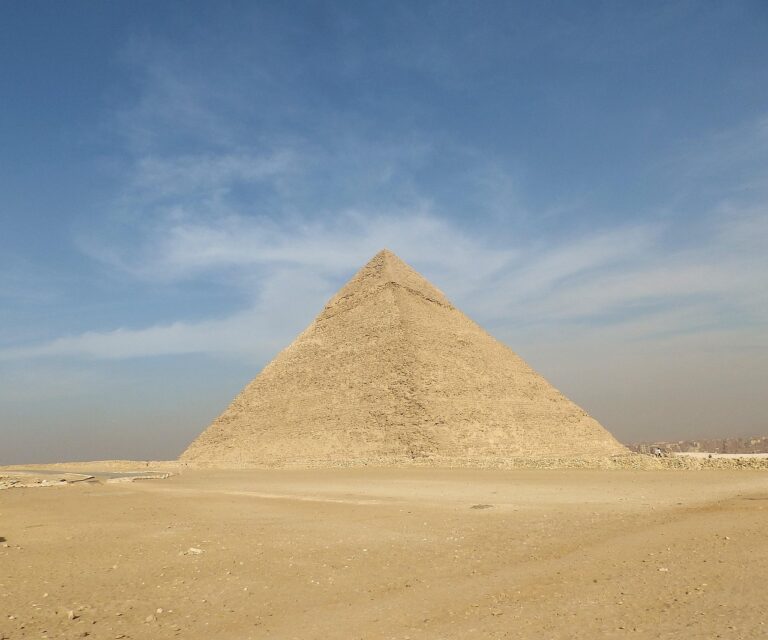
    Men fear time, the old saying used to go, ‘but time fears the Sphinx.’ That famous statue and Egypt’s Great Pyramid before which it has reclined for thousands of years have been long regarded as the most ancient monumental structures on Earth. Indeed, their late 20th century reappraisals indicated that they were even older than suspected.

    Beginning in 1974, a medical physicist and colleague of Albert Einstein, Kurt Mendelssohn, showed that the Great Pyramid was not the 2560 BCE tomb of some vainglorious king described by mainstream scholars.1 Instead, the ‘Mountain of Ra’ was raised nearly six centuries earlier, at the very outset of Pharaonic Civilisation, as a massive public works project to unify the numerous, divisive tribes of the Nile Delta in the common cause of its construction.

    So too, the Great Sphinx ‘ roughly contemporaneous, according to Egyptologists, with the Great Pyramid ‘ has been back-dated to at least 5000 BCE ‘ two millennia before the first Egyptian dynasty ‘ by an American geologist at Boston University. During the early 1990s, Robert M. Schoch found that erosion on the Sphinx was not caused by the effects of wind-driven sand, as consensus opinion held, but by moving water, when conditions at the Nile Valley were far more rainy, long prior to the 26th century BCE.2

    As recently as 2009, these extreme chronological disclosures were radically eclipsed by radiocarbon testing of a monumental ceremonial centre in southern Turkey. Its T-shaped pillars, arranged in concentric, stone circles emblazoned with anthropomorphic, zoomorphic and geometric bas-relief images, pushed the start of civilisation back to eleven thousand years ago. But now, even Gobekli Tepe’s primacy has been overtaken by the announcement last autumn of a much larger megalithic complex, half a world away from Anatolia, two thousand or more years older.

    The paradigm-shattering ruins were found in western Java, fifty kilometres southwest of Cianjur, a city with more than two million residents; Jakarta lies one hundred twenty kilometres to the northwest. A half-hour drive over asphalt and unpaved roads to the village of Karyamukti passes through mountainous landscape dotted with rice paddies and farms flourishing in the volcanic soil with chillies, peanuts, pineapple and corn, then skirts an immense tea plantation. At Mount Padang, hardy visitors need about twenty minutes to climb some 370 stone steps, rising at almost a forty-degree angle, ninety-five metres to the summit, which is crowned with the largest megalithic site in southeastern Asia. It encompasses more than twenty-five hectares, including nine hundred square metres of five, rectangular, stone courtyards ascending northwest to southeast, precisely laid out on a series of landscaped terraces, and neatly organised into low walls, inner partitions, and outward gateways, all of them connected by flights of stairs.

    Within and without the enclosures are dozens of standing monoliths, but many more lie scattered about. The entire complex comprises an estimated 3,703,700 black, andesite blocks ranging from one to two metres in length, and formed by geological processes into polygonal structures of five-, six- or eight-sided columns. (Andesite is an extrusive, igneous rock, a type of basalt formed by volcanic action.) Average dimensions for the columns are 0.3-by-0.3-by-1.5 metres. These smooth-sided blocks weigh from ninety to six hundred kilograms, with an average, individual weight of about three hundred kilograms. In other words, the site’s prehistoric workers transported approximately 1,111,110,000 kilograms (1,224,790 short tons) of building materials 885 metres above sea level, up the precipitous slopes of Mount Padang. Added to their burden was a non-local source for their andesite, which had to be brought in from some distant quarry unknown to academic scholars.

    Archaeologists were further surprised to find traces of a kind of adhesive, glue or perhaps cement that bound some of the top courses of the walls. Beneath, investigators were perplexed by the presence of several layers of sand that had been deliberately incorporated into the original stonework by the prehistoric engineers, perhaps allowing the blocks to move and slide against each other with the motion of seismic disturbances, instead of rigidly resisting such geologic upheavals and breaking under tension. Here was possible evidence for ancient earthquake-proof construction. Java is notorious for its tectonic violence, which claimed the lives of about eighty victims as recently as 2 September 2009. But it seemed utterly inconceivable that some pre-industrial people living in a remote, Indonesian backwater could have actually applied a form of technology our modern world has only recently begun to grasp.

    ‘Musical’ Rocks

    Contributing to the stones’ high strangeness, most of them possess an unusual quality that may have additionally warranted their distant importation by the ancient builders to the top of Mount Padang. Most of its andesite blocks and columns resonate with a bell-like tone when struck with another hard object. They belong to a rare, geological occurrence known as lithophony, the property of some rocks to emit musical sounds under percussive stress. Although only slightly more than one dozen lithophonic boulder fields have been identified in the world, most are found on private property, or have been obliterated by urban development.

    Two, separate sites identically named ‘Ringing Rocks Park’ may be visited in the United States at Upper Black Eddy and Lower Pottsgrove Township, or Stony Garden on the northern slope of Haycock Mountain, all in Pennsylvania. Yet another American ‘Ringing Rocks’ field is found in Montana’s Deerlodge National Forest, on the southwestern flank of Dry Mountain, in Jefferson County, southeast of Butte. Australia has its own ‘Ringing Rocks’ in northwest Queensland, and Mexico’s Cerro de las Campanas, or ‘Hill of the Bells,’ is located on a hill in the city of Querétaro. There are the Musical Stones of Skiddaw in Cumbria, England, but Scotland’s Clach a’ Choire is more cogent to our investigation, because this ‘Ringing Stone Of Tiree’ bears fifty-three circular ‘cup marks’ made by New Stone Age musicians, 4,500 years ago. They, like the builders at far-off Java’s Mount Padang, discovered something unusually mystical in the bell-like sounds. Remarkably, all these various sites produce very different tones from one another; no two locations sound exactly alike.3

    During laboratory testing of several lithophonic rocks in 1965, Pennsylvania geologist Richard Faas found that they created a series of tones at frequencies lower than the range of human hearing, and only became audible when they interacted with each other. Although lithophonic rocks sound metallic, their somewhat higher iron content is not responsible for such music, but rather a combination of the density of the stone and high degree of internal stress. Or so geologists speculate. In truth, beyond the cursory examinations undertaken by Faas, no actual studies to identify the source of lithophony have been made. Why some rocks produce ringing tones remains a scientific riddle.

    Their anomalous appearance among the ruins of Mount Padang is another dimension of their ancient mystery. No doubt, they were used by the prehistoric inhabitants as part of their ceremonial and spiritual activities. A concentration of lithophonic rocks on the site’s first terrace is referred to as ‘the gamelan stones’ for their suggestive arrangement and the variety of musical sounds they make. Notes they produce have been identified as F, G, D and A by Hokky Situngkir from the Bandung Fe Institute, an Indonesian research organisation.4

    Alignments at Gunung Padang

    Archaeo-astronomers have determined that at least several of Mount Padang’s larger standing stones point to very definite celestial phenomena, such as sunrise and sunset on the summer and winter solstices, together with those of the spring and vernal equinoxes. The ceremonial centre’s name may, in fact, have actually derived from these prehistoric solar orientations. For example, the word padang, in the language of the Sundanese people of West Java Province, translates as ‘bright.’ Gunung Padang, the archaeological zone itself, is commonly referred to by native residents as Sundapura, or ‘the Shrine of the Sun,’ while the hill on which the ruins are located (‘Mount Padang’) is traditionally called Parahyang Padang: ‘Where The Sun Ancestors Dwell,’ or ‘Place Of The Ancestors Of The Sun.’ These names or titles imply that the original inhabitants were astronomer-priests and/or priestesses, who aligned some of their monoliths with important solar positions. As such, these ‘Sun Ancestors’ were light-worshippers, not unlike the European megalith-builders, who often oriented their own standing stones in western France and the British Isles with identical solar coordinates. Today, Gunung Padang is still sought out as a holy place by the two hundred to seven hundred visitors, most of them religious pilgrims, who visit every month.

    Geomantic alignments are also in evidence. Terrace I is deliberately aligned with nearby Mount Gede, where Karuhun cemetery has been revered for untold generations as the country’s oldest ancestral burial ground. Five, crudely sculpted, andesite thrones stand in Terrace II; six more are found in Terrace V. Although overshadowed by their massive courtyards, Mount Padang’s hundreds of stone terraces are themselves engineering marvels, two metres in height and diameter, with an uncanny resemblance to their far better known agricultural counterparts at another mountainous location on the other side of the world, in the Inca citadel of Machu Picchu, among the Peruvian Andes.

    The Mysterious Nan Madol

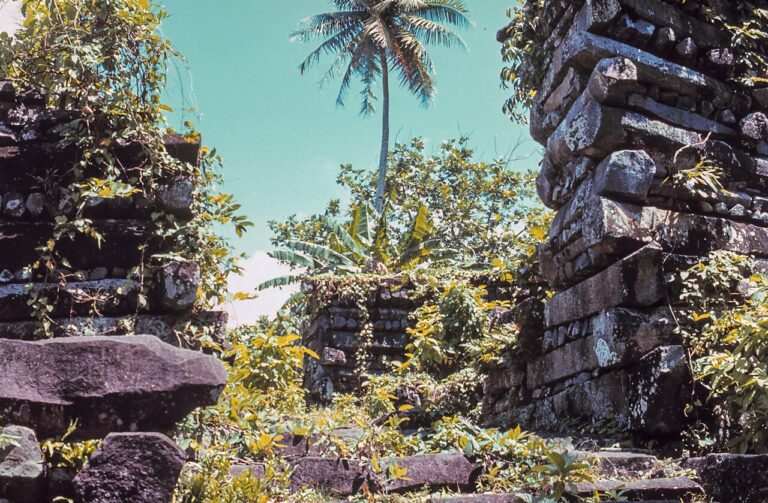
    But this South American parallel is not Gunung Padang’s only overseas’ comparison. No less great is an astounding, perhaps kindred mystery 4,345 kilometres northeast from Java, in a remote corner of the western Pacific Ocean. Off the coast of the Micronesian island of Pohnpei ‘ ‘Built Upon An Altar’ ‘ stand the massive ruins of a long-dead archaeological site. Incongruously built on a coral reef less than two metres above sea level, Nan Madol ‘ ‘Spaces In Between’ ‘ is a series of rectangular islands and colossal towers choked by draping vegetation. Ninety-two man-made islands are enclosed within the ‘downtown’ area’s 2.6 square kilometres. All are inter-connected by an extensive network of what appear to be massive canals, each nine metres across and more than one metre deep at high tide.

    An estimated two hundred fifty million tons of prismatic basalt ‘ related to Gunung Padang’s andesite ‘ went into the construction of Nan Madol. Its stone girders rise in a cribwork configuration to eight metres. Between four and five million stone columns went into the construction of this prehistoric megalopolis. These prismatic columns range in length from one to four metres, although many reach six metres. Their average weight is around five tons each, but the larger examples weigh twenty or twenty-five tons apiece. An estimated four to five million basalt pillars, girders and logs went into building Nan Madol. It is, in effect, a double-walled enclosure comprising thirteen thousand, five hundred cubic metres of coral, with an additional four thousand, five hundred cubic metres of basalt. Remove all concealing vegetation, and visitors would behold crudely worked masses of basalt contrasting with orderly courses of stone rising in massive towers and overpowering walls amid a complex of smaller, rectangular buildings and man-made lakes interconnected by dozens of canals and numerous steps, sometimes formed into grand staircases, and spread out over eighteen square kilometres.

    Construction migrated to the main island of Pohnpei, where a rectangular enclosure fifteen metres long by eleven metres wide, with bisecting, one-metre-high interior wall, was discovered in a remote, swampy meadow high in the mountains; its configuration and mountaintop setting are particularly reminiscent of Gunung Padang. Although the Micronesian island’s twin courtyards contain a five hundred square-metre area, a pair of inner platforms are only a third of a metre high. As at Nan Madol, roughly cut basalt boulders and basalt ‘logs’ were stacked to form the enclosure. Several others stand on Pohnpei’s southwest coast, with the largest example atop a two hundred forty-metre-high mountain. The summit is entirely surrounded by walls about two metres high connected via paved walkways to several terraced platforms.

    No one knows who raised them, when or why. Micronesian myth recounts only that exceptionally tall, twin-brother sorcerers, named Olisihpa and Olsohpa, arrived sometime during the ancient past in a ‘large canoe’ from their distant homeland. It was a great kingdom of glittering splendour, until falling stars and earthquakes eventually destroyed Kanamwayso, which sank to the bottom of the sea. This native oral tradition seems like a variation on the more famous story of Mu, or Lemuria, a deeply ancient and supposedly sophisticated, pan-Pacific civilisation that exerted lasting influence on both Asia and America prior to its destruction by a natural catastrophe similar to the tsunami that ravaged northern Japan, in 2010. Before the analogous loss of Kanamwayso, Olisihpa and Olsohpa allegedly built the basalt enclosures and staircases that continue to grace Nan Madol and Pohnpei. Despite more than one hundred years of scientific investigations, however, no known culture has been associated with these places. Meanwhile, the moist, tropical climate skewers accurate carbon-dating at both locations.

    Nor is their original purpose entirely clear. Nothing about either location suggests real urban centres, lacking as they do any provision for food production or storage. No human burials have been found there, save a few, individual skeletons of above-average stature ‘ calling to mind local myths of the founding-fathers, Olisihpa and Olsohpa ‘ unearthed by Japanese archaeologists during the 1930s. The rectangular arrangement of walls with regularly spaced openings and partitions suggest a ceremonial function. But for what people, and why in this extremely remote, obscure corner of the vast Pacific’ Nevertheless, Nan Madol’s and Pohnpei’s fundamental resemblances to Gunung Padang imply, at the very least, a relationship of some kind, however inconceivable.

    14,000 BCE’

    Yet more extraordinary than even these comparisons and the monumental greatness of the Indonesian site itself is its uniquely profound age. The first archaeological survey of Gunung Padang appears in a ‘Report, the Department of Antiquities’ (Rapporten van de Oudheidkundige Dienst) for Holland’s colonial office, whose anonymous author posited during 1914 that the ruins could not predate the official beginning of Java’s history in the early 5th century CE, although they appeared much older. For the rest of the 20th century, the site went unrecognised by the outside world, even after it was briefly mentioned by the prolific Dutch archaeological author, Dr. N.J. Krom, in 1946’s Under Palm And Banyan Trees.5 

    Thirty-three years later, a Canberra team from the Australian National University’s Centre for Archaeological Research ‘ ‘dedicated to investigating and learning with and about the people, languages, and land of Asia and the Pacific region’ ‘ returned for the site’s first, scientific examination.6In doing so, they determined that Gunung Padang was far older than previously imagined. Lichen growth alone covering many of the megaliths bespoke an antiquity going back millennia before Java’s earliest known culture. Not until February 2012, however, was a State-sponsored evaluation of the site carried out, when thorough radiocarbon testing revealed it was built and first occupied about 4,800 years ago. This surprisingly early Third Millennium BCE date placed Gunung Padang squarely within Western Europe’s Megalithic Age, with implications for transoceanic contact, however heretical such considerations struck conventional scholars.

    But as the researchers were carrying out their investigations, they noticed traces on Mount Padang’s surface of what might be other, underground structures. No less a supporter of science than the President of Indonesia himself, Susilo Bambang Yudhoyono, lavished the archaeologists with costly GSSI and Multi-Channel SuperSting R-8 ground-penetrating radar units, plus GEM-Ovenhausser geo-magnetometers. These state-of-the-art instruments readily found and accurately confirmed the existence of large and small chambers, walls, gates and staircases buried deep beneath the often-visited, open-air ruins in a virtual subterranean mirror image of Gunung Padang.

    According to team leader and geologist, Dr. Danny Hilman Natawidjaja, ‘3-D geo-electric and geo-radar [procedures] discovered two doors in the hallway’ of a chamber measuring ten-by-ten-by-ten metres at a depth of twenty-five metres.7 Throughout last summer and into early fall, he and his twenty colleagues ‘ leading seismologists, philologists, archaeologists, anthropologists, and petrographers ‘ carefully dredged up organic materials, which were sent for laboratory testing in the United States, because the Indonesians were determined to avoid any appearance of politically motivated results.

    ‘US lab validates Cianjur ‘ancient structure’ theory,’ The Jakarta Post announced on 5 November. ‘A recent analysis of carbon-dating by the Miami-based Beta Analytic Lab has apparently validated findings by a government-sanctioned team that a man-made structure lies buried under Mount Padang in Cianjur, West Java. The lab used samples of sand, soil and charcoal found at a depth of between three and twelve metres beneath the mountain’s surface. Based on geo-electric, geo-radar and geo-magnetic [surveys], a large chamber is buried at least up to fifteen metres from the surface’ Carbon-dating test results from the Miami lab show that the structure could date back to 14,000 B.C., or beyond.’8

    Since publication of The Jakarta Post report, repeated and additional analysis by Beta Analytic scientists confirmed their initial 14,000 BCE findings. The significance of this discovery cannot be over-stated, because it crosses the Ice Age event horizon. Even Turkey’s Gobekli Tepe, for all its Tenth Millennium BCE antiquity, came into being only after the close of the last glacial epoch, when environmental conditions were moderating sufficiently to allow for the development of proto-civilisation. Less distracted by the incessant challenges to their survival, our ancestors were afforded opportunities for broader, more complex social cooperation. But Gunung Padang proves that humans were already in possession of a relatively high culture two thousand years earlier, while the Ice Age was still in progress.

    This ‘Shrine of the Sun’ has radically pushed back the origins of civilisation to remoter levels of time and space, because mainstream palaeo-anthropologists, fixated on Europe and the Near East, are resistant to the very notion of mankind’s transition from ‘savagery’ in Indonesia. Yet, it is precisely here that Stephen Oppenheimer, a British geneticist, member of Green Templeton College, Oxford, and an honorary fellow of Liverpool School of Tropical Medicine, traced the beginnings of civilised mankind with his controversial Eden in the East, in 1999.9 It had been preceded during the previous century by The Lost Continent of Mu, written by another Englishman, James Churchward, an Imperial British Army colonel serving in India, where his translation of original Hindu monastery source materials likewise recorded how humans took that first step in the Western Pacific realm.10 My own The Lost Civilization of Lemuria (2006) and Before Atlantis (2013) similarly trace the rise of homo erectus in Java, his Pacific-wide dispersal and accelerated evolution after the eruption of history’s greatest volcanic event, and his descendants’ subsequent invention of civilisation.

    These conclusions are wonderfully brought to life by recognition of Gunung Padang as Man’s earliest-known megalithic complex. Its apparent sophistication declares that it was not the first, but must have been preceded by the construction of even earlier ceremonial centres. Civilisation is, therefore, older than we presently comprehend. If, however, the quest for its ultimate origins goes on, and deeper into the past than ever imagined, then at the very least, Gunung Padang is pointing us in their proper direction.

    You can read more about ancient civilisations, including articles on an ancient pan-Pacific civilisation and Turkey’s Gobekli Tepe, in New Dawn Special Issue Vol 7 No 1.

    If you appreciated this article, please consider a digital subscription to New Dawn.

    Footnotes

    1. Kurt Mendelssohn, The Riddle of the Pyramids, London: Thames & Hudson, 1974.

    2. Robert M. Schoch, Voices of the Rocks, NY: Harmony, 1999.

    3. Ringing Rocks Park, Upper Black Eddy, Pennsylvania, www.youtube.com/watch’v=V4VtjFhysgc;Ringing Rocks Park, Lower Pottsgrove Township, Pennsylvania, www.youtube.com/watch’v=NBfrLoBpsIQ; Ringing rocks, Queensland, Australia, www.youtube.com/watch’v=dl_zL4g2gvs;Musical Stones of Skiddaw, England, www.youtube.com/watch’v=inWKcmVEwvs; Ringing Rocks, Montana, www.youtube.com/watch’v=smiCS1Ixfts; Cerro de las Campanas, Querétaro, Mexico,www.youtube.com/watch’v=_dMRcnlZ2tk; The Ringing Stone, or Clach a’ Choire, Scotland,www.youtube.com/watch’v=eNn-4O_G-bU

    4. www.abovetopsecret.com/forum/thread880575/pg1

    5. Dr. N. J. Krom, Onder Palmen En Waringins, Holland: Uitgeverij in Den Toren, 1946.

    6. ANU Centre for Archaeological Research, http://chl.anu.edu.au/archaeology/car.php

    7. www.abovetopsecret.com/forum/thread880575/pg1

    8. ‘U.S. lab validates Cianjur ‘ancient structure’ theory,’ 5 November 2012, The Jakarta Post,www.thejakartapost.com/news/2012/11/05/us-lab-validates-cianjur-ancient-structure-theory.html.

    9. Stephen Oppenheimer, Eden in the East, London: George Weidenfeld & Nicholson, Ltd., 1999.

    10. Col. James Churchward, The Lost Continent of Mu, U.S.: Brotherhood of Life, 1987 reprinting of the 1924 original.

    11. Frank Joseph, The Lost Civilization of Lemuria, U.S.: Bear and Company, 2006; Before Atlantis, U.S.: Bear and Company, 2013.

    FRANK JOSEPH has published more books (eight) about the lost civilisation of Atlantis than any other writer in history. These and his twenty, other titles dealing with archaeology, military history and metaphysics have been released in thirty-seven foreign editions around the world. He was the editor-in-chief of Ancient American, a popular science magazine, from its inception in 1993 until his retirement fourteen years later. He lives today with his wife, Laura, in the Upper Mississippi Valley of the United States.

    The above article appeared in New Dawn No. 136 (Jan-Feb 2013).

    Read this article with its illustrations and much more by downloading
    your copy of New Dawn 136 (PDF version) for only US$5.95

    © Copyright New Dawn Magazine, http://www.newdawnmagazine.com. Permission granted to freely distribute this article for non-commercial purposes if unedited and copied in full, including this notice.


  • The Age of the Pyramids

    The Age of the Pyramids


    The Great Pyramid of Giza, among the seven wonders of the ancient world, points towards the celestial north pole with a margin of error of only a tiny fraction of one degree.

    Dr. Kate Spence, a British Egyptologist, believes she may have solved two of the great mysteries of archaeology – how the ancient Egyptians aligned the pyramid with such remarkable geographical accuracy and when the vast royal tomb was built.

    Pointing north

    The Great Pyramid is a master of precision. Comprised of an estimated 2.5 million limestone blocks, archaeologists have known for over a century that the Great Pyramid was pointed almost exactly north, but nobody has been able to explain how the ancient Egyptians managed to align it with such unprecedented accuracy.


    The deviation in accuracy is minute as Dr. Spence explains:

    ‘The Great Pyramid is extremely accurately aligned towards north. The sides deviate from true north by less than three ark minutes, that’s less than a twentieth of a degree, which is extremely accurate in terms of orientation.’

    Modern astronomers would have little difficulty in finding north because the Pole Star, Polaris, is almost directly above the North Pole. But astronomers know that the Earth regularly wobbles very slowly on its axis over a period of 26,000 years and so in ancient Egyptian times there would have been no star overhead marking true north.

    The Spence theory

    Using computer simulations of the night sky as it would have been seen at the time of the Egyptians, Dr Spence, from Cambridge University, suggests that the ancient Egyptians carefully monitored two stars which revolve in the northern region of the night sky.

    The north-finding stars were Kochab, in the bowl of the Little Dipper (Ursa Minor), and Mizar, in the middle of the handle of The Plough or Big Dipper (Ursa Major). Dr Spence says that the ancient Egyptians realised that when one was directly above the other then the line between the two-marked true north.

    Dr Spence speculates that these astronomical calculations were made at special ceremonies early in a pharaoh’s reign and that construction work would then begin on the pyramids to house their tombs. She explains:

    ‘What would probably have happened is that the king would have dressed in his ceremonial gear, and there would probably have been priests dressed as gods who would begin stretching chords and marking out the base. It would have been a highly charged religious atmosphere, taking place in the dark, at night, with torches everywhere. It would have been a spectacular ceremony.’

    The ancient Egyptians fascination with the night sky is well known. Believing that the Gods lived in the Duat, an afterworld in the sky, the pharoahs who were responsible for the construction of the pyramid at Giza, would have associated the stars with eternity and afterlife.

    Dating the pyramids

    In the past the date of the ancient Egyptian pyramids has been a source of much debate among historians, who have put it at around the middle of the third millennium BC, by tracing the chronology of Kings. However, publishing her research in the scientific journal Nature, Dr Spence says her theory gives a more precise date for the beginning of construction work on the Great Pyramid.

    The celestial north pole was only aligned exactly with Kochab and Mizar in 2, 467 BC, which would put the beginning of building work about 70 years later than many archaeologists, have previously thought.

    Dr Owen Gingerich, Senior Astronomer, at the Harvard-Smithsonian Centre for Astrophysics said Dr Spence’s theory is an ingenious and convincing astronomical solution to a long-standing mystery. He comments:

    ‘I was rather tickled to see the solution that she had put forward and wondered why nobody else had thought of it before, because I think it makes a lot of sense and it has an internal coherence.’

    Source:
    BBC World Service, Science and Technology,
     The Stargazers of Ancient Egypt


    How Old are the Pyramids?

    by JOSEPH JOCHMANS

    The controversy raised by John Anthony West and Robert Schoch concerning the true age of the Great Sphinx is now beginning to overcast the other famous monuments which share space on the Giza plateau—namely, the three pyramids that were supposedly built by Pharaohs Khufu, Khafre and Menkhare in the Fourth Dynasty. Were these Pyramids constructed only 4,300 years ago, or—like the Sphinx—is there evidence they could be far older, dating instead to perhaps 12,000 years ago?

    Let’s begin first with looking at the age of the Great Pyramid. The conservative historians’ entire case for dating the Great Pyramid to the Fourth Dynasty rests upon two major pieces of evidence. The first is the story of Herodotus, who in 443 B.C. visited Egypt and recounted how Pharaoh Cheops (the Greek name for Khufu) built the Great Pyramid during his reign with 100,000 men in 20 years. However, we now know this story is highly questionable. Even his contemporaries called Herodotus the “Father of Lies.” Not only do the construction estimates he gave not work, but Herodotus, as an Initiate in the Egyptian Mystery Schools, was sworn to secrecy regarding the true nature of the Pyramid, and he more than likely copied a fictitious tale about the monument that was then in circulation among the common masses. The Greek historian’s account stands in sharp contrast to most other Egyptian, Hebrew, Greek, Roman, Hermetic, Coptic and medieval Arabic scholarly sources which agree that the Great Pyramid was not constructed during the time frame of Pharaoh Khufu or Dynastic Egypt, but was the product of the “Age of the Gods” thousands of years earlier.

    The second piece of evidence is the existence of painted hieroglyphic inscriptions found in the air space chambers above the King’s Chamber, which include the name of Pharaoh Khufu. They were supposedly discovered by Col. Richard Howard-Vyse in 1837, when he forced his way up to these chambers using gunpowder. But there are certain facts showing these inscriptions were in actuality forgeries.

    Actually, we have the testament of Pharaoh Khufu himself that he only did repair work on the Great Pyramid. The Inventory Stele, found in 1857 by Auguste Mariette just to the east of the Pyramid, dates to about 1500 B.C., but according to Maspero and other experts, shows evidence of having been copied from a far older stele contemporaneous with the Fourth Dynasty. In the Stele, Khufu himself tells of his discoveries made while clearing away the sands from the Pyramid and Sphinx. He dedicated the account to Isis, who he called the “Mistress of the Western Mountain,” “Mistress of the Pyramid,” and identified the Pyramid itself as the “House of Isis.”

    The Stele describes how Pharaoh Khufu, “gave to her (Isis) an offering anew, and he built again (to restore, renovate, reconstruct) her temple of stone.” From there, the Pharaoh inspected the Sphinx, according to the text, and related the story of how in his time both the monument and a nearby sycamore tree had been struck by lightning. The bolt had knocked off part of the headdress of the Sphinx, which Khufu carefully restored. Egyptologist Selim Hassan, who dug out the Sphinx from the surrounding sands in the 1930’s, observed there is indeed evidence that portions of the Sphinx were damaged by lightning, and the mark of ancient repairs is very apparent. Also, he noted, sycamore trees once grew to the south of the monument, which had been dated to a great age.

    The Stele then ends with the story of how Khufu built small pyramids for himself and his daughters, wife and family, next to the Great Pyramid. Today, the ruins of three small pyramids are indeed situated on the east side of the monument. Archaeologists have found independent evidence that the southernmost of the three small pyramids flanking the Great Pyramid was in fact dedicated to Henutsen, a wife of Khufu. Everything in the inscription thus matches the known facts. If these facts can be believed as true, then the additional information that Khufu was only a restorer of the Great Pyramid and not its builder, must also be treated as historically true.


    ANCIENT LEGENDS AND MODERN RESEARCH CONFIRM EACH OTHER

    When we look at mythic history for the story of the origins of the Great Pyramid, we discover that the monument was not attributed to any Pharaoh, but was the product of the genius and higher learning of the Gods of Old. Time and time again, from the Roman Marcellinus to the Coptic Al Masudi and the Arab Ibn Abd Alhokim, the recounters of the ancient legends tell how the Pyramid was built to preserve the knowledge of a magnificent civilization from destruction by a Flood, and that it was this Flood which brought the Age of the Gods to its tragic end. The various Chronologies of Legendary Rulers place a minimum date for the Age of the Gods as circa 10,000 B.C. This is the time frame Plato, in his Timaeus and Critias, ascribed the destruction of Atlantis. And it is also this date, as can be proven in modern scientific studies, which was highlighted by major climatic, geologic and geomagnetic disturbances, accompanied by massive paleo-biological extinctions in the planet, marking the division point between the Ice Age and the Present Era.

    In Egypt, geologists examining the fossil record have found that the combined effect of melting glaciers in the Mountains of the Moon, plus a sharp rise in precipitation levels in Central Africa, caused the Nile river circa 10,000 B.C. to swell in size a thousandfold, eroding away cliff walls miles from its present banks, and washing out its entire valley throughout the length of Egypt. At the same time, as the Mediterranean Sea began to fill and rise due to higher ocean levels from melting northern glaciers, its waters for a brief period also flooded the lower Nile valley.

    mpl_2fl

    These, geologists are certain, are the last major flood events in Egypt’s fossil history, before the sea retreated and the Nile settled down to today’s relatively peaceful, winding flow. Yet, knowing this, geologists are hard pressed to explain why there existed a fourteen-foot layer of silt sediment around the base of the Pyramid, a layer which also contained many seashells, and the fossil of a sea cow, all of which were dated by radiocarbon methods to 11,600 B.P. (Before Present) plus or minus 300 years.

    Legends and records likewise speak of the fact that, before the Arabs removed the Pyramid’s outer casing stones, one could see water marks on the stones halfway up the Pyramid’s height, in about the 240-foot level, which would be 400 feet above the present Nile level. The medieval Arab historian Al Biruni, writing in his treatise The Chronology of Ancient Nations, noted: “The Persians and the great mass of Magians relate that the inhabitants of the west, when they were warned by their sages, constructed buildings of the King and the Giza Pyramids. The traces of the water of the Deluge and the effects of the waves are still visible on these pyramids halfway up, above which the water did not rise.” Add to this the observation made when the Pyramid was first opened, that incrustations of salt an inch thick were found inside. Most of this salt is natural exudation from the chambered rock wall, but chemical analysis also shows some of the salt has a mineral content consistent with salt from the sea. Thus, during the prehistoric Flood, when waters surrounded the Great Pyramid, the known and unknown entrances leaked, allowing seawater into the interior, which later evaporated and left the salts behind. The locations where the salts are found are consistent with the monument having been submerged half-way up its height.

    If the floodings of 10,000 B.C. were the last major catastrophic water events in Egypt, and the Pyramid exhibits signs of having been subjected to them, it means the Pyramid must date from a period before the flooding occurred.

    Though most Egyptologists today have yet to accept such a necessary “radical” revision of their dating of the Pyramid, there have been other discoveries that have forced them to at least realize that their preconceived theories of any early Dynastic age for the structure is no longer tenable.

    In 1983 and 1984, prehistorian Robert J. Wenke from the University of Washington, and president of the American Research Center in Egypt, was given permission to collect mortar samples from various ancient construction sites, including the Great Pyramid and the Sphinx Temple. The mortar contained particles of charcoal, insect matter, pollen, and other organic materials which could be subjected for carbon-14 dating analysis. Using two different radiocarbon dating laboratories—the Institute for the Study of Man at Southern Methodist University, and the Institute of Medium Energy Physics in Zurich—the samples revealed a number of curiosities. For the Great Pyramid samples, the tests performed at the two labs initially gave very different clusterings of dates, off by several thousands of years. When certain “adjustments” in the data were applied, the resulting time frame narrowed to 3100 B.C. to 2850 B.C.—which is still 400 years earlier than when most Egyptologists believe the Great Pyramid was built. Even more anomalous, the dates obtained from mortar used near the top of the Pyramid were a thousand years older than those obtained from mortar nearer the Pyramid base. The researchers, if they were to fully believe these findings, would have to propose that the Pyramid had somehow been built from the top down.

    What makes the datings further unacceptable is that all of them were taken from areas of previously exposed surfaces. We know from such sources as the Inventory Stele that the Giza monuments were time and time again subjected to many reconstructions and repair work, inside and out. Therefore the radiocarbon dates can only give us clues as to when the time frame was for the repair work, not the actual construction of the Great Pyramid. If the dates are to be believed at all, they at least tell us that reconstruction work was done on the monument in a time period long before the “accepted” building was done, which means the Pyramid itself must be from an even earlier period, farther distant in the past.


    WERE THE THREE GIZA PYRAMIDS MODELS FOR EGYPT’S “PYRAMID AGE”?

    Expanding our sphere of inquiry to now include all three of the Giza Pyramids, we find that an interesting historical conundrum arises regarding their “accepted” construction. If, as conservative scholars surmise, the three Giza Pyramids were built in the Fourth Dynasty by the succession of three Pharaohs—Khufu, Khafre and Menkhare— what we find regarding the sizes of the three pyramids in association with the three reigns is inconsistent with what we would have expected to have happened.

    First, Khufu ruled and supposedly constructed the Great Pyramid. Khafre followed Khufu, and in order to be politically and religiously “correct,” we would have expected him to have erected a pyramid larger than Khufu’s. To do otherwise would have seriously reflected on his being inferior to his predecessor. Generally speaking, a ruler could not afford for his people to think that their Pharaoh was weaker in power and less blessed by the gods and goddesses than the ruler before him.

    After Khafre, Menkhare next took the throne of Egypt, and in order to be in continued good political and religious form, we would have expected him to build the largest pyramid of all, dwarfing those of Khufu and Khafre in order to make sure he was not to be outshone by either of his predecessors.

    Yet what we find at Giza is exactly opposite the expected scenario: Supposedly Khufu constructed the largest pyramid, Khafre built his slightly smaller than Khufu’s, and Menkhare erected a pyramid only a third the size of the other two.

    If what actually happened contradicts what should have happened if the three Giza pyramids were built in the Fourth Dynasty, then this can only mean that something is fundamentally wrong with the accepted scenario.

    Instead of the three Pharaohs building the three Giza pyramids, what if the pyramids were already present, old with age, and in the Fourth Dynasty the three succeeding rulers simply claimed possession of the structures, doing repair work on them, and building only the minor subsidiary pyramids around them for themselves and their families—just as the Inventory Stele describes Khufu did. What would we expect would have happened?

    Khufu, first on the scene, would naturally have laid claim to the largest pyramid for himself, or the Great Pyramid. His successor, Khafre, now left with only two pyramids to choose from, would have taken possession of the second largest. Menkhare, the last to reign, would have had to be content with the last pyramid available, the smallest of the three.

    Such a scenario best fits the actual facts, for this is exactly the succession of pyramids the Pharaoh had jurisdiction over, each in their turn. Clearly, what this suggests is the Giza pyramids came first, then the Pharaohs ruled, not the other way around.

    According to conservative scholars, the Giza Three were supposed to represent the “height of accomplishment” in the Egyptian age of pyramid building, from the Third to the Thirteenth Dynasties, 2700 to 1800 B.C. But if the Giza Pyramids are in reality 12,000 years old, then they instead must have served as the models the Dynastic Egyptians repeatedly tried to copy and emulate. If we recognize this greater antiquity for the Giza Three, then many mysteries surrounding the design and construction of Egypt’s other pyramids find their solutions.

    The conservative view purports that the early pyramids along the Nile developed by stages of “evolution.” Initially, in the First and Second Dynasties, from circa 3200 to 2800 B.C., the Pharaohs were buried in mastabas, which were rectangular-shaped structures with walls sloping inward, built over underground vaults. What has baffled archaeologists is that each of the first kings of Egypt had not one but two such mastabas, at Abydos, and at Saqqara. One of these served as a cenotaph, or an empty tomb in honor of the royal person. The reason for this early practice is still a puzzle to scholars, not yet solved.

    However, we know from ancient records that the peoples of the ancient world at one time had knowledge of the existence of the known entrance to the Great Pyramid, and they left evidence, in the form of torch soot and graffiti on the walls, that they penetrated as far as the Descending Passage and Pit Chamber. The Second and Third Pyramids also possess passages and empty chambers deep beneath their foundations. Did the early Pharaohs, in studying the design of the Giza Pyramids standing silently before them on the Nile, imitate the empty Pyramid chambers in the building of their second royal tombs, believing the empty chambers had a special spiritual significance they wished to emulate?

    In the Third Dynasty, beginning about 2780 B.C., Pharaoh Zoser undertook to build a mastaba for himself as had his predecessors, but then decided to go several steps further. Two more mastaba structures were constructed on top of the first in step fashion, and finally, these in turn were incorporated as one side of a six-tiered pyramid. The development of this curious structure—today called the Step Pyramid, and located at Saqqara—indicates that Zoser was attempting to copy or duplicate a particular image. The pyramid does resemble a Sumerian ziggurat, or “holy mountain,” except that unlike the ziggurat Zoser’s structure possessed no sanctuary at its apex, and had a system of internal tunnels and chambers. The only structures which come close to being models for Zoser’s work are the Giza Pyramids.

    Significantly—and again in imitation of the Giza monuments—Zoser was not buried in his Step Pyramid. The foot of a mummy thought to have belonged to Zoser was found in one chamber, but the wrappings proved to be from a period much later than the Third Dynasty. All in all, a total of sixty mummies were found in and around the Step Pyramid, but these have been dated to the Saitic or Late Period, in the first millennium B.C. Zoser’s tomb has been identified as located at Bet Khalaif, and no pyramid structure was found associated with it.

    Following Zoser, his successor, Pharaoh Sekhemket, attempted to build a pyramid, but it appears never to have been completed, and today is only a mass of rubble. However, archaeologists did find at the bottom of a shaft below the structure a sealed alabaster sarcophagus. When the sarcophagus was opened, it was found to be completely empty, mirroring the state the Stone Box was found in, in the Great Pyramid.

    The one ruler who by far was the most ambitious pyramid builder of the Third Dynasty was Pharaoh Senefru. He constructed three monuments, and there is every reason to believe he attempted to duplicate the feat of the three Giza Pyramids. He came close, for his pyramids contained two-thirds as much stone, covered 90 percent as much area, and were built with comparable speed as the Giza structures. The one obvious difference is their building design and masonry were very crude, when examined alongside the work done in the Giza area.

    It is in the period immediately following Senefru, at the beginning of the Fourth Dynasty, that we are supposed to believe that Egyptian architects somehow miraculously overcame all their construction shortcomings, and developed the quantum leap of techniques for advanced building that went into the making of the Giza Pyramids. But the Giza monuments, however, stand out above all the rest of the pyramids in Egypt in many unique ways, clearly showing they were not related to the other Egyptian pyramids in time or construction.

    First, only the Great Pyramid and (from what is known from legend and esoteric literature) the other two Giza Pyramids have chambers in their upper interior—all the rest possess only a lower chamber or chambers near the foundation. These are copies of the pit chambers in the Giza Pyramids. The Dynastic Egyptians, not knowing of the secret chambers higher up, had no precedent for including these in their own pyramids.

    Second, only the Giza Three are accurately aligned to true north, which is indicative of a very sophisticated science of Earth measurement and construction—elements exhibited in no other pyramid.

    Third, only the Giza monuments were built with a high degree of accuracy—this precision, coupled with the apparent mastery of large, multi-ton stone construction, is what allowed the Giza Pyramids to reach their gigantic size, the largest in Egypt. In the Second and Third Pyramids the construction blocks are often not as massive or as finely positioned as they are seen in the Great Pyramid, but they are precise enough to place them in an entirely different category from all other structures along the Nile.

    Fourth, the Giza monuments were built using construction designs totally alien to any other pyramid form. As William R. Fix, in Pyramid Odyssey observed: “Because the other pyramids consist of much smaller blocks, they were built as a series of shells with multiple internal retaining walls to give cohesiveness. The three large Giza Pyramids do not have these internal casings. The very size of the blocks produces the necessary stability. This characteristic reveals a general excellence of workmanship and also imply a much higher technological capability than that employed anywhere else..

    And fifth, unlike any pyramid supposedly built either before or after the Giza Three, none of the Giza monuments contain religious symbols or pictures in any of their inner chambers.

    According to conservative scholars, the Giza Pyramids were built by the Fourth Dynasty Pharaohs Khufu, Khafre and Menkhare, as tombs. Yet not one of their bodies was found in any of them. The King’s Chamber in the Great Pyramid was discovered to be completely empty upon its opening, its Stone Box sealed but vacant. In the Belzoni Chamber, beneath the Second Pyramid, a stone box was found like the one in the Great Pyramid, but it too contained no corpse. In 1878, a sarcophagus with a mummy inside was brought to light in the Third Pyramid. Though both the sarcophagus and mummy were lost at sea during their transport to the British Museum, samples had been taken from them, and when later analyzed by radiocarbon dating techniques, they were found to be from a fairly late date, only 2,000 to 2,500 years ago.

    It is becoming increasingly apparent that the three Pharaohs who are thought to have built the Giza Pyramids instead simply claimed the monuments as their own, having given up on the idea of attempting to duplicate the structures, as Senefru had tried but failed to do before them. There are several subsidiary pyramids around the Giza Three which were probably built by the Pharaohs, and today are almost in total ruins because of their greatly inferior construction. According to ancient stelae and legends, the Pharaohs also made repairs on the Pyramids—but had nothing to do with their actual construction.

    With Menkhare came the end of the Fourth Dynasty, and at the beginning of the Fifth Dynasty we are supposed to believe, according to the historians, that the Egyptians suddenly reverted back to the same old methods of design and greatly inferior construction techniques as seen in the pyramids prior to the Fourth Dynasty. The first Pharaoh, Shepeskaf, actually built nothing more than a mastaba for his burial place. He was then followed by Userkaf, whose pyramid was so badly made it today is only a heap of debris. Sahure, Nieswerre and Neferirkare came next, and between them at Abu Sir they attempted to erect three pyramids (again duplicating Giza), but these in no way approached the size or grandeur of the Giza Three, and today are nothing more than broken piles. The same can be said for the monuments of the Sixth through the Thirteenth Dynasties, after which pyramid building for the most part came to an end. In all, 23 major pyramids were erected following the Fourth Dynasty and in each single case, the work on them was done hastily, with little care of precision, and using blocks that were no more than roughly squared boulders. We may well ask, if the Giza Pyramids, in all their excellence, were supposedly built in the Fourth Dynasty, what happened to the advanced knowledge seen in their design and construction—why was it never used again, in not a single later pyramid?

    Author William R. Fix concluded: “The many fundamental differences between the major Giza monuments and the rest of Egypt’s pyramids indicates that they do not fit into the contended chronology for dynastic Egypt. But if they do not belong to dynastic Egypt, there is only one direction in which they can be moved-not forward, but back into the past.”

    In truth, the Giza Pyramids were not an integral part of the evolutionary development of the Egyptian pyramids. Instead, they were there from the very beginning, the motivation and influence which spurred the building of the Dynastic pyramids along the Nile.

    The source of the above article by Joseph Robert Jochmans is available at
    http://www.atlantisrising.com/issue8/ar8pyramids.html


    Edgar Cayce – Great Pyramid and Sphinx Reading from 1932

    READING 5748-6. This Reading given by Edgar Cayce July 1st 1932.

    1. EC: Much has been written respecting that represented in the Great Pyramid, and the record that may be read by those who would seek to know more concerning the relationships that have existed, that may exist, that do exist, between those of the Creative Forces that are manifest in the material world. As indicated, there were periods when a much closer relationship existed, or rather should it be said, there was a much better understanding OF the relationship that EXISTS between the creature and the Creator.

    2. In those conditions that are signified in the way through the pyramid, as of periods through which the world has passed and is passing, as related to the religious or the spiritual experiences of man – the period of the present is represented by the low passage or depression showing a downward tendency, as indicated by the variations in the character of stone used. This might be termed in the present as the Cruciatarian Age, or that in which preparations are being made for the beginning of a new sub-race, or a change, which – as indicated from the astronomical or numerical conditions – dates from the latter portion or middle portion of the present fall [1932]. In October there will be a period in which the benevolent influences of Jupiter and Uranus will be stronger, which – from an astrological viewpoint – will bring a greater interest in occult or mystic influences.

    3. At the correct time accurate imaginary lines can be drawn from the opening of the great Pyramid to the second star in the Great Dipper, called Polaris or the North Star. This indicates it is the system toward which the soul takes it flight after having completed its sojourn through this solar system. In October there will be seen the first variation in the position of the polar star in relation to the lines from the Great Pyramid. The dipper is gradually changing, and when this change becomes noticeable – as might be calculated from the Pyramid – there will be the beginning of the change in the races. There will come a greater influx of souls from the Atlantean, Lemurian, La, Ur or Da civilizations. These conditions are indicated in this turn in the journey through the pyramid. 4. How was this begun? Who was given that this should be a record of man’s experiences in this root race? for that is the period covered by the prophecies in the pyramid. This was given to Ra and Hermes in that period during the reign of Araaraart when there were many who sought to bring to man a better understanding of the close relationship between the Creative Forces and that created, between man and man, and man and his Maker.

    5. Only those who have been called may truly understand. Who then has been called? Whosoever will make himself a channel may be raised to that of a blessing that is all that entity-body is able to comprehend. Who, having his whole measure full, would desire more does so to his own undoing.

    6. (Q) What are the correct interpretations of the indications in the Great Pyramid regarding the time when the present depression will end?
    (A) The changes as indicated and outlined are for the latter part of the present year [1932]. As far as depression is concerned, this is not – as in the minds of many – because fear has arisen, but rather that, when fear has arisen in the hearts of the created, SIN lieth at the door. Then, the change will occur – or that seeking will make the definite change – in the latter portion of the present year. Not that times financially will be better, but the minds of the people will be fitted to the conditions better.

    7. (Q) What was the date of the actual beginning and ending of the construction of the Great Pyramid?
    (A) Was one hundred years in construction. Begun and completed in the period of Araaraart’s time, with Hermes and Ra.

    8. (Q) What was the date B.C. of that period?
    (A) 10,490 to 10,390 before the Prince entered into Egypt.

    9. (Q) What definite details are indicated as to what will happen after we enter the period of the King’s Chamber?
    (A) When the bridegroom is at hand, all do rejoice. When we enter that understanding of being in the King’s presence, with that of the mental seeking, the joy, the buoyancy, the new understanding, the new life, through the period.

    10. (Q) What is the significance of the empty sarcophagus?
    (A) That there will be no more death. Don’t misunderstand or misinterpret! but the INTERPRETATION of death will be made plain.

    11. (Q) If the Armageddon is foretold in the Great Pyramid, please give a description of it and the date of its beginning and ending.
    (A) Not in what is left there. It will be as a thousand years, with the fighting in the air, and – as has been – between those returning to and those leaving the earth.

    12. (Q) What will be the type and extent of the upheaval in ’36?
    (A) The wars, the upheavals in the interior of the earth, and the shifting of same by the differentiation in the axis as respecting the positions from the Polaris center.

    13. (Q) Is there not a verse of scripture in Isaiah mentioning the rock on which the great pyramid is builded?
    (A) Not as we find; rather the rock on which John VIEWED the New Jerusalem – that is, as of the entering in the King’s Chamber in the Pyramid.

    14. (Q) What is the date, as recorded by the Pyramid, of entering in the King’s Chamber?
    (A) ’38 to ’58.

    15. (Q) If the Passion of Jesus is recorded in the Great Pyramid, please give the date according to our present system of recording time?
    (A) This has already been presented in a fair and equitable manner through those students of same, and these descriptions have been presented as to their authenticity.

    16. (Q) How was this particular Great Pyramid of Gizeh built?
    (A) By the use of those forces in nature as make for iron to swim. Stone floats in the air in the same manner. This will be discovered in ’58.

    17. (Q) What is the significance of the character of the figure of the Sphinx, mentioned above?
    (A) In this particular period of Araaraart and of the priest (that began those understandings – and passed through those of the hell in the misinterpretation of same), there was even then the seeking through those channels that are today called archaeological research.

    In those periods when the first change had come in the position of the land, there had been an egress of peoples – or THINGS, as would be called today – from the Atlantean land, when the Nile (of Nole, then) emptied into what is now the Atlantic Ocean, on the Congo end of the country. What is now as the Sahara was a fertile land, a city that was builded in the edge of the land, a city of those that worshipped the sun – for the use of its rays were used for supplying from the elements that which is required in the present to be grown through a season; or the abilities to use both those of introgression and retrogression – and mostly retrograded, as we are in the present.

    The beginnings of these mounds were as an interpretation of that which was crustating in the land. (See, most of the people had tails then!) In those beginnings these were left. When there was the entrance of Arart and Araaraart, they begin to build upon those mounds which were discovered through research. With the storehouse, or record house (where the records are still to be uncovered), there is a chamber or passage from the right forepaw to this entrance of the record chamber, or record tomb. This may not be entered without an understanding, for those that were left as guards may NOT be passed until after a period of their regeneration in the Mount, or the fifth root race begins. In the building of the pyramid, and that which is now called the Mystery of Mysteries [the Sphinx], this was intended to be a MEMORIAL – as would be termed today – to that counsellor who ruled or governed, or who acted in the capacity of the director in the MATERIAL things in the land.

    With the return of the priest (as it had been stopped), this was later – by Isis, the queen, or the daughter of Ra – turned so as to present to those peoples in that land the relationships of man and the animal or carnal world with those changes that fade or fall away in their various effect. These may be seen in a different manner presented in many of the various sphinxes, as called, in other portions of the land – as the lion with the man, the various forms of wing, or characterizations in their various developments. These were as presentations of those projections that had been handed down in their various developments of that which becomes man – as in the present.

    18. We are through.


  • The Ancient Egyptian ET Connection

    The Ancient Egyptian ET Connection


    Whilst we were visiting various Egyptology sites recently we came across this picture that was taken inside the Tomb of Ptah-Hotep, at Saqqara, Egypt, which dates back to the 5th Dynasty.

    Ptah-hotep served during the reign of Izezi as a sage. His maxims are in the Prisse Papyrus which are in the Louvre. Izezi was the eighth king of the 5th Dynasty and ruled Egypt from 2388 till 2356 BC.

    The picture shows servants offering food to the Egyptian sage and Philosopher Ptah-Hotep (who is sat at a table to the left of this part of the picture).

    We were flabbergasted to say the least when we took a closer look at this image and could make out an ‘alien grey’ in the bottom of the picture! Does this prove that the building and placement of the Pyramids were aided by alien intelligence?

    We have only been able to find the three images of this picture that you see here and have learned that this particular wall mural does not appear in any official guidebooks!… I wonder why? This same mural is in an old book called ‘In The Shadow Of The Pyramids – Egypt during the Old Kingdom’.

    The implications of the discovery of this ancient stone picture that includes the alien are absolutely huge! and could be one of the most important clues to alien intervention into our ancient history ever made!

    We have included an enlargement of ‘The Grey’. This picture could explain why the Egyptians appeared to be so technically advanced, and how they were able to build the Pyramids with such precision. For instance the coffin in The Great Pyramid was cut so accurately that we
    could not even recreate a similar coffin out of rock today –  even with our laser technology!

    It also ties in with the Egyptians infatuation with Orion. The three Pyramids at Giza have been proven to line up exactly with ‘the belt’ in the constellation of Orion (Discovered  by Graham Hancock and Robert Bauval). We also have to remember that Betelgeuse, which is a star in the Orion constellation has been suggested in ancient history as the home planet of aliens that have visited Earth.

    You may have seen this picture before. These images were found on the ceiling beams of the 3000 year old New Kingdom Temple — specifically dedicated to the chief god of the Egyptian pantheon, Osiris. located several hundred miles south of Cairo and the Giza Plateau, at Abydos. As you can see, images of a helicopter, submarine, plane and hovercraft are depicted! Again this piece of ancient art seems to suggest that the Egyptians knew about the latest technology that we are using today. 

    6 wooden gliders were found in one of the Pyramids at Saqqara.

    Although 5 of them have been destroyed, one does exist in the Late Dynastic Room at the Egyptian museum in Cairo amongst the wooden bird collection.

    Some readers believe that this could be a bird, but birds do not have tails that fan sideways.

    The release of the image on Mars in recent times that show the image of Nefertiti, the Egyptian Princess also strengthens the link between ancient Egypt and alien civilisations.

    Lets not forget about the Cydonia region on Mars that include ‘The Face On Mars, The D & M Pyramids (that also are placed to line up with Orions belt) and other Mars anomalies that are related to Egyptology!

    It seems that Egypt is not the only place that has been visited by Aliens in ancient times.

    This plate called ‘The Lolladoff plate’ is a 12,000 year old stone dish found in Nepal. It clearly shows a disk shaped UFO (top of pic).

    There is also a figure on the disc looking remarkably similar to a Grey.

    This picture was discovered by us recently in a book called ‘Life and Death of a Pharaoh – Tutankhamen’ by Christiane Desroches-Noblecourt, published by World Books in 1963.

    It is allegedly of a seven or eight month old unborn child, but certainly looks very different to that in our opinion. For instance, look at the length of the fingers! they are extremely long, unlike those of an infant just about to be born, or an adult human for that matter. Also look at the shape of the head and the large eyes… are you getting the picture yet? 

    The paragraph that accompanies the picture reads as follows: ‘Two small coffins, bearing Tutankhamen’s name and laid head to foot and side by side in a plain chest, contained the mummies of two seven or eight month foetuses, one of them probably female (pictured). It does not seem possible that in the midst of such a special collection of objects a place should have been set aside for two supposedly still-born children of Tutankhamun and Ankhesenamun.

    Why should such royal children, dying before their father, be buried in his tomb? There is nothing to confirm or to invalidate such a hypothesis, but the pattern of the archaic delta ritual invites one to consider the little mummies as the equivalents of the two placental (khonsu) images in Horemheb’s tomb, which contained remnants of burial furnishings specifically connected with the delta ritual, as did the ravaged tombs of Amenophis II and Tuthmosis IV.’ 

    We have recently managed to track down a rare picture of not only the other mummified foetus, but the two bodies together in one picture! The two bodies look completely different. What is even stranger is that the foetus at the top of the picture is supposed to be
    fully developed and yet the one pictured below is supposed to be 5 months premature? The premature baby is nearly 4 inches longer than the fully developed one? How can this be?

    The wall mural that is pictured to the left resides in a temple in the goldmines of Kush. Notice the rocket and figures standing by it!


  • 1995: THE HALL OF RECORDS

    1995: THE HALL OF RECORDS


    WILL THE LEGENDARY EGYPTIAN TREASURE TROVE BE REDISCOVERED IN 1999?


    By Dr. Joseph Robert Jochmans

    Recently, archaeologists announced an important find has been brought to light, a major series of tombs found in the Valley of the Kings, the burial vaults of the sons of Ramses II. What is amazing is that previously, the Valley had been thoroughly searched for almost a century, and was thought to be completely exhausted for any further investigation. That a find of such major proportions could have eluded so many Egyptologists, including Howard Carter, the discoverer of the tomb of Tutankhamen in the same Valley, goes to show that the land of the Nile still has many secrets. What else, we may well ask, lurks below the sands?

    For untold centuries both historical and esoteric sources have passed down stories of a forgotten time-capsule of Ancient Wisdom, far greater in importance than the golden treasures of Tutankhamen. The various accounts speak of chambers located beneath the Great Pyramid and the Sphinx at Giza, filled with a technological legacy left by lost advanced civilizations older than Egypt itself. Along with the stories are also preserved a number of prophecies foretelling who, when and how the vanished time-capsule will be opened.
    The Messages in Stone

    Our search begins with several stone stelae or tablets from the Middle and New Kingdom periods (between 4,000 and 3,000 years old), found in the vicinity of the Sphinx, which show the great animal reclining on top of a high pedestal surmounted by a cornice. One ancient artist, a Twelfth Dynasty scribe named Mentu-her, made sure his viewers knew his subject matter was the Great Sphinx and not other sphinxes found along the Nile, by drawing in the Pyramids in perspective in the background, a technique very rarely seen in Egyptian art.

    Seven other stelae go further, and show a door on the side of the pedestal. The famous Stele of Thutmose IV, located between the paws of the Sphinx, likewise depicts at its top the Sphinx Iying upon an understructure, with a doorway clearly seen. Finally, on yet another stele, made by an official named Nezem, and now kept in the Louvre, there is clearly depicted a flight of six steps leading to the door.

    Conservative scholars have attempted to explain the pedestal as simply a representation of the nearby Temple of the Sphinx, because from a front view perspective the Sphinx does look like it sits on its roof. But this illusion can only be seen from the front and on the surface. The ancient artists, on the other hand, depicted the pedestal from the side and from below.

    In the 1930’s, the sands around the Sphinx were finally completely cleared away, and we now know that the ancient monument rests firmly on bedrock. But the bedrock itself may have been the pedestal the Egyptian artists had in mind. And deep below somewhere along the southern side may yet be discovered the six steps and doorway, the entrance to secret hollowed out chambers undisturbed.

    An important early Egyptian source that tells us much about the Hall of Records is called the Building Texts, found among the hieroglyph inscriptions on the inner enclosure wall of the temple of Horus at Edfu, in the heart of southern Egypt. The Building Texts refer to a number of now lost documents, grouped together into what was called The Sacred Book of Temples, which gave a history and description of the major shrines along the Nile from a very remote period. These were first established by a group of creator-entities called the Shebtiw, who were associated with the god Divine Heart or Thoth, the Egyptian deity of Wisdom.

    According to the Building Texts, the sacred books and power objects were eventually placed back inside the bw-hmn or Hall, and the Shebtiw sealed the entrance, constructed a new enclosure about it, and erected power staffs and pillars outside to protect its secrets, hidden away again from all but its guardians. The site thereafter became known as bw-hmr, the Place of the Throne of the Soul, regarded as the location where only the highest Initiations were performed.

    In another Egyptian text, known today as the Westcar Papyrus, which bears evidence of dating to the Fourth Dynasty, is the story of an enigmatic sage named Djeda who could not only perform miraculous feats of magic, but who also possessed certain information concerning what he called the secret chambers of the books of Thoth. In the narrative, Djeda told Pharaoh Khufu the location of specific keys that will one day open the hidden place, which he described as follows: In the city of Ani (Heliopolis) is a temple called the House of Sapti, referring to Septi, the fifth Pharaoh of the First Dynasty, who reigned about 3000 B.C. Within the temple is a special library room where the scrolls of inventory are kept. The walls of this room are made of sandstone blocks, and either within or behind one of these blocks is a secret niche containing a small box made of flint or whetstone. It is within this box that the ipwt-seals or keys that will open the secret chambers of Thoth, the Hall of Records, may still be hidden.

    When Khufu asked Djeda to bring these keys to him, the sage replied he did not have the power to do so, but prophesied that he who some day would find the keys would be one of three sons born to Rad-dedet, the wife of the chief priest of Ra in Heliopolis, Lord of Sakhbu (the second Lower Egyptian nome or district in the Nile Delta), and that the three would be born on the 15th day of the month of Tybi (our October-November).

    Now it is generally interpreted that the three mentioned were the first three Pharaohs of the succeeding Fifth Dynasty. But because much of Egyptian literature is multi-leveled in its symbolism, there is reason to believe that a more hidden meaning may have been intended, that the three enigmatic brothers may also be those yet future individuals who will one day find and open the Hall of Records.

    Today, many portions of the old city of Heliopolis are still buried and unexcavated, silently resting underneath the expanding suburbs of Cairo. The secret of the House of Septi may yet await discovery.
    Ancient Tales

    Interpreter of ancient languages Zecharia Sitchin cites a hymn composed in the Eighteenth Dynasty which speaks of the god Amun taking on the functions of the heavenly Harakhty (the Sphinx) who attains perception in his heart, command on his lips as he enters the two caverns which are under his (the Sphinx’s) feet. The command of Amun is then placed into the writings of Thoth, the god of Hidden Knowledge and Initiation.

    The famed Greek historian Herodotus, in 443 B.C., recorded after his visit to Egypt that extending beneath and in all directions far beyond the pyramid whereon great figures are graven is a vast labyrinth, and a way into it underground.

    In the Corpus Hermeticum, a body of treatises compiled from older materials toward the beginning of the Christian era, we find in one of these works, the Virgin of the World, these words:

    The sacred symbols of the cosmic elements, the secrets of Osiris, were hidden carefully. Hermes (the Greek equivalent to Thoth), before his return to Heaven, invoked a spell on them, and said, O holy books which have been made by my immortal hands, by incorruption’s magic spell remain free from decay throughout eternity and incorrupt by time. Become unseeable, unfindable, from everyone whose foot shall tread the plains of this land, until old Heaven shall bring instruments for you, whom the Creator shall call His souls. Thus spake he, and laying the spells on them by means of his works, he shut them safe away in their rooms. And long has been the time since they were hid away.

    The Roman Marcellinus, in the 4th century, stated: There are certain subterranean galleries and passages full of windings beneath the pyramids which, it is said, the adepts in the ancient rites (knowing that the flood was coming, and fearing that the memory of the sacred ceremonies would be obliterated), constructed vaults in various places, mining them out of the ground with great labor. And upon leveled walls they engraved the hieroglyphic characters.

    Marcellinus contemporary, Iamblichus, wrote a treatise on the Mysteries of the Egyptians, and described the Initiation associated with the Sphinx. In a secret location between the paws of the feline monument, he said, is a bronze door, its opening triggered by a hidden spring. Beyond it, the neophytes went into a circular room. From this point on, they were subject to a series of trials to become full members among the Initiates, eventually reaching Masterhood.

    In similar fashion, the tenth century Coptic chronicler Al Masudi observed from earlier accounts that in the area of the Sphinx were subterranean doorways to the Giza monuments: One entered the pyramid through a vaulted underground passage 100 cubits or more long; each pyramid had such a door and entry.

    In later centuries, the medieval Arab chronicler Firouzabadi noted that the chambers of the Sphinx were constructed at the same time as the Great Pyramid: The Pyramid was erected by Esdris (Hermes or Thoth), to preserve there the sciences, to prevent their destruction. And also, the first priests, by observations of the stars, preserved records of medicine, magic and talismans elsewhere. Likewise, Ibn Abd Alhokim, who told the story of the antediluvian king Salhouk’s dream of the Flood and his building of the Pyramid to save wisdom, also recounted that Salhouk dug a vault nearby the Pyramid, filling it with all manners of works on mathematics, astronomy and physics: And they built gates (entrances) of it forty cubits underground, with foundations of massive stones from the Ethiopians, and fastened them together with lead and iron. When Salhouk was finished, he covered it with colored marble from top to bottom and he appointed a solemn festival, at which were present all the inhabitants of the kingdom.

    The Jewish historian Josephus recorded further that Enoch built an underground temple of nine vaults, one beneath the other, placing within tablets of gold. His son, Methuselah, also worked on the project, putting in the brick walls of the vaults according to his father’s plan. As Manly P. Hall noted, the Freemasons predict that someday a man will locate this buried vault, and that he will be an initiate after the order of Enoch.
    Prophetic Code

    Ever since two centuries ago when Sir Isaac Newton took a special interest in the sacred geometry of the Great Pyramid, and speculated that its inner labyrinth of tunnels and chambers was a prophecy calendar in stone, a host of scholars who have attempted to elaborate on this idea, and crack the Pyramid’s prophetic code.

    In correlation with the prophecy inside the Great Pyramid, the nearby Sphinx may hold its own symbology of past and future happenings. According to ancient Egyptian and Coptic traditions, one of the earlier forms of the Sphinx, before it was carved into its present configuration, is that it had the front paws of a lion, the back legs and tail of a bull, the face of a human, and along its sides where today one can see the remains of stone incendiary boxes, fires were lit at night to give the Sphinx the appearance of having the flaming wings of an eagle.

    Lion. Bull. Human. Eagle. We have here not only the Four Beings before the throne of the Divine as described in the Books of Ezekiel and the Revelations, but we also have here the four Fixed signs of the Zodiac, Leo, Taurus, Aquarius and Scorpio.

    Most significantly, in the Precession of the Equinoxes, the distant Age of Leo 12,000 years ago saw the burial of the Hall of Records beneath the Sphinx’s front paws. Recent archaeological and geologic surveys conducted by John Anthony West and Robert Schoch have demonstrated that the Sphinx does indeed date to such a remote time period.

    Today we have just entered the Age of Aquarius, and the face of the Sphinx symbolizes the face of global humanity joined in one mind and one heart, the goal of evolving Aquarian civilization.

    Another 6,000 years into the future will complete the Sphinx’s prophecy in the distant Age of Scorpio, when perhaps humanity’s spiritual evolution will be complete. The flaming wings of the Sphinx may be more than just that of an eagle; they may signify the fire of the Phoenix, the higher form of Scorpio that epitomizes its central themes of death and transfiguration. It is striking to note that the Pyramid’s time line ending in the 83rd century will also fall in the Age of Scorpio.

    Another theory sees the Sphinx embodying not only the four Fixed signs, but more specific astrological locations which Philip Sedgwick in his book Astrology of Deep Space identifies as the Four Points of Avatar, found at 14 degrees of Leo, Taurus, Aquarius and Scorpio. There are those students of the Egyptian Mysteries who believe that when all Four Points of Avatar will be triggered by planetary configurations, this may be a cosmic key for opening the doorway into the Sphinx’s forgotten secrets.

    Significantly, the next occurrence will take place on August 6, 1999. Will this presage the opening of the hidden Hall of Records? After that, the only other Four Points of Avatar hits to take place in the foreseeable future will be from May 4-14, 2003; November 6-11, 2005; and January 2-10, 2006.
    The Visionaries

    America’s most famous psychic, Edgar Cayce, who lived from 1877 to 1945, saw in vision that at the same time the Great Pyramid was being built over 12,000 years ago, other activities were underway to preserve books of knowledge. The hiding place for these books Cayce variously described as the hall of records yet to be uncovered, a storehouse of records, a time-capsule, a small tomb or pyramid, the pyramid of unknown origins as yet, the holy mount yet to be uncovered. As to which direction from the Sphinx the Hall lies, the seer specified in several trances that it is between that monument and the Nile river, toward the east, as the sun rises from the waters, the line of the shadow (or light) falls between the paws of the Sphinx.

    Renowned as France’s most famous seer, Nostradamus in 1558 published the completed edition of his book of prophecies, Les Vrayes Centuries, The True Centuries. The book was composed of 969 prophetic quatrains or four-lined poetic verses, all purposely written cryptically as a defense against the Inquisition of his day, who took a dim view of all forms of forecasting.

    Despite the obscuring of his words, many of Nostradamus prophetic verses have seen their fulfillment to a remarkable degree of accuracy, describing such twentieth century events as the World Wars, the landing of a man on the Moon, and even such modem happenings of the 1990s as the fall of Communism in Russia, the end of the Cold War, the Gulf War, the reunification of Germany, plus the rise of global pollution and the AIDS epidemic.

    Nostradamus also left behind a significant group of verses which, once we work out the seer’s puzzling cryptics, offers us invaluable information about the coming opening of the lost Hall of Records in Egypt.

    Here’s one example:
    They will come to discover the hidden topography of the land (at Giza),

    The urns holding wisdom within the monuments (the Pyramids) opened up,

    Their contents will cause the understanding of holy philosophy to expand greatly,

    White exchanged for black, falsehoods exposed, new wisdom replacing the established tradition that no longer work. VII,14.
    The Message From the Past to the Future

    When we look at the sum total of information from both historical and psychic sources regarding the Hall of Records, we find some remarkable correlations. These include: its location (below and around the Sphinx), age (at least twelve millennia old), identity of its builder (Thoth-Hermes), purposes (a storehouse and Initiation site), descriptions of its contents (advanced wisdom and science), the number of its future openers (three), the circumstances of its re-discovery (found by spiritual intuition), and the coming time-frame when it could possibly be brought to light (between 1999 and 2012).

    Most modern conservative Egyptologists believe that the Hall of Records is nothing more than a mere myth or fable, because its existence does not fit into currently acceptable views of ancient history. Yet the stubborn persistence of the story of the lost Hall through the millennia, plus the consistency of its description and the integrity of the many sources testifying to its reality, suggests there is something very substantial to the story, that it may be based on fact. Perhaps very soon, within the next fifteen years if the prophecies are right, we will be able to agree with Egyptologist Gerald Massey, who wrote: Someday what we thought was myth will be found to contain the true history of the past, while what we always regarded as history will be relegated to a myth of our own making.

    Finding of the Hall of Records will no doubt catalyze the transformation of everything we know about the past, and in so doing, will also revolutionize how we will enter the future ahead. The lost time-capsule from the past may be destined to change the very nature of time itself, as we know it.
    Copyright 1995. Joseph Robert Jochmans. All rights reserved. Excerpted from Joseph’s book, Time-Capsule: the Search for the Lost Hall of Records in Ancient Egypt.
    Atlantis Rising Copyright 1994-1996 – all rights reserved
    P.O. Box 441, Livingston, Montana 59047

  • 1995: Rare Great Pyramid Data

    1995: Rare Great Pyramid Data


    Compiled by Tim G. Hunkler

    References are denoted as [nn:pp] where “nn” is a document number and “pp” is the page.
    {text in curly braces are editors notes, comments, and calculations}


    CUSTOM UNITS OF MEASURE

    [11:149] – The American inch = 25.400508001 mm and the British inch = 25.399978 mm.

    [11:150] – The sacred Jewish, or pyramid, inch = 1.001081 American inch = 1.00106 British inch.
    [14:2] – The pyramid inch “PI” = 1.0011 present inches, and 1.0010846752 British inches [4:164]
    [11:151] – Use of the pyramid inch is attributed to Sir Isaac Newton, who discovered that many of the measurements of the pyramid would be in whole numbers if this unit were used.
    [14:6] – The English inch was originally the same as the pyramid inch during the time of Queen Elizabeth.
    [14:1] – The pyramid or “sacred” cubit = 25 pyramid inches.
    [4:255] – The mean density of the earth is about 5.7 times that of water at 68 degrees F. and a barometric pressure of 30.00 PI of mercury.
    [4:255] – All of the courses of masonry in the King’s Chamber have 23 or more stones, except the 5th course, which has only 7 (5,7 -> 5.7).
    [4:257] – The Pyramid Pint is 28.5 (5 * 5.7) cubic pyramid inches of water.
    [4:257] – The Pyramid Pound is 5 cubic pyramid inches of earth matter of average density.
    [4:257] – A Pyramid Pint weighs one Pyramid Pound.
    [4:257] – A Pyramid Ton is 2500 Pyramid Pints or 2500 x 5 cubic pyramid inches of average density earth matter. {(12500 cubic PI) * (1.003246507 cu inch / cubic PI) * (90.620464 gram / cu inch) * (1 kg / 1000 grams) = 1136.4333 kg}
    [4:257] – A cubic pyramid cubit of average density earth matter weighs 1.25 Pyramid Tons. {(25 x 25 x 25 cubic PI / 1 cubic pyramid cubit) * (Pyramid Ton / 2500 x 5 cubic PI) = 1.25 Pyramid Ton / cubic Cubit}
    [4:257] – The coffer in the King’s Chamber has a volume equal to 1 Pyramid Ton.
    [4:116] – The Pyramid Mile is 2917.46356+ cubits or 6084.6418 ft. {mile = 5280 ft., British nautical mile = 6080 ft.}


    CONSTRUCTION AND DIMENSIONS [18:xiii] To date, archaeologists have located 98 pyramids in Egypt, all of which are located on the West Bank of the Nile. None on East side.
    [18:245] – The Great Pyramid has been dated as circa 2770 B.C.
    [11:161] – The pyramid was built in 2623 B.C.
    [68:35] – The pyramid was built circa 2450 B.C. according to star alignment data for the 4 air shafts of the King and Queen’s chambers.
    [14:75] – At the time the pyramid was built there was no written language (only hieroglyphics).
    [11:150] – The pyramid is the most comprehensively surveyed building in the world.
    [14:70] – The Giza Plateau has a fairly level granite bedrock base, in essence, a flat topped mountain. Other regions near the Great Pyramid could not have supported the immense weight of the structure.
    [70:68] – The Great Pyramid is at the northern edge of the Giza plateau and close to the cliff there. Much of the rubble and debris from construction was dumped over the cliff and actually acts to strengthen the cliff from crumbling due to the tremendous weight and closeness of the Great Pyramid.
    [14:40] – There is so much stone mass in the pyramid that the interior temperature is constant and equals the average temperature of the earth, 68 degrees Fahrenheit.
    [14:60] – The pyramid is estimated to have 2,300,000 stone blocks weighing from 2-30 tons each with some weighing as much as 70 tons.{conflicts with [5:20]}
    [5:20] – Computer calculations indicate 590,712 stone blocks used in construction.
    [11:143] – Two types of limestone were used for construction. A soft limestone either pure or nummulitic was used for the bulk of the core blocks and a hard white limestone for the mantle. Hard limestone becomes more polished with age.
    [11:139] – The base of the pyramid covers 13.6 acres with each side greater than 5 acres in area.
    [14:76] – The outer mantle was composed of 144,000 casing stones, all highly polished and flat to an accuracy of 1/100th of an inch, about 100 inches thick and weighing about 15 tons each with nearly perfect right angles for all six sides. [11:146]
    [5:52] – Computer calculations indicated 40,745 casing stones were used averaging 40 tons each before the face angle was cut.
    [18:71] – The average casing stone on the lowest level was 5 ft. long by 5 ft. high by 6 ft. deep and weighed 15 tons.
    [14:78] – The casing stones weighing as much as 20 tons were placed with an accuracy of 5/1000ths of an inch, and an intentional gap of about 2/100ths of an inch for mortar.
    [5:52] – Assuming 590,712 blocks and a build time of 20 years an average of 81 blocks per day would need to be placed. Using 10 work crews per side of the pyramid, each work crew would need to place 2 block per day.
    [14:79] – The mortar used is of an unknown origin. It has been analyzed and it’s chemical composition is known but it can’t be reproduced. It is stronger than the stone and still holding up today.
    [14:74] – The cornerstone foundations of the pyramid have ball and socket construction capable of dealing with heat expansion and earthquakes.
    [4:5] – The four corner sockets are at different heights. The vertical distance between the highest and lowest is 17 inches. The reference point known as the “mean socket level”, or base level, is generally used as the reference for height and perimeter measurements.
    [4:5] – The “sidereal socket level” is the mean of just the SW and SE socket heights.
    [11:151] – The length of a base is 9131 PI from corner to corner in a straight line.
    [4:5] – The length of a base side at the base socket level is 9131 pyramid inches or 365.24 pyramid cubits.
    [4:5] – The length of a base side at sidereal socket level is 9131.4 pyramid inches or 365.256+ pyramid cubits.
    [4:7] – The length of the perimeter at the sidereal socket level is 36525.63629+ pyramid inches.
    [4:9] – 201 complete courses of masonry remain with remnants of 2 more at the summit. The top surface is 5478 pyramid inches above the mean socket level. Another 335 pyramid inches higher is the geometric apex formed by the corner edges of the projected mantle.
    [70:151] – The 35th course of stones is roughly 50 inches tall, nearly twice the height of the previous courses. The height of the 35th course = 1162.6 PI from ground or the length of the Antechamber x 10.
    [4:10] – The capstone is thought to have been intact about 100 B.C. since no mention of its absence was recorded by the historian Diodorus Siculus.
    [14:25] – The capstone of the pyramid is thought to have always been absent. {conflicts with [4:10]}
    [4:22] – The capstone is thought to have been an exact replica of the large pyramid on a scale of 1 to sqrt(Pi)/100. The ratio of any corresponding pyramid dimension over the capstone dimension, when multiplied by the square root of Pi equals 100.
    [4:11] – The estimated height of the capstone is about 103.03+ pyramid inches and about 6-1/2 cubits on a side.
    [14:62] – The height of the pyramid to the missing apex formed by extending the sides is 5813 PI.
    [4:7] – The perfect formula height of the pyramid including the missing apex is 5813.2355653763+ PI, calculated from perimeter of base (sidereal socket level) divided by 2 Pi.
    [11:151] – The height to the missing apex is 5812.98 PI.
    [14:63] – The height of the pyramid without the capstone is 5496 PI. {conflicts with [4:9]}
    [14:28] – The four faces of the pyramid are slightly concave, the only pyramid to have been built this way.
    [18:65] – The centers of the four sides are indented with an extraordinary degree of precision forming the only 8 sided pyramid. The effect is not visible from the ground or from a distance but only from the air, and then only under the proper lighting conditions.
    [18:310] – The 5 angles of the Great Pyramid are: edge to edge of face at apex = 76:17:13.2 (deg,min,sec), edge to diagonal edge at apex = 96:3:0.0, dihedral or face to face parallel to base = 112:25:39.4, edge to base = 41:59:50.5, face to base = 51:51:14.3. The face to base angle is the angle of the casing stones.
    [11:161] – The Great Pyramid is the only pyramid to have chambers above ground level. {not true, for example Bent Pyramid of Sneferu (Khufu’s father), Red pyramid at Dashur}
    [18:310] – The volume of the pyramid is: V = 1/3 base area x height = 161,559,817,000 cubic PI = 10,339,828.3 cubic pyramid cubits. {(5813.2355653 PI)/3 * 9131 PI * 9131 PI}
    [0:1] – The length of the Great Pyramid’s corner edges are 8688.00 PI.
    [0:2] – The slant face height of the Great Pyramid’s sides are 7391.72 PI.
    [0:3] – The area of the base covers 13.3 acres or 83,375,161 sq. PI.
    [0:4] – The area of each face covers 10.8 acres or 67,493,782 sq PI.
    [14:46] – The angle of the Descending Passage is 26 deg, 18 min, 9.5 sec or about 26.30 degrees.
    [11:151] – The passages are straight to within 0.013 in. per 100 ft.
    [4:162] – The dimensions of the Descending Passage are 4535 PI in length, 41.524 PI in width, and 36.197 PI in height. [4:197]
    [4:97] – The length of the Ascending passage from the junction of the Descending Passage to the Grand Gallery is 1543.46451 PI.
    [4:96] – The length of the Grand Gallery is 1881.5985600+ PI, and its width just above the ramp stones is 82.41 PI.
    [11:165] – Grand Gallery is 28 feet high by 1881-1/3 PI long.
    [4:97] – The length of the horizontal passage to the Queen’s Chamber is 1521.31136 PI.
    [102:12] – The name “Queen’s Chamber” is considered a misnomer by Egyptologists since no queens have ever been found in pharaoh’s pyramids.
    [4:94] – The volume of the Queen’s Chamber is 9,963,200 cubic PI.
    [70:140] – Dimensions of the King’s Chamer in PI: 412.132 x x 230.243 H
    [14:39] – Dimensions of the King’s Chamber in PI: 413 L x 206 W x 228 H {conflicts with [36:266]}
    [4:266] – Height of King’s Chamber is 230.388 PI.
    [70:119] – The lowest course of blocks in the King’s Chamber appears 5 PI shorter than the rest because the floor is raised above the base of the walls. The height of the walls is then 235.243 PI.
    [4:12] – There are 100 blocks making up the walls of the King’s Chamber in 5 courses.
    [4:221] – Antechamber to King’s Chamber: 116.26471 PI length (103.03292 PI is granite), 149.44644 PI high
    [4:255] – Coffer measurements: volume = 71250 cubic PI, interior length = 77.8141353+ PI, interior width = 26.6836336+ PI, interior depth = 34.3147946+ PI, exterior length (at top) = 89.94438003 PI, exterior length (at bottom) 89.6578860PI, exterior width = 38.67063162 PI, exterior height = 41.21316892, side and end thickness = 5.99349900 PI, bottom thickness = 6.89837429 PI.
    [39:68] – The granite coffer in the King’s Chamber is too big to fit through the passages and so it must have been put in place during construction.
    [11:159] – Microscopic analysis of the coffer reveals that it was made with a fixed point drill that used hard jewel bits and a drilling force of 2 tons.
    [70:111] – The coffer was sawed out of a block of solid granite. This would have required bronze saws 8-9 ft. long set with teeth of sapphires. Hollowing out of the interior would require tubular drills of the same material applied with a tremendous vertical force.
    [18:110] – Although the walls of the Queen’s Chamber are of finished stone, the floor is rough and unfinished. Many believe the room to have been abandoned as the intended pharaoh’s burial room as the King’s Chamber was completed. The horizontal passage to the Queen’s Chamber still bears faint red ocher construction lines along its entire 150 foot length. The horizontal passage is also rough and unfinished.
    [18:110] – The Queen’s Chamber has a gabled roof and the King’s Chamber a flat roof. It was long a custom for Arabs to bury their women in rooms with gabled roofs but to bury men in rooms with flat ceilings.
    [42:65] – The casing stones for the Great Pyramid were cut in quarries from Tura and Masara located on the east bank of the Nile on outskirts of Cairo.
    [18:72] – The Great Pyramid had a swivel door entrance at one time. Swivel doors were found in only two other pyramids: Khufu’s father and grandfather, Sneferu and Huni, respectively.
    [11:157] – It is reported that when the pyramid was first broken into that the swivel door, weighing some 20 tons, was so well balanced that it could be opened by pushing out from the inside with only minimal force, but when closed, was so perfect a fit that it could scarcely be detected and there was not enough crack or crevice around the edges to gain a grasp from the outside.
    [102:9] – The original entrance was located on the north face, about 49 feet above the base and 24 feet east of the central axis of the north face.
    [18:82] – The Grand Gallery contains two grooves, one in the east wall and one in the west wall. They are 7 inches high, 1 inch deep, and 5 inches up from the 3rd overlapping corbel. They run the entire length of the gallery.
    [68:45] – Of all the pyramids, only the Great Pyramid has “air shafts”. The King’s Chamber has 2, about 5 inches in diameter which connect to the exterior. The Queen’s Chamber has 2 which stopped just short of the walls of the chamber and which do not penetrate completely to the exterior. The cross section of these shafts are sometimes oval, sometimes domed, and sometimes rectangular.
    [14:58] – There are no hieroglyphics or writings in the Great Pyramid. The only symbols are some graphics on the wall of the Room of Chaos.
    [102:154] – Each of the ceiling stones in the Grand Gallery were individually removable. The Great Pyramid could have functioned as a stellar observatory during its construction.
    [70:302] – There are 36 ceiling stones in the roof of the Grand Gallery.
    [4:258] – Taking average earth density as 1.0, the average density of the core limestone blocks is 0.412, the limestone casing blocks is 0.367, the granite of the King’s Chamber is 0.479.
    [4:258] – The estimate for the average density of the pyramid as a whole, taking into account the different type and quantities of stone as well as the hollow chambers is 0.4078994+ times that of the average earth density (taken as 1.0).


    SECRET ROOMS

    [68:173] – Sixty-five meters up the southern shaft of the Queen’s Chamber is a miniature portcullis slab discovered by a robotic camera in 1993. Attached are two copper fittings, one broken. This area of the shaft is lined with Tura limestone, which is typically used in pyramids only for lining chambers.
    [18:103] – In the King’s Chamber all of the stone joints are very tight except in the lower left-hand corner of the west wall. Here the joints are larger than normal and covered by mortar. This is a strong indication of an opening to another chamber or passage. The Egyptian government has refused requests for further exploration.
    [18:104] – In 1986 a French team using microgravimeter equipment detected small hidden cavities behind the west wall of the horizontal passage to the Queen’s Chamber. They were permitted to bore a 1″ diameter hole and found a cavity filled with sand. They were not permitted to dig or tunnel for further investigation.
    [18:105] – The cavities in the horizontal passage to the Queen’s Chamber correspond to two floor stones in this passageway with joints perpendicular to the rest of the joints in the floor stones. This type of indicator can also be found at the junction of the descending and ascending passageways.
    [18:276] – About 70 feet along the north side of the Great Pyramid from the northeast corner is a 4×10 ft stone sunk into the foundation at an angle. The joints are very precise and this is the only stone in the foundation perimeter not at a right angle to normal construction. It would have been covered by the mantle but is now accessible since the mantle is gone. It is very likely an entrance. No further investigation has been done.
    [14:72] – It has long been believed that the Sphinx had subterranean tunnels leading to each of the three major pyramids. In October, 1994, a passage leading to a subterranean area beneath the Sphinx was re-discovered. Further investigation is expected in February of 1995.
    [88:101] – In 1987 a Japenese team used an electromagnetic wave method to search for cavities in the Great Pyramid. They identified a cavity under the horizontal passage to the Queen’s Chamber about 1.5 meters beneath and extending for 2.5-3.0 meters in depth. They also identified a cavity behind the wester part of the northern wall of the Queen’s Chamber. They identified no cavities within the King’s chamber, possibly due to the denser granite walls. Three potential cavities were identified in the area of the Sphinx.


    GEOMETRIC RELATIONS

    [14:57] – The information symbolized within the Great Pyramid is repeated multiple times.
    [14:13] – The ratio of the diagonal of the pyramid’s base to it’s height = 9:10
    [14:14] – The slope of the angle of the pyramid’s corners are in the ratio of 9:10
    [14:16] – The length of the Antechamber to the King’s Chamber = 1/50th the height of the pyramid.
    [14:24] – Value of Pi: The perimeter of the base divided by twice the height = Pi to 5 decimal places {9131*4/5813*2 = 3.141579+}
    [18:126] – The relationship of Pi between the circumference and diameter of a circle was thought to have been first reported in 300 B.C. by the Greek mathematician Archimedes.
    [70:140] – Value of Pi: The perimeter of the north or south wall of the King’s Chamber divided by the length of the wall = Pi {(230.38+5.0+412.12)*2 / 412.12 = 3.14}
    [18:126] – Value of Phi: – The ratio of the apothem (face slant height) to half a base side = Phi (1.618). Phi is another transcendental number like Pi which has no exact value (approximate value = 1.6181818…). The unique properties of Phi are that phi +1 = phi squared and also 1 + 1/phi = phi. The Phi ratio is the basis for the Fibonacci sequence 1,1,2,3,5,8,13.,21,34… which was not generally publicized until 1200 A.D.
    [18:194] – There is evidence that the Egyptians had worked out a relationship between Pi and Phi of: Pi = 6/5ths of (Phi)**2.
    [18:126] – If the height of the pyramid is taken as the radius of a circle, then the circumference of this circle is the same as the perimeter of the base. This provided the complimentary squaring of a circle and circling of a square. The key to this relationship is knowledge of the value of Pi and designing the angle of the pyramid to be exactly 51 degrees, 51 minutes, and 14.3 seconds.
    [14:18] – The length of the King’s Chamber in pyramid inches used as the diameter of a circle produces a circle with area equal to the area of the base of the pyramid if that area is expressed in sacred cubits.
    [18:102] – The Pythagorean relationship represented by a 3-4-5 right triangle is displayed in the dimensions of the King’s Chamber. The east wall diagonal is 309″, the length is 412″, and the long central diagonal is 515″. However, the Pythagorean relation was not identified until 497 B.C.
    [18:102] – In the King’s Chamber, the stone over the entrance is the only stone in the walls that is two courses high. It represents a 3-4-5 Pythagorean relationship by its measure of 124″L x 93″H x 155″ diagonal.
    [4:263] – The coffer’s mean length is the same as the width of the King’s Chamber minus the length of the antechamber.
    [4:265] – The external height of the coffer is 1/10th the length of the King’s Chamber.
    [4:266] – The top of the coffer has an inset to hold the lid. The inset forms a rectangle of 80.949+ PI by 34.244+ PI. The perimeter of this rectangle is the same as the height of the King’s Chamber {230.388 PI}.
    [70:109] – The coffer’s interior volume is 1/2 of it’s exterior volume.


    GEOPHYSICAL AND ASTRONOMICAL RELATIONS [11:151] – The information encoded into the Great Pyramid is repeated multiple times.
    [11:143] – With the mantle in place, the Great Pyramid could be seen from the mountains in Israel and probably the moon as well. It’s polished surfaces would have reflected light like a beacon.
    [14:59] – Mean Earth Temperature: The average temperature of Egypt equals the average temperature of earth = avg. temperature of Queen’s Chamber = 68 degrees Fahrenheit.
    [102:122] – With the original surrounding courtyards and temples in place, the pyramid was used as a sundial.
    [14:9] – The pyramid was used to indicate solstices and equinoxes.
    [4:114] – The pyramid is located at 29 degrees, 58 minutes, 51.06 seconds north latitude, and 31 degrees, 9 minutes, and 0.0 seconds east longitude.
    [4:111] – Marks Spring Equinox: Due to the angle of the sides of the pyramid vs. it’s latitude, it casts no shadow at noon during the spring equinox.
    [14:72] – Aligned True North: The Great Pyramid is the most accurately aligned structure in existence and faces true north with only 3/60th of a degree of error. The position of the North Pole moves over time and the pyramid was probably exactly aligned at one time.
    [14:71] – Center of Land Mass: The Great Pyramid is located at the center of the land mass of the earth. The east/west parallel that crosses the most land and the north/south meridian that crosses the most land intersect in two places on the earth, one in the ocean and the other at the Great Pyramid.
    [4:5] – Tropical Year or Calendar Year: The length of a base side is 9131 pyramid inches measured at the mean socket level, or 365.24 pyramid cubits, which is the number of days in a year. {9131/25 = 365.24, accurate to 5 digits}
    [14:3] – Tropical Year: – The perimeter of the base divided by 100 = 365.24, the number of days in a year. {9131 PI * 4 / 100, accurate to 5 digits}
    [14:17] – Tropical Year: The length of the Antechamber used as the diameter of a circle produces a circumference of 365.242. {accurate to 6 digits}
    [4:251] – Tropical Year: – The length of the granite portion of the floor of the antechamber to the King’s Chamber times 2*sqrt(Pi) = 365.242
    [4:96] – Tropical Year: The ratio of the lengths of the Grand Gallery to the solid diagonal of the King’s Chamber times 100 equals the number of days in a tropical year. {(1881.5985600 / 51.516461) * 100 = 365.242200, accurate to 8 digits}
    [4:222] Sidereal Year: – The length of the antechamber of the King’s Chamber times Pi = length of a sidereal year { 116.26471 PI * 3.14159 = 365.25636 days, accurate to 8 digits}
    [4:5] – Sidereal Year: The length of a base side at sidereal socket level is 365.256+ pyramid cubits. {accurate to 6 digits}
    [4:94] – Synodical Month: The “unit dimension” for the Queen’s Chamber is 92.173077+ PI. The number of days in the moon’s synodical month can be found from: 10 * U.D. = 10 * Pi * SM – 6, where SM is the days and 6 represents “man’s” number. {921.73077 = 10*3.14159*SM – 6, SM = 29.5305882 days = 29days, 12hrs, 44min, 2.76 sec, accurate to 9 digits}
    [4:97] – Synodical Month: Ten times the ratio of the lengths of the Grand Gallery to the Horizontal Passage equals the ratio of a tropical year to a synodical month. {10 * (1881.5985600 / 1521.31136) = 1.236826733; 365.2422 / 29.5305882= 1.236826702, the same to 8 digits}
    [4:97] – Synodical Month: – The ratio of the lengths of the Grand Gallery to the Ascending Passage is 1/10th the ratio of the day’s in the Bible’s prophetic year (360) to the days in the moon’s synodical month. {1881.5985600 / 1543.46451 = 0.1 * (360/SM), SM = 29.53059357+, accurate to 8 digits}
    [14:11] – Mean Distance to the Sun: ] The height of the pyramid times 10**9 = avg. distance to sun. {5813.2355653 * 10**9 * (1 mi / 63291.58 PI) = 91,848,500 mi}
    [14:12] – Mean Distance to the Sun: ] Half of the length of the diagonal of the base times 10**6 = average distance to the sun
    [4:7] – Mean Distance to Sun: The height of the pyramid times 10**9 represents the mean radius of the earth’s orbit around the sun, or Astronomical Unit. { 5813.235565376 pyramid inches x 10**9 = 91,848,816.9 miles}
    [4:106] – Mean Distance to Moon: ] The length of the Jubilee passage times 7 times 10**7 is the mean distance to the moon. {215.973053 PI * 7 * 10**7 = 1.5118e10 PI = 238,865 miles }
    [4:267] – Sun’s Radius: Twice the perimeter of the bottom of the granite coffer times 10**8 is the sun’s mean radius. { 270.45378502 PI* 10**8 = 427,316 miles}
    [14:19] – Earth’s Polar Radius: The sacred cubit times 10**7 = polar radius of the earth (distance from North Pole to earth’s center) {25 PI * 10**7 * (1.001081 in / 1 PI) * (1 ft / 12 in) * (1 mi/ 5280 ft) = 3950 miles }
    [11:153] Radius of the Earth: The curvature designed into the faces of the pyramid exactly matches the radius of the earth.
    [14:21] – Precession of the Equinoxes: ] The sum of the pyramid’s two base diagonals in PI = length of the Precession of the Equinoxes (~25827 years)
    [14:22] – Precession of the Equinoxes: ] The distance from the ceiling of the King’s Chamber to the apex of the pyramid = 4110.5 PI. Which is the radius of a circle whose circumference = the precession of the equinoxes. {4110.5 * 2 * Pi = 25827}
    [102:113] – Precession of the Equinoxes: ] The perimeter of the 35th course of blocks, which is much thicker than any of the other courses, gives a figure for the precession of the equinoxes.
    [14:23] – Speed of Earth around the Sun: – The pyramid inch times 10**8 = the speed of the earth around the sun, circa 2600 B.C.
    [14:27] Mass of the Earth: The weight of the pyramid is estimated at 5,955,000 tons. Multiplied by 10**8 gives a reasonable estimate of the earth’s mass.
    [11:153] Average Land Height: The average height of land above sea level for the earth is 5449 inches. This is also the height of the pyramid.
    [14:47] – The pyramid suggests a temperature system: 0 = freezing point of water, 50 = unvarying temp of Queen’s Chamber, 250 = boiling point of water. Given this, then 1000 = temp of red hot iron, 4000 = temp that iron liquifies, and 5000 = temp of white heat and temp that platinum fuses. Nice round numbers.
    [39:45] – 5 cubic pyramid inches of earth of average density has the same mass as 1/(50×50) of the coffer’s volume of water at a temperature that is 1/5th the difference between freezing and boiling.
    [39:90] – On midnight of the autumnal equinox in the year of the Great Pyramid’s completion, a line extending from the apex pointed to the star Alcyone. Our solar system is thought by some to revolve around this star along with other solar systems much like the planets revolve around our sun.
    [14:48] – A line drawn on a map from the apex of the pyramid to Bethlehem = angle of the Ascending Passage and crosses the Red Sea at the most likely point that the Israelites crossed when departing Egypt (Parting of the Red Sea).
    [14:49] – A line drawn on a map south from the apex of the pyramid at the angle of the Ascending Passage crosses Mount Sinai (Ten Commandments).
    [14:66] – North Star Pointer: The Descending Passage pointed to the pole star Alpha Draconis, circa 2170-2144 B.C. This was the North Star at that point in time. No other star has aligned with the passage since then.
    [11:159] – The 344 ft. length of the Descending Passage provides an angle of view of only +/- 1/3 of a degree. Alpha Draconis has not been in alignment for thousands of years. The next alignment will be with the North Star, Polaris, in about 2004 A.D. Polaris in Greek means “Satan”.
    [68:172] – The southern shaft in the King’s Chamber (45 deg, 00 min, 00 sec) pointed to the star Al Nitak (Zeta Orionis) in the constellation Orion, circa 2450 B.C. The Orion constellation was associated with the Egyptian god Osiris. No other star aligned with this shaft during that Epoch.
    [68:172] – The northern shaft in the King’s Chamber (32 deg, 28 min, 00 sec) pointed to the star Alpha Draconis, circa 2450 B.C.
    [68:172] – The southern shaft in the Queen’s Chamber (39 deg, 30 min, 00 sec) pointed to the star Sirius, circa 2450 B.C. Sirius was associated with the Egyptian goddess Isis and is also part of a unique ceremony practiced by the African Dogon tribe.
    [68:172] – The northern shaft in the Queen’s Chamber (39 deg, 00 min, 00 sec) pointed to the star Ursa Minor, circa 2450 B.C.
    [68:124] – Pyramids mirror Orion Constellation: The pyramid positions on the ground are a reflection of the positions of the stars in the constellation Orion circa 10,400 B.C. Five of the 7 brightest stars have pyramid equivalents: The 3 great pyramids of Khufu, Khafra, and Menkaura for the belt of Orion, the pyramid of Nebka at Abu Rawash corresponds to the star Saiph, the pyramid at Zawat al Aryan corresponds to the star Bellatrix. The only two missing star positions are for Betelgeuse and Rigel.
    [4:17] – The Light Equation: The height of the Great Pyramid, minus the height of the capstone represents one millionth the time it takes light to travel the mean radius of the earth’s orbit around the sun (1 astronomical unit) using 1 pyramid inch equals 24 hours (mean solar day). { (5813.2355653 – 103.0369176) / 10**6 = .0057101986+ days = 493.36116 seconds = 8 minutes, 13.36 seconds }
    [14:45] – Pyramid as a crystal: If the pyramid were a clear crystal or glass prism, it would reflect sunlight at an angle of about 26.5 degrees. {the descending passing has an angle of about 26.30 degrees}
    [4:19] – The Velocity of Light: With distance of one A.U. known and the transit time of light for this same distance the velocity of light can be found. { 91,848,816.9 miles / 493.36+ seconds = 186,169.5 miles/sec }
    [4:26] – The Constant of Aberration of Light: – The telescope adjustment due to the speed of the earth as it moves through space when viewing stars. It is measured as an angle of tilt and is 20.2608+ seconds of arc. The difference in width between the upper Grand Gallery and Ascending Passage as measured from an axial line through the center is 20.26 pyramid inches.
    [4:30] – The Sun’s Parallax: The size of the earth as viewed from the Sun and expressed as an angle and generally taken to be 1/2 the diameter at the equator (Solar Equatorial Parallax) is 8.9008091 seconds of arc using 91,848,817 miles as the mean distance to the sun and 3963.4914 miles as the equatorial radius. The distance between the mean socket level and the height of the leveled bedrock is 8.9008 PI.
    [4:258] – Earth’s Volume: The product of the pyramid’s volume and density times 10**15 equals the ratio of volume to density of the earth. {10,339,823.3 cubic cubits * 0.4078994 * 10**15 = 4.21760772 x 10**21 cubic cubits = 259.93 x 10**9 cubic miles}
    [4:266] – Earth’s Mass: Mass of the pyramid = volume * density = 10,339,823.3 cubic cubits * 0.4078994 earth density = 4,217,497. The mass converted to pyramid tons = 4217607.72 * 1.25 = 5,272,010 pyramid tons. Since the mean density of the earth was defined as 1.0, then the mass of the earth is 10**15 times the mass in pyramid tons = 5.272 x 10*21 pyramid tons = 5.99 x 10**24 kg
    [4:275] – Gaussian Constant of Gravitation (k): The reciprocal of the distance between the Coffer and the north or south wall of the King’s Chamber, minus one ten-billionth the bottom perimeter of the Coffer.

    {(1/58.13235 PI) – ((89.6578860+38.67063162 PI)*2 / 10**10) = 0.017202100 radians = 3 degrees, 5 minutes, 46.96 seconds of arc}

    NUMERICAL RELATIONS [39:46] – The word “pyramid” is from the Coptic “pyr” meaning division, and “met”, meaning ten, “the division of ten”.
    [14:29] – The difference between the distance of a straight line from corner to corner of the base and the curved line of the concave face is 286.1022, the Displacement Factor (DF)
    [14:30] – The ceiling of the Grand Gallery is 286.1 PI higher than the ceiling of the Ascending Passage.
    [14:31] – The perimeter of the base formed by the platform of the missing capstone = 2861 PI
    [14:32] – The center axis of the Great Step is located 35.76 PI east of the vertical axis of the pyramid. 35.76 *8 = 286.08
    [14:33] – The square base has a small depression halfway along each side of 35.76 PI deep. 35.76 * 8 = 286.08

    SEVENTEEN and 153
    [14:50] – The first four digits of DF (286.1022) add up to 17, the number of steps up to the entrance of the pyramid.
    [14:51] – The sum of the digits from 1 to 17 = 153, a number which appears multiple times in the pyramid.
    [14:52] – Jesus’s public ministry lasted 918 days. (153 * 6)
    [14:53] – The number of fish caught by Jesus’s disciples was 153. {John 21}
    [14:54] – The Grand Gallery is 153 feet long.
    [14:55] – If the 17 steps up to the entrance were continued to the peak there would be 153 steps.
    [14:56] – The center seam of the floor in the King’s Chamber corresponds to March 4-5, 1945. The bombing of Hiroshima occurred 153 days later.

    FIVES
    [39:45] – There are 5 sides to a pyramid and 5 corners.
    [39:45] – There are 5×5 pyramid inches in a cubit.
    [39:45] – The floor of the Queen’s Chamber is on the 25th (5×5) course of blocks.
    [39:45] – The floor of the King’s Chamber is 5×5 courses higher than the Queen’s Chamber.
    [39:45] – The niche in the wall of the Queen’s Chamber is 5×3 ft. high, it is corbelled with 5 stories, the top is 5×5 inches across, and the inner edge is 5×5 inches from the perpendicular center of the wall containing the niche.
    [39:45] – The King’s Chamber has 5 courses of stone in each of it’s 4 walls, and a total of 5x5x4 total stones in it’s walls.
    [39:45] – The King’s Chamber has 5 chambers above it.
    [39:45] – The coffer in the King’s Chamber has 5 solid sides.
    [39:45] – The King’s Chamber is 5×10 times the volume of the coffer.
    [39:45] – 5 cubic pyramid inches of earth of average density has the same mass as 1/(50×50) of the coffer’s volume of water at a temperature that is 1/5th the difference between freezing and boiling.
    [39:45] – The coffer’s interior volume is 50*50*50 cubic pyramid inches times 5.7, divided by 10. (5.7 is mean earth density)

    SEVENS
    The number 7 figures prominently in the Book of Revelation.
    [39:88] – The height of the Grand Gallery is 7 times the average height of the other passages.
    [39:88] – The Grand Gallery has 7 overlapping courses forming its sides.
    [39:88] – The Jubilee passage is 1/7th the length of the horizontal passage to the Queen’s Chamber.
    [39:88] – The Queen’s Chamber is a 7 sided room (gable roof is 2 sides)
    [39:88] – The volume of the peaked area of the Queen’s Chamber above the walls is 1/7th the volume of the rest of the chamber from the floor to a level equal to the ceiling of the passageway which enters the chamber.
    SIMPSON PROPORTIONS OF KING’s CHAMBER
    [4:12] – If we use a “unit dimension” for the King’s Chamber of 103.03 PI, which is the length of the granite portion of the floor in the Antechamber to the King’s Chamber measured north to south and also the theoretical height of the missing capstone, then the dimensions of the King’s Chamber exhibit some interesting relationships:


    measure

    whose square is

    width

    UD * 2

    4

    height

    UD * 223607

    5

    length

    UD * 4

    16

    end diagnonal

    UD * 3

    9

    floor diagonal

    UD * 4.472

    20

    side diagonal

    UD * 4.583

    21

    solid diagnonal

    UD * 5

    25

    sum of squares


    100


    [70:184] – The square of UD = the area of the four external sides of the coffer.
    [70:184] – One third of UD = the depth of the coffer.
    [70:184] – The square of UD divided by 2 Pi = the height of the coffer squared.

    [4:92] – If we use a “unit dimension” for the Queen’s Chamber of 92.173077+ PI, then the dimensions of the Queen’s Chamber exhibit some interesting relationships:
    height = UD * 2 whose square is: 4
    width = UD * 2.2360679+ whose square is: 5
    length = UD * 2.4494897+ whose square is: 6
    end diagonal = UD * 3 whose square is: 9
    floor diagonal = UD * 3.1622776+ whose square is: 10
    side diagonal = UD * 3.3166247 whose square is: 11
    solid diagonal = UD * 3.8729833+ whose square is: 15
    —————————————–
    sum of squares of all 7 dimensions = 60
    gable height = UD * 2.6457513+ whose square is: 7
    PROPHECIES [11:161] – When years are substituted for inches, the passages of the Great Pyramid become a prophetic calendar.
    [11:161] – The start of the Great Pyramid’s construction was 2623 B.C.
    [11:160] – The only markings in the pyramid are in the Descending Passage at 482 PI inches from the pyramid face. This represents the last year the Pole Star was aligned with the passage, 2141 B.C.
    [83:225] – The start of the construction of the Great Pyramid is recorded at 2523 B.C. via a scribed mark on the wall of the descending passage perpendicular to the floor of the passage. All other stone joints in the passage are vertical to the horizon.
    [39:85] – The start of the construction of the Great Pyramid is recorded at circa 2170 B.C. via a scribed mark on the wall of the descending passage.
    [11:160] – 1170 PI (years) from the construction start date to the point where the Ascending Passage meets the Descending Passage.
    [11:161] – 1485 PI (years) from junction of Ascending/Descending passage to start of the Grand Gallery.
    [11:165] – 1881-1/3 PI (years) in length of Grand Gallery.
    [14:43] – The ancient Hebrews used units of measure that were the same length as the pyramid inch and sacred cubit.
    [14:35] – Red Granite appears in the pyramid apparently to mark special events in conjunction with prophetic events related to the Jews.
    [11:159] – The red granite is fairly rare and identical with that of Mt. Horeb, the mountain on which Moses is said to have received the Ten Commandments. {wasn’t this Mt. Sinai?}
    [14:36] – The empty coffer in the King’s Chamber is made of red granite.
    [4:251] – A portion of the floor in the Antechamber to the King’s Chamber is red granite and corresponds to the “unit dimension” of the King’s Chamber.
    [14:64] – A red granite stone, triangular in shape, appears on a false door at the intersection of the Ascending and Descending passages. This corresponds to the prophecy year of circa 1486 B.C. (Hebrews depart Egypt under Moses)
    [14:37] – The cubic capacity of the coffer = same as Ark of Covenant made by Moses {Exodus 25}
    [70:272] – The Ark of the Covenant was 2.5 x 1.5 x 1.5 Sacred Cubits. Guessing the thickness of the sides as 1.8 PI gives a volume of 71,282 cubit pyramid inches vs. the volume of the coffer of 71250 cubic pyramid inches.
    [14:20] – The pyramid inch and sacred cubit are found as raised images on a red granite plaque at the entrance to the Antechamber of King’s room.
    [14:34] – The length of the diagonals of the floor of the Antechamber are 666 PI. {Revelation 13, mark of the Beast}
    [14:76] – There were 144,000 casing stones {Revelation 7, servants of God given seals during the apocalypse}
    [83:225] – Birth of Adam, 4128.25 B.C.
    [11:161] – Exodus of Israelites from Egypt, 1453 B.C. {junction of Ascending & Descending passages}
    [83:226] – Birth of Jesus, Sept. 29, 2 B.C. {intersection of Queen’s Chamber floor level with Ascending Passage}
    [4:160] – Birth of Jesus, about autumnal equinox, 2 B.C.
    [83:226] – Baptism of Jesus, Oct. 14, 29 A.D.
    [36,161] – Baptism of Jesus, Oct. 5, 29 A.D.
    [83:226] – Crucifixion of Jesus, April 3, 33 A.D. {beginning of Grand Gallery}
    [11:161] – Start of WWI, 1914 A.D. {end of Grand Gallery}


    MISCELLANEOUS [14:10] – The pyramid is the only remaining structure of the 7 wonders of the ancient world.
    [14:5] – The polished surfaces of the original mantle reflected heat, sunlight, and moonlight and was probably used as to aid Nile river navigation at night.
    [83:87] – No mummy has ever been found in a pyramid in Egypt. Mummies have always come from mastabas or tombs in the Valley of the Kings.
    [18:23] – The word “pharaoh” is from the Hebrew interpretation of the Egyptian “per aa”, originally meaning “the great house”.
    [11:167] – The word “pyramid” is composed of the Greek words “pyra” meaning fire, light, or visible, and the word “midos” meaning measures.
    [83:90] – Between 1300-1700 A.D. mummy flesh was ground into powder and used in Europe as medicinal aids.
    [83:91] – Mummy powder has also been used for artist paints.
    [83:91] – Mummy wrappings were at one time used to make paper and burned in fireplaces by poor Egyptians.
    [14:68] – The pyramids of Giza are among the oldest man-made structures in existence.
    [68:13] – Egypt was conquered by Alexander the Great in 332 B.C.
    [68:15] – The Greek (Egyptian) names of the pharaohs who ruled during the construction of the 3 great pyramids are: Cheops (Khufu), Chephren (Khafra), Mycerinos (Menkaura).
    [68:13] Cleopatra was the last pharaonic ruler of Egypt before it fell to Rome in 30 B.C.
    [11:157] – The first recorded forced entry into the Great Pyramid was by the Arab Abdullah Al Manun, caliph of Baghdad, in 820 A.D.
    [102:63] – Initially, after the 5 chambers above the King’s Chamber were opened, those that entered the 2nd chamber were turned black by a powder which existed only in that chamber. It was analyzed and determined to be the dust from the cast off shells and skins of insects.
    [18:17] – Most pyramids were accompanied by smaller satellite pyramids usually built to the south and east of the main pyramid. Some were tombs for queen’s and princesses. Most of the structures were mastabas built to entomb the pharaoh’s family, members of royalty, and the priestly class.
    [18:271] – In nearly all of the pyramids and tombs, it was a general practice that the burial chamber was oriented slightly west of the north/south center line of the pyramid.
    [14:41] – In ancient Egypt, Pharaoh’s wives were never buried with them in pyramids or tombs, they were buried separately.
    REFERENCE CONSTANTS from: McGraw-Hill Encyclopedia of Astronomy, 1982, ISBN 0-07-045251-2
    Aberration of Light = 20.496 seconds of arc
    Average Days in Calendar Year = 365.2425 days (400 year leap-year cycle)
    Light Year = 5.879 x 10**12 mi
    Mass of the Earth = 5.975 x 10**24 kg = 6.586 x 10**21 tons
    Mean Distance from Sun = 149,597,870,000 meters = 92,937,200 mi.
    Mean Distance to Moon = 238,247 mi
    Mean Earth Velocity = 66,600 mi/hr
    Mean Earth Density = 5.53 g / cu. cm = 90.620464 grams / cu. inch
    Mean Earth Equatorial Radius = 6378.160 km = 3969.96 miles
    Mean Earth Polar Radius = 6356.775 km = 3956.65 miles
    Mean Sun Radius = 6.960 +/- .001 x 10**5 km = 432,470 mi.
    Moon Synodical Month = 29.5305882 days
    Precession of Equinox = 25,800 years (approx)
    Sidereal Year = 365.25636 days
    Tropical Year = 365.24220 days
    Velocity of Light = 186,291 mi/sec

    from: Science and Technology Desk Reference, 1993, Gale Carnegie Library
    Mean Circumference of Moon = 6790 mi
    Mean Circumference of Earth = 24902 miles at equator, 24860 miles at poles
    Mean Distance to Moon = 238,857 mi
    Mean Diameter of Moon = 2159 mi
    Mean Diameter of Earth = 7926 miles at equator
    Mean Distance from Sun = 92,955,900 mi
    Moon Sidereal Month = 27.32166 days
    Velocity of Light = 186,282 mi/sec
    from: Physics, 1966, D. Halliday & R. Resnick, ISBN 0-471-34524-5
    Mean Radius of Earth = 6.37 x 10**6 m = 3960 miles
    Mass of earth = 5.98 x 10**24 kg
    Density of water (@ 20 deg. Celsius) = 1.00 x 10**3 kg/ cu. meter
    Pi = 3.14159 26535 89793 23846+

    Derived Values from Reference Constants:
    Mean Earth Radius = (3969.96 + 3956.65) / 2 = 3963.305 miles
    Earth Surface Area = 4 * Pi * (3963.305 mi)**2 = 197,389,867 sq. mi.
    Earth Volume = 4/3 * Pi * (3963.305 mi)**3 = 260.772 x 10**9 cubic miles.
    REFERENCE SOURCES: [0:] – Derived by editor from numbers and standard geometric formulas presented elsewhere in this text.
    [4:] – The Authorship and Message of the Great Pyramid, 1953, Julian T. Gray, E. Steinmann & Co., OH
    [5:] – Back in Time 3104 B.C. to the Great Pyramid, 1990, S. G. Taseos, ISBN 0-9626053-0-1
    [11:] – The Delicate Balance, 1989, John Zajac, ISBN 0-910311-57-9
    [14:] – Dramatic Prophecies of the Great Pyramid, 1974, Rodolfo Benavides, ISBN 0-914732-00-5
    [18:] – The Egyptian Pyramids: A Comprehensive & Illustrated Reference, 1990, J.P. Lepre, ISBN 0-89950-461-2
    [39:] – The Great Pyramid: A Miracle in Stone, 1973, Joseph A. Seiss, ISBN 0-06-067211-0
    [68:] – The Orion Mystery: Unlocking the Secrets of the Pyramids, 1994, R. Bauval & A. Gilbert, ISBN 0-517-59903-1
    [70:] – Our Inheritance in the Great Pyramid, 1891, C. Piazzi Smyth, ISBN 0-89345-029-4
    [83:] – Pyramid Prophecies, 1988, Max Toth, ISBN 0-89281-203-6
    [88:] – The Pyramids and Temples of Gizeh, 1885, W.M. Flinders Petrie, ISBN 1-85417-051-1
    [102:] – Secrets of the Great Pyramid, 1978, Peter Tompkins, ISBN 0-06-090631-6

    Compiled 1994,1995 by Tim G. Hunkler


  • 2012: Scientists Prove Ancient Alien Cauldrons in Siberia are Real

    2012: Scientists Prove Ancient Alien Cauldrons in Siberia are Real

    A team of scientists and researchers have just returned from an expedition in Siberia and the Valley of the Dead and are claiming they have found proof of at least five of the legendary cauldrons that ancient aliens supposedly built.

    A team of Russian scientists and researchers have just returned from the ?Valley of Death? region in Siberia with startling claims.  Lead scientist Michale Visok had this to say in an interview with a Russian newspaper on what they had found:

    We went out into the Valley of Death to really see and investigate the metal cauldrons that people claim exist there and we actually found five metallic objects buried in marsh like swamps?

    Michale gave the following details about these metal objects:

    1. They are each submerged in small pools of swamp like water that is anywhere from 2-3 feet deep.
    2. They are definitely metallic.  The scientists entered each swamp and walked on top of the objects and heard metallic sounds when striking the objects.
    3. The tops of the objects are very smooth to the touch but there are sharp points along the outer edges.
    4. 2 of the team members got ill during the investigation.
    5. The team consisted of 3 geologists, 1 astrophysicist, 1 mechanical engineer and 3 research assistants.

    Asked what does the team think they have discovered?  Could it be something built by ancient aliens like so many people believe? Michale declined to comment other than ?there is definitely something weird out there, we have no idea what they are or what they were used for?.

    Michale and his team are planning another expedition in the coming weeks before colder weather will make the trip impossible for the rest of the year.  He hopes to actually retrieve a piece of the metal objects by using a diamond drill bit but said he is very cautious about possibly damaging whatever they are.

    So could these objects really be ancient alien artifacts?  According to many believers, these cauldrons are actually defense weapons built by ancient aliens to defend our planet against all space based threats whether by hostile aliens, asteroids or comet strikes.  Many people site the numerous meteorites that have crashed or exploded in the area as evidence of this including the famous Tunguska meteorite in 1908, the Chulym meteorite in 1984 and the Vitim meteorite in 2002.

    Lets hope Michale and his team can get more answers and actually be able to retrieve a sample of the objects so we can really determine if these are alien built or not.  I know I am intrigued ??..

    normalvod1_1-120x70


  • Where is the Capstone of the Great Pyramid?

    Where is the Capstone of the Great Pyramid?


    The Great Pyramid of Giza is one of the most geometrically perfect structures ever built on planet Earth. You can find books, careers, even entire lives devoted to theories about how it was built and what its intended purpose was. However, even if you’re a first time onlooker, whether in person or in a photograph, one thing is blatantly obvious–the top seems to be missing.

    The top or capstone is traditionally thought to be the last piece added when constructing a pyramid. Some have speculated that the Great Pyramid’s capstone was made of solid gold, or in some theories, at least gold-plated. Of course presently undetermined, some have stated this was for an aesthetic purpose, boasting the wealth and power of the Pharaoh Cheops, for whom it was supposedly built. Others have offered a more functional explanation such as The Great Pyramid is actually a machine and its design, including a massive gold capstone, was intended for harnessing and transmitting energy, not just for showing-off.

    Since the capstone is absent, rumors abound as to why it’s missing or where it has gone. Egyptologists tend to stick by their guns–namely, that the pyramid was a tomb built for Cheops around 2500 BC and that the capstone is missing because it was looted, similar to other ancient Egyptian relics and tombs. Archaeologists, geologists, and researchers have been poking holes in this mainstream theory for decades. If you want the official version of The Great Pyramid and its missing capstone, go read the first paragraph of any encyclopedia entry. We will explore some of the “other” theories for those who find it hard to swim in the mainstream.

    The First Building?

    Readers familiar with the work of Edgar Cayce, Graham Hancock, or Erich von Daniken have undoubtedly heard of Atlantis or of the prehistoric civilizations whose technological advancement is claimed to rival or surpass our own. The location of this mysterious land has never been proven, though most tend to agree that Atlantis was somewhere in the Atlantic Ocean. Some researchers propose that our modern era of civilization began with the destruction of the old era, or Atlantis. Across the globe, nomadic peoples and primitive cultures seemed to experience advancements in sudden bursts. One theory is that these cultures were infiltrated by refugees from the Atlantean culture. They brought with them the knowledge for advancing technology and thus seeding a modern civilization.

    In this theory, many believe that The Great Pyramid (with its capstone) is much, much older than commonly suggested. In fact, some believe it was built to preserve the Atlantean legacy. Others suggest that it was built after the cataclysm, using the knowledge that the refugees had preserved. Either way, the precision and technology necessary to build this massive structure eludes even the cutting-edge of modern science.

    When examining why The Great Pyramid was built, we will further discuss two hypotheses.

    1. The design of the pyramid encodes mathematical information about the form and function of the universe. It was made so large with the hardest stone around in order to protect this vital information and to ensure that it would stand the test of time.
    2. The finished pyramid (with capstone) was a device or machine for harnessing and using energy.

    Who built The Great Pyramid, and when it was built remains a mystery, however, the mathematics that are so ubiquitous in its design are not. Contrary to popular belief, there are no inscriptions or hieroglyphs inside the pyramid.

    The only clues we have are measurements, ratios, and proportion. Some believe that the pyramid is a geometric representation of the Earth. The length of the bases, the height, and the slope of the sides correspond to the circumference of the Earth, its diameter, and its surface area. This data is essential to travel, astronomy, and cartography, among other things. The imaginary numbers Pi and Phi, though often attributed to Greek astronomers, are also prevalent in the much older Great Pyramid.

    Unlike the mathematical hypothesis above, the “machine” theory looks to the inner parts of the pyramid, such as its rooms and chambers. The inner-workings of the pyramid were designed in a very odd, but specific way. The Queen’s Chamber and The Grand Gallery, in particular, are designed in such an elaborate manner that it casts doubt onto their “official” functions as simply a tomb and a passageway.

    The peculiar nature of the inside of the pyramid has inspired a number of studies and speculations as to the acoustical properties of these rooms, the specific material chosen for their construction, the relationship of the rooms to one another, and the type of energy that The Great Pyramid was built to manipulate. Sub-theories and possible explanations are many, but the verdict is still out on what kind of machine this pyramid really was, or is.

    The common theme among these sub-theories is that the pyramid does not function without the capstone. The capstone completes the pyramid and is considered the most important part. Without it, we’re left with a 13-acre, six-million ton mystery. The golden capstone has been missing for as long as history seems to remember. Could it be the missing piece to the most advanced machine on our planet?

    The Egyptian Government had plans to put a gold-plated capstone on The Great Pyramid at the turn of the century to celebrate the beginning of its seventh millennium, but scrapped its plans at the last minute, with no real explanation. Whether this was to restore the energetic function of the pyramid, or simply a gesture to promote tourism and Egyptian history, we may never know. And so, tomb, puzzle, or machine, The Great Pyramid remains incomplete, like the symbol found on the back of every American one-dollar bill.

    Read more http://otherworldmystery.com/where-is-the-capstone-of-the-great-pyramid


  • The Nightmarish Underworld

    The Nightmarish Underworld


    The Pyramid Texts


    “The Pyramid Texts were a collection of Egyptian mortuary prayers, hymns, and spells intended to protect a dead king or queen and ensure life and sustenance in the hereafter. The texts, inscribed on the walls of the inner chambers of the pyramids [from c. 2686-c. 2160 BC]., are found at Saqqarah in several 5th- and 6th-dynasty pyramids, of which that of Unas, last king of the 5th dynasty, is the earliest known. The texts constitute the oldest surviving body of Egyptian religious and funerary writings available to modern scholars.”

    – Encyclopaedia Britannica The Pyramid Texts “represent the only large corpus of religious texts set down during the Old Kingdom. With the exception of the hetep-di-nisut prayer, private tombs contained neither religious texts nor representations of gods. Contact with the gods was the prerogative of the king.” – Jaromir Malek, In the Shadow of the Pyramids

    “In the so-called Pyramid Texts (c. 2400 BC), the dead pharaoh seeks to fly up to heaven and join the sun-god Re on his unceasing journey across the sky, incorporated, thus, in a mode of existence beyond change and decay. A passage in the later Book of the Dead (1200 BC) represents the deceased, who has been ritually identified with Osiris, declaring that he comprehends the whole range of time in himself, thus asserting his superiority to it.” – Encyclopaedia Britannica

    “The Pyramid Texts describe the ascent of the departed king to the sky. He joins Orio (Osiris), and Sirius is his guide. They continue together as participants in the cosmic cycle. A similar wish is expressed in other texts. The spirits of the dead hope to join the never-setting, never-dying, circumpolar stars. These two possible transfigurations, in which the dead pharaoh joins Osiris or the Circumpolar stars, may explain the orientation of the so-called air shafts from the King’s Chamber in the Great Pyramid. They may be ramps by which the dead king makes his way to heaven.” – E. C. Krupp, “Astronomers, Pyramids and Priests” in In Search of Ancient Astronomies

    At the end of the Pharaoh’s journey to the Afterlife, he ascends the Stairway of Heaven in the Eye of Horus. “The roaring tempest drives him, it roars like Seth. The guardians of Heaven’s parts open the doors of Heaven for him.
    ‘Dawning as a falcon’, he reaches the celestial realm of Ra on the ‘Imperishable Star’ and is placed on the throne of Osiris. His lifetime is eternity, its limit everlastingness.” – Text from the pyramid of King Pepi

    “…Some scholars have recently [1973] taken the bold step of seeing the Pyramid Texts, given their content and arrangement, as the quintessence of the rituals carried out when the ruler was interred; the actual course of this event, which took place in the chambers of the temple complex in the Pyramid area, was then as it were, reflected in the inscriptions in the corridors and chambers of the actual pyramid, the royal burial-place.” – Siegfried Morenz, Egyptian Religion

    “The king-making ritual is known to have been performed in the pyramid of Unas. As in a Masonic Temple, the ceiling of the main chamber represents the sky with stars in place. The commonly accepted view is that the ceremony was celebrated on the last night of the waning moon, beginning at sunset and continuing all night until sunrise, the purpose being a resurrection ritual which identified the dead king with Osiris.
    “The coronation took place in two stages. The first stage included anointing and an investiture with a ceremonial collar and apron as well as a presentation of an ankh (symbol of life) and four posies. In the second stage royal insignia were presented and the main ritual began. A crucial part of this was the reaffirmation of the union of the Two Lands and the investiture of the new king by presenting two distinctly different crowns and regalia [Henri Frankfort, in Kingship and the Gods]. At what stage in these proceedings the king became a god [Horus] is never stated.”
    “The new Horus is considered to be the Morning star…” – Christopher Knight & Robert Lomas, The Hiram Key: Pharaohs, Freemasons and the Discovery of the Secret Scrolls of Jesus

    “The reed-floats of the sky are set in place for me, that I may cross by means of them to Re at the horizon…I will stand among them, for the moon is my brother, the Morning Star is my offspring…” – The new Osiris in the Pyramid Texts

    “…The Egyptian hieroglyphic for the morning star has the literal meaning ‘divine knowledge. This seems to support our thesis that the candidate for kingship was raised to the status of the new god/king Horus by sharing the secrets of the gods in the land of the dead, where he learned the great secrets before returning to Earth as the morning star broke the horizon just before sunrise.”
    “At the coronation/funeral ritual, the old king was resurrected as the new one, and proved himself a suitable candidate by traveling around the perimeter of the entire country. This was really a symbolic act as the new king was conducted around the temple room to show himself a worthy candidate to those present, which included the god Re and his main assistant.” – Christopher Knight & Robert Lomas, The Hiram Key: Pharaohs, Freemasons and the Discovery of the Secret Scrolls of Jesus


    The Book of the Dead

    “The Book of the Dead was an.”ancient Egyptian collection of mortuary texts made up of spells or magic formulas, placed in tombs and believed to protect and aid the deceased in the hereafter. Probably compiled and re-edited during the 16th century BC, the collection included Coffin Texts dating from c. 2000 BC, Pyramid Texts dating from c. 2400 BC, and other writings. Later compilations included hymns to Re, the sun god. Numerous authors, compilers, and sources contributed to the work. Scribes copied the texts on rolls of papyrus, often colourfully illustrated, and sold them to individuals for burial use. Many copies of the book have been found in Egyptian tombs, but none contains all of the approximately 200 known chapters. The collection, literally titled ‘The Chapters of Coming-Forth-by-Day‘, received its present name from Karl Richard Lepsius, German Egyptologist who published the first collection of the texts in 1842..” – Encyclopaedia Britannica

    The Heliopolitan Recension of The Chapters of Coming Forth by Day”or first section of it, was in use during the fourth and fifth dynasties and can be dated back to before 3500 B.C.”
    According to A.E. Wallis Budge in Books on Egypt and Chaldea, “the book is definitely not of Egyptian origin for, although it would appear that from pre-dynastic times the aborigines of Egypt possessed tolerably well defined ideas about the future life, they could not be regarded as the authors even of the earliest Recension of the Book of the Dead, because the work presupposes the existence of ideas which the aboriginals did not possess and refers to an elaborate system of sepulture which they never practiced.”
    “It is interesting to note that, although the Egyptians must have been overall a dark-skinned people and therefore predominantly brown-eyed, they almost always depicted their Sun gods with blue eyes. A folk memory, no doubt, of a fair and blue-eyed people who, to them, were the original race of ‘gods’.” – Murray Hope, Practical Egyptian Magic

    “Collections of formulas, such as the Egyptian Pyramid Texts and the Book of the Dead, were compilations of magical prayers that allowed the dead to forestall all the dangers and meet all the eventualities. In particular, they contain negative confessions in which the dead man justifies himself before the court of Osiris (god of the dead). The funeral liturgies of the ancient Egyptians have preserved lamentations that echo the family in mourning. Hymns written on papyrus that are compositions in honour of a divinity and that were recited during sacred ceremonies have also been preserved. Such are the hymns of the pharaoh Akhenaton (Amenophis IV, 14th century BC) to the god Aton and the hymns in honour of the god Amon-Re that boast of divine benefits and sometimes confess misery and sin..”

    .”…The Book of the Dead (from about 1800 BC),…reads very much like an oratorio. Although there is no evidence that it was actually performed, the ritual is full of theatrical elements. It describes the journey of the soul, brought after death by the jackal-headed god Anubis into the Hall of Truth, where the dead man’s heart is weighed against a feather. If the heart, made light by goodness, does not outweigh the feather, then the soul is brought before Osiris and granted immortality..” – Encyclopaedia Britannica


    The Tuat or (Duat or Dwat)


    “The idea that the dead had to make a journey to the otherworld, to which they belonged, finds expression in many religions. The oldest evidence occurs in the Egyptian Pyramid Texts (c. 2375-c. 2200 BC). The journey is conceived under various images. The dead pharaoh flies up to heaven to join the sun-god Re, in his solar boat, on his unceasing voyage across the sky, or he joins the circumpolar stars, known as the “Imperishable Ones,” or he ascends a ladder to join the gods in heaven.” – Encyclopaedia Britannica “The gods who are in the sky are brought to you, the gods who are on earth assemble for you, they place their hands under you, they make a ladder for you that you may ascend on it into the sky, the doors of the sky are thrown open to you, the doors of the starry firmament are thrown open for you.” – Pyramid Texts, Utterance 572

    “Later Egyptian funerary texts depict the way to the next world as beset by awful perils: fearsome monsters, lakes of fire, gates that cannot be passed except by the use of magical formulas, and a sinister ferryman whose evil intent must be thwarted by magic.” – Encyclopaedia Britannica

    According to Mesopotamian literature, “below the earth, in the realm of Nergal, dwelt spirits and defeated gods. The ritual texts depicted this region as dark, inhabited by beings clothed with wings. It was a land from which there was no return, except perhaps for assassinated or wronged persons who might come back briefly to haunt their malefactors. It was a dusty place, where the ghosts lived on dusky air and mud. Only a few privileged people could find water or a place to sleep.” – Ninian Smart, The Religious Experience of Mankind

    “The Egyptian conception of the Underworld was that it was a nightmarish place – dark, dismal, unsafe, peopled with monsters, genii and all kinds of carnivorous animal. The Coffin Texts provide spells for escaping from such creatures; and spells for the prevention of suffering from evils such as walking upside down or eating excrement.” – Barbara Watterson, The Gods of Ancient Egypt

    “Tuat [or the zone of twilight or heaven by night] is the name which the Egyptians gave in primitive times to the region to which the dead departed after they had left this earth, and the word has been translated by ‘Other World’….It was ‘unseen’, and dark and gloomy, and there were pits of fire in it, and it formed the home of hellish monsters, and of the damned.”
    “The early Egyptians thought that Egypt was the world, and that it was surrounded by a chain of lofty mountains, like the Gele Kaf of the Arabs, which was pierced in two places, one in the east and the other in the west. In the evening the sun passed through the western hole, and traveling, not under the earth, but on the same plane and outside the chain of mountains it came round to the eastern hole in the mountains, through which it entered to begin the new day above the earth. Outside the chain of mountains, but quite close to them, was situated the Tuat, and it ran parallel with them. On the outer side of the Tuat was another chain of mountains which surrounded Egypt, and a river ran between them. We may say, then that the Tuat closely resembled that part of the Valley of the Nile which constitutes Egypt, and that it was to all intents and purposes circular in form. Now as the Tuat lay on the other side of the chain of mountains which surrounded Egypt, and was therefore deprived of the light of the sun and moon which illumined its skies, it was shrouded in the gloom and darkness of night…”

    “The part of the Tuat that was close to Egypt was a terrible place, which much resembled the African ‘bush’. Parts of it were desert, and parts of it were forest, and parts of it were ‘scrub’ land, and there were no ‘roads’ through any part of it. Tracks there were, just as there are in the forests of the Sudan, but it was hopeless for the disembodied soul to attempt to find its way by means of them, unless guided by some friendly being who knew the ‘ways’ of that awful region. Everywhere there was thick darkness. All the region of the Tuat was inhabited, but the beings who dwelt there were hostile to all new-comers, and they could only be placated by gifts, or made subservient to the souls of the dead on their way to the kingdom of Osiris, by the use of spells, or words of power. They way was bared too, by frightful monsters which lived on the souls of the dead, and at one place or another the deceased was obliged to cross streams which were fed by the river in the Tuat, and even the river itself. In one part of this terrible region was situated a district called ‘Sekhet Hetepet, i.e., the ‘Field of Offerings’, or the Elysian Fields, and within this was a sub-district called ‘Sekhet Aaru’, i.e., the ‘Field of Reeds’; in the later lived the god Osiris and his court. In primitive times his kingdom was very small, but gradually it grew, and at length absorbed the whole of the Tuat. He ruled the inhabitants thereof much as an earthly king ruled men, and from first to last there seem to have bee in his kingdom nobles, chiefs, and serfs, just as there were in Egypt.”
    The deceased might also attempt to reach the Kingdom of Osiris by water. “The Egyptians thought that the Nile which flowed through Egypt was connected with the river in the Tuat, but to reach the latter the deceased would have to pass through the two holes in the First Cataract from which the Nile rose, and then he would have to sail over streams of fire and boiling water before he arrived in post. The banks of these streams were filled with hostile beings which sought to bar his progress, and lucky indeed was that soul which triumphed over all obstacles, and reached the City of God.” – E. A. Wallis Budge, The Book of the Dead

    The Book of What is in the Dwat is portrayed on an immense unrolled painted papyrus in the New Kingdom tomb galleries in the Valley of the Kings, 1600-1300 BC. The book can be understood in several ways. “Physically it is the glorious rebirth of the solar globe, and is therefore the triumph of light over darkness. Spiritually, taking into consideration the mummy lying on the ground, we can see here the sublimation of incarnate being in the image of metabolism, which, through multiple purifications, transforms the densest matter into the subtle marrow (makh) of the spinal chord, here represented by the large serpent. The human being’s spiritual quest leads him toward the state of blessedness (again makh), and the eastern gate of the sky opens toward eternal life, the conquest of shadowless light.” – Lucy Lamy, Egyptian Mysteries

    With the approach of night the strength of the Ra, the sun god of Heliopolis, diminished. The solar barque “entered the realm of night and met the powers of darkness. The chief of these was the serpent Apep who tried to swallow the barque; a nightly struggle ensued, and when the sun reappeared on the eastern horizon the next day prayers of thankfulness were offered that Ra was triumphant and the sun would continue to shine.” – Richard Patrick, Egyptian Mythology

    In the Eleventh section of the Tuat, the boat of Afu Ra [the sun god] passes the territory of the town of Sais. “The region to the left of the god is one of fire, and in, but quite close to the boat, stands Horus, who is working magic with the snake-headed boomerang which he holds in his hand. Before him is the serpent called ‘Seth-heh’, i.e., the ‘eternal Seth’. Horus is superintending the destruction of the bodies, souls, shadows, and heads of the enemies of Ra, which is being affected in the pits of fire before him. The fire in the pits is supplied from the bodies of the goddesses who are in charge of them. In the first pit, the victims are immersed in the fiery depths head downwards. When Afu Ra arrives at the last of the pits, his journey though the Tuat proper is ended, and it only remains for him to pass through the ante-chamber to the east of it, in order to arrive at the sky of this world….He has followed a course which first went from south to north, the to the east, and finally towards the Mountain of the Sunrise. Afu Ra has now reached the “uttermost limit of thick darkness” and arrives at the Twelfth Section of the Other World…This section contains the great mass of Celestial Waters called Nu, and the goddess Nut, who is here the personification of the god of the morning. We see Afu Ra in his boat as before, and in front of it is the Beetle of Kehpera, under whose form the new sun is to be born. Before the boat is the great serpent Ankh-neteru, and twelve amkhiu-gods, taking hold of the tow-line, enter this serpent at the tail, and, drawing the god in his boat through the body of the serpent, bring him out at his mouth. During his passage through the serpent Afu Ra is transformed into Khepera, and the amkhiu-gods are also transformed, and emerge with him from the serpent, and minister to him all the day. Afu Ra, in the form of Khepera [the ancient god associated with the creation of the world], is now towed into the sky by twelve goddesses, who lead him to Shu, the god of the atmosphere and sky of this world….As the disk appears in the sky; the newly-born god of day is acclaimed by gods and goddesses, who destroy any and every enemy who appears in the presence of the god, and sing hymns to him.” – E. A. Wallis Budge, The Book of the Dead

    After the Egyptians abandoned the mine in the Timma Valley (some thirty kilometers north of the Gulf of Aqaba) during their decline in the twelfth century BC, the Midianties converted the temple into a shrine of their own for a while…In the makeshift Holy of Holies of the shrine, the excavators found only one object, perhaps the most intriguing object of all Timma – tiny, beautifully molded copper serpent with a gilded head, the ancient fertility symbol of the Middle East. It immediately called to mind the ‘serpent of brass’ of Moses (Numbers 21:9), which later became such an object of veneration.” – Magnus Magnusson, BC – The Archaeology of the Bible Lands

    “Apart from the local god one other deity with local connections figured very prominently in the thoughts of the Egyptians of the Old Kingdom. It was the god of the local necropolis, such as Khentiamentiu at Abdju (Abydos) and Sokar in the Ineb-hedj (Memphis) region, and universally Anubis, usually associated with the jackal, and later Osiris. At a man’s death one of the elements of his personality, ‘vital force’ or ‘spirit’ (ka), continued to exist in the tomb, while the deceased himself became an akh-sprit after the accomplishment of the prescribed funeral rites. The body was deemed necessary the ka’s continued existence, and attempts to provide a substitute abode for it lead to the introduction of tomb statues. The same belief prompted the first experiments with artificial preservation (mummification). The ka’s material needs were similar to those of the living, and food and drink offerings were brought to the tomb’s chapel which was the only part publicly accessible. In the absence of real offerings, these could be provided symbolically by representations on the stela (false-door) or tomb walls, or by recitation of prescribed formulae. The activities represented in Old Kingdom tombs which are connected with such provisioning are thus meant to be taking place very much in this world, not in any version of an Egyptian paradise.” – Jaromir Malek, In the Shadow of the Pyramids

    “The great gods of Egypt themselves were not exempt from the common lot. They too grew old and died. For like men they were composed of body and soul, and like men were subject to all the passions and infirmities of the flesh. Their bodies, it is true, were fashioned of more ethereal mold, and lasted longer than ours, but they could not hold out for ever against the siege of time. Age converted their bones into silver, their flesh into gold, and their azure locks into lapis-lazuli. When their time came, they passed away from the cheerful world of the living to reign as dead gods over dead men in the melancholy world beyond the grave. Even their souls, like those of mankind, could only endure after death so long as their bodies held together, and hence it was as needful to preserve the corpses of the gods as the corpses of common folk. lest with the divine body the divine spirit should also come to an untimely end. The high gods of Babylon also, though they appeared to their worshippers only in dreams and visions, were conceived to be human in their bodily shape, human in their passions, and human in their fate; for like men they were born into the world, and like men they loved and fought and died.” – Sir James George Frazer, The Illustrated Golden Bough