Tag: Ancients

  • Precession and the Golden Age: How Much Did the Ancients Know?


    Precession and the Golden Age: How Much Did the Ancients Know?


    Dateline: Wednesday, September 14, 2005

    By: WALTER CRUTTENDEN
    By: Archaeoastronomer and Author

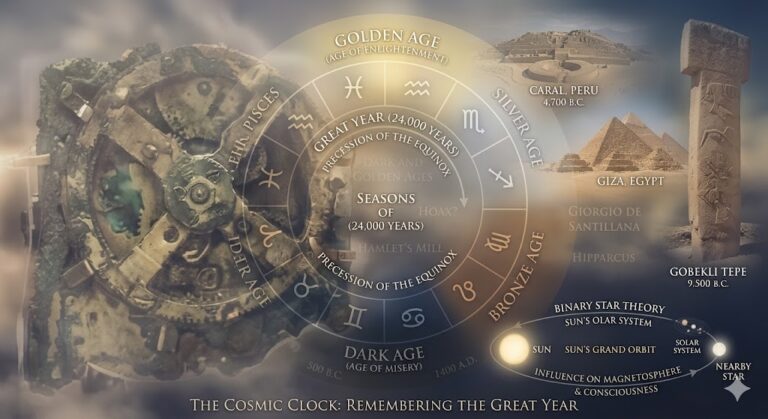
    In 1901, divers working off the Greek island of Antikythera found the remains of a 2,000-year-old clocklike mechanism. Now in the Greek National Archaeological Museum, the extraordinary find is a complex assembly of twenty or more precision gears designed to compute the motions of the Sun, Moon and planets. Nothing comparable is known from ancient scientific texts, and from a traditional historic point of view, such a mechanism should not have existed for at least another thousand years. The discovery of the Antikythera Device is equivalent to finding a supercomputer on a farm in the 18th century.

    Archaeological finds that upset our current understanding of history are growing increasingly common. The incredible discovery of six pyramids in Caral, Peru, is a case in point. These structures that surround a huge plaza and circular kivas (no one knows what they were used for) have been reliably dated to 4,700 B.C. That is 400 years before the accepted date of the Great pyramid at Giza. Like the Greek computing device, they are out of place and out of time sequence with our current understanding of history. It was not expected that ancient people in South America built pyramids before the Egyptians.

    The Antikythera device, ancient pyramids, astronomically aligned megaliths and similar structures found around the world were apparently built to monitor the movement of the heavens – at least that could be one of their uses. The vast majority of Neolithic tombs built prior to about 1000 B.C. in Europe and North Africa; ziggurats of the Middle East; henges and great stone markers in Britain and around the world, appear to be oriented toward the equinox, solstices or four cardinal points. With this preponderance of evidence it now seems likely these ancient builders not only understood the motions of the heavens but most likely tracked the precession of the equinox as well.

    Precession of the Equinox

    The “precession of the equinox” is the slow movement of the equinox (that point in time each Spring and Fall when night and day are of equal length – and the Earth’s axis sits at an exact ninety degree angle to the Sun) against the background constellations.

    Today, on the first day of spring––the Vernal Equinox– if you look due east at sunrise, you can see the constellation Pisces is fading from view and Aquarius is rising to take its place. This is what is meant by the “dawning of the age of Aquarius”. It is not just an astrological colloquialism but a convenient way for layman or astronomer alike to note the rough position of the equinox relative to the twelve constellations of the zodiac.

    The equinox moves slowly taking about 24,000 years, more or less, to precess through all twelve signs and return to its starting position. Plato called this cyclical time period the “Great Year”. The motion of the equinox is how one tells the time within this great cycle.

    Although most historians and scientists still teach that the precession of the equinox was not discovered until about 150 B.C. by Hipparcus, that is now being questioned. Giorgio de Santillana, the late professor of the history of science at MIT, documented in his book, Hamlet’s Mill, that this cycle was well known to dozens of ancient cultures around the world. In fact he tells us the Great Year is one of the most prevalent myths of all time, as popular as the great flood myth.

    Dark and Golden Ages

    Ancestral people acknowledged the precession of the equinox and believed the Great Year had its seasons. Similar to yet different than the seasons of spring, summer, fall and winter in the solar year – the Great Year was thought to be punctuated with a Golden Age of incredible beauty at one end, and a Dark Age of misery at the other. The Vedic Indians and early Mediterranean cultures had different names for these periods of the Great Year, and the Greeks simply called them the Iron, Bronze, Silver and Golden Ages. Thus, there was a valid reason why we find ancient cultures so intent on tracking the precession of the equinox.

    Just as we want to know our place in the solar year with its changing conditions, ancient people wanted to know their place in the Great Year. Many of the ancient myths, before the last Dark Age, spoke of a long lost Golden Age and lamented the coming of the Dark Age and its pending loss of culture and knowledge.

    And this is what an examination of the archaeological record shows. Around 4,000 to 5,000 years ago Mohenjodaro and the Indus Valley were in full bloom; the megaliths of Britain and the great pyramids in Caral, Peru, and Giza were newly constructed; the ziggurats, gardens, dams and great water systems of Mesopotamia were fully functioning. A vast agricultural civilization also existed within the Amazon and much of the Americas, and the amazing fifty-ton, carved architectural columns of Gobekli, Turkey , were already 5,000 years old!

    Mankind was at a high state of civilization and had been for centuries. Evidence shows that countries traded far and wide and had the technological capability to master much of their environment just as we do today. Yet, this was not to last. All of the great ancient civilizations, every one, slowly fell silent over the next few thousand years as the Earth approached a worldwide Dark Age, an age that was not overcome until the Renaissance period of the 14th through the 17th centuries.

    Truth or Fiction

    Today we are taught that there was no Golden Age, man was a simple hunter-gatherer that grew to his modern state in a roughly linear path. To believe otherwise is to believe in fairy tales.

    Yet, this is not a matter of belief, it is a matter of science. We know the cycle of the precession of the equinox is real. We know the Great Year is woven into the myth and folklore of just about every ancient culture that existed on Earth. And we can see the archaeological record indicates a high state of civilization that declined into a Dark Age before beginning to advance again with the Renaissance. The precession of the equinox, with alternating high ages of enlightenment and low ages of darkness, may not be the accepted paradigm but it does make sense of anomalous artifacts like the Antikythera device and ancient, astronomically aligned structures because it puts them into a workable context. In the Great Year such phenomena are no longer anomalous – they are expected.

    But it is difficult to imagine how civilization might be so influenced just by a slight wobble of the Earth’s axis, the current theory of precession. Could precession have a different explanation? Some modern astronomers seem to think so.

    Just as the cycle of day and night is caused by the Earth spinning on its axis, and just as the cycle of the seasons is caused by the Earth on its tilted axis orbiting the Sun, it now appears that precession and the cycle of the Great Year might also be caused by an orbit. But this orbit is not so small as the Earth going round the Sun. This is a grand orbit of our Sun carrying the solar system in a huge arc around another nearby star. Under this new theory it is the constant change in direction of the solar system that produces the apparent motion of the stars; the precession of the equinox.

    As our Sun moves in a great orbit it carries the Earth in and out of the influence of another star. This in turn affects our magnetosphere, ionosphere and consciousness itself, much like our closest star the Sun affects all life, causing all manner of plant and animal to grow, spawn, sleep or wake. It is this larger motion that indirectly produces the cycle of the Great Year and makes sense out of ancient mythology and the history of our distant past.


  • Secrets of the Sphinx

    Secrets of the Sphinx


    Mysteries of the Ages Revealed.


    Secrets of the Sphinx by Andrew Raymond is an amazing act of syntheses and one of the more informative books to be published in recent times. By reading this review and other pages linked from this site, you will discover that our scientists divide the 25,800-year cycle of our Earth into twelve ages instead of twelve months, and that the Great Sphinx in Egypt marks the “Happy New Year” of this cycle. The 25,800-year cycle of our planet with its four seasons is called the great year, the Platonic year (Plato’s year), or the precession of the equinoxes in a comprehensive dictionary.


    The four seasons of the great year are marked by Egypt’s four minor sphinxes, Ezekiel’s four heads of the beast, Revelation’s four cherubim, and astronomy’s Taurus, Leo, Aquarius, and Scorpio (Abraham’s Eagle) constellations.


    Our Current Position in the Great Year
    (Cross takes 25,800 years to make one turn through the twelve ages) .
    Our astrological birth signs no longer coincide with the sun’s location in the constellations of the Zodiac because of precession. Even the Tropic of Cancer and the Tropic of Capricorn are now the Tropic of Taurus and the Tropic of Scorpio when we observe the sun on the solstices? Our astrologers and map makers neglected to update our present position in the cosmos for over 2,000 years. We are not the astrological birth signs the newspapers and a majority of the astrologers proclaim we are!

    The North star (pole star) also changes with the precession of the equinoxes.
    The North star was Thuban (Alpha Draconis) when the Great Pyramid was constructed to align with true North. The descending passage of the Great Pyramid points to Thuban, the most accurately aligned pole star of all the North stars in the 25,800-year cycle of our Earth.


    25,800-Year Cycle of Earth

    Comprehend that the word sphinx means to bind or close a circle tightly, and that the Great Sphinx binds Virgo and Leo in the Zodiac on the ceiling of the Portico — at Esna’s Khnum Temple. The Great Sphinx marks the “Happy New Year” of our present Platonic year, and Leo was the first age in this great year. Listen when the Vatican informs us every Christmas Eve, when it reads the ancient Calens (calendar) from Rome, that it was the sixth age or the Piscean Age when Jesus, the fisherman, was born 2,000 years ago. Even the ancient Persians called Polaris the “turning point star” 5,000 years before it became our current pole star between the sixth and seventh ages.


    Precession of the Vernal Equinox.
    (Currently, we are at the end of the Sixth Age — halfway around one great year)

    When Moses threw out the golden calf, he knew it was the end of the Taurus Age or the fourth age in our present great year. He instructed his followers to get rid of the bull, put lambs’ blood on the doors, and place Rams’
    horns in the temples. By looking at the Master Calendar, the Mazzaroth, or the Zodiac in the heavens, anyone could see that it was the dawning of the Age of Aries the ram or lamb. It was the start of the fifth age in our current great year.

    It was the third age, or the Age of Gemini 6,000 to 8,000 years ago, when some people on the Earth believe Adam and Eve lived. Gemini is also known as the twins or Adam and Eve in the ancient Zodiacs.

    At one time in history, the Vernal Equinox used to indicate New Year’s Day in our annual calendar until Julius Caesar moved it to January 1 in 45 BC. The names of our months still reflect March as the first month of the year. In Latin, Septem is seven, Octo is eight, Novem is nine, and Decem is ten. This is why the name of an age is determined by where the sun is on the Vernal Equinox.
    The megalithic monuments like Stonehenge, Chichen Itza, and Casa Grande are all trying to find the Vernal Equinox or the first day of spring in the Northern Hemisphere.

    Understand how Nostradamus, Revelation writers, and the Mayans could have used this 25,800-year cycle of our planet to predict what can be expected as we approach what some call the millennium. The ancients refer to the coupled-ages of Pisces (Fish) and Aquarius (Man) in the great year as the time for the FisherMan (Jesus) or Merman (Fish-Man) to return from the sea. The old legends say that he will teach the people how to heal and govern themselves.

    Don’t be confused by the misinformed people on the planet. Our scientists inform us that, in the great year, we are dawning into the Age of Aquarius and leaving the Piscean Age. When someone says, its the dawning of the Age of Aquarius, that is no different then someone saying, it is the beginning of the month of July. Only, ages are around 2,150 years long, while months are made up of approximately 30 days. Many college books inform us that we are commencing a new age in the great year.

    Even Pat Robertson, who throws oranges across the media-air waves at the new age people, wrote a book called The End of the Age. He should realize — if we are eternal as he preaches and it is the end of an age, than it must be the beginning of a new age.

    Catch the “joke of the universe”. The Oneness, God, or the Whole says to
    Itself: I am everything! I am God! I am It! I am the point or a perfect circle!
    God I am bored! I am so tired of playing with Myself. This is ridiculous. I am tired of being all one or alone.

    “Boring”

    Notice that “all one” and “alone” are essentially the same word. If one is all one, then one must be alone. Are we sensing the predicament of the One Who Causes? Being absolutely bored, the Oneness comes up with a bright idea.
    Why! I’ll just split into two. This would be the same way we split into two teams to play football, chess, or checkers. The Perfect Circle, God, or the Whole gets imaginative, and It splits in two or in-to creation.


    In-Divided-Dual or Individual

    Once the Oneness or God splits into the two U’s (You & You, Us or We), what is a game the universe can play? “Hide and Seek” of course! God can hide from Itself, and spend Its Being trying to find Itself. Give me space to find myself! I have been found! I found it! Most of us know that lost and found departments are normally found together.


    A Double of You or A Double U

    The game of the universe is hide and seek. Dis-member to separate.
    Re-member is to put it back together again or to remember something we have forgotten. Every baby knows this intuitively, until we teach it to babble in words.

    The last 2,000 years has been the Piscean age. Two fish tied together trying to swim apart. We allowed them to swim so far apart, that we lost sight that the opposites are connected. This is the hide stage of the game of “Hide and Seek”
    in full manifestation. The more we separate them the more lost we become. At this juncture in the great year, we are using less than twelve percent of our brain’s potential, and we are only putting one fish on the car bumper. How lost we are!


    Piscean Symbol

    The coming of Aquarius, the man or water bearer, gives us two lines that fit back together. We are approaching a time of Atonement (at-one-ment). It is time for us to re-member or awaken. It is time to look down and observe that our right and left hands are connected. Notice that the electric light doesn’t work without the plus and minus. The end of the Piscean Age is a time of Revelations. It is time to reveal the truth. Catch the Joke! — It was necessary to get lost just to play.


    Aquarian Symbol

    Secrets of the Sphinx is a revealing book that is subtitled The Mysteries of the Ages Revealed. It will point out that it is not the end of the world, but we can expect some very big seasonal changes — the same as the frost comes and the leaves change colors shortly after the beginning of fall. It will teach you what types of foods will help you stay healthy, look younger, and handle the sun’s increasing light at this juncture in the great year.

    Secrets of the Sphinx is an uplifting experience and an easy book to read.
    You will be thinking about this publication long after you set it down!
    Copyright material-Secrets of the Sphinx©. You may use it for personal use only.