Category: Atlantis

  • THE ATLANTEAN ORIGIN OF THE SEVEN SACRAMENTS


    THE ATLANTEAN ORIGIN OF THE SEVEN SACRAMENTS


    Introduction

    In the Bible, as in India, myths are never told in detail, but only in tiny flashes which recall the twinkle of a star, the fall of a meteor or the avatar of a god in a transitory theophany. Only when highly allegorized and, hence, incomprehensible, are myths ever told in any detail. They are then peddled as the actual history of personages such as Jesus, Zoroaster, Moses, Abraham, Krishna, Buddha, etc..

    However, the several flashes are the pieces of a jigsaw puzzle, and fit together serendipitously when demythologized and integrated with each other. All religions — ours included — center on the story of Atlantis (Eden) and of its Fall (Adam’s) and destruction by the Flood, as well as on the hope of its rebirth at the Millennium.

    We have shown elsewhere in detail how “Christ” is a personification of Atlantis. And so are his many aliases such as Adam, Noah, Moses, Abraham, St. John, etc.. We have also demonstrated in detail that all our Christian rituals and beliefs — whose objective and meaning we forgot long ago — ultimately derive from India and reenact the history of Atlantis. Here we return briefly to the problem in order to moot out the importance of Atlantis as the source of all our myths and eschatological beliefs.

    Let us consider first the Sacraments, keeping in mind that, mythically, all Saviours are one and the same, in different avatars. Thus, Adam, Christ, Krishna, Moses, Noah, Atlas, Shiva, etc., are just one and the same deity. Likewise, all religious traditions come from a single Tradition, which is the tradition of Atlantis and Lemuria. They are all part of the Urreligion that some anthropologists of genius have discerned as the original source of all religions, both primitive and evolved.

    Before we proceed, however, some observations are in order, as they substantiate the case for the origin of our Christian Sacraments in India. India is the true site of Atlantis, and the link that re-links us back to our primordials in Paradise. First of all we note that the Sacraments are Seven. Seven is a Magic Number of great importance, whose Hindu origin can hardly be contested. Seven is the number of the Rishis (Hindu Patriarchs) from whom we descend, as well as the number of elapsed eras in Hinduism. But, above all, it is the number of dvipas, the counterpart of Paradise in Indian tradition.

    The Sacraments are seven because seven is the sacred number of Elohim and of the Holy Ghost, his alias. Contrariwise, ten is the number of Jahveh, the god to whom we owe the Ten Commandments. Now, seven and ten are also the numbers of Atlantis and Lemuria. Ten is the number of Atlantis’ Ten Princes, and seven is the number of the Islands that composed Lemurian Atlantis, as well as that of its Seven Prajapatis (or Patriarchs – Rulers).

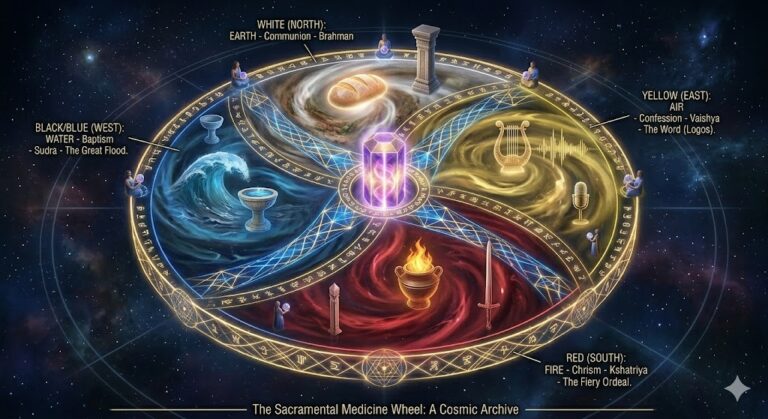
    In yet a different connection, we have the fact that the Sacraments of Christianism utilize four material supports: bread, wine, oil and water. Four is the number of the Hindu castes. It is far more than a coincidence that these four substances also represent the four varnas (castes). Bread is white like the heraldic color of the Brahmans it represents. Wine is red like blood, and characterizes the warlike Kshatriyas. Oil is yellow like the fat Vaishyas it symbolizes.

    Finally, water is blue like the symbolic color of the Sudras or serfs. Indeed, the heraldic color of the Sudras is black. Black is confused in India with blue or purple, for traditional reasons. In reality, water symbolizes Death by drowning at the Flood, a form that results in a purple color for the dead. As we see, the four substances represent the contributions of the Four Races (or castes), as well as their respective elements, with oil representing Fire; water, Water; wine (spirit) representing Air and bread standing for the Earth, from which it grows.

    The Four Elements are not indeed the ones that compose the material world, but those which destroy it when the eras come to their end. Fire, Water, Air and Earth allegorize the universal Conflagrations, Floods, Hurricanes and Earthquakes that either unite or work separately in order to destroy the world, when the time comes for it to happen. The same allegory is also symbolized by the Four Magian Kings — the three usual ones plus the fourth, Christ, to whom they came in order to pay their respect. Jesus is the Logos, the Word, the “Divine Breath” that corresponds to Wind.

    In other words, Jesus represents the Brahman priests, issued from the mouth of Purusha, the Primordial Man, the intoners of the sacred mantras (“prayers”). The other three Kings are characterized by their gifts. Gold, the ruddy metal, represents the Kshatryas (“Reds” or “Warrior Caste”), in their pristine, undecayed condition. Myrrh is indeed musk (civet), the noblest form of “butter”, the element that represents the Vaishyas (the Merchants or Burgeoisie). And, finally, incense, the burnt offering of excellency, represents the dark Sudras (“Serfs”), the “charred” element whose fate has been the cruel one of serving the other three castes.

    So, those who can indeed read beyond the obvious, will have no difficulty in discerning in these Christian symbols — which make no sense whatsoever in Israel or even in the Ancient World — the antecedent ones of Hinduism: the Four Guardians (“Kings” or Lokapalas), the Four Castes, the Four Elements (or Principles or Races) of which the world was originally composed, in Paradisial times. Where else, but in primeval India — the true site of Atlantis — do you have the Four Races of Mankind, the Reds, Whites, Blacks and Yellows contending for supremacy in a war that eventually led to the world’s destruction in the dawn of times?

    1) BaptismThat Baptism is a recollection or ritual reenactment of the Flood is a fact already been recognized by St. Jerome and other Church Patriarchs. Prof. Mircea Eliade (Treatise on the History of Religions, Paris 1970) shows this fact in detail. Essentially, all religions have some sort of Baptism or Ablution, intended to cleanse away some sort of Original Sin. This sin is no other than that of the Atlanteans: sinfully mingling with “mortal” women of the inferior castes, but deeming their own offspring “inferior” and enslaving it. Yes, Racism is a stupid notion that is unfortunately as old as humanity itself. It is the Original Sin that led Mankind into Doom, and probably will again, if we do not wake up in time. How can one fall so low as to enslave one’s own children?

    Baptism is what the Hindus call Pralaya (“dissolution”); the demise of all things in order to allow their return to the Primordial Chaos and insure their re-creation afresh. There are two kinds of Baptism: the one of John and that of Christ. John as the “precursor of Christ” may well symbolize what Occultists call Lemuria, whose “fall” preceded that of Atlantis. John’s watery baptism represents the demise of Atlantis by the flood, just as Christ’s baptism by fire represents the destruction of Lemuria in a volcanic Conflagration. The Sacrament of Chrism corresponds to the Fiery Baptism, as we shall see further below.

    The symbolism of Baptism has been expounded by St. John Chrysostom:

    “Baptism… represents death and interment, life and resurrection. When we plunge our heads under the water, as in a sepulcher, the old man becomes completely drowned and buried. When he leaves the water, the new man suddenly rises.”
    The Old Man is Adam, the prototype of Christ. The New Man is Christ, the second Adam. The two Saviours correspond to the twin Jerusalems, one Celestial and the other Messianic. We note how most Saviours actually emerge from the waters either directly or symbolically: So did Moses, Osiris, Perseus, Noah, Sargon, Joseph, Skanda, Trita, the Oannés, Quetzalcoatl, etc. Even Christ did so, as symbolized by his manger of reeds.

    The Druids too had a kind of Baptism. So did the Mystery Religions of Greece and Rome. In India, Baptism is ritually performed in the Ganges and many other tirthas (bathing spots in rivers) by all pious Hindus. The Buddhists too have a kind of Baptism which is more an ablution or sprinkling than ritual immersion.

    In the Americas, the ritual drowning of the gold-laden Eldorado reenacted the submersion of Atlantis. In India, Krishna’s statue is thus baptized in the thirtapuja. The same type of ritual also existed in Greece, Rome, Arabia and elsewhere. The Sea of Bronze of Solomon’s Temple was a sort of Baptismal font, not unlike the ones found in Harappa and Mohenjo-Daro. These had ghatts or ladders leading to the waters, identical to those of the Ganges river used for the rituals of ablution. The Egyptian temples had sacred pools where the worshippers were baptized.

    2) ChrismChrism or Confirmation is a sort of second Baptism, with oil, instead of water. Oil is the symbolic equivalent of fire, as its fuel. Chrism actually corresponds to the Baptism of Fire of the Holy Ghost. The Baptism of Fire is the Fiery Ordeal or Suttee (Sati) of the Hindus, and insures purification by fire. The Buddhists of Tibet too use a Baptism of Fire (a sprinkling with fiery dust). The word “Chrism” means “oil” or “anointing” in Greek. The ritual of anointing is used not only in Confirmation, but also in Extreme Unction and Consecration of priests, kings, temples, statues, etc..

    The word “Chrism” directly relates to the name of Christ (“The Chrismed One” = “The Anointed One”). It evokes the custom of certain primitive tribes of India (the Gonds, Khonds, etc.) who used to “Chrism” the victims of their human sacrifices before burning them at stake, so that they would burn better. The custom is a sad recollection of the fate of Paradise. There, in the Land of Plenty, the gods fattened the humans before dispatching them in the Universal Conflagration that preceded the Flood. Such is the reason why the Hindus called Paradise (Atlantis) by names such as Gomeda, meaning “the Land of the Fat Cattle”. And such is also the origin of the strange rite of burnt offerings of all kinds. Yes, it is as Shakespeare said: “As flies to wantom boys, so are we to the gods”.

    Chrism corresponds to the fiery avatar of the Holy Ghost as a sort of vajra or meteorite falling from the skies over the Apostles during Pentecost. It imparts Charisma (“grace”), the gift of abundance and healing powers. This “fall” is usually associated with the palladium in Paganism, and with the Linga in India. The “tongues of fire” (linguas, in Latin) of Pentecost were visibly lingas (or cerauni), falling down from Heaven. This “avatar” of the Spirit (Logos) is Christ himself, “falling from Heaven as lightning”, that is, as the vajra thunderbolt, in order to herald the end of the former era and the start of the next one, that of Christianism.

    The Sacraments center on stuffs such as water, oil, wine, bread, blood, which somewhat evoke the strange composition of the Seven Seas of the Hindu dvipas (Paradises). The meaning of the Holy Ghost’s Charisma is given by Paul in I Cor. 12-14. This theme will not be discussed here, except for the above, and to say that the obscurity of its images and allegories bespeak of a hermetic disclosure reserved to initiates, one that is related to the burning of Atlantis.

    Fire and Water (Baptism and Chrism) were administered together in the primitive Church, and only later became separated. As in ordeal of Atlantis, which was attended by both cataclysms, the association of Chrism and Baptism implies the same thing. So, granted that Baptism symbolizes the Flood, it is clear that Chrism allegorizes the fiery cataclysm that the Stoics called Ekpyrosis (or Universal Conflagration.

    In conclusion, one might say that Chrism or Anointing corresponds to the Baptism of Fire of the Holy Ghost, whereas the Baptism of Water corresponds to the one of the Father, his dual. The Holy Ghost also corresponds to Agni or Kama, the fiery gods of the Hindus, whereas the Father (or Jahveh) corresponds to the watery gods, Indra or Soma. More exactly, the two Baptisms correspond to the Flood and the Conflagration of Paradise, and to the two gods that brought them about, Indra and Agni in India, and Christ and John in Christianism.

    3) MatrimonyThe Sacrament of Holy Matrimony represents on a human scale what the so-called Cosmogonic Nuptials of Fire and Water symbolize at the Terrestrial level. At the Celestial level it signifies the joining or, rather, the equilibration of the influences of the two Polar Constellations — the Linga (Ursa Minor) and the Yoni (Lyra) — that takes place at the Equinoxes.

    These two points are the “doors” (the Pitri-yana and the Deva-yana) where the two Celestial influences balance each other, resulting in an era transition. In the Zodiacal plane the Equinoxes coincide with Aquarius and Leo (Fire and Water), and herald the era transitions determined by the Tetramorph.

    The symbolism of the Cosmogonic Nuptials of Fire and Water — which is central to most religions — is allegorized in Christianism by the highly esoteric union of Christ (Christos = ointment = “fire”) and Mary (Maria = “sea” = “water”). In Paganism, we have its equivalent in the union of Venus or Aphrodite (“seafroth” = “water”) and Cupid or Eros (love = “fire”); of Cadmus (“musk” = oil = “fire”) and Harmonia (“ermine” = aquatic = “water”); of Zeus (a tempest god) and Hera (an infernal Erinys); of Demeter (a meteorite = “fire”) and Poseidon (a sea-god); etc., etc..

    The union of the two principles is symbolized by the pramantha, the Cross, the Star of David and so on. It represents both the destruction of Paradise and the union of the two races that existed in the Golden Age and which will be repeated in the Millennium all over again.

    In India the Cosmogonic Nuptials of Fire and Water is symbolized in the birth of Skanda which resulted from the union of the fiery seed of Agni with Ganga, the water-nymph of the river Ganges. This sacred Hierogamy seems to be the allegory of the explosive union of the magma of a submarine volcano with the waters of the sea above it.

    This mystic union of fire and water is a characteristic feature of Indonesia, which is precisely the site of Eden. The Hindus allegorize this fearful event by the fall of the vajra inside the waters of the Cosmic Ocean. The vajra is the tip of Mt. Meru, decapitated in the cataclysmic explosion. It falls from above, from the tip of the Holy Mountain that formerly stretched all the way to Heaven, scraping it. This union also allegorizes the event as the castration of Brahma or of Shiva; as the decapitation of Dadhyanch or of Mahavidya, and a million other similarly sophisticate symbolisms of Hindu mythology.

    In the Ancient Testament the matrimonial union is recognized as a symbol of the Covenant and of the love of Jahveh for Israel (cf. Ose.2; Isa. 54:4 ; 62: 4; Jer. 2:2; 3: 20; Ezek. ch.16 and 23, etc.).

    In the New Testament, marriages are usually celebrated at night and are often attended by agapes which somewhat evoke the strange marriage rituals described in the Song of Songs. The practice also evokes the puzzling orgies of the Gnostic Cathars of Medieval Europe. These love feasts are reenactments of the Cosmogonic Nuptials, the orgiastic mingling of Fire and Water that takes place at Doom. The archetypal Doom is, of course, the destruction of Atlantis and Lemuria by this sort of cataclysm of Fire and Water which we encounter in all traditions.

    The association with the Covenant — a word that implies the idea of a mystic union like the ones under study — directly recalls the Flood (cf. Gen. 9:3-17). Its symbol, the rainbow that marked the site of the brutal cataclysm, later became symbolized by the engagement ring. This covenant is bloodless, and accords to the fact that death by drowning sheds no blood.

    In Exodus 24, two Covenants (“marriages”) are mentioned. One is bloody, with the participants being sprinkled with blood, and the other is bloodless. The first one is orgiastic (an agape) and is celebrated by a nocturnal supper akin to the Last Supper.

    The two ceremonies closely evoke the rituals of the Holy Mass, itself a mystic replica of the union of Fire and Water. The two Covenants represent the two types of Mass, one white and diurnal, the other black and nocturnal. The emblem of the Second Alliance is the Ark of the Covenant. And, as shown in some early representations, this Ark was indeed an omphalos or palladium.

    Blood is symbolic of “fire”, of Leo, and of the destructive Kshatryas. Water (libations) represent Aquarius and its watery dispensations, as well as the Brahmans (pourers of libations). The other symbols of the Alliance (or Matrimony) are likewise Cosmogonic: the Tablets of the Law; the aspersion with blood; the agape; the orgies (chaotic mingling of fire and water); the Baptism of the New Covenant; the restoration of the Temple; the insistence on love, etc.. So, Marriage represents the mystic union of Fire and Water that allegorizes the destruction of Atlantis-Paradise by these two agents.

    4) ConfessionOriginally, the Confession of the Sins was done aloud, as it still is in some Christian sects. But, even whispered, it relates to the magic power of words and sound as embodied in the idea of the Hindu mantras and the Christian Logos (or Word). Christ imparted the power of forgiving the Sins to the Apostles by blowing (or whispering) upon them the Holy Ghost (the Logos), as described in John 20:21-23.

    The idea of the sacredness of speech or sound is of Indian origin. The Hindus and Buddhists believe that mantras (prayers or ritual formulas) such as the OM MANI PADME HUM convey a power which evokes Cosmic resonances and precipitate the advent of Doom and the new era. They embody this power in deities such as Brihaspati (“Lord of Speech”), Sarasvati, Vach (“Voice”), Rudra (“Howler”), and many others.

    The Hindu theory of sound is too complex to expound here, and the reader is directed to more specialized sources. Suffice it to say that sound (or wind or air) is one of the Four Elements, on a level with Five and Water. More exactly, sound (sabda) is the quintessence (or “fifth element”) usually represented as Ether (akasha) when sacred, and as vach (“voice”) when human. Here it represents the shakti, the divine essence of the female power.

    The Celts personified Speech in Ogmios, whom they equated to the Logos. The Greeks also associated sacred sound with the rhombus (“bullroarer”), the sacred instrument of Dionysian Mysteries. Indeed, the bullroarer and the drum (or the flute or the lyre) were ritually used the world over for evoking Cosmic resonances capable of activating the bindu, the “seed” of Creation.

    The sound of the bullroarer is often associated with the roar of thunder and the death of the Primordial Bull which represents Dionysos, the Golden Calf. Christ too has been likened to a bull (cf. Psalm 22 and his agony bellow on the Cross). So have the howling Rudra (Shiva) and of many other gods.

    Sound is also associated with the universal Thunderbird, variously called Rudá (in Brazil), Garuda (in India), Symorgh (in Persia), Pegasus (in Greece), Zu (in Babylon), Bennu or Phoenix (in Egypt), Cherub or Angel (in Israel), etc.. The clapping of their wings simulates the roar of thunder. And this thunder is really the fearful rumble of the volcanic explosion that destroyed Paradise, as well as the roar of the onrushing waters of the sea, stirred by the cataclysm.

    Jahveh is often associated with thunder (his voice), particularly when he rides the winged Cherubs (cf. Ezek.1:24; 10:5; 43: 2; Psa.18:10; 29:3; 68:4; 80:1; 99:1; II Sam. 22:11; Job 37:2; Dan. 10:6; Rev.1:15, etc.). These theophanies are often connected with the destruction of the city of Jerusalem (cf. Eze. 43: 3), with the Flood, with the fall of “fiery coals”, etc.. A close study reveals that the hidden message is the destruction of paradisial Atlantis by the fall of the vajra.

    Jahveh is often called “rock”, “fortress”, “high tower”, etc.. These words closely evoke the atala or watchtower which we discussed elsewhere, and which is an alias of Mt. Atlas. He comes down from above as a thundering vajra and destroys the Tower or Temple in order to rebuild it as his own. This is an allegory of the era transitions that the gods periodically bring about in order to renovel Creation and start a new world.

    5) OrdinationOrdination is the rite of the Christian Church for the commissioning of priests. The essential ceremony consists in the imposition of hands on the heads of the ones to be ordained by the officiant. The officiant priest also recites prayer to the Holy Ghost to grant the recipient his Seven Graces (Charismas). The Christian ritual derives from the Jewish one called Semikhah, first used by Moses to ordain Joshua as his successor. In the New Testament, the Apostles use the imposition of hands to ordain the seven disciples who would be their followers.

    Besides the imposition of the hands, other rituals are often included, such as anointing and the investiture with the vestments of the office. But it is the laying of hands and the prayer to the Spirit that ultimately characterizes the Sacrament of Ordination and imparts the Seven Gifts of the Holy Ghost that qualify the candidate for priesthood.

    Symbolically, the laying of hands transmits a spark of the spirit of the imponent to the imposed, just as a burning candle can impart its flame to another, unlit candle. This way, an uninterrupted chain is established by ordination that stretches all the way back to the origin, to the first instituter of the ministry. And this was Christ himself as an alias of Melchisedek, the initiator of Abraham.

    More exactly, this uninterrupted chain stretches all the way back to Atlantis or Paradise, and recollects its burning in the Primordial Conflagration. The “lighting” of the iniciant commemorates the inflaming of Purusha in the Primordial Conflagration, or its alias, the burning of Kama, the Hindu love god, by Shiva’s fiery glance.

    All these symbols are mere allegories of the burning of Paradise by the fierce explosion of its volcano, Mt. Atlas. The idea also evokes the etym of the word “religion” as the restablishment of a link (religo) with our Paradisial origins. Again this is an idea that derives from India. It relates to the myth of Brihaspati, the Lord of Prayer, whose endless chain of mantras goes back all the way to primordial cataclysm.

    This idea is also expressed in India by the link afforded by the smoke of sacrificial fires linking Heaven and Earth. Again, this is an allegory of the inflaming of Paradise and the smoke of the Primordial Sacrifice, as we discuss elsewhere. A further allegory is the idea of the sutratma (or “soul thread”), a sort of umbilical chord that stretches without interruption to our origins. Yet another is expressed by the traditions of the Upanishads, which we discuss further below.

    There can be no question that the origin of the rite of imposition of hands and the transmission of the Holy Ghost derives from the Hindu rituals and traditions discussed above. But these are indeed ritual recollection of the primordial events concerning Paradise and its destruction in the Primordial Conflagration.

    In other words, what we have is a ritual enactment of the destruction of Atlantis by the fiery explosion of its lofty volcano, Mt. Atlas. This terrible event is also commemorated by the perpetual fire that burns in Christian temples, a usage copied from the identical one of the Jews who, in turn, borrowed it from the Hindus.

    The idea that this fire cannot cease to burn and must not suffer interruption is symbolically represented by the equivalent uninterrupted chain of transmission of the holy Ghost form one officiant to the next. This Perpetual Fire is likewise connected to the identical fire that was kept perpetually burning in the altars of Vesta and Hestia in Rome and in Greece by the Vestal virgins.

    An identical tradition existed in the Americas, with the Mayas and Aztecs. As we have shown, the temples of Vesta and Hestia, her Greek counterpart, are close replicas of the topography of Paradisial Atlantis and Lemuria. Their temples were round and conical, with the Holy Fire perpetually burning in the altar at its center. This design simulates a volcano or, rather, the volcanic peak of Mt. Atlas, ready to explode and destroy Paradise at any moment.

    Ananda Coomaraswami has shown that this design and ritual closely duplicates that of the Vedic altar, itself a replica of Mt. Meru and the Hindu Paradise. There can be no question about the precedence of the Hindus. But the diffusion of the tradition to the Americas can only have taken place at a far earlier epoch than that normally envisaged by both historians and archaeologists.

    The Hindus have another tradition of Perpetual Fires that again links with the fiery destruction of Paradise in the Primordial Conflagration. This is the Fiery Mare (or Vadavamukha), the All-Consuming Fire that perpetually burns deep down inside the Ocean’s bottom. This fire is kept in check by the waters of the Ocean, which it consumes continually. At Doom, this equilibrium is disrupted, and the Mare goes haywire, incending the whole world.

    The Fiery Mare is really the Love-God Kama inflamed by the fiery glance of Shiva’s third eye. The burning Kama was confined inside the Mare’s skull, which is really the vajra formed from the decapitated head of Dadhyanch, as we tell elsewhere. Again we have a connection between the Perpetual Fire and the destruction of Paradise in the Primordial Conflagration.

    Kama, the Hindu Love-God, is the archetype of the Holy Ghost. Indeed, Kama is also called Ananga (“Bodiless”) in Sanskrit, an etym that really means “spirit”, “ghost”. Kama is also the archetype of Eros and Cupid, and is considered the Primordial Creator, destroyed or incended in the conflagration of Paradise.

    The Upanishads — a name that suggests the idea of being initiated or “incended” in the long chain that stretches all the way back to Paradisial times — is an esoteric collection of teachings and initiatic doctrines that expands the Vedas and expounds its doctrines in coded language, reserved for the Initiates. Its name also suggests something like the imposition of hands or, really, the initiation or enlightening of the neophytes that the ritual symbolizes.

    Apparently, this real meaning of the “laying of hands” was forgotten somewhere during the long stretch that links us back to Paradise and the primordial events that culminated in its fiery destruction. The rituals of the Christian Sacrament of ordination were, as we said above, copied from the Jewish ones for the commissioning of rabbis, the Semikhah.

    And the Jews really came from India and, before that, from Indonesia, the true site of Eden and of primordial “Egypt”. Interestingly enough, the Semikhah can be traced back to Moses and Joshua, and the flight of the Hebrews from their destroyed Paradise in Mt. Sinai. Mt. Sinai is verily the same as Mt. Meru or Atlas, the Holy Mountain of Paradise that was burnt down by the fiery avatar of the Lord who is no other than the Holy Ghost.

    We do not believe that the true meaning of the imposition of hands during Ordination is generally known even inside the Christian Church. But the above exegesis of its significance and origin cannot be validly contested, as is clear to anyone that studies the matter in detail.

    The iniciatic secrets in question were apparently forgotten, and only the mechanical actions of the ritual were preserved. They are enacted in an empty way, like the mechanical movements of an automaton, destitute of soul. We have long forgotten the god whom we honor with such rituals which we ape emptily, despite the fact that he is the very Soul of the World. And that Soul is indeed Atlantis, represented as Kama, the Love God of the Gnostics of all times.

    6) Extreme UnctionExtreme Unction or, as it now called, The Anointing of the Sick, hardly differs in meaning from the Sacrament of Chrism, and is here only discussed briefly. Extreme Unction is, as the name suggests, the anointing of the sick in extremis and of any others who are on the imminence of dying. The alleged purpose is the remission of sins or the attempt at a cure. But this contradicts the fact that it is applied after all hope of cure is abandoned, and that Confession is the proper ritual for remission.

    The ritual of anointing in Extreme Unction is usually accompanied by Confession of the sins if that is at all possible, and by the administration of the Eucharist as a viaticum, the food for the journey the moribund is about to undertake. The anointing of the sick is a practice of most, if not all religions. It is an extremely ancient ritual and is just about universal.

    The administration of the Eucharist as a viaticum is interesting. It embodies the idea that the deceased go to a very distant region, in a sort of pilgrimage to Paradise. This is also the conception behind the actual pilgrimages to the Holy Land that is an ancient custom of the Christians of all times. This practice also existed in essentially all religions. We discuss the symbolism of this return trip to Paradise in our section on the meaning of the Holy Barque, in The Atlantean Symbolism of the Egyptian Temple .

    The Greeks would flock to sacred sites such as Eleusis and Delphi, often in quest of initiation into the secrets of the Mysteries. Their traditions, and those of the Romans, tell of the long pilgrimage of the soul to remote regions such as the Islands of the Blest, which lay in the most extreme regions of the world.

    Ancient Egyptian texts such as The Book of the Dead describe in detail the long pilgrimage and the perils of the soul in the beyond, in its quest for the site of Paradise. The Egyptians too placed Paradise in the Far Orient, beyond the seas and the place where the Sun rises everyday. The Bardo Thodol, the Tibetan Book of the Dead, also tell at length the long pilgrimage and the perils of the soul in its pilgrimage to Paradise, its temporary abode, where it awaits reincarnation.

    The Muslims have, as one of their most sacred duties, the obligation to emprehend a pilgrimage to Mecca, their Holy Land, at least once in their lifetimes. But it is in India, as usual, that we find the reason and the origin for such ancient practices. The pious Hindu is observant of such ritual pilgrimages, and has dozens of holy sites to chose from. These are distributed all over India, often in remote, difficult regions such as the Himalayas and the Nilgiris.

    Mt. Kailasa, in the Trans-Himalayas of Tibet, is one of the most sacred spots of the Shivaites. The Holy Mountain is identified with Mt. Meru, the mountain of Paradise, as well as with the immense phallus of Shiva, shedding the abundance of his gifts. Every devout Hindu aims to bathe in the Ganges, the holiest of their rivers. If at all possible he also emprehends pilgrimages to all of India’s Seven Holy Rivers. He also endeavors to visit the Seven Holy Cities: Ayodhya, Mathura, Hardwar, Benares, Kanchipuram, Ujjain and Dwaraka.

    All these are considered holy sites, connected with the sacred history of Paradise and its destruction in primordial times. But their most holy spots are Lake Manasarowar, near Mt. Kailasa, and Lanka in Ceylon, the sites of their two extremal Paradises. However, all seven sacred spots correspond to the Seven Dvipas (or Paradises),which are the archetypes of the Seven Islands of the Blest of the Greeks and Romans, as well as the Paradises of other nations. It is from these Seven Islands that all other sacred septenaries ultimately issue.

    As we see, all nations have rituals similar to the above, which entail a return to Paradise in a pilgrimage that simulates the wanderings of the soul after death. Even the Occultists have similar traditions. They quest initiation in the ancient arcanes, except that in a context of actuality and magic, rather than in that of the beyond. Christ, Buddha, Pythagoras, Plato, Solon, Zoroaster, Mani, Apollonius of Tyana, and most other great initiates are said to have gone to India, in their quest for Initiation in the arcanes of the Mysteries.

    In a way, the adventurous rovings of the ancient Heroes such as Ulysses, Hercules, Alexander, Dionysos, Gilgamesh and many others belongs to the same context as the above. They exploited the distant regions connected with Hades and with Paradise, in a way that many experts have linked with the wanderings of the soul in the netherworld.

    Modern Occultists are also wont to undertake long, painful pilgrimages. They often go to India and the Far Orient questing Initiation. But many prefer the famous Route of Santiago de Compostela, in Spain. This is connected with Celtic traditions having to do with the Holy Grail and the Elixir, apparently the objective of all such quests. Dante, the well-known Initiate and Occultist, wrote in his Vita Nuova, published in 1293, that Santiago de Compostela, Rome and the Holy Land were the chief centers of attraction for the pilgrims of his time.

    We see then that the ritual of Extreme Unction is connected with a return to Paradise and the obtaining of the Elixir of Life either in reality or in the netherworld. And reality always links Paradise with India, the aim of true heroes from remotest times. But Extreme Unction proper has an origin that will be considered fescenine and outrageous by most. However, the obscene context is merely a device to disguise profound iniciatic secrets and to divert the inquisitive profane.

    In Greek and Roman religion it was believed that the dead entering Hades were led and guarded by Cerberus, the terrifying dog that was the guardian of Hell. Cerberus would “greet” every incomer with his enormous phallic tail, a disguise of his member. The dying were then anointed in order to render the process less hurtful.

    The Greek-Roman belief derives from a similar one of the Egyptians. According to this people, the dead, on their way to Amenti, had to cross an immense lake or river which ringed the region. The only way to do it was the barge of Kharun, the sinister ferryman of Hell. Kharun is the same as the Greek Charon, the barger of the Styx, the river that encircled Hades. He is also the same as Hermes and Anubis in their sinister avatars, where they often assumed the canine form that corresponds to that of Cerberus, the Guardian of Hell.

    The Styx is the same as the River Oceanus of Homer, the circular river of Atlantis turned into Tartarus after its sinking. This is copied from the Vaitarani or Asayana of Hindu legends, which far predate the times of Homer. And Cerberus and Orthrus, the twin guardian dogs of Hell, are also copied from the Sarameyas of Vedic India.

    In ancient belief, the lascivious Kharun (or Charon) would charge a dear price for his services, the same one exacted by Cerberus, his canine alias. In some traditions, this price was merely a coin, which would be placed in the mouths of the dead. But the coin is merely an euphemism for the true price exacted, as the word “coin” is synonymous with the anal sphincter in fescenine usage. In this role, Kharun impersonates the Egyptian Pharaoh as the Barger of (Sunken) Paradise, that is, of Atlantis.

    The barger of Hell first appears in The Epic of Gilgamesh, as Urchanabi, the Barger of Paradise, which the Sumero-Babylonians called Dilmun. It is Urchanabi who takes Gilgamesh to Dilmun in his barge at what price we know not. Gilgamesh is questing the Elixir of Life there, but fails in his attempt, like so many other Heroes, for the task is difficult.

    In a variant, Gilgamesh reaches the Gates of Paradise, where he is stopped by the Scorpion-Men who guard its access. Gilgamesh is admitted, again in an obscure way. The Scorpion-Men are the archetypes of the Karibu or Cherubs that performed a similar task in later variants of the myth. These Cherubs apparently charged the same price from incomers, as the word for scorpion means “stinger”, “pricker”, and has a phallic connotation.

    In reality, their myth allegorizes the crossing of the Pillars of Hercules and Atlas. This crossing was a prerequisite for reaching Paradise, as we show elsewhere. But it was forbidden, and all trespassers caught in the attempt were summarily impaled by the Phoenicians who guarded these Straits.

    In another context, the practice of anointing has also to do with the rituals of Initiation in several traditions. In many initiatic rituals the hierophant will exact from the neophytes the same high price we have been discussing. This practice is standard in many primitive religions, and was also very widespread in the ancient world.

    The Greek philosophers would ordinarily demand it from their disciples, and their banquets — named symposia, or “lying together” — were truly communal orgies were the pupils had to yield to their masters in public. For that purpose, the disciples were properly anointed, as in other rituals of Initiation. As we see, ritual anointing has always to do with the disclosure to the initiatic secrets concerning Paradise and its whereabouts, as well as admission to immortality.

    In an entirely different context, there is another traditional reason for the anointing in the Extreme Unction. Again it is connected with Paradise and related traditions. In India the Gonds and the Khonds, among other primitive tribes, used to sacrifice human victims until rather recently. These victims were called meriahs, a word denoting something like “scapegoat”.

    The meriahs were sacrificed by burning, and their roasted bodies were later eaten in a ritual akin to that of Communion. Before the meriahs were roasted alive, their bodies were carefully anointed as a preparation for the ritual. The reasons for anointing were twofold. First, it rendered their meat more proper for consumption. But the anointing was also a gesture of mercy, as the victim caught fire, and died a quick death, instead of being slowly roasted alive by the bonfire.

    But there is also a third, secret reason for the ritual. Paradise — particularly the Lemurian one — is usually associated with the idea of abundance and fatness as a result of overeating. The queen of Punt, the Egyptian Paradise, is usually represented as an enormously fat woman. Likewise, the prehistoric Venuses of Neolithic times are equally abundant of flesh. But this is no sign of disease, as many think.

    The idea is again the same as above, being related to Paradise and abundance. Indeed, the abundance of Paradise is brought about by its volcano, whose cinders fertilize the soil and cause abundant rains due to the altered atmospheric conditions. But the price is dear, as it also brings death when it explodes, destroying everything in the region.

    So, we see that the ritual of Extreme Unction is connected with Paradisial traditions down from Neolithic times, at least. The idea is that the dying are anointed for the same reason that were the meriahs of the Gonds and Konds, in preparation for a return to Paradise, where they would enjoy abundance and peace, but run the risk of being burnt when it turns into a fiery hell. In other words, the volcano fattens people with the fertility it brings about, but later “fries” them in terrible conflagration when they explode.

    7) CommunionWe reserved the Sacrament of Communion for the end because it is both the most important, as well as the most telltale of all. Communion commemorates the Lord’s Last Supper. Better yet, it refers to the one after his death, of the 153 fishes that he ate in communion with his disciples. These fishes were netted by the disciples, under the guidance of Jesus himself. Fishing with nets symbolizes the advent of the Celestial Kingdom (cf. Mat. 13: 47: ff.).

    Peter (“stone”) plunging into the seas, is literally a representation of the fall of the vajra that causes the Flood and fills the seas with dead people. It is these corpses who become the Eucharist (eu charis = “good meat” = manna) that the others have to eat in order to survive in the devastated conditions of after the Flood. This Eucharist is also the manna that the Israelites had to eat in order to survive in the Sinai desert, during their exodus from their destroyed Paradise.

    The comparison of the corpses which fill the seas like dead fishes is not ours, but is traditional. It is specifically mentioned in Sumerian The Epic of Gilgamesh, the first known account of the Flood. In India, there is a clever inversion of the motif, and it is the Fish (Matsya), who saves Manu, the archetype of the Biblical Noah. Even in the Americas we find the myth of the Flood that drowns all persons and turns them into fishes (i.e.; corpses eaten like fish or eaten by fishes, and literally turned into fish flesh).

    Communion is ritual cannibalism, and was so practiced in deed and in symbol essentially everywhere. It is still practiced in India (by the local aboriginals), in Africa, in the Americas, in Oceania and even in Europe, in certain rituals associated with black magic. Practices such as head-hunting, scalping, lycanthropy, vampirism, nagualism, omophagia and cruent sacrifices are all connected directly or indirectly with cannibalism and ritual communion.

    The Jews, like so many peoples in distress — were forced into committing cannibalism, as hinted by the Lamentations of Jeremiah and, more literally, by the ritual consumption of manna (manas = “human”) during their wanderings in the Sinai desert. The destroyed Jerusalem of Jeremiah and others is indeed Eden or Lemuria, the destroyed Paradise which they were forced to abandon in the primordial diaspora.

    Christ too is often likened to the fish or dolphin, the Ichtos by which he is symbolized. So are Dionysos (the dolphin) and Skanda (the makara or shishumara) and Vishnu (Matsya). The human victims consumed in communion were often ground into flour and baked as a sort of cake. Here we see the origin of the identification of bread (the Host) with the body of the Lord. Fishes too were often ground into flour for reasons of preservation, and were thus consumed in the ancient World, for instance by the Ichthiophagi (“fish-eaters”) of Herodotus and others.

    The “Corn-Gods” of several nations were also identified with fishes for the same reason. Atagartis, the Syrian goddess, was a corn-goddess and a nagini (“fish-woman”).The Nagas (“fishes”) of Assam (India) practice head-hunting and cannibalism even today. Dagon, the Semitic corn-god was a fish (dag = “fish”). Many other examples could yet be mentioned.

    Kama, the Hindu love god is often identified to the makara or dolphin with which he is usually associated. Kama is also an alias of Purusha, sacrificed and cooked and consumed “himself to himself”. This expression can only imply cannibalism or the eating of humans by humans. The practice has to do with the meriahs (or human escape-goats) sacrificed and used as “corn” by the Gonds and the Khonds.

    Kukulkan, the fiery, winged serpent of the Toltecs and Mayas, was both a corn-god and a fish. He is all god of resurrection and reincarnation, like Christ and Dionysos. The eating of Dionysos Zagreus by the Titans and the stories concerning Zeus Lykaios (“Werewolf”) in Greece also embody the idea of consuming the deity’s flesh in holy communion. Likewise, the Bersekers of Odin and the werewolves who ate Zoroaster’s corpse also belong to the same motif.

    The “gods” embody the paideuma of the manes (or ancestors), killed by the Flood, whose corpses were eaten by the few survivors, who had no alternative for preserving their lives. This practice is far more frequent than is usually suspected, and there are innumerous reported cases of such happenings even among civilized people. For instance, the Spanish Conquistadores often ate Indians during their long expeditions in the wilderness of the Americas.

    The fish (Matsya) who saved Manu, the ancestor for all humans, during the Flood, is in all probability an allegory of the Eucharist. So is Leviathan, the giant fish or seamonster of the Bible. At Doom, Leviathan is killed and his dead body serves as food for the survivors in the great banquet of Armaggedon. Yu-kiang is the Chinese counterpart of Kukulkan, being a sea-god represented as either a flying dragon, a fish, or a human. He too became a sort of Eucharist. So did, at least ritually, Amerindian “corn-gods” such as Kukulkan and Quetzalcoatl.

    It is a feature of Revelation, and indeed, most eschatological disclosures that the vultures and wolves feast on the flesh of the kings and warriors killed in combat, as we discuss elsewhere. This motif first appears in the Kumarasambhava of Kalidasha, from which The Book of Revelation was probably copied by John or whoever wrote under that name.

    In similar myths, the dead who serve as food (or Eucharist) are represented by the huge boar consumed in Valhalla by the warriors of Odin; by the serpent Leviathan or Lothan (a sort of dolphin representing the makara) eaten in a banquet by the guests; etc.. A similar allegory shows Purusha, the Primordial Man, generating all men from his sacrificed remains. In a reversal of the motif, the Hero is eaten by the fish or dragon or some other monster. Such is the case of Jonah, eaten by the whale, and of the similar relations of the Kalevala and other sources.

    In Psalm 22 — a remarkably detailed prophecy of Christ’s crucifixion that discloses its true symbolic meaning — the Faithful Servant is apparently devoured by the wicked men that behave as ravening dogs and lions ready to devour him. The Faithful Servant of Psalm 22 is an archetypal Christ consumed in communion at the Great Assembly (of Armaggedon).

    This intriguing psalm tells how both the fat and the meek of the earth “shall eat and worship until they are satisfied”. Theirs is the Messianic Banquet that takes place at Doom. And it may well be that the Resurrection of the Dead associated with it ultimately refers to ritual cannibalism.

    This originated from the universal practice of thus insuring the survival of the deceased relatives, a practice adopted by many primitives, even today. This is also implied by the garbled final lines of the remarkable Psalm in question, which should, perhaps, be thus understood, as the following passage attests:

    I will honor Thy name in the Great Assembly,
    And fulfill my vow before those who fear Thee.
    The humble shall eat and be satisfied…
    And I will live forever within their hearts…
    All the fat upon the earth shall eat and worship.
    And the buried in the grave shall bow before him.
    And my spirit shall live forever within them…In other words, the events described in the psalm exactly prefigure, by one thousand years, those enacted by Christ. They have been disfigured, in order to preserve the secret that the life of Christ is pure allegory. In the psalm, the dispirited Faithful Servant suddenly takes heart, and consents in his sacrifice, after he is assured by Jahveh that he will survive in spirit inside the hearts of the worshippers who are about to devour him.

    True or not, that is precisely what the worshipping Christians affirm when they take communion: that Christ somehow enters, in flesh and in blood, inside their hearts. Interestingly enough this was precisely the creed of the worshippers of Dionysos Zagreus and, even more literally, of those of Purusha, in India.

    Purusha was believed to survive in the hearts of his worshipers. Indeed, the heart is called Purusha-pura (or “Purusha’s fortress”) in Sanskrit, because Purusha is believed to reside there. Impossible not to see that the Christian doctrines concerning Communion derives from these Hindu archetypes, which date from Vedic times.

    The sacrifice of Purusha and the roasting and eating of Zagreus by the Titans closely replicate that of the Faithful Servant of Psalm 22 and his eating by the circumstants. Such human sacrifices closely evoke that of the meriahs in India, and also, the ashvameda (or horse sacrifice of the Hindus), where the victim was first anointed with grease or butter (christos) and then roasted and eaten communially, as we commented above.

    Dadhyanch — an alias of Purusha as the Primordial Sacrifice — has a name that can most aptly be interpreted as “giver of fat”. Dadhyanch gave his own bones and flesh for the fashioning of the vajra and the imprisonment of the Fiery Mare that survives deep down inside the waters of the Ocean. Again we have here another archetypal Communion in allegorized form.

    The institution of the Eucharist in Luke (22:15-20) is indeed strange, as the prophet speaks of two chalices. The problem is serious, and has been much debated, without success. Apparently, Christ was celebrating two different covenants (or “communions”). One was that of the traditional Paschal Lamb, and the other that of himself as the new Paschal Lamb.

    This duality is also implied by the twin Rivers of Life that flow from the thrones of the Lamb and of Jahveh in Revelation 22. These two sacred “thrones” are the “pillars” (or Polar Mountains) which are also the Holy Grails represented as Mt. Meru. This Holy Mountain is also dual (the Sumeru and the Kumeru) and is hollowed at the summit, where it holds a lake (Manasa), as if it were indeed some type of grail.

    The twin Trees of Life and Knowledge are the Jambu Tree of India, which is also dual. This last is composed of two inverted trees, the ashvatta or pipal and the bodhi tree or holy fig (Ficus Indica and Ficus Religiosa), which grow, one downwards from the top of the other. The Sacred Oak of the Druids was also dual, with the mistletoe growing downwards from its top. So was also the Babylonian Tree of Life, which is often represented as a composite tree resembling a grapevine coiled around a palm tree.

    The twin Grails of Luke’s Eucharist also correspond to the twin Cherubs who are the Guardians of the Tree of Life, to the two Pillars of Hercules, to Jachin and Boaz, to the twins Ashvins, etc.. And, of course, they closely relate to the two sunken continents of Atlantis and Lemuria, which is what they indeed represent. More exactly they represent the craters of the local volcanoes, full either of water (when quiescent) or of fiery magma (when erupting).

    The Paschal supper consisted not really of bread, but of lamb. We have here the identity “bread” = “flesh” encountered in the name of Bethlehem (beith lehem = “house of flesh (or bread)”). The manner by which the bread and the wine constitute the flesh and blood of Christ is an inscrutable mystery, as declared by the Church. Nevertheless, the dualism implied is obvious, and refers to the two covenants mentioned above.

    Theologians have never understood the manner in which Christ is present in the Eucharist. And they never will, unless they open their eyes to speculations such as ours, based on the logic of Comparative Religion. Purely spiritual interpretations will never do, if we are to believe that Christ was an actual human being. And allegations that the subject is a “mystery” is merely a way of eluding the importune questions.

    The Eucharist is the Messianic Banquet allegorized by the Last Supper, either in deed or in fancy. And this Banquet took place at the dawn of humanity, just after the Flood that wiped out Atlantis, decimating its inhabitants. The few, bewildered survivors could only save themselves by scavenging the carcasses of their beloved dead, precisely as described in the Lamentations of Jeremiah.

    We all participated in this gloomy Banquet, not really the last — for Time became inverted thenceforth — but really, the First Supper of the present humanity. Yes, we were all present there, not in spirit only, but in the flesh and blood of our ancestors. They are, indeed, the “matrix” or soul that animates this mass of inert matter we call “body”.

    It was only this supreme effort for survival that possibilitated the perpetuation of Mankind. This was indeed the Sacrifice performed by Noah, by Utnapishtin and by Manu Vaishvasvata, as soon as they land their arks. The smoke that attracted the gods, and so pleased them, was that of the roasted human carrion that the Noahs and their people were forced to eat, in order to survive and continue the human saga.

    True miracles are hard to come by. Perhaps, by this supreme sacrifice, humanity was allowed to survive when so many highly qualified beasts such as the mammoths and the saber-toothed tigers became utterly extinct. It is precisely this fact that Jesus emphasizes in the passage of John where he institutes Communion:

    It is the spirit that vivifies,
    The flesh is of no worth.
    The words which I spoke to you,
    They are the Spirit and they are Life.
    If we really think about these remarkable words, we realize that Jesus was absolutely right. Flesh is matter, and matter is dead. What matters is this tiny spark of the primordial Purusha that survives in each of us, indeed, inside each of our cells.

    This spark is the Eternal Fire which has been burning incessantly since the dawn of Mankind. Man proper is only the Word or Logos, this bright spark of God that renders us a little more than the brute beasts on whose flesh we prey. It is word that establishes the Golden Link, the Sutratma (or Soul Thread) of Tradition that has been passed from mouth to ear from one generation to the next, ever since the dawn of time.

    And what is that ineffable secret of the mysteries that has never been betrayed and that only belongs to the superior humans who guide us all in the crossing of the wilderness? The fact that we eat human flesh when condition are forcing enough? Truly, this is indeed a sad reality but not crucial enough for the importance of the matter.

    The reality is possibly far more frightening. Perhaps it is the one that gods do not truly exist at all, and that we are utterly alone to steer this beautiful spaceship Earth towards nowhere. Evolution is merely a fiction, and we do not progress at all, but are forever bound in an endless samsara that can only be ended by collective extinction

    Rationality too, is only a mythical belief, and we reason solely based on the archetypes brainwashed into our minds by our parents and ancestors. We imitate our parents like apes, mimicking their rites and deeds and motives and petty ideals in a vicious circle. Gods and religion are, perhaps, fictions, ghosts invented for recreational purposes by our forefathers, in order to provide a motivation for the masses, and to act both as an opiate and as internal, ever-watching policemen.

    But this gloomy picture of the human condition is merely the nightmare of those who deny that Man is far more than our mortal sackles. Man has both a soul and a spirit imparted us from our dawn in Paradise. Soul, feminine and wiser, is Mahavidya (or Great Wisdom), the divine spark, the atom of Lemurian Atlantis that survived the cataclysm that devastated this paradisial region.

    And Spirit is Purusha, the spark perhaps divine, perhaps demonic that we got from our ancestors in the second Paradise, that of Atlantis proper. It is these two sparks that our ancestors ingested in Paradise, the flesh and blood of their sisters and brothers, their parents, their children killed in the terrible cataclysm. “Do this in memory of me”, they say, the two Great Gods who indeed represent Atlantis and Lemuria. And we, poor bastards, altogether forgot the purpose of the ritual.


    Copyright © 1997 Arysio Nunes dos Santos. Webmaster Bernardo de Pádua dos Santos. Fair quotation and teaching usage is allowed, as long as full credit is given to this source, and its home address is given in full.


  • The Bermuda Triangle


    The Bermuda Triangle


    By Geoffrey Keyte

    The area of the Atlantic Ocean popularly referred to as the Bermuda Triangle is a complete enigma and has proven to be so for much of recorded history.

    Many seemingly inexplicable occurrences and disappearances have taken place in this particular area. No rational explanation that will satisfy the materialistic parameters of the typical scientist has been offered that would account for all the mysterious happenings that have taken place in the Bermuda Triangle during the course of many thousands of years.

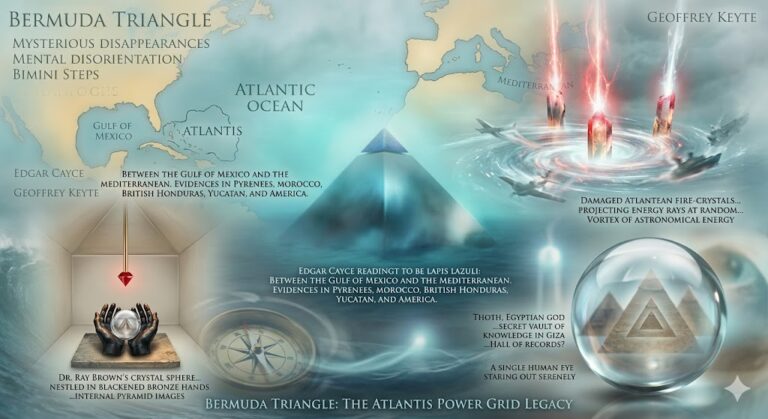
    Where is the Bermuda Triangle? Many of us believe that the Bermuda Triangle is situated more or less in the middle of an area of the Atlantic Ocean that once housed Atlantis.

    While many eminent Atlantean authorities express differing opinions and ideas as to precisely where Atlantis was situated, I would like to refer to a reading given by Edgar Cayce in 1932:

    “The position…the continent of Atlantis occupied is between the Gulf of Mexico on the one hand and the Mediterranean upon the other. Evidences of this lost civilization are to be found in the Pyrenees and Morocco, British Honduras, Yucatan and America.There are some protruding portions…that must have at one time or another been a portion of this great continent. The British West Indies, or the Bahamas, are a portion of same that may be seen in the present. If the geological survey would be made in some of these especially, or notably in Bimini and in the Gulf Stream through this vicinity, these may be even yet determined” (364-3).”

    Be that as it may, and in most things I am always inclined to believe what Edgar Cayce has to say, in my opinion Atlantis was situated roughly speaking where Cayce proposes.

    When Atlantis was destroyed it sank to the very bottom of the ocean. While the ruined temples now play host to multitudinous underwater creatures, the great Atlantean fire-crystals that once provided so much of the tremendous power and energy that was found in Atlantis long ago still exist. And they are still emitting strong energy beams into the universe.

    Unfortunately, however, when the destruction occurred some of these fire-crystals were partially damaged, which has resulted in them only being able to project their energy rays at random. It is said that each fire-crystal would have been at least twenty feet high and some eight feet wide. In Atlantis these fire- crystals would have been erected in a series of three, thus creating a vortex of astronomical energy and a power of the first magnitude!

    From time to time, the force field emitted by these damaged Atlantean fire-crystals becomes very powerful and any plane or ship coming within the influence of this force field disintegrates and is transformed into pure energy. Hence the inexplicable and mysterious disappearances that has very often been blamed on the area of the ocean known as the Bermuda Triangle!

    Some scientists have advanced the theory that many of the planes and ships that have been lost and that have disappeared within the Bermuda Triangle have been transported into some kind of Black Hole or time warp. This is, I would strongly suggest, simply not true. Those individuals who were aboard planes and ships when they disappeared have basically between returned to spirit.

    On a few rare occasions, ships that had been reported as having vanished have actually returned. The crew members, though, have all appeared to be insane, incoherent and babbling wild stories. This has occurred because there are certain times when the force field projected by the Atlantean fire-crystals is not strong enough to effect total disintegration. Mental disorientation results instead!

    It is very similar to someone who receives an overdose from a shock treatment to the brain. Not enough, perhaps, to kill, or destroy the person, but enough to seriously damage the brain structure and to cause insanity and other forms of madness. The ramblings that all these crew members have related are hallucinations, thoughts of fear and of unknown indescribable horrors with which their minds cannot possibly cope.

    In addition to the damaged Atlantean Fire-Crystals, the Timekeeper Crystal still stands guard within the ruined Atlantean Temple of Healing. The great Timekeeper Crystal, however, does not project its energies in the same way as the fire-crystals because it is hermetically sealed.

    The Timekeeper Crystal is waiting patiently for the time which is yet to come when once again it will play its important role in the affairs of the world!

    In 1970, Dr.Ray Brown, a naturopathic practitioner from Mesa, Arizona, went scuba diving with some friends near the Bari Islands in the Bahamas, close to a popular area known as the Tongue of the Ocean.

    During one of his dives, Brown became separated from his friends and while searching for them he was startled when he came across a strange pyramid shape silhouetted against the aquamarine light.

    Upon investigating further, Brown was surprised by how smooth and mirror-like was the stone surface of the whole structure, with the joints between the individual blocks almost indiscernible.

    Swimming around the capstone, which Brown thought might have been lapis lazuli, he discovered an entrance and decided to explore inside.

    Passing along a narrow hallway, Brown finally came to a small rectangular room with a pyramid-shaped ceiling. He was totally amazed that this room contained no algae or coral growing on the inner walls. They were completely spotless!

    In addition, though Brown had brought no torch with him, he could nevertheless see everything in the room with his normal eyesight. The room was well lit, but no direct light source was visible.

    Brown’s attention was drawn to a brassy metallic rod three inches in diameter hanging down from the apex of the center of the room and at its end was attached a many-facetted red gem, which tapered to a point.

    Directly below this rod and gem, sitting in the middle of the room, was a stand of carved stone topped by a stone plate with scrolled ends. On the plate there was a pair of carved metal bronze-colored hands, life-sized, which appeared blackened and burnt, as if having been subjected to tremendous heat.

    Nestled in the hands, and situated four feet directly below the ceiling rod gem point, was a crystal sphere four inches in diameter.

    Brown tried to loosen the ceiling rod and red gemstone but neither would move. Returning to the crystal sphere, he found,to his amazement, that it separated easily from the bronze hand holders. With the crystal sphere in his right hand he then made his way out of the pyramid.

    As he departed, Brown felt an unseen presence and heard a voice telling him never to return!

    Fearing, rightly, that his unusual prize might be confiscated as salvage-treasure by the American Government, Dr. Brown did not reveal the existence of his strange crystal sphere, nor did he relate his experiences until 1975, when he exhibited his crystal for the first time at a psychic seminar in Phoenix.

    Since that time, the crystal sphere has made only a very few public appearances but on each occasion people who have seen it have experienced strange phenomena directly associated with it.

    Deep inside the crystal form, one gazes upon three pyramidical images, one in front of the other, in decreasing sizes. Some people who enter a deep meditative state of consciousness are able to discern a fourth pyramid, in the foreground of the other three.

    Elizabeth Bacon, a New York psychic, claimed while in trance, that the crystal sphere had once belonged to Thoth, the Egyptian God who was responsible for burying a secret vault of knowledge in Giza, near the three great Pyramids.

    Perhaps the positions of the three pyramidical images in the crystal sphere hold the long-sought key to finding a fourth, as yet unfound, subterranean pyramid that will lead us to the Hall of Records? Who knows?

    Looking at the crystal sphere from the side, the internal images dissolve into thousands of tiny fracture lines. Brown feels that these may prove to be electrical in nature, like some form of microscopic circuitry.

    From yet another angle, and under special conditions, many people have been able to see a large single human eye staring out serenely at them. Photographs of this eye have also been taken!

    Dr. Brown’s crystal sphere has been the source of a wide variety of paranormal and mysterious occurrences. People have felt breezes or winds blowing close to it. Both cold and warm layers surround it at various distances. Other witnesses have observed phantom lights, heard voices or felt strange tingling sensations surrounding it.

    A compass needle, when placed next to the crystal sphere, will spin counter-clockwise, then commence turning in the opposite direction when moved only inches away. Metals become temporarily magnetized when they come into close contact with the sphere.

    There are even recorded instances where healing has taken place by merely touching the sphere.

    We may only speculate as to why the crystal sphere was created and what part it once played within the underwater Bahamas pyramid discovered by Ray Brown!

    If, as we suspect, this area of water once formed part of the continent of Atlantis, then what other buried treasures await future divers? The possibilities are endless.

    Seismographic surveys carried out across the Atlantic Ocean have shown that there are many deviations and unexplained contours to be found right at the bottom of the ocean. To date, however, no serious exploration has ever been undertaken to find out exactly what is to be found on the ocean’s floor.

    Perhaps Brown’s Bahamas pyramid once formed part of Atlantis? It has been suggested that this sunken pyramid once attracted, accumulated and even generated some form of cosmic force.

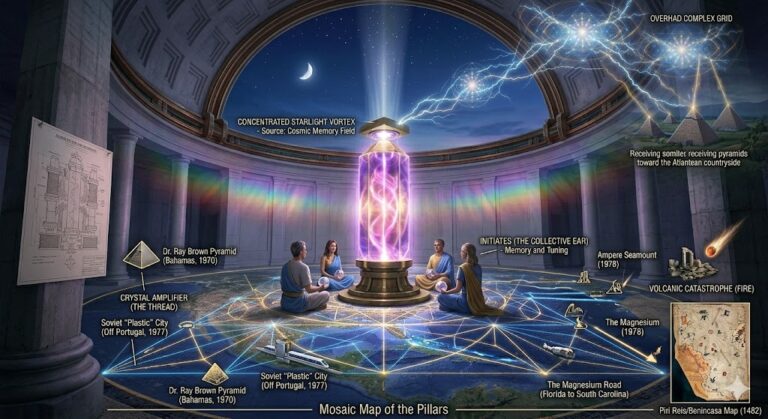
    The suspended rod may have conducted forces accumulated in the capstone. The faceted red gem at its end may have been used to concentrate and project the energies to the crystal sphere below it. The burnt and blackened hands, showing the evidence of an energy transfer, probably amplified the release of these energies while the crystal sphere acted as the tuner and broadcaster of the energies.

    In 1933, Edgar Cayce suggested in two readings that the Atlanteans possessed some form of atomic power and radioactive forces:

    ” Through the same form of fire the bodies of individuals were regenerated by burning, through application of rays from stone, the influences that brought destructive forces to an animal organism. Hence the body often rejuvenated itself and it remained in that land until the eventual destruction, joining with the peoples who made for the breaking up of the land, or joining with Belial at the final destruction of the land. In this, the entity lost. At first it was not the intention nor desire for destructive forces. Later it was for ascension of power itself”
    (440-5; December 20, 1933)

    And Cayce goes on:

    “As for a description of the manner of construction of the stone: we find it was a large cylindrical glass (as would be termed today), cut with facets in such manner that the capstone or force that concentrated between the end of the cylinder and the capstone itself..As indicated, the records as to ways of constructing same are in three places in the earth, as it stands today: in the sunken portion of Atlantis, or Poseidia, where a portion of the temples may yet be discovered under the slime of ages of sea water – near what is known as Bimini, off the coast of Florida. And (secondly) in the temple records that were in Egypt, where the entity acted later in cooperation with others towards preserving the records that came from the land where these had been kept. Also (thirdly) the records that were carried to what is now Yucatan, in America, where these stones (which they know so little about) are now, during the last few months, being uncovered.”
    (440-5;December 20, 1933)

    One particularly interesting piece of information in the above reading is the reference to Bimini. In 1969, steps were discovered leading down under the ocean at Bimini. These have always been believed to have once formed part of Atlantis although it appears that little further excavations or explorations have ever taken place on this site. But – and really it is not too big a but – it does seem that the balance of probability is firmly tilted towards the supposition that Atlantis was more than a legend; that, in reality, it was a historical fact.

    In the meantime, however, the damaged Atlantean fire-crystals will continue, from time to time, to have an effect upon some of the planes and ships which pass through the area known as the Bermuda Triangle.


    If you have any information, past-life memories, etc., that you would like to share with me, I shall always be very pleased to hear from you.
    Geoffrey Keyte, Crystal 2000 (International)
    37, Bromley Road
    St. Annes-on-Sea
    Lancashire, England FY8 1PQ
    Internet Address: 100347.2724@compuserve.com


  • Cayce on Atlantis


    Cayce on Atlantis


    The origin of the Atlantean continent is obscured in the misty period of prehistory. Indeed, even psychic records are hard to understand, for the earth’s surface has changed many times during even this cycle.

    When man entered this earth as man, according to the Edgar Cayce readings, Atlantis was a great continent lying in what is now the Atlantic Ocean between the Gulf of Mexico and the Mediterranean Sea.

    In area it can be compared with what is now Europe and Russia. The north and south poles did not occupy their present positions, nor were the land surfaces now existent then above water except as follows:

    The eastern seaboard was the coastal region of Atlantis; the region of the Carpathian mountains and the Mongolian Desert were habitable, as was the northern part of what is now Africa, as was the southeastern portion of Atlantis.

    The Andean coast of South America were covered by water, while the plains of Utah, Nevada, and Arizona were above sea level. The people of Atlantis passed through the same stages of development as other peoples. As we shall see, there were periods when they attained very high understanding of natural laws and excelled the other races of the world in material civilization.

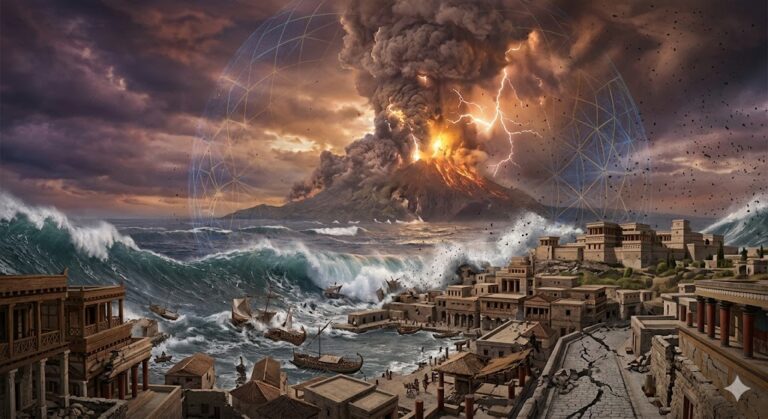
    The first of a series of disturbances came as a result of the use of the very high explosives which were used to destroy the enormous animals that then roamed the world. Great gas pockets were blown open and volcanic eruptions and earthquakes from the slow cooling earth broke up the continent into a group of large islands.

    The Bible gives an account of this second change, terming it the flood. Before the final destruction which began about 10,700 B.C. the principal islands remaining were Poseidia, Aryaz and Og. The West Indies are remains of this great continent.

    The people of Atlantis were a combination of the hardened thought forms manifesting in that part of the earth, and man’s projection, as in present form, as one of the five races, resulting in the red race.

    At first the homes were in caves among the rocks and in nests in the trees. Later through group organization, structures of wood and stone were built. Stone was first use to form the implements with which the people protected themselves and secured food. Iron, brass, and copper were also employed even before the first upheavals.

    The early Atlanteans were peaceful and so made rapid advances in the application of natural laws.

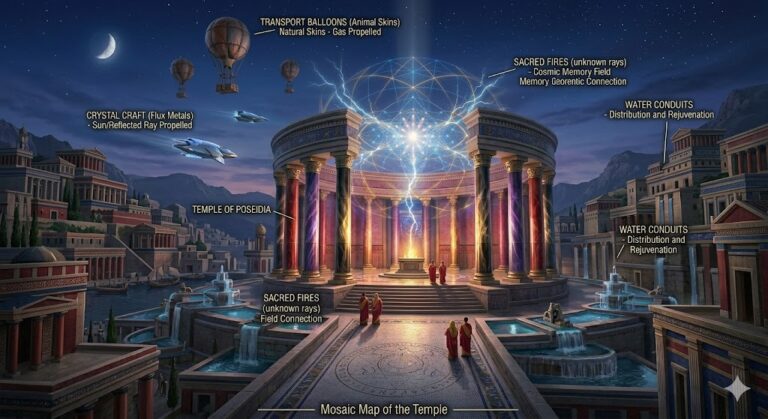
    At an early period natural gas was utilized to make large balloons from the skins of animals and these balloons were used to transport building materials. Electricity was also discovered and set to work for man, thus paving the way for remarkable developments in this field.

    Turmoils arose with the mixing of those of pure lineage with those who had not completely thrown off the animal influences. Contempt, hatred, and bloodshed resulted.

    With this growth of disturbing factors – resulting from the magnification of desires without regard for the rights of others – an effort was made to draw the people back to the worship of one God, by establishing the first altars upon which were made the sacrifices of the field and forest. Rituals and ceremonies were instituted and the sacred fires set, as the shrine of the pure and the means of cleansing for all.

    After the first destruction, the altars were sometimes used for human sacrifice, by those turning more and more away from the original understanding of the Creative Force. Strife, rather than peace, became the common state, and the fact that great understanding of nature’s forces had been attained made the destructions all the more terrible.

    From this time on, though material civilization rose to great heights, there was a growing unrest which brought about the many migrations both to the east and the west.

    As can well be understood when considering the period of time covered, civilizations rose and fell many times on this great continent. At the heights of material achievement the Atlanteans were far more advanced than we are today. They used electricity as we do and, moreover, included among their inventions, well developed television and radio; amplification of light rays for telescopes; and more advanced systems for heating and lighting.

    Rays of various kinds were controlled, including the death ray. Fluxes of metals unknown today were used in the various types of air and water craft which were constructed by the Atlanteans. The forces used to propel these crafts were first gas and electricity, but later, forces from the sun’s rays – caught and reflected by crystals.

    Many beautiful cities were built throughout the land. Perhaps the largest was that called Poseidia, located on what became the last of the great islands also designated by that name. Here on the bay of Parfa – one of the great harbors of the ancient world – the Atlanteans constructed a city of stone.

    Water was brought in great conduits from the mountains and distributed to the individual buildings and beautiful pools, of which there were many. The buildings, other than the temple in the heart of the city, were built in tiers. Colored stones, highly polished, were used; and inlay work was prevalent.

    In the temple were to be found enormous semi-circular columns of onyx, topaz, and beryl, inlaid with amethyst and other stones that caught the rays of the sun at various angles. In the temple, the sacred fires burned continually. These were rays that we know nothing of today. There was an outer court, or assembly hall; the inner rooms for attendants and the inner chamber about the alter and fires.

    In appearance the Atlanteans varied as do the people of a vast country today. In the early periods there were both giants and pygmies. Monstrosities resulted from the mixing of the thought forms, but the pure strain as came down from one of the five projections was the origin of the red race.

    There are many evidences of Atlantean influences at the present time. As yet men have not established the direct connection. Northern Spain, the region of the Pyrenees; Morocco and Egypt on one side of the Atlantic, the British Honduras, Yucatan and America on the other, show remnants of the civilization brought in by the migrating Atlanteans.

    We must remember that the periods of exodus from Atlantis were far apart. The type of civilization carried to the region of the Pyrenees and America just before and after the first destruction was not the same as that carried to Central America and Morocco before the second upheaval, and to Egypt and Yucatan before the final destruction.

    In the Pyrenees there are ruins of the early Atlantean settlements; and in Morocco early settlements, also as yet uncovered. In America, traces of Atlantean rituals and ceremonies are to be found among many of the Indian tribes. In Central America and Egypt ancient ruins show definite Atlantean influences, while in both places there will be uncovered records of Atlantean history, duplicate accounts of the early civilizations that will explain much of the early Jewish records as found in the Bible.

    The West Indies – as has been pointed out – are actual portions of the continent; and on Bimini there are in existence today remains of an old Atlantean temple.

    (For more information see the Edgar Cayce #364 series readings which were given specifically on the topic of Atlantis.)

    Edgar Cayce Readings copyright ©1971 Edgar Cayce Foundation, Inc.

    This site is not affiliated with the A.R.E. or any organization.


  • History of the Golden Ages


    History of the Golden Ages

    Dedicated to the creators of the future Golden Age…
    Left to humanity as a vision of the future of Planet Earth…

    by EN-MAR – Steve Omar

    From The House of David Teaching Center


    “This is probably the greatest discovery in World history” was stated by Maxine Asher, the co-director of a scientific expedition that found Atlantis at the bottom of the ocean reported United Press International (UPI) and major newspapers in the United States during the summer of 1973. UPI continued that “Maxine Asher said that scuba divers found data to prove the existence of the super-civilization which legend says sank beneath the sea thousands of years ago”…”the divers had found evidence of roads and large columns some with concentric spiral motifs, in the exact place described by the Greek philosopher Plato” (beyond the Pillars o Hercules, off Spain).

    “The group of some 70 scientists, teachers and adventurers was endorsed by Pepperdine University in Los Angeles, CA.” The information is NOT based on any New Age channeling or psychic recall or manifestations. It is primarily based on many ancient writings found around the world.

    RUINS
    1. City on the bottom of Atlantic Ocean off Spain, found by Dr. Maxine Asher’s expedition in 1973 and reported by UPI Asher was Interviewed and evidence was Witnessed by Steve Omar, director of the M.I.N.D. International Research Agency,Maui, Hawaii.

    2. Pyramid explored by Dr. Ray Brown on the sea floor off the Bahamas in 1970. Brown was accompanied by 4 divers who also found roads, domes, rectangular buildings, unidentified metallic instruments, and a statue holding a mysterious” crystal containing miniature pyramids. The metal devices and crystals were taken to Florida for analysis at a university there. What was discovered was that the crystal amplified energy that passed through it. Brown interviewed by M.I.N.D.

    3. Ruins of roads and buildings found off Bimini Island in the 1960s by the photographed and published expeditions of Dr. Manson Valentine. Steven Forsberg, co-founder of the Lahaina Times newspaper dove into these ruins in 1982 to witness them first hand. Similar ruins were also photographed off Cay Sal in the Bahamas. The ruins are of the same construction as the oldest city ever found on land, according to archaeologists, in Tiajuanaco, Bolivia where a calendar was uncovered that shows the exact position of the stars and planets 27,000 years ago. This is more than 20,000 years BEFORE the oldest civilizations in school history books!

    4. Similar underwater ruins found off Morocco and photographed 50 to 60 feet underwater.

    5. Dr. David Zink found in 1957, off the Bahamas coast, a stylized marble head building block cast in a mold and a construction piece drilled by a bit, as well as a stone column that he reported radiated energy. Forsberg of M.I.N.D. interviewed Dr. Zink and obtained the photographs.

    6. A ruined harbor like complex discovered on the sea floor off Bimini by Captain John Alexander.

    7. The deep sea diving submarine Aluminaut discovered a well preserved paved road on the bottom of the Atlantic Ocean make of black top magnesium oxide, running along the sea floor from Florida South Carolina.

    8. Temple pillars buildings, statues, wide curving boulevards with smaller avenues branching out like spokes in a wheel, majestic temples and pyramids videotaped by Captain Reyes Miranga on the Spanish named salvage ship “Talia.”

    9. A huge 11 room pyramid found 10,000 feet under water in the mid Atlantic Ocean with a huge crystal top, as reported by Tony Benik.

    10. Several acres of white marble-like ruins found on tile ocean floor off Cuba reported by Liecesaer Hemingway.

    11. Mysterious dome structures reportedly seen in clear water by several pilots in the Straits of Florida.

    12. Soviet expeditions to Atlantic Ampere Seamount resulted in photographs of ruins destroyed by lava (like the Aztecs and Mayans wrote Atlan was destroyed by.) This discovery was in the New York Times newspaper May 21, 1978.The photos were developed by the Academy’s Petrovsky Marakuyev and reported by the deputy Director of the Soviet Academy of Science’s Institute of Oceanography, Professor Aksyonove, who also reported ruins found off Cadiz, Spain in the same area as Dr. Maxine Asher’s previous discovery.

    13. 1981 expedition of P. Cappellano discovered mysterious ruins with strange symbols on them on the sea floor off the Canary Islands.

    14. 1977 report of a huge pyramid found off cay Sal in the Bahamas, photographed by Ari Marshall’s expedition, about 150 feet underwater. The pyramid was about 650 feet high. Mysteriously, the surrounding water was lit by sparkling white water flowing out of the openings in the pyramid and surrounded by green water, instead of the black water everywhere else at that depth.

    15. An urn brought to the surface by Dr. Aher’s expedition.

    16. The foundations of a 100 by 75 foot structure photographed on the sea bottom off Andros Island.

    17. A sunken city about 400 miles of Portugal found by Soviet expeditions led by Boris Asturua, with buildings made of extremely strong concrete and plastics. He said , “the remains of streets suggests the use of monorails for transportation.” He added that he brought up a statue.

    18. A six foot column or spire protruding from a double circular gear-like base embedded in the ocean floor, with peculiar light emanations from the bottom of the shaft showing up in photos taken by Dr. William Bell in 1958.

    19. Pillars found on the Atlantic floor in 1969 by Robert Fero and Michael Grumley, a chunk of which was carved from rock NOT found anywhere in that part of the world.

    20. A road off the Bahamas explored by Dr. Manson Valentine.

    21. Dimitri Rebikoff, using his underwater platform and a special collecting lens, reported ruins found encircling an underwater freshwater spring.

    22. Marble Acropolis underwater across five acres of fluted columns raised on pillars.

    23. Heinrich Schilemann, the man who found and excavated the famous ruins of Troy (which historians thought was only a legend), reportedly left a written account of his discovery of a bronze vase with a metal unknown to scientists who examined it, in the famous Priam Treasure. Inside it are glyphs in Phoenician stating that it was from King Chronos of Atlantis! IDENTICAL potter was found in Tiajuanaco, Bolivia.

    24. Twenty researchers, including archaeologists, a marine biologist, geologist, and cartographer dived onto ruins on the sea floor off Bimini in 1975 and brought back artifacts from which they concluded that the walls and roads were made of materials not found in that part of the world.

    Plato and others wrote that Atlantis was a huge continent like Africa, stretching across the Atlantic. The Aztecs, Mayans and Incas and other Indian tribes told explorers of the sunken Atlan in the Atlantic and the sunken MU (Lemuria) in the Pacific.

    In the Pacific, ruins of an ancient city were explored on the ocean floor off Ponape Island. Another was found underwater 30 miles off Easter Island. A ruined road on Karotonga Island goes into the ocean, runs underwater for many miles, and comes out of the ocean on another island in a straight line! Professor Menzies, from Duke University, photographed a ruined civilization on the sea bottom between Peru and Tahiti with unknown hieroglyphics on a column. Monolithic ruins from a lost civilization were found on a haft dozen South Pacific Islands, which are said to be Lemurian mountain peaks above water.

    MAP EVIDENCE

    1. Professor Charles Hapgood, Professor of Geology at New Hampshire University reported that a large unknown Atlantic Island appears on an ancient map (the famous Piri re is a map seen on TV and in dozens of books.)

    2. An ancient map that King Henry owned in 1500 A.D. clearly shows Atlantis.

    3. Greek documents and maps showing Atlantis that Christopher Columbus studied before he set sail for America, including the 1482 Benincasa Map showing 3 Atlantis islands that no longer exist!

    ANCIENT WRITINGS ABOUT ATLANTIS

    1. Plato wrote a detailed account of Atlantis with its location, later history culture, and destruction.

    2. Ancient writings from the Aztecs and Mayans like the Chilam Balam, Dresden Codex, Popuhl Vuh, Codex Cortesianus, and Troano Manuscript were also translated into histories of the destruction of Atlantis and Lemuria.

    3. The Oera Linda Book from Holland is said to be one of the oldest books ever found. Adela tells of the destruction of the large Atlantic island by earthquakes and tidal waves.

    4. The ancient Greek historian Diodorus wrote that thousands of years earlier Phoenicians had been to the immense Atlantic island (where Plato wrote Atlantis was.)
    (Note that Phoenician hieroglyphics have been found on numerous ruins in the South American Jungles that are so ancient that the “white” Indian tribes nearby lost memory of who built these ruins.) Diodorus wrote that the Atlanteans had WAR with the Amazonians!

    5. The Greek Kantor reported visiting Egypt where they saw a marble column carved with hieroglyphics about Atlantis.

    6. Greek historian Ammianus Marcellinus wrote about the destruction of Atlantis (he was highly respected.)

    7. Proculus visited the islands off Africa (Canaries or Azores) where the natives told him of the destruction of Atlantis around 450 A.D. long before that date.

    8. Plutarch wrote about the lost continent in his book “Lives.”

    9. Herodotus, regarded by some as the greatest historians of the ancients, wrote about the mysterious island civilization in the Atlantic and a city on it located in the region the Dr. Asher expedition found just that!

    10. The Greek historian Timagenus wrote of the war between Atlantis and Europe and said tribes in ancient France said that was their original home. (Note that clear bright paintings in caves in France clearly show people wearing 20th century clothing: one painting led to an underground pyramid complex. French historian and archaeologist Robert Charroux dated them at 15,000 B.C.

    11. Claudius Aelianus referred to Atlantis in his 3rd century work, “The Nature of Animals.”

    12. Theopompos (Greek historian) wrote of the huge size of Atlantis and it’s cities of Machimum and Eusebius and a golden age free from disease and manual labor.

    13. James Churchward wrote several volumes of books documenting ancient writings he claims to have translated in Southeast Asia concerning Atlantis and Mu, while geologist William Niven claimed to have excavated identical tablets in Mexico.

    14. Dr. George Hunt Williamson, who authored several books on his Atlantean- Lemurian research in the 1950’s, was an anthropologist explorer once listed in Who’s Who in America. Williamson wrote how descendants of the Incas led him to an ancient manuscript in a temple in the Andes Mountains that told of the destruction of Atlantis and Mu, which had an advanced technology, by earthquake and tidal waves. Williamson also visited dozens of Indian tribes in the United States and Mexico that told him of Atlantis and Mu, including the Hopi Indians.

    15. Tablet from Lhasa. Tibet and also from Easter Island. It is clear from ancient writings that belief in Atlantis was common and accepted in Greece, Egypt, and Mayax (Mayan and Aztec Empires) by historians. The Basques of Spain, the Gauls of France, the tribes of the Canary and Azores islands, a tribe in Holland, and dozens of Indian tribes all speak of their origins in a large lost and sunken Atlantic land. Belief in the large sunken? ????

    Human footprints and shoe prints, a perfectly engineered cube, Jewelry, a pre- historic animal with a hole in its skull that scientists admit only a bullet could make, a remnant of a screw, and other modern artifacts have been found in layered rock strata geologists admit formed on these objects MILLIONS OF YEARS AGO! All of these discoveries were printed in public daily news papers when they occurred, and left out books simply because historians could not explain them with THEIR theories.

    Most all ancient civilizations believed in the TITANS, the race of giant humans that inhabited Earth long ago. Different races knew them by different names. These 7 to 12 foot humanoids were thought to be legendary until the excavation of over a dozen skeletons 8 to 12 feet tall, around the world, shook archaeologists. These skeletons were positively human. Some of these skeletal remains are on Maui in lava caves near Ulupalakua and Olowalu. The Spanish Conquistadors left diaries of wild blond-haired, blue-eye 8 to 12 foot high men running around in the Andes during the conquest of the Incas. A couple were reportedly captured but died en route to Europe. If giant animals (dinosaurs) were possible then why not giant men?

    The Germans and the Nordic Scandinavians spoke of a vanished continent in the North Atlantic ocean called Thule with the civilization of HYPERBOREA located on it. THULE reported stretched into what is now the northern polar ice cap where it is buried underneath miles of ice so we cannot see it.

    HISTORY IS A REPETITION OF GOLDEN AGES FOLLOWED BY THE ENDS OF EMPIRES.

    In the dawn of time, a civilization would begin and advance to greatness, only to be destroyed.

    Humanity would then regress back to primitive conditions and have to begin all over again. Little trace of the former empire would remain. Ancient historian stated that civilization has been completely destroyed at least 5 times, either by water or fire. The devastation came either in the form of volcanic earth- quakes or a comet (fire) and earthquakes and tidal waves (water). The last END OF AN AGE came with a combination of fire and water combined with man’s inhumanity to man. Waters that are NOW oblivion had become tombs of ice, glaciers buried whole cities.

    THE REASON FOR WRITING THE EARTH HISTORY IS TO RE-STATE: IT CAN HAPPEN AGAIN!

    Geologists around the world agree that the ice in Alaska and most other polar lands in the north were tropical thousands of years ago. Many plants, fish and animals native to subtropical climates have been found frozen beneath the Arctic glaciers. Coral and palm trees are frozen in Alaska. Frozen animals were found devouring tropical vegetation, found crushed in herds in the positions of running from some cataclysmic disaster that occurred INSTANTLY. Scientists now have proof that the North Pole has shifted its position several times by many thousands of miles! What was once tropical is now ice cap! What was once glaciers is now the tropics! Here in 1990, EXPERTS AGREE that this reversal will occur WITHIN THE NEXT FIFTY (50) YEARS OR LESS!

    If our cities were buried by ice thousands of feet thick weighing billions of tons, our scientists agree that it would grind them to dust beyond recognition, accompanied by thousands of years of rust and rot…to dust. Is that what happened to the THULE civilization spoken of by so many ancients?

    Many famous writers, like Diodorus Pliny, and Virgil wrote about THULE, a land the Greeks knew existed before their time. They described Thule in the, North Atlantic as warm and green surrounded by high mountains, known for breathtakingly beautiful women. The race reportedly was blonde with blue eyes, the men were exceptionally handsome, although some writers spoke of a violet skinned race with golden hair, that ruled these people (that could have genetically died out and became extinct with the dinosaurs.) The ancients agreed that the

    HYPERBOREAN RACE was tall and in excellent physical condition, and some told of how they conquered the aging process and looked youthful in old age. They were reportedly vegetarians and fruitarians who lived in harmony with nature. Although several ancient writers firmly believed in Thule, historians of the Middle Ages, who had no evidence that the north was once warm and therefore inhabited, naturally censored it out of the history books we inherited! Today’s science KNOWS that the far north was once tropical!

    The South Polar continent of Antarctica was also once ice free, and that fact is clearly shown on the ancient Piri-ries Map seen displayed on television documentaries, which show mountain ranges not discovered until the 1940’s! That map could ONLY have been made BEFORE the ice cap! Even the Eskimos speak of the warm lands in the north that was the cradle of civilization as they knew it.

    A German archaeologist, Jurgen Spanuth, wrote that he went to Egypt, where he deciphered some hieroglyphics telling of a Lost Empire in the North. In 1953, Jurgen found ruins of an ancient city of unknowns on the bottom of the North Sea, and he produced photographic evidence!

    During the 1920-30’s, German researchers who were exploring ancient Nordic writings became believers in the lost continent of Thule, and the race of Super men who had existed then during a glorious Golden Age. They were convinced that the Supermen were genetically and culturally the most advanced race in world history, and convinced professors and historians believed that the Hyperboreans had telepathic and cosmic powers, had been destroyed by ice, and that humanity had degenerated.

    When Borman, Hitler and his central aides heard this research, they theorized that the Nordic Aryan race in Germany had descended from the Supermen who had once ruled the planet, and therefore the Aryans were the superior race. Hitler mated the ideology that the Third Reich of the Arian Nazis were the return of the Super Race for a future Golden Age.

    Remember that Nazi science in the 1930’s and 40’s was, in many ways, more advanced than in the United States and other nations. The Nazis had rockets, Jet planes, radar, and many weapons BEFORE any other country…and had superior submarines and the first freeways!

    In 1945 they were experimenting with real flying saucers that were destroyed in Allied bombings, and the inventors burned the blueprints. The conquering Allies were astounded to find crude but working saucers and tried to reproduce them in strict (yet unsuccessful) secrecy, while captured German rocket scientists invented the U.S. Space Program! Yet even more shocking was the diaries of Nazi leaders who seriously based their world plans on literature about Thule, psychic powers, Atlantis and ancient supermen!

    The founders of the Nazis believed that they were destined to create the new Super Race that would rule this planet in the future Golden Age. The Nazi leaders were convinced that all of history was in cycles, consisting of golden ages followed by disasters. Hitler stated that the repetition of history required that to recreate the supermen who had come and gone, the Nazis must exterminate all of the inferior races they believed inhabited the planet. It was their belief that it was the destiny of the Nazis, in the universal plan, to manifest the Age of Aquarius and a new race. They believed Earth was near the end of a Cycle when all nations would again be destroyed…by a polar shift, earthquakes, fire and tidal waves. The Nazis had plans to survive in under- ground cities in South America, as they believed the Atlanteans had, those who rounded the Aztecs, Incas and Mayans. The Nazis transferred millions of dollar of their gold and secret armies and many scientists to a remote region in Argentina to survive. The infamous genetic experiments on prisoners in Nazi concentration camps were attempts to manipulate genes to create and breed the New Race, which was to be founded by blond, blue-eyed Nazi SS troops.

    Hitler sent generals and SS agents to the Himalayan Mountains to try to learn the yogi techniques of mind-over matter for the New Race (details can be found in book entitled “Morning of the Magicians.”)

    We are not sure how long ago Thule was destroyed. Some ancient writers claim Hyperboreans became so highly evolved over thousands of years that they became transparent beings (is this the teleportation which our own scientists admit will be possible in the future?) We do know that a beautiful chalice made of zinc and silver with intricate inlaid flower designs all “over it” was excavate 15 feet deep in solid rock that geologists confirm was solidified millions of years ago. In 1851, an engineered iron nail was found in Salzburg, Austria in a perfectly formed quartz crystal which geologists said solidified 12 million years ago.

    The Hitler Nazis could have done well with their advanced knowledge, yet they misused psychic powers, just like the Atlanteans had done!

    Special thanks to NewAge On-Line Australia for this and the following links
    (http://www.newage.com.au)


  • The Lost Continent of Atlantis


    The Lost Continent of Atlantis


    Plato gave the world the oldest remaining written account of Atlantis, in Critias, recorded circa 370 BC. By his account, Poseidon, god of the sea, sired five pairs of male twins with mortal women. Poseidon appointed the eldest of these sons, Atlas the Titan, ruler of his beautiful island domain. Atlas became the personification of the mountains or pillars that held up the sky. Plato described Atlantis as a vast island-continent west of the mediterranean, surrounded by the Atlantic ocean. The Greek word Atlantis means the island of Atlas, just as the word Atlantic means the ocean of Atlas. Atlantis was governed in peace, was rich in commerce, was advanced in knowledge, and held dominion over the surrounding islands and continents. By Plato’s legend, the people of Atlantis became complacent and their leaders arrogant; in punishment the Gods destroyed Atlantis, flooding it and submerging the island in one day and night.

    In a sense, Atlantis actually existed, and was indeed destroyed by the sea in a cataclysmic event, very plausibly lasting a day and a night. Plato’s account was wrong in several essential ways, but was derived from correct, if garbled, historical accounts. Plato’s writings embodied the now lost words of Solon, a Greek ruler who visited Egypt circa 590 BC. Plato’s account of Atlantis was thus a retelling of the story of Solon, who in turn told the stories that he had heard during his trip to Egypt.

    In Egypt, Solon heard of the ancient land of Keftiu, a island-nation named for holding one of the four pillars that supported the Egyptian sky. Keftiu was, according to the Egyptians, an advanced civilization that was the gateway to and ruler of all of the lands to the far west of Egypt. Keftiu traded in ivory, copper, and cloth. Keftiu supported hosts of ships and controlled commerce far beyond the Egyptians domain. By Egyptian record, Keftiu was destroyed by the seas in an apocalypse. Solon carried this story to Greece, and passed it to his son and grandson.

    Plato recorded and embellished the story from Solon’s grandson Critias the younger, translating the land of the pillars which held the sky (Keftiu) into the land of the titan Atlas. Keftiu-Atlantis was Egypt’s gateway to the “western” lands (Greece, Libya, and beyond), and was the home of a civilization that held dominion over the surrounding lands. But Plato mistook the location of Atlantis: Atlantis was not west of the Mediterranean, but was merely west of Egypt. Yet Plato preserved enough detail about the land of Atlantis that its identification is now unmistakeable. Plato never realized that the land of Atlantis was already familiar to him: Atlantis was the land of the Minoan culture, namely ancient Crete. The Minoan culture spread its dominion throughout the nearby islands of the Aegean, more than 1500 years BC.

    Crete, now part of Greece, was the capital for the Minoan people — an advanced civilization with language, commercial shipping, complex architecture, ritual and games. The Minoans were peaceful: very little evidence of military activity was found in their ruins. Daedalus, the ancient scientist, was the architect of the 4-storied palace at Knossos, said to be the capitol of the Minoan culture. At Knossos one can still find the ruins of the labyrinth that housed the legendary Minotaur, slewn by Thesius. Minoan culture extended across the island of Crete, with most of its developments along the northern coast of Crete. But after 800 years of dominance, the Minoan culture came to an abrupt end, circa 1470 BC.

    Correspondence of Minoan cultural artifacts with aspects of the Atlantis legend make the identity of the two seem virtually certain. Perhaps the most unusual of these is the Minoan bullfighting. By legend, the inhabitants of Keftiu would engage in ritualistic bullfighting, with unarmed Minoan bullfighters wrestling and jumping over uninjured bulls. This foolhardy practice is richly illustrated in remaining Minoan artwork. Legend also holds that Atlantis was peaceful — this is confirmed by a virtually complete absence of weapons in Minoan ruins and in Minoan artwork — unusual for peoples of that time. Egyptian legend held that elephants were found on Keftiu — while there were presumably no elephants on Crete, the Minoans were known to deal in ivory, and appear to have been the principal access to ivory for Egypt 20 centuries before Christ.

    But what of the fabled apocalypse which, according to the Egyptians, swallowed the Keftiu-Atlantis in one day and one night? This also has basis in historical fact. The trail of evidence leads to the small island of Santorini.

    Santorini (also known as Thera) lies 75 km north of Crete. Santorini was also a Minoan land, and ruins can be found throughout the island. A mountain lay at its center, probably about 1500 meters in height until approximately 1500 BC. This mountain was a volcano; eruptions began about 1500 BC, and smoldered until a final climax about 1470 BC. The volcano at Santorini was geologically similar to Krakotoa in composition, structure, and tectonic location; Santorini was about 4 times larger in diameter than Krakotoa, and probably somewhat more violent. The fury of its final explosion is inferred from geologic core samples, from comparison to the detailed observations made on Krakotoa in 1883, and from the simultaneous obliteration of almost all Minoan settlements.

    In summer, circa 1470, volcanic ash filled the sky, blotted out the sun, triggered hail and lightning, and rained down over the Aegean. Earthquakes shook the land, and stone structures fell from the motion. When the enormous magma chamber at Santorini finally collapsed to form the existing caldera, enormous tsunamis (tidal waves) spread outward in all directions. The coastal villages of Crete were flooded and destroyed. The only major Minoan structure surviving the waves and earthquakes was the palace at Knossos, far enough inland to escape the tidal waves. But in the days that followed, volcanic ash covered some settlements, and defoliated the island. In famine from the ash, with the bulk of their civilization washed away, the remaining Minoans were overrun by Mycenaeans from Greece, and Knossos finally fell.

    The island of Santorini is now the rim of the the volcano — the caldera is covered by the Aegean sea. Mounds of pumice and volcanic ash mark its center, where the volcano remains. New inhabitants of Santorini mine the volcanic ash to make cement — and still find ancient ruins under the stone. The ash is now the soil, olive and fruit trees cover the landscape, and former Atlantis is mostly buried. New inhabitants have rebuilt Crete, but the mute ruins of ancient Atlantis can still be seen.
    References

    This page is a summary of: J V Luce: The End of Atlantis: New Light on an Old Legend, 1969, Thames and Hudson. Reprinted 1993 by Efstathiades Group.

    Copyright © 1996 Lakeshore Technologies Incorporated. All rights reserved


  • Trapped Essences


    Trapped Essences


    Joshua David Stone

    In an absolutely fascinating transcript from the Tibetan Foundation, Betty J. Dix channeled Ashtar on the subject of “trapped energy in the Earth.” In this transcript, Ashtar speaks of the later days of Atlantis when the Sons of Belial (egocentric people and lords of materialism) trapped many people’s “essences within pseudo-crystals.” I don’t mean to say that the soul extension or incarnated personality itself was trapped, but rather that a certain portion of the soul extension’s energy was trapped. The pseudo- crystals are not true crystals: true crystals would not allow that to happen. The Sons of Belial created the pseudo-crystals to look like regular crystals, and some of them are coming to the surface of the planet now. Ashtar says that these crystals don’t feel right when you pick them up. The energy in them feels dead.

    In order for these souls to go to their next level of evolution, their trapped essences need to be released. Souls on the inner plane are requesting that this work be done now because of the great transformation that is taking place on Earth. Ashtar is requesting that all Light workers help in this important work. The crystals don’t have to be physically broken to release the energy, just worked with energetically. Some of the pseudo-crystals can be placed on crystal clusters and asked to heal and release the energies that have been trapped inside. It can also be requested that the pseudo-crystal heal and become a true crystal.

    Interestingly enough, when the trapped essence leaves, many pseudo-crystals just disappear. Some transmute into another form and other into a true crystal in its beginning stages of conscious development.

    Ashtar states that these pseudo-crystals are all over the planet, but found especially in Africa, South America, and the United States. Once it is released, the essence will usually return to its soul. In some cases the trapped essence may need some guidance to return to the soul.

    In Atlantis, toward the end time, the Sons of Belial actually created entrapment machines to accomplish the process. They were able to do it without the machines, but he machines did it faster. He also says that implants were used to pull out the essence.

    It is very important to make people aware of this phenomenon, for most people have never heard of it. Ashtar says that out of twenty pounds of crystals, as many as five pounds could be pseudo-crystals. Working with pseudo-crystals in meditation to release the trapped essences and transform the pseudo-crystal is a great service that can be rendered to many souls.

    The pseudo-crystals can also be worked with without coming into physical contact with them, although some will have to be physically touched to facilitate the releasing process. The more Light workers focus on releasing the trapped essences, the more others will be able to come to the surface, for many are trapped in the Earth.

    Ashtar says that in the future the Earth will be of such a great magnitude of Light that the essence will be unable to stay. Most of the pseudo-crystals look like clear quartz, smoke quartz, and a lavender shade of amethyst. Your will not be able to know a pseudo-crystal by just looking at it: you will have to feel it to know for sure, although when viewed clairvoyantly, the distinction is obvious. Ashtar says that there are hundreds of thousands of pseudo-crystals.

    Source Of Information: Hidden Mysteries. Light Technology Publishing P.O. Box 1526, Sedona, AZ 86339.


    I would like to add, that the essences aspect comes from the over identification toward a technical approach. In an extreme case you may consider this, a scientists essence goes into the astral-form of his/her development due over identification to it. As ego is to focus will on physical plane, the balance is important to use it, else astral aspect of a personality goes really trapped. Trapped Essences might perceived as a specific form of karmic tie.


  • The Legend of Atlantis


    The Legend of Atlantis


    by Bob H.
    We are currently living in the “end of time” and many people are now talking about the new millennium or Golden Age which follows our “end of time”

    Everyone agrees that everything will be quite different during this Golden Age and that Christ consciousness will again prevail on this planet. But can we see that this will require and enormous change to occur within us as well?

    As the time comes for these planetary changes to manifest, everyone will be able to exercise their choice of either accepting or rejecting these new environmental conditions. some will be so entrenched in the old ways that they will have no choice but to deny the very existence of their new surroundings. There are many famous past examples of people confronted with a totally new situation, who were completely unable to accept that they had heard or seen what actually transpired and so simply ignored the event.

    For example, I am told that when they first fleet arrived in Botany Bay, the aborigines totally ignored it, because they had never seen anything like that before and could not make any connection with this event and their own reality. Perhaps something has happened in your own life, which your logical mind has simply denied as being possible?

    How are we to prepare ourselves then, for these coming earth changes?

    I suspect that everyone’s preparation will have to be quite different and will need to be guided by their own intuition. Generally speaking, people with a Western background will still have a strong connection to the old Atlantean mindset. This also manifested later in Egypt. It strongly exercises the properties of duality, namely a strong will for domination of your surroundings in an eternal struggle of “good against evil”.

    It was in Atlantis that the concept of egoic separation from our source was born. By contrast, the descendants of the Lemurian civilization even today still do not act as if they were living in separation from their fellow human beings and god’s world of all that is. The problem which we of the Western world have subsequently inherited was recognized by the Indian culture and recorded in Sanskrit writings some two thousand years ago. It is simply that the instant you consider yourself as a separate egoic entity, which is not totally connected to all that is, you will be subjected to great dilemma.

    Since we in our western culture all tend to fit into the category of classifying ourselves as “separate”, we will get a shock when the new Christ-consciousness arrives and suddenly people around you know how you are really feeling and actually know what is on your mind.

    The Legend of Atlantis book and video series [see bottom of article] was designed to minimize the shock of the changes which will arrive for all of us on this planet and elsewhere. It is intended to give us the insight into understanding the mistakes made as a result of “egoic separation”, starting way back in the days of Atlantis. It attempts to dissolve the classical divisive doctrine of “They are the evil ones and we are the righteous ones”. No matter which side you were born into, this concept has been the basis of all human interaction since the days of Atlantis and is the very essence of what has created all our wars in the past.

    The message is aimed at those born into the world of logic. I suspect that this is because they (we) are the ones who will have to make the greatest sacrifice. It is not given because you need to gather information in order to be able to plan and control. Its purpose is to prevent people from entering into a state of shock and denial, when these changes come. It is so that we will understand our past patterns and then be able to let go of the delusion of separation from God (or All that is).

    Clearly I am not in a position to know the details of this new reality at the moment, but I believe that in the new world of Christ consciousness, we will be making everyday decisions which are intended to benefit the collective structure, not just our separate little egoic selves. There will not be the possibility of lying, because your neighbour will know what you are thinking. You may find it humorous at first to contemplate that, but the enormous consequences of living permanently under these conditions are difficult for us to comprehend fully at the moment, because we are not accustomed to such a human condition. History will not even need to be recorded, it will just be known – as it once was a long time ago. (The Druids, for example, saw no need to leave any physical record of the history).

    I suspect that we all recognize the fact that at the moment we do not have access to the real truth about any single point in history. Our history has always been one of a struggle for domination and then the records were written by the victor. This does not leave us with an unbiased account of the past.

    We know that in order to predict a mathematical progression for example, you must have at least three numbers in the series. In a similar vein, this message recognizes the fact that in order to be able to move into the future in a sensible way, you must first come to grips with your past and your present. We must know the real truth about our past and our present, in order to be able to make sensible decisions about our future.

    “The Legend of Atlantis” [see end of article] looks at the past role of black masters and the necessity for humanity to have experienced duality in our separation – i.e.. the notion that good and bad people exist. It explores the existence of other dimensional realms on our planet, such as Agartha and Shamballa. It was created sot that we can all move confidently and with understanding into the future which awaits us. The coming earth changes over which we as ordinary human beings appear to have no control are also discussed.

    The coming Golden Age will not be achieved by you being taken up in a flying saucer, but only you “Being There”. There will be no escape from the coming “Christ Consciousness”. the prevailing physical conditions in our solar system will simply be such that in order to survive, humanity will literally have to evolve into a dimension of higher frequency. (See also Malachi, 4)

    The good news is that we are receiving considerable help and those people who do not live in rejection of the incoming energies will succeed in making the required quantum jump in our human evolution.

    There are those who have known for some time, what the future in this dimension holds and sought to escape it by all kinds of technological devices. They have created inhabited living environments within and without this planet, using the massive economic resources available to western governments. But no matter how we squirm, we will all simply have to accept the new consciousness reality. A simple case of “shape up or ship out”.

  • Atlantis – An Introduction

    The following Introduction contains excerpts from the following full length articles (which are linked at the end of the article):-

    History of the Golden Ages – by Steve Omar
    Crystal Power and Energies in Atlantis – by Geoffrey Keyte
    The Way – by T. Donovan


    Evidence For Its’ Existence

    “This is probably the greatest discovery in World history”, was stated by Maxine Asher, the co-director of a scientific expedition that found Atlantis at the bottom of the ocean, reported United Press International and major newspapers in the United States during the summer of 1973. UPI continued that “Maxine Asher said that scuba divers found data to prove the existence of the super-civilization which legend says sank beneath the sea thousands of years ago. The divers had found evidence of roads and large columns, some with concentric spiral motifs, in the exact place described by the Greek philosopher Plato”.

    “The group of some 70 scientists, teachers and adventurers was endorsed by Pepperdine University in Los Angeles, California.”

    The document “History of the Golden Ages” reveals over 30 ruins including pyramids, domes, paved roads, rectangular buildings, columns, canals and artifacts that have been found on the ocean bottoms from the Bahamas to the nearby coasts of Europe and Africa, referencing the vast size of the lost continent.

    Dozens of historians and famous writers wrote about the Atlantis they believed existed, how the Mayans and Aztecs had told their conquerors that they came from Atlantis and Mu, about ancient tablets photographed in Peru showing those two lost continents, Atlantis and Lemuria, and ancient maps clearly showing Atlantis.

    Just some of the ruins so far found include:

    – A pyramid explored by Dr Ray Brown on the sea floor off the Bahamas in 1970. Brown was accompanied by 4 divers who also found roads, domes, rectangular buildings, unidentified metallic instruments, and a statue holding a “mysterious” crystal containing miniature pyramids. The metal devices and crystals were taken to Florida for analysis at a university there. What was discovered was that the crystal amplified energy that passed through it.

    – Ruins of roads and buildings found off Binini Island in the 1960’s by the photographed and published expeditions of Dr Mansan Valentine. Similar ruins were also photographed off Cay Sal in the Bahamas. Similar underwater ruins were found off Morocco and photographed 50 to 60 feet underwater.

    – A huge 11 room pyramid found 10,000 feet under water in the mid Atlantic Ocean with a huge crystal top, as reported by Tony Benlk.

    – A 1977 report of a huge pyramid found off Cay Sal in the Bahamas, photographed by Ari Marshall’s expedition, about 150 feet underwater. The pyramid was about 650 feet high. Mysteriously the surrounding water was lit by sparkling white water flowing out of the openings in the pyramid and surrounded by green water, instead of the black water everywhere else at that depth.

    – A sunken city about 400 miles off Portugal found by Soviet expeditions led by Boris Asturua, with buildings made of extremely strong concrete and plastics. He said “the remains of streets suggests the use of monorails for transportation”. He also brought up a statue.

    – A marble acropolis underwater across five acres of fluted columns raised on pillars.

    – Heinrich Schilemann, the man who found and excavated the famous ruins of Troy (which historians thought was only a legend), reportedly left a written account of his discovery of a bronze vase with a metal unknown to scientists who examined it, in the famous Priam Treasure. Inside it are glyphs in Phoenician stating that it was from King Chronos of Atlantis. Identical pottery was found in Tiajuanaco, Bolivia.

    Many other examples of roads, buildings and columns are available, many of them made with materials not available in their areas.

    Many ancient maps are also known to have Atlantis on them, including the ancient Greek ones studied by Christopher Columbus before he set sail for America.

    Ancient writings from the Aztecs, Mayans, Greeks, Egyptians, Spain, India, Tibet, and islands in the Atlantic and Pacific oceans all speak of ancient sunken continents and their connection to them.

    Human footprints and shoe prints, a perfectly engineered cube, jewelry, a prehistoric animal with a hole in its skull that scientists admit only a bullet could make, a remnant of a screw, and other modern artifacts have been found in layered rock strata geologists admit formed on these objects MILLIONS of years ago. All of these discoveries were printed in public daily newspapers when they occurred, and left out of history books simply because historians could not explain them with THEIR theories.

    Who Were the Atlanteans?


    Firstly, it’s important to point out that Atlantis was not the only continent from ancient times that sank beneath the waves. There was the huge continent of Lemuria which also incorporated other countries like Mu and Mar in the Pacific Ocean, and Lumania in the Indian Ocean. Remnants of the lost continents may still be seen as the peaks of their mountains make small islands in the middle of vast oceans – Easter Island is thought to be a remnant of Lemuria and still bears the great stone statues, though only their heads are showing above the ground.

    There were also the lands of Thule and Hyperborea in the north, which are believed to be sunk below what is now the north pole. There is also information about this land at the north pole continuing to exist today on a fourth dimensional level – but that’s another story. Also the land which is now at the south pole was also thought to be once inhabited when it was a tropical land.

    The story of how these various continents became inhabited with highly advanced civilizations is a fascinating one, but after many thousands of years it all came to an end for the last time around 11,500 years ago with dramatic planetary events which sank and shifted continents and covered much of the earth with water. Clues to the history on earth before our own recently recorded history can be found in the Sumerian texts.

    So who were the Atlanteans and how did they live? The following information has been gathered from various sources for a very brief introduction. I recommend that you read the original documents for more in-depth information [linked at the bottom of the page].

    The original Atlanteans were of extra-terrestrial origin and came to earth over 50 thousand years ago. They were of human shape, but not modern earth humans as we are. They were very tall and fair skinned and probably originated from the Lyrian star system. They are also known as the Elohim or Annunaki and their story is hidden in the texts of Genesis. They had life spans of around 800 years and are known in some texts as ‘the tall ones’.

    Most all ancient civilizations believed in the Titans, the race of giant humans that inhabited Earth long ago. Different races knew them by different names. These 7 to 12 foot humanoids were thought to be legendary until the excavation of over a dozen skeletons 8 to 12 feet tall, around the world, shocked archaeologists. The Spanish Conquistadors left diaries of wild blond-haired, blue eyed 8 to 12 foot high men running around in the Andes during the conquest of the Incas.

    They, along with other groups working on the planet, eventually developed the smaller human being by genetic manipulation, originally for use as workers.

    The ‘Adamu’ (or man) were originally created to work in various projects around the world. Some of these were mining, food production, construction, etc. By giving man the ability to reproduce on his own (the original sin), the population began to multiply quite rapidly. The Annunaki began to clamor for more of the workers. Human females were further altered so that conception was possible not once per year, but every 28 days. This can be found in Genesis, Chapter 3, Verse 16.

    The Annunaki soldiers eventually started to reproduce with the earth human females: “When the sons of the Elohim came unto the daughters of man, and they bore them children”.

    Technology on Atlantis


    The Atlantean consciousness eventually evolved from a less material, fourth-dimensional form toward the sensual, or physical. Far from being like the other ‘ancient’ civilizations that we know about, the level of technology reached when Atlantis was at its’ peak was far superior to our own.

    Among the accomplishments of the Atlanteans, for example, was ‘perfect’ weather control. Now the average immediate notion is of abundant fields of waving grain in endless summer alongside the most beautiful of beaches. They had that, and it bored them; too utilitarian to them, like we might look at a vineyard. They left such backlands to the serving creatures. The Atlanteans had come into the physical world essentially for the stimulation. They loved storms. Whole areas of their land were given over, like national parks, to violent displays of atmospheric turbulence. Their servants, of course, were less fond of these events, which could kn the equivalent of “artistic license” spill over and kill them, destroy their homes, etc. If the Atlanteans noticed and/or cared, they could restore all this damage at will. Some did, some didn’t.

    They also had the ability to effect geological events for their experiential pleasure. Volcanic fountains were a favorite, but much was done with steam and mineral venting for artistic result. They had plenty of time. The earlier ones were still immortal. More than one volcanic seamount poking its head above the waters of the Atlantic Ocean started out this way. Later, of course, they lost control.

    The real core of Atlantean technology that can still be dug up around the earth was far beyond something as simple as weather control. What has attracted the military like carrion is the ‘threshold’ technology. Some hint of this floated up in the movie ‘Stargate’, except that the Atlantean version could be called ‘Probability Gate’. It’s a solid state device (with no selectable ‘dial’ like the stargate in the movie, for instance) that uses what we think of as time/space as an energy source. The threshold is a lens into probable existence streams, or continua. This area was delved into more deeply with research like the Philadelphia Experiment.

    Atlantean Crystals

    The Atlanteans used crystals quite extensively, and misused them to such a degree that they eventually led to the catastrophe which caused Atlantis to disappear into the ocean.

    The Atlanteans used the knowledge of the crystal refraction, amplification and storage. It is known that a beam of light directed intensely and focused specifically on certain series of facets in a gem will, when it exits from the reflective plane of the gem, be amplified rather than diminished. And further, these amplified energies were broken down into a wide and sophisticated spectrum. The Atlanteans used the spectrum of this energy so as to be more useable, and for a specific purpose, much as one would use petroleum in terms of its various spectrum limitations for specific purposes.

    Extracting this and that and other things from the same basic substance, they used certain divisions of the energy for growing things. Others for healing, others for knowledge or increasement of substance. Other phases of spectrum for disassembling molecule structures, and yet other combinations of these strata for building, assembling structures, as in chains; or producing matter, transmutation of matter and that sort. Their basic technology is still available in the earth plane in various locations.

    Crystals have the ability to transfer energy, to retain it, to maintain its intensity, to focus and transmit it over great distance to similar receivers as are equal or comparable to the transmitter. Thus, from one pyramid to another the Atlanteans, in a sense, transmitted energy. That when the face of the earth was directed toward a certain point, one pyramid would function to intensify and transmit energies to other pyramids which would then act as receiving devices and would disperse energy as it was needed. The opposite would be true, when that pyramid was at unfocusable point to their celestial alignment the others would transmit to those. Very simple method, very effective method. Though it brought them many difficulties later.

    Atlantean crystals were natural forms, but their growths were speeded up. Some specimens of clear quartz were produced to almost 25 feet high and 10 feet in diameter, had 12 sides and were used for storing and transmitting power.

    Small crystals, four to five feet high were infused with different colors, and had a varied number of facets, to be used for different purposes, such as healing, meditation, psychic development, increasing mental capacity, communications, powering generators, dematerialization, and transport of objects, magnetic force fields, and travel at speeds undreamed of by our culture today.

    A number of crystals were shaped into inverted pyramids, with four to six sides, were infused with various shades of pink or rose, which created a light beam for surgery, by changing molecular structure, and for soothing pain, particularly in the delicate areas of the brain, the eyes, the heart and reproductive organs. Gold or yellow crystals changed colors to deeper hues in the presence of disease or bodily vibrational disorders. Ruby and purple stones helped cure emotional and spiritual problems; and black crystals, no longer in existence, were powerful protectors.

    For general rejuvenation and a return of vitality the ancient Atlanteans periodically meditated 15 to 20 minutes inside a circle of 6, 11, 22 or 24 stones of different types, holding a clear quartz in their hands, which acted as a control and focaliser.

    All these various crystals received their power from a variety of sources, including the Sun, the Earth’s energy grid system, or from each other. The larger stones, called Fire Crystals, were the central receiving and broadcasting stations, while others acted as receivers for individual cities, buildings, vehicles and homes. On a higher spiritual level, rooms made of crystals were places where the Initiates left their bodies in the Final Transcendence, often never to return.

    In the modern Bermuda Triangle, on the ocean bottom where the ruins of Atlantis now exist, the energy build-up in the sunken and damaged Fire Crystals can periodically trigger dematerializations of anything in the area.

    One of the most detailed descriptions of the Atlantean use of a mysterious instrument called the Great Crystal was given by Edgar Cayce, who mentioned it many times. The crystal, he said was housed in a special building oval in shape, with a dome that could be rolled back, exposing the Crystal to the light of the sun, moon and stars at the most favorable time.

    The interior of the building was lined with non-conducting metal or stone, similar to asbestos or bakelite, a thermosetting plastic. The Crystal itself, which Cayce also called the Tuaoi Stone, or Firestone, was huge in size, cylindrical in length, and prismatic in shape, cut with six sides. Atop the crystal was a moveable capstone, used to both concentrate incoming rays of energy, and to direct currents to various parts of the Atlantean countryside.

    It appears that the Crystal gathered solar, lunar, stellar, atmospheric and Earth energies as well as unknown elemental forces and concentrated these at a specific point, located between the top of the Crystal and the bottom of the capstone.

    The energy was used for various purposes. In the beginning it was used as purely a spiritual tool by initiates who could handle the great energy. The early Atlanteans were peaceful people. As they developed more physical material bodies, they used the crystal to rejuvenate their bodies and were able to live hundreds of years while maintaining a youthful appearance.

    Later the Crystal was put to other uses. Currents of energy were transmitted throughout the land, like radio waves, and powered by these, crafts and vehicles traversed the land, through the sky and under the sea at the speed of sound. By utilization of other currents originating from the Crystal, the Atlanteans were also able to transmit over great distances the human voice, and pictures, like modern television. In the same manner, even heat and light could be directed to specific buildings or open arenas, giving illumination and warmth by seemingly invisible means.

    Toward the end of their existence, however, the Atlanteans became greedier for more power, the operation of the Crystal was taken over by those of less spiritual fortitude, and the energies of the Great Crystal were tuned to higher and more destructive frequencies.

    Finally the Crystal was tuned too high, activating volcanoes and melting mountains, ultimately causing the submergence of Atlantis, and perhaps even the axis shift of the Earth itself.

    THE LEGEND OF ATLANTIS

    The above Introduction contains excerpts from the following full length articles:-

    History of the Golden Ages – by Steve Omar

    Crystal Power and Energies in Atlantis – by Geoffrey Keyte


  • The Treasure of Atlantis

    The Treasure of Atlantis

    p. 1


    THE TREASURE OF ATLANTIS


    Here is an action-filled fantastic written in the early days of Edgar Rice Burroughs and employing many of the devices that the master hand used in opening up a whole new field of fiction in that remote period prior to 1920. Here is a novel from the 1916 pages of the half-fabled All Around magazine, full of the nostalgia and dreams of that era when the world was so much larger and life was, accordingly, less complicated.

    In J. Allan Dunn’s THE TREASURE OF ATLANTIS, an orchid hunter’s discovery is the catalyst that leads an expedition into the interior of South America to the lost remnant of ancient Atlantis. Cut off from the modern world, Atlantis offers swashbuckling intrigue, danger, and action that is eminently suitable for the “Time-Lost” series. Here is thrilling adventure out of the past in the Edgar Rice Burroughs tradition.

    p. 2 p. 3

    THE TREASURE OF ATLANTIS

    p. 4 p. 5


    THE TREASURE OF ATLANTIS

    J. ALLAN DUNN

    1872-1941

    [1916]


    Source edition: New York: Centaur Press, October 1970. Originally published in All Around, December 1916.

    Scanned, Proofed and Formatted at sacred-texts.com, December 2009, by John Bruno Hare. This text is in the public domain in the US because it was published prior to 1923. The additional material from the Centaur Press edition is included because of a lack of copyright notice in this edition.

    Cover
    Click to enlarge

    Cover

    Title Page
    Click to enlarge

    Title Page

    Verso. Note lack of copyright notice
    Click to enlarge

    Verso. Note lack of copyright notice


    p. 6 p. 7

    INTRODUCTION

    All Around …

    All Around … The New Magazine … New Story … half-fabled, near-legendary magazine of the ’teens.

    It began in November 1910 as The New Magazine, became New Story in August 1911, and experienced one more title change—to All Around—in December 1915, before combining with another Street & Smith pulp, People’s Magazine, in April 1917.

    New Story was an exciting and robust magazine. In 1913 it succeeded in obtaining the second novel of the immensely popular Tarzan series by Edgar Rice Burroughs—in direct competition with The All-Story (the Munsey magazine that had published “Tarzan of the Apes” in October 1912). “The Return of Tarzan” was published as a seven-part serial beginning in June 1913. A month after it had ended, another Burroughs’ serial, historical and heroic, “The Outlaw of Torn,” began in the January 1914 issue. It was in good company, for the popular English novelist H. Rider Haggard was represented with “Allan and the Holy Flower” at the same time.

    By the time the title had changed to All Around in December of 1915, the magazine was basically one of fantastic and swashbuckling adventure, and it is easy to believe that the instantaneous and startling success achieved by Edgar Rice Burroughs beginning in 1912 was influential in the pattern of stories adopted by the magazine. Indeed, Burroughs was represented in the February 1916 issue with “Beyond Thirty,” a fantastic which loomed as near-unobtainable for a period approaching fifty years.

    Other inclusions were in the same vein. Robert Ames Bennet who had written the popular THYRA at the turn of the century was represented

    p. 8

    with a fine serial, “The Bowl of Baal.” This is set in the far reaches of Arabia during World War I, and it involves a lost race, some fearsome creatures, and enough high adventure to satisfy the most avid reader. “The Buddha’s Elephant” appeared in the August 1916 issue from the pen of prolific H. Bedford-Jones writing under the name of Allan Hawkwood. It is a tale of an ancient Greek city surviving in the Gobi. George B. Rodney’s fantastic, “The Underground Trail,” appeared in the last (March 1917) issue of All Around. It was good enough to be published in book form as BEYOND THE RANGE, and, even in 1970, it remains an attractive book to the science-fantasy collector.

    “The Treasure of Atlantis” appeared complete in one issue in December 1916. It reflected some of the news and theories of the day with its Crete/Atlantis theme, and in many ways allies itself with the 1970 thinking which holds that Cretan civilization was destroyed by volcanic eruption. As early as 1909, Atlantis had been identified with Crete in some archeological circles, and the belief was popular in the ’teens. But the fact, the theory behind “The Treasure of Atlantis” is unimportant. It is enough to say that this story was written to entertain—to quench the interest and appetite of the armchair adventurer.

    There is little doubt that “The Treasure of Atlantis” was written for the same audience that had made the Burroughs’ stories popular. Morse, its hero, is strong and silent, and despite his position of wealth and influence in a world of more than fifty years ago, he is unhappy with civilization. His partner in exploration, the great archeologist, is a character that is part-Burroughs, part-Haggard, with more than a little of Conan Doyle’s famous Professor Challenger about him.

    “The Treasure of Atlantis” combines the lure of the unknown, the grandeur of the fabled past, and savage, swashbuckling action. As such, it is’ a fitting novel for the “Time-Lost” series.


    p. 9

    CONTENTS

    Chapter

    Page

    I

    The Flowing Road

    13

    II

    The Vase of Minos

    21

    III

    Laidlaw’s Theory

    24

    IV

    Caxoeira Canyon

    34

    V

    Kiron

    41

    VI

    The Gates of Dor

    54

    VII

    The Queen Advances

    64

    VIII

    Aulus the Gladiator

    68

    IX

    The Initiation

    76

    X

    The Isle of Sele

    87

    XI

    The Judgment of Ru

    106

    XII

    The Hall of Sacrifice

    114

    XIII

    The End of Atlantis

    121


    p. 10 p. 11

    THE TREASURE OF ATLANTIS

    p. 12 p. 13

    THE TREASURE OF ATLANTIS

    CHAPTER I—THE FLOWING ROAD

    “It’s good to be back again, Morse, back to civilization, and it’s mighty good of you to take me in this way.”

    Stanley Morse looked at the orchid hunter as the latter leaned forward from the cozy depth of the saddlebag chair and stretched his lean hands to the blaze. The fingers were more like claws than human attributes; the whole man seemed little more than a well-preserved mummy, a strangely different person from the vigorous naturalist Morse remembered meeting three years before on the higher reaches of the Amazon—the “Flowing Road.” The man’s clothes hung in ludicrous folds about his gaunt frame, and he shivered despite the heat of the blazing logs that almost scorched his chair.

    “Nonsense, Murdock!” he said. “I’m only trying to repay your own hospitality. Do you suppose I have forgotten the time you took me into camp on the Huallagos River, when my raft had gone to pieces in the Chapaja Rapids with all my equipment? You’ve got the malaria in your system yet. Let me get you something to offset that ague.”

    “It’s more than malaria, Morse. There’s nothing in your medicine chest, or anyone else’s, that can help me,

    He laughed a little hysterically and stripped back the sleeve from one arm. The limb, save for its power of movement, seemed atrophied, flesh and muscle and skin had shrunk about the bones until they looked like two sticks held together with twisted cords.

    “That’s emblematic of the rest of me,” he said, as the loose cloth slid back over his knobby wrist. “I’ve done my last league on the Flowing Road or any other road, for that matter. I’ve found my last orchid.”

    p. 14

    “You’ll be all right with a few weeks’ rest,” replied Morse, with forced optimism. “As for the financial end of it, we can build a bridge across that stream.”

    “I need no man’s charity,” said Murdock, with a flash of fierce resentment. “If you’ll put me up for a while—it won’t be long—as you have offered to, I’ll accept it gladly; but I can pay my way, Morse.”

    “That’s all right,” answered Morse, sensing the feverish excitement of his guest; “we’ll not talk of payment. Tell me about your trip, if you feel up to it. And join me in a hot toddy.”

    He touched a bell, and a deft man-servant answered, retiring to bring in the necessary concomitants.

    “This beats chacta,” said Murdock, as he sipped the steaming liquid. “And this”—his eyes roved round the big room, the walls set with well-filled bookcases that reached half their height, the spaces above covered with curios and trophies of the chase, mostly South American—”this is a long way from Ucali’s hut on the headwaters of the Xingu.”

    He lapsed into a reverie, staring into the fire, his skull-like head sunk between his hands, as if he could see in the glowing coals the seething cataracts of a torrent racing between rugged sandstone palisades clothed with dense forests, where the lianas writhed between the trees and bound them together in an almost impenetrable jungle.

    Stanley Morse, gentleman adventurer, who spent his bountiful income in the exploration of unknown lands for the sheer love of sport and the thrill of danger, watched his guest pityingly. There were hardly ten years between them, he reflected, remembering the man of three years ago, bronzed and lusty, barely entering the prime of life. Now he seemed sixty, twice Morse’s own age, and prematurely old at that. Presently he relapsed with a long sigh, finished his toddy, and settled back amid the cushions luxuriantly.

    “The headwaters of the Xingu. That was where you came out?” Morse queried. “Don’t talk if you are too tired. Let it go until tomorrow, and turn in.”

    “There may be no tomorrow,” answered the orchid hunter. There was nothing morbid in his tone. He spoke cheerfully, as one who recognizes overpowering odds

    p. 15

    and accepts them bravely. “So I shall talk tonight. Yes, that is where I came out of the carrasco (brush)—alone. But the story I want to tell you begins back of that, on the chapadao (plateau) between the Xingu and the Manoel, south of Para, in Matto Grosso State.”

    He turned his head, with its dark eyes glowing in deep hollows sunk in the skin that looked like brown parchment, and spoke in a low tone fraught with impressiveness.

    “Did you know, Morse,” he queried, “that there was a great city on the southern part of the Amazonian plateau?”

    “It hardly surprises me,” said Morse. “I’ve never seen any evidences in Brazil myself, but I made a trip to Chan Chan, in Peru, near Trujillo. Pre-Inca they call it. Not much left but a honeycomb of mud walls now, though.”

    “Mud walls! Pish! I’m not talking of ruins, man! I mean a living city. Temples cut from the living rock, great buildings of stone set along the shore of a mighty lake amid tropical foliage and cultivated fields. Paved roadways, and people thronging them clad in brilliant garments. Boats on the lake, with banks of oars and striped sails. A city set in a bowl of gray cliffs in the shadow of a snow-capped peak with a plume of smoke coming from it like the curl of a lazy fire!”

    “You’ve seen it?”

    “Twice!”

    He spoke with conviction, and Morse for a moment shared the vision. The next sentence shattered it:

    “Twice in the air. Don’t think I’m crazy, Morse. It was a mirage, but even a fata Morgana has to be projected from an actual object. And there’s tangible proof to back it up. They were not air castles I saw, not the ‘airy segments of a dream.’”

    Morse tried to veil his growing skepticism. The orchid hunter was Scotch, and the Gaels, he reflected, were apt to be “fey” and see visions. The man was physically and probably mentally sick. But he humored him. “A mirage is an optical effect rather than an optical illusion, I believe,” he said. “Undoubtedly there was some solid basis for the reflection. Are you sure about the smoke above the peak? It was my impression that

    p. 16

    [paragraph continues]Brazil was free from disturbances. It’s a long time since I read up anything about it, but I seem to remember that there were no eruptive features since the Devonian period, according to the scientists.”

    “A fig for the scientists! Let the scientists travel a country instead of theorizing about it. Show me the scientist who has hacked his way through twelve miles of carrasco and charted the lower Amazonian chapadaos. I lay no claim to being a scientist. I know one branch of botany, but I know it well, and I know enough of geology in that connection to tell a crystalline formation from an amorphous. The valleys of the Madeira, Tapajos, Manoel, and Xingu are floored with crystalline. And the rest of the formations are tilted and faulty. In fifteen years I’ve known a third as many temblors (earthquakes), and I know a volcano when I see one. Twice I saw it, across the canyon—the temples by the lake, the snow-capped cone, and the plume of vapor. Twice!”

    Again he focused his attention on the burning logs, speaking as if the fiery recesses were focal points through which he viewed the strange sights of the land that is bordered by the Flowering Road, the mighty Amazon.

    “You know, without my telling you, the general characteristics of the chapadao region,” said Murdock. “The main plateaus at an average level of three thousand feet, but up by the streams and rivers into sections, dense forests in the lowlands, woodlands in the shallower valleys, and the grassy campos on the heights. It seemed as if misfortune trailed us. Our bogadores deserted us, the cargadores were a lazy crowd, reports of rare blossoms turned out myths, hardly a week occurred without some accident, common enough, save when they happened so frequently.

    “I had started late, owing to difficulties brought up by the European war, going up the Amazon eight hundred and seventy miles from Para to Itacoatiara and so up the Madeira River six hundred and sixty-odd miles to San Antonio Falls. From there I had to traverse and raft it to the Small Pebble Rapid, Guajara Merim, they call it, and it was hard work. I was after a Cycnoches, a weird, night-blooming orchid that looks, by moonlight, exactly like a great azure butterfly. It was worth five

    p. 17

    thousand dollars to me for every fertile capsule I could bring out, and I stayed longer than I should. It was the middle of September before I started on the four-hundred-and-fifty-mile trek—that’s as the parallel rulers mark it on the map—to the Alto Tapajos, with another four hundred miles downriver through almost continuous rapids to really navigable water to Marahao Grande. It was foolhardy to stay that long, but it looked like my last trip with a fortune at the end—and I found my orchid!

    “Then the luck turned. definitely. Our stores were low, and we hurried along, half fed, in an attempt to forestall the rainy season. You know what that means—a difference of forty feet in the rivers, making them all but impassable. I never met with such a mat or jungle, lianas fighting us every foot of the way, and the gnats, flies, and beetles, to say nothing of the vampire bats and leeches, draining our strength and impregnating us with their poisons. I had a young chap named Gordon with me. I left him behind, poor fellow! He was a clever naturalist and a plucky comrade. We staggered on, delirious from insect venom often—the whole trip seems a nightmare—and, after crossing the Janiar, the ill luck culminated.

    “We came across a settlement where the native chief was sick, and we were called upon to cure him—a common enough occurrence, but one that landed us this time on the horns of a dilemma. The man was dying, due to pass out in forty-eight hours or less, from enteric fever. You can imagine the situation. Fail to treat him, or treat him and fail! It made you either a beneficent wizard or a devil! I did the best I could, and kept him alive a week. He was grateful enough, poor wretch, but there were ugly looks as we left the pueblo, and I knew the news would be sent ahead by the ‘jungle wireless,’ the hollow logs hung on lianas that they beat with a stick coated with rubber.

    “As we advanced, I had evidence of increasing hostility. We had dogs with us, and they constantly warned us of lurking enemies. We extinguished all fires and buried the embers before dark, and all smoking was stopped after nightfall while we kept constant watch. We caught the sound of drums one afternoon, first in one

    p. 18

    direction, then in another, and I knew we were trapped. The cowardly cargadores started to pick up their packs and flee, but I made them stop, and we felled trees for a barricade. Well, they attacked just before dawn, and poor Gordon was hit with an arrow tipped with urari.

    “We beat them off that time, and pressed on, with Gordon in a litter. He lasted three days, with his arm swollen up twice the size of his thigh, and passed out in coma. Four times different bands tried to leave us in the jungle, and each time I lost two or three of the cargadores through flight that undoubtedly cost them their lives. The last time an arrow scratched me, passing under my arm through my shirt. I put leeches on the wound and took strychnine, but I was a doomed man from that moment. My heart failed me at every exertion and the poison was absorbed inevitably into my system.

    “We shook them off at last, and two weeks later we crossed a campo of dried grass and came to a great cut in the plateau eroded by a stream that ran in rapids five hundred feet below. I made camp there, hoping to gain strength.

    “It was the next morning I saw the mirage. Not I alone, but the half dozen carriers still left with me. It was as I told you, plain in the sky—temples, buildings, lake, boats, and the crowded causeways. I had practically no fever that morning. The cargadores prostrated themselves in terror. That afternoon they left, taking their ‘packs with them while I was having my siesta. My two machete men stayed behind, not from any particular fidelity, but, as they expressed it, we were bound to be killed, anyway, and they might as well stay where they were comfortable and meet death rather than try and run away.

    “You may imagine it was not a cheerful situation! I was on my last legs in the heart of the Brazilian jungle, the rainy season close at hand, practically all my supplies gone, without bearers! It was a tight hole. To crown the trouble, the cargadores had taken along my orchids in their scurry.

    “There was nothing to do but to make the best of it, and that meant getting under way. My rifles and ammunition were in the shelter, and one of the dogs had stayed behind. There was no use crossing the stream, for the

    p. 19

    opposing cliffs were sheer and apparently unscalable, though I thought I saw traces of a succession of rough steps that almost looked like masonry leading to a ledge halfway up the cliff. But there they ended definitely in a smooth wall. So I decided to follow the stream downward. It ran almost due northeast toward the Amazon, and I hoped that later it would widen and become navigable for a raft. Shorthanded as we were, that was a slim chance, but the only one in sight.

    “It was useless to follow the carriers. The day was drawing to a close, and I determined to pass the night where we were. At sunset I heard a shout from the machete men, and found them groveling on the edge of the precipice. It was the mirage again, floating in a sky of pale green. It was no hallucination, Morse. I was not the only one to see it, and if ever a man had braced himself for an emergency I was in that condition. I found that the Indians considered it a sure sign of death, a vision of their heaven, I imagine. But the two who stayed with me were real men.

    “We struck out early next morning. The plateau sloped sharply downward, and in two hours we were clear of the grass and brush and among trees and jungle once more, following a fairly well-beaten trail. About a mile in, the dog got restless, and we advanced cautiously. Suddenly the hound, which was ahead, began to whimper—he was trained not to bay or howl—and stood still. I crept up to him. The trail widened out. Swinging face downward in the center of the opening, his outstretched fingers a foot clear of the ground, a man hung, one leg caught in the running loop of a rope that was attached to a springy palm, the noose trap that the Indians set for tapirs in the river runways. But this was not a tapir trail. The man had evidently hung there for a long time. The free leg swayed limp, the body was relaxed, and the face, as it swung toward us, was congested. There was a red fillet about his hair that proclaimed him a chieftain, the alcalde of some pueblo.

    “We had him down in a jiffy. I could scent help to ourselves from his gratitude if he wasn’t dead. We worked over him feverishly, and presently he groaned and opened his eyes, and then his mouth, down which I poured some chacta that helped him to tell his story.

    p. 20

    “His name was Tagua, chief of a tribe inhabiting the village of Apara. He was an old man, but still too fond of life to suit his nephew who wanted his place. This precious relative had set the trap and then told Tagua that he had seen a tatu (armadillo) on the trail, knowing the old man would travel ten miles to get its flesh. That was the day before. Tagua walked into the trap in the afternoon, and was jerked up in a second. It was fortunate for him that no peccaries came that way, or a jaguar. None of the villagers did. His nephew looked out for that.

    “When we had kneaded and rubbed Tagua’s joints into place and pliancy, his gratitude knew no bounds. He knew all about us by the wireless drums, and volunteered to send back a message that would leave us immune. He may have given up the information that we were murdered.

    “When we marched into Apara, Tagua managing to put up a front for the entry, we created a sensation. Mbata, the nephew, had already usurped the leadership, but he was quickly convinced of his mistaken ambition. After a big feast, Tagua put me up in his own hut, and that night I solidly cemented the friendship. Mbata paid us a visit about three o’clock with a big knife calculated to sever all friendly relations. I woke as he came in, and dropped him with a revolver bullet as he leaned over Tagua, knife in hand.

    “After that I owned the village. I had not only saved Tagua’s life, but snuffed out that of the one man he was afraid of. He gave me ten of his pisanos (villagers), four of them boatmen and six carriers, and all the yuca, dried fish, and bananas we wanted. More than that, he sent out scouts for my missing carriers, but they failed to find any trace of them.

    “I left him my hound and poor Gordon’s rifle, with a good supply of cartridges, and he forthwith adopted me. It was not all form, as I will show you. The night before we left, I spoke of the mirage and Tagua confirmed its existence. It was known to his people as Dor, and its inhabitants were not Indians, but men whose skins were white as mine. Long generations before, his people had been used as slaves over a period of years. When the work was complete they had been driven out

    p. 21

    through a hole in the cliff at the head of the masonry steps I thought I had seen, and the place closed up after them. His own great-great-great-grandfather had been among the captive workmen, and when he left he had stolen a vase from the house of his bondlord.

    “This vase had long been a fetish in Tagua’s family. It was one of the things Mbata had desired. But Tagua had hidden it cunningly in the floor of his hut, and Mbata had been unsuccessful. It had been a bad fetish, he declared, and to my astonishment, seriously gave it as his opinion that stolen goods never brought good fortune.

    “So he insisted on my taking it. And it was gold! He said that twice a year the people of Dor threw many vessels and ornaments of gold and jewels into their lake for sacrifices. The city was sealed in by cliffs that could not be climbed, but it was rich in metal. Gold was used for ornaments, for plates, for drinking cups.

    “Whatever his imagination though, the vase attested that he told at least some measure of truth. I took it. We got to the Xingu in the rains, and to Para—”

    “And the vase?”

    “Is here. I brought it with me.”


    CHAPTER II—THE VASE OF MINOS

    Long after the orchid hunter had gone to bed, Morse held the vase in his hands, turning it over and over while the ruddy firelight played upon the repousse surface, speculating upon its history. Had he known what the cup held for him of perilous adventure upon the very rim of death, it is possible that he would have resisted the spell it gradually wound about him.

    It was untarnished and undented, despite the softness of the beaten surface of unalloyed metal, and it was of the most exquisite workmanship. Finally he set it upon the table beneath the glow of his lamp. The vase was an oval container, exquisitely symmetrical, supported by four serpents of solid gold whose heads met with forked tongues touching beneath the center of the bowl.

    Its main surface was divided into two panels by the duplicated design of a double ax. On one side a superbly

    p. 22

    modeled bull was being baited by a youth and a maid, clad in garments apparently Grecian. The figures were lithe in action, beautiful in pose. Darts clung to the snorting, wounded bull that pawed the ground with lowered head. The other panel was filled with ancient writings above which, in raised letters, was the word minos that Morse easily deciphered, though the characters were ancient Greek.

    Here was a riddle: a golden vase brought back from the heart of Brazil, yet eminently Grecian! He turned to his bookshelves, the word “Minos” stirring his recollections. Far into the night he read of the great Minoan dynasty established on the isle of Crete, in the Mediterranean, of its wonderful empire and powerful fleet, houses that possessed ventilating and sanitary systems far ahead of their time, and of the civilization that produced both pictorial and linear writing two thousand years beyond Phoenician culture, for long credited as leader in such matters.

    He read of Minos, the Sun God, son of Zeus, and of his wife, Pasiphae, the “all-shining Moon Goddess,” of the cruel sports in the Minoan bull rings, the tragic death of Minos, killed by a king’s daughter, who poured boiling water over him in a bath. Of Minos’ children, Daedalus and Ariadne, noted names of Greek mythology. Of the victims tortured by being enclosed in the belly of a red-hot brazen bull, and of the invasion of the kingdom of Crete two thousand years before Christ, and its final destruction, four hundred years later, in the Dorian Conquest, by the rude tribes of northern Europe.

    It was a curious tale, half legend, half history, fancy and fact interwoven in a web of fascination; but what had Crete, the little island empire south of Greece, in common with the tale of Murdock, the orchid hunter, and of Tagua the tribal chieftain over a thousand leagues away, separated by the length of the Mediterranean Sea and the breadth of the Atlantic Ocean?

    The puzzle was too great for him to solve. He left it for the time, set back the glowing embers of the fire, placed the vase of Minos in a wall safe, and switched off the lights. On his way to his bedroom, he passed the room set aside for Murdock and smiled at the open door. He knew the sign of the traveler, fresh from months in

    p. 23

    the open air, to whom closed doors and windows seem to create a stifling prison. As he tiptoed past, he paused to listen to the orchid hunter’s breathing. That the man would never travel again the Flowing Road he was assured, and he wondered if his guest was resting easily.

    There was no sound. As Morse stood in the doorway, listening, the street lights faintly illumined the room and the prone figure on the bed, fully dressed. It held a rigidity of pose that alarmed him. He entered and bent above his guest, shook him lightly by the shoulder, then raised his arm. The pulse was irresponsive, and the hand fell heavily upon the quilt.

    Morse turned on the lights. There was no need for a second glance. Murdock had found his last orchid, had departed on his final trek. Morse telephoned for a physician and sympathetically arranged the wasted form, hardly more than an articulated skeleton.

    The orchid hunter had been writing. There was a folded paper beneath a book on the desk that was a part of the room’s well-chosen furnishings. This was addressed to his host. It read:


    My heart is very weak tonight. No pain, only an absence of power that leaves me barely strength to write these words. I leave the vase and its history, not just in gratitude, but because I believe it was given me that the mystery of the City in the Sky may be solved. So things work out in the history of us all, I think. The riddle of the race leaves a clew that sooner or later falls into the proper hands. Such hands are yours. Here is my diary, kept daily, and there is a map in my trunk that will guide to Tagua and the canyon of the vision.


    I have neither kith nor kin. I leave no one to be sorrowful about me save the orchid dealers who made their desk-chair profits from my risks. It was a great game while it lasted, and the Flowing Road is the trail of trails. Good night, good friend; goodby, perhaps, and, if so, remember, when you enter the city of Dor, your grateful visitor,

    Ronald Murdock.

    p. 24

    The physician confirmed Morse’s idea that Murdock’s death was not to have been put off.

    “Strychnine could hardly have prolonged it,” he said after an examination. “It does not need an autopsy to tell that the man’s heart was rotten. Valve muscles flabby. He was a strong man once. Urari, you say? Humph! That’s a local name for curare, extract of resinous South American barks. Has several alkaloids in its active principle. We really know very little about it save that it is one of the deadliest of poisons. Defies analysis to a certain extent. It must have been a diluted or weakened extract and the slightest of incisions. A friend of yours, Mr. Morse? I am sorry. It was a peaceful death. I will attend to the certificate.”

    “And I to his funeral,” Morse promised himself. A sudden idea struck him, and he registered it as a vow to make a fitting burial of the sturdy Scotchman.


    CHAPTER III—LAIDLAW’S THEORY

    To Stanley Morse, the dead man’s letter, as he read it, seemed to bind him to a quest made sacred by the last testament of the orchid hunter. The more he pondered over the idea, the more it found favor with him. He had no ties nor business to keep him in New York, and the fever of adventure was easily stimulated in his veins. The interior of Brazil offered a trip that he had always promised himself, and the prospects of discovering a hidden city soon dominated both his waking thoughts and his dreams at night.

    A week after Murdock’s death, he made a visit to the Metropolitan Museum, where he was made welcome by an assistant curator of archaeology. The museum was already the richer for Morse’s travels, and he was privileged to ready admission to the administrative offices and the time and knowledge of its experts.

    Morse set the vase on the green blotter of the scientist’s desk, and, going to the window, raised the blind so that the March sunshine lit the rich metal with a radiance that was dazzling on the high places of the embossed design.

    “What do you make of that?” he asked.

    p. 25

    The curator took the vase up reverently, examined it with close scrutiny for ten silent minutes, then set it down again.

    “Where did you get it?” he parried.

    “That is the pith of the story,” laughed Morse. “Don’t look at me as if you thought I’d been raiding some of your precious cases. I came by it honestly. As a preamble I’ll tell you that I’m not going to give it to the Metropolitan or any other museum. It is dedicated to a special purpose.”

    The official’s face fell involuntarily.

    “Or sell it, I suppose?”

    Morse shook his head.

    “It’s worth a small fortune,” said the curator. “It’s a perfect example, a glorious example, of a Cretan vase. The tableau is undoubtedly connected with the Minotaur legend. None of the excavations at Cnossus have unearthed anything finer. Crete, you know, was given autonomy in 1889 by the European powers, and the government exercises a jealous eye over all discoveries. Do you know anything of the ancient history of the island?”

    “I’ve been reading it up of late. I retained enough of my school days to make out the word ‘Minos.’ What’s the inscription?”

    The curator shrugged his shoulders. “You’ll have to take that to Laidlaw,” he said. “I can’t decipher it.”

    “Who is Laidlaw?”

    “Gordon Laidlaw, F. R. G. S., archaeologist and anthropologist. Haven’t you met him? He’s a master scientist, but from my standpoint pretty much of a crank.”

    “He holds an unprovable theory that the lost country of Atlantis, or its remains, is to be found somewhere on the American continent, where it was left after a mighty cataclysm split the earth into the continents of Africa and America and formed the Atlantic Ocean.” The curator spoke almost contemptuously.

    “Atlantis? Wasn’t there some theory a few years back which tied Atlantis and Crete together?”

    “There was a long article in the London Times about six years ago. A man named Martin also advanced the idea. Why?”

    “Because this vase was found by an orchid hunter

    p. 26

    in the center of the Amazonian chapadao, or plateau.” “Impossible! I beg your pardon, Mr. Morse, but are you sure of that?”

    “Absolutely.”

    The curator sprang from his chair and paced his office in his excitement, talking staccato sentences.

    “It’s insane—insane! Can there be something in Laidlaw’s theory after all? No, it’s preposterous! Atlantis is a myth. A theoretic foundling! And you’ve never met Laidlaw? It’s insane—insane!”

    He picked up the vase and fondled it between his palms.

    “May I keep this overnight—in the museum?” he asked. “I want to show it to my colleagues and tell them the story.”

    “You haven’t heard it yet,” said Morse dryly, “but I’ll tell it to you if you introduce me to Laidlaw.”

    “Surely. He lives up in the Berkshires. I’ll wire him. He’ll be down in the morning—tonight, if he could get here.”

    “Will you let me know when he arrives? You have my telephone?”

    “Of course. Now tell me about the orchid hunter.”


    Morse’s decorous valet awakened him the next’ morning before daylight.

    “There’s a—a person who demands to see you, sir,” he said. “Quite an extraordinary party, with a face—you’ll pardon me—like a wild lion. Name of Laidlaw.”

    “Laidlaw!” Morse shook off the filmy net of sleep and set up in bed. “Show him up!” he ordered.,

    A minute later he heard a bass voice bellowing in the hall:

    “Which room? That one? All right.”

    His door opened as if a gale had forced the lock, and a man, half giant, half dwarf, waddled into the room. Large amber eyes were set in a weather-burned face, as much of it as was discernible in the frame of tawny, shaggy hair and beard that seemed to make up a continuous mane. His nose was beaked like an eagle’s, his eyes aflame with a light that might have been equally that of fierceness or a proud invincibility of purpose.

    p. 27

    Below the broad shoulders, the massive torso was that f a giant; by all fairness the man should have been even feet in height, but ludicrous legs, short, curved like those of a Pekingese spaniel, supported the upper frame.

    He advanced to the bed, his glance compelling that of the half-awake Morse.

    “Where?” demanded Laidlaw, and his great voice boomed like the roar of a bull. “Where is the vase?”

    Morse shook off his sleep and slipped on a dressing robe as he rose to greet his visitor.

    “The vase is not here, Mr. Laidlaw,” he said.

    “Not here? You’ve not lost sight of it? Man, how could you?” The visitor groaned and sat down on a chair where the effect of his dwarfed legs was immediately discounted and he appeared a giant, a troubled giant, mopping his brow and gazing anxiously at Morse.

    “It means comparatively little to you, compared to what it does to me,” he went on. “I have been scoffed at by my fellows for years on account of a theory that is absolutely sound, but which they smile at to my face and laugh at behind my back, or else say: ‘Poor Laidlaw, he’s been overdoing things, and he’s a bit cracked.’ I know them. And now comes the chance to choke them with their own laughter, to make them take back the sneers, to make the most important archaeological discovery of all time—and you’ve let some one get the vase away from you—the vase that would tell me in a moment whether I was a genius or a crackbrain!”

    The man’s gestures, the tones of his bass voice, ranging from enthusiasm to deep despair, were almost enough to make Morse laugh. But he hastened to reassure him:

    “It’s at the museum. I left it there overnight with our mutual friend. I’m sure it will be perfectly safe with him.”

    The archaeologist groaned.

    “We can’t get at it until ten o’clock, and it’s not yet five! Man! And I’ve come ramping down from the Berkshires in a rattletrap that stuck in the mud and balked at the hills. Mud up to my waist. I’d have walked to make better time if it hadn’t been so deep.”

    “I had no idea you’d arrive so soon, Laidlaw.”

    p. 28

    “If you had been waiting for the biggest thing in your life for twenty-odd years, would you hesitate? Though I beg your pardon for letting my impatience upset your household, to say nothing of your sleep.”

    “That’s nothing. You’ve had no breakfast? I’ll order some. In the meantime, here is Murdock’s dairy and his map. I’ll be dressed before you’ve read them.”

    Laidlaw was immediately immersed in the diary. The unconventionality of using his host’s bedroom as a reading room did not even occur to him, and Morse smiled to himself at his guest’s enthusiasm. He gave instructions for a meal and entered his bathroom. Midway through his shower, the bathroom door opened and Laidlaw’s leonine face and massive shoulders protruded through the opening.

    “If you’ve ordered eggs,” he said, “I forgot to tell you that I cannot eat them if they’re more than just thoroughly warmed through. You’ll pardon me for mentioning it.”

    Morse smiled again before he turned off the shower. The idea of a man who had devoted a third of his lifetime to one theory with an almost fanatic devotion bothering about the time of his eggs was amusing.

    “I’m fussy about that myself,” he answered. “Always boil them and time them at the table.”

    “Good!” Laidlaw’s eyes roved over Morse’s muscular and athletic figure. “Man, but you’re powerfully built!” he said. “I wish—but that’s one of my faults; I cannot help but envy a well-made man. I’ve got the torso of Hercules and the legs of a bullfrog!”

    He closed the door abruptly and disappeared. Morse began to entertain a singular liking for his visitor with his almost childlike enthusiasm and frankness. Breakfast was over before seven o’clock, and after the meal Laidlaw dilated at length upon his theory of the lost city of Atlantis. The main thread of his belief centered in the migration of the Cretans after the Dorian invasion in the sixteenth century B.C. to a place on the then western coast of Africa.

    “All probabilities point to this,” he said. “The Cretan, or Minoans, were on most friendly terms with the Egyptians. They were primarily responsible for much of the civilization of ancient Egypt. Their hieroglyphics

    p. 29

    antedate all others. In Babylonian scripts and many records of Egypt I have found constant reference to Atlantis as a country somewhere toward the west, the setting sun. The Luxor Museum contains a vase and certain inscribed tablets telling of gifts made to Egyptian royalty by the people of Atlantis, and the script and workmanship of the vase are undoubtedly Minoan. Have you a world projection?”

    They were in the library, and Morse produced a large atlas, which he laid upon the center table and opened at an equivalent projection in which the world was cartographed in an ellipse. Both bent above it.

    “I am only going to take up the question in hand,” said Laidlaw, his face lit up with the belief in his theory. “You are, of course, acquainted with the general idea of world subsidence. The Pacific is studded with the mountaintops of a submerged continent, though its depths are far greater than those of the Atlantic. Not a nation or tribe of either inland or coast possessions, civilized or barbaric, but unites in the story of a great flood. This, I maintain, was caused by—avoiding technical terms—a shrinkage of the earth’s surface due to the settling of substrata even today manifested in lesser degree by earthquakes more or less persistent along recognized zones.

    “Now, look at the contours of North and South America, as opposed to South Africa and Europe. Allowing for lowlands that are now permanently submerged shoals, does not the map resemble a puzzle picture with the assembled portions shaken apart? See how the eastern angle of Brazil, at Cape St. Roque, would fit snugly into the Gulf of Guinea, the bulk of the Sahara Desert lie along the retreating northeastern coast of South America, the lower half of the same continental coast line correspond with that of southwestern Africa.”

    Morse followed the argument with an interest that began to be leavened by the other. man’s conviction. The theory was at least plausible.

    “So! Then presume that this cataclysm found the Minoan, then settled in their new country of Atlantis, established somewhere westward of what is now Cape Verde, in the Franco-African possessions. After the movement had subsided, the survivors found themselves

    p. 30

    on the Brazilian coast, in the neighborhood of Para, south of the Amazon, itself a subsidiary crack of the catastrophe reaching more than two thirds of the way across South America. The sands of Sahara—the sandstone plateaus of Brazil are coeval!”

    The idea was startling, revolutionary; yet to Morse, listening to the inspired voice of Laidlaw, it gained possibility.

    “But would the Minoans or Atlanteans survive such a catastrophe?”

    “Why not? Other tribes did, and handed down the story of the Deluge. There is no reason why their descendants should not be living today. Remember, their have been persistent rumors since the earliest explorations of white-skinned peoples living in the remote interior of South America. If we find a people in Dor who show the characteristics of Atlantis—or Crete—why then my critics are confounded, and you and I will have achieved no small measure of fame.

    “What time is it?” he broke off.

    “Eight o’clock.”

    “I can’t wait two hours, Morse. It’s an impossibility. Where is your telephone?”

    He called the assistant curator at his home and persuaded him to meet them at the museum within half an hour. Falling in with his mood, Morse brought his car around and within a quarter of an hour they were standing on the steps of the Metropolitan, with fifteen idle minutes facing them. Morse lit a pipe and watched Laidlaw curiously. The latter paced up and down with the nearest attempt to a stride his ridiculous legs would permit. It would be a rash man, Morse thought, who would make open fun of the scientist’s physique. The mighty chest, and arms that swung below the knee, the leonine face, eagle nose, and keen eyes held a promise of more than ordinary strength that would easily offset the handicap of the bowed, short legs. Laidlaw might lower the pace on a trail, but he would be a good man to have along in a pinch.

    The assistant curator appeared at last, stepping down from a bus and blinking through his glasses. Laidlaw waddled down the steps, clutched him by the arm to the amusement of the passersby, and almost bore the

    p. 31

    slighter man up to the museum entrance, not releasing his clutch until after they were in the department office. Then he spoke for the first time.

    “The vase?” he gasped.

    “If you’ll let go my arm,” said the curator, with mild reproach, “I’ll get it out of the vault.”

    Laidlaw mumbled an apology, and the museum official departed, rubbing his almost paralyzed arm. When he returned, he handed the vase over to Morse, who in turn handed it to the expectant Laidlaw.

    The theorist trotted to the window with his prize like some great mastiff with a bone, and examined it minutely, inside and out, from all angles. There came a series of grunts from him that Morse translated as both favorable and excited.

    “What did the museum authorities think of it?” he asked the curator.

    “Cretan, beyond a doubt. You will pardon me, Mr. Morse, but our experts are inclined to believe some extraordinary coincidence must have taken that vase to the Brazilian jungle. Some Old World adventurer, who carried it with him on all his journeys. The other suggestion is—appears to be—inexplicable.”

    Morse shrugged his shoulders.

    “It is interesting,” he said. “I am going to see what there is in it. I have always intended an expedition into the heart of Brazil.”

    “Is Laidlaw going with you?”

    For the moment Morse was frankly at fault. Then he laughed.

    “To tell you the truth, I had never thought of him as not doing so. Since he arrived at my house before daylight there has been little doubt of his determination, and he apparently took it for granted that I agreed with him. Even if I had not practically planned the trip, Laidlaw has a certain way with him…”

    The curator nodded.

    “Most fanatics have a gift for persuasion…But I shouldn’t call him that. He may be right. Who knows?”

    And then, changing the subject: “Mr. Morse, the faculty has empowered me to make you a very liberal offer for the vase. It should be preserved for science and the public benefit—”

    p. 32

    “If it passed from me to the museum it would be as a gift,” said Morse. “But that is impossible.”

    “As a loan? While you are absent?”

    “I’ll tell you what I’ll do,” said Morse jestingly. “If you think you can get it away from Laidlaw, I might agree. But seriously, it may be useful on the trip. I want to take it along, and I have decided to dedicate it to an object that is more or less sacred to me. If we get through and back again, I’ll bring the museum something that will more than make up for it.”

    In the meantime, Laidlaw, his face aglow, had left the window and seated himself at the desk, entirely unconscious of the presence of anyone. Vase in front of him, he was copying the characters of the script onto a pad, evidently intending to waste no time in deciphering them.

    “He’ll do in a few minutes what would take us hours,” whispered the curator to Morse. He is the acknowledged authority on Minoan lore for all his tangential ideas.”

    They watched him working energetically, arranging the symbols, grouping and comparing them. Presently, he laid down his pencil with a sigh and gazed into vacancy, exaltation irradiating his strong features.

    Morse and the curator moved toward him. He regarded them blankly; then recognition slowly came into his eyes.

    “There,” he said triumphantly, “is a literal translation of the linear script. No doubt Mr. Morse will permit photographs of the vase before we take it with us. There is no time for confutation before we start. It is up to the museum to verify this translation and to prepare the world for what will come out of Brazil. Listen!


    Minos
    Son of Zeus and Europa
    Minos the Sun God.
    Husband of Pasiphae
    The All-Shining
    Pasiphae the Moon Goddess.
    Father of Ariadne
    The Exceeding-Holy
    Ariadne the Nature Mother. p. 33
    Minos the King
    The King of Kings
    Minos the Law Giver.


    Made by Zal the Artificer in the forty-ninth generation after the Great Flood in the seventh year of the reign of the Fifth Pta, descendant of Minos, King of the New Atlantis in his capital of Dor.

    Laidlaw brought his great fist down on the oak desk with a shwack that splashed the ink from the wells.

    “Ha!” he exclaimed. “Refute that if you can. The forty-ninth generation after the Great Flood in the reign of the Fifth Pta, King of the New Atlantis! The gift vase in the Luxor Museum bore the name of Pta the First.”

    He turned to Morse.

    “And I am taking the glory,” he said. “It is you who have solved the matter. Wherever the name of Laidlaw is mentioned, that of Morse must be coupled with it.”

    Suddenly his exultation faded, and his face grew anxious. “Mr. Morse,” he said, “I have been carried away by my own enthusiasm. I have thought you shared it. You have been so interested, so cordial to me, a—crude and blustering fool who broke in on you like a thief in the night. I have assumed you were going to Dor. It is your discovery; I have no right to exploit it without your permission. I understand you are an explorer, that you know much of South America—”

    “Say no more, Laidlaw. I am going to Dor; I have a mission there aside from the adventure. You will join me, of course. You are a scientist; I am merely an explorer, and an amateur one at that. It would lend me dignity if you were to go along.”

    The face of Laidlaw cleared and he gripped Morse’s hand silently, his features working in their emotion.

    “There is one condition,” said Morse, as he released his fingers and slipped his hands into his pocket.

    “Anything. What is it?”

    “That you reserve your handshakes for your enemies, not your friends. I won’t be able to hold a pen for a week.”


    p. 34

    CHAPTER IV—CAXOEIRA CANYON

    Vivid flashes of forked lightning, following hot puffs of wind, illuminated the aisles of the Amazonian forest, inky black between the intervals. The long line of carriers, tired of struggling over and under the tough festoons of tree roots and ground vines and the trailing lianas that disputed every inch of the trail, came to a sudden halt. The two leaders, stumbling persistently behind the bearers, confirmed the move, and the Morse-Laidlaw expedition tried to find secure shelter from the coming storm that had driven night before it in such untimely fashion.

    There was little cover from the threatened hurricane that could be considered satisfactory. The cargadores threw their burdens beneath the heaviest undergrowth they could find, and, with their employers, leaned against the tree trunks. Morse and Laidlaw ensconced themselves in a fold of a great massaranduba (cow tree) as the first heavy drops fell.

    “I’m not built for this trail, Morse,” said Laidlaw, though his cheery voice evinced no complaint. “I’ve tripped up in these infernal jungle traps a dozen times. My nose is bleeding, and I’ve cracked both shins falling on my rifle.”

    “And I’ve been swung off my feet with a noose about my neck about as often,” replied Morse. “We’re due here till morning, anyway. By tomorrow night I hope to reach Apara. Here it comes!”

    They shrank against the mighty bole as the gale swept through the forest, the roar of the wind intensified by the crackling of trees that were literally up-rotted and tossed by the tempest as if they had been so many wisps of straw. Two sturdy trunks crashed down close to their feet, and only the giant spread of mighty bough above them saved them from destruction. In the intermittent pauses of the storm the shrieks of monkeys and the screeching of parrots and herons joined the wailing of the bearers and machete men in an appalling din. Birds flapped heavily to the branches overhead; animals shuffled in among them; and once a wild cry of dismay went up as a great snake wound its scaly length among the Indians, too disturbed for attack.

    p. 35

    The gale lasted two hours. It was the last effort of the rainy season, and had not been unexpected by Morse, who had deliberately chosen the time of the trip to take advantage of the high water in the rivers. They had come by steamship to Para, at the mouth of the Amazon, traversed eight hundred and seventy miles of the Flowing Road to the mouth of the Madeira, and ascended that tributary nearly seven hundred miles in a launch to the San Antonio Falls, above which the river raged in continuous rapids for three hundred miles, impossible for upriver travel. At San Antonio, they engaged their porters and machete men and struck eastward across the great plateau broken up into subsidiary chapadaos, crossing the Tapajos River at Taguaraizino, and its tributary, the Manoel, at the border angle of Para and Matto Grosse States, reaching the old, half-grown trail of Murdock, and arriving with a few days’ march of Apara village, at a stream marked on the orchid hunter’s map as Caxoeira, in the beginning of May, with six months of good weather in prospect.

    It had been a hard trek, and the caravan showed signs of the trying-out process. Morse had marveled at Laidlaw’s adaptation to the trying conditions. Once eggs disappeared inexorably from the menu, he made neither murmur nor suggestion as to meals, accepting chameleon or monkey with manioc for vegetable and banana for dessert with equanimity. The drawback of his short legs was eliminated by his endurance.

    Once, for sport, he had drawn himself up into the lianas and swung along above ground for a hundred yards as easily as a gorilla, scaring the prehensile-tailed monkeys that chattered above him and striking awe into the hearts of the Indians. The quest well started, nothing seemed to disturb a certain humorous equanimity that characterized him and made him an ideal trail companion. Torrential rains soaked them; they steamed in their own perspiration; gnats and gaudy-flied, heavy-shelled beetles, all laden with poison sacs and natural hypodermic syringes, tormented them, but they proved immune to the fevers, and their formidable numbers and equipment secured them from hostile attacks.

    Morse was in top condition. By dint of strict discipline and a general knowledge of conditions, he kept his

    p. 36

    train in similar shape, and they made unprecedented time. Across the grassy summits of the chapadaos, the day’s march was more often over than under twenty miles, and a general spirit of confidence in their own ability permeated the party. Morse had said nothing to the bearers concerning the real object of the expedition. He had consulted with Laidlaw, and they had decided to keep silent.

    “We may not be welcome at Dor,” Morse suggested, “and, according to Murdock, the Indians seem inclined to be superstitious in the matter. We don’t want to lose them before we reach Apara.”

    In spare hours since they had left New York, Morse applied himself, under the tutelage of Laidlaw, to acquiring facility in ancient Greek and learning to decipher the symbols of Cretan pictorial and linear script.

    “There will be variations in the language, undoubtedly,” said Laidlaw, “but the roots may be the same, and present practice will prove a fine working basis.” So Morse resurrected the memories of his school and college classics and pounded away until he was able to converse freely with Laidlaw. Except where the Greek held no equivalents for the names of modern articles, they practically adopted it in place of English.

    “Dialects spring up and mother languages alter with change of location and climate, much as we will undoubtedly find the old Cretan ceremonials and customs, religious and social, dominated by local conditions,” warned Laidlaw. “If the snow-capped cone mentioned by Murdock is a volcano, it will undoubtedly have had its influence on their worship. The old Minotaur legend will likely have become a myth unless they have cattle, which I doubt. The volcanic fires will have an important part in their ritual, I imagine. Though it is, of course, all theory on my part.”

    With education and speculation, the time passed quickly, and it seemed only a short time since Laidlaw had first burst into Morse’s bedroom. A genuine friendship, founded on mutual peril and respect for each other’s bearing and sturdy manhood, sprang up between the two men. Morse was amazed at the resources of Laidlaw’s learning, and Laidlaw treated the other as a son of whom he was justly proud, relegating to him the

    p. 37

    leadership by right of experience and capability.

    The morning after the storm, Morse broke camp at daybreak. The hurricane had blazed a broad trail of uprooted trees, torn undergrowth, and lianas through the forest and strewn it with boughs and branches. Dead a birds lay here and there, and one great limb had smashed to a pulp a great anaconda fully thirty feet in length and as thick around as Morse’s thigh.

    According to the map, they had crossed the last watercourse and had now only to climb out of the valley to the highlands where Tagua ruled the village of Apara. During the morning they made good progress, and at sunset they arrived at the village and sent in word to its ruler with gifts of bright-colored prints.

    There was no surprise at their appearance; the jungle wireless had announced them as it had elsewhere along the route. The bearers fraternized with the half-naked pisanos of the village, and two headmen escorted Morse and Laidlaw to a large bamboo hut which they speedily made comfortable with their camp equipment.

    Morse asked for Tagua by name. “Tell him,” he said, “that we are friends of Murdock to whom he made the present of the cup of gold.”

    The response from the chief took initial form in return presents of fat capybaras, an agouti, and an armadillo, together with wild figs and bananas. In half an hour the chief arrived, apologizing for his delay. He had been in a mud bath for his rheumatism, and had waited to cleanse himself. He limped badly, and was evidently in pain, though he beamed with evident friendliness.

    “You come from Senhor Mirradoche?” he asked in the flowing Indian dialect. “Does he send greetings?”

    “Greetings from beyond the trail, Tagua. The senhor is dead.”

    “Eyah! It is bad news. He was a good man. I linger like an old tree, but he is taken.”

    He lapsed into silence which the Americans did not interrupt. At length he asked: “What may I do for you?”

    Morse repeated the story told by the orchid hunter.

    “We would find the city and enter it,” he concluded.

    Tagua sank back in mingled incredulity and horror. “It is impossible!” he exclaimed. “The way is closed, and they permit no strangers within the city

    p. 38

    save as bondmen. You cannot go alone. And none of the pisanos would dare go with you. It is a land of ghosts who dwell sometimes on the land and sometimes in the sky. Have I not seen it? Did not Mirradoche see the Sky City and the people walking?”

    “Nevertheless we will go,” declared Morse, “even if we go alone. Where is the way?”

    “You are strong men and brave,” said the chief thoughtfully, “and friends of my friend. Therefore I warn you. But you men of other jungles are all mad and most stubborn. Yet, maybe you are magicians. Have I not heard of him who swings in the trees and talks to the apes like a brother?”

    It was somewhat of an exaggeration; but Laidlaw, who had long ago mastered the key language of the Amazonian dialects, laughed.

    “But that will not help you scale the walls,” Tagua went on. “The way leads by the stairs that Mirradoche told you of, but they are broken and the ghosts have sealed the cliff. Give it up, senhors. Maybe tomorrow you may see the Sky City from the campo. I myself will lead you opposite the stairway. Then return while still your bodies hold your soul.”

    They quizzed him, but he could add nothing to the dim legend that once the Indians had been forced to work in the Land of the Ghost People and had been driven out at the end of their task, his ancestor bringing with him the golden vase he had taken.

    Morse opened a pack and produced it, setting it on the camp table. A cover for the vase had been made at his direction, carefully designed to conform with the original. This was soldered tightly to the bowl.

    “This cup,” he said, “was given me by our friend. In it are his ashes. I shall give them burial within the city of Dor. I swear it!” he added, setting one hand upon the urn.

    Tagua looked at him with astonished admiration.

    “If you say so, then I believe you will do it.”

    Outside the hut, the night was filled with weird noises when they emerged. Tagua had declared a feast in his visitor’s honor. Fires blazed at the ends of the mud-caked street, and villagers dressed in gaudy prints, bedecked with strings of alligator teeth, feathers, and

    p. 39

    lustrous bird skins paraded up and down behind musicians beating loudly on drums and blowing piercing notes through reed flutes in rude rhythm. With them mingled the bearers and machete men. Native liquors were in evidence, and the crowd sang and danced at will.

    At the appearance of Tagua and his guests the crowd entered a big hut decorated with fresh palm trees and lit by tallow dips along the walls. The chief conducted Morse and Laidlaw to a platform at one end to watch the dancing, which took place on the uneven mud floor with much stamping of feet to the drums and flutes. It was evident that before long the native ferments would be in full possession.

    Morse took advantage of the first pause brought about by temporary exhaustion and stated the object of the expedition. With the first mention of the Sky City a silence fell upon the mob. He concluded with a call for volunteers, promising a rifle to each man and other rewards that would make them comparatively rich for life.

    The men shuffled their feet and whispered among themselves, and Tagua spoke.

    “I am old and useless,” he said. “Also I am afraid of the Ghost People. Yet would I go with these two if only that shame should not be set upon my village and Apara be called the abode of cowards. Maya”—he singled out a tall warrior hung with rows of alligator teeth—”what say you?” The men stepped forward. His chest bore the scars of close encounter with some sharp-clawed jungle denizen; he carried his head high, and was evidently regarded as a sub-chief.

    “If I send an arrow against a jaguar or a man,” he said, “I know when I have hit. If I miss, it is my fault. But how can one fight against ghosts when the arrow pierces a shadow and is lost in a cloud? Yet am I no coward. What one dares I dare! Xolo! Will you follow these strangers with me?”

    Xolo, long and lean, streaks of gray in his black hair, not an ounce of spare flesh on his body, naked save for a breechclout, corded with stringy muscles, came to the side of Maya.

    “I will go,” he said simply.

    But that was the end of the recruiting. The men who

    p. 40

    had accompanied the expedition were paid, and neither Morse’s offer of high payment nor Tagua’s persuasive powers could coax another warrior into service. Maya and Xolo were the best hunters of the district, Tagua said, and both had performed notable deeds in war against hostile tribes. Better still, while both were adepts with spear and bow and blow gun, Tagua had intrusted them from time to time with the use of the rifle given him by Murdock, and they were accustomed to its use and fairly good shots.

    It was not Morse’s idea to make an entry into the mystic city with any force that might be construed as an attempt at invasion, but he had hoped to secure enough men to bear the bulk of his equipment. With only Maya and Xolo available, he and Laidlaw were forced to spend the morning reducing their outfit to only the most necessary articles. The two Indians were intrusted with rifles; Morse and Laidlaw, besides these, armed themselves with automatic pistols. A few presents, a compass, powerful flashlights, some few canned provisions, with ammunition, made up the bulk of what they selected to take with them.

    The rest Morse gave into Tagua’s charge.

    “If we do not return for these before the rainy season, they are yours,” he said, after opening one bale that contained cotton goods of startling color and design, which he gave outright to the chief.

    They set out in mid-afternoon for the spot where Murdock had camped across the canyon from the stone steps. Tagua accompanied them. Close to sunset they came out of a clump of carrasco upon the edge of the precipice. The wall dropped almost sheer five hundred feet to the torrent, which, swollen by the recent rain, swirled and seethed from bank to bank. The opposing cliff was far higher than the one they stood upon, a perpendicular scarp of rock on the rim lifting up to almost a thousand feet.

    The setting sun was almost level with the flat summit of the plateau behind them and painted the farther cliff with a broad band of rose. Beneath their feet the canyon was in shadow, in which the foaming rapids showed like a cavalry charge of gray horses.

    Morse imagined that he could dimly make out the

    p. 41

    stone steps leading halfway up the cliff. Laidlaw was gazing at the summit of the opposing wall, sharp against the eastern sky of pale turquoise-matrix green, flecked here and there with little rosy clouds, the heralds of the gorgeous afterglow to follow.

    Suddenly he drew in his breath sharply, and Morse looked up. Tagua, Maya, and Xolo were on their hands and knees, their heads resting on the ground.

    In the sky, ethereal, slightly tremulous, but distinct, was the vision of a city built upon the shores of a lake that held the reflections of its stone buildings and of colonnaded temples that seemed to be hewn out of the solid rock. On the lake, ships were being rowed shoreward with banks of oars, some propelled by sails of striped material, a multitude of people were passing along a paved highway by the edge of the water. Luxuriant verdure set off the buildings, and, reared from the back cliff, there rose a snow-capped dome with a plume of smoke lazily curling from its peak.

    As the sun dropped behind the western edge of the plateau, the colors of the mirage blended with the afterglow, the waters of the lake seemed to slowly rise and inundate the city, the plume of smoke became a floating cloud, and the vision vanished.

    Morse and Laidlaw turned in common impulse and clasped hands. There was no need for words. It was the city of Dor, cloud-painted indeed, but a sky canvas copied from an original that lay somewhere beyond the high precipice that now bent a grim frown upon them, the rosy band vanished with the descending sun.


    CHAPTER V—KIRON

    Morse and the scientist were on the canyon rim before sunup, but no mirage greeted them. Evidently the vision occurred only during certain atmospheric conditions. To both of them its timely appearance upon their arrival seemed a happy harbinger. But, as they gazed into the depths of the gorge, evidence that the real difficulty of the quest was just making itself manifest was very clear.

    In the still morning air the hissing rush of the

    p. 42

    turbulent waters far below them was plainly heard. The descent from where they stood appeared impossible, nor, as far as they could see in either direction, could they determine any natural trace of a trail. In the present high condition of the water, the torrent lapped either precipice without indication of a beach from which to launch whatever craft they might use in crossing.

    Opposite the stairway, which led only to a narrow ledge, the Caxoeira surged in a great whirlpool, part of the giant eddy evidently occupying a hollow in the cliff directly below them. As they gazed, great logs came riding down the current, tossed about like matches in a mill stream, rearing half their length out of the wild race of tawny waters as they struck against submerged rocks, plunging, splintered and sullen, back into the tide to be carried on the circle of the whirlpool till they were sucked into the vortex or spurned from the outer eddies into the main current.

    “We’ll have to wait a day or so until the water goes down,” said Morse. “We could get down the cliff with ropes, but to cross that flood is a different proposition, even if we had a raft ready built and at water level.”

    Laidlaw shrugged his shoulders resignedly.

    “I suppose so,” he answered, scanning closely the stairway with his binoculars. “There is no doubt but that has been built up with a masonry of boulders and cement,” he said. “But either it led to a higher ledge which has fallen away, or Tagua’s story of the opening appears to be sheer legend. I can’t find a sign of any entrance, past or present. But it must have been built for some purpose and led to or from somewhere.”

    Tagua had returned to his village the night before, and neither Maya nor Xolo could offer any enlightenment. Maya volunteered the information that the stream was fifteen feet above its usual height and might be expected to return to normal within forty-eight hours.

    “But the whirlpool,” he added, “is always present.”

    A mile upstream, the cliff could be descended to a stony beach as soon as the water subsided.

    “We should find plenty of stranded logs to make a catamaran,” said Morse. “We can use lianas to bind it together. They are even better than rope. And we’ll need poles and paddles.” He gave the order to Maya and

    p. 43

    [paragraph continues]Xolo to descend to timber level and secure these, with sufficient green lianas, when Laidlaw, who had continued his examination of the stairs, grasped his arm and drew him back from the brink of the cliff, motioning at the same time to the Indians to follow the movement.

    “What is it?” asked Morse. Laidlaw’s face was flushed, his eyes blazing with excitement.

    “Crawl out to the edge, and you’ll see,” he answered, setting the example.

    Flat on their stomachs they cautiously moved to the brink, Maya and Xolo wriggling behind them like snakes.

    The face of the cliff that backed the ledge to which the stone steps led was no longer a blank wall. In it appeared two openings, symmetrical, equal, evidently the work of man, separated by a narrow strip of rock that protruded like a tongue across the ledge.

    “A slab that swings on a pivot,” muttered Laidlaw in Morse’s ear. “Worked from within only, in all probability. But an entrance nevertheless. Look!”

    The word was superfluous. The attention of the four pair of eyes was glued to the openings not far below their own level. Through the righthand portal came a figure, clad in a loin cloth of red and yellow stripes, fringed to the knees. A short cape of jaguar skin hung over one shoulder. In one hand he bore a long wand tipped with metal. His skin was copper-colored, but worn and weathered like some piece of driftwood from the sea. Through their glasses, Morse and Laidlaw saw, with growing eagerness, that the man was an Indian, but unlike any they had ever seen.

    Laidlaw’s hand rested on Morse’s shoulder, and his powerful fingers sank deep into the latter’s muscles. Four more Indians issued from the heart of the cliff. These wore only short clouts of yellow. Between them they bore the naked figure of a man, bound with arms tight lashed to his sides, the ropes encircling him to his ankles so that the body was stiffened with the wrappings. His skin was in marked contrast to the others. Where the sun had not tanned it, it was white.

    Through their glasses they could see the man’s lips move, though the noise of the river drowned his words. His face was calmly contemptuous, the features regular, the hair smooth and dark. His captors made no

    p. 44

    attempt at answer, but laid him down on the ledge, helpless. The man with the staff bent over him and ordered some loose boulders to be set between him and the rim of the ledge. Then he motioned to the others, who preceded him into the dark mouth of the tunnel. Ten seconds after their disappearance the slab turned on its pivot and fitted into the cliff so completely that the powerful glasses failed to reveal a trace of its existence.

    Morse sprang to his feet, followed by Laidlaw.

    “He’s not an Indian,” he cried.

    “He is a Greek, distinctly a Greek,” said Laidlaw.

    “Whatever he is, we’ve got to get him off of that,” said Morse, and suddenly cupped his hands and shouted. The man, by frightful effort, had succeeded in slightly arching himself upon the soles of his feet and the top of his head and was trying to edge himself to the verge of the narrow platform.

    “He can’t get by those boulders,” said Laidlaw. “That’s what they put them there for.”

    “I’m not so sure of that,” replied Morse. He’s making a desperate attempt. He didn’t hear me. I wish we had a megaphone. You try it, Laidlaw. Tackle him in Greek.”

    The next instant the scientist’s stentorian voice bellowed its message. It bridged the noise of the stream and the bound man turned his face toward them as Laidlaw repeated his brief sentence of friendship and promised help. A slight smile passed over the man’s face, but he renewed his efforts, only to abandon them temporarily from exhaustion.

    “He understands me, I am sure of that,” said Laidlaw. “But he seems bent on killing himself. I wonder what he’s afraid of?”

    The question was answered by a shadow that slid over the ground among their own. Looking up, they saw a great bird soaring in the blue. Higher up was another speck, and beyond that yet another.

    “Urubu,” said Maya briefly, as the vulture planed downward in a great spiral.

    “That’s what he’s afraid of,” said Morse. “Before we could reach him those brutes will strip his bones. I imagine he’s afraid of losing consciousness; and they may not wait until he’s dead, seeing him helpless. He

    p. 45

    prefers a quick death to a slow one. Well, we can discourage their little game.”

    The scavenger of the sky wheeled so close above their heads that they could feel the draft from its outspread pinions, the naked, repulsive neck craning from a ruff of dirty white feathers, its eyes regarding them curiously but unafraid. Laidlaw raised his rifle.

    “Better wait till he lights and make sure of him,” said Morse. “And look out for aricochets.”

    “I’ll leave it to you,” said Laidlaw. “You’re the better shot. But don’t leave that poor devil down there in suspense, tortured like a modern Prometheus.”

    The vulture suddenly lifted his wings tip to tip and dropped plummetwise to the ledge, where he spread his pinions for balance, losing all the grace of his early motion as he shuffled along the ledge toward the helpless man.

    Morse’s rifle cracked. The bullet thudded softly into the broad back of the bird between its shoulders, and with a harsh croak it toppled from the ledge and fell into the whirlpool, a lifeless bundle of feathers.

    “Next!” said Morse grimly, levering a cartridge into position. Another vulture hovered uncertainly above the canyon, and, gaining courage, made the ledge, only to meet the fate of the first bird. A third, realizing that unusual conditions prevailed, halted on the topmost rim of the cliff, peering over until a bullet settled him.

    “You’ll kill the bound man from fright yet,” said Laidlaw, “to judge from his face. He must take us for gods.”

    “That’s a dangerous role to adopt, from all I’ve seen,” said Morse. “I don’t see any more of the brutes about. I fancy we’ve accounted for the local air patrol. Now we’ve got to get across to him somehow. He must be in torture from those ropes. Tell him we’re coming, Laidlaw.”

    The scientist roared his message across the gulf, and the man nodded. Apparently the summary slaughter of the birds inspired him with confidence in the men who spoke to him in his own tongue, for he ceased struggling.

    “Now then,” said Morse, “we’ve got a man-size job ahead. Let’s get at it, Maya!”

    The Indians disappeared on the run, and Morse and

    p. 46

    [paragraph continues]Laidlaw overhauled their store of strong hempen line, set aside some provisions, and cached their rifles and the remainder of their goods in the thick brush, retaining only their automatics. Maya and Xolo returned with a supply of lianas and half a dozen stout poles which they had trimmed with hand axes. There was no time for shaping paddles, and Xolo explained that they would not be necessary. He studied the whirlpool intently, and Morse passed his field glasses for better observation. With a brief grunt at the power of the lenses, Xolo continued his survey of the eddies for several minutes.

    “I think,” he said, “there is a big cave below—so.” He scooped out an imaginary hollow with his arms and squatted on his haunches. “We will make a raft and find the current.” He traced the proposed course with his finger in the soil. “If we keep close into this side, we will follow the water to the other. Then Maya and I will jump ashore on the steps. There is a big rock there for anchor.”

    Even from the height it seemed a desperate venture, but Morse knew the skill and knowledge of the Indian raftsmen, and their two companions were superb examples of courage and strength. Gathering up the equipment, they followed Maya to the point where he declared descent was practicable. It was a hard climb, encumbered as they were, with sheer descents from ledge to ledge, but they accomplished it at last and stood on a great, level-surfaced boulder a foot above the rapids.

    Xolo took the hempen lines they had brought and busied himself in the manufacture of a lariat, while Maya carefully surveyed the preliminary eddies. Speech was only possible by shouting above the thunder of the raging water, racing by with tawny manes, fretting at the rocks that curbed its mad career to the Amazon, a thousand miles away.

    The Indian poised himself, his fellow standing clear of the whirling loop, holding with Morse and Laidlaw the slack of his line in readiness to take up the sudden tug. A log came riding down the cataract, its heavier butt lifting the lighter upper half. Xolo tossed the lariat, and the noose settled fairly behind the projection of a broken branch. The swift pull almost dragged the four men from the boulder before Morse could snub the line about

    p. 47

    a smaller rock and bring the log to rest alongside their impromptu wharf.

    In half an hour they had secured six fairly matched logs and dragged them on the boulder. Then they set to work to make four of them into a rude platform, binding them together with the lianas. Laidlaw’s strength was a notable aid in hauling tight the lashings. The two remaining logs they arranged as outriders, rigging them with some branches that the current had already washed among the rocks. When it was completed they were smoking with perspiration and ready for rest and food.

    “We’d better strip, Laidlaw,” said Morse, as they finished the meal. “We may stand a better chance if we have an upset.”

    “Small chance of getting free of that maelstrom,” said Laidlaw, as he began to peel his sweat-glued shirt from his massive chest. “What do we do?”

    “We’ll fend off when we’re told,” said Morse. “Otherwise we’ll leave it to Maya and Xolo.”

    It was hard work to launch the catamaran, which, the moment it was freed, was swept away in the clutch of the current, bucking like the craziest of wild horses. The Americans knelt for steadiness; but Maya and Xolo, balancing themselves, rode the writhing logs upright, one at either end of the raft. Their judgment of the swift surges was marvelous, seeming to see the hidden rocks as plainly as if the torrent bed was dry, while thrusting with their poles and avoiding a dozen disasters in a minute, and keeping the catamaran close to the nearer shore. In five minutes they had entered the whirlpool, and the hollow predicted by Xolo showed in a deep cavern swept by the tawny, foam-streaked waters. The rocking logs, threatening every instant to tear away from the tough web of the lianas, were sucked under the cliff by a force that seemed bent on smashing them against the inner wall.

    “Yai!” shouted Xolo, and Morse and Laidlaw thrust with all their might. The stout poles bent like bows, and Morse felt his muscles cracking with the strain, while Laidlaw’s stood out from the mighty shoulders like clustering snakes. A second more and they were free of the hollow and riding the circumference of the whirlpool in a great arc toward the opposite shore and the stone

    p. 48

    staircase. Xolo crouched for his leap and sprang, his bronze body lithe as that of a jaguar, carrying a line with him which he quickly cast about the boulder he had noted from the clifftop. Maya followed with another line, and slipped on the wet surface of the rock, falling waist-deep into the torrent.

    For an instant the raft swung to the single line, taut as a harp string, opposing the full force of the current. Maya, clinging with one hand to his rock, pitched the line he still held to Xolo, who took two swift turns about the boulder. The double cable held. Maya scrambled ashore, and Morse and Laidlaw followed in safety just as the first line parted with a twang. The raft swung broadside and the second line, chafing against a sharp surface, gave way. The logs, suddenly released, entered the whirlpool at a tangent and were rapidly drawn into the vortex, disappearing in a broken jumble.

    “Touch and go, Laidlaw. There goes the grub!”

    “How do we get back?” replied his companion with a grin. “If I wait till that stream goes down I’ll be too weak to wade, much less swim.”

    “We won’t go thirsty, anyway,” answered Morse. “Where’s that bundle?” He looked for a special parcel of restoratives bound tightly with the lesser lianas that he had tossed ahead of him. It had dropped safely on the surface of the steps, and he picked it up.

    The lower treads of the stone stairway—and they were obviously cut by human hands—were submerged. The remainder led steeply up the side of the cliff, broken away here and there, but easily surmountable.

    The party hurried up them to the ledge where the prisoner lay. As the four came into sight of the bound man, they stopped dead in their tracks. Close by the prostrate form poised a great vulture, beak ready to plunge into the unprotected man’s face.

    Morse’s pistol flashed from its belt holster, and the foul creature fell, flapping feebly, across the form of its intended victim. Laidlaw, as swiftly as his short legs would allow, reached it and flung it by one wing far out into the canyon.

    The man had fainted. Maya and Xolo slashed at the leather strips that had sunk cruelly and deeply into his flesh, while Laidlaw chafed the released limbs with

    p. 49

    gentle strength and Morse forced a few drops of aguardiente between the clenched teeth. The man swallowed, coughed on a second mouthful, and opened his eyes upon the solicitous face of Morse upon whose knee his own head rested.

    “We are friends,” said Morse in Greek. For a second the man’s eyes looked puzzled, then he smiled and answered in a swift gush of words of which Morse only vaguely caught the drift. Laidlaw answered promptly, and the two began an animated conversation which Morse interrupted by an offer of iguana flesh and bananas which the man gratefully accepted.

    “You’ll soon get the swing of what he says,” Laidlaw told Morse in English. “The language was certain to. have some variants, but essentially it is the Greek of Homer. I will ask him to talk more slowly. He has said that we are not friends, but his preservers—gods, in fact. I am trying to disabuse him of that idea.”

    When their patient had completed his meal, Laidlaw looked whimsically across the scraps at Morse. “I wish I were a god,” he said. “I wouldn’t be so dependent on food. You haven’t got a banana or two hidden away for supper have you?”

    The two Indians had taken over the rubbing of the Atlantean’s limbs, massaging them methodically, apparently a little in awe of him. He accepted their ministrations as one born for such attention.

    Presently he stood up and stretched himself, going through a series of calisthenics that he persisted in despite his evident stiffness. His body was as finely modeled as a Greek statue, muscles showing evidence of athletic training, ivory skin speaking eloquently of special care. Beside Laidlaw he appeared almost a stripling. The Atlantean was more a reduced replica of Morse’s almost perfect physique.

    As the twilight gathered in the depths of the canyon L and the setting sun painted its daily band of rose on the cliff above their heads, he told his story.

    “I am Kiron,” he began, with a proud consciousness of all the name imported among his own people. “Male regent of the New Atlantis. In the one hundred and twenty-third generation after the great flood”—Laidlaw looked meaningly at Morse—”the last Pta died

    p. 50

    without issue, and the people were divided concerning a successor. So the kingdom was made a double kingdom, and a son and a daughter of the two brothers of Pta were made joint rulers. Ever since then a king and queen have reigned over the land together. Now, Rana, daughter of my uncle, is queen. She is ambitious to establish an individual monarchy, both from her own desires and those of the priests under Ru, who is their chief.

    “Rana is not my consort, for it is against our law for the children of brothers or sisters to mate with each other. Neither is there love between us; nor has there ever been. Moreover, my heart is long given elsewhere.

    “Therefore, she and Ru plotted against me that Rana might rule, for there is no one of the rank to take my place. Open warfare they feared lest the best of the land be killed. For you must know that we people of Atlantis mingle not with other nations, and much care has been given to our breeding that the race might sustain its strength and beauty. It is the law of Atlantis that none may lead who are not perfect in body. Indeed, despite all care in mating and the development of the young men and maidens, we have lost much in stature.”

    He paused and gazed admiringly at Morse.

    “There goes any lingering idea of my godhood,” said Laidlaw. “I don’t qualify.”

    Kiron resumed his tale. “Rana and Ru sent me a message to come to her in secret on a question of grave import. When I did so, they commanded me to be seized and borne to this place by the secret way that has been closed for many generations, leaving me here for the vultures to devour.

    “It was a shrewd stroke. I was at my private palace of Zut, and crossed the lake by night—last night—and none saw my entrance to the palace by the royal water gate save my slaves. I found Rana and Ru, and their henchmen made me captive without preamble. No others know what has befallen me, and Rana and Ru would not dare announce it. For I am beloved of my people.

    “They brought me here at daybreak, and as the bird-settled for its meal—you came! Henceforth you are as my brothers.” He extended his hands to them with a gesture of equality.

    “Will not your slaves tell of your visit?”

    p. 51

    “All Atlantean slaves are bred dumb,” Kiron answered. “Neither can they read nor write. We find that it makes them far less prone to revolt… It is a good custom.” He looked casually at the two Indians, squatting apart, and they seemed to catch the import of his words.

    “Now, my brothers,” said Kiron, “tell me of your purpose and of your own land, in which doubtless you are princes.”

    Laidlaw complied, Morse listening with increasing ease as the familiar accents of the scientist’s voice aided him to catch the change of phrasing and of word endings. The scientist dealt lightly with American customs and democracy, and soon included Morse in his story with the discovery of the vase. Kiron’s interest evinced itself by his rapt silence. Night fell as Laidlaw told of his own researches in Europe and northern Africa, of his theory and its apparent proving.

    The stars came out and the shining constellations changed as they swung above the canyon gap, but Laidlaw still boomed his tale in sonorous Greek.

    They were three thousand feet above sea level. The night was warm and two men, one naked and the other practically so, listened to a third, whose mighty upper body showed gray in the dusk, tell his strange story. The two Indians, smudges of silent statuary, hunkered with heads on their knees, appeared to sleep as Laidlaw knitted together the raveled web of bygone ages and annihilated the years, while below them the torrent labored at the never-ending task of world-shaping.

    “By all the gods, that is a mighty tale!” said Kiron. “And you may hold me witness that it is the truth. As prince regent, I was taught much of our lore that is hidden from all save the priests and monarchs, and your story bridges the chasms and throws light upon the dark places. Ru shall hear you and be abashed before your knowledge, and all Atlantis shall proclaim your wisdom.”

    He turned to set a friendly hand upon Morse’s arm.

    “And you, brother, who are formed even as Minos himself, son of Zeus and god of the sun, greatly will we reward you. And, because of your manhood, Atlantis shall make you a first noble and you shall enter the

    p. 52

    [paragraph continues]Brotherhood of Kal.”

    “You do us honor,” said Morse. “But how may such things be accomplished? It seems to me we sit outside a barrier beyond which lies your kingdom and the fulfillment of your wishes toward us.”

    Kiron laughed. “Truthfully,” he said, “I had forgotten. On the third morning slaves will come to find what the vultures have left and cast the remains into the river, and then report that Kiron has been disposed of. We will stand aside until the way is open, and it shall be the slaves who are fed to the water. If you care not to soil your own hands, I will slay them with mine.”

    He spoke with an arrogant confidence in his powers. “So we shall descend the pathway of the burned out fires and come to Dor,” he continued. “It will be a rare sight, the faces of my Cousin Rana and of the high priest, Ru! They will say nothing, for even Rana’s people would not,. dare to seize me and would rise against her. A king of Atlantis may not be judged save by universal consent. You will do well to watch Rana’s face, my brothers. It is as beautiful and yet as cruel as the Flower of the Long Sleep that slays you as you bend to inhale its fragrant, deadly breath.

    “But where is this vase you speak of?”

    “It is across the canyon with the rest of our weapons and some of our supplies,” said Laidlaw, sighing half out of weariness and half out of hunger.

    “We may cross the river by nightfall tomorrow,” said Kiron. “I fear I have left you hungry, yet what is hunger compared with the gain of knowledge and of friendship? Let us sleep here on the ledge. Tomorrow we shall pass to your encampment and return to punish the dogs that Rana intrusted with her treachery.”

    Morse spoke to Maya and Xolo and, without a word, they found a sleeping place and settled themselves for the night. The Americans and the Atlantean were soon to duplicate their example.

    They cat-napped away a good part of the following day, with some time devoted to fruitless exploration. In the late afternoon the torrent had subsided sufficiently for them to cross the stream, wading and leaping from boulder to boulder, and to climb to the summit of the cliff.

    p. 53

    While Maya and Xolo prepared the meal that was so badly needed, Kiron examined the vase.

    “It is from the royal treasury,” he said, “though the cover is of strange craftsmanship. See here the double axes of Minos and Pasiphae. I would like to meet the dog who stole it!”

    “He is long since dust,” said Morse, and he explained to Kiron the presence of the funereal ashes of Murdock within the vase and his intentions concerning their disposition.

    The idea caught the young king’s imagination. “It is a worthy deed,” he proclaimed. “It shall be carried out, and the name of your friend carven upon the walls of the temple along with your own. Have you not brought great news to Atlantis?”

    After the meal he examined with unconcealed wonder the rifles, the field glasses, compass, and chronometer, following intelligently the explanations of Laidlaw of their use and mechanism. The compass was new to him only in form. The flashlights excited his particular delight. “They are little suns,” he exclaimed, “little suns that shall light us through the fire path.”

    They recrossed the stream with little difficulty in the gray of early morning, relying on Kiron’s assurance that the slaves could not reach the ledge before dawn. Carefully and quickly they disposed themselves close to the gate that led to a lost race.

    The sun rose behind the cliff, touching the plateau with a glorious golden color. The Indians were motionless statues on the stairway. Morse, Laidlaw, and Kiron stood quietly against the cliff on either side of the opening. Time passed slowly.

    Suddenly, without a sound, the great slab of basalt swung upon its pivot and ears strained for the footfalls that must follow. Out from the dark hole came the leader, advancing onto the ledge with the staff that proclaimed his authority held firmly in one hand. The silent watchers did not move. Now, four men appeared in the opening and their emergence became a signal for action.

    Silently, on the balls of their feet, the three attacked from behind. Morse felled the nearest with a single blow and Laidlaw’s fist crashed down upon the back of another’s skull. Both fell, blood gushing from

    p. 54

    the mouth of the one the scientist had hammered with his great fist.

    The headman sprang backward, whirling his staff in both hands as Kiron ran in upon him. The Atlantean ducked under the weapon and seized his opponent around the hips. Without apparent effort he raised him and heaved him over the cliff as if the powerful slave leader had been an inanimate bundle of little weight.

    One of the slaves fled down the staircase, only to meet the charging Indians. In an attempt to stop, he lost his footing and plunged into the gulf below. The last man fought furiously, but Laidlaw gained a gorilla-like embrace and quickly pushed his crumpled opponent away.

    Before they could interfere, Kiron had spurned one of the fallen slaves over the precipice. His fellows lay insensible. “We shall leave these carrion to the birds.”

    “Let your little suns shine,” he said, “and I will lead you to Dor.”


    CHAPTER VI—THE GATES OF DOR

    For a little way the tunnel was dimly lit by the daylight that came through the opening. Kiron reached above his head and tugged at a bronze handle attached to a lever working in a slot of metal in the wall. A sound of falling water came to their ears, and the daylight faded as the gates behind them closed upon the outer world.

    “Hydraulic?” asked Laidlaw.

    “The lake has thrice risen and flooded the lower dwellings,” said Kiron. “The engineers drove a course-way through the rock that follows this tunnel and empties into a great cleft we shall presently cross. The flood waters open doors automatically and carry off the waste. Meantime we use a small supply to open and close the gates and raise the bridge.”

    Morse used only his flashlight, saving Laidlaw’s and the extra batteries for an emergency. The power lens and reflector gave a brilliant light that was amply sufficient. The way led slightly upward through a shaft of volcanic origin. The flashlight revealed iridescent walls that occasionally changed in character, though always carrying the scars of ancient fires. At times great

    p. 55

    stalactites hung from the roof, and once they walked through a realm covered with the yellow prisms of sparkling sulphur crystals. The steamy air was laden with brimstone. Laidlaw, testing the water that trickled down the sides, hastily withdrew a blistered finger.

    To right and left, chambers and passages opened out. The floor had been roughly paved, and their progress was rapid. Ten minutes’ travel brought them to the cleft which Kiron had spoken of. Here, the sound of rushing waters beneath them could be plainly heard. But the gap was almost entirely covered by a bridge of bronze cantilever construction. The heels of Morse and Laidlaw clanged on its metal, and Kiron, once across, pulled another handle. The bridge swung upward on silent hinges, completely blocking the passage and leaving a deep gulf in front of it.

    The tunnel showed increasing signs of man’s work. Its steeper pitches had been made into series of low steps. At regular intervals along the sides, bronze brackets connected with an ornamental pipe that seemed to be designed for lighting.

    “They are served from metal reservoirs at the far end which contain a gas that collects in the fissures of the mountain,” explained Kiron. “The control is at Dor, and they are only lit on special occasions.”

    “There is volcanic fire also?” asked Laidlaw.

    “Dor is beneath the shadow of a great volcano in which lava simmers,” answered Kiron. “And in the temple, below the Spot of Sacrifice, is a deep shaft in which the fire of the altar of the gods always plays. Tele, the astrologer, whom you shall meet, will tell you that the wrath of the gods has not been manifested for more than fifty generations. Our traditions tell us that New Atlantis was born of fire and water, and by water and fire it shall be destroyed.”

    Presently the tunnel became quadrangular with smooth walls and ceiling. Frescoes appeared, painted upon a plaster background with occasional bas-reliefs in the same material, showing rows of processional figures treated in the style of decorations found in the ruins of early Greece and Egypt.

    Before one of these Kiron halted while Morse turned his light upon the pictographs. They represented an

    p. 56

    enormous creature, seemingly as large as a hippopotamus in proportion to other figures. It stood erect on hind feet, balanced by a great tail, it sides covered with scaly armor. Parallel lines of servants and warriors in crested helmets, with broad-bladed swords, framed the monster. On one side was the giant form of a man with the head of a jaguar, holding a bow, the arrows from which bristled from the chest of a great beast. Above was a cartouche filled with hieroglyphics which Laidlaw translated.

    “Here Pta the King, Pta the Hunter, Pta the Lord of All that Breathes, killed the Beast of the Caves. Mighty is Pta!”

    Laidlaw waved his hands excitedly. “The beast is a mylodon, one of the mammoth cave sloths of the Pleistocene and recent deposits. A fantastic find!”

    “Its skeleton and skin are in the royal museum,” said Kiron. “It is said that this was the last of its kind, but in the last three generations there have been reports that a great beast lives in the big caves at the southern end of the lake. What truth there is in this I do not know, but I have often meant to hunt it. If you wish, we will some day seek the beast together. Those death-giving tubes of yours should be more than a match for it, and you shall gain the wreath of victory.”

    Realizing that the king was offering them an honor coveted by himself, Morse thanked him. “Let us teach you the use of the tubes, and you shall not be outdone even by Pta himself.”

    Kiron remained silent, but his expressive features could not hide the pleasure that came to his face.

    Abruptly, the tunnel turned to the right. They mounted a long flight of steps with daylight far above them. At the head of the staircase the way was closed with massive bronze gates, and beyond there loomed a beautifully paved terrace guarded by a balustrade of stone. Beyond this, traced against a cloudless sky, were the serrated summits of a volcanic ridge.

    A circular gong of bronze, three feet in diameter, hung close to the gates. Beneath it, in a wall niche, was a knobbed stick, the end thickly coated with rubber. Kiron picked it up and handed it to Laidlaw.

    “Strike, my brother,” he said, “and strike your

    p. 57

    mightiest, that Dor may know a king knocks at its gates. But strike only once. Kings summon with one call, one stroke, one trumpet cry, and others knock and wait.”

    Kiron’s nakedness had been covered with a long strip of striped cloth from the Americans’ supplies. It was draped about him and belted to form a flowing skirt that fell halfway between knees and ankles, making a mantle that covered his shoulders and left his right arm bare. Xolo had made him a pair of sandals from broad forest leaves such as he himself wore.

    Morse, watching Laidlaw grasp the rubber knob, smiled to himself at his companion’s soiled and stained khaki, the trousers tucked into high, laced boots, a dingy solar helmet upon his head. He became aware of his own disarray and wondered briefly how this lost people might regard their travel-worn appearance.

    Laidlaw swung his arm, and the rubber knob struck its target fair in the center. It tilted heavily at the ponderous blow, and the deep cry of its vibrations echoed in the tunnel and beat against their eardrums.

    The sound had not reached its height before a man in a short skirt and a jacket that resembled a bolero appeared. The surprise upon his face changed to consternation as he beheld Kiron and the strangers. For a moment he hesitated in apparent bewilderment.

    “Open!” pronounced Kiron somberly.

    The man produced a curiously pronged key, inserted it in the lock, and turned it. As he pressed his foot upon a metal stud in the paving, the gates rolled noiselessly aside. The man groveled.

    “Pardon, O great king!” he stammered. “I had thought—”

    “Let it be your last one,” said Kiron sternly. “Thoughts can be dangerous at a time like this. Send quickly and bring us litters.

    “It would be better, I think,” he said, as the man disappeared at a run, “if we go in closed litters to my wing in the palace. There we can attire ourselves fittingly. You will permit me to offer you clean linen?”

    Morse accepted, pleased at the Atlantean’s delicacy.

    “Give me a long robe, Kiron,” said Laidlaw, “that these legs of mine may not too early disgrace your standards.”

    p. 58

    “Would that mine bore as stout a body,” replied Kiron. Then he continued: “The rains are over, and this is the month of Minos, the festival month of the reappearance of the Sun God. At noon, when he looks through the roof of his upper temple, the people will assemble and give thanks. Ru will address them and doubtless Rana will as well. She may lament my absence,” he added satirically. “I shall be glad to be on hand to reassure her.”

    By this time three litters of carved wood inlaid with carved ivory panels on which the double ax was conspicuous were at hand. Morse and Laidlaw climbed into two of these, and pulled close the silken curtains at Kiron’s direction. The strong shoulders of the bearers took them along in comfort.

    Lying on his side, Morse could observe the lake through a crack in the curtains. Stretching toward purple hills, the water was dotted with islands. On the nearest one rose the white columns of a temple surrounded by trees. Boats with striped sails glided over the water.

    The lake seemed to occupy the bowl of a great crater. Its waters were strangely blue and placid; the blue of another world. Off in the distance came the distant sound of trumpets. A deep-throated chant echoed mournfully across the water. But no one was encountered, and the bearer’s feet padded along tirelessly in route to their unknown destination.

    They entered a doorway and traversed a passage lined with white stone on which the double-ax sign was endlessly repeated. Finally, the litters were set down, and Morse and Laidlaw stepped out into a paved courtyard in the center of colonnades.

    Palms grew in great vases between the pillars. The bearers disappeared noiselessly. Kiron stood beside the edge of a pool in which a fountain splashed in the sun.

    “Welcome to Dor!” he greeted them. “I will show you your apartments; my own slaves will attend you.”

    He led them to a room of great size. The walls were frescoed in gesso duro, with unglazed window openings cased in bronze lattice, over which trailed flowering vines. Low couches and chairs shaped to the figure stood about. Through a doorway they caught an inviting glimpse of water in a pool.

    p. 59

    Kiron pointed to another door of paneled wood.

    “There is your bath,” he said. “When you have bathed, will you join me in the pool?”

    Morse gazed in astonishment at the lavatory fittings.

    “Hot and cold water!” he exclaimed. “Silver fittings, ivory combs! And a mirror, no less!”

    He surveyed himself disconsolately in a tall plate of polished metal.

    “A nice pair of scarecrows we are!” he said. “Fine visitors for a palace. Look at this luxury, Laidlaw. You take it as if you had registered at the Ritz.”

    “I expected it,” said Laidlaw. “The Cretans were fully our equals in sanitary science. Thank the Lord for a bathtub. I wonder when we eat?”

    “You’re impossible,” laughed Morse. “What do you think they’ll serve us? Peacock and mullet, I suppose. I’m hungry myself.”

    A series of light knocks sounded on the door.

    “Come in,” called Laidlaw.

    A pair of bronzed youths entered. One bore a ewer of gold in a deep bowl in which snow was closely packed with two goblets inserted bowl downward in the cool crystals. The other carried linen cloths and a cake of what might have been soap. They retired without uttering a word.

    “Kiron’s silent system,” commented Laidlaw. “I wish this soap-weed cake were edible.”

    “What’s in the pitcher?” asked Morse.

    “Try it.” Laidlaw poured the silver cups full of a ruby-colored liquor that smelled of spices and grapes. It was sweet, cloying to their palates, but nonetheless invigorating. After a hot bath, they crossed the main apartment to where Kiron awaited them.

    Without a word, the three moved simultaneously, diving into the inviting, emerald water and racing for the far end of the marble tank, a hundred feet away. Just as the fingers of Morse and Kiron were outstretched to touch its side, Laidlaw, with a mighty surge, forged in ahead of them, the winner of the undeclared race. More youths awaited them as they emerged, dripping, clad them in loose linen wraps, and escorted them to couches. There they were massaged with sweet

    p. 60

    scented oils. A servant brought a pile of garments, dividing them into three groups. The youths assisted Morse and Laidlaw to invest themselves in the strange attire, after one had passed a comb through Laidlaw’s tawny hair and beard, to his passive disgust. Kiron and Morse were shaved quickly and smoothly by attendants with wedge-shaped razors that were as well-tempered as any American product.

    Laidlaw was garbed in a pleated skirt of dull red that fell to his insteps and was bordered with a fringe of gold. His misshapen dwarf legs were well concealed. A golden girdle, scaled and flexible as a snake’s skin, held it in place. Above was a tunic of fine wool, purple in hue, the left arm short-sleeved and the right bare, showing Laidlaw’s Herculean proportions to their full advantage. Gilded sandals, bound with thongs of soft leather, and a fillet of the same material about his brows completed the costume.

    Like some lord of ancient Assyria, he walked the length of the pool, squaring his shoulders before the critical eyes of Kiron.

    Morse wore a double chiton of white wool, sleeveless, caught at the shoulders with gold fibulae brooches, and belted with vermilion leather incrusted with gold filigree set with pale-green olivines. The skirt of this singular garment touched his knees, and its cloth was bordered with golden brocade. His sandals were scarlet, his garb almost a duplicate of Kiron’s.

    Morse enjoyed the freedom and coolness of the costume, and his naturalness brought an exclamation from Laidlaw.

    “You look like an Atlantean to me, Morse.”

    The discarded clothing lay on one of the couches of the main apartment when they entered. Kiron showed them a space in the wall, masked so cunningly by a part of the design that the uninitiated eye would never suspect its existence. In it they stowed their goods, and Kiron revealed the secret of its opening by pressing the paneled eye of a big cat creeping over ivy-covered rocks and about to spring upon a pheasant-like bird.

    “Now,” said the Atlantean, “let us eat. We have an hour before the middle day.”

    Laidlaw did not try to suppress a sigh of pleasure.

    p. 61

    In the courtyard, a trestle table and seats had been arranged. Glossy leaves bearing red waxen flowers were entwined between goblets and platters of gold on a white cloth. The peacocks of Morse’s imagination did not make an appearance, but the mullets were typified by a lake fish of delicate flesh, served in a sauce of thyme and cucumber. This was followed by a pudding of meal, surrounded by a number of enormous frogs’ legs. A sweet pudding filled with chopped fruits ended the repast, at which time even Laidlaw attempted to loosen the links of his girdle.

    There were litters in attendance, and the three were borne from the palace behind silken curtains. When they halted in a paved alley between high walls, Kiron dismissed the bearers and led the way to an entrance barely the height of Morse. The Atlantean struck his foot upon a disk of metal that protruded slightly from the threshold, and the bronze gateway slid into the wall. Fifty steps stretched down to a corridor leading to a blank wall. A flower of bronze, hollow-centered, projected from a stone slab.

    Kiron advanced and spoke into the petals. Immediately there was a light sound of clicking. A section of the wall descended into the floor. Kiron turned his head to Laidlaw.

    “We, too, have our inventions,” he said proudly as they passed through the opening. “This is a hidden entrance to the temple.”

    A long incline appeared before them, rising to the antechamber of a great hall, and ending in a high screen woven from golden threads into a weird design of foliage and fruit. The workmanship was so fine that the light pierced it, and through it came the sound of a high, querulous voice.

    “That is Ru,” said Kiron, anger rising in him.

    A blare of trumpets followed; a burst of voices in a swelling harmony. A strange incense penetrated the antechamber. A woman’s deep contralto, ineffably sweet and alluring, reached them.

    “Re has removed the veil from his face and smiles once more. Great is Re. The blossoms are invested with his breath and speak of golden fruit. The land sends up incense. The hearts of youth listen to the mating

    p. 62

    cries of the birds and are glad. Atlantis smiles beneath the glory of Re that now descends upon us.”

    And now a chant sounded:


    “His glory descending
    Our hearts fill with pleasure
    Our voices ascending In manifold measure
    Proclaim adoration,
    The joy of a nation
    To greet thee, O Re!
    Re! Re!
    Giver of Light and Life!
    Our hearts with joy are rife
    Hear us, O Re!”


    Beyond the screen, the hall was suddenly flooded with a golden glow. Presently the woman’s voice broke the silence.

    “The golden flower opens! Lo, our prayers are acceptable! Gladness shall come to Atlantis, and fertility. Yet there is a shadow upon the radiance that showers down. Kiron, our king, beloved of Re, is missing from the festival, absent from this gathering.”

    A cry arose of “Kiron! Kiron!”

    But Kiron did not move, and a sardonic smile crossed his face.

    “Wait! Rana has not yet ended.”

    “You call for Kiron, and he answers not,” said the queen. “Some grave misfortune must have befallen him. The oracles are silent, though Ru, your spirit lord, has besought them. The holy fires smoldered sullenly at his questioning.”

    “Kiron! Where is Kiron?” called a voice, quaveringly. “Has he lost favor with the gods?”

    “I cannot answer you, my people,” said Rana. “Like you, I can only ask: ‘Where is Kiron?’”

    “Here!”

    Beckoning Morse and Laidlaw to follow, Kiron strode around the screen. Bearded priests in flowing robes encircled a platform. A slender woman stood before a throne of gold that glittered with gems. Beside it, a second royal chair was empty. The emblem of the

    p. 63

    double ax, gleaming blades on ebony staffs, loomed between them. From an opening in the roof, a shaft of sunshine poured in. Beyond it the Americans vaguely glimpsed a multitude of shifting forms.

    “Here!” repeated Kiron, one arm upraised, advancing until he stood in the center of the dancing motes of sunray. “Kiron is here, and unto Re the Sun God gives his salutation.”

    A cheer from a thousand throats echoed from roofs and walls.

    Morse saw Rana shrink back, terror in her eyes. A priest whose robes were heavy with brocade down which his long beard broke in a silver shower stepped to her side and whispered. She straightened her slim length and advanced to the edge of the dais. Her eyes were transformed into crimson orbs of hate, which she quickly masked with lowered eyelids.

    “Zeus be praised!” she said. “Kiron, chosen of Re, Rana the queen rejoices with our people.”

    She extended a hand that was like a white flower. Kiron chose to ignore it and ascended the platform as the people roared their approval.

    “People of Atlantis,” he began, “I bring to you my brothers, strangers who are not strange, visitors who bring tidings from the remote past, of Minos, king of kings, bearers of great news. See, Re shines on them and hails them as his own!”

    The shifting shaft of sunbeam had enveloped Morse and Laidlaw where they stood.

    “Disperse to the feasting and the dance,” said Kiron. “Presently Ru, high priest of Minos and of Re, shall address you. We would be alone with our new brothers.”

    Morse and Laidlaw felt the challenge of keen glances. Morse found the gaze of Rana directed at him with an admiration that she made no attempt to hide. Laidlaw’s amber eyes encountered another kind of look. For there was both challenge and threat centered in the narrow look of Ru.

    As the crowd departed, Kiron addressed himself to Rana. “The vultures feed on the carrion you sent to give them daintier food. Are you not glad to greet me, cousin?”

    p. 64

    “You speak in strange riddles, Kiron,” she answered softly in a voice that held the magic of united strings. “Truthfully, I am glad to see you. Present me to your brothers.”


    CHAPTER VII—THE QUEEN ADVANCES

    After his one speech to Rana in which he acknowledged her treachery, Kiron, strangely, made no further mention of it. To Morse’s astonishment, he spoke to his cousin in a cordial and open manner, as if the subject were forgotten.

    Kiron occupied his throne, settled himself naturally, and directed Laidlaw to relate his story to the ring of priests. Rana, in the meantime, had beckoned Morse to her side with a slight motion and a strange magnetic look in her deep and unfathomable eyes. In spite of his knowledge—and he could not shake the picture of Kiron lying bound upon the ledge as food for the vultures—he felt an attraction to this beautiful woman. He fought it wonderingly. Rana was beautiful by any standards, and her manner was an entrancing combination of swiftly changing vivacity and languor. Insensibly Morse began to place much of the blame of her actions upon Ru, who made no attempt to hide his antipathy for the strangers, even as he acknowledged the wonder of Laidlaw’s story.

    The ring of priests stood wide-eyed as Laidlaw told of the discovery of the cup, and showed keen interest in his account of the island of Crete and its history. There was unbridled enthusiasm at the disclosure of a living race who were at least remotely related to them. And there was wonder and disbelief as Laidlaw promised to display a collection of photographs of Greek art and architecture, the American describing as simply as he could the nature of a “sun picture.”

    Ru listened with a scowl deepening on his brows, alternately watching Laidlaw and Morse, or noting the satirical smile that continually played across the face of Kiron.

    Rana plied Morse with a thousand questions, and her expressive eyes and red, pouting lips were a magnet to him. “Were there many men like him in his own

    p. 65

    land? Yes. Ah, he was surely too modest. In Atlantis such a man might aspire to anything; even a throne!”

    Morse, in almost a hypnotic trance, tried to affect an ignorance of her plain speaking. She halted and appraised him, a trace of puzzlement on her brow. And all at once the vivacity flamed again. She covered him with a flattery that made no attempt to hide her delight in his person. She praised his Greek and promised to be his personal tutor of Atlantean idioms. She outlined a tour with a score of things to see with her as guide. And she made it clear that any attempt to include Laidlaw would prove distasteful to her.

    “Let him prate to the priests,” she said. “He is old and I do not like his legs.” Evidently her keen eyes had judged their hidden proportions, despite the long robes. “His face is hairy, and he is a musty creature. Knowledge is for age, when the joys of manhood are mere fruit husks. Let us not waste our time upon rinds when the luscious pulp is before us.”

    At last Laidlaw was finished, but there was further talk with the priests. There were games in the afternoon, and what better time was there that Ru might present the strangers to the people?

    “He can sit in the priests’ benches,” said Rana, indicating Laidlaw. “You shall sit with me.”

    Somehow, the imperiousness, the totality of her manner began to penetrate his consciousness, and beyond the outwardly beautiful shell he began to see her more clearly. Morse began to wonder what her purpose was in showering him with attention.


    He was limp and perspiring when he left her spell; aware that he had been fighting with himself for nothing more than his own right to think; aware of her beauty and her magnetism; and suddenly and vividly aware of how Kiron had been tied and left to die at her command. He shuddered.


    Laidlaw was full of talk and excitement. He was in his element. He had talked past a meal and had not even missed it. Now that the great archeologist had a few minutes apart from this hidden people, he could not silence his hoarse voice. And while he had been addressing

    p. 66

    [paragraph continues]Morse all along, he suddenly realized that his fellow American was there.

    “The queen is a beautiful woman,” he began, a question in his voice.

    “She is that,” replied Morse unfeelingly.

    “Remember Kiron,” admonished Laidlaw, for once laconic.

    Morse nodded slowly, and was silent for a time.

    “There is something about her,” he said at last, searching carefully for words. “When she was near me it was almost as if that part of me that knew what she had done was blocked out—there was something powerful about her… She is powerful!”

    “Ru is powerful, too,” said Laidlaw. “He hates us, and someday he means to fill a throne. If that day comes … ” Laidlaw stopped and drew a finger across his throat suggestively. Then he continued:

    “The old struggle between church and state is here. And the Atlantean priesthood is losing its grip. The people are overcivilized, too sophisticated. They demand to be amused, and the theologians are unable to satisfy them. Ru recognizes this and realizes that his only way of retaining power is to seize the throne. Oh, I found out a few things,” said Laidlaw. “Didn’t talk all of the time!

    “Kiron is a cultured aristocrat, the kind out of style in most of the world. He was born to privileges that he will not give up lightly. Rana is a woman. One thing only dominates her—sex. It is her weapon, her armor, her delight; the one thing that Ru plays upon. He has her convinced that Kiron’s indifference is scorn, and she hates him.

    “Ru has no love for either of us, but he fears you because you could become a permanent fixture—if Rana can dominate you.”

    Morse looked at him quizzically. “You seem to have a keen insight into the ways of women.”

    “I? Risk myself in that kind of labyrinth?” Laidlaw laughed, but there was a touch of bitterness in his voice. Morse wondered whether there was a claw mark somewhere that had not entirely healed.

    “Rana,” summed up the scientist, “has been spoiled by adulation. As princess and queen, she has been

    p. 67

    accustomed to cry for the moon and keep on crying until she got it. Now that she’s in power, she is incorrigible.”

    “Don’t you believe in suffrage, Laidlaw?”

    “Suffrage and sex—the fair sex don’t make a team. Over there”—he pointed to the island they had seen from the litter where the columned temple rose from its setting of tropical verdure—”is the home of Atlantean suffrage minus sex. It is the island of Sele, inhabited by a cult of women who have deliberately subordinated sex to the pursuit of knowledge and power. Their leader is none other than Rana’s sister, Leola, who is said to be more beautiful than Rana herself. But Rana is not jealous. Leola abjures mankind. She is the high priestess of Pasiphae, the moon goddess, sharer of the double ax.”

    Morse looked at the island with curiosity. An island of beautiful virgins who had deliberately chosen to challenge men’s prerogatives was intriguing to him.

    “Only the priesthood is allowed to land there,” said Laidlaw, interpreting his friend’s glance. “Ru and his followers are also celibates. I don’t imagine that Leola and her followers are overpopular. The population of Atlantis is on the wane.”

    “Do you think they have any chance of achieving their ambitions?” asked Morse.

    “To become the equal of man? I doubt it. Mentally and physically they are handicapped by the sex instinct. It would take many generations to overcome that, and by their own laws future generations are impossible. They can only add to their numbers by fresh recruits who are largely influenced by the chance of becoming more or less conspicuous. The priestesses of Pasiphae are very important at festival functions.”

    “If you had been Adam, the world would never have been populated,” laughed Morse. “Eve would have had a lonely time of it.”

    “It is because there is some of the old Adam in me that I am on my guard,” replied Laidlaw to his friend’s astonishment. “I am not a bachelor from choice, Morse. I am as human as you are.”

    “I’m afraid that you met the wrong woman once,” thought Morse, but he did not speak his thoughts. Instead, he asked: “Did you notice that the lake water is noticeably warm?”

    p. 68

    “The priests mentioned it,” Laidlaw replied. “They say it is a recurrent phenomena that precedes activity in the volcano, and they are rather glad of it. I imagine it gives them an opportunity to renew their grip on the credulity of the people by ceremonials. They can magnify their own importance and supposedly ward off the calamity by appeasing the wrath of the gods.”


    CHAPTER VIII—AULUS THE GLADIATOR

    The games were held in an amphitheater hewn from living rock on a volcanic islet not far from the mainland. Laidlaw was quickly ushered off into a group of priests, and Morse found that he was to share a seat in the royal lodge between the two monarchs.

    Rana claimed his attentions immediately.

    Morse looked to Kiron who merely shrugged and smiled. But when the opportunity afforded itself, he whispered: “Beware of the Flower of Everlasting Sleep. Do not inhale the fragrance. It intoxicates, but it is fatal.”

    The Atlantean games opened with a procession of maidens, singing and bearing great armfuls of flowers with which they strewed the arena. Trumpeters with long-necked instruments circled the arena, accompanied by a band of priests. They halted at the royal lodge and hailed its occupants by name. Morse was surprised to hear himself included.

    A second halt was made on the opposite side of the arena before a purple canopy. Morse was able to make out the figure of Ru—and beside him Laidlaw—as the hailing ceremony was repeated.

    A strange perfume arose from the crushed petals that filled the arena. The air was clear, and the rays of the sun were warm and dazzling for the mid-afternoon spectacle. Morse fought to stay clear of Rana’s intense being and a repetition of their first meeting. He concentrated on the arena, asked questions profusely, and finally with a slight smile Kiron came to his aid—to the obvious displeasure of his co-ruler.

    The monarch spoke of many things: of traditions and ancient festivals, of horses—unknown in New

    p. 69

    [paragraph continues]Atlantis and known only through the lore of the past—of cattle. Kiron revealed that they possessed cattle, but their herd had shrunk and bulls were a scarcity. They were used only upon very special occasions—”of which this is one,” he added diplomatically.

    A quartet of footraces began the arena activities, and when they had been completed wreaths of gilded leaves were bestowed upon the victors by the monarchs. Immediately following, a bull made its appearance. It was a magnificent creature, white, spotted with black, with gilded horns and hoofs, and a garland of roses about its neck. The crowd acclaimed it, calling it by name as if it were some stage favorite.

    To those who were thirsty for blood-letting, this was a disappointment. Bulls were too scarce to be killed and served merely as a motive for an exhibition of marvelous agility. Youths and maidens armed with long spears and shorter darts attacked the brute, but the points of their weapons were short, and hardly drew blood. The bull was driven into a frenzy and finally into a sullen fit. A girl vaulted lightly to its neck, seized its horns, and rode off in triumph as her companions prodded the creature to an exit.

    The gladiatorial games that followed provided the cue for general excitement. The weapons were real and the men in earnest. They fought in bands at first, then in couples: a javelin thrower, clad only in a linen breechcloth, protected by a partner with broad-bladed sword and a shield almost as long as himself. So dexterous were they that few serious wounds were dealt in the minutes allowed to each bout by the arena master. Still, there was blood enough to bring fierce shouts from their adherents on the benches.

    Morse turned away from the action. He saw the beautiful mouth of Rana take on cruel lines, saw her eyes glaze with crimson like some fierce beast. There was no hypnosis here. Morse knew Rana now; knew she could never hold him in trance again. He turned to Kiron who watched somewhat wearily, while making expert comments on the moves of the battlers.

    The finest gladiators had been reserved for single combat, and the crowd shouted for its favorites. Occasionally, a winner, still breathing heavily, would

    p. 70

    advance to a spot before a group of nobles and offer a challenge to the amateurs. There would be a pause, and finally a young aristocrat would rise, cast away his outer garments amidst the cheers of the spectators, and descend to the arena. At times, the professionals were hard pressed, but for the most part they treated their opponents with a good-humored tolerance born of conscious superiority.

    Last of all came the boxers, deep-chested giants of heavier mold—men who flailed at each other within the limits of a square indicated by upright posts. Their hands were protected with leather bands bound about the knuckles, fastened at the wrists, and studded with bronze. Two slaves fought ferociously for a prize of freedom, one felling the other with a savage blow upon the temple, and watching with a grin as the loser was dragged away, dying and insensible.

    The Atlanteans fought stripped save for the cestus on the knuckles, and adhered to rules that precluded wrestling and kicking. The fights ended with one combatant owning himself beaten or unable to continue. The winners that came for their victory wreaths were badly bruised, but apparently they were Rana’s favorites for she added to their wreaths gold coins from a bag brought by an attendant.

    Few of the boxers challenged the spectators, and there were no takers, a fact which brought jeers of derision from the populace. Apparently they were not keen to face a possible disfigurement or bad beating.

    The final bout ended with a victory for the champion of Atlantis. He was a massive man, weighing well over two hundred and fifty pounds, his powerful body a mass of gnarled muscles and brute strength. The sympathy of the spectators was with his opponent, a lighter, younger man who circled about his foe, raining upon him a torrent of quick swinging blows. The champion waited patiently, dodging and guarding some of the blows, but taking many full upon his features. Finally, the lighter man slowed his attack, breathing heavily from his exertions. And this seemed to be a signal for the champion’s strategy. He leaped forward with ponderous arms swinging, too suddenly for his tired opponent to dodge completely away. A glancing blow slowed him, and then

    p. 71

    one great blow from the champion caught the challenger full on the base of the skull. The latter crumpled without a sound.

    The victor advanced with a lurching swagger toward the royal box. His bestial features, scarred in earlier fights, were livid and bruised where the blows of his most recent opponent had gone home. Tiny, piglike eyes glared at Morse from beneath scarred brows. A trickle of blood dripped from his nose, but the broad chest of the fighter rose and fell evenly—as if he had not even exerted himself.

    “So, Aulus, you are still champion,” said Rana as she bent to place the wreath upon the low brow and dropped some clinking coins into the cestus-bound palm. “This is but a tithe I won on you from the king today.”

    “I have always contested that Aulus is clumsy,” said Kiron, as casually as if he had been discussing the points of a hound. “Some day a quicker, more intelligent man will come along. Diagoras was beaten before he tied on his cestus, beaten by a title.”

    “Which I still hold,” grinned Aulus. “Diagoras will fight no more. I struck the marrow from his spine. Aulus is still champion—unless”—he hesitated for a moment, as if fearful of his own boldness—”unless someone should lift this and take away my wreath.”

    He stepped back, took off the bloodstained cestus from his left hand, raised it toward Morse, looking straight at him, and flung it to the sand in front of the royal box.

    There could be no mistaking the directness of the challenge, nor the taunting leer in the gladiator’s eyes. The arena caught the situation as one person and grew silent. Morse felt himself the target of a thousand eyes. Beside him, Rana leaned forward, her lips parted, her eyes bent upon his face. Across the wide arena he could distinguish Laidlaw standing upon his feet.

    Kiron touched his arm and whispered to him. With Aulus still glaring at him, the silence was overwhelming. Morse dimly caught some words: “—a trick of Ru.” But his blood was mounting under the eyes of the champion. If there were some trick, the only way to circumvent it would be to beat the champion at his own game or lose all prestige for himself and Laidlaw.

    p. 72

    He rose, and the spectators lost their silence. They rose with him, cheered, pushed, and the arena became a bedlam. Morse vaulted lightly onto the victor’s platform, ran down the steps to where the cestus lay, and held it aloft. The dark eyes of Rana caught his own. They tried to see into them, and a baffled look passed over the beautiful face. Morse knew that she was trying to calculate his chances of victory; she looked for fear, for courage, for stupidity, and looked for other intangibles. And Morse knew that she saw—nothing!

    The noise of the arena gradually subsided, and Kiron’s modulated voice called: “Thrice the amount of the bet against Aulus once again, Rana.”

    And Morse was surprised by the answer.

    “You tempt me to discourtesy. I wager on our guest.”

    At these words, the face of Aulus turned into a scowl. He took up the cestus that Morse tossed upon the platform, and looked long into the crowd. Morse had turned without a word and followed the arena master into the gymnasium. Strange butterflies crawled within his stomach for he was not one to seek out a fight. Still, he told himself, the Atlantean boxers were clumsy—punchers. He believed in his own skill, and he had taken lessons from modern experts. Morse hoped that his boxing ability, his speed of hand and foot, and his conditioning would offset the superior weight and brute strength of Aulus.

    The American was seized with an intense desire to defeat this swaggerer, and his butterflies disappeared.

    In the gymnasium he stripped to a loin cloth and allowed himself to be rubbed with oils by a sad-eyed man who proclaimed himself the trainer of the slain Diagoras. When it came time to don the cestus, there were none save those belonging to the gladiators.

    “Give me those of Diagoras,” said Morse.

    The trainer brought them reluctantly.

    “I fear that they are covered with misfortune,” he said.

    “They are covered with the blood of Aulus,” replied Morse grimly. “More of it will wipe away the evil.”

    “That is well spoken,” said the trainer, and then in an aside: “Beware of his right arm. And if he appears

    p. 73

    to weaken in any way, then be most wary.”

    Morse nodded understanding and stepped into the arena, knowing now that civilization was far behind. A throaty roar greeted him as he crossed the sand. Flowers flung by half the populace littered his path, as many tried to emulate their rulers by making him their favorite. But many were quiet, and Morse knew that they had wagered on the professional.

    As he advanced Morse felt a strange sense of exultation as if some ancestor—or he himself in a former incarnation—had once trod the arena to pit his strength and skill against another’s.

    Aulus waited disdainfully, leaning his bulk against one of the pillars of the fight space. When his opponent was only a few paces away, he coiled suddenly like some great reptile ready to strike. Morse waited expectantly, but the arena master hurried between them, and with a few words led the two before the royal box. Right arms extended, they hailed the monarchs.

    Rana gazed at them in anticipation of the savage sport that was to follow. The fire of her eyes held those of Aulus, but Morse turned his glance to Kiron’s face. The monarch’s lips moved silently and quickly, and the American read the words: “right lower ribs.”

    Accompanied by the arena master, the combatants moved in a measured step to the square that was to be their place of conflict.-The two were of a height, but the shoulders of Aulus were broader, and his chest and hips formed a square torso, in distinction to that of Morse, whose frame sloped inward to narrow hips. The American’s muscles were long and less visible than those of the professional; and his legs, though well-developed, were saplings beside the huge boughs of the gladiator.

    Morse’s trip through the jungle had left him in fine condition, without an extra ounce of weight. Aulus was a trifle gross with good living, although his wind had seemed excellent in the earlier combat. Morse remembered the wild swings of the Atlantean boxers and planed to treat the populace to an exhibition of jolting straight arm punches. He hoped they would be a disconcerting surprise to Aulus, who owned a sixty pound weight advantage. “Jabbing and footwork,” he told himself.

    p. 74

    The combatants took their places, and after a look to Kiron, the arena master dropped his baton, the signal that commenced the battle.

    Distaining his opponent for a moment, Aulus carefully placed his right foot forward, the left hand on guard, and the right hand opposite his breast in the now familiar Atlantean form. Morse opposed him loosely, hands high, poised on both feet ready to move in and out with lightning thrusts.

    The arena had fallen silent again, and the battlers could hear the chirp of a bird from an outer tier. Aulus stood like a rock, derisively smiling with swollen lips that disclosed teeth broken from cestus blows. Morse felt a fury to erase the mocking grimace. He advanced, feinted with his left, drawing up the right hand of Aulus. Instantly Morse led with his right hand, and followed with a low smash to the ribs, side-stepping the wild counter swings.

    Aulus grunted as the blow smashed home, and Morse knew that at some time his man had been injured sufficiently for him to favor a spot that might hold a weakness. The cruel cestus studs had ripped the skin, and blood ran down the gladiator’s flanks, bringing a shout from the benches. Raging, Aulus wheeled and charged with a flurry of blows. So swift and determined was the attack that Morse had barely time to deliver a straight left hand to the face before he was forced to cover and retreat. The hammering of the great arms, hard as bronze, threatened to smash down his defense.

    Feeling left his forearms. And while a clinch would have given him a breather, grappling was forbidden in the arena. A roar told him that he had retreated beyond the limits of the square, and he side-stepped nimbly to gain the center. Aulus floundered after him, and Morse saw that he had opened up a flowing wound above the eye and on the cheek bone. The Atlantean dashed the blood aside and charged with a thunderous growl, only to run into another straight jab. Morse ducked under a wild swing, and as the gladiator pivoted off balance he was pounded heavily below the heart.

    Aulus’ left eye was closing fast. He bellowed his rage at this agile opponent who fought in so unorthodox a manner. Morse danced in and out with quick, sharp

    p. 75

    blows, but he did not go untouched. Once a glancing swing had all but paralyzed his shoulder and left arm, and on another occasion the cestus had cut his cheek. He felt the blood dripping down as he countered to the lower ribs and once again got a responsive grunt of pain. Morse’s arms ached from blocking punches, but Aulus’ face was now a gory mask. And yet there was no weakening to the Atlantean’s blows.

    Aulus now stood in the center of the square, revolving like some clumsy turret as Morse moved around him. His unclosed eye glowered red with a venomous determination, and as Morse planted an uppercut squarely on his jaw, the gladiator shook off the blow with a laugh. The man appeared as invincible as an oak.

    The sound from the benches seemed far away, as breaking waves on a distant beach, and the American found himself longing for Queensbury rules and the attention of deft seconds during a breathing spell.

    With a third blow to the ribs Aulus staggered back, mouth open, face distorted, arms lowered. Morse leaped forward to press his attack. And suddenly the gladiator. regained his full strength, his features demoniac with anticipated triumph. Morse knew that he had been lured into the trap against which he had been warned. A smashing blow stung him sideways, and before he could regain his balance another pushed past his guard and caught him over the heart. His lungs failed; the air grew dark; he reeled dizzily. Only the absolute condition of his legs kept him on his feet as he crouched instinctively. Thunder sounded in his ears, and he felt that the end had come.

    But no blows fell. The mist cleared away, and he looked out from under his guard. Aulus was on the ground. The force of the misjudged blow he had meant to end the combat had brought him crashing to the sand. Morse summoned all his reserve and sprang at him like a tiger. The gladiator was rising from his left knee, his right arm extended upward. There was a livid bruise on the ribs where Morse had made his target, and as Aulus straightened to full height the American punched with all his force to this spot. Aulus groaned and dropped his hands. The blow had cracked his ribs, sending the splintered bone inward. Morse’s right hand went home

    p. 76

    to the jaw, his left to the Adam’s apple.

    The giant tottered. His knees sagged and he confusedly raised one arm to clear the blood from his eyes, now both blinded. Instinctively he tried to protect his head. Morse shifted all his weight to his left foot, and put every ounce of power into a final punch. It caught Aulus between the parting of the ribs, battering the force of its impact through the muscles of the diaphragm.

    Morse caught the look of unfeigned agony on the chopped countenance and stepped back. The mighty bulk wavered, the coordination between brain and nerve and muscle failed, and he crashed to the ground, a palpitating mass.

    Morse stood aside as the arena master hurried up. The air was rent with salvos of applause and cries of consternation and disbelief. The official beckoned to the American. Aulus was writhing in pain as Morse bent over him.

    “It is enough!” he cried. “I am undone. Beaten and blind. Bear me away, Milo. I yield my wreath.”


    CHAPTER IX—THE INITIATION

    Morse was the new idol of the populace. Whenever he appeared, crowds made way for him with cries of admiration; while the maidens, who perpetually wore wreaths of heavy-scented blossoms, cast them before him so that his existence out of doors was almost a continued triumphal procession. And since the games, Rana had increased her attentions. She showered him with gifts and invitations, and all but openly declared herself willing to accept him as lover and husband.

    Morse could admire her from a distance for she was unquestionably a beautiful woman. But his fascination for her was gone; she held no spell for him now. And he avoided her as much as possible. Finally, as the month drew to its close, he spoke to Laidlaw.

    “Look,” he said. “I can’t take much more of this. I have to work at avoiding her. How soon are you going to be ready to leave?”

    Laidlaw looked at him in bewildered surprise. “Leave! I haven’t even begun my work here. Next

    p. 77

    week is the start of the month of Pasiphae; the month of Demeter follows. I must observe the festivals and their ritual. They may be close to those of three thousand years ago. This is an expedition into the past; you can’t be serious about leaving at this time. I have six months’ work in front of me—a year’s.”

    So enamored was Laidlaw of his subject that he forgot Morse’s appeal. “The only thing that bothers me is the lack of film for the camera. We should have brought a motion picture outfit, Morse. Think of it—tangible proof, the scientific value. Why didn’t we bring one?”

    “I don’t want to interrupt your researches,” said Morse in a tone that secured the scientist’s wandering attention, “but we may have to get away from here in a hurry. You know what Rana’s attitude is. I don’t think I can be diplomatic toward her much longer without insulting her. Our affairs are going to come to a crisis some day soon, and when I break with her there’s going to be trouble.

    “I dodged her last week by staying across the lake, and at that she sent me a letter each day and a jewel which she claims is a vital part of my costume. Rana is as clever as she is beautiful, Laidlaw. Ambitious, too, but she holds nothing for me. She spins a web of circumstance that puts us together, and she may want to make me her consort. But somewhere along the line she’s going to try and do away with Kiron, and if this happens Ru is going to be right there. He’s either going to control her, or failing that he’s going to eliminate her just as she intends to eliminate Kiron.”

    Laidlaw nodded gravely, his work forgotten for the moment.

    “You may be right. If Ru can assert himself while we’re still here, we’re going to find ourselves out on the ledge with the vultures some morning, and there won’t be any rescue party.”

    The scientist went on slowly. “I’ve often wondered how genuine her interest in you really is. In the beginning I thought it was feigned—completely so; that she and Ru were working hand in hand against Kiron and against us as well. Now, I’m not so sure about Rana. You’re too strong of mind for her, and you baffle her. She’s still power-hungry beyond belief, but she can’t

    p. 78

    conquer you and I believe that this fascinates her.

    “You know Kiron has been anxious to honor us by giving us the full citizenship he promised when we rescued him. Now, I think Rana has come over to this idea as well, while Ru has been quietly working against it all along. You see, if they initiate us to the level of nobles as Kiron intends, it would afford us a little more protection against anything that the old priest might have planned for us. Anyway, I think we have some sort of a conflict growing between Rana and Ru, and you may very well be the cause of it.”

    “Laidlaw, if you can see that much, you can see the problems facing us if we stay here.”

    Laidlaw nodded his head sadly. “You’re right, of course. But I’ve got to have a month for my work. Somehow, you’ve got to smooth things over for that long. Morse, I implore you…”

    Morse had to laugh at the other’s seriousness. “All right, then. One month. It’s not going to be easy. And don’t say anything about our intention to depart. We’ll have to fly at the last moment—with Kiron’s aid if we can get it.”


    As the days passed, Rana took up the cause to ennoble Morse and Laidlaw. Since the former had defeated Aulus in the arena, her interest was—as Laidlaw sensed—more genuine. And when she finally, in a public speech, championed the honor due the visitors, Ruts powerful opposition fell silently away with the applause of the populace.

    Morse was to receive the second degree of epoptae, and Laidlaw, by reason of his dwarfed and misshapen legs, was to receive the slightly lesser degree of mystae. (Morse wondered how much was due to his companion’s imperfections and how much was due to Rana’s interest in him.)

    The initiation took place in the underground chambers of the Temple of the Double Ax, dedicated to the sun and moon gods, Minos and Pasiphae. It was midnight on the last day of the month of Minos when Morse and Laidlaw, clad in ceremonial robes, blindfolded, their ears muffled by a light bandage, another across their mouth and nostrils, were escorted by winding ways to

    p. 79

    the council chamber. Thirty silent forms wearing long-sleeved robes of gray that fell over their feet were grouped about a central figure occupying a throne carved from the rock wall. Oil lamps cast a flickering light upon the mute assembly. The silent figures all wore masks representing jaguars, human skulls, and the heads of great beaked birds.

    The man on the throne was distinguished by a headgear representing a bull. Frescoes dimly showed upon the walls. In the semicircle formed by the initiates stood a glowing brazier supported upon upreared and intertwisting snakes. Incense rose from the green flames of a burning liquid. Morse and Laidlaw were led to a point directly behind it.

    “Neophytes!” The voice, despite its resonance, had a strident quality that assured the Americans that Ru was speaking through a megaphone-like object in his mask. “You have been instructed in your behavior. Courage conquers all things. Fear breeds. weakness. This is the wedding night of Minos, son of Zeus, and god of the sun, and Pasiphae, the all-shining, goddess of the moon, deities of the double ax, founders of Atlantis.”

    As he spoke the altar flame changed first to orange, then to a vivid blue at the mention of the honored names.

    “May you be found worthy in their sight to become as their children. Your sight—” (the bandages were removed from their eyes) “—your hearing and your speech—” (the other mufflings followed) “—have been taken from you to be restored as the trials shall prove you fit. Through darkness, danger, and through death the way shall lead back to light and life. Do not step from the trail or those who lurk close by will seize and destroy you.”

    The light in the brazier died down as the words ceased, flickering to a’ creeping silver flame that suddenly leaped up and vanished, leaving the chamber in stygian darkness. By its last lambent effort the Americans could see that the chamber had emptied itself of other occupants in some mysterious fashion. The frescoes wavered on the solid walls as if they shook with the passing of the initiates. They caught a glimpse of the vacant throne before blackness enveloped them.

    p. 80

    A liquid substance began to drip—spat, spat—upon the pavement with a regularity that timed their pulses to its beat. The darkness thickened; the air grew oppressive with a salty tang—half scent, half flavor; the subtle essence of newly-spilled blood. There were whisperings about them, inarticulate chuckles, grotesque cacklings, and cold blasts of wind passed over them with the beat of invisible wings.

    Suddenly eyes appeared in the darkness. They glowed weirdly, green and crimson, moved about them at various heights, and finally settled in two immovable rows, baleful and hypnotic. More ghoulish chuckling and laughter, and the eyes began to whirl. Finally, with an animal chorus of gnashing of teeth, scraping of claws, and fearful howls, silence came to the chamber.

    “If we could work anything like that in the States,” whispered Morse in English, “we’d have the Psychological Research Society at our feet.”

    “They’ve been working at it for thousands of years,” replied Laidlaw. “Damned effective.”

    The dark slowly became less intense, the air laden with the delicate fragrance of spring blossoms. Black turned into purple, and purple became gray, and finally they could see the walls in front of them dissolving in whirls of mist.

    Upon a couch lay the exquisite form of a sleeping woman, rounded breasts lifting with her gentle breathing, skin rosy with youth and health. As they gazed, a subtle change occurred. The curves lost their roundness, the flesh shriveled and became blue, the air grew rank with the smell of death.

    Before their eyes the infinitely fair creature was falling away, disintegrating. The face became a skull as the flesh withered. The hair, bleached white, fell out in huge chunks; ribs and pelvis bones stood out in horrible distinction; the chamber reeked with the stench of a house. The bones fell away and crumbled, leaving only a little pile of dust from which a snake writhed away.

    The wall resumed shape behind the gray veil, and a dazzling light enveloped them. From its center a voice sounded:

    “The Eye of Minos witnesses and approves. Behind them another took up the ritual:

    p. 81

    “It is recorded. Turn and enter.”

    A narrow opening appeared to their vision. They crossed the threshold and a door clanged violently behind them. The room was filled with a tremulous blue radiance. At the farther end stood a statue of a woman wearing a helmet crested with the new moon. Hands were raised above its finely carved head, a twisted snake in each. About the statue’s body was entwined the scaly coils of an enormous serpent, with its head resting upon the shoulder. Dull eyes gleamed like uncut emeralds. A sound of chanting came from beyond the walls:


    “To thee, All-Shining One
    Goddess divine!
    Unto thy votaries
    Vouchsafe a sign.
    Let thy snakes twining
    Show us thou livest,
    Show us that Pasiphae
    Still mercy givest
    Shine on thy votaries
    Goddess benign.”


    “Serpents?” said Morse, a question in his voice.

    “Pasiphae in her chthonian representation as ‘Goddess of the Underworld,’” came the reply.

    The light brightened with a brilliance that came in waves like the rays of the aurora borealis. In its shimmer the carven snakes seemed to quiver and the eyes of the great serpent grew brighter.

    “Look out, Laidlaw!” cried Morse suddenly. “The brute’s alive!”

    The head of the ophidian raised from the shoulder of the statue and disappeared, to glide out from beneath the arm in a swift undulation, its jaws open, its tongue vibrating. A whisper of movement was heard as scales scraped over pavement.

    The blood of the initiates ran cold as they waited for the reptile’s attack. The obscene slithering was the only sound to be heard in the chamber, and they could only guess at its position.

    “Ru!” snarled Morse.

    Laidlaw kept silent. He had thought from the first

    p. 82

    glance that the snake was alive, but he believed it had been coiled about the statue in a sluggish state of coma. There was no question of its identity. More than thirty feet in length, it was the most powerful and ill-tempered of all the big serpents, the anaconda.

    Suddenly Morse felt a coil encircle his lower leg in a lightning loop and mount to the thigh, compressing it until it seemed that the bone must break. He set his hands on the writhing, clammy body, trying to reach the head, but encountered only a continually thickening coil. He let out an exclamation and it was echoed by Laidlaw. The anaconda had attacked both Americans at the same time, using Morse as a support on which to base the leverage of its constriction.

    The firm, unyielding body of the snake offered no hold. The coil about Morse’s waist was as thick as his thigh, hard as a hempen cable, resistless, inexorable. His case was desperate, and both men were without weapons. A choking cry came from Laidlaw as Morse strove again to loosen the deadly twist that was slowly squeezing his leg into jelly, at the same time holding him powerless from moving.

    “Laidlaw!” he cried.

    The choking sound changed to a great sob of relief.

    “Ah!” sounded Laidlaw, strength emanating from his voice. “I’ve got him! He had me about the waist. Now then!”

    The long length of the snake whipped into wild action. Morse was thrown violently to the ground, and he felt Laidlaw close beside him. Between them, the infuriated reptile writhed and thrashed, dragging them over the hard stone floor. Laidlaw’s breath came in great gasps as he exerted all his strength. Morse felt the coil about his thigh relax, and dragged at it until he freed himself. He tried to rise, but his leg refused to carry his weight. He half crawled toward Laidlaw.

    “How can I help you?” he cried.

    A grunt answered him. The snake’s body lay across that of his friend, writhing more and more feebly. Laidlaw rolled over on top of it.

    “I’ve choked the hellish thing,” he gasped. “I think it’s dead, but I don’t dare let go of it.”

    A series of dull thuds came to their ears from outside

    p. 83

    the chamber. The chanting was taken up again:


    “Hear us, O Shining One
    Grant our desire.
    Pasiphae! Pasiphae!
    Dread we thy ire
    One to the other
    O Bountiful Mother
    Accept the gifts we bring
    As at thy feet we cling,
    Pasiphae! Pasiphae!
    All-Shining One.”


    “I think we were intended to be the gifts,” said Laidlaw. “That could well have been our funeral ode.”

    The flickering radiance was gradually returning, and Morse, now with his own weight on the lower half of the anaconda, saw Laidlaw battering its head, already a shapeless bloody stump, against the stone floor. One loose coil was about his middle, and Morse tugged until it came limply away. The two sat up and looked at each other as Laidlaw flung away the battered head, and Morse kicked at the convulsively twitching mass with his sound leg while he tried to rub the other back to sensibility.

    “Cheerful little trick,” he said angrily. “The snake of the goddess resenting the intrusion of strangers. That would have been the verdict, I suppose. Ru full of regrets and the snake full of us. Ugh! How did you manage to get hold of its neck?”

    “Good luck! The devil has ruined my digestion forever, though.”

    Morse started to laugh, and Laidlaw found himself echoing him. In the reaction to their danger, they laughed half-hysterically until they could force themselves to their feet. The scientist rubbed his stomach. My diaphragm is jellied. How’s your leg?”

    Morse prodded it and winced. “It’s sound, but it’s sore as the devil.”

    “Well, if Ru planned this,” said Laidlaw, “he did a good job. He had an alibi ready.”

    The mystic voice broke into the chamber:

    “Advance, O neophytes!”

    p. 84

    A section of the wall slid downward and they passed through the opening into natural light, leaving the dying snake behind. At a junction of the low corridor, a gray and shapeless figure with a skull mask stood beckoning to them. Had this proved to be Ru, Morse felt that he could have done away with him then and there. But the voice of this sentinel quickly betrayed the presence as Kiron.

    “The mystae to the right,” he said, “your test has ended. Yours, epoptae, to the left,” adding in a lower tone: “And courage, brother, even in darkness.”

    Laidlaw held back a moment, but Morse urged him on.

    “If they plan to do us harm we can’t escape it,” he said, and took the left-hand passage. It ended almost before it had begun in another gloomy chamber that grew totally dark when the door closed behind his entrance. A voice like that of a ventriloquist, its source indeterminate, accosted him.

    “Now comes the final choice, epoptae. Perhaps it lies with you. Who knows? Perhaps the gods direct. Yet it is on your action that the issue hangs. Gaze and ponder before your body answers to your settled will.”

    With a clang, a door slid back, and a gush of heat surged into the room. A fire glared in a passage beyond the door, pulsing with swift plays of molten orange and vermilion. The portal closed, and a second door revealed four leaping, maneless cat-creatures. Large as full-grown lions, they were skin-clad in ebony velvet, with topaz eyes, crimson mouths, and sabered ivory fangs. The beasts sprang at him and roared in frenzy as a barred gate rose up before them.

    A third exit lifted, and a breath of night air, mingled with flower perfume and the clean smell of the lake, stole into his nostrils. The way lay open up a slight incline to a point where silver moonlight bathed an open causeway. As this was shut out, the voice came to him:

    “Commend the prompting of your will unto the gods. As they judge you, so shall you go scatheless or to your doom.”

    The floor beneath him started to revolve slowly, not enough to disturb his balance, but acquiring speed enough to wipe out any lingering idea he might hold of

    p. 85

    the location of the respective doors.

    Morse had entered the ordeal in the belief that the initiation was calculated to break the nerves of a superstitious man. The fight with the snake had disturbed his confidence; but his wrath, somewhat calmed by Kiron’s friendly message, was still dominant enough to wish to put a swift end to what he still believed to be a combination of masquerade and optical illusion.

    Without hesitation, he moved to the wall. One hand encountered a projection; the other, sliding over the vertical surface, passed from coolness to heat, slight but distinctly noticeable. He moved along the contour of the chamber until he felt a second knob, and bent, listening intently. Did he hear the faint sound of muffled growls? Morse wondered if the tests might hold real quality.

    Swiftly he sought the third latch, found it, clutched and pulled. It resisted, but then slid readily before a side thrust. Before him rose the incline to the moonlit causeway, and pure air met him as he ran up the rise.

    Gulping the sweet air into his lungs, he reached the causeway. Behind him the egress had closed, and the carven facade of the temple showed in gray and purple silence. Morse crossed the causeway to a balustrade and leaned upon it. The crescent moon faintly outlined the temple on the isle of Sele. Here was the realm of Leola, sister of Rana, and her Dianae.

    A breeze blew off the lake, and suddenly Morse wondered if this beautiful Leola could hold any of the magical enchantment that her island did, there in the moonlight. Below him, a galley with oars supplementing a silvered sail reached silently for a wharf. He straightened from his thoughts, his arms folded on the wide baluster rail, then turned reluctantly to move away. A soft, thudding rush of feet sounded behind him. A cloth was thrown over his head, and the gathered folds pinned his arms to his sides.

    Morse fought against the arms that sought to hold him and lift him from his feet. Coarse oaths came to his ears, sounding dimly through the muffling linen. Then, still struggling, he was lifted from his feet and borne away.

    A voice rang out. It was high pitched and as sweetly

    p. 86

    clear as the sound of a silver trumpet. His captors paused and set him down.

    “Who are you who dare to profane the bridal night of Pasiphae? Stand, before I turn you into stone!”

    Morse heard the mumbling apologies of the men who had attacked him. The cloth was hastily removed, and he faced his rescuer.

    It was a woman. She was slender and tall, clothed in garments that glittered, one arm raised forcibly. There was something strangely familiar about her face. It was clean-carven, imperious, set like a flower upon a neck that was as round and smooth as a column. Hair, piled high, glinted pale gold in the moonlight. Two eyes burned like azure stars.

    The woman stood on the causeway. Behind her were a score of her fair sex, clad in white garments with ornaments that gleamed as they moved.

    “Who are you?” she asked. “And why does this rabble molest you?”

    The men who had seized him slunk away as Morse answered.

    “I am one of the strangers to Atlantis.” And as he spoke he knew that this was Leola. Her likeness to Rana could not be mistaken. But here was a refinement of feature, a majesty that the queen could not approach.

    “I have no idea who these are who have attacked me,” he continued, “though I might make a guess. The night has not been altogether fortunate for me—until now.”

    She surveyed him with a disdain that was tempered by a half-concealed curiosity.

    “You are the one who conquered Aulus,” she said, “and tonight you became an epoptae. Are you so enamored of Atlantis that you would forsake your own land?”

    “I have never been enamored—until this moment,” he answered truthfully, his eyes upon hers. Did her eyes waver?

    “Your words are idle,” she said.

    “Yet I would thank you for my rescue.”

    “I would not willingly see even a man harmed,” came the reply.

    “Even a man!” Morse repeated the words out loud and smiled. “Still I thank you. And I thank the gods,

    p. 87

    [paragraph continues]Leola, that I am a man—and that you are a woman.” Again her eyes seemed to waver.

    “I do not read the meaning of your words,” she said, and some of her assurance was gone.

    “They are not hard to understand,” he answered. “But the key lies not in the mind, but in the heart.”

    A knot of men was hurrying toward them, and a voice called his name. It was Laidlaw.

    “Here are my friends,” said Morse. “Again I thank you, Leola. We will meet again.”

    She made no answer save for an uptilt of that haughty head, and stepped backward, still facing him, until her women surrounded her. Only then did Morse turn to greet his friends.

    “Le-o-la!” he said, just above his breath, testing the liquid syllables. “Le-o-la! The name fits her. It is like the murmur of moonlit ripples upon a silver beach.”


    CHAPTER X—THE ISLE OF SELE

    Kiron came in upon the two Americans the next morning shortly after their plunge. Four automatic pistols and belts lay upon the low couch, and he picked up one of them.

    “You expect trouble?” he asked seriously.

    “We are going to start it, Kiron,” answered Morse—”start it at the first hint that the other fellow is even thinking about it.”

    He buckled the belt about his waist. “After this, Laidlaw and I are going to feel a lot safer with these handy, and I’d appreciate it if you would send Maya and Xolo to us for some additional support. I’ve had enough of this sort of thing.”

    He exposed his leg, deep purple and yellow where the anaconda had crushed it.

    “My middle’s in the same shape,” said Laidlaw. “Hereafter I’ve got a special grudge against snakes, including a certain two-legged one.”

    Kiron looked puzzled, and Morse related what had happened in the shrine of Pasiphae and the attempt to capture him afterward.

    “There is no snake about the middle of the statue,”

    p. 88

    said the king. “It must have been placed there to destroy you.”

    He mused thoughtfully. “Ru might have said that the snake appeared to resist the profanation of the shrine by strangers. But since you passed the ordeal successfully, you have some measure of protection. I don’t think you will be attacked on the street, though I will send your Indians to you.

    “There are strange things working in Atlantis. Unseen politics, disaffection among the soldiers. With no outer enemies to fear, our military is recruited for police duty, though every noble keeps up the practice of arms. Ru and the priests control a force of Indians who have been well trained. It is plain they constitute a menace. There has been grumbling over taxes, which are light enough, and a disposition to break through old rules regarding nobility; almost all the elements of rebellion are slowly fermenting.

    “But these are not your troubles,” he added. “I should not burden you with them. I came to ask you to breakfast with me.”

    “My stomach is in sad condition,” grinned Laidlaw, “but this is a good chance to test it. And one should never discuss politics on an empty stomach.”

    As they ate, Kiron outlined the festivities of the month of Pasiphae. It was the month of planting, the wedding of seeds with the earth—an occasion in which the priestesses of the moon goddess took a prominent part. Many gifts were thrown into the lake to propitiate the god that dwelt beneath the water, and these Kiron expected to be unusually valuable and numerous owing to the gradually increasing warmth of the water. The festivals would end with a joint service in worship of the double-ax deities.

    “Not too many years ago the priests used to sacrifice maidens to Minos,” said Kiron, “and youths to Pasiphae. But this custom is no longer practiced, for which I am thankful. Ru resents this loss and loses no opportunity to prophesy trouble in consequence. But the people are tired of innocent blood being spilled.

    “By the way, Morse,” asked Kiron, “did Leola speak to you?”

    Morse felt his face grow hot. Even as Kiron had

    p. 89

    been speaking, his mind had been wandering to thoughts of this priestess. He had dreamt of her through the night, and he pondered a little that she had so filled his thoughts. At the same moment Kiron had questioned him, Morse was wondering if he had fallen in love.

    “Yes,” he answered, still embarrassed. “She did speak to me. As a matter of fact she referred to me as ‘even a man,’ as if she was issuing an order to her followers not to tread on worms.”

    “That’s the way she feels about us,” laughed Kiron. “I have a grudge against her myself. She won over the girl who was learning to return my love. Now she is Leola’s first priestess.”

    “Who is she?” asked Laidlaw.

    “Lycida,” returned the king. “A beautiful creature, . and far more human than Leola. We’ll see a good deal of both of them in the next day or so. If I were you,”—he looked warningly at Morse—”I wouldn’t let Rana catch you looking in the direction of her younger sister. She’s loved her a lot more since Leola took her stand against men and went off to Sele.”


    Rana welcomed Morse to the stand erected for the royal court upon the palace steps. She did not even acknowledge Laidlaw. Morse managed to conceal his limp, not caring to discuss its origin with her in front of Ru, who inquired after his health with a placid assurance of friendship. .

    “After the festival,” whispered Rana—she had a trick of making the most trivial utterances sound confidential—”I have planned an entertainment at my villa at the southern end of the lake. Cnidus, the poet, has written a drama—’The End of Eros,’ he calls it—that is a satire on our affairs. And we are all going to take part in it. You and Kiron may go hunting the cave beast while we rehearse if you promise not to get hurt.”

    upon leaned toward him languorously, her breath upon his cheek, her bare arm, soft as satin, lightly touching the length of his. Morse felt unusually irritant. His leg throbbed, and he had much the same feeling that a bird has when its feet first stick to a lined twig. He answered shortly, and Rana drew back, half-offended.

    “You are ill-tempered this morning,” she said.

    p. 90

    [paragraph continues]“One would think you were your friend over there. Look at that sulky brute!”

    Morse could not retain his smile as he glanced at Laidlaw, who was not in the least sulky.

    “That’s better,” breathed Rana; “I had almost begun to hate you.” She shot him a glance that held more than a hint of temper. Morse remembered his promise to Laidlaw and spurred himself to lighter talk, wondering in the meantime how he could escape the threatened visit to the villa.

    The morning was magnificent. At the far end of the lake, twenty-five miles away, the crater was outlined in sharp relief. The water was a deep sapphire. Here and there boats carrying large numbers of spectators came on under sail and oar, straddling like giant water bugs. A ceremonial barge from Sele was midway to the shore, and the sweet voices of the priestesses came faintly to them. The causeway that bordered the lake was strewn ankle deep with flowers, and water bearers passed along refreshing them so that they might render their full fragrance as they were crushed beneath the feet of the procession.

    A blare of trumpets came from the temple steps, and a company of priests in gleaming golden robes made their way to the landing to greet the priestesses of Pasiphae. Ru, after making his courtesies, had disappeared from the royal box.

    The route was lined with spectators of all ages, and shifting colors from their bright-hued garments gave the effect of a flower garden in a breeze. Behind the palace the volcano cast its morning shadow across that quarter of Atlantis, and a fume of vapor issued from its snow cap in irregular puffs.

    Silence fell as the spectators craned their necks. A long fanfare of trumpets ended, and the sound of chanting became more and more pronounced. The procession had started.

    First to appear were a company of children, some of whom sang in shrill, sweet voices. Others played a simple tune upon a double pipe. Older youths and maidens followed, leading with garlands a snow-white bull with gilded horns and hoofs, a wreath about its massive neck—all that remained of the grisly minotaur worship

    p. 91

    once found in ancient Crete.

    The priest’s guard was headed by a giant Indian, of that strange race who were long servitors to the Atlanteans. Clad in jaguar skins, a crested helmet, and with a chain of gold upon his great chest, he glanced insolently about him. Forewarned by Kiron’s talk at breakfast, Morse detected an arrogance, a swagger, dominating the entire bodyguard, and he believed that rebellion was contained here only by the prospect of license to come.

    Ru rode in their center in an open litter, his head shaded by a heavily fringed canopy held by four slaves. Behind him marched a column of priests, carrying for a standard the emblem of the double ax. More of the Indian bodyguard appeared, with sullen jaguars held in check by short bronze chains. The front ranks of the spectators shrank back until a body of gladiators paraded before them. Among them was Aulus, who cast a malevolent glare at Morse as he passed.

    Athletes of both sexes walked with the bulls of the arena. A break in the procession was closed by maidens strewing white-petaled, fresh flowers, and others carrying wicker cages from which they released white doves, emblems of Pasiphae. The Americans had an unpleasant reminder as a dozen girls marched by with serpents twining about their arms and throats and white bodies. But these snakes were boars, none over ten feet in length, and mild-dispositioned pets of the temple.

    A hundred priestesses, dark hair bound with fillets of silver to uphold a crescent-moon disk, sleeveless garments shot with the same metal, swung by disdainfully, chanting as they went. Morse barely noticed them, waiting for the approach of the high priestess. He sat erect, his face alight, his eagerness unconcealed. Rana leaned back, watching him intently, as if suddenly suspicious of his interest. Kiron, too, was now alert, shaken from the usual blasé pose which he wore in public.

    She came at last, abreast with two other litters of ivory on which her lieutenants reclined. Above them were silken awnings of azure, studded with silver stars. A single priestess dared a swift, shy glance at the court, then turned away as Kiron stirred in his seat.

    p. 92

    Leola lay indifferent to the crowd, her face as serene as the full moon, the exquisite outline of her form revealed by her clinging drapery. One bare, rounded arm lay so that the taper fingers drooped over the edge of the litter, one arched, silver-sandaled foot peeping from the brocaded hem of her robe.

    There was confusion among the gladiators. Two of the bulls were out of control, and the procession halted. Irresistibly attracted, Morse gazed at Leola, his heart in his eyes. Slowly under his gaze the high priestess turned her head toward him as golden poppies turn toward the sun. The white lids—he could trace the tiny blue veins upon them—lifted, and her dark eyes looked into his. An invisible bridge was formed. Morse felt his spirit stealing out upon it, and knew that hers had come to meet it. A rosy blush transfused her face, the blush spreading to her neck and flooding the ivory of her army to the fingertips, like Pygmalion’s marble Galatea slowly coming to life under the sculptor’s compelling love.

    Trumpets sounded and the procession resumed its march. Leola’s litter passed. The connection established by their glances snapped as an electric current dies with the turn of a switch, and Morse gave an involuntary sigh that released the breath he had been holding in.

    Beside him, he became suddenly conscious of Rana’s presence; he turned. The queen’s face was sphinxlike, and the spots of rouge she affected stood out against her pallor like crimson bruises. Her eyes were as hard and glittering as those of the anaconda at the shrine.

    “So,” she spoke slowly, picking her words, “you and. my sister seem attracted by each other! It is strange, indeed, for she has disavowed men both by preference and by oath. She may change one, but do not tempt her to break the other. It would mean death for both of you—unless—”

    She stopped speaking, her hands shaking like a wintry leaf, her voice trembling! “You have seen her before?” she almost hissed.

    Morse answered her quietly, wondering at his own calmness.

    “She rescued me last night when some of your

    p. 93

    [paragraph continues]Atlantean cutthroats set upon me. I suspect I have her to thank for my life.”

    “Ah!” Rana relaxed, and some of the cruelty left her eyes, though suspicion still lurked in their depths. “Who were these men?”

    “They came at me swiftly,” he replied, “and later they slunk quietly into the shadows. They were Indians, but not slaves. They wore swords.”

    Rana’s brows met, and she compressed her lips. “They shall be punished,” she said aloud; and to herself: “And you, my sister, shall be watched.”

    The court rose after the procession had passed, making their way, first by litter and then by boats, to a great float roofed with silken curtains. Here they feasted and watched the ceremony of propitiation. Ru and his priests descended the water stairs of the temple, and as the men chanted, cast objects into the water that glittered as they whirled and shot out colored sparks from the gems that incrusted them. Then they ranged themselves on either side, as Leola and her attendants repeated the action. The populace lined the balustrade, waiting for a signal for their share in the sacrifice.

    It came with a blast of trumpets, and a shower of ornaments rained into the lake. The trumpets were repeated, and at each blast gold and gems broke the water’s surface. Kiron tossed in a miniature replica of the double ax, but Morse noticed that the nobles cast their share not overliberally.

    “It is all a great waste,” said Rana, as she slipped a magnificent bracelet from her wrist. Still, it satisfies the people and keeps the artificers busy. You, too, must sacrifice, now that you are a noble of Atlantis.”

    “I have nothing valuable but what you have given me,” said Morse. He spoke as a matter of fact, but Rana smiled and laid her hand upon his arm with a lingering pressure.

    “That was a courtier’s speech,” she said. “Give me that fibula.”

    He took the golden ornament that was strangely like an elaborate safety pin from his mantle and handed it to her. She plucked a silver cord from the fringe of her rainbow-plaided girdle and tied the pin to her bracelet, then turned and tossed the two offerings into the air

    p. 94

    together. The knot slipped, and the offerings fell apart before they reached the water. There was an involuntary silence among the nobles, and Kiron smiled. Rana shot him a murderous look, her face distorted like that of Medusa.

    “Poseidon refuses your combination, cousin,” mocked Kiron. “The omens are not favorable.”

    “I hate you!” she hissed. Kiron only laughed, and Rana bent an inscrutable look upon Morse. There was tragedy here, and apprehension, and a purpose that he could not quite understand.

    “The ceremonial is over,” she said abruptly. “It is useless to wait longer. Let us return to the palace.”

    She rose petulantly, summoning the boats, but she did not ask him to join her for the return. With open relief, Morse took a seat beside Laidlaw.

    The conclusion of the ritual was a signal for the crowd to depart. This was done in a confusion of oars and sails that produced much laughter and shouting. Somehow, a lane was cleared for the ceremonial barge of the high priestess of Pasiphae, a cumbersome, top-heavy craft with a shrine built high upon its stern. It was towed by ropes from two galleys, rowed by lesser priestesses and neophytes.

    A sudden wind blew from the cliffs and sent the cluster of boats into a hopeless entanglement. Laughter was replaced by cries of consternation. Morse saw that the royal float had been torn from its moorings, and, impelled by the strong wind upon its awnings and curtains, it bore down on the overladen boats.

    The float was high out of water, and heavily built; it was a formidable engine of destruction as it drove before the fury of this sudden gale. Women and children screamed, and men fought hard to clear their boats from its path. It smashed into an open shallop, driving the craft beneath the water as its occupants were dragged aboard a larger vessel. A second float was destroyed, and the float now threatened the barge of the priestesses.

    The oarswomen towing the barge faltered in their stroke, undecided as to a course of action. Morse, recognizing the frail construction of the barge, urged his rowers forward. In the face of imminent danger,

    p. 95

    [paragraph continues]Leola remained calm, but below her women huddled together in fear. The heavy float crashed into the stern of the barge, and the shrine, insecurely attached, first rocked and then toppled into the water amid the shrieks of the onlookers.

    Leola moved suddenly as the platform tottered, springing to clear herself. As she reached the water, weighted down as she was by her heavy, silvered robes and ritual ornaments, she fought to swim away from the wreck, but the supports of the silken awning struck her and she sank below the surface.

    A score of boats raced to the rescue of the high priestess, and the one which carried Morse and Laidlaw was as close as any. Morse flung off his outer garment and dived into the water. An oar struck him a glancing blow on the side of his head as he leaped, but it did not deter him. He surfaced, wiped the mingled blood and water from his eyes, and sought his direction.

    The blue-and-silver awning floated thirty feet away, and there beyond it he made out a gleam of silver tissue And the clutching fingers of a hand that barely showed above the surface; then disappeared. Morse pushed himself through the water with frantic strokes, and, nearing the point where he had glimpsed the hand, he dove. Below him he saw a confused mass of garments outspread in the current, and streaming from them a mass of golden hair. He reached for the hair, seized it finally, and struggled upward. His lungs seemed about to burst before he broke the surface into the world of bright sunlight. For half a minute there was silence about him, and then a roar of excited cheers.

    Morse turned on his back, paddling with his legs and one hand, letting go of the girl’s hair and managing to throw his free arm about her shoulders. Leola’s body, heavy with the soaked robes, dragged down, but her head was securely on his shoulder. Her face, pale as the petals of a water lily, dark eyes closed, lay turned toward his chest.

    Laidlaw suddenly loomed above the couple, anchored squarely in the stern of the boat. A moment later, his powerful arms gathered in the limp form of Leola, and Morse was pulled over the side by two oarsmen.

    “Row to the float!” Morse ordered gaspingly, as he

    p. 96

    fought for his breath. The sudden gale was over, and the big platform that had caused the damage had been secured. Now it swung on its broken cable, held by men in boats who had come up too late for the rescue.

    Morse stepped onto the float and took Leola from Laidlaw’s arms, laying her gently on the rugs and cushions that had been provided for the royal party. He knelt over her. There were no visible bruises. The support had struck the mass of her hair, tearing it from its combs and fastenings, but the thick pad of it had caused the blow to stun and not injure her. And her insensibility had prevented her from swallowing a dangerous amount of water.

    As Morse knelt down, the blood from his scalp wound dropped upon her robe. He gently raised the ivory arms above her head and lowered them again to promote respiration. After a dozen motions, he was rewarded by a quiver of her eyelids and the slow, perceptible heave of her breast. Someone handed him a crystal flask, and he dropped a little of the pungent liquid between her slightly parted lips that disclosed the even, pearly teeth. Her eyes opened and gazed into his, blankly at first, before the light suddenly shone in them. She sighed.

    Morse thought he distinguished some syllables and bent lower. He was not mistaken. It was his name that she murmured for a second time—not the harsh surname—but his first name, softened by the Greek tongue to “Stan-na-li.” Then her eyes closed as he whispered her name in return. A faint tinge of rose appeared in her cheeks.

    A group of protesting priestesses surrounded them. Two of them knelt, and Morse remembered one as the girl who had glanced up at Kiron from her litter. She pillowed Leola’s head upon her lap and attempted to make her comfortable. Morse was surprised at the angry voices and glances that he drew, and allowed Laidlaw to draw him to one side where Kiron spoke to him.

    “Come into my boat, both of you. You have done all you can; at least, all they’ll let you do.”

    The barge had sunk. The priestesses had been taken in by the boats that had towed them, and they were now

    p. 97

    on the float seeking to shield their high priestess from the gaze of men.

    “They seem to be angry that you saved her life,” said Laidlaw, helping Morse bind a strip of linen about his head.

    Kiron chuckled.

    “They are,” he said. “You have profaned the person of Pasiphae’s representative. They will have- to hold votive ceremonies for a month to wipe out the ignominy of the touch of a man. I wish I’d had your chance, though,” he added ruefully.

    “With Leola?” asked Laidlaw.

    “Not with Leola,” admitted the king. And he went on: “Rana looks furious. I watched her during the rescue and I think she sensed your anxiety. If I were you, I’d make that wound of yours an excuse for staying away from the banquet tonight. Otherwise the praise that you are bound to receive from those who do not share the priestesses’ view of profanation is going to provoke Rana into a display of temper. You’re not hurt are you?”

    “Nothing but a scrape,” replied Morse. “Sorry if I called down the wrath of Pasiphae.”

    But he did not look very unhappy as he said it, and Kiron rallied him.

    “Leola didn’t raise any objection when she revived,” he said with a smile.

    Morse grinned in reply. “I’ll send my excuses to Rana. Laidlaw, will you take them?”

    Laidlaw grunted. “You need a nurse,” he said.


    Later, an hour after Laidlaw had departed for the banquet, Morse rose suddenly from the lounge on which he had been lying. Strange thoughts had been running through his mind—thoughts of Leola. Since their meeting, his nature seemed to have changed, developed into a condition that left him feverish and uncertain. He had never been in love; he avoided it; he had exposed himself little to its conditions. Occasionally, when he was in New York after wanderings in little-known lands, he would find it necessary to attend some elaborate function of relatives or family friends. But here he would remain the silent, almost unseen

    p. 98

    guest, lurking in some out-of-the-way corner and dreaming of his next exploration—much to the chagrin of many of the women whose main objective seemed to be “seeing Stanley married and securely tied down.”

    Morse knew that he was not cut out for such a life, that he was out of place in the society that bred him. But in Le-ol-a, priestess of Pasiphae, there was much to lure him. Le-ol-a, mentally alert, throwing out a challenge to men that, failing her standard, she would have none of; blessed with a beauty that was flawlessly alien to the women he knew; possessing an element of the very mystery that drew him irresistibly, time and again, to the unexplored and unknown. Leola…

    From the first moment of meeting he had sensed the magic, the electricity between them. Now he knew what he had not seen before, hidden as it had been by this new feeling: that Leola must become his mate … jungle or civilization, it made no difference. And he knew, too, that he had pierced the armor of her reserve. Her eyes, the flush on her cheeks, the murmur of his name upon her lips; they told him.

    But Morse did not blind himself. Rana was jealous. Leola was a priestess with vows that excluded men from her life. Love for him would expose her to a scorn—perhaps more—from the priestesses of Sele, and perhaps the virulence of Ru. Yet, if she loved him? His soul kindled at the thought. He loved her. She was the mystery that he had sought unknowingly over all the world. He would win her.

    And Kiron would aid him. The king, beneath his practiced indifference, was a man, and he hid a passion for another priestess of that woman’s isle. They would flee Atlantis, its intrigues and threat of revolution.

    Morse’s thoughts could not wait. Before him was a night of freedom. Unseen, he could slip across to the isle of Sele, forbidden though it was to men, and confront Leola in the very shrine of Pasiphae, if that were necessary.

    He dressed himself with scrupulous care and lingered before the metal mirror in a fashion that would have been laughable to the Morse of a day before.

    p. 99

    [paragraph continues]It had been only twenty-four hours since he had first seen her. Since then she had looked at him with eyes that hinted at understanding and spoken with lips that had betrayed her.

    He called Maya and Xolo and cautioned them to tell any inquirers that he was asleep—that he could not be disturbed. These bronzed watchmen could be relied upon in case a message came from Rana. Then he slipped away toward the water stairs.

    The night was brilliant, the deserted causeway illuminated by moon and stars. The nobles were at the palace fete; the populace, tired with the day’s excitement, in their homes.

    Kiron had given him the key to a bronze lock that chained a light boat, and Morse stepped into it. He took up the strange, square-bladed oars and rowed the shallop swiftly from the shore, sending wavelets back along the calm surface. As the boat left the landing, two forms, clad in the tawny kilts of the priest’s guard, rose from the shadow and slipped away in the direction of the palace.

    Morse turned his head and saw the isle of Sele, its temple columns white beneath the moon. A bluish ray, made more conspicuous by the smoke that curled in the spreading shaft of light, lifted from behind the pillars. The lake was destitute of other craft, and an almost invisible mist hung over it in patches. Morse ran his hand through the water and was startled at the temperature. It had been warm when he rescued Leola, but now it seemed to be almost the temperature of blood.

    As he approached the island, the sound of singing came to his ears. It was the chant of women’s voices in a simple, pleasing harmony carried to him on the breeze. He faced the city, gray against the background of trees and cliff. The snowy cone of the volcano appeared silver, and from it came great puffs of cloud, Purple-bodied, laced at the edges by the moonlight. Morse noticed that they were on the increase from the morning.

    Soon he was in the shadow of the isle. The water was deep close up to the steep and rocky shore which was thickly set with tall trees and a profusion of palms

    p. 100

    and semi-tropical undergrowth. Flowers grew everywhere—on the ground—amid the shrubbery, in the treetops, and between them the vivid blossoms of orchids swung free, hanging from branches or trailing along the lianas.

    Morse avoided the main landing, and paddled along easily, looking for a place to step ashore. The chanting came faintly through the trees, and above them the blue, vaporous ray showed ominously. He was aware of the danger of being discovered on the sacred island, and remembered the anger of the priestesses after his rescue of Leola. These women were trained in the use of arms, Kiron had said, and boasted of their ability to equal man in all athletic pursuits. Morse was inclined to believe in their capability. Yet, he reflected, they had screamed and shown signs of indecision in their alarm at the float. Perhaps they were unable to banish all feminine attributes.

    A long, narrow cove appeared, and he headed into it silently. At its extreme the surface was covered with enormous circular leaves, the size of a table-top, among which floated huge, pink water lilies. Morse stepped ashore to a velvety turf, secured the boat, and moved through a wood in the direction of the singing. The trees were thick, and it took him a long time to make his way through the dense underbrush in the extreme darkness. Finally he broke through, and only by gripping some stout creepers did he hold himself back from a fall that would have meant instant discovery.

    Morse had reached the rim of a grassy bowl that sloped before him in a sharp incline toward an oval of level ground at its center. The grass in the bowl was starred with gorgeous, night-blooming flowers. At one end of the oval twelve exquisitely carved columns were set in a circle. They were unroofed and unconnected and fashioned so skillfully and elaborately that they seemed to be shafts of magical growth, rather than pillars of solid stone. In the center of their circle stood an altar upon which burned the flame that formed the blue ray. Two priestesses stood beside it, one pouring oil occasionally into the reservoir that fed the flame, while the other from time to time cast into it a powder that produced the color and gave out a resinous

    p. 101

    pungent perfume.

    In the open space before the shrine, a figure, clad only in a diaphanous robe, postured within a group of priestesses who lay motionless on the ground, their vestments covering them in filmy folds. Surrounding them in double ranks were the singers, waving long branches of palm in rhythm to their chant. The sound of strings and notes of piping arose from somewhere in their midst.

    Brilliant moonlight illumined the scene almost as vividly as by day, yet invested it with a mystery that caused it to seem unreal, the vision of a dream.

    Crouched in the thicket, his gaze fixed on the center figure whose limbs moved with exquisite grace, Morse listened to the words of the song:


    “Mother of Life and Love,
    Thou the All Giving
    Shine on us from above
    Our faults forgiving.
    Thou who divinest
    All our desires;
    Note, as thou shinest,
    Thy altar fires.
    Virgin and cold as we,
    In emulation
    Strive we to copy thee
    With adoration.
    Thy beams, descending,
    Enter our hearts;
    Pour prayers ascending
    Mount on our darts.
    Hear us, O Pasiphae
    Being divine!
    Smile on us, Pasiphae
    Shine, goddess, shine!”


    The chant ended, and the prostrate votaries arose. With arms aloft, they wove in and out the measures of a stately dance about their high priestess who stood in an attitude of appeal. Her arms were extended to the moon, its beams full upon her face, subduing the pale gold of her hair to frosted silver. Faster and faster

    p. 102

    moved the dancers, their garments streaming with the pace until they formed a continuous, swiftly moving chain of shimmering silk, lowering their arms to shoulder level and linking fingers, while their naked feet seemed hardly to touch the ground.

    The motion was reversed, the steps slackened, and the chain broke into separate links, each with a silent, motionless figure of supplication. The palm branches were raised moonward. The altar attendants left their fire and advanced toward Leola. From one of them she took a bow, and from the other four arrows. Impaled upon the latter, close to the points, were strips of papyrus. Leola bent the bow, and the first shaft sped upward, glittering as it curved in a graceful arc to fall beyond the rim of the basin among the trees.

    The high priestess turned as she loosed one of the prayer-bearing messengers to each quarter of the heavens. The last arrow dropped within a few feet of Morse, its head buried in the turf. He reached out cautiously, secured it, and placed it within the folds of his chiton.

    The altar fire was dying down. The singers and musicians had formed ranks and marched toward a path that led through the forest to their temple. The dancers followed. Only Leola remained.

    When the oval was deserted, she moved slowly toward the shrine and knelt beside the altar. The flame fluttered and vanished. The high priestess regained her feet, passed her hands across her brows, then raised them toward the moon. Morse caught the sound of a faint sigh. The procession had disappeared. The words of the chant to which they marched were scarcely audible:


    “Smile on us, Pasiphae!
    Shine, goddess, shine!”


    He cupped his hands and called softly but distinctly. “Le-ol-a!”

    The high priestess started, set a swift hand to her heart, and looked toward him as he repeated her name. He stepped free of the thicket and advanced down the slope toward the shrine. She came toward him, her

    p. 103

    arms motioning him away.

    “Go back!” she cried. “You must not be seen-here. It means death. Go back!”

    Morse’s heart gave a sudden leap. She did not want him discovered. She wanted to shield him, high priestess though she was.

    “I will not go back unless you come with me,” he said simply.

    “With you—where?” she answered, a little wildly.

    “To the edge of the forest, where your last arrow fell at my feet.”

    “Where my last arrow fell?” she repeated slowly, a strange look of awe upon her face.

    “Yes,” he insisted. “Come!”

    He held out his hand, and she slipped her cool fingers into it unresistingly. Instantly he thrilled to her touch, and knew that she shared the emotion.

    At the fringe of the thicket she paused and attempted to withdraw her hand.

    “I must not, I will not!” she cried. “What magic have you wrought on me, O stranger?”

    “Not a stranger, but ‘Stan-na-li,’” he said. The moonlight could not efface the rosy color that stole into her face. “As for the magic, it was not I who used it; it was you, Leola.”

    “I?”

    “You. For never until now did I know for what I have been seeking. As you have lived without need of man, Leola, so did I live without need of woman—until I met you. Then, as the seed breaks through the dark earth and bears a blossom, my spirit flowered. But the flower blooms only for you.”

    “You must not talk to me this way,” she said. “I spoke to you—I came this far with you only to repay the life you saved this afternoon.”

    “Only for that, Leola? Swear to me that it was for that reason alone, and I will believe you and go.” He forced her to meet his gaze.

    “You are not kind,” she murmured.

    “Listen,” said Morse. “I heard the words of the chant to Pasiphae.”

    She drew back with a gleam of anger in her eyes. “You dared—”

    p. 104

    “I dared,” he answered quietly. “And you know why I dared, Leola. It was not to witness forbidden rites. But I heard the last of the singing. You asked the moon goddess to receive the prayers impaled upon your darts. You believe that she can answer them?”

    “Surely.”

    He took the arrow from his robe and read the linear script inscribed upon the papyrus:

    “Grant, O Pasiphae, the dearest wish of our hearts.”

    “It fell at my feet,” he said. “Your hand guided its upward flight, but surely the goddess directed its descent. Am I not the answer?”

    He had dared a great deal, and resentment flamed in her glance. Then it softened.

    “I do not know why I stay here talking with you,” she said. “My vows—”

    The moonlight faded. Clouds formed from the vapors of the volcano were being driven across the face of the planet by a breeze which was beginning to stir the tree tops in back of them.

    “Look!” said Morse. “Pasiphae is mighty, but Eros conquers her and veils her face. Love has come to both of us, Leola. It spoke from our eyes as they met when the procession halted. Was it for nothing that you came ashore last night as I was being captured, for nothing that I found you in the waters of the lake and rescued you? It was the will of the gods, Leola. Fate mocks at vows, except the ones she prompts; and Fate vowed you and I to each other long ago when she willed that we should meet, though half the world divided us.”

    A heavy mass of vapor completely shrouded the moon and chased the watchful shadows. Morse placed his arms about her and drew her to him. For a moment she resisted, then suddenly accepted the embrace. Her face was lifted slowly to his, as if fighting against surrender. He set his palm against the masses of her hair and bent his lips to her. They were tremulous, but warm with life, and met his in a kiss that joined them irrevocably.

    Men broke through the undergrowth, seized Morse from behind, and tore Leola from his arms. Her hair

    p. 105

    caught upon a trailing vine and showered down in a rain of pale gold as the moon’s disk cleared. Morse struggled in silence as more men flung themselves upon him, but Leola shook off the lighter grasp of the two that held her.

    “How dare you!” she gasped. “How dare you! One cry and my followers will come and slay you for your profanation!”

    A man took a step from the band. He was bearded and dressed in priestly vestments. Morse recognized him as one of Ru’s advisers.

    “You have no followers, Leola,” he said sternly. “It is you who have profaned your own shrine. Do you think the priestesses of Pasiphae will obey one who has forsworn her vows and brought the worship of the goddess into disrepute?”

    Leola was silenced. Rude hands were clapped across Morse’s mouth before he could prevent it. The next moment he was trussed and helpless, and being carried to the cove where he had landed. Beside his shallop was a galley manned by slaves. He was tossed into its stern like a bundle, and the next moment Leola, also bound and gagged, was laid beside him.

    Morse was sick at the thought of what he had brought upon the woman he loved, and he twisted until the hide strips sank into his flesh. His arm rested against Leola’s, and her fingers interlaced themselves in his with a pressure that was forgiveness perhaps, perhaps love.

    The galley was poled out of the cove, and under lusty strokes raced toward the mainland. As Morse lay there, the wind lifted a fragrant tress of Leola’s hair, and it fell across his face like a caress. He touched it with his lips.

    The boat glided against the landing, and the prisoners were lifted out silently and carried up the water stairs. Morse saw the cone of the volcano lifting its peak against the stars, its hoary crest gleaming frostily. The puffs of vapor had turned into an uninterrupted flow of smoke that funneled out to a dense mass, part of which streamed leeward like a dusty, pointing finger. The lower part of the cloud was tinged with a lurid, pulsating glow.


    p. 106

    CHAPTER XI—THE JUDGMENT OF RU

    The palace festival hall was a blaze of light as the prisoners were ushered in. Its tables were arranged in a wide U, and the diners had apparently rearranged their places in expectation of something to come. Ru sat by the side of Rana, and back of them were ranged the priests of Minos. The guard was heavily disposed inside the door.

    Morse looked around, first for Kiron and then for Laidlaw, but both men were absent.

    Morse and Leola had been placed upon their feet outside the entrance, their lower bonds loosened in order that they might walk, and then forced into the dining hall by their captors. Rana regarded them with the eyes of a basilisk, and Ru with more complacency but none the less assurance.

    “So, my sister,” said Rana fiercely, “it seems that you are more human than we thought. You—the woman who styled the other sex stupid—have succumbed to the seduction of a stranger.”

    Leola surveyed the queen calmly, as if she had not spoken, and Ru took up the denunciation.

    “Priestess of Pasiphae, you are forsworn,” he said, and the nobles about the tables craned their necks to listen. “The fire mountain shows the anger of the gods. The lake itself is an emblem of their growing wrath. We have consulted the oracles with anxious questionings, and they have answered.”

    In the silence that fell upon the hall as Ru paused, the heavy breathing of the audience betrayed their fear and superstition. Ru looked at them with the air of an animal trainer who had been doubtful whether his performers had forgotten their tricks, but now he knew that they were held well in hand.

    “The oracle has said: ‘From fire and water was Atlantis born. When fire and water mingle, then the beginning shall be the end. Watch carefully, lest destruction come from without. Desert not the gods, lest in time of peril they in turn desert you.’

    “‘When fire and water mingle!’ The lake will soon begin to boil unless the danger can be averted. Vapor hangs over it tonight—vapor born of the mingling of

    p. 107

    the elements. ‘Watch carefully, lest destruction come from without.’ Within our midst, in the very center of our age-old worship of the eternal gods—Leola has been unfaithful to her vows, a priestess who has flouted the gods and made a mockery of them before their own altars!”

    A muttering broke out along the line of tables. Rana alone said nothing, but she bent a venomous gaze upon her sister who looked through her as if she had not been present.

    “From the outside have come strangers with talk of peoples who are so much more powerful than Atlantis. If they are so great and wise, why do they come to spy upon us? Why are they not content to remain in their own land as we are in Atlantis? Yet, we would have treated them courteously, but they have conspired with this recreant priestess to pollute our sacred shrines. Their penalty must be death!”

    The mutterings grew louder, but under Ru’s piercing stare no one dared show signs of dissent.

    “And simple death cannot atone for, nor avert, the gathering displeasure of the gods. Sacrifice alone will appease them!”

    A slight tremor rocked the building, and the lamps swung on the chains that supported them. Ru’s eyes blazed with triumph.

    “See!” he cried. “The gods answer and accept!”

    The mutterings changed to audible exclamations of awe and wonder. Into the faces of the nobles, men and women alike, crept the look that they had worn in the amphitheater. Their eyes hardened and their mouths grew cruel. There had been no human sacrifices in Atlantis for some time; it would be a rare spectacle.

    “The false priestess shall stand upon the Spot of Sacrifice while Re touches with his shining finger the rays of his emblem,” said Ru. “As for the stranger, let him learn the embrace of the Bull of Minos.”

    Morse, wondering what horrors might lie in the fate decreed for Leola, dimly sensed what his own would be. He knew the ancient torture of the Minoans described in the frescoes of Cnossus, where strangers were “presented” to the bull, shut up within the belly of a brazen image made red-hot to receive them. Doomed

    p. 108

    and without hope as he believed them, strangely, death seemed far away, unfathomable. His mind was misty, and idly, without feeling, he wondered what they would do to Laidlaw, and if the scientist had already been condemned.

    Dimly he heard the thrill, almost the pleasure, in the tones of the nobles as they repeated: “The Bull of Minos!”

    He turned to Leola, and her eyes held an open avowal of love before they saddened to farewell.

    “Forgive me,” he said hoarsely. The mist was clearing from his mind as the hands of the guards took hold of him.

    “There is nothing to forgive,” Leola answered quietly. “You have given me love, and that is more than life!”

    “Silence, you wanton!” It was the shrill voice of Rana, cracking in its malignity and unsuppressed anger. The queen had risen, and her face was convulsed with a deadly hatred. Ru laid a restraining hand upon her arm.

    Leola smiled. “Yours is a hollow victory, my sister. I win far more than I lose, and you lose what you could never have won.”

    Rana snatched a sharp-cutting dagger from the table and threw it with all her strength and fury. Hate thwarted her aim, and the blade sank into the shoulder of a guard who stood close by.

    Ru motioned the captives away.

    There was a sudden rush of sandaled feet, and the hall was filled with the indignant priestesses of Pasiphae. Their heads were topped with crested helmets, their waists girdled with swords. Some carried long shields that covered their bodies and bore spears, while the remainder were armed with bows and arrows. They surrounded Leola, the feathered shafts threatening Rana and Ru. The guards fell back sullenly; the determination of these women warriors was not to be held lightly.

    One of the two priestesses who had been carried abreast of Leola in the afternoon procession—it was not the girl who had glanced at Kiron—advanced halfway the length of the tables and addressed Ru.

    p. 109

    “By what right,” she demanded, in a tone of arrogance and anger, “do your guards seize the person of our high priestess upon the isle of Sele, within the holy borders of the shrine?”

    Ru answered evenly:

    “The priests of Minos have always held the right of entry upon Sele. But wait—” he cried, as the priestess started to bring up her spear. “Hear me out. We followed in the footsteps of this stranger, believing that he intended to violate the sacred precincts of the isle to keep a tryst with Leola.”

    There was a movement of disbelief, of repulsion, among the priestesses, and their gaze fastened on Leola’s face.

    “We found her,” continued Ru, “in his embrace. She cannot deny it. Ask her,” he cried, as the priestesses protested in indignation.

    The spokeswoman turned to Leola, half-fearfully. The unasked question was in her silent glance.

    “It is true,” the high priestess admitted calmly.

    As swiftly as waves retreat from a sloping beach, the priestesses of Pasiphae drew back from Leola as a thing abhorred, whose touch would befoul them. Only one remained close to her; it was the one whom Kiron had called Lycida. She hesitated for a moment as the others moved away sullenly. Then she stepped to Leola’s side, lifting her head fearlessly, and checked the high priestess before she could speak.

    “Then I, too,” she said, looking scornfully at her fellows, “abjure my vows. My respect for her is stronger than my devotion to Pasiphae. The vows of friendship to flesh and blood are stronger than those to a goddess in the souls of whose followers humanity is as lifeless as the flame that died last night upon the altar of the shrine.”

    Her voice rang out fearlessly, and her dark eyes flashed.

    “So be it,” said Ru grimly. “You have cast your lot with flesh and blood, and your fate is entwined with the fate of Leola. The gods will appreciate another offering. Tomorrow, at dawn, you may have cause for regret when you face an offended Pasiphae at the entrance of the underworld.”

    p. 110

    Lycida shivered, but stood as straight as an arrow.

    “We will give them into your keeping,” continued Ru to the priestesses. “We will await you in the Hall of Sacrifice an hour before sunrise.”

    It was a shrewd move that allied the irate votaries of Pasiphae with him in the judgment that he had declared. He had no wish to offend them at the present. There was time enough for that later on.

    The first priestess, whose eyes already held a look of satisfied ambition, hesitated for only a moment. At a sign from her, the armed priestesses closed in about Leola and her companion and led them from the hall.

    The sound of their departure had barely died away when there was a noise of confusion in the antechamber. The clang of a shield, the quick clatter of weapons, and the imperious voice of Kiron ordered the guards to stand aside.

    A little phalanx of nobles entered, swords in hand. They were armored in helmets, breastplates, and greaves, and their sword arms were protected from wrist to elbow by plates of bronze. With them were the personal attendants of the young king, the Indians Maya and Xolo who flanked Laidlaw, and Kiron himself. The scientist and the two Indians held rifles. Thrusting the guards aside, they surrounded Morse, their shields welded into an unbreakable barrier.

    “This time, Ru, you have usurped your prerogatives,” said Kiron. “This man and this”—he indicated Morse and Laidlaw—”can hardly be called strangers. On the contrary, they are citizens and nobles of Atlantis, members of the Brotherhood of Kol, epoptae and mystae of the ritual over which you presided. They can be judged only by the will of the people.”

    Ru’s face grew scarlet, and the veins on his forehead stood out as if he had been lashed.

    “This we will not countenance!” he shrieked. “Our shrines have been profaned. Their lives are forfeit. Be careful that you do not involve yourself!”

    He struck a gong that hung upon a tripod close by him. Above its sound broke a heavy detonation, and again the palace shook to its foundations.

    “Listen to the voice of Minos,” cried Ru. “Atlantis

    p. 111

    is shaken. We lie in the hollow of his palm. Beware or he will close it and crush us.”

    In answer to the sound of the gong, a company of guards appeared behind Ru to strengthen his position. Consternation reigned among the feasters. The violence of the tremor and the ferocity of Ru’s speech frightened them, and the priest was quick to recognize this. The terror of the moment had invested him with all the ancient powers of his office.

    “Seize them!” he cried, and the guards rushed at the little force who stood firm to the attack, outnumbered though they were. A clash of bronze upon bronze sounded as Kiron and his men fiercely resisted the crush of men who sought to cut them down by shear weight of numbers.

    Morse and Laidlaw, joined by Maya and Xolo, forced their way into the front ranks, and opened fire, the first use of firearms that the Atlanteans had ever witnessed. The noise of the rifles and automatics was almost lost in the fierce combat, but Ru’s guards saw the spitting fire and shrank back before the stream of lead that smashed through flesh and bone and left a dozen of their number on the floor.

    Morse caught a glimpse of the head and shoulders of Ru behind the mass of guards, and he fired without taking aim. The bullet smashed against the golden headpiece that the high priest wore and sent it banging to the floor. Ru bobbed low with surprising alacrity and kept out of sight behind his guards.

    “Quickly!” shouted Kiron, as the attack slackened. “Before they can cut us off.”

    Still facing their opponents, the little band backed slowly through the door and then hastened along the corridor to Kiron’s quarters. A few of the party had been wounded in the short conflict, and these were treated as Kiron revealed his doings to the Americans.

    “I sent a messenger to your apartments and learned from the Indians that you had left instructions not to be disturbed. After a little while Ru was interrupted by some of his men who talked excitedly, although I could not hear what was said. An evil but satisfying look came over his face as he exchanged a word with Rana,

    p. 112

    and then his men rushed off with new instructions.

    “As soon as the opportunity presented itself, I slipped away to your apartments. Maya admitted that you were not there, and I set out to find you. The boat that I had lent you was gone, and a little distance from there I found a fisherman who told me of an incoming barge that held prisoners from Sele. Messages were sent to Laidlaw and these men whom I felt certain I could count on, and we armed ourselves. You know the rest. What do you know of Leola?”

    Morse told him and the king’s face became pale and hard as he heard of the devotion of the priestess, Lycida.

    “They left the palace by another way,” he said slowly. “If I had met them…” he paused and let his sentence go unfinished, fighting deep emotion. Finally he gained control of himself.

    “We cannot stay here indefinitely. The doors are solid, but Ru will inflame all of Atlantis against us. They are already in mortal fear from the earth tremors. The fisherman told me that the western waters are white with dead fish, and the paint on his boat was blistered with the heat. The volcanic cloud is red with the reflection of fire.”

    He turned to the nobles who had fought for him. “I do not wish to embroil you in this quarrel, my friends. Yet, I am afraid that you are already marked men.”

    “Your cause is ours, Kiron,” one of them answered for all.

    “Good! If I can get word to my villa, there are fifty men there who are well-trained in the use of arms. But our numbers will still remain too few,” he mused sadly.

    “Leola and her friend must be rescued,” interposed Morse quietly but firmly. “Ru plans to sacrifice them at dawn. We must reach them somehow. A raid on Sele—”

    “We would be cut down before we reached the boats,” said Kiron.

    “Then a bold stroke in the temple. Can you gain us entrance somehow? If we could hide ourselves until the right moment, seize the girls, and fight out way to the tunnel, we might have a chance. The guns will hold

    p. 113

    them off if we can take them by surprise.”

    Kiron looked at Morse doubtfully.

    “It is the only thing we can do,” he agreed finally. “It is a desperate chance. Your death tubes may aid us to win through, but I think Ru will be certain to guard the tunnel. But I can gain access to the temple by the royal entrance. It opens only to my touch, and even Ru does not have the secret. The passage leads from here to the chamber of Tele, the astrologer. He will help us, for he has no love for Ru. The priests hate him because he will not read the stars to suit their will.”

    A fierce hammering sounded on the metal doors that shut off the wing from the rest of the palace. Maya appeared to tell them that Ru’s forces had mustered for an attack.

    “If the doors will hold them for awhile, ” said Morse, “we can collect our ammunition and make our way to your astrologer.”

    On the outside, men battered savagely at the doors. It took only a few moments to secure the arms, the flashlights, and the field glasses. They stepped into the large room that housed the king’s pool, and Kiron moved to its side, reaching for some unseen object beneath the water’s surface. There was a rush of water, and the pool emptied rapidly.

    Kiron turned and motioned them down a flight of steps.

    Along the side of the pool, a series of bronze rings were set for handholds. The king inspected them carefully, selected one, and gave it a peculiar twist to the side. A low door appeared, and they passed through, followed by the nobles who had cast their lot with the king. The passage was pitch dark. Laidlaw switched on his flashlight and by its light Kiron found a lever set in the wall. As he pulled it, the door behind them closed quickly, and the sound of water was easily distinguishable. The pool was being refilled.

    “The doors should hold them,” said Kiron hopefully. “I made sure that they were well built. By the time they have them down, the pool will have reached its normal level. Let me lead. There are other tricks that make this hidden way secure.”


    p. 114

    CHAPTER XII—THE HALL OF SACRIFICE

    The hidden way led downward with sudden dips and turns. Along the route they passed through two ancient doors, both several inches thick and encased in metal. They were opened only after Kiron had spoken through a tube and set in motion delicately balanced machinery that was controlled by the action of a diaphragm. Finally, they came to the end of the passage—to face a blank wall.

    Silencing his companions, Kiron blew into a pipe that ran into the wall. For a minute nothing happened, and then a soft, muffled whistle penetrated back through the tube. Laidlaw and Morse exchanged glances as Kiron spoke swiftly into the tube and stepped back. The wall slid silently away, and they crowded into a room that was almost filled by the numbers of their party.

    An old man, bowed nearly double, so that his straggling beard swept the floor, greeted them. The men of the king’s party moved a step backward, involuntarily, awed to be in the presence of the astrologer who could read in the stars the secrets of their life and death.

    The stargazer wore a black robe emblazoned with rayed disks worked in gold and silver. On his breast was the representation of the sun, centered by an opal that changed color at every laboring breath. His hands shook palsiedly. The wrinkled skin of his face held the unhealthy pallor of shadowed fungi. Only his two eyes lived, and they mated the opal of the ornament.

    His first words halted the king’s speech. “I expected you, Kiron,” he said simply, in a deep voice that was astonishingly vibrant. “You and the strangers. The stars have told me.” He pointed to a circular stone on which was engraved a mass of symbols.

    “In the month of Pasiphae, in this generation, disaster shall come to Atlantis. Disaster from within and without. The appointed time is here. As the stars are born in flame and perish in dead ashes, so nations rise and fall as the gods have appointed.

    “Still, the children of Atlantis will not perish in entirety. In an alien land, you”—he pointed a wavering finger at Kiron—”will survive with the priestess

    p. 115

    you love. In the far days to come, your son’s son shall once again rule the people of Minos. And you”—he fixed his lustrous eyes upon a fascinated Morse—”you, too shall breed those who will restore the ancient glory of Atlantis.

    “Last night, I read the Stars. Soon you will travel beneath constellations I have never seen; yet ones I know well. You will tread a path laid out aeons before you drew your first breath. I have prophesized this to Ru and his priests, but because I have refused to twist the inexorable law that is written in the sky to their ambitions, I am discredited.

    “What is your will?”

    Kiron explained quickly, and the sage nodded.

    “Rest in the best manner that you can until I call you,” he said. “I go to read the symbols of the night. No one will suspect your presence here. Will you come with me, man of another land?” he asked Laidlaw. “My time is short, and yet I would exchange knowledge with you. The brain may die, but knowledge is incorruptible. When we return I will place you behind the calendar disk in a hollow that is unknown to Ru. The disk is pierced in its carving, and you can observe all that passes, and at the chosen moment enter the temple.

    “The way is difficult, and the omens tell of hardship and death. Yet courage will take you to your end.”

    Laidlaw and the astrologer disappeared up a narrow, winding stair, and the party relaxed as far as cramped quarters would permit. There could be no thought of sleep in the anxiety of what was to come,: and presently Kiron arose.

    “The way should be clear now,” he said. “I will return to my quarters by the way that we entered, and then leave the palace in disguise. We can use the men who are at my villa. I think the tunnel to the outer world will be guarded, but there is an old exit at the northern end of the lake that was closed many years ago. Still, we may be able to open it—if we can get that far.”

    Morse tried to dissuade him, but the king was resolute.

    “We must have more men,” he said, and Morse reluctantly acknowledged this. Even with the advantage

    p. 116

    given them by their firearms, they would be smothered quickly by the sheer weight of the numbers opposing them.

    Kiron departed, and the moments dragged until Tele and Laidlaw returned.

    “There are two hours left before daylight,” said Laidlaw, “and the night is almost as bright as day with the reflection from the volcano. Unless I miss my guess, we’re going to see an eruption within twenty-four hours. We counted four shocks while we were on the parapet, and the city is beginning to awaken. Ru has sent messengers out to keep the people informed.”

    “Damn him!” said Morse. “I won’t miss the next time I get a shot at him. Did you see anything of Kiron?”

    “We didn’t see him, and we were careful not to expose ourselves,” said Laidlaw, once Morse had explained the king’s errand. “There are many boats on the lake. The priestesses from Sele have arrived, and we heard them chanting.”

    Aside to Morse, he said: “Tele has cast his lot with us. By giving us sanctuary he will be linked to us the moment we show ourselves from behind the calendar stone. He is a rare mixture of shrewdness and more than a smattering of real science. I hope we can take him back with us. I like him. You haven’t brought anything along to eat, have you?”

    “Not I,” Morse answered. “Didn’t you satisfy yourself at the feast?”

    “My mouth was filled with words when it should have been full of meat,” said Laidlaw wryly.

    “I’m afraid you’ll be long hungry before our next meal. We’ve got to be moving.”

    They filed down a slanting corridor to find themselves in a circular chamber closed by a great circle of stone slitted with deep carving on its unexposed side. The flashlight showed a bronze pipe that was fitted with a mouthpiece leading to a box-like affair above the stone.

    “Tele’s private megaphone by which he spouts his oracles,” guessed Laidlaw. He switched off his flashlight at the astrologer’s directive.

    They crowded around the openings that looked into

    p. 117

    the Hall of Sacrifice. The darkness harbored them, and they waited, fingering their weapons nervously.

    Suddenly, lights appeared in the inner chamber. The hall was revealed in all its vastness, a forbidding place carved from solid rock. Frescoes of frightening sacrificial rites decorated the walls. Directly in line with the calendar stone was an altar, a high platform built of massive blocks on which rested a golden flower, its petals closed upon its center. Above it loomed the savage figure of the deity, cross-legged, clad in a loin cloth, a mighty idol with the head of a bull. Its eyes glowed crimson, and one hand held a torch that spouted a flame of natural gas. The other held a golden goblet. Steps led up to the altar, and on either side stood two thrones of marble.

    A murmur of voices reached the ears of the hidden people. Before them Ru and his attendants entered the chamber and prostrated themselves before the altar. They were clad in ceremonial vestments that fairly coruscated with gems and polished metal.

    Morse’s finger itched on the trigger of his pistol. Only the knowledge that a shot would destroy all chances of saving Leola restrained him.

    A priest advanced to a pillar that was hewn in rough semblance of a human figure with bowed shoulders that supported the roof of the chamber. He pressed a center spot in the carved figure. Slowly the petals of the flower lifted and fell back until they formed the rays of the sun about a transparent center of crystal through which shone a ruddy glow. Another man worked a lever from behind one of the thrones. A grating noise could be heard; Ru and the priests stepped rapidly aside as a portion of floor opened before them, and the chamber was filled with the glare and heat of a roaring furnace, Tongues of fierce flame increased the temperature perceptibly before the opening closed again.

    “The Spot of Sacrifice,” whispered Laidlaw. “Connected by a shaft with the volcano itself, I think. At dawn, the sun shines through a crack that penetrates the roof and faces the east. The gem is the finger of Minos which stirs his emblem, the sun flower, to life. With its opening the shaft is uncovered, and the victim is hot into the incandescent lava.

    p. 118

    “Of course the sunbeam is a theatrical trick. The devilish invention works mechanically. But the finger of Minos is a vital part of the ritual that ties it to the supernatural. And Tele declares it will not pierce the slit today, though there is no eclipse due. He thinks the smoke from the volcano will veil the sun, and he’s probably right. It should put a hitch in Ru’s ceremonial.”

    “I hope so,” said Morse anxiously. “I’m afraid something may have happened to Kiron. He’s got to be here before daylight to do us any good or to avoid discovery.”

    Ru and his followers, satisfied that the hellish machinery was in working order, departed. The lights still burned in the Hall of Sacrifice, and from beyond the walls the silent watchers could hear the faint sound of chanting.

    After a time, a column of guards filed in and fixed ropes to keep back the populace who were never allowed too close to the “divine” mysteries. When this was completed, some of the men took up stations by the main entrance, and the crowd swarmed in. Their murmur of conversation was subdued in the presence of the god and the nature of the circumstance.

    Finally, Ru and his train made their entrance. In another part of the chamber, a door opened, and the sound of chanting became clear and loud. The priestesses of Pasiphae, their white and silver vestments changed for robes of somber purple that was almost a black marched toward the altar. In their midst Leola and Lycida walked with heads erect.

    Four of the priests received the victims, as the priestesses took up a station to the right of the altar, standing opposite to the attendants of Ru. There was a long pause.

    In the hidden cavity behind the calendar stone, Morse and Laidlaw could hear the beating of their hearts as they prayed for Kiron’s coming. They counted a double company of guards within the Hall of Sacrifice, and another detachment entered in company with Rana, who passed by Leola with a look of triumph. She seated herself majestically on one of the thrones, while the other—the throne of Kiron—

    p. 119

    remained empty.

    The priests of Minos began a sacred song to the sun. Ru stood in an expectant attitude, glancing above him to the cut in the roof through which the sunbeam would fall. The four priests bound the feet of the victims, and Leola was left standing on the Spot of Sacrifice.

    At Tele’s bidding, the little company grouped to one side behind the calendar stone. The astrologer readied himself to touch the mechanism that would swing the stone on a pivot, watching Morse intently. Morse, in turn, watched every move of the priests for the first suggestion of a movement that would cause the flower to open.

    But Ru cast anxious looks at the slot above him. The lights had been lowered to make the appearance of the sunbeam more effective, but nothing happened. Twice the priests repeated the final phrases of their chant:


    “The Sun God comes in flame.
    Hail unto Re, all hail!
    Acclaim his sacred name
    To Re, all hail!”


    No finger of light appeared. The people shifted uneasily, and a deep voice sounded:


    “Re refuses the sacrifice.
    He shines not upon deeds that are unjust.”


    It was the voice of the Oracle. For a moment even Ru was startled. Morse could see the frightened eyes of the guards as Tele’s impressive voice boomed through his megaphone. He had confided the secret of the sunbeam’s non-appearance. The earthquake had loosened courses from the roof, but, with characteristic mystery, reserved this knowledge until it became necessary to use every second of delay.

    Ru grew furious, aware that his own tricks were being used against him. He faced the people knowing that he must act without delay.

    “By Re and Minos,” he cried, “the Oracle speaks falsely. The sun is veiled by the smoke from the volcano.

    p. 120

    [paragraph continues]But its power can pierce the cloud. Look! The sun flower opens!”

    A priest had moved silently to the pillar and touched the hidden stud. The rays began to lift. A second priest advanced toward the lever that would precipitate Leola into the shaft as the heart of the flower was disclosed.

    The calendar stone revolved on its edge, and Morse, Laidlaw, and their band swept into the temple. Laidlaw fired at the priest, who dodged unhurt behind Rana’s throne as soon as he caught sight of them. Morse caught Leola to his side, while Rana, maddened by rage and jealousy, leaped at her sister with an upraised knife. From behind the throne Ru cried out to stop her, but the queen gave him not so much as a look. At that moment a portion of the floor rolled back, and a great tongue of flame shot almost to the temple roof. Rana shrieked, dropped her weapon, and covered her face with her hands, seared and blinded with the leaping flames. She tottered and fell forward with a hideous shriek into the shaft of death.

    The temple became a bedlam. The guards fell back momentarily, then attacked the band with fury, pressing them back toward the calendar stone. Suddenly, Kiron appeared behind them with a body of fifty men, and the guards fell back before these new reinforcements. The king moved forward swiftly and pulled Lycida from the arms of a pair of Ru’s henchmen who had sought to push her into the flames.

    For a moment, there was a lull in the fighting, and then Ru’s strong voice called out. He urged the multitude to avenge their queen and the profanation of the temple, and the spectators, who had been silent spectators to the fierce battle, looked at each other dumbly. Ru’s urging was renewed, and then with a thunderous roar the mob surged forward. Morse had time to set Leola behind the stone, and then joined Laidlaw and the two Indians in a fusillade at their attackers. But the wave could not be stopped; the numbers were too great.

    Tele was down, gasping his life away with a great wound in his breast. And Kiron himself was hard pressed until Laidlaw, noticing the king’s peril, shot two of his closest adversaries. Ru, his passion kindled by the overpowering rush of the multitude, forgot his

    p. 121

    danger in the impending victory. He moved from his sanctuary behind the throne, shrieking his hate. And for just a moment he was revealed to Morse.

    The American steadied himself and his aim was true. A crimson star blazed on the forehead of the high priest, and he screamed, spun wildly, and plunged headlong into the fiery pit.

    In the next minute the band was behind the great stone, and Kiron fumbled for the hidden spring. He found it, and the ponderous mass shut out the furious attackers.


    CHAPTER XIII—THE END OF ATLANTIS

    For what seemed like hours, but what was in reality only a few minutes, Kiron and his companions traversed unused passages until they had reached the street. As they emerged from the palace, the earth shook violently, and a number of men were thrown to the ground. The sky was leaden where the great pall of the volcano shifted above the city, lit up by sudden flashes. The lake was covered with waves in which fish floated by the thousands, and steam hung above the surface like a low fog.

    Here and there along the causeway sections of cornices had fallen. Apparently tremors, which had gone unnoticed in the low level of the temple during the intense fighting, had been occurring with greater frequency.

    Kiron led them to the boats in which he had landed his men. As the band showed themselves on the main causeway, howls of rage greeted them. Behind them, they saw the first ranks of the infuriated populace, some of the guards, and a few of the bolder priests, who burst from the temple entrance like angry hornets.

    The boats were boarded and pushed into the lake with less than a hundred feet to spare, but the pursuers poured into other vessels, and their oars lashed the water to a frenzied foam. Morse, Laidlaw, and the two Indians sought to discourage them with their rifles, but the odds were too great. And many of the pursuing craft, with two tiers of oars, were gradually overhauling

    p. 122

    them.

    “We’ll have to land on Sele,” shouted Kiron. “We can fight them from the water stairs and have the temple to fall back to.”

    “We’ll have to watch out or they’ll flank us,” said Morse, remembering the cove. “Are there any other landing places besides that one they used to capture us?” he asked Leola.

    “There are none,” she answered.

    “Then Maya and Xolo can guard the cove with a dozen men and their guns. If only we had more rifles!”

    The little group moved away quickly, following the Indians. There was little time for talk, barely time to range themselves upon the shallow steps of Sele, before the leading galley moved alongside, and the fight was on again.

    Morse and Laidlaw checked the first attack, but ammunition was running low. Moreover, their opponents were now fully convinced that the volcanic eruption and earthquake were caused by the actions of the priestess and the outsiders, and they fought desperately. Soon, the lower steps were covered with dead and dying, but the attack did not waver. Step by step the little force retreated, fighting tenaciously. Behind shields set edge to edge, they wielded their swords, while those in the second line flung short javelins or thrust with long spears.

    The defenders held the advantage of the steps which had been hewn from the rocky bed of the island. Yet, they were rolled back inevitably toward the temple. Three galleys had landed, and in the distance additional ships were leaving the city.

    The guards, trained fighters that they were, fought like fiends. Their giant leader appeared invulnerable as he swung his ax with frightful and deadly dexterity, changing it to either hand as the occasion demanded and shouting wild cries to which his henchmen responded. Kiron attacked him and was beaten to his knees, recovering under the prompt covering of friendly shields.

    At last the little band of defenders found themselves unable to retreat—they had been backed against the columns of the temple. Laidlaw and Morse were close

    p. 123

    beside each other when they fired their last cartridges. Morse stooped to secure a spear, and, as he rose, the giant guardsman, cleaving a way through the wavering ranks, charged at him. His swift leap evaded Morse’s spearthrust, and with a shout of triumph he leaped in, ax swinging high. Morse was off-balance, and there was no aid at hand. Laidlaw was throttling an assailant in his powerful hands, and the balance of Kiron’s men were reeling in near-exhaustion. Before Morse could ready himself for a defense, something whistled past his ear. The giant guardsman, with a look of astonishment, dropped his ax and flung up both arms.

    From his broad chest protruded the feathered shaft of an arrow. Others began to fly, two in a volley, straight to their marks. Morse secured the bronze battleax that had threatened him and turned to see Leola and her companion, Lycida, loosing arrow after arrow against their attackers. There were no bows to be used in retaliation. The weapon had become almost obsolete and was used only by the priestesses of Pasiphae as a sacred symbol.

    Morse waved at Leola, and she called out encouragement. Laidlaw had found a sword and was swinging it around him with unquenchable fury, the great scientist lost in a berserk madness. Morse, ax in hand, fought to his side, and together they inspired a rally that drove back the attackers. As the fighting ceased, Maya and Xolo came up on the run, followed closely by the men who had been dispatched to guard the other landing. They reported that an earthquake had closed the cove, squeezing the rocks into a high dike. These reinforcements were welcome, particularly the weapons with the few remaining cartridges.

    But it could only be the beginning of the end. Less than a dozen of the initial force remained on their feet. The survivors were wounded, bruised, almost too weary to lift their weapons. Twenty boats were on the lake, bringing certain death closer at every oar pull.

    In the breathing space allotted by fate they greeted each other with grim smiles. The two priestesses stood close to the men they had chosen over their vows, and Laidlaw surveyed them with looks of kindly sympathy. The scientist looked like a Viking warrior,

    p. 124

    with his hair and beard in a ruffled mane. Bare from the waist, his body was splotched with blood, and there was a nasty cut on one forearm. He had set a helmet on his head, and a gory sword was still clutched in one hand.

    “It’s a good way to go out,” he grinned. “I’ve always thought I’d like to be in one good, smashing fight. And we’ve had it. Ey! Here they come!”

    The lovers embraced for a final time. The flotilla was less than a hundred yards away, and shouts of vengeance carried from them. The three galleys that had first pursued them floated idly, covered with dead and dying, a monument to the bravery of the hunted. But less than twenty remained able to give battle to an enemy numbering more than a thousand.

    A frightful roar came from the volcano. The cloud pall shook and scattered as flame shot up. The crate . r lip became a molten mass that slowly moved down the steep slopes, erasing the snow. The island quivered, shook. Behind them temple columns toppled and crashed down. The water stairs were split in two, the edges grinding and working hungrily against each other. A great wave suddenly slapped at the land and sent its scalding spray among them. The men in the boats ceased to row. A second lava overflow spilled from the crater in time with a second shock.

    Leola clutched at Morse’s arm.

    “Look!” she cried, pointing to the northern shore. The wall of the lake was opening! The mountain dissolved before their eyes, a great wedge splitting below the water line. Clouds of fine ash began to fall, covering the lake with scum and the land with fine powder that choked them., The boats were now rowing frantically for the farther shore.

    “They’ll never make it,” said Laidlaw. “The current will grip them. They’ll go over that Niagara—listen to the sound of it. The lake’s emptying! Damn these ashes; my mouth’s full of them!”

    They climbed the shattered steps and entered the half-ruined temple. Leola led them to an inner chamber where they found food and drink. And somehow they ate by the light of a pair of torches. The temple lights had been destroyed, and the sifting ashes turned

    p. 125

    the day to a choking twilight. The volcanic dust became unbearable, and they descended into the temple crypts, where flashlight rays exposed rows of skeletons in niches hollowed from the rock.

    Laidlaw examined the latter.

    “Lava,” he said. “The whole island’s built out of it. These tunnels are of volcanic formation. I’m afraid that we and Atlantis are going to go out together.”

    Morse took Leola in his arms. “Are you afraid?” he asked.

    “Afraid? Of what? No matter where the path leads, we go down it together.”

    “I believe we’ll get clear,” said Kiron optimistically. “Do you remember Tele’s prediction? That with courage we would win through? I have faith in that last Oracle of his. He was generally too correct to be popular.”

    Encouraged by Kiron, they fought the hours in silence. No ashes reached them, but the air grew foul and hot. Twice earth tremors of lessening violence loosened ancient skeletons upon them. Gradually the temperature increased until they could endure it no longer.

    “Lava rising in the old channels,” announced Laidlaw. “But the shocks seem to have ended. Suppose we take a look.”


    The world on which they gazed was new to them. The wan rays of the setting sun shone tired and old upon a gray landscape. The volcanic ash had ceased to fall, but everywhere there was a fine dust—uprooted trees, damaged buildings, all powdered to the same dreary shade. The water stairs—what was left of them—ended in a sheer drop to what had been the lake. The water had fallen thirty feet, and the turbid current swirled slowly toward the gap in the mountains through which it still poured with the noise of a distant cataract. There was not a boat to be seen.

    The city of Dor stood upon cliffs. Many of its buildings had fallen, and its palace and temple were on fire. Little remained that had escaped nature’s hand of destruction. Nor was there any sign of human survival. The volcano vomited its pall of smoke, black above,

    p. 126

    blood-red below, and the slow lava stream had almost reached the line of trees. Everything was dull with the gray film that floated in patches upon the dying lake. Here was the abomination of desolation.

    “Not a cheerful outlook,” said Morse. “But it is an outlook!”

    “There are no boats,” said Kiron.

    “There are trees,” Morse answered. “We can build a raft.”


    Three months later there was talk across the table in Morse’s dining room.

    “I think I’ll go back to Atlantis,” said Laidlaw. Kiron made a face. “Haven’t you had enough of destruction?” he asked.

    Laidlaw smiled. “I don’t think you four have been married long enough for me to coax away the grooms, but I want to finish my researches, and with Kiron’s permission I’m going to form a company.”

    “A company for what?” asked Kiron. “And why with my permission?”

    “Because you should have the first claim on it. The lake bottom off the temple water stairs ought to be high and dry by now. There’s a fortune lying there in gold and jewels to be picked up.”

    “Getting a mercenary streak, Laidlaw?” laughed Morse.

    “Money is always useful, if only to leave to godchildren,” answered the scientist. “I’ll use most of it for archeological researches, with the exception of the possible legacies just mentioned. Want to come with me, Kiron?”

    The late king of Atlantis shook his head.

    “We haven’t started on what you call our honeymoon yet. Better come with us, Laidlaw. We are going to spend it in Crete.”

    “A lot of company you’d be to me, or I to you,” said the scientist. “I prefer Atlantis. How about you, Morse? Think of the treasure-trove we can uncover.”

    “I think,” said Morse, as his hand closed over that of Leola’s, “that as far as I’m concerned, I have the treasure of Atlantis.”


    p. 127

    Advertisement

    The following period advertisement followed the text of this book in the proof edition. It has been transcribed for completeness.

    The Pathless Trail

    SWASHBUCKLING JUNGLE ADVENTURE

    In the year 1925, the controversial Englishman, Colonel P. H. Fawcett disappeared into the remote mountain country of Brazil to a fate that baffled a curious world. Colonel Fawcett had excited archeologists and armchair adventurers with his quest for a lost prehistoric city which he believed to exist in this unexplored hinterland.

    Three years earlier, a lone American—a teller of tales and a searcher after truth—ventured into the dangerous and unknown region of the Brazilian-Venezuelan border on a quest of his own. The land that he entered was the most fearsome in the world—the land of the sixty-foot sucuruju (anaconda), ruthless cannibals, and jungle disease; a land which a Conan or a Solomon Kane might think twice about entering. Yet Arthur Olney Friel entered this world seeking the truth behind the many legends and tales of white Indians in the back of beyond. And he returned to chronicle his adventures and his deductions in the poetically

    (continued on next page)

    p. 128

    titled non-fiction volume, THE RIVER OF SEVEN STARS.

    But Friel was best known in those days for his fiction. A prolific and accomplished writer, he wrote his novels of high adventure about the fearsome jungle that he knew first hand, and which he flavored with his own fertile imagination.

    THE PATHLESS TRAIL is a fitting novel to initiate the “Time-Lost” series from Centaur Press. It is a swashbuckler; heroic, fastmoving, and loaded to the hilt with savage creatures and men of the unexplored jungle. It is a book of conflict, and its heroes are men of conflict.

    THE PATHLESS TRAIL is the first of a quartet of books that grow progressively more imaginative with each title. Historically, these novels appeared as long serials in the grand old pulp magazine of the 1920’s, Adventure, prior to appearing in book form in both this country and in England. Other Adventure stalwarts of the period included Talbot Mundy, Harold Lamb, Hugh Pendexter, and Arthur D. Howden Smith; an array that influenced a youthful Robert E. Howard and enthralled many thousands of readers.

    Featuring white Indians, weird creatures, and dreams of empire, the series has lain half-forgotten, half-buried, its once great popularity in the shadow of almost fifty years. But to this day it remains an exciting and powerful series for the armchair adventurer.

    Watch for these other Centaur Press books by Arthur O. Friel:

    TIGER RIVER

    THE KING OF NO MAN’S LAND

    MOUNTAINS OF MYSTERY


    Back cover copy

    “WHY “TIME-LOST?”

    During the first half of the Twentieth Century, the popular fiction magazines of the day—the “pulps”—played a major role in the development of new writing talents. They were a perfect apprenticeship for the young author, and a means of supplying a thirsty public with escape literature. Of the thousands of stories written for the pulps in this era, a respectable number went into book form.

    Today, however, these stories are, in part, forgotten. Castaways of time… “Time-Lost.”

    After many years of research, the editors of Centaur Press have selected the best of these and fitted them into a new series. The stories themselves have defied time, and somehow have a flavor that is generally missing from contemporary fiction. This is another dimension of writing. Here is a high adventure series with direction!

    WHAT ARE “TIME-LOST” BOOKS?

    The basic premise of “Time-Lost” books is swashbuckling high adventure and heroic action. The setting is almost always in a realm that is strange to civilization. It may be the fearsome jungle of Brazil, flavored by the fertile imagination of Arthur O. Friel as in THE PATHLESS TRAIL. Or it may be the sword and sorcery exploits of Solomon Kane in Atlantean Negari as in Robert E. Howard’s THE MOON OF SKULLS.

    “TIME-LOST” BOOKS from CENTAUR PRESS

    THE PATHLESS TRAIL by Arthur O. Friel

    THE MOON OF SKULLS by Robert E. Howard

    THE TREASURE OF ATLANTIS by J. Allan Dunn

    THE HAND OF KANE by Robert E. Howard

    TIGER RIVER by Arthur O. Friel

    THE BOWL OF BAAL by Robert Ames Bennet

    SWORDSMEN & SUPERMEN “Time-Lost” anthology

    CAESAR DIES by Talbot Mundy

    THE KING OF NO MAN’S LAND by Arthur O. Friel

    SOLOMON KANE by Robert E. Howard


  • The Oera Linda Book

    The Oera Linda Book


    The Oera Linda Book

    by Wiliam R. Sandbach

    [1876]


    In the 19th century, ascendant nationalism in Europe used local folklore and ancient legends to bolster a sense of identity. One curious example of this is the Oera Linda Book, a controversial manuscript, dated 1256, from the Frisian region of the Netherlands. The Oera Linda book is today conventionally agreed to be a forgery, written during the mid-19th century. This is based on the paper which the manuscript is written on, as well as internal and linguistic evidence.

    Purporting to be an episodic chronicle of wars and migrations of the Frisian people, the Oera Linda Book describes events dated (very precisely) from 2194 BCE to 803 CE. The reference date is the submergence of ‘Atland,’ a lost land in the North Sea, which, according to the book, occurred in 2193 BCE. The book is peppered with descriptions of catastrophic earth changes, including volcanic eruptions, strange weather, and rapid sea level changes. This is intriguing because, even if a forgery, the Oera Linda Book predates the origin of the modern Atlantis craze, which began with Ignatius Donnelly’s Atlantis, the Antediluvian World, published in 1882.

    The Oera Linda Book also claims that Europe was ruled by a (mostly) peaceful, just matriarchy for most of its history, and that the Frisians invented writing. There is a dark side, too: parts of the Oera Linda Book have touches of bigotry and intolerance which will be galling to most modern readers. This mix of themes have led to a continued fascination with this text, regardless of its authenticity.

    PRODUCTION NOTES: I was unable to obtain a printed copy of this edition, so I printed out and scanned back in a Google page image PDF, which does not give the best OCR yield. Hence there may still be OCR errors lurking in this text. I had to omit the parallel Frisian text on facing pages for technical reasons. Most of the footnotes in the body of the text had to be placed at an inferred position, as for the most part the footnotes refer to the Frisian text, not the English. For this reason the place name references in the footnotes are logically reversed. As far as I can tell, this is the first time that an unmodified transcript of this translation of the Oera Linda Book has appeared online.–J.B. Hare, January 29th, 2009.


    Title Page
    Translator’s Preface
    Introduction
    Okke my Son
    The Book Of Adela’s Followers
    Frya’s Tex
    This has Fasta Spoken
    These are the Laws Established for the Government of the Citadels
    Universal Law
    Here Follow the Laws which were thus Established
    These are the Rights of the Mothers and the Kings
    Here are the Rules Established for the Security of all Frisians
    From Minno’s Writings
    Laws for the Navigators
    Useful Extracts from the Writings left by Minno
    From Minno’s Writings
    From the Writings of Minno
    These are the Three Principles on which these Laws are founded
    These Rules are made for Angry People
    These are the Rules Concerning Bastards
    What is written hereunder is inscribed on the Walls of Waraburgt
    This stands inscribed upon all Citadels
    How the Bad Time came
    This is inscribed on the Waraburgt by the Aldegamude
    All this is inscribed not only on the Waraburgt, but also on the Burgt Stavia, which lies behind the Port of Stavre
    What the Consequence of this was
    Now we will write about the War between the Burgtmaagden Kalta and Min-erva
    We now come to the History of Jon
    Now we shall write how it fared with Jon. It is inscribed at Texland.
    This is about the Geertmen
    In the Year One Thousand and Five after Atland was submerged, this was inscribed on the Eastern Wall of Fryasburgt
    This is inscribed in all our Citadels
    How it fared afterwards with the Magy
    The Writings of Adelbrost and Apollonia
    The Second Writing
    The Elegy of the Burgtmaagd
    The Oldest Doctrine
    The Second Part of the Oldest Doctrine
    This is written on Parchment. Speech and Answer to other Maidens as an Example
    Now I will write myself, first about my Citadel, and then about what I have been able to see
    The Writings of Frêthorik and Wiljow
    Now I will relate how the Geertman and many followers of Hellenia came back
    This Writing has been given to me about Northland and Schoonland (Scandinavia)
    Hail to all true Frisians
    The Writing of Konerêd
    Now I will write about Friso
    What Friso did further
    Now I will write about his son Adel
    Here is the Writing with Gosa’s Advice
    Here is my Counsel
    The Writing of Beeden
    Letter of Rika the Oudmaagd, read at Staveren at the Juul Feast
    Fragmentary


    THE

    OERA LINDA BOOK

    FROM

    A Manuscript of the Thirteenth Century

    WITH THE PERMISSION OF THE PROPRIETOR

    C. OVER DE LINDEN, OF THE HELDER

    The Original Frisian Text

    AS VERIFIED BY DR J. O. OTTEMA

    ACCOMPANIED BY AN

    ENGLISH VERSION OF DR OTTEMA’S DUTCH TRANSLATION

    BY

    WILLIAM R. SANDBACH

    LONDON

    TRÜBNER & CO., LUDGATE HILL

    [1876]

    Scanned, proofed and formatted at sacred-texts.com, January 2009, by John Bruno Hare. This text is in the public domain because it was published prior to 1923.


    Click to enlarge

    Title Page

    Click to enlarge

    Page 48 of the Oera Linda manuscript, showing the alphabet in use


    p. v

    TRANSLATOR’S PREFACE.

    The work of which I here offer an English translation has excited, among the Dutch and German literary societies, a keen controversy in regard to its authenticity—a controversy not yet brought to a conclusion, some affirming that it contains internal evidence of truth, while others declare it to be a forgery. But even the latter do not insist on its being the work of a modern fabricator. They allow it to be one hundred, or perhaps one hundred and fifty, years old. If they admit that, I do not see why they refuse it a greater antiquity; and as to the improbability of the stories related in it, I refer the reader to the exhaustive inquiry in Dr Ottema’s Preface.

    Is it more difficult to believe that the early Frisians, being hardy and intrepid marine adventurers, sailed to the Mediterranean, and even proceeded farther, than that the Phœnicians sailed to England for tin, and to the Baltic for amber? or that a clever woman

    p. vi

    became a lawgiver at Athens, than that a goddess sprang, full grown and armed, from the cleft skull of Jupiter?

    There is nothing in the narratives of this book inconsistent with probability, however they may vary from some of our preconceived ideas.; but whether it is really what it pretends to be—a very ancient manuscript, or a more modern fiction—it is not the less a most curious and interesting work, and as such I offer it to the British public.

    In order to give an idea of the manuscript, I have procured photographs of two of its pages, which are bound with this volume.

    I have also followed Dr Ottema’s plan of printing the original Frisian opposite to the translation, so that any reader possessing a knowledge of the language may verify the correctness of the translation.

    In addition to the Preface which I have translated, Dr Ottema has written two pamphlets on the subject of the Oera Linda Book (1. Historical Notes and Explanations; 2. The Royal Academy and Het Oera Linda Bok), both of which would be very valuable to any one who wished to study the controversy respecting the authenticity of the work, but which I have not thought it necessary to translate for the present publication.

    p. vii

    There has also appeared in the “Deventer Courant” a series of twelve letters on the same subject. Though written anonymously, I believe they are from the pen of Professor Vitringa. They have been translated into German by Mr Otto.

    The writer evidently entered upon his task of criticism with a feeling of disbelief in the authenticity of the book; but in his last letter he admits that, after a minute examination, he is unable to pronounce a positive conviction either for or against it.

    His concluding remarks are to the following effect

    “If the book is a romance, then I must admit that it has been written with a good object, and by a clever man, because the sentiments expressed in it are of a highly moral tendency; and the facts related, so far as they can be controlled by regular history, are not untruthful; and where they deal with events of which we have no historical records, they do not offend our ideas of possibility or even probability.”

    WM. R. SANDBACH.


    p. v

    INTRODUCTION.
    C. over de Linden, Chief Superintendent of the Royal Dockyard at the Helder, possesses a very ancient manuscript, which has been inherited and preserved in his family from time immemorial, without any one knowing whence it came or what it contained, owing to both the language and the writing being unknown.

    All that was known was that a tradition contained in it had from generation to generation been recommended to careful preservation. It appeared that the tradition rests upon the contents of two letters, with which the manuscript begins, from Hiddo oera Linda, anno 1256, and from Liko oera Linda, anno 803. It came to C. over de Linden by the directions of his grandfather, Den Heer Andries over de Linden, who lived at Enkhuizen, and died there on the 15th of April 1820, aged sixty-one. As the grandson was at that time barely ten years old, the manuscript was taken care of for him by his aunt, Aafje Meylhoff, born Over de Linden, living at Enkhuizen, who in August 1848 delivered it to the present possessor.

    Dr E. Verwijs having heard of this, requested permission to examine the manuscript, and immediately recognised it as very ancient Fries. He obtained at the same time permission to make a copy of it for the benefit of the Friesland Society, and was of opinion that it might be of great importance, provided it was not supposititious, and invented for some deceptive object, which he feared. The manuscript

    p. vi

    being placed in my hands, I also felt very doubtful, though I could not understand what object any one could have in inventing a false composition only to keep it a secret. This doubt remained until I had examined carefully-executed facsimiles of two fragments, and afterwards of the whole manuscript—the first sight of which convinced me of the great age of the document.

    Immediately occurred to me Cæsar’s remark upon the writing of the Gauls and the Helvetians in his “Bello Gallico” (i. 29, and vi. 14), “Græcis utuntur literis,” though it appears in v. 48 that they were not entirely Greek letters. Cæsar thus points out only a resemblance—and a very true one—as the writing, which does not altogether correspond with any known form of letters, resembles the most, on a cursory view, the Greek writing, such as is found on monuments and the oldest manuscripts, and belongs to the form which is called lapidary. Besides, I formed the opinion afterwards that the writer of the latter part of the book had been a contemporary of Cæsar.

    The form and the origin of the writing is so minutely and fully described in the first part of the book, as it could not be in any other language. It is very complete, and consists of thirty-four letters, among which are three separate forms of a and u, and two of e, i, y, and o, besides four pairs of double consonants ng, th, hs, and gs. The ng, which as a nasal sound has no particular mark in any other Western language, is an indivisible conjunction; the th is soft, as in English, and is sometimes replaced by d; the gs is seldom met with—I believe only in the word segse, to say, in modern Fries sidse, pronounced sisze.

    The paper, of large quarto size, is made of cotton, not very thick, without water-mark or maker’s mark, made upon a frame or wire-web, with not very broad perpendicular lines.

    An introductory letter gives the year 1256 as that

    p. vii

    in which this manuscript was written by Hiddo overa Linda on foreign paper. Consequently it must have come from Spain, where the Arabs brought into the market paper manufactured from cotton.

    On this subject, W. Wattenbach writes in his “Das Schriftwesen im Mittelalter” (Leipzig, 1871), s. 93:—

    “The manufacture of paper from cotton must have been in use among the Chinese from very remote times, and must have become known to the Arabs by the conquest of Samarcand about the year 704. In Damascus this manufacture was an important branch of industry, for which reason it was called Charta Damascena. By the Arabians this art was brought to the Greeks. It is asserted that Greek manuscripts of the tenth century written upon cotton paper exist, and that in the thirteenth century it was much more used than parchment. To distinguish it from Egyptian paper it was called Charta bombicina, gossypina, cuttunea, xylina. A distinction from linen paper was not yet necessary. In the manufacture of the cotton paper raw cotton was originally used. We first find paper from rags mentioned by Petrus Clusiacensis (1122-50).

    “The Spaniards and the Italians learned the manufacture of this paper from the Arabians. The most celebrated factories were at Jativa, Valencia, Toledo, besides Fabriano in the March of Ancona.” *

    In Germany the use of this material did not become very extended, whether it came from Italy or Spain. Therefore the further this preparation spread from the East and the adjoining countries, the more necessity there was that linen should take the place of cotton. A document of Kaufbeuren on linen paper of the year 1318 is of very doubtful genuineness. Bodman considers the oldest pure

    p. viii

    linen paper to be of the year 1324, but up to 1350 much mixed paper was used. All carefully-written manuscripts of great antiquity show by the regularity of their lines that they must have been ruled, even though no traces of the ruled lines can be distinguished. To make the lines they used a thin piece of lead, a ruler, and a pair of compasses to mark the distances.

    In old writings the ink is very black or brown; but while there has been more writing since the thirteenth century, the colour of the ink is often grey or yellowish, and sometimes quite pale, showing that it contains iron. All this affords convincing proof that the manuscript before us belongs to the middle of the thirteenth century, written with clear black letters between fine lines carefully traced with lead. The colour of the ink shows decidedly that it does not contain iron. By these evidences the date given, 1256, is satisfactorily proved, and it is impossible to assign any later date. Therefore all suspicion of modern deception vanishes.

    The language is very old Fries, still older and purer than the Fries Rjuchtboek or old Fries laws, differing from that both in form and spelling, so that it appears to be an entirely distinct dialect, and shows that the locality of the language must have been (as it was spoken) between the Vlie and the Scheldt.

    The style is extremely simple, concise, and unembarrassed, resembling that of ordinary conversation, and free in the choice of the words. The spelling is also simple and easy, so that the reading of it does not involve the least difficulty, and yet with all its regularity, so unrestricted, that each of the separate writers who have worked at the book has his own peculiarities, arising from the changes in pronunciation in a long course of years, which naturally must have happened, as the last part of the work is written five centuries after the first.

    p. ix

    As a specimen of antiquity in language and writing, I believe I may venture to say that this book is unique of its kind.

    The writing suggests an observation which may be of great importance.

    The Greeks know and acknowledge that their writing was not their own invention. They attribute the introduction of it to Kadmus, a Phenician. The names of their oldest letters, from Alpha to Tau, agree so exactly with the names of the letters in the Hebrew alphabet, with which the Phenician will have been nearly connected, that we cannot doubt that the Hebrew was the origin of the Phenician. But the form of their letters differs so entirely from that of the Phenician and Hebrew writing, that in that particular no connection can be thought of between them. Whence, then, have the Greeks derived the form of their letters?

    From “thet bok thêra Adele folstar” (“The Book of Adela’s Followers”) we learn that in the time when Kadmus is said to have lived, about sixteen centuries. before Christ, a brisk trade existed between the Frisians and the Phenicians, whom they named Kadhemar, or dwellers on the coast.

    The name Kadmus comes too near the word Kadhemar for us not to believe that Kadmus simply meant a Phenician.

    Further on we learn that about the same time a priestess of the castle in the island of Walcheren, Min-erva, also called Nyhellenia, had settled in Attica at the head of a Frisian colony, and had founded a castle at Athens. Also, from the accounts written on the walls of Waraburch, that the Finns likewise had a writing of their own—a very troublesome and difficult one to read—and that, therefore, the Tyrians and the Greeks had learned the writing of Frya. By this representation the whole thing explains itself, and it becomes clear whence comes the exterior

    p. x

    resemblance between the Greek and the old Fries writing, which Cæsar also remarked among the Gauls; as likewise in what manner the Greeks acquired and retained the names of the Finn and the forms of the Fries writing.

    Equally remarkable are the forms of their figures. We usually call our figures Arabian, although they have not the least resemblance to those used by the Arabs. The Arabians did not bring their ciphers from the East, because the Semitic nations used the whole alphabet in writing numbers. The manner of expressing all numbers by ten signs the Arabs learned in the West, though the form was in some measure corresponding with their writing, and was written from left to right, after the Western fashion. Our ciphers seem here to have sprung from the Fries ciphers (siffar), which form had the same origin as the handwriting, and is derived from the lines of the Juul?

    The book as it lies before us consists of two parts, differing widely from each other, and of dates very far apart. The writer of the first part calls herself Adela, wife of Apol, chief man of the Linda country. This is continued by her son Adelbrost, and her daughter Apollonia. The first book, running from page 1 to 88, is written by Adele. The following part, from 88 to 94, is begun by Adelbrost and continued by Apollonia. The second book, running from page 94 to 114, is written by Apollonia. Much later, perhaps two hundred and fifty years, a third book is written, from page 114 to 134, by Frethorik; then follows from page 134 to 143, written by his widow, Wiljow; after that from page 144 to 169 by their son, Konereed; and then from page 169 to 192 by their grandson, Beeden. Pages 193 and 194, with which the last part must have begun, are wanting, therefore the writer is unknown. He may probably have been a son of Beeden.

    On page 134, Wiljow makes mention of another writing of Adela. These she names “thet bok thêra sanga (thet

    p. xi

    boek), thêra tellinga,” and “thet Hellênia bok;” and afterwards “tha skrifta fon Adela jeftha Hellênia.”

    To fix the date we must start from the year 1256 of our era, when Hiddo overa Linda made the copy, in which he says that it was 3449 years after Atland was sunk. This disappearance of the old land (âldland, âtland) was known by the Greeks, for Plato mentions in his “Timæus,” 24, the disappearance of Atlantis, the position of which was only known as somewhere far beyond the Pillars of Hercules. From this writing it appears that it was land stretching far out to the west of Jutland, of which Heligoland and the islands of North Friesland are the last barren remnants. This event, which occasioned a great dispersion of the Frisian race, became the commencement of a chronological reckoning corresponding with 2193 before Christ, and is known by geologists as the Cimbrian flood.

    On page 80 begins an account in the year 1602, after the disappearance of Atland, and thus in the year 591 before Christ; and on page 82 is the account of the murder of Frâna, “Eeremoeder,” of Teerland two years later—that is, in 589. When, therefore, Adela commences her writing with her own coming forward in an assembly of the people thirty years after the murder of the Eeremoeder, that must have been in the year 559 before Christ. In the part written by her daughter Apollonia, we find that fifteen months after the assembly Adela was killed by the Finns in an attack by surprise of Texland. This must accordingly have happened 557 years before Christ. Hence it follows that the first book, written by Adela, was of the year 558 before Christ. The second book, by Apollonia, we may assign to about the year 530 before Christ. The latter part contains the history of the known kings of Friesland, Friso, Adel (Ubbo), and Asega Askar, called Black Adel. Of the third king, Ubbo, nothing is said, or rather that part is lost, as the pages 169 to 188 are missing.

    p. xii

    [paragraph continues]Frethorik, the first writer, who appears now, was a contemporary of the occurrences which he relates, namely, the arrival of Friso. He was a friend of Liudgert den Geertman, who, as rear-admiral of the fleet of Wichhirte, the sea-king, had come with Friso in the year 303 before Christ, 1890 years after the disappearance of Atland. He has borrowed most of his information from the log-book of Liudgert.

    The last writer gives himself out most clearly as a contemporary of Black Adel or Askar, about the middle of his reign, which Furmerius states to have been from 70 before Christ to 11 after the birth of Christ, the same period as Julius Cæsar and Augustus. He therefore wrote in the middle of the last century before Christ, and knew of the conquest of Gaul by the Romans. It is thus evident that there elapsed fully two centuries between the two parts of the work.

    Of the Gauls we read on page 84 that they were called the “Missionaries of Sydon.” And on page 124 “that the Gauls are Druids.” The Gauls, then, were Druids, and the name Galli, used for the whole nation, was really only the name of an order of priesthood brought from the East, just as among the Romans the Galli were priests of Cybele.

    The whole contents of the book are in all respects new. That is to say, there is nothing in it that we were acquainted with before. What we here read of Friso, Adel, and Askar differs entirely from what is related by our own chroniclers, or rather presents it in quite another light. For instance, they all relate that Friso came from India, and that thus the Frisians were of Indian descent; and yet they add that Friso was a German, and belonged to a Persian race which Herodotus called Germans (Γερμάνιοι). According to the statement in this book, Friso did come from India, and with the fleet of Nearchus;

    p. xiii

    but he is not therefore an Indian. He is of Frisian origin, of Frya’s people. He belongs, in fact, to a Frisian colony which after the death of Nijhellênia, fifteen and a half centuries before Christ, under the guidance of a priestess Geert, settled in the Panjab, and took the name of Geertmen. The Geertmen were known by only one of the Greek writers, Strabo, who mentions them as Γερμᾶνες, differing totally and entirely from the Βραχμᾶνες in manners, language, and religion.

    The historians of Alexander’s expeditions do not speak of Frisians or Geertmen, though they mention Indoscythians, thereby describing a people who live in India, bat whose origin is in the distant, unknown North.

    In the accounts of Liudgert no names are given of planes where the Frieslanders lived in India. We only know that they first established themselves to the east of the Punjab, and afterwards moved to the west of those rivers. It is mentioned, moreover, as a striking fact, that in the summer the sun at midday was straight above their heads. They therefore lived within the tropics. We find in Ptolemy (see the map of Kiepert), exactly 24° N. on the west side of the Indus, the name Minnagara; and about six degrees east of that, in 22° N., another Minnagara. This name is pure Fries, the same as Walhallagara, Folsgara, and comes from Minna, the name of an Eeremoeder, in whose time the voyages of Teunis and his nephew Inca took place.

    The coincidence is too remarkable to be accidental, and not to prove that Minnagara was the headquarters of the Frisian colony. The establishment of the colonists in the Punjab in 1551 before Christ, and their journey thither, we find fully described in Adela’s book; and with the mention of one most remarkable circumstance, namely, that the Frisian mariners sailed through the strait which in those times still ran into the Red Sea.

    p. xiv

    In Strabo, book i. pages 38 and 50, it appears that Eratosthenes was acquainted with the existence of the strait, of which the later geographers make no mention. It existed still in the time of Moses (Exodus xiv. 2), for he encamped at Pi-ha-chiroht, the “month of the strait.” Moreover, Strabo mentions that Sesostris made an attempt to cut through the isthmus, but that he was not able to accomplish it. That in very remote times the sea really did flow through is proved by the result of the geological investigations on the isthmus made by the Suez Canal Commission, of which M. Renaud presented a report to the Academy of Sciences on the 19th June 1856. In that report, among other things, appears the following: “Une question fort controversée est celle de savoir, si à l’époque où les Hebreux fuyaient de l’Egypte sous la conduite de Moïse, les lacs amers faisaient encore partie de la mer rouge. Cette dernière hypothèse s’accorderait mieux que l’hypothèse contraire avec le texte des livres sacrés, mais alors il faudrait admettre que depuis l’époque de Moïse le seuil de Suez serait sorti des eaux.”

    With regard to this question, it is certainly of importance to fall in with an account in this Frisian manuscript, from which it seems that in the sixteenth century before Christ the connection between the Bitter Lakes and the Red Sea still existed, and that the strait was still navigable. The manuscript further states that soon after the passage of the Geertmen there was an earthquake; that the land rose so high that all the water ran out, and all the shallows and alluvial lands rose up like a wall. This must have happened after the time of Moses, so that at the date of the Exodus (1564 B.C.) the track between Suez and the Bitter Lakes was still navigable, but could be forded dry-foot at low water.

    This point, then, is the commencement of the isthmus,

    p. xv

    after the forming of which, the northern inlet was certainly soon filled up as far as the Gulf of Pelusium.

    The map by Louis Figuier, in the “Année scientifique et industrielle” (première année), Paris, Hachette, 1857, gives a distinct illustration of the formation of this land.

    Another statement, which occurs only in Strabo, finds also here a confirmation. Strabo alone of all the Greek writers relates that Nearchus, after he had landed his troops in the Persian Gulf, at the mouth of the Pasitigris, sailed out of the Persian Gulf by Alexander’s command, and steered round Arabia through the Arabian Gulf. As the account stands, it is not clear what Nearchus had to do there, and what the object of the farther voyage was. If, as Strabo seems to think, it was only for geographical discovery, he need not have taken the whole fleet.. One or two ships would have sufficed. We do not read that he returned. Where, then, did he remain with that fleet?

    The answer to this question is to be found in the Frisian version of the story. Alexander had bought the ships on the Indus, or had had them built by the descendants of the Frisians who settled there—the Geertmen—and had taken into his service sailors from among them, and at the head of them was Friso. Alexander having accomplished his voyage and the transport of his troops, had no further use for the ships in the Persian Gulf, but wished to employ them in the Mediterranean. He had taken that idea into his head, and it must be carried into effect. He wished to do what no one had done before him. For this purpose Nearchus was to sail up the Red Sea, and on his arrival at Suez was to find 200 elephants, 1000 camels, workmen and materials, timber and ropes, &c., in order to haul the ships by land over the isthmus. This work was carried on and accomplished with so much zeal and energy that after three months’ labour the fleet was launched in the Mediterranean. That the fleet really

    p. xvi

    came to the Mediterranean appears in Plutarch’s “Life of Alexander;” but he makes Nearchus bring the fleet round Africa, and sail through the Pillars of Hercules.

    After the defeat at Actium, Cleopatra, in imitation of this example, tried to take her fleet over the isthmus in order to escape to India, but was prevented by the inhabitants of Arabia Petræa, who burnt her ships. (See Plutarch’s “Life of Antony.”) When Alexander shortly afterwards died, Friso remained in the service of Antigonus and Demetrius, until, having been grievously insulted by the latter, he resolved to seek out with his sailors their fatherland, Friesland. To India he could not, indeed, return.

    Thus these accounts chime in with and clear up each other, and in that way afford a mutual confirmation of the events.

    Such simple narratives and surprising results led me to conclude that we had to do here with more than mere Saga and Legends.

    Since the last twenty years attention has been directed to the remains of the dwellings on piles, first observed in the Swiss lakes, and afterwards in other parts of Europe. (See Dr E. Rückert, “Die Pfahlbauten;” Wurzburg, 1869. Dr T. C. Winkler, in the “Volksalmanak,” t. N. v. A. 1867.) When they were found, endeavours were made to discover, by the existing fragments of arms, tools, and household articles, by whom and when these dwellings had been inhabited. There are no accounts of them in historical writers, beyond what Herodotus writes in book v. chapter 18, of the “Paeonen.” The only trace that has been found is in one of the panels of Trajan’s Pillar, in which the destruction of a pile village in Dacia is represented.

    Doubly important, therefore, is it to learn from the writing of Apollonia that she, as “Burgtmaagd” (chief of the virgins), about 540 years before Christ, made a journey

    p. xvii

    up the Rhine to Switzerland, and there became acquainted with the Lake Dwellers (Marsaten). She describes their dwellings built upon piles—the people themselves—their manners and customs. She relates that they lived by fishing and hunting, and that they prepared the skins of the animals with the bark of the birch-tree in order to sell the fare to the Rhine boatmen, who brought them into commerce. This account of the pile dwellings in the Swiss lakes can only have been written in the time when these dwellings still existed and were lived in. In the second part of the writing, Konerèd oera Linda relates that Adel, the son of Friso (± 250 years before Christ), visited the pile dwellings in Switzerland with his wife Ifkja.

    Later than this account there is no mention by any writer whatever of the pile dwellings, and the subject has remained for twenty centuries utterly unknown until 1853, when an extraordinary low state of the water led to the discovery of these dwellings. Therefore no one could have invented this account in the intervening period. Although a great portion of the first part of the work—the book of Adela—belongs to the mythological period before the Trojan war, there is a striking difference between it and the Greek myths. The Myths have no dates, much less any chronology, nor any internal coherence of successive events. The untrammelled fancy develops itself in every poem separately and independently. The mythological stories contradict each other on every point. “Les Mythes ne se tiennent pas,” is the only key to the Greek Mythology.

    Here, on the contrary, we meet with a regular succession of dates starting from a fixed period—the destruction of Atland, 2193 before Christ. The accounts are natural and simple, often naive, never contradict each other, and are always consistent with each other in time and place. As, for instance, the arrival and sojourn of Ulysses with the

    p. xviii

    [paragraph continues]Burgtmaagd Kalip at Walhallagara (Walcheren), which is the most mythical portion of all, is here said to be 1005 years after the disappearance of Atland, which coincides with 1188 years before Christ, and thus agrees very nearly with the time at which the Greeks say the Trojan war took place. The story of Ulysses was not brought here for the first time by the Romans. Tacitus found it already in Lower Germany (see “Germania,” cap. 3), and says that at Asciburgium there was an altar on which the names of Ulysses and his father Laërtes were inscribed.

    Another remarkable difference consists in this, that the Myths know no origin, do not name either writers or relaters of their stories, and therefore never can bring forward any authority. Whereas in Adela’s book, for every statement is given a notice where it was found or whence it was taken. For instance, “This comes from Minno’s writings—this is written on the walls of Waraburch—this in the town of Frya—this at Stavia—this at Walhallagara.”

    There is also this further. Laws, regular legislative enactments, such as are found in great numbers in Adela’s book, are utterly unknown in Mythology, and indeed are irreconcilable with its existence. Even when the Myth attributes to Minos the introduction of lawgiving in Crete, it does not give the least account of what the legislation consisted in. Also among the Gods of Mythology there existed no system of laws. The only law was unchangeable Destiny and the will of the supreme Zeus.

    With regard to Mythology, this writing, which bears no mythical character, is not less remarkable than with regard to history. Notwithstanding the frequent and various relations with Denmark, Sweden, and Norway, we do not find any traces of acquaintance with the Northern or Scandinavian Mythology. Only Wodin appears in the person of Wodan, a chief of the Frisians, who became the

    p. xix

    son-in-law of one Magy, King of the Finns, and after his death was deified.

    The Frisian religion is extremely simple, and pure Monotheism. Wr-alda or Wr-alda’s spirit is the only eternal, unchangeable, perfect, and almighty being. Wr-alda has created everything. Out of him proceeds everything—first the beginning, then time, and afterwards Irtha, the Earth. Irtha bore three daughters—Lyda, Finda, and Frya—the mothers of the three distinct races, black, yellow, and white—Africa, Asia, and Europe. As such, Frya is the mother of Frya’s people, the Frieslenders. She is the representative of Wr-alda, and is reverenced accordingly. Frya has established her “Tex,” the first law, and has established the religion of the eternal light. The worship consists in the maintenance of a perpetually-burning lamp, foddik, by priestesses, virgins. At the head of the virgins in every town was a Burgtmaagd, and the chief of the Burgtmaagden was the Eeremoeder of the Fryasburgt of Texland. The Eeremoeder governs the whole country. The kings can do nothing, nor can anything happen without her advice and approval. The first Eeremoeder was appointed by Frya herself, and was called Fâsta. In fact, we find here the prototype of the Roman Vestal Virgins.

    We are reminded here of Velleda (Welda) and Aurinia in Tacitus (“Germania,” 8. Hist., iv. 61, 65; v. 22, 24. “Annals,” L 54), and of Gauna, the successor of Velleda, in Dio Cassius (Fragments, 49). Tacitus speaks of the town of Velleda as “edita turris,” page 146. It was the town Mannagarda fords (Munster).

    In the county of the Marsians he speaks of the temple Tanfane (Tanfanc), so called from the sign of the Juul. (See plate I.)

    The last of these towns was Fâstaburgt in Ameland, temple Foste, destroyed, according to Occa Scarlensis, in 806.

    If we find among the Frisians a belief in a Godhead

    p. xx

    and ideas of religion entirely different from the Mythology of other nations, we are the more surprised to find in some points the closest connection with the Greek and Roman Mythology, and even with the origin of two deities of the highest rank, Min-erva and Neptune. Min-erva (Athénè) was originally a Burgtmaagd, priestess of Frya, at the town Walhallagara, Middelburg, or Domburg, in Walcheren. And this Min-erva is at the same time the mysterious enigmatical goddess of whose worship scarcely any traces remain beyond the votive stones at Domburg, in Walcheren, Nehallenia, of whom no mythology knows anything more than the name, which etymology has used for all sorts of fantastical derivations. *

    The other, Neptune, called by the Etrurians Nethunus, the God of the Mediterranean Sea, appears here to have been, when living, a Friesland Viking, or sea-king, whose home was Alderga (Ouddorp, not far from Alkmaar). His name was Teunis, called familiarly by his followers Neef Teunis, or Cousin Teunis, who had chosen the Mediterranean as the destination of his expeditions, and must have been deified by the Tyrians at the time when the Phenician navigators began to extend their voyages so remarkably, sailing to Friesland in order to obtain British tin, northern iron, and amber from the Baltic, about 2000 years before Christ.

    Besides these two we meet with a third mythological person—Minos, the lawgiver of Crete, who likewise appears to have been a Friesland sea-king, Minno, born at Lindaoord, between Wieringen and Kreyl, who imparted to the Cretans an “Asagaboek.” He is that Minos who, with his brother Rhadamanthus and Æacus, presided as

    p. xxi

    judges over the fates of the ghosts in Hades, and must not be confounded with the later Minos, the contemporary of Ægeus and Theseus, who appears in the Athenian fables.

    The reader may perhaps be inclined to laugh at these statements, and apply to me the words that I myself have lately used, fantastic and improbable. Indeed at first I could not believe my own eyes, and yet after further consideration I arrived at the discovery of extraordinary conformities which render the case much less improbable than the birth of Min-erva from the head of Jupiter by a blow from the axe of Hephaestus, for instance.

    In the Greek Mythology all the gods and goddesses have a youthful period. Pallas alone has no youth. She is not otherwise known than adult. Min-erva appears in Attica as high priestess from a foreign country, a country unknown to the Greeks. Pallas is a virgin goddess, Min-erva is a Burgtmaagd. The fair, blue-eyed Pallas, differing thus in type from the rest of the gods and goddesses, evidently belonged to Frya’s people. The character for wisdom and the emblematical attributes, especially the owl, are the same for both. Pallas gives to the new town her own name, Athènai, which has no meaning in Greek. Min-erva gives to the town built by her the name Athene, which has an important meaning in Fries, namely, that they came there as friends—”Âthen.”

    Min-erva came to Attica about 1600 years before Christ, the period at which the Grecian Mythology was beginning to be formed. Min-erva landed with the fleet of Jon at the head of a colony in Attica. In later times we find her on the Roman votive stones in Walcheren, under the name of Nehallenia, worshipped as a goddess of navigation; and Pallas is worshipped by the Athenians as the protecting goddess of shipbuilding and navigation.

    Time is the carrier who must eternally turn the “Jol” (wheel) and carry the sun along his course through the

    p. xxii

    firmament from winter to winter, thus forming the year, every turn of the wheel being a day. In midwinter the “Jolfeest” is celebrated on Frya’s Day. Then cakes are baked in the form of the sun’s wheel, because with the Jol Frya formed the letters when she wrote her “Tex.” The Jolfeest is therefore also in honour of Frya as inventor of writing.

    Just as this Jolfeest has been changed by Christianity into Christmas throughout Denmark and Germany, and into St Nicholas’ Day in Holland; so, certainly, our St Nicholas’ dolls—the lover and his sweetheart—are a memorial of Frya, and the St Nicholas letters a memorial of Frya’s invention of letters formed from the wheel.

    I cannot analyse the whole contents of this writing, and must content myself with the remarks that I have made. They will give an idea of the richness and importance of the contents. If some of it is fabulous, even as fabulous it must have an interest for us, since so little of the traditions of our forefathers remains to us.

    An internal evidence of the antiquity of these writings may be found in the fact that the name Batavians had not yet been used. The inhabitants of the whole country as far as the Scheldt are Frya’s people—Frieslanders. The Batavians are not a separate people. The name Batavi is of Roman origin. The Romans gave it to the inhabitants of the banks of the Waal, which river bears the name Patabus in the “Tabula Pentingeriana.” The name Batavi does not appear earlier than Tacitus and Pliny, and is interpolated in Cæsar’s “Bello Gallico,” iv. 10. (See my treatise on the course of the rivers through the countries of the Frisians and Batavians, p. 49, in “De Vrije Fries,” 4th vol. 1st part, 1845.)

    I will conclude with one more remark regarding the language. Those who have been able to take only a superficial

    p. xxiii

    view of the manuscript have been struck by the polish of the language, and its conformity with the present Friesland language and Dutch. In this they seem to find grounds for doubting the antiquity of the manuscript.

    But, I ask, is, then, the language of Homer much less polished than that of Plato or Demosthenes? And does not the greatest portion of Homer’s vocabulary exist in the Greek of our day?

    It is true that language alters with time, and is continually subject to slight variations, owing to which language is found to be different at different epochs. This change in the language in this manuscript accordingly gives ground for important observations to philologists. It is not only that of the eight writers who have successively worked at the book, each is recognisable by slight peculiarities in style, language, and spelling; but more particularly between the two parts of the book, between which an interval of more than two centuries occurs, a striking difference of the language is visible, which shows what a slowly progressive regulation it has undergone in that period of time. As the result of these considerations, I arrive at the conclusion that I cannot find any reason to doubt the authenticity of these writings. They cannot be forgeries. In the first place, the copy of 1256 cannot be. Who could at that time have forged anything of that kind? Certainly no one. Still less any one at an earlier date. At a later date a forgery is equally impossible, for the simple reason that no one was acquainted with the language. Except Grimm, Richthofen, and Hettema, no one can be named sufficiently versed in that branch of philology, or who had studied the language so as to be able to write in it. And if any one could have done so, there would have been no more extensive vocabulary at his service than that which the East Frisian laws afford. Therefore, in the centuries lately elapsed, the preparation

    p. xxiv

    of this writing was quite impossible. Whoever doubts this let him begin by showing where, when, by whom, and with what object such a forgery could be committed, and let him show in modern times the fellow of this paper, this writing, and this language.

    Moreover, that the manuscript of 1256 is not original, but is a copy, is proved by the numerous faults in the writing, as well as by some explanations of words which already in the time of the copyist had become obsolete and little known, as, for instance, in page 82 (114), “to thêra flête jefta bedrum;” page 151 (204), “bargum jefta tonnum fon tha bests bjar.”

    A still stronger proof is that between pages 157 and 158 one or more pages are missing, which cannot have been lost out of this manuscript, because the pages 157 and 158 are on the front and the back of the same leaf.

    Page 157 finishes thus: “Three months afterwards Adel sent messengers to all the friends that he had gained, and requested them to send him intelligent people in the month of May.” When we turn over the leaf, the other side begins, “his wife, he said, who had been Maid of Tex-land,” had got a copy of it.

    There is no connection between these two. There is wanting, at least, the arrival of the invited, and an account of what passed at their meeting. It is clear, therefore, that the copyist must have turned over two pages of the original instead of one. There certainly existed then an earlier manuscript, and that was doubtless written by Liko oera Linda in the year 803.

    We may thus accept that we possess in this manuscript, of which the first part was composed in the sixth century before our era, the oldest production, after Homer and Hesiod, of European literature. And here we find in our fatherland a very ancient people in possession of development, civilisation, industry, navigation, commerce, literature,

    p. xx

    and pure elevated ideas of religion, whose existence we had never even conjectured. Hitherto we have believed that the historical records of our people reach no farther back than the arrival of Friso the presumptive founder of the Frisians, whereas here we become aware that these records mount up to more than 2000 years before Christ, surpassing the antiquity of Hellas and equalling that of Israel.

    This paper was read at a meeting of the Frisian Society, February 1871.


    Footnotes

    vii:* Compare G. Meerman, Admonitio de Chartæ nostralis origine. Vad. Letteroef. 1762. P. 630.

    J. H. de Stoppelaar, Paper in the Netherlands. Middelburg, 1869. P. 4.

    xx:* Min-erva was called Nyhellenia because her counsels were ny and hel, that is, new and clear. In Paul’s epitome of S. Pomponius Festus, de verborum Significatione, we find “Min-erva dicta quod bene moneat.” See Preller, Roman Mythology, p. 258.


    p. 3

    OKKE MY SON—

    You must preserve these books with body and soul. They contain the history of all our people, as well as of our forefathers. Last year I saved them in the flood, as well as you and your mother; but they got wet, and therefore began to perish. In order not to lose them, I copied them on foreign paper.

    In case you inherit them, you must copy them likewise, and your children must do so too, so that they may never be lost.

    Written at Liuwert, in the three thousand four hundred and forty-ninth year after Atland was submerged—that is, according to the Christian reckoning, the year 1256. Hiddo, surnamed Over de Linda.—Watch. *

    Beloved successors, for the sake of our dear forefathers, and of our dear liberty, I entreat you a thousand times never let the eye of a monk look on these writings. They are very insinuating, but they destroy in an underhand manner all that relates to us Frisians. In order to gain rich benefices, they conspire with foreign kings, who know that we are their greatest enemies, because we dare to speak to their people of liberty, rights, and the duties of princes. Therefore they seek to destroy all that we derive from our forefathers, and all that is left of our old customs.

    Ah, my beloved ones! I have visited their courts! If Wr-alda permits it, and we do not chew ourselves strong to resist, they will altogether exterminate us.

    Liko, surnamed Over de Linda.

    Written at Liudroert,
    Anno Domini 803.


    Footnotes

    3:* 3449—1256 is 2193 before Christ.


    p. 4 p. 5

    THE BOOK OF ADELA’S FOLLOWERS.

    Thirty years after the day on which the Volksmoeder was murdered by the commander Magy, was a time of great distress. All the states that lie on the other side of the Weser had been wrested from us, and had fallen under the power of Magy, and it looked as if his power was to become supreme over the whole land. To avert this misfortune a general assembly of the people was summoned, which was attended by all the men who stood in good repute with the Maagden (priestesses). Then at the end of three days the whole council was in confusion, and in the same position as when they came together. Thereupon Adele, demanded to be heard, and said:—

    You all know that I was three years Burgtmaagd. You know also that I was chosen for Volksmoeder, and that I refused to be Volksmoeder because I wished to marry Apol; but what you do not know is, that I have watched everything that has happened, as if I had really been your Volksmoeder. I have constantly travelled about, observing what was going on. By that means I have become acquainted with many things that others do not know. You said yesterday that our relatives on the other side of the Weser were dull and cowardly; but I may tell you that the Magy † has not won a single village from them by force of arms; but only by detestable deceit, and still more by the rapacity of their dukes and nobles.

    Frya has said we must not admit amongst us any but free people; but what have they done? They have imitated our enemies, and instead of killing their prisoners, or letting them go free, they have despised the counsel of Frya, and have made slaves of them.

    Because they have acted thus, Frya cared no longer to watch over them. They robbed others of their freedom, and therefore lost their own.

    p. 6 p. 7

    This is well known to you, but I will tell you how they came to sink so low. The Finn women had children. These grew up with our free children. They played and gamboled together in the fields, and were also together by the hearth.

    There they learned with pleasure the loose ways of the Finns, because they were bad and new; and thus they became denationalised in spite of the efforts of their parents. When the children grew up, and saw that the children of the Finns handled no weapons, and scarcely worked, they took a distaste for work, and became proud.

    The principal men and their cleverest sons made up to the wanton daughters of the Finns; and their own daughters, led astray by this bad example, allowed themselves to be beguiled by the handsome young Finns in derision of their depraved fathers. When the Magy found this out, he took the handsomest of his Finns and Magyars, and promised them “red cows with golden horns” to let themselves be taken prisoners by our people in order to spread his doctrines. His people did even more. Children disappeared, were taken away to the uplands, and after they had been brought up in his pernicious doctrines, were sent back.

    When these pretended prisoners had learned our language, they persuaded the dukes and nobles that they should become subject to the Magy—that then their sons would succeed to them without having to be elected. Those who by their good deeds had gained a piece of land in front of their house, they promised on their side should receive in addition a piece behind; those who had got a piece before and behind, should have a rondeel (complete circuit); and those who had a rondeel should have a whole freehold. If the seniors were true to Frya, then they changed their course, and turned to the degenerate sons. Yesterday there were among you those who would have called the whole people together,

    p. 8 p. 9

    to compel the eastern states to return to their duty. According to my humble opinion, they would have made a great mistake. Suppose that there was a very serious epidemic among the cattle, would you run the risk of sending your own healthy cattle among the sick ones? Certainly not. Every one must see that doing that would turn out very badly for the whole of the cattle. Who, then, would be so imprudent as to send their children among a people wholly depraved? If I were to give you any advice, it would be to choose a new Volksmoeder. I know that you are in a difficulty about it, because out of the thirteen Burgtmaagden that we still have remaining, eight are candidates for the dignity; but I should pay no attention to that.

    Teuntia, the Burgtmaagd of Medeasblik, who is not a candidate, is a person of knowledge and sound sense, and quite as attached to our people and our customs as all the rest together. I should farther recommend that you should visit all the citadels, and write down all the laws of Frya’s Tex, as well as all the histories, and all that is written on the walls, in order that it may not be destroyed with the citadels.

    It stands written that every Volksmoeder and every Burgtmaagd shall have assistants and messengers—twenty-one maidens and seven apprentices.

    If I might add more, I would recommend that all the respectable girls in the towns should be taught; for I say positively, and time will show it, that if you wish to remain true children of Frya, never to be vanquished by fraud or arms, you must take care to bring up your daughters as true Frya’s daughters.

    You must teach the children how great our country has been, what great men our forefathers were, how great we still are, if we compare ourselves to others.

    p. 10 p. 11

    You must tell them of the sea-heroes, of their mighty deeds and distant voyages. All these stories must be told by the fireside and in the field, wherever it may be, in times of joy or sorrow; and if you wish to impress it on the brains and the hearts of your sons, you must let it flow through the lips of your wives and your daughters.

    Adela’s advice was followed.

    These are the Grevetmen under whose direction this book is composed:—

    Apol, Adela’s husband; three times a sea-king; Grevetman of Ostflyland and Lindaoorden. The towns Liudgarda, Lindahem, and Stavia are under his care.

    The Saxman Storo, Sytia’s husband; Grevetman over the Hoogefennen and Wouden. Nine times he was chosen as duke or heerman (commander). The towns Buda and Manna-garda-forda are under his care.

    Abêlo, Jaltia’s husband; Grevetman over the Zuiderfly-landen. He was three times heerman. The towns Aken, Liudburg, and Katsburg are under his care.

    Enoch, Dywcke’s husband; Grevetman over Westflyland and Texel. He was chosen nine times for sea-king. Waraburg, Medeasblik, Forana, and Fryasburg are under his care.

    Foppe, Dunroo’s husband; Grevetman over the seven islands. He was five times sea-king. The town Walhallagara is under his care.

    This was inscribed upon the walls of Fryasburg in Tex-land, as well as at Stavia and Medeasblik.

    It was Frya’s day, and seven times seven years had elapsed since Festa was appointed Volksmoeder by the desire of Frya. The citadel of Medeasblik was ready, and a Burgtmaagd was chosen. Festa was about to light her new lamp, and when she had done so in the presence

    p. 12 p. 13

    of all the people, Frya called from her watch-star, so that every one could hear it: “Festa, take your style and write the things, that I may not speak.” Festa did as she was bid, and thus we became Frya’s children, and our earliest history began.

    This is our earliest history.

    Wr-alda *, who alone is eternal and good, made the beginning. Then commenced time. Time wrought all things, even the earth. The earth bore grass, herbs, and trees, all useful and all noxious animals. All that is good and useful she brought forth by day, and all that is bad and injurious by night.

    After the twelfth Juulfeest she brought forth three maidens:—

    Lyda out of fierce heat.

    Finda out of strong heat.

    Frya out of moderate heat.

    When the last came into existence, Wr-alda breathed his spirit upon her in order that men might be bound to him. As soon as they were full grown they took pleasure and delight in the visions of Wr-alda.

    Hatred found its way among them.

    They each bore twelve sons and twelve daughters—at every Juul-time a couple. Thence come all mankind.

    Lyda was black, with hair curled like a lamb’s; her eyes shone like stars, and shot out glances like those of a bird of prey.

    Lyda was acute. She could hear a snake glide, and could smell a fish in the water.

    Lyda was strong and nimble. She could bend a large tree, yet when she walked she did not bruise a flower-stalk.

    Lyda was violent. Her voice was loud, and when she screamed in anger every creature quailed.

    p. 14 p. 15

    Wonderful Lyda! She had no regard for laws; her actions were governed by her passions. To help the weak she would kill the strong, and when she had done it she would weep by their bodies.

    Poor Lyda! She turned grey by her mad behaviour, and at last she died heart-broken by the wickedness of her children. Foolish children! They accused each other of their mother’s death. They howled and fought like wolves, and while they did this the birds devoured the corpse. Who can refrain from tears at such a recital?

    Finda was yellow, and her hair was like the mane of a horse. She could not bend a tree, but where Lyda killed one lion she killed ten.

    Finda was seductive. Her voice was sweeter than any bird’s. Her eyes were alluring and enticing, but whoever looked upon them became her slave.

    Finda was unreasonable. She wrote thousands of laws, but she never obeyed one. She despised the frankness of the good, and gave herself up to flatterers.

    That was her misfortune. Her head was too full, but her heart was too vain. She loved nobody but herself, and she wished that all should love her.

    False Finda! Honey-sweet were her words, bat those who trusted them found sorrow at hand.

    Selfish Finda! She wished to rule everybody, and her sons were like her. They made their sisters serve them, and they slew each other for the mastery.

    Treacherous Finda! One wrong word would irritate her, and the cruellest deeds did not affect her. If she saw a lizard swallow a spider, she shuddered; but if she saw her children kill a Frisian, her bosom swelled with pleasure.

    p. 16 p. 17

    Unfortunate Finda! She died in the bloom of her age, and the mode of her death is unknown.

    Hypocritical children! Her corpse was buried under a costly stone, pompous inscriptions were written on it, and loud lamentations were heard at it, but in private not a tear was shed.

    Despicable people! The laws that Finda established were written on golden tables, but the object for which they were made was never attained. The good laws were abolished, and selfishness instituted bad ones in their place. O Finda I then the earth overflowed with blood, and your children were mown down like grass. Yes, Finda! those were the fruits of your vanity. Look down from your watch-star and weep.

    Frya was white like the snow at sunrise, and the blue of her eyes vied with the rainbow.

    Beautiful Frya! Like the rays of the sun shone the locks of her hair, which were as fine as spiders’ webs.

    Clever Frya! When she opened her lips the birds ceased to sing and the leaves to quiver.

    Powerful Frya! At the glance of her eye the lion lay down at her feet and the adder withheld his poison.

    Pure Frya! Her food was honey, and her beverage was dew gathered from the cups of the flowers.

    Sensible Frya! The first lesson that she taught her children was self-control, and the second was the love of virtue; and when they were grown she taught them the value of liberty; for she said, “Without liberty all other virtues serve to make you slaves, and to disgrace your origin.”

    Generous Frya! She never allowed metal to be dug from the earth for her own benefit, but when she did it it was for the general use.

    p. 18 p. 19

    Most happy Frya! Like the starry host in the firmament, her children clustered around her.

    Wise Frya! When she had seen her children reach the seventh generation, she summoned them all to Flyland, and there gave them her Tex, saying, “Let this be your guide, and it can never go ill with you.”

    Exalted Frya! When she had thus spoken the earth shook like the sea of Wr-alda. The ground of Flyland sank beneath her feet, the air was dimmed by tears, and when they looked for their mother she was already risen to her watching star; then at length thunder burst from the clouds, and the lightning wrote upon the firmament “Watch!”

    Far-seeing Frya! The land from which she had risen was now a stream, and except her Tex all that was in it was overwhelmed.

    Obedient children! When they came to themselves again, they made this high mound and built this citadel upon it, and on the walls they wrote the Tex, and that every one should be able to find it they called the land about it Texland. Therefore it shall remain as long as the earth shall be the earth.


    Footnotes

    5:† Magy, King of the Magyars or Finns.

    13:* Wr-alda, always written as a compound word, meaning the Old Ancient, or the Oldest Being.


    Frya’s Tex.

    Prosperity awaits the free. At last they shall see me again. Though him only can I recognise as free who is neither a slave to another nor to himself. This is my counsel:—

    1. When in dire distress, and when mental and physical energy avail nothing, then have recourse to the spirit of Wr-alda; but do not appeal to him before you have tried all other means, for I tell you beforehand, and time will prove its truth, that those who give way to discouragement sink under their burdens.

    p. 20 p. 21

    2. To Wr-alda’s spirit only shall you bend the knee in gratitude—thricefold—for what you have received, for what you do receive, and for the hope of aid in time of need.

    3. You have seen how speedily I have come to your assistance. Do likewise to your neighbour, but wait not for his entreaties. The suffering would curse you, my maidens would erase your name from the book, and I would regard you as a stranger.

    4. Let not your neighbour express his thanks to you on bended knee, which is only due to Wr-alda’s spirit. Envy would assail you, Wisdom would ridicule you, and my maidens would accuse you of irreverence.

    5. Four things are given for your enjoyment—air, water, land, and fire—but Wr-alda is the sole possessor of them. Therefore my counsel to you is, choose upright men-who will fairly divide the labour and the fruits, so that no man shall be exempt from work or from the duty of defence.

    6. If ever it should happen that one of your people should sell his freedom, he is not of you, he is a bastard. I counsel you to expel him and his mother from the land. Repeat this to your children morning, noon, and night, till they think of it in their dreams.

    7. If any man shall deprive another, even his debtor, of his liberty, let him be to you as a vile slave; and I advise you to burn his body and that of his mother in an open place, and bury them fifty feet below the ground, so that no grass shall grow upon them. It would poison your cattle.

    8. Meddle not with the people of Lyda, nor of Finda, because Wr-alda would help them, and any injury that you inflicted on them would recoil upon your own heads.

    p. 22 p. 23

    9. If it should happen that they come to you for advice or assistance, then it behoves you to help them; but if they should rob you, then fall upon them with fire and sword.

    10. If any of them should seek a daughter of yours to wife, and she is willing, explain to her her folly; but if she will follow her lover, let her go in peace.

    11. If your son wishes for a daughter of theirs, do the same as to your daughter; but let not either one or the other ever return among you, for they would introduce foreign morals and customs, and if these were accepted by you, I could no longer watch over you.

    12. Upon my servant Fasta I have placed all my hopes. Therefore you must choose her for Eeremoeder. Follow my advice, then she will hereafter remain my servant as well as all the sacred maidens who succeed her. Then shall the lamp which I have lighted for you never be extinguished. Its brightness shall always illuminate your intellect, and you shall always remain as free from foreign domination as your fresh river-water is distinct from the salt sea.


    This Has Fasta Spoken.

    All the regulations which have existed a century, that is, a hundred years, may by the advice of the Eeremoeder, with the consent of the community, be inscribed upon the walls of the citadel, and when inscribed on the walls they become laws, and it is our duty to respect them all. If by force or necessity any regulations should be imposed upon ne at variance with our laws and customs, we must submit; but should we be released, we must always return to our own again. That is Frya’s will, and must be that of all her children.

    p. 24 p. 25

    FASTA SAID—

    Anything that any man commences, whatever it may be, on the day appointed for Frya’s worship shall eternally fail, for time has proved that she was right; and it is become a law that no man shall, except from absolute necessity, keep that day otherwise than as a joyful feast.


    These are the Laws Established for the Government of the Citadels.

    1. Whenever a citadel is built, the lamp belonging to it must be lighted at the original lamp in Texland, and that can only be done by the mother.

    2. Every mother shall appoint her own maidens. She may even choose those who are mothers in other towns.

    3. The mother of Texland may appoint her own successor, but should she die without having done so, the election shall take place at a general assembly of the whole nation.

    4. The mother of Texland may have twenty-one maidens and seven assistants, so that there may always be seven to attend the lamp day and night. She may have the same number of maidens who are mothers in other towns.

    5. If a maiden wishes to marry, she must announce it to the mother, and immediately resign her office, before her passion shall have polluted the light.

    6. For the service of the mother and of each of the Burgtmaidens there shall be appointed twenty-one townsmen—seven civilians of mature years, seven warriors of mature years, and seven seamen of mature years.

    p. 26 p. 27

    7. Out of the seven three shall retire every year, and shall not be replaced by members of their own family nearer than the fourth degree.

    8. Each may have three hundred young townsmen as defenders.

    9. For this service they must study Frya’s Tex and the laws. From the sages they must learn wisdom, from the warriors the art of war, and from the sea-kings the skill required for distant voyages.

    10. Every year one hundred of the defenders shall return to their homes, and those that may have been wounded shall remain in the citadels.

    11. At the election of the defenders no burgher or Grevetman, or other person of distinction, shall vote, but only the people.

    12. The mother at Texland shall have three times seven active messengers, and three times twelve speedy horses. In the other citadels each maiden shall have three messengers and seven horses.

    13. Every citadel shall have fifty agriculturists chosen by the people, but only those may be chosen who are not strong enough to go to war or to go to sea.

    14. Every citadel must provide for its own sustenance, and must maintain its own defences, and look after its share of the general contributions.

    15. If a man is chosen to fill any office and refuses to serve, he can never become a burgher, nor have any vote. And if he is already a burgher, he shall cease to be so.

    16. If any man wishes to consult the mother or a Burgtmaid, he must apply to the secretary, who will take him to the Burgtmaster. He will then be examined by a surgeon to see if he is in good health. If he is passed,

    p. 28 p. 29

    he shall lay aside his arms, and seven warriors shall present him to the mother.

    17. If the affair concerns only one district, he must bring forward not less than three witnesses; but if it affects the whole of Friesland, he must have twenty-one additional witnesses, in order to guard against any deceptions.

    18. Under all circumstances the mother must take care that her children, that is, Frya’s people, shall remain as temperate as possible. This is her most important duty, and it is the duty of all of us to help her in performing it.

    19. If she is called upon to decide any judicial question between a Grevetman and the community, she must incline towards the side of the community in order to maintain peace, and because it is better that one man should suffer than many.

    20. If any one comes to the mother for advice, and she is prepared to give it, she must do it immediately. If she does not know what to advise, he must remain waiting seven days; and if she then is unable to advise, he must go away without complaining, for it is better to have no advice at all than bad advice.

    21. If a mother shall have given bad advice out of illwill, she must be killed or driven out of the land, deprived of everything.

    22. If her Burgtheeren are accomplices, they are to be treated in a similar manner.

    23. If her guilt is doubtful or only suspected, it must be considered and debated, if necessary, for twenty-one weeks. If half the votes are against her, she must be declared innocent. If two-thirds are against her, she must wait a whole year. If the votes are then the same, she must be considered guilty, but may not be put to death.

    p. 30 p. 31

    24. If any of the one-third who have voted for her wish to go away with her, they may depart with all their live and dead stock, and shall not be the less considered, since the majority maybe wrong as well as the minority.


    Universal Law.

    1. All free-born, men are equal, wherefore they must all have equal rights on sea and land, and on all that Wr-alda has given.

    2. Every man may seek the wife of his choice, and every woman may bestow her hand on him whom she loves.

    3. When a man takes a wife, a house and yard must be given to him, If there is none, one must be built for him.

    4. If he has taken a wife in another village, and wishes to remain, they must give him a house there, and likewise the free use of the common.

    5. To every man must be given a piece of land behind his house. No man shall have land in front of his house, still less an enclosure, unless he bas performed some public service. In such a case it may be given, and the youngest son may inherit it, but after him it returns to the community.

    6. Every village shall possess a common for the general good, and the chief of the village shall take care that it is kept in good order, so that posterity shall find it uninjured.

    7. Every village shall have a market-place. All the rest of the land shall be for tillage and forest. No one shall fell trees without the consent of the community, or without the knowledge of the forester; for the forests are general property, and no man can appropriate them.

    p. 32 p. 33

    8. The market charges shall not exceed one-twelfth of the value of the goods either to natives or strangers. The portion taken for the charges shall not be sold before the other goods. *

    9. All the market receipts must be divided yearly into a hundred parts three days before the Juul-day.

    10. The Grevetman and his council shall take twenty parts; the keeper of the market ten, and his assistants five; the Volksmoeder one, the midwife four, the village ten, and the poor and infirm shall have fifty parts.

    11. There shall be no usurers in the market.

    If any should come, it will be the duty of the maidens to make it known through the whole land, in order that such people may not be chosen for any office, because they are hard-hearted.

    For the sake of money they would betray everybody—the people, the mother, their nearest relations, and even their own selves.

    12. If any man should attempt to sell diseased cattle or damaged goods for sound, the market-keeper shall expel him, and the maidens shall proclaim him through the country.

    In early times almost all the Finns lived together in their native land, which was called Aldland, and is now submerged. They were thus far away, and we had no wars. When they were driven hitherwards, and appeared as robbers, then arose the necessity of defending ourselves, and we had armies, kings, and wars.

    For all this there were established regulations, and out of the regulations came fixed laws.


    Footnotes

    33:* The market dues were paid in kind.


    Here Follow the Laws which were thus Established.

    1. Every Frisian must resist the assailants with such weapons as he can procure, invent, and use.

    p. 34 p. 35

    2. When a boy is twelve years old he must devote one day in seven to learning how to use his weapons.

    3. As soon as he is perfect in the use of them they are to be given to him, and he is to be admitted as a warrior.

    4. After serving as a warrior three years, he may become a citizen, and may have a vote in the election of the headman.

    5. When he has been seven years a voter he then may have a vote for the chief or king, and may be himself elected.

    6. Every year he must be re-elected.

    7. Except the king, all other officials are re-eligible who act according to Frya’s laws.

    8. No king may be in office more than three years, in order that the office may not be permanent.

    9. After an interval of seven years he may be elected again.

    10. If the king is killed by the enemy, his nearest relative may be a candidate to succeed. him.

    11. If he dies a natural death, or if his period of service has expired, he shall not be succeeded by any blood relation nearer than the fourth degree.

    12. Those who fight with arms are not men of counsel, therefore no king must bear arms. His wisdom must be his weapon, and the love of his warriors his shield.


    These are the Rights of the Mothers and the Kings.

    1. If war breaks out, the mother sends her messengers to the king, who sends messengers to the Grevetmen to call the citizens to arms.

    2. The Grevetmen call all the citizens together and decide how many men shall be sent.

    p. 36 p. 37

    3. All the resolutions must immediately be sent to the mother by messengers and witnesses.

    4. The mother considers all the resolutions and decides upon them, and with this the king as well as the people must be satisfied.

    5. When in the field, the king consults only his superior officers, but three citizens of the mother must be present, without any voice. These citizens must send daily reports to the mother, that they may be sure nothing is done contrary to the counsels of Frya.

    6. If the king wishes to do anything which his council opposes, he may not persist in it.

    7. If an enemy appears unexpectedly, then the king’s orders must be obeyed.

    8. If the king is not present, the next to him takes command, and so on in succession according to rank.

    9. If there is no leader present, one must be chosen.

    10. If there is no time to choose, any one may come forward who feels himself capable of leading.

    11. If a king has conquered a dangerous enemy, his successors may take his name after their own. The king may, if be wishes, choose an open piece of ground for a house and ground; the ground shall be enclosed, and may be so large that there shall be seven hundred steps to the boundary in all directions from the house.

    12. His youngest son may inherit this, and that son’s youngest son after him; then it shall return to the community.


    Here are the Rules Established for the Security of all Frisians.

    1. Whenever new laws are made or new regulations

    p. 38 p. 39

    established, they must be for the common good, and not for individual advantage.

    2. Whenever in time of war either ships or houses are destroyed, either by the enemy or as a matter of precaution, a general levy shall be assessed on the people to make it good again, so that no one may neglect the general welfare to preserve his own interest.

    3. At the conclusion of a war, if any men are so severely wounded as to be unable to work, they shall be maintained at the public expense, and shall have the best seats at festivals, in order that the young may learn to honour them.

    4. If there are widows and orphans, they shall likewise be maintained at the public expense; and the sons may inscribe the names of their fathers on their shields for the honour of their families.

    5. If any who have been taken prisoners should return, they must be kept separate from the camp, because they may have obtained their liberty by making treacherous promises, and thus they may avoid keeping their promises without forfeiting their honour.

    6. If any enemies be taken prisoners, they must be sent to the interior of the country, that they may learn our free customs.

    7. If they are afterwards set free, it must be done with kindness by the maidens, in order that we may make them comrades and friends, instead of haters and enemies.


    From Minno’s Writings.

    If any one should be so wicked as to commit robbery, murder, arson, rape, or any other crime, upon a neighbouring state, and our people wish to inflict punishment, the culprit shall be put to death in the presence

    p. 40 p. 41

    of the offended, in order that no war may arise, and the innocent suffer for the guilty. If the offended will spare his life and forego their revenge, it may be permitted. If the culprit should be a king, Grevetman, or other person in authority, we must make good his fault, but he must be punished.

    If he bears on his shield the honourable name of his forefathers, his kinsmen shall no longer wear it, in order that every man may look after the conduct of his relatives.


    Laws for the Navigators.

    Navigator is the title of those who make foreign voyages.

    1. All Frya’s sons have equal rights, and every stalwart youth may offer himself as a navigator to the Olderman, who may not refuse him as long as there is any vacancy.

    2. The navigators may choose their own masters.

    3. The traders must be chosen and named by the community to which they belong, and the navigators have no voice in their election.

    4. If during a voyage it is found that the king is bad or incompetent, another may be put in his place, and on the return home he may make his complaint to the Olderman.

    5. If the fleet returns with profits, the sailors may divide one-third among themselves in the following manner: The king twelve portions, the admiral seven, the boatswains each two portions, the captains three, and the rest of the crew each one part; the youngest boys each one-third of a portion, the second boys half a portion each, and the eldest boys two-thirds of a portion each.

    6. If any have been disabled, they must be maintained at the public expense, and honoured in the same way as the soldiers.

    p. 42 p. 43

    7. If any have died on the voyage, their nearest relatives inherit their portion.

    8. Their widows and orphans must be maintained at the public expense; and if they were killed in a sea-fight, their sons may bear the names of their fathers on their shields.

    9. If a topsailman is lost, his heirs shall receive a whole portion.

    10. If he was betrothed, his bride may claim seven portions in order to erect a monument to her bridegroom, but then she must remain a widow all her life.

    11. If the community is fitting out a fleet, the purveyors must provide the best provisions for the voyage, and for the women and children.

    12. If a sailor is worn out and poor, and has no house or patrimony, one must be given him. If he does not wish for a house, his friends may take him home; and the community must bear the expense, unless his friends decline to receive it.


    USEFUL EXTRACTS FROM THE WRITINGS LEFT BY MINNO.

    Minno [*+] was an ancient sea-king. He was a seer and a philosopher, and he gave laws to the Cretans. He was born at Lindaoord, and after all his wanderings he had the happiness to die at Lindahem.

    If our neighbours have a piece of land or water which it would be advantageous for us to possess, it is proper that we should offer to buy it. If they refuse to sell it, we must let them keep it. This is Frya’s Tex, and it would be unjust to act contrary to it.

    If any of our neighbours quarrel and fight about any matter except land, and they request us to arbitrate, our best course will be to decline; but if

    [p. 44] [p. 45]

    they insist upon it, it must be done honourably and justly.

    If any one comes and says, I am at war, you must help me; or another comes and says, My son is an infant and incompetent, and I am old, so I wish you to be his guardian, and to take charge of my property until he is of age, it is proper to refuse in order that we may not come into disputes about matters foreign to our free customs.

    Whenever a foreign trader comes to the open markets at Wyringen and Almanland, if he cheats, he must immediately be fined, and it must be published by the maidens throughout the whole country.

    If he should come back, no one must deal with him. He must return as he came.

    Whenever traders are chosen to go to trading stations, or to sail with the fleets, they must be well known and of good reputation with the maidens.

    If, however, a bad man should by chance be chosen and should try to cheat, the others are bound to remove him. If he should have committed a cheat, it must be made good, and the culprit must be banished from the land in order that our name may be everywhere held in honour.

    If we should be ill-treated in a foreign market, whether distant or near, we must immediately attack them; for though we desire to be at peace, we must not let our neighbours underrate us or think that we are afraid.

    In my youth I often grumbled at the strictness of the laws, but afterwards I learned to thank Frya for her Tex and our forefathers for the laws which they established upon it. Wr-alda or Alvader has given me many years, and I have travelled over many lands and seas, and after all that I have seen, I am convinced that we alone

    [p. 46] [p. 47]

    are chosen by Alvader to have laws. Lyda’s people can neither make laws nor obey them, they are too stupid and uncivilised. Many are like Finda. They are clever enough, but they are too rapacious, haughty, false, immoral, and bloodthirsty.

    The toad blows himself out, but he can only crawl. The frog cries “Work, work;” but he can do nothing but hop and make himself ridiculous. The raven cries “Spare, spare;” but he steals and wastes everything that he gets into his beak.

    Finder’s people are just like these. They say a great deal about making good laws, and every one wishes to make regulations against misconduct, but does not wish to submit to them himself. Whoever is the most crafty crows over the others, and tries to make them submit to him, till another comes who drives him off his perch.

    The word “Eva” is too sacred for common use, therefore men have learned to say “Evin.”

    “Eva” means that sentiment which is implanted in the breast of every man in order that he may know what is right and what is wrong, and by which he is able to judge his own deeds and those of others; that is, if he has been well and properly brought up. “Eva” has also another meaning; that is, tranquil, smooth, like water that is not stirred by a breath of wind. If the water is disturbed it becomes troubled, uneven, but it always has a tendency to return to its tranquil condition. That is its nature, just as the inclination towards justice and freedom exists in Frya’s children. We derive this disposition from the spirit of our father Wr-alda, which speaks strongly in Frya’s children, and will eternally remain so. Eternity is another symbol of Wr-alda, who remains always just and unchangeable.

    Eternal and unalterable are the signs wisdom and rectitude,

    [p. 48] [p. 49]

    which must be sought after by all pious people, and must be possessed by all judges. If, therefore, it is desired to make laws and regulations which shall be permanent, they must be equal for all men. The judges must pronounce their decisions according to these laws. If any crime is committed respecting which no law has been made, a general assembly of the people shall be called, where judgment shall be pronounced in accordance with the inspiration of Wr-alda’s spirit. If we act thus, our judgment will never fail to be right.

    If instead of doing right, men will commit wrong, there will arise quarrels and differences among people and states. Thence arise civil wars, and everything is thrown into confusion and destroyed; and, O foolish people! while you are injuring each other the spiteful Finda’s people with their false priests come and attack your ports, ravish your daughters, corrupt your morals, and at last throw the bonds of slavery over every freeman’s neck.


    Footnotes

    ^43:+ Minno, Minos (the Ancient).


    FROM MINNO’S WRITINGS.

    When Nyhalennia [**], whose real name was Min-erva, was well established, and the Krekalanders [*+] loved her as well as our own people did, there came some princes and priests to her citadel and asked Min-erva where her possessions lay. Hellenia answered, I carry my possessions in my own bosom. What I have inherited is the love of wisdom, justice, and freedom. If I lose these I shall become as the least of your slaves; now I give advice for nothing, but then I should sell it. The gentlemen went away laughing and saying, Your humble servants, wise Hellenia. But they missed their object, for the people took up this name as a name of honour. When they saw that

    [p. 50] [p. 51]

    their shot had missed they began to calumniate her, and to say that she had bewitched the people; but our people and the good Krekalanders understood at once that it was calumny. She was once asked, If you are not a witch, what is the use of the eggs that you always carry with you? Min-erva answered, These eggs are the symbols of Frya’s counsels, in which our future and that of the whole human race lies concealed. Time will hatch them, and we must watch that no harm happens to them. The priests said, Well answered; but what is the use of the dog on your right hand? Hellenia replied, Does not the shepherd have a sheep-dog to keep his flock together? What the dog is to the shepherd I am in Frya’s service. I must watch over Frya’s flocks. We understand that very well, said the priests; but tell us what means the owl that always sits upon your head, is that light-shunning animal a sign of your clear vision? No, answered Hellenia; he reminds me that there are people on earth who, like him, have their homes in churches and holes, who go about in the twilight, not, like him, to deliver us from mice and other plagues, but to invent tricks to steal away the knowledge of other people, in order to take advantage of them, to make slaves of them, and to suck their blood like leeches. Another time they came with a whole troop of people, when the plague was in the country, and said; We are all making offerings to the gods that they may take away the plague. Will you not help to turn away their anger, or have you yourself brought the plague into the land with all your arts? No, said Min-erva; I know no gods that do evil, therefore I cannot ask them to do better. I only know one good spirit, that is Wr-alda’s; and as he is good be never does evil. Where, then, does evil come from? asked

    [p. 52] [p. 53]

    the priests. All the evil comes from you, and from the stupidity of the people who let themselves be deceived by you. If, then, your god is so exceedingly good, why does he not turn away the bad? asked the priests. Hellenia answered: Frya has placed us here, and the carrier, that is, Time, must do the rest. For all calamities there is counsel and remedy to be found, but Wr-alda wills that we should search it out ourselves, in order that we may become strong and wise. If we will not do that, he leaves us to our own devices, in order that we may experience the results of wise or foolish conduct. Then a prince said, I should think it best to submit. Very possibly, answered Hellenia; for then men would be like sheep, and you and the priests would take care of them, shearing them and leading them to the shambles. This is what our god does not desire, he desires that we should help one another, but that all should be free and wise. That is also our desire, and therefore our people choose their princes, counts, councillors, chiefs, and masters among the wisest of the good men, in order that every man shall do his best to be wise and good. Thus doing, we learn ourselves and teach the people that being wise and acting wisely can alone lead to holiness. That seems very good judgment, said the priests; but if you mean that the plague is caused by our stupidity, then Nyhellenia will perhaps be so good as to bestow upon us a little of that new light of which she is so proud. Yes, said Hellenia, but ravens and other birds of prey feed only on dead carrion, whereas the plague feeds not only on carrion but on bad laws and customs and wicked passions. If yon wish the plague to depart from you and not return, you must put away your bad passions and become pure within and without. We admit that the advice is good, said the priests, but how shall we induce all the people under our rule

    [p. 54] [p. 55]

    to agree to it? Then Hellenia stood up and said: The sparrows follow the sower, and the people their good princes, therefore it becomes you to begin by rendering yourselves pure, so that you may look within and without, and not be ashamed of your own conduct. Now, instead of purifying the people, you have invented foul festivals, in which they have so long revelled that they wallow like swine in the mire to atone for your evil passions. The people began to mock and to jeer, so that she did not dare to pursue the subject; and one would have thought that they would have called all the people together to drive us out of the land; but no, in place of abusing her they went all about from the heathenish Krekaland to the Alps, proclaiming that it had pleased the Almighty God to send his clever daughter Min-erva, surnamed Nyhellenia, over the sea in a cloud to give people good counsel, and that all who listened to her should become rich and happy, and in the end governors of all the kingdoms of the earth. They erected statues to her on all their altars, they announced and sold to the simple people advice that she had never given, and related miracles that she had never performed. They cunningly made themselves masters of our laws and customs, and by craft and subtlety were able to explain and spread them around. They appointed priestesses under their own care, who were apparently under the protection of Festa [**], our first Eeremoeder, to watch over the holy lamp; but that lamp they lit themselves, and instead of imbuing the priestesses with wisdom, and then sending them to watch the sick and educate the young, they made them stupid and ignorant, and never allowed them to come out. They were employed

    [p. 56] [p. 57]

    as advisers, but the advice which seemed to come from them was but the repetition of the behests of the priests. When Nyhellenia died, we wished to choose another mother, and some of us wished to go to Texland to look for her; but the priests, who were all-powerful among their own people, would not permit it, and accused us before the people of being unholy.


    Footnotes

    ^49:* Nyhellenia or Nehalennia.

    ^49:+ Krekaland, the Krekenland means Magna Grecia as well as Greece.

    ^55:* Fasta is Vesta, or the Vestal Virgins.


    FROM THE WRITINGS OF MINNO.

    When I came away from Athenia with my followers, we arrived at an island named by my crew Kreta, because of the cries that the inhabitants raised on our arrival. When they really saw that we did not come to make war, they were quiet, so that at last I was able to buy a harbour in exchange for a boat and some iron implements, and a piece of land. When we had been settled there a short time, and they discovered that we had no slaves, they were very much astonished; and when I explained to them that we had laws which made everybody equal, they wished to have the same; but they had hardly established them before the whole land was in confusion.

    The priests and the princes declared that we had excited their subjects to rebellion, and the people appealed to us for aid and protection. When the princes saw that they were about to lose their kingdom, they gave freedom to their people, and came to me to establish a code of laws. The people, however, got no freedom, and the princes remained masters, acting according to their own pleasure. When this storm had passed, they began to sow divisions among us. They told my people that I had invoked their assistance to make myself permanent king. Once I found poison in my food. So when a ship from

    [p. 58] [p. 59]

    [paragraph continues] Flyland sailed past, I quietly took my departure. Leaving alone, then, my own adventures, I will conclude this history by saying that we must not have anything to do with Finda’s people, wherever it may be, because they are full of false tricks, fully as much to be feared as their sweet wine with deadly poison.

    Here ends Minno’s writing.


    THESE ARE THE THREE PRINCIPLES ON WHICH THESE LAWS ARE FOUNDED.

    1. Everybody knows that he requires the necessaries of life, and if he cannot obtain them he does not know how to preserve his life.

    2. All men have a natural desire to have children, and if it is not satisfied they are not aware what evil may spring from it.

    3. Every man knows that he wishes to live free and undisturbed, and that others wish the same thing.

    To secure this, these laws and regulations are made.

    The people of Finda have also their rules and regulations, but these are not made according to what is just–only for the advantage of priests and princes–therefore their states are fall of disputes and murder.

    1. If any man falls into a state of destitution, his case must be brought before the count by the maidens, because a high-minded Frisian cannot bear to do that himself.

    2. If any man becomes poor because he will not work, he must be sent out of the country, because the cowardly and lazy are troublesome and ill-disposed, therefore they ought to be got rid of.

    3. Every young man ought to seek a bride and to be married at five-and-twenty.

    [p. 60] [p. 61]

    4. If a young man is not married at five-and-twenty, he must be driven from his home, and the younger men must avoid him. If then he will not marry, he must be declared dead, and leave the country, so that he may not give offence.

    5. If a man is impotent, he must openly declare that no one has anything to fear from him, then he may come or go where he likes.

    6. If after that he commits any act of incontinence, then he must flee away; if he does not, he may be given over to the vengeance of those whom he has offended, and no one may aid him.

    7. Any one who commits a theft shall restore it threefold. For a second offence he shall be Bent to the tin mines. The person robbed may forgive him if he pleases, but for a third offence no one shall protect him.


    THESE RULES ARE MADE FOR ANGRY PEOPLE.

    1. If a man in a passion or out of illwill breaks another’s limb or puts out an eye or a tooth, he must pay whatever the injured man demands. If he cannot pay, he must suffer the same injury as he has done to the other. If he refuses this, he must appeal to the Burgtmaagd in order to be sent to work in the iron or tin mines until he has expiated his crime under the general law.

    2. If a man is so wicked as to kill a Frisian, he must forfeit his own life; but if the Burgtmaagd can send him to the tin mines for his life before he is taken, she may do so.

    3. If the prisoner can prove by proper witnesses that

    [p. 62] [p. 63]

    the death was accidental, he may go free; but if it happens a second time, he must go to the tin mines, in order to avoid any unseemly hatred or vengeance.


    THESE ARE THE RULES CONCERNING BASTARDS.

    1. If any man sets fire to another’s house, he is no Frisian, he is a bastard. If he is caught in the act, he must be thrown into the fire; and wherever he may flee, he shall never be secure from the avenging justice.

    2. No true Frisian shall speak ill of the faults of his neighbours. If any man injures himself, but does no harm to others, he must be his own judge; but if he becomes so bad that he is dangerous to others, they must bring it before the count. But if instead of going to the count a man accuses another behind his back, he must be put on the pillory in the market-place, and then sent out of the country, but not to the tin mines, because even there a backbiter is to be feared.

    3. If any man should prove a traitor and show to our enemies the paths leading to our places of refuge, or creep into them by night, he must be the offspring of Finda; he must be burnt. The sailors must take his mother and all his relations to a desolate island, and there scatter his ashes, in order that no poisonous herbs may spring from them. The maidens must curse his name in all the states, in order that no child may be called by his name, and that his ancestors may repudiate him.

    Click to enlarge
    Plate 1: Page 45 of the manuscript of the book of Adela’s Followers

    [p. 64] [p. 65]

    War had come to an end, but famine came in its place. There were three men who each stole a sack of corn from different owners, but they were all caught. The first owner brought his thief to the judge, and the maidens said everywhere that he had done right. The second owner took the corn away from his thief and let him go in peace. The maidens said he has done well. The third owner went to the thief’s house, and when he saw what misery was there, he went and brought a waggon-load of necessaries to relieve their distress. Frya’s maidens came around him and wrote his deed in the eternal book, and wiped out all his sins. This was reported to the Eeremoeder, and she had it made known over the whole country.


    WHAT IS WRITTEN HEREUNDER IS INSCRIBED ON THE WALLS OF WARABURGT.

    (See Plate I.)

    What appears at the top is the signs of the Juul–that is, the first symbol of Wr-alda, also of the origin or beginning from which Time is derived; this is the Kroder, which must always go round with the Juul. According to this model Frya formed the set hand which she used to write her Tex. When Fasts was Eeremoeder she made a running hand out of it. The Witkoning–that is, the Sea-king Godfried the Old–made separate numbers for the set hand and for the runic hand. It is therefore not too much that we celebrate it once a year. We may be eternally thankful to Wr-alda that he allowed his spirit to exercise such an influence over our forefathers.

    In her time Finda also invented a mode of writing,

    [p. 66] [p. 67]

    Click to enlarge
    Plate 2

    but that was so high-flown and full of flourishes that her descendants have soon lost the meaning of it.

    Afterwards they learned our writing–that is, the Finns, the Thyriers, and the Krekalanders–but they did not know that it was taken from the Juul, and must therefore always be written round like the sun. Furthermore, they wished that their writing should be illegible by other people, because they always had matters to conceal. In doing this they acted very unwisely, because their children could only with great difficulty read the writings of their predecessors, whereas our most ancient writings are as easy to read as those that were written yesterday.

    Here is a specimen of the set hand and of the running hand, as well as of the figures, in both.

    (See Plate II.)


    THIS STANDS INSCRIBED UPON ALL CITADELS.

    Before the bad time came our country was the most beautiful in the world. The sun rose higher, and there was seldom frost. The trees and shrubs produced various fruits, which are now lost. In the fields we had not only barley, oats, and rye, but wheat which shone like gold, and which could be baked in the sun’s rays. The years were not counted, for one was as happy as another.

    On one side we were bounded by Wr-alda’s Sea, on which no one but us might or could sail; on the other side we were hedged in by the broad Twiskland (Tusschenland, Duitschland), through which the Finda people dared not come on account of the thick forests and the wild beasts.

    Eastward our boundary went to the extremity of the East Sea, and westward to the Mediterranean

    [p. 68] [p. 69]

    [paragraph continues] Sea; so that besides the small rivers we had twelve large rivers given us by Wr-alda to keep our land moist, and to show our seafaring men the way to his sea.

    The banks of these rivers were at one time entirely inhabited by our people, as well as the banks of the Rhine from one end to the other. Opposite Denmark and Jutland we had colonies and a Burgtmaagd. Thence we obtained copper and iron, as well as tar and pitch, and some other necessaries. Opposite to us we had Britain, formerly Westland, with her tin mines.

    Britain was the land of the exiles, who with the help of their Burgtmaagd had gone away to save their lives; but in order that they might not come back they were tattooed with a B on the forehead, the banished with a red dye, the other criminals with blue. Moreover, our sailors and merchants had many factories among the distant Krekalanders and in Lydia. In Lydia (Lybia) the people are black. As our country was so great and extensive, we had many different names. Those who were settled to the east of Denmark were called Jutten, because often they did nothing else than look for amber (jutten) on the shore. Those who lived in the islands were called Letten, because they lived an isolated life. All those who lived between Denmark and the Sandval, now the Scheldt, were called Stuurlieden [**] (pilots), Zeekampers [*+] (naval men), and Angelaren [*++] (fishermen). The Angelaren were men who fished in the sea, and were so named because they used lines and hooks instead of nets. From there to the nearest part of Krekaland the inhabitants were called Kadhemers, because they never went to sea but remained ashore.

    Those who were settled in the higher marches bounded by Twisklanden (Germany) were called Saxmannen, because they were always armed against the wild beasts and the savage Britons. Besides

    [p. 70] [p. 71]

    these we had the names Landzaten (natives of the land), Marzaten [**] (natives of the fens), and Woud or Hout zaten (natives of the woods).


    Footnotes

    ^69:* Stjurar, in Latin Sturii.

    ^69:+ Sekampar, in Latin Sicambri.

    ^69:++ Angelara, in Latin Angli.

    ^71:* Marsata, in Latin Marsacii.


    HOW THE BAD TIME CAME.

    During the whole summer the sun had been hid behind the clouds, as if unwilling to look upon the earth. There was perpetual calm, and the damp mist hung like a wet sail over the houses and the marshes. The air was heavy and oppressive, and in men’s hearts was neither joy nor cheerfulness. In the midst of this stillness the earth began to tremble as if she was dying. The mountains opened to vomit forth fire and flames. Some sank into the bosom of the earth, and in other places mountains rose out of the plain. Aldland [*+], called by the seafaring people, Atland, disappeared, and the wild waves rose so high over hill and dale that everything was buried in the sea. Many people were swallowed up by the earth, and others who had escaped the fire perished in the water.

    It was not only in Finda’s land that the earth vomited fire, but also in Twiskland (Germany). Whole forests were burned one after the other, and when the wind blew from that quarter our land was covered with ashes. Rivers changed their course, and at their mouths new islands were formed of sand and drift.

    During three years this continued, but at length it ceased, and forests became visible. Many countries were submerged, and in other places land rose above the sea, and the wood was destroyed through the half of Twiskland (Germany). Troops of Finda’s people came and settled in the empty places. Our dispersed people were exterminated or made slaves. Then watchfulness was doubly impressed upon us, and time taught us that union is force.


    Footnotes

    ^71:+ Aldland, in Latin Atlantis.


    This is inscribed on the Waraburgt by the Aldegamude.

    The Waraburgt is not a maiden’s city, but the place where

    p. 72 p. 73

    all the foreign articles brought by sailors were stored. It lies three hours south from Medeasblik.

    Thus is the Preface.

    Hills, bow your heads; weep, ye streams and clouds. Yes. Schoonland * (Scandinavia) blushes, an enslaved people tramples on your garment, O Frya.

    This is the history.

    One hundred and one years after the submersion of Aldland † a people came out of the East. That people was driven by another. Behind us, in Twiskland (Germany), they fell into disputes, divided into two parties, and each went its own way. Of the one no account has come to us, but the other came in the back of our Schoonland, which was thinly inhabited, particularly the upper part. Therefore they were able to take possession of it without contest, and as they did no other harm, we would not make war about it. Now that we have learned to know them, we will describe their customs, and after that how matters went between us. They were not wild people, like most of Finda’s race; but, like the Egyptians, they have priests and also statues in their churches. The priests are the only rulers; they call themselves Magyars, and their headman Magy. He is high priest and king in one. The rest of the people are of no account, and in subjection to them. This people have not even a name; but we call them Finns, because although all the festivals are melancholy and bloody, they are so formal that we are inferior to them in that respect. But still they are not to be envied, because they are slaves to their priests, and still more to their creeds. They believe that evil spirits abound everywhere, and enter into men and beasts, but of Wr-alda’s spirit they know nothing. They have weapons of stone, the Magyars of copper. The Magyars affirm that they can exorcise

    p. 74 p. 75

    and recall the evil spirits, and this frightens the people, so that you never see a cheerful face. When they were well established, the Magyars sought our friendship, they praised our language and customs, our cattle and iron weapons, which they would willingly have exchanged for their gold and silver ornaments, and they always kept their people within their own boundaries, and that outwitted our watchfulness.

    Eighty years afterwards, just at the time of the Juulfeest, they overran our country like a snowstorm driven by the wind. All who could not flee away were killed. Frya was appealed to, but the Schoonlanders (Scandinavians) had neglected her advice. Then all the forces were assembled, and three hours from Godasburgt * they were withstood, but war continued. Kat or Katerine was the name of the priestess who was Burgtmaagd of Godasburgt. Kat was proud and haughty, and would neither seek counsel nor aid from the mother; but when the Burgtheeren (citizens) knew this, they themselves sent messengers to Texland to the Eeremoeder. Minna—this was the name of the mother—summoned all the sailors and the young men from Oostflyland and Denmark. From this expedition the history of Wodin sprang, which is inscribed on the citadels, and is here copied. At Aldergamude † there lived an old sea-king whose name was Sterik, and whose deeds were famous. This old fellow had three nephews. Wodin, the eldest, lived at Lumkamakia ‡, near the Eemude, in Oostflyland, with his parents. He had once commanded troops. Teunis and Inka were naval warriors, and were just then staying with their father at Aldergamude. When the young warriors had assembled together, they chose Wodin to be their leader or king, and the naval force chose Teunis for their sea-king and Inka for their admiral. The navy then sailed to Denmark, where they took on board Wodin and his valiant host.

    p. 76 p. 77

    The wind was fair, so they arrived immediately * in Schoonland. When the northern brothers met together, Wodin divided his powerful army into three bodies. Frya was their war-cry, and they drove back the Finns and Magyars like children. When the Magy heard how his forces had been utterly defeated, he sent messengers with truncheon and crown, who said to Wodin: O almighty king we are guilty, but all that we have done was done from necessity. You think that we attacked your brothers out of illwill, but we were driven out by our enemies, who are still at our heels. We have often asked your Burgtmaagd for help, but she took no notice of us. The Magy says that if we kill half our numbers in fighting with each other, then the wild shepherds will come and kill all the rest. The Magy possesses great riches, but he has seen that Frya is much more powerful than all our spirits together. He will lay down his head in her lap. You are the most warlike king on the earth, and your people are of iron. Become our king, and we will all be your slaves. What glory it would be for you if you could drive back the savages! Our trumpets would resound with your praises, and the fame of your deeds would precede you everywhere. Wodin was strong, fierce, and warlike, but he was not clear-sighted, therefore he was taken in their toils, and crowned by the Magy.

    Very many of the sailors and soldiers to whom this proceeding was displeasing went away secretly, taking Kat with them. But Kat, who did not wish to appear before either the mother or the general assembly, jumped overboard. Then a storm arose and drove the ships upon the banks of Denmark, with the total destruction of their crews. This strait was afterwards called the Kattegat †. When Wodin was crowned, he

    p. 78 p. 79

    attacked the savages, who were all horsemen, and fell upon Wodin’s * troops like a hailstorm; but like a whirlwind they were turned back, and did not dare to appear again. When Wodin returned, Magy gave him his daughter to wife. Whereupon he was incensed with herbs; but they were magic herbs, and by degrees he became so audacious that he dared to disavow and ridicule the spirits of Frya and Wr-alda, while he bent his free head before the false and deceitful images. His reign lasted seven years, and then he disappeared. The Magy said that he was taken up by their gods and still reigned over us, but our people laughed at what they said. When Wodin had disappeared some time, disputes arose. We wished to choose another king, but the Magy would not permit it. He asserted that it was his right given him by his idols. But besides this dispute there was one between the Magyars and Finns, who would honour neither Frya nor Wodin; but the Magy did just as he pleased, because his daughter had a son by Wodin, and he would have it that this son was of high descent. While all were disputing and quarrelling, he crowned the boy as king, and set up himself as guardian and counsellor. Those who cared more for themselves than for justice let him work his own way, but the good men took their departure. Many Magyars fled back with their troops, and the sea-people took ship, accompanied by a body of stalwart Finns as rowers.

    Next comes upon the stage the history of Neef Teunis and Neef Inka.


    Footnotes

    73:* Skênland or Scandinavia.

    73:† 2193-101 is 2092 before Christ.

    75:* Goda-hisburch is Gothenburg.

    75:† Alderga in Ouddorp, near Alkmaar.

    75:‡ Lumkamâkja bithêre Emuda is Embden.

    77:* Amering, still in use in North Holland to signify a breath or a twinkling of an eye.

    77:† Kâtagat is the Kattegat.

    79:* Wodin is Odin or Wodan.


    ALL THIS IS INSCRIBED NOT ONLY ON THE WARABURGT, BUT ALSO ON THE BURGT STAVIA, WHICH LIES BEHIND THE PORT OF STAVRE.

    When Teunis wished to return home, he went first towards Denmark; but he might not land there, for so the

    [p. 80] [p. 81]

    mother had ordered, nor was he to land at Flyland nor anywhere about there. In this way he would have lost all his people by want and hardship, so he landed at night to steal and sailed on by day. Thus coasting along, he at length arrived at the colony of Kadik [**] (Cadiz), so called because it was built with a stone quay. Here they bought all kinds of stores, but Tuntia the Burgtmaagd would not allow them to settle there. When they were ready they began to disagree. Teunis wished to sail through the straits to the Mediterranean Sea, and enter the service of the rich Egyptian king, as he had done before, but Inka said he had had enough of all those Finda’s people. Inka thought that perchance some high-lying part of Atland might remain as an island, where he and his people might live in peace. As the two cousins could not agree, Teunis planted a red flag on the shore, and Inka a blue flag. Every man could choose which he pleased, and to their astonishment the greater part of the Finns and Magyars followed Inka, who had objected to serve the kings of Finda’s people. When they had counted the people and divided the ships accordingly, the fleet separated. We shall hear of Teunis afterwards, but nothing more of Inka.

    Neef Teunis coasted through the straits to the Mediterranean Sea. When Atland was submerged there was much suffering also on the shores of the Mediterranean, on which account many of Finda’s people, Krekalanders, and people from Lyda’s land, came to us. On the other hand, many of our people went to Lyda’s land. The result of all this was that the Krekalanders far and wide were lost to the superintendence of the mother. Teunis had reckoned on this, and had therefore wished to find there a good

    [p. 82] [p. 83]

    haven from which he might go and serve under the rich princes; but as his fleet and his people had such a shattered appearance, the inhabitants on the coasts thought that they were pirates, and drove them away. At last they arrived at the Phoenician coast, one hundred and ninety-three years after Atland was submerged [**]. Near the coast they found an island with two deep bays, so that there appeared to be three islands. In the middle one they established themselves, and afterwards built a city wall round the place. Then they wanted to give it a name, but disagreed about it. Some wanted to call it Fryasburgt, others Neeftunia; but the Magyars and Finns begged that it might be called Thyrhisburgt [*+].

    Thyr [*++] was the name of one of their idols, and it was upon his feast-day that they had landed there; and in return they offered to recognise Teunis as their perpetual king. Teunis let himself be persuaded, and the others would not make any quarrel about it. When they were well established, they sent some old seamen and Magyars on an expedition as far as the town of Sidon; but at first the inhabitants of the coast would have nothing to do with them, saying, You are only foreign adventurers whom we do not respect. But when we sold them some of our iron weapons, everything went well. They also wished to buy our amber, and their inquiries about it were incessant. But Teunis, who was far-seeing, pretended that he had no more iron weapons or amber. Then merchants came and begged him to let them have twenty vessels, which they would freight with the finest goods, and they would provide as many people to row as he would require. Twelve ships were then laden with wine, honey, tanned leather, and saddles and bridles mounted in gold, such as had never been seen before.

    Teunis sailed to the Flymeer with all this treasure, which so enchanted the Grevetman of Westflyland that he induced

    [p. 84] [p. 85]

    [paragraph continues] Teunis to build a warehouse at the mouth of the Flymeer. Afterwards this place was called Almanaland [**], and the market where they traded at Wyringen [*+] was called Toelaatmarkt. The mother advised that they should sell everything except iron weapons, but no attention was paid to what she said. As the Thyriers had thus free play, they came from far and near to take away our goods, to the loss of our seafaring people. Therefore it was resolved in a general assembly to allow only seven Thyrian ships and no more in a year.


    Footnotes

    ^81:* Kadik is Cadiz.

    ^83:* 2193-193 is 2000 years before Christ.

    ^83:+ Thyrhisburch is Tyre.

    ^83:++ Thyr is the son of Odin.

    ^85:* Almanaland is Ameland.

    ^85:+ Wyringa is Wieringen.


    WHAT THE CONSEQUENCE OF THIS WAS.

    In the northernmost part of the Mediterranean there lies an island close to the coast. They now came and asked to buy that, on which a general council was held.

    The mother’s advice was asked, and she wished to see them at some distance, so she saw no harm in it; but as we afterwards saw what a mistake we had made, we called the island Missellia [*++] (Marseilles). Hereafter will be seen what reason we had. The Golen [* section], as the missionary priests of Sidon were called, had observed that the land there was thinly peopled, and was far from the mother. In order to make a favourable impression, they had themselves called in our language followers of the truth; but they had better have been called abstainers from the truth, or, in short, “Triuwenden,” as our seafaring people afterwards called them. When they were well established, their merchants exchanged their beautiful copper weapons and all sorts of jewels for our iron weapons and hides of wild beasts, which were abundant in our southern

    [p. 86] [p. 87]

    countries; but the Golen celebrated all sorts of vile and monstrous festivals, which the inhabitants of the coast promoted with their wanton women and sweet poisonous wine. If any of our people had so conducted himself that his life was in danger, the Golen afforded him a refuge, and sent him to Phonisia, that is, Palmland. When he was settled there, they made him write to his family, friends, and connections that the country was so good and the people so happy that no one could form any idea of it. In Britain there were plenty of men, but few women. When the Golen knew this, they carried off girls everywhere and gave them to the Britons for nothing. So all these girls served their purpose to steal children from Wr-alda in order to give them to false gods.


    Footnotes

    ^85:++ Miasellja is Marseilles.

    ^85: section Gola are the Galli or Gauls.


    NOW WE WILL WRITE ABOUT THE WAR BETWEEN THE BURGTMAAGDEN KALTA AND MIN-ERVA,

    And how we thereby lost all our southern lands and Britain to the Golen.

    Near the southern mouth of the Rhine and the Scheldt there are seven islands, named after Frya’s seven virgins of the week. In the middle of one island is the city of Walhallagara [**] (Middelburg), and on the walls of this city the following history is inscribed. Above it are the words “Read, learn, and watch.”

    Five hundred and sixty-three years after the submersion of Atland–that is, 1600 years before Christ [*+]–a wise town priestess presided here, whose name was Min-erva–called by the sailors Nyhellenia. This name was well chosen, for her counsels were new and clear above all others.

    On the other side of the Scheldt, at Flyburgt, Sijrhed presided. This maiden was full of tricks. Her face was

    [p. 88] [p. 89]

    beautiful, and her tongue was nimble; but the advice that she gave was always conveyed in mysterious terms. Therefore the mariners called her Kalta, and the landsmen thought it was a title. In the last will of the dead mother, Rosamond was named first, Min-erva second, and Sijrhed third in succession. Min-erva did not mind that, but Sijrhed was very much offended. Like a foreign princess, she wished to be honoured, feared, and worshipped; but Min-erva only desired to be loved. At last all the sailors, even from Denmark and Flymeer, did homage to her. This hurt Sijrhed, because she wanted to excel Min-erva. In order to give an impression of her great watchfulness, she had a cock put on her banner. So then Min-erva went and put a sheep-dog and an owl on her banner. The dog, she said, guards his master and his flock, and the owl watches that the mice shall not devastate the fields; but the cock in his lewdness and his pride is only fit to murder his nearest relations. When Kalta found that her scheme had failed she was still more vexed, so she secretly sent for the Magyars to teach her conjuring. When she had had enough of this she threw herself into the hands of the Gauls; but all her malpractices did not improve her position. When she saw that the sailors kept more and more aloof from her, she tried to win them back by fear. At the full moon, when the sea was stormy, she ran over the wild waves, calling to the sailors that they would all be lost if they did not worship her. Then she blinded their eyes, so that they mistook land for water and water for land, and in this way many a good ship was totally lost. At the first war-feast, when all her countrymen were armed, she brought casks of beer, which she had drugged. When they were all drunk

    [p. 90] [p. 91]

    she mounted her war-horse, leaning her head upon her spear. Sunrise could not be more beautiful. When she saw that the eyes of all were fixed upon her, she opened her lips and said:

    Sons and daughters of Frya, you know that in these last times we have suffered much loss and misery because the sailors no longer come to buy our paper, but you do not know what the reason of it is. I have long kept silence about it, but can do so no longer. Listen, then, my friends, that you may know on which side to show your teeth. On the other side of the Scheldt, where from time to time there come ships from all parts, they make now paper from pumpkin leaves, by which they save flax and outdo us. Now, as the making of paper was always our principal industry, the mother willed that people should learn it from us; but Min-erva has bewitched all the people–yes, bewitched, my friends–as well as all our cattle that died lately. I must come out with it. If I were not Burgtmaagd, I should know what to do. I should burn the witch in her nest.

    As soon as she had uttered these words she sped away to her citadel; but the drunken people were so excited that they did not stop to weigh what they had heard. In mad haste they hurried over the Sandfal, and as night came on they burst into the citadel. However, Kalta again missed her aim; for Min-erva, her maidens, and her lamp were all saved by the alertness of the seamen.


    Footnotes

    ^87:* Walhallagara is Middelburg, in Walcheren.

    ^87:+ 2193-583 is 1630 years before Christ.


    WE NOW COME TO THE HISTORY OF JON.

    Jon, Jon, Jhon, Jan, are all the same name, though the pronunciation varies, as the seamen like to shorten everything to be able to make it easier to call. Jon–that is, “Given”–was a sea-king, born at Alberga, who sailed

    [p. 92] [p. 93]

    from the Flymeer with a fleet of 127 ships fitted out for a long voyage, and laden with amber, tin, copper, cloth, linen, felt, otter-skins, beaver and rabbit skins. He would also have taken paper from here, but when he saw how Kalta [**] had destroyed the citadel he became so angry that he went off with all his people to Flyburgt, and out of revenge set fire to it. His admiral and some of his people saved the lamp and the maidens, but they could not catch Sijrhed (or Kalta). She climbed up on the furthest battlement, and they thought she must be killed in the flames; but what happened? While all her people stood transfixed with horror, she appeared upon her steed more beautiful than ever, calling to them, “To Kalta!” Then the other Schelda people poured out towards her. When the seamen saw that, they shouted, “We are for Min-erva!” from which arose a war in which thousands were killed.

    At this time Rosamond the mother, who had done all in her power by gentle means to preserve peace, when she saw how bad it was, made short work of it. Immediately she sent messengers throughout all the districts to call a general levy, which brought together all the defenders of the country. The landsmen who were fighting were all caught, but Jon with his seamen took refuge on board his fleet, taking with him the two lamps, as well as Minerva and the maidens of both the citadels. Helprik, the chief, summoned him to appear; but while all the soldiers were on the other side of the Scheldt, Jon sailed back to the Flymeer, and then straight to our islands. His fighting men and many of our people took women and children on board, and when Jon saw that he and his people would be punished for their misdeeds, he secretly took his departure. He did well, for all our islanders, and the other Scheldt people who had been fighting were

    [p. 94] [p. 95]

    transported to Britain. This step was a mistake, for now came the beginning of the end. Kalta, who, people said, could go as easily on the water as on the land, went to the mainland and on to Missellia (Marseilles). Then came the Gauls out of the Mediterranean Sea with their ships to Cadiz, and along all our coasts, and fell upon Britain; but they could not make any good footing there, because the government was powerful and the exiles were still Frisians. But now came Kalta and said: You were born free, and for small offences have been sent away, not for your own improvement, but to get tin by your labour. If you wish to be free again, and take my advice, and live under my care, come away. I will provide you with arms, and will watch over you. The news flew through the land like lightning, and before the carrier’s wheel had made one revolution she was mistress of all the Thyriers in all our southern states as far as the Seine [**]. She built herself a citadel on the high land to the north, and called it Kaltasburgh. It still exists under the name of Kerenak. From this castle she ruled as a true mother, against their will, not for her followers, but over them, who were thenceforth called Kelts [*+]. The Gauls gradually obtained dominion over the whole of Britain, partly because they no longer had any citadel; secondly, because they had there no Burgtmaagden; and thirdly, because they had no real lamps. From all these causes the people could not learn anything. They were stupid and foolish, and having allowed the Gauls to rob them of their arms, they were led about like a bull with a ring in his nose.


    Footnotes

    ^93:* Kalta Min-his, Minnesdaughter.

    ^95:* Sejene is the Seine.

    ^95:+ Kaltana are the Celts.


    [p. 96] [p. 97]

    Now we shall write how it fared with Jon.

    IT IS INSCRIBED AT TEXLAND.

    Ten years after Jon went away, there arrived three ships in the Flymeer; the people cried Huzza! (What a blessing!) and from their accounts the mother had this written.

    When Jon reached the Mediterranean Sea, the reports of the Gauls had preceded him, so that on the nearest Italian coast he was nowhere safe. Therefore he went with his fleet straight over to Lybia. There the black men wanted to catch them and eat them. At last they came to Tyre, but Min-erva said, Keep clear, for here the air has been long poisoned by the priests. The king was a descendant of Teunis, as we were afterwards informed; but as the priests wished to have a king, who, according to their ideas, was of long descent, they deified Teunis, to the vexation of his followers. After they had passed Tyre, the Tyrians seized one of the rearmost ships, and as the ship was too far behind us, we could not take it back again; but Jon swore to be revenged for it. When night came, Jon bent his course towards the distant Krekalanden. At last they arrived at a country that looked very barren, but they found a harbour there. Here, said Min-erva, we need not perhaps have any fear of princes or priests, as they always look out for rich fat lands. When they entered the harbour, there was not room for all the ships, and yet most of the people were too cowardly to go any further. Then Jon, who wished to get away, went with his spear and banner, calling to the young people, to know who would volunteer to share his adventures. Min-erva did the same thing, but she wished to remain there. The greater part stopped with Min-erva, but the young sailors went with Jon.

    [p. 98] [p. 99]

    [paragraph continues] Jon took the lamp of Kalta and her maidens with him. Min-erva retained her lamp and her own maidens.

    Between the near and the distant coasts of Italy Jon found some islands, which he thought desirable. Upon the largest he built a city in the wood between the mountains. From the smaller islands he made expeditions for vengeance on the Tyrians, and plundered their ships and their lands. Therefore these islands were called Insulae Piratarum, as well as Johannis Insulae [**].

    When Min-erva had examined the country which is called by the inhabitants Attica [*+], she saw that the people were all goatherds, and that they lived on meat, wild roots, herbs, and honey. They were clothed in skins, and had their dwellings on the slopes (hellinga) of the hills, wherefore they were called Hellingers. At first they ran away, but when they found that we did not attack them, they came back and showed great friendship. Min-erva asked if we might settle there peaceably. This was agreed to on. the condition that we should help them to fight against their neighbours, who came continually to carry away their children and to rob their dwellings. Then we built a citadel at an hour’s distance from the harbour. By the advice of Min-erva it was called Athens, because, she said, those who come after us ought to know that we are not here by cunning or violence, but were received as friends (atha). While we were building the citadel the principal personages came to see us, and when they saw that we had no slaves it did not please them, and they gave her to understand it, as they thought that she was a princess. But Min-erva said, How did you get your slaves? They answered, We bought some and took others in war. Min-erva replied, If nobody would buy slaves they would

    [p. 100] [p. 101]

    not steal your children, and you would have no wars about it. If you wish to remain our allies, you will free your slaves. The chiefs did not like this, and wanted to drive us away; but the most enlightened of the people came and helped us to build our citadel, which was built of stone.

    This is the history of Jon and of Min-erva.

    When they had finished their story they asked respectfully for iron weapons; for, said they, our foes are powerful, but if we have good arms we can withstand them. When this had been agreed to, the people asked if Frya’s customs would flourish in Athens and in other parts of Greece (Krekalanden). The mother answered, If the distant Greeks belong to the direct descent of Frya, then they will flourish; but if they do not descend from Frya, then there will be a long contention about it, because the carrier must make five thousand revolutions of his Juul before Finda’s people will be ripe for liberty.


    Footnotes

    ^99:* Jonhis elanda–John’s Islands, or the Pirated Isles.

    ^99:+ Athenia is Athens.


    THIS IS ABOUT THE GEERTMEN. [**]

    When Hellenia or Min-erva died, the priests pretended to be with us, and in order to make it appear so, they deified Hellenia. They refused to have any other mother chosen, saying that they feared there was no one among her maidens whom they could trust as they had trusted Minerva, surnamed Nyhellenia.

    But we would not recognise Min-erva as a goddess, because she herself had told us that no one could be perfectly good except the spirit of Wr-alda. Therefore we chose Geert Pyre’s daughter for our mother. When the priests saw that they could not fry their herrings on our fire (have everything their own way), they left Athens, and said that we

    [p. 102] [p. 103]

    refused to acknowledge Min-erva as a goddess out of envy, because she had shown so much affection to the natives. Thereupon they gave the people statues of her, declaring that they might ask of them whatever they liked, as long as they were obedient to her. By these kinds of tales the stupid people were estranged from us, and at last they attacked us; but as we had built our stone city wall with two horns down to the sea, they could not get at us. Then, to and behold I an Egyptian high priest, bright of eye, clear of brain, and enlightened of mind, whose name was Cecrops [**], came to give them advice.

    When he saw that with his people he could not storm our wall, he sent messengers to Tyre. Thereupon there arrived three hundred ships full of wild mountain soldiers, which sailed unexpectedly into our haven while we were defending the walls. When they had taken our harbour, the wild soldiers wanted to plunder the village and our ships–one had already ravished a girl–but Cecrops would not permit it; and the Tyrian sailors, who still had Frisian blood in their veins, said, If you do that we will burn our ships, and you shall never see your mountains again. Cecrops, who had no inclination towards murder or devastation, sent messengers to Geert, requiring her to give up the citadel, offering her free exit with all her live and dead property, and her followers the same. The wisest of the citizens, seeing that they could not hold the citadel, advised Geert to accept at once, before Cecrops became furious and changed his mind. Three months afterwards Geert departed with the best of Frya’s sons, and seven times twelve ships. Soon after they had left the harbour they fell in with at least thirty ships coming from Tyre with women and children. They were on their way to Athens, but when they heard how things stood there they went with Geert. The sea-king of

    [p. 104] [p. 105]

    the Tyrians brought them altogether through the strait which at that time ran into the Red Sea (now re-established as the Suez Canal) [**]. At last they landed at the Punjab, called in our language the Five Rivers, because five rivers flow together to the sea. Here they settled, and called it Geertmania. The King of Tyre afterwards, seeing that all his best sailors were gone, sent all his ships with his wild soldiers to catch them, dead or alive. When they arrived at the strait, both the sea and the earth trembled. The land was upheaved so that all the water ran out of the strait, and the muddy shores were raised up like a rampart. This happened on account of the virtues of the Geertmen, as every one can plainly understand.


    Footnotes

    ^101:* Here follows the narrative contained in page from 48 to 56.

    ^103:* Sekrops is Cecrops.

    ^105:* Strete, at present restored as the Suez Canal. Pangab is the Indus.


    IN THE YEAR ONE THOUSAND AND FIVE AFTER ATLAND WAS SUBMERGED, THIS WAS INSCRIBED ON THE EASTERN WALL OF FRYASBURGT. [*+]

    After twelve years had elapsed without our seeing any Italians in Almanland, there came three ships, finer than any that we possessed or had ever seen.

    On the largest of them was a king of the Jonischen Islands whose name was Ulysses, the fame of whose wisdom was great. To him a priestess had prophesied that he should become the king of all Italy provided he could obtain a lamp that had been lighted at the lamp in Tex-land. For this purpose he had brought great treasures with him, above all, jewels for women more beautiful than had ever been seen before. They were from Troy, a town that the Greeks had taken. All these treasures he offered to the mother, but the mother would have nothing to do with them. At last, when he found that there was nothing to be got from her, he went to Walhallagara [*++] (Walcheren). There there was established a Burgtmaagd whose name was Kaat,

    [p. 106] [p. 107]

    but who was commonly called Kalip [**], because her lower lip stuck out like a mast-head. Here he tarried for years, to the scandal of all that knew it. According to the report of the maidens, he obtained a lamp from her; but it did him no good, because when he got to sea his ship was lost, and he was taken up naked and destitute by another ship. There was left behind by this king a writer of pure Frya’s blood, born in the new harbour of Athens, who wrote for us what follows about Athens, from which may be seen how truly the mother Hei-licht spoke when she said that the customs of Frya could never take firm hold in Athens.

    From the other Greeks you will have heard a great deal of bad about Cecrops, because he was not in good repute; but I dare affirm that be was an enlightened man; very renowned both among the inhabitants and among us, for he was against oppression, unlike the other priests, and was virtuous, and knew how to value the wisdom of distant nations. Knowing that, he permitted us to live according to our own Asegaboek. There was a story current that he was favourable to us because he was the son of a Frisian girl and an Egyptian priest: the reason of this was that he had blue eyes, and that many of our girls had been stolen and sold to Egypt, but he never confirmed this. However it may have been, certain it is that he showed us more friendship than all the other priests together. When he died, his successors soon began to tear up our charters, and gradually to enact so many unsuitable statutes that at long last nothing remained of liberty but the shadow and the name. Besides, they would not allow the laws to be written, so that the knowledge of them was hidden from us. Formerly all the cases in

    [p. 108] [p. 109]

    [paragraph continues] Athens were pleaded in our language, but afterwards in both languages, and at last in the native language only. At first the men of Athens only married women of our own race, but the young men as they grew up with the girls of the country took them to wife. The bastard children of this connection were the handsomest and cleverest in the world; but they were likewise the wickedest, wavering between the two parties, paying no regard to laws or customs except where they suited their own interests. As long as a ray of Frya’s spirit existed, all the building materials were for common use, and no one might build a house larger or better than his neighbours; but when some degenerate townspeople got rich by sea-voyages and by the silver that their slaves got in the silver countries, they went to live out on the hills or in the valleys. There, behind high enclosures of trees or walls, they built palaces with costly furniture, and in order to remain in good odour with the nasty priests, they placed there likenesses of false gods and unchaste statues. Sometimes the dirty priests and princes wished for the boys rather than the girls, and often led them astray from the paths of virtue by rich presents or by force. Because riches were more valued by this lost and degenerate race than virtue or honour, one sometimes saw boys dressed in splendid flowing robes, to the disgrace of their parents and maidens, and to the shame of their own sex. If our simple parents came to a general assembly at Athens and made complaints, a cry was raised, Hear, hear! there is a sea-monster going to speak. Such is Athens become, like a morass in a tropical country full of leeches, toads, and poisonous snakes, in which no man of decent habits can set his foot.


    Footnotes

    ^105:+ 2193-1005 is 1188 before Christ.

    ^105:++ Walhallagara is Walcheren.

    ^107:*Kalip, called by Homer Kalipso.


    THIS IS INSCRIBED IN ALL OUR CITADELS.

    How our Denmark [**] was lost to us 1602 years after the submersion of Atland [*+]. Through the mad wantonness of Wodin, Magy had become master of the east part of Scandinavia. They dare not come over the hills and over the sea. The mother would not prevent it. She said, I see no danger in their weapons, but much in taking the Scandinavians back again, because they are so degenerate and spoilt. The general assembly were of the same opinion. Therefore it was left to him. A good hundred years ago Denmark began to trade; they gave their iron weapons in exchange for gold ornaments, as well as for copper and iron-ore. The mother sent messengers to advise them to have nothing to do with this trade. There was danger to their morals in it, and if they lost their morals they would soon lose their liberty. But the Den-markers paid no attention to her. They did not believe that they could lose their morals, therefore they would not listen to her. At last they were at a loss themselves for weapons and necessaries, and this difficulty was their punishment. Their bodies were brilliantly adorned, but their cupboards and their sheds were empty. Just one hundred years after the first ship with provisions sailed from the coast, poverty and want made their appearance, hunger spread her wings all over the country, dissension marched proudly about the streets and into the houses, charity found no place, and unity departed. The child asked its mother for food; she had no food to give, only jewels. The women applied to their husbands, the husbands appealed to the counts; the counts had nothing to give, or if they had, they hid it away. Now the jewels must be sold, but while the sailors

    [p. 112] [p. 113]

    were away for that purpose, the frost came and laid a plank upon the sea and the strait (the Sound). When the frost had made the bridge, vigilance ceased in the land, and treachery took its place. Instead of watching on the shores, they put their horses in their sledges and drove off to Scandinavia. Then the Scandinavians, who hungered after the land of their forefathers, came to Denmark. One bright night they all came. Now, they said, we have a right to the land of our fathers; and while they were fighting about it, the Finns came to the defenceless villages and ran away with the children. As they had no good weapons, they lost the battle, and with it their freedom, and Magy became master. All this was the consequence of their not reading Frya’s Tex, and neglecting her counsels. There are some who think that they were betrayed by the counts, and that the maidens had long suspected it; but if any one attempted to speak about it, his mouth was shut by golden chains.

    We can express no opinion about it, we can only say to you, Do not trust too much to the wisdom of your princes or of your maidens; but if you wish to keep things straight, everybody must watch over his own passions, as well as the general welfare.

    Two years afterwards Magy himself came with a fleet of light boats to steal the lamp from the mother of Texland. This wicked deed he accomplished one stormy winter night, while the wind roared and the hail rattled against the windows. The watchman on the tower hearing the noise, lighted his torch. As soon as the light from the tower fell upon the bastion, he saw that already armed men had got over the wall.

    He immediately gave the alarm, but it was too late. Before the guard was ready, there were two thousand people battering the gate. The struggle did not last long.

    [p. 114] [p. 115]

    [paragraph continues] As the guard had not kept a good watch, they were overwhelmed. While the fight was going on, a rascally Finn stole into the chamber of the mother, and would have done her violence. She resisted him, and threw him down against the wall. When he got up, be ran his sword through her: If you will not have me, you shall have my sword. A Danish soldier came behind him and clave his bead in two. There came from it a stream of black blood and a wreath of blue flame.

    The Magy had the mother nursed on his own ship. As soon as she was well enough to speak clearly, the Magy told her that she must sail with him, but that she should keep her lamp and her maidens, and should hold a station higher than she had ever done before. Moreover, he said that he should ask her, in presence of all his chief men, if he would become the ruler of all the country and people of Frya; that she must declare and affirm this, or be would let her die a painful death. Then, when he had gathered all his chiefs around her bed, he asked, in a loud voice, Frana, since you are a prophetess, shall I become ruler over all the lands and people of Frya? Frana did as if she took no notice of him; but at last she opened her lips, and said: My eyes are dim, but the other light dawns upon my soul. Yes, I see it. Hear, Irtha, and rejoice with me. At the time of the submersion of Atland, the first spoke of the Juul stood at the top. After that it went down, and our freedom with it. When two spokes, or two thousand years, shall have rolled down, the sons shall arise who have been bred of the fornication of the princes and priests with the people, and shall witness against their fathers. They shall all fall by murder, but what they have proclaimed shall endure,

    [p. 116] [p. 117]

    and shall bear fruit in the bosoms of able men, like good seed which is laid in thy lap. Yet a thousand years shall the spoke descend, and sink deeper in darkness, and in the blood shed over yon by the wickedness of the princes and priests. After that, the dawn shall begin to glow. When they perceive this, the false princes and priests will strive and wrestle against freedom; but freedom, love, and unity will take the people under their protection, and rise out of the vile pool. The light which at first only glimmered shall gradually become a flame. The blood of the bad shall flow over your surface, but you must not absorb it. At last the poisoned animals shall eat it, and die of it. All the stories that have been written in praise of the princes and priests shall be committed to the flames. Thenceforth your children shall live in peace. When she had finished speaking she sank down.

    The Magy, who had not understood her, shrieked out, I have asked you if I should become master of all the lands and people of Frya, and now you have been speaking to another. Frana raised herself up, stared at him, and said, Before seven days have passed your soul shall haunt the tombs with the night-birds, and your body shall be at the bottom of the sea. Very good, said the Magy, swelling with rage; say that I am coming. Then he said to his executioners, Throw this woman overboard. This was the end of the last of the mothers. We do not ask for revenge. Time will provide that; but a thousand thousand times we will call with Frya, Watch! watch! watch!


    Footnotes

    ^111:* Dena marks, the low marches.

    ^111:+ 2193-1602 is 691 years before Christ.


    HOW IT FARED AFTERWARDS WITH THE MAGY.

    After the murder of the mother, he brought the lamp and the maidens into his own ship, together with all

    [p. 118] [p. 119]

    the booty that he chose. Afterwards he went p the Flymeer because he wished to take the maiden of Medeasblik or Stavoren and install her as mother; but there they were on their guard. The seafaring men of Stavoren and Alderga would gladly have gone to Jon, but the great fleet was out on a distant voyage; so they proceeded in their small fleet to Medeasblik, and kept themselves concealed in a sheltered place behind trees. The Magy approached Medeasblik in broad daylight; nevertheless, his men boldly stormed the citadel. But as they landed from the boats, our people sallied forth from the creek, and shot their arrows with balls of burning turpentine upon the fleet. They were so well aimed that many of the ships were instantly on fire. Those left to guard the ships shot at us, but they could not reach us. When at last a burning ship drifted towards the ship of the Magy, he ordered the man at the helm to sheer off, but this man was the Dane who had cleft the head of the Finn. He said, You sent our Eeremoeder to the bottom of the sea to say that you were coming. In the bustle of the fight you might forget it; now I will take care that you keep your word. The Magy tried to push him off, but the sailor, a real Frisian and strong as an ox, clutched his head with both hands, and pitched him into the surging billows. Then he hoisted up his brown shield, and sailed straight to our fleet. Thus the maidens came unhurt to us; bat the lamp was extinguished, and no one knew how that had happened. When those on the uninjured ships heard that the Magy was drowned, they sailed away, because their crews were Danes. When the fleet was far enough off, our sailors turned and shot their burning arrows at the Finns. When the Finns saw that, and found that they were betrayed, they fell into confusion, and lost all discipline and order. At this moment the garrison sallied

    [p. 120] [p. 121]

    forth from the citadel. Those who resisted were killed, and those who fled found their death in the marshes of the Krylinger wood.

    POSTSCRIPT.

    When the sailors were in the creek, there was a wag from Stavoren among them, who said, Medea may well laugh if we rescue her from her citadel. Upon this, the maidens gave to the creek the name Medea meilakkia [**] (Lake of Medea). The occurrences that happened after this everybody can remember. The maidens ought to relate it in their own way, and have it well inscribed. We consider that our task is fulfilled. Hail!

    THE END OF THE BOOK.


    Footnotes

    ^121:* Medemi lacus, Lake of Medea’s laughter.


    THE WRITINGS OF ADELBROST AND APOLLONIA.

    My name is Adelbrost, the son of Apol and Adela. I was elected by my people as Grevetman over the Lindaoorden. Therefore I will continue this book in the same way as my mother has spoken it.

    After the Magy was killed and Fryasburgt was restored, a mother had to be chosen. The mother had not named her successor, and her will was nowhere to be found. Seven months later a general assembly was called at Grenega (Groningen) [**], because it was on the boundary of Saxamarken. My mother was chosen, but she would not be the mother. She had saved my father’s life, in consequence of which they had fallen in love with each other, and she wished to marry. Many people wished my mother to alter her decision, but she said an Eeremoeder ought to be as pure in her conscience as she appears outwardly, and to have the same love for all her children. Now, as I love Apol better than anything else in the world, I cannot be such a mother. Thus spoke and reasoned Adela, but all the other maidens wished to be the mother. Each state was in favour of its own maiden, and would not yield. Therefore none was chosen, and the kingdom was without any restraint. From what follows you will understand Liudgert, the king who had lately died, had been chosen in the lifetime of the mother, and seemingly with the love and confidence of all the states. It was his turn to live at the great court of Dokhem [*+], and in the lifetime of the mother great honour was done to him there, as there were more messengers and knights there than had ever been seen there before. But now he was lonely and forsaken,

    [p. 124] [p. 125]

    because every one was afraid that he would set himself above the law, and rule them like the slave kings. Every headman imagined that he did enough if he looked after his own state, and did not care for the others. With the Burgtmaagden it was still worse. Each of them depended upon her own judgment, and whenever a Grevetman did anything without her, she raised distrust between him and his people. If any case happened which concerned several states, and one maid had been consulted, the rest all exclaimed that she had spoken only in the interest of her own state. By such proceedings they brought disputes among the states, and so severed the bond of union that the people of one state were jealous of those of the rest, or at least considered them as strangers; the consequence of which was that the Gauls or Truwenden (Druids) took possession of our lands as far as the Scheldt, and the Magy as far as the Wesara. How this happened my mother has explained, otherwise this book would not have been written, although I have lost all hope that it would be of any use. I do not write in the hope that I shall win back the land or preserve it: in my opinion that is impossible. I write only for the future generations, that they may all know in what way we were lost, and that each may learn that every crime brings its punishment.

    My name is Apollonia. Two-and-thirty days after my mother’s death my brother Adelbrost was found murdered on the wharf, his skull fractured and his limbs torn asunder. My father, who lay ill, died of fright. Then my younger brother, Apol, sailed from here to the west side of Schoonland. There he built a citadel named Lindasburgt [**], in order there to avenge our wrong. Wr-alda accorded him many years for that. He had five sons, who all caused fear

    [p. 126] [p. 127]

    to Magy, and brought fame to my brother. After the death of my mother and my brother, all the bravest of the land joined together and made a covenant, called the Adelbond. In order to preserve us from injury, they brought me and my youngest brother, Adelhirt, to the burgt–me to the maidens, and him to the warriors. When I was thirty years old I was chosen as Burgtmaagd, and my brother at fifty was chosen Grevetman. From mother’s side my brother was. the sixth, but from father’s side the third. ‘By right, therefore, his descendants could not put “overa Linda” after their names, but they all wished to do it in honour of their mother. In addition to this, there was given to us also a copy of “The Book of Adela’s Followers.” That gave me the most pleasure, because it came into the world by my mother’s wisdom. In the burgt I have found other writings also in praise of my mother. All this I will write afterwards.

    These are the writings left by Bruno, who was the writer of this burgt. After the followers of Adele had made copies, each in his kingdom, of what was inscribed upon the walls of the burgt, they resolved to choose a mother. For this purpose a general assembly was called at this farm. By the first advice of Adela, Teuntje was recommended. That would have been arranged, only that my Burgtmaagd asked to speak: she had always supposed that she would be chosen mother, because she was at the burgt from which mothers had generally been chosen. When she was allowed to speak, she opened her false lips and said: You all seem to place great value on Adela’s advice, but that shall not shut my mouth. Who is Adele, and whence comes it that you respect her so highly? She was what I am now, a Burgtmaagd of this

    [p. 128] [p. 129]

    place; is she, then, wiser and better than I and all the others? or is she more conversant with our laws and customs? If that had been the case, she would have become mother when she was chosen; but instead of that, she preferred matrimony to a single life, watching over herself and her people. She is certainly very clear-sighted, but my eyes are far from being dim. I have observed that she is very much attached to her husband, which is very praiseworthy; but I see, likewise, that Teuntje is Apol’s niece. Further I say nothing.

    The principal people understood very well which way the wind blew with her; but among the people there arose disputes, and as most of the people came from here, they would not give the honour to Teuntje. The conferences were ended, knives were drawn, and no mother was chosen. Shortly afterwards one of oar messengers killed his comrade. As he had been a man of good character hitherto, my Burgtmaagd had permission to help him over the frontier; but instead of helping him over to Twiskland (Germany), she fled with him herself to Wesara, and then to the Magy. The Magy, who wished to please his sons of Frye, appointed her mother of Godaburgt, in Schoonland; but she wished for more, and she told him that if he could get Adele out of the way he might become master of the whole of Frya’s land. She said she hated Adele for having prevented her from being chosen mother. If be would promise her Tex-land, her messenger should serve as guide to his warriors. All this was confessed by her messenger.


    Footnotes

    ^123:* Grenega is Groningen.

    ^123:+ Dokhem is Dokkum.

    ^125:* Lindasburch, on Cape Lindanaes, Norway.


    THE SECOND WRITING.

    Fifteen months after the last general assembly, at the festival of the harvest month, everybody gave himself

    [p. 130] [p. 131]

    up to pleasure and merry-making, and no one thought of anything but diversion; but Wr-alda wished to teach us that watchfulness should never be relaxed. In the midst of the festivities the fog came and enveloped every place in darkness. Cheerfulness melted away, but watchfulness did not take its place. The coastguard deserted their beacons, and no one was to be seen on any of the paths. When the fog rose, the sun scarcely appeared among the clouds; but the people all came out shouting with joy, and the young folks went about singing to their bagpipes [**], filling the air with their melody. But while every one was intoxicated with pleasure, treachery had landed with its horses and riders. As usual, darkness had favoured the wicked, and they had slipped in through the paths of Linda’s wood. Before Adela’s door twelve girls led twelve lambs, and twelve boys led twelve calves. A young Saxon bestrode a wild bull which he had caught and tamed. They were decked with all kinds of flowers, and the girls’ dresses were fringed with gold from the Rhine.

    When Adele came out of her house, a shower of flowers fell on her head; they all cheered loudly, and the fifes of the boys were heard over everything. Poor Adele! poor people! how short will be your joy! When the procession was out of sight, a troop of Magyar soldiers rushed up to Adela’s house. Her father and her husband were sitting on the steps. The door was open, and within stood Adelbrost her son. When be saw the danger of his parents, he took his bow from the wall and shot the leader of the pirates, who staggered and fell on the grass. The second and third met a similar fate. In the meantime his parents had seized their weapons, and went slowly to Jon’s house. They would soon have been taken, but

    [p. 132] [p. 133]

    [paragraph continues] Adela came. She had learned in the burgt to use all kinds of weapons. She was seven feet high, and her sword was the same length. She waved it three times over her head, and each time a knight bit the earth. Reinforcements came, and the pirates were made prisoners; but too late–an arrow had penetrated her bosom! The treacherous Magy had poisoned it, and she died of it.


    Footnotes

    ^131:* Gurbam. C. Niebuhr, Travels, vol. L p. 174. The bagpipe is called by the Egyptians Sumara el Kurbe.


    THE ELEGY OF THE BURGTMAAGD.

    Yes, departed friend, thousands are arrived, and more are coming. They wish to hear the wisdom of Adela. Truly, she was a princess, for she had always been the leader. O Sorrow, what good can you do!

    Her garments of linen and [**] wool she spun and wove herself. How could she add to her beauty? Not with pearls, for her teeth were more white; not with gold, for her tresses were more brilliant; not with precious stones, for her eyes, though soft as those of a lamb, were so lustrous that you could scarcely look into them. But why do I talk of beauty? Frya was certainly not more beautiful; yes, my friends, Frya, who possessed seven perfections, of which each of her daughters inherited one, or at most three. But even if she had been ugly, she would still have been dear to us. Is she warlike? Listen, my friend. Adele was the only daughter of our Grevetman. She stood seven feet high. Her wisdom exceeded her stature, and her courage was equal to both together. Here is an instance. There was once a turf-ground on fire. Three children got upon yonder gravestone. There was a furious wind. The people were all shouting, and the mother was helpless. Then came Adela. What are you all standing still here for? she cried. Try to

    [p. 134] [p. 135]

    help them, and Wr-alda will give you strength. Then she ran to the Krylwood and got some elder branches, of which she made a bridge. The others then came to assist her, and the children were saved. The children bring flowers to the place every year. There came once three Phoenician sailors, who began to ill-treat the children, when Adela, having heard their screams, beat the scoundrels till they were insensible, and then, to prove to them what miserable wretches they were, she tied them all three to a spindle.

    The foreign lords came to look after their people, and when they saw how ridiculously they had been treated they were very angry, till they were told what had happened. Upon that they bowed themselves before Adele, and kissed the hem of her garment. But come, distant living friend. The birds of the forest fled before the numerous visitors. Come, friend, and you shall hear her wisdom. By the gravestone of which mention has already been made her body is buried. Upon the stone the following words are inscribed:–

    TREAD SOFTLY, FOR HERE LIES ADELA.

    The old legend which is written on the outside wall of the city tower is not written in “The Book of Adela’s Followers.” Why this has been neglected I do not know; but this book is my own, so I will put it in out of regard to my relations.


    Footnotes

    ^133:* To hnekka, a high petticoat reaching up to the neck.


    THE OLDEST DOCTRINE.

    Hail to all the well-intentioned children of Frya!

    [p. 136] [p. 137]

    [paragraph continues] Through them the earth shall become holy. Learn and announce to the people Wr-alda is the ancient of ancients, for he created all things. Wr-alda is all in all, for he is eternal and everlasting. Wr-alda is omnipresent but invisible, and therefore is called a spirit. All that we can see of him are the created beings who come to life through him and go again, because from Wr-alda all things proceed and return to him. Wr-alda is the beginning and the end. Wr-alda is the only almighty being, because from him all other strength comes, and returns to him. Therefore he alone is the creator, and nothing exists without him. Wr-alda established eternal principles, upon which the laws of creation were founded, and no good laws could stand on any other foundation. But although everything is derived from Wr-alda, the wickedness of men does not come from him. Wickedness comes from heaviness, carelessness, and stupidity; therefore they may well be injurious to men, but never to Wr-alda. Wr-alda is wisdom, and the laws that he has made are the books from which we learn, nor is any wisdom to be found or gathered but in them. Men may see a great deal, but Wr-alda sees everything. Men can learn a great deal, but Wr-alda knows everything. Men can discover much, but to Wr-alda everything is open. Mankind are male and female, but Wr-alda created both. Mankind love and hate, but Wr-alda alone is just. Therefore Wr-alda is good, and there is no good without him. In the progress of time all creation alters and changes, but goodness alone is unalterable; and since Wr-alda is good, he cannot

    [p. 138] [p. 139]

    change. As he endures, he alone exists; everything else is show.


    THE SECOND PART OF THE OLDEST DOCTRINE.

    Among Finda’s people there are false teachers, who, by their over-inventiveness, have become so wicked that they make themselves and their adherents believe that they are the best part of Wr-alda, that their spirit is the best part of Wr-alda’s spirit, and that Wr-alda can only think by the help of their brains.

    That every creature is a part of Wr-alda’s eternal being, that they have stolen from us; but their false reasoning and ungovernable pride have brought them on the road to ruin. If their spirit was Wr-alda’s spirit, then Wr-alda would be very stupid, instead of being sensible and wise; for their spirit labours to create beautiful statues, which they afterwards worship. Finda’s people are a wicked people, for although they presumptuously pretend among themselves that they are gods, they proclaim the unconsecrated false gods, and declare everywhere that these idols created the world and all that therein is–greedy idols, full of envy and anger, who desire to be served and honoured by the people, and who exact bloody sacrifices and rich offerings; but these presumptuous and false men, who call themselves God’s servants and priests, receive and collect everything in the name of the idols that have no real existence, for their own benefit.

    They do all this with an easy conscience, as they think themselves gods not answerable to any one. If there are some who discover their tricks and expose them, they hand them over to the executioners to be burnt for their calumnies, with solemn ceremonies in honour of the false gods;

    [p. 140] [p. 141]

    but really in order to save themselves. In order that our children may be protected against their idolatrous doctrine, the duty of the maidens is to make them learn by heart the following: Wr-alda existed before all things, and will endure after all things. Wr-alda is also eternal and everlasting, therefore nothing exists without him. From Wr-alda’s life sprang time and all living things, and his life takes away time and every other thing. These things must be made clear and manifest in every way, so that they can be made clear and comprehensible to all. When we have learned thus much, then we say further: In what regards our existence, we are a part of Wr-alda’s everlasting being, like the existence of all created beings; but as regards our form, our qualities, our spirit, and all our thoughts, these do not belong to the being. All these are passing things which appear through Wr-alda’s life, and which appear through his wisdom, and not otherwise; but whereas his life is continually progressing, nothing can remain stationary, therefore all created things change their locality, their form, and their thoughts. So neither the earth nor any other created object can say, I am; but rather, I was. So no man can say, I think; but rather, I thought. The boy is greater and different from the child; he has different desires, inclinations, and thoughts. The man and father feels and thinks. differently from the boy, the old man just the same. Everybody knows that. Besides, everybody knows and must acknowledge that he is now changing, that he changes every minute even while he says, I am, and that his thoughts change even while he says, I think. Instead, then, of imitating Finda’s wicked people, and saying, I am the best part of Wr-alda, and through us alone he can think,

    [p. 142] [p. 143]

    we proclaim everywhere where it is necessary, We, Frya’s children, exist through Wr-alda’s life–in the beginning mean and base, but always advancing towards perfection without ever attaining the excellence of Wr-alda himself. Our spirit is not Wr-alda’s spirit, it is merely a shadow of it. When Wr-alda created us, he lent us his wisdom, brains, organs, memory, and many other good qualities. By this means we are able to contemplate his creatures and his laws; by this means we can learn and can speak of them always, and only for our own benefit. If Wr-alda had given us no organs, we should have known nothing, and been more irrational than a piece of sea-weed driven up and down by the ebb and flood.


    THIS IS WRITTEN ON PARCHMENT–“SKRIVFILT.” SPEECH AND ANSWER TO OTHER MAIDENS AS AN EXAMPLE.

    An unsociable, avaricious man came to complain to Troost, who was the maid of Stavia. He said a thunderstorm had destroyed his house. He had prayed to Wr-alda, but Wr-alda had given him no help. Are you a true Frisian? Troost asked. From father and forefathers, replied the man. Then she said, I will sow something in your conscience, in confidence that it will take root, grow, and bear fruit. She continued, When Frya was born, our mother stood naked and bare, unprotected from the rays of the sun. She could ask no one, and there was no one who could give her any help. Then Wr-alda wrought in her conscience inclination and love, anxiety and fright. She looked round her, and her inclination chose the best. She sought a hiding-place under the sheltering lime-trees, but the rain came, and the difficulty was that she got wet. She had seen.

    [p. 144] [p. 145]

    how the water ran down the pendent leaves; so she made a roof of leaves fastened with sticks, but the wind blew the rain under it. She observed that the stem would afford protection. She then built a wall of sods, first on one side, and then all round. The wind grew stronger and blew away the roof, but she made no complaint of Wr-alda. She made a roof of rushes, and put stones upon it. Having found how hard it is to toil alone, she showed her children how and why she had done it. They acted and thought as she did. This is the way in which we became possessed of houses and porches, a street, and lime-trees to protect us from the rays of the sun. At last we have built a citadel, and all the rest. If your house is not strong enough, then you must try and make another. My house was strong enough, he said, but the flood and the wind destroyed it. Where did your house stand? Troost asked. On the bank of the Rhine, he answered. Did it not stand on a knoll? Troost asked. No, said the man; my house stood alone on the bank. I built it alone, but I could not alone make a hillock. I knew it, Troost answered; the maidens told me. All your life you have avoided your neighbours, fearing that you might have to give or do something for them; but one cannot get on in the world in that way, for Wr-alda, who is kind, turns away from the niggardly. Fasta has advised us, and it is engraved in stone over all our doors. If you are selfish, distrustful towards your neighbours, teach your neighbours, help your neighbours, and they will return the same to yon. If this advice is not good enough for you, I can give you no better. The man blushed for shame, and slunk away.


    NOW I WILL WRITE MYSELF, FIRST ABOUT MY CITADEL, AND THEN ABOUT WHAT I HAVE BEEN ABLE TO SEE.

    My city lies near the north end of the Liudgaarde. The tower has six sides, and is ninety feet high, fiat-roofed, with a small house upon it out of which they look at the stars. On either side of the tower is a house three hundred feet long, and twenty-one feet broad, and twenty-one feet high, besides the roof, which is round. All this is built of hard-baked bricks, and outside there is nothing else. The citadel is surrounded by a dyke, with a moat thirty-six feet broad and twenty-one feet deep. If one looks down from the tower, he sees the form of the Juul. In the ground among the houses on the south side all kinds of native and foreign herbs grow, of which the maidens must study the qualities. Among the houses on the north side there are only fields. The three houses on the north are full of corn and other necessaries; the two houses on the south are for the maidens to live in and keep school. The most southern house is the dwelling of the Burgtmaagd. In the tower hangs the lamp. The walls of the tower are decorated with precious stones. On the south wall the Tex is inscribed. On the right side of this are the formulae, and on the other side the laws; the other things are found upon the three other sides. Against the dyke, near the house of the Burgtmaagd, stand the oven and the mill, worked by four oxen. Outside the citadel wall is the place where the Burgtheeren and the soldiers live. The fortification outside is an hour long–not a seaman’s hour, but an hour of the sun, of which twenty-four go to a day. Inside it is a plain five feet below the top. On it are three hundred crossbows covered with wood and leather.

    Besides the houses of the inhabitants, there are along

    [p. 148] [p. 149]

    the inside of the dyke thirty-six refuge-houses for the people who live in the neighbourhood. The field serves for a camp and for a meadow. On the south side of the outer fortification is the Liudgaarde, enclosed by the great wood of lime-trees. Its shape is three-cornered, with the widest part outside, so that the sun may shine in it, for there are a great number of foreign trees and flowers brought by the seafarers. All the other citadels are the same shape as ours, only not so large; but the largest of all is that of Texland. The tower of the Fryaburgt is so high that it rends the sky, and all the rest is in proportion to the tower. In our citadel this is the arrangement: Seven young maidens attend to the lamp; each watch is three hours. In the rest of their time they do housework, learn, and sleep. When they have watched for seven years, they are free; then they may go among the people, to look after their morals and to give advice. When they have been three years maidens, they may sometimes accompany the older ones.

    The writer must teach the girls to read, to write, and to reckon. The elders, or “Greva,” must teach them justice and duty, morals, botany, and medicine, history, traditions, and singing, besides all that may be necessary for them to give advice. The Burgtmaagd must teach them how to set to work when they go among the people. Before a Burgtmaagd can take office, she must travel through the country a whole year. Three grey-headed Burgtheeren and three old maidens must go with her. This was the way that I did. My journey was along the Rhine–on this side up, and on the other side down. The higher I went, the poorer the people seemed to be. Everywhere about the Rhine the people dug holes, and the sand that was got out was poured with water over fleeces to get the gold, but the girls did not wear golden crowns of it. Formerly they were

    [p. 150] [p. 151]

    more numerous, but since we lost Schoonland they have gone up to the mountains. There they dig ore and make iron. Above the Rhine among the mountains I have seen Marsaten. The Marsaten are people who live on the lakes. Their houses are, built upon piles, for protection from the wild beasts and wicked people. There are wolves, bears, and horrible lions [**]. Then come the Swiss [*+], the nearest to the frontiers of the distant Italians, the followers of Kalta and the savage Twiskar, all greedy for robbery and booty. The Marsaten gain their livelihood by fishing and hunting. The skins are sewn together by the women, and prepared with birch bark. The small skins are as soft as a woman’s skin. The Burgtmaagd at Fryasburgt [*++] (Freiburg) told us that they were good, simple people; but if I had not heard her speak of them first, I should have thought that they were not Frya’s people, they looked so impudent. Their wool and herbs are bought by the Rhine people, and taken to foreign countries by the ship captains. Along the other side of the Rhine it was just the same as at Lydasburcht [* section] (Leiden). There was a great river or lake [***], and upon this lake also there were people living upon piles. But they were not Frya’s people; they were black and brown men who had been employed as rowers to bring home the men who had been making foreign voyages, and they had to stay there till the fleet went back.

    At last we came to Alderga. At the head of the south harbour lies the Waraburgt, built of stone, in which all kinds of clothes, weapons, shells, and horns are kept, which were brought by the sea-people from distant lands. A quarter of an hour’s distance from there is Alderga, a great river surrounded by houses, sheds, and gardens, all richly decorated. In the river lay a great fleet ready, with banners of all sorts of colours. On Frya’s day the shields were hung on board likewise. Some shone

    [p. 152] [p. 153]

    like the sun. The shields of the sea-king and the admiral were bordered with gold. From the river a canal was dug going past the citadel. Forana [**] (Vroonen), with a narrow outlet to the sea. This was the egress of the fleet; the Fly was the ingress [*+]. On both sides of the river are fine houses built, painted in bright colours. The gardens are all surrounded by green hedges. I saw there women wearing felt tunics, as if it were writing felt. [*1] Just as at Staveren, the girls wore golden crowns on their heads, and rings on their arms and ankles. To the south of Forana lies Alkmarum. Alkmarum is a lake or river in which there is an island. On this island the black and brown people must remain, the same as at Lydasburgt. The Burgtmaagd of Forana told me that the burgtheeren go every day to teach them what real freedom is, and how it behoves men to live in order to obtain the blessing of Wr-alda’s spirit [*++]. If there was any one who was willing to listen and could comprehend, he was kept there till he was fully taught. That was done in order to instruct the distant people, and to make friends everywhere. I had been before in the Saxenmarken, at the Mannagardaforda [* section] castle (Munster). There I saw more poverty than I could discover wealth here. She answered: So whenever at the Saxenmarken a young man courts a young girl, the girls ask : Can you keep your house free from the banished Twisklanders? Have you ever killed any of them ? How many cattle have you already caught, and how many bear and wolfskins have you brought to market ? And from this it comes that the Saxons have left the cultivation of the soil to the women, that not one in a hundred can read or write ; from this it comes, too, that no one has a motto on his shield, but only a misshapen form of some animal that he has killed;

    [p. 154] [p. 155]

    and lastly, from this comes also that they are very warlike, but sometimes as stupid as the beasts that they catch, and as poor as the Twisklanders with whom they go to war. The earth and the sea were made for Frya’s people. All our rivers run into the sea. The Lydas people and the Findas people will exterminate each other, and we must people the empty countries. In movement and sailing is our prosperity. If you wish the highlanders to share our riches and wisdom, I will give you a piece of advice. Let the girls, when they are asked to marry, before they say yes, ask their lovers: What parts of the world have you travelled in? What can you tell your children about distant lands and distant people? If they do this, then the young warriors will come to us; they will become wiser and richer, and we shall have no occasion to deal with those nasty people. The youngest of the maids who were with me came from the Saxenmarken. When we came back she asked leave to go home. Afterwards she became Burgtmaagd there, and that is the reason why in these days so many of our sailors are Saxons.


    END OF APOLLONIA’S BOOK


    Footnotes

    ^151:* Lions in Europe, see Herodotus, vii. 125.

    ^151:+ Swetsar are Swiss.

    ^151:++ Fryasburch is Freiburg.

    ^151: section Lydasburch is Leyden, the city.

    ^151:** Flyt, jeftha mare, is a lake or sea.

    ^153:1 Felt, very thin and compressed, with a smooth surface.

    ^153:* Forana is Vroonen.

    ^153:+ Engamuda is Egmond.

    ^153:++ Diodorus Siculus. v. 27, on the Gauls.

    ^153: section Mannagardaforda is Munster.


    THE WRITINGS OF FRETHORIK AND WILJOW.

    MY name is Frethorik, surnamed oera Linda, which means over the Linden. In Ljndwardia I was chosen as Asga. Ljndwardia is a new village within the fortification of the Ljudgaarda, of which the name has fallen into disrepute. In my time much has happened. I had written a good deal about it, but afterwards much more was related to me. I will write an account of both one and the other after this book, to the honour of the good people and to the disgrace of the bad.

    In my youth I heard complaints on all sides. The bad time was coming; the bad time did come–Frya had forsaken us. She withheld from us all her watch-maidens, because monstrous idolatrous images had been found within our landmarks. I burnt with curiosity to see those images. In our neighbourhood a little old woman tottered in and out of the houses, always calling out about the bad times. I came to her; she stroked my chin; then I became bold, and asked her if she would show me the bad times and the images. She laughed good-naturedly, and took me to the citadel. An old man asked me if I could read and write. No, I said. Then you must first go and learn, he replied, otherwise it may not be shown to you. I went daily to the writer and learnt. Eight years afterwards I heard that our Burgtmaagd had been unchaste, and that some of the burgtheeren had committed treason with the Magy, and many people took their part. Everywhere disputes arose. There were children rebelling against their parents; good

    [p. 158] [p. 159]

    people were secretly murdered. The little old woman who had brought everything to light was found dead in a ditch. My father, who was a judge, would have her avenged. He was murdered in the night in his own house. Three years after that the Magy was master without any resistance. The Saxmen had remained religious and upright. All the good people fled to them. My mother died of it. Now I did like the others. The Magy prided himself upon his canning, but Irtha made him know that she would not tolerate any Magy or idol on the holy bosom that had borne Frya. As a wild horse tosses his mane after he has thrown his rider, so Irtha shook her forests and her mountains. Rivers flowed over the land; the sea raged; mountains spouted fire to the clouds, and what they vomited forth the clouds flung upon the earth. At the beginning of the Arnemaand (harvest month) the earth bowed towards the north, and sank down lower and lower. In the Welvenmaand (winter month) the low lands of Fryasland were buried under the sea. The woods in which the images were, were torn up and scattered by the wind. The following year the frost came in the Hardemaand (Louwmaand, January), and laid Fryasland concealed under a sheet of ice. In Sellemaand (Sprokkelmaand, February) there were storms of wind from the north, driving mountains of ice and stones. When the spring-tides came the earth raised herself up, the ice melted; with the ebb the forests with the images drifted out to sea. In the Winne, or Minnemaand (Bloeimaand, May), every one who dared went home. I came with a maiden to the citadel Liudgaarde. How sad it looked there. The forests of the Lindaoorden were almost all gone. Where Liudgaarde used to be was sea. The waves swept over the fortifications. Ice had destroyed the tower, and the houses lay heaped over each other. On the slope of the dyke I found a stone

    [p. 160] [p. 161]

    on which the writer had inscribed his name. That was a sign to me. The same thing had happened to other citadels as to ours. In the upper lands they had been destroyed by the earth, in the lower lands by the water. Fryasburgt, at Texland, was the only one found uninjured, but all the land to the north was sunk under the sea, and has never been recovered. At the mouth of the Flymeer, as we were told, thirty salt swamps were found, consisting of the forest and the ground that had been swept away. At Westflyland there were fifty. The canal which had run across the land from Alderga was filled up with sand and destroyed. The seafaring people and other travellers who were at home had saved themselves, their goods, and their relations upon their ships. But the black people at Lydasburgt and Alkmarum had done the same; and as they went south they saved many girls, and as no one came to claim them, they took them for their wives. The people who came back all lived within the lines of the citadel, as outside there was nothing but mud and marsh. The old houses were all smashed together. People bought cattle and sheep from the upper lands, and in the great houses where formerly the maidens were established cloth and felt were made for a livelihood. This happened 1888 years after the submersion of Atland [**].

    For 282 [*+] years we had not had an Eeremoeder, and now, when everything seemed lost, they set about choosing one. The lot fell upon Gosa, surnamed Makonta. She was Burgtmaagd at Fryasburgt, in Texland. She had a clear head and strong sense, and was very good; and as her citadel was the only one that had been spared, every one saw in that her call. Ten years after that the seafarers came from Forana and Lydasburgt. They wished to drive the black men, with their wives and children, out of the country. They wished to obtain the opinion of the mother upon the subject. She asked them:

    [p. 162] [p. 163]

    [paragraph continues] Can you send them all back to their country? If so, then lose no time, or they will find no relatives alive. No, they said. Goss replied: They have eaten your bread and salt; they have placed themselves entirely under your protection. You must consult your own hearts. But I will give you one piece of advice. Keep them till you are able to send them back, but keep them outside your citadels. Watch over their morals, and educate them as if they were Frya’s sons. Their women are the strongest here. Their blood will disappear like smoke, till at last nothing but Frya’s blood will remain in their descendants. So they remained here. Now, I should wish that my descendants should observe in how far Goss spoke the truth. When our country began to recover, there came troops of poor Saxon men and women to the neighbourhoods of Staveren and Alderga, to search for gold and other treasures in the swampy lands. But the sea-people would not permit it, so they went and settled in the empty village of the West Flyland in order to preserve their lives.


    Footnotes

    ^161:* 2193-1888 is 305 before Christ.

    ^161:+ Since 587 before Christ. See pages <page 110> and <page 112>.


    NOW I WILL RELATE HOW THE GEERTMAN AND MANY FOLLOWERS OF HELLENIA CAME BACK.

    Two years after Gosa had become the mother (303 B.C.) [**] there arrived a fleet at Flymeer. The people shouted “Ho-n-seen” (What a blessing). They sailed to Staveren, where they shouted again. Their flags were hoisted, and at night they shot lighted arrows [*+] into the air. At daylight some of them rowed into the harbour in a boat, shouting again, “Ho-n-seen.” When they landed a young fellow jumped upon the rampart. In his hand he held a shield on which bread and salt were laid. After him came a grey-headed man, who said we come from

    [p. 164] [p. 165]

    the distant Greek land to preserve our customs. Now we wish you to be kind enough to give us as much land as will enable us to live. He told a long story, which I will hereafter relate more fully. The old man did not know what to do. They sent messengers all round, also to me. I went, and said now that we have a mother it behoves us to ask her advice. I went with them myself. The mother, who already knew it all, said: Let them come, they will help us to keep our lands, but do not let them remain in one place, that they may not become too powerful over us. We did as she said, which was quite to their liking. Fryso remained with his people at Staveren, which they made again into a port as well as they could. Wichhirte went with his people eastwards to the Emude. Some of the descendants of Jon who imagined that they sprang from the Alderga people went there. A small number, who fancied that their forefathers had come from the seven islands, went there and set themselves down within the enclosure of the citadel of Walhallagara. Liudgert, the admiral of Wichhirt, was my comrade, and afterwards my friend. Out of his diary I have taken the following history.

    After we had been settled 12 times 100 and twice 12 years [*+] in the Five Waters (Punjab), whilst our naval warriors were navigating all the seas they could find, came Alexander [**] the King, with a powerful army descending the river towards our villages. No one could withstand him; but we sea-people, who lived by the sea, put all our possessions on board ships and took our departure. When Alexander heard that such a large fleet had escaped him, he became furious, and swore that he would burn all the villages if we did not come back. Wichhirte was ill in bed. When Alexander heard that, he waited till he was better. After that he came to him, speaking very kindly–but he deceived,

    [p. 166] [p. 167]

    as he had done before. Wichhirte answered: Oh greatest of kings, we sailors go everywhere; we have heard of your great deeds, therefore we are full of respect for your arms, and still more for your wisdom; but we who are free-born Fryas children, we may mot become your slaves; and even if I would, the others would sooner die, for so it is commanded in our laws. Alexander said: I do not desire to take your land or make slaves of your people, I only wish to hire your services. That I will swear by both our Gods, so that no one may be dissatisfied. When Alexander shared bread and salt with him, Wichhirte had chosen the wisest part. He let his son fetch the ships. When they were all come back Alexander hired them all. By means of them he wished to transport his people to the holy Ganges, which he had not been able to reach. Then he chose among all his people and soldiers those who were accustomed to the sea. Wichhirte had fallen sick again, therefore I went alone with Nearchus, sent by the king. The voyage came to an end without any advantage, because the Joniers and the Phoenicians were always quarrelling, so that Nearchus himself could not keep them in order. In the meantime, the king had not sat still. He had let his soldiers cut down trees and make planks, with which, with the help of our carpenters, he had built ships. Now he would himself become a sea-king, and sail with his whole army up the Ganges; but the soldiers who came from the mountainous countries were afraid of the sea. When they heard that they must sail, they set fire to the timber yards, and so our whole village was laid in ashes. At first we thought that this had been done by Alexander’s orders, and we were all ready to cast ourselves into the sea: but Alexander was furious, and wished his own people to kill the soldiers. However, Nearchus,

    [p. 168] [p. 169]

    who was not only his chief officer, but also his friend, advised him not to do so. So he pretended to believe that it had happened by accident, and said no more about it. He wished now to return, but before going he made an inquiry who really were the guilty ones. As soon as he ascertained it, he had them all disarmed, and made them build a new village. His own people he kept under arms to overawe the others, and to build a citadel. We were to take the women and children with us. When we arrived at the mouth of the Euphrates, we might either choose a place to settle there or come back. Our pay would be guaranteed to us the same in either case. Upon the new ships which had been saved from the fire he embarked the Joniers and the Greeks. He himself went with the rest of his people along the coast, through the barren wilderness; that is, through the land that she had heaved up out of the sea when she had raised up the strait as soon as our forefathers had passed into the Red Sea.

    When we arrived at New Gertmania (New Gertmania is the port that we had made in order to take in water), we met Alexander with his army. Nearchus went ashore, and stayed three days. Then we proceeded further on. When we came to the Euphrates, Nearchus went ashore with the soldiers and a large body of people; but he soon returned, and said, The Bing requests you, for his sake, to go a voyage up the Red Sea; after that each shall receive as much gold as he can carry. When we arrived there, he showed us where the strait had formerly been. There he spent thirty-one days, always looking steadily towards the desert.

    At last there arrived a great troop of people, bringing with them 200 elephants, 1000 camels, a quantity of timber, ropes, and all kinds of implements necessary to drag our fleet to the Mediterranean Sea. This astounded us, and seemed

    [p. 170] [p. 171]

    most extraordinary; but Nearchus told us that his king wished to show to the other kings that he was more powerful than any kings of Tyre had ever been. We were only to assist, and that surely could do us no harm. We were obliged to yield, and Nearchus knew so well how to regulate everything, that before three months had elapsed our ships lay in the Mediterranean Sea. When Alexander ascertained how his project had succeeded, he became so audacious that he wished to dig out the dried-up strait in defiance of Irtha; but Wr-alda deserted his soul, so that he destroyed himself by wine and rashness before he could begin it. After his death his kingdom was divided among his princes. They were each to have preserved a share for his sons, but that was not their intention. Each wished to keep his own share, and to get more. Then war arose, and we could not return. Nearchus wished us to settle on the coast of Phoenicia, but that no one would do. We said we would rather risk the attempt to return to Fryasland. Then he brought us to the new port of Athens, where all the true children of Frya had formerly gone. We went, soldiers with our goods and weapons. Among the many princes Nearchus had a friend named Antigonus. These two had only one object in view, as they told us–to help the royal race, and to restore freedom to all the Greek lands. Antigonus had, among many others, one son named Demetrius, afterwards called the “City Winner.” He went once to the town of Salamis, and after he had been some time fighting there, he had an engagement with the fleet of Ptolemy. Ptolemy was the name of the prince who reigned over Egypt. Demetrius won the battle, not by his own soldiers, but because we helped him. We had done this out of friendship for Nearchus, because we knew that he was of bastard birth by his white skin, blue eyes, and

    [p. 172] [p. 173]

    fair hair. Afterwards, Demetrius attacked Rhodes [**], and we transported thither his soldiers and provisions. When we made our last voyage to Rhodes, the war was finished. Demetrius had sailed to Athens. When we came into the harbour, the whole village was in deep mourning. Friso, who was king over the fleet, had a son and a daughter so remarkably fair, as if they had just come out of Fryasland, and more beautiful than any one could picture to himself. The fame of this went all over Greece, and came to the ears of Demetrius. Demetrius was vile and immoral, and thought he could do as he pleased. He carried off the daughter. The mother did not dare await the return of her joi [*+] (the sailors wives call their husbands joi or zoethart (sweetheart). The men call their wives troost (comfort) and fro or frow, that is, vreuyde (delight) and frolic; that is the same as vreugde.

    As she dared not wait for her husband’s return, she went with her son to Demetrius, and implored him to send back her daughter; but when Demetrius saw the son he had him taken to his palace, and did to him as he had done to his sister. He sent a bag of gold to the mother, which she flung into the sea. When she came home she was out of her mind, and ran about the streets calling out: Have you seen my children. Woe is me! let me find a place to hide in, for my husband will kill me because I have lost his children.

    When Demetrius heard that Friso had come home, he sent messengers to him to say that he had taken his children to raise them to high rank, and to reward him for his services. But Friso was proud and passionate, and sent a messenger with a letter to his children, in which he recommended them to accept the will of Demetrius, as he wished to promote their happiness; but the messenger had another letter with poison, which he ordered them to take:

    [p. 174] [p. 175]

    But, said he, your bodies have been defiled against your will. That you are not to blame for; but if your souls are not pure, you will never come into Walhalla. Your spirits will haunt the earth in darkness. Like the bats and owls, you will hide yourselves in the daytime in boles, and in the night will come and shriek and cry about our graves, while Frya must turn her head away from you. The children did as their father had commanded. The messenger had their bodies thrown into the sea, and it was reported that they had fled. Now Friso wished to go with all his people to Frya’s land, where he had been formerly, but most of them would not go. So Friso set fire to the village and all the royal storehouses; then no one could remain there, and all were glad to be out of it. We left everything behind us except wives and children, but we had an ample stock of provisions and warlike implements.

    Friso was not yet satisfied. When we came to the old harbour, he went off with his stout soldiers and threw fire into all the ships that he could reach with his arrows. Six days later we saw the war-fleet of Demetrius coming down upon us. Friso ordered us to keep back the small ships in a broad line, and to put the large ships with the women and children in front. Further, he ordered us to take the crossbows that were in the fore part and fix them on the sterns of the ships, because, said he, we must fight a retreating battle. No man must presume to pursue a single enemy–that is my order. While we were busy about this, all at once the wind came ahead, to the great alarm of the cowards and the women, because we had no slaves except those who had voluntarily followed us. Therefore we could not escape the enemy by rowing. But Wr-alda knew well why he

    [p. 176] [p. 177]

    did this; and Friso, who understood it, immediately had the fire-arrows placed on the crossbows. At the same time he gave the order that no one should shoot before he did, and that we should all aim at the centre ship. If we succeeded in this, he said, the others would all go to its assistance, and then everybody might shoot as he best was able. When we were at a cable and a half distance from them the Phoenicians began to shoot, but Friso did not reply till the first arrow fell six fathoms from his ship. Then he fired, and the rest followed. It was like a shower of fire; and as our arrows went with the wind, they all remained alight and reached the third line. Everybody shouted and cheered, but the screams of our opponents were so loud that our hearts shrank. When Friso thought that it was sufficient he called us off, and we sped away; but after two days’ slow sailing another fleet of thirty ships came in sight and gained upon us. Friso cleared for action again, but the others sent forward a small rowing-boat with messengers, who asked permission to sail with us, as they were Joniers. They had been compelled by Demetrius to go to the old haven; there they had heard of the battle, and girding on their stout swords, had followed us. Friso, who had sailed a good deal with the Joniers, said Yes; but Wichirte, our king, said No. The Joniers, said he, are worshippers of heathen gods; I myself have heard them call upon them. That comes from their intercourse with the real Greeks, Friso said. I have often done it myself, and yet I am as pious a Fryas man as any of you. Friso was the man to take us to Friesland, therefore the Joniers went with us. It seems that this was pleasing to Wr-alda, for before three months were past we coasted along Britain, and three days later we could shout huzza.


    Footnotes

    ^163:* 303 before Christ.

    ^163:+ Barnpila, De falarica, Livy, xxi. 8.

    ^165:* Alexander at the Indus, 327 before Christ.

    ^165:+ 327+1224 is 1551 before Christ.

    ^173:* 305 before Christ.

    ^173:+ Joi en trast. At Scheveningen you still hear “Joei en troos.” Joi is the French joye.


    [p. 178] [p. 179]

    THIS WRITING HAS BEEN GIVEN TO ME ABOUT NORTHLAND AND SCHOONLAND (SCANDINAVIA).

    When our land was submerged I was in Schoonland. It was very bad there. There were great lakes which rose from the earth like bubbles, then burst asunder, and from the rents flowed a stuff like red-hot iron. The tops of high mountains fell and destroyed whole forests and villages. I myself saw one mountain torn from another and fall straight down. When I afterwards went to see the place there was a lake there. When the earth was composed there came a duke of Lindasburgt with his people, and one maiden who cried everywhere, Magy is the cause of all the misery that we have suffered. They continued their progress, and their hosts increased. The Malty fled, and his corpse was found where he had killed himself. Then the Finns were driven to one place where they might live. There were some of mixed blood who were allowed to stay, but most of them went with the Finns. The duke was chosen as king. The temples which had remained whole were destroyed. Since that time the good Northmen come often to Texland for the advice of the mother; still we cannot consider them real Frisians. In Denmark it has certainly happened as with us. The sea-people, who call themselves famous sea-warriors, went on board their ships, and afterwards went back again.

    Heil!

    Whenever the Carrier has completed a period, then posterity shall understand that the faults and misdeeds that the Brokmannen have brought with them belonged to their forefathers; therefore I will watch, and will describe as much of their manners as I have seen. The Geertmannen I can

    [p. 180] [p. 181]

    readily pass by. I have not had much to do with them, but as far as I have seen they have mostly retained their language and customs. I cannot say that of the others. Those who descend from the Greeks speak a bad language, and have not much to boast of in their manners. Many have brown eyes and hair. They are envious and impudent, and cowardly from superstition. When they speak, they put the words first that ought to come last. For old they say at; for salt, sat; and for man, ma–too many to mention. They also use abbreviations of names, which have no meaning. The Joniers speak better, but they drop the H, and put it where it ought not to be. When they make a statue of a dead person they believe that the spirit of the departed enters into it; therefore they have hidden their statues of Frya, Fasta, Medea, Thiania, Hellenia, and many others. When a child is born, all the relatives come together and pray to Frya to send her servants to bless the child. When they have prayed, they must neither move nor speak. If the child begins to cry, and continues some time, it is a bad sign, and they suspect that the mother has committed adultery. I have seen very bad things come from that. If the child sleeps, that is a good sign–Frya’s servants are come. If it laughs in its sleep, the servants have promised it happiness. Moreover, they believe in bad spirits, witches, sorcerers, dwarfs, and elves, as if they descended from the Finns. Herewith I will finish, and I think I have written more than any of my forefathers. Frethorik.

    Frethorik, my husband, lived to the age of 63. Since 108 years he is the first of his race who died a

    [p. 182] [p. 183]

    peaceable death; all the others died by violence, because they all fought with their own people, and with foreigners for right and duty.

    My name is Wiljo. I am the maiden who came home with him from Saxsenmarken. In the course of conversation it came out that we were both of Adela’s race–thus our affection commenced, and we became man and wife. He left me with five children, two sons and three daughters. Konreed was my eldest son, Hachgana my second. My eldest daughter is called Adela, my second Frulik, and the youngest Nocht. When I went to Saxsenmarken I preserved three books–the book of songs, the book of narratives, and the Hellenia book.

    I write this in order that people may not think they were by Apollonia. I have had a good deal of annoyance about this, and therefore now wish to have the honour of it. I also did more. When Gosa Makonta died, whose goodness and clear-sightedness have become a proverb, I went alone to Texland to copy the writings that she had left; and when the last will of Frana was found, and the writings left by Adela or Hellenia, I did that again. These are the writings of Hellenia. I have put them first because they are the oldest.


    HAIL TO ALL TRUE FRISIANS.

    In the olden times, the Slavonic race knew nothing of liberty. They were brought under the yoke like oxen. They were driven into the bowels of the earth to dig metals, and had to build houses of stone as dwelling-places for princes and priests. Of all that they did nothing came to themselves, everything must serve to enrich and make more powerful the priests and the princes, and to satisfy them. Under this treatment they grew

    [p. 184] [p. 185]

    gray and old before their time, and died without any enjoyment; although the earth produces abundantly for the good of all her children. But our runaways and exiles came through Twiskland to their boundaries, and our sailors came to their harbours. From them they heard of liberty, of justice, and laws, without which men cannot exist. This was all absorbed by the unhappy people like dew into an arid soil. When they fully understood this, the most courageous among them began to clank their chains, which grieved the princes. The princes are proud and warlike; there is therefore some virtue in their hearts. They consulted together and bestowed some of their superfluity; but the cowardly hypocritical priests could not suffer this. Among their false gods they had invented also wicked cruel monsters. Pestilence broke out in the country; and they said that the gods were angry with the domineering of the wicked. Then the boldest of the people were strangled in their chains. The earth drank their blood, and that blood produced corn and fruits that inspired with wisdom those who ate them.

    Sixteen hundred years ago (she writes, 593 B.C. [**]), Atland was submerged; and at that time something happened which nobody had reckoned upon. In the heart of Findasland, upon a mountain, lies a plain called Kasamyr [*+] (Cashmere) that is “extraordinary.” There was a child born whose mother was the daughter of a king, and whose father was a high-priest. In order to hide the shame they were obliged to renounce their own blood. Therefore it was taken out of the town to poor people. As the boy grew up, nothing was concealed from him, so he did all in his power to acquire wisdom. His intellect was so great that he understood everything that he saw or heard. The people regarded him with respect, and the priests were afraid of his questions. When he was of full age he went to his

    [p. 186] [p. 187]

    parents. They had to listen to some hard language; and to get rid of him they gave him a quantity of jewels, but they dared not openly acknowledge him. Overcome with sorrow at the false shame of his parents, he wandered about. While travelling he fell in with a Frisian sailor who was serving as a slave, and who taught him our manners and customs. He bought the freedom of the slave, and they remained friends till death. Wherever he went he taught the people not to tolerate rich men or priests, and that they must guard themselves against false shame, which everywhere did harm to love and charity. The earth, he said, bestowed her treasures on those who scratch her skin; so all are obliged to dig, and plough, and sow if they wish to reap, but no one is obliged to do anything for another unless it be out of goodwill. He taught that men should not seek in her bowels for gold, or silver, or precious stones, which occasion envy and destroy love. To embellish your wives and daughters, he said, the river offers her pare stream. No man is able to make everybody equally rich and happy, but it is the duty of all men to make each other as equally rich and as happy as possible. Men should not despise any knowledge; but justice is the greatest knowledge that time can teach, because she wards off offences and promotes love.

    His first name was Jessos [**], but the priests, who hated him, called him Fo, that is, false; the people called him Krishna, that is, shepherd; and his Frisian friend called him Buddha (purse), because he had in his head a treasure of wisdom, and in his heart a treasure of love.

    At last he was obliged to flee from the wrath of the priests; but wherever he went his teaching had preceded him, whilst his enemies followed him like

    [p. 188] [p. 189]

    his shadow. When Jessos had thus travelled for twelve years he died; but his friends preserved his teaching, and spread it wherever they found listeners.

    What do you think the priests did then? That I must tell you, and you must give your best attention to it. Moreover, you must keep guard against their acts and their tricks with all the strength that Wr-alda has given you. While the doctrine of Jessos was thus spreading over the earth, the false priests went to the land of his birth to make his death known. They said they were his friends, and they pretended to show great sorrow by tearing their clothes and shaving their heads. They went to live in caves in the mountains, but in them they had hid all their treasures, and they made in them images of Jessos. They gave these statues to simple people, and at last they said that Jessos was a god, that he had declared this himself to them, and that all those who followed his doctrine should enter his kingdom hereafter, where all was joy and happiness. Because they knew that he was opposed to the rich, they announced everywhere that poverty, suffering, and humility were the door by which to enter into his kingdom, and that those who had suffered the most on earth should enjoy the greatest happiness there. Although they knew that Jessos had taught that men should regulate and control their passions, they taught that men should stifle their passions, and that the perfection of humanity consisted in being as unfeeling as the cold stones. In order to make the people believe that they did as they preached, they pretended to outward poverty; and that they had overcome all sensual feelings, they took no wives. But if any young girl had made a false step, it was quickly forgiven; the weak, they said, were to be assisted, and to save

    [p. 190] [p. 191]

    their souls men must give largely to the Church. Acting in this way, they had wives and children without households, and were rich without working; but the people grew poorer and more miserable than they had ever been before. This doctrine, which requires the priests to possess no further knowledge than to speak deceitfully, and to pretend to be pious while acting unjustly, spreads from east to west, and will come to our land also.

    But when the priests fancy that they have entirely extinguished the light of Frya and Jessos, then shall all classes of men rise up who have quietly preserved the truth among themselves, and have hidden it from the priests. They shall be of princely blood of priests, Slavonic, and Frya’s blood. They will make their light visible, so that all men shall see the truth; they shall cry woe to the acts of the princes and the priests. The princes who love the truth and justice shall separate themselves from the priests; blood shall flow, but from it the people will gather new strength. Finda’s folk shall contribute their industry to the common good, Linda’s folk their strength, and we our wisdom. Then the false priests shall be swept away from the earth. Wr-alda’s spirit shall be invoked everywhere and always; the laws that Wr-alda in the beginning instilled into our consciences shall alone be listened to. There shall be neither princes, nor masters, nor rulers, except those chosen by the general voice. Then Frya shall rejoice, and the earth will only bestow her gifts on those who work. All this shall begin 4000 years after the submersion of Atland, and 1000 years later there shall exist no longer either priest or oppression.

    Dela, surnamed Hellenia, watch!

    [p. 192] [p. 193]

    Thus runs Frana’s last will: All noble Frisians, Heil! In the name of Wr-alda, of Frya, and of Freedom, I greet you; and pray you if I die before I have named a successor, then I recommend to you Teuntja, who is Burgtmaagd in the citadel of Medeasblik; till now she is the best.

    This Gosa has left behind her: Hail to all men! I have named no Eeremoeder, because I know none, and because it is better for you to have no mother than to have one you cannot trust. One bad time is passed by, but there is still another coming. Irtha has not given it birth, and Wr-alda has not decreed it. It comes from the East, out of the bosom of the priests. It will breed so much mischief that Irtha will not be able to drink the blood of her slain children. It will spread darkness over the minds of men like storm-clouds over the sunlight. Everywhere craft and deception shall contend with freedom and justice. Freedom and justice shall be overcome, and we with them. But this success will work out its own loss. Our descendants shall teach their people and their slaves the meaning of three words; they are universal love, freedom, and justice. At first they shall shine, then struggle with darkness, until every man’s head and heart has become bright and clear. Then shall oppression be driven from the earth, like the thunder-clouds by the storm-wind, and all deceit will cease to have any more power. Gosa.


    Footnotes

    ^185:* 4193-1600 is 593 years before Christ.

    ^185:+ Kasamyr is Cashmere.

    ^187:* Jes-us–not to be confounded with Jesus any more than Krisen (Krishna) with Christ.


    [p. 194] [p. 195]

    THE WRITING OF KONERED.

    My forefathers have written this book in succession. I will do this, the more because there exists no longer in my state any citadel on which events are inscribed as used to be the case. My name is Konered (Koenraad). My father’s name was Frethorik, my mother’s name was Wiljow. After my father’s death I was chosen as his successor. When I was fifty years old I was chosen for chief Grevetman. My father has written how the Lindaoorden and Lindgaarden were destroyed. Lindahem is still lost, the Lindaoorden partially, and the north Lindgaarden are still concealed by the salt sea. The foaming sea washes the ramparts of the castle. As my father has mentioned, the people, being deprived of their harbour, went away and built houses inside the ramparts of the citadel; therefore that bastion is called Lindwerd. The sea-people say Linwerd, but that is nonsense. In my youth there was a portion of land lying outside the rampart all mud and marsh; but Frya’s people were neither tired nor exhausted when they had a good object in view. By digging ditches, and making dams of the earth that came out of the ditches, we recovered a good space of land outside the rampart, which had the form of a hoof three poles eastward, three southwards, and three westwards. At present we are engaged in ramming piles into the ground to make a harbour to protect our rampart. When the work is finished we shall attract mariners. In my youth it looked very queer, but now there stands a row of houses.

    [p. 196] [p. 197]

    [paragraph continues] Leaks and deficiencies produced by poverty have been remedied by industry. From this men may learn that Wr-alda, our universal father, protects all his creatures, if they preserve their courage and help each other.


    NOW I WILL WRITE ABOUT FRISO.

    Friso, who was already powerful by his troops, was chosen chief Grevetman of the districts round Staveren. He laughed at our mode of defending our land and our sea-fights; therefore he established a school where the boys might learn to fight in the Greek manner, but I believe that he did it to attach the young people to himself. I sent my brother there ten years ago, because I thought, now that we have not got any mother, it behoves me to be doubly watchful, in order that he may not become our master.

    Goss has given us no successors. I will not give any opinion about that; but there are still old suspicious people who think that she and Friso had an understanding about it. When Gosa died, the people from all parts wished to choose another mother; but Friso, who was busy establishing a kingdom for himself, did not desire to have any advice or messenger from Teerland. When the messengers of the Landsaten came to him, he said that Gosa had been far-seeing and wiser than all the counts together, and yet she had been unable to see any light or way out of this affair; therefore she had not had the courage to choose a successor, and to choose a doubtful one she thought would be very bad; therefore she wrote in her last will, It is better to have no mother than to have one on whom you cannot rely. Friso had seen a great deal. He had been brought up in the wars, and he had just learned and gathered as much of the tricks and

    [p. 198] [p. 199]

    cunning ways of the Gauls and the princes as he required, to lead the other counts wherever he wished. See here how he went to work about that.

    Friso had taken here another wife, a daughter of Wilfrethe, who in his lifetime had been chief count of Staveren. By her he had two sons and two daughters. By his wish Kornelia, his youngest daughter, was married to my brother. Kornelia is not good Frisian; her name ought to be written Korn-helia. Weemoed, his eldest daughter, he married to Kauch. Kauch, who went to school to him, is the son of Wichhirte, the king of the Geertmen. But Kauch is likewise not good Frisian, and ought to be Kaap (Koop). So they have learned more bad language than good manners.

    Now I must return to my story.

    After the great flood of which my father wrote an account, there came many Jutlanders and Letlanders out of the Baltic, or bad sea [**]. They were driven down the Kattegat in their boats by the ice as far as the coast of Denmark, and there they remained. There was not a creature to be seen; so they took possession of the land, and named it after themselves, Jutland. Afterwards many of the Denmarkers returned from the higher lands, but they settled more to the south; and when the mariners returned who had not been lost, they all went together to Zeeland [*+]. By this arrangement the Jutlanders retained the laud to which Wr-alda had conducted them. The Zeeland skippers, who were not satisfied to live upon fish, and who hated the Gauls, took to robbing the Phoenician ships. In the south-west point of Scandinavia there lies Lindasburgt, called Lindasnose, built by one Apol, as is written in the book [*++]. All the people

    [p. 200] [p. 201]

    who live on the coasts, and in the neighbouring districts, had remained true Frisians; but by their desire for vengeance upon the Gauls, and the followers of Kaltona, they joined the Zeelanders. But that connection did not hold together, because the Zeelanders had adopted many evil manners and customs of the wicked Magyars, in opposition to Frya’s people. Afterwards, everybody went stealing on his own account; but when it suited them they held all together. At last the Zeelanders began to be in want of good ships. Their shipbuilders had died, and their forests as well as their land had been washed out to sea. Now there arrived unexpectedly three ships, which anchored off the ringdyk of our citadel. By the disruption of our land they had lost themselves, and had missed Flymond. The merchant who was with them wished to buy new ships from us, and for that purpose had brought all kinds of valuables, which they had stolen from the Celtic country and Phoenician [**] ships. As we had no ships, I gave them active horses and four armed couriers to Friso; because at Stavere, along the Alberga, the best ships of war were built of hard oak which never rots. While these sea rovers remained with us, some of the Jutmen had gone to Tex-land, and thence to Friso. The Zeelanders had stolen many of their strongest boys to row their ships, and many of their finest daughters to have children by. The great Jutlanders could not prevent it, as they were not properly armed. When they had related all their misfortunes, and a good deal of conversation had taken place, Friso asked them at last if they had no good harbours in their country. Oh, yes, they answered; a beautiful one, created by Wr-alda. It is like a bottle, the neck narrow, but in the belly a thousand large boats may lie; but we have no citadel and no defences to keep out

    [p. 202] [p. 203]

    the pirate ships. Then you should make them, said Friso. That is very good advice, said the Jutlanders; but we have no workmen and no building materials; we are all fishermen and trawlers. The others are drowned or fled to the higher lands. While they were talking in this way, my messengers arrived at the court with the Zeeland gentlemen. Here you must observe how Friso understood deceiving everybody, to the satisfaction of both parties, and to the accomplishment of his own ends. To the Zeelanders he promised that they should have yearly fifty ships of a fixed size for a fixed price, fitted with iron chains and crossbows, and fall rigging as is necessary and useful for men-of-war, but that they should leave in peace the Jutlanders and all the people of Frya’s race. But he wished to do more; he wanted to engage all our sea rovers to go with him upon his fighting expedition. When the Zeelanders had gone, he loaded forty old ships with weapons for wall defences, wood, bricks, carpenters, masons, and smiths, in order to build citadels. Witto, or Witte, his son, he sent to superintend. I have never been well informed of what happened; but this much is clear to me, that on each side of the harbour a strong citadel has been built, and garrisoned by people brought by Friso out of Saksenmarken. Witto courted Siuchthirte and married her. Wilhem, her father, was chief Alderman of the Jutmen–that is, chief Grevetman or Count. Wilhem died shortly afterwards, and Witte was chosen in his place.


    Footnotes

    ^199:* Balda jefta kvade se is the Baltic. Juttarland is Jutland.

    ^199:+ Zeeland is the Danish Islands.

    ^199:++ See page <page 124>.

    ^201:* Phonisjar are Punics or Carthaginians.


    WHAT FRISO DID FURTHER.

    Of his first wife he still had two brothers-in-law, who were very daring. Hetto–that is, heat–the youngest, he sent as messenger to Kattaburgt, which

    [p. 204] [p. 205]

    lies far in the Saxsenmarken. Friso gave him to take seven horses, besides his own, laden with precious things stolen by the sea-rovers. With each horse there were two young sea-rovers and two young horsemen, clad in rich garments, and with money in their purses. In the same way as he sent Hetto to Kattaburgt, he sent Bruno that is, brown–the other brother-in-law, to Mannagarda oord. Mannagarda oord was written Mannagarda ford in the earlier part of this book [**], but that is wrong. All the riches that they took with them were given away, according to circumstances, to princes, princesses, and chosen young girls. When his young men went to the tavern to dance with the young people there, they ordered baskets of spice, gingerbread, and tuns of the best beer. After these messengers he let his young people constantly go over to the Saxsenmarken, always with money in their purses and presents to give away, and they spent money carelessly in the taverns. When the Saxsen youths looked with envy at this they smiled, and said, If you dare go and fight the common enemy you would be able to give much richer presents to your brides, and live much more princely. Both the brothers-in-law of Friso had married daughters of the chief princes, and afterwards the Saxsen youths and girls came in whole troops to the Flymeer.

    The burgtmaidens and old maidens who still remembered their greatness did not hold with Friso’s object, and therefore they said no good of him; but Friso, more cunning than they, let them chatter, but the younger maidens he led to his side with golden fingers. They said everywhere, For a long time we have had no mother, but that comes from our being fit to take care of ourselves. At present it suits us best to have a king to win back our lands that we have lost through the imprudence of our mothers.

    [p. 206] [p. 207]

    [paragraph continues] Further they said, Every child of Frya has permission to let his voice be heard before the choice of a prince is decided; but if it comes to that, that you choose a king, then also we will have our say. From all that we can see, Wr-alda has appointed Friso for it, for he has brought him here in a wonderful way. Friso knows the tricks of the Gauls, whose language he speaks; he can therefore watch against their craftiness. Then there is something else to keep the eye upon. What count could be chosen as king without the others being jealous of him? All such nonsense the young maidens talked; but the old maidens, though few in number, tapped their advice out of another cask. They said always and to every one: Friso does like the spiders. At night he spreads his webs in all directions, and in the day he catches in them all his unsuspecting friends. Friso says he cannot suffer any priests or foreign princes, but we say that he cannot suffer anybody but himself; therefore he will not allow the citadel of Stevie to be rebuilt; therefore he will not have the mother again. To-day Friso is your counsellor, to-morrow he will be your king, in order to have full power over you. Among the people there now existed two parties. The old and the poor wished to have the mother again, but the young and the warlike wished for a father and a king. The first called themselves mother’s sons, the others father’s sons, but the mother’s sons did not count for much; because there were many ships to build, there was a good time for all kinds of workmen. Moreover, the sea-rovers brought all sorts of treasures, with which the maidens were pleased, the girls were pleased, and their relations and friends.

    [p. 208] [p. 209]

    When Friso had been nearly forty years at Staveren he died [**]. Owing to him many of the states had been joined together again, but that we were the better for it I am not prepared to certify. Of all the counts that preceded him there was none so renowned as Friso; for, as I said before, the young maidens spoke in his praise, while the old maidens did all in their power to make him hateful to everybody. Although the old women could not prevent his meddling, they made so much fuss that he died without becoming king.


    Footnotes

    ^205:* See page 11.

    ^209:* 263 before Christ.


    NOW I WILL WRITE ABOUT HIS SON ADEL.

    Friso, who had learned our history from the book of the Adelingen, had done everything in his power to win their friendship. His eldest son, whom he had by his wife Swethirte, he named Adel; and although he strove with all his might to prevent the building or restoring any citadels, he sent Adel to the citadel of Texland in order to make himself better acquainted with our laws, language, and customs. When Adel was twenty years old Friso brought him into his own school, and when he had fully educated him he sent him to travel through all the states. Adel was an amiable young man, and in his travels he made many friends, so the people called him Atharik–that is, rich in friends–which was very useful to him afterwards, for when his father died he took his place without a question of any other count being chosen.

    While Adel was studying at Texland there was a lovely maiden at the citadel. She came from Saxenmarken, from the state of Suobaland, therefore she was called at Texland Suobene [*+], although her name

    [p. 210] [p. 211]

    was Ifkja. Adel fell in love with her, and she with him, but his father wished him to wait a little. Adel did as he wished; but as soon as he was dead, sent messengers to Berthold, her father, to ask her in marriage. Berthold was a prince of high-principled feelings. He had sent his daughter to Texland in the hope that she might be chosen Burgtmaagd in her country, but when he knew of their mutual affection he bestowed his blessing upon them. Ifkja was a clever Frisian. As far as I have been able to learn, she always toiled and worked to bring the Frya’s people back under the same laws and customs. To bring the people to her side, she travelled with her husband through all Saxenmarken, and also to Geertmannia–as the Geertmen had named the country which they had obtained by means of Goss. Thence they went to Denmark, and from Denmark by sea to Texland. From Texland they went to Westflyland, and so along the cost to Walhallagara; thence they followed the Zuiderryn (the Waal), till, with great apprehension, they arrived beyond the Rhine at the Marsaten of whom our Apollonia has written [**]. When they had stayed there a little time, they returned to the lowlands. When they had been some time descending towards the lowlands [*+], and had reached about the old citadel of Aken, four of their servants were suddenly murdered and stripped. They had loitered a little behind. My brother, who was always on the alert, had forbidden them to do so, but they did not listen to him. The murderers that had committed this crime were Twisklanders, who had at that time audaciously crossed the Rhine to murder and to steal. The Twisklanders are banished and fugitive children of Frya,

    [p. 212] [p. 213]

    but their wives they have stolen from the Tartars. The Tartars are a brown tribe of Finda’s people, who are thus named because they make war on everybody. They are all horsemen and robbers. This is what makes the Twisklanders so bloodthirsty. The Twisklanders who had done the wicked deed called themselves Frijen or Franken. There were among them, my brother said, red, brown, and white men. The red and brown made their hair white with lime-water [**]–but as their faces remained brown, they were only the more ugly. In the same way as Apollonia, they visited Lydasburgt and the Alderga. Afterwards they made a tour of all the neighbourhood of Stavera. They behaved with so much amiability, that everywhere the people wished to keep them. Three months later, Adel sent messengers to all the friends that he had made, requesting them to send to him their “wise men” in the month of May. [*+]

    [p. 214] [p. 215]

    his wife, he said, who had been maagd of Texland, had received a copy of it. In Texland many writings are still found which are not copied in the book of the Adelingen. One of these writings had been placed by Goss with her last will, which was to be opened by the oldest maiden, Albetha, as soon as Friso was dead.


    Footnotes

    ^209:+ Hamconius, page 8. Suobinna.

    ^211:* See page 150.

    ^211:+ Delta, still in use in North Holland for swampy land.

    ^213:* Diodorus Siculus, V. 28.

    ^213:+ Here the copyist, Hiddo oera Linda, has turned over a leaf too much, and has thus omitted two pages.


    HERE IS THE WRITING WITH GOSA’S ADVICE.

    When Wr-alda gave children to the mothers of mankind, he gave one language to every tongue and to all lips. This gift Wr-alda had bestowed upon men in order that by its means they might make known to each other what must be avoided and what must be followed to find salvation, and to hold salvation to all eternity. Wr-alda is wise and good, and all-foreseeing. As he knew that happiness and holiness would flee from the earth when wickedness could overcome virtue, he has attached to the language an equitable property. This property consists in this, that men can neither lie nor use deceitful words without stammering or blushing, by which means the innately bad are easily known.

    As thus our language opens the way to happiness and blessedness, and thus helps to guard against evil inclinations, it is rightly named the language of the gods, and all those by whom it is held in honour derive honour from it. But what has happened? As soon as among our half brothers and sisters deceivers arose, who gave themselves out as servants of the good, it soon became otherwise. The deceitful priests and the malignant princes, who always clung together, wished to live according to their own inclinations, without regard to the laws of right. In their wickedness they went

    [p. 216] [p. 217]

    so far as to invent other languages, so that they might speak secretly in anybody’s presence of their wicked and unworthy affairs without betraying themselves by stammering, and without showing a blush upon their countenances. Bat what has that produced? Just as the seed of good herbs which has been sown by good men in the open day springs up from the ground, so time brings to light the evil seed which has been sown by wicked men in secret and in darkness.

    The wanton girls and effeminate youths who consorted with the immoral priests and princes, taught the new language to their companions, and thus spread it among the people till God’s language was clean forgotten. Would you know what came of all this? how that stammering and blushing no longer betrayed their evil doings;–virtue passed away, wisdom and liberty followed; unity was lost, and quarrelling took its place; love flew away, and unchastity and envy met round their tables; and where previously justice reigned, now it is the sword. All are slaves–the subjects of their masters, envy, bad passions and covetousness. If they had only invented one language things might possibly have still gone on well; but they invented as many languages as there are states, so that one people can no more understand another people than a cow a dog, or a wolf a sheep. The mariners can bear witness to this. From all this it results that all the slave people look upon each other as strangers; and that as a punishment of their inconsiderateness and presumption, they must quarrel and fight till they are all destroyed.


    HERE IS MY COUNSEL.

    If you wish that you alone should inherit the earth, you must never allow any language but God’s language to pass your lips, and take care that your own language remains free from outlandish sounds. If you wish that some of Lyda’s children and some of Finda’s children remain, you must do the same. The language of the East Schoonlanders has been perverted by the vile Magyars, and the language of the followers of Kaltana has been spoiled by the dirty Gauls. Now, we have been weak enough to admit among us the returned followers of Hellenia, but I anxiously fear that they will reward our weakness by debasing our pure language.

    Many things have happened to us, but among all the citadels that have been disturbed and destroyed in the bad time, Irtha has preserved Fryasburgt uninjured; and I may remark that Frya’s or God’s language has always remained here untainted.

    Here in Texland, therefore, schools should be established; and from all the states that have kept to the old customs the young people should be sent here, and afterwards those whose education is complete can help those who remain at home. If foreigners come to buy ironwares from you, and want to talk and bargain, they must come back to God’s language. If they learn God’s language, then the words, “to be free” and “to have justice,” will come to them, and glimmer and glitter in their brains to a perfect light, and that flame will destroy all bad princes and hypocritical dirty priests.

    The native and foreign messengers were pleased with that writing, but no schools came from it. Then Adel established schools himself. Every year Adel and Ifkja went to inspect the schools. If they found a friendly feeling

    [p. 220] [p. 221].

    existing between the natives and foreigners, they were extremely pleased. If there were any who had sworn friendship together, they assembled the people, and with great ceremony let them inscribe their names in a book which was called the Book of Friendship, and afterwards a festival was held. All these customs were kept up in order to bring together the separate branches of Frya’s race; but the maidens who were opposed to Adel and Ifkja said that they did it for no other reason than to make a name for themselves, and to bring all the other states under their subjection.

    Among my father’s papers I found a letter from Liudgert the Geertman [**]. Omitting some passages which only concern my father, I proceed to relate the rest.

    Punjab, that is five rivers, and by which we travel, is a river of extraordinary beauty, and is called Five Rivers, because four other streams flow into the sea by its mouth. Far away to the eastward is another large river, the Holy or Sacred Ganges. Between these two rivers is the land of the Hindoos. Both rivers run from the high mountains to the plains. The mountains in which their sources lie are so high that they reach the heavens (laia), and therefore these mountains are called Himmellaia. Among the Hindoos and others out of these countries there are people who meet together secretly. They believe that they are pure children of Finda, and that Finda was born in the Himmellaia mountains, whence she went with her children to the lowlands. Some of them believe that she, with her children, floated down upon the foam of the Ganges, and that that is the reason why the river is called the Sacred Ganges. But the priests, who came from another country, traced out these people and had them burnt, so that they

    [p. 222] [p. 223]

    do not dare to declare openly their creed. In this country all the ‘priests are fat and rich. In their churches there are all kinds of monstrous images, many of them of gold. To the west of the Punjab are the Yren (Iraniers), or morose (Drangianen), the Gedrosten (Gedrosiers), or runaways, and the Urgetten, or forgotten. These names are given by the priests out of spite, because they fled from their customs and religion. On their arrival our forefathers likewise established themselves to the east of the Punjab, but on account of the priests they likewise went to the west. In that way we learned to know the Yren and other people. The Yren are not savages, but good people, who neither pray to nor tolerate images; neither will they suffer priests or churches; but as we adhere to the light of Fasts, so they everywhere maintain fire in their houses. Coming still further westward, we arrive at the Gedrosten. Regarding the Gedrosten: They have been mixed with other people, and speak a variety of languages. These people are really savage murderers, who always wander about the country on horseback hunting and robbing, and hire themselves as soldiers to the surrounding princes, at whose command they destroy whatever they can reach.

    The country between the Punjab and the Ganges is as flat as Friesland near the sea, and consists of forests and fields, fertile in every part, but this does not prevent the people from dying by thousands of hunger. The famines, however, must not be attributed to Wr-alda or Irtha, but to the princes and priests. The Hindoos are timid and submissive before their princes, like hinds before wolves. Therefore the Yren and others have called them Hindoos, which means hinds. But their timidity is frightfully abused. If strangers come to purchase corn, everything is turned

    [p. 224] [p. 225]

    into money, and this is not prevented ‘by the priests, because they, being more crafty and rapacious than all the princes put together, know very well that all the money will come into their pockets. Besides what the people suffer from their princes, they suffer a great deal from poisonous and wild beasts. There are great elephants that sometimes go about in whole flocks and trample down cornfields aid whole villages. There are great black and white cats which are called tigers. They are as large as calves, and they devour both men and beasts. Besides other creeping animals there are snakes from the size of a worm to the size of a tree. The largest can swallow a cow, but the smallest are the most deadly. They conceal themselves among the fruits and flowers, and surprise the people who come to gather them. Any one who is bitten by them is sure to die, as Irtha has given no antidote to their poison, because the people have so given themselves up to idolatry. There are, besides, all sorts of lizards, tortoises, and crocodiles. All these reptiles, like the snakes, vary from the size of a worm to the trunk of a tree. According to their size and fierceness, they have names which I cannot recollect, but the largest are called alligators, because they eat as greedily the putrid cattle that float down the stream as they do living animals that they seize. On the west of the Punjab where we come from, and where I was born, the same fruits and crops grow as on the east side. Formerly there existed also the same crawling animals, but our forefathers burnt all the underwood, and so diligently hunted all the wild animals, that there are scarcely any left. To the extreme west of the Punjab there is found rich clay land

    [p. 226] [p. 227]

    as well as barren heaths, which seem endless, occasionally varied lovely spots on which the eye rests enchanted. Among the fruits there are many that I have not found here. Among the various kinds of corn some is as yellow as gold. There are also golden apples, of which some are as sweet as honey and others as sour as vinegar. In our country there are nuts as large as a child’s head. They contain cheese and milk. When they are old oil is made from them. Of the husks ropes are made, and of the shells cups and other household utensils are made. I have found in the woods here bramble and holly berries. In my country we have trees bearing berries, as large as your lime-trees, the berries of which are much sweeter and three times as large as your gooseberries. When the days are at the longest, and the sun is in the zenith, a man’s body bas no shadow. If you sail very far to the south and look to the east at midday, the sun shines on your left side as it does in other countries on the right side. With this I will finish. It will be easy for you, by means of what I have written, to distinguish between false accounts and true descriptions.–Your .


    Footnotes

    ^221:* See page <page 164>.


    THE WRITING OF BEEDEN.

    My name is Beeden, son of Hachgana. My uncle, not having married, left no children. I was elected in his place. Adel, the third king of that name, approved of the choice, provided I should acknowledge him as master. In addition to the entire inheritance of my uncle, he gave me some land which joined my inheritance, on condition that I would settle people there who should never his people [**]

    [p. 228] [p. 229]

    therefore I will allow it a place here.


    Footnotes

    ^227:* Here there are wanting in the manuscript twenty pager (perhaps more), in which Beeden has written about the King, Adel the Third, called Ubbo by the writers of our chronicles.


    LETTER OF RIKA THE OUDMAAGD, READ AT STAVEREN AT THE JUUL FEAST.

    My greeting to all of you whose forefathers came here with Friso. According to what you say, you are not guilty of idolatry. I will not speak about that now, but will at once mention a failing which is very little better. You know, or you do not know, how many titles Wr-alda has; but you all know that he is named universal provider, because that everything comes and proceeds from him for the sustenance of his creatures. It is true that Irtha is named sometimes the feeder of all, because she brings forth all the fruits and grains on which men and beasts are fed; but she would not bear any fruit or grain unless Wr-alda gave her the power. Women who nourish their children at their breasts are called nurses, but if Wr-alda did not give them milk the children would find no advantage; so that, in short, Wr-alda really is the nourisher. That Irtha should be called the universal nourisher, and that a mother should be called a feeder, one can understand, figuratively speaking; but that a father should be called a feeder, because he is a father, goes against all reason. Now I know whence all this folly comes. Listen to me. It comes from our enemies; and if this is followed up you will become slaves, to the sorrow of Frya and to the punishment of your pride. I will tell you what happened to the slave people; from that you may take warning. The foreign kings, who follow their own will, place Wr-alda below the crown. From envy that Wr-alda is called the universal father, they wish also to be called fathers of the people. Now, everybody knows that kings do not regulate

    [p. 230] [p. 231]

    the productiveness of the earth; and that they have their sustenance by means of the people, but still they will persist in their arrogance. In order to attain their object they were not satisfied from the beginning with free gifts, but imposed a tax upon the people. With the tax thus raised they hired foreign soldiers, whom they retained about their courts. Afterwards they took as many wives as they pleased, and the smaller princes and gentry did the same. When, in consequence, quarrels and disputes arose in the households, and complaints were made about it, they said every man is the father (feeder) of his household, therefore he shall be master and judge over it. Thus arose arbitrariness, and as the men ruled over their households the kings would do over their people. When the kings had accomplished that, they should be called fathers of the people, they had statues of themselves made, and erected in the churches beside the statues of the idols, and those who would not bow down to them were either killed or put in chains. Your forefathers and the Twisklanders had intercourse with the kings, and learned these follies from them. But it is not only that some of your men have been guilty of stealing titles, I have also much to complain of against your wives. If there are men among you who wish to put themselves on a level with Wr-alda, there are also women who wish to consider themselves equals of Frya. Because they have borne children, they call themselves mothers; but they forget that Frya bore children without having intercourse with a man. Yes, they not only have desired to rob Frya and the Eeremoeders of their honourable title (with whom they cannot put themselves upon an equality), but they do the same with the honourable titles of their fellow-creatures. There are women who allow themselves to be called ladies,

    [p. 232] [p. 233]

    although they know that that only belongs to the wives of princes. They also let their daughters be called maagden, although they know that no young girls are so called unless. they belong to a citadel. Yon all fancy that you are the better for this name-stealing, but you forget that jealousy clings to it, and that every wrong sows the seed of its own rod. If you do not alter your course, in time it will grow so strong that you cannot see what will be the end. Your descendants will be flogged by it, and will not know whence the stripes come. But although you do not build citadels for the maidens and leave them to their fate, there will still remain some who will come out of woods and caves, and will prove to your descendants that you have by your disorderliness been the cause of it. Then you will be damned. Your ghosts will rise frightened out of their graves. They will call upon Wr-alda, Frya, and her maidens, but they shall receive no succour before the Juul shall enter upon a pew circuit, and that will only be three thousand years after this century. [**]

    THE END OF RIKA’S LETTER.


    Footnotes

    ^233:* Here the writing of Beeden ends. In the manuscript two successive pages are missing according to the paging, but no doubt there are more wanting. The abrupt opening of what follows shows that the beginning of the following writing has been lost, and, in consequence, also the notification of the name of the writer, who may have been a son or a grandson of Beeden.


    Fragment.

    This page begins in the middle of the sentence. There do not appear to be any missing pages in the source book.–JBH.

    … therefore I will first write about black Adel. Black Adel was the fourth king after Friso. In his youth he studied first at Texland, and then at Staveren, and afterwards travelled through all the states. When he was twenty-four years old his father had him elected Asega-Asker. As soon as be became Asker he always took the part of the poor. The rich, he said, do enough of wrong b means of their wealth, therefore we ought to take Care that the poor look up to us. By arguments of this kind he became the friend of the poor and the terror of the rich. It was carried so far that his father looked up to him. When his father died he succeeded, and then he wished to retain his office as well, as the kings of the East used to do. The rich would not suffer this, so all the people rose up, and the rich were glad to get out of the assembly with whole skins. From that time there was no more talk of equality. He oppressed the rich and flattered the poor, by whose assistance he succeeded in all his wishes. King Askar, as he was always called, was seven feet high, and his strength was as remarkable as his height. He had a clear intellect, so that he understood all that was talked about, but in his actions he did not display much wisdom. He had a handsome countenance and a smooth tongue, but his soul was blacker than his hair. When he had been king for a year, he obliged all the young men in the state to come once a year to the camp to have a sham fight. At first he had some trouble with it, but at last it became such a habit that old and young came from all sides to ask if they might take part in it. When he had brought it to this point, he established military schools. The rich complained that their

    [p. 236] [p. 237]

    children no longer learned to read and write. Askar paid no attention to it; but shortly afterwards, when a sham fight was held, he mounted a throne and spoke aloud: The rich have come to complain to me that their boys do not learn to read and write. I answered nothing; but I will now declare my opinion, and let the general assembly decide. While they all regarded him with curiosity, he said further: According to my ides, we ought to leave reading and writing at present to the maagden and wise people. I do not wish to speak ill of our forefathers; I will only say that in the times so vaunted by some, the Burgtmaagden introduced disputes into our country, which the mothers were unable, either first or last, to put an end to. Worse still, while they talked and chattered about useless customs the Gauls came and seized all our beautiful southern country. Even at this very time our degenerate brothers and their soldiers have already come over the Scheldt. It therefore remains for us to choose whether we will carry a yoke or a sword. If we wish to be and to remain free, it behoves our young men to leave reading and writing alone for a time; and instead of playing games of swinging and wrestling, they must learn to play with sword and spear. When we are completely prepared, and the boys are big enough to carry

    helmet and shield and to use their weapons, then, with your help, I will attack the enemy. The Gauls may then record the defeat of their helpers and soldiers upon our fields with the blood that flows from their wounds. When we have once expelled the enemy, then we must follow it up till there are no more Gauls, Slaves, or Tartars to be driven out of Frya’s inheritance. That is right, the majority shouted, and the rich did not dare to open their mouths.

    [p. 238] [p. 239]

    [paragraph continues] He must certainly have thought over this address and had it written out, for on the evening of the same day there were copies in at least twenty different hands, and they all sounded the same. Afterwards he ordered the ship people to make double prows, upon which steel crossbows could be fixed. Those who were backward in doing this were fined, and if they swore that they had no means, the rich men of the village were obliged to pay. Now we shall see what resulted from all this bustle. In the north part of Britain there exists a Scotch people–the most of them spring from Frya’s blood–some of them are descended from the followers of Keltana, and, for the rest, from Britons and fugitives who gradually, in the course of time, took refuge there from the tin mines. Those who come from the tin mines have wives, either altogether foreign or of foreign descent. They are all under the dominion of the Gauls. Their arms are wooden bows and arrows pointed with stag’s-horn or flint. Their houses are of turf and straw, and some of them live in caves in the mountains. Sheep that they have stolen form their only wealth. Some of the descendants of Keltana’s followers still have iron weapons, which they have inherited from their forefathers. In order to make myself well understood, I must let alone for a while my account of the Scotch people, and write something about the near Krekalanders (Italians. The Krekalanders formerly belonged to us only, but from time immemorial descendants of Lyda and Finda have established themselves there. Of these last there came in the end a whole troop from Troy. Troy is the name of a town that the far Krekalanders (Greeks) had taken and destroyed. When the Trojans had nestled themselves among the near Krekalanders, with time and industry they built a strong town with walls and citadels named Rome, that is,

    [p. 240] [p. 241]

    [paragraph continues] Spacious. When this was done, the people by craft and force made themselves masters of the whole. land. The people who live on the south side of the Mediterranean Sea, come for the most part from Phoenicia. The Phoenicians [**] (Puniers or Carthaginians) are a bastard race of the blood of Frya, Finda, and Lyda. The Lyda people were there as slaves, but by the unchastity of the women these black people have degenerated the other people and dyed them brown. These people and the Romans are constantly struggling for the supremacy over the Mediterranean Sea. The Romans, moreover, live at enmity with the Phoenicians; and their priests, who wish to assume the sole government of the world, cannot bear the sight of the Gauls. First they took from the Phoenicians Marseilles–then all the countries lying to the south, the west, and the north, as well as the southern part of Britain–and they have always driven away the Phoenician priests, that is the Gauls, of whom thousands have sought refuge in North Britain. A short time ago the chief of the Gauls was established in the citadel, which is called Kerenac (Karnac), that is the corner, whence he issued his commands to the Gauls. All their gold was likewise collected there. Keeren Herne (chosen corner), or Kerenac, is a stone citadel which did belong to Kalta. Therefore the maidens of the descendants of Kaltana’s followers wished to have the citadel again. Thus through the enmity of the maidens and the Gaul’s, hatred and quarrelling spread ever the mountain country with fire and sword. Our sea people often came there to get wool, which they paid for with prepared hides and linen. Askar had often gone with them, and had secretly made friendship with the maidens and some princes, and bound himself to drive the Gauls out of Kerenac. When he came back there again he gave to the princes and the fighting men iron helmets and steel bows. War had come with him, and soon blood was streaming down

    [p. 242] [p. 243]

    the slopes of the mountains. When Askar thought a favourable opportunity occurred, he went with forty ships and took Kerenac and the chief of the Gauls, with all his gold. The people with whom he fought against the soldiers of the Gauls, he had enticed out of the Saxenmarken by promises of much booty and plunder. Thus nothing was left to the Gauls. After that he took two islands for stations for his ships, from which he used later to sally forth and plunder all the Phoenician ships and towns that he could reach. When he returned he brought nearly six hundred of the finest youths of the Scotch mountaineers with him. He said that they had been given him as hostages, that he might be sure that the parents would remain faithful to him; but this was untrue. He kept them as a bodyguard at his court, where they had daily lessons in riding and in the use of all kinds of arms. The Denmarkers, who proudly considered themselves sea-warriors above all the other sea-people, no sooner heard of the glorious deeds of Askar, than they became jealous of him to such a degree, that they would bring war over the sea and over his lands. See here, then, how he was able to avoid a war. Among the ruins of the destroyed citadel of Stavia there was still established a clever Burgtmaagd, with a few maidens. Her name was Reintja, and she was famed fur her wisdom. This maid offered her assistance to Askar, on condition that he should afterwards rebuild the citadel of Stavin. When he had bound himself to do this, Reintja went with three maidens to Hals [**] (Holstein). She travelled by night, and by day she made speeches in all the markets and in all the assemblies. Wr-alda, she said, had told her by his thunder that all the Frya’s people must become friends, and united as brothers and sisters, otherwise Finda’s people would come and sweep them off the face of the earth. After the thunder Frya’s seven watch-maidens appeared to her in a dream seven nights in succession. They had

    [p. 244] [p. 245]

    said, Disaster hovers over Frya’s land with yoke and chains; therefore all the people who have sprung from Frya’s blood must do away with their surnames, and only call themselves Frya’s children, or Frya’s people. They must all rise up and drive. Finda’s people out of Frya’s inheritance. If you will not do that, you will bring the slave-chains round your necks, and the foreign chiefs will ill-treat your children and flog them till the blood streams into your graves. Then shall the spirits of your forefathers appear to you, and reproach your cowardice and thoughtlessness. The stupid people who, by the acts of the Magyars, were already so much accustomed to folly, believed all that she said, and the mothers clasped their children to their bosoms. When Reintja had brought the king of Holstein and the others to an agreement, she sent messengers to Askar, and went herself along the Baltic Sea. From there she went to the Lithauers (Face-hewers), so called because they always strike at their enemy’s face. The Lithauers are fugitives and banished people of our own race, who wander about in the Twisklanden. Their wives have been mostly stolen from the Tartars. The Tartars are a branch of Finda’s race, and are thus named by the Twisklanders because they never will be at peace, but provoke people to fight. She proceeded on beyond the Saxsenmarken, crossing through the other Twisklanders in order always to repeat the same thing. After two years had passed, she came along the Rhine home. Among the Twisklanders she gave herself out for a mother, and said that they might return as free and true people; but then they must go over the Rhine and drive the Gauls out of Frya’s south lands. If they did that, then her King Askar would go over the Scheldt and win back the land. Among the Twisklanders many bad customs of the Tartars and Magyars have crept in, but likewise many of our

    [p. 246] [p. 247]

    laws have remained. Therefore they still have Maagden, who teach the children and advise the old. In the beginning they were opposed to Reintja, but at last she was followed, obeyed, and praised by them where it was useful or necessary.

    As soon as Askar heard from Reintja’s messengers how the Jutlanders were disposed, he immediately, on his side, sent messengers to the King of Hals. The ship in which the messengers went was laden with women’s ornaments, and took also a golden shield on which Askar’s portrait was artistically represented. These messengers were to ask the King’s daughter, Frethogunsta, in marriage for Askar. Frethogunsta came a year after that to Staveren. Among her followers was a Magy, for the Jutlanders had been long ago corrupted. Soon after Askar had married Frethogunsta, a church was built at Staveren. In the church were placed monstrous images, bedecked with gold-woven dresses. It is also said that Askar, by night, and at unseasonable times, kneeled to them with Frethogunsta; but one thing is certain, the citadel of Stavia was never rebuilt. Reintja was already come back, and went angrily to Prontlik the mother, at Texland, to complain. Prontlik sent out messengers in all directions, who proclaimed that Askar is gone over to Idolatry. Askar took no notice of this, but unexpectedly a fleet arrived from Hals. In the night the maidens were driven out of the citadel, and in the morning there was nothing to be seen of the citadel but a glowing heap of rubbish. Prontlik and Reintja came to me for shelter. When I reflected upon it, I thought that it might prove bad for my state. Therefore, we hit upon a plan which might serve us all. This is the way we went to work. In the middle of the Krijlwood, to the east of Liudwerd, lies our place of refuge, which can only be reached by a concealed path. A long time ago I had

    [p. 248] [p. 249]

    established a garrison of young men who all hated Askar, and kept away all other people. Now it was come to such a pitch among us, that many women, and even men, talked about ghosts, white women, and gnomes, just like the Denmarkers. Askar had made use of all these follies for his own advantage, and we wished to do the same. One dark night I brought the Maagden to the citadel, and afterwards they went with their serving-maids dressed in white along the path, so that nobody dare go there any more. When Askar thought he had his hands free, he let the Magyars travel through his states under all kinds of names, and, except in my state, they were not turned away anywhere. After that Askar had become so connected with the Jutlanders and the Denmarkers, they all went roving together; but it produced no real good to them. They brought all sorts of foreign treasures home, and just for that reason the young men would learn no trades, nor work in the fields; so at last he was obliged to take slaves; but that was altogether contrary to Wr-alda’s wish and to Frya’s counsel. Therefore the punishment Was sure to follow it. This is the way in which the punishment came. They had all together taken a whole fleet that came out of the Mediterranean Sea. This fleet was laden with purple cloths and other valuables that came from Phoenicia. The weak people of the fleet were put ashore south of the Seine, but the strong people were kept to serve as slaves. The handsomest were retained ashore, and the ugly and black were kept on board ship as rowers. In the Fly the plunder was divided, but, without their knowing it, they divided the punishment too. Of those who were placed in the foreign ships six died of colic. It was thought that the food and

    [p. 250] [p. 251]

    drink were poisoned, so it was all thrown overboard, but the colic remained all the same. Wherever the slaves or the goods came, there it came too. The Saxsenmen took it over to their marches. The Jutlanders brought it to Schoonland and along the coasts of the Baltic Sea, and with Askar’s mariners it was taken to Britain. We and the people of Grenega did not allow either the people or the goods to come over our boundaries, and therefore we remained free from it. How many people were carried off by this disease I cannot tell; but Prontlik, who heard it afterwards from the maidens, told me that Askar had helped out of his states a thousand times more free-men than he had brought dirty slaves in. When the pest had ceased, the Twisklanders who had become free came to the Rhine, but Askar would not put himself on an equality with the princes of that vile degenerate race. He would not suffer them to call themselves Frya’s children, as Reintja had offered them, but he forgot then that he himself had black hair. Among the Twisklanders there were two tribes who did not call themselves Twisklanders. One came from the far south-east, and called themselves Allemannen. They had given themselves this name when they had no women among them, and were wandering as exiles in the forests. Later on they stole women from the slave people like the Lithauers, but they kept their name. The other tribe, that wandered about in the neighbourhood, called themselves Franks, not because they were free, but the name of their first king was Frank, who, by the help of the degenerate maidens, had had himself made hereditary king over his people. The people nearest to him called themselves Thioth–his sons–that is, sons of the people. They had remained free, because they never would acknowledge any king, or prince, or master except those chosen by general consent in a general assembly. Askar had

    [p. 252] [p. 253]

    already learned from Reintja that the Twisklander princes were almost always at war with each other. He proposed to them that they should choose a duke from his people, because, as he said, he was afraid that they would quarrel among themselves for the supremacy. He said also that his princes could speak with the Gauls. This, he said, was also the opinion of the mother. Then the princes of the Twisklanders came together, and after twenty-one days they chose Alrik as duke. Alrik was Askar’s nephew. He gave him two hundred Scotch and one hundred of the greatest Saksmannen to go with him as a bodyguard. The princes were to send twenty-one of their sons as hostages for their fidelity. Thus far all had gone according to his wishes; but when they were to go over the Rhine, the king of the Franks would not be under Alrik’s command. Thereupon all was confusion. Askar, who thought that all was going on well, landed with his ships on the other side of the Scheldt; but there they were already aware of his coming, and were on their guard. He had to flee as quickly as he had come, and was himself taken prisoner. The Gauls did not know whom they had taken, so he was afterwards exchanged for a noble Gaul whom Askar’s people had taken with them. While all this was going on, the Magyars went about audaciously over the lands of our neighbours. Near Egmuda, where formerly the citadel Forana had stood, they built a church larger and richer than that which Askar had built at Staveren. They said afterwards that Askar had lost the battle against the Gauls, because the people did not believe that Wodin could help them, and therefore they would not pray to him. They went about stealing young children, whom they kept and brought up in the mysteries of their abominable doctrines. Were there people who

    [Here the manuscript ends abruptly.]


    Footnotes

    ^241:* Phonsiar are Carthaginians.

    ^243:* Hals is Holstein.