Category: Asian History

  • Baalbek — Ancient Temple and Landing Spot For Otherworldly Visitors

    Baalbek — Ancient Temple and Landing Spot For Otherworldly Visitors


    Would it be wise to believe that a primitive society erected one of the most mysterious cities, thousands of years ago, using nothing more than early Bronze Age tools? If not, who helped them carve and transport the largest stones in the world?


    by EWAO

    In Lebanon, 4,000 feet above sea level, lies the mythical Baalbek, an ancient site with a history spanning over 9,000 years. It was an ancient Phoenician city, named after the god Ba’al.

    According to Phoenician legends, Baalbek was the location where Ba’al first arrived on Earth in ancient times, therefore the initial building must have served as a huge landing platform for the aliens who once visited our planet.

    This theory seems plausible because the stone blocks used to build the initial temple or city of Ba’al, are the largest that have ever existed in the whole world.

    The building blocks weigh about 1,500 tons and have a size of 68 x 14 x 14 feet. Beyond the remarkable size of this site, there is no information regarding its builders or the actual purpose the structure had served.

    The technique used for cutting those gigantic stones has intrigued researchers for many years now. Because some ancient writings describe Baalbek as a landing place, the idea of a pre-existing advanced civilization, as well as alien technological support doesn’t seem far from reality.

    Evidence shows that the colossal stones at Baalbek were not put together by the Romans or any other civilization after Christ.

    While Roman technology at that time could cut stones up to 5 tons, we can’t explain who managed to shape the 1,500-ton blocks, considered the largest megaliths in the entire world.

    It is likely that the platform under Heliopolis – the name given by Alexander the Great after he conquered the area – served as the base for another timeworn temple that possibly the Egyptians or the Romans wiped out to build their own.

    The same area where Heliopolis was constructed was formerly used by the Egyptians to worship Ra. Now I wonder why they would build another temple on the exact same spot, unless that location was of extreme importance for some reason?

    Another interesting remark is the fact that, after the old temple was teared down and the Romans built Heliopolis, people were still worshiping Ba’al as well as other Greek and Roman Gods.

    Other large temples were built over this site, such as the temple of Jupiter – the largest of its kind, also temples for Venus and Mercury, a bit smaller in size.

    The rock quarry was located a quarter mile away from the area, meaning that the builders had to carry the colossal stones all the way to where the site is located. Another remarkable achievement is the precision of their stonework; the stones were set so close to each other that not even a sheet of paper could fit between them.

    The lack of references for building such a massive platform is extremely questionable.

    Why are there no records reminding of the original builders of the former temple raised before the time of the Romans and the Greeks, considering the amount of work put into it and the fact that this place is unique would make any civilization want to take credit for their astonishing work?

    Biblical researchers have linked Baalbek – temple for Ba’al to Ba’al-gad, sanctuary to Ba’al. Many similarities exist between these two, including the same region in Lebanon where these were built:

    “So Joshua took all that land, the hill country and all the Negeb and all the land of Goshen and the lowland and the Arabah and the hill country of Israel and its lowland from Mount Halak, which rises toward Seir, as far as Ba’al-gad in the Valley of Lebanon below Mount Hermon. And he captured all their kings and struck them and put them to death.” – Joshua 11:16 – 11:17

    It has become clear that Baalbek is an enigmatic and legendary site, used by various civilizations throughout thousands of years – The Romans, the Greeks, the Egyptians and the Phoenicians are some of the known cultures who used it and all of them worshiped Ba’al.

    Beyond these, we lack information concerning its origins or why the site was so relevant religion wise, although one thing is certain – the original design hasn’t been done by the Romans, and there is no other civilization that could had completed such a daring feat.

    These are not clumsy artifacts like Stonehenge. These are perfectly fitted 1,500-ton stones aligned intone of the biggest ancient foundation known to modern-day science.

    What exactly occurred that made the builders leave without a clue regarding their existence and what purpose the site once held remains a topic for debate, but up to this day, more questions remain rather than answers.

    Alexander: In the so called “Lost Book of Enki” it is stated the Baalbek was a landing platform for Anunnaki spaceships and Enlil’s abode. The Romans, during their occupation, have built temples on top of the abandoned landing platform. 


  • Nibiruans

    Nibiruans


    Contribution by; ERHOLDT CONRAD E-mail conrad.herholdt@bmw.co.za
    http://skywebs.com/earthportals/Portal_Messenger/sitchin.html

    Nibiruans live on the planet Nibiru, which revolves around our sun every 3,600 years.

    Nibiru is the 12th planet (counting the Sun and Moon) in our local solar system, and is due to cross the orbits of Earth and Mars in the very near future.

    These astounding statements are made possible by the Sumerian cuneiform deciphering skills of Zecharia Sitchin, a linguist in command of many ancient languages who has set the scientific world on its ear with his astounding interpretations of ancient writings.

    In 1976, Sitchin’s first book, The Twelfth Planet, began an odyssey that has literally transformed the field of ancient history; in 1993 came the sixth book in his Earth Chronicle series, When Time Began. Among other mind boggling assertions, this book links the complex calendar of Stonehenge and the puzzling ruins of Tiahuanaco in Peru to the ancient culture of the Sumerians, and by extension, to the Nibiruans, who are also called the Anunnaki.

    These are the folks Sitchin insists not only created the Sumerian culture, but who also genetically created human beings as we know them. And yes, they live on this mysterious 12th planet, Nibiru.

    Without stretching the English language too much, it is safe to say that the information Sitchin presents is as profound as the realism portrayed in the film Planet of the Apes.

    To date, Sitchin has deciphered more then 2,000 clay cylinders from that ancient land on the Persian Gulf that existed some 6,000 years ago. Some of these fragments, which date to 4,000 B.C., are in museums around the world.

    One fragment in particular, presently in Germany, indicates that Earth is the seventh planet, counting in from Pluto. The time frame here is four millennia before modern astronomy confirmed the existence of Pluto as an actual planet in our solar system.

    So how did an ancient race of people know this fact? Sitchin says it is because these ancient people did not come from Earth, but from Nibiru.

    Profound family squabbles eventually caused the Nibiruans to abandon planet Earth, leaving human beings to fend for themselves. These early humans would never possess the ability to travel among the stars like their creators, nor would they possess the immortality of their creators.

    Eons later, however, we humans finally have sent an intelligently designed satellite probe beyond the confines of our solar system. Are we repeating our past? This is but one of the perplexing questions Sitchin investigates in the Earth Chronicles.

    Not only an eminent archeologist, Sitchin is also a formidable analyst of ancient cultures, in fact, perhaps the best ever.

    His explicative comparisons of similar but disparate mythologies provide a fuller understanding of world religions. Among other things, Sitchin’s investigations indicate that there may be an outpost in orbit around Mars preventing current humans from getting there (a fact verified by both U.S. and Russian space probe problems in that neighborhood).

    But the primary focus of this impressive research is ancient Sumer. The decipherment of that culture’s clay tablets, buried for millennia, reveals roots that stretch all the way back to 450,000 B.C.

    The reason Sitchin was motivated to learn to read cuneiform tablets was his initial curiosity as a boy concerning the meaning of “Nephilim”, an enigmatic group mentioned in the Old Testament. Translated, “Nefilim” means “those who came down.”

    “Came down from where” is the starting point that makes the Earth Chronicles better reading than any Sherlock Holmes mystery. In order to unlock the mystery, Sitchin takes on a journey all around the world to ancient cities and former civilizations.

    It would be impossible to do justice to his research in such a brief review as this one; however, there are some very significant findings on the existence of this other race of people. Perhaps the most compelling is the “face on Mars,” the structure in the area called Cydonia on the Red Planet. What is it?

    If the relationship of the face on Mars is analyzed for its distance to other pyramidal structures also discovered on Mars, the geometric relationship is found to be identical to the distances of the Egyptian Sphinx and the pyramids in the surrounding areas of Egypt.

    Sitchin concluded the placement of these pyramids indicates that they served as landing markers for the Nibiruans after they entered the Earth’s atmosphere from outer space.

    Sitchin also has asserted that the early pyramids were not designed by the Egyptians. NBC-TV aired a program on Nov.10, 1993 entitled “The Mystery of the Sphinx”, indicating that the Sphinx is 2,000 years older than previously thought. This corroborates Sitchin’s findings that someone other than the Egyptians designed the pyramids.

    One astounding assertion after another has made Sitchin the most controversial writer of our time because he challenges everything we thought we knew about human civilization.

    It’s easy to dismiss Sitchin’s research in the same way that other people dismiss UFO’s, Eric Von Daniken and countless other researchers who claimed to have found evidence for extraterrestrial visitors to this planet.

    But Sitchin is well aware of this devil’s advocacy, and vaporizes the arguments of skeptics with solid scholarship, including the most rigorous translations of Sumerian text, Vedic tales and excerpts from the original Greek and Hebrew versions of the Bible.

    This ability to translate many languages is no small achievement. Those of us who will never possess the ability to decipher 6,000-year-old clay tablets must trust that Sitchin has done his job accurately. But his sources reveal an utter integrity, including the finest, most respected citations and references imaginable.

    The two most recent individuals to pay attention to Sitchin were Colin Powell and Norman Schwarzkopf, the American Generals who were key figures in the recent Gulf War.

    The landing place of the Nibiruans was in an area once called Eridu, now called Southern Iraq. The main reason Saddam Hussein was not captured was because he was holding out in an ancient step pyramid constructed by one of those early civilizations mentioned by Sitchin, and which the Americans were loathe to bomb, because of their inestimable historical value.

    Once the gloss of the media is removed from consensus reality, an entirely new picture emerges as to who knows what concerning what Sitchin has uncovered.

    This writer may never know who knows what, but the circumstantial evidence in the Earth Chronicles concerning the Nibiruans is absolutely compelling.

    Where does one look for their arrival?

    Answer: In the Southern skies. The fact becomes incontrovertible once you study Sitchin. He points out that NASA has located a massive black object in the Southern skies, and the recent reactivation of the telescopes in Argentina and Chile seems to indicate a renewed interest in that portion of the heavens.

    Assimilating all the findings is really beyond the ability of any single person; however, a dedicated team could assemble all the relevant information.

    Though the information would necessarily be classified top secret, Sitchin has in fact laid out all the secrets in the Earth Chronicles. It is now up to us to revamp our own understanding of who we are as a species called humans so we can, as Sitchin says, “be more prepared when the Anunnaki arrive.”

    Many of us will never travel all over the world to visit the ancient observatories. However, Sitchin has, and what he has found concerning the placement of these observatories on the surface of the Earth also is startling. All the observatories are inclined to the Southern hemisphere. They also are on the same Earth latitude.

    In his latest book, , we learn that many of these observatories measure exact lunar and solar risings and settings with an accuracy unmatched by any modern measuring equipment.

    The field of astronomy and astrology are made completely understandable by Sitchin, who shows that the concept of “Divine Time” was something these ancient astronomer priests created to predict the arrival of their creators. Farfetched, to be sure, but when logic and patience are afforded to Sitchin’s conclusions, one comes away with the realization that humanity has been misled in regards to our actual origins.

    The biochemical research is especially haunting. Our entire DNA structure is like a Contact time-release capsule. When we were originally programmed, our basic DNA structure was limited to a double-helix strand. The triggering mechanism that enables us to function as we do is affected by stellar radiation. We are now at a place in the orbit around our central galaxy where the radio frequencies of the center of the galaxy, as well as many other star systems, are communicating new information to us.

    The release of this information, according to Sitchin, coincides with the next arrival of the 12th planet. The arrival of the year 2013, a la Jose Arguelles, synchronizes nicely with the arrival of the 12th planet.

    The government’s attempt to construct a Freedom Space Lab will be aimed to ascertain the whereabouts of Nibiru.

    The big question, of course, is what will these beings whom we have confused with gods think of us now? In the past we were not granted the same powers they had, but as a result of thousands of years of genetic selection, we have in some ways become like gods.

    Most all of the ancient languages have now been deciphered, and the 22 Hebrew letters have been found to contain information based on light-generating systems. Our understanding of toroidal force fields, fibonacci series, fractals and open topological vector spaces have been expressed in the language of mathematics.

    Star fields begin to look more like computer-generated printouts than random points of light in the night sky.

    If there is one thing Sitchin has definitely accomplished, it has been to expand the human imagination.

    The legendary cultures of Atlantis and Lemuria no longer appear fantastic, but as efforts of other races to survive on planet Earth.

    The SETI project, the government’s official Search for Extraterrestrial Intelligence has been canceled, and then reactivated by a private consortium of companies. The most recent Mars probe completely disappeared. The answer given to these enigmas are unsatisfactory, when weighted against the evidence that another race of people is about to visit our planet, as they apparently have many times in the past.

    Remember, it takes Earth one year to orbit the sun. It takes Nibiru 3,600 years, according to Sitchin. Therefore, one year for the Nibiruans is equal to 3,600 Earth years.

    In addition to being a top-of-the-line linguist, and maybe the greatest historian of all time, Sitchin also admits to being a Sumerian. He has completed all this research, he says, to prepare us, the human race, for the return of our creators.

    The work of Zecharia Sitchin is without question the most mind-stretching cosmology available to date. Furthermore, it appears unchallengeable academically.

    I personally recommend everyone to begin reading Zecharia Sitchin immediately.
    Regards,
    Conrad Herholdt
    BMW: +27 (0) 12 338 3352
    Home: +27 (0) 12 661 7097

    South Africa : GMT +2


  • Surprising Discoveries On Ancient Hindu Texts Describes 7,000-Year-Old Planes That Could Travel To Other Planets; NASA Tries To Stop The Revelations?!

    Surprising Discoveries On Ancient Hindu Texts Describes 7,000-Year-Old Planes That Could Travel To Other Planets; NASA Tries To Stop The Revelations?!


    January 5, 2015 –  INDIA – Ancient knives so sharp they could slit a hair in two, 24-carat gold extracted from cow dung and even 7,000-year-old planes that could travel to other planets. Those are just a couple of the startling claims made at this week’s Indian Science Congress.

    The surprising discoveries based on ancient Hindu texts, such as the Vedas and the Puranas, were presented at a session on “Ancient Indian Sciences through Sanskrit,” held for the first time in the history of the Indian Science Congress, which took place for the 102nd time in Mumbai on Sunday.

    One of the more controversial lectures, presented by Captain Anand Bodas, a retired principal of a pilot training facility, was dedicated to ancient airplane technology. “There is a reference to ancient aviation in the Rigveda,” Bodas said.

    “The basic structure was of 60 by 60 feet, and in some cases, over 200 feet. They were jumbo planes,” Bodas said. “The ancient planes had 40 small engines. Today’s aviation does not know even of a flexible exhaust system.”

    The ancient aircraft could not only move in any direction, but travel between planets, Captain Bodas claimed.

    The more than 3,000-year-old manuscript also described ancient pilots’ diet and clothes. According to Bodas, during specific periods pilots drank the milk of buffalo, cow and sheep, and they wore clothes made from vegetation grown underwater.

    “Now we have to import aeroplane alloys. The young generation should study the alloys mentioned in his book [Vimana Samhita by Maharishi Bharadwaj] and make them here,” Bodas said.

    Bodas’s bodacious claims infuriated other participants in the congress, however.

    NASA scientist Ram Prasad Gandhiraman started an online petition, demanding that the Indian Science Congress to cancel Bodas’s lecture, because it mixed mythology and science. “If we scientists remain passive, we are betraying not only the science, but also our children,” said the petition, which was signed by over 1,000 people. Overall, in the last couple of weeks dozens of scientists slammed the idea to give a platform to “pseudoscience.”

    However, the organizers of the congress, which unites over 30,000 Indian scientists, believed they were reviving the “vast knowledge of science” contained in the Indian holy texts.

    At last Saturday’s ceremony at the beginning of the conference, Prime Minister Narendra Modi urged the nation’s scientists to “explore the mysteries of science.”

    “We in India are the inheritors of a thriving tradition of Indian science and technology since ancient times’ mathematics and medicine, metallurgy and mining, calculus and textiles, architecture and astronomy,” said Modi, who is a Hindu nationalist. “The contribution of Indian civilization to human knowledge and advancement has been rich and varied.”

    Union minister for environment, Prakash Javadekar, stressed the possibility to find application of ancient Indian concepts of technology in the modern world. “Scientists of ancient India, who lacked sophisticated tools or machines, developed accurate scientific concepts based on minute observations and logic,” he said, The Hindustan Times reported.

    Among other technologies, introduced at the congress there were polymers to build houses, made of cactus juice, egg shells and cow dung; a cow bacteria that turns anything eaten by an animal into pure gold, and the curious procedure of an autopsy, conducted by leaving a dead body floating in water for three days. – RT.


  • Cataclysm of the Ancients: The Day That Shook The Earth

    Cataclysm of the Ancients: The Day That Shook The Earth


    Scholars and thinkers have long pondered over the riddles of supposed lost cities, and chiefly among them, the possibility that an advanced civilization the likes of the fabled Atlantis had once existed somewhere in the ancient world.

    The distance modern man is held from ultimate realization of what the world that once existed was truly capable of, that is, among the minds and ingenuities of the ancient dwellers of this planet, is troublesome indeed. Part of the problem is that in these ancient prehistoric societies, the use of language to record their histories either did not exist, or in the event that they did, certain ancient languages may remain undeciphered. Then there are the cataclysms of the ancient world; the apocalyptic destroyers of civilizations that wiped clean the remnants of parts of this world that will never be recovered.

    In more recent times, there have been similar natural phenomenon that have presented earth changing events, or those that were at least dangerously close to it. In 1908, what is believed to have been an asteroid exploded before colliding with the Earth, creating massive destruction over modern day Krasnoyarsk Krai, Russia. The blast, known today as the Tunguska event, was said to have produced an eerie glow in the sky that could be seen as far away as Europe. A little further back in 1883, the volcanic island of Krakatoa between Java and Sumatra erupted in an explosion that could be heard as far away as Japan and Australia. The volcanic force of the eruption thrust stone and debris as high as seventeen miles into the air, and the skies within 100 miles of the Sunda Strait was darkened as though day had turned to night for a period afterward.

    Neither of these incidents quite compare with one natural disaster that transpired in the ancient world, to which no other modern natural cataclysm would compare. The volcanic island of Santorin, known in ancient times as Thera, had been one among the handful of islands settled by Cretan colonists. It was located some seventy miles north of Crete, and though riddled by earthquakes, there had not been any direct indication that the volcano of Santorin was active until early in the fifteenth century, when a volcanic eruption consumed most of the island?s Cretan colonies.

    Archaeological evidence suggests that the colonists had advance warning of this early disaster, likely as a result of one of the greater earthquakes that may have coincided with it. Thus, it appears the majority of the colonists had managed to escape. Furthermore, despite the numerous earthquakes and volcanic eruption that consumed their first established settlements there, the colonists?some of them, at least?appear to have returned, as evidence of new settlements above the volcanic debris were unearthed during excavations there. However, the greatest disaster was still yet to come, in a third and final act that geological evidence suggests would have literally shaken the ancient Earth.

    When the largest eruption on Santorin occurred, the resulting blast was of epic proportions?estimated to have been far greater than the Krakatoa blast of 1883. Settlements on Crete?s northern coast, some seventy miles away, were destroyed by the blast. The inferno was of such magnitude that, like Krakatoa, the core of the blast collapsed inward on itself some time afterward, producing a gulf into which the sea poured, upsetting the surrounding ocean and producing tidal waves as much as 150 feet high that further pounded Crete?s northern coast. The impressive destruction leveled a large swathe of the Cretan colonies, which archaeologists believe had been in political and cultural decline already for some time, even before the hell that spewed forth from Santorin island.


    In fact, radiocarbon dating from the period seems to show that there were indeed massive changes occurring on this planet that nearly coincided with the eruption at Santorin. Around the time that RC dating methods indicate that the blast took place, some variety of climactic event had occurred in the Northern Hemisphere that appeared to be linked with famine in parts of Asia, as well as dendrochronological (tree ring) data evidenced from parts of Europe, which indicate a massive climactic event that occurred in around 1628 BC.

    Could this be the source of the decline that had begun prior to the destruction that followed the blast at Santorin Island? Despite the changes occurring there in the 1620s BC, technological developments that include the earliest use of running water piped into homes anywhere in Europe were discovered amidst the Cretan colonies here, including hot water that was likely heated by geothermal energies related to the volcano that would eventually consume the island?s inhabitants.

    In relative terms, these kinds of advancements seen in the Cretan colonies helped them rank among some of the greatest in the ancient world. It?s easy to see why some scholars have put forth the notion that the Atlantean legends themselves might have stemmed from the advancement, and subsequent destruction, of the Cretan colonies at Santorin.


  • The Baghdad Battery

    The Baghdad Battery


    The Baghdad Battery, sometimes referred to as the Parthian Battery, is the common name for a number of artifacts created in Mesopotamia, in during the Iranian dynasties of Parthian or Sassanid period (the early centuries AD), and probably discovered in 1936 in the village of Khuyut Rabbou’a, near Baghdad, Iraq.

    These artifacts came to wider attention in 1938 when Wilhelm König, the German director of the National Museum of Iraq, found the objects in the museum’s collections. In 1940, König published a paper speculating that they may have been galvanic cells, perhaps used for electroplating gold onto silver objects.This interpretation continues to be considered as at least a hypothetical possibility. If correct, the artifacts would predate Alessandro Volta‘s 1800 invention of the electrochemical cell by more than a millennium. Description and datingThe artifacts consist of terracotta jars approximately 130 mm (5 in) tall (with a one and a half inch mouth) containing a copper cylinder made of a rolled-up copper sheet, which houses a single iron rod. At the top, the iron rod is isolated from the copper by bitumen plugs or stoppers, and both rod and cylinder fit snugly inside the opening of the jar, which bulges outward towards the middle.

    The copper cylinder is not watertight, so if the jar was filled with a liquid containing citric acid, this would surround the iron rod as well. The artifact had been exposed to the weather and had suffered corrosion, although mild given the presence of an electrochemical couple. This has led some scholars to believe lemon juice, grape juice, or vinegar was used[citation needed] as an acidic electrolyte solution to generate an electric current from the difference between the electrochemical potentials of the copper and iron electrodes.

    König thought the objects might date to the Parthian period (between 250 BC and AD 224). However, according to Dr St John Simpson of the Near Eastern department of the British Museum, their original excavation and context were not well recorded (see stratigraphy), so evidence for this date range is very weak. Furthermore, the style of the pottery (see typology) is Sassanid (224-640).

    Most of the components of the objects are not particularly amenable to advanced dating methods. The ceramic pots could be analysed by thermoluminescence dating, but this has apparently not yet been done; in any case, it would only date the firing of the pots, which is not necessarily the same as when the complete artifact was assembled.

    Another possibility would be ion diffusion analysis, which could indicate how long the objects were buried.Electrical Copper and iron form an electrochemical couple, so that in the presence of any electrolyte, an electric potential (voltage) will be produced. König had observed a number of very fine silver objects from ancient Iraq which were plated with very thin layers of gold, and speculated that they were electroplated using batteries with these being the cells.

    After the Second World War, Willard Gray demonstrated current production by a reconstruction of the inferred battery design when filled with grape juice. W. Jansen experimented with benzoquinone (some beetles produce quinones) and vinegar in a cell and got satisfactory performance.

    However, even among those who believe the artifacts were electrical devices, electroplating as a use is not well regarded today. Paul Craddock of the British Museum said “The examples we see from this region and era are conventional gold plating and mercury gilding. There?s never been any untouchable evidence to support the electroplating theory.”

    The gilded objects which König thought might be electroplated are now believed to have been fire-gilded (with mercury). Reproduction experiments of electroplating by Dr Arne Eggebrecht consumed “many” reproduction cells to achieve a plated layer just one micrometre thick. Other scientists noted that Dr Eggebrecht used a more efficient, modern electrolyte; using only vinegar, the battery is very feeble.

    An alternative, but still electrical explanation was offered by Paul Keyser. It was suggested that a priest or healer, using an iron spatula to compound a vinegar based potion in a copper vessel, may have felt an electrical tingle, and used the phenomenon either for electro-acupuncture, or to amaze supplicants by electrifying a metal statue. However, this is dubious, since a “tingle” requires a far higher voltage than can be generated by an iron/copper cell.


  • 2013: Mankind’s Cradle of Civilisation Found in Java?

    2013: Mankind’s Cradle of Civilisation Found in Java?


    February 3, 2013 

    By FRANK JOSEPH

    Men fear time, the old saying used to go, ‘but time fears the Sphinx.’ That famous statue and Egypt’s Great Pyramid before which it has reclined for thousands of years have been long regarded as the most ancient monumental structures on Earth. Indeed, their late 20th century reappraisals indicated that they were even older than suspected.

    Beginning in 1974, a medical physicist and colleague of Albert Einstein, Kurt Mendelssohn, showed that the Great Pyramid was not the 2560 BCE tomb of some vainglorious king described by mainstream scholars.1 Instead, the ‘Mountain of Ra’ was raised nearly six centuries earlier, at the very outset of Pharaonic Civilisation, as a massive public works project to unify the numerous, divisive tribes of the Nile Delta in the common cause of its construction.

    So too, the Great Sphinx ‘ roughly contemporaneous, according to Egyptologists, with the Great Pyramid ‘ has been back-dated to at least 5000 BCE ‘ two millennia before the first Egyptian dynasty ‘ by an American geologist at Boston University. During the early 1990s, Robert M. Schoch found that erosion on the Sphinx was not caused by the effects of wind-driven sand, as consensus opinion held, but by moving water, when conditions at the Nile Valley were far more rainy, long prior to the 26th century BCE.2

    As recently as 2009, these extreme chronological disclosures were radically eclipsed by radiocarbon testing of a monumental ceremonial centre in southern Turkey. Its T-shaped pillars, arranged in concentric, stone circles emblazoned with anthropomorphic, zoomorphic and geometric bas-relief images, pushed the start of civilisation back to eleven thousand years ago. But now, even Gobekli Tepe’s primacy has been overtaken by the announcement last autumn of a much larger megalithic complex, half a world away from Anatolia, two thousand or more years older.

    The paradigm-shattering ruins were found in western Java, fifty kilometres southwest of Cianjur, a city with more than two million residents; Jakarta lies one hundred twenty kilometres to the northwest. A half-hour drive over asphalt and unpaved roads to the village of Karyamukti passes through mountainous landscape dotted with rice paddies and farms flourishing in the volcanic soil with chillies, peanuts, pineapple and corn, then skirts an immense tea plantation. At Mount Padang, hardy visitors need about twenty minutes to climb some 370 stone steps, rising at almost a forty-degree angle, ninety-five metres to the summit, which is crowned with the largest megalithic site in southeastern Asia. It encompasses more than twenty-five hectares, including nine hundred square metres of five, rectangular, stone courtyards ascending northwest to southeast, precisely laid out on a series of landscaped terraces, and neatly organised into low walls, inner partitions, and outward gateways, all of them connected by flights of stairs.

    Within and without the enclosures are dozens of standing monoliths, but many more lie scattered about. The entire complex comprises an estimated 3,703,700 black, andesite blocks ranging from one to two metres in length, and formed by geological processes into polygonal structures of five-, six- or eight-sided columns. (Andesite is an extrusive, igneous rock, a type of basalt formed by volcanic action.) Average dimensions for the columns are 0.3-by-0.3-by-1.5 metres. These smooth-sided blocks weigh from ninety to six hundred kilograms, with an average, individual weight of about three hundred kilograms. In other words, the site’s prehistoric workers transported approximately 1,111,110,000 kilograms (1,224,790 short tons) of building materials 885 metres above sea level, up the precipitous slopes of Mount Padang. Added to their burden was a non-local source for their andesite, which had to be brought in from some distant quarry unknown to academic scholars.

    Archaeologists were further surprised to find traces of a kind of adhesive, glue or perhaps cement that bound some of the top courses of the walls. Beneath, investigators were perplexed by the presence of several layers of sand that had been deliberately incorporated into the original stonework by the prehistoric engineers, perhaps allowing the blocks to move and slide against each other with the motion of seismic disturbances, instead of rigidly resisting such geologic upheavals and breaking under tension. Here was possible evidence for ancient earthquake-proof construction. Java is notorious for its tectonic violence, which claimed the lives of about eighty victims as recently as 2 September 2009. But it seemed utterly inconceivable that some pre-industrial people living in a remote, Indonesian backwater could have actually applied a form of technology our modern world has only recently begun to grasp.

    ‘Musical’ Rocks

    Contributing to the stones’ high strangeness, most of them possess an unusual quality that may have additionally warranted their distant importation by the ancient builders to the top of Mount Padang. Most of its andesite blocks and columns resonate with a bell-like tone when struck with another hard object. They belong to a rare, geological occurrence known as lithophony, the property of some rocks to emit musical sounds under percussive stress. Although only slightly more than one dozen lithophonic boulder fields have been identified in the world, most are found on private property, or have been obliterated by urban development.

    Two, separate sites identically named ‘Ringing Rocks Park’ may be visited in the United States at Upper Black Eddy and Lower Pottsgrove Township, or Stony Garden on the northern slope of Haycock Mountain, all in Pennsylvania. Yet another American ‘Ringing Rocks’ field is found in Montana’s Deerlodge National Forest, on the southwestern flank of Dry Mountain, in Jefferson County, southeast of Butte. Australia has its own ‘Ringing Rocks’ in northwest Queensland, and Mexico’s Cerro de las Campanas, or ‘Hill of the Bells,’ is located on a hill in the city of Querétaro. There are the Musical Stones of Skiddaw in Cumbria, England, but Scotland’s Clach a’ Choire is more cogent to our investigation, because this ‘Ringing Stone Of Tiree’ bears fifty-three circular ‘cup marks’ made by New Stone Age musicians, 4,500 years ago. They, like the builders at far-off Java’s Mount Padang, discovered something unusually mystical in the bell-like sounds. Remarkably, all these various sites produce very different tones from one another; no two locations sound exactly alike.3

    During laboratory testing of several lithophonic rocks in 1965, Pennsylvania geologist Richard Faas found that they created a series of tones at frequencies lower than the range of human hearing, and only became audible when they interacted with each other. Although lithophonic rocks sound metallic, their somewhat higher iron content is not responsible for such music, but rather a combination of the density of the stone and high degree of internal stress. Or so geologists speculate. In truth, beyond the cursory examinations undertaken by Faas, no actual studies to identify the source of lithophony have been made. Why some rocks produce ringing tones remains a scientific riddle.

    Their anomalous appearance among the ruins of Mount Padang is another dimension of their ancient mystery. No doubt, they were used by the prehistoric inhabitants as part of their ceremonial and spiritual activities. A concentration of lithophonic rocks on the site’s first terrace is referred to as ‘the gamelan stones’ for their suggestive arrangement and the variety of musical sounds they make. Notes they produce have been identified as F, G, D and A by Hokky Situngkir from the Bandung Fe Institute, an Indonesian research organisation.4

    Alignments at Gunung Padang

    Archaeo-astronomers have determined that at least several of Mount Padang’s larger standing stones point to very definite celestial phenomena, such as sunrise and sunset on the summer and winter solstices, together with those of the spring and vernal equinoxes. The ceremonial centre’s name may, in fact, have actually derived from these prehistoric solar orientations. For example, the word padang, in the language of the Sundanese people of West Java Province, translates as ‘bright.’ Gunung Padang, the archaeological zone itself, is commonly referred to by native residents as Sundapura, or ‘the Shrine of the Sun,’ while the hill on which the ruins are located (‘Mount Padang’) is traditionally called Parahyang Padang: ‘Where The Sun Ancestors Dwell,’ or ‘Place Of The Ancestors Of The Sun.’ These names or titles imply that the original inhabitants were astronomer-priests and/or priestesses, who aligned some of their monoliths with important solar positions. As such, these ‘Sun Ancestors’ were light-worshippers, not unlike the European megalith-builders, who often oriented their own standing stones in western France and the British Isles with identical solar coordinates. Today, Gunung Padang is still sought out as a holy place by the two hundred to seven hundred visitors, most of them religious pilgrims, who visit every month.

    Geomantic alignments are also in evidence. Terrace I is deliberately aligned with nearby Mount Gede, where Karuhun cemetery has been revered for untold generations as the country’s oldest ancestral burial ground. Five, crudely sculpted, andesite thrones stand in Terrace II; six more are found in Terrace V. Although overshadowed by their massive courtyards, Mount Padang’s hundreds of stone terraces are themselves engineering marvels, two metres in height and diameter, with an uncanny resemblance to their far better known agricultural counterparts at another mountainous location on the other side of the world, in the Inca citadel of Machu Picchu, among the Peruvian Andes.

    The Mysterious Nan Madol

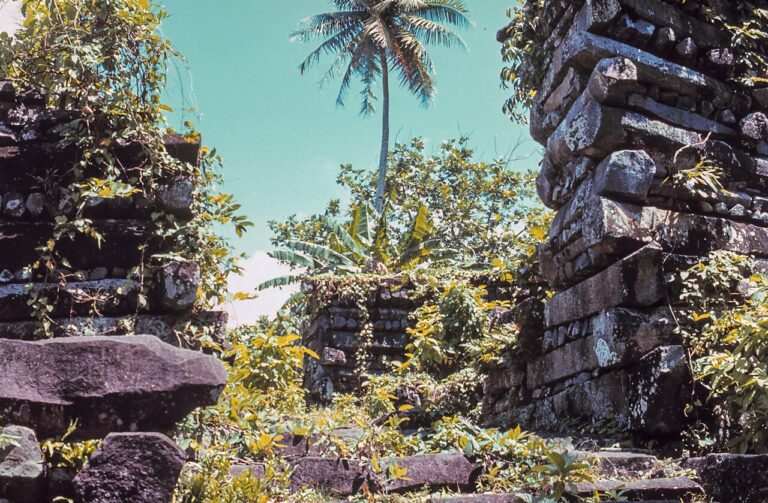
    But this South American parallel is not Gunung Padang’s only overseas’ comparison. No less great is an astounding, perhaps kindred mystery 4,345 kilometres northeast from Java, in a remote corner of the western Pacific Ocean. Off the coast of the Micronesian island of Pohnpei ‘ ‘Built Upon An Altar’ ‘ stand the massive ruins of a long-dead archaeological site. Incongruously built on a coral reef less than two metres above sea level, Nan Madol ‘ ‘Spaces In Between’ ‘ is a series of rectangular islands and colossal towers choked by draping vegetation. Ninety-two man-made islands are enclosed within the ‘downtown’ area’s 2.6 square kilometres. All are inter-connected by an extensive network of what appear to be massive canals, each nine metres across and more than one metre deep at high tide.

    An estimated two hundred fifty million tons of prismatic basalt ‘ related to Gunung Padang’s andesite ‘ went into the construction of Nan Madol. Its stone girders rise in a cribwork configuration to eight metres. Between four and five million stone columns went into the construction of this prehistoric megalopolis. These prismatic columns range in length from one to four metres, although many reach six metres. Their average weight is around five tons each, but the larger examples weigh twenty or twenty-five tons apiece. An estimated four to five million basalt pillars, girders and logs went into building Nan Madol. It is, in effect, a double-walled enclosure comprising thirteen thousand, five hundred cubic metres of coral, with an additional four thousand, five hundred cubic metres of basalt. Remove all concealing vegetation, and visitors would behold crudely worked masses of basalt contrasting with orderly courses of stone rising in massive towers and overpowering walls amid a complex of smaller, rectangular buildings and man-made lakes interconnected by dozens of canals and numerous steps, sometimes formed into grand staircases, and spread out over eighteen square kilometres.

    Construction migrated to the main island of Pohnpei, where a rectangular enclosure fifteen metres long by eleven metres wide, with bisecting, one-metre-high interior wall, was discovered in a remote, swampy meadow high in the mountains; its configuration and mountaintop setting are particularly reminiscent of Gunung Padang. Although the Micronesian island’s twin courtyards contain a five hundred square-metre area, a pair of inner platforms are only a third of a metre high. As at Nan Madol, roughly cut basalt boulders and basalt ‘logs’ were stacked to form the enclosure. Several others stand on Pohnpei’s southwest coast, with the largest example atop a two hundred forty-metre-high mountain. The summit is entirely surrounded by walls about two metres high connected via paved walkways to several terraced platforms.

    No one knows who raised them, when or why. Micronesian myth recounts only that exceptionally tall, twin-brother sorcerers, named Olisihpa and Olsohpa, arrived sometime during the ancient past in a ‘large canoe’ from their distant homeland. It was a great kingdom of glittering splendour, until falling stars and earthquakes eventually destroyed Kanamwayso, which sank to the bottom of the sea. This native oral tradition seems like a variation on the more famous story of Mu, or Lemuria, a deeply ancient and supposedly sophisticated, pan-Pacific civilisation that exerted lasting influence on both Asia and America prior to its destruction by a natural catastrophe similar to the tsunami that ravaged northern Japan, in 2010. Before the analogous loss of Kanamwayso, Olisihpa and Olsohpa allegedly built the basalt enclosures and staircases that continue to grace Nan Madol and Pohnpei. Despite more than one hundred years of scientific investigations, however, no known culture has been associated with these places. Meanwhile, the moist, tropical climate skewers accurate carbon-dating at both locations.

    Nor is their original purpose entirely clear. Nothing about either location suggests real urban centres, lacking as they do any provision for food production or storage. No human burials have been found there, save a few, individual skeletons of above-average stature ‘ calling to mind local myths of the founding-fathers, Olisihpa and Olsohpa ‘ unearthed by Japanese archaeologists during the 1930s. The rectangular arrangement of walls with regularly spaced openings and partitions suggest a ceremonial function. But for what people, and why in this extremely remote, obscure corner of the vast Pacific’ Nevertheless, Nan Madol’s and Pohnpei’s fundamental resemblances to Gunung Padang imply, at the very least, a relationship of some kind, however inconceivable.

    14,000 BCE’

    Yet more extraordinary than even these comparisons and the monumental greatness of the Indonesian site itself is its uniquely profound age. The first archaeological survey of Gunung Padang appears in a ‘Report, the Department of Antiquities’ (Rapporten van de Oudheidkundige Dienst) for Holland’s colonial office, whose anonymous author posited during 1914 that the ruins could not predate the official beginning of Java’s history in the early 5th century CE, although they appeared much older. For the rest of the 20th century, the site went unrecognised by the outside world, even after it was briefly mentioned by the prolific Dutch archaeological author, Dr. N.J. Krom, in 1946’s Under Palm And Banyan Trees.5 

    Thirty-three years later, a Canberra team from the Australian National University’s Centre for Archaeological Research ‘ ‘dedicated to investigating and learning with and about the people, languages, and land of Asia and the Pacific region’ ‘ returned for the site’s first, scientific examination.6In doing so, they determined that Gunung Padang was far older than previously imagined. Lichen growth alone covering many of the megaliths bespoke an antiquity going back millennia before Java’s earliest known culture. Not until February 2012, however, was a State-sponsored evaluation of the site carried out, when thorough radiocarbon testing revealed it was built and first occupied about 4,800 years ago. This surprisingly early Third Millennium BCE date placed Gunung Padang squarely within Western Europe’s Megalithic Age, with implications for transoceanic contact, however heretical such considerations struck conventional scholars.

    But as the researchers were carrying out their investigations, they noticed traces on Mount Padang’s surface of what might be other, underground structures. No less a supporter of science than the President of Indonesia himself, Susilo Bambang Yudhoyono, lavished the archaeologists with costly GSSI and Multi-Channel SuperSting R-8 ground-penetrating radar units, plus GEM-Ovenhausser geo-magnetometers. These state-of-the-art instruments readily found and accurately confirmed the existence of large and small chambers, walls, gates and staircases buried deep beneath the often-visited, open-air ruins in a virtual subterranean mirror image of Gunung Padang.

    According to team leader and geologist, Dr. Danny Hilman Natawidjaja, ‘3-D geo-electric and geo-radar [procedures] discovered two doors in the hallway’ of a chamber measuring ten-by-ten-by-ten metres at a depth of twenty-five metres.7 Throughout last summer and into early fall, he and his twenty colleagues ‘ leading seismologists, philologists, archaeologists, anthropologists, and petrographers ‘ carefully dredged up organic materials, which were sent for laboratory testing in the United States, because the Indonesians were determined to avoid any appearance of politically motivated results.

    ‘US lab validates Cianjur ‘ancient structure’ theory,’ The Jakarta Post announced on 5 November. ‘A recent analysis of carbon-dating by the Miami-based Beta Analytic Lab has apparently validated findings by a government-sanctioned team that a man-made structure lies buried under Mount Padang in Cianjur, West Java. The lab used samples of sand, soil and charcoal found at a depth of between three and twelve metres beneath the mountain’s surface. Based on geo-electric, geo-radar and geo-magnetic [surveys], a large chamber is buried at least up to fifteen metres from the surface’ Carbon-dating test results from the Miami lab show that the structure could date back to 14,000 B.C., or beyond.’8

    Since publication of The Jakarta Post report, repeated and additional analysis by Beta Analytic scientists confirmed their initial 14,000 BCE findings. The significance of this discovery cannot be over-stated, because it crosses the Ice Age event horizon. Even Turkey’s Gobekli Tepe, for all its Tenth Millennium BCE antiquity, came into being only after the close of the last glacial epoch, when environmental conditions were moderating sufficiently to allow for the development of proto-civilisation. Less distracted by the incessant challenges to their survival, our ancestors were afforded opportunities for broader, more complex social cooperation. But Gunung Padang proves that humans were already in possession of a relatively high culture two thousand years earlier, while the Ice Age was still in progress.

    This ‘Shrine of the Sun’ has radically pushed back the origins of civilisation to remoter levels of time and space, because mainstream palaeo-anthropologists, fixated on Europe and the Near East, are resistant to the very notion of mankind’s transition from ‘savagery’ in Indonesia. Yet, it is precisely here that Stephen Oppenheimer, a British geneticist, member of Green Templeton College, Oxford, and an honorary fellow of Liverpool School of Tropical Medicine, traced the beginnings of civilised mankind with his controversial Eden in the East, in 1999.9 It had been preceded during the previous century by The Lost Continent of Mu, written by another Englishman, James Churchward, an Imperial British Army colonel serving in India, where his translation of original Hindu monastery source materials likewise recorded how humans took that first step in the Western Pacific realm.10 My own The Lost Civilization of Lemuria (2006) and Before Atlantis (2013) similarly trace the rise of homo erectus in Java, his Pacific-wide dispersal and accelerated evolution after the eruption of history’s greatest volcanic event, and his descendants’ subsequent invention of civilisation.

    These conclusions are wonderfully brought to life by recognition of Gunung Padang as Man’s earliest-known megalithic complex. Its apparent sophistication declares that it was not the first, but must have been preceded by the construction of even earlier ceremonial centres. Civilisation is, therefore, older than we presently comprehend. If, however, the quest for its ultimate origins goes on, and deeper into the past than ever imagined, then at the very least, Gunung Padang is pointing us in their proper direction.

    You can read more about ancient civilisations, including articles on an ancient pan-Pacific civilisation and Turkey’s Gobekli Tepe, in New Dawn Special Issue Vol 7 No 1.

    If you appreciated this article, please consider a digital subscription to New Dawn.

    Footnotes

    1. Kurt Mendelssohn, The Riddle of the Pyramids, London: Thames & Hudson, 1974.

    2. Robert M. Schoch, Voices of the Rocks, NY: Harmony, 1999.

    3. Ringing Rocks Park, Upper Black Eddy, Pennsylvania, www.youtube.com/watch’v=V4VtjFhysgc;Ringing Rocks Park, Lower Pottsgrove Township, Pennsylvania, www.youtube.com/watch’v=NBfrLoBpsIQ; Ringing rocks, Queensland, Australia, www.youtube.com/watch’v=dl_zL4g2gvs;Musical Stones of Skiddaw, England, www.youtube.com/watch’v=inWKcmVEwvs; Ringing Rocks, Montana, www.youtube.com/watch’v=smiCS1Ixfts; Cerro de las Campanas, Querétaro, Mexico,www.youtube.com/watch’v=_dMRcnlZ2tk; The Ringing Stone, or Clach a’ Choire, Scotland,www.youtube.com/watch’v=eNn-4O_G-bU

    4. www.abovetopsecret.com/forum/thread880575/pg1

    5. Dr. N. J. Krom, Onder Palmen En Waringins, Holland: Uitgeverij in Den Toren, 1946.

    6. ANU Centre for Archaeological Research, http://chl.anu.edu.au/archaeology/car.php

    7. www.abovetopsecret.com/forum/thread880575/pg1

    8. ‘U.S. lab validates Cianjur ‘ancient structure’ theory,’ 5 November 2012, The Jakarta Post,www.thejakartapost.com/news/2012/11/05/us-lab-validates-cianjur-ancient-structure-theory.html.

    9. Stephen Oppenheimer, Eden in the East, London: George Weidenfeld & Nicholson, Ltd., 1999.

    10. Col. James Churchward, The Lost Continent of Mu, U.S.: Brotherhood of Life, 1987 reprinting of the 1924 original.

    11. Frank Joseph, The Lost Civilization of Lemuria, U.S.: Bear and Company, 2006; Before Atlantis, U.S.: Bear and Company, 2013.

    FRANK JOSEPH has published more books (eight) about the lost civilisation of Atlantis than any other writer in history. These and his twenty, other titles dealing with archaeology, military history and metaphysics have been released in thirty-seven foreign editions around the world. He was the editor-in-chief of Ancient American, a popular science magazine, from its inception in 1993 until his retirement fourteen years later. He lives today with his wife, Laura, in the Upper Mississippi Valley of the United States.

    The above article appeared in New Dawn No. 136 (Jan-Feb 2013).

    Read this article with its illustrations and much more by downloading
    your copy of New Dawn 136 (PDF version) for only US$5.95

    © Copyright New Dawn Magazine, http://www.newdawnmagazine.com. Permission granted to freely distribute this article for non-commercial purposes if unedited and copied in full, including this notice.


  • 2012: Scientists Prove Ancient Alien Cauldrons in Siberia are Real

    2012: Scientists Prove Ancient Alien Cauldrons in Siberia are Real

    A team of scientists and researchers have just returned from an expedition in Siberia and the Valley of the Dead and are claiming they have found proof of at least five of the legendary cauldrons that ancient aliens supposedly built.

    A team of Russian scientists and researchers have just returned from the ?Valley of Death? region in Siberia with startling claims.  Lead scientist Michale Visok had this to say in an interview with a Russian newspaper on what they had found:

    We went out into the Valley of Death to really see and investigate the metal cauldrons that people claim exist there and we actually found five metallic objects buried in marsh like swamps?

    Michale gave the following details about these metal objects:

    1. They are each submerged in small pools of swamp like water that is anywhere from 2-3 feet deep.
    2. They are definitely metallic.  The scientists entered each swamp and walked on top of the objects and heard metallic sounds when striking the objects.
    3. The tops of the objects are very smooth to the touch but there are sharp points along the outer edges.
    4. 2 of the team members got ill during the investigation.
    5. The team consisted of 3 geologists, 1 astrophysicist, 1 mechanical engineer and 3 research assistants.

    Asked what does the team think they have discovered?  Could it be something built by ancient aliens like so many people believe? Michale declined to comment other than ?there is definitely something weird out there, we have no idea what they are or what they were used for?.

    Michale and his team are planning another expedition in the coming weeks before colder weather will make the trip impossible for the rest of the year.  He hopes to actually retrieve a piece of the metal objects by using a diamond drill bit but said he is very cautious about possibly damaging whatever they are.

    So could these objects really be ancient alien artifacts?  According to many believers, these cauldrons are actually defense weapons built by ancient aliens to defend our planet against all space based threats whether by hostile aliens, asteroids or comet strikes.  Many people site the numerous meteorites that have crashed or exploded in the area as evidence of this including the famous Tunguska meteorite in 1908, the Chulym meteorite in 1984 and the Vitim meteorite in 2002.

    Lets hope Michale and his team can get more answers and actually be able to retrieve a sample of the objects so we can really determine if these are alien built or not.  I know I am intrigued ??..

    normalvod1_1-120x70


  • 1992: Z. V. Togan: The Origins of the Kazaks and the ôzbeks

    1992: Z. V. Togan: The Origins of the Kazaks and the ôzbeks


    H. B. Paksoy

    [First published in Central Asian SurveyVol. 11, No. 3. 1992]

    [Reprinted in H. B. Paksoy, Ed. CENTRAL ASIA READER: The Rediscovery of History (New York/London: M. E. Sharpe, 1994) 201 Pp. + Index. ISBN 1-56324-201-X (Hardcover); ISBN 1-56324- 202-8 (pbk.) LC CIP DK857.C45 1993 958-dc20]


    Editor’s Introduction

    A professor of history for over half a century, Zeki Velidi Togan (1890-1970), a Bashkurt Turk, studied and taught in institutions of higher learning on three continents, including the United States.1 His first book, TÅrk ve Tatar Tarihi (Turk and Tatar History), was published in Kazan in 1911. The renowned scholars N. Ashmarin and N. Katanov (1862-1922),2 both of Kazan University, and V.V. Bartold (1869-1930) of St. Petersburg University, invited Togan to study with them.

    In 1913, Togan was asked by the Archeology and Ethnography Society of Kazan University to undertake a research trip to Turkistan. After successful completion of that endeavor, the Imperial Russian Academy of Sciences,3 jointly with International Central Asia Research Society, sponsored Togan for a more extensive expedition. Portions of Togan’s findings began to be published in scholarly journals prior to the First World War. His lifetime output approaches four hundred individual items in at least five languages. He also had facility in several others. Like the Ukrainian scholar Mikhail Hrushevsky (1866-1934) and the Czech Thomas Masaryk (1850-1937), Togan was not only a scholar devoted to writing about the history of his nation, but also worked to secure its intellectual, cultural, civil, and political independence. He became a leader of the Turkistan National Liberation Movement in Central Asia (1916-1930s), called the Basmachi Movement by the Russians. A revealing anecdote is offered by A. Inan, a close colleague of Togan both as a historian and as a leading member of the Turkistan National Liberation movement. The event takes place in June 1922 in the vicinity of Samarkand:

     When a Bolshevik military unit, detailed to liquidate us, opened fire, we took refuge in a nearby cemetery. As we began defending ourselves, I noticed that Togan had taken out his ever-present notebook and was busily scribbling. The circumstances were so critical that some of those among our ranks even thought that he was hurriedly recording his last will and testament. He kept writing, seemingly oblivious to the flying bullets aimed at him, and the accompanying sounds of war. I shouted at him from behind the tombstone that was protecting me, and asked why he was not fighting. Without looking up, continuing to write, he shouted back: You continue firing. The inscriptions on these headstones are very interesting.4

    Togan’s investigation of the origin of the Kazaks and the ôzbeks is adapted from his TÅrkili TÅrkistan, a project he worked on during the 1920s, a period when he was establishing extensive contacts with the Central Asian population from Ferghana to the shores of the Caspian on behalf of the Turkistan national liberation movement. After he left Central Asia, and earned his doctorate in Europe, he continued his research using published sources. Though completed in 1928, the work was not published until 1947, in Istanbul.

    Togan’s analysis and documentation in the excerpt printed here may contribute to the clarification of the issues involved in efforts to rediscover the ethnogenesis of the UzbeksKazakhs,5 and other Central Asians. It should be recalled that these designations are primarily geographical, tribal, or confederation names, not ethnonyms. Often they were taken from geographic reference points by travelers and then were mistakenly or deliberately turned into ethnic or political classifications. Early in the eighth century, Central Asians themselves provided an account of their identity, history, and political order.6 Later efforts to identify and disseminate information concerning the genealogy of Central Asians can be traced to a wave of native Central Asian leadership that was suppressed in the Stalinist liquidations. Examples from the period survive in abundance, in Central Asian dialects, published in three alphabets in various Central Asian cities.

    Notes

    • 1. In addition to Togan’s Hatiralar (Memoirs) (Istanbul, 1969), this account makes use of bibliographic material appearing in Fen-Edebiyat FakÅltesi Arastirma Dergisi, AtatÅrk öniversitesi, Erzurum (Sayi 13, 1985) and information provided by Togan’s colleagues, students, and family friends.
    • 2. Despite their names, neither was Russian, but both had been baptized. Togan calls Katanov a Sagay-Turk from the Altai region, and Ashmarin a Chuvash-Turk.
    • 3. For a description of the formation of the Academy, see R.N. Frye, “Oriental Studies in Russia,” in Russia and Asia: Essays on the Influence of Russia on the Asian Peoples, ed. Wayne Vucinich (Stanford: Stanford University Press, 1972).
    • 4. Over the years I have been told of this incident independently by several students and friends of both Inan and Togan. Later in life it seems to have occasioned numerous droll exchanges between Inan and Togan; every time Inan mentioned the incident, Togan relished recounting the story of Inan’s having been “wounded” in the same battle. The two men endured arduous times together, both in Asia and Europe, and later in their careers became colleagues at Istanbul University, where, reportedly, each sent his students to the seminars of the other. On one occasion toward the end of their lives, when Inan became seriously ill, Togan asked his doctoral students to visit Inan at the hospital and read him passages from Togan’s Hatiralar (which was still in manuscript), especially the portion about “Inan’s wounding.” Indeed, Togan records the fighting in his memoirs, including Inan’s “wounding,” but not his own “note-taking.” He simply states that he “read the headstones written in the Kufi script” (Hatiralar, p. 414). Togan identifies the location of the cemetery as Qala-i Ziyaeddin.
    • 5. Note that Togan and other historians spell these words ôzbek and Kazak, respectively. “ôzbek” is the only form encountered in the material published in Tashkent during the 1928-39 period, when a subset of the Latin alphabet was used. The term “Cossack” (Russian: Kazak), incidentally, is a corruption of “Kazak” (Russian: Kazakh), though there is little, if any, ethnic relation between them. Similarly, the term “Tatar,” as found in the KÅltigin (of the Orkhon group) stelea of the eighth century A.D., is a correct rendition. During the Mongol irruption of the thirteenth century, Western authors inaccurately used “Tartarus” (which actually refers to “the infernal regions of Roman and Greek mythology,” hence, hell), yielding the form “Tartar.” By that time “Tartarus” had already been assimilated into Christian theology in Europe. Possibly St. Louis of France was the first, in 1270, to apply this unrelated term and spelling to the Chinggisid troops of Jochi.
    • 6. These were recorded on scores of stelea, written in their unique alphabet and language, and erected in the region of Orkhon-Yenisey. See Talat Tekin, A Grammar of Orkhon Turkic. Indiana University Uralic and Altaic Series, vol. 69 (Bloomington/The Hague: Mouton, 1968) (contents dating from the eighth century).

    THE ORIGINS OF THE KAZAKS AND THE ôZBEKS

    The Concepts of Tatar, Kipchak, Togmak, and ôzbek Tatar, Kipchak, Togmak, and ôzbeks:

    The nomadic populace of the entire Desht-i Kipchak [Kipchak steppe], from the Tarbagatay mountains to the Syr Darya River, and from Khorezm to the Idil [Volga] basin and Crimea, were termed “Togmak” during the era of the Mongols, prior to the spread of Islam. Among the Khiva ôzbeks, the term (in EbÅlgazi)a known as “Togma”; Baskurts “Tuvma;” Nogay (according to the Cevdet Pasha history),b “Tokma” designated individuals without a known lineage, or fugitives to be sold as slaves, being offenders of the law. The negative connotation ascribed to this term, generally referencing the Kipchaks and Altin Orda (Golden Horde) Tatars, must have occurred after the spread of Islam. It is not known that the Jochi Ulus utilized that appellation. It appears that this tribe, known as “Togmak,” had been designated as “ôzbek” after “ôzbek Khan” (1312-1340). According to Bartold, the terms “ôzbek” and “ôzbek Ulus” have been utilized in Central Asia to distinguish this tribe and its entire military population from the “Chaghatay”; until the dissolution of the Altin Orda during the fifteenth century, and the dissemination of its uruk as ôzbek, Kazak, and Nogay Ulus. Their identifying battle cry was the word alach.

    It is necessary to define some of the ethnic terms in use in the Jochi Ulus: The ôzbeks of today, living in Transoxiana and Khorezm, comprise the dominant group known under the general rubric “tatar” in the Jochi Ulus. However, it is possible that the term “tatar” was used in a wider context, applying not only to the dominant group but perhaps also to the dominated. The term Kipchak also has dual connotations, applying narrowly and specifically to the Kipchak lineage as well as generally and broadly to the entire populace of the Kipchak steppe, including the ôzbeks. According to our findings, the term “tatar” earlier applied within the Jochi Ulus only to the Turk and Mongol elements issuing from the east, to the dominant component, and “kipchak” to the subject nomadic tribes of the steppe. The term “Togmak” became the general term of reference to all. After the ôzbek Khan, the word “ôzbek” applied to all “Tatar” and “Kipchak” in their totality, replacing “Togmak.” However, the Kipchak and the “Tatar,” arriving from the east during the age of the Mongols, mixed with the elements of the older civilization of the land, as opposed to the nomadic tribes, and started forming, let us say, the “Yataq Tatar” or “Yataq Kipchak.”* Then, “Tatar” began to assume a wider meaning than “ôzbek,” and the term “ôzbek” became the appellation of the nomadic aristocraciese of the ôzbek, Nogay, Kazak, and Baskurt [confederations] that separated from the Tatar and the Kipchak societies. Nevertheless, although the word “Tatar” had lost its previous meaning, in the vernacular of the people it continued to be utilized as “Elin Tatari,” meaning the “Aristocracy of the Land.” Moreover, since the trade was in the hands of the Tatar “Ortaq”f firms during the Mongol period (especially Mongol and Uyghur), “Tatar” also meant “merchant.” During the fourteenth and fifteenth centuries, when the dominant military-nomadic Tatar and Kipchak amalgamation of the Jochi Ulus emerged as the ôzbeks, those not belonging to the ruling tribes formed other strata as follows:

    • 1. “As,” of the old civilization of the Kipchak steppe, in the vicinity of Astrakhan and Saray; “Bulgar-Kazan” Turks of the Middle Idil; Burtas and Mokshi (in Islamic and Mongolian sources, “Mîks”); in the Crimea region, “Tat” and the remnants of the old Khazars; Istek and Ibir-Sibir tribes in western Siberia;
    • 2. Kipchak and Bashkurt, who were settled. Those among them in the region of the Urals are also known as “Tepter” (defter), having been so recorded in registers;
    • 3. Some portions of today’s Kazak and Baskurt, who stayed away from political life, living from earlier times as neighbors of the Siberian tribes of “Istek.” Even today, it is possible to distinguish the dominant and subject Turks within the Jochi Ulus: the dominant uruks remember the dastans of historical personages and the traditions of the steppe aristocracy, while the subject uruks remember only the dastans of the shamanistic mythology and traditions of “charva” and are unaware of the political and historical dastans.

    The Language, Customs and Traditions of the Old Kipchak-ôzbek

    The fourteenth- and fifteenth-century Arab authors (Ibn Battuta, Ibn Fadl allah al-Umari, and Ibn Arabshah) have described well the life, mores, and character of the ôzbeks and the Kipchaks of the Kipchak steppe. According to Ibn Arabshah, the ôzbek Turks of the Kipchak steppe are regarded as possessing the most lucid language, their men and women are the most handsome, generally displaying aristocratic bearing, not deigning to trickery or lies, being the gentlefolk of all the Turks.h The language of these ôzbeks, living from Yedisu to Crimea, can be observed in the poetry fragments and other monuments coming down to us, is generally the same; and its Kipchak characteristics have been partially preserved in the speech of today’s ôzbek, Kazak, and Mangit-Nogay. Their way of life and customs, parallel to “TÅrk-chigil” and “TÅrkmen-Oguz” group,i is the same. Their written histories, folk literature, and especially heroic epics of the Kipchak steppe such as Chinggis, Jochi and his Sons, Edige, Toktamis, Nureddin, chora Batir,j and Koblandi, their verse stories, Cirenche chechen recitations, and others, are the same everywhere. The melodies of the Baskurt and nomadic ôzbeks are today recited among the Crimean and Constanza Nogays. The Nogay dastans are recited word for word among the Karakalpak and the Kazak of Khorezm. The old and the new Kipchak Turks did not engage in “black service” occupations and considered themselves as the master; they have not made the transition to farming except under extreme necessity, regarding it an occupation contrary to the spirit of the steppe aristocracy; and even under severe economic crisis they did not allow their daughters to marry sedentary grooms. In this regard, the Nogays had shown the greatest exaggeration, and were cut down in their tens of thousands and even hundreds of thousands during the Kalmak [Mongol] and Russian occupations. Among them, the historical personae and epic heroes such as Chinggis, Toktamis, Edige, Er Tagin, Urak Mamay, and Adil Sultan personify the spirit and the ideals of the steppe aristocracy. In the collective and unified dastan literature of the ôzbek of the old Jochi Ulus, comprising the current ôzbek, Kazak, Mangit-Nogay, and Baskurt, the following elements of ethics, moral qualities, and characteristics are discernible: exaltation of endeavor; readiness to die in defense of honor; the principle of espousing society and state above all; enduring difficulties with ease; belief that efforts expended in overcoming obstacles facilitate progress; willingness to undertake long and arduous journeys; women’s desire only for men in possession of these qualities; and the elevated position of noble women and mothers in the society. These are all proclaimed in the literature of the old Tatar and Kipchak aristocratic strata, meaning ôzbek literature.

    Generally, the good and the bad customs and habits of the old Turks are evident even more overtly among the ôzbek-Kipchak: imperturbability (levelheadedness); dislike of confusion; moderation; courage; an affinity for being in charge; harshness in battle but extreme calmness in peace; not killing but selling of prisoners; purity of heart and honesty; their extreme sincerity taken advantage of by the enemy; amplifying small conflicts between individuals and uruks, causing them to drag out over years and even generations; becoming materialistic under severe economic conditions, which culminates in the selling of family members or stealing and selling of others. All these are the attributes of the ôzbek and the Kipchak, recorded by the Arab travelers beginning with Ibn Battuta, since the time of the ôzbek Han.

    Division of the “ôzbek” Society into ôzbek, Kazak, and Mangit-Nogay

    The division of the ôzbeks into “ôzbek,” “Kazak,” and “Mangit-Nogay” took place not in the Idil basin but while they were living in the Syr Darya basin. Sons of Jochi “Batu” and “Berke” Han had influence over the chagatay Ulus; most of Transoxiana was subject to the Altin Orda. Khorezm and the lower Syr Darya, beginning from the Otrar region, belonged to the Jochi Ulus according to the division of the Mongols. In the military organization of the Jochi Ulus, this area constituted the “Sol Kol” tribes; in the administrative division, it formed the “Gîk Orda.” During 1358-61, when the affairs of the Altin Orda (also known as Ak Orda) became muddled, the “Kiyat” beys, commanding all the troops of the “Sag Kol” [Right Flank] tribes, brought them to Crimea, and the “Sol Kol” [Left Flank] tribes to Syr Darya. At the time, since the lineage of Batu had come to an end, according to the yasa [Mongol customary law]k and the law of inheritance, the ultimate rule was passed on to the descendants of Shiban Han,* Jochi’s fifth son. Many ôzbek uruks in today’s Turgay province, in the vicinity of “Ak Gîl” [White Lake], raised to the throne as Han Hizir, who was a descendant of the Shiban. Nayman, Karluk, Uyghur, Kongrat, and Bîyrek uruks were in favor. However, the rule of this descendant of Shiban was confined to a portion of the “Sol Kol” confederations and the “Tura” stronghold of the Tobol basin in western Siberia. The uruks of the Syr Darya of the Sol Kol raised “Kara Nogay Han,” a son of SÅ Bas, descendant of “Tokay TemÅr,” who had not until that day been involved in the affairs of government. It appears that the “Sol” uruks of this region comprised Shirin, Barin Kipchak, Argun, Alchin, Katay, Mangit, and KÅrlevÅt, collectively known as “Yedi San.”l The bases of these Sol Han were in the cities of Yenikend, Cend, Barchinlig Kent, Sabran, Otrar, and the core, Siginak. Evidently, some of those uruks were even then involved in the affairs of the Transoxiana. Among the soldiery of TemÅr,m the Kipchak and the Nayman played important roles. During the era of TemÅr’s sons, ôzbeks became rather powerful (1427), under the leadership of “Barak Han,” a descendant of Tokay TemÅr. When Barak was killed in 1429, descendants of Shiban Han occupied Syr Darya basin. Accordingly, the real center of the Jochi Ulus (Ak Orda) moved next to Transoxiana. At the same time, Mangit, who were backing the descendants of Tokay TemÅr, acquired great influence under the rule of “Edige Beg,” which means “TemÅr Bek of the Altin Orda.” Other uruk joined them, and all together became known as “Mangit,” because of the appellation of the dominant uruk, and on the other hand as “Nogay” (probably because they raised Kara Nogay Han). Hence I have used the appellation Mangit-Nogay throughout this work. At the beginning of the sixteenth century, “Shiban-ôzbek” Han and the uruks subject to them arrive and settle in Transoxiana and Khorezm. At that time, the western regions of today’s Kazakistan, as well as Baskurt and Tura lands, became subjected to Mangit- Nogay in their entirety. In this manner, a strong Mangit-Nogay society is constituted as opposed to the ôzbeks. The aforementioned rulers, Kirey and Canibek, sons of Barak Han, were subject to the famous Ebulkhayir of Shiban descent. In 1466 they left this Han and became “kazak,” sought asylum from the descendants of chagatay to their east (the Hans ruling in the environs of Kashgar and Yedisu), acquired the obedience of some uruks to themselves, and with that aid once again obtained the allegiance of uruks that owed fealty to them but were living in the domains of the descendants of Shiban. Accordingly, next to the “Shiban ôzbek,” a “Kazak ôzbek” society was established.

    Thus, the ôzbek society comprised three powerful groups during the second half of the fifteenth century. What earlier belonged to the Gîk Orda Han and the descendants of Tokay TemÅr became the domains of Shiban Han. The possessions of the Shiban are taken over by the Nogay princes. Kazaks, on the other hand, demanded shares in both as well as in the chagatay domains. During the mid-sixteenth century, the “Mangit-Nogay” princes were situated in “Arka” and “Ulu Tav,” which constitutes the center of today’s Kazakistan; began meddling in the affairs of lands west of Idil, even the shores of Azak; and slowly shifted westward. The lands in contention, the lower Syr Darya basin and Arka regions, became depopulated. As a result, these regions came under the rule of Kazak Hans, who previouly had lived in Talas and chu. During the second half of the seventeenth century, first the “Nogay” and later, during the first half of the eighteenth century, “Kalmak” matters became upset, and Kazak Hans became the sole ruler of all steppes east of the Yayik [Ural] river. Nogay withdrew toward Crimea and the northern Caucasus. Kazak Hans, after separation from the Shiban ôzbeks, began referring to their neighboring Kazaks as “Kazak ôzbekleri.” In Haydar Mirza Douglat’s history, they are also so termed.n Kazaklar

    The Word “Kazak” and the Concept of Being a “Kazak”

    The name “Kazak” was at first reserved for the rulers; later, it also applied to tribes owing fealty to them and to the states they wished to establish. Prior to that time the name “Kazak” did not even apply to a tribal confederation, let alone to the state. Generally, the term “Kazak” was employed to designate those who were left without a family (boydak) due to a rebellion of political nature; sometimes those who withdrew from society, to the mountains and wildernesses, to await more favorable times before taking over governmental matters, without the benefit and protection of the tribe; to adolescent boys who had been separated to help them become accustomed to life; and to those who left their lands to become ordinary brigands. Under the influence of the Turk, the tradition of sending the sons out with a weapon also became accepted among the Russians and recorded in Islamic sources, and is referenced as “Kazak” in Turkish even today as well as in the past. A political person becoming Kazak leaves that designation after settling down in a land following conquest, or joining another political personage to legitimize himself. He remembers his “Kazak” past as days of his youth when he learned to endeavor and endure difficulties (like TemÅr, and among his sons Ebu Sait Mirza, HÅseyin Baykara, BabÅr Mirza, and, from among the ôzbeks, Shiban Han and his followers). Of course, a man can be a Kazak only for a few years in his lifetime. In that context, the concept of “Kazak” is in opposition to statehood. Kasim Han and his son Hak Nazar, descendants of Canibek and Giray, who had become kazak toward the end of the fifteenth century, tended to view their own states in that way, as temporary.

    At the end of the sixteenth century (1599), the Kazak rulers left the “chu” region under pressure from the northeastern Kalmaks, and took refuge in the strongholds of Tashkent and environs. Until 1723 and another Kalmak rout, they settled in those regions and attempted to have the steppe tribes convert to sedentary agriculture. In pursuit of that policy, “Tug Baglayip,” which means announcing the official flag of the state, established some sort of administrative apparatus and attempted to establish a state “devlet tÅzÅmek” by grouping the troops into “YÅz” [hundred] and “Bin” [thousand]. The Orda (headquarters) of the Han was divided into three, namely “UluyÅz,” “OrtayÅz,” and “KichiyÅz.” Among the ôzbek, the terms “Han” and “Kalgay” were used to designate the ruler, the first heir, and the second heir; among the Nogay, “Bek,” “Nuradin,” “Keykubad” signified the same ranks. It is though that the act of dividing the Han Orda into three (names alternately used were “Ulugorda,” “Ortaorda,” and “Kichikorda”) was inherited from a time when an experiment in pursuit of establishing a governmental structure was conducted.

    However, the pressure of the Kalmaks, and later, the Russians (from Siberia), did not allow them to establish a permanent government and live under that structure, encompassing the elements of all the tribes. The tribes living in the territories northeast of the steppes, having termed themselves “Kazak,” adopted the ôzbek and Nogay aristocracy’s equivalent of an “animal husbandry, tent-dwelling” way of life. The weakness of the Kazak statehood was of course affected by that.

    The Growth of Kazaks

    The portion of the steppe inhabited by the ôzbeks became the domains of the Nogay, who became subject to the Kazak Hans. During the sixteenth century (at the time of the Saydak and Yusuf Mirza), the Mangit-Nogay on the eastern side of the Idil alone numbered about two million. The formation of the TemÅr state in the east and conquest of Istanbul and the annexation of Crimea in the west forced the tribes of the Idil to choose between “Bukhara” (Transoxiana) and “Rum” [Asia Minor]; I shall return to [this matter] in the history section below. This did not allow the retention of the tribes in the lower Idil and Yayik in order to structure a powerful state. When in 1558 the Russians intruded into these domains, depriving the tribes of their herds and forcing them to live under individuals such as Alchi Ismail, who worked with the Russians, the tribes were dispersed.

    Continued attacks of the Kalmak, and finally their settling between Idil and Yayik during 1643, forced an important portion of the Nogay, with the political and aristocratic strata at their head, to move to Crimea, and from there to the Caucasus and further west. But the overwhelming majority of the two million Nogay living to the east of Idil remained there. A portion of them migrated to Khorezm and the Syr Darya basin. In that regard, new tribes arrived in Transoxiana from the Kipchak Steppe at the time of the AbdÅlaziz (1645-1680) and SÅphan Kulu (1680-1702), the descendants of Astrakhan Hans now ruling in Bukhara, strengthening the Kazak Hans. Likewise, the “Kazak” tribes living in Turgay and Ural consist of those tribes earlier included under Nogay. During the second half of the sixteenth and the seventeenth century the evacuation by the Turk tribes of the Idil basin was so serious, especially after the Kalmak migrations to the west of Idil and to Jungaria, that the Idil-Yayik region was virtually empty until the nineteenth century. The “Kazak” tribes arriving here in 1801 under the rule of BÅkey Han of the KichiyÅz consisted entirely of “Nogay” tribes who had lived there earlier.

    During the third quarter of the eighteenth century, the Kazak Hans were in control of the region from “Idil” and “Yayik” to Jungaria, receiving patents from the Russian (St. Petersburg) and Chinese (Beijing) governments, regarding the patents as those governments’ special praises of the Kazak Hans. The tribes, living over such a wide territory and apart from each other on the steppes, did not distance themselves from each other in language and customs. On the contrary, they have preserved the unity of their dialect, customs, and traditions, despite their illiteracy, because of their intermixing at the time of the Kalmaks, and later during the competition of the Hans, migrating from one region to the next, from east to west, and then again from west to east. The emergence of their common heroic personae- -through their struggles with the Kalmak on the steppes, through large gatherings (for example, the wedding celebrations of the Hans and the Beys, and “as” feasts, or “Yog” ceremonies), through the participation of representatives of all “Kazak” tribes in the poetic contests held at such occasions, and through the recited poems which propagated the styles and common traits throughout the tribes–preserved the traditions and customs. Today, from Jungaria to the Idil basin, the dialect of the Kazaks is altogether the same. However, their long life away from the influence of a central Han; their nonparticipation in large political events, resulting in isolation from international political life; and their preoccupation with tribal politics in addition to living with the spirit of “Kazaklik,” have not failed to influence these Turks. Generally, in political and intellectual life the old “Kazaklik” is still regarded as a virtue. They are also wary of other, neighboring Turks. This, of course, is the negative aspect of Kazaklik. On the other hand, since the Kazaks are not under the strong influence of an old culture, they are better and speedily able to grasp the contemporary scientific methods and ideas faster than the neighboring cultivated Turk tribes. Kazak tribes and their divisions: “UluyÅz” included eleven uruks: Duvlat (its oymak are: Buptay, Cimir, Siyqim, Canis), Adban, Suvan, chaprasti, Esti, Ochakti, Sari Uysun, Calayir, Qangli, Chanchkili, and Sirgeli. According to old reckoning, “UluyÅz” population totals 460,000. They live in the Yedisu and Syr Darya provinces.

    “OrtayÅz” has five uruks: Girey, Nayman, Argin, Qipchaq, and Qongrat. Girey has two oymaks: “Uvak Girey” (aris: Cantiqay, Cadik, chiruchi, Iteli, Qaraqas, MÅlgÅ, chobar-Aygir, Merket, It-Imgen, Cas-Taban, Sarbas, chi-Moyun) and “Qara-Girey” (aris: Morun [soy Bayis Morun, Siban, Qurdcay, Tuma and Baysiyiq Semiz Nayman, Bulatchi, Toqpaq] and Bay-Ciket [soy Cumuq and Tugas]). Girey live in the Kara Irtis, Irtis, Obagan, Kisma Isim, and Oy river basins. “Nayman” tribe has twelve oymaks: Aqbora, Bulatchi, Ters Tamgali, Tîrtovul, Kîkcarli, Ergenekti, Semiz Baganali, Sadir, Matay, Sari Cumart, Qazay, Baltali. Nayman were living in the direction of Ulutav, Balkas, and Tarbagatay. According to old reckoning, they number 500,000. Of their lineage, Baganali has three aris: Toqbulat (soy Ciriq, Ibiske, Qizil Taz, Qara Bala, Sari Sargaldaq); Sustan (soy: Boydali, Bes Bala); Aq Taz (soy Teney, Baliqchi, Qarmaqchi, Seyid [tire: Bay Emet, churtay ara Ataliq, Mamay, Babas, Bulatchi Nayman, Cumuq, Calman, Badana]). “Argin” tribe is divided into three large oymak: Mumin (aris: Bigendik, chigendik [soy: Atigay, Bagis, Qancagali, Tobuqti, Qaravul, Sari, chaqchaq Tuman, Amancul, KÅchey, Baqay, CÅzey, Aq Nazar, Tenet, Qarabas, Qalqaman, Bay Emet, Qochkar, Cetim], Madyar, Tîlek); Quvandiq (aris: Altay, Qarpiq, Temes, Agis, Qalqaman, Aydabul); SîyÅndÅk (aris: Qurucas, Quzgan, Qusqal, Tîki); in addition, there is an independent “Qara Qisek” aris (containing the soy Tîrtovul, Taraqti).

    According to old reckoning, Argin number 89,000. They are living in the Irtish, Isim, Tobol basin. “Qongrat” tribe is subdivided into two large oymak: Kîktin Ogli and KÅtenci (aris: Cemtimler, Mangitay, Qara Kîse, Quyusqansiz, Teney, Toqbulat, Baylar-Cancar, Busman). Qongrats are living in the Syr Darya basin. “Qipchaq” has four large oymak: Kîk MÅrÅn, KÅldenen, Buchay, Qara Baliq.

    Qipchaq possess numerous aris, soy, and tire. They principally live in the “Oy,” “Tobol,” and “Turgay” basins. “Kichi YÅz” is composed of three tribes: Alimoglu (in the Kazak pronunciation, “Elimolu”), Bayoglu (Kazak pronunciation, “Bayoli”), Yedi Urug (Kazak pronunciation “Ceti-ru”). The aris of “Alimoglu” are Qarasaqal (soy: chunqara [tire: Qangildi, KÅtkÅlech, Sekerbay, Batan, Car Boldi], Saribas [tire: Baqti-Berdi, Bavbek, Nazim], Busurman [tire: Nogay, GasikÅr, Cekey], Tîrtqara [tire: Turum ara: chavdar, Aviqman, Qachan, Toguz Seksen, Toqman ara: Saqal, Can-Keldi, Sekerbay, KÅtkÅlech, Khan Geldi, Qasim ara: Ayit, Seksek, Madi, Baqcan, Appaq ara: Qara-Kese, Ak-Bes, Batan]), Qara-Kisek, Kite, Tîrt-Qara, chÅmekey, chekli, Qara-Kisek, Qazan-Taban, Istek, Bayis, Esen Geldi, Cakev. Aris of “Bayoglu” are Aday (soy: Baliqchi, Aqman, TÅbÅs [tire: Zarubay, chunqay, Bavbek, Tabunay, chikem, Bebkey], Mugal [tire: chavlay, chekÅy], chibeney [tire: Cumart, chelim], Qonaq [tire: Urus, Toq-Sara], Qosay, TÅkÅchey); Cappas (soy: Kineki, Kirman, Sumruq, Andarchay, Qoldiqay, Qara-Kîz, Qalqaman), Alacha, Baybaqti (soy: Qanq [tire: KÅli Sunduq, Bavbek, Aliz], El-Teke, Bataq (tire: chabachi, Qolchiq, Sagay, Cavgati, Tuqabay, Buganay, Kîchmen, Itemke), Masqar (soy: Qutluch-Atam, Babanazar, Masaq), Beris, (soy: Sibaq, Nogay, Qayli-Qach, Can-Mirza [tire: Toqman, Bes-Qasqay] Isiq), Tazlar, Isen-Temir, chirkes (soy: KÅsÅn [tire: Samay, Umurzaq, ötegen, Ulcabay], Cavqachiq, Qis-Kistek, KÅyÅs, Ilmen), Tana, Qizil-Kurt (soy: El-chula, Subi), Seyikhlar, Altun, (soy: Calabaq, Aydurgay, Sagay). The aris of “Yedi Uruk” are: Tabin, Tama, Kirderi (soy: Yabagu), Cagalbayli, Kireyit, Tilev, Ramazan.

    Of these tribes, “Elimolu” is living in the Ural province, along the lower reaches of the Syr Darya, southeast of Aral Lake, on the eastern side of Khorezm and in eastern Bukhara; “Bayolu” tribe is in Bîkey Orda, in Ural province, Mangislak, and all of öst Yurt. “Yedi Uruklar,” on the other hand, are living in Ural and Turgay provinces. According to old reckoning, the population of “Kichi YÅz” is shown to be 800,000.

    ôzbekler

    The ôzbek Tribes Arriving in Transoxiana

    The ôzbek of the present day arrived with all the organizations and institutions existing among the Shiban ôzbeks and Transoxiana and Khorezm Jochi Ulus. In fact, the hierarchy (“orun”) occupied in government by the tribes was the same. ôzbeks, while succeeding the descendants of the TemÅr, replaced the existing establishments with their own.

    Also arriving were the elements close to the palace circles of the “Ich Eli” of the Altin Orda, meaning quite civilized components. Moreover, according to the terminology of chronicler ôtemis Haci,* the descendants of Shiban arriving in Transoxiana comprised the ruling elements of the old “ôzbek Eli” (meaning Golden Horde), “famed Tura named Mangit Villages,” meaning western Siberian “Tura” province where the settled Mangit ulus lived.p Turgay Province, with its center in today’s “Ak-Gîl,” “chalkar-Gîl,” belonged to the descendants of Shiban. Previously, Abulhayir Han, who took away the “Tura and Baskurt” regions from the other branch of the Shiban descendants from west Siberian Han Mahmudek, was governing these territories. Abulhayir later obtained the lower reaches of Syr Darya and, in 1431, Khorezm. Abulhayir pursued the policy of basing the governance of the state upon the southern and northern agricultural and settled regions of the Jochi Ulus. HÅseyin Khorezmi, the great scholar of the time, wrote a Turkish poem praising this ruler, entitled “Kaside-i Burde,” appended to one of his works. Another scholar, named Mesut Kohistani, wrote a Persian language history book depicting the life of this ruler. During the sixteenth century a large portion of the ôzbeks made the transition to village and agricultural life in the Zarafshan basin and in Khorezm. They perhaps belong to the elements arriving from the Syr Darya and “Tura” regions where they were already making the transformation. Shiban Han was a ruler accustomed to traversing the area between Syr Darya and Astrakhan. Shibanli Mehdi and Hamza Sultan, who had arrived in Transoxiana before Shiban, were the sons of Bahtiyar Sultan, the ruler of the settled regions, strongholds, and castles of the “Tura” province. It is thought that the ôzbek arriving with them did so at the time of later TemÅrids.

    Turning to the tribal organization: “ôzbek” are referred to everywhere as “doksan iki boy ôzbek” [Ninety-two Tribe ôzbek]. Here “boy” means tribe. For the Baskurt, the term “Twelve Tribe Baskurt” is used. Among the ôzbek, there is a “genealogy” naming their ninety two-tribes.

    There are slight discrepancies between the new and the sixteenth-seventeenth-century manuscript copies of the genealogy (for example, the Akhund KurbanaliKhanikov, and Sheykh SÅleyman published versions). Undoubtedly, this genealogy lists those tribes at the time of the Altin Orda, meaning prior to the separation of the Mangit-Nogay and the Kazak. They are as follows: Min, YÅz, Qirq, öngechit, Calayir, Saray, On, Qonrat, Alchin, Nayman, Argin, Qipchaq, chichak, Qalmaq, Uyrat, Qarliq, Turgavut, Burlas, Buslaq, chemerchin, Qatagan, Kilechi, Kineges, Bîyrek, Qiyat, Bozay, Qatay (Khitay), Qanli, ôzce Buluci (?), Topchi (?), Upulachi, Culun, Cit, Cuyut, Salcavut, Bayavut, Otarchi, Arlat, Kireyit, Unqut, Mangit, Qangit, Oymavut, Qachat, Merkit, Borqut, Quralas, Qarlap, Ilaci, GÅlegen (?), Qisliq, Oglan, KÅdey, TÅrkmen, DÅrmen, Tabin, Tama, Mechet, Kirderi, Ramadan, Mumun, Aday, Tuqsaba, Qirgiz, Uyruci, Coyrat, Bozaci, Oysun, Corga, Batas, Qoysun, Suldiz, Tumay, Tatar, Tilev, Qayan, Sirin, KÅrlevÅt, chilkes, Uygur, Yabu(=Yabaqu), Agir(Agiran), Buzan, Buzaq, MÅyten, Macar, Qocaliq, choran, chÅrchÅt, Barin(=Behrin), Mogul, NîkÅs [Nukus].

    Thirty-three of these tribal names belong to the Mongol, others to the renowned TÅrk tribes of the Jochi Ulus, the remainder to those unknown to us today. The tribes such as Barlas and Kavchin, who were living in Transoxiana prior to the arrival of the ôzbeks, but joined them, are not named here. Of the stated ninety-two tribes, approximately forty-five are part of the ôzbek today. The aforementioned Mongol tribes are of course those constituting the Mongol units sent to the Jochi Ulus. The majority of those tribes carrying Mongolian names are now found in the Transoxiana and Khorezm. It appears that the genealogy, which has been handed down traditionally, indicates the belief of its owners, the ôzbeks of Transoxiana and Khorezm, that they are descendants of these tribes, and therefore represent the entire forces constituting the foundations of the Altin Orda, and its transmission of the related organization to Transoxiana. Today, the subdivison of the tribes are as follows:

    • (1) Qongrat tribe: They have five oymak.
      • The first is Qancagali, consisting of following aris: Orus, Qara-Qursak, chîlik, Quyan, Quldavli, Miltek, KÅr-Tugi, Gele, Top-Qara, Qara-Boz, Nogay, Bilgelik, Dîstelik.
      • The second oymak, of nine aris: Aq-Tana, Qara, churan, TÅrkmen, Qavuk, Bes-Bala, Qarakalpaq, Qacay, Khoca- Bece.
      • Third oymak, Qostamgali, again nine aris: KÅl-Abi, Barmaq, KÅce-Khur, Kîl-chuburgan, Qarakalpaq, Qostamgali, Seferbiz, Dilberi, Cachaqli.
      • Fourth, Qostamgali oymak, seven aris: Tartugli, Agamayli, Isigali, Qazancili, öyÅkli, BÅkechli, Qaygali.
      • Fifth, Qir oymak, five aris: GÅzili, KÅsevli, Ters, Baliqli, Quba. All of these branches of the Kongrat uruk are found in the Amu Derya delta, in the provinces of Khuzar (Ghuzar) of Bukhara, Sirabad, Qurgan-Tepe. They have, to a large extent, retained the nomadic ways in Bukhara. Those in Khorezm are settled;
    • (2) Nayman tribe. Three oymak: Qostamgali, Uvaqtamgali, Sadir. They live in Khorezm and Samarkand;
    • (3) Kineges, made up of five oymak: Qayrasali, Taraqli, Achamayli, chikhut, Abaqli. They live in Shehrisebz and Khiva;
    • (4) Mangit, made up of three oymak: Toq-Mangit, Aq-Mangit, Qara- Mangit. They live in Khiva and Qarsi;
    • (5) Tuyaqli, living in Samarkand and Kette-Qurgan;
    • (6) MÅyten, living in Samarkand and Kette-Qurgan;
    • (7) Saray, living on the borders of Shehrisebz-Yekke-Bag;
    • (8) Barin, living in Ferghana province and Kette-Kurgan tÅmen;
    • (9) Khitay and (10) Qipchak: They constitute the most important segments of Samarkand and Kette-Kurgan. They are very numerous in Khiva and Ferghana;
    • (11) Min, living in Samarkand, Penchkent, Jiakh, and in Ferghana;
    • (12) öch Uruk: Misit, Tama, Yabu. They live in the vicinity of Ziyaeddin of Bukhara;
    • (13) Burqut, living along the borders of chilek and Kermine;
    • (14) Arlat, living in Qara-Kîl;
    • (15) Qangli, living at the border of Jiakh tÅmen;
    • (16) Qirk, YÅz, Min: living in Jiakh tÅmen;
    • (17) Batas, living in the vicinity of Qarsi, Ghuzar;
    • (18) Qaraqalpak, made up of five oymak: Qara-Qoylu, Qara-Singir, Oymavut, Istek, Achamayli, and living in the Amu Darya delta and north of Samarkand, at “Ak-Tepe.”

    Those ôzbek who have best preserved the old dialects and traditions are especially those living in the “Jiakh” tÅmen (Qirq, Qangli, Saliq, TÅrk, TÅrkmen, Nayman, Mangit, Qitay-YÅz, Solaqli, Tuyaqli, Alacha, Burqut, Sirkeli, Baymaqli, Calayir, Qirgiz, YÅz, Quyan-Tuyaqli, Parcha-YÅz, Qarapcha, Quschi, Oraqli, Toqcari, Qostamgali, Saray, Qancagali). However, these tribes are numerically small. In eastern Bukhara, those tribes maintaining nomadic life, in the vicinity of Dushanbe, are “Laqay,” “Marqa Kichi YÅz,” and, around Feyzabad, “Qarliq.”

    Concerning the ôzbek tribes in Afghanistan Turkistan, we are only in possession of a table prepared by the Indian Mir Ietullah at the beginning of the nineteenth century.* Accordingly, the ôzbek tribes there are as follows: At “SerpÅl” near “Sibirgan,” “Achamayli” oymak of the “Min” tribe; next to them, at “Sayyad,” “Achamayli” and “Qazayagi” of the “Min”; at Sencayrek, the “Qipchak” uruk; at Kunduz, all “Qatagan”; in the vicinity of “Balkh,” “Saray” and “Mîyten” uruks. At “Eskemis” of Badakshan, “BÅrge” and “Timis” oymak of Qatagan. In “Narin,” chagatay” uruk. Mir Izetullah also provides information on the oymak of Mîyten and Qatagan uruk: Mîyten is made up of seven oymak: Tilikhane, Germsili, Qazayaqli, chagar, Sum, Aqsayiq, chÅchen. Qatagan uruk has three oymak: Bes-Qaban, Salcavut, Tîrt-Ata. “Bes-Qaban” has five aris: Laqqa (=Laqay), Yangi-Qatagan, Kesmever, Qayan, Manas. Kesmever has four tire: Aq-Taglik, Endicani, Qalasi, Bomin. “Manas” has three tire: Temis, Sar-Bagis, BÅrge. “Tîrt-Ata” has four aris: Sariq-Qatagan, churaq, Bassiz, Mardad. “churaq” has two tire: Qiz Atizi, Sîlen. Mardad has three tire: öchata, Bozan, Cutuduq.

    Among the ôzbek tribes, there are those adopting the nickname of “Bekzad.” In the past, those had played an active role in the governance of the land and the army, and performed the enthroning ceremony of the hans. Among them, in Khiva especially Qiyat-Qongrat, Uygur-Nayman, Qangli-Qipchak, NÅkÅs- Mangit tribes; in Bukhara, at the time of descendants of Shiban, “Quschu,” “Nayman,” “Qarluq,” and “Bîyrek” tribes; at the time of the Mangit (according to Radloff) Min, Arlat, Barin, Batas uruks were well known. The “Qatagan” are also regarded “Bekzad.” Among the uruks: Tuyaqli, Mîyten, Khitay (Qatay), Mangit; and the majority of Qongrats in Bukhara are among the last arriving from Desht-i Kipchak. These were earlier members of the “Mangit-Nogay” confederation, as well as the “Kazak,” arriving later in Transoxiana.

    Editor’s Notes

    • a. Abulghazi Bahadir Khan (1603-1663), Secere-i Terakime (The Lineage of the Turks), completed in 1659. The French translation by Desmaisons is no longer satisfactory, for it lacks critical apparatus; an English translation is long overdue.
    • b. Cevdet Pasha (1822-1895) was an Ottoman historian, administrator, and educational and judicial reformer. See Stanford J. and E.K. Shaw, History of the Ottoman Empire and Modern Turkey (Cambridge: Cambridge University Press, 1977), vol. II.
    • c. In a footnote, below, Togan provides the nomenclature applied to subdivisions from the tribal confederation down to the smallest unit. An uruk is comprised of oymaks, which are made up of aris, a composition of soy.
    • d. Uran: the word shouted in the heat of the battle, to allow combatants to identify and gauge the whereabouts of their fellows without taking their eyes off the common adversary. It is an integral part of identity in Central Asia, forming a triad, along with tamga and dastan. The term tamga, originally referring to the “seal” of a given group, was later borrowed by Russians to designate customs levies (Russian: tamozhnia). The tamga was embroidered on tents, incorporated into rugs, filigreed into jewelry, and used as a cattle brand. A list of early tamgas is found in Kashgarli Mahmut’s Diwan Lugat at TÅrk (twelfth century; hereafter DLT). A dastan is an “oral history” of the origins, customs, practices, and exploits of ancestors. See the discussion of the Dede Korkut dastan in this collection.
    • e. According to a popular etymology of the designation ôzbek, it is derived from “ôzÅm Bek,” meaning “My Essence is Princely.”
    • f. Ortaq: “partner.” Among the Mongols, the khan provided capital to his “partners” so that they could take caravans from one end of the Mongol domains to other, to trade with neighbors. Elizabeth Endicott-West and Thomas Allsen have been jointly exploring this topic.
    • g. On the Bulgar Turks see O. Pritsak, “Kultur und Sprache der Hunnen,” Festschrift fÅr Dmytro Cyzev’ky (Berlin, 19540; and R.N. Frye, “City Chronicles of Central Asia: Kitab-e Mullazade,” Avicenna Commemoration Volume (Calcutta, 1956).
    • h. Here Togan provides the Arabic quotation in a footnote.
    • i. The lineages, inter alia, of the chigil and the Oguz Turks are outlined in DLT.
    • j. See H.B. Paksoy, “Chora Batir: A Tatar Admonition to Future Generations,” Studies in Comparative Communism, vol. 19, nos. 3 & 4 (Autumn/Winter 1986). k. The original compilation of Mongol customary law was designated Altan Tobchi. See The Secret History of the Mongols, translated, inter alia, by F. Cleaves. For a later survival of the yasa, see V.A. Riasanovsky, Customary Law of the Nomadic Tribes of Siberia. Indiana University Uralic Altaic Series, vol. 48 (Bloomington, 1965).
    • l. Yedi San: Seven Reputations. The term “san” may also signify surname, or even the manner with which those tribes may have presented themselves in a gathering or in battle.
    • m. Togan uses this spelling. The name of TemÅr (Timor) (d. 1405) was corrupted in Western languages as Tamerlane, Tamburlane, and so forth.
    • n. See N. Elias and E. Denison Ross, eds., The Tarikh-i Rashidi of Mirza Muhammad Haidar Dughlat (London 1898), pp. 119, 122, 272-74.
    • o. For the significance of the “as” and “Yog” ceremonies, see A.T. Hatto, The Memorial Feast for Kîkîtîy Han (Oxford, 1977).
    • p. Another relevant history on the region, compiled from several manuscript sources and edited by Y. Bregel, was published as Firdaws al-ikbal: History of Khorezm (Leiden, 1988).