Tag: The Path on the Rainbow

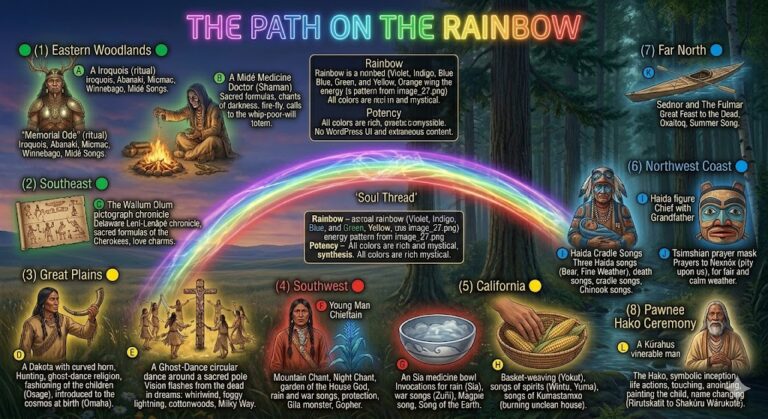
  • The Path on the Rainbow

    The Path on the Rainbow


    The Path on the Rainbow:

    An Anthology of Songs and Chants from the Indians of North America

    Edited by George W. Cronyn

    New York: Boni and Liveright, Inc.

    [1918]


    This anthology of Native American poetry, song and ritual, presents texts from a wide range of culture areas. The translations are largely based on work by anthropologists, and all reflect genuine Native American lore. These poems come from a place in which magic, art and ritual are indistinguishable. They reflect an archaic consciousness which comes close to the Homeric or Indian epics in which gods walk the earth, magic is alive, and animals are just as human as you or me. To read these texts is to be absorbed back into that consciousness.–J.B. Hare


    p. vii

    CONTENTS

    Early Moon Translated by Carl Sandburg xi
    Introduction Mary Austin xiii

    SONGS FROM THE EASTERN WOODLANDS

     
    Abanaki Songs Translated by John Reade 3
    Vengeance Song (Micmac) Translated by Silas T. Rand 5
    Iroquois Ritual Translated by Harriet Maxwell Converse 6
    Fire-Fly Song (Ojibwa) Translated by H. H. Schoolcraft 10
    Calling-One’s-Own (Ojibwa) Translated by Charles Fenno Hoffman 10
    Ojibwa War Songs Translated by H. H. Schoolcraft 11
    Two Winnebago Songs Translated by Natalie Curtis Burlin 12
    Sacred Midé Songs (Ojibwa) Translated by W. J. Hoffman 13
    Songs of the Chippewa Translated by Frances Densmore 13
    Memorial Ode (Iroquois) Translated by Mary Austin 26

    SONGS FROM THE SOUTHEAST

     
    The Wallum Olum (Delaware) Translated by Prof. D. G. Brinton 31
    Sacred Formulas of the Cherokees Translated by James Mooney 33

    SONGS FROM THE GREAT PLAINS

     
    Hunting Songs (Dakota) Translated by Stephen Return Riggs 41
    The Fashioning of the Children (Osage) Translated by J. Owen Dorsey 41
    p. viii    
    Ritual Chants of the Omaha Translated by Alice Fletcher 46
    Songs of the Ghost-Dance Religion (Arapaho-Cheyenne-Comanche-Paiute-Sioux-Kiowa-Caddo) Translated by James Mooney 51

    SONGS FROM THE SOUTHWEST

     
    Viracocha (Ancient Inca) Translated by Garcilasso de la Vega 61
    War Songs (Zuñi) Translated by Matilda Coxe Stevenson 61
    Invocations for Rain (Sia) Translated by Matilda Coxe Stevenson 62
    Magpie Song (Navajo)   66
    Songs in the Garden of the House God (Navajo) Translated by Washington Matthews 66
    The Mountain Chant of the Navajo Translated by Washington Matthews 67
    The Town Crier Calls at Dawn (Pueblo) Translated by J. W. Fewkes 81
    Song of the Horse (Navajo) Translated by Natalie Curtis Burlin 82
    Song of the Blue-Corn Dance (Zuñi) Translated by Natalie Curtis Burlin 82
    Songs of the Pima Translated by Frank Russell 83
    Song of the Earth (Navajo) Translated by Natalie Curtis Burlin 118
    Hunting Song (Navajo) Translated by Natalie Curtis Burlin 120
    Song of the Rain Chant (Navajo) Translated by Natalie Curtis Burlin 121
    Song from the Mountain Chant (Navajo) Translated by Natalie Curtis Burlin 122
    Corn-Grinding Song (Zuni) Translated by Natalie Curtis Burlin 123
    Korosta Katzina Song (Hopi) Translated by Natalie Curtis Burlin 124
    He-Hea Katzina Song (Hopi) Translated by Natalie Curtis Burlin 125
    p. ix    

    SONGS FROM CALIFORNIA

     
    Songs of Spirits (Wintu) Translated by Jeremiah Curtin 129
    Songs of Kumastamxo (Yuma) Translated by John Peabody Harrington 130

    SONGS FROM THE NORTHWEST COAST

     
    Prayers of the Tsimshian Translated by Prof. Franz Boas 135
    Three Songs from the Haida Translated by Constance Lindsay Skinner 136
    Bear Song (Haida) Translated by John R. Swanton 137
    Haida Cradle Songs Translated by John R. Swanton 138
    Bilqula Death Song Translated by Constance Lindsay Skinner 143
    Songs of the Tlingit Translated by John R. Swanton 143
    Spell Song (Kwakiutl) Translated by Prof. Franz Boas 154
    Chinook Songs Translated by Prof. Franz Boas 154

    SONGS FROM THE FAR NORTH

     
    Songs for the Great Feast to the Dead Translated by Edward W. Nelson 159
    Eskimo Songs Translated by Prof. Franz Boas 161
    Sednor and The Fulmar (Eskimo Ballad) Translated by Prof. Franz Boas 162

    INTERPRETATIONS
    CONSTANCE LINDSAY SKINNER

     
    Summer Dawn   167
    Song of the Search   170
    Song of Whip-Plaiting   171
    Song of the Young Mother   172
    Song of Basket-Weaving   175
    The Change-Song   176
    Song of the Full Catch   178
    Spring to the Earth-Witch   178
    Chief Capilano Greets His Namesake at Dawn   180
    The Wild Woman’s Lullaby   182
    Indian Lover’s Hymn   183
    p. x    

    MARY AUSTIN

     
    The Song of the Hills (Yokut)   184
    Neither Spirit nor Bird (Shoshone)   185
    Prayer to the Mountain Spirit (Navajo)   186
    Song for the Passing of Beautiful Women (Paiute)   187
    Song of a Passionate Lover (Yokut)   188
    The Heart’s Friend (Shoshone)   188
    A Song in Time of Depression (Paiute)   189

    FRANK GORDON

     
    Along the South Star Trail   190
    Sa-a Naraï   193
    Earth-Mother   196
    Feast of Wolves   198
    Lone-Dog Unto the Delawares   199

    ALICE CORBIN HENDERSON

     
    Listening   200
    Buffalo Dance   200
    Where the Fight Was   201
    The Wind   201
    Courtship   202
    Parting   202

    PAULINE JOHNSON

     
    The Lost Lagoon (Tekashionweke)   202
    The Song my Paddle Sings (Tekashionweke)   203

    CONSTANCE LINDSAY SKINNER

     
    Plem-Salia-Kwi (Autumn Dawn)   205

    SONGS FROM THE HAKO

     
    (A Pawnee Ceremony) Translated by Alice Fletcher

    p. xi

    EARLY MOON

    The baby moon, a canoe, a silver papoose canoe, sails and sails in the Indian West.

    A ring of silver foxes, a mist of silver foxes, sit and sit around the Indian moon.

    One yellow star for a runner, and rows of blue stars for more runners, keep a line of watchers.

    O foxes, baby moon, runners, you are the panel of memory fire-white writing tonight of the Red Man’s dreams.

    Who squats, legs crossed, and arms folded, matching its look against the moon-face, the star-faces, of the West?

    Who are the Mississippi Valley ghosts, of copper foreheads, riding wiry ponies in the night?—no bridles, love arms on the pony necks, riding in the night, a long old trail?

    Why do they always come back when the silver foxes sit around the early moon, a silver papoose, in the Indian West?


    p. xiii

    INTRODUCTION

    The poetic faculty is, of all man’s modes, the most responsive to natural environment, the most sensitive and the truest record of his reactions to its skyey influences, its floods, forests, morning colors. It is the first to register the rise of his spirits to the stimulus of new national ideals. If this were not so there would be no such thing as nationality in art, and it is only by establishing some continuity with the earliest instances of such reaction that we can be at all sure that American poetic genius has struck its native note. Therefore it becomes appropriate and important that this collection of American Indian verse should be brought to public notice at a time when the whole instinctive movement of the American people is for a deeper footing in their native soil. It is the certificate of our adoption, that the young genius of our time should strike all unconsciously on this ancient track to the High Places.

    Poetic art in America, at the time it began to be overlaid by European culture, had reached a mark close to that of the Greeks at the beginning of the Homeric era. The lyric was well developed, the epic was nascent, and the drama was still in the Satyris stage of development, a rude dance ritual about an altar or a sacrificial fire. Neither poetry nor drama were yet divorced from singing, and all art was but half-born out of the Great Mystery. Magic was sung, and songs had magic power. Both were accompanied by appropriate bodily movement, so that an Indian will say indifferently, I cannot sing that dance, or I cannot dance that song. Words, melody and movement were as much mixed as the water of a river with its own ripples and its rate of flowing. Hum a few bars of a plainsman’s familiar song, and he will

    p. xiv

    say, puzzled, “It ought to be a war song,” but without the words he will scarcely identify it. Words may become obsolete so that the song is untranslatable, but so long as enough of it remains to hold together the primary emotional impulse out of which it sprang, the Indian finds it worthy to be sung. He is, indeed, of the opinion that “White man’s songs, they talk too much.”

    This partly explains why most Indian songs are songs for occasions. The rest of the explanation lies in the fact that songs have magic power. Tiráwa, Wokonda, The Friend of the Soul of Man, is in everything; in the field we plant, the stone we grind with, the bear we kill. By singing, the soul of the singer is put in harmony with the essential Essence of Things. There are songs for every possible adventure of tribal life; songs for setting out on a journey, a song for the first sight of your destination, and a song to be sung by your wife for your safe return. Many of these songs occur detached from everything but the occasion from which they sprang, such as the women’s grinding song, measured to the plump, plump! of the mealing stone, or the Paddle Song which follows the swift rhythm of the stroke. Others, less descriptive and retaining always something of a sacred character, occur originally as numbers in the song sequences by which are celebrated the tribal Mysteries.

    Back of every Indian ceremony lies a story, the high moments of which are caught up in song, while the burden of the narrative is carried by symbolic rite and dance. The unequal social development of contemporaneous tribes affords examples from every phase of structural development from the elemental dance punctuated by singing exclamations to the Mountain Chant of the Zuñi in which the weight of the story has broken down the verse variants into strong simple forms capable of being carried in a single memory. Halfway between them is the ritual sequence of the Midéwan.

    The practical necessity of being preserved and handed on by word of mouth only, must be constantly borne in mind in considering the development of Indian verse forms.

    It operated to keep the poetry tied to its twin-born melody,

    p. xv

    which assisted memory, and was constantly at work modifying the native tendency to adjust the rhythm to every changing movement of the story. Ancient Chippeway singers kept ideographic birch bark memoranda of their songs, and wampum belts commemorated the events that gave use to them, but the songs themselves came down from their ancient sources hundreds of years in the stream of human memory shaped by its limitations.

    From the Zuñi Creation Cycle with its sustained narrative style to the Homeric Epic is but one poetic bound, the space between them, represented in old world literature by the Norse Sagas and the Kalevala, indicated but not filled, in America, by prose relations. It is probable that if we had anything like adequate records of the literature of vanished tribes, this pre-Homeric period would show notable examples of epic stuff. Nobody really knows how the Walam Olum or the Creek Migration Myths were recited. They embodied whole epochs of tribal history, to which the known literary remains were merely the mnemonic key, a tally of significant items. In every tribe are floating songs which appear to be fragments from a story sequence the key of which has been lost, and it is not unlikely that records like the Red Score would have owned complete, if detached, narratives of the historic events so slightly indicated, some of which may yet yield themselves to the patient researcher.

    For the casual reader more interest attaches to the personal songs, the lullabies, love songs, most of all the man’s own song which he makes of his great moment. This is a peculiar personal possession. No one may sing it without his permission. He may bestow it on a friend, or bequeath it to the tribe on his death, but it is also possible that he may die without having sung it to anyone but his god.

    On one occasion in the high Sierras I observed my Indian packer going apart at a certain hour each day to shuffle rhythmically with his feet and croon to himself. To my inquiry he said it was a song which he had made, to be sung by himself and his wife when they were apart from one another.

    p. xvi

    It had no words; it was just a song. Wherever they were they turned each in the direction he supposed the other to be, when the sun was a bow-shot above the edge of the heavens, and sang together. This is the sort of incident which gives the true value of song in aboriginal life. It is not the words which are potent, but the states of mind evoked by singing, states which the simple savage conceived as being supernally good for him. He evoked them therefore on all his most personal occasions. Poetry is the Path on the Rainbow by which the soul climbs; it lays hold on the Friend of the Soul of Man. Such exalted states are held to be protective and curative. Medicine men sing for their patients, and, in times of war, wives gather around the Chief’s woman and sing for the success of their warriors.

    “Calling on Zeus by the names of Victory” as Euripides puts it.

    It is this inherent power of poetry to raise the psychic plane above the accidents of being, which gives meaning to the custom of the Death Song. As he sees his moment approaching, the Indian throws himself, by some profound instinct of self-preservation, into the highest frame of mind attainable. When men in battle broke into the death song, they had committed themselves to the last desperate adventure. Dying of enfeebling sickness, their friends came and sang around them. One such I heard, the death song of a Yokut Song Maker. It was very simple:


    “All my life
    I have been seeking,
    Seeking!”


    [paragraph continues]What more than this have the schools taught us!

    Of Indian meters there has been no competent study made. The whole problem of form is inextricably complicated with melody and movement. The necessity of making his verse conform to a dance, probably accounts for the liberal use of meaningless syllables. To our ear no specific forms seem indicated, yet that the Indians recognize a certain correspondence between

    p. xvii

    form and meaning is certain. They will readily classify songs of other tribes in unknown tongues into songs of love or war or magic. The genius of the tribal language is a determining factor. No clumsiness of translation can quite disguise the—from our point of view—superior singableness of Chippeway verse. In general, poetry of forest dwellers is more lyric than the songs of mountain and mesa. An inquiry which I once made into the psychology of the Indian sign language with a view to discovering a possible relation between it and Greek manual gesture as displayed in ancient graphic art, led to the conclusion that Indian rhythms arise rather in the centre of self-preservation than of self-consciousness. Which is only another way of saying that poetry is valued primarily by the aboriginal for the reaction it produces within himself rather than for any effect he is able to produce on others by means of it. This is true even of that class of songs which originates wholly in the desire to affect the fortunes or well being of others, songs of healing and magic formulae.

    The first stage of Indian magic is the rise of the singer on his own song to a plane of power; only while he is in this plane is he able to bring the wish of his client to pass. It is a natural process of deterioration which leads to the song being thought of as having potency in itself.

    Magic songs can generally be recognized by the form of affirmation in which they are cast, as in the Winnebago Love Song, which is not really a song of love, but a song to secure success in love,

    Whosoe’r I look upon
    He becomes love crazed.

    or the Cherokee formula to insure the constancy of the beloved, and the Micmac vengeance song

    Death I make,
    Singing

    p. xviii

    Among the Navajo the magic effect is made certain by the fourfold repetition of the affirming phrase, four being a sacred number.

    These are all items which have to be taken into account in interpreting American Indian poetry. It is in the very nature of primitive verse that it should require interpretation, even among the audiences for whom it is originally intended. For verse is to the Red singer but a shorthand note to his emotions, a sentence or two, a phrase out of the heart of the situation. It is the “inside song” alone which is important. Says the Medicine Man, explaining these matters, “You see Injun man singin’ an’ cryin’ while he sing. It ain’t what he singin’ make him cry; iss what the song make him think, thass what he cryin’ about.”

    This inside song may be a fleeting instant of revelation, or a very long story… as if one should try in the Zuñi fashion to compress the whole Christian myth into one bitter cry,


    My God! My God!
    Why hast Thou deserted me?


    Hi-ihiya, naiho-o,
    It is finished,
    In beauty it is finished
    Nai-ho-o!


    Whole cycles of tribal or personal experience can lie behind some such simple but absolute phrasing. It is this hidden beauty for which the interpreter must dig deep into aboriginal life.

    The Ghost Dance songs included in this collection are scarcely intelligible until the reader realizes that they are supposed to be the flashes of revelation brought from the dead in dreams, foretelling the approach of a spiritual revival.

    Thus it came to the Cheyenne:


    I bring the whirlwind
    That you may know one another


    We shall live again!


    p. xix

    To the Piaute also


    Fog, fog,
    Lightning, lightning,
    Whirlwind, whirlwind.


    and then


    The cottonwoods are growing tall
    They are growing tall and green.


    [paragraph continues]For to the Piaute from his flat Reservation on Walker River, the faint young green of the cottonwoods is the first sign of that new growth which follows after seasonal storms. Any adequate rendering of these songs would have to convey in native figures all this sense of immanent world-overturning and spiritual reëstablishment in the Oneness of God and the Brotherhood of man.


    (It is I who wear the Morning Star on my forehead…
    All that grows upon the earth is mine
    Says the Father.)


    [paragraph continues]Thus interpreted they would rank with the prophetic utterances of the herdsman of Tekoa. It is quite possible, indeed, that in time all these ghostly songs would have been detached from their obscure authors and ascribed to the Messiah of the Ghost Dance, who would have been reckoned among the major prophets.

    For such illuminating gleams that Indian poetry can throw on the genesis of inspired literature, its study would be worthwhile, even if without the renewal of our native stock of poetic forms and figures.

    It is probable that the best Indian poetry has been lost to us in the stamping out of superior tribes.

    This would be particularly the case in the south, where

    p. xx

    social development had reached a stage which only the pueblos and the Five Nations of western New York approached.

    Miss Convers has shown us in the fragments of Iroquois ritual something of what might still be recovered from the remnants of that race, but this single example from the forgotten tribe of Tenasa, on the shore of the Missi-sippu seems to me to overleap all time and space and touch the hidden source of Greek inspiration. It is a marriage song, the faithful translation of an unliterary explorer, Greek in its mode, and in a certain tender irony of mood, but with touches to which only a full knowledge of Indian thought can give their full value, for all of which I venture to give it the isolation of its native quality.


    Tiakens, thou buildest a house,
    Thou bringest a wife to live in it.


    Thou art married, Tiakens, thou art married,
    Thou wilt become famous, thy children wilt name thee among
    the elders.
    Think of Tiakens as an old man!


    By what name is thy bride known,
    Is she beautiful?
    Are her eyes soft as the light of the moon?
    Is she a strong woman?
    Didst thou understand her signs as she danced
    to thee?
    I know not whether thou lovest her,
    Tiakens,
    What saidst the old man, her father, when you asked for his
    pretty daughter?
    What betrothal gifts didst thou give her?


    Rejoice, Tiakens, be glad, be happy,
    Build thyself a happy home.
    This is the song of its building.


    p. xxi

    [paragraph continues]The single line which identifies the song of Tiakens as intrinsically American is that one which inquires:

    Didst thou understand her signs when she danced to thee? embodying as it does a very widespread aboriginal belief that in the dance and song, more than in any other medium, a maiden revealed the physical capacity and the power of sustained emotion which fitted her for marriage. Since when, and with what unhappy results, have we forgotten that creative emotion is a qualification for marriage! We do shallowly indeed when we dismiss the dance and song as mere millinery of courtship. They are the speech of the spirit identifying itself with cosmic forces. I do not know whether or not the Tenasa had the custom known on the Pacific Coast as the Dance of Marriageable Maidens, but I know that if you cut deeply into any Indian poem it yields that profound and palpitant humanism without which no literary art can endure.

    Failure to realize the living background of Indian art has led to singular misinterpretation, in a class of songs common to every tribe, and almost invariably translated as love songs by the novice. These are the songs of the Mystics, Songs of Seeking. They record the unavailing search of the soul for the Absolute, for touch of that Great Mystery which is the object of the Indian’s profoundest aspiration. Two such songs may be found in Frederick Burton’s collection of Ojibway music, done into rather sentimental love ditties, the “Lake’s Sheen” and the “Birch Bark Canoe,” though their character as religious songs was so plainly marked that Mr. Burton himself commented on the singularity of Indian sweethearts forever getting themselves lost and requiring to be sought. It is well to remember before attempting the interpretation of an Indian love song, that the great Mystics have always appropriated the intimate language of the heart for the soul’s quest. As will be seen from the examples which Mr. Cronyn has included in his collection, the work of interpreting our treasure of Indian verse has been but lightly begun. While some of these, notably Miss Corbin’s “Across the River” leave nothing to be desired of the spirit, form and content

    p. xxii

    of the original, many others have had frankly to sacrifice one of them.

    In my own interpretations I have been feeling rather for a full expression of Indian thought, than for lyrical quality.

    And in any case, mine is not a singing gift. All Indian verse is either sung or chanted, but the difficulty of fitting Indian rhythms to European music is only surpassed by the difficulty of getting Indian music arranged in European notation.

    The long divided Muses of poetry, music and dance must come together again for the absolute rendering. Enough cannot be said in praise of the work of Miss Fletcher, Natalie Curtis, Frank Cushing and Washington Mathews, to mention no others, for the clarity and sincerity of their literal translations. The interpreter’s work is all before him. I know of no task so salutory to the poet who would, first of all, put himself in touch with the resident genius of his own land.

    MARY AUSTIN


    p. 1 p. 2 p. 3

    SONGS FROM THE EASTERN WOODLANDS

    THE PARTED LOVERS

    ABANAKI

    I

    THE MAN SINGS


    My parents think they can separate me from the girl I love;
    We have vowed to love each other while we live.
    Their commands are vain: we shall see each other while the world lasts.
    Yes! let them say or do what they like; we shall see each other while the rocks stand.


    THE WOMAN SINGS


    Here I sit on this point, whence I can see the man that I love.
    Our people think that they can sever us; but I shall see him while the world lasts.
    Here shall I remain, in sight of the one I love.


    II

    THE GIRL DESERTED BY HER JEALOUS COMPANIONS SINGS


    Now I am left on this lonely island to die—
    No one to hear the sound of my voice.
    Who will bury me when I die?
    Who will sing my death-song?


    p. 4


    My false friends leave me here to die alone;
    Like a wild beast, I am left on this island to die.
    I wish the wind spirit would carry my cry to my love!
    My love is swift as the deer; he would speed through the
    forest to find me.
    Now I am left on this lonely island to die.
    I wish the wind spirit would carry my cry to my love!
    My love is as swift as the deer; he would speed through the
    forest to find me;
    Now I am left on this lonely island to die.
    I wish the spirit of air would carry my breath to my love.
    My love’s canoe, like sunlight, would shoot through the water
    to my side;
    But I am left on this lonely island to die, with no one to pity
    me but the little birds.
    My love is brave and strong; but, when he hears my fate, his
    heart will break.
    And I am on this lonely island to die.
    Now the night comes on, and all is silent but the owl.
    He sings a mournful song to his mate, in pity for me.
    I will try to sleep.
    I wish the night spirit to hear my song; he will tell my love of
    my fate; and when I awake, I shall see the one I love.
    I am on this lonely island to die.


    III

    HER LOVER SEES HER IN A DREAM AND, GOING TO SEARCH FOR HER, SINGS


    Come, my beloved, let us go up that shining mountain, and
    sit together on that shining mountain; there we will watch
    the Sun go down in beauty from that shining place.
    There we will sit, till the Night Traveler arises in beauty
    about the shining mountain; we will watch him as he
    climbs to the beautiful skies.


    p. 5


    We will also watch the little Stars following their chief.
    We will also watch the Northern Lights playing their game of
    ball in their cold, glistening country.
    There we will sit, on the beautiful mountain, and listen to the
    Thunder beating his drum.
    We will see the flashes from the lit pipe of the Lightning.
    We will see the great Whirlwind race with Squall.
    There we will sit, until all creatures drowse.
    There we will hear the great Owl sing his usual song: “Go-to-
    sleep-all,” and see all animals obey his call.
    There we will sit in beauty on the mountain, and watch the
    small Stars in their sleepless flight.
    They do not mind the song, “go-to-sleep-all”; neither will we
    mind it, but sit more closely together, and think of
    nothing but ourselves, on the beautiful mountain.
    Again, the “go-to-sleep-all” will be heard, and the Night
    Traveler will come closer to warn us that all are sleeping,
    except ourselves and the little Stars.
    They and their chief are coursing along, and our minds go
    with them.
    Then the Owl sleeps; no more is heard “go-to-sleep-all”;
    the Lightnings flash afar; the great pipe is going out; the
    Thunder ceases beating his drum; and though our bodies
    urge us to be sleeping, we sit in beauty still upon the
    shining mountain.


    VENGEANCE SONG

    MICMAC


    Death I make, singing
    Heh-yeh! heh-yeh! heh-yeh! heh-yeh!
    Bones I hack, singing
    Heh-yeh! heh-yeh! heh-yeh! heh-yeh!
    Death I make, singing!
    Heh-yeh! heh-yeh! heh-yeh! heh-yeh!


    p. 6

    IROQUOIS RITUAL OF FIRE AND DARKNESS

    The members of the Ho-no-tci-no-ga Society assemble. Now the Medicine Doctor or Shaman casts the sacred tobacco on the medicine-blaze, and in a low voice he chants:


    Great Spirit who puts us to sleep in darkness,
    We thank thee for the silences of darkness.
    (Singer)
    Now I ask blessing and make prayers.
    (He sprinkles sacred tobacco on the fire.
    Then he speaks to the Invisible)
    Now I give you tobacco,
    You, the great Darkness!
    (To the Thunder Spirit)
    Now we act as we offer you tobacco!
    You love it most of all offerings.
    With it you will hear us better
    And not tire of our talking
    But love us with all power
    Beyond all treasures
    Or spreading of words through the air!
    All men traveling under great heaven
    You have invited, your grandchildren and all nations;
    Oh you, maker of noise,
    You, the great Thunderer!
    Your grandchildren wish to thank you!
    All your grandchildren have asked me
    To offer this tobacco upon the mountain to you!
    (Speaking to the Great Spirit)
    You the All-maker,
    Above-all-high
    Best Friend of people!
    We ask you to help us!
    We implore your favor!
    I have spoken.


    p. 7

    The lights are extinguished, leaving the assembly in total darkness. The Watcher of the Medicine uncovers the bundles, exposing it to the air, and as he does so a faint luminous cloud hovers over the table and disappears. Now the Chanter gives the signal and the members sing:

    THE CHANT OF DARKNESS


    Wait here in the darkness!
    Come, all you who listen,
    Go the magic journey:
    Now the sky is empty
    Of all sun-and-star-shine;
    Come, we lose our footing.
    Night no friend of ours is;
    She has shut her eyelids.
    Moon who has forgotten
    Lets us wait in darkness!


    Now the chiefs take their rattles, shaking them softly as the Chanter sings and members of the clan give the whip-poor-will cry.

    THE CHANT OF INVITATION TO THE WHIP-POOR-WILL TOTEM


    (Chorus)
    Thus sings the Whip-poor-will,
    Follow me, follow me!
    Thus speaks the Chief to him,
    Yes, I will follow you!
    Lo! the night darkening
    Stalks through the shadow-land;
    No light to beckon us
    Murmurs the waterfall,
    Thus sings the river-voice!
    Someone is nearing us,


    p. 8


    Creeping upon us close,
    Two fires of eyes are close
    Lighting the forest path—
    Hear how his breath blows by!
    Fol-low me, fol-low me,—
    So sings the whip-poor-will!
    Yes, I am following—
    Thus the Chief answers him.


    Cries announce that the Wolf and his mate have entered the room.


    Hark the trees whispering
    Bend their old bodies low,
    Not the strong North Wind’s hand
    Nay, but One great and swift
    Parts them with whistling breath!
    Hark! how the thickets snap!
    Fearless the footfalls pass
    Pushing the trees apart!
    Great horns dividing them.
    (Again the Whip-poor-will chorus)


    Now Buck and Doe, with cries, enter. The song continues:


    How I go shivering!
    No snow is falling now,
    Where hides the sun his fire?
    Something swift-footed comes
    Roaring and warning me!
    Eyes of the night it blinds,
    Falling like heavy mist!
    Now it creeps close to me,
    Warning and beckoning
    Where the black forest looms.
    (Whip-poor-will chorus)


    The Bear and his mate have come and the song goes on:


    How the wind whistles now!
    No one dares race with it.
    Great trees bend low to it,
    Rivers fight back to it,


    p. 9


    Roaring and splashing it!
    Hear how its strong wings beat
    Deep in the gusty sky!
    High through the night it flies
    Whistling and screaming, still
    Hunting the prey that runs!
    (Whip-poor-will chorus)


    The Hawk and its mate are announced. Then rites symbolizing the dangers of the forest tangles and swampy horrors are performed. According to the legend Eagle must dismiss the meeting. His coming, which is imitated on the small flute, announces the day. As the dawn-light penetrates the ceremonial place the last chorus is chanted of

    THE EAGLE


    Deep the dew-water falls
    No one comes close to me!
    Where are you, Whip-poor-will?
    Why am I waiting now
    Calling you, calling you?
    Screaming the night away
    With his great feathers spread
    Catching the darkness up
    I hear the Eagle-bird
    Pulling the blanket back
    From the east, sleeping still.
    How swift he flies, bearing the sun to the morning;
    See how he perches there on the trail of the east-sky.
    Whip-poor-will, Whip-poor-will,
    No more I follow thee!
    When night springs up again
    Will you cry, “Follow me?”


    The singing ends and the matrons bring in food and distribute it to all.


    p. 10

    FIRE-FLY SONG

    OJIBWA

    Flitting white-fire insects!
    Wandering small-fire beasts!
    Wave little stars about my bed!
    Weave little stars into my sleep!
    Come, little dancing white-fire bug,
    Come, little flitting white-fire beast!
    Light me with your white-flame magic,
    Your little star-torch.


    CALLING-ONE’S-OWN

    OJIBWA


    Awake! flower of the forest, sky-treading bird of the prairie.
    Awake! awake! wonderful fawn-eyed One.
    When you look upon me I am satisfied; as flowers that drink dew.
    The breath of your mouth is the fragrance of flowers in the morning,
    Your breath is their fragrance at evening in the moon-of-fading-leaf.
    Do not the red streams of my veins run toward you
    As forest-streams to the sun in the moon of bright nights?
    When you are beside me my heart sings; a branch it is, dancing,
    Dancing before the Wind-spirit in the moon of strawberries.
    When you frown upon me, beloved, my heart grows dark—
    A shining river the shadows of clouds darken,
    Then with your smiles comes the sun and makes to look like gold
    Furrows the cold wind drew in the water’s face.
    Myself! behold me! blood of my beating heart.


    p. 11


    Earth smiles—the waters smile—even the sky-of-clouds smiles—but I,
    I lose the way of smiling when you are not near,
    Awake! awake! my beloved.


    OJIBWA WAR SONGS

    I


    Hear my voice, Birds of War!
    I prepare a feast for you to feed on;
    I see you cross the enemy’s lines;
    Like you I shall go.
    I wish the swiftness of your wings;
    I wish the vengeance of your claws;
    I muster my friends;
    I follow your flight.
    Ho, you young men warriors,
    Bear your angers to the place of fighting!


    II


    From the south they came, Birds of War—
    Hark! to their passing scream.
    I wish the body of the fiercest,
    As swift, as cruel, as strong.
    I cast my body to the chance of fighting.
    Happy I shall be to lie in that place,
    In that place where the fight was,
    Beyond the enemy’s line.


    III


    Here on my breast have I bled!
    See—see! these are fighting-scars!
    Mountains tremble at my yell!
    I strike for life.


    p. 12

    LOVE-SONG

    WINNEBAGO

    Whomsoe’er look I upon
    He becomes love-crazed;
    Whomsoe’er speak I unto,
    He becomes love-crazed;
    Whomsoe’er whisper I to,
    He becomes love-crazed;
    All men who love women,
    Them I rule, them I rule,
    My friend;
    Whom I touch, whom I touch,
    He becomes love-crazed.

    HOLY SONG

    WINNEBAGO


    (Saith the Spirit,
    “Dream, oh, dream again,
    And tell of me,
    Dream thou!”)


    Into solitude went I
    And wisdom was revealed to me.
    (Saith the Spirit,
    “Dream, oh, dream again,
    And tell of me,
    Dream thou!”)


    Let the whole world hear me,
    Wise am I!
    (Now saith the Spirit,
    “Tell of me,
    Dream thou!”)


    p. 13


    All was revealed to me;
    From the beginning
    Know I all, hear me!
    All was revealed to me!
    (Now saith the Spirit,
    “Tell of me,
    Dream thou!”)


    SACRED MIDÉ SONGS

    OJIBWA


    Drifting snow,
    why do I sing?


    The Sun and Moon,
    Their bodies
    shine over the world
    unto me as unto you, my Midé
    friend.


    SONGS OF THE CHIPPEWA

    HEALING SONG


    They are in close consultation
    with their heads together
    Wenabojo
    and his grandmother.


    LOVE-CHARM


    What are you saying to me?
    I am arrayed like the roses
    and beautiful as they.


    p. 14

    I AM WALKING


    Toward calm and shady places
    I am walking
    on the earth.


    THEY THINK ME UNWORTHY


    They think me unworthy
    my Midé brethren
    but look and see
    the length of my wigwam.


    THE SOUND IS FADING AWAY


    The sound is fading away
    It is of five sounds
    freedom
    The sound is fading away
    It is of five sounds.


    DOCTOR’S SONG


    I am singing and dreaming in my poor way
    over the earth
    I who will again disembark
    upon earth.


    SONG OF THE TREES


    The wind
    only
    I am afraid of.


    p. 15

    SONG OF THE THUNDERS


    Sometimes
    I go about pitying
    myself
    while I am carried by the wind
    across the sky.


    THE APPROACH OF THE STORM


    From the half
    of the sky
    that which lives there
    is coming, and makes a noise.


    I AM AFRAID OF THE OWL


    Very much
    also
    I
    of the owl
    am afraid
    whenever I am sitting alone
    in the wigwam.


    I AM AS BRAVE AS OTHER MEN

    Men who are brave and heroic
    as you esteem them to be
    Like them
    I also
    consider myself to be.

    p. 16

    MY MUSIC REACHES TO THE SKY


    My music
    reaches
    to the sky.


    FAREWELL TO THE WARRIORS


    Come
    it is time for you to depart
    We are going on a long journey.


    SONG OF THE MAN WHO WAS TO BE HUNG


    The thunders will take me home,
    whenever I mind to go home,
    my friends,
    and the wind
    it will take me home, too.


    FRIENDLY SONG

    I


    Over there
    in the sky
    they have taken pity on me.


    II


    The sky
    loves to hear me.


    GAMING SONG


    I will go home
    if I am beaten
    after more articles
    to wager.


    p. 17

    WAR SONGS

    At Co’goben’s
    village
    they are weeping
    the men

    At Co’goben’s
    village
    they are wailing
    the women.

    I feel no fear
    when the Great River man
    death
    speaks of.

    THE MAN WHO STAYED HOME


    Although
    Jinwábe
    considers himself
    a man
    his wife
    certainly
    takes all his attention.


    ARROW SONG

    Scarlet
    is its head

    SONG OF THE BUFFALO

    Strike ye
    our land
    with curved horns

    p. 18

    SONG OF THE MINISINOWUCK


    It is uncertain what will happen
    to the one from whom I fly
    It is uncertain what will happen
    to the one from whom I rise.


    DRUM SONG


    I make them dance
    those brave men
    those brave men
    every one of them


    SONG OF WOMAN-OF-THE-RED-SKY, WHO WENT WITH HER HUSBAND, SINGING INTO BATTLE


    At that time
    if I had been a man
    truly
    a man
    I would have seized.


    DEATH SONG OF NAMEBINES


    The odor of death
    I discern the odor of death
    in the front of my body


    THE SIOUX WOMEN GATHER UP THEIR WOUNDED


    The Sioux women
    pass to and fro wailing
    as they gather up
    their wounded men
    The voice of their weeping comes back
    to us.


    p. 19

    THEY ARE PLAYING A GAME


    The noise of passing feet
    on the prairie
    They are playing a game as they come
    those men.


    SCALP SONG


    I wonder
    if she is humiliated
    the Sioux woman
    that I cut off her head.


    SONG OF REJOICING


    It shall be
    that I rejoice
    O, my son
    your elder brother
    you have brought back
    O, my son
    it shall be
    that I rejoice
    O, my son.


    DEATH SONG


    Is there anyone who
    would weep for me?
    My wife
    would weep for me.


    SONG OF THE BUTTERFLY


    In the coming heat
    of the day
    I stood there.


    p. 20

    MAPLE SUGAR


    Maple sugar
    is the only thing
    that satisfies me.


    A SONG OF SPRING


    As my eyes
    search
    the prairie
    I feel the summer in the spring.


    CARRIED AROUND THE SKY


    As the wind is carrying me
    around the sky.


    THE SKY WILL RESOUND


    It will resound finely
    the sky
    when I come making a noise.


    AN OVERHANGING CLOUD


    An overhanging
    cloud
    repeats my words with pleasing sound.


    HEAPS OF CLOUDS


    Great heaps
    of clouds
    in the direction I am looking.


    p. 21

    THE NOISE OF THE VILLAGE


    Whenever I pause
    the noise
    of the village.


    MIDÉ BURIAL SONG


    Neniwá
    let us stand
    and you shall see
    my body
    as I desire.


    LOVE SONGS

    MY LOVE HAS DEPARTED

    I


    A loon
    I thought it was
    but it was
    my love’s
    splashing oar.


    II


    To Sault Ste. Marie
    he has departed
    My love has gone on before me,
    Never again
    can I see him.


    THE GENEROUS ONE


    Why should
    I, even I


    p. 22


    be jealous
    because of that bad boy?


    RECOVERY


    Do not weep
    I am not going to die.


    LOVE-HURT


    Although he said it
    still
    I am filled with longing
    when I think of him.


    GLAD-PARTING


    Come
    I am going away
    I pray you
    let me go
    I will soon return
    Do not
    weep for me
    Behold
    we will be very glad
    to meet each other
    when I return
    Do not
    weep for me.


    INVITATION


    My sweetheart
    a long time
    I have been waiting for you


    p. 23


    to come over
    where I am.


    YOU DESIRE VAINLY


    You desire vainly
    that I seek you
    the reason is
    I come
    to see your younger sister.


    HE IS GONE


    I might grieve
    I am sad
    that he has gone
    my lover.


    SONG OF AN AMBITIOUS MOTHER


    I am asking for
    Bugac’s
    daughter
    My big
    brass kettle
    he is giving.


    NONSENSE SONG OF THE GAME OF SILENCE


    (If you speak or laugh you are defeated)
    It is hanging
    in the edge of the sunshine
    It is a pig I see
    with its double (cloven) hoofs
    It is a very fat pig.
    The people who live in a hollow tree
    are fighting


    p. 24


    They are fighting bloodily
    He is rich
    He will carry a pack toward the great water.
    (The rabbit speaks)
    At the end of the point of land
    I eat the bark off the tree
    I see the track of a lynx
    I don’t care, I can get away from him
    It is a jumping trail
    sep!


    WORK STEADILY


    Be very careful
    to work steadily
    I am afraid they will take you away from me.


    I HAVE FOUND MY LOVER


    Oh
    I am thinking
    Oh
    I am thinking
    I have found .
    my lover
    Oh
    I think it is so.


    MIDÉ SONGS

    THESE REPRESENT THE EXPRESSION OF RELIGIOUS IDEAS

    I


    Is it that
    which my voice resembles?


    p. 25


    Even metal
    the sounding of my voice?


    II


    From beneath the high hill
    my voice echoes forth.


    III


    The strength of metal
    has entered into my arrow point.
    A spirit
    I could kill.
    The strength of iron
    has entered into my arrow point.


    IV


    Beautiful as a star hanging in the sky
    is our Midé lodge.


    V


    I have gained such spirit-power
    that I can tame it in my hand
    It is true
    even our white shell
    I can tame it in my hand.


    VI


    Do not speak ill of the Midé
    my Midé brethren.
    Wherever you may be
    do not speak ill of a woman
    my Midé brethren.


    VII


    We may live by it always
    my Midé brethren
    It is spiritual
    the inspiration we receive.


    p. 26

    VIII


    In the middle of the sea
    in the lengthy room of the sea
    there I am standing.


    IX


    I that hasten around
    I shoot at a man and he falls in a trance
    Then I feel with my hand
    to see if he is still alive.


    X

    My Midé brother
    is searched
    In his heart is found
    that which I seek to remove
    a white shell.

    XI


    Into thy body
    I shoot
    the spirit


    XII


    What is this
    I promise you?
    The skies shall be bright and clear for you
    This is what I promise you.


    MEMORIAL ODE

    Chief John Buck, hereditary Keeper of the Wampum, made and sung his ode in 1884 on the occasion of the removal of the bones of Chief Red Jacket from their original burying place to Forest

    p. 27

    Lawn Cemetery. The Great League is the League of the five Iroquois nations in Western New York.

    CHANT


    Now, listen, Ye who established the Great
    League,
    Now it has become old,
    Now there is nothing but wilderness.


    Ye are in your graves who established it.
    Ye have taken it with you and have placed it under you,
    And there is nothing left but desert.
    There you have taken your great minds.
    That which you established, you have taken with you
    Ye have placed under your heads what ye have established,
    The Great League.


    REFRAIN


    Woe, Woe! Hearken ye!
    We are diminished
    Woe, woe!
    The land has become a thicket.
    Woe, woe!
    The clear places are deserted
    They are in their graves who established it.
    Woe, the Great League!
    Yet they declared it should endure.
    The Great League, Woe!
    Their work has grown old
    We are become wretched. Woe!


    p. 28 p. 29 p. 30 p. 31

    SONGS FROM THE SOUTHEAST

    FRAGMENT FROM THE WALLUM-OLUM OR CHRONICLE OF THE LENI-LENÂPÉ *

    DELAWARE

    After the rushing waters had subsided
    The Lenâpé of the Turtle were close together,
    In hollow houses, living together there.
    It freezes where they abode:
    It snows where they abode:
    It storms where they abode:
    It is cold where they abode.
    At this northern place they speak favorably
    Of mild, cool lands
    With many deer and buffaloes.
    As they journeyed, some being strong,
    Some being rich, they separated
    Into house-builders and hunters:
    The hunters showed themselves at the north:
    The hunters showed themselves at the east:
    The hunters showed themselves at the south:
    The hunters showed themselves at the west.
    In that ancient country, in that northern country,
    In that Turtle country
    The best of Lenâpé were the Turtle-men.
    All the cabin fires of that land were disquieted
    And all said, “Let us go.”


    p. 32

    To the Snake land, to the east, they went
    Going away, earnestly grieving.
    Split asunder, weak, trembling, their land burned
    They went, torn and broken, to Snake Island.
    Those from the north being free, without care
    Went forth from the land of snow in different directions.
    The fathers of the Bald Eagle and the White Wolf remain
    Along the sea, rich in fish and strength.
    Floating up stream in their canoes
    Our fathers were rich, they were in the light
    When they were at those islands.
    Head Beaver and Big Bird said:
    “Let us go to Snake Island,” they said.
    All say they will go along
    To destroy all the land.
    Those of the north agreed,
    Those of the east agreed,
    Over the sea, the frozen sea,
    They went to enjoy it.
    On the wonderful slippery water,
    On the stone-hard water all went,
    On the great tidal sea, the muscle-bearing sea.
    Ten thousand at night,
    All in one night,
    To the Snake Island, to the east, at night,
    They walk and walk, all of them.
    The men from the north, the east, the south:
    The Eagle clan, the Beaver clan, the Wolf clan,
    The best men, the rich men, the head men,
    Those with wives, those with daughters, those with dogs.
    They all come, they tarry at the land of the spruce-pines:
    Those from the west come without hesitation,
    Esteeming highly their old home at the Turtle land.
    There was no rain and no corn
    So they moved further seaward.
    At the place of caves, in the Buffalo land,
    They at last had food on a pleasant plain.


    Footnotes

    31:* This famous fragment, the only written (pictograph) historical record extant among the Eastern tribes, is included as an example of the Saga element in Indian literature.


    p. 33

    SACRED FORMULAS OF THE CHEROKEES

    I

    CONCERNING LIVING HUMANITY

    LOVE CHARM

    Hû! Listen! In Alahí yi you repose, O Terrible Woman,
    O you have drawn near to hearken.
    There in Elahiyi you are at rest, a White Woman. *
    No one, is ever lonely when with you.
    You are most beautiful.
    Instantly and at once you have rendered me a white man.
    No one is ever lonely when with me.
    Now you have made the path white for me.
    It shall never be dreary.
    Now you have put me into it.
    It shall never become blue.
    You have brought down to me from above the white road.
    There in mid-earth you have placed me.
    I shall stand erect upon the earth.
    No one is ever lonely when with me.
    I am very handsome.
    You have put me into the white house.
    I shall be in it as it moves about and no one with me shall ever be lonely.
    Verily, I shall never become blue.
    Instantly you have caused it to be so with me.

    And now there in Elahiyi you have rendered the woman blue.
    Now you have made the path blue for her.
    Let her be completely veiled in loneliness.
    Put her into the blue road.
    And now bring her down.


    p. 34

    Place her standing upon the earth.
    Where her feet are now and wherever she may go, let loneliness leave its mark upon her.
    Let her be marked out for loneliness where she stands.

    Ha! I belong to the Wolf clan, that one alone which was allotted into for you.
    No one is ever lonely with me.
    I am handsome.
    Let her put her soul in the very center of my soul, never to turn away.
    Grant that, in the midst of men she shall never think of them.
    I belong to the one clan alone which was allotted for you when the seven clans were established.

    Where other men live it is lonely.
    They are very loathsome.
    The common polecat has made them so like himself that they are fit only for his company.
    They have become mere refuse.
    They are very loathsome.
    The common opossum has made them so like himself that they are fit only to be with him.
    They are very loathsome.
    Even the crow has made them so like himself that they are fit only for his company.
    They are very loathsome.
    The miserable rain-crow has made them so like himself that they are fit only for his company.

    The seven clans all alike make one feel very lonely in their company.
    They are not even good looking.
    They go about clothed with mere refuse.
    They even go about covered with dung.
    But I—I was ordained to be a white man.

    p. 35

    I stand with my face toward the Sun Land.
    No one is ever lonely with me.
    I am very handsome.
    I shall certainly never become blue.
    I am covered by the everlasting white house wherever I go.
    No one is ever lonely with me.
    Your soul has come into the center of my soul, never to turn away.
    I, Gatigwan asti—I take your soul.
    Sge!

    II

    TO INSURE CONSTANCY

    Listen! O, now you have drawn near to harken, O, Ancient One.
    This woman’s soul has come to rest at the edge of your body.
    You are never to let go your hold upon it.
    It is ordained that you shall do just as you are requested to do.
    Let her never think upon any other place.
    Her soul has faded within her.
    She is bound by the black threads.

    III

    Listen! “Ha! Now the souls have met, never to part,” you have said, O Ancient One above.
    O Black Spider, you have brought down from on high.
    You have let down your web.
    She is of the Deer clan; her name is Ayâsta.
    Her soul you have wrapped up in your web.
    Listen! Ha! But now you have covered her with loneliness.

    Her eyes have faded.
    Whither can her soul escape?
    Let her be sorrowing as she goes along, and not for one night alone.

    p. 36

    Let her become an aimless wanderer, whose trail may never be followed.
    O Black Spider, may you hold her soul in your web so that it shall never get through the meshes.
    What is the name of the soul?
    They two have come together.
    It is mine!

    Listen! Ha! And now you have harkened,
    O Ancient Red.
    Your grandchildren have come to the edge of your body.
    You hold them yet more firmly in your grasp, never to let go your hold.
    O Ancient One, we have become as one.
    The woman has put her soul into our hands.
    We shall never let it go!
    Yu!

    IV

    TO DESTROY LIFE

    Listen! Now I have come to step over your soul
    You are of the Wolf clan.
    Your name is A’yû’nini.
    Your spittle I have put at rest under the earth.
    I have come to cover you over with the black rock.
    I have come to cover you over with the black cloth.
    I have come to cover you over with the black slabs, never to reappear.
    Toward the black coffin of the upland in the Darkening Land your paths shall stretch out.
    So shall it be for you.
    The clay of the upland has come to cover you.
    Instantly the black clay has lodged there where it is at rest at the black houses in the Darkening Land.
    With the black coffin and with the black slabs I have come to cover you.

    p. 37

    Now your soul has faded away.
    It has become blue.
    When darkness comes your spirit shall grow less and dwindle away, never to reappear.
    Listen!

    V

    THOSE ABOUT TO BE SLAIN

    Ha yi! Yû! Listen!
    Now instantly we have lifted up the red war club.
    Quickly his soul shall be without motion.
    There under the earth, where the black war clubs shall be moving about like ball sticks in the game, there his soul shall be, never to reappear.
    We cause it to be so.
    He shall never go and lift up the war club.
    We cause it to be so.
    There under the earth the black war club and the black fog have come together as one for their covering.
    The black fog shall never be lifted from them.
    We cause it to be so.


    Footnotes

    33:* White—happy; blue—despondent. “To make lonely” or to be “lonely” was, to the Cherokees, the depth of degradation.


    p. 38 p. 39 p. 40 p. 41

    SONGS FROM THE GREAT PLAINS

    HUNTING SONGS

    DAKOTA

    I


    Something I’ve killed, and I lift up my voice;
    Something I’ve killed, and I lift up my voice;
    The northern buffalo I’ve killed, and I lift up my voice;
    Something I’ve killed, and I lift up my voice.


    II


    The saddle bind:
    Children dear.
    For half a day,
    I will kill.


    THE FASHIONING OF THE CHILDREN

    OSAGE

    CHANT OF THE RED EAGLE CLAN

    The First of the Race
    Was saying, “Ho, younger brother! the children have no bodies.
    “We shall seek bodies for our children.
    “Ho, younger brother! you shall attend to it.”
    They reached one upper world and stood.
    There they were not human beings.

    p. 42

    “Ho, younger brother! the children have no bodies,” he was saying.
    “We must seek bodies for our children.”
    They reached the second upper world and stood.
    There they were not human beings.
    “Ho, younger brother! the children have no bodies,” he was saying.
    “We must seek bodies for our children.”
    They reached the third upper world and stood.
    There they were not human beings.
    “Ho, younger brother! the children have no bodies,” he was saying.
    “We must seek bodies for our children.”
    They reached the fourth upper world and stood.
    There they became human beings.
    Still, the children were without (human) bodies.
    “We must continue to seek bodies for our children.”
    They returned to the third upper world and stood.
    The children were really without bodies.
    “Ho, younger brother! the children have no bodies,” he was saying.
    “We must continue to seek bodies for our children.”
    They returned to the second upper world and stood.
    The children did not find bodies for themselves.
    “Ho, younger brother! the children have no bodies,” he was saying.
    “We must make an examination awhile longer.”
    They returned to the first upper world and stood.
    They came to red oak and were standing on it.
    On a very fine day they came hither and stood.
    Kaxe-wahü-sa (the Black Bear), who was then moving,
    Came directly to them and stood.
    “Ho, elder brother!” (said the Black Bear.)
    “You shall continue to burn my feet for me.”
    “Ho, Kaxe-wahü-sa!” was he (the Tsicu) saying.
    Kaxe-wahü-sa went to the star Watse-tuka.
    “Ho, grandfather!” he was saying.

    p. 43

    “The children have no bodies.”
    Watse-tuka replied, “Can I give the children bodies?
    “I have an everlasting road in which I must keep.
    “I am not the only mysterious one;
    “You shall attend to it awhile longer.”
    Then Kaxe-wahü-sa went to the star Watse-mika.
    “Ho, grandmother!” he said;
    “The children have no bodies.”
    She replied, “Can I give bodies to the children?
    “I have an everlasting road in which I must keep.
    “I am not the only mysterious one!
    “You shall attend to it awhile longer.”
    Then he went to the mysterious one of day.
    “Ho, grandfather!” said he;
    “The children have no bodies.”
    Said he, “Can I give the children bodies?
    “I have an everlasting road in which I must keep.
    “I am not the only mysterious one;
    “You shall attend to it awhile longer.”
    Then he went to the mysterious one of night.
    “Ho, grandfather!” said he;
    “The children have no bodies, grandfather!”
    The Moon replied, “Can I give bodies to the children?
    “I have an everlasting road in which I must keep.
    “I am not the only mysterious one;
    “You shall attend to it awhile longer.”
    Then he went to the Pleiades, saying,
    “Ho, grandfathers!
    “The children have no bodies.”
    One of these replied, “Can I give bodies to the children!
    “I have an everlasting road in which I must keep.
    “I am not the only mysterious one;
    “You shall attend to it awhile longer.”
    Then he went to the constellation called Three Deer.
    “Ho, grandfather,” said he;
    “The children have no bodies.”
    The latter replied, “Can I give the children bodies?

    p. 44

    “I have an everlasting road in which I must keep.
    “I am not the only mysterious one;
    “You shall attend to it awhile longer.”
    Then he went to the Morning Star, saying,
    “Ho, grandfather!
    “The children have no bodies.”
    The star replied, “Can I give bodies to the children?
    “I have an everlasting road in which I must keep.
    “I am not the only mysterious one;
    “You shall attend to it awhile longer.”
    Then he went to the Small Star, saying,
    “Ho, grandfather!
    “The children have no bodies.”
    The star replied, “Can I give bodies to the children?
    “I have an everlasting road in which I must keep.
    ‘I am not the only mysterious one;
    “You shall attend to it awhile longer.”
    The female Red Bird, who had been moving, was sitting on her nest.
    To her he came, saying,
    “Ho, grandmother!
    “The children have no bodies.”
    She replied, “I can cause your children to have (human) bodies from my own.
    “My left wing shall be a left arm for the children.
    “My right wing shall be a right arm for them.
    “My head shall be a head for them.
    “My mouth shall be a mouth for them.
    “My forehead shall be a forehead for them.
    “My neck shall be a neck for them.
    “My throat shall be a throat for them.
    “My chest shall be a chest for them.
    “My thighs shall be thighs for them.
    “My knees shall be knees for them.
    “My heels shall be their heels.
    “My toes shall be their toes.
    “My claws shall be their toenails.

    p. 45

    “You shall live forever without destruction.
    “Your children shall live as human beings.
    “The speech of children I will bestow on your children.”

    THE CHILD IS INTRODUCED TO THE COSMOS AT BIRTH

    OMAHA

    Ho! Ye Sun, Moon, Stars, all ye that move in the heavens,
    I bid you hear me!
    Into your midst has come a new life.
    Consent ye, I implore!
    Make its path smooth, that it may reach the brow of the first hill!
    Ho! Ye Winds, Clouds, Rain, Mist, all ye that move in the air,
    I bid you hear me!
    Into your midst has come a new life.
    Consent ye, I implore!
    Make its path smooth, that it may reach the brow of the second hill!
    Ho! Ye Hills, Valleys, Rivers, Lakes, Trees, Grasses, all ye of the earth,
    I bid you hear me!
    Into your midst has come a new life.
    Consent ye, I implore!
    Make its path smooth, that it may reach the brow of the third hill!
    Ho! Ye Birds, great and small, that fly in the air,
    Ho! Ye Animals, great and small, that dwell in the forest,
    Ho! Ye insects that creep among the grasses and burrow in the ground—
    I bid you hear me!
    Into your midst has come a new life.
    Consent ye, I implore!

    p. 46

    Make its path smooth, that it may reach the brow of the fourth hill!
    Ho! All ye of the heavens, all ye of the air, all ye of the earth:
    I bid you all to hear me!
    Into your midst has come a new life.
    Consent ye, consent ye all, I implore!
    Make its path smooth—then shall it travel beyond the four hills!


    RITUAL CHANT AT THE PREPARATION OF THE SWEAT LODGE FOR THE SICK

    OMAHA

    The Stone, with the curative powers of its heat, becomes a symbol of permanency and strength.

    Ho! Aged One, eçka, *
    At a time when there were gathered together seven persons,
    You sat in the seventh place, it is said,
    And of the Seven you alone possessed knowledge of all things,
    Aged One, eçka.
    When in their longing for protection and guidance,
    The people sought in their minds for a way,
    They beheld you sitting with assured permanency and endurance
    In the center where converged the paths,
    There, exposed to the violence of the four winds, you sat,
    Possessed with power to receive supplications,
    Aged One, eçka.
    Where is his mouth, by which there may be utterance of speech?
    Where is his heart, to which there may come knowledge and understanding?


    p. 47

    Where are his feet, whereby he may move from place to place?
    We question in wonder,
    Yet verily it is said you alone have power to receive supplications,
    Aged One, eçka.
    I have desired to go yet farther in the path of life with my little ones,
    Without pain, without sickness,
    Beyond the second, third, and fourth period of life’s pathway,
    Aged One, eçka.
    O hear! This is my prayer,
    Although uttered in words poorly put together,
    Aged One, eçka.

    RITUAL CHANT FOR THE SICK

    OMAHA

    He! Aged One, eçka
    Thou Rock, eçka
    Aged One, eçka
    He! I have taught these little ones
    They obey, eçka
    Aged One, eçka
    He!
    He! Unmoved from time without end, verily
    Thou sittest, eçka
    In the midst of the various paths of the coming winds
    In the midst of the winds thou sittest, eçka
    Aged One, eçka
    He! The small grasses grow about thee, eçka
    Thou sittest as though making of them thy dwelling place, eçka
    He! Verily thou sittest covered with the droppings of birds, eçka
    Thy head decked with the downy feathers of the birds, eçka

    p. 48

    Aged One, eçka
    Thou who standest next in power, eçka
    He! thou water, eçka.
    Water that hast been flowing
    From time unknown, eçka
    He! Of you the little ones have taken
    Though thy mysteries remain unrevealed
    These little ones crave thy touch, eçka
    He! Thou that standest as one dwelling place, eçka
    Even as one dwelling place, eçka
    Ye great animals, eçka
    He! Who make for us the covering, eçka
    These little ones, thou hast said, let their thoughts reverently dwell on me, eçka
    He! Thou tent frame, eçka
    Thou standest with bent back o’er us
    With stooping shoulders, bending over us
    Verily, thou standest
    Thus my little ones shall speak of me, thou hast said
    Brushing back the hair from thy forehead, eçka
    The hair of thy head
    The grass that grows about thee
    Thy hairs are whitened, eçka
    The hairs that grow upon thy head, eçka
    O, the paths that the little ones shall take, eçka
    Whichever way they may flee from danger, eçka
    They shall escape. Their shoulders shall be bent with age as they walk
    As they walk on the well-beaten path
    Shading their brows now and again with their hands
    As they walk in their old age, eçka
    That of thy strength they shall partake, eçka
    Therefore thy little ones desire to walk closely by thy side, eçka
    Venerable One, eçka.

    p. 49

    RITUAL OF THE COSMIC FORCES

    OMAHA

    Toward the coming of the sun
    There the people of every kind gathered,
    And great animals of every kind.
    Verily all gathered together, as well as people.
    Insects also of every description,
    Verily all gathered there together,
    By what means or manner we know not.
    Verily, one alone of all these was the greatest,
    Inspiring to all minds,
    The great white rock,
    Standing and reaching as high as the heavens, enwrapped in mist,
    Verily as high as the heavens.
    Thus my little ones shall speak of me,
    As long as they shall travel in life’s path, thus they shall speak of me.
    Such was the words, it has been said.
    Then next in rank
    Thou, male of the crane, stoodst with thy long beak
    And thy neck, none like to it in length,
    There with thy beak didst thou strike the earth.

    This shall be the legend
    Of the people of yore, the red people,
    Thus my little ones shall speak of me.
    Then next in rank stood the male gray wolf, whose cry,
    Though uttered without effort, verily made the earth to tremble,
    Even the stable earth to tremble.
    Such shall be the legend of the people.
    Then next in rank stood Hega, the buzzard, with his red neck.
    Calmly he stood, his great wings spread, letting the heat of the sun straighten his feathers.
    Slowly he flapped his wings,

    p. 50

    Then floated away, as though without effort,
    Thus displaying a power (a gift of Wakonda) often to be spoken of by the old men in their teachings.

    SONG OF SCORN

    OMAHA

    Ena! The one I wish to marry has gone to war.
    Ena! The one I hate has not gone forth but remains here.

    THE GHOST-DANCE RELIGION

    In 1892 the last serious Indian outbreak occurred. This was occasioned by the government’s efforts to suppress the practices of a new religion which, during the two years preceding, had spread over a large part of, the west, among the Indian tribes from the Plains to the Coast, and from the Columbia to the Rio Grande. The Prophet of this new cult claimed to be the Messiah, and professed to exercise divine powers. He instituted certain dances, which his followers, in a vain attempt to overthrow the world-order magically, perverted into frenzied rites, wherein entranced, they saw visions and spoke with the dead. The Messiah concept is an ancient one in Indian mythology, antedating all Christian influence, and so desperate had become the straits of the Vanishing Race that these doctrines received wide acceptance. At length the government intervened and brought the strange worship to an end.

    Mr. James Mooney investigated this interesting phenomenon and actually discovered the Seer, who proved to be an inoffensive visionary dwelling in a remote valley of the Southwest. This young man’s life and theories (a full-blood, apparently untouched by Christian influence), curiously resembled those of Christ, and like the latter, he preached the doctrines of Nonresistance and the Brotherhood of Man. In this case our government played the part of Rome.

    p. 51

    These songs were sung during the dancing, and express in the image of the Whirlwind, a mystic and exalted contemplation of the approaching Great Change. Unessential repetitions have been omitted for brevity’s sake.


    Footnotes

    46:* Eçka—I implore.


    SONGS OF THE GHOST-DANCE RELIGION

    ARAPAHO

    DISILLUSION

    I


    My children, when at first I liked the Whites,
    My children, when at first I liked the Whites,
    I gave them fruits,
    I gave them fruits.


    ECSTASY

    II


    My children, my children,
    The wind makes the head-feathers sing—
    The wind makes the head-feathers sing.
    My children, my children.


    LABORS OF THE SPIRIT

    III


    My children, my children,
    I take pity on those who have been taught,
    Because they push on hard,
    Says our Father.


    p. 52

    WONDER

    IV


    How bright is the moonlight!
    Tonight as I ride with my load of buffalo beef.


    THE WHIRLWIND (POWER OF CHANGE) SPEAKS

    V


    I circle around
    The boundaries of earth,
    Wearing the long wing feathers as I fly.


    VISION

    VI


    My children, my children,
    Look! the earth is about to move.
    My Father tells me so.


    SPIRIT-JOY

    VII


    I fly around yellow,
    I fly with the wild rose on my head,
    On high—He’e’e’!


    REVELATION

    VIII


    My children, my children,
    It is I who wear the morning star on my head;
    I show it to my children,
    Says the Father.


    p. 53

    TRAVAIL, OF SPIRIT

    IX


    Father, have pity on me,
    Father, have pity on me;
    I am crying for thirst;
    All is gone—I have nothing to eat.


    INVOCATION

    X


    Father, the Morning Star!
    Father, the Morning Star!
    Look on us, we have danced until daylight,
    Take pity on us—Hi’i’i!


    THE MESSIAH SPEAKS

    CHEYENNE


    I am coming in sight—
    I bring the Whirlwind with me—
    That you may know one another.


    REINCARNATION

    COMANCHE


    We shall live again,
    We shall live again.
    The sun’s beams are spreading out—He’e’yo’!
    The sun’s yellow rays are spreading out—Ahi’ni’yo’!


    SONGS OF LIFE RETURNING

    PAIUTE

    I


    The wind stirs the willows.
    The wind stirs the grasses.


    p. 54

    II


    The cottonwoods are growing tall,
    They are growing tall and verdant.


    III


    A slender antelope,
    A slender antelope
    He is wallowing upon the ground.


    IV


    Fog! Fog!
    Lightning! Lightning!
    Whirlwind! Whirlwind!


    V


    Whirlwind! Whirlwind!
    The snowy earth comes gliding, the snowy earth comes
    gliding.


    VI


    There is dust from the whirlwind,
    There is dust from the whirlwind,
    The whirlwind on the mountain.


    VII


    The rocks are ringing.
    The rocks are ringing,
    They are ringing in the mountains.


    SONG OF THE PATH OF SOULS

    VIII


    The snow lies there—ro’rani!
    The snow lies there—ro’rani!
    The milky way lies there!


    p. 55

    CREATION

    SIOUX

    I


    This is my work—Yo’yoyo’!
    All that grows upon the earth is mine—Yo’yoyo’!
    Says the Father—Yo’yoyo’!
    E’ya Yo’yoyo’!


    LAMENT

    II


    Mother, come home; mother, come home.
    My little brother goes about always crying,
    My little brother goes about always crying.
    Mother, come home; mother come home.


    COURIER CHANT

    III


    He! They have come back racing,
    Why, they say there is to be a buffalo hunt over here,
    Why, they say there is to be a buffalo hunt over here,
    Make arrows! Make arrows!
    Says the Father, says the Father.


    THE MILLENIUM

    IV


    The whole world is coming,
    A nation is coming, a nation is coming,
    The Eagle has brought the message to the tribe.
    Over the whole earth they are coming;
    The buffalo are coming, the buffalo are coming,
    The Crow has brought the message to the tribe.


    p. 56

    JUDGMENT

    KIOWA


    The Father will descend.
    Everybody will arise.
    Stretch out your hands.
    The earth will tremble.


    VISITATION

    II


    The spirit army is approaching,
    The whole world is moving onward.
    See! Everybody is standing watching.
    Let us all pray.


    THE SECRET OF HUMANITY

    III


    Because I am poor,
    I pray for every living creature.


    THE GOD-MAN

    IV


    My Father has had pity on me.
    I have eyes like my Father’s,
    I have hands like my Father’s,
    I have legs like my Father’s,
    I have a form like my Father’s.


    p. 57

    THE SPIRIT HUNTERS

    V


    The spirit host is advancing, they say.
    They are coming with the buffalo, they say.
    They are coming with the new earth, they say.


    MYSTIC

    VI


    That wind, that wind
    Shakes my tipi, shakes my tipi,
    And sings a song for me,
    And sings a song for me.


    EXHORTATION

    CADDO


    Come on, Caddo, we are all going up,
    Come on, Caddo, we are all going up
    To the great village—He’e’ye’!
    To the great village—He’e’ye’!
    With our Father above,
    With our Father above when he dwells on high—He’e’ye’!
    Where our Mother dwells—Hhe’e’ye’!
    Where our Mother dwells—Hhe’e’ye’!


    p. 58 p. 59 p. 60 p. 61

    SONGS FROM THE SOUTHWEST

    VIRACOCHA

    ANCIENT INCA


    Beautiful Princess
    Lo, thy brother
    Breaks thy vessel
    Now in fragments.
    From the blow comes
    Thunder, lightning,
    Strokes of lightning.
    And thou, princess,
    Take the water;
    As the rain, fall;
    As the hail, fall;
    As the snow, fall;
    Viracocha
    World-dispenser.


    WAR SONGS

    ZUNI


    To you of the six regions
    Whose homes cover the earth
    I give shells..
    Yellow ant, blue ant, red ant, all color ant
    U—hu—we—u—hu—we-
    U—hu—we—u—hu—we.
    To you whose homes
    Are covered with mountain tops


    p. 62


    I give shells
    Yellow, blue, red, white, all color, black.
    When we meet the enemy
    A little arrow storm will arise.
    When we meet him on the road nearby
    He will never more inhale the sacred breath of day.
    I inhale the sacred breath of day.
    All come quickly,
    The enemy comes from ambush.
    A Navajo is killed,
    We inhale the sacred breath of day.


    You have met the enemy.
    He will never more inhale the sacred breath of day.
    The enemy is destroyed.
    Who will be our great Bow priest?
    Who is to become a Bow priest?
    Well! who will kick the scalp?
    His younger mother, his elder sister.
    Who will wash the scalp?
    His younger father, his elder brother.
    Well!
    Good!


    PRAYER FOR RAIN

    SIA


    White floating clouds,
    Clouds like the plains
    Come and water the earth.
    Sun embrace the earth
    That she may be fruitful.
    Moon, lion of the north,
    Bear of the west,
    Badger of the south,
    Wolf of the east,


    p. 63


    Eagle of the heavens,
    Shrew of the earth,
    Elder war hero,
    Warriors of the six mountains of the world,
    Intercede with the cloud people for us,
    That they may water the earth.
    Medicine bowl, cloud bowl, and water vase
    Give us your hearts,
    That the earth may be watered.
    I make the ancient road of meal,
    That my song may pass over it—
    The ancient road.
    White shell bead woman
    Who lives where the sun goes down,
    Mother Whirlwind,
    Father Sus’sistinnako,
    Mother Ya’ya, creator of good thoughts.
    Yellow woman of the north,
    Blue woman of the west,
    Red woman of the south,
    White woman of the east,
    Slightly yellow woman of the zenith,
    And dark woman of the nadir,
    I ask your intercession with the cloud people.


    RAIN SONG OF THE GIANT SOCIETY

    SIA


    We, the Ancient Ones,
    Who ascended from the middle of the world below,
    Our medicine is precious,
    It is as our hearts precious to us,
    Arrow of lightning
    Come to us
    Echo.
    Spruce of the north


    p. 64


    And all your people;
    Your thoughts come to us.
    Who is it?
    White floating clouds.
    May your thoughts come to us
    And all your people,
    May their thoughts come to us.
    Who is it?
    Clouds like the plains,
    May your thoughts come to us.
    Who is it?
    Arrow of lightning,
    May your thoughts come to us.
    Who is it?
    Earth horizon
    And all your people,
    May your thoughts come to us.


    INVOCATION TO THE U’WANNAMI

    SIA

    I


    Come you, ascend the ladder; all come in; all sit down.
    We were poor, poor, poor, poor, poor, poor,
    When we came to this world through the poor place,
    Where the body of water dried for our passing.
    Banked up clouds cover the earth.
    All come four times with your showers,
    Descend to the base of the ladder and stand still;
    Bring your showers and great rains.
    All, all come, all ascend, all come in, all sit down.


    II


    I throw out to you my sacred meal that you may all. come.
    Hold your gaming-stick; throw it forward; all come.


    p. 65


    All come out and give us your showers and great rains; all come,
    That the seeds may be strong and come up, that all seed plants may come up and be. strong.
    Come you that all trees and seeds may come up and be strong.
    Come you hither; all come.


    III


    Cover my earth mother four times with many flowers.
    Let the heavens be covered with the banked up clouds.
    Let the earth be covered with fog; cover the earth with rains.
    Great waters, rains, cover the earth. Lightning cover the earth.
    Let thunder be heard over the earth; let thunder be heard;
    Let thunder be heard over the six regions of the earth.


    IV


    Rain-makers, come out from all roads that great rivers may cover the earth;
    That stones may be moved by the torrents;
    That trees may be uprooted and moved by the torrents.
    Great rain-makers, come out from all roads, carry the sands of our earth mother of the place.
    Cover the earth with her heart, that all seeds may develop,
    That my children may have all things to eat and be happy;
    That the people of the outlying villages may all laugh and be happy;
    That the growing children may all have things to eat and be happy.
    This way our great father wishes you to come.
    This way our great mother wishes you to come.
    That we may have all kinds of seeds and all things good;
    That we may inhale the sacred breath of life;
    That our fathers and our mothers may bring us happy days.
    Let our children live and be happy.
    Send us the good south winds.
    Send us your breath over the lakes that our great world may be made beautiful and our people may live.


    p. 66

    V


    There, far off, my Sun Father arises, ascends the ladder, comes forth from his place.
    May all complete the road of life, may all grow old.
    May the children inhale more of the sacred breath of life.
    May all my children have corn that they may complete the road of life.
    Here sit down; here remain; we give you our best thoughts.
    Hasten over the meal road; we are jealous of you.
    We inhale the sacred breath through our prayer plumes.


    MAGPIE SONG

    NAVAJO


    The Magpie! The Magpie! Here underneath
    In the white of his wings are the footsteps of morning.
    It dawns! It dawns!


    SONGS IN THE GARDEN OF THE HOUSE GOD

    NAVAJO

    I


    Truly in the East
    The white bean
    And the great corn-plant
    Are tied with the white lightning.
    Listen! rain approaches!
    The voice of the bluebird is heard.
    Truly in the East
    The white bean
    And the great squash
    Are tied with the rainbow,


    p. 67


    Listen! rain approaches!
    The voice of the bluebird is heard.


    II


    From the top of the great corn-plant the water gurgles, I hear it;
    Around the roots the water foams, I hear it;
    Around the roots of the plants it foams, I hear it;
    From their tops the water foams, I hear it.


    III


    The corn grows up. The waters of the dark clouds drop, drop.
    The rain descends. The waters from the corn leaves drop, drop.
    The rain descends. The waters from the plants drop, drop.
    The corn grows up. The waters of the dark mists drop, drop.


    IV


    Shall I cull this fruit of the great corn-plant?
    Shall you break it? Shall I break it?
    Shall I break it? Shall you break it?
    Shall I? Shall you?
    Shall I cull this fruit of the great squash vine?
    Shall you pick it up? Shall I pick it up?
    Shall I pick it up? Shall you pick it up?
    Shall I? Shall you?

    THE MOUNTAIN CHANT OF THE NAVAJO

    CHARACTER OF THE SONGS

    Some songs are self-explanatory or readily understood, but the greater number cannot be comprehended without a full knowledge of the mythology and of the symbolism to which they refer; they merely hint at mythic conceptions. Many contain archaic expressions, for which the shaman can assign a meaning,

    p. 68

    but whose etymology cannot now be learned; and some embody obsolete words whose meaning is lost even to the priesthood. There are many vocables known to be meaningless and recited merely to fill out the rhythm or to give a dignified length to the song. For the same reasons a meaningless syllable. is often added or a significant syllable duplicated. Other poetical licenses are taken, such as the omission of a syllable, the change of accent, the substitution of one vowel for another. The most familiar words are often distorted beyond recognition. For these various reasons the task of noting and translating these songs is one of considerable difficulty. In order to simplify the meaning of certain chants repetitive phrases are set as refrains.

    PRELUDE

    INVOCATION TO DSILYI N’EYANI


    Reared Within the Mountains!
    Lord of the Mountains!
    Young Man!
    Chieftain!
    I have made your sacrifice.
    I have prepared a smoke for you.
    My feet restore thou for me.
    My legs restore thou for me.
    My body restore thou for me.
    My mind restore thou for me.
    My voice restore thou for me.
    Restore all for me in beauty.
    Make beautiful all that is before me.
    Make beautiful all that is behind me.
    It is done in beauty.
    It is done in beauty.
    It is done in beauty.
    It is done in beauty.


    p. 69

    FIRST SONG OF THE THUNDER


    Thonah! Thonah!
    There is a voice above,
    The voice of the thunder.
    Within the dark cloud,
    Again and again it sounds,
    Thonah! Thonah!
    Thonah! Thonah!
    There is a voice below,
    The voice of the grasshopper.
    Among the plants,
    Again and again it sounds,
    Thonah! Thonah!


    II

    TWELFTH SONG OF THE THUNDER


    The voice that beautifies the land!
    The voice above,
    The voice of the thunder
    Within the dark cloud
    Again and again it sounds,
    The voice that beautifies the land!
    The voice that beautifies the land!
    The voice below;
    The voice of the grasshopper
    Among the plants
    Again and again it sounds,
    The voice that beautifies the land!


    III

    FIRST SONG OF THE EXPLODING STICK


    Young Woman Who Becomes a Bear set fire in the mountains


    p. 70


    In many places; as she journeyed on
    There was a line of burning mountains.
    The Otter set fire in the waters.
    In many places; as he journeyed on
    There was a line of burning waters.


    IV

    LAST SONG OF THE EXPLODING STICK


    Maid Who Becomes a Bear sought the gods and found them;
    On the high mountain peaks she sought the gods and found them;
    Truly with my sacrifice she sought the gods and found them.
    Somebody doubts it, so I have heard.


    V

    FIRST DAYLIGHT SONG


    The curtain of daybreak is hanging,
    The Daylight Boy (it is hanging),
    From the land of day it is hanging;
    Before him, as it dawns, it is hanging;
    Behind him, as it dawns, it is hanging.
    Before him, in beauty, it is hanging;
    Behind him, in beauty, it is hanging;
    From his voice, in beauty, it is hanging.


    VI

    LAST DAYLIGHT SONG


    Lullaby, lullaby.
    It is daybreak. Lullaby.
    Now comes the Daylight Boy. Lullaby.


    p. 71


    Now it is day. Lullaby.
    Now comes the Daylight Girl. Lullaby./ 

    VII

    SONG OF THE PROPHET


    That flowing water! That flowing water!
    My mind wanders across it.
    That broad water! That flowing water!
    My mind wanders across it.
    That old age water! That flowing water!
    My mind wanders across it.


    VIII

    SONG OF THE RISING SUN DANCE


    Where the sun rises
    The Holy Young Man
    The great plumed arrow
    Has swallowed
    And withdrawn it.
    The sun
    Is satisfied.
    Where the sun sets,
    The Holy Young Woman
    The cliff rose arrow
    Has swallowed
    And withdrawn it.
    The moon
    Is satisfied.


    p. 72

    IX

    LAST WORDS OF THE PROPHET


    Farewell, my younger brother!
    From the holy places the gods come for me.
    You will never see me again; but when the showers pass and
    the thunders peal,
    “There,” you will say, “is the voice of my elder brother.”
    And when the harvest comes, of the beautiful birds and
    grasshoppers you will say,
    “There is the ordering of my elder brother!”


    SONG OF BÉKOTSIDI WHEN HE MADE THINGS

    Both of the gods sang while they were at work, and this was the song that Békotsidi sang to bless all that he was making. It was the first song which he sang at this work.

    Now Békotsidi, that am I.
        For them I make.
    Now child of Day Bearer am I.
        For them I make.
    Now Day Bearer’s beam of blue.
        For them I make.
    Shines on my feet and your feet too.
        For them I make.
    Horses of all kinds now increase.
        For them I make.
    At my fingers’ tips and yours.
        For them I make.
    Beasts of all kinds now increase.
        For them I make.
    The bluebirds now increase.
        For them I make.
    Soft goods of all kinds now increase.

    p. 73

    For them I make.
    Now with the pollen they increase.
        For them I make.
    Increasing now, they will last forever.
        For them I make.
    In old age wandering on the trail of beauty.
        For them I make.
    To form them fair, for them I labor.
        For them I make.

    SONGS OF DAWN BOY

    I

    Where my kindred dwell,
        There I wander.
    The Red Rock House,
        There I wander.
    Where dark kethawns are at the doorway,
        There I wander.
    With the pollen of dawn upon my trail,
        There I wander.
    At the yuni, the striped cotton hangs with pollen.
        There I wander.
    Going around with it.
        There I wander.
    Taking another, I depart with it.
        With it I wander.
    In the house of long life,
        There I wander.
    In the house of happiness,
        There I wander.
    Beauty before me,
        With it I wander.
    Beauty behind me,
        With it I wander.

    p. 74

    Beauty below me,
        With it I wander.
    Beauty above me,
        With it I wander.
    Beauty all around me,
        With it I wander.
    In old age traveling,
        With it I wander.
    On the beautiful trail I am,
        With it I wander.

    II

    In Kininaéki.
    In the house made of dawn.
    In the story made of dawn.
    On the trail of dawn.
    O, Talking God!
    His feet, my feet, restore
    His limbs, my limbs, restore.
    His body, my body, restore.
    His mind, my mind, restore.
    His voice, my voice, restore.
    His plumes, my plumes, restore.
    With beauty before him, with beauty before me.
    With beauty behind him, with beauty behind me.
    With beauty above him, with beauty below me.
    With beauty below him, with beauty below me.
    With beauty around him, with beauty around me.
    With pollen beautiful in his voice, with pollen beautiful in my voice.
    It is finished in beauty.
    It is finished in beauty.
    In the house of evening light.
    From the story made of evening light.
    On the trail of evening light.
    O, House God!
    (The rest as in I, except that lines 12 and 13 are transposed.)

    p. 75

    III

    To the house of my kindred,
        There I return.
    Child of the yellow corn am I.
    To the Red Rock House,
        There I return.
    Where the blue kethawns are by the doorway,
        There I return.
    The pollen of evening light on my trail,
        There I return.
    At the yuni the haliotis shell hangs with the pollen,
    Going around,
        With it I return.
    Taking another, I walk out with it.
        With it I return.
    To the house of old age,
        Up there I return.
    To the house of happiness,
        Up there I return.
    Beauty behind me,
        With it I return.
    Beauty before me,
        With it I return.
    Beauty above me,
        With it I return.
    Beauty below me,
        With it I return.
    Beauty all around me,
        With it I return.
    Now in old age wandering,
        I return.
    Now on the trail of beauty, I am.
        There I return.

    p. 76

    A PRAYER

    FOR SECOND DAY OF THE NIGHT CHANT

    From the base of the east.
    From the base of the Pelado Peak.
    From the house made of mirage,
    From the story made of mirage,
    From the doorway of rainbow,
    The path out of which is the rainbow,
    The rainbow passed out with me.
    The rainbow raised up with me.
    Through the middle of broad fields,
    The rainbow returned with me.
    To where my house is visible,
    The rainbow returned with me.
    To the roof of my house,
    The rainbow returned with me.
    To the entrance of my house.
    The rainbow returned with me.
    To just within my house,
    The rainbow returned with me.
    To my fireside,
    The rainbow returned with me.
    To the center of my house,
    The rainbow returned with me.
    At the fore part of my house with the dawn,
    The Talking God sits with me.
    The House God sits with me.
    Pollen Boy sits with me.
    Grasshopper Girl sits with me.
    In beauty Estsánatlehi, my mother, for her I return.
    Beautifully my fire to me is restored.
    Beautifully my possessions are to me restored.
    Beautifully my soft goods to me are restored.
    Beautifully my hard goods to me are restored.
    Beautifully my horses to me are restored.

    p. 77

    Beautifully my sheep to me are restored.
    Beautifully my old men to me are restored.
    Beautifully my old women to me are restored.
    Beautifully my young men to me are restored.
    Beautifully my women to me are restored.
    Beautifully my children to me are restored.
    Beautifully my wife to me is restored.
    Beautifully my chiefs to me are restored.
    Beautifully my country to me is restored.
    Beautifully my fields to me are restored.
    Beautifully my house to me is restored.
    Talking God sits with me.
    House God sits with me.
    Pollen Boy sits with me.
    Grasshopper Girl sits with me.
    Beautifully white corn to me is restored.
    Beautifully yellow corn to me is restored.
    Beautifully blue corn to me is restored.
    Beautifully corn of all kinds to me is restored.
    In beauty may I walk.
    All day long may I walk.
    Through the returning seasons may I walk.
    On the trail marked with pollen may I walk.
    With grasshoppers about my feet may I walk.
    With dew about my feet may I walk.
    With beauty may I walk.
    With beauty before me, may I walk.
    With beauty behind me, may I walk.
    With beauty above me, may I walk.
    With beauty below me, may I walk.
    With beauty all around me, may I walk.
    In old age wandering on a trail of beauty, lively, may I walk.
    In old age wandering on a trail of beauty, living again, may I walk.
    It is finished in beauty.
    It is finished in beauty.

    p. 78

    NIGHT CHANT

    FOR THE NINTH SONG

    In Tsegihi,
    In the house made of dawn,
    In the house made of evening twilight,
    In the house made of dark cloud,
    In the house made of rain and mist, of pollen, of grasshoppers,
    Where the dark mist curtains the doorway,
    The path to which is on the rainbow,
    Where the zig-zag lightning stands high on top,
    Where the he-rain stands high on top,
    Oh, male divinity!
    With your moccasins of dark clouds, come to us,
    With your mind enveloped in dark cloud, come to us,
    With the dark thunder above you, come to us soaring,
    With the shapen cloud at your feet, come to us soaring.
    With the far darkness made of the dark cloud over your head, come to us soaring.
    With the far darkness made of the rain and the mist over your head, come to us soaring,
    With the far darkness made of the rain and the mist over your head, come to us soaring.
    With the zig-zag lightning flung out high over your head,
    With the rainbow hanging high over your head, come to us soaring.
    With the far darkness made of the dark cloud on the ends of your wings,
    With the far darkness made of the rain and the mist on the ends of your wings, come to us soaring,
    With the zig-zag lightning, with the rainbow hanging high on the ends of your wings, come to us soaring.
    With the near darkness made of dark cloud of the rain and the mist, come to us,
    With the darkness on the earth, come to us.

    p. 79

    With these I wish the foam floating on the flowing water over the roots of the great corn,
    I have made your sacrifice,
    I have prepared a smoke for you,
    My feet restore for me.
    My limbs restore, my body restore, my mind restore, my voice restore for me.
    Today, take out your spell for me,
    Today, take away your spell for me.
    Away from me you have taken it,
    Far off from me it is taken,
    Far off you have done it.

    Happily I recover,
    Happily I become cool,
    My eyes regain their power, my head cools, my limbs regain their strength, I hear again.
    Happily for me the spell is taken off,
    Happily I walk; impervious to pain, I walk; light within, I walk; joyous, I walk.
    Abundant dark clouds I desire,
    An abundance of vegetation I desire,
    An abundance of pollen, abundant dew, I desire.
    Happily may fair white corn, to the ends of the earth, come with you,
    Happily may fair yellow corn, fair blue corn, fair corn of all
    kinds, plants of all kinds, goods of all kinds, jewels of all
    kinds, to the ends of the earth, come with you.
    With these before you, happily may they come with you,
    With these behind, below, above, around you, happily may they come with you,
    Thus you accomplish your tasks.

    Happily the old men will regard you,
    Happily the old women will regard you,
    The young men and the young women will regard you,
    The children will regard you,

    p. 80

    The chiefs will regard you,
    Happily, as they scatter in different directions, they will regard you,
    Happily, as they approach their homes, they will regard you.

    May their roads home be on the trail of peace,
    Happily may they all return.
    In beauty I walk,
    With beauty before me, I walk,
    With beauty behind me, I walk,
    With beauty above and about me, I walk,
    It is finished in beauty,
    It is finished in beauty.

    PROTECTION SONG

    NAVAJO

    TO BE SUNG ON GOING INTO BATTLE

    I

    Now, Slayer of the Alien Gods, among men am I.
    Now among the alien gods with weapons of magic am I.
    Rubbed with the summits of the mountains,
    Now among the alien gods with weapons of magic am I.
    Now upon the beautiful trail of old age,
    Now among the alien gods with weapons of magic am I.

    II

    Now, Offspring of the Water, among men am I.
    Now among the alien gods with weapons of magic am I.
    Rubbed with the water of the summits,
    Now among the alien gods with weapons of magic am I.
    Now upon the beautiful trail of old age,
    Now among the alien gods with weapons of magic am I.

    p. 81

    III

    Now, Lightning of the Thunder, among men am I.
    Now among the alien gods with weapons of magic am I.
    Rubbed with the summit of the sky,
    Now among the alien gods with weapons of magic am I.
    Now upon the beautiful trail of old age,
    Now among the alien gods with weapons of magic am I.

    IV

    Now, Altsodoniglehi, among men am I.
    Now among the alien gods with weapons of magic am I.
    Rubbed with the summits of the earth,
    Now among the alien gods with weapons of magic am I.
    Now upon the beautiful trail of old age,
    Now among the alien gods with weapons of magic am I.


    THE TOWN CRIER CALLS AT DAWN TO ANNOUNCE THE FEAST

    PUEBLO

    All people awake, open your eyes, arise,
    Become children of light, vigorous, active, sprightly.
    Hasten clouds from the four world quarters;
    Come snow in plenty, that water may be abundant when summer comes;
    Come ice, cover the fields, that the planting may yield abundance,
    Let all hearts be glad!
    The knowing ones will assemble in four days;
    They will encircle the village dancing and singing songs…
    That moisture may come in abundance.


    p. 82

    SONG OF THE HORSE

    NAVAJO

    How joyous his neigh!
    Lo, the Turquoise Horse of Johano-ai,
    How joyous his neigh,
    There on precious hides outspread standeth he;
    How joyous his neigh,
    There on tips of fair fresh flowers feedeth he;
    How joyous his neigh,
    There of mingled waters holy drinketh he;
    How joyous his neigh,
    There he spurneth dust of glittering grains;
    How joyous his neigh,
    There in mist of sacred pollen hidden, all hidden he;
    How joyous his neigh,
    There his offspring many grow and thrive for evermore;
    How joyous his neigh!


    SONG OF THE BLUE-CORN DANCE

    ZUÑI


    Beautiful, lo, the summer clouds,
    Beautiful, lo, the summer clouds!
    Blossoming clouds in the sky,
    Like unto shimmering flowers,
    Blossoming clouds in the sky,
    Onward, lo, they come,
    Hither, hither bound!


    p. 83

    PIMA RITUAL SONG CYCLE

    THE FLOOD

    I

    ELDER BROTHER, SON OF EARTH


    (Chanted by the People)
    Dazzling power has Elder Brother,
    Mastering the winds with song.
    Swiftly now we come together,
    Singing to gain control.


    II

    EARTH DOCTOR PROPHESIED THE FLOOD, CAUSED BY ELDER BROTHER:


    Weep, my unfortunate people!
    All this you will see take place.
    Weep, my unfortunate people!
    For the waters will overwhelm the land.
    Weep, my unhappy relatives!
    You will learn all.
    Weep, my unfortunate relatives!
    You will learn all.
    The waters will overwhelm the mountains.


    III

    ELDER BROTHER FROM HIS OLLA SONG:


    Black house! Black house! Hold me safely in;
    Black house! Black house! Hold me safely in,
    As I journey to and fro, to and fro.


    p. 84

    AS HE WAS BORNE ALONG BY THE FLOOD HE SANG:


    Running water, running water, herein resounding,
    As on the clouds I am carried to the sky,
    Running water, running water, herein roaring,
    As on the clouds I am carried to the sky.


    EMERGING SAFELY FROM THE OLLA HE SANG:


    Here I come forth! Here I come forth!
    With magic powers I emerge.
    Here I come forth! Here I come forth!
    With magic powers I emerge.
    I stand alone! Alone!
    Who will accompany me?
    My staff and my crystal
    They shall bide with me.


    IV

    HOW SOUTH DOCTOR FORETOLD THE DESTRUCTION OF EARTH AND ALL ITS CREATURES:


    The waters dissolve the land.
    The waters dissolve the land.
    The mighty magician tests his strength.
    The waters dissolve the mountain.
    The waters dissolve the mountain.
    Nasi foresees what is coming.


    V

    EARTH DOCTOR BEHELD THE RISING WATERS:


    Haiya! Haiya! Flood! Flood! Hai-iya!
    See the doom awaiting them!


    p. 85


    Haiya! Haiya! Flood! Flood! Hai-iya!
    Here are my doomed people before me.


    VI

    SOUTH DOCTOR RAISED THE MOUNTAINS:


    On the Crooked mountain I am standing,
    Trying to disperse the waters.
    On the Crooked mountain I am standing,
    Trying to disperse the waters.


    AND MARKED THE LIMITS OF THE FLOOD:


    On the Crooked mountain top I’m standing,
    Trying to disperse the waters.
    On the Crooked mountain top I’m standing, –
    Trying to disperse the waters.


    BUT HE COULD DO NO MORE:

    Powerless! Powerless!
    Powerless is my magic crystal!
    Powerless! Powerless!
    I shall become as stone.

    Earth Doctor escaped destruction by shutting himself in his reed staff
    Elder Brother was saved in his olla.
    After the waters rolled back
    Elder Brother was first to appear and so became ruler of the world.
    Now Earth Doctor created all things anew.

    p. 86

    CREATION SONGS BY EARTH DOCTOR

    I


    Earth Magician shapes this world.
    Behold what he can do!
    Round and smooth he molds it.
    Behold what he can do!


    II


    Earth Magician makes the mountains.
    Heed what he has to say!
    He it is that makes the mesas.
    Heed what he has to say.
    Earth Magician shapes this world;
    Earth Magician makes its mountains;
    Makes all larger, larger, larger.


    III


    Into the earth the Magician glances;
    Into its mountains he may see.


    IV


    I have made the Sun!
    I have made the Sun!
    Hurling it high
    In the four directions.
    To the East I threw it
    To run its appointed course.


    V


    I have made the Moon!
    I have made the Moon!
    Hurling it high
    In the four directions.
    To the East I threw it
    To run its appointed course.


    p. 87

    VI


    I have made the Stars!
    I have made the Stars!
    Above the earth I threw them.
    All things above I’ve made
    And placed them to illumine.


    WARS OF THE PEOPLE

    I

    AFTER A TIME ELDER BROTHER WENT WITH THE PEOPLE TO SLAY HÂ-ÂK, THE FEMALE MONSTER


    Dazzling power has Elder Brother,
    Mastering the winds with song.
    Swiftly now we come together,
    Singing to secure control.
    Kovakova, kovakova,
    Kovakova, kovakova.
    Singing on the summit
    Of great Mo-hatûk mountain,
    Anayokuna, anayokuna, hayokuna.
    Sacred pipe of Tcu-unarsat,
    Sleep-inducing sacred pipe,
    Anayokuna, anayokuna, hayokuna.
    Hâ-âk flees from her pursuers,
    But her spring and mortar stay.
    Throw a great stone!
    Throw a great stone!
    The blue owl is brightest,
    Throw a great stone!
    The blue owl is brightest,
    Throw a great stone.


    p. 88

    II

    WHEN THEY HAD SLAIN HÂ-ÂK THEY WENT AGAINST THEIR ENEMIES, SINGING:


    We go; we go; we go; we go.
    Happy, we leave our homes.
    We go; happily we go.
    We run; we run; we run; we run.
    Happy, we leave our land.
    With pleasure hence we hasten.


    III

    THUS SANG THE PEOPLE AS THEY CAME UP OUT OF THE EARTH, WHITHER THEY FLED DURING THE FLOOD:


    Together we emerge with our rattles;
    Together we emerge with our rattles,
    Bright-hued feathers in our headdresses.


    With our nyñnyirsa we went down,
    With our nyñnyirsa we went down;
    Wearing Yoku feathers in our headdresses.


    This is the White Land, we arrive singing,
    Headdresses waving in the breeze.
    We have come! We have come!
    The land trembles with our dancing and singing.


        We run, we run, we run, we run,
    Happy we leave our land;
    With pleasure hence we hasten.


    On these Black mountains all are singing,
    Headdresses waving, headdresses waving.


    p. 89


    We all rejoice! We all rejoice!
    Singing, dancing, the mountains trembling.


    IV

    WHEN THEY ATTACKED THE MEN OF MORNING-BLUE THEY SANG:


    Yonder stands the doomed habitation.
    About the pueblo runs its frightened chieftain
    In yellow garment with hand-print decoration.


    V

    AT GILA CROSSING ELDER BROTHER SANG:


    I am the magician who with the sacred pipe
    Of Tcu-unarsat increase my magic power.
    I am the magician of the downy feathers.
    With the soothing sacred pipe.
    I bring sleep upon my enemy.


    VI

    THEY WENT AGAINST THE ENEMY NEAR TEMPE, SINGING:


    Look for him! Look for him!
    Poor distracted enemy; take him!
    Poor fear-stricken enemy; take him!


    p. 90

    VII

    WHEN HE CLIMBED THE CLIFF TO ATTACK EAGLE, ELDER BROTHER SANG:


    Up the cliff, steep and smooth,
    Up the cliff, steep and smooth,
    Up the cliff, steep and smooth,
    Climbs Elder Brother
    With his shining power.
    Up the cliff, steep and smooth,
    Up the cliff, steep and smooth,
    He climbs step by step.


    VIII

    THERE HE CONCEALED HIMSELF AS A FLY, SINGING:


    Himovali! Die fly! Himovali! Die fly!
    I shall sleep! I shall sleep!
    Himovali! Let die! I am drowsy.
    I will sleep! Buzz-z.


    IX

    WHEN EAGLE RETURNED HIS WIFE PUT HIM TO SLEEP WITH THIS SONG:


    Haya yakahai yahai mo! Haya yakahai mo!
    I am sleepy, I am sleepy.
    Haya yakahai yahai mo! I am sleepy.


    p. 91

    X

    THEN THE ELDER BROTHER SLEW THE EAGLE AND RETURNING IN TRIUMPH, ELDER BROTHER CELEBRATED HIS PROWESS:


    Child of the Raven! Child of the Raven!
    You of the dazzling power.
    See my magic power shining like the mirage.


    HUNTING SONGS

    I


    At the time of the White Dawn;
    At the time of the White Dawn,
    I arose and went away.
    At Blue Nightfall I went away.


    I ate the thornapple leaves
    And the leaves made me dizzy.
    I drank thornapple flowers
    And the drink made me stagger.
    The hunter, Bow-remaining,
    He overtook and killed me,
    Cut and threw my horns away.
    The hunter, Reed-remaining,
    He overtook and killed me,
    Cut and threw my feet away.


    Now the flies become crazy
    And they drop with flapping wings.
    The drunken butterflies sit
    With opening and shutting wings.


    p. 92

    II


    Young Hare Magician running
    Brings black-tailed deer venison.
    And young Badger Magician
    Brings the feet of black-tailed deer.


    Had I neither winds or clouds?
    In the east the Yellow Ikol,
    In the west the Yellow Ikol
    Called me. I had no winds or clouds.


    BASKET-BEATING SONGS

    I


    As the Sun sinks to the westward
    We begin singing the Eagle songs.
    The home of the Magician rises,
    Standing before me in the land.
    We begin singing the Eagle songs.


    Earth Magician now comes hither;
    Earth Magician now comes hither.
    From the depths the songs are rising,
    And by him are here established.
    As now the land is prosperous;
    As now the land is prosperous
    Elder Brother comes from the East;
    He comes here as a child might,
    The land prospers with his coming.


    It was in the western mountains
    That White-Eater Woman dwelt.
    It was in the western mountains
    That White-Eater Woman dwelt.


    p. 93


    The evening glows red in the West,
    And the birds here gather about me.
    Now I hear the screams of the Eagle.
    Haiya ha aiya haya haya ha-a!
    Now I meet and see you. Haiya ha!


    II


    Roll from cliff end to cliff end,
    Roll, Winds, from the steep house walls.
    Thus the growing excitement
    Gathers like the winds that blow
    From the house of Wind Magician.


    In the East, my younger brothers,
    We are preceded by the bearers
    Of the sacred eagle feathers.
    In the East, my younger brothers,
    We are preceded by the bearers
    Of the sacred eagle feathers


    In the distant land of Eagle,
    In the distant land of Eagle
    Sounds the harmonious rolling
    Of reverberating thunder.


    Now the Swallow begins his singing;
    Now the Swallow begins his singing.
    And the women who are with me,
    The poor women begin to sing.


    The Swallows meet in the standing cliffs;
    The Swallows meet in the standing cliffs.
    And the rainbows arched above me,
    There the blue rainbow arches meet.


    The Black Swallows running hither;
    The Black Swallows running hither,


    p. 94


    Running hither come to lead me,
    Lead me there, lead me there.


    Haiya! Far in the distant east
    Lie the clouds hidden under the mountain.
    Far in the east direction
    To the hidden clouds I come running.


    We are beating the basket drums:
    We are beating the basket drums.
    I am singing, I am listening;
    From my feathers clouds are shaking.


    I am circling like the Vulture,
    Staying, flying near the blue.
    I am circling like the Vulture,
    Breathing, flying near the blue.


    Now the Reddish Bat rejoices
    In the songs which we are singing;
    He rejoices in the eagle down
    With which we ornament our headdress.


    I ran into the swamp confused;
    There I heard the Tadpoles singing.
    I ran into the swamp confused,
    Where the bark-clothed Tadpoles sang.


    In the West the Dragonfly wanders,
    Skimming the surface of the pools,
    Touching only with his tail. He skims
    With flapping and rustling wings.


    Thence I run as the darkness gathers,
    Wearing cactus flowers in my hair.
    Thence I run as the darkness gathers,
    In fluttering darkness to the singing place.


    p. 95

    SONG OF THE RACE


    Many people have gathered together,
    I am ready to start in the race,
    And the Swallow with beating wings
    Cools me in readiness for the word.


    Far in the west stands the Black mountain
    Around which our racers ran at noon.
    Who is this man running with me,
    The shadow of whose hands I see?


    SONG OF STRANGENESS


    Singing to the gods in supplication;
    Singing to the gods in supplication,
    Thus my magic power is uplifted.
    My power is uplifted as I sing.


    Harlots hither running come;
    Harlots hither running come,
    Holding blue flowers as they run.
    Talking in whispers they file along.


    Along the crooked trail I’m going,
    Along the crooked trail going west.
    To the land of rainbows I’m going,
    Swinging my arms as I journey on.


    NAME-SONG


    The ceremonial reeds are lifted;
    The ceremonial reeds are lifted.
    Ma-akahi has killed an Apache,
    And we meet together here in war paint


    p. 96


    To collect hair trophies with their power.
    Hivayomi has taken a captive,
    And the magic of his bow dies with him.


    PUBERTY SONG


    Come, hurry forth, hurry forth.
    Already the echoing sounds
    Of darkness are heard around.


    The Virgin is not sleepy,
    She is wakeful through the night.


    The Saguaro lies there broken;
    And my fallen feathers rise
    O’er the top of Table Mountain.


    The boy stirred the rumbling stones;
    The woman heard and could not sleep.
    And my toe nails are broken.


    The branches of darkness fell,
    Cutting my feathers as I passed.


    SONG OF THE MAGIC OF DAWN


    On the top of Móhatûk
    There are many clouds standing.
    On the top of Móhatûk
    Many fog clouds are rising.
    The bitter wind blows on us;
    The bitter wind blows on us,
    As we sing with many bows.


    p. 97


    Though I am a Navitco,
    I hear you talk about me.
    I thrust my head through the sky
    And with it I run away.


    Cut sticks, cut sticks, cut sticks straight.


    FETISH SONG


    We commence the fetish song;
    We commence the fetish song.
    It is difficult but I try;
    The night grows very noisy.


    The fetish song arises;
    The fetish song arises.
    To it the crazed women run;
    To it the crazed women run.


    Pity me! Oh, pity me!
    And strip away my disease;
    Now strip away my disease;
    Clear it away by singing.
    I’m going to the singing;
    I’m going to the singing.
    It is leading to the mountain,
    Running to Sievat mountain.


    LIGHTNING SONG


    See the destructive lightning
    Going to kill the distant tree.
    It is going, my younger brother,
    To split the distant tree.


    p. 98


    Around the mountain I carry
    My poor younger brother:
    Carry him around the mountain
    And then stand before it.


    The lightning like reddish snakes
    Tries to lash and shiver the trees.
    The lightning tries to strike them,
    But it fails and they still stand.


    Through the roaring darkness I run,
    Carrying my poor younger brother;
    From the top of the sky the lightning
    Shoots, and strikes nearby.


    HORNED TOAD SONG


    The East Land seems very pleasant.
    I go toward it and I see
    How pleasant it seems to be.
    I go toward the Pleasant Land.


    West Land is most terrible.
    I go toward it and I see
    How terrible the Land is.
    I go toward the fearful Land.


    GILA MONSTER SONG


    Pitiable harlot though I am,
    My heart glows with the singing
    While the evening yet is young.
    My heart glows with the singing.


    p. 99


    Where the two stones were standing,
    Black Wind roared in fearful blasts,
    Driving the birds before him
    Fluttering back and forth.


    On the summit of white Ngiwolik
    There the green frogs are singing.
    Lying near the blue storm clouds
    There many frogs are singing.


    BLACK LIZARD SONG


    We first sing at the Magician’s;
    We first sing at the Magician’s,
    The round disk of the Sun arose,
    Accompanied with its rays.


    Harlots came running in a group;
    Harlots came running in a group.
    Harlots came with hikimoli,
    Flower crowns upon their heads.


    Black Lizard found the trail where
    Elder Brother had been running,
    And he came out from the clouds
    With water upon his arms.


    Darkness settles on the summit
    Of the great Stony Mountain.
    There circling round it settles
    On the great Stony Mountain.


    The ruddy beams like spider threads
    Across the sky came streaming.
    The reddish snakes like spider’s web
    To the opposite side came flaming.


    p. 100

    BLACK-TAILED DEER SONG


    Down from the houses of magic;
    Down from the houses of magic,
    Blow the winds and from my antlers,
    And my ears they stronger gather.


    Over there I ran trembling;
    Over there I ran trembling,
    For bows and arrows pursued me.
    Many bows were on my trail.


    What horse is trying to catch me?
    What horse is trying to catch me?
    The horse with the star forehead
    Now slowly gains upon me.


    We are sitting here together;
    We are sitting here together,.
    Singing the song of the east,
    Singing the song of the west.


    RATTLESNAKE SONG


    In the early evening,
    In the early evening
    We begin to sing many songs;
    And I join in singing many.


    It was near Kâ-matûk mountain
    That this Rattlesnake came forth;
    And he saw the low clouds lying
    Near the summit of the mountain.


    Who is this, who is this?
    Is it not Horned Rattlesnake?


    p. 101


    Is it not Horned Rattlesnake
    Who now appears before us?


    The Butterflies are singing;
    The Butterflies are singing,
    As I go past the foundations
    Below, of the ancient house.


    BEAVER SONG


    You talk about and fear me;
    You talk about and fear me.
    As like the sinuous snake
    I go upon the water.


    I see that you go slowly;
    I see that you go slowly.
    Strong as the Sun among the trees,
    You leave your mark upon them.


    Younger brother, I am Beaver,
    I am the quick-eared Beaver
    That gnaws the trees of the forest,
    ’Tis I who overthrow them.


    OWL SONG


    Toward great Kâ-matûk mountain
    I go to join the singing,
    During the glow of evening.
    I meet all the singers there.


    Owl is singing in the distance,
    I hear him moving back and forth.


    p. 102


    Many harlots came here running;
    Here came running and came laughing.


    Small Owl resembles Tcokot;
    The winds rise from Owl’s feathers.
    With their ashy tips he starts them.
    Small Owl is like the Large Owl.


    Owl makes me drink the reddish water;
    Rapidly intoxicated
    I try to walk straight toward the east,
    And find my footsteps staggering.


    QUAIL SONG


    The Gray quails were bunched together
    Coyote ran to look upon them.
    The Blue quails were bunched together;
    Coyote looked sidewise at them.


    MOUSE SONG


    Wings of birds invisible
    Are now fluttering above you.
    You stand with face uplifted
    And quietly listen there.


    Our land was unfortunate;
    The floods came rolling westward,
    Then they came flowing westward,
    And I cried out much afraid.


    p. 103

    BEAR SONG


    I am the Black Bear. Around me
    You see the light clouds extending.
    I am the Black Bear. Around me
    You see the light dew falling.


    I drink the reddish liquor
    Which kills the spirit in me.
    I drink the reddish liquor
    Which kills the spirit in me.


    Now the singing has commenced,
    Now the singing has commenced.
    I go with my younger brother;
    I know the songs we’re singing.


    ROADRUNNER SONG


    Roadrunner with the bushy head
    Is always crying, poi! poi!
    As he runs around the house.
    Poi! poi! around the house.


    Here is the lonely Roadrunner;
    Here is the lonely Roadrunner.
    He eats lizards in the morning;
    He eats solitary lizards.


    Here is the red-eyed Roadrunner;
    Here is the red-eyed Roadrunner,
    Who runs about the mistletoe.
    This is the red-eyed Roadrunner.


    I run and hide! I run and hide!
    Now I kill the Gray Lizard


    p. 104


    And I eat his fat body.
    I run and hide! I run and hide.


    Over yonder in the mesquite
    Stands the Hawk’s nest with its branches
    Which rise like kiâhâ frame sticks,
    Over yonder in the mesquite.


    DOG SONG


    The songs commence at nightfall,
    And the winds blow toward the north.
    The winds are blowing strongly,
    Blowing my tail toward the north.


    Butterfly wings are falling;
    Butterfly wings are falling,
    Falling upon and harming;
    My suffering is greater.


    See the small dogs come running;
    See the poor dogs come running.
    See the horsemen coming after;
    See the horsemen come laughing.


    HARE SONG


    Hare is jumping and singing;
    Hare is jumping and singing,
    While the wind is roaring.
    While the wind is roaring.


    Hare is dancing and singing;
    Hare is dancing and singing,


    p. 105


    While the clouds are roaring,
    While the clouds are roaring.


    With headdress of owl feathers;
    With headdress of owl feathers,
    He comes to my far country;
    He comes bringing hence his bow.


    The Gray Mouse came at nightfall;
    The Gray Mouse came at nightfall,
    Came running in the darkness;
    Came breathing in the darkness.


    I am shut in at day dawn;
    I am shut in at day dawn,
    All night I am free to run
    But am shut in at day dawn.


    GOPHER SONG


    In the reddish glow of nightfall,
    In the reddish glow of nightfall
    I return to my burrow,
    About which the flowers bloom.


    With the four eagle feathers,
    With the four eagle feathers
    I stir the air. When I turn
    My magic power is crossed.


    And I make hills of soft earth;
    And I make hills of soft earth.
    My breath withers all before it;
    My breath withers all before it.


    p. 106

    COYOTE SONG


    Coyote commences singing;
    Coyote commences singing.
    The young woman hurries forth
    To hear the Coyote songs.


    A hat of eagle feathers;
    A hat of eagle feathers,
    A headdress was made for me
    That made my heart grow stronger.


    Coyote ran around it;
    Coyote ran around it,
    Ran into the blue water,
    Changed the color of his hair.


    BADGER SONG


    Here am I unfortunate;
    Here am I unfortunate,
    Not to know the songs to sing;
    The songs we sing at sunset.


    There came a Gray Owl at sunset
    There came a Gray Owl at sunset
    Hooting softly around me,
    He brought terror to my heart.


    The land lay quietly sleeping;
    The land lay quietly sleeping.
    My young stretch, crying, haya!
    Pity them digging in the dust.


    You Sun out there in the west;
    You Sun out there in the west,


    p. 107


    You are now talking to me.
    You are sounding your gourd rattle.


    The land is parched and burning,
    The land is parched and burning.
    Going and looking about me
    I see a narrow strip of green.


    Yet I do not know surely,
    Yet I do not know surely.
    The harlot is here among us.
    I go away toward the west.


    The shadow of Crooked mountain,
    The curved and pointed shadow.
    ’Twas there that I heard the singing;
    Heard the songs that harmed my heart.


    The light glow of evening;
    The light glow of evening
    Comes as the quails fly slowly,
    And it settles on the young.


    BUTTERFLY SONG


    The Butterfly song we now commence;
    The Butterfly song we now commence,
    Dancing on sides to and fro
    Until the dust arises.


    The Butterfly Bird, the Butterfly Bird
    Commences to sing his many songs.
    I run to where the dust arises,
    Close to the walls of the house.


    p. 108


    I commence the song, I commence the song.
    I heard the singing as I ran;
    I heard the singing as I ran.
    I join with the singing.


    The Cat-tail Woman commences singing;
    The Cat-tail Woman commences singing.
    I join the circling dancers,
    Striking my breast and singing.


    I sail in the clouds to Table mountain;
    I sail in the clouds to Table mountain,
    And I sing with Kâ-matûk mountain
    Upon which there are no clouds.


    Hurry to the Dead Standing mountain;
    Hurry to the Dead Standing mountain.
    See there, my Younger Brother,
    How the winds there run their course.


    At the clearing of Ma-ayal mountain;
    At the clearing of Ma-ayal mountain,
    Before the house of the Magician,
    There stands the woman laughing.


    Here on the slopes of Crooked mountain;
    Here on the slopes of Crooked mountain,
    Around whose crest the foam remains,
    We have run for blue water.


    DEMON SONG


    Singing at Kâ-matûk mountain;
    Singing at Kâ-matûk mountain,
    I listen to their singing;
    I come running to sing with them.


    p. 109


    Evening now is falling;
    Evening now is falling,
    And demons appeared running
    To strip and expose my soul.


    In a Santa Rita cave;
    In a Santa Rita cave,
    As I entered in the cave,
    I saw the breath of demons.


    Here demon boys came running;
    Here demon boys came running,
    Grasping my hair they carried me,
    Brought me to a distant land.


    RAIN SONGS

    I

    Hi-ihiya naiho-o! Let us begin our song,
    Let us begin, rejoicing. Hitciya yahina-a.
    Let us begin our song, let us begin rejoicing,
    Singing of the large corn. Hitciya yahina-a.
    Singing of the small corn. Hitciya yahina-a.

    II

    Hi-ihiya naiho-o! The darkness of evening
    Falls as we sing before the sacred âmina.
    About us on all sides corn tassels are waving.
    Hitciya yahina! The white light of day dawn
    Yet finds us singing, while corn tassels are waving.
    Hitciya yahina-a! The darkness of evening
    Falls as we sing before the sacred âmina.
    About us on all sides corn tassels are waving.
    Hitciya yahina! The white light of day dawn
    Yet finds us singing, while the squash leaves are waving.

    p. 110

    Hi-iya naiho-o! The earth is rumbling
    From the beating of our basket drums.
    The earth is rumbling from the beating
    Of our basket drums, everywhere humming.
    Earth is rumbling, everywhere raining.

    III

    Hi-ihiya naiho-o! Pluck out the feathers
    From the wing of the Eagle and turn them
    Toward the east where lie the large clouds.
    Hitciya yahina-a! Pluck out the soft down
    From the breast of the Eagle and turn it
    Toward the west where sail the small clouds.
    Hitciya yahina! Beneath the abode
    Of the rain gods it is thundering;
    Large corn is there. Hitciya yahina!
    Beneath the abode of the rain gods
    It is raining; small corn is there.

    WAR SONGS

    I


    Over that black sandy land,
    Over the top came running,
    Over the top came running.
    The Apache slave was killed
    And his hide tanned for leather.


    II


    Here the warrior, Shining-row,
    Came and saw the night around me.
    Young Coyote made a shield house
    And he sat in it shouting,
    And that was pleasing to me.
    Young Coyote tied the darkness;


    p. 111


    The cigarettes were passed around,
    Four times when he led me there.
    The Hawk on Mahyal mountain
    Stood with me beating his wings.


    III


    There arose in the East Land
    One whom I met there smoking
    Flowerlike cigarettes.


    Running dazed and falsely speaking
    Pitiable and faint-hearted
    I feel at Crooked mountain.


    There I’m going, there I’m going.
    I have to drink the liquor
    That makes me stagger as I run.


    Vulture arose from Sandy hill
    Shining upon the land around.


    IV


    The Gray Spider magician
    He made a square kiâhâ.
    He is indeed a magician.


    They are shouting, they are shouting,
    Around the hill of Atci.
    The poor people there are shouting
    As the news of battle comes.


    V


    Now where is he, where is he,
    That he has not already come?
    Yes, I fear that he has been killed.


    p. 112


    You hung the Raven trophies
    On a pole and danced around them.


    Amid the rocks of the mountain
    The women tried to hide themselves;
    But the men ran and killed them.


    CORN SONG

    Hi-ilo-o ya-a-a! He who sees everything
    Sees two stalks of corn standing;
    He’s my younger brother. Hi-ilo-o ya-a-a!
    He who sees everything, sees the two squashes;
    He’s my younger brother. Hi-ilo-o ya-a-a!
    On the summit of Ta-atûkah sees the corn standing;
    He’s my younger brother. Hi-ilo-o ya-a-a!
    On the summit of Ta-atûkah sees the squash standing;
    He’s my younger brother. Hi-ilo-o woiha!

    Hi-ilo-o ya-a-a! Over Ta-atûkam
    Rise the clouds with their loud thundering.
    Hi-ilo-o ya-a-a! Over Ta-atûkam
    Rise the clouds with their loud raining.
    Hi-ilo-o ya-a-a! The Bluebird is holding
    In his talons the clouds that are thundering.
    Hi-ilo-o ya-a-a! Yellowbird is holding
    In his talons the clouds that are raining.

    Hi-ilo-o ya-a-a! See Elder Brother
    Breathe out the winds that over Ta-atûkam
    Drive the clouds with their loud thundering.
    Hi-ilo-o ya-a-a! See Elder Brother
    Breathe out the winds that over Ta-atûkam
    The welcome storm clouds are suspending.
    Hi-ilo-o ya-a-a! In the great rain clouds
    Let me sing my song of rejoicing.

    p. 113

    MAGICIAN SONG


    At early dawn I entered,
    Entered in the white light of day
    And my heart flamed with power
    As I entered the magic house.


    In the lofty feather house
    His magic is increasing,
    And he moves very slowly
    With the power in his heart.


    Elder Brother first came forth;
    Elder Brother first came forth,
    And with his shining power
    Governed over all the land.


    Earth Magician became angry;
    Earth Magician became angry,
    And with his magic power
    He destroyed all the houses.


    With a Black Snake I tie them;
    With a Black Snake I tie them,
    The houses with a Black Snake,
    The houses with a Black Snake.


    With a White Snake I tie them;
    With a White Snake I tie them,
    The houses with a White Snake,
    The houses with a White Snake.


    NAVITCO SONG


    The chicken beans are rattling,
    They are rattling as they fall.


    p. 114


    The chicken beans are rattling,
    They are rattling as they fall.


    And the stone wall arose there,
    And the stone wall arose there.
    When the gourd seed was planted
    It made its way through to grow.


    WIND SONG


    Wind now commences to sing;
    Wind now commences to sing.
    The land stretches before me,
    Before me stretches away.


    Wind’s house now is thundering;
    Wind’s house now is thundering.
    I go roaring o’er the land,
    The land covered with thunder.


    Over the windy mountains;
    Over the windy mountains,
    Came the myriad-legged wind;
    The wind came running hither.


    The Black Snake Wind came to me;
    The Black Snake Wind came to me,
    Came and wrapped itself about,
    Came here running with its song.


    Swiftly with a cup of water
    I came running to make you drink.
    I make you drink the water
    And turn dizzily around.


    p. 115


    Among the white cactus leaves;
    Among the white cactus leaves,
    I came running to that place;
    I came running to that place.


    SONG OF THE VISION-MAKER


    The evening glow yet lingers;
    The evening glow yet lingers,
    And I sit with my gourd rattle
    Engaged in the sacred chant.
    As I wave the eagle feathers
    We hear the magic sounding.


    Puissant Night is shaking me
    Just as he did at the time
    When I was taken up in spirit
    To the great Magician’s house.


    Yellow Bird placed his feathers
    Where they fell on the head of the woman;
    Making of her a harlot who ran about
    With her hands clasped before her.


    Bluebird drifted at the edge of the world,
    Drifted along upon the blue wind.
    White Wind went down from his dwelling
    And raised dust upon the earth.


    The moonshine abides in me;
    And soon you men and women will see
    The reed that I now am blowing
    Bring the Moon down to meet me.


    Haiya! The gourd is rattling;
    Haiya! The gourd is rattling.


    p. 116


    When I go to see it there
    I surely find it rattling.


    It is evening, it is evening.
    And four times at evening
    Calls the white-headed Swallow
    As he plucks out his feathers.


    Elder Brother cuts his reed,
    Yonder before me now he throws it,
    Stepping upon it so that the
    Clouds repeat the sound.


    Gray Coyote is a dirty meddler,
    He wears a belt of snake skin.
    Gray Coyote is a dirty meddler,
    He wears a belt of snake skin.


    Blue Frog-women met and carried me
    To the cloud land in the East.
    Blue Frog-women met and carried me
    To where the clouds are standing.


    Gray Coyote stood in the forest,
    From his shoulders he plucked feathers
    That gave me shining power,
    Plucked wing feathers bearing power.


    I entered Yâinupanu mountain
    And saw Elder Brother’s land
    Marked off with its square corners,
    Marked as in a rectangle.


    Yellow Bird carries me to the caves,
    To the distant caves of the mountain,
    And we hear the sound of his footsteps
    As he moves upon his way.


    p. 117


    Gray Road-runner, the magician,
    As his young cried out with hunger,
    Ran about engaged in killing
    Millipeds that he carried home.


    The Black Turtle now approaches us,
    Wearing and shaking his belt of night.
    The Black Turtle now approaches us,
    Wearing and shaking his belt of night.


    The harlot arose and ran about,
    Beating her breast and the air.
    The harlot arose and ran about,
    Beating her breast and the air.


    Understand, my younger brothers,
    That it is the Sun that gives me
    The trance vision that I see.
    The Sun gives magic power.


    NOTE

    “Tell me,” I asked an Indian song-poet who had just taught me a song of his composing, “when you made your song, which came first, words or music?”

    The Indian stared at me in puzzled surprise: “I made a song,” he answered, “a song is words and music—all comes together.”

    Because Indian poems are therefore really songs, conceived as a very part of the iteration and intonation of music, I have endeavored in my translations to hold in minutest detail to the original rhythm and accent, believing that only thus can the Indian verse sing, through an alien tongue, in its true form.

    NATALIE CURTIS
    Santa Fe, New Mexico, September, 1917


    p. 118

    SONG OF THE EARTH

    NAVAJO


    All is beautiful,
    All is beautiful,
    All is beautiful, indeed.


    Now the Mother Earth
    And the Father Sky,
    Meeting, joining one another,
    Helpmates ever, they.
    All is beautiful,
    All is beautiful,
    All is beautiful, indeed.


    Sisnajinni,
    Tsodsichl,
    Meeting, joining one another,
    Helpmates ever, they.
    All is beautiful,
    All is beautiful,
    All is beautiful, indeed.


    Now Doko-oslid
    And Depenitsa,
    Meeting, joining one another,
    Helpmates ever, they.
    All is beautiful,
    All is beautiful,
    All is beautiful, indeed.


    And the night of darkness
    And the dawn of light,
    Meeting, joining one another,
    Helpmates ever, they.
    All is beautiful,
    All is beautiful,


    p. 119


    All is beautiful, indeed.


    Now Hastyeyalli
    And Hastyehogan,
    Meeting, joining one another,
    Helpmates ever, they.
    All is beautiful,
    All is beautiful,
    All is beautiful, indeed.


    And the white corn
    And the yellow corn,
    Meeting, joining one another,
    Helpmates ever, they.
    All is beautiful,
    All is beautiful,
    All is beautiful, indeed.


    And the corn-pollen
    And the Ripener,
    Meeting, joining one another,
    Helpmates ever, they.
    All is beautiful,
    All is beautiful,
    All is beautiful, indeed.


    Life-that-never-passeth,
    Happiness-of-all-things,
    Meeting, joining one another,
    Helpmates ever, they.
    All is beautiful,
    All is beautiful,
    All is beautiful, indeed.


    Now all is beautiful,
    All is beautiful,
    All is beautiful, indeed.


    p. 120

    HUNTING SONG

    NAVAJO


    Comes the deer to my singing,
    Comes the deer to my song,
    Comes the deer to my singing.


    He, the blackbird, he am I,
    Bird beloved of the wild deer,
    Comes the deer to my singing.


    From the Mountain Black,
    From the summit,
    Down the trail, coming, coming now,
    Comes the deer to my singing.


    Through the blossoms,
    Through the flowers, coming, coming now,
    Comes the deer to my singing.


    Through the flower dew-drops,.
    Coming, coming now,
    Comes the deer to my singing.


    Through the pollen, flower pollen,
    Coming, coming now,
    Comes the deer to my singing.


    Starting with his left fore-foot,
    Stamping, turns the frightened deer,
    Comes the deer to my singing.


    Quarry mine, blessed am I
    In the luck of the chase.
    Comes the deer to my singing.


    Comes the deer to my singing,
    Comes the deer to my song,
    Comes the deer to my singing.


    p. 121

    SONG OF THE RAIN CHANT

    NAVAJO


    Far as man can see,
    Comes the rain,
    Comes the rain with me.


    From the Rain-Mount,
    Rain-Mount far away,
    Comes the rain,
    Comes the rain with me.


    O’er the corn,
    O’er the corn, tall corn,
    Comes the rain,
    Comes the rain with me.


    ’Mid the lightnings,
    ’Mid the lightnings zigzag,
    ’Mid the lightnings flashing,
    Comes the rain,
    Comes the rain with me.


    ’Mid the swallows,
    ’Mid the swallows blue,
    Chirping glad together,
    Comes the rain,
    Comes the rain with me.


    Through the pollen,
    Through the pollen blest,
    All in pollen hidden,
    Comes the rain,
    Comes the rain with me.


    Far as man can see,
    Comes the rain,
    Comes the rain with me.


    SONG FROM THE MOUNTAIN CHANT

    NAVAJO


    Thereof he telleth.


    Now of the Holy Youth,
    Thereof he telleth.


    Moccasins decked with black,
    Thereof he telleth.


    And richly broidered dress,
    Thereof he telleth.


    Arm-bands of eagle feathers,
    Thereof he telleth.


    And now the rain-plumes,
    Thereof he telleth.


    Now of the Male-Rain,
    Thereof he telleth.


    Now of the rain-drops fallen,
    Thereof he telleth.


    Now of Unending Life,
    Thereof he telleth.


    Now of Unchanging Joy,
    Thereof he telleth.


    Thereof he telleth.


    p. 123

    CORN-GRINDING SONG

    ZUÑI

    I


    O, my lovely mountain,
    To’ yallanne!
    O, my lovely mountain,
    To’ yallanne!
    To’ yallanne!
    High up in the sky,
    See Rain-makers seated,
    Hither come the rain-clouds now,
    He-ya, ha-ya, he-ya!


    Behold, yonder
    All will soon be abloom
    Where the flowers spring
    Tall shall grow the youthful corn-plants.


    II


    Lovely! See the cloud, the cloud appear!
    Lovely! See the rain, the rain draw near!
    Who spoke?
    ’Twas the little corn-ear
    High on the tip of the stalk
    Singing while it looked at me
    Talking aloft there
    “Ah, perchance the floods
    Hither moving
    Ah, may the floods come this way!”


    III


    Yonder, yonder the fair rainbow,
    See the rainbow brightly decked and painted!
    Now the swallow bringeth glad news to your corn,


    p. 124


    Singing, “Hitherward, hitherward, hitherward, rain,
    “Hither come!
    “Hither come!”
    Now hear the corn-plants murmur,
    “We are growing, everywhere!
    “Hi, yai! The world, how fair!”


    KOROSTA KATZINA SONG

    HOPI


        Yellow butterflies,
    Over the blossoming virgin corn,
    With pollen-painted faces
    Chase one another in brilliant throng. 

    Blue butterflies,
    Over the blossoming virgin beans,
    With pollen-painted faces
    Chase one another in brilliant streams.

    Over the blossoming corn,
    Over the virgin corn
    Wild bees hum!

    Over the blossoming beans,
    Over the virgin beans
    Wild bees hum!

    Over your field of growing-corn
    All day shall hang the thunder-cloud;
    Over your field of growing corn
    All day shall come the rushing rain.


    p. 125

    HE-HEA KATZINA SONG

    HOPI


    Corn-blossom maidens
    Here in the fields,
    Patches of beans in flower,
    Fields all abloom,
    Water shining after rain,
    Blue clouds looming above.


    Now behold!
    Through bright clusters of flowers
    Yellow butterflies
    Are chasing at play,
    And through the blossoming beans
    Blue butterflies
    Are chasing at play.


    p. 126 p. 127 p. 128


    p. 129

    SONGS FROM CALIFORNIA

    SONGS OF SPIRITS

    WINTU

    I

    LIGHTNING


    I bear the sucker-torch to the western tree-ridge.
    Behold me! first born and greatest.


    II

    OLELBIS (THE CREATOR)


        I am great above.
    I tan the black cloud.


    III

    HAU (RED FOX)


    On the stone ridge east I go.
    On the white road I, Hau, crouching go.
    I, Hau, whistle on the road of stars.


    IV

    POLAR STAR


    The circuit of earth which you see,
    The scattering of stars in the sky which you see,
    All that is the place for my hair.


    p. 130

    SONGS OF KUMASTAMXO

    YUMA

    I

    WHEN THE SPIRIT-WIND APPROACHED


    “The Wind is wandering, is wandering;
    The Wind is wandering, is wandering.”


    II

    WHEN HE BURNT THE UNCLEAN HOUSE


    “The house will burn, will burn.
    The house will be crackling, will be crackling.
    It will blaze.
    We are going to dance.
    It is going to be lighted.
    It is going to be lighted.
    It will blaze.
    We are going to dance.
    Something bird-like is coming. * 

    Bird-like tracks will be about the place.
    We are going to light this unclean house.
    It will blaze, blaze.”


    III

    WHEN HE MADE THE RIVER


        “This is my water, my water.
    This is my river, my river.
    We love its water.


    p. 131


    We love its foamwood.
    It shall flow forever.
    It shall flow forever.
    When the weather grows hot, it shall rise and overflow its banks.
    It shall flow forever.”


    IV

    AFTER HE HAD FINISHED HIS CREATING


    “Into the earth I go down, go down.
    Nothing but earth will I be seeing, will I be seeing.
    I sink down into the old river-bed,
    Down into the interior.”


    V

    WHEN HE BECAME THE EAGLE


        “I am springing, springing.
    Wing-feathers!
    Body-feathers!
    On my hands wing-feathers.
    On my body body-feathers.”


    p. 132 p. 133 p. 134 p. 135


    Footnotes

    130:* Where a house had been burnt seeds were scattered, for the birds to devour.


    SONGS FROM THE NORTHWEST COAST

    PRAYERS OF THE TSIMSHIAN TO NEXNÓA


    Nexnóx, Nexnóx!
    Chief, Chief!
    have pity upon us!
    else there will be nobody
    to smoke under you!
    Nexnóx, have pity upon us!


    FOR FAIR WEATHER


    Nexnóx, Nexnóx!
    Chief, Chief!
    have pity upon us!
    Look down and see
    what those under you
    whom you made are doing!
    Pull up your foot
    and sweep off your face! *


    FOR CALM WEATHER


    Hold in your breath, Chief,
    that it may be calm.


    Footnotes

    135:* “pull up your foot” means “stop the rain”; “sweep off your face” means “take away the clouds.”


    p. 136

    THREE SONGS FROM THE HAIDA:
    QUEEN CHARLOTTE’S ISLAND, B.C.

    LOVE SONG


    Beautiful is she, this woman,
    As the mountain flower;
    But cold, cold, is she,
    Like the snowbank
    Behind which it blooms.


    THE BEAR’S SONG


    (Whoever can sing this song is admitted forever to the friendship of the bears)
    I have taken the woman of beauty
    For my wife;
    I have taken her from her friends.
    I hope her kinsmen will not come
    And take her away from me.
    I will be kind to her.
    Berries, berries I will give her from the hill
    And roots from the ground.
    I will do everything to please her.
    For her I made this song and for her I sing it.


    SONG FOR FINE WEATHER


    O good Sun,
    Look thou down upon us:
    Shine, shine on us, O Sun,
    Gather up the clouds, wet, black, under thy arms—
    That the rains may cease to fall.
    Because thy friends are all here on the beach


    p. 137


    Ready to go fishing
    Ready for the hunt.
    Therefore look kindly on us, O Good Sun!
    Give us peace within our tribe
    And with all our enemies.
    Again, again, we call
    Hear us, hear us, O Good Sun!


    BEAR SONG

    HAIDA


    Chief, chief, that I am,
    Be careful how you pull your grandfather around.
    Be careful how you pull around your grandfather
    As you sit beside him.
    I am too much of a boy for you.
    Chief, chief that I am, 

    Chief, chief that I am,
    I am already far away.
    At the cliff, coming from my passage through the mountains,
    I, hold up my head grandly.
    Chief, chief that I am,
    I am already far away from it.
    From my blue mountain I am now far away.
    On the Island I travel, led about proudly.
    From it I am far away.
    Chief, chief that I am.

    Chief, chief that I am,
    They say that I have green mountains.
    They say that I went into the creek I own which stretches its length afar.
    Chief, chief that I am.


    p. 138


    Chief, chief that I am,
    When the sun rises I start traveling about.
    Now I am lying under a deadfall.
    Chief, chief that I am. 

    Chief, chief that I am,
    My power is all taken away,
    My power is all taken away.
    Chief, chief that I am,
    My power is all taken away,
    Chief, chief that I am.

    Chief, chief, whither did my great brother wander proudly?
    My mind shakes as I go about.
    Chief, chief.

    Chief, chief,
    Tell me where he fell.
    I do not know the place.
    Chief, chief, chief.


    HAIDA CRADLE SONGS

    I


    Again perhaps you expect to sit up high in your father’s canoe *
    chief-woman, and look around upon all things
    in front of Upset-Canoe.
    Be careful, be careful, chief-woman!


    p. 139


    Again perhaps you expect to sit up high in your father’s canoe,
    chief-woman, and look around the place
    whence abalones come.
    Be careful, be careful, chief-woman.


    II


    Perhaps you are crying and crawling
    to get your grandmother’s hand
    which was hurt on a wooden tray with square sides, I hear;
    for that you are crying and crawling
    chief-woman, chief-woman,
    crying and crawling.


    III


    Whence have you fallen, have you fallen?
    Whence have you fallen, have you fallen?
    Did you fall, fall, fall, fall,
    from the top of a salmonberry bush?


    IV


    Stop crying, chief’s child! Stop crying, chief’s child!
    I do not expect that drums will sound again for you, chief’s
    child, if it is for that you are crying and wriggling.
    Stop crying, great chief’s child, a child of noble family sits
    quietly.
    Now, now, great chief’s child; a child of noble family sits
    quietly.
    Stop crying, chief’s child! Stop crying, chief’s child!
    I do not expect that they are going to lay heavy planks for
    you again, chief’s child; if it is for that you are crying and
    wriggling.
    Stop crying, great chief’s child, a child of noble family sits
    quietly.
    Now, now, great chief’s child; a child of noble family sits
    quietly.


    p. 140

    V


    One sits here like a common person facing the woods
    Say, stop telling lies!
    Your mouth will be crooked
    you mosquito-people-trash!


    VI


    In your father’s house, your father’s house
    Cape Qóna seagulls eating things
    are making cries.
    In the midst of all these things
    you are going to move
    proudly as you sit.


    VII


    Come, let us take it on our knees!
    Come, let us take it on our knees!
    Hand it to one another inside of its father’s house,
    hand it to one another!
    Come, let us take it on our knees!
    Come, let us take it on our knees!


    VIII


    At that time when my child
    goes about as a youth
    vainly alone
    I shall sit around.
    His son
    making a great noise
    went by on the water.
    I wonder where he is going!
    His son
    making a great noise
    went by on the water.
    It must be to the North islands.


    p. 141

    IX


    Did you make up your mind
    to fall into the cradle
    to fall into the cradle
    to fall in from the top of a spruce-tree?
    to fall in from the top of a salmonberry bush?


    X


    Be careful, my noble sons!
    you will grow to one another like leaves.
    Be careful, my own chief!
    Be careful, my own chief!


    XI


    Are you crying for this, chief?
    Are you crying for this, chief?
    Are you crying to have your sisters
    put you up higher, chief?
    Crying for your cousins to make the people
    as numerous in front of you
    as when people make seagulls cry,
    being obliged to step on them,
    For these things are you crying, chief?


    XII


    You came to me, you came to me, ye he  he!
    You came to me, you came to me.
    You came walking to me, calling me “mother,”
    instead of to someone else.
    To me my child, who is a chief’s child,
    came walking, calling me “mother,”
    Mother of noble family,
    Mother of noble family, mother of noble family,
    mother of noble family, mother of noble family.


    p. 142

    XIII


    Why does he cry softly?
    Why does he wriggle as he sits?
    He wriggles and cries for grandfather’s house.


    XIV


    It is not now as it was in olden times.
    Even slaves are beginning to own good abalone-shells!


    XV


    Dogs, even,
    when they have pups
    to them give their love.
    That is why
    mine I love.


    XVI


    Still stands
    Skîlsîs town.
    Do not cry
    upon my knees!


    XVII


    Why is it
    your slave close by
    (even I, your mother!)
    you want something you cannot get, you say?
    You are very foolish,
    uncle reborn,
    I bore.


    XVIII


    My child says:
    Look around at the waves,—
    Then she fools me
    with unripe salmonberries.


    p. 143

    XIX


    Behind Sea-Lion Town
    I was looking around a while;
    the future chief I found,
    just big enough to walk.
    Take care, take care, my own chief!
    Take care, my own master!


    XX


    Women are better than men,
    women are better than men.
    Women have more property.
    Chiefs of my family,
    where are you?


    XXI


    Upon his grandmother’s land
    my child walks proudly.
    For that his foot is dear.
    Do not cry!


    Footnotes

    138:* Chiefs’ children used to be placed high up on blankets in the center of trading canoes so that they could look about. Here the baby is reminded of what she used to do in a former existence.


    BILQULA DEATH SONG


    He makes me pure
    O making pure, making pure!
    I destroy not life
    I am the life maker.


    SONG OF QAQATCGUK

    TLINGIT


    The man who thought he had perished
    dreams thus about himself:
    I keep feeling
    as if I had gotten home.


    p. 144

    SONG OF WOMAN’S PREMONITION


    Already I am going,
    I am going to die.
    I have dreamed of my son.


    SONG OF RAVEN


    That Raven must have been a great fellow.
    He went down under the sea.
    Then they pulled up his nose.
    He went through the town for his nose.
    When it was given him he started to fly out of doors.
    He flew out with it.
    Why! instead of looking like himself, he looks as if he ought
    to have a drink.
    After you have done as he has done you can wander about the
    entire world-beach.


    CRADLE SONG FOR A GIRL


    If I do not take anything to the party
    I shall be ashamed,
    I shall be ashamed.
    Little girls, listen.
    Little girls, listen.


    CRADLE SONG


    Let me shoot a small bird
    for my younger brother.
    Let me spear a small trout
    for my younger sister.


    p. 145

    SONG OF LITTLE-LAKE-UP-ABOVE

    (When his people expected others to come with food to give them a feast)


    It is before my face every day.
    And when I sleep I always think of you.
    I long much for you.
    Thinking about you comes to me
    like a sudden sickness.


    SONG OF SORROW

    (By a woman whose brothers were drowned and their bodies not recovered)


    Your reef has beaten me,
    Kágwantan’s children.
    But take pity on me.
    I wonder what I always attend to
    when I wake up in the morning.
    Sometime I might see my brothers.


    COMPOSED BY SMALL-LAKE-UNDERNEATH

    (About a drifting log found full of nails, out of which a house was built. Sung when a feast is about to be given for a dead man)


    I always compare you to a drifting log
    with iron nails in it.
    Let my brother float in,
    in that way.
    Let him float ashore
    on a good sandy beach.
    I always compare you, my mother,
    to the sun passing behind the clouds.
    That is what makes the world dark.


    p. 146

    KAGWANTAN SONG FOR THE FEAST


    (When a slave is to be killed)
    The words of people
    now snow me under,
    the words of worthless people.


    SUNG BY THE WOLF FAMILIES


    (Coming to a feast)
    A rich man is coming.
    Your feelings you keep silent.
    When it is ended,
    thus they always say:
    “It is all gone.”


    AT A GREAT FEAST


    We are also going to be invited
    to Killisnoo.
    High-cast people
    are going to eat.


    BY NAQUALI


    I wonder what my future life
    will do to me.


    p. 147

    SONG OF FOR-A-TOWN SPIRIT


    (About the Táqdentan, because when the latter came to Juneau to drink they did not pay any attention to the Auk people.)
    I observe how people are treated
    after they are dead,
    and therefore I drink
    before I die.
    What you did was very selfish,
    Táqdentan’s children.
    But I do not blame you
    for your words.
    It is this Raven’s fault.


    BY NIGOT


    What do you think I live for?
    I live to drink whiskey.
    Have pity on me,
    foam children.


    BY TSAKAK


    It is only crying about myself
    that comes to me in song.


    BY ONE OF THE LENÉDI


    (About Juneau when gold was first found there)
    Do not talk any more,
    Lenédi’s children.
    You are ahead
    of all the people in the world.


    p. 148

    AN ANGRY SONG COMPOSED BY SEXDAGWET


    (Against Little Raven, a blind man of Tongas)
    Just as if a man chased him
    out on the beach
    because of someone’s talking,
    Little Raven threw himself
    before my words.
    I do not feel even a little numb.
    That fellow, Little Raven,
    whose words
    they are always reporting to me,
    can not see anything. 

    (On the same subject)
    Little Raven,
    I hate what you keep saying,
    because you are a slave’s son
    and can see nothing.
    I hate to have you talk to me
    because you have spots all over your face
    like a big sea cucumber
    and look like a slave.
    Don’t you know that,
    because you can not see anything,
    you big slave’s son,
    you keep picking up sand
    instead of dipping into the dish?


    BY DEAD-SLAVE

    (About a woman named Poor-orphan, who was a very poor girl, but afterward became the richest woman in Wrangell)

    I used to make fun
    of this poor little girl at Wrangell
    when she was very small.


    p. 149

    BY A SHAMAN OF THE KÁGWANTAN NAMED KAGANK


    It is only on account of Strong Drink
    that you pity me.
    Why don’t you also love me?


    BY UNDER-A-BLANKET

    (About the son of Luknaxádi, whose brother was killed in compensation for the killing of her brother)


    His mind is just like mine,
    Lubnaxádi’s children.
    So that I am beginning to love him.
    I wonder what I always look for
    when I wake up in the morning.
    Sometime I might see my brothers.


    BY MAN-THAT-IS-NOT-ALL-RIGHT


    (About Princess Thom)
    Even from a house of Strong Drink
    men get away,
    but not from you,
    Raven woman.


    BY AMONG-THE-BRANT


    (When his wife had been taken from him)
    Like one who desires Strong Drink,
    I never sleep,
    Toqyédi’s children.


    p. 150


    (On the same subject)
    My own mind is very hard to me.
    It is just as if
    I were carrying my mind around.
    What is the matter with you?


    BY OTHER-WATER


    (Over a dead man)
    My younger brother has brought me
    great joy of laughter.
    If I knew the way they go,
    I would go right to him.


    BY JOINED-TOGETHER

    (When all his friends went down the rapids at Gonaxó and were drowned)


    I always look expectantly
    to see some one
    stand up in front of the town
    and in the bay.
    I always compare my brothers
    to the people the duck tribe saved.
    They went right down under the earth
    like those high-cast people.


    BY HERE-IS-A-FEATHER


    (When his brother died)
    It is as if my grandfather’s house
    were turning over with me.
    Where is the person who will save me?


    p. 151

    BY MAN-FOR-HIMSELF


    I love you from my heart,
    Tsaguédi’s children.
    You are the only one
    I will die with.


    BY CGWATC


    (About an uncle who had died)
    I always think within myself
    that there is no place
    where people do not die.


    MOURNING SONG OF SAKWET


    (About her brother who was drowned)
    I am like the people
    who were killed
    by the south wind.


    (On the same subject)
    Perhaps my brother went
    into the sun’s trail
    so that I can never see him again.


    PEACE-SONG AFTER A GREAT WAR


    If you had died,
    Kágwantan’s children,
    I would have cut off my hair for you
    I love you so much
    I would have blackened my face for you,
    Kágwantan’s children.


    p. 152

    SONG OF A HUMMING-BIRD DEER


    I am feeling very lonely away.
    I am going to my uncle’s town.
    I am singing inside, my masters.
    I am crying about myself.


    BY LQENA

    (When he was the only one of his people saved and his enemies wanted to make peace with him. He danced as a deer, singing this song and at the end of it cut in two the man standing next to him)


    I did this way regarding myself.
    I would not let what my conscience
    said to me, pass.
    Before his death I saw his ghost.
    At once he stabbed
    and killed Cadasíktc.


    BY QAUCTE


    (Who married a Téqoedi woman)
    After you have been drinking
    you had better stop talking
    about how well you were brought up,
    Téqoedi’s children.
    What one of you thinks about it.
    when he is sober?


    p. 153

    LOVE SONG OF A TAGISH WOMAN


    Why have I come to you
    to Dyea from far inland
    only to find
    that you have gone away?
    Here I am,
    crying for you.


    LOVE-SONG OF SIQUET, THE DANCER


    I wonder what this coming July morning
    will be like.
    My mind is very weak
    thinking that I shall be unable
    to see my sweetheart.


    BY RAVEN-SKIN


    (When his sweetheart abandoned him)
    If one had control of death
    it would be very easy
    to die with a Wolf woman.
    It would be very pleasant.


    MOURNING-SONG OF THE KÁGWANTAN


    It is his own fault
    that this man of the Wolf people died.
    Do not lay the blame on anyone else.


    p. 154

    SPELL SONG

    KWAKIUTL


    What of olden times,
    shall I tell you of olden times
    what of olden times
    my grandchildren?
    You of olden times,
    you of olden times,
    a cloud,
    lay on the mountains.


    CHINOOK SONGS

    SONGS OF THE MAN

    I


    Ya, that is good!
    Ya, that is good!
    That worthless woman
    does not like me.


    II


    Very unhappy I was
    with my wife,
    in Victoria.
    Nobody
    said good-day to us
    in Victoria.


    III


    Aya, aya!
    I have seen
    Sitka your country.
    Never mind, if I die
    now soon.


    p. 155

    SONGS OF THE WOMAN

    I


    I don’t care
    if you desert me.
    Many pretty boys are in the town.
    Soon I shall take another one.
    That is not hard for me!


    II


    Nothing shall bother my mind now.
    Don’t speak to me. I wish I were dead with my sister.


    III


    Ya  ya,
    When you take a wife,
    Ya  ya,
    Don’t become angry with me.
    I do not care.


    IV


    I am very glad
    when the steamboat comes here.
    I think I shall cry
    when the steamboat leaves.


    V


    I broke down! my dear!
    Say good-bye!
    to me now.
    Always I cry
    for I live far away.


    p. 156 p. 157 p. 158 p. 159


    SONGS FROM THE FAR NORTH

    SONGS FOR THE GREAT FEAST TO THE DEAD

    I


    For our children are gone,
    While those of our friends remain.
          Ai-ya-ya-yai.
    Come back, nephew, come back, we miss you;
          Ai-ya-ya-yai.
    Come back to us, our lost ones,
    We have presents for you.
          Ai-ya-ya-yai.
    Oh, my brother, come back to me,
          Ai-ya-ya-yai.
    Come back, my brother, I am lonely,
          Ai-ya-ya-yai.
    My brother come back and we
    Will give you a small present,
          Ai-ya-ya-yai-yae-yai, etc.
    My children, where are you?
          Ai-ya-ya-yai.
    Come back to us, our children.
    We are lonely and sad.
          Ai-ya-ya-yai.


    II


    Come, my brother,
    Return to us again;
    We wait for you;


    p. 160


    Come, brother, come.
          Ai-ya-ya-yai.
    Return once more.
    Our mother, come back to us.
          Ai-ya-ya-yai.
    Return, our father;
    We wait for you;
    Come back to us,
    And we, who are lonely,
    Will give you food.
          Ai-ya-ya-yai.


    III


    Dead ones, come here;
          A-la’-ai-ya’
    Come here, do.
    sealskins for a tent you will get,
          A-la’-ai-ya’
    Come here, do.
    reindeer skins for a bed you will get,
          A-la’-ai-ya’


    IV


    We will sing a song.
    We will go down the current.
    The waves will rise;
    The waves will fall.
    The dogs will growl at us.


    p. 161

    ESKIMO SONGS

    OXAITOQ’S SONG


    I walk so long thus
    inland, inland.
    I walk so long thus
    inland, inland, and inland.
    I am not loved
    inland, inland.
    I am not loved
    she is the greatest of all
    inland and inland.
    They love best
    inland, inland.
    They love best
    what I obtain
    inland and inland.
    They love best
    inland, inland.
    They love best
    the food that I bring
    inland and inland.


    SUMMER SONG


    Ajaja, it is pleasant,
    it is pleasant at last
    the great world
    when it is summer at last.
    Ajaja, it is pleasant,
    it is pleasant at last
    the great world
    when our caribous begin to come.
    Ajaja, they make great noise,


    p. 162


        they make great noise,
    the brooks there in our country
    when it is summer.
    Ajaja, this great water
    has spread over the ice;
    I cannot walk
    to the rock across there.
    Ajaja, I feel sorry for them,
    I feel sorry for them,
    not being able to speak,
    these gulls.
    Ajaja, I feel sorry for them,
    I feel sorry for them,
    not being able to speak,
    these ravens.
    A great animal comes now;
    no one observes it;
    I keep it secret;
    the ravens do not tell.
    Food like that I cannot obtain.
    but quickly I got
    little sculpins.
    Ajaja, he has found a smooth slope,
    he has found a smooth slope,
    to burrow into,
    the bad old fox.


    SEDNOR AND THE FULMAR

    AN ESKIMO BALLAD


    (Recitative)
    Where is she
    who would never marry?
    In a kayok to the mainland
    going away.


    p. 163


    Dost thou see, my eyes,
    dost thou see them?
    Ia, ha, ha, ha, ha!
    To a tent of ragged skins,
    he has brought her, crying;
        (the Fulmar, her husband)
    Her father with her elder brother
    in a boat coming;
        (he, seeking his daughter)
    In a boat his daughter embarked.
    Her husband, the Fulmar, cried:
        (thus the Magician!)
    The Fulmar says: “My means for transforming
    let me see them as they are;
    let me see them once more.”
    Now they are taking the woman back;
    to the tent going home;
    the Fulmar followed,
        (thus the Magician!)
    Wind very strong to come near them;
        (he made, the Magician!)
        they were shipwrecked, nearly.
        (Her father fears death!)
    His daughter he pushes
    into the sea.
    To the boat on both sides—
    to the boat she clings.
        (Still followed, the Fulmar!)
    With a knife he struck her;
    whales emerged.
    Again he struck her;
    a thong seal emerged.
    Again he struck her;
    a fiord seal emerged.
        (thus the Magician!)
    Her whole body she leaned.
        (Sednor, fearing death!)


    p. 164


    With a knife into the eyes
    he stabbed her;
    He killed her.
        (Thus the Fulmar, the Magician!)
    On the shore
    her father lifted her.
    A quilt he took;
    on the beach laid her down.
    With a dog skin she was covered,
        (Sednor, the Beautiful)
    The flood-tide took her. 

    (Based on a literal translation.)


    p. 165 p. 166 p. 167


    INTERPRETATIONS

    SUMMER DAWN

    TEM-EYOS-KYI


        She comes—Tem-Eyos-Kwi—
    The maiden who has known love!
    Last Night Love touched her in the house of waiting.
    Love hid the seeds of life in her garments.
    In the wind of her walking they are scattered;
    All the sod will bloom with them!
    None shall be lost: because of her gladness, the gladness of love known. 

    Ah—hi-i! She sees the earth not as we see it—
    We who were not overtaken by Love in the house of waiting.

    Wake, women, maidens and wives!
    Greet Tem-Eyos-Kwi!
    Greet her with feet dancing,
    With songs of the heart and lips trembling to silence,
    Hands that lift their wonder to the breast
    Yet touch not the flesh.

    Wake, sons, lovers, young chiefs, hunters with arrows!
    Sharpen the darts, make strong, bend the bow;
    Keen, keen as light, and clear as the wind be your eyes!
    The women await you in secret places,
    They have hidden themselves in the leafy shelters:
    All the green leagues of the forest are ashake with invitation.


    p. 168


    The quick beating of their hearts is the whisper along the bending grass.
    The sod grows warm—O men, Summer-dawn is the spirit of the women! 

    They have washed their hearts with prayer,
    And their bodies with juices of cedar:
    Perfumed and dried by the wind they have come up from the shore—
    The great hosts of the women—
    Unwrapping themselves from the mists of the morning.
    They have entered the forest with the footfalls of muted music,
    With light tossing steps like the spray on long beaches.
    The swinging trees drip dew:
    With lines of sparkling rain they point the way the women
    have gone,
    Leaving all the paths to them open.

    Harken! They follow Tem-Eyos-Kwi, singing:

    “Come, come, O swift and strong!
    We are the women: seek us!
    Our hearts, like little swallows, nest above the secret pools.
    Oh, say, shall not the winged dart pierce,
    And the shadow of the bended bow
    Stir the still, deep pools?
    Oh, the waters shall sparkle and leap and mingle,
    And brim at your lips, O men!
    They shall be poured out and drip upon a chief’s feet;
    They shall fill the hollows of his house with children!
    Flowing in laughter and whispers and little cries
    As smoke through the smoke-hole at evening!
    Ai! ah! ai! Women! Waken the soil with freshets;
    Bear joy upward as a canoe with sails, swifter than paddles.
    O men, hunters of life,


    p. 169


    We are the harborers, the fosterers—the women:
    Seek us!” 

    It was the women, the harborers, the fosterers, who rose first,
    And followed Tem-Eyos-Kwi:
    They called to the men.

    The men go forth like one!
    Lightning and heat are their weapons, hurled crashing before them.
    Their hairs, spreading wide, give black wings to the sun,
    As a cloud filled with eagles blown up from the sea.
    They enter the forest with the tramp of thunder and the darkness of storm;
    And the song of the women is stilled.
    The cry of offering ascends, it passes the swooping shadows;
    There is a sigh through the forest of winds sinking—
    Then the hush.

    On the leaves is a sweet whisper of rain,
    Whispered sweetness of pangs past.
    The warm soil drinks the coolness of tears—
    Tears that are dropping melodies
    Because cunning hands and strong have shaken the living cords.
    The skies part, the black wings fold;
    The Sun-chief’s canoe rides on the upper blue with furled sails:
    Tem-Eyos-Kwi, laughing, is at the paddle.
    Our village is drenched with light.
    (Ei-i! Tem-Eyos-Kwi is glad because Love has overtaken us;
    Because now we see the earth as she sees it.)
    Two by two, they come up from the forest—the men and the women.
    The women’s smiles are the little sun-tipped clouds
    Floating across the face of the mountain:
    The look in their eyes is deeper than seas.


    p. 170


    High in the light the men lift their heads.
    On their clear brows is the mystic mark
    Of those from whom a great dream has gone forth.
    Firmly they hold the hands of the women,
    Who have given peace to their strength, and a meaning.
    Together, together, the race-makers enter the lodges.


    SONG OF THE SEARCH


        I descend through the forest alone.
    Rose-flushed are the willows, stark and a-quiver,
    In the warm sudden grasp of Spring;
    Like a woman when her lover has suddenly, swiftly taken her.
    I hear the secret rustle of the little leaves,
    Waiting to be born.
    The air is a wind of love
    From the wings of eagles mating—
    O eagles, my sky is dark with your wings!
    The hills and the waters pity me,
    The pine-trees reproach me.
    The little moss whispers under my feet,
    “Son of Earth, Brother,
    Why comest thou hither alone?” 

    Oh, the wolf has his mate on the mountain—
    Where art thou, Spring-daughter?
    I tremble with love as the reeds by the river,
    I burn as the dusk in the red-tented west,
    I call thee aloud as the deer calls the doe,
    I await thee as hills wait the morning,
    I desire thee as eagles the storm;
    I yearn to thy breast as night to the sea,
    I claim thee as the silence claims the stars.
    O Earth, Earth, great Earth,
    Mate of God and mother of me,


    p. 171


    Say, where is she, the Bearer of Morning,
    My Bringer of Song?
    Love in me waits to be born,
    Where is She, the woman?


    SONG OF WHIP-PLAITING


        In the dawn I gathered cedar-boughs
    For the plaiting of thy whip.
    They were wet with sweet drops;
    They still thought of the night.
    All alone I shredded cedar-boughs,
    Green boughs in the pale light,
    Where the morning meets the sea,
    And the great mountain stops.
    Earth was very still. 

    I heard no sound but the whisper of my knife,
    My black flint knife.
    It whispered among the white strands of the cedar,
    Whispered in parting the sweet cords for thy whip.
    O sweet-smelling juice of cedar—
    Life-ooze of love!
    My knife drips:
    Its whisper is the only sound in all the world!

    Finer than young sea-lions’ hairs
    Are my cedar-strands:
    They are fine as little roots deep down.
    (O little roots of cedar
    Far, far under the bosom of Tsa-Kumts!—
    They have plaited her through with love.)
    Now, into my love-gift
    Closely, strongly, I will weave them—
    Little strands of pain!


    p. 172


    Since I saw thee
    Standing with thy torch in my doorway,
    Their little roots are deep in me. 

    In the dawn I gathered cedar-boughs:
    Sweet, sweet was their odor,
    They were wet with tears.
    The sweetness will not leave my hands,
    No, not in salt sea-washings:
    Tears will not wash away sweetness.
    I shall have sweet hands for thy service.

    (Ah—sometimes—thou wilt be gentle?
    Little roots of pain are deep, deep in me
    Since I saw thee standing in my doorway.)

    I have quenched thy torch—
    I have plaited thy whip.
    I am thy Woman!


    SONG OF THE YOUNG MOTHER


        M’-m’-m’-m’-n! N’-n’-n’-n’-m!
    Ai-i-he-i—ah-o-he-a-i-ne—
    Swing my chiefling fragrantly
    On the cedar-branch.
    Cedar, Cedar, tenderly
    Sway to the singing wind.
    Bright flying Wind with song in thy white throat,
    And light in thy wide sea-eyes,
    The sky’s blue feathers on thy wing—
    Oh blow, blow, gently, softly, Wind,
    Rock my chiefling, Wind,
    In his little woven cradle.
    In the dusk my fingers still threaded,
    Needing no light.


    p. 173


    I remember my mother sat near me often, watching;
    Sometimes weeping. Yes, she wept;
    Yet answered not when I asked wherefor.
    In the night thou hast waked me at his side—
    Dancing, in thy dark house, to the doors that soon must open
    On thy white shining dawn-shores of life:
    And I have seen the Moon-Woman’s round face
    Laughing through the smoke-hole, mocking,
    Pointing to thy empty cradle hanging.
    Ai! but her smile grew kind! She said,
    “Wait a little longer, impatient one;
    When next my round face peeps through the smoke-hole,
    I will seek him at your breast.”
    Ai-i-hi! Very precious is the man-child!
    Ere it is born a woman loves it.
    How cam’st thou here, little Chiefling?
    A woman gave thee life! 

    Yes—my mother wept, watching me weave for thee…
    And I have wept, too, a little.

    Strange, that pain came with love;
    I knew it not until thy father sought me.
    Yet—what woman would cast love out?

    Gladly in the dusk I waited him—
    None told me, not my mother even, of the pang.
    So my heart, joyous, sounded a song of drums,
    Beating the loud wild march for his swift-trampling feet.
    The breasts of love were as the eaves of a house,
    Jutting through the red mists and the dusk of ending day,
    Calling the hunter to enter to his rest.
    The door trembled with strange winds—
    He circled my house with the arms of strength,
    And took me with weapons…Joy?
    Ay. Yet I cried from the depths with a sudden deep cry,


    p. 174


    And in grieving earth was the torch quenched.
    …Darkness…and his, his utterly, in that dark…
    None had told me…
    Nor that his strength would leap, rejoicing at my cry. 

    At dawn—it is our custom—I went forth alone
    Into the mists that wrap the sleeping cedars
    And droop to the pale unwakened sea.
    Alone on the dawn’s white rim I gathered cedar-boughs.
    My tears fell, shining among the earth’s bright drops;
    For now I knew
    Why the maiden plaits a whip of cedar-fibre,
    To give into her husband’s hand on her marriage-day.
    Once I asked my father—it seemed so strange
    A maid should weave and weave a rod for her own sorrow.
    He laughed and said: “It is our custom; ay, an old custom—
    I know not if it means aught now,
    Or ever did have meaning.”
    My mother sat near. Ay, I have remembered that she spoke not;
    But, silently, in the shadow of his body, drooped her head.

    Ay, ’tis old, the custom,
    Old as earth is old;
    Ancient as passion,
    Pitiless as passion—
    Ay, pitiless, pitiless, the earth-way for women!
    Bitter it is, as the taste of bright sea-water,
    That he, who takes the gift, and wields our weaving of desire,
    Knows not the meaning of the gift—nor can know ever!
    Into the heedless hand of passion
    We yield our power-of-pain…
    It is the law of the earth-way.

    So it is with birth-giving.
    Aii-he! the mightier pang,
    The mightier loving!


    p. 175


    And thou and thy father, the two Strong Ones,
    Glad, glad of the woman’s pain-cry! 

        M’-m’-m’-m’-n—Ai-i-he-i—
    Sleepest thou, little Fatling?
    Ay, thou didst long drink at my breast—
    (But hast not drained it of love.)
    Cedar, Cedar, carefully
    Guard my little brown cone
    On thy earth-bending branch.
    M’-m’-m’-m’-n—Ai-i-he-i—
    Little life-bud on the bough!
    Sleep, sleep, thou drowsy one—
    Thou art guarded well.
    Ay, rock, rock, safely, safely, little Man-Child—
    A woman watches thee.


    SONG OF BASKET-WEAVING


    Kulasgh, Kulasgh, my mother, *
    I sit at thy knee
    Weaving my basket of grasses,
    Weaving for my harvest of berries when the Ripe Days come.
    Thy fingers gently touch my hair with fragrance,
    Thy mouth drips a song, for the wind has kissed it—
    (Love sings in thy mouth!)
    The soil listens and answers;
    I feel a stirring beneath me and hear buds opening,
    The river chants thy song and the clouds dance to it.
    Tonight the stars will float upon thy singing breath,
    Gleaming like slanting flocks above the sea.
    All the earth sings: and its voices are one song!


    p. 176


    I alone am silent: I alone, a maid waiting him, the Fate,
    The Stirring One, the Planter of the Harvest,
    The Basket-Filler.
    Kulasgh, Kulasgh, Mother!
    See how beautiful, how liberal, is my basket,
    How tightly woven for the waters of Love,
    How soft for the treading of children’s feet,
    How strong to bear them up!
    Kulasgh, Kulasgh, Mother, remember me—
    Ere the Sunset and the Dropping Leaf!


    Footnotes

    175:* Kulasgh, Cedar tree, considered the source of life by the British Columbian Coast tribes, as it supplies all their necessities, even food in fish famine.


    THE CHANGE-SONG


        Death’s first snows are drifting on my cheek,
    Pale are my lips
    As the kiss of Cin-Uza;
    I lie low and still.
    Near me crouch my silent kinsmen,
    They hold the breath and wait the hour of wailing;
    They have wrapped the scarlet mourning blanket
    Round the shoulders of the oldest man;
    He has taken their sorrow.
    He droops at my door
    Like a bleeding hawk where the eagles have battled.
    He is so old he feels not any grief,
    His heart is cold,
    In his ears no sound is,
    And in his eyes no light.
    Therefore have my kinsmen given him their griefs—
    Because the dawn leaps clear into their eyes,
    Because the sound of women’s feet
    Rustling on the cedar mats when the torch is blown
    Calls sweetly to their ears,
    And their hearts are beating for the hunt.
    They may not bear the sorrow of my passing,
    We have known strong joys together!


    p. 177


        I take your loves, my kinsmen,
    I leave; with you no griefs!
    Sing, my kinsmen, when ye swing me
    To the topmost branches of the cedar.
    Sweet-smelling arms of cedar, reach for me,
    Tenderly receive me,
    Hold me in the Last Caress under open sky!
    Sing, my kinsmen, when the oldest man
    Takes his lone trail through the forest.
    He will wear no mourning-blanket when he comes again tomorrow!
    He will say, “Rejoice—
    I have borne your grief afar,
    I have buried it deep,
    The place is not known.”
    The wind of your singing shall rock me
    In the arms of my mother, the cedar.
    Yet there is a sweeter song, my kinsmen;
    It is the Change-Song of Supreme One.
    I hear it now,
    He chants it to my heart;
    Because pale death has crossed my threshold, and has clasped my hand.
    “Fear not,” sings Supreme One;
    “I am making pure, making pure,
    I destroy not life,
    I am Life-maker!”


        The oldest man has entered the forest,
    Ah! Ah! my kinsmen are wailing;
    They saw me depart with Death
    Into the White Change.
    But I go on—and on!
    And I sing the Change-Song of Supreme One:
    Ha-eohos la no-ya ai-a me la-la
    Q’ oalahag’ i-h-e-e la-wo!


    p. 178

    SONG OF THE FULL CATCH

    Here’s good wind, here’s sweet wind,
    Here’s good wind and my woman calls me!
    Straight she stands there by the pine-tree,
    Faithful waits she by the cedar,
    She will smile and reach her hands
    When she sees my thousand salmon!
    Here’s good wind and my woman calls me.

    Here’s clear water, here’s swift water,
    Here’s bright water and my woman waits me!
    She will call me from the sea’s mouth—
    Sweet her pine-bed when the morning
    Lights my canoe and the river ends!
    Here’s good wind, here’s swift water,
    Strong as love when my woman calls me!


    SPRING TO THE EARTH-WITCH

    PAI-IYA TO SWI-YA KWENEWESALS


        My eyes I will not cover!
    I am Pai-iya, stepping free on the goathills behind thy village.
    Blue shadows and white mists, like flowers,
    Lie deep in thy green forests.
    Night lingers in thy hair;
    Pools of starred dusk are thine eyes.
    Thy speech is gray fog, impenetrable,
    Shrouding the port of the crimson lure—
    (The ships of the trusting one are broken.)
    Oh, flower-red is thy girdle at morning and evening!
    If it were loosened there would be a race of men,
    And thou the harbor of a thousand wondering ships.
    I have lifted dawn before me as a shield,
    Swi-ya Kwen-e-we-sals!


    p. 179


        The Raven pecks beside thy door;
    On thy roof the Thunder-Bird claps his wings;
    Thy smile darkles across the skies.
    Thy smile is death—
    My heart is the riven sea beneath.
    If thy scarlet girdle were unknotted would it stem the sea of my wound?
    Nay! Call not me with the wind blowing through thy garments!
    I have bound the mountains to my feet,
    Swi-ya Kwen-e-we-sals! 

    Last night I saw winged stars in flight
    Circling o’er thy dwelling.
    They swung at rest on the points of the shore pine—
    Torches red-spanning the bay.
    My wolves, at my call,
    In long gray troops fled up from the forest.
    They sphered in guard about me—sleeping on my shield
    poised on the four world-crags—
    As darkened silver cloud-mists wind about the moon.
    I have shepherded them into the canyon between us—
    (But my eyes I will not cover!)
    Wilt thou come, daring, among my fanged flocks,
    Swi-ya Kwen-e-we-sals?

    What is this warmth stealing to my height
    Like footsteps of a strange desire?
    Wave on wave of pink and gold breaks over the white;
    The petals open, chirring,
    As if they were feathers on the Song-bird’s swelling throat.
    My wolves, with heads hanging and fangs covered, slowly moving, moving,
    Huddle in the valley like sky-shadows before rain.
    Whose steps flow and ripple over the dark moss,
    Parting the green walls of cedars,


    p. 180


    Blossoming among my mating flocks?
    Whence this unraveling of flame blown loose across the air? 

    My eyes I will not cover!
    I have woven thongs of the mountain mists
    And bound me to the morning star.
    Between the cliffs of Night and Day, thou emergest!—
    Thy sod-brown bosom, the mystical craving eyes above;
    The yearning fragrance of thy closed hands,
    The wild winds between thy feet,
    And the rivers under thy girdle!
    I have cast down the great shield of the dawn!
    Come, redden its rim with me,
    Swi-ya Kwen-e-we-sals!


    CHIEF CAPILANO GREETS HIS NAMESAKE AT DAWN


        White Head of Waters, White Head of Light—
    Capilano; Cla’h’ya.
    White head of the Chief to thee lifts greeting.
    I am hoar with years as thou, great Father;
    My hair hangs like the dropping ice
    Of thy highest hushed waters.
    I have lived a hundred years at thy foot,
    Singing the prayer of thanks for life:
    “O Kia-Kunaë, Great Spirit One, Great Kind One,
    I praise thee for life, I serve thee with living,
    I bless thee that in kindness thou hast made the earth
    And with love covered it.
    Yea, by thy kindness, men and trees stand forth;
    Silently, to me, speak they the speech of brothers.
    For delights the little rivers come among the hills,
    Shining with the smiles of women;
    Ay, as the merry murmuring of many maidens


    p. 181


    Are the rivers; swift and tender in their coming.
    (Because thou art kind, Kunaë, thou madest women.)
    It is the morn, Kunaë, I pray, I praise thee.”
    Ah!—how many hundred years hast thou prayed thus, Capilano?
    With thee this day, Mountain-Father, I thank Kunaë for another dawn.
    I am girt with blanket and rope of cedar-fibre;
    In my ear is a ring of fine bark.
    Thou art belted with innumerable pine-trees;
    To thee they are smaller than feathers.
    The sun is the cedar-ring in thine ear,
    The long sea asleep is the spear in thy hand.
    It is still, with pale lights on the distant blade,
    Pointing at rest to islands beyond the dropping sky.
    Thou art come forth, as a hunter, to the dawn,
    Herding the antlered shadows down the forest slope.
    Their swift fleeing hoofs strike fire from the beaten sandshores of morning,
    And the black wraiths swoon upon the bright opening sea.
    With blood of his proud throat crimsoning the eastern sky
    The great Stag of the Dark in the van falls dying. 

    Here was I chief ere the coming of the white man;
    Now is his village spread from this sea beyond my sight.
    His canoes are floating villages;
    They go by with a great noise and a black smoke.
    His deeds are mighty; they leap with roaring clouds and thunder-fires
    Into the blue quiet morning and the white moon-sky.

    Yet have I heard no sound mightier
    Than the sun shattering the night
    On thy stone shoulder, Capilano.
    Yet have I seen no sight more wonderful and fair


    p. 182


    Than the coming of the light,
    When Day, the silver-winged gull, down-swooping finds the sea.
    Yet have I known no thing sweeter, stronger,
    Than the smell of piney winds and blue rippling sea-water,
    And the kindness of Kunaë-Kia, the living One,
    Waking the heart of the old chief
    To another dawn of life.


    THE WILD WOMAN’S LULLABY


    What shall I sing to thee, Babe on my back?
    Song of the Eagle that mates with the storm!
    Hi-i-ri-i-ki! Ri-eek!
    The wild gale is weeping, driven before him
    To his nest on the black lone mast of the night;
    Swinging, swinging, far out, high out, over the sea!
    Hi-i-ri-i-ki! Ri-eek!
    Thy father is Eagle-Go-High, chief of thy tribe:
    Fiercest in war, wisest in council, swiftest in hunting,
    Harshest and fondest in the tent of his woman;
    He is my mate! 

    What shall I sing to thee, Babe on my back!
    Song of the wind that is wanton forever!
    Fleeing forever, luring and weeping, laughing and leaping forever;
    Calling forever—calling—for the chase of swift wings,
    For the drive and the smite of wild wings,
    For the fold of strong wings,
    For the sleep in warm wings.
    OO-o-roo-o-rrr-ufffff-oo! Thy mother is Storm-Dancer, daughter of Winds.
    What art thou, Little Chiefling, babe of my heart?


    p. 183


    The star that I plucked from the mast of the night,
    When the wings of thy father outstrove me.
    Hi-i-ri-i-ki! Ri-eek!
    Eagle-Go-High, this is thy son,—
    He falls asleep, smiling,
    To the scream of thy nesting-call.
    Hi-i-ri-i-ki! Ri-i-ki! Ri-eek!


    INDIAN LOVER’S HYMN


    Sea-Song and Storm-Song
    And drums of the night,
    Drums of love’s footfall beating through the dark;
    Wind of my pulse and a breaking tide,
    And my cry the one note, the one note,
    Piercing the sky like a star over thee
    O See-Gooltha maq-ha-ten-tle,
    See-Gooltha with the two high breasts! 

    I am come as a river between hills,
    Meeting the sea among cliffs—
    O Waters surging to Waters in the monotoned might of the war-chant,
    With the sod sounding back,
    And thy voice—! sweet to the hunter’s ear
    Is the shrill arrowed hawk before the wind!
    O See-Gooltha maq-ha-ten-tle,
    Thy kiss opens the dark
    And the moon unfolds in thine eyes.

    Thunders of breaking day
    Long foaming surf-lines of light
    Sweep the morning beaches,
    Blown by winds that march and sing:
    Tall winds, with hunters’ feet, swift and trackless,


    p. 184


    Scattering the light from Kunaë’s * eyes
    And the laughter from his mouth—
    Red is love’s glory on the forest
    As a slain moose.
    O See-Gooltha maq-ha-ten-tle
    I arise from thy heart,
    My lips lift, from thy kiss,
    Flame-bright wings of new desire spreading to the Sun.
    Give thy hand and leap with me o’er thy threshold to the Good Ground!
    Run with cool palm to palm pressed, breasts beating,
    Thighs by fleet thighs flashing, down the white swaying shore.
    Brown feet and crags and trampling pines,
    Tread to the sound,
    Of Sea-Song and Storm-Song
    And Drums of the Dawn!


    THE SONG OF THE HILLS

    FROM THE YOKUT

    BEING THE SONG OF A MAN AND A WOMAN WHO MIGHT HAVE LOVED


    This is the song of the Hills
    In the hour when they talk together,
    When the alpen glow dies down in the west and leaves the heavens tender;
    In the pure and shadowless hour
    When the Mountains talk together; 

    “Fir tree leaneth to fir,
    The wind-blown willows mingle;


    p. 185


    Clouds draw each to each, dissolve, depart, and renew one another;
    But the strong Hills hold asunder. 

    “Had we been less we had loved;
    We had stooped and been tender;

    “But our hands are under the earth
    For the travail of her harvests,
    Upholding the rain-sleeked fields
    And the long, brown, fruitful furrow.
    Terror taketh the earth
    When the Mountains move together.

    “But ever as winds of Spring
    Set the meadow grasses caressing,
    And the coo-dove’s call.
    To the coo-dove’s mate
    Resounds in the oak-wood valleys,
    We shall thrill with the brooding earth,
    We shall turn, touch hands, and remember,
    Had we been less, how much we had loved
    How nobly we might have been tender.”


    Footnotes

    184:* Kunaë: Supreme One.


    NEITHER SPIRIT NOR BIRD

    SHOSHONE LOVE SONG


    Neither spirit nor bird;
    That was my flute you heard
    Last night by the River.
    When you came with your wicker jar
    Where the river drags the willows,
    That was my flute you heard,
    Wacoba, Wacoba,
    Calling, Come to the willows!


    p. 186


    Neither the wind nor a bird
    Rustled the lupin blooms,
    That was my blood you heard
    Answer your garment’s hem
    Whispering through the grasses;
    That was my blood you heard
    By the wild rose under the willows. 

    That was no beast that stirred,
    That was my heart you heard
    Pacing to and fro
    In the ambush of my desire,
    To the music my flute let fall.
    Wacoba, Wacoba,
    That was my heart you heard
    Leaping under the willows.


    RAYER TO THE MOUNTAIN SPIRIT

    FROM THE NAVAJO


    Lord of the Mountain,
    Reared within the Mountain
    Young Man, Chieftain,
    Hear a young man’s prayer!
    Hear a prayer for cleanness.
    Keeper of the strong rain,
    Drumming on the mountain;
    Lord of the small rain
    That restores the earth in newness;
    Keeper of the clean rain,
    Hear a prayer for wholeness, 

    Young Man, Chieftain,
    Hear a prayer for fleetness.


    p. 187


    Keeper of the deer’s way,
    Reared among the eagles,
    Clear my feet of slothness.
    Keeper of the paths of men,
    Hear a prayer for straightness. 

    Hear a prayer for courage.
    Lord of the thin peaks,
    Reared amid the thunders;
    Keeper of the headlands
    Holding up the harvest,
    Keeper of the strong rocks
    Hear a prayer for staunchness.

    Young Man, Chieftain,
    Spirit of the Mountain!


    ONG FOR THE PASSING OF BEAUTIFUL WOMEN

    FROM THE PAIUTE


    Go thy way in comeliness!
    Strong sun across the sod doth make
    Such quickening as thy countenance. 

    Pursue thy unguessed errand and pass by;
    I am more worth for what thy passing wakes,
    Great races in my loins to thee that cry!
    My blood is redder for thy loveliness.
    Prosper; be fair; pass by!


    p. 188

    SONG OF A PASSIONATE LOVER

    FROM THE YOKUT


    Come not near my songs,
    You who are not my lover,
    Lest from out that ambush
    Leaps my heart upon you! 

    When my songs are glowing
    As an almond thicket
    With the bloom upon it,
    Lies my heart in ambush
    All amid my singing;
    Come not near my songs,
    You who are not my lover!

    Do not hear my songs,
    You who are not my lover,
    Over-sweet the heart is
    Where my love has bruised it,
    Breathe you not that fragrance,
    You who are not my lover!
    Do not stoop above my heart
    With its languor on you,
    Lest I should not know you
    From my own belovèd,
    Lest from out my singing
    Leaps my heart upon you!


    THE HEART’S FRIEND

    SHOSHONE LOVE SONG


    Fair is the white star of twilight,
    And the sky clearer


    p. 189


    At the day’s end;
    But she is fairer, and she is dearer
    She, my heart’s friend! 

    Fair is the white star of twilight,
    And the moon roving
    To the sky’s end;
    But she is fairer, better worth loving,
    She, my heart’s friend.


    A SONG IN TIME OF DEPRESSION

    FROM THE PAIUTE


    Now all my singing Dreams are gone
    But none knows where they are fled
    Nor by what trail they have left me. 

    Return, O Dreams of my heart,
    And sing in the summer twilight,
    By the creek and the almond thicket
    And the field that is bordered with lupins!

    Now is my refuge to seek
    In the hollow of friendly shoulders,
    Since the singing is stopped in my pulse
    And the earth and the sky refuse me;
    Now must I hold by the eyes of a friend
    When the high white stars are unfriendly.

    Over sweet is the refuge of trusting;
    Return and sing, O my Dreams,
    In the dewy and palpitant pastures,
    Till the love of living awakes
    And the strength of the hills to uphold me.


    p. 190

    ALONG THE SOUTH STAR TRAIL: TRIBAL SONGS FROM THE SOUTHWEST

    THE TOM-TOM


        Drum-beat, beat of drums,
    Pebble-rattle in the gourd,
    Pebble feet on drifting sand…
    Drum-beat, beat of drums
    I have lost the wife-made robe of bearskin…
    Take the prize—mine the loss.
    Have I lost too the courage of the black bear—
    His power, his thunder?
    Lul-la-by,
    Games’ queer lullaby…
    O robe of mine!—
    O luck of mine! 

    Drum-beat, beat of drums,
    Pebble-rattle in the gourd,
    Coyote feet upon the plain…
    Drum-beat, beat of drums—
    Coyotes crushed the tender ham-string and the bone…
    A bull-calf bawls, dies alone.
    Where are the herds of buffalo and the hides,
    The meat, the tepees?
    Lul-la-by,
    Man’s dread lullaby…
    O home of mine!
    O life of mine!

    Drum-beat, beat of drums,
    Pebble-rattle in the gourd,
    Horse-hoof beat upon the ground…
    Drum-beat, beat of drums
    By Wounded Knee ye buried them, buried them—
    Red men’s flesh, their bones…


    p. 191


    By Wounded Knee we buried them, buried them.
    The songs we sung, the dreams…
    Lul-la-by,
    The white man’s lullaby…
    O race of mine!
    O brothers mine! 

    Drum-beat, beat of drums,
    Pebble-rattle in the gourd,
    Pulse-beat in the fever…
    Drum-beat, beat of drums—
    Famine drank from the gourd bottle, ate the gourd;
    Left the skin, the bone.
    She walked the pathway from the east, of the departed—
    Left me forsaken, alone…
    Lul-la-by,
    Tiráwa’s long lullaby…
    O blood of mine!
    O child of mine!

    Drum-beat, beat of drums,
    Pebble-rattle in the gourd.
    Still feet in the grave-mound…
    Drum-beat, beat of drums—
    The gourd-rattle handle leads to the sun and life;
    Leaves clay, leaves cold.
    A purple smoke arises from bowl to float on winds;
    Leaves ashes—my ash…
    Lul-la-by,
    Death’s sweet lullaby…
    O flesh of mine!
    O hands of mine!

    Drum-beat, beat of drums,
    Pebble-rattle in the gourd,
    Dream-feet in the yellow line…
    Drum-beat, beat of drums—


    p. 192


    One half the feather of Tiráwa’s bird is white;
    The other black—’tis night;
    Tiráwa’s song at night is morning star of dawn
    Where dance dreams, in light…
    Lul-la-by,
    The spirit’s lullaby…
    O soul of mine!
    O breath of mine! 

    Drum-beat, beat of drums,
    Pebble-rattle in the gourd,
    Calves’ feet in starry plains…
    Drum-beat, beat of drums—
    A sacred herd graze on tips of fair fresh flowers
    In garden—Star of Evening’s.
    A bison drinks mixed all-waters, pure
    From Spring; ’tis hers…
    Lul-la-by,
    All-Life’s lullaby…
    O land of mine!
    O plains of mine!

    Drum-beat, beat of drums,
    Pebble-rattle in the gourd,
    Dance-feet ’round the sun…
    Drum-beat, beat of drums—
    By the sun see the dancing white men with the red—
    By Wounded Knee, a post!
    There they blend their songs together, brother-wise;
    Here the post, the paint…
    Lul-la-by,
    The Nation’s lullaby…
    O race of mine!
    O brothers mine!

    Drum-beat, beat of drums,
    Pebble-rattle in the gourd,


    p. 193


    Child feet in the hogan…
    Drum-beat, beat of drums—
    A child has taught her little spider pet to weave
    Bead-work at my door;
    A child has taught these dimming eyes to see
    Thread-work, star-lit lodge…
    Lul-la-by,
    Love’s own lullaby…
    O hogan mine!
    O hogan thine! 

    Drum-beat, beat of drums,
    Pebble-rattle in the gourd,
    Soul-feet in trail of wind…
    Drum-beat, beat of drums—
    Hear the great sea-feet, beating on the flint-rock!
    Drum-beat, beat of drum—
    Hear the beat of distant feet on South Star Trail!
    Drum-beat, beat of drum—
    Ti-rá-wa!
    Earth’s great Ti-rá-wa.
    O heart-beat thine!
    O drum-beat thine!


    SA-A NARAÏ


    So I heard it commanded,
    On the edge of the mesa,
    By the sitter on the mesa,
    In the season of falling leaves: 

    Count thou, my son, the lights on South Star Trail;
          Sa-a Naraï
    Trust not time nor strength—they are twin liars;
          Sa-a Naraï
    On track of birth-dance the mourners wail—


    p. 194

    Sa-a Naraï
    The Tribe moves on—count thou the fires.
          Sa-a Naraï
    Beads, a few in falling rain; grains in desert sand;
          Sa-a Naraï
    The door of night swings wide—it will not close.
          Sa-a Naraï
    Still room for beads, dying hills for land;
         Sa-a Naraï
    The door is open—the Soul Trail glows.
          Sa-a Naraï
    I counted my sheep but not the bones;
          Sa-a Naraï
    A woman vows and goes her way;
          Sa-a Naraï
    Dust-wedded wealth—the desert owns—
          Sa-a Naraï
    Tomorrow smiles, while sad is yesterday.
          Sa-a Naraï
    Feast on wit and beauty—pendants of bone—
          Sa-a Naraï
    The eye-strings tie two souls today.
          Sa-a Naraï
    Fill the earthen bowl—fill jar of stone—
          Sa-a Naraï
    Youth blooms fresh—spring has not gone;
          Sa-a Naraï
    Winter gathers, gathers fruit of spring shower;
          Sa-a Naraï
    The frost-chain shakes—a soul moves on.
          Sa-a Naraï
    I saw a cripple, I saw a thief.
          Sa-a Naraï
    Go, hoe your corn with shoulder-blade of deer.
          Sa-a Naraï
    Where blows a wind, there stirs a leaf;

    p. 195


          Sa-a Naraï
    A bone enghosts a hoe—greed your spear.
          Sa-a Naraï
    If Red Moccasin moans, who knows the way?
          Sa-a Naraï
    I am ashamed before that standing within me—
          Sa-a Naraï
    The spirit upward flies—it will not stay;
          Sa-a Naraï
    Follow soon, thou must, the Voice within thee.
          Sa-a Narai
    Shagwakwa laughs—in black night sings—
          Sa-a Naraï
    Give me my mother’s bones—unto me, dreams!
          Sa-a Naraï
    A puff to the gods whither blue smoke wings—
          Sa-a Naraï
    Smoke now with me—soon the yellow line gleams.
          Sa-a Naraï
    Eat thy mother’s flesh—she is the corn:
          Sa-a Naraï
    Is there a stranger who is not thy brother?
          Sa-a Naraï
    The One Above sung life—lo, love was born!
          Sa-a Naraï
    Hast shared the gift of thy first mother?
          Sa-a Naraï
    A little puff—a little kernel—
          Sa-a Naraï
    The Tribe moves on—it will not stay.
          Sa-a Naraï
    A little play by the trail eternal—
          Sa-a Naraï
    A little puff—lo, the South Star Way…
    So I heard it chanted.


    p. 196

    ON THE WAR-PATH


        Hey—ye!
    Hey!
    Hey—now go, gather, gather living arrows, gather!
    Stand ye in the white dawn—
    Crouch, spring, run!
    Hey now, plume feather, feather—eagle flying feather—
    Strike ye in the red dawn!
    Crouch, spring, run!
    Hey, now pray power of storm!
    Hey, now pray lightning’s bolt!
    Hey, now pray power of flint!
    Hey, now pray weather, weather—war-like stormy weather!
    Slay ye in the yellow dawn—
    Crouch, spring, run!
    Hey, now go, gather, gather, bleeding bonnets gather—huh!


    EARTH-MOTHER


    O, ho, yo,
    O, ho, yo,
    To thee, my life,
    To thee, my wife,
    To thee, my mother— 

    Who are these the many-feeding?
    Heaps of horns,
    Hills of fur—
    To thee, I come to partake of food,
    My mother,
    O, ho—

    So say’th the spring,
    So say’th the wing,
    So say’th my mother—


    p. 197


    Thus, it was I heard the feet beat—
    My ear down,
    On the ground—
    Yea, I put my lips to thee and drank song,
    My mother,
    O, ho— 

    So cries the tree,
    So cries the sea,
    So cries my mother—

    There, the word was overheard,
    By the cactus
    Standing lone—
    Yea, by the cypress thou wilt teach me,
    My mother,
    O, ho—

    So walks the light,
    So walks the night,
    So walks my mother—

    Even unto the long black shadows,
    Goeth the frail thing,
    Evening star—
    Whither thou goeth and thy smile go I,
    My mother.
    O, ho—

    So broods the dark,
    So broods the bark,
    So broods my mother—

    Beneath the bark-blanket were the little men—
    The six-legged,
    Painted black and red—


    p. 198


    Unto thee will I hide me to sleep,
    My mother,
    O, ho— 

    To thee, O breath,
    To thee, O death,
    To thee, my mother—

    I saw it, yea in a dream, I saw it—
    My soul
    Arise from sleep—
    In the morning, thou wilt call me,
    My mother.

    O, ho, yo,
    O, ho, yo,
    To thee, O—
    Yo.


    FEAST OF WOLVES


    Ho, oh-o-o
    Come ye shades, shadows come
    Ho, oh-o-o
    Come ye shades, shadows come
    Come ye shades, oh-o-o, ho, oh-o-o
    Ye night ghosts and dance ye
    What—dark!
    Ho, oh-o-o
    Come ye wolves, wolf-howls come
    Ho, oh-o-o
    Come ye wolves, wolf-howls come
    Come ye wolves, oh-o-o, ho, oh-o-o
    Ye singers merry feast ye
    What—bark!
    Ho, oh-o-o


    p. 199


    Come ye crows, crow-bills come
    Ho, oh-o-o
    Come ye crows, crow-bills come
    Come ye crows, oh-o-o, ho, oh-o-o
    Ye black robes and flap ye
    What—hark!
    Ho, oh-o-o
    Come ye bones, bone-grins come
    Come ye bones, oh-o-o, ho, oh-o-o
    What—stark!


    LONE-DOG UNTO THE DELAWARES


    Brothers—Lennapi,
    Hear ye, come ye, all ye—
    By south-way, east-way, shore-land place,
    Men come,
    Boats come,
    Float fast,
    Handsome.
    Man-who-Paints, much-talker, he much-walked
    Easterly, south also,
    All-time stalked—
    Friends they, he says,
    Sun-rise men, sun-born men, east-coming;
    Great things have, wonderful, thundering
    Yea, great things, hear we, from clam-clam-sea—
    Hear ye—
    White-bird boat, great eagle, floats up streams,
    Man-carrying, house-bearing, much-fire gleams.
    Friends they,
    Say they,
    Come ye, hear ye, all ye,
    Brothers there, cousins there, Lennapi,
    Turtle men, turkey men, wolf clan,


    p. 200


    Let us running-friendly be,
    Let us brother-hearted be,
    Giver-brothers standing we,
    Men with meat, men with hides, everyman,
    Come ye, run ye, all ye.
    From Branchy-river-place,
    From Straightened-river-place,
    From Great-falls-at,
    From Shore-land-at,
    Sassafras-land.
    Many caves men,
    Riding waves men,
    All ye Wolves, Turtles, Lennapi—
    Bring your gifts, laying them
    At Clam-clam-sea.


    LISTENING *


        The noise of passing feet
    On the prairie—
    Is it men or gods
    Who come out of the silence?


    BUFFALO DANCE


        Strike ye our land
    With curved horns!
    Now with cries
    Bending our bodies,


    p. 201


    Breathe fire upon us;
    Now with feet
    Trampling the earth,
    Let your hoofs
    Thunder over us!
    Strike ye our land
    With curved horns!


    Footnotes

    200:* Miss Frances Densmore’s literal translations from the Chippewa furnished the keynotes of this and the following five songs.       A. C. H.


    WHERE THE FIGHT WAS


        In the place where the fight was
    Across the river,
    In the place where the fight was
    Across the river:
    A heavy load for a woman
    To lift in her blanket,
    A heavy load for a woman
    To carry on her shoulder.
    In the place where the fight was
    Across the river,
    In the place where the fight was
    Across the river:
    The women go wailing
    To gather the wounded,
    The women go wailing
    To pick up the dead.


    THE WIND


        The wind is carrying me round the sky;
    The wind is carrying me round the sky.
    My body is here in the valley—
    The wind is carrying me round the sky.


    p. 202

    COURTSHIP


        When I go I will give you surely
    What you will wear if you go with me;
    A blanket of red and a bright girdle,
    Two new moccasins and a silver necklace.
    When I go I will give you surely
    What you will wear if you go with me!


    PARTING


        Now I go, do not weep, woman—
    Woman, do not weep;
    Though I go from you to die,
    We shall both lie down
    At the foot of the hill, and sleep. 

    Now I go, do not weep, woman—
    Woman, do not weep;
    Earth is our mother and our tent the sky.
    Though I go from you to die,
    We shall both lie down
    At the foot of the hill, and sleep.


    THE LOST LAGOON


    It is dusk on the Lost Lagoon,
    And we two dreaming the dusk away,
    Beneath the drift of a twilight gray—
    Beneath the drowse of an ending day
    And the curve of a golden moon. 

    It is dark on the Lost Lagoon,
    And gone are the depths of haunting blue,


    p. 203


    The grouping gulls, and the old canoe,
    The singing firs, and the dusk and—you,
    And gone is the golden moon. 

    O lure of the Lost Lagoon—
    I dream tonight that my paddle blurs
    The purple shade where the seaweed stirs—
    I hear the call of the singing firs
    In the hush of the golden moon.


    THE SONG MY PADDLE SINGS


    West wind, blow from your prairie nest,
    Blow from the mountains, blow from the west.
    The sail is idle, the sailor too;
    O! wind of the west, we wait for you.
    Blow, blow!
    I have wooed you so,
    But never a favor you bestow.
    You rock your cradle the hills between,
    But scorn to notice my white lateen. 

    I stow the sail, unship the mast:
    I wooed you long but my wooing’s past;
    My paddle will lull you into rest.
    O! drowsy wind of the drowsy west,
    Sleep, sleep,
    By your mountain steep,
    Or down where the prairie grasses sweep!
    Now fold in slumber your laggard wings,
    For soft is the song my paddle sings.

    August is laughing across the sky,
    Laughing while paddle, canoe and I,
    Drift, drift,


    p. 204


    Where the hills uplift
    On either side of the current swift.
    The river rolls in its rocky bed;
    My paddle is plying its way ahead;
    Dip, dip,
    While the waters flip
    In foam as over their breast we slip. 

    And oh, the river runs swifter now;
    The eddies circle about my bow.
    Swirl, swirl!
    How the ripples curl
    In many a dangerous pool awhirl!

    And forward far the rapids roar,
    Fretting their margin for evermore.
    Dash, dash,
    With a mighty crash,
    They seethe, and boil, and bound, and splash.

    Be strong, O paddle! be brave, canoe!
    The reckless waves you must plunge into.
    Reel, reel.
    On your trembling keel,
    But never a fear my craft will feel.

    We’ve raced the rapid, we’re far ahead!
    The river slips through its silent bed.
    Sway, sway,
    As bubbles spray
    And fall in tinkling tunes away.
    And up on the hills against the sky,
    A fir tree rocking its lullaby,
    Swings, swings,
    Its emerald wings,
    Swelling the song that my paddle sings.


    p. 205

    PLEM-SALIA-KWI

    AUTUMN DAWN


    Plem-Salia-Kwi is the Hunter returning with plenty,
    And the Fisher from the green sea.
    His shoulders are heavy with deer’s meat;
    His great canoe is slow with salmon.
    We listen to the nudge of its tall ghost-prow
    In all our landing coves.
    We hear the ground-wind of his moccasins
    Rustling the forest-floors:
    Swifter than joy they speed on the purple paths of the Fall—
    Paths stained with fruitage, oozing odors.
    He comes to us, his little brown blood-brothers by the sea:—
    Through the dark silver-blue spruces, and the massed sea-green cedars,
    Through the brown and crimson maples,
    And the cottonwoods’ dropping gold;
    Through the pearl shimmer of the naked birches.
    Plem-Salia-Kwi’s blanket is the white, broidered, mist;
    Its fringes are dew-bells
    That tinkle little whispers down the mountain.
    While he still slept,
    Lake-Woman, Mother of Waters, wove him his blanket:
    Wove it of the wool of the mist-herds
    Drifting down from the cloud-ranges.
    She patterned it in bead-drops, sun-colored—
    A rainbow starts in the heart of each—
    With blue ravelings from sky-patches,
    With pink shells from the beaches of morning.
    He bears the strong bent bow of the hills,
    And the swift wind-arrows scarlet-shafted with dawn:
    And the tall spear of falling light,
    October light, the mystical weapon.
    (Ah-h! Ahi! Ah-h! We sing to Kunaë
    For the beauty and harvest of Plem-Salia-Kwi.)


    p. 206


    The little children,
    In laughing, leaping, running, stumbling,
    Pattering and creeping down to the beaches,
    Give thanks for the harvest of sweet, dried berries
    And the plenty of the breast.
    They go down to converse with the swallows,
    Who bathe in the small leaf-locked pools.
    Ak-hi! the shrill joy of the children,
    At the twirring and flashing of brown wings in bright water,
    And the twittering of news from all the nests of the sea-coast! 

    The pine-logs make a good smoke, blue, clear, sweet-smelling,
    The cooking baskets bubble with water:
    The women chant, while they heat stones for the baking,
    Concerning the large baskets of food they have cooked,
    And the racks of crimson, smoked salmon,
    And the many trays of dried berries,
    Sun-baked and jellied in long strips, packed in cool leaves.
    They behold their men coming up from the caves
    With hammers and copper, with silver and cunning shells;
    And they clatter at their ears, saying:—
    “Is not thy roof fragrant with cedar-trays of berries?
    Have I not stored thy house full?
    Hast thou not a little wayward son of thee at each of thy hands?
    Is the cradle on my back—the cradle of thy despised little daughter—empty?
    Where is another such wife?
    Speak, O thou Hunter of Life,
    That caughtest me unknowing in the pine shadows—
    Ak-hi-i! Il-ak-il-ak!—
    When I danced after Tem-Eyos-Kwi!”

    The men answer not:
    But in their eyes, behind their lashes, is a little smile,
    Like light in the depths of a reedy pool.


    p. 207


    Early, ere their clattering women woke,
    They went down to the caves with their axes.
    They have digged copper and silver and brilliant shells
    From a secret store.
    Tink-tonk, tink-tonk, tink-tonk!
    Through the forest rings the song of their hammers.
    The silent men are hammering rings for their women:
    Rings, bracelets, anklets, for their women,
    Glad gifts for their women, their mates. 

    For the silent men have seen
    That Plem-Salia-Kwi walks not alone.
    Through all his paths She follows him—his Woman, his Mate—
    Sharing his blanket.
    She has no other garment, her breast is bare,
    She has given all to him she follows;
    So comes he with plenty!
    He tires not forever on his leagues of march,
    Because her feet are set to his foot-prints,
    And the gleam of her bare hand slants across his shoulder.
    Therefore the silent men, the Hunters and Providers of Life,
    Greet Plem-Salia-Kwi, the Harvest-Bringer, their Blood-Brother the Mated One,
    With the tink-tonk, tink-tonk, tink-tonk of bright hammers,
    Shaping gifts for their women:
    Ringing their thanksgiving song for full joys—
    Full baskets, full cradles, the full arms of sleep.


    p. 208 p. 209 p. 210


    SONGS FROM THE HAKO: A PAWNEE CEREMONY

    RENDERED IN THE RHYTHMS OF THE ORIGINALS, BY ALICE FLETCHER
    WITH INTERPRETATIONS BY TAHIRUSSAWICHI, A PAWNEE

    p. 211

    PREFATORY NOTE

    The position of Tahirussawichi in the Pawnee tribe is that of a man worthy of respect—one versed in a knowledge of serious things, whose life has been devoted to the acquisition and maintenance of certain sacred rites. He is esteemed as a man of truth— one who has the favor of Tiráwa. He possesses a knowledge of curative roots, and often attends the sick, using herbs as medicine. He is the keeper of certain old and sacred objects, and leads in their attendant ceremonies. His great care in observing all the details of the intricate ceremony of the Hako is well known in the tribe, and much good fortune is believed to follow his leadership in this ceremony. His title is Kúrahus. This term is applied to a man of years who has been instructed in the meaning and use of sacred objects as well as their ceremonies. The word is sometimes employed as a synonym for a venerable man, one who commands respect, but throughout this paper it is used in its official sense—the leader of the ceremony.

    NATURE OF THE CEREMONY

    The teachings of the public ceremony were general in character. They emphasized, on the one hand, man’s dependence on the supernatural for all the gifts of life, and on the other hand, his dependence on the family tie for the gifts of peace and happiness. The specific teachings were reserved for the Son. These began in the ritual to the Dawn (tenth ritual) on the morning of the second and third days, which prefigured the secret ceremonies

    p. 212

    of the fifth morning, when the bond .of the family relation was extended beyond blood kinship through the symbolic rites which recognized the common source of life in Tiráwa atius.

    Looking over the entire ceremony, it is interesting to note how older rites have had their share in the development of the Hako, and how the trend of thought among the native seers has borne them toward a conception of the brotherhood of man, a conception recognized as the noblest known to the human family.

    This impressive ritual-drama may be compared to a medieval Miracle Play, and has exercised an influence no less profound on the tribes which have performed it. The chief persons in the drama are, the Father, the Son, the Children, and attendant Deities (the associates and representatives of Tiráwa atius, the Master of Life). Mother Corn, Kawas, the Eagle, the Morning Star, the Dawn, the Day and Father Sun. The Father is chosen from the tribe which presents the great spectacle; the Son is selected by the priests from another tribe by the curious psychic process described in the Second Ritual. Unusual blessings are supposed to accrue to those who take the leading parts.

    p. 213

    THE HAKO: A PAWNEE CEREMONY

    FIRST RITUAL

    INVOKING THE POWERS

    EXPLANATION BY THE KÚRAHUS, OR CHIEF PRIEST

    At the creation of the world it was arranged that there should be lesser powers. Tiráwa atius, the mighty power, could not come near to man, could not be seen or felt by him, therefore lesser powers were permitted. They were to mediate between man and Tiráwa. The first song mentions some of these lesser powers in the order in which they come near to man, in the order of their creation.

    INVOCATION TO THE GREAT SPIRITS

    I


    We heed as unto thee we call;
    Oh, send to us thy potent aid!
    Help us, Oh, holy place above!
    We heed as unto thee we call.


    II


    We heed as unto thee we call;
    Oh, send to us thy potent aid!
    Help us, Hotoru, giver of breath!
    We heed as unto thee we call.


    p. 214

    III


    We heed as unto thee we call;
    Oh, send to us thy potent aid!
    Help us, Shakuru, father of strength!
    We heed as unto thee we call.


    IV


    We heed as unto thee we call;
    Oh, send to us thy potent aid!
    Help us, h’Uraru, mother of all!
    We heed as unto thee we call.


    PREPARING THE FEATHERED STEM

    Blue is the color of the sky, the dwelling place of Tirawahut, that great circle of the powers which watch over man. As the man paints the stick blue we sing. We ask as we sing that life be given to this symbol of the dwelling place of Tiráwa. We paint the groove red because the passageway is red through which man’s breath comes and goes to give him life. The sun, too, is red, and the groove represents the straight path whereon the sun shines, the path which man must travel if he would live in peace and prosper. The teachings of this ceremony make a straight path along which if a man walks he will receive help from the powers.

    I


    Take we now the blue paint,
    Touch with it the stem, putting on the sacred symbol,
    Emblem of the clear sky,
    Where dwell the gods, who, descending, bring us good gifts,
    Gifts of life and plenty.


    II


    When the man begins to paint the stick green this song is sung.


    p. 215


    Take we now the green paint,
    Touch with it the stem, the mated stem,
    Putting on the emblem, the sacred and living symbol.
    Mother earth.
    From above descending, bountiful blessings on thee,
    Mother earth. 

    Oh, Kawas, come, with wings outspread in sunny skies!
    Oh, Kawas, come, and bring us peace, thy gentle peace!
    Oh, Kawas, come, and give new life to us who pray!


    In this ceremony the brown eagle is called Kawas. This eagle has been made holy by being sacrificed to Tiráwa. Its feathers are tied upon the stem that has been painted blue to represent the sky.

    This stem was the first one painted and decorated, because it is female and the leader. It represents the night, the moon, the north, and stands for kindness and helpfulness. It will take care of the people. It is the mother.

    Throughout the ceremony the Kúrahus carries this feathered stem.

    SONG TO MOTHER CORN

    Mother Corn knows all places and all that happens among men; therefore the corn which comes from her must lead, must direct us where to go.

    I


    Tiráwa, harken! Mighty one,
    Above us in blue, silent sky!
    We standing wait thy bidding here.
    The Mother Corn standing waits,
    Waits to serve thee here;
    The Mother Corn stands waiting here.


    p. 216

    II


    Tiráwa, harken! Mighty one,
    Above us in blue, silent sky!
    We flying seek thy dwelling there.
    The Mother Corn flying goes
    Up to seek thee there;
    The Mother Corn goes flying up.


    III


    Tiráwa, harken! Mighty one,
    Above us in blue, silent sky!
    Behold! We in thy dwelling stand.
    The Mother Corn, standing there.
    Leader she is made;
    The Mother Corn is leader made.


    IV


    Tiráwa, harken! Mighty one,
    Above us in blue, silent sky!
    The downward path we take again.
    The Mother Corn, leading us,
    Doth thy symbol bear;
    The Mother Corn with power leads.


    Mother Corn having reached the blue dome where dwells the great circle of powers, Tirawahut, and having gained what she went for, tawitshpa, authority to lead in the ceremony, she descends to earth by the four paths.

    SECOND RITUAL

    PREFIGURING THE JOURNEY TO THE SON

    The spirit of Mother Corn leads our spirits in the search for the Son. We draw near, in the spirit, to the village where the Son

    p. 217

    dwells. The Son does not see us as we stand there; he is sleeping. We fix our minds upon Mother Corn and upon him; we think of the gifts we are to bring him when we come to him with the Hako, the gifts that the birds and the animals that attend these sacred objects will surely bestow upon him—long life, children, and plenty. Now the spirit of Mother Corn touches him. We fix our minds upon Mother Corn and upon the Son; if we are in earnest he will respond to her touch. He will not waken, he will not see her, but he will see in a dream that which her touch will bring to him, one of the birds that attend the Hako, for all the spirits of those birds are with Mother Corn and they do her bidding, and he may hear the bird call to him. Then, when he awakens, he will remember his dream, and as he thinks upon it, he will know that he has been chosen to be a Son, and that all the good things that come with the ceremony which will make him a Son are now promised to him.

    CHANT OF THE MYSTIC JOURNEY

    I


    Mother Corn, Oh hear! Open our way!
    Lo! As we draw near, let our souls touch thine
    While we pray thee:
    Children give to us. Mother Corn, hear!


    II


    Mother Corn, Oh hear! Open our way!
    Lo! Our heads we bow, while our souls touch thine;
    Then as one mind
    Make the choice of Son. Mother Corn, hear!


    III


    Mother Corn, Oh hear! Open our way!
    Lo! With head erect Mother stands, and then
    Moves she through air
    On her mission bent. Mother Corn, hear!


    p. 218

    IV


    Mother Corn, Oh hear! Open our way!
    Lo! Now over hills, over streams, we go
    Taking our way
    Toward the Children’s land. Mother Corn, hear!


    V


    Mother Corn, Oh hear! Open our way!
    Lo! Our journey’s end now is near, we look
    O’er the strange land,
    Seeking Children there! Mother Corn, hear!


    VI


    Mother Corn, Oh hear! Open our way!
    Lo! Our eyes behold where they dwell. In their
    Village we walk,
    Seeking there the Son. Mother Corn, hear!


    VII


    Mother Corn, Oh hear! Open our way!
    Lo! His lodge we find, through the door we pass.
    Sleeping he lies,
    Knows not we are there. Mother Corn, hear!


    VIII


    Mother Corn, Oh hear! Open our way!
    Lo! Now at her touch comes a dream; then a
    Bird calls, “My son!”
    While his soul responds. Mother Corn, hear!


    p. 219

    THIRD RITUAL

    SENDING THE MESSENGERS

    The four messengers are selected informally by the Father from among his near relatives. They are generally young men, lithe and strong of limb, and able to make a long journey quickly. The distance to be traveled varies from a few miles to a hundred or more, and as they must carry all their provisions, it becomes necessary for them to get over the ground as rapidly as possible.

    The formal appointment of these messengers takes place in the lodge of the Father, in the presence of the sacred objects spread at ceremonial rest.

    When the messengers arrive at the lodge of the Son, he sends for his kindred and consults with them. Only a recent death in his family or some catastrophe which has deprived him of his property will be accepted as sufficient excuse for his not receiving the Hako party. If he accepts the tobacco he will bid the messengers return to the Father and say, “I am ready.” In either case he must make gifts to the messengers in recognition of the proffered honor.

    THE FATHER’S MESSAGE TO THE SON

    I


    I bid you travel o’er the land to the Son,
    And with you take these words of mine unto him:
    “Behold! Your Father comes to you speedily.”


    II


    We wait their journey o’er the land to the Son,
    When they will give these words of mine unto him:
    “Behold! Your Father comes to you speedily.”


    p. 220

    FOURTH RITUAL

    VIVIFYING THE SACRED OBJECTS

    On the morning of the day the journey is to begin the Kúrahus rises from his place in the lodge behind the Hako and goes outside. There he ties the sacred objects on the selected tent pole.

    The rope of buffalo hair is used to tie these sacred objects to the pole, which is then set up at the entrance of the lodge. Here it stands where the wind of the dawn may breathe upon the Hako and the first rays of the sun strike the sacred objects and give them life.

    SONG OF PRAISE TO MOTHER CORN

    As we sing we think that Mother breathing forth life, who has come out of the past, has now started to lead us on the journey we are to take and to the fulfilment of our desire that children may be given us, that generations may not fail in the future, and that the tie may be made strong between the Father and the Son.

    I


    Mother with the life-giving power now comes,
    Stepping out of far distant days she comes,
    Days wherein to our fathers gave she food;
    As to them, so now unto us she gives,
    Thus she will to our children faithful be.
    Mother with the life-giving power now comes!


    II


    Mother with the life-giving power is here.
    Stepping out of far distant days she comes.
    Now she forward moves, leading as we walk
    Toward the future, where blessings she will give,
    Gifts for which we have prayed granting to us.
    Mother with the life-giving power is here!


    p. 221

    THE HAKO PARTY PRESENTED TO THE POWERS

    INVOCATION TO TIRÁWA

    This song is addressed to Tiráwa atius. He is the father of all and all things come from him. We pray in our hearts as we sing. We ask Tiráwa to watch over the Kúrahus, to guide his acts and to guard his words so that he may make no mistake and the ceremony may be complete. From the east the flashes of the eyes of Tiráwa come darting through the air upon us and upon the sacred objects.


    Look on us as here we are standing, raising our voices!
    Look on us as here we, presenting, lift now these emblems that are so holy up to thy gaze!
    Swift, a flash from out of the heavens
    Falls on us as here we are standing, looking at thee.


    INVOCATION TO THE GODS

    The people are now looking toward the north, the moon, the night, the mother of the day.

    We ask the powers of the north, they who can see the path of life, to lead us and make us able to walk, us and our children.

    To all the powers of the east, west, south, and north we have sung and have presented ourselves. As we walked, we have traced upon the earth the figure of a man. This image that we have traced is from Tiráwa. It has gone around with us, and its feet are where we now stand; its feet are with our feet and will move with them as we now take four steps, bearing the sacred objects, in the presence of all the powers and begin our journey to the land of the Son.

    I


    Look down, West gods, look upon us! We gaze afar on your dwelling.
    Look down while here we are standing, look down upon us, ye mighty!
    Ye thunder gods, now behold us!
    Ye lightning gods, now behold us!


    p. 222


    Ye that bring life, now behold us!
    Ye that bring death, now behold us!


    II


    Look down, South gods, look upon us! We gaze afar on your dwelling.
    Look down while here we are standing, look down upon us, ye mighty!
    Ye daylight gods, now behold us!
    Ye sunshine gods, now behold us!
    Ye increase gods, now behold us!
    Ye plenty gods, now behold us.


    III


    Look down, North gods, look upon us! We gaze afar on your
    dwelling, look down upon us, ye mighty!
    Ye darkness gods, now behold us!
    Ye moonlight gods, now behold us!
    Ye that direct, now behold us!
    Ye that discern, now behold us!


    FIFTH RITUAL

    MOTHER CORN ASSERTS AUTHORITY

    THE JOURNEY BEGINS

    I


    The mother leads and we follow on,
    Her devious pathway before us lies.
    She leads us as were our fathers led
    Down through the ages.


    II


    The mother leads us and we follow on,
    Her pathway straight, where a stage each day.


    p. 223


    We forward walk, as our fathers walked
    Down through the ages.


    [paragraph continues]Mother Corn, who led our spirits over the path we are now to travel, leads us again as we walk, in our bodies, over the land.

    We speak of this path as devious, not merely because we must go over hills and through valleys and wind around gulches to reach the land of the Son, but because we are thinking of the way by which, through the Hako, we can make a man who is not of our blood a Son; a way which has come down to us from our far-away ancestors like a winding path.

    CROSSING THE PRAIRIE

    I


    Looking o’er the prairie, naught our eyes discern there,
    Wide the land stretches out before us;
    Then we cry aloud to Mother Corn: “Doth thy pathway lie here?”


    II


    Heeding now our crying, while our eyes she opens,
    Mother Corn moveth out before us
    On the lonely prairie, where we see straight the pathway lies there!


    SONG OF OBEDIENCE

    Mother Corn speaks to us and we are assured in our spirits. The next song is to enforce obedience to Mother Corn.

    I


    Hark! She speaks, and quickly we turn to her,
    Looking toward the west to the spot where we
    Passed ’neath the eyes of gods; and now do we heed her words:
    “Yonder is the place in the distant west
    Whence I have come out of the past to you.”


    p. 224

    II


    “Born of the earth and touched by the deep blue sky,
    Have I been chosen by the gods to lead.
    You are to hear my voice and follow my strict commands,
    As your fathers did in the days gone by.
    Thence come I to open your pathway here.”


    SONGS AND CEREMONIES OF THE WAY

    The journey we are taking is for a sacred purpose, and as we are led by the supernatural power in Mother Corn we must address with song every object we meet, because Tiráwa is in all things. Everything we come to as we travel can give us help, and send help by us to the Children.

    Trees are among the lesser powers, and they are represented on the Hako which we carry, so when we see trees we must sing to them.

    Trees grow along the banks of the streams; we can see them at a distance, like a long line, and we can see the river glistening in the sunlight in its length. We sing to the river, and when we come nearer and see the water and hear it rippling, then we sing to the water, the water that ripples as it runs.

    SONG TO THE TREES AND STREAMS

    I


    Dark against the sky yonder distant line
    Lies before us. Trees we see, long the line of trees,
    Bending, swaying in the breeze.


    II


    Bright with flashing light yonder distant line
    Runs before us, swiftly runs, swift the river runs,
    Winding, flowing o’er the land.


    p. 225

    III


    Hark. Oh, hark. A sound, yonder distant sound
    Comes to greet us, singing comes, soft the river’s song,
    Rippling gently ’neath the trees.


    SONG WHEN CROSSING THE STREAMS

    I


    Behold, upon the river’s brink we stand!
    River we must cross;
    Oh, Kawas, come! To thee we call. Oh, come, and thy permission give
    Into the stream to wade and forward go.


    II


    Behold, the water covers now our feet!
    River we must cross;
    Oh, Kawas, hear! To thee we call. Oh, come, and thy permission give
    On through the stream to pass and forward go.


    SONG TO THE WIND

    I


    Hither, Winds, come to us, touch where water
    O’er us flowed when we waded;
    Come, oh, Winds, come!


    II


    Lo! The Winds round us sweep where water
    O’er us flowed. Safe now are we,
    By the Winds safe.


    p. 226

    SONG TO THE MOUNTAINS

    I


    Mountains loom upon the path we take;
    Yonder peak now rises sharp and clear;
    Behold! It stands with its head uplifted,
    Thither go we, since our way lies there.


    II


    Mountains loom upon the path we take;
    Yonder peak now rises sharp and clear;
    Behold! We climb, drawing near its summit;
    Steeper grows the way and slow our steps.


    III


    Mountains loom upon the path we take;
    Yonder peak that rises sharp and clear,
    Behold us now on its head uplifted;
    Planting there our feet, we stand secure.


    IV


    Mountains loom upon the path we take;
    Yonder peak that rose so sharp and clear,
    Behold us now on its head uplifted;
    Resting there at last, we sing our song.


    SONG TO THE MESA

    I


    The mesa see; its flat top like a straight line cuts across the sky;
    It blocks our path, and we must climb, the mesa climb.


    II


    More mesas see; their flat tops rise against the sky, they bar our path;
    We reach their base, and we must climb, the mesas climb.


    p. 227

    III


    The mesas’ side we now ascend, the sharp ridge pass, its flat top reach;
    There lies their base that we must take, and forward go.


    IV


    The mesas rise around us still, their flat tops cut across the sky:
    They block our way, yet still we climb, the mesas climb.


    MOTHER CORN REASSERTS LEADERSHIP

    THE SEARCH FOR THE CHILDREN

    I


    Here we give our thanks, led by Mother Corn,
    As our eyes dwell upon the borders of the land
    Where dwell the Children we are seeking.


    II


    Now our eyes look on people walking to.
    Soon our eyes catch the print of footsteps on the ground,
    Made by the Children we are seeking.


    III


    Still we travel on, led by Mother Corn.
    Now our eyes look on people walking to and fro;
    They the Children are, we are seeking.


    As we move on and enter the land of the Children we sing, in the second stanza, about their footprints, the marks of their moccasins where they have walked to and fro on the ground. We may not actually see these marks, but the song represents us as seeing them; Mother Corn has seen them, and she is leading us.

    When the village of the Children is in sight the following

    p. 228

    song is sung. Mother Corn speaks in the first stanza and tells us she has come again to this place. Her spirit had been here before when she came seeking the Son. To-day we have arrived with her at this her destination, and we give thanks to Mother Corn.

    SONG OF THE JOURNEY’S END

    I


    Here is the place where I came, seeking to find the Son;
    Here have I led you again, here is our journey’s end.
    Thanks we give unto the Mother Corn!
    Here is the place where she came, seeking to find the Son;
    Here she has led us again, here is our journey’s end.


    II


    Here to this place have we come, bringing the Son our gifts,
    All of the gifts that go forth bearing the promised help.
    Thanks he’ll give as he sees, Mother Corn,
    All of the gifts that we bring, bring to his village here;
    Here, where you led, Mother Corn; here, where our journey ends.


    SIXTH RITUAL

    THE SON’S MESSAGES RECEIVED

    I


    Now our eyes look on him who is here;
    He is as the Son we have sought;
    He brings again tidings from the Son:
    “Father, come to me, here I sit,
    Waiting here for thee.”


    II


    Now our eyes look on him who is clad
    As befits the Son we have sought;


    p. 229


    He, arising, walks; follow we his steps,
    Moving slowly on toward the Son,
    Where he waiting sits.


    [paragraph continues]The pack containing the clothing provided for this representative of the Son is now opened. After the messenger has finished eating he is dressed in the new clothing.

    We clothe him because that is an act which marks the care of a father for his child. The garments we put upon him are fine and embroidered; these fine and carefully made garments show that we have been thinking of him, that we regard him highly and wish to do him honor.

    Just before we reach the village we halt and sing the next song.

    SEEKING THE SON

    I


    Where is he, the Son?
    Where his dwelling place that I seek?
    Which can be his lodge, where he sits
    Silent, waiting, waiting there for me?


    II


    Here is he, the Son,
    Here is his dwelling place that I seek;
    This is here his lodge, where he sits
    Silent, waiting, waiting here for me.


    SEVENTH RITUAL

    THE CONSECRATION OF THE LODGE

    When the Son has dispatched his messenger to the Hako party, he with a few of his near relatives, enters the lodge set apart for

    p. 230

    the ceremony, there to await the return of his messenger and the coming of the Fathers.

    He seats himself at the south side of the lodge near the door. This is the humblest place, and he takes it to show that he is not seeking his own honor. By the choice of him as the Son a very high honor has been bestowed upon him, and his appreciation of this is shown by his taking the seat of the lowliest and not assuming prominence before the people.

    The Kúrahus directs the chief of the Hako party to advance one step and to stand upon the threshold while the first stanza of the next song is sung.

    TOUCHING AND CROSSING THE THRESHOLD

    I


    Sent down by powers on high,
    She bears a promise most sure;
    The Mother Corn breathes forth life,
    On threshold She stands
    Of my Son’s dwelling. All’s well!


    II


    Sent down by powers on high,
    She bears a promise most sure—
    Now Kawas, bringing new life,
    The threshold crosses
    Of my Son’s dwelling. All’s well!


    MOTHER CORN BREATHING LIFE IS NOW WALKING IN THE LODGE

    I


    The Mother Corn, with breath of life,
    Now enters into my Son’s lodge;
    There she walks within:
    With breath of life walks Mother Corn.
    The Mother Corn, with breath of life,


    p. 231


    Now circles she within the lodge,
    Walking round within;
    With breath of life walks Mother Corn.


    KAWAS HOVERS OVERHEAD IN THE LODGE

    I


    Kawas, bearing new life, entereth this dwelling,
    Comes as to her own nest, on her spread pinions;
    There so gently she hovers over these her Children.


    II


    Kawas, bearing new life, flieth through this dwelling,
    All the lodge she cleanses, with her wings sweeping,
    Making clear the place, sweeping out the harm and danger.


    CLOTHING THE SON AND OFFERING THE SMOKE

    The lodge having been made ready as a nest within which life might be given and made secure, the Father performs his first act of recognition and responsibility. He puts upon the Son the garments he has previously prepared for the purpose. When clad in the finely embroidered clothing, the Son is told to make the offering of smoke to Tiráwa atius, as a prayer for the consecration of the new-born relationship.

    THE SON PRAYS TO THE GODS

    I


    Oh, speak to the gods list’ning above us!
    Oh, let your prayers ascend to the mighty ones on high!


    II


    My son obeys. His voice is now trav’ling far, speeding on;
    It goes to the list’ning gods above us;
    There will his prayer be heard by the mighty ones on high.


    p. 232

    SONG OF THE PRAYER SMOKE

    I


    See the smoke pass by!
    Rising high above, follows where his voice
    Sped, intent to reach
    Where the gods abide in the deep blue sky.
    See the smoke pass by!


    II


    See the smoke ascend!
    Now the odor mounts, follows where his voice
    Sped, intent to reach
    Where the gods abide. There the odor pleads,
    Pleads to gain us help.


    EIGHTH RITUAL (FIRST DAY)

    THE FATHERS FEED THE CHILDREN

    Now the heralds summon the people to the lodge and they come, dressed in their best attire and bringing gifts.

    IN PRAISE OF TIRÁWA

    Father, unto thee we cry!
    Father thou of gods and men;
    Father thou of all we hear;
    Father thou of all we see—
    Father, unto thee we cry!


    INVOCATION TO THE ALL-FATHER

    When the Kúrahus begins to sing this song he must think what this ceremony is for and be mindful that all the powers that the heavens contain and all the powers that are felt over the earth are now coming near and bending over the Hako.

    p. 233

    All the powers that are in the heavens and all those that are upon the earth are derived from the mighty power, Tiráwa atius. He is the father of all things visible and invisible. He is the father of all the people, and perpetuates the life of the tribe through the gift of children. So we sing, your father, meaning the father of all people everywhere, the father of all things that we see and hear and feel.


    Father, thou above, father of the gods,
    They who can come near and touch us,
    Do thou bid them bring us help.
    Help we need. Father, hear us!


    SONGS FOR LAYING DOWN THE FEATHERED STEMS

    FIRST SONG

    The feathered stems represent the eagle; the holy place, where the stems are laid to rest, represents the eagle’s nest. A nest is made for the young; the making of a nest in the lodge of the Son by Kawas presages the fulfillment of the promise of children to the Son, as well as the establishment of a close bond, like that of father and son, between the members of two unrelated clans or tribes.

    I


    See where she comes to her little one lying so snugly and safely the nest in!
    Hark! She is calling; hear her,
    List as her nestlings make answer;
    See how she gently hovers.
    Happy our hearts as we look on her hovering over her nestlings so gently.


    II


    See where she comes to her little ones lying so snugly and safely the nest in!
    Hark! She is calling; hear her,


    p. 234


    List as her nestlings answer;
    See her alighting gently.
    Happy our hearts as we see her alighting there over her nestlings so gently.


    SECOND SONG

    I


    Loud, loud the young eagles cry, cry, seeing their mother come;
    Flies she to them slantwise, flies;
    Then over the nest she hangs, there hovering, stays her flight;
    Thanks, thanks as we look we give.


    II


    Thanks, thanks, from our hearts we give, thanks give as we watch the bird
    As she to them slantwise flies:
    Then over her nest she drops; there, folding her wings, she rests,
    Rests safely within her nest.


    NINTH RITUAL (FIRST NIGHT)

    THE VISIONS ARE INVOKED

    When the sun has set and it is dark and the stars are shining, then the Children gather in the lodge. Some, as they come in, will advance to the holy place and there drop a stick; this means the gift of a pony. For every such gift the Kúrahus returns thanks to the giver.

    After all are seated, wood is piled upon the fire, and when the flames leap high the Kúrahus rises, then his assistant and the chief rise and the Hako are taken up.

    The singers carrying the drum follow the Hako bearers as they move slowly around the lodge, singing the following song.

    p. 235

    I

        Holy visions!
    Hither come, we pray you, come unto us,
    Bringing with you joy;
    Come, oh, come to us, holy visions,
    Bringing with you joy.

    [paragraph continues]We sing about the visions which the birds on the feathered stems are to bring to the Children.

    Visions come from above, they are sent by Tiráwa atius. The lesser powers come to us in visions. We receive help through the visions. All the promises which attend the Hako will be made good to us in this way.

    Visions can come most readily at night; spirits travel better at that time. Now when we are met together we, the Fathers, call upon the visions to come to the Children.

    II


    Holy visions!
    Near are they approaching, near to us here,
    Bringing with them joy;
    Nearer still they come—holy visions—
    Bringing with them joy.


    [paragraph continues]The visions have heard the call of the spirits of the birds upon the feathered stems, joined to the call of our spirits, and they are descending by the east from their dwelling place above, and are coming toward the lodge.

    We sing, “They are coming,” and the Children join in the song, as we pass around and wave the feathered stems.

    III


    Holy visions!
    Lo! Before the doorway pause they, waiting,
    Bearing gifts of joy;


    p. 236


    Pausing there they wait—holy visions—
    Bearing gifts of joy.


    [paragraph continues]As we sing the visions touch and cross the threshold and then pass down the long passageway leading into the lodge. As we reach the west they have entered the lodge.

    Kawas and all the birds have called these visions to bless the Children. The visions have heard, they have traveled far, they have reached the lodge, and now they have entered and are in the presence of the Children.

    IV


    Holy visions!
    Now they cross the threshold, gliding softly
    Toward the space within;
    Softly gliding on—holy visions—
    Toward the space within.


    V


    Holy visions!
    They the lodge are filling with their presence,
    Fraught with hope and peace;
    Filling all the lodge—holy visions
    Fraught with hope and peace.


    [paragraph continues]The visions which attend the Hako are now touching the Children, touching them here and there and by their touch giving them dreams, which will bring them health, strength, happiness, and all good things.

    VI


    Holy visions!
    Now they touch the children, gently touch them,
    Giving dreams of joy;
    Gently touch each one—holy visions—
    Giving dreams of joy.


    p. 237

    [paragraph continues]As we sing, the visions are walking away; they have done what they came to do; they are now leaving the lodge, and when we reach the west the space they had filled is empty.

    We pause and we think of the visions going away over the silent earth to ascend to their dwelling place.

    VII


    Holy visions!
    Ended now their mission, pass they outward,
    Yet they leave us joy;
    Pass they all from us—holy visions—
    Yet they leave us joy.


    VIII


    Holy visions!
    They, the sky ascending, reach their dwelling;
    There they rest above;
    They their dwelling reach—holy visions—
    There they rest above.


    TENTH RITUAL

    THE BIRTH OF DAWN

    As the night draws to a close, the Kúrahus orders the server to lift the skins which hang at the outer and inner doors of the long passageway of the lodge, and to go outside and watch for the first glimmer of light.

    At the first indication of a change, when the air begins to stir, the server comes in with the tidings, and we rise, take up the Hako, and stand at the west, behind the holy place; there, looking toward the east, we sing this song. We sing it slowly and with reverent feeling, for it speaks of the mysterious and powerful act of Tiráwa atius in the birth of Dawn.

    p. 238

    THE SUMMONS TO MOTHER CORN

    I


    Awake, Oh, Mother, from sleep!
    Awake! The night is far spent;
    The signs of dawn are now seen
    In east, whence cometh new life.


    [paragraph continues]We call to Mother Earth, who is represented by the ear of corn. She has been asleep and resting during the night. We ask her to awake, to move, to arise, for the signs of the dawn are seen in the east and the breath of the new life is here.

    Mother Earth hears the call; she moves, she awakes, she arises, she feels the breath of the new-born Dawn. The leaves and the grass stir; all things move with the breath of the new day; everywhere life is renewed.

    This is very mysterious; we are speaking of something very sacred, although it happens every day.

    THE AWAKENING OF MOTHER CORN

    II


    The Mother wakens from sleep;
    She wakes, for night is far spent;
    The signs of dawn are now seen
    In east, whence cometh new life.


    [paragraph continues]The eagle soars where these powers dwell and can communicate with them. The new life of the new day is felt by these powers above as well as by Mother Earth below.

    THE SUMMONS TO KAWAS, THE EAGLE

    III


    Awake, oh, Kawas, from sleep!
    Awake! The night is far spent;
    The signs of dawn are now seen
    In east, whence cometh new life.


    p. 239

    THE AWAKENING OF KAWAS

    IV


    Now Kawas wakens from sleep,
    Awakes, for night is far spent;
    The signs of dawn are now seen
    In east, whence cometh new life.


    [paragraph continues]H’Kawas hears the call and awakes. Now all the powers above wake and stir, and all things below wake and stir; the breath of new life is everywhere. With the signs in the east has come this new life.

    Kawas, the brown eagle, the messenger of the powers above, now stands within the lodge and speaks. The Kúrahus hears his voice as she tells him what the signs in the east mean.

    She tells him that Tiráwa atius there moves upon Darkness, the Night, and causes her to bring forth the Dawn. It is the breath of the new-born Dawn, the child of Night and Tiráwa atius, which is felt by all the powers and all things above and below and which gives them new life for the new day.

    V


    Then Kawas stands and speaks forth:
    “A child from Night is now born;
    Tiráwa, father on high,
    On Darkness moving, brings Dawn.”


    VI


    “I understand now, I know
    A child from Night has been born;
    Tiráwa, father on high,
    On Darkness moving, brings Dawn.”


    THE MORNING STAR AND THE NEW-BORN DAY

    We sing this song slowly with reverent feeling, for we are singing of very sacred things.

    p. 240

    The Morning Star is like a man; he is painted red all over; that is the color of life. He is clad in leggins and a robe is wrapped about him. On his head is a soft downy eagle’s feather, painted red. This feather represents the soft, light cloud that is high in the heavens, and the red is the touch of a ray of the coming sun. The soft, downy feather is the symbol of breath and life.

    The star comes from a great distance, too far away for us to see the place where it starts. At first we can hardly see it; we lose sight of it, it is so far off; then we see it again, for it is coming steadily toward us all the time. We watch it approach; it comes nearer and nearer; its light grows brighter and brighter.

    INVOCATION TO THE MORNING STAR

    I


    Oh, Morning Star, for thee we watch!
    Dimly comes thy light from distant skies;
    We see thee, then lost thou art.
    Morning Star, thou bringest life to us.


    II


    Oh, Morning Star, thy form we see!
    Clad in shining garments dost thou come,
    Thy plume touched with rosy light.
    Morning Star, thou now art vanishing.


    INVOCATION TO DAWN

    III


    Oh, youthful Dawn, for thee we watch!
    Dimly comes thy light from distant skies;
    We see thee, then lost art thou.
    Youthful Dawn, thou bringest life to us.


    p. 241

    IV


    Oh, youthful Dawn, we see thee come!
    Brighter grows thy glowing light
    As near, nearer thou dost come.
    Youthful Dawn, thou now art vanishing.


    As we sing this song the Morning Star comes still nearer and now we see him standing there in the heavens, a strong man shining brighter and brighter. The soft plume in his hair moves with the breath of the new day, and the ray of the sun touches it with color. As he stands there so bright, he is bringing us strength and new life.

    As we look upon him he grows less bright, he is receding, going back to his dwelling. place whence he came. We watch him vanishing, passing out of our sight. He has left with us the gift of life which Tiráwa atius sent him to bestow.

    As we stand, looking through the long passageway of the lodge, watching and singing, we see the Dawn come nearer and nearer; its brightness fills the sky, the shadowy forms on the earth are becoming visible. As we watch, the Dawn, like the Morning Star, recedes. It is following the Star, going back to the place whence it came, to its birthplace.

    The Day is close behind, advancing along the path of the Morning Star and, as we watch, the Dawn vanishes from our sight.

    DAYLIGHT

    We sing this song with loud voices, we are glad. We shout, “Daylight has come! Day is here!” The light is over the earth. As we look out through the door of the lodge we can see the trees, and all things stand out clearly in the light.

    We call to the Children, we bid them awake and throw off the robes that covered their heads as they slept and let their eyes look out and behold the light of day, the day that has come, that is here.

    p. 242

    SONG OF THE JOY OF DAY

    I


    Day is here! Day is here, is here!
    Arise, my son, lift thine eyes. Day is here! Day is here, is here!
    Day is here! Day is here, is here!
    Look up, my son, and see the day. Day is here! Day is here, is here!
    Day is here! Day is here, is here!


    II


    Lo, the deer! Lo, the deer, the deer
    Comes from her covert of the night! Day is here! Day is here, is here!
    Lo, the deer! Lo, the deer, the deer!
    All creatures wake and see the light. Day is here! Day is here, is here!
    Day is here! Day is here, is here!


    ELEVENTH RITUAL

    CHANT TO THE SUN

    On this, the second day of the ceremony, we remember our father the Sun. The sun comes directly from Tiráwa atius, and whoever is touched by the first rays of the sun in the morning receives new life and strength which have been brought straight from the power above. The first rays of the sun are like a young man, they have not yet spent their force or grown old, so, to be touched by them is to receive an accession of strength.

    All the time I am singing this song I remember the Sun, the Moon, the Stars, the Corn; all these were made by Tiráwa atius, and I ask them to give us success and plenty; success in hunting and in war; plenty of food, of children, and of health. The Sun, the Moon, the Stars, the Corn, are powerful.

    p. 243

    We speak of the sun as Father breathing forth life (h’Aars), causing the earth to bring forth, making all things to grow. We think of the sun, which comes direct from Tiráwa atius, the father of life, and his ray (hukawi) as the bearer of this life. (You have seen this ray as it comes through a little hole or crack.) While we sing, this ray enters the door of the lodge to bring strength and power to all within.

    The first four verses of this chant are sung in the morning; they follow the movements of the ray. When the spot has reached the floor we stop singing and do not begin again until the afternoon, so that our song can accompany the ray as it leaves the lodge, touches the hills, and finally returns to the sun.

    I


    Now behold; hither comes the ray of our father Sun; it cometh
    over all the land, passeth in the lodge, us to touch, and give
    us strength.


    II


    Now behold, where alights the ray of our father Sun; it touches
    lightly on the rim the place above the fire, whence the
    smoke ascends on high.


    III


    Now behold; softly creeps the ray of our father Sun; now o’er
    the rim it creeps to us, climbs down within the lodge;
    climbing down, it comes to us.


    IV

    Now behold; nearer comes the ray of our father Sun; it reaches
    now the floor and moves within the open space, walking
    there, the lodge about.

    [paragraph continues]Later, when the sun is sinking in the west, the land is in shadow, only on the top of the hills toward the east can the spot, the

    p. 244

    sign of the ray’s touch, be seen. Then we sing the stanza as we go around the lodge the third time.

    The ray of Father Sun, who breathes forth life, is standing on the edge of the hills. We remember that in the morning it had stood on the edge of the opening in the roof of the lodge over the fireplace; now it stands on the edge of the hills that, like the walls of a lodge, inclose the land where the people dwell.

    V


    Now behold where has passed the ray of our father Sun; around
    the lodge the ray has passed and left its blessing there,
    touching us, each one of us.


    VI


    Now behold; softly climbs the ray of our father Sun; it upward
    climbs, and o’er the rim it passes from the place whence
    the smoke ascends on high.


    VII


    Now behold on the hills the ray of our father Sun; it lingers
    there as loath to go, while all the plain is dark. Now has
    gone the ray from us.


    VIII


    Now behold; lost to us the ray of our father Sun; beyond our
    sight the ray has gone, returning to the place whence it
    came to bring us strength.


    CHANT OF THE EAGLES

    This song likens the bustle and stir of the Hako party as it comes into the village to the flapping of the wings of a flock of birds as they come to a place and alight. It refers also to the birds represented on the feathered stems—the eagle, the duck, the woodpecker, and the owl. The noise of the wings of these birds is what is meant, for they are moving with the Fathers toward the Children.

    p. 245

    THE WINGS OF THE MIGHTY

    I


    Hark, the sound of their wings! Mighty birds are here now
    alighting, bearing promised good.
    Hark, the, sound of their wings! Surely the Hako is coming.
    Children, forward bring your gifts.


    II


    Hark, the sound of their wings! Mighty birds are here now
    alighting, bearing promised good.
    Hark, the sound of their wings! See! The Hako has come. We
    children forward bring our gifts.


    TWELFTH RITUAL (SECOND NIGHT)

    THE RITES CAME BY A VISION

    FIRST SONG


    Was it, we ask, in dreams that the Fathers saw
    Clearly the Hako, wherewith I make you now
    As my son,
    My own begotten?
    Was it in dreams they learned how to make you thus
    My offspring? 

    Truly, in dreams it was that the Fathers saw
    Clearly the Hako, wherewith I make you now
    As my son,
    My own begotten.
    Truly, in dreams they learned how to make you thus
    My offspring.


    SECOND SONG


    This is the teaching, this is the word sent
    Down to us from our fathers:


    p. 246


    All of the wise words, all of the good gifts,
    Brought unto you as a Son,
    Verily, through a dream all of these things,
    All, by the east descended.
    This is the teaching, this is the word sent
    Down to us from our fathers:
    All of the wise words, all of the good gifts,
    Now brought to you as my Son,
    Verily, as of old, all of these things,
    All, by the east descended.


    THIRD SONG—TO THE PLEIADES


    Look as they rise, up rise
    Over the line where sky meets the earth;
    Pleiades!
    Lo! They ascending, come to guide us,
    Leading us safely, keeping us one;
    Pleiades,
    Us teach to be, like you, united.


    FOURTH SONG—OF KATASHA, THE DWELLING PLACE OF THE VISIONS

    I


    Give heed. We tell of Katasha holy,
    Whence the dreams come down, when draweth the night time near;
    Near the gods is their dwelling,
    They who watch o’er men; all silently come they down.


    II


    Give heed! The bird of whom we are telling
    Sends the dreams to us, when draweth the night time near;
    Kawas, she that is sending
    Holy visions, bringing, silently bringing peace.


    p. 247

    III


    Give heed! The birds of whom we are telling
    Climb with dreams to us, when draweth the night time near;
    Down the path they are climbing;
    Where the gods to men are traveling come they down.


    IV


    They climb, these birds; a dream each is bringing;
    Bear they dreams to us, when draweth the night time near;
    Kawas—she that is sending
    Down the birds with dreams; so faithful the Hako birds!


    V


    Then back they speed, the birds that were bringing
    Down the dreams that come when draweth the night time near;
    Birds and dreams are ascending
    Where the gods are dwelling, watching there over men.


    VI


    Now this we know in truth—where are resting
    Dreams that come to us when draweth the night time near;
    True it is that he did see them;
    In a vision saw he Katasha, where they dwell.


    FIFTH SONG

    I


    Mother Corn! Mother Corn! We pray thee,
    Be our leader, foes entrapping!
    Trusting in thee, we wander far, yet we see no foe;
    Food is gone, hope is dead within us.


    II


    Then in dreams Mother Corn spoke to me:
    “I will lead you, foes entrapping!


    p. 248


    “Testing your courage, far have I let you go astray;
    “Rise, my child, follow me to vict’ry!”


    SIXTH SONG

    I


    As I lay sleeping, as I lay dreaming,
    Out of the distance came one advancing
    One whom I ne’er had seen before, but when her voice
    addressed me, straightway I knew her—
    Lo! ’Twas our Mother, she whom we know.


    II


    I rose from sleeping, my dream rememb’ring
    Her words I pondered, words of our mother,
    Then I asked of each one I met, Tell me, how far may her
    shrine be? When I found it
    Sweet smoke I offered unto our Mother.


    PART II

    THE SACRED FEAST OF THE CORN TAKES PLACE

    FIRST SONG—TO OUR FATHER SUN


    Father, unto thee we cry;
    Father thou of gods and men;
    Father thou of all we hear;
    Father thou of all we see;
    Father, unto thee we cry.


    SECOND SONG


    Father! Thou above, father of the gods,
    They who can come near and touch us,
    Do thou bid them bring us help.
    Help we need. Father, hear us!


    p. 249

    THIRD SONG—TO OUR MOTHER EARTH

    I


    Behold! Our Mother Earth is lying here.
    Behold! She giveth of her fruitfulness.
    Truly, her power gives she us.
    Give thanks to Mother Earth who lieth here.


    II


    Behold on Mother Earth the growing fields!
    Behold the promise of her fruitfulness!
    Truly, her power gives she us.
    Give thanks to Mother Earth who lieth here.


    III


    Behold on Mother Earth the spreading trees!
    Behold the promise of her fruitfulness!
    Truly, her power gives she us.
    Give thanks to Mother Earth who lieth here.


    IV


    We see on Mother Earth the running streams;
    We see the promise of her fruitfulness.
    Truly, her power gives she us.
    Our thanks to Mother Earth who lieth here!


    FOURTEENTH RITUAL (THIRD NIGHT)

    INVOKING THE VISIONS OF THE ANCIENTS

    I


    Oh, come hither,
    Holy dreams—Our fathers knew them
    Hither come to us!
    Thanks we give unto them. They our message will hear,
    Calling them to come.


    p. 250

    II


    This way come they,
    Holy dreams—Our fathers knew them—
    Come they now this way.
    Thanks we give unto them. Coming now, they draw near,
    Coming now this way.


    III


    They come nearer,
    Holy dreams—Our fathers knew them—
    Come they now this way.
    Thanks we give unto them. On the threshold stand they,
    Holy visions stand.


    IV


    Now then enter,
    Holy dreams—Our fathers knew them—
    Enter now the lodge.
    Thanks we give unto them. Enter they the lodge now,
    Enter now the lodge.


    V


    The Son they see,
    Holy dreams—Our fathers knew them—
    See him now within.
    Thanks we give unto them. Entered now, they see him,
    See the Son within.


    VI


    Now they hover,
    Holy dreams—Our fathers knew them—
    Hover us above.
    Thanks we give unto them. Pausing here above us,
    Hover they above.


    p. 251

    VII


    Now depart they,
    Holy dreams—Our fathers knew them—
    Now they go away.
    Thanks we give unto them. They are passing from us,
    Going from the lodge.


    VIII


    Above rest they,
    Holy dreams—Our fathers knew them—
    Rest they now above.
    Thanks we give unto them. Where they rest we send thanks,
    Thanks send far above.


    THE FLOCKING OF THE BIRDS

    In the early spring the birds lay their eggs in their nests, in the summer they rear their young, in the fall all the young ones are grown, the nests are deserted and the birds fly in flocks over the country. One can hear the fluttering of a startled flock, the birds suddenly rise and their wings make a noise like distant thunder. Everywhere the flocks are flying. In the fall it seems as though new life were put into the people as well as into the birds; there is much activity in coming and going.

    When the eggs are hatched and the young are grown, the birds flock; the promise of young has been fulfilled. In this song, which we sing toward the close of the ceremony, we are thinking of the fulfilling of the promise given by the Hako, that children will be granted to the people, so that they may be many and strong, and we sing that the great flocks are coming.

    I


    All around the birds in flocks are flying;
    Dipping, rising, circling, see them coming.
    See, many birds are flocking here,
    All about us now together coming.


    p. 252

    II


    Yonder see the birds in flocks come flying;
    Dipping, rising, circling, see them gather.
    Loud is the sound their winging makes,
    Rushing come they on the trees alighting!


    III


    From the flock an eagle now comes flying;
    Dipping, rising, circling, comes she hither.
    Loud screams the eagle, flying swift.
    As an eagle flies, her nestlings seeking.


    IV


    It is Kawas coming, Kawas flying;
    Dipping rising, circling, she advances.
    See! Nearer comes she, nearer comes.
    Now, alighted, she her nest is making.


    V


    Yonder people like the birds are flocking,
    See them circling, this side, that side coming.
    Loud is the sound their moving makes,
    As together come they, onward come they.


    VI


    Toward the lodge where sits the Son they hasten,
    Bringing forward gifts with joyful shouting.
    Hark! Now they like the eagle scream,
    Glad of heart, as when her nest she seeth.


    p. 253

    FIFTEENTH RITUAL

    SONGS FOR THE SIXTEEN CIRCUITS OF THE LODGE

    The life of man depends upon the earth (h’Atira). Tiráwa atius works through it. The kernel is planted within Mother Earth as she brings forth the ear of corn, even as children are begotten and born of women.

    FIRST SONG

    I


    Look on her! She who sought far and near for a Son!
    Look on her! She who led from afar unto you!


    II


    Thanks we give unto her who came here for a Son.
    Thanks we give unto her who has led us to you.
    Thanks we give, Mother Corn, breathing life on us all.


    SECOND SONG

    I


    Rev’rent our hearts turn unto the one who brings to us
    Long life and children, peace, and the gifts of strength and food.
    Rev’rent our hearts turn unto our Mother Corn!


    II


    Rev’rent our hearts turn unto the source whence come to us
    Long life and children, peace, and the gifts of strength and. food,
    Gifts from Tiráwa, sent through our Mother Corn.


    THIRD SONG

    I


    O’er the prairie flits in ever widening circles the shadow of a
    bird about me as I walk;


    p. 254


    Upward turn my eyes, Kawas looks upon me, she turns with
    flapping wings and far away she flies.


    II


    Round about a tree in ever widening circles an eagle flies,
    alertly watching o’er his nest;
    Loudly whistles he, a challenge sending far, o’er the country
    wide it echoes there defying foes.


    FOURTH SONG

    I


    Kawas flying where her nestlings now are crying; loudly cry
    they when they hear her wings;
    Kawas flying, cry her children, as they hear her come.
    ’Tis Kawas who now homeward comes!
    ’Tis Kawas who now homeward comes!
    Quickly flying as she hears her young ones in the nest.


    II


    Kawas flying, o’er us flying, we her nestlings cry for joy as
    now we see her come
    Kawas flying! Glad our hearts as now we see her come.
    ’Tis Kawas brings us good gifts! ’Tis Kawas brings us good gifts!
    Kawas brings gifts to us; we, like her nestlings, cry.


    FIFTH SONG

    I


    Atira comes, she brings you life, she gives you joy; to her give
    thanks as she draws near.
    Now in the lodge before our eyes Atira moves;
    Look upon her who brings you life, who gives you joy. Oh,
    offer thanks to Mother Corn!


    p. 255

    II


    The Hako comes within the lodge, it walks within; let us give
    thanks as it draws near.
    Now in the lodge with Mother Corn the Hako moves;
    Thanks do we give for all the joy it brings to us, the children
    here, from realms above.


    SIXTH SONG

    I


    I know. not if the voice of man can reach to the sky;
    I know not if the mighty one will hear as I pray;
    I know not if the gifts I ask will all granted be;
    I know not if the word of old we truly can hear;
    I know not what will come to pass in our future days;
    I hope that only good will come, my children, to you.


    II


    I now know that the voice of man can reach to the sky;
    I now know that the mighty one has heard as I prayed;
    I now know that the gifts I asked have all granted been;
    I now know that the word of old we truly have heard;
    I now know that Tiráwa harkens unto man’s prayer;
    I know that only good has come, my children, to you.


    SIXTEENTH RITUAL

    (FIFTH DAY, DAWN)

    SEEKING THE CHILD

    The child referred to is usually a little son or daughter of the Son, the man who has received the Hako party. Upon this little child we are to put the signs of the promises which Mother Corn and Kawas bring, the promise of children, of increase, of long life, of plenty. The signs of these promises are put upon this little child, but they are not merely for that particular child

    p. 256

    but for its generation, that the children already born may live, grow in strength, and in their turn increase so that the family and the tribe may continue.

    FIRST SONG


    With the dawn will I seek, seek my child,
    Among the Children seek
    One the gods shall here make;
    My offspring, my own child.


    SECOND SONG

    I


    Where is he, the Son?
    Where his dwelling place that I seek?
    Which can be his lodge, where he sits
    Silent, waiting, waiting there for me?


    II


    Here is he, the Son,
    Here his dwelling place that I seek;
    This here is his lodge where he sits
    Silent, waiting, waiting here for me.


    SYMBOLIC INCEPTION

    FIRST SONG

    The ear of corn represents h’Uraru, Mother Earth who brings forth; the power which causes her to bring forth is from above, and the blue paint represents that power.

    We hold the painted ear of corn toward the little child that the powers from above and from below may come near it.


    Now our eyes look on him who is here;
    He is as the Son we have sought;
    He brings us again tidings of the Son:
    “Father, come to me, here I sit
    Waiting here for thee.”


    p. 257

    SIXTEENTH RITUAL—PART II

    SECOND SONG

    While we sing the third stanza, the Kúrahus touches the little child on the forehead with the ear of corn. The spirit of Mother Corn, with the power of Mother Earth, granted from above, has touched the child.

    The touch means the promise of fruitfulness to the child and its generation.

    I


    Tiráwa, harken! Mighty one
    Above us in blue, silent sky!
    We standing wait thy bidding here;
    The Mother Corn standing waits,
    Waits to serve thee here;
    The Mother Corn stands waiting here.


    II


    Tiráwa, harken! Mighty one
    Above us in blue, silent sky!
    We touch upon thy country fair;
    The Mother Corn touches there
    Upon the border land;
    The Mother Corn is touching there.


    III


    Tiráwa harken! Mighty one
    Above us in blue, silent sky!
    The path we reach leads up to thee;
    The Mother Corn enters there,
    Upward takes her way;
    The Mother Corn to thee ascends.


    IV


    Tiráwa, harken! Mighty one


    p. 258


    Above us in blue, silent sky!
    Behold! We in thy dwelling stand;
    The Mother Corn, standing there,
    Leader now is made;
    The Mother Corn is leader made.


    THIRD SONG

    This song means that it is accomplished, that the child has been encompassed by the powers represented by the united stems. It is a promise of procreation.

    I


    Here stand we while upon Tiráwa now we wait;
    Here Kawas stands, her mate with her is standing here;
    They both are standing, waiting, bringing gifts with them.


    II


    We finished are, as on Tiráwa now we wait;
    The task of Kawas with her mate accomplished is,
    And all the work they came to do is finished now.


    ACTION SYMBOLIZING LIFE

    The child, surrounded by the creative forces, is urged to move, to arise as the first song is sung.

    The four steps taken by the child represent the progress of life.

    FIRST SONG


    I am ready; come to me now, fearing nothing; come now to me here.
    Little one, come, come to me here; fearing nothing, come.


    SECOND SONG


    Stepping forward is my child, he forward steps, the four steps takes and enters into life;
    Forward stepping, four steps taking, enters into life.


    p. 259

    THIRD SONG


    Here we go singing, looking on the child Borne in his father’s arms, he leading us;
    Follow me singing, looking on the child.


    SEVENTEENTH RITUAL

    TOUCHING THE CHILD

    On the preceding night water was taken from a stream; this water is now put into a bowl. Every detail of this act is symbolic. The time when the water was obtained was night, the mother of day; running water symbolizes the continuity of life, one generation following another; the bowl which holds the water resembles in its shape the dome of the sky, the abode of the powers which bestow life.

    The child is touched with the water upon the head and face, an invisible outline being made, which afterward is to become distinct. The first touching with water, one of the lesser powers, is to cleanse and give strength.

    FIRST SONG

    I


    Give heed, my child, lift your eyes, behold the one who is standing here;
    Behold, my child; waiting here to bring the gift of strength to you.
    Give heed, my child. Look! Water waits to bring to you gift of strength.


    II


    Give heed, my child, lift your eyes, behold the one who has brought you strength
    Behold, my child! Strength you have and finished is the task.
    Give heed, my child. Look! Water now has brought to you gift of strength.


    p. 260


    Water is for sustenance and the maintenance of health; it is
    one of the great gifts of Tiráwa atius.
    The white man speaks of a heavenly Father; we say Tiráwa
    atius, the Father above, but we do not think of Tiráwa as
    a person. We think of Tiráwa as in everything, as the
    power which has arranged and thrown down from above
    everything the man needs. What the power above, Tiráwa
    atius, is like, no one knows, no one has been there.


    ANOINTING THE CHILD

    As we sing this song the old man makes the same lines upon the face of the child as he made with the water and the brush of grass. This is in recognition that the life which has been sustained and nourished is now consecrated to Tiráwa atius, the Father above, who gives life to all things.

    I


    Give heed, my child, lift your eyes, behold the one who is standing here,
    Behold, my child! waiting now to fit and set you here apart.
    Give heed, my child. Look! Sacred ointment now is here come to you.


    II


    Give heed, my child, lift your eyes, behold the one who has holy made.
    Behold, my child! You are set apart, and finished is the task.
    Give heed, my child. Look! Sacred ointment now has set you apart.


    SECOND SONG

    The grass of which the brush is made is gathered during a ceremony belonging to the Rain shrine. It represents Toharu, the living covering of Mother Earth. The power which is in Toharu gives food to man and the animals so that they can live and

    p. 261

    become strong and able to perform the duties of life. This power represented by the brush of grass is now standing before the little child.

    While we sing this song the old man touches the forehead of the child with the brush of grass. The power of Toharu has reached the child, has come in contact with it to impart the strength that comes from food.

    I


    Give heed, my child, lift your eyes, behold the one who is standing here;
    Behold, my child! waiting here to bring the gift of food to you.
    Give heed, my child. Look! Grass now waits to bring to you gift of food.


    II


    Give heed, my child, lift your eyes, behold the one who has brought you food.
    Behold, my child! Food you have received, and finished is the task.
    Give heed, my child. Look! Grass has now here brought you the gift of food.


    PAINTING THE CHILD

    FIRST SONG

    The paint symbolizes the red clouds of the dawn, the coming of the new day, the rising sun, the vigor of life. The power of the new day, the new life, is now standing before the child.

    As we sing this song the old man touches the forehead with the red paint. The vigor of life, the power of the touch of the sun, is now on the child.

    I


    Give heed, my child, lift your eyes, behold the one who is standing here,


    p. 262


    Behold, my child! waiting to bring the gift of life to you.
    Give heed, my child. Look! Red paint waits, the vigor of life to bring.


    II


    Give heed, my child, lift your eyes, behold the one who has brought you life.
    Behold, my child. Life you have received and finished is the task.
    Give heed, my child. Look. Red paint leaves the vigor of life with you.


    SECOND SONG

    Blue represents the sky, the place where Tiráwa atius dwells, and with this blue paint we are to make upon the child a picture of the face of Tiráwa atius. It is a mark of Tiráwa atius’ acceptance of the consecrated child and a sign of his presence. The symbol of the dwelling place of Tiráwa atius stands before the child.

    I


    Give heed, my child, lift your eyes, behold the one who is standing here,
    Behold, my child! waiting here to make the sign of him above.
    Give heed, my child. Look! Blue paint waits to bring to you sign of him.


    II


    Give heed, my child, lift your eyes, behold the one who has brought the sign,
    Behold, my child! brought to you the sign. Accomplished now the task.
    Give heed, my child. Look! Blue paint now has left with you sign of him.


    p. 263

    PUTTING ON THE SYMBOLS

    FIRST SONG

    The down represents the high, light clouds (cirrus) in the blue of the sky; they are near the abode of Tiráwa atius.

    The down is taken from under the wings of the white eagle. The white eagle is the mate of the brown eagle, and the child is the child of Kawas, the brown eagle. The down grew close to the heart of the eagle and moved as the eagle breathed. It represents the breath and life of the white eagle, the father of the child.

    While we sing this song the old man opens his hand and lets the down fall upon the hair. The soft, white clouds near the abode of Tiráwa atius have dropped and covered the head of the child.

    I


    Give heed, my child, lift your eyes, behold the one who is standing here,
    Behold, my child! waiting here to bring the sign of clouds above.
    Give heed, my child. Look! Down of eagle waits with the sign of clouds.


    II


    Give heed, my child, lift your eyes, behold the one who has laid on you,
    Behold, my child! sign of fleecy clouds that near Tiráwa float.
    Give heed, my child. Look! Rests on you sign of the clouds above.


    [paragraph continues]We sing in the fifth stanza that it is accomplished, the head of the consecrated child now rests in the soft, white clouds which float near the dwelling place of Tiráwa atius.

    p. 264

    SECOND SONG

    While we sing this song, the old man ties the downy feather on the child’s hair. Tiráwa atius is now with the little child as the double feather waves over its head.

    I


    Give heed, my child, lift your eyes, behold the one who is standing here,
    Behold, my child! waiting here to bring the last, great gift to you.
    Give heed, my child. Look! Waits to bring the emblem the Father sends.


    II


    Give heed, my child, lift your eyes, behold the one who has left on you,
    Behold, my child! left on you Tiráwa’s breathing sign.
    Give heed, my child. Look! On you rests the emblem the Father sent.


    [paragraph continues]Now we sing that all is accomplished. The child has been fully prepared, the sacred symbols put upon it, the powers from above have come, and Tiráwa atius breathes over it.

    The child is now told to look into the bowl of water and behold its face. The running water symbolizes the passing on of generations, one following another. The little child looks on the water and sees its own likeness, as it will see that likeness in its children and children’s children. The face of Tiráwa atius is there also, giving promise that the life of the child shall go on, as the waters flow over the land.

    p. 265

    EIGHTEENTH RITUAL

    FULFILLMENT PREFIGURED

    MAKING THE NEST

    The circle represents a nest, and is drawn by the toe because the eagle builds its nest with its claws. Although we are imitating the bird making its nest, there is another meaning to the action; we are thinking of Tiráwa making the world for the people to live in. If you go on a high hill and look around, you will see the sky touching the earth on every side, and within this circular inclosure the people live. So the circles we have made are not only nests, but they also represent the circle Tiráwa atius has made for the dwelling place of all the people. The circles also stand for the kinship group, the clan, and the tribe.

    The down represents the light clouds near the dwelling place of Tiráwa—the dome of the sky over the dwelling place of the people—and it stands for the protection of Tiráwa.

    SONG


    Behold where two eagles come forth!
    Now they soar high over head:
    See where one flies, watching, flies, guarding he
    His mate who has gone to her nest, dropping there;
    ’Tis Kawas who brings there new life.


    SYMBOLIC FULFILMENT

    The child represents the young generation, the continuation of life, and when it is put in the circle, it typifies the bird laying its eggs.

    SONG


    Within the nest the child rests its little feet,
    Awaiting there the gift sent by gods above;
    Descending there to him comes the promised life.


    p. 266

    THANK OFFERING

    An offering of sweet smoke is made to Tiráwa; then all traces of the nest are obliterated, and the lodge is once more thrown open to the people.

    NINETEENTH RITUAL

    THE CALL TO THE CHILDREN

    The purpose of the rite is recognized by the important place given to children in this part of the ceremony. The ponies presented to the Fathers are each led up by a little child; the acting out of a man’s war-like deeds is to honor his child, and the little child with the black covering upon its head and the picture of Tiráwa upon its face receives, with the chief, the gifts as they are presented.

    In every instance the child is the tie between the two groups, the Fathers and Children.

    FIRST SONG


    Harken! List! We are calling you. Come! Come! Children, come!
    Come! We’re ready and waiting, your Father’s waiting. Come! Children, come!
    Hear us calling, calling you! Children, come!
    Children, come! Come hither!
    Harken! List as we call you, call to the Children to come.


    SECOND SONG


    Ready and waiting, we call you, loud we call you, loudly call;
    “Come to us, Children,” call we loudly, call we long; Oh, come!
    Come! Come! Come!
    Hear us calling, calling, Children! Oh, come!
    Hear us calling, come to us here! Come!


    p. 267

    THIRD SONG


    Look, where they come, see them, see them, young ones and old ones!
    Look! Here they come, this way, that way flocking together.
    Hither they come, shouting like eagles,
    Shouting come.
    Joyous, happy, gladly come they, gaily coming, coming hither.
    See where they come, flocking like birds, shouting like eagles
    As they come to the Fathers.


    TWENTIETH RITUAL

    BLESSING THE CHILD

    When I sing this song I pray to Tiráwa to come down and touch with his breath the symbol of his face and all the other symbols on the little child. I pray with all my spirit that Tiráwa atius will let the child grow up and become strong and find favor in its life.

    This is a very solemn act, because we believe that Tiráwa atius, although not seen by us, sends down his breath as we pray, calling on him to come.

    As I sing this song here with you I can not help shedding tears. I have never sung it before except as I stood looking upon the little child and praying for it in my heart. There is no little child here, but you are here writing all these things down that they may not be lost and that our children may know what their fathers believed and practiced in this ceremony. So, as I sing, I am calling to Tiráwa atius to send down his breath upon you, to give you strength and long life. I am praying for you with all my spirit.

    The purport of this song is hidden from the people, but this is what it means: All that I have been doing to you, little child, has been a prayer to call down the breath of Tiráwa atius to give you long life and strength and to teach you that you belong to him—that you are his child and not mine.

    p. 268

    SONG


    Breathe on him!
    Breathe on him!
    Life thou alone canst give to him.
    Long life, we pray, Oh Father, give unto him!


    INCIDENTAL RITUALS

    I—COMFORTING THE CHILD

    Long ago there lived a holy man who knew all the songs and the rites of this ceremony, and to him came a vision wherein he was taught how to bring comfort to a little child when, during the ceremony, it cried and could not be pacified. In this vision he was shown what he must do to bring comfort to the little child, and he heard the songs that he must sing. The songs which he heard have been handed down through many generations.

    When during the ceremony a child cries and can not be comforted, the mother, or someone sent by her, can approach the Kúrahus who carries the brown-eagle stem and ask him to comfort and quiet the child. The Kúrahus must comply with this request, so he rises and stands before the holy place, takes up the feathered stem and sings this song, which tells the brown eagle, Kawas, that its baby is crying.

    FIRST SONG


    Kawas, harken; thy baby is crying!
    It grieveth, wailing and weeping and crying so sore.
    Ah! It cries, cryeth so sorely;
    Kawas, hasten, thy little one cryeth so sore.


    SECOND SONG


    Father cometh, now he cometh;
    See him, little one; hark! his footsteps!


    p. 269


    With him, see! coming are the eagles,
    All are coming now to thee.


    THIRD SONG

    I


    Look, my child, who is coming unto you;
    Look up, my little one, now your trouble goes away, away;
    Look! Above you flies one who guards you,
    Whose presence brings you joy. Now your sorrow has departed.


    II


    Ah, you look! See the eagles flying over you.
    From up above they come, from the clear blue sky where Father dwells;
    They to you this peace-bringing solace give.
    A happy little child now is smiling here light hearted.


    II—CHANGING A MAN’S NAME

    If any man of the Son’s party had achieved success in war, and his achievements had been acknowledged by the people, he could request the Son to have the ceremony of changing his name performed.

    This dramatic poem is in a rhythmic form impossible to reproduce in English; neither is a literal translation adequate to convey its meaning, since a single word sometimes represents a complex action, to the understanding of which a knowledge of the customs and beliefs of the tribe is essential. The terseness of expression was also intended to close the meaning to the uninitiated, keeping it sacred from the common people. Although the form of the following rhythmic rendition could not be determined as heretofore by musical phrases, the English version contains nothing which is not in the original text explained and amplified by the Kúrahus.

    The ritual is in three parts. The first gives a brief narration

    p. 270

    of the institution of the custom of changing the name in consequence of some new achievement. The second shows how the man was enabled to accomplish this act. It began with his lonely vigil and fast, when he cried to the powers for help. The scene then shifts to the circle of the lesser powers, who, in council, deliberate on the petition which makes its way to them and gains their consent. Then the Winds summon the messengers, and these, gathering at the lesser powers’ command, are sent to earth to the man crying in lonely places, to grant his desire. This part closes with a few vivid words which set forth that only by the favor and help of the powers had the man been able to do the deed. The third deals with the man’s names, the one to be discarded and the one now to be assumed.


    Harken! ’Twas thus it came to pass:
    In ancient days, a Leader and his men
    Walked this wide earth, man’s vast abode
    Roofed by the heavens, where dwell the gods.
    They reached a place, the spot no man can tell,
    Faced dangers dread, and vanquished them:
    Then, standing as if born anew to life
    Each warrior threw away the name
    That had been his ere yet these deeds were done. 

    Harken! The Leader and his men
    Made there the Vict’ry Song, and set the mark!
    Ye must o’ertake, if ye would be like them!

    Harken! The Leader and his men
    Turned then toward home. Their Vict’ry Song
    Proclaimed them near; the village rose,
    Looked toward the hill, where on the top
    Stood the brave men singing their Song,
    Heralding thus the favor of the gods
    By which they had surpassed all former deeds,
    Made new their claim to be accounted men.


    p. 271


    Harken! And whence, think ye, was borne
    Unto these men courage to dare,
    Strength to endure hardship and war?
    Mark well my words, as I reveal
    How the gods help man’s feebleness.
    The Leader of these warriors was a man
    Given to prayer. Oft he went forth
    Seeking a place no one could find,
    There would he stand, and lift his voice
    Fraught with desire, that he might be
    Invincible, a bulwark ’gainst all foes
    Threat’ning his tribe, causing them fear.
    Nighttime and day this cry sped on,
    Traveling far, seeking to reach
    Harken! Those places far above
    Harken! Within the circle vast
    Where sit the gods, watching o’er men. 

    Harken! This poor man’s prayer went on,
    Speeding afar into the blue
    Heavens above, reached there the place—
    Harken! Where dwell the lesser gods—
    Harken! And great Tiráwa, mightier than all!

    Harken! It was because a god
    Received this prayer, considered it,
    Favored its plea, and passed it on
    To him whose place was next, in that grand ring,
    Who, in his turn received the prayer,
    Considered it, and sent it on—
    Harken! Around that circle vast—
    Harken! Where sit the gods above.

    Harken! And thus it was the prayer
    Sent by this man won the consent
    Of all the gods. For each god in his place


    p. 272


        Speaks out his thought, grants or rejects
    Man’s suppliant cry, asking for help;
    But none can act until the Council grand
    Comes to accord, thinks as one mind,
    Has but one will, all must obey.
    Harken! The Council gave consent.
    Harken! And great Tiráwa, mightier than all. 

    Harken! To make their purpose known,
    Succor and aid freely to give,
    Heralds were called, called by the Winds;
    Then in the west uprose the Clouds
    Heavy and black, ladened with storm.
    Slowly they climbed, dark’ning the skies;
    While close on every side the Thunders marched
    On their dread way, ’till all were come
    To where the gods in stately Council sat
    Waiting for them. Then, bade them go
    Back to the earth, carrying aid
    To him whose prayers had reached their circle vast.
    This mandate given, the Thunders turned toward earth,
    Taking their course slantwise the sky.

    Harken! Another followed hard—
    Lightning broke forth out of the Cloud,
    Zig-zag and dart, cleaving their way
    Slantwise to earth, their goal to reach.

    Harken! For these two were not all
    That hastened to proclaim the gods’ behest;
    Swift on their wings, ranging the path,
    Black breasts and red, yellow, and white,
    Flying about, clearing the way
    For those who bore the message of the gods
    Granting the man courage to dare,


    p. 273


    Strength to endure, power to stand
    Invincible, a bulwark ’gainst all foes. 

    Harken! ’Twas thus it came to pass:
    The Leader grasped the help sent by the gods;
    Henceforth he walked steadfast and strong,
    Leading his men through dangers drear,
    Knowing that naught could strike at him
    To whom the gods had promised victory.

    Attend! Once more I change his name!

    Harken! Rirutskatit, it was
    We used to call him by, a name he won
    Long days ago, marking an act
    Well done by him, but now passed by.

    Harken! Today all men shall say—

    Harken! His act has lifted him
    Where all his tribe behold a man
    Clothed with new fame, strong in new strength,
    Gained by his deeds, blessed by the gods.
    Harken! Shakúru Wárukote shall he be called.


    CONCLUSION

    LAST WORDS OF TAHIRUSSAWICHI

    I have done what has never been done before. I have given you all the songs of this ceremony and explained them to you. I never thought that I, of all my people, should be the one to give this ancient ceremony to be preserved, and I wonder over it as I sit here.

    I think over my long life with its many experiences; of the

    p. 274

    great number of Pawnees who have been with me in war, nearly all of whom have been killed in battle. I have been severely wounded many times—see this scar over my eye. I was with those who went to the Rocky Mountains to the Cheyennes, when so many soldiers were slain that their dead bodies lying there looked like a great blue blanket spread over the ground. When I think of all the people of my own tribe who have died during my lifetime and then of those in other tribes that have fallen by our hands, they are so many they make a vast cover over Mother Earth. I once walked with these prostrate forms. I did not fall but I passed on, wounded sometimes but not to death, until I am here to-day doing this thing, singing these sacred songs and telling you of these ancient rites of my people. It must be that I have been preserved for this purpose, otherwise I should be lying back there among the dead.