Tag: Pulsed Field

  • Research Abstracts Showing the Synergistic Effects Between Pulsed Fields and Chemotherapy


    Research Abstracts Showing the Synergistic Effects Between Pulsed Fields and Chemotherapy


    Since the paper was written in 2004, more supporting published references to the effect have been discovered. Some have been published as recently as March of 2006. As more references are discovered or published, they will be added to this web page.

    BMC Cancer. 2006 Mar 17;6:72.

    Alternating current electrical stimulation enhanced chemotherapy: a novel strategy to bypass multidrug resistance in tumor cells.

    Janigro D, Perju C, Fazio V, Hallene K, Dini G, Agarwal MK, Cucullo L.

    Division of Cerebrovascular Research, Cleveland Clinic Lerner College of Medicine, Cleveland, OH 44106, USA. janigrd@ccf.org

    BACKGROUND: Tumor burden can be pharmacologically controlled by inhibiting cell division and by direct, specific toxicity to the cancerous tissue. Unfortunately, tumors often develop intrinsic pharmacoresistance mediated by specialized drug extrusion mechanisms such as P-glycoprotein. As a consequence, malignant cells may become insensitive to various anti-cancer drugs. Recent studies have shown that low intensity very low frequency electrical stimulation by alternating current (AC) reduces the proliferation of different tumor cell lines by a mechanism affecting potassium channels while at intermediate frequencies interfere with cytoskeletal mechanisms of cell division. The aim of the present study is to test the hypothesis that permeability of several MDR1 over-expressing tumor cell lines to the chemotherapic agent doxorubicin is enhanced by low frequency, low intensity AC stimulation.

    METHODS: We grew human and rodent cells (C6, HT-1080, H-1299, SKOV-3 and PC-3) which over-expressed MDR1 in 24-well Petri dishes equipped with an array of stainless steel electrodes connected to a computer via a programmable I/O board. We used a dedicated program to generate and monitor the electrical stimulation protocol. Parallel cultures were exposed for 3 hours to increasing concentrations (1, 2, 4, and 8 microM) of doxorubicin following stimulation to 50 Hz AC (7.5 microA) or MDR1 inhibitor XR9576. Cell viability was assessed by determination of adenylate kinase (AK) release. The relationship between MDR1 expression and the intracellular accumulation of doxorubicin as well as the cellular distribution of MDR1 was investigated by computerized image analysis immunohistochemistry and Western blot techniques.

    RESULTS: By the use of a variety of tumor cell lines, we show that low frequency, low intensity AC stimulation enhances chemotherapeutic efficacy. This effect was due to an altered expression of intrinsic cellular drug resistance mechanisms. Immunohistochemical, Western blot and fluorescence analysis revealed that AC not only decreases MDR1 expression but also changes its cellular distribution from the plasma membrane to the cytosol. These effects synergistically contributed to the loss of drug extrusion ability and increased chemo-sensitivity.

    CONCLUSION: In the present study, we demonstrate that low frequency, low intensity alternating current electrical stimulation drastically enhances chemotherapeutic efficacy in MDR1 drug resistant malignant tumors. This effect is due to an altered expression of intrinsic cellular drug resistance mechanisms. Our data strongly support a potential clinical application of electrical stimulation to enhance the efficacy of currently available chemotherapeutic protocols.

    PMID: 16545134

    1: Anticancer Res. 2001 Jan-Feb;21(1A):317-20.

    Drug resistance modification using pulsing electromagnetic field stimulation for multidrug resistant mouse osteosarcoma cell line.

    Hirata M, Kusuzaki K, Takeshita H, Hashiguchi S, Hirasawa Y, Ashihara T.

    Department of Orthopaedic Surgery, Kyoto Prefectural University of Medicine, Kawaramachi-Hirokoji, Kamigyo-ku, Kyoto, Japan.

    Multidrug resistance (MDR) is one of the major problems in osteosarcoma chemotherapy. Therefore, methods of overcoming MDR are urgently needed. In this study, we investigated the effects of pulsing electromagnetic field stimulation (PEMFs) on a MDR murine osteosarcoma cell line which strongly expresses P-glycoprotein (P-gp). To assess the reversal effects of PEMFs on doxorubicin (DOX) resistance, MTT assay was applied. Viable cells were assessed by the trypan blue exclusion test. Fluorescence intensity of DOX binding to nuclear DNA of each cell was measured using a cytofluorometer. Changes in P-gp expression in each cell were detected by the indirect immunofluorescence method using an antibody to Pgp. PEMFs increased DOX binding ability to nuclear DNA and inhibited cell growth, although it had no significant effect on P-gp expression. These findings indicated that PEMFs reversed the DOX resistance of the MOS/ADR1 cells by inhibiting P-gp function. The results suggested that PEMFs may be useful as a local treatment for MDR osteosarcoma.

    PMID: 11299755

    1: Radiats Biol Radioecol. 2003 May-Jun;43(3):351-4.

    [Antitumor effect of joint action of low intensity electromagnetic fields and ultra low doses of doxorubicin]

    [Article in Russian]

    Ostrovskaia LA, Budnik MI, Korman DB, Bliukhterova NV, Fomina MM, Rykova VA, Burlakova EB.

    Emanuel Institute of Biochemical Physics, Russian Academy of Sciences, Moscow, 119991 Russia. l.ostrovskaya@chph.ras.ru

    Combined action of a low intensive physical factor and a chemotherapeutic agent in ultralow doses against Lewis lung carcinoma was studied. Antitumor activity of low intensiwe electromagnetic field was expressed as inhibition of tumor growth at 60% compare to control. Ultra low doses of doxorubicin as well as its standard dose resulted in inhibition of tumor growth by 60-70% in comparison with control. Joint action of both factors leaded to increasing in the antitumor effect that reached such level of tumor growth inhibition as 85% relative to control.

    PMID: 12881995

    Cancer Biochem Biophys. 1999 Jul;17(1-2):89-98.

    Magnetic field induced inhibition of human osteosarcoma cells treated with adriamycin.

    Chakkalakal DA, Mollner TJ, Bogard MR, Fritz ED, Novak JR, McGuire MH.

    Creighton University Biomedical Engineering Center, Creighton University School of Medicine, Omaha, NE 68105, USA.

    Morbidity resulting from the toxicity of chemotherapeutic drugs suggests that novel approaches are worthy of investigation. Development of the use of low intensity magnetic fields as an adjuvant to current treatment regimens to prevent metastatic disease may prove to be efficacious. Using a cell culture model, we have developed a magnetic field (MF) treatment that offers the possibility of lowering the therapeutic dose of these drugs and thereby reducing morbidity. Our studies have found that a low intensity (approximately 2 gauss) MF signal and a relatively low dose (0.1 microg/ml) of Adriamycin (ADR) inhibited proliferation of human osteosarcoma cells by 82%, whereas the MF and ADR acting individually caused only 19% and 44% inhibition, respectively.

    PMID: 10738905

    Bioelectromagnetics. 2002 Dec;23(8):578-85.

    Influence of 1 and 25 Hz, 1.5 mT magnetic fields on antitumor drug potency in a human adenocarcinoma cell line.

    Ruiz-Gomez MJ, de la Pena L, Prieto-Barcia MI, Pastor JM, Gil L, Martinez-Morillo M.

    Laboratory of Radiobiology, Department of Radiology and Physical Medicine, Faculty of Medicine, University of Malaga, Teatinos, Malaga, Spain.

    The resistance of tumor cells to antineoplastic agents is a major obstacle during cancer chemotherapy. Many authors have observed that some exposure protocols to pulsed electromagnetic fields (PEMF) can alter the efficacy of anticancer drugs; nevertheless, the observations are not clear. We have evaluated whether a group of PEMF pulses (1.5 mT peak, repeated at 1 and 25 Hz) produces alterations of drug potency on a multidrug resistant human colon adenocarcinoma (HCA) cell line, HCA-2/1(cch). The experiments were performed including (a) exposures to drug and PEMF exposure for 1 h at the same time, (b) drug exposure for 1 h, and then exposure to PEMF for the next 2 days (2 h/day). Drugs used were vincristine (VCR), mitomycin C (MMC), and cisplatin. Cell viability was measured by the neutral red stain cytotoxicity test. The results obtained were: (a) The 1 Hz PEMF increased VCR cytotoxicity (P < 0.01), exhibiting 6.1% of survival at 47.5 microg/ml, the highest dose for which sham exposed groups showed a 19.8% of survival. For MMC at 47.5 microg/ml, the % of survival changed significantly from 19.2% in sham exposed groups to 5.3% using 25 Hz (P < 0.001). Cisplatin showed a significant reduction in the % of survival (44.2-39.1%, P < 0.05) at 25 Hz and 47.5 microg/ml, and (b) Minor significant alterations were observed after nonsimultaneous exposure of cells to PEMF and drug. The data indicate that PEMF can induce modulation of cytostatic agents in HCA-2/1(cch), with an increased effect when PEMF was applied at the same time as the drug. The type of drug, dose, frequency, and duration of PEMF exposure could influence this modulation. Copyright 2002 Wiley-Liss, Inc.

    PMID: 12395412

    1: J Environ Pathol Toxicol Oncol. 1993 Oct-Dec;12(4):193-7.

    Biological effects of PEMF (pulsing electromagnetic field): an attempt to modify cell resistance to anticancer agents.

    Pasquinelli P, Petrini M, Mattii L, Galimberti S, Saviozzi M, Malvaldi G.

    C.R.E.S.A.M., Pisa, Italy.

    Pulsing Electromagnetic Field (PEMF) effects lead to a modification of the multidrug resistance (MDR) of cells in vitro and in vivo. The murine leukemic doxorubicin-resistant cell line, P388/Dx, subjected to PEMF irradiation in vitro, showed a significant difference in thymidine incorporation when the concentration of doxorubicin reached a level of 1 microgram/mL, which corresponds to the inhibition dose 50 (ID50). The human lymphoblastic leukemia vinblastine-resistant cell line, CEM/VLB100, also showed a significant modification under the same experimental conditions at the in vitro ID50 corresponding to a vinblastine concentration of 100 ng/mL. BDF1 mice transplanted with P388/Dx cells also had an increase in their life span when doxorubicin was injected intraperitoneally in fractionated doses, while being subjected to PEMF irradiation.

    PMID: 8189374

    1: Pharmacol Res. 2003 Jul;48(1):83-90.

    Static and ELF magnetic fields enhance the in vivo anti-tumor efficacy of cis-platin against lewis lung carcinoma, but not of cyclophosphamide against B16 melanotic melanoma.

    Tofani S, Barone D, Berardelli M, Berno E, Cintorino M, Foglia L, Ossola P, Ronchetto F, Toso E, Eandi M.

    Department of Medical Physics, Ivrea Hospital, ASL 9, 10015 (TO), Ivrea, Italy.

    Previous works showed that exposure to static and extremely low frequency (ELF) magnetic fields (MF) over 3 mT slows down the growth kinetics of human tumors engrafted s.c. in immunodeficient mice, reducing their metastatizing power and prolonging mouse survival. In the experiments reported here, immunocompetent mice bearing murine Lewis Lung carcinomas (LLCs) or B16 melanotic melanomas were exposed to MF and treated respectively with two commonly used anti-cancer drugs: cis-diamminedichloroplatinum (cis-platin) and N,N-bis (2-chloroethyl)tetra-hydro-2H-1,3,2-oxazaphosphorin-2-amine 2-oxide (cyclophosphamide). The experiment endpoint was survival time. The survival time of mice treated with cis-platin (3mg/kg i.p.) and exposed to MF was significantly (P<0.01) longer than that of mice treated only with cis-platin or only exposed to MF, superimposing that of mice treated with 10mg/kg i.p. of the drug, showing that MF act synergically with the pharmacological treatment. On the contrary, when mice treated with cyclophosphamide (50mg/kg i.p.) were exposed to MF no synergic effects were observed, the survival curve being exactly the same as that of mice treated with the drug alone. No clinical signs or toxicity were seen in any of the mice exposed to MF alone or along with cis-platin or cyclophosphamide treatment, compared to mice given only the two known drugs.A possible explanation for the synergic effect of MF being found in mice treated with cis-platin could be that the platinum ion stimulates radical production and that MF enhance active oxygen production bringing about changes in tumor cell membrane permeability, influencing positively the drug uptake. Alternatively, or in addition to this, it has been demonstrated that the rate of conversion of cis-platin to reactive species able to bind to DNA, is increased by localized production of free radicals by MF.

    PMID: 12770519

    Pulsed EM fields not only enhance the effects of chemotherapeutic medications, they can also enhance the effects of antibiotics.

    J Bone Joint Surg Br. 2003 May;85(4):588-93.

    Electromagnetic augmentation of antibiotic efficacy in infection of orthopaedic implants.

    Pickering SA, Bayston R, Scammell BE.

    Academic Department of Orthopaedic and Fracture Surgery, Queen’s Medical Centre, Nottingham, England, UK.

    Infection of orthopaedic implants is a significant problem, with increased antibiotic resistance of adherent ‘biofilm’ bacteria causing difficulties in treatment. We have investigated the in vitro effect of a pulsed electromagnetic field (PEMF) on the efficacy of antibiotics in the treatment of infection of implants. Five-day biofilms of Staphylococcus epidermidis were grown on the tips of stainless-steel pegs.They were exposed for 12 hours to varying concentrations of gentamicin or vancomycin in microtitre trays at 37 degrees C and 5% CO2. The test group were exposed to a PEMF. The control tray was not exposed to a PEMF. After exposure to antibiotic the pegs were incubated overnight, before standard plating onto blood agar for colony counting. Exposure to a PEMF increased the effectiveness of gentamicin against the five-day biofilms of Staphylococcus epidermidis. In three of five experiments there was reduction of at least 50% in the minimum biofilm inhibitory concentration. In a fourth experiment there was a two-log difference in colony count at 160 mg/l of gentamicin. Analysis of variance (ANOVA) confirmed an effect by a PEMF on the efficacy of gentamicin which was significant at p < 0.05. There was no significant effect with vancomycin.

    PMID: 12793569

    Antimicrob Agents Chemother. 1996 Sep;40(9):2012-4.

    Bacterial biofilms and the bioelectric effect.

    Wellman N, Fortun SM, McLeod BR.

    Engineering Research Center, Department of Electrical Engineering, Montana State University, Bozeman 59717-0378, USA.

    Bacterial biofilms are acknowledged to be a major factor in problems of ineffective sterilization often encountered in clinics, hospitals, and industrial processes. There have been indications that the addition of a relatively small direct current electric field with the sterilant used to combat the biofilm greatly increases the efficacy of the sterilization process. The results of the experiments reported in this paper support the concept of the “bioelectric effect” as reported by J.W. Costerton, B. Ellis, K. Lam, F. Johnson, and A.E. Khoury (Antimicrob. Agents Chemother, 38:2803-2809, 1994). With a current of 1 mA flowing through the chamber containing the biofilm, an increase in the killing of the bacteria of about 8 log orders was observed at the end of 24 h (compared with the control with the same amount of antibacterial agent but no current). We also confirmed that the current alone does not affect the biofilm and that there appear to be optimum levels of both the current and the sterilant that are needed to obtain the maximum effect.

    PMID: 8878572 [PubMed – indexed for MEDLINE]

    Antimicrob Agents Chemother. 2004 Dec;48(12):4662-4.

    A radio frequency electric current enhances antibiotic efficacy against bacterial biofilms.

    Caubet R, Pedarros-Caubet F, Chu M, Freye E, de Belem Rodrigues M, Moreau JM, Ellison WJ.

    Unite Securite Microbiologique des Aliments, Institut des Sciences et Techniques des Aliments de Bordeaux, Universite de Bordeaux 1, Talence, France. r.caubet@istab.u-bordeaux1.fr

    Bacterial biofilms are notably resistant to antibiotic prophylaxis. The concentration of antibiotic necessary to significantly reduce the number of bacteria in the biofilm matrix can be several hundred times the MIC for the same bacteria in a planktonic phase. It has been observed that the addition of a weak continuous direct electric current to the liquid surrounding the biofilm can dramatically increase the efficacy of the antibiotic. This phenomenon, known as the bioelectric effect, has only been partially elucidated, and it is not certain that the electrical parameters are optimal. We confirm here the bioelectric effect for Escherichia coli biofilms treated with gentamicin and with oxytetracycline, and we report a new bioelectric effect with a radio frequency alternating electric current (10 MHz) instead of the usual direct current. None of the proposed explanations (transport of ions within the biofilm, production of additional biocides by electrolysis, etc.) of the direct current bioelectric effect are applicable to the radio frequency bioelectric effect. We suggest that this new phenomenon may be due to a specific action of the radio frequency electromagnetic field upon the polar parts of the molecules forming the biofilm matrix.

    PMID: 15561841


  • Pulsed Field Assisted Chemotherapy


    Pulsed Field Assisted Chemotherapy

    James E. Bare

    8005 Marble Ave. NE

    Albuquerque, NM 87110

    505-268-4272

    jbare@plasmasonics.com


    This paper was originally written in 2004 and more published research has now been located which is not referenced in this paper. A web page has been created with the full abstracts from published research that demonstrates the synergism between pulsed EM fields and chemotherapeutic medications .

    Updated References and Abstracts

    Research into the physiologic effects of low power, pulsed electromagnetic (EM) fields, has produced a number of important discoveries. To date, with rare exception, these discoveries at best are investigational, and have not been applied in a clinical manner. Much of this research material is unknown to the general practitioner, and has not been correlated into a potentially utilizable treatment method. This paper proposes the fusion of existing cancer chemotherapy techniques with low power pulsed EM field research discoveries. Evidence is presented that the sum of these combined effects far exceeds that of each method individually. A transmitted, pulsed EM field, can be created which will safely produce whole body permeation/saturation. Such saturation can create an interaction of the pulsed EM field with chemotherapeutic medications, simultaneously, at all tumor sites throughout the body. By creating a synergism of biochemical, electrochemical , and electronic principles, the practitioner should be able to achieve a superior treatment outcome.

    Present chemotherapy regimens are fraught with many shortcomings. The worst of these is toxicity , which can include permanent damage to various vital organs including the heart, lungs and kidneys. Even without such permanent damage, short term toxicity manifests as severe nausea, repression of the hematopoietic system, alopecia, and many other types of physical unpleasantness. Other major problems with chemotherapy are development of cellular accommodation ( non responsive/refractory to treatment), patient/family mental stress, and in many cases no clear cut outcome other than temporary tumor shrinkage. Actual prolongation of patient survival post treatment is all too often a secondary consideration in the application of chemotherapy.

    The great majority of cancer research is directed not to a solution of the these problems, but rather towards a solution to cancer. For patients, the only reason they consent to such abusive treatment, is that the consequences of untreated cancer outweigh the negative repercussions of treatment. What is needed is a new chemotherapeutic medication which will selectively affect cancer cells, and has minimal side effects/toxicity. This medication would also have improved outcomes from treatment, and be highly resistant to cellular accommodation . Primary importance would be directed to improved patient survival percentages and overall length of survival. Such a medication does not now apparently exist, and next to an outright cure, could be considered as the “Holy Grail “ of cancer treatment. It is the contention of this paper that it may be possible to adapt at least a few of the presently utilized chemotherapeutic medications, to a new treatment protocol. A protocol that will produce the effects that meet this idealized vision of cancer treatment.

    This transformation of available chemotherapeutic medications and treatment is to be accomplished via a synergistic combination of the medication with a low voltage and low current, transmitted pulsed electromagnetic (EM) field. The ideal transmitted EM field is one that can couple itself energetically to the entire body. That is, the field may be used to treat the entire body at one time. This will ensure that wherever the medication can be delivered within the body, treatment congruence between the field and the medication will occur. There is considerable scientific supporting evidence for this proposal that will be discussed in the following paragraphs.

    The utilization of electrical pulses with chemotherapy medications is not new. This technique is being investigated and employed by a variety of researchers and cancer treatment specialists. The primary method utilized is some variant of what is known as electropermeabilization or as it is also known, electroporation. An ultra short time duration, but high intensity, electrical pulse , is applied to a tumor or group of cells to produce short duration and reversible pores within the plasma membrane. Pores through which various ions and molecules may be introduced into the interior of the cell. To use this technique, a tumor site is saturated with a chemotherapy drug and then pulsed through implanted electrodes with a very short and very intense electrical signal.

    An associated technique being utilized by some clinicians and researchers is known as EChT or Electro Chemical Treatment of tumors. In this method electrodes are inserted into the cancer site along with a chemotherapeutic medication. In contrast to electropermeabilization, relatively low currents and voltages are used on the tumor site. These voltages and currents may be applied for many hours at a time. The migration of charged particles in the created field is somewhat akin to electrophoresis and has produced some excellent responses to treatment.

    Many of the chemotherapeutic drugs chosen for EchT or electropermeabilization techniques belong to the class known as Alkylating agents. These compounds are electrically polarized and capable of being influenced to migrate in an electrical field vector. There are obvious and non obvious reported problems to both of these electrically based methods. These include:

    1. The techniques can only be used on specific localized tumors.

    2. The patient must endure the implantation of electrodes and direct injection of the chemotherapy medication. Often deep within the body.

    3. The effects occur primarily between the electrodes, with very large tumors needing

    multiple placement of needle electrodes. The technique cannot be utilized with

    extremely small tumors. This allows small metastatic sites to escape treatment.

    4. Some tissues do not tolerate the direct application of chemotherapeutic medications, and there may be collateral damage to healthy tissue.

    5. With EChT, there is also metallic ion migration off the electrodes into the surrounding tissues. This can create localized areas of metal toxicity.

    6. The patient must endure the bursts of electrical current into their body from either EChT or electropermeabilization. In EChT, the electricity is much akin to that delivered by a muscle stimulator. An electropermeabilization pulse is more akin to the spark derived from an automotive ignition coil. To use a more graphic example of what a patient experiences, imagine having a muscle stimulator or car ignition coil attached directly to your colon.

    In defense of electropermeabilization and EChT, both methods overcome some major problems in traditional oral or IV chemotherapy. Through direct injection into a tumor, the medication can be concentrated at the site of the tumor without creating whole body toxicity. Electropermeabilization and EChT offer a method to increase drug delivery into the cancer cells, which has brought about some very significant responses to treatment. Further, the amount of medication necessary to produce a toxic response within the cancer cells, is at times, significantly reduced.

    EChT and Electropermeabilization are not the methods to be utilized in this proposal . They have been discussed only to demonstrate that there are existing synergies between electrical fields and chemotherapeutic medications.

    Concept Discussion:

    The human body ( or for that matter any mammals body) is very complex electrically . Each cell within the body has a particular set of electrical parameters within which it functions. The cells of the body operate and maintain their homeostasis at least partially through electro chemical processes. Electrically charged particles such as ions, and proteins, accumulate on both sides of the various membrane interfaces of a cell, and create an electrical potential. Normal cells and cancer cells have many different physiologic qualities, which include those of their plasma membrane potential and electrochemistry. A normal cell has a plasma membrane potential of about 70 to 100 mv (Cone, 1970, 1975, 1985). This is equal to an electrical potential of between 10 and 20 million volts per meter ( Brown, 1999). The mitochondrial membranes of a normal cell maintain an electrical potential of almost 40 million volts per meter (Brown, 1999).

    When a cell becomes cancerous, plasma membranes degenerate and depolarize ( Marino et. al. 1994 ) .More succinctly, the electrical potential across the membrane drops drastically. The degeneration and loss of electrical potential of the plasma membrane in cancer allows it to become more permeable to water, and to certain ions such as sodium that normally are found in abundance on the outside of a normal cell. In cancer, sodium is allowed through the cells plasma membrane and accumulates within the cytosol. Meanwhile the ionic elements of potassium, magnesium , calcium, and zinc, which are normally found inside of the cell plasma membrane, tend to migrate out of the cytosol (Seeger and Wolz, 1990). As the distribution of ions shift, cancer cells tend to become very electronegative, and the tissue areas surrounding the cancer cells become quite electropositive. This electropositivity has been used for detection of cancer (Marino, et. al, 1994). The combined effects of the low plasma membrane electrical potential and ionic imbalance, assists in the conversion of a normal cells aerobic based metabolism to that of a cancer cell with an anaerobic based metabolism. Conversion to anaerobic glycolysis (fermentation) as a primary mechanism for energy production results in excessive accumulation of organic acids and acidic pH alterations in cancerous tissues (Seeger and Wolz, 1990).

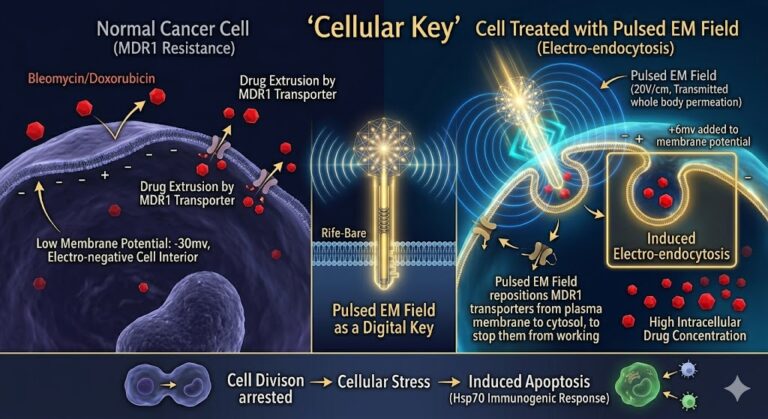
    The loss of electrical potential across a cancer cells plasma membrane is the foundation upon which this proposal is based. The application of an artificially created electrical field of a few tens of millivolts at the plasma membrane of a cancer cell will create an electrochemical imbalance of the cell. An imbalance which this proposal intends to exploit.

    Ions and molecules ( chemotherapy medications) enter cells through a variety of different methods. These methods include ion gating, osmosis, and endocytosis. In a normal cell, these mechanisms are all driven by cellular energetic pathways. Ion Gating and Osmotic methods are capable of only passing small ions through the cell plasma membrane. Endocytosis, can pass large macromolecules such as sugars, and most importantly medications. These three methods of transport can be artificially mediated and elicited by the presence of an external pulsed electrical field. (Teissie and Tsong 1981, Petrov and Mircevova, 1986 , Rosemberg and Korenstein ,1997 ) When so accomplished they are known as Voltage Dependent Ion Gating, Electro Osmosis, and Electro Endocytosis. By inducing these electrically driven methods of transport, pulsed electrical fields are capable of producing disruption of the cancer cells electro chemical balance and function ( Panagopoulos, Karabarbounis and Margaritis, 2002).

    Electro endocytosis is of significant interest to this proposal. Endocytosis is a process whereby the cell plasma membrane invaginates and surrounds a large macro molecule. This piece of plasma membrane then closes off to form a vesicle which transports the molecule within the cell. The reverse process is known as exocytosis, whereby the empty vesicle is transported back to the plasma membrane. The vesicle then opens, and rejoins the plasma membrane. The process of endocytosis must be balanced to some degree with the process of exocytosis. If an extreme excess of endocytosis in relation to exocytosis occurs, a possible compromise of the cells plasma membrane may ensue.

    It is well known that at very high electrical field strengths, a process known as vesicle electroformation occurs. This process can create extremely large or macro size vesicles out of bilayer lipid membranes. A high electrical field strength dependent process is not the mechanism this proposal seeks to utilize.

    Rosemberg and Korenstein ( 1997) have shown that the process of electro endocytosis can occur at very low field strengths. They found it possible to incorporate molecules in the 1-2000 kD range into 85% of the cells used in their test. Other researches have supported this finding. The necessary field strength can be as low as 20 V/cm or a transmembrane potential of 6mv ( Teissie & Tsong, 1981). Electrically polar and nonpolar chemotherapeutic molecules have been utilized with very low electrical field strengths to produce highly significant positive treatment outcomes. Entin, et. al. (2003) , used fields of 40V/cm (12 mv added transmembrane potential ) with Bleomycin, Taxol , and Cisplatin in treatment of mice inoculated with melanoma cells. A low voltage enhancement was also reported by Miyazaki, et. al. (2003). Mice inoculated with Colon cancer cells were given intratumor injections of Bleomycin and exposed to fields of from 50 to 150V/cm . The use of chemotherapeutic medications with electrical fields can result in enhanced cellular sensitivity to the medication. Gray , et. al. (2000) found severe over dosage reactions to Adriamycin (ADM) occurred when ADM was administered to animals kept in a static but very intense electrical field .

    Cisplatin and it’s immediate family of molecules acts directly upon DNA. It has been used successfully in the combined treatment of B-16 melanoma bearing mice with low ( 20-100V/cm) field strength ( Entin et. al., 2003). It seems apparent that not only will the presence of cis-platinum type molecules within a cancer cell be advantageous, but so would a simultaneous stimulation of the activity level of the cells DNA. Cancer cells go through periods of rest and activity and most chemotherapeutic drugs are primarily effective against rapidly dividing cells. Application of chemotherapeutic medications is often timed to a perceived interval of genetic/cellular activity. The usage of low voltage pulsed fields seems to create an artificial “window” of activity. Low voltage pulsed electrical fields act not just upon the ability of a cell to aid molecular & ionic transport, they also act upon the cells DNA. Binderman, et. al.(1985) found that at between 13 to 50 V/cm , cell cultures of skeletal origin would immediately show changes in cyclic AMP levels and enhanced DNA synthesis . Blank and Soo ( 1997 ) reported a frequency dependent effect on Na, K-ATPase enzyme activation in fields of from 3- 3000 Hz. Pulsed EM fields have been linked not just to enzyme reactions but also to increased transcription rates for specific genes. Pulsed EM fields act directly on signal transduction pathways and with electrons in DNA to stimulate biosynthesis ( Goodman and Blank 2002).

    Chemotherapy cellular resistance is the most common cause of treatment failure and has several different etiologies. The most ubiquitous method of resistance to treatment is that of activation and expression of energy dependent transporters that literally remove the medications from the cells ( Gottesman 2002). The medication, due to the action of transporters, is not allowed to accumulate to a toxic level and cannot perform it’s assigned task. Even though small amounts of chemotherapeutic drugs do enter resistant cancer cells, the drugs biochemical action is thwarted. It is thought that the primary action of chemotherapeutic drugs is the initiation of apoptosis. Apoptosis is at least partially mediated by the behavior and chemical signals produced by the mitochondria. The mitochondria of malignant cells are electrochemically different from those of normal cells. This electrochemical difference acts to block mitochondrial response to the medication, and thwarts the apoptotic cascade.

    The plasma membrane potential of mitochondria in cancers cells has been found to be elevated, in one case it was approximately 60 mv higher than that of control epithelial cells ( Modica-Napolitano and Aprille 1987 ). Elevated mitochondrial membrane potential coincides with Cisplatin resistance in some cancer cell lines ( Dorward and Singh 1996). The high transmembrane potentials of mitochondria are created by a relative electropositivity of the outer membrane and a high negativity of the inner membrane ( Johnson , et. al. 1981). Mitochondrial based apoptotic mechanisms require that the plasma membranes of mitochondria depolarize, resulting in diminution of the transmembrane potential ( Mayer and Oberbauer 2003). Due to their elevated electropotential, mitochondria of cancer cells are going to have to undergo a much greater fall in electrical potential than a normal cell to initiate apoptosis. Further, formation of mitochondrial permeability transition pores ( a key factor in the initiation of mitochondrial based apoptosis) is inhibited as pH decreases (Nicolli , et. al. 1994).

    There are other inhibitors of treatment response within cancer cells. The majority of solid tumors show some if not total resistance to chemotherapy. This resistance is mediated by a local stress response to the microenvironment. When solid tumors are subjected to local conditions of hypoxia, acidic pH and low levels of glucose they react by stopping division. When cell division is arrested in this manner, chemotherapeutic medications become ineffective, that is they fail to induce apoptosis. ( Tomida and Tsuruo 1999 ). In summary, cancer cells are at least partially self protected against chemotherapy initiation of apoptosis through their electrochemistry.

    Pulsed Field Correction of Drug Resistance:

    Correction of cellular stress factors, inhibition of intercellular drug transporter mechanisms, excess acid production, and excess mitochondrial membrane potentials, may be possible through the application of external pulsed EM fields.

    Rosemberg and Korenstein ( 1997 ) found that low voltage induced electro endocytosis could be used to incorporate polysaccharides and – galactosides into cells. A confirmation of this effect was presented by Rols, et. al.( 1995) . When stressed by hypoxic conditions, cancer cells produce compounds that create neoangiogenesis. They also produce more hypoxia inducible factor 1 (HIF1) , increase expression of hypoxia regulated genes , and metabolically shift to utilize the oxidizing ability within the fatty acid synthesis pathway ( Hochachka, et. al. 2002 ) . Angiogenic responses to hypoxia can lead to increased tumor growth , increased metastasis and poor treatment outcomes ( Duffy, et. al. 2003). Through the application of pulsed EM fields it may be possible to circumvent these stress responses to hypoxia. Di Carlo, et.al. ( 2000), found that EM field exposures protected chick embryo’s from hypoxic insult. More definitively it was found that EM fields could be used to induce increased heat shock protein 70 (hsp70) levels ( Han,et. al. 1998, Carmody, et. al. 2000 ). Hsp70 plays an important part in the protection of tissues to hypoxia ( Rafiee, et. al. 2003 ). Overproduction of hsp70 has been found to protect cancer cells from apoptosis following irradiation and chemotherapy (Witkin, 2001). This must be judged against the consequences of a hypoxic response. The expression of hsp 70 is key to preventing some of the sequences that lead to hypoxic response. More importantly, hsp70 has been linked to anti cancer immune system responses. Apoptosis can result in an immunogenic or non immunogenic response. The immunogenic response is dependent upon the presence of hsp70. Stressed cancer cells express hsp 70 on their plasma membranes , and can initiate an antitumor response by the immune system ( Feng, et. al. 2003). This response can be significant. Mice were inoculated with Colon 26 cells and then treated with EChT and Bleomycin. An 80 to 100 % response rate occurred. When the same mice were reinoculated with Colon 26 cells, the mice rejected the cells and no tumor growth was noted. Injection of a different cancer produced tumors in these same mice (Miyazaki et. al. 2003 ). It has been found that immunogenic response to necrotic and apoptotic tumor cells can be equivalent (Kotera et. al. 2001)

    To clarify, the presence of pulsed EM fields may inhibit many of the undesirable cellular metabolic responses of cancer cells to hypoxia. These responses include; generation of hsp70, inhibition of expression of HIF1, diminish the production of angiogenic proteins, initiation of an anti cancer immune response, and possibly inhibit the activity of the FAS to reduce cellular growth rates. This proposed outcome from the use of pulsed EM fields to inhibit angiogenesis and tumor growth is supported in the literature. Pulsed EM fields were found to inhibit tumor growth with a reduction in the extent of vascularization and increased areas of tumor necrosis compared to controls ( Williams, et. al. 2001).

    In a cancer cell, Na+ ions accumulate inside the cell and K+ ions accumulate outside the cell. Modification and reversal of the local ionic concentrations and can be created by an external AC field. ( Teissie and Tsong 1981). Further , elevated pHi will increase the delta pH across the plasma membrane. It has been found that as a Multi Drug Resistant (MDR) protein is expressed, the delta psi or plasma membrane potential decreases ( Roepe, et. al. 1993). The presence of a pulsed field will circumvent the fall in plasma membrane potential. The energy within a pulsed EM field is capable of being absorbed by plasma membranes at least partially through the process of electro conformational coupling (Tsong,, et. al.,1989) Once absorbed, this energy may be converted to the chemical bond energy of ATP or to the potential energy of concentration gradients ( Tsong, et. al., 1989, Timashev 1981) . EM pulse responses of cellular membrane systems are frequency dependent. This response has been shown in several membrane enzyme systems ( Markin and Tsong 1991, Luchian, et. al., 2002, Ruiz-Gomez, et.al., 2002, Gluck et.al. 2001). Frequencies can also be utilized to affect cell division and growth. Kirson et al.,2004 ,found that low intensity frequencies in the 100 KHz to 300 KHz produced an inhibitory effect on a variety of human and rodent cell tumor lines. This effect was non thermal, and acted through both arrest of cell division and destruction of cells undergoing division.

    Movement of ions and molecules across the mitochondrial membranes is normally accomplished by a chemiosmotic mechanism that is free electron dependent. It is possible that the presence of a pulsed field could supplement, drive, or supplant this mechanism and affect the electropotential gradient of mitochondria. This may result in a diminution of the outer membranes electropositivity, allowing the Voltage Dependent Anion Channels ( VDAC) to open. As the electropotential of the mitochondrial membranes become depolarized the probability of Mitochondrial Permeability Transition Pore ( MPTP ) formation increases. (Petronilli, et. al., 1994). Formation of MPTP’s is a necessary precursor to the initiation of mitochondrial based apoptotic mechanisms. Similar pulsed fields gradients should act to inhibit the expulsion of drug molecules from the cell. The transporters will have to work against an artificially created concentration gradient that seeks to actively bring ions and molecules into the cell.

    Pulsed EM Field Generation:

    From a practitioners viewpoint any instrument that might generate a pulsed EM field must conform to several criteria. Primarily, the device must be safe for the patient, and application must be consistent from patient to patient. Secondarily the device must be easy for the practitioner to utilize. Presently, there is not such a clinical device approved for use by the US FDA. Countries such as Canada have approved pulsed EM field devices that meet this criteria. Below is a picture of a type of device that will produce the necessary non thermal pulsed EM field. A variant of this instrument is presently approved by Health Canada as a transmitted field TENS device for the control of pain. Effective range is approximately 6 meters, typical treatment distance of the patient from the device is 2 meters.

    300 Watt PEP pulsed field transmitter. 27.125 MHz carrier frequency. Pulse rate capability 225 KHz.

    Transmitted Pulse. 10 KHz pulse rate ( 10,000 pulses per second )

    Summary :

    The application of a transmitted pulsed EM field of low potential makes it possible to modify the electrochemistry and physiology of cancer cells. Cellular membrane systems and cellular mitosis are frequency responsive, and can be influenced by pulsed EM fields of varying frequency sequences and duration. Frequency sequences can be created to selectively encourage different metabolic responses. The presence of the external field will produce a change in transmembrane potentials . This change in potentials will create osmotic, ion gating, and endocytotic effects at the cells plasma membranes. Internal and external actions of the field will result in ion/molecular transport, reversal of cellular stress factors, interfere with angioneogeneis, increase DNA transcription rates, produce an immune response, and cause inhibition of drug resistance mechanisms

    It is the hypothesis of this paper that the totality of these effects will be enhanced transport of chemotherapeutic medications into the cells, retention of the medications to achieve high concentration levels, and increased responsiveness to the utilized medication . As the concentration of the medication increases in conjunction with the pulsed field altered cancer cell metabolism, apoptotic effects should become predominant. Transmitted pulsed EM fields when used in conjunction with chemotherapeutic medications will; decrease the treatment dosage substantially, produce an enhanced response to treatment, and have minimal to no toxic side effects.

    Citations:

    1. Binderman I., Somjen D, Shimshoni Z, Levy J, Fischler H, Korenstein R, Stimulation of Skeletal-Derived Cell Cultures by Different Electric Field Intensities is Cell Specific. Biochem Biophys Acta. 1985 Mar 21;844(3):273-9 PMID: 2982428

    2. Blank M, Soo L , Frequency Dependence of NA,K-ATPase Function in Magnetic Fields. Bioelctrochemistry and Bioenergetics 1997 May;42 (2) 231-234

    3. Brown G. The Energy of Life: The Science of What Makes Our Minds and Bodies

    Work. New York, NY: The Free Press, 1999.

    4. Carmody S, Wu XL, Lin H, Blank M, Skopicku H, Goodman R, Cytoprotection by Electromagnetic Field-Induced hsp70: A Model for Clinical Application, J. Cell Biochem 2000 Sep. 7;70(3):453-9 PMID 10972982

    5. Cone CD. Variation of the transmembrane potential level as a basic mechanism of

    mitosis control. Oncology 1970;24:438-470. PMID: 5495918

    6. Cone CD. The role of surface electrical transmembrane potential in normal and

    malignant mitogenesis. Ann NY Acad Sci 1975;238:420-35.

    7. Cone CD. Transmembrane Potentials and Characteristics of Immune and Tumor

    Cells. Boca Raton, Florida: CRC Press, 1985.

    8. Di Carlo AL, Mullins JM, Litovitz TA, Thresholds for Electromagnetic Field -Induced Hypoxia Protection:Evidence for a Primary Electric Field Effect. Bioelctrochemistry 2000 Sep;52(1):9-16 PMID: 11059571

    9. Dorward AM, Singh G. Energetic Characteristics of Cisplatin Resistant Ovarian Carcinoma Cells. Anticancer Research 1996 Jan-Feb;16(1):443-7 PMID: 8615651

    10. Duffy JP, Eibl G, Reber, HA, Hines OJ, Influence of Hypoxia and Neoangiogenesis on the Growth of Pancreatic Cancer Molecular Cancer 2003, 2:12

    11. Entin I, Plotnikov A, Korenstein R, Keisari Y. Tumor Growth Retardation, Cure, and Induction of Antitumor Immunity in B-16 Melanoma-Bearing Mice by Low Electric Field Enhanced Chemotherapy. Clinical Cancer Research Vol 9,3190-3197 August 2003

    12. Feng H, Zeng Y, Graner MW, Likhavheva A, Katsanis E, Exogenous Stress Proteins Enhance the Immunogenicity of Apoptotic Tumor Cells and Stimulate Antitumor Immunity, Blood 2003 Jan1;101(1):245-52 Epub 2002 Aug 22 PMID: 12393411

    13. Gluck B., Guntzschel V, Berg H., Inhibition of Proliferation of Human Lymphoma Cells U937 by a 50 Hz Electromagnetic Field. Cell Mol. Biol.( Noisy-le grand) 2001;47 Online Pub: OL115-7 PMID: 11936855

    14. Goodman R, Blank M, Insights into Electromagnetic Interaction Mechanisms. J.Cell Physiology 2002 Jul;192(1):16-22 PMID: 12115732

    15. Gottesman MM, Mechanisms of Cancer Drug Resistance, Annu. Rev. Med. 2002;53:615-27 PMID: 11818492

    16. Gray JR, Frith CH, Parker JD In vivo Enhancement of Chemotherapy with Static Electric or Magnetic Fields. Bioelectromagnetics 2000 Dec;21 (8):575-83 PMID: 1102947

    17. Han L, Lin H, Head M, Jin M, Blank M, Goodman R. Application of Magnetic Field-Induced Heat Shock Protein 70 For Presurgical Cytoprotection. Journal of Cell Biochem. 1998

    Dec 15;71(4):557-83 PMID: 982770

    18. Hochachka PW, Rupert JL, Goldenberg L. Gleave M, Kozlowski P, Going Malignant: The Hpoxia-Cancer Connection in the Prostate. Bioessays 2002 Aug;24(8):749-57

    PMID: 12210536

    19. Johnson LV, Walsh ML, Bockus BJ , Chen LB Monitoring of Relative Mitochondrial Membrane Potential in Living Cells by Fluorescence Microscopy. J. Cell Biology 1981 Mar;88(3):526-35 PMID: 6783667

    20. Kirson ED , Gurvich Z, Schneiderman R, Dekel E, Itzhaki A, Wasserman Y,

    Schatzberger R, Palti Y Disruption of Cancer Cell Replication by Alternating Electric Fields

    21. Kotera Y, Shimizu K, Mule JJ, Comparative Analysis of Necrotic and Apoptotic Tumor Cells as a Source of Antigens(s) in Dendritic Cell-Based Immunization. Cancer Res, 2001 Nov 15;61(22):8105-9 PMID: 11719436

    22. Luchian T., Bancia B, Pavel C,Popa G , Biomembrane Excitability Studied Within a Wide-Band Frequency of an Interacting Exogenous Electric Field, Electromagnetic Biology and Medicine 2002 ; 21(3):287-302

    23. Marino AA, Iliev IG, Schwalke MA, Gonzalez E, Marler KC, Flanagan CA, Association Between Cell Membrane Potential and Breast Cancer. Tumour Biol. 1994;15(2):82-9 PMID:8184256

    24. Marino AA, Morris DM, Schwalke MA, Iliev IG, Rogers S Electrical Potential Measurements in Human Breast Cancer and Benign Lesions . Tumor Biology 1994 ; 15(3):147-52 PMID: 8073228

    25. Markin VS, Tsong TY, Frequency and Concentration Windows for the Electric Activation of a Membrane Active Transport System. Biophys. J. 1991 Jun;59(6):1308-16 PMID:1873467

    26. Mayer B, Oberbauer R, Mitochondrial Regulation of Apoptosis News Physiol Sci. 2003 Jun;18: 89-94 PMID: 12750442

    27. Miyazaki S, Gunji Y, Matsubara H. Shimada H, Uesato M, Suzuki T, Kouzu T Ochiai T, Possible Involvement of Antitumor Immunity in the Eradication of Colon 26 Induced by Low-Voltage Electrochemistry with Bleomycin. Surg. Today 2003;33(1):39-44 PMID : 12560905

    28. Modica-Napolitano JA, Aprielle JR, Basis for the Selective Cytotoxicity of Rhodamine 123. Cancer Res. 1987 Aug. 15;47(16):4361-5 PMID 2886218

    29. Panagopoulos DJ, Karabarbounis A, Margaritis LH, Mechanism for Action of Electromagnetic Fields on Cells. Biochem Biophys Res Commun 2002 Oct 18 ; 298(1) 95-102

    30. Petronilli V, Nicolli A, Costantini P, Bernardi P Regulation of the Permeability Transition Pore, a Voltage-Dependent Mitochondrial Channel Inhibited by Cyclosporin A. Biochem Biophysics Acta 1994 Aug 30;1187(2):225-9 PMID: 7521212

    31. Petrov AG, Mircevova L , Is Flexoelectricity the Coupling Factor Between Chemical Energy and Osmotic Work in the Pump? A Model of Pump. Gen Physiol Biophys, 1986 Aug;5(4):391-403 PMID: 2429895

    32. Rafiee P, Pritchard KA Jr, Ogawa H, Eis AL, Komorowski RA, Fitzpatrick CM, Tweddell JS, Litwin SB, Mussatto K. Jaquiss RD, Baker JE. Cellular Redistribution of Inducible Hsp70 Protein in the Human and Rabbit Heart in Response to the Stress of Chronic Hypoxia: Role of Protein Kinases. J Biol Chem. 2003 Oct 31;278(44):43636-44 Epub 2003 Aug 22

    PMID: 12937165

    33. Roepe PD, Wei LY, Cruz J, Carlson D, Lower Electrical Membrane Potential and Altered pHi Homeostasis in Multi-Drug Resistant (MDR) Cells:Further Characterization of a Series of MDR Cell Lines Expressing Different Levels of P-Glygoprotein. Biochemistry 1993 Oct 19;32(41):11042-56 PMID: 8105888

    34. Rols MP, Femenia p, Teissie J. Long-Lived Macropinocytosis Takes Place in Electropermeabilized Mammalian Cells Biochem Biophys Res Commun 1995 Mar 8;208(1):26-35 PMID: 7887937

    35. Rosemberg Y, Korenstein R, Incorporation of Macromolecules into Cells and Vesicles by Low Electric Field: Induction of Endocytotic-Like Processes, Bioelctrochemistry and Bioenergetics May 1997; 42 (2) 275-281

    36. Ruiz-Gomez MJ, de la Pena L, Prieto-Barcia MI,Pastor JM, Gil L, Martinez-Morillo M, Influence of 1 and 25 Hz, 1.5mT Magnetic Fields on Antitumor Drug Potency in a Human Adenocarcinoma Cell Line. Bioelectromagnetics 2002 Dec;23(8):578-85 PMID: 12395412

    37. Seeger PG, Wolz S. Successful Biological Control of Cancer: By Combat

    Against the Causes. Gesamtherstellung: Neuwieder Verlagsgesellschaft mbH,1990.

    38. Teissie J. , Tsong T. Voltage Modulation of Na+/K+ Transport in Human Erythrocytes. Journal of Physiology ( Paris ) , 1981 May;77(9):1043-1053 PMID: 6286955

    39. Timashev SF, Effect of Electrical Fields on the Kinetics of Biological Processes, Biofizika 1981 Jul-Aug;26(4):642-646

    40. Tomida A, Tsuruo T, Drug Resistance Mediated by Cellular Stress Response to the Microenvironment of Solid Tumors. Anticancer Drug Des. 1999 Apr;14(2):169-177

    PMID:10405643

    41. Tsong TY, Liu DS, Chauvin F, Astumian RD, Resonance Electro conformational Coupling: A Proposed Mechanism for Energy and Signal Transductions by Membrane Proteins. Biosci. Rep. 1989 Feb;9(1):13-26 PMID: 2655737

    42. Tsong TY, Liu DS, Chauvin F, Electro Conformational Coupling (ECC): An Electric Field Induced Enzyme Oscillation for Cellular Energy and Signal Transductions. Bioelectrochemistry and Bioenergetics Vol 21 Issue 3, June 1989 319-331

    43. Williams CD, Markov MS, Hardman WE, Cameron IL. Therapeutic Electromagnetic Field Effects on Angiogenesis and Tumor Growth. Anticancer Res. 2001 Nov-Dec;21(6A):3887-91

    PMID: 11911264

    44. Witkin SS, Heat Shock Protein Expression and Immunity: Relevance to Gynecologic Oncology Eur J. Gynaecol. Oncol. 2001;22(4):249-56 PMID 11695802