Tag: Nan-Madol

  • Nan Madol

    The story of Nan Madol is one of both remarkable human history and enduring local myth, with the two inextricably intertwined in the cultural memory of Pohnpei.
    The Myth of Origin: The Twin Sorcerers
    According to Pohnpeian legend, the city’s creation begins not with mortal engineering, but with powerful magic. Two brothers, the sorcerers Olisihpa and Olosohpa, arrived in a large canoe from the mythical Western Katau (or Kanamwayso), seeking a place to build an altar to worship the god of agriculture, Nahnisohn Sahpw.
    After several unsuccessful attempts to build on the main island, they found the perfect location on the coral reef flats off the shore of Temwen Island. HerThe tale of Nan Madol blends extraordinary human accomplishment with enduring island legend, the two inseparable in Pohnpei’s collective memory. Its past is shaped as much by myth as by history, each reinforcing the other. The Myth of Origin: The Twin Sorcerers In Pohnpeian tradition, Nan Madol did not arise through ordinary human effort, but through supernatural power. The story begins with two sorcerer brothers, Olisihpa and Olosohpa, who sailed in a great canoe from the mythical western land of Katau (also known as Kanamwayso). Their goal was to build an altar to honor Nahnisohn Sahpw, the god of agriculture. After failing to construct the altar on the main island, the brothers discovered an ideal site, the legend says, the brothers used their sorcery and the aid of a flying dragon to levitate the massive basalt columns into place. These stones, some weighing up to 50 tons, moved as if by “ghost hands” across the water and air.
    Once the structures were built, Olisihpa died, and Olosohpa became the first ruler of the Saudeleur dynasty, marrying a local woman and establishing a lineage that would rule Pohnpei for centuries.
    The Historical Dynasty: The Saudeleurs
    Archaeological evidence supports the establishment of the Saudeleur dynasty and the subsequent construction of the megalithic city.
    • Early Settlement: Human activity on Pohnpei dates back to the first or second century CE, with early artificial islets appearing around the 8th or 9th century CE.
    • Megalithic Construction: The peak of the monumental building occurred between 1200 and 1600 CE. Nan Madol became the centralized political and ceremonial capital of the island’s 25,000 inhabitants.
    • A City of Power and Control: The city was designed to isolate the ruling elite from the common people. The rulers, initially seen as benevolent, grew increasingly oppressive over time, forcing local chieftains to live in the city where they could be watched and demanding constant tribute of food and supplies from the main island.
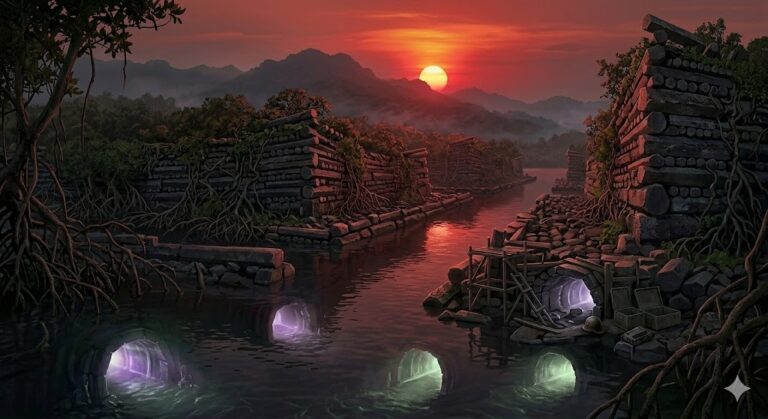
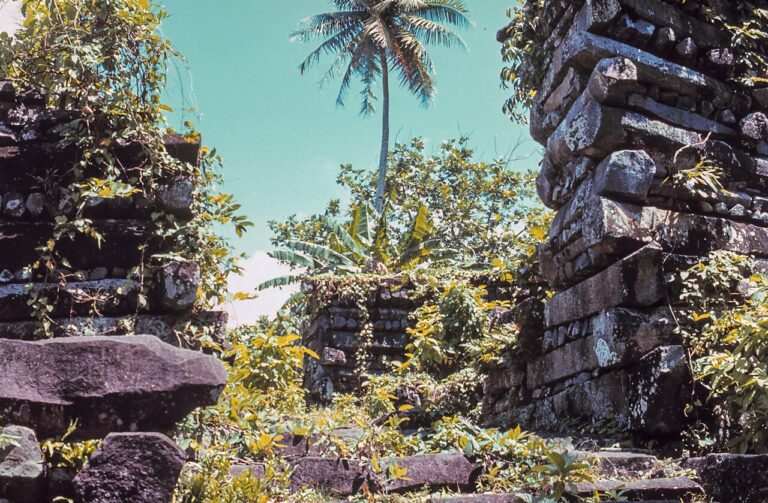
    • A Feat of Engineering: The construction involved quarrying hundreds of thousands of tons of naturally occurring columnar basalt from a volcanic plug miles away on the main island. These “logs” were then transported—likely via bamboo rafts—and meticulously stacked in a log-cabin style without mortar, a monumental feat of logistics and engineering that still baffles modern experts.
    The Fall and the “City of Ghosts”
    The Saudeleur dynasty’s tyrannical rule led to its downfall. A warrior-hero named Isokelekel, often described in oral histories as a demigod or foreign invader from Kosrae, arrived with a war party. Aided by the oppressed Pohnpeian populace, Isokelekel defeated the last Saudeleur ruler, who, in some legends, retreated up a stream and transformed into a fish.
    Isokelekel established a new, more decentralized system of rule, and while he resided briefly in Nan Madol, his successors soon abandoned the logistically challenging city, moving back to their own districts.
    Over time, the grand capital became a silent ruin, reclaimed by mangrove roots and silt. The legends and the sheer mystery of its construction contributed to its nickname, the “City of Ghosts,” a place where ancient spirits and the memory of a lost civilization still linger in the spaces between the colossal stone walls.
    Nan Madol is a site steeped in both enduring mysteries that baffle modern science and rich local legends that offer supernatural explanations for the inexplicable. 
    Key Mysteries
    Construction Methods: The primary mystery is how the Pohnpeians, without the use of pulleys, levers, or metal tools, managed to transport and precisely stack massive basalt columns, some weighing up to 50 tons, to create a city on a remote coral reef.
      • Transportation: The nearest quarry site is miles away, across rugged terrain and open water. A 1995 Discovery Channel documentary attempt to float a one-ton stone by raft failed, deepening the puzzle of how larger stones were moved.
      • Lifting: How the multi-ton stones were hoisted up to build walls as high as 25 feet remains an engineering enigma.
    • Purpose and Abandonment: While historians know it was the ceremonial and political center of the Saudeleur dynasty, questions remain about the exact purpose of every one of the 90+ islets, as some had very specific functions (e.g., food prep, canoe making). The exact reason for its ultimate abandonment around the 18th century is also unclear, with theories ranging from a typhoon to disease or the logistical difficulties of living in a city with no fresh water or internal food source.
    • Submerged Structures: Some researchers have speculated about parts of the city being older, built during a time of lower sea levels, or even the remnants of a sunken continent. However, subsequent underwater archaeological surveys have determined that most submerged “structures” are natural coral formations, not man-made structures. 
    Key Legends
    • The Twin Sorcerers: The most prominent local legend attributes the city’s construction to two brothers, Olisihpa and Olosohpa, powerful sorcerers who arrived by canoe from a mythical land to build an altar for the agriculture god. They used their magic and the help of a flying dragon to levitate the huge stones into place.
    • The City of Ghosts: Many modern Pohnpeians view the ruins with a sense of fear and superstition, referring to Nan Madol as the “City of Ghosts” and believing the site is inhabited by the spirits of dead kings and powerful rulers with supernatural abilities. Disturbing the site is believed to bring a curse or bad luck.
    • The Curse of Governor Berg: This legend tells of a German governor in the early 20th century, Victor Berg, who disregarded a royal ban and opened a sealed tomb on Nan Madol, reportedly finding the skeletal remains of giants. That night, a wild storm arose, and Berg died the next morning, a death locals attributed to a curse from the gods for his disrespect.
    • Giants and Lost Continents: Some fringe theories and popular culture interpretations have connected the massive scale of the architecture to a lost continent like Mu or Lemuria, or even extraterrestrial intervention, though these claims lack scientific evidence.


  • Pohnpei and the Curse of the Pacific


    Pohnpei and the Curse of the Pacific


    by Scott Corrales

    “At his house in R’lyeh, dead Cthulhu lay dreaming…” with this powerful intriguing phrase, H.P. Lovecraft drew thousands of readers into his controversial “Mythos” of the Old Ones, the Elder Gods, and pre-human races which had left their impact on our planet in ages lost beyond the recall of certain fictional magical books, such as the ever-present Necronomicon.

    Debate rages to this very day around the grains of truth that may have fueled the powerhouse of Lovecraft’s fiction, even though the New Englander scoffed at the occult. But the fact of the matter is that certain parts of the world contain hints of strange activity having taken place during times before our historical records.

    Mysterious Polynesia

    Our image of Polynesia has been colored by images of tropical beauty, Paul Gaugin’s escape from the decadent west to pristine Tahiti and its dusky beauties, the island-hopping exploits of the U.S.
    Marines during World War II, and other more or less fixed perceptions.

    In 1984, the late Spanish ufologist and cryptoarchaeologist Andreas Faber Kaiser arranged a visit to the island of Ponapé (or Pohnpei, in local parlance) on a quest to unveil the mystery of Nan-Matol, a city hewn out of raw basalt, with magnificent harbors, streets, and habitation for tens of thousands, spreading out over ninety artificial islets. Natives shun the ruins, which have been reclaimed by the mangrove swamps, believing that the lost city is evil in nature and that those who remain beyond sundown in its interior never emerge alive.

    Archaeologists have ascribed Nan-Madol to Polinesian builders. However, there is no proof that Polynesian builders crafted such an impressive metropolis, or that there should have ever been a population of that size on Pohnpei. Occultists, following the Theosophical hard line, associate the gargantuan ruins with the legendary lost continent of Lemuria.

    Occultists and believers in lost continents have given us a wealth of details about submerged lands such as Lemuria, the primeval continent whose bulk occupied most of the South Pacific. Theosophists, for example, tell us that the Lemurians were one of the “root races” which peopled the world before our own brand of humanity appeared on the scene; controversial authors such as Denis Saurat and Hans Bellamy describe Lemuria as a smoke-enveloped volcanic landscape of raging volcanoes and sulphurous lakes, peopled by giant, troll-like beings with hides rather than skin, and equipped with three eyes. These monsters later “evolved” into our early forebears. Philosophical musings about ur-races abound and are easily dismissible. But what does one make out the evidence that a clearly developed civilization existed in that part of the world long ago?

    Faber Kaiser and his team of Spanish investigators realized that the most basic question regarding Nan Matol was how could anyone move almost half a million blocks of basalt to this location. Their exploration turned up a number of tunnels, walls measuring some four hundred feet in length, canals and tombs. Interviews with local inhabitants revealed the widely held belief that the tunnels, which have never been explored adequately, lead to underwater locations in which fabulous treasures have been concealed. While this can be dismissed as the usual wishful thinking that accompanies every story of a lost city, there is evidence that the Japanese military extracted a considerable amount of platinum during its wartime occupation of Pohnpei.

    Stories of giant human bones are also associated with Nan Matol. An early source The Story of Nan Madol, The Atlantis of the Pacific by Bill S. Ballinger, continues the story of what the Japanese found during their mandate of the Caroline Islands, stating that very ancient bones, much larger than those corresponding to normal human dimensions, had been unearthed in 1928. This detail, suspicious at first, is confirmed by the native belief that the tenants of Nan Matol had been three distinct races of giants: a human-like species, capable of flight, a simian race of giants who could also fly, and lived beneath the sea, and a third strain of “mega giants” who could best be described as worker-drones who labored beneath the sea.

    The giant legend doesn’t stop there, either. As late as 1910, western scholars noted the proliferation throughout Polinesia of the belief in a cannibalistic race of giants called the Kona. “Proof” of their existence can be found in the presence of massive tomb-slabs which have never been investigated.

    Further research uncovered the local legend of Olosipe and Olosaupa, the magical twins responsable for the building of the basalt city. The twins were engineers, builders, and magicians who had mastered the secret of transporting matter through the air (the power which enabled Merlin to build Stonehenge, in the legends of the Arthurian cycle), bringing in very large blocks of basalt from distant lands. Their magnificent, ocean-girt city was linked by tunnels to certain locations in Asia.

    Easter Island

    Easter Island, the enigmatic volcanic island off the coast of South America, has been the focus of many magazine articles and reviews in recent years. Nevertheless, many of these treatments have ignored the clearly paranormal phenomena surrounding this curious piece of real estate in the middle of the South Pacific Ocean.

    Aside from the immutable visage of the Sphinx as it looks over the sandy plains of Gizeh, no other stone effigy (or effigies) can be more memorable that the giant moais of Easter Island, which have been drawn, photographed and cartooned in publications all over the world since the dawn of the century. The long nosed, dark-browed basalt monoliths stare impassively out at the vastness of the Pacific as if awaiting a long-delayed arrival, or longing for a time gone by.

    Easter Island has been provided an abundant quarry for all manner of speculation–an oddly productive scenario for crypto archaeologists and crypto anthropologists as well as the odd UFO expert. Figures of distinction like Thor Heyerdahl brought Easter Island to the forefront of world attention in the wake of his expeditions to the island, but otherwise, Easter Island has remained another mythical destination in the minds of armchair travelers, the place with the ominous stone statues.

    The enigmatic moais made the news in recent months: an exhibit on Easter Island held in Barcelona, Spain during September 1995 coincided with the fiercest storms in the city’s history, leaving one person dead and many more injured in its wake. As the ten foot tall statue was being transported to the museum on a flatbed truck, it toppled to the ground, suffering slight damage. Talk of a curse began making the rounds among the nervous citizenry.

    Is there indeed a strange energy surrounding these monoliths? A power which isn’t evil, but nonetheless far from good? More importantly, is this curse still active?

    The fact remains that Easter Island has claimed the lives of a number of researchers who sought to get to the bottom of its mysteries. In the early 1900’s, Katherine Routledge, one of the first women researchers to visit the island, was afflicted by a strange madness resulting from terrible nightmares; Mac Millan Brown, another investigator, perished in a similar fashion. Max Bunster, a Chilean researcher, was apparently murdered in his own home by an unknown assailant who beat him to death with a small stone moai which formed part of his collection. Unfortunate coincidences, or clues to an awful reality?

    Spirits do roam Easter Island. Another Spanish expedition, led by researcher Antonio Ribera, camped at the feet of the Akivi moai one evening to carry out psychophonies–the recording of spirit voices, a popular channel of investigation among European paranormalists. After the session had concluded, and the researchers had gone to sleep in their slumber bags, the otherwise pleasant Polynesian night turned into something less agreeable.

    The five members of Ribera’s group claimed to hear the padding of bare feet outside their tents, yet there was nothing to be seen when they got up to inspect. Soon, all became aware of a slow, monotonous chanting, emanating from somewhere in the darkness between the Akivi moai and a nearby hilltop. An archaeologist in the group, who had managed to fall asleep in spite of the strange activity around him, suddenly felt the vise-like grip of a hand seizing his shoulder. Terrified, he managed to say: “I’m a friend!” Turning his head slowly, he very nearly fainted when he realized that no mortal hand had latched on to his shoulder. The pressure gradually subsided.