Category: Ways

  • The Old Cherokee Wedding


    The Old Cherokee Wedding


    The Cherokee wedding ceremony is a very beautiful event, whether it is the old fashoned, or ‘ancient’ ceremony or a modern one. The original ceremony differed from clan to clan and community to community, but basically used the same ritual elements.

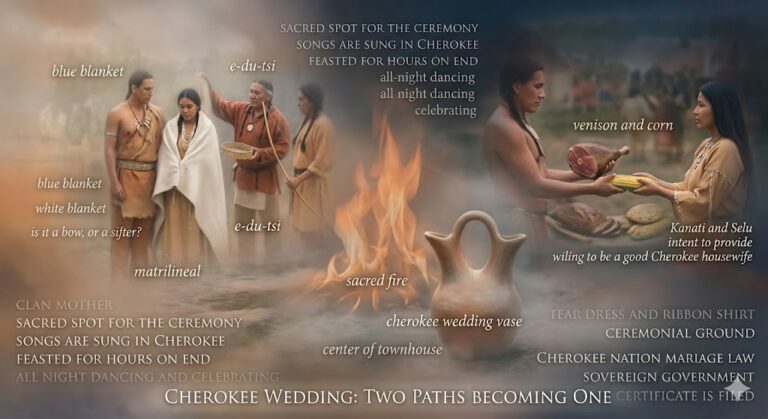
    Because clanship is matrilineal in the Cherokee society, it is forbidden to marry within one’s own clan. Because the woman holds the family clan, she is represented at the ceremony by both her mother (or clan mother) and oldest brother. The brother stands with her as his vow to take the responsibility of teaching the children in spiritual and religious matters, as that is the traditional role of the ‘uncle’ (e-du-tsi). In ancient times, they would meet at the center of the townhouse, and the groom gave the bride a ham of venison while she gave an ear of corn to him, then the wedding party danced and feasted for hours on end. Venison symbolized his intention to keep meat in the household and her corn symbolized her willing to be a good Cherokee housewife. The groom is accompanied by his mother.

    After the sacred spot for the ceremony has been blessed for seven consecituve days, it is time for the ceremony. The bride and groom approach the sacred fire, and are blessed by the priest and/or priestess. All participants of the wedding, including guests are also blessed. Songs are sung in Cherokee, and those conducting the ceremony bless the couple. Both the Bride and Groom are covered in a blue blanket. At the right point of the ceremony, the priest or priestess removes each blue blanket, and covers the couple together with one white blanket, indicating the beginning of their new life together.

    Instead of exchanging rings, in the old times the couple exchanged food. The groom brought ham of venison, or some other meat, to indicate his intention to provide for the household. The bride provided corn, or beanbread to symbolize her willingness to care for and provide nourishment for her household. This is interesting when noting that when a baby is born, the traditional question is, “Is it a bow, or a sifter?” Even at birth, the male is associated with hunting and providing, and the female with nourishing and giving life. The gifts of meat and corn also honor the fact that traditionally, Cherokee men hunted for the household, while women tended the farms. It also reflects the roles of Kanati (first man) and Selu (first woman).

    The couple drank together from a Cherokee Wedding Vase. The vessell held one drink, but had two openings for the couple to drink from at the same time. Following the ceremony, the town, community or clans provided a wedding feast, and the dancing and celebrating often times continued all night.

    Today, some Cherokee traditionalists still observe portions of these wedding rituals. The vows of today’s ceremony reflect the Cherokee culture and belief system, but are in other ways similar to wedding ceremonies of other cultures and denominations. Today’s dress can be in a tear dress and ribbon shirt, a wedding gown, or normal attire worn at a Ceremonial Ground.

    Cherokee Nation has a marriage law, and Cherokee couples are allowed to marry under this law instead of the State marriage laws. This is because Cherokee Nation is a sovereign government. The couple is not required to obtain a license; however, the person(s) conducting the ceremony must be licensed by the Cherokee Nation in order to do so. After the religious leader contacts the Cherokee Nation District Court, the court clerk will prepare a certificate. This paper shows that the couple were indeed married in a ceremony by a religious or spiritual leader licensed to do so. The certificate is returned to the Cherokee Nation District Court after all parties have signed it, and filed in the official records.

    Info provided by the Cherokee Nation Cultural Resource Center. For information regarding culture and language, please contact:


  • Building a Sweat Lodge


    Building a Sweat Lodge


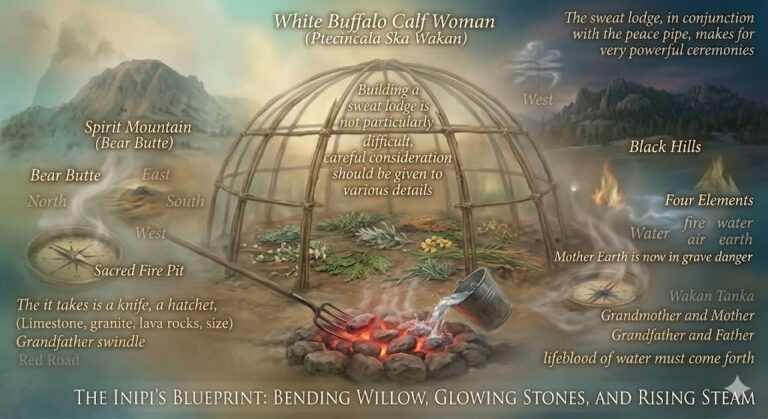
    Building a sweat lodge is not particularly difficult, but careful consideration should be given to various details.

    Choosing a Location and Siting the Lodge

    A quiet and secluded area is the obvious setting for a sweat lodge. Privacy is essential, yet the area must also be accessible. Once you have found the site, you must then choose where you wish to place the lodge itself.

    There is no hard, fast rule that the doorway of a sweat lodge must face a particular location. The lodge doorways at the base of Spirit Mountain in the Black Hills face west. Most Sioux and Ojibwa sweat lodges face east or west, but you must consider the terrain, location, and setting of the entire lodge area when selecting your lodge opening. In the interest of fire safety, you may have to select your fireplace area first. This will determine the direction of the opening for you, since lodges almost always face the fire.

    Fire Safety

    Fire safety is of extreme importance in selecting the lodge site and choosing the location of the fire pit. At times, fire pits may have to be dug deeper then what may seem necessary and their location will have to take advantage of windbreaks or shelter from the wind. Even if it is a calm day, assume that the wind could become a factor. Seldom is a sweat lodge built for only one evenings activity; therefore, always consider that high winds can come up during the time the fire is heating the rocks for a later ceremony and resulting sparks and drier conditions could result in a fire.

    Heating the Rocks

    Early on, assign several participants to gather firewood and rocks. Put one or two persons in charge of preparing the fireplace, building the fire, and heating the rocks. If you start the fire early, the rocks are usually hot by the time the lodge is finished.

    Be sure the fireplace is far enough from the lodge so that the ceremony participants can have some privacy. Many times there will be two successive sweat ceremonies, and people usually wait their turn sitting around the comforting fire. Their conversations could be distracting to the ceremony if the fireplace is too close to the lodge.

    Rocks should be of limestone or granite, without significant cracks. Use rocks a little larger than a softball, or the size of a cantaloupe. Never use sandstone or other porous, water-absorbing-type stones. Wet sandstone can explode when heated in the fireplace. Lava rocks are probably the best rocks to use because they seem to retain their heat and also convey unusual images when they are heated to a red glow and are observed within the dark confines of the lodge.

    Several hatchets, a shovel, and a pitchfork are useful tools for the fire and stone heating.

    Building the Frame

    If everyone pitches in, you can build a sweat lodge in three to four hours. All it takes is a knife, a hatchet, and a ball of string. The frame is usually made of willow, but any sapling will do.

    The average size lodge will comfortably seat eight to twelve people. To estimate the size, first draw a circle two feet in diameter in the center of the lodge site. This will be the rock pit that you will dig later. Sit cross-legged on the ground facing the circle, and leave at least a foot or two between your knees and the center circle’s outer edge. Place a stick with a string tied to it in the center of the circle. Run the string a few inches behind your sitting position. The string serves as a radius for the lodge, and you can then draw the circumference on the ground. A nine foot diameter lodge will seat twelve people com-fortably. A ten foot diameter lodge will seat fifteen to sixteen people. Remember, however, that a large lodge will be difficult to heat unless it is well insulated. With the black tarp found in so many hardware stores and the blankets participants bring, however, a large lodge can be built that will hold the heat.

    Cut twelve saplings with a base approximately the size of a quarter or fifty cent piece. After the saplings have been brought to the lodge area, remove the branches and sharpen the bottoms. If you have selected willow, use the soft branches and leaves for the floor of the lodge. Place the sharpened ends into the ground at an equal distance around the drawn circumference, leaving an opening for the doorway. You may use a heavier pointed stake to make the holes for the saplings, or use a hunting knife if the ground is very hard.

    Be sure the saplings are embedded deep enough into the ground so they hold firm when they are bent and tied together to form the domed frame. The bend of the sapling should allow for a large man to sit comfortably. Don’t build your lodge too tall or it will be difficult to heat. Bind the saplings with string, fishing line or willow bark peeled in long strings.

    To strengthen and reinforce the lodge, tie sapling crossbraces horizontally to the upright saplings. While work is progressing on tying the saplings together, send part of the group to gather grass, sage, cedar, or leaves to place on the floor for people to sit on. If wildflowers are available, a sprinkling within the lodge adds a pleasant aroma. When placing the seating material, leave room for the rocks to be rolled into the lodge, usually a foot wide path from the doorway to the rock pit.

    Covering the Sweat Lodge

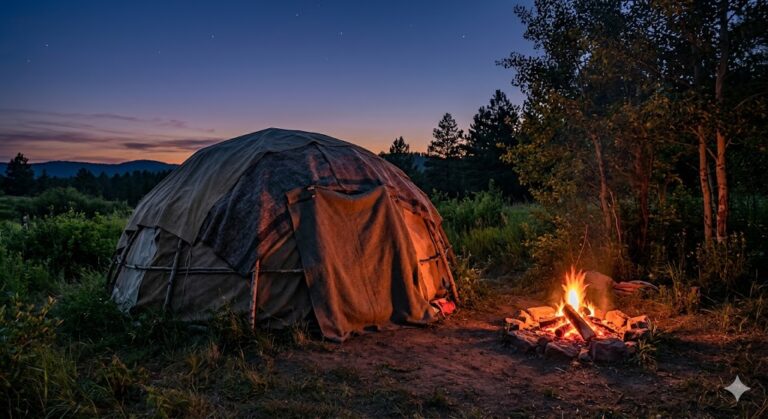
    Tarps are excellent for covering the sweat lodge frame. They are waterproof, and if it rains, participants will find a dry haven inside the lodge. The best method is to cover the frame with a tarp and then cover the tarp with clean blankets. The blankets provide heat and sound insulation and also block out all the light. The more blankets draped over the frame, the better the insulation, and the fewer rocks you will need. If it is colder weather, drafts will not penetrate inward. Use a thick blanket, or several blankets for the doorway. For an adequate supply of blankets, ask each participant to bring one or two. To prevent blankets from sliding off the lodge, use twine or tie the corner of each blanket to the corner of a counter balancing blanket draped on the opposite side of the lodge.

    Transporting the Rocks

    The ceremony can begin when some of the rocks are glowing red. A long handled pitchfork is a convenient tool for adjusting rocks around a fire and transporting them to the lodge.

    You will also want to have several five gallon buckets of water both for the ceremony and for dousing the fire when everyone is ready to leave the area. You will also need a dipper and a two to three gallon pail for splashing water onto the heated rocks.

    Sweat lodges are easily constructed structures made of saplings bent together and tied with twine to form a half sphere. A pit is dug in the center for heated rocks. The structure is covered with a tarp or blankets. In days past, hides of buffalo robes covered the frame. The earthen floor is strewn with sage, flat cedar, flowers, grass or reeds. Participants gather within the darkened interior to endure the steam generated by dippers of water poured over the hot stones. Inipi is the Sioux term for the sweat lodge.

    While the sweat lodge itself is simple to describe, it is impossible to convey the ultimate culmination of spiritual, mystical and psychic expression of the Sweat Lodge Ceremony. You have to experience it to fully understand its fullness and depth.

    The average-sized lodge is approximately eight feet by twelve feet. A group can get together on a remote or semi-remote area and build its own “little church” in a few hours.

    In the past, participants visited the sweat lodge prior to engaging in the Vision Quest, Sun Dance, and Spirit Calling Ceremonies. Traditional Native Americans held these main ceremonies to meet the spiritual needs of the tribe, group or individual. The sweat lodge prepared them for a higher, deeper plane or dimension. Before the Sun Dance, sun dance pledgers cleansed themselves physically and spiritually within the steamy mist of the sweat lodge. Then the Sun Dance chief or assisting holy man would conduct the Inipi in the early morning hours, before or while the sun rested on the horizon. Vision Questers would cleanse and prepare themselves in the sweat lodge before ascending a lonely hilltop or before the long climb to the top of Spirit Mountain (Bear Butte) in the Black Hills.

    Today, however, the cleansing experience is fast becoming a major ceremony for those of all races, creeds, and nationalities who seek natural, nature based, Mother Earth based expression. Even among Native Americans, for whom it was once only a preparation, the sweat lodge experience is becoming a major ceremony, especially among Native Americans living in cities, who have limited access to other tribal ceremonies.

    Once the lodge is covered and the ceremony is under way, the participants find a deep connection back into a past. A tribal closeness to the Natural Way unfolds like a budding blossom. A natural bonding begins within the misty, generative womb of Mother Earth. A bonding to one’s own concept of God, the Creator, and the created Mother, upon which we all thrive daily. The spiritual bond is likened to an attachment to Mother Earth as one sits within her warm womb. It can be a key function in the search for a spiritual link to God’s creation-nature, the environment.

    Eagle Man, an Oglala Sioux, equates the Inipi as the ceremony that “intermingles and conveys the lifeblood of the world.” Water is the lifeblood of this ecosystem of fire, water, air, and earth,-the four elements. Although the Pipe Ceremony precedes a Sweat Lodge Ceremony, the peace pipe is not smoked until after the participants have endured the Sweat Lodge Ceremony. The Pipe Ceremony honors and brings forth universal truth, but first the lifeblood of water must come forth from the participants.

    The four directions are called upon within the lodge. The misty fire heated steam covers you, bringing forth your own mist (sweat). Your universal lifeblood comes forth and intermingles with the misty waters of your brothers and sisters around you. The waters of the world (the bucket of water), which have been brought into the lodge, join and mix with the air of the four directions when the dipper of water is ladled onto the hot stones, making steam. The four winds will carry the life blood out of the lodge to the four quarters of our planet. A part of your lifeblood will seep back into Mother Earth.

    The peace pipe is smoked after the four endurances of the Sweat lodge. The participants are refreshed; their lifeblood is traveling through the ecosystem; and their visible breath, symbolizing truth, will be carried throughout the universe. The sweat lodge, in conjunction with the peace pipe, makes for very powerful ceremonies.

    The Sweat Lodge Ceremony recreates time and space, at least in the Indian sense. Powers wrote in Oglala Religion, “The placing of tobacco representing the four winds, zenith, nadir, and Spotted Eagle in a sacred pipe renders the pipe powerful because it contains the entire universe. When it is lighted, life and breath are invested in the universe; and when it is smoked, the universe passes through one’s own body and is sent back to Wakan Tanka.” The universe stands for truth. It is the Great Spirit’s ultimate creation, and all universal things work synchronistically, harmoniously, in accord with the ultimate truth of the Great Mystery Creator. All traditional Indians are very careful about what they say while holding the pipe. Their visible breath of their words must be truth, otherwise they would be very disrespectful of the universe and the Creators ultimate power, which was passed through the pipe.


  • Inipi Ceremonies


    The Ceremony


    Some Indians prefer only males in Inipi ceremonies; others do not differentiate, or mind the mixed male and female participation within the same lodge. As time moves on, mixed lodges are becoming more prevalent. Many believe there should be no differentiation as we are all creations of the Great Spirit, all equal, all holy, especially in the spiritual sense. What differences there are between man and woman are special, due to the Creator. It is a special relationship, in practical respects, but on a spiritual level there is an equal sameness.

    An Inipi usually starts with the loading and offering of the peace pipe. As in the majority of Sioux ceremonies, the Woman’s role reflects her position of honor. A woman, representative of White Buffalo Calf Maiden, will take tobacco and circle clockwise around the fireplace, trailing some particles of tobacco. She will then leave a trail from the fireplace to the sweat lodge opening. She enters the lodge with her remaining portion of tobacco and circles the stone pit with a light sprinkling. The sweat lodge is now considered open, and the participants may proceed to undress for the lodge.

    Loin cloths, tennis shorts or swimming trunks are preferred for the men, shorts and a halter or tee shirt for the women. Participants may wear, or carry in their pockets, special stones, crystals, or other significant objects. Once the ceremony group has entered and is seated around the stone pit, the ceremony leader enters, sitting slightly to the side of the doorway. If the leader has an assistant or a singer, that person sits on the opposite side of the doorway. A fire tender is stationed outside and may serve as a doorkeeper and water tender as well.

    The lodge leader calls upon the doorkeeper to drop the flap, usually a thick blanket, covering the lodge opening. The lodge becomes black, and at this point the lodge leader asks for a short, contemplative silence.

    After the brief silence the flap is raised, and the leader calls upon the fire tender to bring in the stones. Before a ceremony, a fire tender should be briefed on the safe handling of the stones. A pitchfork is preferred to a shovel for bringing the stones into the lodge as it prevents glowing coals, which create discomforting smoke within the lodge, from being carried along,. A shovel is preferred for fire tending at the fireplace site, especially when the glowing coals have to be kept over the rocks or stones to keep them hot for a second ceremony. In the old days, elk horns or deer horns were used for pitchforks and shovels.

    The lodge leader and his or her assistant usually have a short, stout stick and greet the entering stone. “Hau kola” (Hello, friend), they say to the stone. After four stones have been brought in, the flap is closed.

    The lodge is dark and quiet. The participants see only the glowing red-orange stones within the lodge. Some may see within those stones images that have waited since time immemorial. Energized by Father Sky, energized by the fire, which, in turn was from the trees, and they, in tu rn, gave of themselves, they whose only life energy came from the sun, the sun a part of Father Sky-all creation part of the great Oneness. Long, long ago, these rocks were created by the One, and the images reflected from them were placed purposely by the Creator, specifically for the participants’ perception at this particular moment in time. Purposely, specially, and powerfully! A Sweat Lodge Ceremony thus begins with deep, meaningful, refreshing power.

    Before the first dipper of water is poured on the rocks, the leader should assure all within the lodge that anyone is free to leave at any time. Anyone who becomes frightened or fearful should try to endure or try to summon courage to stay, but at times there are some who cannot endure a Sweat Lodge Ceremony. If this is the case, the participant should simply call out, and the ceremony will be halted temporarily so that person can carefully leave through the doorway.

    The following is the way one Oglala Sioux begins a ceremony while the participants are looking for symbols within the cooling stones.

    First Endurance: Wiyopeyate (West)

    The recognition of the spirit world is symbolic of the First Endurance. For some, it is time to ask the Almighty for a spirit guide.

    In Black Elk’s vision, the First Grandfather was from the west. This Grandfather held a cup of water and said that water was the power to make live.

    In the west, in the black, we believe the spirit beings live. Someday, if we have lived a good life, we too will be among the spirit beings and will be looking down upon this world and our families and friends.

    In this ceremony we are going to ask those above, who are looking down upon this tiny lodge, to hear the prayers that shall come from the lodge.

    Black Elk spoke of the powers of the four directions; we will call upon these powers in our four prayers, our four endurances today.

    At this point, a dipper of water will be poured upon the rocks. Steam will shoot upward. Three more dippers will be poured onto the rocks.

    My friends, we will contemplate and pray to the
    Great Spirit above, Wakan Tanka, thanking the
    All-Providing One for the life-giving rains which this
    water symbolizes. We shall ask that our spiritual
    lives become strong and healthy. Let this ceremony,
    with its lifeblood of water, cleanse our spirit
    and refresh us. We will be mindful that the four
    directions shall enter here tonight, and our lifeblood
    of water that we give up from our bodies
    shall be carried to the four quarters of this planet.
    We therefore shall pray sincerely, because of the
    power of this ceremony. We shall ask the helpers
    of the Great Spirit to enter into our lodge, and to
    give encouragement to the prayers and beseechments
    that we will make here tonight.

    Oh, Wakan Tanka,
    Oh, Great Spirit Above,
    We are gathered here below
    In our pitiful little lodge
    Made upon our Mother, Mother Earth.

    We shall call upon the four powers
    The four quarters
    The four directions
    The four Grandfathers of Black Elks’ vision.

    Father Sky said he would help us;
    Mother Earth said she would help us;
    The Buffalo Calf Woman has instructed us;
    And our relatives shall be looking on while we pray.

    Oh, Wakan Tanka,
    Oh, All-Providing One,
    Oh, Creator of All,
    We shall beseech you
    Through the powers you have created for us.

    Mitakuye oyasin [Literally, for all my relatives]
    Ho. Hetch etu aloh [It is so, indeed]

    At this time, those within the lodge may introduce themselves to the Spirit World, beginning with the person to the left of the lodge leader.

    “Oh, forces that come among us within this womb of our
    Mother, I am Cetan Lutah, and I am most pleased to be here
    tonight. Hetch etu aloh.”

    The introductions help to allow a more personal perspective within this powerful group beseechment. After the introductions, the fire tender or doorkeeper will be called, and the cool air will be allowed to refresh the participants for a few minutes before the second Endurance begins.

    The leader may comment while the flap is held open:

    Appreciate the life giving air.
    We must be aware.
    Someday, each of us will take our last breath.
    This cool air rushing inward
    Reminds us to appreciate
    Our Breath
    Our Life.

    More rocks may be called for, although if an “easy” approach was called for in the first endurance, there is usually enough heat in the stones for the second endurance.

    Second Endurance: Waziya (North)

    The flap is closed and the second endurance begins. The cleansing steam and the recognition of courage symbolizes the second endurance.

    We will now call upon the power
    From the white north
    Let us think about the Great White Giant, Waziya,
    Or Way-ah-zahtah.
    The one who puts our Mother Earth to sleep
    Under the winter’s mantle of snow
    Endurance, strength, cleanliness, honesty.

    A dipper of water is poured upon the rocks. Enough dippers are poured to bring forth the steam throughout the lodge.

    Endurance, cleanliness, strength, purity
    Will keep our lives straight
    Our actions only for a good purpose.
    Our words will be truth.
    Only honesty shall come from our interaction
    With all things.
    I shall give up some of my waters.
    I shall endure this ceremony to send my prayers.

    The drum may be sounded for a time, while the participants endure and contemplate.

    The second Grandfather
    Held an herb of power in his hand.
    The black horse, the horse of the spirit
    Was gaunt and sick.
    The black horse took the herb and
    Became strong and healthy.
    Oh, powers of the universe,
    I will take this herb
    To become strong and healthy to endure.

    At this time, the leader may pass out sage to the participants to hold or chew. The sage represents the healing herb, the fortifying herb, the herb that can help overcome the bad things of the world.

    Since from the north comes the great, white, cleansing wing, the leader can take a wing, or several feathers and fan the air.

    The thunder nation is appearing.
    Behold.
    The white goose nation is appearing.
    Behold.

    Let this cleansing wing
    And the sage you have upon you
    Give strength and courage to endure this ceremony.

    If the heat subsides, more steam may be generated by applying more water.

    The second endurance comes to an end after a period of contemplation. By this time, all the participants should be sweating. The fire tender or doorkeeper is then called upon to lift the flap. As the flap is raised and held open, the leader asks the participants how they are feeling. Most respond enthusiastically at this stage. A dipper of water may be passed to those participants who desire to pour the water over their heads.Minne mitak oyasin (water for all my relatives) may be called out, meaning that the water shall take their water (sweat) into all parts of the earth and to all their relatives.

    Third Endurance: Wiyoheyapa (East)

    Usually more rocks and a new bucket of water are needed before the third endurance. After the new stones have entered, the flap is closed. The recognition of knowledge and praying individually out loud symbolize the third endurance. All within look upon the stones in silence, viewing images upon and within the red glow. After a while, water is poured upon the rocks and the leader begins.

    Red is the color of the east. The third Grandfather,
    the Grandfather of the daybreak star, appeared to
    Black Elk. The daybreak star symbolizes an awakening.
    From awakening can come knowledge and
    wisdom for all races to overcome the ignorance,
    the destructive and wasteful, consuming fears that
    detour our resources. This morning we begin a
    new day. New knowledge came with this day, as evidenced by the red way that is before us here
    . The red peace pipe was presented by our third
    Grandfather. The pipe is spiritual. With spirit and
    knowledge the world can be made well.

    The drum is sounded for a few moments. The leader continues:

    Brothers and Sisters
    Each of you is asked to pray:
    Pray for what you desire in this life,
    Pray for a loved one or a relative,
    Pray for better leadership in this world,
    Better religious leadership,
    Better political leadership,
    Pray for our Mother Earth.
    Any and all of these things you may pray for.
    End your prayer with HETCH ETU
    when you are finished, so that your brother or sister
    next to you may begin his or her prayer. > My sister or brother sitting next to me,
    Please begin your prayer.

    This prayer indicates the beginning of individual prayers.
    The participant sitting to the left of the leader prays first. The rest follow with their prayers in a clockwise or sunwise manner.

    Oh, Great Spirit,
    I thank you for this experience tonight.
    I pray that all ways, all hoops
    Come together in understanding.
    I pray that the world leaderships come together
    To end the needless waste or war spendings.
    I pray that the ways of the Indian people live on.
    I pray that our environment
    Becomes cleaner and less polluted.
    I thank you again, Great Spirit, for this ceremony.
    HETCH ETU ALOH.

    This prayer or similar versions are common in a Sweat Lodge Ceremony.
    After all have prayed, the leader calls for the fire tender or doorkeeper to raise the flap. Mitakuye oyasin is called out as the flap is raised.

    The dipper of water may be passed around again to those who wish the water to be poured over their heads to refresh and cool themselves and to facilitate the mixing of their lifeblood of water with Mother Earth.

    Forth Endurance: Itokaga (South)

    The last endurance centers on healing. “Yupayo!” (Close the door) the fire tender is commanded, and the last endurance prayer may begin.

    The south stands for healing and growth. Black Elk spoke of south, from whence comes the power to grow. The bright red stick with green leaves in Black Elk’s vision was given by the south Grandfather. The stick grew into a great shading tree that stood in the center of the nation’s circle. From knowledge (the east) comes growth (the south), and from growth can come healing.

    Let us think of Mother Earth, her rich bounty will result
    from springtime, the golden corn and the seeds of
    harvest, all grown strong from Mother Earth, the
    spring rains, and the energy of Father Sky. It is time
    to consider healing: healing of ourselves, healing of
    a loved one, healing of adversaries for peace among
    nations, and healing of the harms done Mother Earth.
    There are four concepts of healing, my friends, for
    you to contemplate to the Great Spirit above while
    I sing this song [or play the drum].

    The leader will then pour four dippers of water onto the rocks, and the steam will build. The drum is played and/or a song is sung while the participants contemplate. The leader may call out a short reminder for the benefit of the participants’ contemplation; for example:

    Oh, Great Spirit,
    I pray for myself in order that I may be healed.
    Oh, Great Spirit,
    I pray for my close friend who is sick and needs help.
    Oh, Great Spirit,
    I pray for this world so that all these atomic weapons
    And other bad things that we point at each other
    Will someday soon all be destroyed.
    I pray that all adversaries will communicate
    And all of the mistrust will be healed.
    Oh, Great Spirit,
    I pray for the environment.
    I pray for its cleansing
    And the renewal of our Mother Earth.

    The leader may point out some specific areas and ask for the Great Spirit’s wisdom regarding them.
    When the steam has subsided, the leader will usually offer a summarizing prayer, or one or several of the participants may pray out loud in respect to a particular area of healing. Usually the leader will have briefed certain individuals regarding preparing, to some degree, a prayer regarding healing; or the individuals are free to request time to voice their healing prayer.

    The leader concludes the ritual with a short final prayer – a prayer of thanksgiving for a successful Sweat Lodge Ceremony.

    The light of the Great Spirit surrounds us.
    The love of Wakan Tanka enfolds us.
    The power of the Creator protects us.
    The presence of God watches over us.
    Where ever I am, the Great Spirit is!

    The fire tender or doorkeeper is called and the participants leave the lodge one by one in a clockwise manner, beginning with the first person to the right of the entrance.
    The participants usually change into a dry set of clothes to be comfortable when they gather once again to smoke the peace pipe that was loaded earlier. After the pipe has been smoked, there might be a supper. The hot coals are excellent for metal boiling pots loaded with stews which are cooking while the ceremony is in progress. Coolers of juice, mineral waters, or soda are consumed in quantity by thirsty participants after the ceremony. Garbage bags are brought to take out all that has been brought in. A plate of food is placed at a distance from the lodge as an offering to all the spirits that entered the ceremony.

    The ceremony is very refreshing. Many participants will linger to sit around the fire in peace and serenity, appreciating and remembering their moving spiritual experience.

    Sweat Lodge Checklist

    For Building the Frame

    • Hatchets
    • Hunting knives
    • String, twine or fishing line
    • Tarps
    • Several clean blankets

    For the Fireplace

    • Hatchet
    • Shovel
    • Pitchfork (or deer horns)
    • Matches
    • Limestone or granite rocks (approximately 20 per ceremony, cantaloupe size)
    • Several five gallon water containers

    For Inside the Lodge

    • Two or three gallon pail
    • Dipper
    • Drums, rattles
    • Eagle-bone or wooden whistle
    • Sage

    Personal Items

    • Change of clothing and towel
    • Tobacco bundles
    • Special amulets, stones or crystals, medicine bags
    • Peace Pipe (if you have one)
    • Mineral water, soda, or juice; absolutely no alcohol*
    • Food contribution for supper
    • Cooking and eating utensils
    • Potholders
    • Garbage bags.

    For thousands of years the Native North Americans beseeched and acknowledged in ceremony without any form of drugs or alcohol. Their spiritual path led them to a highly harmonious lifestyle, social and environmentally. They also reaped a high self-esteem and positive self-worth. Respect Indian ceremony and its proven history. For thousands of years Mother Earth was very respected. Respect the deep dignity of these spiritual ways.